




Services on Demand
Journal

Article
 English (pdf)
 Article in xml format
 Article references
 Automatic translation
 Send this article by e-mail
Indicators
Related links
-
 Cited by Google
 -
 Similars in Google
Share

 Permalink
African Human Mobility Review
On-line version ISSN 2410-7972Print version ISSN 2411-6955
AHMR vol.11 n.3 Cape Town Sep./Dec. 2025
https://doi.org/10.14426/ahmr.v11i3.2839
ARTICLES
The Middling Citizenship Trap: Belonging Denied Through Neoliberal Exclusionary Inclusion in South Africa
Yvonne Zama Sibaya
University of KwaZulu-Natal, South Africa. zamasibaya@outlook.com
ABSTRACT
This ethnographic study examines 26 first-generation professional middle-class naturalized South African citizens, using purposive sampling from 2019 to 2022. These citizens experience racial violence and sociocultural exclusion despite legal inclusion. The research investigates "middling citizenship," which has become a liminal space where naturalized professionals navigate between legal legitimacy and cultural foreignization in post-apartheid neoliberal governance. Despite state naturalization granting legal belonging, participants struggle with integration, as racialized boundaries sustain exclusion, while economic capital permits only partial inclusion. The findings show how naturalized citizens use their economic power to resist marginalization. They do this by performing belonging through economic visibility while remaining culturally invisible. The study unmasks the neoliberal paradox of middling citizenship, exposing post-apartheid contradictions. Rainbow Nation rhetoric promises colorblind integration, but in practice, it perpetuates colonial racial hierarchies. The results show that merit-based citizenship creates conditional belonging, privileging economic performance over cultural acceptance. Postcolonial frameworks are needed to acknowledge authentic belonging beyond economic legitimacy in transitional democracies.
Keywords: Middling citizenship, neoliberalism, invisibility, naturalization, middle class, integration
INTRODUCTION
South Africa's strategic quest for "exceptional talent" invites a new cohort of global citizens into a neoliberal paradox of its own making. This pursuit of economic inclusion entrenches their permanent social otherness, systematically undermining the nation-building goals it claims to serve (Klotz, 2024). The recruitment of a highly skilled premium stock of immigrant professionals has become a cornerstone of national policy in aging societies and competitive economies worldwide (Nowicka, 2024: 1758-1759). Joppke (2024) refers to this logic as "neoliberal nationalism," whereby states grant citizenship to "market-ready" professionals who can contribute to the economy. This privilege signifies complete membership and confers a set of rights and responsibilities (Birkvad, 2019: 798; Bertocchi et al., 2025: 45-46). The process reaches its zenith with naturalization, which represents the ultimate state control over access to membership (Badenhoop, 2021: 565). This paradox challenges the very goals these policies intend to achieve, as they undermine the cohesiveness of national identity and community (Winter, 2024). This paper exposes how neoliberal South Africa creates "middling" citizens trapped between economic inclusion and cultural exclusion. It then reveals how merit-based integration perpetuates colonial hierarchies beneath Rainbow Nation rhetoric. Finally, it maps how naturalized professionals creatively navigate this paradox, demanding recognition that economic legitimacy without cultural belonging fundamentally undermines post-apartheid citizenship.
LIMINAL BELONGING: BETWEEN LEGAL RECOGNITION AND CULTURAL OTHERING
Middling migration is not new and can be pegged to transnational migration echoing parallel typologies of global middle-class migrants (Jaskulowski and Pawlak, 2022: 2057), including nouveau bourgeois, elites (Ong, 2022; Mogiani, 2024; Winter, 2024), subaltern othered citizens/subjects (Du Bois and Marable, 2015), and "New Argonauts" (Saxenian, 2006), defined by governmentality and self-formation technologies (Ong, 2022; Laruffa, 2023; Fourie, 2024). I interrogate the (in)visibility of naturalized citizens in South Africa as a typology of a new middle-class citizen identity beyond legal and normative ethnic boundaries, within resurging neoliberal state processes of positive and negative integration (Bloemraad et al., 2023; Abu-Laban, 2024; Joppke, 2024; Winter, 2024).
Ong (2022) theorizes a neoliberal mutation of citizenship whereby states commodify membership through investment visas, such as "entrepreneur, immigrant investor, and start-up visas," rendering citizenship a "fungible" good. Ong argues that this system produces interchangeable "pied-à-terre subjects"; in crisis, citizenship becomes "biological" and "thinned out," reduced to a struggle for the "right to mere survival" (2022: 2-3). This reveals a fundamental shift where market logic undermines liberal democracy, creating a polarizing divide between "elite globalists" and "besieged post-citizens" (2022: 6-7). However, for the naturalized professional in South Africa, the meritocratic bargain is a myth, resulting in a status that is both changeable and unfinished. Middling citizenship in neoliberal South Africa represents a layer of negotiated identities at the margins of society. It connects the range of civic belonging, as well as the neoliberal inclusions and cultural exclusions, experienced by naturalized professionals. This study argues that concepts of civic belonging require equitable middling and civic agency for all people who identify as citizens, regardless of status (Bates, 2024; Winter, 2024). As Favell (2022: 4,11) argues, the "national order of things" and the "liberal nationalist" compromise create a system of "conditional belonging" (De Waal, 2020), whereby even those who are formally included can remain socially and politically distant. This creates a class of "good immigrants" and "permitted outsiders" (Hackl, 2022) who are in a perpetually conditional status.
Middling citizenship is a strategy of "negotiated integration" employed by middle-class, naturalized professionals (Ong, 1999; Beaman, 2017, 2023). This concept captures the liminal posture of South African professionals who, despite racial or xenophobic marginalization (Monson, 2015; Morifi and Mahlatsi, 2021), leverage economic capital and neoliberal self-fashioning to negotiate inclusion. Although South Africa's naturalization strategy portrays professional migrants as stable members of society (Mokofe, 2023; Fourie, 2024), this class-based integration creates socio-economic differentiation at the expense of meaningful social inclusion (Birkvad, 2019; Donnaloja and McAvay, 2022). Despite institutional efforts to distinguish affluent naturalized citizens, they are still subject to processes of "othering" that mark them as outsiders to the national community (Jansen van Rensburg, 2024; Klotz, 2024; Sereke and Drzewiecka, 2024). This reflects broader racialized class inequalities and insufficient postcolonial restitution. Neoliberalism operates as a bridging habitus (Nowicka, 2015, 2024), facilitating economic establishment while rendering naturalized citizens invisible through limited inclusion mechanisms (Levitt and Schiller, 2004). Their "negotiated identities" (Owen et al., 2024) and strategic adaptations (Mokofe, 2023; Netshivhambe, 2025) therefore occur within structural constraints that enable economic mobility while restricting full civic belonging.
Meritocratic belonging and South Africa's neoliberal contradictions
South Africa's nation-building project is taking place in the "confounding socio-political climate of a state that is still in transition" (Owen et al., 2024: 2156). The constitutional commitment to dismantling the divided state has collided with neoliberal governance, which blends a resurgent politics of exclusion (Ndlovu-Gatsheni, 2021) and redefines belonging based on economic performance and cultural otherness. The state's approach to immigration has become a key source of contradiction, torn between a neoliberal logic that values migrants as human capital and a populist impulse that frames them as a threat (Nshimbi, 2022). This fuels a discourse that excludes immigrants from "national time" (Misago and Landau, 2023: 1615), thereby reinforcing the symb olic boundaries of otherness. This domestic reality of "middle-class nation-building" (Winter, 2024) means that inclusion is conditional rather than an inherent right (De Waal, 2020; Ndlovu and Ferim, 2025). I term this the "middling trap," whereby immigrant-origin citizens recruited for economic success find their sense of belonging is constantly under scrutiny (Badenhoop, 2021; Nyamnjoh, 2021).
This reflects a global shift toward "earned citizenship" (Joppke, 2022: 138), a "prize for performance," which is sustained by neoliberal nationalism (Joppke, 2024). Political actors exploit this ideology through a populist repertoire that pits a "virtuous and homogenous people" against "others" (Peker and Winter, 2024: 1700). The result is a form of "social closure" (Winter, 2024: 1645) that establishes durable hierarchies of "categorical inequality" (Bloemraad et al., 2024: 236). For the naturalized professional, this is the core mechanism of the "middling trap": they are recruited for their economic performance, yet their "national capital" is constantly devalued (Winter, 2024: 1645). Karim (2025: 2) shows that naturalization transforms citizenship into a "tiered system" where individuals are continuously evaluated and required to demonstrate their "suitability," in contrast to those who are citizens by birth. Yet, within this trap, new forms of agency emerge. They develop "techniques" to earn respect (Sereke and Drzewiecka, 2024) and build convivial relationships that "challenge the political categorization of African others" (Owen et al., 2024: 2156). Through these daily acts, they challenge the narrow chronotope of nationalism (Misago and Landau, 2023). Their success redefines conditional belonging within the ambiguous counter-movements of the (post)neoliberal order (Laruffa, 2023), rendering them highly visible targets for the very populist discourse they transcend economically (Machinya, 2022). Their achievement necessitates an ongoing display of behavior that is "worthy of imitation" (Nyamnjoh, 2021: 251), but this can never fully resolve their probationary status.
Third-spaces othering and reworlding
Middle-class neoliberals inhabit a hybrid space which, as Bhabha (1994) describes, is a "third space" of conflict, resistance, and compromise. This third space is an area where identity is actively negotiated (Ndlovu-Gatsheni, 2023) by naturalized professionals who interpret cultural meanings in different ways to avoid being dominated. This negotiation occurs within a "postcolonial realism," as framed by Sorensen (2021), confronting the political realities of power. In South Africa, this is evident in the ongoing struggles over language, identity, and belonging (Vandeyar and Catalano, 2020). Third-space liminality traps postcolonial, Third World, middle-class, marginalized cultural identities within (South Africa's) neocolonial power cycles. This reveals how localized cultures differentiate themselves while exercising collective classed agency against rented belonging. Ndlovu-Gatsheni's (2023) reworlding framework positions this resistance as a revolt against Euro-American power structures where systemic disparities perpetuate hierarchical oppression through "insufficient postcolonial restitution" (Nyamnjoh, 2021) and "racialized class inequalities" (Nshimbi, 2022; Misago and Landau, 2023). For middle-class, naturalized citizens, this liminal space generates ambiguous membership and class agency that subvert nationalist exclusion (Owen et al., 2024). This manifests as strategic invisibility through limited inclusion, achieving economic integration through social imperceptibility (De Waal, 2020; Mogiani, 2024; Nowicka, 2024).
Neoliberal paradox, governmentality and the "middling trap"
Applying Foucault's (2008) framework of neoliberal governmentality to South Africa, Fourie (2024) reveals how states produce self-managing "worker-citizens" (Joppke, 2024). The legal legitimacy of these citizens, derived from their economic performance (2024), creates a paradox where inclusion requires perpetual self-reinvention as "entrepreneurs of the self" amid racialized exclusion. This meritocratic "contract" (2024), which demands ethnically anonymous subjects, establishes a middle class that is trapped in "categorical inequalities" (Bloemraad et al., 2024). This fractures the Aristotelian ideal of a stabilizing middle class (Smith, 2012; Turner, 2020; Bates, 2024), essential to South Africa's middle-class nation-building project (Winter, 2024) and collides with systemic "politics of exclusion" (Ndlovu and Ferim, 2025). This traps naturalized professionals in conditional belonging. Post-apartheid, non-racialism, a "colorblind" neoliberalist approach masked the racialized capitalism of the Growth, Employment, and Redistribution (GEAR) macroeconomic strategy, embedding white supremacy in economic structures (Ruiters, 2020; Swilling, 2020). Although neoliberalism promotes borderless markets, it relies on nationalist immigration policies to produce "middling" citizens. For example, policies like GEAR exacerbated precarity by depoliticizing race and attributing failure to the individual (Narsiah, 2002; Ruiters, 2020; Fourie, 2024). This "policy paradox" subverts transformative goals, creating tension between the attraction of skills and nativist discourse (Nshimbi, 2022; Mokofe, 2023). Consequently, the state formally promises inclusion while materially delivering exclusion (Ong, 2022; Laruffa, 2023). Integration thus becomes a "managerial mirage" (Favell, 2022), operationalized through "spatiotemporal exclusion" (Misago and Landau, 2023). Mokofe's (2023) finding of a missing labor market premium is evidence of the "zone of exclusion" (Morifi and Mahlatsi, 2021), where formal citizenship becomes meaningless.
This systemic design is engineered to thwart substantive belonging. Institutional failures make these citizens highly visible to crime yet invisible to justice, while policies create hierarchies that undermine constitutional equality (Netshivhambe, 2025). Thus, the "middling trap" emerges from this neoliberal contradiction: although these citizens are hailed for their economic potential, they become visible targets for the state's own policy failures and are forever suspended in probationary belonging (Badenhoop, 2021; Nyamnjoh, 2021).
Theorizing neoliberal paradox, governmentality, and middle-class identities
Shifting beyond frameworks of transnational elites (Ong, 1999; Beaman, 2023) and cultural rights (Rosaldo, 2008), this study advances middling citizenship as a "negotiated integration" strategy. Here, middle-class, naturalized South African professionals use economic capital to navigate conditional belonging amid sociocultural marginalization. By definition, middling citizenship is a strategy of negotiated integration adopted by middle-class naturalized citizens who, despite being marginalized on sociocultural grounds, use economic capital and neoliberal self-fashioning to navigate a liminal space of conditional belonging. This condition is produced by a specific political context. The state's nation-building project through immigration (Winter, 2024: 1627) aims to create a class-based national identity and is underpinned by "neoliberal nationalism" (Joppke, 2024: 1657). This ideology fuses market logic with national identity, creating a system of categorical inequality (Bloemraad et al., 2024). The state's own racialized categories produce a resilient hierarchy here, resulting in immigrant exclusions from democratic rights (Ndlovu and Ferim, 2025), which provide meritocratic economic advantages while enforcing cultural exclusion. The result is the middling trap, a paradoxical state of unfinished incorporation where economic inclusion is guaranteed, but full civic belonging is withheld. I examine middle-class, naturalized South African citizens who are caught in this "middling trap" between economic inclusion and cultural exclusion to analyze the interaction between class and race in the neoliberal regime, which ultimately results in limited inclusion. These citizens face categorical inequality (Bloemraad et al., 2024) due to the effects of neoliberal governance, resulting in conditional belonging and civic invisibility (De Waal, 2020; Mogiani, 2024; Nowicka, 2024). This empirically supports the idea that middling citizenship is linked to meritocratic economic benefits (Winter, 2024), but these overlook the wider consequences of marginalizing activities (Ruiters, 2020; Swilling, 2020; Fourie, 2022). These issues are exacerbated in the current ambiguous "(post)neoliberal" era (Laruffa, 2023: 586). This trap manifests as civic invisibility and conditional belonging, dynamics that are exacerbated within the current neoliberal climate. Consequently, middling citizenship is not a failure of the system but rather a deliberate design feature, revealing the interaction between class and race within a neoliberal regime that prioritizes market utility over universal inclusion.
METHODOLOGY
This ethnographic study employed a critical citizenship framework to investigate "middling citizenship," which is defined as the liminal space between legal inclusion and sociocultural exclusion, among 26 highly skilled naturalized immigrants in neoliberal South Africa. Drawing on the work of Winter (2024), Ndlovu-Gatsheni (2023), and Harvey (2005), this approach facilitates investigation into the dual nature of citizenship as both inclusive and exclusive. The study examines how middling citizenship functions as a neoliberal governance mechanism producing conditional belonging and how individuals resist or adapt to these constraints through self-governance and identity work.
Prior to fieldwork, I conducted the research in strict accordance with formal approval granted by the Humanities and Social Sciences Research Ethics Committee (protocol number HSSREC/00001208/2020). A central and reflexive component was the negotiation of my own positionality. As a South African-born native citizen, I was engaged in a dynamic process where I could be, and was perceived to be, both an insider and an outsider. This liminal status mirrored the "middling" subjectivities under investigation. My proximity to and distance from the participants' experiences required continuous critical reflection to guide my interactions and methodological decisions, ensuring sensitivity to participant well-being. Following xenophobic surges, naturalization was negotiated privately, with professionals reluctant to reveal their status. Recruitment involved multiple phases: initial connections were made through professional networks using snowball sampling via intermediaries, and then referrals were contacted via digital channels for consent. During the 2020 COVID-19 restriction lifting, I spent over three months recruiting by visiting racially specific residential and business establishments owned by ethnic minority communities, targeting naturalized individuals of Southeast European, Palestinian, African, Chinese, and South-Asian descent. The 26 participants, who ranged in age from 25 to 70, were a purposive sample of dual citizens from African, Asian, European, and Middle Eastern countries. Two of the participants were born in South Africa to naturalized parents. The sample size was determined by theoretical saturation; however, the final group was predominantly male (19 out of 26) and middle-aged (average age 50), reflecting gendered migration patterns.
To safeguard autonomy and welfare, informed consent was obtained through a two-step process: initial verbal consent was followed by formal, recorded consent at each interview. Stringent protocols ensured confidentiality and anonymity through the use of pseudonyms, secure data storage, and the right to withdraw. Between 2020 and 2021, semi-structured interviews lasting 50-60 minutes were conducted using digital platforms (Pink et al., 2015; Góralska, 2020), with some requiring multiple meetings. The focus of the study on the post-naturalization phase is a constraint that potentially impacts generalizability; richer data would have been provided by a longitudinal design. This is especially pertinent when considering the multifarious and gendered experiences of middling citizenship, which necessitate further exploration.
FINDINGS
The Bourdieusian habitus of professionals performing middling belonging
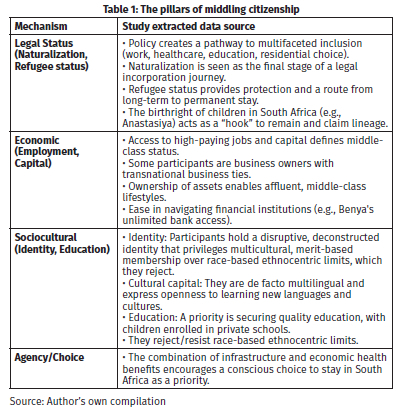
Naturalized middle-class citizens with diverse networks live in private, gated neighborhoods and have access to postgraduate or private education. This demonstrates the relationship between identity, economic capital, and cultural integration (see Table 1). Their Bourdieuan middle-class disposition (Nowicka, 2024) enables them to be visible within their class while also ensuring the exclusive protection of an invisible presence, ultimately facilitating their integration into a neutral cultural segment. Conversely, some South African communities that oppose full multiculturalism revitalize ethnic customs in restored postcolonial identities (Nyamnjoh, 2021; Klotz, 2024; Gordon, 2025). From this perspective, naturalized citizens appear culturally distinct and threatening to modernity, where race lacks economic significance (Machinya, 2022; Mokofe, 2023). Nevertheless, South Africa's immigration policies legitimize intercultural mobility and family reunification, establishing permanent homes that promote domestic and international mobility (Badenhoop, 2021).
Bloemraad and Sheares (2018: 825) argue that democratic nationality becomes irrelevant due to exclusion based on class, gender, or ethno-racial inequalities, and demonstrate in their synthesis that citizenship is actively claimed by both citizens and non-citizens through cultural, flexible, everyday, performative, and semi-citizenship (see Table 2). Since the migration boom of the 1970s, all participants and their South Africa-born children have lived in the country as students, employees, and entrepreneurs (Manby, 2021; Klotz, 2024). Their origins vary: some are descended from apartheid-era migrants; some were born in South Africa; and some, like Thalia, arrived with families seeking economic opportunity, only to stay after civil war necessitated refugee status. Most transitioned from residency with employment to formal naturalization.
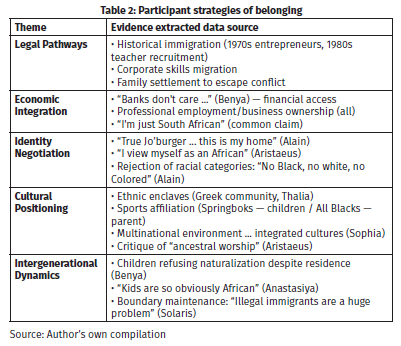
Ghanaian-born Charles moved to South Africa in the peak apartheid townships to teach. When apartheid inequalities began to crumble in the early 1990s, Solaris, Aristaeus, and Alain assumed business leadership positions and pushed for the inclusion of Black professional employment and advancement. While some younger generations are still enrolled in school, others started entering the professional public/private marketplace in the early 2000s as working professionals after completing their tertiary education. Belonging is asserted through an Arendtian "right to rights" (Joppke, 2024) by these naturalized citizens, with state protection and access being claimed while their foreign heritage is sustained or eroded (children's invisibility tactic to preserve South Africanness instigated by parents). Despite experiencing exclusion, they remain strategically engaged in integration structures to secure their economic future. "I would say it has been excellent overall as a naturalized South African" (Charles) and that of their children, "it only seems sensible that we stay and work together ... because the kids are so obviously South African" (Anastasiya). These perspectives illustrate the primary incentives of naturalizing strategies based on long-term residence, prosperity, family preservation, and birthright as an unrestricted identity/home resistance (Ndlovu-Gatsheni, 2023).
Economic legibility
When I used a bank to purchase my first home, I didn't even have an ID [passport holder]. Banks don't care, as long as you have the necessary paperwork and can demonstrate that you are earning. On other opportunities, all that matters is whether you have the necessary funds (Benya).
Naturalized citizens retain dual citizenship, revealing the global connections between local communities and nation-states (Deckard and Heslin, 2016: 1145; Favell, 2022). However, despite affluence, the hierarchical structure of citizenship creates categorical inequalities and selective political inclusion for citizens of immigrant origin (Hackl, 2022; Bloemraad et al., 2024). South Africa's pluralistic character and open-door policies foster a multicultural society that attracts global talent (Nyamnjoh, 2021; Nshimbi, 2022; Nowicka, 2024). Benya exemplifies this trajectory, having left her homeland for education and professional advancement (Ong, 1996: 754; Bloemraad and Ueda, 2006: 2). Here, middling citizenship is manifested through her visible financial status, which paradoxically enables economic permanence (Nowicka, 2015), while cultural prejudice prevents her from engaging fully in civic life (Joppke, 2024).
Everyday invisibility
The racialization of cultural difference operates as a core mechanism of neoliberal nationalism (Joppke, 2024), marking racialized minorities as inherently different from the national community regardless of economic standing. This logic sustains the fragile belonging of middling citizens, legitimizing their conditional inclusion (De Waal, 2020; Badenhoop, 2021; Winter, 2024). Consequently, their cultural visibility becomes a persistent site of prejudice, decoupled from economic capital, thereby trapping them in civic peril (Ong, 2022; Abu-Laban, 2024). Alain laments:
Feeling excluded usually happens plenty of times when I'm surrounded by diverse ethnicities. Relationships are viewed from a cultural perspective; therefore, there are many small things that they say that contribute to this feeling.
While migration literature provides incentives based on poor states as reasons to migrate, this study discovered the histories of highly qualified individuals who had a better likelihood of success when transferring from rich markets to become economic actors (Badenhoop, 2021; Nowicka, 2024). Aristaeus navigates local and geographical biases in South Africa, contrasting this with non-racialized Kenya, where he believes racial differences are less consequential:
Within the South African context, I view myself as an African who is inside Africa, not as a Kenyan, and I do struggle with the distinction of race because I was brought up in a very privileged way where race was never an issue.
This illustrates dual citizens' expectations of inclusion because they originate from non-racialized states, and it highlights contrasts between pluralist inclusive states without racial segregation and those that discriminate based on ethnicity and origin (Ndlovu and Ferim, 2025).
Joppke (2024: 6) observes a paradox in the liberal state: neoliberalism, while theoretically hostile to nationalism, fosters a fluid boundary where immigration policy directly shapes citizenship. In this framework, conduct rules equalize natives and foreign-origin citizens, transforming territorial admission into membership. Consequently, naturalized citizens under corporate globalization are valued exclusively for their economic contribution and capacity for self-sufficiency (Foucault, 2008; Ong, 2022):
I work for a multinational where we do not adhere to any local preferential treatment because we work out in parts of Africa, Central Europe, and South America. We just don't believe in associating people within groups: no Black, no white, no Colored. There are just people who work with qualifications, which is how I'd like to see my world (Alain).
Joppke, Ong, and Favell assert that neoliberal nationalist immigration policy prioritizes land access over a predetermined political identity, centering the "worker citizen" to create a non-ethnic community that includes immigrants while excluding non-contributors. Problematically, this system is vulnerable to populist co-option, which strategically "marries neoliberalism and ethnic nationalism" (Machinya, 2022; Misago and Landau, 2023; Klotz, 2024; Peker and Winter, 2024: 1700).
Aristaeus showcases South Africans' distinct cultural and religious traditions as in flux and how they are merged with global influence:
South Africans still, surprisingly, despite the level of education and exposure, still believe a lot in ancestral worship. In South Africa, it's easy to find a "sangoma" who goes to church; that doesn't happen in Kenya; the two never meet [yet]. In South Africa, you often have guys going home, and they slaughter a goat. They have a slice of the skin of the goat tied around the wrist. They believe in traditional rituals, which, for a lot of Kenyans, disappeared a long time ago when the missionaries came; they convinced us quite thoroughly you are a Christian, and you are Christian.
Aristaeus linked middle-class ideals of cosmopolitan lifestyles and the cultural shift of ukupucuka, ukuthuthuka, or ukuhlanzeka, which in South Africa refers to middle-class affluence or upward mobility in which someone is elevated from a position of overcoming poverty and hardship to one of a refined status shaped by social and economic capital in society (Sigenu, 2022).
Previous theories of nationhood emphasized ethnic and racial distinctiveness (Levitt and Schiller, 2004). In contrast, Joppke (2022: 13) argues that neoliberal nationalism promotes a new homogeneity by replacing ethnic boundaries with a "community of value," accelerating assimilation into a merit-based identity for those who can contribute. Despite this shift, cultural symbols persistently shape hegemonic social spaces. This tension echoes Johannesburg's apartheid history, where ethnic identification functioned as a shallow metaphor for roots within rigid racial geographies, obscuring the city's complex topography (Klotz, 2024). Alain explained:
Going home, as people would say, they are, no matter where they are in South Africa, people have family in other places and engage in different activities at various moments. I don't have that; I'm someone from Johannesburg, you know. I always joke and say I'm a true Jo'burger, a native Johannesburgian; since I don't have to travel elsewhere, this place is my home.
Alain's perspective contrasts with those of native South Africans, whose identity is rooted in ethnic heritage, place, and tradition. They cultivate cultural capital through ancestral rituals like emakhaya visits, sustaining an authentic sense of belonging (Plaatjie, 2020; Moyo and Laine, 2021). The perception of urban foreigners as placeless is structurally produced, not a natural fact. State-generated categorical inequalities (Bloemraad et al., 2024) reinforce this by marking naturalized citizens as perpetually "other" (Sereke and Drzewiecka, 2024). This bias stems from a colonial epistemology that demands singular, fixed identities for legitimate belonging (Mamdani, 1996; Ndlovu-Gatsheni, 2018). A reworlding lens (Ndlovu-Gatsheni, 2023) reveals this as a form of epistemic injustice, invalidating the flexible, transnational identities that are characteristic of Global Southern experience.
Soft power and symbolic inclusion
This study reveals how naturalization empowers dual citizens' self-identification as competitive global agents, transcending ethnic and statist limitations through civic integration (Ong, 1999, 2006; Aptekar, 2016; Joppke, 2024):
I feel South African; I don't really have a specific Chinese identity. I am South African; that is where I am from. Why should there be another level? Ja (Alexander).
This paper examines the transactional nature of family in immigration law for highly skilled workers, analyzing the "economization of everything" as a core neoliberal practice (Fourcade, 2016 in Joppke, 2024: 9). South Africa's soft power (Nye, 2021: 6), manifested through constitutional values, multicultural settlement, and open immigration policies has cultivated its reputation as a land of milk and honey. For naturalized dual citizens, this translates into a sense of global citizenship that transcends ethnic and national constraints. Immigration policies privilege affluent, skilled groups, as South Africa's "race for talent" shows (Shachar, 2006). This neoliberal nationalism puts "market-ready" immigrants first (Joppke, 2024; Winter, 2024), creating a hierarchy where they become good immigrants (Hackl, 2022) and are granted conditional inclusion. This fosters a cosmopolitan "bridging habitus" (Nowicka, 2015) and global citizen identity (Nye, 2021), but it also reveals a fundamental tension in their belonging, as it clashes with the persistent national order of things (Favell, 2022).
The experiential trajectories of citizenship are where integration and belonging are most closely related, and it is in these encounters that people achieve a sense of completeness and a profound sense of identity and belonging (Bloemraad, 2013; Beaman, 2023; Winter, 2023, 2024; Joppke, 2024).
We were never included in anything, so we had to create our own sort of community within other Greeks that had immigrated as well ... a family of people that were not blood (Thalia).
This study's participants, living with families who emigrated with them or were born post-migration, demonstrate complex belonging patterns. Intermarriage and multiethnic children reflect performed South African colorblindness, while workplace relationships with multiethnic counterparts appear uncomplicated, even though viewed as unconventional by Indigenous South Africans. Professionals like Alain, Solaris, and Aristaeus leverage perceived credibility and work ethic as merits of inclusion. Entrepreneurs Elista and her husband mediate cross-cultural workplace disputes effectively, while Thalia's affectionate public friendship with her non-white patrons disrupts expected racial boundaries (Nowicka, 2020). Through a postcolonial realist lens (Sorensen, 2021; Nshimbi, 2022), these practices reveal middling citizenship not as liberatory hybridity but as a precarious condition shaped by persistent coloniality within neoliberalism, where Joppke's (2024: 9) emphasis on economic self-reliance frames eligibility through spousal income and employment.
DISCUSSION
The paradox of neoliberal multiculturalism
Visibility and invisibility are forms of social agency (Brighenti, 2010). Mogiani (2024: 191, 196) frames migrant struggles for recognition on a spectrum from visible "acts of citizenship" to the "imperceptible politics" of evading formal rights, arguing their "complex and ever-changing interplay ... blurs the boundaries" between these political forms (2024: 190, 196). This theoretical framework examines the tactical negotiations of naturalized citizens within the scope of this study. Their experience is defined by a collision between the unwanted visibility of economic success, which incites xenophobic tension, and the imperceptible politics they employ through strategic integration (Mokofe, 2023; Mogiani, 2024: 186, 191; Owen et al., 2024). I assert that this dynamic exposes a significant social divide in South Africa, where legal citizenship is undermined by a lack of substantive social integration.
This study's findings show a shift from multicultural models of inclusion (Bloemraad et al., 2023) to neoliberal nationalism (Joppke, 2024), where even celebrated elite professionals remain "market-ready" actors in a transactional citizenship, rather than citizens embraced based on shared humanity. This creates the central neoliberal paradox of securing economic legitimacy while maintaining a conditional sense of civic belonging. The state values the productive migrant-worker relationship, creating "bio-legitimacy" (Deckard and Heslin, 2016), but stops short of granting full rights, resulting in a status that is fragile and uncertain (Ong, 2022; Joppke, 2024). Consequently, the persistence of ethnic identity should not be misread as successful multiculturalism (De Waal, 2020). Instead, it functions as a strategic adaptation to a hegemonic culture that offers only provisional acceptance, thereby reinforcing the categorical inequalities (Bloemraad et al., 2024) of the national modus (Favell, 2022). Ultimately, middle-class success does not resolve this standing but reframes it, leaving naturalized professionals as "post-citizens" (Ong, 2022) who are formally included yet fundamentally estranged in their own home. Participants like Sophia and Alain reveal that their "success" is a precarious performance within a system that grants economic legitimacy while withholding unconditional civic belonging.
In a private-sector workplace, Sophia emphasizes that cross-cultural collaboration builds employability, credibility, and transactional capital within a neoliberal framework. This aligns with the argument of Bloemraad et al. (2023: 10-11) for multicultural strategies that value bicultural or multicultural lives through state affirmation and cultural exemptions. In such an environment, where naturalized citizens integrate into diverse middle-class communities, the reciprocity required in global cities is fostered. However, this occurs within a system of neoliberal citizenship (Goodman, 2023; Joppke, 2024) that prioritizes merit-based identity and labor functions. Sophia's call for accommodating pluralistic cultural manifestations is vital. But its success depends on Bloemraad et al.'s (2023) optimal conditions for intergroup contact. These are equal status, cooperation, common goals, and institutional support. These conditions are often structurally absent in neoliberal contexts. My analysis suggests that the optimal conditions of Bloemraad et al. remain structurally absent for South Africa's middling citizens. Their equal status is dependent on economic performance, while the requisite "institutionally supportive context" is undermined by systematic exclusion (Ruiters, 2020; Ndlovu and Ferim, 2025: 403). This creates a system of categorical inequality that fundamentally limits any prospect of genuine integration (Bloemraad et al., 2024; Fourie, 2024).
Toward a postcolonial citizenship framework: Decolonizing middling citizenship
This analysis shows that middling citizenship is a particular kind of negotiated integration. Here, economic capital creates provisional visibility within a system designed to maintain otherness. Unlike the transnational mobility of "flexible citizenship" (Ong, 1999), these professionals are rooted in South Africa and are trapped within its shifting neoliberal middle-class policies (Winter, 2024: 1627). The fundamental issue with immigration is its failure to decolonize structures of belonging. Their successful adoption of a bridging habitus (Nowicka, 2015) secures economic inclusion and builds the economy, but neoliberal nationalist logic (Olofinbiyi, 2022; Joppke, 2024; Ndlovu and Ferim, 2025) systematically questions their cultural belonging. This politics of exclusion amid economic incorporation (Ndlovu and Ferim, 2025) indicates the state's "insufficient postcolonial restitution" (Nyamnjoh, 2021). Consequently, a fundamental reworlding of citizenship is required to transcend the coloniality of market-based inclusion, which undermines true multiculturalism while maintaining racial hierarchies (Brown, 2019; Ndlovu-Gatsheni, 2023; Fourie, 2024; Peker and Winter, 2024).
South Africa's strategy for naturalization promotes the integration of working foreigners into the social fabric, yet class functions as a conduit (Narsiah, 2002) that establishes socio-economic disparities rather than fostering comprehensive integration. Thus, middling citizenship is a negotiated integration strategy for professionals who, despite being marginalized on sociocultural grounds (Adedeji et al., 2023; Owen et al., 2024), use their economic capital to gain inclusion. This fundamentally disrupts the Aristotelian ideal (Turner, 2020) of a stabilizing middle class to work even harder from instability. Rather than being fully integrated, the South African middling class is characterized by conditional belonging (De Waal, 2020) and its status as a consistently othered group (Sereke and Drzewiecka, 2024). Their position is not one of stable mediation but of fragile uncertainty (Ong, 2022) within a neoliberal nationalist order (Joppke, 2024). Consequently, they cannot serve as the state's bulwark; rather, their existence highlights the state's failure to achieve an integrated polity. They embody the profound instability of the neoliberal moment (Laruffa, 2023; Misago and Landau, 2023).
Ndlovu-Gatsheni's (2023) call for epistemic transformation highlights the key tension that, while identity transcends borders, naturalized citizens are caught up in a web of unequal belonging. Participants such as Aristaeus and Sophia navigate this through imperceptible politics (Mogiani, 2024), leveraging their economic status as worker-citizens (Joppke, 2024) to establish a presence in the nation (Winter, 2024). However, this performance of "invisibility" (Nowicka, 2015) is fragile, and their membership is framed by the state as a matter of choice, responsibility, and performance (Aptekar, 2016; Fourie, 2024; Joppke, 2024). This creates an assertive habitus of simultaneous subjugation and self-assertion. However, this does not guarantee protection. As Hannah Arendt foresaw, they risk forfeiting fundamental rights, not due to a lack of legal status, but because the law itself fails to fully constitute them as rights-bearing subjects through state-generated categorical inequalities (Bloemraad et al., 2024). This void is emblematic of the (post)neoliberal moment (Laruffa, 2023). Therefore, although interventions such as intergroup contact (Bloemraad et al., 2023) aim to build trust, they cannot resolve the structural issue of belonging being rented rather than owned.
The central contribution of this study is its theorization of middling citizenship as a hybrid category that fundamentally challenges the prevailing frameworks of citizenship. It occupies a liminal space between the transnationalism of flexible citizenship, favored by the elite (Ong, 1999), and the subaltern position of cultural citizenship, which is negotiated entirely within a neoliberal governance framework (Fourie, 2024; Joppke, 2024). This position highlights the ongoing challenges of the "national order of things" (Favell, 2022), where economic power enables only limited inclusion while colonial and racial ideas continue to play a role, resulting in a system of "conditional belonging" (De Waal, 2020; Badenhoop, 2021) and "categorical inequality" (Bloemraad et al., 2024). The tension is embodied by the participants: Alexander's assertion of being "simply South African" is met with ongoing othering (Sereke and Drzewiecka, 2024), while Aristaeus's broader African identity is narrowed down to his Kenyan identity. Middling citizenship is defined as a fragile condition in neoliberal South Africa (Ong, 2022), fundamentally a status both granted and challenged continuously.
South Africa has created the perfect paradox: it is the neoliberal middle-class trap. The middling citizen is prized for their economic utility yet rejected for their cultural identity. Their sense of belonging is transactional and fragile, perpetually shattered by xenoracism (De Waal, 2020; Ong, 2022), and their skills are commodified (Joppke, 2024). The critical question is no longer about managing multiculturalism through intergroup contact (Bloemraad et al., 2023), but whether a reimagining of the world from the Global South could dismantle this trap entirely (Ndlovu-Gatsheni, 2023). However, if market value continues to take precedence over belonging and human dignity, the concept of unified South African citizenship is destined to fail.
CONCLUSION
The visibility and invisibility of the experiences and immigrant identification of middle-class naturalized citizens reveal a multidimensional identity. The study emphasizes their diverse experiences of inclusion and exclusion, implying that national identification does not guarantee full integration, despite being desired. Although citizenship status conveys legal membership, the concept of "middling citizenship" advocates for more inclusive forms of incorporation. These include neoliberal procedures that promote a middle-class society in which members strive to create an economic nation for the benefit of the country. Focusing on South African voices, it engages with global debates through the experiences of naturalized citizens, emphasizing their connections to interlocal integration, ethnic heritage, and historical differences. Furthermore, it asks whether corporate diversity initiatives effectively encourage genuine inclusion and fair opportunity for naturalized citizens. The aim is to develop a more nuanced understanding of the challenges and opportunities faced by naturalized citizens and to inform the creation of integrative policies that promote genuine and equitable inclusion. This would ensure that all members of society are valued and empowered, rather than being assessed superficially in terms of their integration. Unfortunately, neoliberalism is a double-edged sword, enabling middle-class professionals to escape structural and social marginalization and gain a sense of middle-class belonging that allows them to participate in the broader economic and global community. Beyond the goal of naturalization, "middling citizenship" reveals how neoliberal language actively undermines integration. This framework promotes illiberal processes and illegal labor practices while obscuring the state's historical responsibility to provide redress. By prioritizing capitalist obligations over societal repair, the system sustains the irregularities it is supposed to combat.
DISCLOSURE STATEMENT
No potential conflict of interest was reported by the author.
DECLARATION OF INTEREST
The author reports that there are no competing interests to declare.
REFERENCES
Abu-Laban, Y. 2024. Middle-class nation building through a tenacious discourse on skills: Immigration and Canada. Journal of Ethnic and Migration Studies, 50(7): 1803-1821. [ Links ]
Adedeji, A., Olonisakin, T.T., Metzner, F., Buchcik, J., Tsabedze, W., Boehnke, K. and Idemudia, E.S. 2023. Interpreting microaggression as a determinant of wellbeing. Journal of Racial and Ethnic Health Disparities, 10(5): 2470-2481. [ Links ]
Aptekar, S. 2016. Making sense of naturalization: What citizenship means to naturalising immigrants in Canada and the USA. Journal of International Migration and Integration, 17: 1143-1161. https://doi.org/10.1007/s12134-015-0458-5. [ Links ]
Badenhoop, E. 2021. Responding to the call for the super citizen: Migrants' ambivalent experiences of naturalization in Germany and the United Kingdom. Citizenship Studies, 25(4): 564-582. [ Links ]
Bates Jr., C.A. 2024. The riddle of the middle: Questioning the interpretation of the mixed or middle-class regime of Aristotle's politics. Przeglqd Politologiczny, 3: 157-175. https://doi.org/10.14746/pp.2024.29.3.10. [ Links ]
Beaman, J. 2017. Citizen outsider: Children of North African immigrants in France. Oakland: University of California Press. https://doi.org/10.1525/luminos.39 [ Links ]
Beaman, J. 2023. From cultural citizenship to suspect citizenship: Notes on rethinking full societal inclusion. Cultural Dynamics, 35(1-2): 60-70. https://doi.org/10.1177/09213740231171261. [ Links ]
Bertocchi, G., Dimico, A. and Tedeschi, G.L. 2025. Strangers and foreigners: Trust and attitudes toward citizenship in Sub-Saharan Africa. The World Bank Economic Review, 39(1): 42-60. https://doi.org/10.1093/wber/lhae014. [ Links ]
Bhabha, H.K. 1994. The postcolonial and the postmodern: The question of agency. In Bhabha, H.K., The location of culture. London: Routledge, pp. 171-197.
Birkvad, S.R. 2019. Immigrant meanings of citizenship: Mobility, stability, and recognition. Citizenship Studies, 23(8): 798-814. [ Links ]
Bloemraad, I. and Ueda, R. 2006. Naturalization and nationality. In Ueda, R. (ed.), A companion to American immigration. Oxford: Blackwell, pp. 36-57. https://doi.org/10.1002/9780470997116.ch3.
Bloemraad, I. 2013. Being American/becoming American: Birthright citizenship and immigrants' membership in the United States. In Sarat, A. (ed.), Special issue: Who belongs? Immigration, citizenship, and the constitution of legality. Leeds: Emerald Group Publishing, pp. 55-84.
Bloemraad, I. and Sheares, A. 2018. Understanding membership in a world of global migration: (How) does citizenship matter? International Migration Review, 51(4): 823-867. https://doi.org/10.1111/imre.12354. [ Links ]
Bloemraad, I., Esses, V.M., Kymlicka, W. and Zhou, Y.Y. 2023. Unpacking immigrant integration: Concepts, mechanisms, and context. Washington, DC: World Bank. [ Links ]
Bloemraad, I., Harell, A. and Fraser, N.A. 2024. Categorical inequalities and Canadian attitudes toward positive and negative rights. Canadian Journal of Political Science/Revue Canadienne de Science Politique, 57(2): 231-253. [ Links ]
Brighenti, A.M. 2010. Visibility in social theory and social research. London: Palgrave Macmillan. https://doi.org/10.1057/9780230282056. [ Links ]
Brown, W. 2019. In the ruins of neoliberalism: The rise of antidemocratic politics in the West. New York: Columbia University Press. https://doi.org/10.7312/brow19384. [ Links ]
Deckard, N.D. and Heslin, A. 2016. After postnational citizenship: Constructing the boundaries of inclusion in neoliberal contexts. Sociology Compass, 10(4): 294-305. https://doi.org/10.1111/soc4.12359. [ Links ]
De Waal, T. 2020. Conditional belonging: Evaluating integration requirements from a social equality perspective. Journal of Intercultural Studies, 41(2): 231-247. https://doi.org/10.1080/07256868.2020.1724906. [ Links ]
Donnaloja, V. and McAvay, H. 2022. The multidimensionality of national belonging: Patterns and implications for immigrants' naturalisation intentions. Social Science Research, 106: 102708. [ Links ]
Du Bois, W.E.B. and Marable, M. 2015. Souls of Black folk. London: Routledge. [ Links ]
Favell, A. 2022. Immigration, integration and citizenship: Elements of a new political demography. Journal of Ethnic and Migration Studies, 48(1): 3-32. https://doi.org/10.1080/1369183X.2022.2020955. [ Links ]
Foucault, M. 2008. The birth of biopolitics: Lectures at the Collège de France 1978-1979. Ed. Michel Senellart, trans. Graham Burchell. Hampshire and New York: Palgrave Macmillan. [ Links ]
Fourie, D. 2022. The neoliberal influence on South Africa's early democracy and its shortfalls in addressing economic inequality. Philosophy and Social Criticism, 50(5): 823-843. https://doi.org/10.1177/01914537221079674. [ Links ]
Fourie, D. 2024. The neoliberal influence on South Africa's early democracy and its shortfalls in addressing economic inequality. Philosophy and Social Criticism, 50(5): 823-843. https://doi.org/10.1177/01914537221079674. [ Links ]
Goodman, S.W. 2023. EU citizenship: A tool for integration? In Barbulescu, R., Goodman, S.W. and Pedroza, L. (eds.), Revising the integration-citizenship nexus in Europe. Cham: Springer, pp. 187-204. https://doi.org/10.1007/978-3-031-25726-1_11.
Góralska, M. 2020. Anthropology from home: Advice on digital ethnography for the pandemic times. Anthropology in Action, 27(1): 46-52. https://doi.org/10.3167/aia.2020.270105. [ Links ]
Gordon, S.L. 2025. Support for immigrant welfare inclusion in South Africa: Socio-political drivers of policy preferences. Ethnic and Racial Studies, 1-21. https://doi.org/10.1080/01419870.2025.2537239.
Hackl, A. 2022. Good immigrants, permitted outsiders: Conditional inclusion and citizenship in comparison. Ethnic and Racial Studies, 45(6): 989-1010. https://doi.org/10.1080/01419870.2021.2011938. [ Links ]
Harvey, D. 2005. A brief history of neoliberalism. New York: Oxford University Press. https://doi.org/10.1093/oso/9780199283262.001.0001. [ Links ]
Jansen van Rensburg, S.K. 2024. The nexus between vulnerability and criminality: Experiences of foreign nationals in South Africa. Cogent Social Sciences, 10(1): 2430448. [ Links ]
Jaskulowski, K. and Pawlak, M. 2022. Middling migrants, neoliberalism and racism. Journal of Ethnic and Migration Studies, 48(9): 2056-2072. [ Links ]
Joppke, C. 2022. The rise of earned citizenship. Studia Paedagogica Ignatiana, 25(1): 135-154. [ Links ]
Joppke, C. 2024. Neoliberal nationalism and immigration policy. Journal of Ethnic and Migration Studies, 50(7): 1657-1676. [ Links ]
Karim, S.A. 2025. Making sense of non-belonging and statelessness resulting from citizenship testing: The voices of stateless Kurds. Journal of Ethnic and Migration Studies, 1-19. https://doi.org/10.1080/1369183X.2025.2545430.
Klotz, A. 2024. Historical roots of South African ambivalence toward "Africa". In Kemedjio, C. and Lynch, C. (eds.), Who gives to whom? Reframing Africa in the humanitarian imaginary. Cham: Springer Nature Switzerland, pp. 71-97.
Laruffa, F. 2023. Making sense of (post)neoliberalism. Politics and Society, 52(4): 586-629. https://doi.org/10.1177/00323292231193805 [ Links ]
Levitt, P. and Schiller, N.G. 2004. Conceptualizing simultaneity: A transnational social field perspective on society. International Migration Review, 38: 1002-1039. https://doi.org/10.1111/j.1747-7379.2004.tb00227.x. [ Links ]
Machinya, J. 2022. Migration and politics in South Africa: Mainstreaming anti-immigrant populist discourse. African Human Mobility Review, 8(1): 59-77. [ Links ]
Mamdani, M. 1996. Citizen and subject: Contemporary Africa and the legacy of late colonialism. Princeton: Princeton University Press. [ Links ]
Manby, B. 2021. Naturalization in African states: Its past and potential future. Citizenship Studies, 25(4): 514-542. https://doi.org/10.1080/13621025.2021.1926098. [ Links ]
Misago, J.P. and Landau, L.B. 2023. "Running them out of time": Xenophobia, violence, and co-authoring spatiotemporal exclusion in South Africa. Geopolitics, 28(4): 1611-1631. https://doi.org/10.1080/14650045.2022.2078707. [ Links ]
Mogiani, M. 2024. Within, beyond, and after citizenship: The interplay between visibility and invisibility among migrants in Patras. Citizenship Studies, 28(2): 183-200. https://doi.org/10.1080/13621025.2024.2336928. [ Links ]
Mokofe, W.M. 2023. Employment implications for naturalized South African citizens. International Journal of Law in Changing World, 2: 16. [ Links ]
Monson, T. 2015. Everyday politics and collective mobilization against foreigners in a South African shack settlement. Africa, 85(1): 131-153. https://doi.org/10.1017/s0001972014000783. [ Links ]
Morifi, K. and Mahlatsi, M. 2021. Negotiating meaningful citizenship in the zone of exclusion: The impact of racism on belonging in the new South Africa. In Ndlovu-Gatsheni, S.J. and Ngcaweni, B. (eds.), The contested idea of South Africa. London: Routledge, pp. 276-290.
Moyo, I. and Laine, J.P. 2021. Precarity of borders and migration regimes in the Southern African region. In Moyo, I., Laine, J.P. and Nshimbi, C.C. (eds.), Intra-Africa migrations: Reimaging borders and migration management. London: Routledge, pp. 89-105.
Narsiah, S. 2002. Neoliberalism and privatisation in South Africa. GeoJournal, 57: 3-13. https://doi.org/10.1023/A:1026022903276. [ Links ]
Ndlovu, S. and Ferim, V.B. 2025. The politics of exclusion in South Africa: A dilemma for permanent immigrants. Athens Journal of Humanities and Arts: 403.
Ndlovu-Gatsheni, S.J. 2018. The dynamics of epistemological decolonisation in the 21st century: Towards epistemic freedom. The Strategic Review for Southern Africa, 40(1): 16-45. [ Links ]
Ndlovu-Gatsheni, S.J. 2021. The cognitive empire, politics of knowledge and African intellectual productions: Reflections on struggles for epistemic freedom and resurgence of decolonisation in the twenty-first century. Third World Quarterly, 42(5): 882-901. [ Links ]
Ndlovu-Gatsheni, S.J. 2023. Beyond the coloniser's model of the world: Towards reworlding from the Global South. Third World Quarterly, 44(10): 2246-2262. https://doi.org/10.1080/01436597.2023.2171389. [ Links ]
Netshivhambe, E.N. 2025. Multiculturalism and cultural tolerance. In Muenstermann, I. (ed.), Belonging in culturally diverse societies: Official structures and personal customs. London: IntechOpen, pp. 229-246.
Nowicka, M. 2015. Habitus: Its transformation and transfer through cultural encounters in migration. In Costa, C. and Murphy, M. (eds.), Bourdieu, habitus and social research: The art of application. London: Palgrave Macmillan, pp. 93-110. https://doi.org/10.1057/9781137496928_6.
Nowicka, M. 2020. Fantasy of conviviality: Banalities of multicultural settings and what we do (not) notice when we look at them. In Hemer, O., Povrzanović Frykman, M. and Ristilammi, P.M. (eds.), Conviviality at the crossroads: The poetics and politics of everyday encounters. Cham: Palgrave Macmillan, pp. 15-42. https://doi.org/10.1007/978-3-030-28979-9_2.
Nowicka, M. 2024. Middle class by effort? Immigration, nation, and class from a transnational and intersectional perspective. Journal of Ethnic and Migration Studies, 50(7): 1758-1776. https://doi.org/10.1080/1369183X.2024.2315355. [ Links ]
Nshimbi, C.C. 2022. (Ir)relevant doctrines and African realities: Neoliberal and Marxist influences on labour migration governance in Southern Africa. Third World Quarterly, 43(7): 1724-1743. [ Links ]
Nyamnjoh, F.B. 2021. Mobility, globalisation, and the policing of citizenship and belonging in the twenty-first century. South African Historical Journal, 73(2): 241-256. https://doi.org/10.1080/02582473.2021.1909121. [ Links ]
Nye, J.S. 2021. Soft power: The evolution of a concept. Journal of Political Power. https://doi.org/10.1080/2158379X.2021.1879572.
Olofinbiyi, S.A. 2022. Anti-immigrant violence and xenophobia in South Africa: Untreated malady and potential snag for national development. Insight on Africa, 14(2): 193-211. [ Links ]
Ong, A. 1996. Cultural citizenship as subject-making: Immigrants negotiate racial and cultural boundaries in the United States. Current Anthropology, 37: 737-762. [ Links ]
Ong, A. 1999. Flexible citizenship: The cultural logics of transnationality. Durham, NC: Duke University Press. https://doi.org/10.1353/book.124394. [ Links ]
Ong, A. 2022. Citizenship: Flexible, fungible, fragile. Citizenship Studies, 26(4-5):599-607. [ Links ]
Owen, J., Juries, I. and Mokoena, M. 2024. Beyond migration categories: Amity, conviviality and mutuality in South Africa. Journal of Asian and African Studies, 59(7): 2154-2169. https://doi.org/10.1177/00219096241283673. [ Links ]
Peker, E. and Winter, E. 2024. Confronting or incorporating middle-class nation-building? Right-wing responses in the pan-Canadian context. Journal of Ethnic and Migration Studies, 50(7): 1696-1717. [ Links ]
Pink, S., Horst, H., Lewis, T., Hjorth, L. and Postill, J. 2015. Digital ethnography: Principles and practice. Los Angeles: SAGE. [ Links ]
Plaatjie, S.R. 2020. "Rural development" and the search for an African development paradigm. In Mafukata, M.A. and Tshikolomo, K.A. (eds.), African perspectives on reshaping rural development. New York: IGI Global, pp. 305-325. https://doi.org/10.4018/978-1-7998-2306-3.ch001.
Rosaldo, R. 2008. Cultural citizenship in San Jose, California. Political and Legal Anthropology Review, 17: 57-64. https://doi.org/10.1525/pol.1994.17.2.57. [ Links ]
Ruiters, G. 2020. Non-racialism: The new form of racial inequality in a neo-apartheid South Africa. Journal of Asian and African Studies, 56(4): 889-904. https://doi.org/10.1177/0021909620949900. [ Links ]
Saxenian, A. 2006. The new Argonauts: Regional advantage in a global economy. Cambridge, MA: Harvard University Press. https://doi.org/10.1111/j.1944-8287.2008.tb00393.x. [ Links ]
Sereke, W.B. and Drzewiecka, J.A. 2024. "Techniques to be respected as a human being!": Moving beyond the binary of strategies and tactics. Ethnic and Racial Studies, 47(10): 2266-2287. https://doi.org/10.1080/01419870.2023.2259465. [ Links ]
Shachar, A. 2006. The race for talent: Highly skilled migrants and competitive immigration regimes. NYU Law Review, 81. https://ssrn.com/abstract=883739. [ Links ]
Sigenu, Z. 2022. Socially constructed meanings of Impucuko in a comparative historical analysis. Master's thesis, University of Cape Town. http://hdl.handle.net/11427/36561. [ Links ]
Smith, S.B. 2012. Political philosophy. New Haven: Yale University Press. [ Links ]
Sorensen, E.P. 2021. Postcolonial realism and the concept of the political. London: Routledge. [ Links ]
Swilling, M. 2020. The age of sustainability: Just transitions in a complex world. London: Taylor and Francis. https://doi.org/10.4324/9780429057823. [ Links ]
Turner, J. 2020. Why does Aristotle think a strong middle class is the bulwark of a good state? Is he right? LATERÀLIS.
Vandeyar, S. and Catalano, T. 2020. Language and identity: Multilingual immigrant learners in South Africa. Language Matters, 51(2): 106-128. [ Links ]
Winter, E. 2023. Beyond binaries and polarization? Rethinking pluralist inclusion in immigrant nations. Nationalism and Ethnic Politics, 29(4): 377-390. https://doi.org/10.1080/13537113.2023.2270647. [ Links ]
Winter, E. 2024. Middle-class nation-building through immigration? Journal of Ethnic and Migration Studies, 50(7): 1627-1656. https://doi.org/10.1080/1369183X.2024.2315348. [ Links ]
Received 30 May 2025
Accepted 18 November 2025
Published 22 December 2025
