




Services on Demand
Journal

Article
 English (pdf)
 Article in xml format
 Article references

 Automatic translation
 Send this article by e-mail
Indicators
Related links
-
 Cited by Google
-
 Similars in Google
Share

 Permalink

African Human Mobility Review
On-line version ISSN 2410-7972Print version ISSN 2411-6955
AHMR vol.11 n.3 Cape Town Sep./Dec. 2025
https://doi.org/10.14426/ahmr.v11i3.2799
ARTICLES
Rural-Urban Migration and Translocal Livelihoods in West Africa: Review of Literature
Edmond Akwasi AgyemanI; Joseph Kofi TeyeII; Joseph YaroII
IAssociate Professor, Dep. Director, Directorate of Research, International Programmes and Institutional Advancement (DRIPIA), Department of Interdisciplinary Studies (DIS), Faculty of Education and Communication Sciences (FECS), Akenten Appiah Menka University (AAMUSTED), Kumasi, Ghana. Corresponding author. eaagyeman@aamusted.edu.gh
IIUniversity of Ghana, Legon, Accra, Ghana
ABSTRACT
In this paper we review literature examining migration and translocal livelihoods across the West African subregion. Translocal livelihood is defined as the networks of interlinkages and interdependence that exist between mobile and non-mobile populations in the region. The paper focuses on translocal livelihoods between rural and urban populations. It adopted a non-systematic literature review approach. The literature indicates that rural-urban migration across West Africa has created various degrees of interdependence between migrants and their household members in the places of origin. Translocal networks diminish the dichotomies between urban and rural spaces. During translocal relations, the movement of resources between migrants and their household members living in the places of origin is bidirectional. Moreover, translocal ties are sustained by the extended family system. However, there is limited understanding about how translocality leads to the sustenance of origin society cultural values such as language, beliefs, and family system among migrants and their children.
Keywords: Rural-urban migration, West Africa, translocal livelihoods, literature review
INTRODUCTION
Rural-urban migration is one of the defining features of the West African migration system (Agyeman and Setrana, 2014) and one of the legacies of colonialism. While some recent studies indicate that this phenomenon has slowed or is stagnating in some African states and that urban to rural migration flows have increased (Beauchemin, 2011; Potts, 2013; ISSER, 2023), rural-urban migration remains one of the principal patterns of internal and cross-border movement within the subregion (Dick and Schraven, 2021). The phenomenon involves individuals of all professions, levels of education, and skilled and unskilled men, women, children, teenagers, and adults.
Much of the driving force of this phenomenon includes push factors such as climate change, population growth, pressure on agricultural lands, spatial inequalities exemplified in the unequal distribution of wealth and amenities between the cities and the countryside, and the dearth of wage employment opportunities in the countryside (Beauchemin, 1999; Steel et al., 2018; Jarawura et al., 2024), as well as conflict and insecurity in the countryside (Ayuba et al., 2023). Spatial inequalities and urbanization trends in West Africa have generated more livelihood opportunities in the cities than the countryside. This situation has generated several pull factors that cause people to migrate from rural to urban areas to seek livelihood opportunities. These opportunities include jobs, business, markets, educational facilities, and acquisition of skills, such as learning a trade (apprenticeship). In fact, due to the concentration of higher educational institutions and white-collar jobs in the major cities across West Africa, most youth tend to move to these places to seek higher education and stay on to work after schooling (Agyeman et al., 2021). In sum, the vibrant urban economies, coupled with the concentration of waged employment, salaried jobs, higher educational institutions and markets constitute factors that attract rural dwellers to the urban settlements (Todaro, 1997; Schürmann et al., 2022).
Income opportunities are, therefore, among the key drivers of rural-urban migration in West Africa (Østby, 2016). Consequently, the development of translocal livelihoods is the result of structural inequalities between rural and urban spaces in sub-Saharan Africa. The translocal networks between rural and urban localities help to bridge the inequalities between these two spaces. However, Greiner (2010) argues that in the case of Namibia, translocal networks between urban and rural dwellers had the potential to exacerbate socio-economic inequalities among people in rural localities. This is because households and individuals that benefit from translocal networks can have an advantage over other households during the process of economic development. On the other hand, Steinbrink and Niedenführ (2020) argue that translocal networks constitute a significant medium to bridge the rural-urban inequality gap within sub-Saharan Africa due to the exchange of tangible and intangible resources between the rural and urban spaces as a result of migrant activities.
Within the West African context, the rural-urban flows of persons have created systems of interdependencies between the two spaces. Some studies have shown that migrants in urban settlements contribute immensely to rural economies and to the welfare of households and family members in the countryside (Ajaero and Onokala, 2013; Awudu et al., 2019; Teye et al., 2019). However, there is still a paucity of knowledge about the extent of such contribution and how it helps to improve the well-being of households and families in the communities of origin. In addition, there is little knowledge about the degree of interconnection between individuals, families, households, and communities in urban and rural spaces as a result of migrant agency. The purpose of this paper is to review existing literature on migration and translocal livelihoods in West Africa to understand the state of knowledge in the field, establish gaps, and tease out the policy implications of the phenomenon of translocal migration in the subregion. We argue for a deeper understanding of the relations of interdependence that are developed between household members in different locations separated by distance but are actively involved in the socio-economic and other aspects of well-being of the entire family.
METHODOLOGY
This paper forms part of the Migration and Translocality in West Africa (MiTraWA) project, whose goal is to examine the networks and linkages that migrants establish between rural and urban spaces across West Africa. The project adopted an in-depth non-systematic literature review approach with the goal of evaluating existing literature and understanding the current state of research on the topic under study (Kraus et al., 2022). This approach appeared more appropriate due to the limited literature available on translocality in migration research across West Africa. The literature review was undertaken in three stages - literature search, reading, and analysis and writing. We relied on online repositories during the literature search. We used citation indices such as Google Scholar and Scopus as well as academic platforms such as ResearchGate and academia.edu for relevant literature including: books, journal articles, dissertations, conference proceedings, and unpublished sources. The research team used keywords such as rural-urban migration, West Africa, translocality, and translocal livelihoods during the search. Additionally, we used the Boolean operators such as "translocality and West Africa," "migration and translocality," "rural-urban migration and translocality" during the literature search. We paid attention to author and geographical relevance during the literature search. Kraus et al. (2022: 2582) show that a non-systematic literature review allows researchers to "weave together relevant literature based on the critical evaluation and (subjective) choice of the author(s) through a process of discovery and critique." It enables researchers to undertake a critical review of the existing literature. We organized the literature in themes and sub-themes and undertook thematic analysis in accordance with the objective of the research.
WHAT IS TRANSLOCALITY?
In migration research, one of the key issues that scholars encounter has to do with deciphering the relationship between mobility and locality (Greiner and Sakdapolrak, 2013). In this regard, research on transnationalism, whose main focus is to explain the linkages that migrants develop between states has gained traction in the last three decades (Basch et al., 1994). Transnationalism scholars argue that even as people migrate to new places, they develop a relationship between their current locality of residence and that of origin. It is within this context that the concept of translocality developed in migration research. According to Greiner and Sakdapolrak (2013: 380), the concept "builds on insights from the longer established research tradition of transnationalism, but seeks to overcome the latter's limited focus on the nation state." Lohnert and Steinbrink (2005) argue that translocality is a situation where an individual or a group share their social and economic life across two or more geographical spaces as a result of migration; in order words, living in more than one place at the same time. These places or geographical spaces are not limited by state boundaries, which is the subject of transnationalism. Translocality research, therefore, focuses on the "the embeddedness of people in more than one place or society" (Peth and Birtel, 2014: 16), whether or not these places or societies are embedded in one or more state boundaries. Research focusing on translocal livelihoods examines the interlocking relationships, attachments, and interdependencies that migrants establish between their host and origin societies that cut across physical geographical boundaries (Peth et al., 2018). These relationships are established between the migrant and their family or household of origin, between the migrant and the community of origin, and between a migrant's host community and their community of origin (Steinbrink, 2009).
In the context of rural-urban migration, translocality or translocal livelihoods hinge on the relations that are developed between the village and the town and between rural and urban dwellers as a result of the agency and activities of migrants. It suppresses the dichotomy between the town and the village or the "here" and the "there" (Greiner and Sakdapolrak, 2013). Translocality creates linkages and networks of interrelations between the mobile and immobile populations.
Lohnert and Steinbrink (2005) argue that within the rural-urban migration context, translocality deals with the relations of interdependence that are developed between household members who have migrated to urban locations and those who have remained in the rural localities. These relations of interdependence are translocal livelihoods. In a recent work, Steinbrink and Niedenführ (2020: 19) assert that the concept "offers an action-centered approach for analyzing various space-spanning forms of economic, migratory, and social interactions related to development issues, as well as a means to understand the significance of these translocal interactions for the livelihoods of movers and stayers." For these authors, rural-urban migration does not lead to underdevelopment or retardation of rural progress, as dependency theories have claimed, but to mutual exchange and the progress of rural societies (Lohnert and Steinbrink, 2005; Steinbrink and Niedenführ, 2020).
Within the spheres of translocality, rural-urban migration, rather than creating dichotomies between urban and rural spaces, contributes to bridge the development gap between the two spaces by generating interlocking translocal families, households, communities, and livelihoods. Therefore, translocal networks ensure that households and communities are not "locally bounded" (Lohnert and Steinbrink, 2005: 97) but expand and interact across wider and different geographical spaces. The substance of translocality is characterized by various forms and degrees of exchanges, reciprocal support systems, communication nets, and interweaving networks. These exchanges take the form of material and immaterial resources, including remittances, social support, communication, mutual visits, and hospitality (Lohnert and Steinbrink, 2005). These relations work to close the inequality gap between rural and urban settlers.
West African migration research and translocality
In West Africa, the concept of translocality was not employed in migration research until recently. Grillo and Riccio (2004) were among the first to employ the concept to study the local development cooperation activities of Senegalese migrants living in Italy. In that study, the authors explored how Senegalese migrants' independent individual or collective efforts (through hometown associations) were integrated with those of local, national, and nongovernmental agencies to promote development in the local communities of origin. Unlike most research on translocality, whose attention is usually on internal migrants, Grillo and Riccio's (2004) work focuses on international migrants and their investment activities in the communities of origin. In the context of internal migration, the research by Romankiewicz (2019) - which was part of the Migration, Climate and Environmental Changes in the Sahel (MICLE) project that started around 2010 - was among the earliest attempts to employ the concept to analyze West African migration dynamics. However, there are studies that employ the terms multi-locality or multi-local livelihoods to analyze rural-urban linkages in West Africa (Yaro, 2004). The research by Agergaard et al. (2009) examined the multi-local linkages between cocoa farming communities in Ghana and frontier urban spaces. Similarly, Steel et al. (2018) analyzed the multi-local linkages between households in farming communities around some villages in Western Ghana and neighboring urban communities.
Despite not operating within well-defined theoretical contours of translocalism, some earlier studies in West Africa, starting from the 1970s alluded to the concept. Research by Mabogunje (1970, 1972) on rural-urban migration in West Africa emphasized the translocal dimension of the phenomenon, even though he did not use the term directly. The systems theory of rural-urban migration, which he developed, encompassed the translocal concept. Referring to the systems theory, he states:
One of the major attractions of this approach is that it enables a consideration of rural-urban migration no longer as a linear, unidirectional, push-and-pull, cause-effect movement but as a circular, interdependent, progressively complex, and self-modifying system in which the effect of changes in one part can be traced through the whole system (Mabogunje, 1970: 16).
In a subsequent work, Mabogunje (1972) details how intra-regional migration has led to exchange and spread of vital resources, including knowledge and new technologies across the subregion that have affected livelihoods in both origin and destination societies. He argues that migration across West Africa contributed to regional economic development due to transfers of innovative techniques between host and origin societies through a process of diffusion that contributed to the stimulation of local economies.
Rural-urban migration and translocal livelihoods in West Africa
Research in West African economies has shown that the dynamics of markets, livelihoods, and mobilities have created a situation where the dichotomies between rural and urban spaces are becoming blurred (Agergaard et al., 2009). In particular, Steel et al. (2018) contend that global economic dynamics and the need to secure alternative livelihood opportunities have created the situation whereby rural communities adopt multi-local and translocal livelihood strategies to gain access to rural and urban resources simultaneously. In light of this, the rural and urban spaces have become complementary, from where rural and urban dwellers draw resources for their livelihoods.
Generally, most rural economies within the subregion are based on agriculture. However, this sector has suffered sustained challenges due to a variety of factors ranging from climate change, changing and unreliable rainfall patterns, increasing incidents of droughts, land degradation, poor roads and communication networks, and conflicts and social unrest. In addition, the agricultural sector faces the challenge of land scarcity, unfavorable land tenure systems, urban sprawl, land grabs, and land fragmentation (Cobbinah and Amoako, 2012; Steel et al., 2018; Romankiewicz, 2019). In some instances, poor road networks, outmoded and non-existing storage facilities, and lack of access to markets contribute to annual losses in the agricultural sector, making rural living unsustainable. This has compelled households and families in rural communities to diversify their livelihood chances through the dispersal of family members across multiple geographical spaces. As a result, multi-spatial livelihoods have become a defining feature of African migration systems (Romankiewicz, 2019).
Some studies consider the migration from rural to urban areas within West Africa as a strategy by rural households and families to diversify their livelihood opportunities to deal with unpredictable and harsh climatic changes, unequal socio-economic realities, and insecurity (Romankiewicz and Doevenspeck, 2014; Teye et al., 2019; Tweneboah and Agyeman, 2021; Dauda et al., 2023; Jarawura et al., 2024). Other studies argue that rural farming communities adopt migration as a strategy to manage seasonality, unreliable rainfall patterns and harsh climatic conditions (Findley and Sow, 1998; Romankiewicz and Doevenspeck, 2014). In their research among farming communities around the Senegal River Valley, Findley and Sow (1998) observed that a section of family and household members migrated to the cities to seek employment when the farming season was over and returned when the farming season started. Awudu et al. (2019) point out that during the period of migration, strong linkages and interaction are maintained between the mobile and immobile household and family members. Those who remain in rural communities depend on the support of the migrants to sustain their livelihoods, while those in urban localities draw on various degrees of social and economic support from family members in the rural communities.
During their study in Nigeria, Ajaero and Onokala (2013) showed that rural-urban migrants in Nigeria made significant contributions to the economies of the communities of origin through remittances and participation in community development projects. In her study in Ghana, Pickbourn (2018) argues that rural-urban migration contributes to women's empowerment by providing them with opportunities and resources for independent income generation to support family members back home. Moreover, researchers observe that migrants' remittances that they send back while they are in the cities, constitute a vital source of income to sustain the families back home and to beef up crop and animal farming when the farming season starts (Findley and Sow, 1998; Romankiewicz, 2019). These translocal activities go a long way to improve incomes, consumption, savings, and stimulate the economic activities of households and family members in the rural communities of origin.
Furthermore, a growing number of studies indicate that migrants in urban settlements play significant roles as breadwinners of their households in rural communities of origin. This category of migrants was the focus of the "migration out of poverty" study undertaken between 2010 and 2020 in Africa and Asia. The study led by Teye et al. (2019) in Ghana found that migrant-sending families in rural communities gained more than non-migrant-sending families in terms of household income and welfare. The literature indicates that the remittances that migrants send home are used to support family expenses, the upkeep of spouses and children left behind, education expenses of younger siblings, nieces and nephews, and to support aged parents and grandparents. Some of the remittances are invested in home construction, renovation of family homes, or for family events such as funerals, naming ceremonies, as well as public donations and other social, cultural, and religious events. Awumbila et al. (2014) found that even migrants who end up living in slums in the cities and working in low-paid jobs in the informal economy are still able to contribute to the well-being of their family members back in the rural communities.
These resource flows and support systems are, however, not unidirectional. There is evidence that in some situations, there is a reverse flow of remittances from family members in rural communities to migrants in urban settlements. This was the subject of study by Awudu et al. (2019) in Ghana. In their study, they found that households from rural communities of Tizza, Kojokpere, Issa, Kaleo, and Jang in the Upper West region of Ghana sent remittances to urban migrants in the mining city of Obuasi in the Ashanti region of Ghana. These remittances took the form of financial, social, and alimentary support. The purpose, according to these authors, was to sustain the livelihoods of the migrant family members and to also maintain effective social ties (Awudu et al., 2019).
Extant literature indicates that social relations within African extended family systems contribute to maintaining and sustaining rural-urban linkages and translocal networks (Awudu et al., 2019; Kanu, 2019). In fact, due to the influence of the extended family system practised in Africa, migrants continue to maintain various forms of linkages with family and household members who are still in their rural communities of origin (Agyeman, 2021). Thus, migrants in the urban areas continue to hold different degrees of obligations toward family members in the rural areas of origin. Hence, in times of difficulty, they draw on social and economic support from family and household members in the origin communities. The incidence of translocal practices between West African migrants and their kin in places of origin points to the sustenance of the extended family system in spite of being physically dispersed as a result of migration.
Patterns and agents of translocal linkages
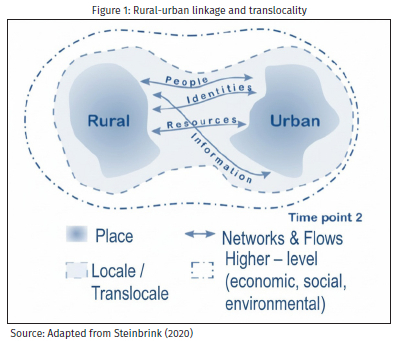
Localities, people, identities, resources, and information constitute the key variables of translocal livelihood relationships. Usually, when dealing with rural-urban migration and translocality, the localities involved are rural and urban spaces. However, the interaction between these two spaces takes place on different levels based on the position and resources of localities involved in the relationship. In other words, what we rank as urban or rural in this relationship can determine the scale of the relationship. This scale also plays a very important role in determining the quality of the relationship. The spaces, agents, and patterns of translocal relations are graphically depicted in Figure 1.
Rural-urban migration in West Africa is characterized by large numbers of low-skilled and less-educated rural inhabitants who migrate to the cities to seek wage employment or to start their own businesses (Awumbila et al., 2016a). While male migrants are often concentrated in the transport, construction, and industry sectors as laborers, many of the female migrants are concentrated in the service sector (Awumbila et al., 2016a, 2016b). Female traders who move to the urban areas are attracted by the markets there. Some of them may move from the villages and hamlets to settle either in the service centers or small towns to start a business in the production value chain. Because of the poor markets for farm produce and seasonality in the rural areas, some of these women seize the opportunities offered by the markets in the small towns or urban areas to market the farm produce that are brought to them from the rural areas. Locally known as market women, they are able to establish formidable business enterprises in these localities through innovative approaches and systems of networks that they maintain with the farmers in the places of origin (Agergaard et al., 2009). Besides trading in foodstuff, some also start grocery or provision stores, enter the restaurant business or other areas in the service sector. In most cases, they leverage resources from the rural communities to run their business. For example, a local restaurant operator may leverage foodstuff and bush meat supplied through networks with rural farmers and hunters. Migrants who are artisans, such as seamstresses and hairdressers may also move to the cities to establish their businesses, or they may acquire the skills in the urban area and return to the village to start the business there while still maintaining ties with migrants in the urban communities for the supply of goods and other materials necessary for the running of their business.
The locale/translocale in the diagram (Figure 1) refers to the space within which the translocal transactions operate. The space constitutes the social field within which translocal activities take place (Greiner, 2010). This social field is made up of rural and urban spaces. Following Owusu (2008), Steel et al. (2018) identify five categories of rural-urban spaces: regional/district towns, secondary towns, small towns, rural service centers/emerging towns, and villages/hamlets. Each of these localities form part of a chain of relationships that connect rural and urban localities. They play roles in the production and supply value chain within the region. These roles include serving as nodes for market centers, mining communities, educational facilities, hospitals, banking, and ICT services for rural folks and connecting rural households to the major urban spaces within the region or country (see Owusu, 2008; Steel et al., 2018). As shown in the diagram (Figure 1), the relations between an urban and a rural locality is dynamic and not static during translocal relations (Steinbrink, 2009). The networks enable bi- or multi-directional flows of persons, information, and resources. They also lead to the construction of translocal identities, whereby individuals define themselves in relation to a multi-local space.
It is important to note that the people who are involved in the translocal relations could be individuals, households, communities, or organized groups such as associations or churches whose members are either migrants or non-migrants. Thus, to effectively measure the quality and impact of the translocal relations that are generated between urban and rural spaces, it is paramount to understand the type of human agents that are involved and the nature of the systems, networks, and structures that they establish to sustain the relationships between them and their origin family and household members as well as between the origin rural community and the destination urban community. These human agents can be stratified by age, sex, education, and social position or by the purpose for which they migrate.
In some cases, household members who migrate to the urban areas consist of individuals seeking employment in the formal and informal economy, who are categorized as labor migrants. These migrants, upon reaching the urban destination, are integrated into various sectors of the urban labor market based on their educational qualifications, skills, and social networks. Because of the concentration of white-collar jobs in the urban areas in most West African countries, many rural dwellers who have received higher education often end up settling and working in an urban space (Agyeman and Fernandez, 2016). Within West Africa, translocal labor migrants include youth migrants (usually unmarried persons and teenagers) who travel from the rural areas to urban settlements to seek employment in the informal and formal economic sectors (Assan, 2014). They also often move to nearby small towns or service centers, or to the regional and national level towns, depending on the quality of their networks. Those who are able to travel to the larger urban spaces seek waged employment within the private sector as messengers, day or night security staff, cleaners, and other related jobs in the service sector. Others go into the informal economy and work as head porters (popularly known as kayayo in Ghana) at the market centers, or as cobblers, and street vendors. Some of these migrants are self-employed. Many within this grouping are also integrated into the transport sector as drivers or driver's mates and motorbike riders, particularly within the francophone countries such as Burkina Faso or Togo. Others also enter the construction sector as laborers. Additionally, some are absorbed by the various artisanal activities in the cities, such as basketry, weaving, sewing, carpentry, welding, and other forms of foundry operations.
In West Africa, the rural-urban linkages also play a huge role in the apprenticeship training ofrural youth. For example, in Nigeria, the Igbo apprenticeship system known as Igba-boi has played a key role in creating many of Nigeria's big entrepreneurs. This is a traditional Igbo cultural practice whereby young people are sent from the villages to kinsmen in the cities who are successful businessmen to learn a trade. A master-servant relationship is developed between the young migrant and his host (Yaro et al., 2015; Kanu, 2019, 2020). After years of serving his master and learning the trade, the master then sets him up by providing him with capital to start his own business and independent life. Kanu (2019, 2020) maintains that many successful businessmen currently in Nigeria are products of this cultural practice. The practice is community focused and it builds strong ties between kinsmen, the rural community, urban space, wealth generation, and development.
Another category of translocal migrants consists mostly of female youth migrants who travel to the small, secondary towns and cities to work as domestic workers and house-helps for upper- and middle-class families (Asante, 2014; Awumbila et al., 2016b). In some cases, their work contract is arranged between the youth migrant's family and the employer. When such is the case, then the family in the origin country may also become a direct beneficiary of their employee's income. However, further research is required to understand how the remittances sent by the various categories of youth migrants constitute an important support net to household members in the rural communities. Within this context therefore, when examining how translocal and multi-local livelihoods aid rural households, it is very important to find out how it also helps communities to develop. More importantly, it is salient to find out how migrant groups, including associations, professional bodies, and religious groups play a role in this process.
There are also cases where rural households send their children to urban areas for education, leading to the establishment of translocal relations between household members in rural and urban areas. Very often also, parents in urban settlements leave their young children in foster care with a family member in the rural areas (Cotton, 2025). This kind of arrangement creates conditions that foster translocal relations between migrants and their relatives in the village. Foster parenting is also common on the transnational level between West African migrant parents in Europe and their relatives in the country of origin (Yount-André, 2022). In cases where the children are sent to urban settlements for educational purposes, their parents living in the village may build a house or rent an apartment in the urban area for the children to live in. In situations of polygamous families, the husband may station one of the wives in the urban home to cater for the children. In such arrangements, there is a reverse flow of remittances from the rural area to the urban area to support the children. Once the children complete school and gain employment, it is their turn to send remittances to their rural homes to support their parents, siblings, and other household members residing there. Greiner (2010) observed this phenomenon during his research in Namibia. However, in the case of West Africa, further research is required to uncover the role of these educated persons in their translocal relations with relatives in the rural communities.
In more recent times, migrants' social networks, translocal relations, and exchanges have been aided a great deal by advances in communication and transportation systems (Dekker and Engbersen, 2014). It is therefore necessary to verify the extent to which technology has improved translocal networks and relations between rural and urban spaces. In fact, household and family members in rural and urban communities are able to communicate and exchange resources through the use of social media (Facebook, WhatsApp, SMS, etc.), mobile banking, and advanced transportation and delivery systems. Door-to-door deliveries enable families in rural communities to send foodstuff to their family members in urban areas and also receive goods from the urban areas. These advances have a greater likelihood to improve the extent of translocal relations between rural and urban households.
Rural-urban migration also leads to the construction of new identities and lifestyles. During his research in Namibia, Greiner (2010: 149) observed: "The translocal movement of people between town and country brings with it a profound change in rural lifestyle." He argued that because translocal migrants maintain their roots in the rural communities of origin, they are able to introduce an urban lifestyle that includes things such as modern furniture, new home construction techniques, and modern farming methods in the village. Some studies also show that translocal livelihoods lead to the development of multilingual identities and multicultural values among migrants (Greiner, 2010; Vukosav and Vukosav, 2021). However, there is also evidence that some migrants abandon their cultures and ties to their places of origin once they settle in the city (Agyeman, 2021). Extant literature on West African migration has focused on the economic rather that the socio-cultural dimension. This, therefore, constitutes an important gap that needs further research.
Our search for literature on intergenerational transfer of translocal activities in West Africa did not yield any results. This situation therefore presents a significant knowledge gap in West African migration research compared to other regions. For example, during Petrou's (2018) research among migrants in the Oceanian archipelago of Vanuatu, she found that there was a strong remittance culture among first- and second-generation migrants living in urban settlements to their rural communities of origin. She observed that whereas first-generation migrants remitted to a wider range of persons, the second generation limited their remittances to close kin, and they remitted more frequently and reliably. In another study, Petrou and Connell (2017) observed that second-generation Paamese migrants maintained their Paamese identity through participation in translocal community activities. Studying Eritrean migrants in Switzerland, Graf and Thieme (2016) noted that translocal encounters between second-generation Eritrean migrants and newly arrived Eritrean refugees influenced the identity formation of the former. In the case of West Africa, future studies will be needed to cast light on the translocal activities between migrants' children and their relatives in the places of origin. Such research will help to understand how translocality leads to the sustenance of origin society cultural values such as language, beliefs, and family systems among the children of migrants who have left their rural communities of origin to settle in urban areas.
CONCLUSION AND RECOMMENDATIONS
The literature reviewed in this paper points to an interconnection between rural and urban inhabitants within a migration landscape. People who migrate from rural to urban settlements across West Africa maintain various degrees of interconnection with their rural households in places of origin. This space of interconnection and interdependence is what we have described as translocal livelihood. Within a translocal livelihood framework, there is a bidirectional exchange of resources between rural and urban dwellers in the form of goods, services, knowledge, and technological innovation. Migrants in urban settlements maintain communication networks with rural households. They send remittances to support households in origin rural communities and maintain relations through periodic visits and investments, particularly in housing and agricultural sectors. At the same time, they receive support and reverse remittances from family members who have remained in the rural communities in times of difficulty. The literature further shows that while translocal livelihoods can improve the well-being of migrant-sending households in rural communities, this can rather exacerbate inequalities between migrant-sending and non-migrant-sending households in these localities.
The literature further shows that translocal networks and livelihoods are gaining importance in West African societies within the rural-urban migration framework. Yet research on translocal livelihoods still remains scant. For example, little is known about cultural exchange and social change caused by the phenomenon of translocal livelihoods. Additionally, there is little knowledge about how translocality contributes to rural economic development across West Africa. Further, the intergenerational aspect of translocality is understudied. As more linkages and interdependencies are created between households in urban and rural settings, it is important to gain a deeper understanding of how research and policy interventions can enhance migrants' contribution to social and economic transformation across West African societies. A deeper understanding of the mechanisms, challenges, and transformational roles of translocal livelihoods is necessary for the design of strategies and policies to increase the relevance of translocality in the migration-livelihood equation.
The present literature review provides an opportunity to critically examine the policy implications of the migration and translocal livelihoods that are increasingly being forged by rural households and urban settlers across the West African subregion. Such policies include devising ways to leverage remittances for climate resilience in the rural economic sector, supporting trading and other business activities of women that help to connect rural and urban economies, providing support systems for the extended family system within the context of translocal relations, as well as providing support to township associations to promote their role in rural economic transformation.
Within the dynamics of translocality, urban households invest in the rural economic sector such as farming and other agricultural activities by sending remittances. These remittances sometimes constitute the capital base and go a long way to support the agricultural and other economic activities of rural households. However, due to adverse climatic conditions, most often migrants who send these remittances experience no return on their investment in the agricultural sector. Nonetheless, to ensure the continuous flow of remittances to support these economic sectors in the rural economies, there is a need for policy interventions. This situation requires policies that will lead to the building of irrigation facilities, provision of agricultural extension services to farmers, provision of regular climate information to farmers (for example, when farmers should expect rainfall), regulation of the land tenure system, construction of high-quality roads, and provision of access to markets. These policy interventions will go a long way to ensure that urban settlers generate a greater interest in investing in their rural communities of origin. Such policies will strengthen the translocal livelihoods between rural and urban households.
Additionally, the literature shows that women who migrated to urban settlements play an important role in creating market opportunities for farm produce and goods from rural communities of origin. However, these women face many challenges ranging from lack of capital, poor transport systems, and lack of security against robbery, especially on the roads. It is evident that there is a need for properly designed policies to support such business activities by women, which will help to link the village and the town.
The extended family system was identified as the defining feature of African traditional family structure (Nukunya, 2016). However, Agyeman (2021) laments that this system upon which all African social institutions are anchored has declined due to migration, family fragmentation, and adoption of Western individualistic values and norms. However, it appears that translocal livelihoods are playing an important role to sustain extended family networks in West Africa. This has important implications for policy. For example, how can policymakers leverage the resources of translocal living to sustain and safeguard the extended family structure in West Africa? Further, it is important to understand how translocal livelihoods affect the cultural identity such as language, religious life, family, and moral values in rural and urban spaces that fall within the translocal social space of migrants. Also, how these identities and values are sustained or not among second-generation migrants is important in future research on translocality.
Finally, migrant groups in urban settlements such as township associations, religious groups, pressure groups, and clubs have a role in spearheading development in migrant communities of origin. Some of these groups of urban dwellers also wield political power and are able to control political activities, electoral politics, and voting behavior in rural communities. It is therefore important to understand the policy implications of their activities.
ACKNOWLEDGMENT
This research was funded by the German Federal Ministry of Education and Research (BMBF Grant 01LG2079A) as part of the Migration and Translocality in West Africa (MiTraWA) project.
REFERENCES
Agergaard, J., Fold, N. and Gough, K. (eds.). 2009. Rural-urban dynamics: Livelihoods, mobility and markets in African and Asian frontiers. London: Routledge. [ Links ]
Agyeman, E.A. 2021. The community, belonging and agency in Akan proverbs. In Nyamnjoh, F., Nwosu: and Yosimbom, H.M. (eds.), Being and becoming African as a permanent work in progress: Inspiration from Chinua Achebe's proverbs. Bamenda: Langaa Publishers, pp. 59-76.
Agyeman, E.A. and Fernandez, G.M. 2016. Connecting return intentions and home investment: The case of Ghanaian migrants in Southern Europe. Journal of International Migration and Integration, 17(3): 745-759. [ Links ]
Agyeman, E.A. and Setrana, M.B. 2014. Human mobility in Ghana. In Baggio, F. (ed.), Africans on the move: Human mobility in Ghana, Nigeria, Angola and South Africa. Cape Town: SIHMA, pp. 13-69.
Agyeman, E.A., Tamanja, M.J.T. and Bingab, B.B.B. 2021. Dimensions of university governance and community relations in Ghana. Africa Development, 46(1): 45-69. [ Links ]
Ajaero, C.K. and Onokala, C. 2013. The effects of rural-urban migration on rural communities of southeastern Nigeria. International Journal of Population Research, 2013: 1-10. [ Links ]
Asante, C.W. 2014. Accra turns lives around: Female migrant traders and their empowerment experiences in Accra, Ghana. Multidisciplinary Journal of Gender Studies, 3(2): 341-367. [ Links ]
Assan, J.K. 2014. Experiences of young migrants working in urban food markets in Southern Ghana: Implications for well-being and social policy. Journal of Social Science for Policy Implications, 2(3): 1-25. [ Links ]
Awudu, H.L., Boampong, O. and Anokye, N.A. 2019. Rural-urban linkages: The case of rural migrants from Upper West Region to Obuasi Municipality in the Ashanti Region, Ghana. Ghana Journal of Development Studies, 16(3): 109-129. [ Links ]
Awumbila, M., Owusu, G. and Teye, J.K. 2014. Can rural-urban migration into slums reduce poverty? Evidence from Ghana. Migrating out of Poverty Working Paper, 13: 1-41. [ Links ]
Awumbila, M., Teye, J.K. and Yaro, J.A. (2016a). Social networks, migration trajectories and livelihood strategies of migrant domestic and construction workers in Accra, Ghana. Journal of Asian and African Studies, 52(7): 982-996. [ Links ]
Awumbila, M., Teye, J.K. and Yaro, J.A. (2016b). Of silent maids, skilled gardeners and careful madams: Gendered dynamics and strategies of migrant domestic workers in Accra, Ghana. GeoJournal, 82(5): 1-14. [ Links ]
Ayuba, D., Akinga, A.Y., Okeh, D.U., Jerico, B.O. and Lucero-Prisno, D.E. 2023. Migration and food security in urban Nigeria: The dilemma of the urban poor. In Cohen, M.J. (ed.), Advances in food security and sustainability. Academic Press, pp. 235-265.
Basch, L., Schiller, N.G. and Blanc, C.S. 1994. Nations unbound: Transnational projects, postcolonial predicaments and deterritorialized nation-states. Langhorne, PA: Gordon and Breach Science Publishers. [ Links ]
Beauchemin, C. 2011. Rural-urban migration in West Africa: Towards a reversal? Migration trends and economic situation in Burkina Faso and Côte d'Ivoire. Population, Space and Place, 17: 47-72. [ Links ]
Beauchemin, E. 1999. The exodus: The growing migration of children from Ghana's rural areas to urban centres. Accra: Catholic Action for Street Children and UNICEF. [ Links ]
Cobbinah, B. and Amoako, C. 2012. Urban sprawl and the loss of peri-urban land in Kumasi, Ghana. International Journal of Social and Human Sciences, 6: 388-397. [ Links ]
Cotton, C. 2025. Child fostering and maternal migration in sub-Saharan Africa. Population Studies, 79(1): 59-80. [ Links ]
Dekker, R. and Engbersen, G. 2014. How social media transform migrant networks and facilitate migration. Global Networks, 14(4): 401-418. [ Links ]
Dick, E. and Schraven, B. 2021. Rural-urban migration in West Africa: Contexts, trends and recommendations. KNOMAD Policy Brief, 13.
Findley, S. and Sow, S. 1998. From season to season: Agriculture, poverty and migration in the Senegal River Valley. In Appleyard, R. (ed.), Emigration dynamics in developing countries, Vol. I, Sub-Saharan Africa. Brookfield: Ashgate.
Graf, S. and Thieme, S. 2016. "We look similar and have the same geographical origin": Translocal encounters of second-generation Eritreans with a new generation of refugees from Eritrea. Geographica Helvetica, 71: 331-340. [ Links ]
Greiner, C. 2010. Patterns of translocality: Migration, livelihoods and identities in Northwest Namibia. Sociologus, 60(2): 131-161. [ Links ]
Greiner, C. and Sakdapolrak: 2013. Translocality: Concepts, applications and emerging research perspectives. Geography Compass, 7(5): 373-384. [ Links ]
Grillo, R. and Riccio, B. 2004. Translocal development: Italy-Senegal. Population, Space and Place, 10: 99-111. [ Links ]
ISSER. 2023. Population in Ghana: An analysis of growth trends and implications for development planning. Policy Brief No. 8. Accra: ISSER.
Jarawura, F.X., Teye, J.K., Kleist, N., Lindegaard, L.S. and Quaye, D. 2024. "These days, things have changed": Historicizing current dynamics of climate-related migration in the savannah zone of Ghana. Climate and Development. https://doi.org/10.1080/17565529.2024.2321168
Kanu, C.C. 2020. The context of Igwebuike: What entrepreneurship development systems in Africa can learn from the Igbo apprenticeship system. Amamihe: Journal of Applied Philosophy, 18(1): 9-42. [ Links ]
Kanu, I.A. 2019. Igwebuikeconomics: The Igbo apprenticeship system for wealth creation. Igwebuike: An African Journal of Arts and Humanities, 5(4): 56-70. [ Links ]
Kraus, S., Breier, M., Lim, M.W., DabiC, M., Kumar, S., Kanbach, D., Mukherjee, D., ... et al. (2022). Managerial Science, 16: 2577-2595.
Lohnert, B. and Steinbrink, M. 2005. Rural and urban livelihoods: A translocal perspective in a South African context. South African Geographical Journal, 87(2): 95-103. [ Links ]
Mabogunje, A.L. 1970. Systems approach to a theory of rural-urban migration. Geographical Analysis, 2: 1-18. [ Links ]
Mabogunje, A.L. 1972. Regional mobility and resource development in West Africa. Montreal and London: McGill-Queen's University Press. [ Links ]
Nukunya, G.K. 2016. Tradition and change in Ghana: An introduction to sociology (Revised and expanded edition). Accra: Woeli Publishing Services. [ Links ]
Østby, G. 2016. Rural-urban migration, inequality and urban social disorder: Evidence from African and Asian cities. Conflict Management and Peace Science, 33(5): 491-515. [ Links ]
Owusu, G. 2008. The role of small towns in regional development and poverty reduction in Ghana. International Journal of Urban and Regional Research, 32(2): 453-472. [ Links ]
Peth, S.A. and Birtel, S. 2014. Translocal livelihoods and labor migration in Bangladesh: Migration decisions in the context of multiple insecurities and a changing environment. In Mallick, B. and Etzold, B. (eds.), Environment, migration and adaptation - Evidence and politics of climate change in Bangladesh. Dhaka: AHDPH.
Peth, S.A., Sterly, H. and Sakdapolrak. 2018. Between the village and the global city: The production and decay of translocal spaces of Thai migrant workers in Singapore. Mobilities, 13(4): 455-472. [ Links ]
Petrou, K. 2018. Generational differences in translocal practices: Insights from rural-urban remittances in Vanuatu. Population, Space and Place, 24(6): e2145. [ Links ]
Petrou, K. and Connell, J. 2017. Rural-urban migrants, translocal communities and the myth of return migration in Vanuatu: The case of Paama. Journal de la Société des Océanistes, 144-145: 51-62. [ Links ]
Pickbourn, L. 2018. Rethinking rural-urban migration and women's empowerment in the era of the SDGs: Lessons from Ghana. Sustainability, 101075: 1-18. [ Links ]
Potts, D. 2013. Rural-urban and urban-rural migration flows as indicators of economic opportunity in sub-Saharan Africa: What do the data tell us? Migrating Out of Poverty Working Paper, 9, 1-39. [ Links ]
Romankiewicz, C. 2019. West African migration in the age of climate change: Translocal perspectives on mobility from Mali and Senegal. PhD Dissertation, University of Bayreuth, Germany. [ Links ]
Romankiewicz, C. and Doevenspeck, M. 2014. Climate and mobility in the West African Sahel: Conceptualising the local dimensions of the environment and migration nexus. In Greschke, H. and Tischler, J. (eds.), Grounding global climate change. Dordrecht: Springer, pp. 79-100.
Schürmann, A., Kleemann, J., Teucher, M., Fürst, C. and Conrad, C. 2022. Migration in West Africa: A visual analysis of motivation, causes and routes. Ecology and Society, 27(3/16): 1-29. [ Links ]
Steel, G., Birch Thomsen, T., Cottyn, I., Lazaro, E.A., Mainet, H., Mishili, F.J. and van Lindert: 2018. Multi activity, multi locality and small town development in Cameroon, Ghana, Rwanda and Tanzania. European Association of Development Research and Training Institutes (EADI).
Steinbrink, M. 2009. Urbanisation, poverty and translocality: Insights from South Africa. African Population Studies Supplement to Val. 23 / Étude de la Population Africaine Supplement du Val. 23, 220-252. [ Links ]
Steinbrink, M. and Niedenführ, H. 2020. Africa on the move: Migration, translocal livelihoods and rural development in sub-Saharan Africa. Switzerland: Springer Nature.
Teye, J.K., Boakye-Yiadom, L., Asiedu, E., Litchfield, J., Appiah Kubi, J.W. and Awumbila, M. 2019. The impact of migration on the welfare of households left behind in rural Ghana: A quasi-experimental impact evaluation. Working Paper 62, University of Sussex School of Global Studies.
Todaro, M.P. 1997. Urbanization, unemployment and migration in Africa: Theory and policy. Policy Research Division Working Paper, 104. New York: Population Council. [ Links ]
Tweneboah, S. and Agyeman, E.A. 2021. Traditional African religion and trans-Saharan migration from Ghana: Analysis of the role of Nkoranza deities in the youth migration to Libya. African Diaspora, 13(1-2): 204-229. [ Links ]
Vukosav, B. and Vukosav, M.K. 2021. Translocal and multilingual identities: The case of Croatians in Hanover, Germany. Linguistic minorities in Europe online. Berlin: De Gruyter Mouton. https://doi.org/10.1515/lme.13998952 [ Links ]
Yaro, J.A. 2004. Combating food insecurity in Northern Ghana: Food insecurity and rural livelihood strategies in Kajelo, Chiana and Korania. Occasional Paper 44, Department of Sociology and Human Geography, University of Oslo.
Yaro, J.A., Teye, J.K. and Awumbila, M. 2015. The life struggles and successes of the migrant construction worker in Accra, Ghana. Ghana Journal of Geography, 7(2): 113-131. [ Links ]
Yount-André, C. 2022. Material care and kinship on trips to Dakar: Proximity via pluriparentalité in transnational Senegalese families. Africanistes, 92(1): 78-100. [ Links ]
Received 09 April 2025
Accepted 05 November 2025
Published 22 December 2025
