




Services on Demand
Journal

Article
 English (pdf)
 Article in xml format
 Article references
 Automatic translation
 Send this article by e-mail
Indicators
Related links
-
 Cited by Google
 -
 Similars in Google
Share

 Permalink
African Human Mobility Review
On-line version ISSN 2410-7972Print version ISSN 2411-6955
AHMR vol.11 n.1 Cape Town Jan./Apr. 2025
https://doi.org/10.14426/ahmr.v11i1.2363
ARTICLES
From Deprivation to Mobilization: Towards a Multideterminant Model of Xenophobic Violence in South Africa
Jean Pierre Misago
Senior Researcher and Assistant Director, African Centre for Migration & Society, Witwatersrand University, Johannesburg, South Africa. https://orcid.org/0000-0001-6964-3926 jean.misago@wits.ac.za
ABSTRACT
Drawing on extensive and comparative qualitative data from a nearly two-decade long and ongoing research, this article responds to inadequacies and limitations of current causal explanations for xenophobic violence in South Africa. The article argues that existing explanations are inadequate as many lack empirical backing and others are incomplete due to their reductionist approach. To address these shortcomings, this article proposes an empirically based and theoretically informed multideterminant (explanatory) model, which identifies and analyses the roles of-and interconnections between-six key determinants, namely: i) socio-economic and political deprivation, ii) xenophobic beliefs, iii) collective discontent, iv) political economy, v) mobilization, and vi) governance. I argue that i) these determinants and their interconnections in a value-added process constitute the necessary and sufficient conditions for the occurrence of xenophobic violence, and ii) this multideterminant model consequently provides an adequate and comprehensive explanation of the xenophobic violence in South Africa. In addition to its scholarly contribution, this article has potential policy implications. By clearly identifying the key elements in the causal chain, the study implicitly points to critical areas where intervention efforts could be targeted to effectively address the ongoing xenophobic violence in South Africa.
Keywords: xenophobia, collective violence, migrants, foreign nationals, governance
INTRODUCTION
Xenophobic violence generally refers to any acts of violence targeted at foreign nationals or "outsiders" because of their being foreign or strangers. It is an explicit targeting of foreign nationals for violent attacks despite other material, political, cultural or social forces that might be at play (Dodson, 2010). As Gordon (2024:1) notes, "xenophobic violence has become an increasingly commonplace occurrence in democratic South Africa" (see also Misago and Landau, 2022). Indeed, "foreign nationals are routinely attacked in their residences, workplaces, business premises, private and public transport, or just walking on the streets" (Misago et al., 2021). As Misago et al. (2021: 4) observe, xenophobic violence in South Africa is generally a collective violent act or "a type of collective violence carried out by groups (large or small) of ordinary members of the public, often mobilised by local leaders (formal or informal) and influential groups or individuals to further their own political and economic interests." Target groups and individuals are regularly killed, assaulted, injured, displaced and their property and livelihood assets looted, destroyed, or appropriated (Misago et al., 2021; Gordon, 2024).
Since 2008, this ongoing violence has attracted considerable and increasing scholarly attention, as academics, researchers and other analysts attempt to explain its causal factors and recommend preventive measures. Scholarly analysis continues to provide different and competing empirical and theoretical explanations. As Misago (2019a) notes, most explanations emphasize broad and structural socio-economic, historical and psychosocial factors, as well as micro-level, local socio-economic and political dynamics. These explanations are valuable in analysing the conditions under which xenophobic violence takes place. However, by implicitly claiming that the causal factors they put forward are necessary and sufficient conditions for the occurrence of xenophobic violence, they "falter when faced with empirical or logical interrogation" (Landau, 2011: 3).
This article argues that existing explanations are inadequate, and their shortcomings lie in a twofold repertoire of analytical blind spots. First, they lack empirical backing as they do not (even attempt to) establish a direct empirical link between common and longstanding conditions and the occurrence of violence in specific communities, at specific times. Second, they are incomplete as most offer reductionist, one-factor explanations for such a complex social phenomenon and, as such, can be at best partial or incomplete. To address these shortcomings, this article proposes an empirically based and theoretically informed multideterminant (explanatory) model, which identifies and analyses the roles of-and interconnections between-six key causal factors (hereafter "determinants"). The six key determinants include i) socio-economic and political deprivation, ii) xenophobic beliefs, iii) collective discontent, iv) political economy, v) mobilization, and vi) governance. I argue that i) these determinants and their interconnections in a value-added process constitute the necessary and sufficient conditions for the occurrence of xenophobic violence, and ii) this multideterminant model consequently provides an adequate and comprehensive explanation of the xenophobic violence in South Africa.
After briefly introducing its data sources and methodological approach, the article provides an overview and shortcomings of existing theoretical and empirical explanations of xenophobic violence in South Africa. It then proceeds to present the multideterminant model it proposes. The final section or conclusion summarises the article's key argument and briefly reflects on scholarly and policy implications.
METHODOLOGY
This article draws on extensive and comparative qualitative data from ongoing research (hereafter "the study") on xenophobic violence in South Africa beginning from 2006. Conducted by the African Centre for Migration & Society at the University of the Witwatersrand, the study involves a systematic investigation into the nature, causal factors, and implications of xenophobic violence in the country. To achieve this goal, the study adopted the "most similar systems" approach by selecting research sites affected by the violence and sites that did not experience violence despite having similar socio-economic dynamics as the neighbouring violence-affected communities. The approach was informed by the understanding that "no enquiry into riots [in this case xenophobic violence] should fail to account for their absence" (Horowitz, 2001: xiv). This "most similar systems" approach allows the study to identify the most significant distinguishing factors that account for the presence of the violence in certain places, and its absence in others.
The study consisted primarily of in-depth qualitative interviews and focus group discussions with local citizens, foreign nationals, perpetrators and victims of the violence, relevant government officials, the police and other local law enforcement bodies such as community policing forums (CPFs), formal and informal community leaders, and other key informants including representatives of different civil society, faith-based, community-based organizations and self-help groups operating in those areas. The study comprised 47 case studies (conducted mainly in the provinces most affected by xenophobic violence, namely Gauteng, Western Cape, KwaZulu-Natal, Eastern Cape and Limpopo) and more than 1130 participants. The study was approved by the University of the Witwatersrand's Human Research Ethics Committee (HREC Non-Medical). Ethics clearance certificate number: H22/08/18.
OVERVIEW AND APPRAISAL OF CURRENT THEORETICAL AND EMPIRICAL EXPLANATIONS
Theoretical approaches to xenophobic violence
Despite its global and growing dimensions, xenophobic violence does not seem to have attracted as much "targeted" theoretical attention as have other types of collective violence. Attempts at theoretical explanations for xenophobic violence in South Africa often borrow from "generic" mainstream theories of collective violence
particularly because, as indicated earlier, xenophobic violence in South Africa is often collective. While there appears to be as many theoretical approaches to collective violence as there are academic disciplines (see DeKeseredy and Barbara, 2006), two lines of theorizing-deprivation and mobilization models-have received much more attention than most (Horowitz, 2001) and currently dominate the literature on collective violence causal factors (Snyder, 1978).
However, I argue that despite their popularity and contribution these models and their imbedded theories are still not adequate explanations for the occurrence of collective violence and, by extension, xenophobic violence. Their limitations lie in their reductionist or isolationist approach, that is, their claims that one factor can fully explain collective violence in isolation of other societal conditions and processes. I argue that, when applied as sufficient explanations, these approaches are ultimately inadequate and in need of supplementation. As Sen (2008) rightly notes, the causal mechanisms of collective violence are more complex than reductionist approaches are capable of accounting for. The following section outlines the key tenets of these models and assesses their explanatory value.
The deprivation model
The central argument of theories in the deprivation model, also known as the "discontent model" (Snyder, 1978), is that generalised real or perceived deprivation in political, social or economic welfare leads to collective discontent or mass anger that eventually erupts in collective violence. There are many different theories in this model, but the two most commonly used include realistic group conflict theory and relative deprivation theory.
The realistic group conflict theory focusses on social-structural sources of group difference and stipulates that violent conflict between groups is rooted in a clash of competing group interests, be they economic or claims to social status and privileges (Brief et al., 2005). The theory suggests that group competition over resources and opportunities can lead to group tensions and ultimately violent group conflict or collective violence (Sniderman et al., 2004).
The relative deprivation theory stipulates that perceptions of deprivation, and concomitant feelings of frustration and alienation, arise when there is a discrepancy between value expectations and value capabilities, as reflected in the social and physical environment (Gurr, 1970). Where deprivation is widespread and extreme, the possibility for violence is greater (Conteh-Morgan, 2004). The scope and intensity of the relative deprivation produces variations in collective discontent which, according to the theory, leads to collective violence (Snyder, 1978; Aya, 1979). In Gurr's (1970: 13) own terms: "discontent arising from the perception of relative deprivation is the basic, instigating condition for participants in collective violence."
As Aya (1979) notes, despite its popular use, the deprivation model has been heavily criticized on methodological and empirical grounds, particularly for failing to i) address important substantive questions relating to how discontented individuals come to undertake collective action, and ii) specify the conditions under which expectations may be frustrated without producing violence. "[...] they simply assume a direct connection between frustration and revolt, and thus beg the question they profess to have answered" (Aya, 1979: 57). As discussed further on, despite its obvious limitations, the deprivation model is commonly used to explain xenophobic violence in South Africa.
The mobilization model
For present purposes, mobilization refers broadly to all strategies and activities aimed at recruiting and persuading individuals to participate in collective action/violence. Theories in this model were developed partly as a response to the above-outlined conceptual and empirical limitations of the deprivation theories (Snyder, 1978). The core argument of this approach is that it is the organization or mobilization of discontent that triggers collective violence rather than just discontent or grievances themselves (Snyder, 1978). The most prominent theories in this model include resource mobilization, rationale choice, and elite manipulation theories.
The resource mobilization theory posits that collective action flows from groups vying for political positions and advantages. It "is simply politics by other means" (Useem, 1998: 216). According to this theory, collective violence is not, or at least not only, a response to deprivation, particularly because that deprivation and the resulting discontent are a "constant" that cannot adequately explain the occurrence of collective violence only in certain places and at certain times (Piven and Cloward, 1991). This is not to say that grievances or discontent are not important or invoked but "they want political mobilization via association, formal or informal, to be galvanised into action" (Aya, 1979: 49, see also Zald and McCarthy, 1979).
The rational choice theory conceives of collective violence as an act of collective and rational decision makers that mobilize their followers and promote their causes with the best available strategies informed by cognitive material and socio-political resources at their disposal (Kitschelt, 1986). It stipulates that "an individual will join collective violent action only when he expects the benefits of his participation to exceed the costs; when the net value of doing so is positive, that is when benefits of such activity outweigh costs" (Hechter et al., 1982: 442). The benefits ought not only to be material or economic rewards. Social, political, "identitive" or emotive incentives are equally important (Muller and Opp, 1986).
The central tenet of the elite manipulation theory is that collective violence results from the manipulation of masses by the elites for their economic and political interests. Understanding that "groups rarely organize themselves without some sort of political leader that is able to harness and bring critical issues to the forefront of individual consciousness" (Gerring, 2009: 12), elites often strategically mobilize existing-or purposely created-popular discontent into collective action to maximum political gain (Gerring, 2009). Elites can be elected or self-appointed leaders, political party leaders or representatives of interest groups.
In general, the mobilization model posits that the organization or mobilization of discontent is a central explanatory variable, particularly insofar as it helps to account for how individuals come to participate collectively (at the same place, time, and often for the same purpose) in violent acts (Gerring, 2009). Despite its merits, however, the model is not without its weaknesses. I argue that the model's inability to determine the specific societal conditions upon which successful mobilization depends renders it an equally inadequate explanation for the occurrence of collective violence. For example, while specifically stipulating that it is the mobilization of discontent that triggers collective violence, the model fails to acknowledge collective discontent as a key element in the collective violence causal chain.
In conclusion, the discussion above clearly shows that while dominant theoretical models contribute to the understanding of collective violence, they fall short when applied as sufficient explanations. Their main weakness lies in their reductionist approach that attempts to explain collective violence solely in terms of deprivation or mobilization. The causal factors they put forward are important but neither works on its own, nor can these models provide a complete and adequate explanation for the occurrence of collective violence. I agree with Sen (2008) who opines that approaches to explaining violence should avoid isolationist models because individual factors, no matter how important they are, cannot provide an adequate understanding of the causation of such a complex phenomenon in isolation of other societal conditions and processes. "A solitarist approach is, in general, a very efficient way of misunderstanding nearly everyone [or everything] in the world" (Sen, 2008: 7).
This article shows that both deprivation and mobilization are important determinants of xenophobic violence but are not sufficient explanations when applied individually or even in combination. They need supplementation, that is, they require the effect of other indispensable determinants to produce incidents of xenophobic violence.
Empirical explanations for xenophobic violence in South Africa
Existing causal explanations for xenophobic violence in South Africa can be grouped into three main categories: i) economic and material, ii) historical, political and institutional, and iii) psychosocial. Indeed, as Lau et al. (2010: 1) note, dominant explanations for collective and xenophobic violence in South Africa characterize it "(i) as a manifestation of social inequality and poverty; (ii) as a manifestation of a 'culture of violence' entrenched by a history of militarism; and (iii) as 'symptomatic' of historical trauma cultivated by the legacy of apartheid."
Economic and material explanations
Informed by poor socio-economic conditions and deprivation prevailing in most of affected communities, economic and material explanations for xenophobic violence in South Africa emphasize competition between citizens and immigrants over scarce resources and opportunities as the main cause of the violence (see for example Dodson, 2010; Sempijja and Tewold, 2020; Misago et al, 2021; Mongale, 2022; Olofinbiyi, 2022). More specific accounts often draw attention to inequality, poverty, unemployment and other particular aspects of material deprivation caused by discriminatory policies and practices of the apartheid regime but also by the new government's service delivery failures (see for example Crush et al., 2008 and Claassen, 2017). Similarly, Sempijja and Mongale (2022: 1) argue that "xenophobic attacks in South Africa were triggered by drivers such as income inequality, inter-group hatred, racism, poverty, unemployment and competition for resources, the quest for social justice emanating from historical socio-economic grievances." Further, Tewold (2020) explains xenophobic violence using the realistic conflict theory and argues that the violence is a result of intergroup competition over scarce resources.
In line with Tilly's observation that "analysts often refer to large-scale causes (poverty, widespread frustration, extremism, resource competition and so on) proposing them as necessary or sufficient conditions for whole episodes of collective violence" (Tilly, 2003: 20), these explanations are evidently informed by the deprivation theoretical model outlined earlier. Echoing the limitations of the model, I agree with Crush et al (2008: 16) that "[W]hile there is an understandable reductionist tendency to view anti-foreign violence as a direct product of the material deprivation and competition amongst poor South Africans, this does not explain why all poor communities did not explode in May 2008"; and with Tshitereke (1999: 4) that "violence is not an inevitable outcome of relative deprivation."
However, despite the lack of definitive empirical backing, economic and material explanations for collective and xenophobic violence persist because the connection between poverty and group violence seems obvious, particularly when violence occurs in poor and unequal societies as it often does. As Sen (2008: 8) puts it:
[...] the connection has appeared to be so obviously credible that the paucity of definitive empirical evidence has not discouraged the frequent invoking of this way of understanding the recurrence of violence in countries with much poverty and inequality.[.] The claim that poverty is responsible for group violence draws on an oversimplification of empirical connections that are far from universal.
I further agree with Sen that "It would be a huge mistake to see economic inequality and poverty as being automatically responsible for violence-indeed, it would be just as serious a mistake as the assumption that inequality and poverty have nothing to do with the possibility of violence" (Sen, 2008: 14). Economic and material deprivation can therefore only be one element among many in the collective violence (or in this case xenophobic violence) causal chain.
Historical, political and institutional explanations
For many analysts, the causes of the xenophobic violence in South Africa lie in factors related to the country's past and current political and institutional configurations, which shaped and continue to shape "the coding of unregulated (and even regulated) human mobility as a threat to insiders' economic and physical well-being and national (or even sub-national) achievement" (Landau, 2011: 5; see also Misago and Landau, 2022). The factors often cited include the legacy of apartheid, the impact of post-apartheid nation-building efforts and "the failure of national rebirth" (Landau, 2011).
Citizen Rights in Africa Initiative (CRAI) (2009), for instance, argues that the legacy of apartheid and isolation created a fertile ground for xenophobic violence in several ways: i) it created radicalized notions of identity, ii) enforced separation among different populations including isolating South Africans from the rest of the continent, and iii) institutionalized violence as a means of communicating grievances and achieving political ends (see also Jaynes, 2008). Further, arguing that African immigrants in South Africa live in "post-apartheid apartheid," Kaziboni (2022: 209) explains the ongoing xenophobic violence in contemporary South Africa as a result of the use and normalisation of violence originating from apartheid's racist past.
Analysts who link xenophobic violence to the post-apartheid nation-building efforts argue, for example, that post-apartheid immigration policies and practices have reinforced "a deep suspicion of those who move" (Landau, 2011: 5) and have constructed the foreigner as the "violable alien" (Misago et al 2009; see also Dodson, 2010: 6) in trying to build a new national identity and protect the new citizenry (Peberdy, 2009; Misago and Landau, 2022). Regarding the failure of national rebirth, analysts argue that the violence against foreign nationals is caused by the government's failure to realise citizens' social and economic rights since 1994, that is, the failure of the government to meet post-apartheid expectations regarding economic conditions and service delivery (CoRMSA, 2008; CRAI, 2009).
In sum, it is only logical to note that, while valuable in providing a relevant context, historical, political and institutional factors alone cannot account for the variations in occurrence and intensity of xenophobic violence. Like economic and material conditions, these factors are longstanding and common in many South African communities or areas that have not experienced a single incident of xenophobic violence to date.
Psychosocial explanations
Analysts also put forward psychosocial factors as explanations for the ongoing xenophobic violence in South Africa. One of these factors is "cultural stereotyping" that results from South Africans' new direct contact with foreign Africans (Dodson, 2010). According to Harris (2002), mutual stereotyping between South Africans and foreigners essentializes and exaggerates cultural differences and thus gives rise to prejudice and conflict. Another factor put forward is the "culture of violence." Some analysts see collective and xenophobic violence in South Africa as a manifestation of a "culture of violence" entrenched by a history of militarism (Lau et al., 2010). Another related explanation is "historical trauma" cultivated by the apartheid legacy (Seedat, 2010). According to Lau et al. (2010: 7), "xenophobic violence, a peculiar form of 'black-on-black' violence, represents the spill over of repressed trauma, as manifest in the transfer of anger and hatred of the former 'colonial masters' onto an equally or more vulnerable 'other' through physical acts of denigration."
In a similar vein, using Freudian political psychology to explain xenophobic violence in South Africa, Olofinbiyi (2022: 198) argues that " [...] a battered psychological mind frame resulting from apartheid dehumanisation is an intriguing causal factor for the violent behaviour of South African xenophobes towards foreign nationals" and that "[.] the painful memory of apartheid is a trigger factor for recurrent xenophobic violence against immigrants in South Africa" (Olofinbiyi, 2022: 199).
Once again, these factors provide a valuable understanding of underlying conditions but are not sufficient explanations because of empirical evidence that shows that the presence of foreign nationals in areas renowned for public violence and violent crime does not necessarily lead to the foreigners' violent exclusion and that xenophobic violence in South Africa is not exclusively a "black-on-black" affair (Tewold, 2020).
As the discussion above clearly indicates, the proposed economic, political and psychosocial explanations are valuable in analysing the conditions under which xenophobic violence takes place. However, by implicitly claiming that the causal factors they put forward are necessary and sufficient conditions for the occurrence of xenophobic violence, they "falter when faced with empirical or logical interrogation" (Landau, 2011: 3). In other words, they are not adequate explanations for the occurrence of xenophobic violence. The reason for this is twofold. First, these explanations maintain only a tenuous relationship with empirical reality. They lack empirical backing as they do not (even attempt to) establish a direct empirical link between common and longstanding conditions and the occurrence of violence in specific communities, at specific times. In other words, they fail to identify and clarify processes through which conditions and motives translate into collective violent attacks. Second, they offer reductionist, one-factor causes to explain such a complex social phenomenon and, as such, can be at best partial or incomplete (Sen, 2008). These explanations ultimately point to general elements of socio-economic and political deprivation that are necessary but not sufficient conditions for the occurrence of xenophobic violence. I attempt to address these shortcomings by proposing the following multideterminant model.
A multideterminant model: Six determinants and their interconnectedness
This study finds that incidents of xenophobic violence are a result of complex interconnections between six key determinants grouped into three layers of causality, namely underlying conditions, proximate causes and triggers. Underlying conditions include i) socio-economic and political deprivation (hereafter deprivation), ii) xenophobia and negative attitudes towards foreign nationals (hereafter xenophobia), and iii) collective discontent. Proximate causes consist of iv) political economy or politico-economic violence entrepreneurship (hereafter political economy), and v) favourable governance (hereafter governance). Mobilization (vi) acts as a trigger. I argue that i) these determinants and their interconnections in a value-added process constitute the necessary and sufficient conditions for the occurrence of xenophobic violence, and ii) this multideterminant model consequently provides an adequate and comprehensive explanation of the xenophobic violence in South Africa. The following provides a brief explanation of these determinants and their interconnectedness. Readers will be referred to earlier work for detailed discussions on individual determinants.
Socio-economic deprivation
As indicated earlier, xenophobic violence occurs mostly (albeit not exclusively) in poor and economically marginalized informal settlements and townships where citizens (many of whom are themselves internal migrants) and immigrants meet amid poor living conditions and severe socio-economic deprivation. To varying degrees, residents in areas covered in this research face longstanding, severe and worsening severe socioeconomic hardships and ills, including high rates of unemployment, poor service delivery, poverty, overcrowding, high crime rates, violence, gangsterism, drug and alcohol abuse, and general lack of livelihood opportunities (Misago et al., 2021).
Perhaps not surprisingly, socio-economic hardships lead to fierce competition for scarce public services, livelihood resources and opportunities that often lead to tensions and conflicts among individuals and groups, particularly between citizens and foreign residents (Misago, 2016a). As this study finds, residents of violence-affected areas perceive this competition as unfair and illegitimate and accuse foreign residents of stealing what is legitimately theirs. A Mamelodi respondent, for example, stated:
The issue of economy, our people are now saying these people are taking our jobs, our spaza shops are now owned by people from outside the country. Then there is this issue of services because; we are too many, they are using our clinics and hospitals; we don't have access to our facilities like we used to previously. There is also this issue of crime, most of the time I see them on the TV they are pastors and scamming our people and all those things that also contributes to the tension.1
As Dodson (2010: 5) suggests, this resented competition produces an "ethnicised political economy in which microeconomic friction is displaced into hate-filled nationalism." As discussed below, when blamed on the presence of outsiders (as often is), widespread socio-economic deprivation provides fertile ground for xenophobic violence as it, together with other factors, leads to collective discontent that often gets mobilized for xenophobic violence.
Xenophobia and negative attitudes towards foreign nationals
In all studies areas, community members and their leaders generally hold strong negative perceptions and attitudes towards foreign nationals whom they blame for most of the socio-economic hardships outlined above. Residents perceive the presence of foreign nationals as a threat to their lives and livelihoods. These sentiments are common not only among residents of our study areas but also among South Africans in general. Indeed, research consistently shows that these sentiments are widespread and cut across race, class, gender, age, ethnic and religious divides (Nyamnjoh, 2006). As an example, a 2020 HSRC survey reveals that 57% of the country's population hold negative attitudes towards immigrants, particularly those of African and Asian origin (HSRC, 2020). A Dunoon respondent confirmed these native attitudes: "Yes, we live with them, but I'm not going to lie, we are pretending [to like] each other. We believe that the crimes that exist here would not exist if they were not here. We have the belief that they are taking our jobs. They are cheap labour. This is the belief we have."2
These attitudes and strong resentment result from-and are in turn reinforced by-constant scapegoating by the public, government officials and political leaders who blame foreign nationals for service delivery failures, and for most of the country's socio-economic ills and hardships described above (UNHCR, 2015). Scapegoating is a well-documented source of negative attitudes and resentment towards foreign nationals in South Africa. Indeed, Human Rights Watch (HRW) indicates that many African and Asian foreigners have been targets of xenophobia because they are "often scapegoated for economic insecurity and government failures in delivering basic services to its citizens ..." (HRW, 2020: 16; see also Crush et al., 2008). This is a typical case predicted by the scapegoating theory that stipulates that "if a majority group encounters difficult economic conditions, they often feel threatened by minorities, especially if they are foreign" (Muswede and Mpofu, 2020: 276).
A 2018 survey revealed that "More than 1 in 10 adults living in South Africa had not taken part in violent action against foreign nationals-but would be prepared to do so [...]. The results of this study show that millions of ordinary South Africans are prepared to engage in anti-immigrant behaviour" (Gordon, 2019: 2). Similarly, a 2023 South African reconciliation barometer report (IJR, 2023: 32) indicates that, in 2023, more than a quarter of South Africans indicated that they were "likely or very likely to take action to prevent African migrants from moving into their neighbourhood, operating a business in their area, or accessing jobs or government services." This clearly indicates that the pervasive xenophobic climate in the country constitutes a "collective mental state" and builds on a psychological "raw material" mobilization for xenophobic violence (Bostock, 2010). By definition, xenophobia is inevitably one of the determinants of xenophobic violence.
Collective discontent against foreign nationals
As mentioned above, a combination of severe socio-economic deprivation and xenophobia are used to blame this deprivation on foreign nationals, which leads to collective anger and discontent towards foreign nationals living in affected communities. For purposes of this article, collective discontent refers to a widespread feeling of dissatisfaction, anger shared by a group of people about certain aspects of their lives and, particularly, about similar, longstanding and unresolved societal issues. In this case, the unresolved concern and the object of the collective discontent is the presence of foreign nationals perceived as a real and increasing threat to their lives and livelihoods.
The framing of foreign nationals as a threat to national security and the well-being of the citizenry mainly takes roots in the past and present socio-political imaginaries and actions. Indeed, Misago and Landau (2022: 5) note that, drawing on a rhetorical archive from the country's colonial and apartheid past, the post-apartheid government's words and actions characterize the migrant as a demonised category responsible for lack of national progress, and "an obstacle to addressing the historical inequities and creating true freedom for a deserving citizenry." As indicated earlier, the study finds that these feelings are firmly entrenched in the minds of many members of local communities who believe that foreign nationals undermine their socio-economic development and prosperity by stealing jobs and businesses opportunities, overburdening or depleting public services, and committing most of the crime in their areas. One Khayelitsha respondent, for example, expressed feelings shared my many:
[...] most of our people are unemployed; people who work are foreign nationals. Like the people of Zimbabwe or Lesotho. I would say that the people in charge of the jobs are foreigners. I don't want to hide that fact. That is the problem. That is why we were saying let's minimize these people [.] So, they live a comfortable life. These are painful things for people. That can make a mess at any time.
As discussed above, research evidence indicates that collective discontent against foreign nationals is pervasive in many communities in South Africa. Many of these discontented communities have not experienced xenophobic violence. In other words, xenophobic violence occurs in some communities and not in others despite, the shared collective discontent. This is evidence that collective discontent does not always lead to collective violence (see also Postmes, 2019). The question then is, under what conditions does collective discontent lead to collective violence or, more specifically, under what conditions does collective discontent against foreign nationals translate into xenophobic violence in South Africa? The following section answers this question by discussing how proximate causes and triggers build on this collective discontent to produce incidents of xenophobic violence.
Political economy and micropolitics
Since 2008, this study has consistently shown that micropolitics and localised political economy are a significant element or determinant in the xenophobic violence causal chain. As I argue elsewhere, "xenophobic violence in post-apartheid South Africa is primarily 'politics by other means' as its instrumental motives are located in the localised political economy and micro-political processes at play in affected communities" (Misago, 2017: 42). Indeed, this study finds that xenophobic violence is in most cases organized/instigated by well-known local interest groups, such as formal and informal leadership structures, civic associations, concerned resident associations, local business and development forums, local political movements, gangs and other interest groups, to further their own political and economic interests (Misago, 2017; Misago and Landau, 2022).
These groups, often referred to as "violence entrepreneurs" (Guichaoua, 2013) exploit or use the existing and well-known collective discontent against foreign nationals to mobilize residents for xenophobic attacks for their own political and economic interests. The finding is in line with the "elite manipulation theory" which stipulates that elites often strategically mobilize existing-or purposely created- popular discontent into collective action for maximum political and economic gain. As an example, the case of the Dudula Movement in Alexandra township in Johannesburg illustrates this point.
In March and May 2022, the Dudula Movement organized and led xenophobic attacks that drove foreign nationals out of their houses and trading stalls in Alexandra. Several people were injured, and foreign-owned trading stalls were destroyed (Simelane, 2022). Despite the Movement's claims that the attacks to remove foreignness were meant to help local South Africans, there was evidence that this was effectively a strategy of self-economic empowerment by its members. Respondents indicated, for example, that Dudula Movement members forcefully evicted foreign nationals from houses only to sell the houses back to the same people later or rent them to other people. They evicted foreign nationals from trading stalls to give the stalls to South Africans for a fee. While a former leader dismissed the idea that the Dudula Movement received financial support from political parties, he confirmed that it benefited economically by collecting money from residents. In his own words: "No, we never received any money. The last time we got money from the traders was when we removed all the illegal foreigners. After we removed them, we put South Africans. I think for the period of six months those South Africans were giving us R30 to trade"3 (see Misago, 2017; Misago and Landau, 2022 for a detailed discussion on the political economy as a driver of xenophobic violence in South Africa).
Mobilization as a trigger of xenophobic violence
As indicated above, "violence entrepreneurs" build on collective discontent to mobilize community members for xenophobic attacks. Indeed, the study identifies mobilization as an immediate trigger of xenophobic violence. For purposes of this article, mobilization broadly refers to all activities, interactions and processes aimed at recruiting and persuading individuals and groups to participate in collective action. It refers to a process of bringing potential participants into action. It focuses on instigators of the violence or "violence entrepreneurs" and their ability to assemble individuals and get them to participate in collective action for a seemingly common/ collective goal (details in Misago, 2019a). Mobilization refers to "the process through which violence entrepreneurs and followers seal temporary loyalties around a violent enterprise" (Guichaoua 2013: 70).
In line with the mobilization theoretical model discussed earlier, this study finds that, while various forms of social, economic and/or political grievances are important elements in heightening tensions and creating collective discontent, anger and resentment towards foreign nationals, it is the mobilization of this discontent-and not the discontent itself-that triggers collective violent attacks on South Africa's foreign residents. Mobilization is the vital connective tissue between discontent and collective violence. As a trigger, mobilization helps explain the pathways from collective discontent and/or instrumental motives to collective violent action. Collective discontent needs mobilization to trigger collective violence action the same way dry grass needs a spark to ignite fire (Gleason, 2011). Instigators of xenophobic violence in South Africa use various mobilization techniques and processes that include "haranguing" and inciting crowds during mass community meetings, mainstream and social media messages, spreading purposely engineered rumours, appeals to community's sense of solidarity and right to self-defence, setting examples and asking community members to join, and hiring unemployed youths to carry out the attacks. For example, in Alexandra (a township in Johannesburg), mobilizing for the May 2008 violence against foreign nationals was the work of the local community leaders who called a mass community meeting where the decision to attack and remove foreign nationals from the area was taken, and after which attacks immediately started. One respondent stated:
The decision to remove foreigners was taken at a meeting held at the police station. There was also a community leader who issued a statement that people must decide on how they deal with someone who has entered his kraal and taken his cattle. This statement for me started the violence. People agreed with community leaders that foreigners must leave. People said "from this very moment we are going to remove foreigners. We no longer want them here." Then attacks immediately started.4
For a detailed empirical and theoretical analysis of mobilization as a trigger of xenophobic violence in South Africa, see Misago (2019a).
Governance as a political opportunity structure for xenophobic violence Using the most similar systems methodological approach, this study identified local governance as the most significant distinguishing factor to explain the occurrence or absence of xenophobic violence in communities or locations with similar socioeconomic conditions and similar collective discontent against foreign nationals. Here, "local governance" refers "to all formal and informal systems of order in a given locality or polity, i.e. the integration of-or interaction between-all localised systems of controls (social, economic, normative, legal, and political) and leadership, authority and power regimes" (Misago, 2019b: 59).
The study indeed provides evidence that xenophobic violence occurs in places where local governance provides a favourable "micro-political opportunity structure" that facilitates the occurrence of the violence in two ways: i) in many cases, official local authority facilitates and is directly involved in the violence, and ii) in areas where official authority is weak or absent, other violence entrepreneurs are provided with an opportunity to act. The study also finds that, despite the presence of other determinants, particularly collective discontent and mobilization efforts, xenophobic violence does not occur in places where local governance does not provide the needed favourable political opportunity structure (Misago, 2016a; Misago, 2019b; Monson, 2011). As Monson (2011: 189) confirms:
[...] the spread of [xenophobic] violence appeared to depend on the strength of leadership institutions in the surrounding areas. Arguably, more strongly democratic forms of leadership created firebreaks against the conflagration, while adjacent areas of weakly institutionalised leadership or leadership autonomous from the state presented softer boundaries, more easily penetrated both by political instigators and by the depoliticised spread of recidivism.
In these areas, local governance constrains rather than facilitates the occurrence of xenophobic violence. These cases are evidence that mobilization for xenophobic violence does not succeed without a favourable political opportunity structure provided by local governance. Governance is therefore a significant determinant of xenophobic violence in South Africa, as it is a defining intervening variable between mobilization and the occurrence of the violence (see Misago, 2019b for a detailed discussion on this determinant).
To sum up, this section discusses six key determinants (deprivation, xenophobia, collective discontent, political economy, mobilization and governance) that need to be present-and interconnections that need to take place-for xenophobic violence to occur. It is these determinants and their interconnections that I term "the multideterminant model" of xenophobic violence in South Africa.
Figure 1 below presents a graphic display of this model. The display is followed by a brief explanation.
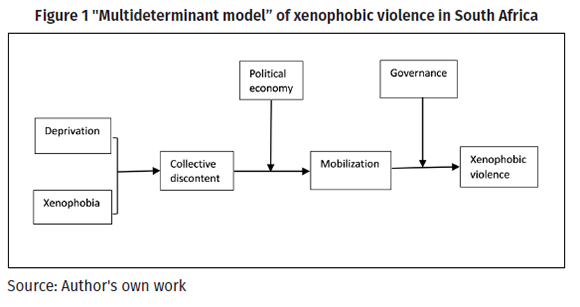
Widespread deprivation and pervasive xenophobia lead to collective discontent and strong resentment towards foreign nationals. Regarding political economy, local violence entrepreneurs exploit existing and well-known collective discontent against foreign nationals to mobilize residents for xenophobic attacks for their own political and economic interests. Localised political economy-or instrumental motives of violence entrepreneurs-acts as an intervening variable between collective discontent and mobilization. For mobilization, violence entrepreneurs use different mobilization techniques to trigger attacks on foreign nationals. They bring aggrieved community members together and stir them into a collective violent act to remove what they perceive to be the source of their discontent. It is the mobilization of discontent that triggers xenophobic violence. In terms of governance, favourable local governance provides mobilization with the micro-political opportunity structure it needs to take place, and eventually succeeds in triggering xenophobic violence. Governance acts as a defining intervening variable between mobilization and the occurrence of xenophobic violence as it alters the nature of their relationship depending on whether it acts as a facilitating or a thwarting agent.
The value-added process, as shown in Figure 1, reflects the determinants outlined above and how they interact in a value-added process to lead to the occurrence of xenophobic violence. Each determinant plays an indispensable role and adds its contribution to the contributions of other determinants. Each must be present for the next to assume the status of a determinant (see also Smelser, 1963). I argue that an incident of xenophobic violence would normally not happen if any of these determinants were absent. This means that none of these determinants can explain xenophobic violence on their own, but together, interacting in a value-added process, they constitute the necessary and sufficient conditions for a xenophobic violence incident to occur. I agree with Sen (2008: 15) that "none of these individual influences, important as they very often are in a fuller picture, can provide an adequate understanding of the causation of widespread violence. [...] The interconnections are as important as the elements that have to be connected." I therefore argue that this multideterminant model provides a comprehensive, theoretically informed and empirically based explanation for xenophobic violence in South Africa. By doing so, the model makes its own case by i) highlighting the need for an integrated empirical and theoretical model for xenophobic violence, and ii) making even more evident the poverty or incompleteness of existing, mono-causal empirical explanations and reductionist theoretical models.
CONCLUSION
Drawing on extensive and comparative qualitative data from a nearly two-decade long and ongoing research, this article responds to inadequacies and limitations of current causal explanations for xenophobic violence in South Africa. It argues that the poverty of existing explanatory models lies in a twofold repertoire of analytical blind spots: i) many lack empirical backing; ii) others are incomplete due to their reductionist approach. To address these shortcomings, this article proposes an empirically based and theoretically informed multideterminant (explanatory) model, which identifies and analyses the roles of-and interconnections between-six key determinants, namely: i) socio-economic and political deprivation, ii) xenophobic beliefs, iii) collective discontent, iv) political economy, v) mobilization, and vi) governance. I argue that i) these determinants and their interconnections in a value-added process constitute the necessary and sufficient conditions for the occurrence of xenophobic violence, and ii) this multideterminant model consequently provides an adequate and comprehensive explanation of the xenophobic violence in South Africa.
In addition to its scholarly contributions, this article has potential policy/ practical relevance and implications. By clearly identifying the main and critical elements of the causal chain, the study implicitly identifies critical areas where intervention efforts could be targeted in order to stop ongoing, and prevent future, xenophobic violence in South Africa. Empirical evidence from this study indicates that responses and intervention strategies to address xenophobic violence in South Africa have largely been ineffective because they are not evidence-based, that is, they are not informed by a clear understanding of key causal factors or determinants (Misago, 2016b). A clear understanding of the elements of the violence causal chain and their modes of interaction could help relevant stakeholders to design more effective intervention strategies. Stakeholders with different mandates and capacities could easily identify intervention areas where their efforts are most needed and are likely to have an impact.
REFERENCES
Aya, R. 1979. Theories of revolution reconsidered: Contrasting models of collective violence. Theory and Society, 8(1): 39-99. [ Links ]
Bostock, W.W. 2010. The psychological preconditions for collective violence: Several case studies. Journal of Alternative Perspectives in the Social Sciences. Available at: https://hdl.handle.net/102.100.100/585478.
Brief, A.P., Umphress, E.E., Dietz, J., Burrows, J.W., Butz, R.M. and Scholten, L. 2005. Community matters: Realistic group conflict theory and the impact of diversity. Academy of Management Journal, 48(5): 830-844. [ Links ]
Citizenship Rights in Africa Initiative (CRAI). 2009. Tolerating intolerance: Xenophobic violence in South Africa. Available at: http://Www.Citizenshiprightsinafrica.Org/Publications/2009/Craisareport.July2009.pdf. Accessed on 11 March 2024.
Claassen, C. 2017. Explaining South African xenophobia. Afrobarometer Working Paper No. 173, June 2017. Available at: https://www.afrobarometer.org/wpcontent/uploads/2022/02/afropaperno173_xenophobia_in_south_africa.pdf. Accessed on 07 April 2024.
Consortium for Refugees and Migrants in South Africa (CoRMSA). 2009. Protecting refugees, asylum seekers and immigrants in South Africa. Johannesburg: CoRMSA. [ Links ]
Conteh-Morgan, E. 2004. Collective political violence: An introduction to the theories and cases of violent conflicts. Routledge: New York and London.
Crush, J., McDonald, D., Williams, Lefko-Everett, K., Dorey, D.,Taylor, D. and Sablonnière, R. 2008. The perfect storm: The realities of xenophobia in contemporary South Africa. Cape Town: Southern African Migration project, Migration Policy Series, Idasa. [ Links ]
Barak, G. 2006. A critical perspective on violence. In DeKeseredy, W.S. and Barbara, P. (eds), Advancing critical criminology: Theory and application. Lexington Books: Lanham, pp 133-154.
Dodson, B. 2010. Locating xenophobia: Debate, discourse, and everyday experience in Cape Town. South Africa. Africa Today, 56(3): 2-22. [ Links ]
Gerring, J. 2009. A decoupage of violence: The harmonization of collective violence theories. University of North Carolina at Chapel Hill.
Gleason, K.A. 2011. Precipitants of the ethnic riot: A hierarchical analysis of structural and proximate causes. Paper prepared for the Midwest Political Science Association (MPSA) annual conference in Chicago, IL (30 March-2 April 2011).
Gordon, S. 2019. What research reveals about drivers of anti-immigrant hate crime in South Africa. The Conversation, 6 September 2019. Available at: https://theconversation.com/what-research-reveals-about-drivers-of-anti-immigrant-hate-crime-in-south-africa-123097. Accessed on 9 April 2024.
Gordon, S.L. 2024. Petty corruption experiences and xenophobic violence in South Africa. Development Southern Africa. Available at: DOI: 10.1080/0376835X.2023.2295873.
Guichaoua, Y. 2013. Group formation, identities, and violent mobilization: Evidence from Nigeria and Niger. In Justino, P., Brück, T. and Verwimp, P. (eds), A micro-level perspective on the dynamics of conflict, violence, and development. Oxford: Oxford University Press, pp 68-91. [ Links ]
Gurr, T.R. 1970). Why men rebel. Princeton, NY: Princeton University Press. [ Links ]
Harris, B. 2002. Xenophobia: A new pathology for a new South Africa? In Hook, D. and Eagle, G. (eds), Psychopathology and social prejudice. Cape Town: University of Cape Town Press, pp. 169-184. [ Links ]
Hechter, M., Friedman, D. and Appelbaum, M. 1982. A theory of ethnic collective action. International Migration Review, 16(2), Special Issue: Theory and Methods in Migration and Ethnic Research: 412-434. [ Links ]
Horowitz, D.L. 2001. The deadly ethnic riot. Berkeley: University of California Press. [ Links ]
Human rights Watch (HRW). 2020. They have robbed me of my life. Xenophobic violence against non-nationals in South Africa. Available at: https://www.hrw.org/report/2020/09/17/they-have-robbed-me-my-life/xenophobic-violence-against-non-nationals-south.
Human Sciences Research council (HSRC). 2020. Brief #2: How to Reduce Xenophobia in South Africa. Available at: http://www.hsrc.ac.za/uplo ads/pageContent/1044713/Xenophobia%20Brief%202%20-P/o20Human%20 Sciences%20Research%20Council(1).pdf. Accessed on 27 April 2021.
Institute for Justice and Reconciliation (IJR). 2023. South African Reconciliation Barometer: 2023 Report. Available at: https://www.ijr.org.za/portfolio-items/south-african-reconciliation-barometers-survey-2023-report/. Accessed on 27 December 2023.
Jaynes, N. 2008. The state of nation building in South Africa in the light of recent xenophobic attacks. In: Nord A.K. (ed.), Perspectives: Political analysis and commentary from Southern Africa. No. 3.08. June 2008.
Kaziboni, A. 2022. Apartheid racism and post-apartheid xenophobia: Bridging the gap. In Rugunanan, P., Xulu-Gama, N. (eds), Migration in Southern Africa. IMISCOE Research Series. Springer, Cham. Available at: https://doi.org/10.1007/978-3-030-92114-914
Kitschelt, H. P. 1986. Political opportunity structures and political protest: Anti-nuclear movements in four democracies. British Journal of Political Science, 16(1): 57-85. [ Links ]
Landau, L.B. 2011. Exorcising the demons within: Xenophobia, violence and statecraft in contemporary South Africa. Johannesburg: Wits University Press. [ Links ]
Lau, U., Seedat, M. and Suffla, S. 2010. Collective violence in South Africa: Explaining the explanations: Research and theory. African Safety Promotion, 8(2): 1-19. [ Links ]
Misago, J.P. 2016a. Migration, governance and violent exclusion: Exploring the determinants of xenophobic violence in post-apartheid South Africa. PhD Thesis, University of the Witwatersrand, South Africa. [ Links ]
Misago, J.P. 2016b. Responding to xenophobic violence in South Africa: Barking up the wrong tree? African Human Mobility Review, 2(2): 443-467. [ Links ]
Misago, J.P. 2017. Politics by other means?: The political economy of xenophobic violence in post-apartheid South Africa. The Black Scholar, 47(2): 40-53. [ Links ]
Misago, J.P. 2019a. Political mobilisation as the trigger of xenophobic violence in post-apartheid South Africa. International Journal of Conflict and Violence, 13: 1-10. [ Links ]
Misago, J.P. 2019b: Linking governance and xenophobic violence in contemporary South Africa. African Journal on Conflict Resolution, 19(1): 58-80. [ Links ]
Misago, J.P. and Landau, L.B. 2022: Running them out of time: Xenophobia, violence, and co-authoring spatiotemporal exclusion in South Africa. Geopolitics. Available at: DOI: 10.1080/14650045.2022.2078707.
Misago, J.P., Kabiri, B. and Mlilo, S. 2021. Xenophobic violence in South Africa: An analysis of trends, causal factors and responses. A Xenowatch Quinquennial Report. African Centre for Migration and Society, December 2021.
Misago, J.P., Landau, L. and Monson, T. 2009. Towards tolerance, law and dignity: Addressing violence against foreign nationals in South Africa. Pretoria: IOM. [ Links ]
Monson, T. 2011. Making the law; breaking the law; taking the law into our own hands: Sovereignty and territorial control in three South African settlements. In Landau L.B. (ed.), Exorcising the Demons within: Xenophobia, Violence and Statecraft in Contemporary South Africa. Johannesburg: Wits University Press. [ Links ]
Muller, E.N. and Opp, K. 1986. Rational choice and rebellious collective action. The American Political Science Review, 80(2): 471-488. [ Links ]
Muswede, T. and Mpofu, S. 2020. Complicity and condonation: The tabloid press and reporting of migrant access to public health in South Africa. In Moyo, D. and Mpofu, S. (eds), Mediating xenophobia in Africa: Unpacking discourses of migration, belonging and othering. Switzerland: Palgrave Macmillan. pp. 267-284. [ Links ]
Nyamnjoh, F.B. 2006. Insiders and outsiders: Citizenship and xenophobia in contemporary Southern Africa. London: Zed Books. [ Links ]
Olofinbiyi, S.A. 2022. Anti-immigrant violence and xenophobia in South Africa: Untreated malady and potential snagfornational development. Insight on Africa, 14(2): 193-211. Available at: https://doi.org/10.1177/09750878221079803. [ Links ]
Peberdy, S. 2009. Selecting immigrants: National identity and South Africa's immigration policies 1910-2008. Johannesburg: Wits University Press. [ Links ]
Piven, F.F. and Cloward, R.A. 1991. Collective protest: A critique of resource mobilization theory. International Journal of Politics, Culture, and Society, 4(4): 435-458. [ Links ]
Postmes, T. 2019. Collective discontent, polarization and protest. Mindwise. Available at: https://mindwise-groningen.nl/collective-discontent-polarization-and-protest/. Accessed on 19 April 2024.
Seedat, M., Bawa, U. and Ratele, K. 2010. Why the wretched kill in democratic South Africa: Reflections on rejuvenation and reconstruction. Social Change, 40(1): 15-27. [ Links ]
Sempijja N. and Mongale C.O. 2022. Xenophobia in urban spaces: Analyzing the drivers and social justice goals from the Ugandan-Asian debacle of 1972 and xenophobic attacks in South Africa (2008-2019). Frontiers in Sustainable Cities, 4:934344. Available at: doi: 10.3389/frsc.2022.934344. [ Links ]
Sen, A. 2008. Violence, identity and poverty. Journal of Peace Research, 45(1): 5-15. [ Links ]
Simelane, B.C. 2022. Violence breaks out as Alexandra Dudula Movement members target foreign informal traders. Daily Maverick, 7 March 2022.
Smelser, N.J. 1963. Theory of Collective Behavior. New York: Free Press. [ Links ]
Sniderman, P.M., Hagendoorn, L. and Prior, M. 2004. Predisposing factors and situational triggers: Exclusionary reactions to immigrant minorities. American Political Science Review, 98(1): 35-49. [ Links ]
Snyder, D. 1978. Collective violence: A research agenda and some strategic considerations. The Journal of Conflict Resolution, 22(3): 499-534. [ Links ]
Tewold, A.I. 2020. Reframing xenophobia in South Africa as colour-blind: The limits of the Afro phobia thesis. Migration Letters, 17(3): 433-444. Available at: https://doi.org/10.33182/ml.v17i3.789. [ Links ]
Tilly, C. 2003. The politics of collective violence. Cambridge: Cambridge University Press. [ Links ]
Tshitereke, C. 1999. Xenophobia and relative deprivation. Crossings, 3(2): 4-5. [ Links ]
United Nations High commissioner for Refugess (UNHCR). 2015. Protection from xenophobia: An evaluation of UNHCR's regional office for Southern Africa's xenophobia related programmes. Available at: https://www.unhcr.org/55cb153f9.pdf. Accessed on 27 March 2021.
Useem, B. 1998. Breakdown theories of collective action. Annual Review of Sociology, 24: 215-238. [ Links ]
Zald, M.N. and McCarthy, J.D. 1979. the dynamics of social movements. Cambridge: Winthrop Publications. [ Links ]
Received 27 August 2024
Accepted 06 December 2024
Published 25 April 2025
1 Interview with a Mamelodi resident, April 7, 2022.
2 Interview with a Dunoon resident, March 14, 2022.
3 Interview with a former Dudula Movement leader, December 2022.
4 Interview with an Alexandra resident, June 2, 2009.
