




Services on Demand
Journal

Article
 English (pdf)
 Article in xml format
 Article references
 Automatic translation
 Send this article by e-mail
Indicators
Related links
-
 Cited by Google
 -
 Similars in Google
Share

 Permalink
African Human Mobility Review
On-line version ISSN 2410-7972Print version ISSN 2411-6955
AHMR vol.10 n.3 Cape Town Sep./Dec. 2024
https://doi.org/10.14426/ahmr.v10i3.2436
ARTICLES
Sustainable Development Goals and Food Remittances: COVID-19 Lockdowns, Digital Transformation, Lessons, and Policy Reflections from the South Africa-Zimbabwe Corridor
Sean SitholeI; Mulugeta F. DinbaboII; Daniel TeveraIII
IInstitute for Social Development, University of the Western Cape, Cape Town, South Africa. Corresponding author: stsithole@uwc.ac.za; https://orcid.org/0000-0003-1384-9567
IIInstitute for Social Development, University of the Western Cape, Cape Town, South Africa. https://orcid.org/0000-0001-5556-9681
IIIDepartment of Geography, Environmental Studies and Tourism, University of the Western Cape, Cape Town, South Africa. https://orcid.org/0000-0002-7435-005X
ABSTRACT
The United Nations (UN) Sustainable Development Goals (SDGs) aim to address global challenges like food insecurity, poverty, inequality, and economic growth. Remittances are crucial in achieving these goals, especially in developing countries. By directly supporting households, remittances help reduce poverty and food insecurity, improve access to healthcare and education and bolster financial stability. Strengthening policies to facilitate safe, affordable remittances aligns with SDG targets and empowers families to break the poverty cycle, contributing to sustainable development at the community level. Recent migration studies reveal that food remittances are essential to achieving the SDG goals, mainly poverty reduction at the household level and the nutrition security of poor households in Southern Africa. The COVID-19 pandemic profoundly disrupted the mechanisms and pathways through which international migrants transfer food remittances to their home countries. In the Global South, recent studies have highlighted the expansion of digital-mobile technology. However, in Southern Africa, digital food remittances are still under-researched. This paper is based on a mixed-methods study whose aim is to contribute to the academic and policy discussion on food remittances by examining the impact of the COVID-19 pandemic lockdowns introduced by the South African and Zimbabwean governments on the nature and volume of cross-border food remittance flows between the two countries. The article begins by assessing the characteristics of food remittance transfers during the pandemic. It then highlights key lessons learned regarding the role of various transfer channels amid significant disruptions. Finally, the discussion pivots to the implications of mobile and digital technology-based channels for the food remittance market, which primarily operates within informal financial ecosystems. This examination underscores the transformative potential of technological advancements in reshaping the dynamics of remittance flows during times of crisis. A key finding is that digital-mobile technologies in cross-border food remittances promote financial and digital inclusion and offer swift, accessible (particularly during the pandemic-induced disruptions of informal channels), reliable, and convenient ways to remit food, which is crucial for food and nutrition security. The insights gained from this paper underscore the need for policymakers to support and enhance the integration of digital-mobile technologies within the food remittance framework. By doing so, stakeholders can ensure improved food and nutrition security for families reliant on these vital transfers, thus contributing to broader socio-economic stability in the region.
Keywords: food remittances, digital technology, mobile transfers, food security, COVID-19, Sustainable Development Goals, Zimbabwean diaspora support
INTRODUCTION
The Sustainable Development Goals (SDGs) represent a universal call to action to tackle some of the world's most pressing challenges, including poverty reduction, inequality, and sustainable economic growth (Allen et al., 2018). Launched by the United Nations (UN) in 2015, the 17 SDGs provide a roadmap for countries to achieve a fairer, more sustainable future by 2030. Goal 1 focuses on eradicating poverty in all forms, recognizing that lifting individuals out of poverty improves overall well-being and economic stability. Goal 10 aims to reduce inequalities within and among countries, promoting social inclusion and justice (Esiri et al., 2024). Additionally, Goal 8 emphasizes sustainable economic growth by fostering decent work opportunities, entrepreneurship, and innovation (Zakari et al., 2022). Together, these targets aim to create resilient, inclusive societies where prosperity and development are accessible to all.
For the most vulnerable segments of society, remittances serve as a catalyst for change and are essential to achieving the SDGs (Malecki, 2021; Burger, 2023; Barkat et al., 2024; Mabrouk, 2024). According to the 2021 International Fund for Agricultural Development (IFAD) report, remittances help achieve SDGs 1-8, 12, and 13. Since a 10% increase in per capita remittances could reduce the percentage of a nation's population living in poverty by 3.5%, this impact includes the eradication of poverty (Burger, 2023:1). Additional effects include eliminating hunger, promoting health and well-being, ensuring clean water and sanitation, promoting gender equality, and providing affordable and clean energy. Remittances also support climate action, promote responsible production and consumption, guarantee decent work, and boost the economy (Barkat et al., 2024). Remittances can also provide financial resources during economic shocks, crises, and pandemics.
On 11 March 2020, the World Health Organization (WHO, 2020) officially declared the COVID-19 crisis as a "pandemic" following a sharp surge in cases and deaths globally. In response, countries across the Global North and South implemented public health lockdowns and restrictions to mitigate the virus' spread and minimize its devastating impact (Ataguba, 2020; Benítez et al., 2020; Prime and Slabe-Erker, 2020; Fauzi and Paiman, 2021; Onyeaka et al., 2021). South Africa and Zimbabwe were no exceptions. In March 2020, the Disaster Management Act and the COVID-19 Prevention, Containment, and Treatment Order were enacted, respectively, to contain and mitigate the spread of the coronavirus. The measures disrupted both domestic and international mobility. The lockdowns, mobility restrictions and disruptions drastically affected migrants and the transfer of remittances, especially the use of informal channels (Crush et al., 2021; Sithole et al., 2022, 2024a; Crush and Tawodzera, 2023).
The COVID-19 pandemic disrupted the channeling of remittances, a crucial source of cash, food, and other goods for many poor households in the Global South. Migrants were compelled to rely on formal and digital-mobile remittance channels due to mobility restrictions, lockdowns, travel bans, border closures, and limited access to informal channels, commonly based on in-person transactions. These disruptions arose from public health measures implemented to contain the spread of the virus, including social distancing, curfews, mobility restrictions, travel bans and border closures. With informal channels constrained, many migrants adopted digital platforms and mobile technologies for remittances, allowing them to evade physical barriers and continue supporting families despite the pandemic and lockdown limitations. The disruptions caused by the COVID-19 pandemic were initially expected to significantly reduce the flow of remittances globally.
However, contrary to these predictions, remittance flows demonstrated remarkable resilience in 2020, the first year of the COVID-19 pandemic, with both formal (including digital) and informal channels playing a considerable role. According to the World Bank (2021) data, in 2020, remittance flows to low- and middle-income countries recorded a modest 1.7% decrease to $549 billion. In some regions in the Global South, by "defying the odds" in Asia and Africa, countries such as Bangladesh, Bhutan, Comoros, The Gambia, Kenya, and Pakistan in 2020 all recorded an upsurge in remittance flows of more than 10% compared to the previous year (Kpodar et al., 2023). Similarly, Mbiba and Mupfumira (2022) note that migrants from Zimbabwe were "rising to the occasion" by sending remittances consistently during the pandemic. For example, they show that Zimbabwean migrants in the United Kingdom (UK) transferred more remittances than in previous years, changed their consumption behaviors, worked extended hours, and even took out loans to support families and relatives back home.
In addition to cash remittances, studies highlight the significance of in-kind transfers - such as food - that played a crucial role during the pandemic. For instance, Zimbabwean migrants in South Africa transfer food remittances to support migrant-sending households, emphasizing the importance of non-cash remittances (Sithole et al., 2022, 2024a; Sithole, 2023). The COVID-19 pandemic accelerated the adoption of digital technologies, enhancing automation and digitization in daily life, from remote work and virtual communication to contact tracing and tracking COVID-19 infections (Datta and Guermond, 2020). These shifts demonstrate how the pandemic disrupted informal remittance pathways and enhanced digital innovation in financial transactions and virtual interactions. The COVID-19 pandemic and lockdowns significantly disrupted food systems, supply chains and consumers' conventional purchasing habits globally.
Mobility restrictions, curfews, and restricted access to familiar food sources, such as supermarkets, food outlets, vendors, and informal markets, increased the adoption of contactless online food purchasing. Consumers increasingly depended on digital platforms, mobile apps, and online services to purchase essential goods. Businesses, in turn, adopted e-procurement systems to connect with farmers and processors and expanded e-commerce operations to meet changing consumer demands (Reardon et al., 2021a, 2021b). In Asian countries such as China and Thailand, the lockdowns and the closure of wet markets drove the rapid growth of digital commerce, with increased use of smartphones and mobile apps facilitating online food purchases through the use of food delivery apps (Chotigo and Kadono, 2021; Liang et al., 2022). Similarly, in Latin America and Africa, public health regulations and amplified distress about safety and hygiene accelerated the adoption of online food buying and delivery apps (Zanetta et al., 2021; Bannor and Amponsah, 2024).
In South Africa, consumers embraced the online services of retail supermarkets and engaged more frequently in online shopping to cope with the pandemic and restricted access to physical stores (Naicker et al., 2021). The COVID-19 pandemic considerably disrupted informal remittance channels, accelerating the adoption of financial technology (fintech) and increasing the use of digital remittance channels. Ratha et al. (2021), using World Bank data, show that international remittances transmitted via mobile devices rose to US$ 12.7 billion in 2020, indicating a 65% increase compared to 2019. Dinarte-Diaz et al. (2022) indicate that remittances were strikingly transferred during the pandemic "neither by land nor by sea" but via banks, digital wallets, mobile money, e-money accounts, and other formal financial channels.
Digital remittance platforms, including online services, mobile apps, and smartphone technologies have transformed how remittances are transferred. Digital and mobile technologies have secure, speedy, dependable, and affordable services to send remittances compared to banking systems, enabling real-time transactions that are accessible and efficient. Proponents of fintech innovations and telecommunication companies highlight that digital transactions are not only faster and more efficient but also cheaper, ensuring that more funds reach recipients conveniently (Datta and Guermond, 2020). The expanding prominence of digital remittances was underscored on the UN's International Day of Family Remittances (IDFR), observed annually on 16 June. In 2023, the theme emphasized the role of digital and financial inclusion in enhancing the impact of remittances and helping migrant families achieve their SDGs (UN, 2023). The IDFR celebrates the critical contributions of migrants toward improving the livelihoods of their families and acknowledges how digital remittance pathways support households by making financial services more inclusive and accessible, especially in rural, remote, and underserved areas.
Research highlights the crucial role of mobile and digital technologies in remittance services, particularly in promoting financial inclusion among vulnerable groups, such as the unbanked, undocumented migrants, and communities in rural or remote African regions (Mutsonziwa and Maposa, 2016; Nyanhete, 2017; Kitimbo, 2021; Tembo and Okoro, 2021). Remittance transfers, in the context of this study, have become increasingly significant, particularly in the context of the rising migration from Zimbabwe to South Africa in the last two decades. The increased migration has been caused by a mix of socio-economic predicaments in Zimbabwe, including high unemployment, currency instability, hyperinflation, declining agricultural outputs, food insecurity, and political instability. Recent data have indicated that South Africa hosts an estimated 2.4 million international migrants, with over one million Zimbabwean migrants, making Zimbabwe the largest migrant-sending country in South Africa (Stats SA, 2023).
Against the backdrop of Zimbabwe's economic crisis, remittances from South Africa have become essential for households, enabling access to basic needs, such as food, healthcare, education, housing, and clothing (Tevera and Maphosa, 2007; Chikanda, 2009a; Mukwedeya, 2011; Mbiba and Mupfumira, 2022). Remittances improve well-being and livelihoods and act as a cushion for families facing severe financial poverty. While cash remittances have received considerable research and policy attention, food remittances have been relatively under-researched and neglected (Crush and Caesar, 2018, 2020). Crush and Caesar (2018, 2020) emphasize the pressing need to better understand food remittances in Africa and examine them, focusing on the drivers, characteristics, and impacts.
This article seeks to contribute to the debates on the SDGs, migrant remittances, and food by examining the impact of COVID-19 pandemic lockdowns and the digitalization of food remittance transfers. It examines three key areas: the characteristics of food remittances during the pandemic, lessons learned from the pandemic and emerging transfer channels, and the implications of evolving digital technology on the predominantly informal food remittance market. The article concludes with a call for further research and policy focus on the synergies between migration, food remittances, and digital-mobile technologies.
COVID-19 LOCKDOWNS: POLICY RESPONSES BY THE SOUTH AFRICAN AND ZIMBABWEAN GOVERNMENTS
The COVID-19 pandemic declaration in March 2020 was followed by a series of lockdowns, travel bans, mobility restrictions, and border closures imposed by South African and Zimbabwean governments, which disrupted the movement of people and goods between the two countries (Crush et al., 2021b; Sithole et al., 2023; 2024a). The disruptions notably limited access to informal remittance channels, prompting many migrants to up-take digital-mobile and formal channels to transmit remittances home. Crush and Si (2020) and Paganini et al. (2020) argue that pandemic containment measures significantly affected national and transnational food supply chains and local and regional food systems in the Global South, further straining informal food markets.
The first confirmed COVID-19 case in South Africa was reported on 5 March 2020, when a South African returned from Italy (RSA, 2020a). By 15 March, the case count had risen to 61, and with the cases predicted to rise, the president declared a national state of disaster under the Disaster Management Act. In the same month, the National Coronavirus Command Council was established to spearhead containment and mitigation measures, including travel bans, border and seaport closures, visa denials and cancellations, school/educational institutions shutdowns, and restrictions on large gatherings (RSA, 2020b). As cases continued to rise, reaching 402 by 23 March 2020, a 21-day nationwide lockdown was implemented from midnight on 26 March 2020, to limit the spread of the virus and mitigate its impact.
The lockdown measures in South Africa included strict prohibitions on inter-provincial travel, curfews, quarantines for travelers from high-risk countries, and suspension of international flights. Entry restrictions were imposed on non-South Africans from high-risk regions. Additional restrictions included canceling mass celebrations and public events, limitations on alcohol sales, and the closure of non-essential businesses, shops, bars, restaurants, and recreational spaces. By 27 March 2020, COVID-19 cases had reached 1,170, and the first virus-related death was reported (RSA, 2020c). Only essential workers and services such as healthcare, emergency, security, municipal services, food production, supply, distribution, or allocation were allowed to continue operations (DIRCO, 2020).
On 21 April 2020, the South African government announced a R500 billion social and economic relief package to support vulnerable communities during the lockdown. However, this aid primarily targeted South African citizens and permanent residents, leaving undocumented migrants, refugees, and asylum seekers without significant support (Mukumbang et al., 2020; Crush and Sithole, 2024a; 2024b). From April 2020 to June 2022, South Africa fluctuated between alert levels 1 and 5 to manage COVID-19 risk, with level 1 indicating low virus spread and high health system readiness and level 2 indicating moderate spread with sustained health system readiness (RSA, 2020d). Alert level 3 indicated a moderate COVID-19 spread with moderate health system readiness. Alert level 4 suggested a moderate to high spread and a low to moderate readiness of the health system, while alert level 5 represented a high COVID-19 spread with low health system capacity.
The South African government (RSA, 2020d) outlined the objectives of each alert level as follows: alert level 1 allowed most activities to resume, with safety measures in place, while health guidelines were to be adhered to at all times and prepared the public for potential escalation. Alert level 2 focused on physical distancing and limited social and leisure activities to prevent case resurgence. Alert level 3 restricted various activities, such as in social and workplaces, to prevent high transmission risks. Alert level 4 was intended to lessen community outbreaks through strict safety measures, permitting limited economic activities. The last category, alert level 5, enforced strict measures to save lives and control virus spread. As of 3 October 2023, South Africa had recorded over 102,500 COVID-19 deaths, more than 4 million confirmed cases, conducted over 21 million tests, and administered 38 million vaccine doses (Johns Hopkins University, 2023a), reflecting the impact and the extensive response to the pandemic.
In Zimbabwe, the first confirmed COVID-19 case was reported on 20 March 2020, when a resident of Victoria Falls returned from the UK. The first COVID-19-related death was recorded soon after, involving a local journalist who had traveled from the United States and was the country's second confirmed case. With a rise in cases, the government implemented the COVID-19 Prevention, Containment, and Treatment Order and initiated a 21-day lockdown (30 March to 19 April 2020). The government also established a National COVID-19 Response Taskforce to monitor pandemic developments, coordinate responses, and mobilize resources to mitigate the crisis' impact (Maulani et al., 2020). The lockdown-imposed restrictions on non-essential activities and gatherings, limited public movement (except for personnel providing essential services), school closures, and closed borders and airports mandated mask-wearing and the establishment of isolation centers (Maulani et al., 2020).
Essential services, including emergency and hospital services, sanitation, state security, electricity and water services, food and retail outlets, agricultural suppliers, communication, money-transfer and exchange services and aid/humanitarian personnel, were exempted from lockdown restrictions (Maulani et al., 2020; Murendo et al., 2021). Zimbabweans returning from abroad were allowed entry but required to undergo a 14-day quarantine upon arrival. As of 3 October 2023, Zimbabwe had recorded over 5,600 deaths and more than 264,000 confirmed cases, with 12.6 million vaccine doses administered (Johns Hopkins University, 2023b), highlighting the efforts undertaken to manage the pandemic's impact.
DIGITAL-MOBILE TECHNOLOGIES, FOOD REMITTANCES, AND SUSTAINABLE DEVELOPMENT GOALS
Digital, mobile, and financial technologies have transformed financial transactions, changing user experiences and services. The COVID-19 pandemic caused disruptions in established informal channels and hastened evolutions in financial technology (fintech) and the adoption of digital and mobile services. According to Agur et al. (2020), digital financial services are comprised of financial tools such as remittances, payments, and credit, accessible through digital and mobile pathways. These services include traditional instruments like credit and debit cards (primarily offered through banks) and new innovations built on digital platforms, cloud computing, and distributed ledger technologies, such as mobile transactions, peer-to-peer (P2P) applications, and crypto-assets. Emara and Zhang (2021) argue that fintech is a crucial driver of financial inclusion, with evolving technologies like mobile money (enabling transactions without a bank account) and mobile banking (facilitating swift digital transactions on mobile devices). Advancements and expansions of digital-mobile payment systems, Internet-based technologies and online money-transfer services have significantly enhanced financial inclusion and access (Abdul Mannan and Farhana, 2023).
Emara and Zhang (2021) argue that advancements in a country's digital ecosystem can facilitate remittances by providing a convenient digital pathway for people, businesses, and governments to process or receive funds. Critical steps to strengthening the digital ecosystem include investing in human capital, expanding Internet access in educational institutions, increasing investments in digital media, mobile data, and Internet services and encouraging the use of electronic banking across consumers, businesses, and governments (Emara and Zhang, 2021). According to the World Bank (2021), digital remittances are transmitted through self-assisted or online payment systems. They can be received in transaction accounts provided by banks or non-bank entities, such as mobile money and e-money accounts available at post offices. Similarly, Agur et al. (2020) describe digital remittances as cross-border transfers facilitated through the Internet by migrants, providing a streamlined alternative to traditional channels.
The rise of digital and mobile technologies has revolutionized how international migrants send cross-border remittances and how beneficiaries receive them. Research highlights that digital and mobile remittances are user-friendly, fast, secure, convenient, and low-cost (Merritt, 2011; Siegel and Fransen, 2013; Ahmad, Green and Jiang, 2020). The World Bank notes that digital remittance channels are generally more cost-effective than conventional bank transfers (Ratha et al., 2021). RemitSCOPE (2022) notes that digital remittances, electronic transactions and mobile money are expanding in the Global South, for example, across Africa, enhancing financial access and digital inclusion for migrants and their families. Governments in several African countries, including Ghana, Kenya, and Liberia, have encouraged banks to reduce or waive transaction fees and increase daily transaction limits to support mobile money and digital financial services (Machasio, 2020). A core objective of fintech is the financial inclusion of vulnerable communities. Ardic et al. (2022) observe that digitalizing remittance services offers innovative ways to enhance financial inclusion, particularly for undocumented migrants and persons with limited digital literacy.
The evolution of cell phone banking and digital-mobile technologies in remittance sending is transformational in the Global South; it enhances financial and digital access and supports economic resilience in marginalized communities (such as unbanked communities and low-income populations). Across regions, including Africa, Asia, the Pacific, the Middle East, Latin America, and the Caribbean, investments in digital ecosystems, electronic payments, and mobile money have increased financial inclusion and made remittances faster, safer, and more convenient for both senders and recipients (Emara and Zhang, 2021; Hahm et al., 2021; Tembo and Okoro, 2021). In Africa, for instance, digital financial services have enabled previously excluded groups, such as those in the informal sector, low-income earners, the unemployed, and youth, to access financial services, thereby boosting digital financial inclusion (Mpofu and Mhlanga, 2022).
In Africa, the growth of digital-mobile financial services has pioneered advanced pathways for remitting and is accessible to informal traders and undocumented migrants who are typically excluded (Tembo and Okoro, 2021). One prominent example of this shift is M-Pesa, Kenya's mobile wallet system, which has set a high standard in Africa and catalyzed the development of similar mobile money services across the continent (Agur et al., 2020; Emara and Zhang, 2021). Launched in 2007 by the Safaricom-Vodafone Group, M-Pesa, meaning "mobile cash" in Swahili, has rapidly gained popularity, supporting both micro-financing and mobile-based money transfers (Hughes and Lonie, 2007; Kingiri and Fu, 2019).
In Southern Africa, the World Bank (2018) notes that undocumented migrants can access digital and mobile remittance services for low-value transactions without formal identification, such as South Africa's policy allowing transfers under a daily limit of R3,000 and a monthly limit of R10,000. In Zimbabwe, mobile banking platforms such as EcoCash, EcoCash Diaspora, and Mukuru have provided rural and urban populations with affordable, reliable, and secure financial services (Mutsonziwa and Maposa, 2016; Gukurume and Mahiya, 2020; Cirolia et al., 2022), making these services not just accessible but also affordable for individuals lacking access to conventional banking systems. This underscores the impact of digital financial solutions on financial inclusion in the region.
Groceries and food remittances are generally transferred through informal channels (non-market pathways). However, recent studies by Sithole (2022, 2023) and Sithole et al. (2022, 2023, 2024a) highlight the emerging flows of cross-border food remittances using mobile and digital technology channels, illustrating a noteworthy shift in the remittance services in sub-Saharan Africa. Fintech companies such as Mukuru Groceries, Malaicha, Ahoyi Africa, Senditoo, Tinokunda, and Shumba Africa now offer services that facilitate the transfer of food, groceries, and other goods through digital services. The services are accessible via smartphones and mobile devices. This digital approach is particularly beneficial for undocumented migrants and informal traders who may lack formal identification (such as ID, passports, and visas) but still wish to engage in remittance transactions.
New fintech entrants like Mukuru and Malaicha have increasingly focused on the South Africa-Zimbabwe remittance corridor, a vibrant and growing market. The name "Malaicha" itself reflects the long-standing term "omalayishas" or "malayishas," which is commonly used to describe informal couriers or transporters of cash, goods, and people, often using buses and vans, along the South Africa-Zimbabwe route. The SiNdebele term "malayitsha" translates to those who carry a heavy load or who load and carry goods, underscoring the importance of these couriers within migrant communities (Nyamunda, 2014; Nzima, 2017). Many Zimbabwean migrants regularly rely on malayishas to send cash and goods back home to their families and relatives (Nyoni, 2012; Thebe, 2015).
The Malaicha company has further emphasized the value of digital platforms for sending food, groceries, and other essentials, highlighting these channels as more secure, reliable, and convenient alternatives for Zimbabwean migrants supporting families back home:
For Zimbabweans who are far from home, ensuring that their family is fed and looked after is one of their most fundamental goals. This is often easier said than done when faced with costly solutions, the potential for damaged goods and uncertainty of whether groceries may even reach their destination. Malaicha.com has revolutionized the way Zim-babweans based in South Africa are able to send goods and groceries to their loved ones (Santosdiaz, 2020).
The digital transformation offers secure remittance alternatives and provides solutions that align with improving service efficiency and security. Cross-border remittances and digital-mobile technology solutions have enormous potential to address several SDG targets. The SDGs focus on sustainability, economic development, social inclusion, environmental issues, and global partnership (De Jong and Vijge, 2021). Rooted in the United Nations's 2030 Agenda for Sustainable Development, the 17 SDGs encompass goals such as no poverty (SDG 1), zero hunger (SDG 2), good health and well-being (SDG 3), quality education (SDG 4), gender equality (SDG 5), clean water and sanitation (SDG 6), affordable and clean energy (SDG 7), decent work and economic growth (SDG 8) and industry, innovation and infrastructure (SDG 9).
The SDGs are greatly aided by remittances, especially in developing nations. Families directly benefit from remittances, which increase access to necessities like food, healthcare, and education, thereby reducing poverty. In general, remittances contribute to SDGs as follows: Goal 1, no poverty; Goal 2, zero hunger; Goal 3, good health and well-being; Goal 4, quality education; Goal 5, gender equality; Goal 6, clean water and sanitation; Goal 7, affordable and clean energy; Goal 8, decent work and economic growth; Goal 12, responsible consumption and production; and Goal 13, climate action. The importance of effective, reasonably priced channels for remittances cannot be overstated, as they are potent for promoting several SDGs and sustainable development when effective, reasonably priced channels are made available. Figure 1 shows the contribution of remittances to 10 key SDGs.
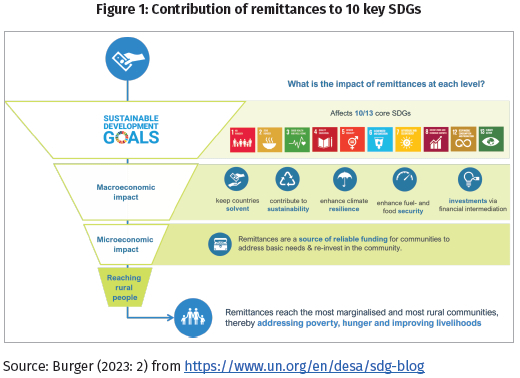
In the Global South, remittances often serve as a lifeline for vulnerable migrant-sending households, particularly in countries facing economic challenges, including poverty, inequality, and food insecurity. The cash and food transfers are crucial for accessing essential needs such as food, healthcare, housing, education, and clothing. Adopting and using digital-mobile technologies for food remittances ensure rapid, accessible, and reliable response to hunger, especially during pandemics such as COVID-19, economic shocks, and emergencies (Sithole et al., 2022, 2023). Therefore, digital-mobile technology-based channels for food remittances, with their convenient and rapid response to hunger, food shortages, and food insecurity, can contribute to attaining zero hunger (SDG 2), eradicating poverty (SDG 1), improving health and well-being (SDG 3), reducing inequality (SDG 10) and other related SDGs. These technologies assist remittance senders and beneficiaries in shrinking inequalities, improving food and nutrition security and presenting sustainable strategies.
METHODOLOGY
The research is based on data collected in 2020 in Cape Town, South Africa. South African cities, such as Cape Town, are major destinations for international migrants because of economic and job opportunities. The research team undertook primary data collection in the southern and northern suburbs of Cape Town. These suburbs include Bellville, Claremont, Kenilworth, Rondebosch, and Wynberg. The selected neighborhoods are strategic localities for international migrants because they have facilities such as economic and employment prospects, as well as social, residential, educational, and entrepreneurial opportunities and services. To ensure diversity in the study, the participants were from diverse backgrounds: experience, education, occupation, age, gender, and location. The research is based on a mixed-methods approach. Thus, the researchers conducted a questionnaire survey of 100 participants for the quantitative part and 10 in-depth interviews for the qualitative section. The research team adopted STATA statistical software to analyze the quantitative data and used a thematic technique for qualitative data analysis. In the study, the researchers adhered to all ethical protocols, such as acquiring ethical clearance, being granted permission, informed consent, and ensuring anonymity and confidentiality.
CROSS-BORDER FOOD REMITTANCES FROM SOUTH AFRICA TO ZIMBABWE DURING COVID-19 PANDEMIC
Background and demographic information of food-remitting migrants
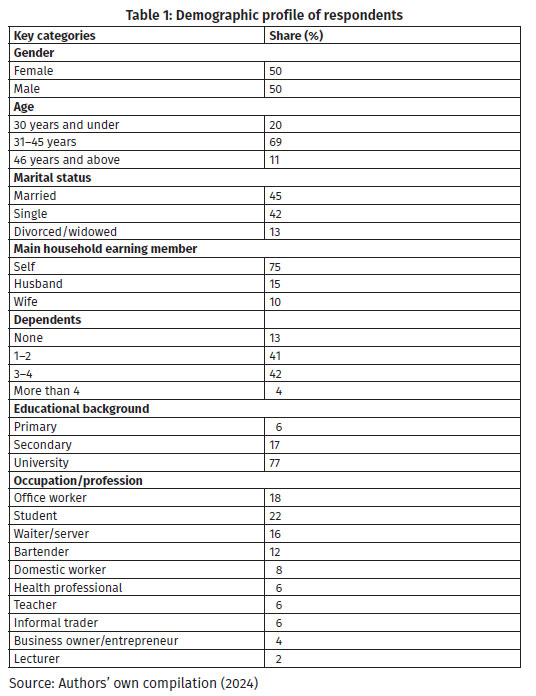
The demographic profile of the 100 food-remitting Zimbabwean migrants who participated in this research is summarized in Table 1. The profile of the participants demonstrated widespread diversity in terms of age (ranging from 23 to 60 years), gender, marital status, dependents (the majority had at least two), education (77% had university qualifications), and occupation (office workers, teachers, lecturers, health professionals, and blue-collar workers - including informal traders and domestic workers). Table 1 shows that a majority of the participants (75%) were de facto household heads and primary earning members of their households. The in-depth interviews were based on accounts from 10 Zimbabwean migrants (six males and four females), and their ages ranged between 27 and 59. The participants' occupations included office workers, teachers, lecturers, postgraduate students, gardeners, waiters (servers), and bartenders.
Migration drivers and motivations to remit food
The research conducted by Sithole et al. (2022, 2023, 2024a), alongside the studies by Crush and Tawodzera (2017), Sithole and Dinbabo (2016), Crush et al. (2015), and Crush and Tevera (2010), underscores the multifaceted nature of the drivers of mass emigration from Zimbabwe over the past two decades. These investigations identify socio-economic and political factors as pivotal influences precipitating this phenomenon. The reasons are consistent with the findings in this study, where the deteriorating economic conditions, socio-economic crises and political instability were the drivers of the mass departure from Zimbabwe (see Figure 2). The majority (85%) of the participants left Zimbabwe to search for employment in South Africa. In contrast, several other participants (72%) emigrated to flee the economic and social predicament experienced by Zimbabwe since the 1990s (hyperinflation rates, high food prices, currency instability, unemployment, and periodic droughts). Two-thirds (64%) stated they emigrated because of the food challenges in Zimbabwe, including prevalent circumstances of food insecurity and food shortages.
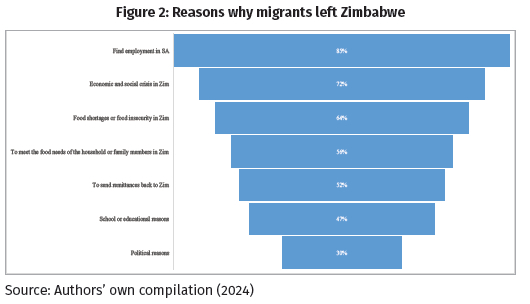
More than half of the survey participants indicated that they departed Zimbabwe to seek economic and income-generating opportunities that would enable them to send back remittances (52%) and meet the food needs of the migrant-sending families and households (56%). Other migration drivers included school or educational reasons (47%) and evading political hostility (30%). Figure 2 shows the reasons why migrants left Zimbabwe.
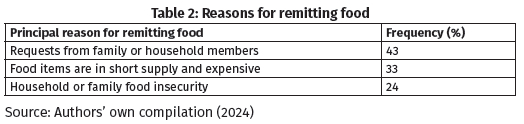
Survey participants were asked to indicate their primary determinants for transferring food to Zimbabwe (see Table 2). A significant proportion, comprising 43% of respondents, reported that their primary reason was to satisfy requests for food from households and family members residing in Zimbabwe. Additionally, one-third (33%) of the participants indicated that their motivations stemmed from the scarcity of essential commodities and the elevated prices of food items in local markets in Zimbabwe. Almost a quarter (24%) of participants sent food to alleviate the food insecurity of their families and households in Zimbabwe.
In the in-depth interviews, the participants emphasized the crucial motivations for food remitting. As one Zimbabwean migrant explained, "I am influenced by the shortages [in Zimbabwe], you know, they [relatives] communicate with me sometimes to say, 'We have run out of basics' ." Another Zimbabwean migrant stated, "My reasons for sending back food are mainly based on the requests that my family makes." From these accounts, it is apparent that the adverse economic situations in Zimbabwe and personal obligations to family members and migrant-sending households were the primary motivations for transferring food remittances.
Food items and frequency of remitting
The prolonged economic challenges (including the food crisis) in Zimbabwe are characterized by widespread food insecurity, food shortages, hyperinflation or skyrocketing food prices, non-compliance with price control measures, considerable and recurrent disruptions in regular food distribution and circulation processes and ravaged national and local food systems (Ramachandran et al., 2022; Moyo 2024). The COVID-19 pandemic, lockdowns, travel bans, and prohibition of public gatherings in Zimbabwe limited the regular operation of agricultural extension services, food supply (transportation of agricultural produce to markets) and disrupted agricultural and food markets (Muvhuringi et al., 2021; Mapfumo et al., 2022). The COVID-19 pandemic and lockdown phases in Zimbabwe were related to surges in food prices, disrupted diet and consumption patterns, and reduction in dietary diversity (Matsungo and Chopera, 2020; Murendo et al., 2021). Thus, cross-border food transfers provide an essential source of food and groceries to cushion households back in Zimbabwe with limited access to food or during periods of economic shocks and food shortages. Chikanda and Tawodzera (2017) also show that for many cross-border traders and migrants, it is substantially cheaper to purchase goods and groceries in South Africa and transport them to Zimbabwe. This study illustrates that Zimbabwean migrants transfer a wide range of food and grocery items, including staple foods in Zimbabwe, grain-based foodstuffs, starchy foods, protein and fat-based foods, fruit and vegetables, dairy products, sugar-based products, beverages, and perishable and non-perishable foods (see Table 3).
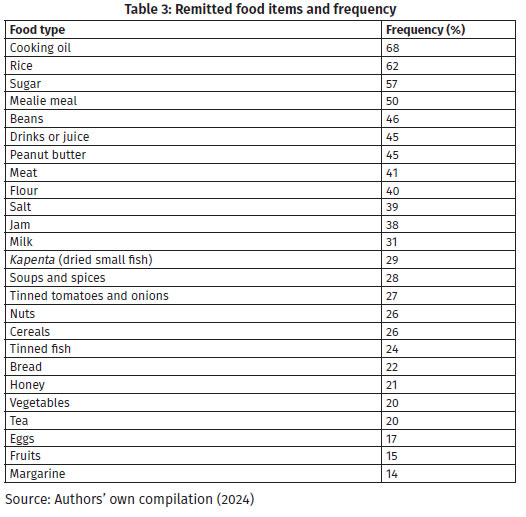
Strikingly, the use of digital-mobile food transfer passages facilitated the transmission of perishable food commodities. The transfer of these food items is enabled by advanced digital-mobile services, which have amenities for beneficiaries of the transferred items to collect their food commodities in Zimbabwe instantaneously when the transactions in Cape Town are completed. Participants were asked about the frequency of food items being remitted to Zimbabwe. Considering the economic and COVID-19 pandemic challenges, such as retrenchments, joblessness and job losses, and loss or absence of reliable income sources (Tawodzera and Crush, 2022), most Zimbabwean migrants specified reduction in transfers and did not have predetermined periods to transfer food commodities to households in Zimbabwe. Thus, 59% remitted food whenever possible, 14% monthly, 14% once annually, 9% twice annually, and 4% were able to transfer food remittances to Zimbabwe every three months (see Figure 3).
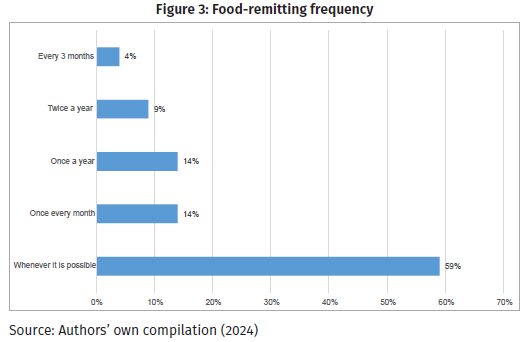
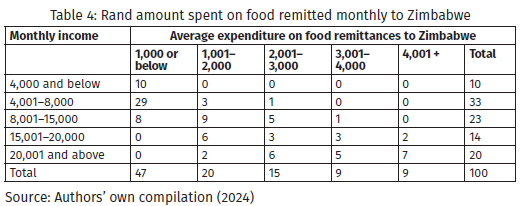
Table 4 shows that the amount spent on food transfers correlated with the average monthly earnings of this study's participants. Participants with monthly incomes below R4,000 transmitted food items valued at R1,000 or below. A considerable majority of participants with earnings between R4,001 and R8,000 also transferred food valued less than R1,000. Participants who transmitted food items valued more than R2,000 had higher earnings exceeding R8,000. Almost half (47%) of the study's participants spent an average amount of R1,000 or below, and another 20% spent between R1,000 and R2,000. Participants with incomes around R4,000 spent a quarter of their monthly earnings to transfer food to Zimbabwe.
Digital-mobile and informal channels
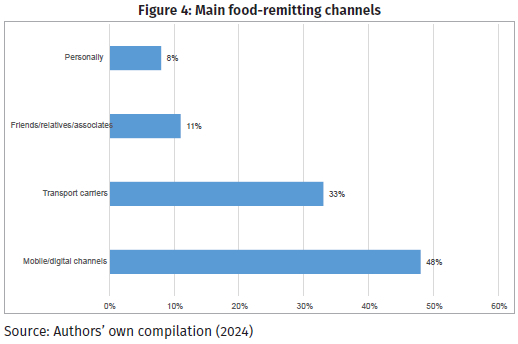
The COVID-19 pandemic resulted in an inevitable rise in the use of digital technologies because of nationwide lockdowns and social distancing protocols (Agur et al., 2020; Pandey and Pal, 2020). Along similar lines, Machasio (2020) posits that government representatives and health practitioners also advocated for the use of contactless and cashless methods of payment to lessen the risk of transmitting the virus through the handling of cash and person-to-person contact. This current study shows that 48% of the participants primarily transfer food remittances from South Africa to Zimbabwe through recently introduced digital-mobile technology-based channels (see Figure 4).
The regular informal methods of transferring remittances through the South Africa-Zimbabwe remittance corridor were disrupted in early 2020 due to the pandemic lockdowns, travel bans, strict mobility restrictions, and border closures that the governments imposed. During the early lockdowns, the general mobility of people outside their residences was restricted, except for essential activities such as purchasing food and medicines. Sithole et al. (2022, 2023, 2024a) postulate that the lockdown restrictions disrupted the migrants' ability to transfer food remittances via informal passages.
Thus, with pandemic disruptions that led to a notable shift from informal channels to digital and mobile-based passages, one Zimbabwean migrant remarked: "I was using buses to send my family some groceries. But because the pandemic caused the border to close, I decided to use the Malaicha and Mukuru services on my phone." Some participants in this study who used the new digital-mobile pathways expressed that they were accessible, rapid, secure, reasonably priced, and reliable. Hello Paisa launched the Malaicha app that adds a convenient channel to send food groceries. A Hello Paisa representative stated, "We are constantly looking at ways to improve our customers' lives, and Malaicha.com is just another way of doing that. Shopping in SA and getting your goods in Zimbabwe the very same day is a game-changer for any Zimbabwean" (Mzekandaba, 2019). Similarly, the new fintech businesses that provide cross-border grocery services emphasized the simplicity and convenience of remitting food during the pandemic through digital platforms. In an interview, a representative of one of the remittance service providers indicated the benefits of services offered by his company to Zimbabwean migrants in South Africa in the backdrop of the pandemic:
Taking recent events into account, with the nationwide lockdown resulting in borders being closed across multiple countries in Africa, a large majority of Zimbabweans found themselves in dire straits when they could not send necessities home to their loved ones in Zimbabwe. Not to mention reduced income, hyperinflated costs, scarcity of essential goods, and widespread food shortages meant that survival necessities were more inaccessible than ever before for many in Zimbabwe. Many Zimbabweans based in South Africa looked no further than Malaicha.com for help, as it bridged the e-commerce gap between Zimbabweans and the goods [that] they needed ... (Santosdiaz, 2020).
Other channels included transport carriers (malayishas, buses, and vans) (33%), friends, acquaintances or kin (11%), and personally (8%) (see Figure 4). To address the pandemic disruptions in the transfer of remittances, the participants' coping strategies included unusual pathways for transmitting cross-border food transfers. For instance, a Zimbabwean migrant stated:
The regular forms of transportation I used could not work because the borders were closed. Because funeral companies were allowed to repatriate bodies across borders, I had to resort to using these companies to send food to Zimbabwe.
During the early stages of the pandemic, funeral firms that repatriate migrant corpses for burial in Zimbabwe were considered essential services and exempted from the pandemic-related cross-border travel prohibitions enforced by the governments of South Africa and Zimbabwe. The use of funeral businesses to remit goods to Zimbabwe was carried out clandestinely and informally to prevent detection by law enforcement officials. Similar sentiments were shared in a study by Moyo (2022), which demonstrates that during the early stages of the pandemic, any and all accessible channels were used to transmit food, including via repatriation vans and smuggling through border sites outside formal border posts.
Notably, digital-mobile passages were primarily used by documented Zimbabwean migrants such as health professionals, office workers, teachers, and students. Documented migrants are generally not hesitant to use the formal remittance pathways, as they have access to the banking system, including credit cards and debit cards, which can be used for completing electronic transactions digitally. The South African government has significantly eased the requirements for transferring low-value remittances. Digital and mobile technology-based services for sending food transfers mainly require identification documents for low-value transmissions. However, irregular/undocumented migrants are cautious about using formal pathways due to registration and transactional requirements such as identity documents (passport, ID, and photographs) and phone numbers. Undocumented migrants fear that law enforcement officials may use their personal information to track, harass, detain, or deport them. Similarly, undertaking the transaction via the banking system requires other documents, such as proof of bank account, income source, immigration status, and proof of address. Nevertheless, other ways are accessible for making low-value transactions, such as direct payment in participating retailers and supermarkets, which undocumented migrants can use.
Migrant networks, social media, and food remitting
A recent study by Sithole (2023) highlighted the significance of migrant networking on social media in cross-border food remitting. Comparable perspectives emerge in this study. Social media apps such as Facebook, WhatsApp, and X (formerly Twitter) enabled the networking of Zimbabwean migrants, which was also crucial for sharing valuable information associated with the transfer of food remittances to Zimbabwe. Nearly 70% of the participants in this research who actively used diverse social media platforms indicated that social media groups were crucial in assisting them in making informed decisions related to the transfer of food groceries. As one of the Zimbabwean migrants stated:
As those conversations go on, we talk about how we migrants in South Africa can send things home, and we also get to ask how other people are also sending [food items] home. So, in all of those groups, I can't think of any group where at some point, we have not had a discussion on sending things to Zimbabwe and just sharing ideas and suggestions on which way is best to use.
Another Zimbabwean migrant explained: "Social media lets us share via WhatsApp even, you know, engaging and making purchases. You can find links on social media to shops you might want to buy from. And also, you can share all of this information via WhatsApp and social media." For almost half of the participants (46%), it assisted them in selecting the ideal channels to use when transferring food remittances to Zimbabwe. It also assisted participants in making pivotal decisions associated with the types of food to transfer (38%) and the optimal periods to remit food (16%). Social media interactions and content were also central in finding the cheapest channels (29%), accessible channels (27%), quickest channels (25%) and dependable channels (19%). Almost three-quarters (74%) of the survey participants acknowledged that interactions via text and voice on WhatsApp and other social media sites guided their decisions to use the food transfer channels primarily used by them.
Social media platforms became even more crucial for migrants in reaching such decisions during the first few months of the pandemic when informal transfer passages such as the malayishas were disrupted and challenging to access. One of the Zimbabwean migrants expressed that he used the "Zimbabweans in Cape Town" page (group on Facebook) to discover how to continue to remit food to his family/household members back home: "When we were under level five lockdown, many people were asking on social media how people who have urgent requests from Zimbabwe are sending through the things." Another Zimbabwean migrant revealed: "Somebody wrote that they were working with a funeral company that repatriates bodies of deceased Zimbabweans. And that's how they were getting their goods through." These insights concur with Unwin et al. (2022), who emphasize the value of digital technology in networking among Zimbabwean migrants in South Africa. Similarly, past studies by Crush et al. (2011), Dekker and Engbersen (2014), and Borkert et al. (2018) show how social media reshapes migrant networks by facilitating information-sharing on migration, integration, and strengthening social bonds. Social media, therefore, proved invaluable to migrants in accessing essential resources, adapting to restrictions, and maintaining support networks during the pandemic.
Food-remitting challenges
The research findings revealed that the general challenges associated with transferring food remittances from South Africa to Zimbabwe included delivery delays (22%), broken/destroyed food items (11%), missing/stolen/lost items (11%), expensive transmission costs (21%), while 35% did not encounter any challenges. The particular shortcomings of the new digital-mobile technology-based channels for transferring food remittances include registration and documentation requirements, specifically when completing large transactions (there are some exemptions for low-value transfers). Irregular and undocumented migrants operating in the informal economy may not possess the required documents (e.g., immigration papers, proof of residence, proof of income sources, and bank accounts). During the in-depth interviews, Zimbabwean migrants explained the drawbacks experienced in transferring food items through digital-mobile pathways. One of the Zimbabwean migrants stated: "Sometimes the online system is down, and as a result, transactions are often incomplete." Another Zimbabwean migrant expressed another frustration: "Sometimes I buy groceries online, but when my family wants to collect the goods, they are told that those items are out of stock and that they have got a refund or have to wait until the goods are available." Another participant specified substitution and delivery delays as prevailing problems: "Quite often the food doesn't arrive on time; occasionally there are substitutes on the order list and one at times ends up getting inferior food items - in terms of brands and nutritional content." The other challenges were high transaction charges, access-related obstacles such as power or Internet connectivity, and limited access to mobile devices and smartphones.
The use of informal passages to transmit food items from Cape Town to Zimbabwe has several drawbacks. Transferring goods (including groceries) from Cape Town to Zimbabwe through informal pathways such as malayishas is relatively high-priced because of the long distances involved. The distance between Cape Town and Beitbridge (Zimbabwean border post) is around 2,000 km and roughly 2,600 km to Harare, Zimbabwe's capital and largest city. A notable challenge in the study was the confiscation of goods by border officers for not complying with import protocols. Thus, transferring food remittances by road can be risky because of the existing likelihood of such goods being impounded by the Zimbabwe Revenue Authority (ZIMRA) officers at the Beitbridge border. This is notably the case when the quantities authorized for duty-free personal use are exceeded or a range of importation regulations are breached (Tevera, 2020). Transferring food remittances through cross-border transport carriers such as malaichas/malayishas or associates can be risky because it is centered on trust. In the instance of mishaps (e.g., theft or seizure of goods at the border by ZIMRA officials), the sender is not compensated. A participant said, "... because there is no warranty on the food items, there are no refunds if the food is lost on the way."
The findings of this study concur with previous studies by Tevera and Chikanda (2009a, 2009b) and Nzima (2017) that highlight how informal passages to transfer cash or goods to Zimbabwe generally include hindrances such as delivery delays, undependability of transfer carriers, and thefts. These prevailing obstacles are why some Zimbabwean migrants in Cape Town have opted to switch to digital and mobile food transmissions, regardless of the relatively pricey costs involved. The findings also corroborate recent studies by the United Nations Economic Commission for Africa (UNECA, 2020) and Chari et al. (2022) that demonstrate that the COVID-19 pandemic, border disruptions and mobility restrictions caused delays in supply chains and blockages that could have negative effects on imports and the food security of impoverished households. However, despite these drawbacks, some migrants articulated that they use mainly informal transfer channels when transferring food to Zimbabwe because of being undocumented and lacking access to the banking system.
KEY TAKEAWAYS AND REFLECTION ON POLICIES
In the past decade, Crush and Caesar (2016, 2018, 2020) have noted that remittance research has focused primarily on cash transfers, while in-kind remittances, such as food transfers, remain overlooked and understudied. Additionally, the growing synergies between cross-border food remittances and digital-mobile technologies in Southern Africa have seen limited examination (Sithole et al., 2022, 2023, 2024a). Despite this gap, food remittances are vital to the food and nutrition security of households in the Global South. This study highlights that cross-border food remittances are critical for migrant-sending households in economic crisis-ridden countries such as Zimbabwe, where a protracted economic crisis has aggravated food and nutrition insecurity. In precarious contexts, food remittances are vital as a safety net, assisting households to survive episodes of economic shocks, limited food access, food shortages, hyperinflation, high prices, climate change-induced droughts, and reduced agricultural outputs.
Beyond supplementing cash remittances, food transfers provide essential nourishment for consumption and assist in lessening food insecurity among impoverished households. Therefore, food remittances are crucial for enhancing the SDGs related to eradicating hunger, food insecurity, poverty, and inequalities and improving health and well-being. Before the COVID-19 pandemic, in-kind transfers, such as food remittances and groceries, were predominantly remitted through informal channels, including transport carriers such as vans, trucks, and buses. At the same time, some fintech companies had begun to develop services to facilitate the transfer of goods, including food, through these digital-mobile technology-based pathways. However, pandemic-related disruptions, such as travel bans, mobility restrictions, border closures, and restrictions in economic activities, accelerated the adoption of digital-mobile technology-based channels by migrants for crossborder remittances, marking a shift toward technologically advanced methods of transferring essential goods.
Contactless channels like digital and mobile platforms offered greater accessibility and convenience during the pandemic, as in-person transactions posed health risks and were deemed unsafe due to the potential for virus transmission. Supporting these findings, Agur et al. (2020) assert that digital and mobile transaction methods are essential for processing remittances during crises. Additionally, social media emerged as a critical tool for communication and information-sharing and facilitating remittance transfers during the pandemic. Sithole (2023) notes that platforms such as Facebook, WhatsApp, and X (formerly Twitter) facilitate virtual communication, strategies and decision-making, enabling the transfer of food remittances even under lockdowns. Social networking apps like WhatsApp show how digital-mobile apps can be used directly to complete remittance transactions and offer affordable, accessible, and convenient services to maintain remittance flows.
Pandemic disruptions resulted in restrictions on transferring food remittances through informal remittance channels. However, migrants exhibited resilience by using alternative informal pathways. For example, smuggling through border spots outside official posts and using transport operators and repatriation vehicles that were permitted to operate as essential services. In the post-COVID-19 landscape, it is expected that many migrants will revert to these informal, cost-effective channels, although the use of digital-mobile platforms is anticipated to grow gradually. Thus, a hybrid model incorporating informal and digital channels will likely emerge. Digitalmobile technology-based remittance channels offer benefits such as services that are speedy, convenient, affordable, secure, and easy to use, but they also have limitations.
Related studies by Sithole et al. (2022, 2023, 2024a) highlight bureaucratic regulations and processes, high transaction fees, electronic transaction errors, and connectivity issues as a result of power outages or limited Internet access, lack of access to cell phones or smart devices to complete the transactions, poor infrastructure, and slow adoption of artificial intelligence (AI). Other challenges include cyber security, data privacy issues, and misinformation, especially on social media. Furthermore, there are accessibility disparities (digital divide) (Rodima-Taylor, 2021), including some communities or individuals experiencing impediments such as low digital literacy, limited education, income constraints, and gender-based restrictions on technology access. The above obstacles can hinder the agenda to promote accessibility and inclusiveness aspects of marginalized communities' digital-mobile remittance service options.
Regarding policy reflections, fintech and digital-mobile technology-based remittance companies have significantly contributed to the financial inclusion of unbanked persons, undocumented migrants, informal traders, low-income persons, and rural communities in the Global South, including Southern Africa. In South Africa, policy settings around remittance transfers are relatively relaxed, but some restrictions continue to hinder progress in inclusivity, especially for irregular migrants. For example, undocumented migrants are allowed to remit only low-value transfers. To support inclusivity in financial and digital access (especially for marginalized groups such as impoverished persons and undocumented migrants), policymakers should consider revising the remittance policy framework to raise the maximum permissible transfer amount for irregular migrants, enabling them to remit adequate food and groceries to their families. Also, infrastructure development is essential to maximize the potential of digital and mobile remittance channels and to support the adoption of AI solutions, such as automated, real-time customer support chatbots available 24/7 (Sithole et al., 2024a, 2024b). Advanced digital and mobile technology amenities have the vast potential to boost efficiency and enhance customer service and user experience, making digital-mobile remittance options more accessible and resourceful.
The COVID-19 lockdowns and pandemic-induced restrictions, such as mobility limitations, travel bans, curfews, visa suspensions, and border closures, disrupted remittance flows and generally disproportionately impacted foreign nationals (who lacked government support and struggled to take care of themselves or to transfer remittances regularly). Balancing public health policies, responses, and economic activities is crucial to mitigate such effects in future pandemics and crises. There is also a need to include foreign nationals and the undocumented in government support and ensure that public health measures do not overly hinder all economic activities, mobility, and remittance flows (including food transfers critical to food and nutrition security for migrant-sending households). Although digital-mobile technology-based remittance services are generally reasonably priced, regulatory adjustments are needed to lower transaction fees further. Reducing these costs would promote the adoption of digital-mobile remittance channels and make them more accessible to low-income migrants who regularly sacrifice their limited resources to support dependents and family members back home.
Sithole et al. (2024a) recommend promoting and expanding digital-mobile technology-based remittance services by highlighting the significance of supporting partnerships between digital-mobile technology-based remittance services and local retailers in Zimbabwe to ensure the timely flow of food and groceries from senders to beneficiaries. Therefore, expanding partnerships (including between remittance systems and local businesses) can enhance the reach of digital-mobile technology-based remittance systems and service delivery, particularly in remote and rural areas where access to digital-mobile devices or technologies and food markets may be limited. Additionally, to reinforce food system resilience, governments must support digital-mobile technologies. This includes developing digital-mobile infrastructure, promoting digital innovations, incorporating food distribution and retailing, enhancing agricultural supply chains, and improving market access for small businesses, smallholder farmers, and consumers. There is a need for the integration of digital-mobile tools into comprehensive food security strategies and for government support of vulnerable populations to stay linked to crucial resources during future crises, pandemics, economic shocks, or climate-related disruptions (Sithole et al., 2024a, 2024b).
CONCLUSION
In sub-Saharan Africa, cross-border food remittances are critical to dietary diversity and food and nutrition security. However, they remain significantly under-researched compared to cash remittances in discussions on digital-mobile remittance transfers and broader remittance debates. This paper addresses this gap by examining the intersection of COVID-19 pandemic lockdowns and the digitalization of cross-border food transfers in the South Africa-Zimbabwe remittance corridor. A striking result uncovers that cross-border food remittances are crucial for tackling food insecurity and hunger in Zimbabwe, a country experiencing prolonged economic predicaments, including high unemployment, poverty, diminishing agricultural yields, inadequate access to food, high food prices, and food shortages. The digital-mobile technology-based channels and other channels to transfer cross-border remittance align with the SDGs by contributing to regular food flows, food security, hunger eradication, reduced poverty and inequalities, and improved health and well-being.
The pandemic and public health measures to mitigate and contain the spread of the coronavirus, including lockdowns, mobility restrictions, travel bans, and border closures, disrupted conventional informal remittance channels, inducing a notable shift toward digital and mobile technology-based strategies. Digital-mobile technology-based channels were resourceful during the pandemic. They enabled virtual, contactless transactions via smartphones and mobile devices in cross-border food remitting, eliminating the need for physical (in-person) interaction. The benefits of digital-mobile technology for remittances are massive. They offer services and channels that enhance a convenient and regular flow of food remittances and are speedy, accessible, reliable, convenient, secure, and affordable. They promote financial inclusion for vulnerable groups, including undocumented migrants, the unbanked, informal traders, low-income earners, and residents of rural or remote areas. Digital solutions are poised to grow and provide service alongside popular informal channels in the post-pandemic era.
There is potential for these digital solutions to integrate into hybrid systems that combine conventional methods, such as transport carriers (malayishas), with digital-mobile pathways, creating a more robust and resilient remittance ecosystem. Additionally, social media has played a crucial role in facilitating interactions and information exchange among migrants, their networks, transport carriers, and service providers for digital-mobile technology-based remittance services. This role of social media has not only aided access to suitable, reliable, and accessible food transfer pathways but also fostered a sense of connection among the stakeholders. Policymakers are urged to explore options to increase maximum transfer limits (especially for undocumented migrants), reduce transaction costs, and balance public health issues with economic activities during pandemics and crises. In conclusion, there is a pressing need for increased policy and research focus on the nature, impact, and digital-mobile technology transformation of cross-border food remittances, particularly regarding their fusion with informal channels, migrants' economic activities, emerging technologies, and AI to enhance resilient food systems and food and nutrition security.
REFERENCES
Abdul Mannan, K. and Farhana, K.M. 2023. Digital financial inclusion and remittances: An empirical study on Bangladeshi migrant households. FinTech, 2(4): 680-697. [ Links ]
Agur, I., Peria, S.M. and Rochon, C. 2020. Digital financial services and the pandemic: Opportunities and risks for emerging and developing economies. International Monetary Fund Special Series on COVID-19.
Ahmad, A.H., Green, C. and Jiang, F. 2020. Mobile money, financial inclusion and development: A review with reference to African experience. Journal of Economic Surveys, 34(4): 753-792. [ Links ]
Allen, C., Metternicht, G. and Wiedmann, T. 2018. Initial progress in implementing the Sustainable Development Goals (SDGs): A review of evidence from countries. Sustainability Science, 13: 1453-1467. [ Links ]
Ardic, O., Baijal, H., Baudino, P., Boakye-Adjei, N., Fishman, J. and Maikai, R. 2022. Financial Stability Institute insights on policy implementation number forty-three: The journey so far - making cross-border remittances work for financial inclusion, Washington, D.C.: World Bank Group. [ Links ]
Ataguba, J.E. 2020. COVID-19 pandemic, a war to be won: Understanding its economic implications for Africa. Applied Health Economics and Health Policy, 18(3): 325-328. [ Links ]
Bannor, R.K. and Amponsah, J. 2024. The emergence of food delivery in Africa: A systematic review. Sustainable Technology and Entrepreneurship, 3(2): 1-12. [ Links ]
Barkat, K., Mimouni, K., Alsamara, M. and Mrabet, Z. 2024. Achieving the Sustainable Development Goals in developing countries: The role of remittances and the mediating effect of financial inclusion. International Review of Economics & Finance, 95: 103460. [ Links ]
Benitez, M.A., Velasco, C., Sequeira, A.R., Henriquez, J., Menezes, F.M. and Paolucci, F. 2020. Responses to COVID-19 in five Latin American countries. Health Policy and Technology, 9(4): 525-559. [ Links ]
Borkert, M., Fisher, K.E. and Yafi, E. 2018. The best, the worst, and the hardest to find: How people, mobiles, and social media connect migrants in(to) Europe. Social Media and Society, 4(1): 1-11. [ Links ]
Burger, L. 2023. Remittances, a vital contributor to the Sustainable Development Goals (SDGs). Available at: https://cenfri.org/articles/remittances-a-vital-contributor-to-the-sdgs/.
Chari, F., Muzinda, O., Novukela, C. and Ngcamu, B.S. 2022. Pandemic outbreaks and food supply chains in developing countries: A case of COVID-19 in Zimbabwe. Cogent Business & Management, 9(1): 2026188. [ Links ]
Chikanda, A. and Tawodzera, G. 2017. Informal entrepreneurship and crossborder trade between Zimbabwe and South Africa. SAMP Migration Policy Series No. 74, Ontario and Cape Town.
Chotigo, J. and Kadono, Y. 2021. Comparative analysis of key factors encouraging food delivery app adoption before and during the COVID-19 pandemic in Thailand. Sustainability, 13(8): 4088. [ Links ]
Cirolia, L.R., Hall, S. and Nyamnjoh, H. 2022. Remittance micro-worlds and migrant infrastructure: Circulations, disruptions, and the movement of money. Transactions of the Institute of British Geographers, 47(1): 63-76. [ Links ]
Crush, J. and Caesar, M. 2016. Food remittances: Migration and food security in Africa. SAMP Migration Policy Series, No. 72, Ontario and Cape Town.
Crush, J. and Caesar, M. 2018. Food remittances and food security: A review. Migration and Development, 7(2): 180-200. [ Links ]
Crush, J. and Caesar, M. 2020. Food remittances and food security. In: Crush, J., Frayne, B. and Haysom, G. (eds.), Handbook on urban food security in the Global South. Cheltenham: Edward Elgar Publishing, pp. 282-306. [ Links ]
Crush, J. and Si, Z. 2020. COVID-19 containment and food security in the Global South. Journal of Agriculture, Food Systems, and Community Development, 9(4): 149-151. [ Links ]
Crush, J. and Sithole, S. 2024a. Enforcement and exclusion: COVID-19 policies, urban migrants, and food insecurity in pandemic South Africa. MiFood Paper No. 23, Ontario.
Crush, J. and Sithole, S. 2024b. South Africa at war: Food insecurity, migrant exclusion and COVID-19 policies. MiFood Policy Audit No. 1, Ontario.
Crush, J. and Tawodzera, G. 2017. South-South migration and urban food security: Zimbabwean migrants in South African cities. International Migration, 55(4): 88-102. [ Links ]
Crush, J. and Tawodzera, G. 2023. Digital disruptions in the South Africa-Zimbabwe remittance corridor during COVID-19. Migration and Development, 12(2): 157-173. [ Links ]
Crush, J. and Tevera, D. (eds.). 2010. Zimbabwe's exodus: Crisis, migration, survival. Cape Town and Ottawa: SAMP and IDRC. [ Links ]
Crush, J., Chikanda, A. and Tawodzera, G. 2015. The third wave: Mixed migration from Zimbabwe to South Africa. Canadian Journal of African Studies/Revue Canadienne des Études Africaines, 49(2): 363-382. [ Links ]
Crush, J., Thomaz, D. and Ramachandran, S. 2021. South-South migration, food insecurity and the COVID-19 pandemic. MiFood Paper No. 1, Ontario.
Crush, J., Eberhardt, C., Caesar, M., Chikanda, A., Pendleton, W. and Hill, A. 2011. Social media, the internet and diasporas for development. SAMP Migration Policy Brief No. 26, Ontario and Cape Town.
Datta, K. and Guermond, V. 2020. Remittances in times of crisis: Reflections on labour, social reproduction, and digitisation during COVID-19. Antipode Online. Available at: https://antipodeonline.org/2020/06/18/remittances-in-times-of-crisis/.
De Jong, E. and Vijge, M. J. 2021. From Millennium to Sustainable Development Goals: Evolving discourses and their reflection in policy coherence for development. Earth System Governance, 7: 100087. [ Links ]
Dekker, R. and Engbersen, G. 2014. How social media transform migrant networks and facilitate migration. Global Networks, 14(4): 401-418. [ Links ]
Department of International Relations and Cooperation (DIRCO). 2020. Statement by President Cyril Ramaphosa on escalation of measures to combat Covid-19 epidemic. Available at: http://www.dirco.gov.za/docs/speeches/2020/cram0323.pdf.
Dinarte-Diaz, L., Jaume, D., Medina-Cortina, E. and Winkler, H. 2022. Neither by land nor by sea. Available at: https://devpolicy.org/Events/2021/Not-by-land-nor-by-sea-the-rise-of-formal-remittances-during-COVID-19-Dinarte-13Apr/full-paper-updated13Apr.pdf.
Emara, N. and Zhang, Y. 2021. The non-linear impact of digitisation on remittances inflow: Evidence from the BRICS. Telecommunications Policy, 45(4): 102112. [ Links ]
Esiri, A.E., Sofoluwe, O.O. and Ukato, A. 2024. Aligning oil and gas industry practices with Sustainable Development Goals (SDGs). International Journal of Applied Research in Social Sciences, 6(6): 1215-1226. [ Links ]
Fauzi, M.A. and Paiman, N. 2021. COVID-19 pandemic in Southeast Asia: Intervention and mitigation efforts. Asian Education and Development Studies, 10(2): 176-184. [ Links ]
Gukurume, S. and Mahiya, I.T. 2020. Mobile money and the (un)making of social relations in Chivi, Zimbabwe. Journal of Southern African Studies, 46(6): 1203-1217. [ Links ]
Hahm, H., Subhanij, T. and Almeida, R. 2021. Finteching remittances in paradise: A path to sustainable development. Asia & the Pacific Policy Studies, 8(3): 435-453. [ Links ]
Hughes, N. and Lonie, S. 2007. M-Pesa: Mobile money for the "unbanked" turning cellphones into 24-hour tellers in Kenya. Innovations: Technology, Governance, Globalisation, 2(1-2): 63-81. [ Links ]
Johns Hopkins University. 2023a. Coronavirus Resource Centre: South Africa. Available at: https://coronavirus.jhu.edu/region/south-africa.
Johns Hopkins University. 2023b. Coronavirus Resource Centre: Zimbabwe. Available at: https://coronavirus.jhu.edu/region/zimbabwe.
Kingiri, A.N. and Fu, X. 2019. Understanding the diffusion and adoption of digital finance innovation in emerging economies: M-Pesa money mobile transfer service in Kenya. Innovation and Development, 10(1): 67-87. [ Links ]
Kitimbo, A. 2021. Mobile money and financial inclusion of migrants in sub-Saharan Africa. In McAuliffe, M. (ed.), Research handbook on international migration and digital technology. Cheltenham: Edward Elgar Publishing, pp. 251-266. [ Links ]
Kpodar, K., Mlachila, M., Quayyum, S. and Gammadigbe, V. 2023. Defying the odds: Remittances during the COVID-19 pandemic. The Journal of Development Studies, 59(5): 673-690. [ Links ]
Liang, Y., Zhong, T. and Crush, J. 2022. Boon or bane? Urban food security and online food purchasing during the COVID-19 epidemic in Nanjing, China. Land, 11(6): 945. [ Links ]
Mabrouk, F. 2024. Remittances and Sustainable Development Goals: An overview of opportunities and challenges in MENA countries. Journal of Ecohumanism, 3(4): 1580-1597. [ Links ]
Machasio, I.N. 2020. COVID-19 and digital financial inclusion in Africa: How to leverage digital technologies during the pandemic. Available at: https://openknowledge.worldbank.org/server/api/core/bitstreams/6d281888-689d-52b6-8b76-b67e82596b5e/content.
Malecki, A. 2021. Migration, remittances, and the Sustainable Development Goals. In Filho, W.L., Azul, A.M., Brandli, L., Salvia, A.L., Özuyar, P.G. and Wall, T. (eds.), Reduced inequalities. Cham: Springer, pp. 568-580. [ Links ]
Mapfumo, A., Mago, S., Mudzingiri, A. and Abel, S. 2022. The effect of COVID-19 on food consumption and security. African Journal of Hospitality, Tourism and Leisure, 11(6): 2027-2035. [ Links ]
Maphosa, F. 2007. Remittances and development: The impact of migration to South Africa on rural livelihoods in southern Zimbabwe. Development Southern Africa, 24(1): 123-136. [ Links ]
Matsungo, T.M. and Chopera, P. 2020. Effect of the COVID-19-induced lockdown on nutrition, health and lifestyle patterns among adults in Zimbabwe. BMJ Nutrition, Prevention & Health, 3(2): 205. [ Links ]
Maulani, N., Nyadera, I.N. and Wandekha, B. 2020. The generals and the war against COVID-19: The case of Zimbabwe. Journal of Global Health, 10(2): 1-7. [ Links ]
Mbiba, B. and Mupfumira, D. 2022. Rising to the occasion: Diaspora remittances to Zimbabwe during the COVID-19 pandemic. World Development Perspectives, 27: 100452. [ Links ]
Merritt, C. 2011. Mobile money transfer services: The next phase in the evolution of person-to-person payments. Journal of Payments Strategy & Systems, 5(2): 143-160. [ Links ]
Moyo, I. 2022. COVID-19, dissensus and de facto transformation at the South Africa-Zimbabwe border at Beitbridge. Journal of Borderlands Studies, 37(4): 781-804. [ Links ]
Moyo, P. 2024. The political economy of Zimbabwe's food crisis, 2019-2020. Journal of Asian and African Studies, 59(2): 640-655. [ Links ]
Mpofu, F.Y. and Mhlanga, D. 2022. Digital financial inclusion, digital financial services tax and financial inclusion in the fourth industrial revolution era in Africa. Economies, 10(8): 184. [ Links ]
Mukumbang, F.C., Ambe, A.N. and Adebiyi, B.O. 2020. Unspoken inequality: How COVID-19 has exacerbated existing vulnerabilities of asylum-seekers, refugees, and undocumented migrants in South Africa. International Journal for Equity in Health, 19(1): 141. [ Links ]
Mukwedeya, T. 2011. Zimbabwe's saving grace: The role of remittances in household livelihood strategies in Glen Norah, Harare. South African Review of Sociology, 42(1): 116-130. [ Links ]
Murendo, C., Manyanga, M., Mapfungautsi, R. and Dube, T. 2021. COVID-19 nationwide lockdown and disruptions in the food environment in Zimbabwe. Cogent Food & Agriculture, 7(1): 1945257. [ Links ]
Mutsonziwa, K. and Maposa, O. 2016. Mobile money - a catalyst for financial inclusion in developing economies: A case study of Zimbabwe using FinScope survey data. International Journal of Financial Management, 6(3): 45-56. [ Links ]
Muvhuringi, P.M., Nyamuziwa, T.K and Chigede, N. 2021. The impact of COVID-19 on agricultural extension and food supply in Zimbabwe. Cogent Food & Agriculture, 7(1): 1918428. [ Links ]
Mzekandaba, S. 2019. Hello Paisa app enables cross-border grocery shopping. Available at: https://www.itweb.co.za/article/hello-paisa-app-enables-cross-border-grocery-shopping/o11r5qxEYKEvKdWL.
Naicker, A., Palmer, K., Makanjana, O. and Nzama, P.F. 2021. The impact of the COVID-19 pandemic on food consumption habits, food purchasing behaviours, and food security status among South Africans. African Journal of Inter/Multidisciplinary Studies, 3(1): 131-143. [ Links ]
Nyamunda, T. 2014. Cross-border couriers as symbols of regional grievance? The malayitsha remittance system in Matabeleland, Zimbabwe. African Diaspora, 7(1): 38-62. [ Links ]
Nyanhete, A. 2017. The role of international mobile remittances in promoting financial inclusion and development. European Journal of Sustainable Development, 6(2): 256. [ Links ]
Nyoni, P. 2012. New insights on trust, honour and networking in informal entrepreneurship: Zimbabwean malayishas as informal remittance couriers. Anthropology Southern Africa, 35(1-2): 1-11. [ Links ]
Nzima, D. 2017. Channelling migrant remittances from South Africa to Zimbabwe: Opportunities and obstacles. Alternation Journal, 24(1): 294-313. [ Links ]
Onyeaka, H., Anumudu, C.K., Al-Sharify, Z.T., Egele-Godswill, E. and Mbaegbu, P. 2021. COVID-19 pandemic: A review of the global lockdown and its far-reaching effects. Science Progress, 104(2): 00368504211019854. [ Links ]
Paganini, N., Adinata, K., Buthelezi, N., Harris, D., Lemke, S., Luis, A., Koppelin, J., Karriem, A., Ncube, F., Nervi Aguirre, E. and Stöber, S. 2020. Growing and eating food during the COVID-19 pandemic: Farmers' perspectives on local food system resilience to shocks in Southern Africa and Indonesia. Sustainability, 12(20): 8556. [ Links ]
Pandey, N. and Pal, A. 2020. Impact of digital surge during COVID-19 pandemic: A viewpoint on research and practice. International Journal of Information Management, 55: 102171. [ Links ]
Primc, K. and Slabe-Erker, R. 2020. The success of public health measures in Europe during the COVID-19 pandemic. Sustainability, 12(10): 4321. [ Links ]
Ramachandran, S., Crush, J., Tawodzera, G. and Onyango, E. 2022. Pandemic food precarity, crisis-living and translocality: Zimbabwean migrant households in South Africa during COVID-19. SAMP Migration Policy Series, No. 85. Southern African Migration Programme (SAMP), Ontario.
Ratha, D., Kim, E., Plaza, S., Seshan, G., Riordan, E. and Chandra, V. 2021. Recovery: COVID-19 crisis through a migration lens. Migration and Development Brief No. 35, KNOMAD/World Bank, Washington, D.C.
Reardon, T., Belton, B., Tasie, L., Lu, L., Nuthalapati, C., Tasie, O. and Zilberman, D. 2021a. E-commerce's fast-T diffusion and adaptation in developing countries. Applied Economic Perspectives and Policy, 43: 1243-1259. [ Links ]
Reardon, T., Heiman, A., Lu, L., Nuthalapati, C., Vos, R. and Zilberman, D. 2021b. "Pivoting" by food industry firms to cope with COVID-19 in developing regions: E-Commerce and "copivoting" delivery intermediaries. Agricultural Economics, 52: 459-475. [ Links ]
RemitSCOPE. 2022. Country profiles: South Africa. Available at: https://remitscope.org/_countries/south-africa/.
Republic of South Africa (RSA). 2020a. Minister Zweli Mkhize reports first case of Coronavirus COVID-19. Available at: https://www.gov.za/news/media-statements/minister-zweli-mkhize-reports-first-case-coronavirus-covid-19-05-mar-2020#:~:text=First%20case%20of%20Covid%2D19,to%20Italy%20with%20his%20wife.
Republic of South Africa (RSA). 2020b. President Cyril Ramaphosa: Measures to combat Coronavirus COVID-19 epidemic. Available at: https://www.gov.za/news/speeches/president-cyril-ramaphosa-measures-combat-coronavirus-covid-19-epidemic-15-mar-2020.
Republic of South Africa (RSA). 2020c. Minister Zweli Mkhize confirms total of 1170 cases of Coronavirus COVID-19. Available at: https://www.gov.za/speeches/minister-zweli-mkhize-confirms-total-1170-cases-coronavirus-covid-19-27-mar-2020-0000.
Republic of South Africa (RSA). 2020d. About alert system. Available at: https://www.gov.za/covid-19/about/about-alert-system#:~:text=The%20country%20was%20on%20adiusted%20alert%20level%204%20from%2016%20Iune%202021.
Rodima-Taylor, D. 2021. The uneven path toward cheaper digital remittances. Migration Policy Institute. Available at: https://www.migrationpolicy.org/article/cheaper-digital-remittances.
Santosdiaz, R. 2020. Virtually buying goods and services in Zimbabwe. Fintech Times, 10 September. Available at: https://thefintechtimes.com/spotlight-mea-virtually-buying-goods-and-services-in-zimbabwe/.
Siegel, M. and Fransen, S. 2013. New technologies in remittance sending: Opportunities for mobile remittances in Africa. African Journal of Science, Technology, Innovation and Development, 5(5): 423-438. [ Links ]
Sithole, S. 2022. The evolving role of social media in food remitting: Evidence from Zimbabwean migrants in Cape Town, South Africa. PhD Thesis, University of the Western Cape, South Africa. [ Links ]
Sithole, S. 2023. Migrant networks, food remittances, and Zimbabweans in Cape Town: A social media perspective. African Human Mobility Review, 9(1): 33-55. [ Links ]
Sithole, S. and Dinbabo, M.F. 2016. Exploring youth migration and the food security nexus: Zimbabwean youths in Cape Town, South Africa. African Human Mobility Review, 2(2): 512-537. [ Links ]
Sithole, S., Tevera, D. and Dinbabo, M.F. 2022. Cross-border food remittances and mobile transfers: The experiences of Zimbabwean migrants in Cape Town, South Africa. Eutopía, Revista de Desarrollo Económico Territorial 22: 10-32. [ Links ]
Sithole, S., Tevera, D. and Dinbabo, M.F. 2023. Emerging digital technologies and cross-border food remittances of Zimbabwean migrants in Cape Town, South Africa, during the early COVID-19 pandemic. MiFood Paper No. 9, Ontario.
Sithole, S., Tevera, D. and Dinbabo, M.F. 2024a. Digital technologies and food remitting by Zimbabwean migrants in South Africa. MiFood Policy Brief No. 10, Ontario.
Sithole, S., Tevera, D. and Dinbabo, M.F. 2024b. Uncovering international migration and remittance patterns in southern Africa during COVID-19: Compelling evidence from Cape Town, South Africa. MiFood Research Brief No. 8, Ontario.
Statistics South Africa (Stats SA). 2023. Census 2022: Statistical release. Available at: https://census.statssa.gov.za/assets/documents/2022/P03014_Census_2022Statistical_Release.pdf.
Tawodzera, G. and Crush, J. 2022. Pandemic precarity, food insecurity and Zimbabwean migrants in South Africa. MiFood Paper No. 4, Ontario.
Tembo, J. and Okoro, C. 2021. Mobile money and regional financial integration: Evidence from sub-Saharan Africa. Journal of Economic and Financial Sciences, 14(1): 13. [ Links ]
Tevera D. 2020. Imagining borders, borderlands, migration and integration in Africa: The search for connections and disjunctures. In Nshimbi, C. and Moyo, I. (eds.), Borders, mobility, regional integration and development: Advances in African economic, social and political development. Cham: Springer, pp. 15-23. [ Links ]
Tevera, D. and Chikanda, A. 2009a. Migrant remittances and household survival in Zimbabwe. SAMP Migration Policy Series No. 51, Cape Town.
Tevera, D. and Chikanda, A. 2009b. Development impact of international remittances: Some evidence from origin households in Zimbabwe. Global Development Studies, 5(3-4): 273-302. [ Links ]
Thebe, V. 2015. The malayisha industry and the transnational movement of remittances to Zimbabwe. In Crush, J., Chikanda, A. and Skinner, C. (eds.), Mean streets: Migration, xenophobia and informality in South Africa. Cape Town and Ottawa: SAMP and IDRC, pp. 194-206. [ Links ]
United Nations (UN). 2023. International Day of Family Remittances 16 June: Digital remittances towards financial inclusion and cost reduction. Available at: https://www.un.org/en/observances/remittances-day.
United Nations Economic Commission for Africa (UNECA). 2020. Facilitating cross-border trade through a coordinated African response to COVID-19. Available at: https://repository.uneca.org/handle/10855/43789.
Unwin, T., Garba, F., Lusaba, M., Lorini, M. and Harindranath, G. 2022. Uses of digital technologies by migrants in South Africa. Available at: https://southsouth.contentfiles.net/media/documents/Uses_of_digital_technologies_by_migrants_in_South_Africa.pdf.
World Bank. 2018. The market for remittance services in southern Africa. Washington, D.C.: World Bank. Available at: https://documents1.worldbank.org/curated/ar/986021536640899843/pdf/The-Market-for-Remittance-Services-in-Southern-Africa.pdf [ Links ]
World Bank. 2021. Recovery: COVID-19 crisis through a migration lens. Migration and Development Brief No. 35. Washington, D.C.: World Bank. [ Links ]
World Health Organization (WHO). 2020. WHO Director-General's opening remarks at the media briefing on COVID-19 - 11 March. Available at: https://www.who.int/director-general/speeches/detail/who-director-general-s-opening-remarks-at-the-media-briefing-on-covid-19-11-march-2020.
Zakari, A., Khan, I., Tan, D., Alvarado, R. and Dagar, V. 2022. Energy efficiency and sustainable development goals (SDGs). Energy, 239: 122365. [ Links ]
Zanetta, L.D.A., Hakim, M.P., Gastaldi, G.B., Seabra, L.M.A.J., Rolim, P.M., Nascimento, L.G.P. ... and da Cunha, D.T. 2021. The use of food delivery apps during the COVID-19 pandemic in Brazil: The role of solidarity, perceived risk, and regional aspects. Food Research International, 149: 110671. [ Links ]
Received 26 September 2024
Accepted 23 November 2024
Published 10 January 2025
