Services on Demand
Journal

Article
 English (pdf)
 Article in xml format
 Article references
 Automatic translation
 Send this article by e-mail
Indicators
Related links
-
 Cited by Google
 -
 Similars in Google
Share

 Permalink
South African Computer Journal
On-line version ISSN 2313-7835Print version ISSN 1015-7999
SACJ vol.37 n.2 Grahamstown Dec. 2025
https://doi.org/10.18489/sacj.v37i2.21924
RESEARCH ARTICLE
A 45-year review of the South African Computer Journal (1979-2023)
Filistéa Naudé; Jan H. Kroeze
University of South Africa, Christiaan de Wet Road, Florida Park, Roodepoort, South Africa. Email: Filistéa Naudé - fnaude@unisa.ac.za; Jan H. Kroeze -jan.kroeze@gmail.com (corresponding)
ABSTRACT
This single-journal study provides a comprehensive overview of the history and development of the South African Computer Journal (SACJ; formerly Quaestiones Informaticae), combined with a bibliometric and altmetric analysis spanning 45 years (1979-2023). Citation data were sourced from Google Scholar and Scopus, while Mendeley readership counts were used as an alternative metric indicator. In total, 768 articles were analysed to assess journal productivity, authorship patterns and collaboration trends. On average, 17 articles were published per year, with an average of 8.3 Google Scholar citations per article. Citation data revealed that 60% of articles had Google Scholar citations, while 40% remained uncited. The journal exhibited a notable shift from single to multi-authorship, with co-authored articles increasing from 22% (1979-1989) to 70% (1990-2023). The results indicate a strong association between collaboration and scholarly impact, as articles with two or three authors consistently achieved higher citation counts and Mendeley readership. The most productive authors and most cited papers were identified. The SACJ journal metrics were also compared with selected international journals in the Computing discipline.
Categories · Applied Computing ~ Digital libraries and archives · General and reference ~ Surveys and overviews
Keywords: Altmetrics, Authorship, Bibliometrics, Citation analysis, Collaboration, Google Scholar, Mendeley readership, Quaestiones Informaticae, Scopus, South African Computer Journal
1 INTRODUCTION
The scientific community primarily relies on expert judgement or peer review as the key qualitative method for research assessment. Bibliometric citation-based indicators serve as quantitative measures used to evaluate scholarly productivity and impact. These metrics are typically applied alongside, or in support of, peer review. Citation-based indicators not only reflect the current impact of research, but are also considered useful predictors of future influence (Abramo et al., 2019).
Scholarly impact is commonly measured by the number of citations an article or journal receives. Citation analysis is a bibliometric method used to quantitatively assess research performance, including aspects such as productivity, citation impact and research quality (Garousi & Fernandes, 2017). Donthu et al. (2021) define the bibliometric methodology as "the application of quantitative techniques (i.e., bibliometric analysis, citation analysis) on bibliometric data (e.g., units of publication and citation)".
Due to the limitations of traditional bibliometric indicators, altmetrics (or alternative metrics) were developed to provide additional quantitative measures for research assessment. Altmetrics capture broader aspects of research impact, including non-academic and societal influence, and are intended to complement traditional citation-based indicators (Thelwall, 2020). Altmetrics "measure the digital attention that an article receives by using data from different online resources" (García-Villar, 2021). One of the key sources of altmetric data is online reference managers such as Mendeley (Araujo et al., 2021). Mendeley readership has been identified as particularly relevant for research evaluation, as reader counts have been found to correlate moderately to strongly with citation counts across most academic disciplines (Thelwall, 2020).
This study presents a 45-year (1979-2023) overview of the South African Computer Journal (SACJ). After an overview of the journal's history, the bibliometric analysis identifies some of the leading trends in terms of publication and citation behaviour, authorship, collaboration, the most productive authors and highly cited papers.
This article is organised as follows: Section 2 states the aim and objectives of this undertaking. Section 3 provides an overview of the journal's history and development, while Section 4 reviews the relevant literature and previous studies. Section 5 outlines the methods used in the article. Section 6 presents the results, while Section 7 summarises and discusses the main findings. Section 8 presents the article's conclusions.
2 AIM AND OBJECTIVES
According to Kotzé and van der Merwe (2009), SACJ plays a pivotal role in South Africa, as few local journals accredited by the Department of Higher Education and Training (DHET) are available for Computer Science scholars to publish their research. Offering publication opportunities in reputable journals is essential, given that journal articles tend to attract more citations than conference papers (Parry, 2019). As a core publication outlet for the South African research and academic community in Computer Science and Information Systems, SACJ plays an important role in disseminating local scholarship. A bibliometric analysis of the journal can offer valuable insights into the nature of, and trends in, Computing1 research in South Africa, while also shedding light on the journal's quality, credibility and influence. Such an analysis may help to further strengthen the standing of SACJ in the scholarly community and guide its future development.
The following objectives informed our endeavour to realise this aim:
• Provide an account of the history of the South African Institute of Computer Scientists and Information Technologists (SAICSIT) and SACJ (see Section 3)
• Summarise and synthesise the relevant literature (see Section 4)
• Design a suitable methodology to analyse SACJ's bibliometrics (see Section 5)
• Document the journal's productivity (see Section 6.1)
• Compare the Google Scholar citations, Scopus citations and Mendeley readership scores (see Sections 6.2 and 6.3)
• Assess authorship patterns and collaboration trends (see Section 6.4)
• Highlight the most influential articles based on citation counts and readership metrics (see Section 6.5)
• Identify the most productive authors based on article productivity (see Section 6.6)
• Determine to what extent articles in a regional South African Computing journal from the developing world are cited (see Sections 6.2 and 6.7)
• Benchmark and compare SACJ to selected international journals, using Scopus journal metrics (see Section 6.7)
Importantly, "Computer Science" is often used as an umbrella term encompassing the broader field of Computer Sciences. For example, the DBLP Computer Science Bibliography (DataBase systems and Logic Programming, a metadata repository) (DBLP, 2025) includes Information Systems journals in its database. There is also significant thematic overlap between master's and doctoral research in Computer Science and Information Systems (Sanders & Alexander, 2015). Thus, in the remainder of this article, Computer Science is used to refer broadly to the wider field of Computing, with the terms being used interchangeably, in line with the ACM (Association for Computing Machinery) Computing Classification System (CCS), which uses "Computing" in this broader sense (ACM-CCS, 2025).
3 BRIEF OVERVIEW OF THE HISTORY OF SACJ
This section provides more information on the history of SACJ and the academic society that owns the journal. First, the focus falls on the academic society (SAICSIT) and its conferences, before shifting to SACJ. Thereafter, the discussion moves to the relationship of SACLA and its conferences with SAICSIT and SACJ.
3.1 THE HISTORY OF SAICSIT
In the late 1970s, SAICSIT grew out of a professional information technology (IT) guild, the Computer Society of South Africa (CSSA). The CSSA's name later changed to the Institute of Information Technology Professionals South Africa (IITPSA), the professional body for information and communication technology (ICT) practitioners (IITPSA, 2025).
In those early days of industrial computing, the CSSA had an academic wing, namely the Research Symposium Organising Committee. Dr Phil Roets, who had been involved in the publication of the symposium proceedings right from the start in 1979, conducted postdoctoral Computer Science studies from 1970-1973 at Cornell University in New York.
Starting soon after his return from the USA, several symposia were organized by a number of University lecturers, with involvement by NRIMS [the National Research Institute for Mathematical Sciences] and the CSIR [the Council for Scientific and Industrial Research in South Africa]. After the second such symposium [28-29 October 1981], SAICS [the South African Institute of Computer Scientists] was founded as a separate entity from the CSSA by a steering committee that included Phil as one of its members. [Taken from Phil Roets's biography - see Supplement A in Naudé and Kroeze (2025)]
According to Kotzé (see Supplement B in Naudé and Kroeze (2025)), SAICS was formed in 1982. In the same year, the new academic society effectively took over the activities of the CSSA's symposium committee. In 2005, in the preface of the 20th conference proceedings, Prof Judith Bishop provided a brief recollection of the founding of the academic society:
In 1982, twelve good men and true (including one woman) got together over a (few) bottles of wine and decided to form a scientific body dedicated to promoting the interests of computing research in this country. The people were: Stef Postma (RAU) [Rand Afrikaans University], Judith Bishop (Wits) [University of the Witwatersrand], Pierre Visser, Gideon De Kock (UPE) [University of Port Elizabeth], Niek du Plooy (CSIR), Doug Laing (IBM), Ken MacGregor (UCT) [University of Cape Town], Phil Roets (NRIMS), Trevor Turton (IBM), Gerrit Wiechers (UNISA) [University of South Africa], Trevor Winer, Roelf van den Heever (UP) [University of Pretoria] and Derrick Kourie (UP). The enduring legacy ofthis group of legends in computing has been the SA [South African] Computer Journal, and the Annual SAICSIT conference. [See Supplement C in Naudé and Kroeze (2025)]
In the first 16 years of the society (1979-1994), as the research committee of the CSSA and later SAICS, at least seven computer research symposia were offered - see Supplement D in Naudé and Kroeze (2025) for a list showing the numbers, years and names of all the conferences (1979-2024).
In 1995, after much debate, the name of the SAICS was changed to SAICSIT as an independent academic society catering for scholars in Computer Science and Information Systems, as well as other related Computing disciplines, and the organisation's constitution was revised as well.
From 1995 onwards, the SAICSIT conference has been held annually, without interruption, following its formative years as the CSSA/SAICS Computer Symposium. In 2025, with the 31st SAICSIT Conference, the society celebrated 30 years of the more inclusive version of the society (1995-2025) and running its annual conferences without interruption, as well as its 46th birthday and 38th conference, if the CSSA/SAICS computer symposia are counted, and assuming that no conferences were held in 1993 and 1994 (see below) (see Supplement D in Naudé and Kroeze (2025)).
The proceedings of the first three CSSA research symposia (1979, 1981, 1983) were published in a new journal, Quaestiones Informaticae (QI), with SAICS becoming involved in 1983. The next four proceedings (1987, 1989, 1991 and 1992) were jointly published by the CSSA and SAICS - with the International Federation for Information Processing (IFIP) (IFIP, 2025) also involved in 1987 and 1989 - as standalone books, except for the 1992 issue, which appeared in SACJ, number 7.
It is unclear whether SAICS symposia were held in 1993 and 1994, as no records or proceedings from those years could be located. Although Prof Bishop mentioned in the preface of a later SAICSIT conference proceedings (2005) that this was the 20th conference (including the CSSA and SAICS conferences), no concrete evidence could be found that conferences were indeed held in 1993 and 1994, despite an extensive search for published papers or proceedings (see Supplements C and D in Naudé and Kroeze (2025)). It is, however, possible that conferences were held and that the papers, or revised versions thereof, were published in SACJ (or other journals), as was done with the first three symposia.
Since 1995, the annual SAICSIT conference proceedings have been published without interruption. From 1995-1998, the proceedings were printed as standalone books. In 1999 and 2000, special editions of SACJ (24 and 26) were used for this purpose. In 2001, SAICSIT went back to publishing standalone volumes - a tradition upheld until 2020. From 2002-2020, the annual SAICSIT proceedings all appeared in the ACM Digital Library (ACM, 2025) in electronic format, while printed copies were still made available for some time. In 2021, the tradition of publishing with ACM came to an end, and the proceedings appeared as an e-book (Singh et al., 2021); in 2022, it appeared in the EPiC (EasyChair Proceedings in Computing) series (Gerber, 2022). Selected revised papers of the 2023 conference appeared in Springer's Communications in Computer and Information Science (CCIS) (Gerber & Coetzee, 2023a), while other peer-reviewed, accepted papers appeared in their own series as "Online Proceedings" (ISSN2 = 29598877) (Gerber & Coetzee, 2023b), available on the SAICSIT Conference website. The 2024 and 2025 conferences followed the same publication model (Gerber, 2024a, 2024b, 2025a, 2025b).
The paragraphs above gave a brief overview of the history of SAICSIT and its annual conference proceedings. For more details on the SAICSIT conferences, some proceedings of which appeared in QI or SACJ, see Supplements D, E and F in Naudé and Kroeze (2025). A list of the founding members and presidents of SAICSIT is available in Supplement G in Naudé and Kroeze (2025).
3.2 THE HISTORY OF SACJ
In this section, we provide a brief overview of the emergence of SACJ from QI. The origin of the journal can be traced back to the series of research seminars organised by the Research Symposium Organising Committee of the CSSA, discussed above.
Kourie (2010) documents the historical development of the journal. QI was established in 1979 (ISSN = 0254-2757). The proceedings of the first three symposia were published in QI (the CSSA's journal, ISSN = 0254-2757), but the journal also accepted other submissions. Between 1979 and 1989, a total of 19 issues in six volumes appeared.
In 1990, QI was renamed as SACJ (online ISSN = 2313-7835; print=1015-7999) to be more descriptive and target a wider audience (see Supplement H in Naudé and Kroeze (2025) and Kourie (1989)). Notably, the phrase Computer Science and Information Systems appears as a subtitle on the first edition of SACJ, a peer-reviewed scholarly journal owned and published semi-annually by SAICS, and later by SAICSIT (2025), with additional special editions.
The relationship of SACJ to the SAICSIT conference has varied over the years. The journal's predecessor, QI, belonged to the CSSA, as did SACJ originally, but SAICS and SAICSIT were also involved in the editorial process. From 1995, SAICSIT assumed ownership of, and responsibility for, SACJ. Both journals published some proceedings, along with selected or revised conference papers and other submissions. For example, a separate proceedings book for the 1989 symposium exists, but some of the papers were also published in the first two issues of SACJ (1990).
The journal publishes original research articles and shorter technical research notes in English in the subject fields of Computer Science, Computer Systems, Information Systems and related fields. The geographic focus is on South Africa, the rest of Africa and less-developed countries, but other international submissions are also considered. The journal also publishes viewpoint articles, letters to the editor, book reviews and announcements. Its editorial board comprises local and international scholars.
For a summary of the availability of the digitised and electronic proceedings of all the SAICSIT conferences and their predecessors - South African Computer Symposium (SACS), South African Computer Research Symposium (SARCS), and SAICS - see Supplement D in Naudé and Kroeze (2025).
3.3 THE HISTORY OF SACLA
Since the chair of the Southern African Computer Lecturers Association (SACLA) (SACLA, 2025) serves ex officio on the SAICSIT Council, there has been a close relationship between the two societies for many years, and the two annual conferences have sometimes been offered back to back. The 2008 SACLA proceedings appeared in a special edition of SACJ (Kourie, 2010). The 50-year history and development of SACLA and the Computer Science departments in South Africa are described by Calitz (2022).
3.4 AVAILABILITY AND VISIBILITY OF THE PROCEEDINGS AND JOURNAL ISSUES
All the historical print-only editions of QI, SACJ and SAICSIT proceedings were digitised in 2018 (see Supplement I in Naudé and Kroeze (2025)). When the SAICSIT Council embarked on the endeavour to digitise previously print-only issues of its journal and conference proceedings (see Supplement I in Naudé and Kroeze (2025)), the goal was to enhance the visibility and availability of the 1979-2001 QI/SACJ issues and SAICSIT proceedings. It was hoped that, over time, this would lead to increased citation rates for these older papers and articles. The electronic copies of all the papers and articles were made available in the SAICSIT Digital Archive, hosted on the Unisa Institutional Repository (UIR) (SAICSIT, 1979-2021) (see Supplement F in Naudé and Kroeze (2025))3. Kotzé and van der Merwe (2009) note that, up to 2009, SACJ had a low citation rate, possibly because it was not an open-access journal.
For a summary of the availability of the digitised and electronic proceedings of all the SAICSIT conferences and their predecessors - SACS, SARCS and SAICS - see Supplement F in Naudé and Kroeze (2025). For an overview of all the papers published in SACJ, see SACJ (2009-2023, 2021-2025) and SAICSIT (1979-2021). Unfortunately, no complete collection of the printed conference proceedings is available, but partial collections do exist (see Supplement F in Naudé and Kroeze (2025)) (note: there may be more scattered issues in other South African libraries).
Hard copies of the early, print-only issues of SACJ were donated to the university libraries of the North-West University (NWU) and the University of Pretoria (UP) (which now have complete collections of QI/SACJ), as well as the University of Cape Town (UCT) and the University of the Free State (UFS) (which have partial collections).
SACJ is accredited by DHET (2015) and is included in four of the 2025-2026 DHET-accredited publication lists (Sabinet, 2025a), namely DHET's sublist of Scopus (Elsevier, 2025), the Directory of Open Access Journals (DOAJ, 2025), the Scientific Electronic Library Online South Africa (SciELO SA) (SciELO, 2025), and DHET's own list of local accredited journals (DHET, 2025).
QI (1979-1989) and SACJ (1990-2009) were indexed in the IET Inspec database, a subscription-based resource compiled by the Institution of Engineering and Technology (IET, 2025).
Since 2000, SACJ has been available in electronic format on Sabinet4 (Sabinet, 2025b) (cf. Kotzé and van der Merwe (2009)) in the Science, Technology and Agriculture Collection of the African Journals database. Until 2009, the journal was only accessible through these specialised paywalled databases.
Its discoverability significantly improved, however, from 2009, when SACJ became an open-access journal, published on the Open Journal Systems platform (SACJ, 2009-2023). In December 2022, SACJ joined Khulisa Journals under the auspices of the Academy of Science of South Africa (ASSAf, 2025). The journal's website was migrated to a new platform (SACJ, 2021-2025). The issues that appeared from 2009 are also available on the journal's previous website (SACJ, 2009-2023), and will remain accessible for some time (Malan, 2023). Several other free web-based services also index SACJ, notably SciELO (2025), DBLP (2025), Dimensions (2025) and DOAJ (2025).
The next section moves from the history of QI and SACJ to a literature review focusing on earlier studies of the journal and other related research.
4 LITERATURE REVIEW
A review of the South African literature reveals that only three previous studies (Kotzé & van der Merwe, 2009; Kourie, 2010; Machanick, 2024) specifically focused on QI and SACJ. A brief overview of these is provided below.
Kotzé and van der Merwe (2009), who analysed the research topics of articles published in SACJ from 1990-2008, examined 344 research articles. In addition, they identified the most productive South African higher education and research institutions and examined publication trends across subject categories and subcategories. However, their study did not include a citation analysis or other bibliometric data, nor did it cover QI.
Kourie (2010) provides a historical profile of QI and SACJ, detailing the journal's founding, editorial leadership and the roles of the CSSA and SAICSIT. The article highlights the ten most-cited articles from 1989-2010, based on Google Scholar citation scores. The study emphasises the need for marketing to enhance SACJ's readership, visibility and citation impact. Also noted (Kourie, 2010), SACJ issues 7, 9, 13, 19, 22, 24 and 26 were special editions that published conference or workshop proceedings, while issues 17, 40 and 42 contained conference papers that were significantly updated and peer reviewed once more. For further details on SACJ's editorial history, see Supplement J in Naudé and Kroeze (2025).
Machanick (2024) provides an overview of his experiences as editor-in-chief of SACJ, focusing on how he developed it into a quality journal with a developmental and mentorship agenda for emerging academics in developing countries. Machanick s experience demonstrated that it is possible to establish a quality, regionally focused journal that bridges the gap between predatory and prestigious publications, highlighting the critical need for a mentoring model for editors to maintain such standards. Notably, in the ecosystems of scholarly journals SACJ fulfils a unique niche role, which may hamper its competitiveness:
Competing in the middle ground of a quality journal with a developmental role is not easy. Authors who aspire to publish in top-ranked journals will go there and authors who require quick publication to check a box want guaranteed turnaround time; that can only be achieved with either a high reject rate or giving up on quality. [Machanick (2024)]
A broader analysis of the South African Computing research literature, beyond QI and SACJ, revealed only a handful of studies (ASSAf, 2019; Brown & Tanner, 2008; Mouton et al., 2022; Mouton et al., 2019; Naudé & Kroeze, 2024; Parry, 2019; Turpin, 2018; van Biljon & Naude, 2018) on the South African research landscape.
Brown and Tanner (2008) investigated the international visibility of South African Information Systems research by analysing publications from South African-affiliated authors in 50 Information Systems journals between 2003 and 2007. They found that only 19 of these journals contained articles with South African authorship, totalling just 39 articles. The study highlights the low international visibility of South African Information Systems research and suggests that the high-ranking Information Systems journals are not well suited to South Africa's development-oriented research focus.
van Biljon and Naude (2018) analysed the research collaboration patterns among South African ICT4D (Information and Communication Technology for Development) researchers from 2003 to 2016, based on publications in Information Technologies and International Development (ITID), the Electronic Journal of Information Systems in Developing Countries (EJISDC) and Information Technology for Development (ITD). The findings revealed that most articles were co-authored (78%): collaboration patterns showed that intra-institutional collaboration (51%) was the most prevalent, followed by international (35%) and inter-institutional collaboration (14%).
Turpin (2018) studied 58 articles published between 2006 and 2015 by South African ICT4D researchers in ITID, EJISDC and ITD, examining publication patterns across institutions, geographic regions and research domains. The findings showed a preference for collaboration among South African authors, with 53 of the 58 papers being co-authored. Of the 53 papers, 18 had international collaborators and 28 had co-authors from the same institution.
Parry (2019) conducted a comprehensive scientometric investigation of Computing research in South Africa, using the Elsevier Scopus database. That study investigated the journal articles, books, book chapters and conference proceedings of researchers affiliated with South African universities from 2008 to 2017 and assessed annual production, differences in institutional outputs, topical trends, collaboration and citation impact. The findings showed a 235% increase in Computing research over the decade under study. Conference papers were the most popular publication format (61.40%), followed by journal articles (36.10%), book chapters (2.33%) and books (0.23%). The study noted that SACJ did not appear among prominent publications due to its late inclusion in Scopus (post-25 March 2016), limiting the analysis to SACJ data from 2016 and 2017.
The ASSAf Committee on Scholarly Publishing conducted a grouped peer review of South African scholarly journals in the Communication and Information Sciences (ASSAf, 2019), and included SACJ in this review. The report highlights SACJ's unique role in the South African Computing research landscape, recognising its high-quality articles across diverse topics (ASSAf, 2019).
Naudé and Kroeze (2024) investigated the research participation of South African-based authors in Springer's Lecture Notes in Computer Science (LNCS), a conference proceedings book and e-book series, for the period 1973-2022. The study compared these authors' publication output and citation impact to the global Computer Science and LNCS output trends. The findings highlight a strong collaborative publication culture among South African LNCS authors, with 91% of articles co-authored and 9% single-authored. Of the articles, 73% had received citations, while 27% remained uncited. When the citation metrics of LNCS were compared to SACJ, LNCS consistently outperformed SACJ. In 2022, LNCS achieved a CiteScore5 of 2.2, compared to SACJ's 0.9. Similarly, LNCS recorded a SCImago Journal Rank score6 of 0.320, exceeding SACJ's score of 0.170. Additionally, LNCS attained a Source Normalised Impact per Paper (SNIP) score7 of 0.542, while SACJ obtained a score of 0.314.
Mouton et al. (2019) undertook a large-scale, multi-disciplinary empirical assessment of South Africa s research performance (including research output, collaboration and citation impact). The bibliometric analyses were based on two databases: the Clarivate Web of Science and the South African Knowledgebase (SAK), a database of university research publications compiled by the Centre for Research on Evaluation, Science and Technology of Stellenbosch University. Section 4.6 of the report covers an analysis of Computer Science from 2000 to 2016. During this period, South African researchers produced a total of 1716 articles in the field of Computer Science. The leading institutions by publication volume were UP (416 articles), UCT (268), US (256) and Wits (227).
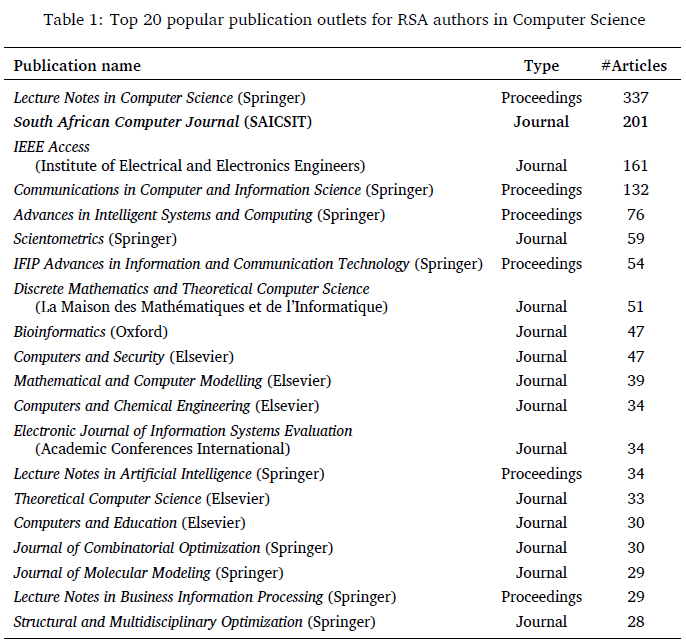
A scientometric assessment of Computer Science in South Africa (in its wider sense as Computing) was conducted (Mouton et al., 2022) for the period 2005-2020. The findings identified SACJ as the second most popular publication outlet for local Computer Science researchers, following LNCS. This study analysed 3441 articles in 472 publications retrieved from the SAK database of DHET subsidy-earning publications. The adapted data (Table 1) underscore the journal s prominence as a key publishing platform within the discipline (see Supplements K and L in Naudé and Kroeze (2025)).
The literature review clearly shows that the only studies specifically exploring the bibliometric data of QI/SACJ were conducted over a decade ago. Moreover, none of these studies covered the journal's entire history from its inception (1979) to 2023. Similarly, broader studies on local Computing research have failed to span this full period. This gap in knowledge highlights the need for a new, comprehensive and encompassing study focusing exclusively on the profile of QI/SACJ. Such an analysis would offer a deeper understanding of the journal's evolution and role in shaping the Computing field in South Africa, as well as a scientific basis for assessing its quality and impact. While previous SACJ studies explored topical/thematic, institutional and citation perspectives, this study seeks to update and expand on those findings by providing a thorough bibliometric and altmetric analysis covering the journal from 1979 to 2023.
5 METHODOLOGY
This study presents a bibliometric and altmetric profile of SACJ over 45 years (1979-2023), focusing on research articles. Letters to the editor, book reviews and announcements were excluded from the analysis. The data for this study were collected in October 2024 (see Supplements M and N in Naudé and Kroeze (2025)).
The bibliographic details for QI (1979-1989) and SACJ (1990-2009) were exported from the Inspec database in MS (Microsoft) Excel spreadsheet format. The bibliographic records for SACJ (2010-2023) were similarly exported from the Sabinet African Journals database, after which the data from Inspec and Sabinet were merged. To ensure accuracy, the retrieved bibliographic records were cross-checked against the QI and SACJ journal contents pages archived on the UIR (1979-2001) (SAICSIT, 1979-2021), the Sabinet database (2001-2008) (Sabinet, 2025b) and the SACJ websites (2009-2025) (SACJ, 2009-2023, 2021-2025).
Google Scholar, which covered both SACJ and QI throughout the 45-year analysis, was selected as the primary citation data source for this study. Google Scholar citations for QI and SACJ were retrieved using Harzing's Publish or Perish software (v 8.16) (Harzing, 2016). The journals' ISSN numbers were searched in Harzing, and the Google Scholar citation data were downloaded in MS Excel. The average number of SACJ citations per article per annum was calculated by dividing the citation count (number of citations) by scholarly productivity (number of papers) (Elsevier, 2018).
SACJ is not indexed by the Clarivate Web of Science database (Clarivate, 2025), but it has been indexed by Elsevier's citation-enhanced database Scopus (Elsevier, 2025) since 2016. The citation data for SACJ were downloaded from the database and exported to MS Excel. The data from 2016 to 2023 were compared to the Google Scholar citation data.
Mendeley readership counts were selected as alternative metric indicator for this study and were manually recorded in a spreadsheet for each article. Readership data were collected only for SACJ articles, as the QI articles were too dated (Mendeley was launched in 2008 and acquired by Elsevier in 2013 (Haunschild, 2020)). Mendeley readership is defined as "the number of users who have saved documents to their private libraries [on the platform]. The more users that save a publication, the more [the] readership attributed to the publication" (Zahedi & Costas, 2020). The average number of Mendeley readers per article was calculated by dividing the total number of readers by the total number of articles.
The number of authors for each QI and SACJ article was recorded in a spreadsheet to analyse the journal's authorship patterns and collaboration activities. The full counting method was applied, meaning each author received full credit for every publication s/he co-authored, regardless of the total number of co-authors (Perianes-Rodriguez et al., 2016). Each appearance of an author on a publication was counted as one full unit of authorship, independent of how many papers the author contributed to the journal. The average number of authors per article was calculated by dividing the total number of authors by the total number of articles.
The degree of collaboration (C) was calculated for SACJ for the period 1979-2023. Sub-ramanyam defines (C) as "the ratio of the number of collaborative research papers to the total number of research papers published in the discipline during a certain period of time" (Subraman-yam, 1983). It is calculated by dividing the total number of multi-authored articles by the total number of articles.
6 RESULTS
6.1 Journal productivity
For the purpose of this study, journal productivity is defined as the number of articles published by SACJ per annum. Figures 1 to 3 present data from 1979 to 2023, specifically detailing the number of articles published each year. It also includes the Google Scholar citations, Scopus Citations and Mendeley readers within each year, as well as the average citations and readers (see Supplements O and P in Naudé and Kroeze (2025) for detailed tables).
In total, 768 articles were published in QI and SACJ between 1979 and 2023, with the journals' productivity fluctuating significantly during this period. The average number of articles per year for QI and SACJ combined, was 17. The highest productivity was in 1999 with 51 articles, and the lowest was three in 1980.
The early years (1979-1989) generally displayed lower journal productivity. In QI, 131 articles were published between 1979 and 1989 (11 years), averaging approximately 11.9 articles per year. As shown in Figure 1, the highest productivity was in 1987 (27 articles). QI published no articles in 1981.
Figures 2 and 3 indicate that 637 SACJ articles were published between 1990 and 2023, spanning a period of 34 years. In SACJ, the majority of articles were published in 1999, with a peak of 51 articles, while the lowest number was recorded in 2011, with only four articles published (Figure 2). On average, SACJ published approximately 18.7 articles per year, over this period.
Figure 2 presents SACJ's journal productivity, along with Google Scholar citations and Mendeley readership data, from 1990-2015. The graph shows a trend of exponential growth in the number of readers and citations per article, with an outlier of Google citations in 1999.
Figure 3 shows the SACJ journal productivity, Google Scholar citations, Scopus citations and Mendeley readers for the period 2016-2023. The number of articles published in this period peaked in 2017.
Prior to 2016, SACJ was numbered by issue, not volume. From 2016 onward, the journal adopted conventional volume numbering, beginning with volume 28 (see Supplement Q in Naudé and Kroeze (2025)).
6.2 Google Scholar and Scopus citations
Combined, QI and SACJ received a total of 6408 Google Scholar citations, with an overall average of 8.3 citations per article. Of the 768 articles published in both journals, 458 (60%) had citations, while the remaining 310 (40%) had none. Citation levels were low in the 1980s. As shown in Figure 1, QI received a total of 82 Google Scholar citations between 1979 and 1989, with an average of 0.6 citations per article. Of the 131 articles published in QI, only 26 (20%) received Google Scholar citations, while 105 (80%) received no citations.
Between 1990 and 2023, SACJ accumulated 6326 Google Scholar citations, averaging 9.9 citations per article (Figures 2 and 3). Of the 637 SACJ articles published during this period, 432 (68%) were cited in Google Scholar, while 205 (32%) remained uncited.
The average number of Google Scholar citations per article increased significantly after 2000, reflecting a clear upward trend (Figure 2). A comparison of three periods shows that the average Google Scholar citations per article rose from 3.9 (1990-1999) to 10.3 (20002009) and further to 20.7 (2010-2015). SACJ transitioned to an open-access journal in 2009 - a change that may have influenced citation rates.
Between 2016 and 2023, the 118 SACJ articles published received a total of 651 citations in Scopus, averaging 5.5 citations per article (Figure 3). Of these, 62 (52%) had Scopus citations while 56 (48%) had none. In comparison, Google Scholar data show a higher citation rate: 100 articles (85%) received citations, while only 18 (15%) remained uncited. Over the same period, 118 articles received 1563 Google Scholar citations, with an average of 13.2 citations per article.
The year 2017 marked the peak in scholarly impact, with the highest citation count recorded. Post-2017, as Figure 3 illustrates, there was a downward trend in citations and readers across all three platforms (Scopus, Google Scholar and Mendeley). Scopus citations dropped from an average of 14.4 per article in 2017 to 1.1 in 2022, while Google Scholar citations declined from 36.4 in 2017 to 3.1 in 2023. The average Google Scholar citations per article dropped from 23.5 (2016-2018) to 5.1 (2019-2023), indicating a downward trend in recent citation impact. This decline may partly reflect the shorter time newer articles have had to accumulate citations, underscoring the typical citation lag following their publication.
6.3 Mendeley readership
From 1990-2023, SACJ accumulated a total of 7754 Mendeley readers of 637 articles, resulting in an average of 12 per article (Figures 2 and 3). Of the 637 SACJ articles, 350 (55%) had Mendeley readers, while 287 (45%) had no readers.
Mendeley readership showed a significant upward trend, especially post-2000: a period comparison shows that the average number per article increased from 1.4 (1990-1999) to 7.3 (2000-2009) and then to 32.65 (2010-2015).
Figure 3 reveals that 2017 was the peak year, with the highest number of Mendeley readers (1461). However, post-2019 there was a noticeable decline, with the average number of Mendeley readers per article dropping from 58.4 in 2017 to 7.8 in 2023.
6.4 Authorship
Over the period 1979-2023, a total of 1464 authors published in SACJ and QI combined, with an average authorship rate of 1.9 authors per article (Tables 2 and 3). A total of 168 authors contributed to QI, with an average of 1.2 authors per article (Table 2). In comparison, SACJ had 1296 contributing authors and an average of 2.0 authors per article (Table 3).
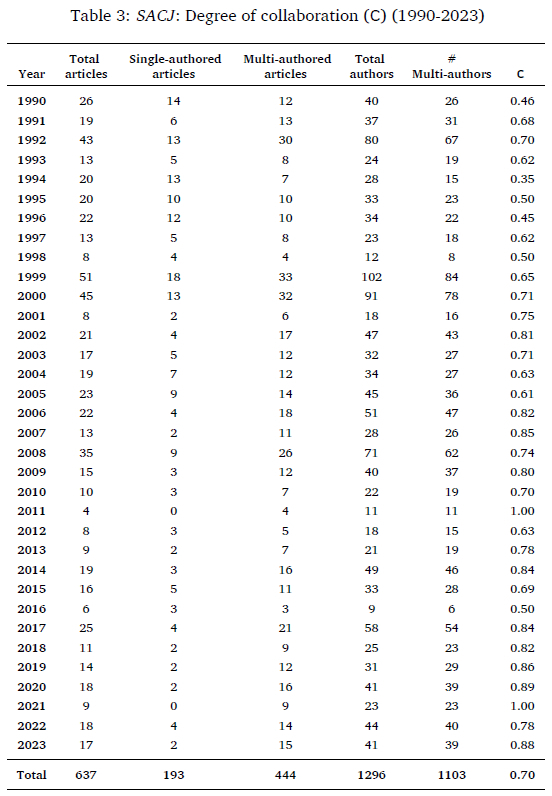
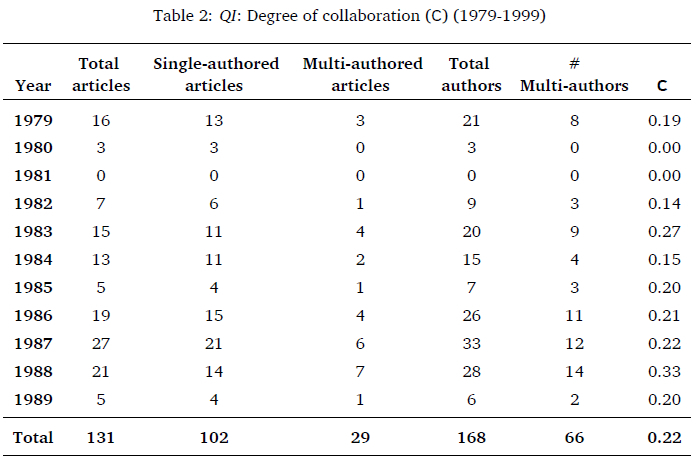
Table 2 shows that the degree of collaboration for QI is 0.22, indicating that 22% of the articles were multi-authored. SACJ shows a higher level of collaboration, with 0.70 (70% of articles) being authored by more than one author (Table 3). Combined, the overall degree of collaboration for QI and SACJ was 0.62, or 62%.
Table 2 shows that between 1979 and 1989, 131 articles were published in QI, of which 102 (78%) were single-authored and 29 (22%) were co-authored.
Of the 637 articles published in SACJ between 1990 and 2023, 193 (30%) were single-authored, while 444 (70%) were co-authored (Table 3).
When combining QI and SACJ, a total of 768 articles were published, with 295 (38%) being single-authored and 473 (62%) co-authored. This reflects a distinct contrast between the two journals: QI tended to favour single authorship, whereas SACJ demonstrated a stronger trend towards collaboration.
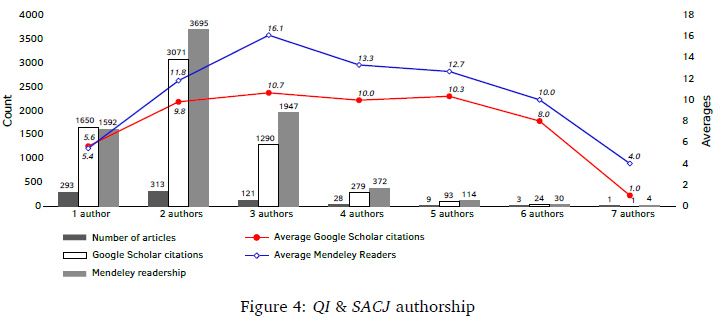
Figure 4 shows that authorship for the combined QI and SACJ dataset ranged from 1 to 7 authors. The highest productivity (i.e., number of articles) came from single-authored (293) and dual-authored (313) articles, comprising 79% of all articles. This was followed by three-authored articles (121) (16%).
The average Google Scholar citations increased from 5.6 (single author) to a peak of 10.7 (3 authors), suggesting that moderate co-authorship may enhance scholarly impact. After three authors, citation averages stabilised or declined slightly, notably to 10.3 (5 authors), 8 (6 authors), and only one citation for the single seven-author article (not significant, due to its singular occurrence). Mendeley readership data aligned with citation trends, peaking with three authors (16.1 readers per article), indicating that three-author articles were both well read and well cited.
Three-author articles achieved the highest average citations (10.7) and readership (16.1), while single-authored articles, despite being the most common (293 articles), had lower average citations (5.6) and readership (5.4). In contrast, while articles with four to six authors continued to show relatively strong averages, the data indicated diminishing returns in impact beyond three authors.
6.5 Influential articles
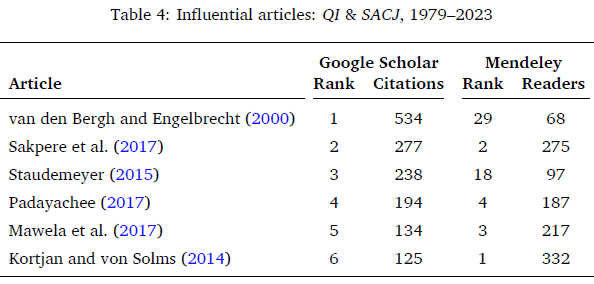
This section analyses the most influential articles based on citations and Mendeley readership. Table 4 presents the six most cited articles published in QI and SACJ, based on Google Scholar citation counts from 1979-2023.
Kourie (2010) identified the article by van den Bergh and Engelbrecht (2000) as the most cited at the time (158 citations), and it remains the most cited SACJ article as at 2023, with 534 citations.
Table 4 highlights the four SACJ articles with the highest Mendeley readership. An article by Kortjan and von Solms (2014) recorded the highest number of Mendeley readers, despite ranking only sixth in terms of citation count. Table 4 suggests a partial overlap between the most cited articles and Mendeley readership in the journal.
6.6 Most productive authors
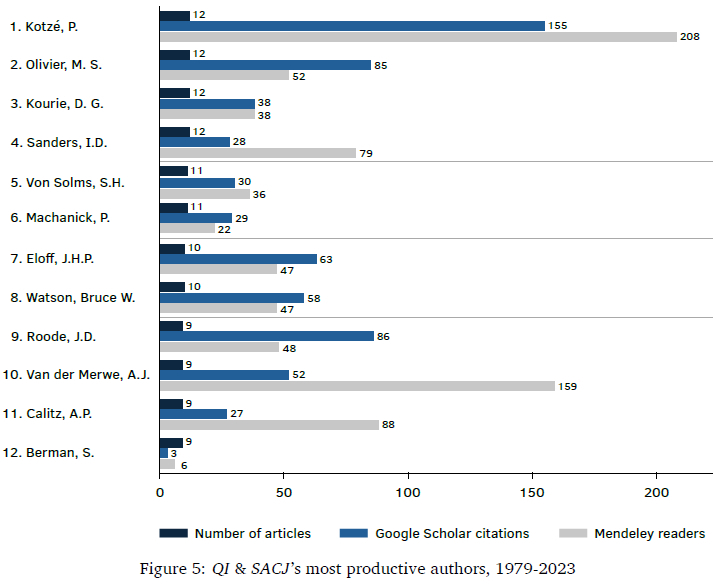
This section analyses the most active and leading contributors to SACJ. For the purpose of this study, a productive author is defined as having a publication frequency of nine or more articles in QI and SACJ between 1979 and 2023. Figure 5 presents a ranking of these 12 authors, based on their article productivity in QI and SACJ combined, followed by their Google Scholar citations and Mendeley reader counts. The most productive authors are P. Kotzé, D.G. Kourie, M.S. Olivier and I. Sanders.
Of the four productive authors identified by Kotzé and van der Merwe (2009) in the 2009 SACJ study, M.S. Olivier and J.H.P. Eloff remained among the authors with the most research articles in SACJ.
Of the productive authors, P. Kotzé (155) had the highest Google Scholar citation impact, followed by J.D. Roode (86) and M.S. Oliver (85). P. Kotzé also had the highest Mendeley readership (208), followed by A.J. van der Merwe (159) and A.P. Calitz (88).
There was no overlap between the authors of the most cited articles (Table 4) and the most productive authors (Figure 5), indicating that the most cited articles were not necessarily produced by the most productive authors, and vice versa.
6.7 Comparison of SACJ with other journals
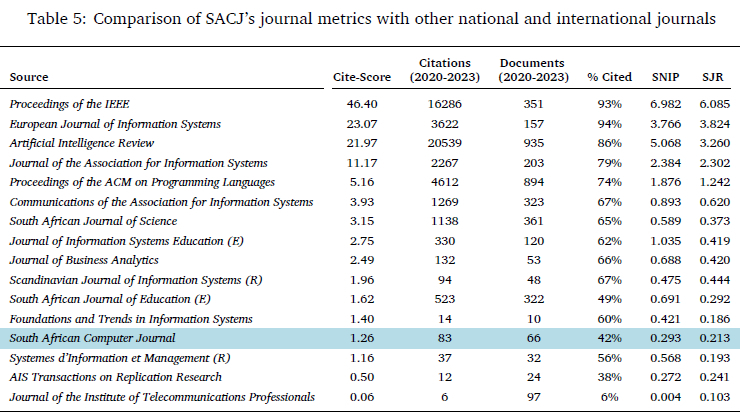
SACJ is ranked in the Scopus Sources database (Elsevier, 2025) across several subject area categories as follows: 928th out of 1620 in Education, 335th out of 507 in Computer Networks and Communications, 322nd out of 474 in Information Systems, 669th out of 947 in Computer Science Applications, and 147th out of 186 in Human-Computer Interaction. SACJ is classified as a Quartile 3 journal in the Scopus database, indicating its position in the third tier of journals within its subject category, based on citation metrics and impact. Quartiles divide journals into four categories: Q1 (top 25%), Q2, Q3, and Q4 (bottom 25%). This indicates that SACJ (Q3) has a mid-to-lower-tier status as a journal.
Using the Scopus Sources database, SACJ was benchmarked against a selection of international journals in the Computing discipline. Given the vast number of journals, it was not feasible to include all comparable titles. Instead, a representative sample of Computer Science and Information Systems journals with a general scope was selected across different quartiles.
To ensure a fair comparison, a few regional and education-focused journals were included, acknowledging SACJs South African context and its strong performance within the education subset of the Scopus database.
Table 5 presents a benchmarking comparison using Scopus metrics, including CiteScore, citations (2020-2023), number of documents, percentage of cited articles, SNIP and SJR (SCImago Journal Rank). The journals range from elite, high-impact publications (e.g. Proceedings of the IEEE) to smaller regional or niche journals (e.g. SACJ, Scandinavian Journal of Information Systems). Journals that are regarded as educational are indicated with (E), and regional journals with (R).
7 DISCUSSION
This single journal study offers a regional perspective on Computing research conducted in South Africa over the past 45 years. This section synthesises and reflects on the study's findings in relation to the journal's citation impact (via Google Scholar and Scopus), altmetric impact (via Mendeley readership), article production, patterns of authorship and collaboration. Looking at the SACJ productivity and publication volume, three periods emerged:
Initial years (1979-1989): Publication numbers were relatively low and inconsistent, ranging from 0 (1981) to 27 (1987).
Growth period (1990-2000): Gradual increase in journal productivity, peaking at 51 articles in 1999.
Steady productivity (2001-2023): Publication numbers fluctuated between 4 and 35, indicating sustained productivity.
The initial years of QI showed low publication productivity. During the apartheid years, academic boycotts and sanctions were imposed on South African academic institutions, leading to the isolation of scholars. These measures had a detrimental effect, restricting international collaboration, influencing publication practices, and possibly reducing the citation impact of South African journals (Benatar, 1990).
There was a significant increase in journal productivity starting in the 1990s (towards the end of apartheid), with a notable peak in 1992. The highest overall number of articles appeared in 1999. The early 2000s also showed higher journal productivity. After 2000, the journal's productivity remained substantial, but did not reach the level of the late 1990s. More recent years (2018-2023) showed a slight decline in journal productivity.
An analysis of Google Scholar citation impact (Average Google Scholar citations per article) for SACJ revealed four phases:
Low-impact period (1979-1995): On average, each article received fewer than two citations.
Emerging influence (1996-2003): Multiple years exceeded five citations per article.
High-impact period (2004-2018): Many years showed double-digit average citations per article.
Decline (2019-2023): The average citations per article started to drop below ten from 2018 onward.
Between 1979 and 1989, 80% of the 131 QI articles remained uncited, which suggests that QI was still emerging and under-recognised. The journal may not have been widely indexed or accessible. The political isolation of South Africa during the apartheid era could have further hindered the visibility and impact of the journal. The 2000s to mid-2010s were the journal's most influential years.
Citations are a complex phenomenon influenced by numerous factors and variables that affect how often a paper is cited (Tahamtan et al., 2016). Below are some of the aspects that might contribute to the decline in SACJ citations from 2018 onwards.
This decline aligns with the broader global trend observed in the discipline of Computer Science, where the average number of citations per paper have declined over the past decade (Wahle et al., 2022), as reflected in the baseline citation rates (2015-2025) of the Clarivate Essentials Science Indicators (ESI), based on Web of Science data (Clarivate, 2025) (see Supplement R in Naudé and Kroeze (2025)). In ESI, field baseline citation rates represent the annualised average number of citations expected per paper within a specific research field.
The rapid growth in global research activity and publication volume (Cunningham & Smyth, 2025) has diluted the average citations per article. The more papers are published, the more the pool of available citations is spread across a larger body of papers, where more papers are competing for citations (Cavero et al., 2014). This expansion means that the average number of citations per paper may decline, because more publications are vying for scholarly attention (Garousi & Fernandes, 2017).
Changes in the scholarly publishing ecosystem, particularly the rise of open-access platforms and preprint servers, have contributed to a shift in citation patterns and diversion across multiple versions of the same work. Increasingly, researchers cite preprints and versions deposited on institutional repositories and academic social media sites, which can result in citations bypassing the final journal versions (Pagliaro, 2021).
Predatory journals may contribute to the distortion of citation patterns. The growing presence of those journals disrupts the citation landscape by diverting citations away from reputable, peer-reviewed journals. Inexperienced authors or those under pressure may inadvertently cite predatory sources instead of rigorous, reputable sources (Machanick, 2024). This misdirection not only reduces citations to legitimate journals, but also contaminates citation networks (Cunningham & Smyth, 2025). The inclusion of low-quality papers in citation-enhanced search engines like Google Scholar pollutes the scholarly system and has an impact on citation distribution.
Mendeley reader counts in this study closely align with traditional citation metrics from Google Scholar and Scopus (see Figures 2 and 3). A notable decline in Mendeley readership occurred after 2017, with the average number of readers per article decreasing from 58.4 in 2017 to just 7.8 in 2023. This downward trend may stem from the same factors which contributed to the decline in citation counts over the same period, as discussed above.
A result that demands more in-depth research is that there was no overlap between the authors of the most cited articles and the most productive authors. The literature indicates (Chang, 2021) that while highly cited authors are often associated with impactful and influential research, they are not necessarily the most productive in terms of publication volume. High-impact authors tend to focus on quality over quantity, producing fewer but more influential papers, compared to highly productive authors. Highly productive authors, by contrast, often publish a larger number of papers, but may not attain the same level of citation impact as highly cited authors. This suggests that productive authors prioritise quantity and may target journals with higher acceptance rates, but the relationship between productivity and citation impact is complex and influenced by many factors (Tahamtan et al., 2016). Further research could examine and compare the publication behaviour of highly cited versus highly productive South African Computing authors.
Over the 45 years analysed, the journal exhibited a clear shift from single- to multi-authorship. Between 1979 and 1989, only 22% of QI articles were co-authored, whereas from 1990 to 2023, 70% of SACJ articles were multi-authored. SACJ aligns with the global trend towards increased collaboration in Computer Science (Franceschet, 2011a), which has been accompanied by a steady rise in the average number of authors per paper over the recent
decades (Cavero et al., 2014; Fernandes & Monteiro, 2017; Kumari & Kumar, 2023). Several factors have contributed to this shift, notably the growing number of postgraduate students co-authoring publications with their supervisors (Brown & Tanner, 2008). Collaborative authorship has been shown to enhance both visibility and citation impact (Ibáñez et al., 2013). The increasing pressure to publish has also encouraged researchers to engage in collaboration as a means of distributing workload and boosting productivity (Cavero et al., 2014). The rise of interdisciplinary research also necessitated collaboration (Franceschet, 2011a).
The findings suggest a clear association between authorship patterns and scholarly impact, as measured by both Google Scholar citations and Mendeley readership. SACJ articles with two or three authors consistently outperformed others, indicating that moderate collaboration may enhance research visibility and academic influence. Notably, three-author papers achieved the highest average citations (10.7) and readership (16.1), while single-authored articles had the lowest averages in both metrics. Interestingly, while papers with four to six authors maintained relatively high averages, the marginal gains diminished, suggesting an optimal range of co-authorship. These results align with the existing literature, which suggests that collaboration can positively influence citation performance (Ibáñez et al., 2013). The analysis reinforced the value of collaborative authorship as a strategy for enhancing scholarly influence.
It is worth mentioning that the higher citation counts of multi-authored papers may partly result from self-citation in related or follow-up publications. Collaborative research tends to have higher self-citation rates than single-authored papers, with studies confirming that multi-authored papers receive higher self-citation rates (Leimu & Koricheva, 2005; Thelwall et al., 2023). This trend can be attributed to the broader network of co-authors, who are more likely to cite their own work. To provide a more accurate assessment, future analysis should consider excluding self-citations.
While SACJ still has room for improvement in terms of its CiteScore, it performs comparatively well when evaluated alongside similar regional and educational journals (see Table 5). (Although SACJ is not, per se, an educational journal, it covers educational technology and the teaching of Computing in South Africa as a key area (Kotzé & van der Merwe, 2009).) Most of these journals have a lower CiteScore (below 3), as does SACJ, than the top journals with scores ranging from 3 to 46. However, this premise should be researched in more detail in future work, since a comprehensive comparison falls outside the scope of this article. SACJ currently ranks in the lower tier of international Computing and Information Systems journals, based on Scopus journal metrics. However, it again compares reasonably well with regional and educational journals, especially considering its national focus and limited resources.
With reference to the comparison of SACJ and LNCS, it should be noted that with a smaller number of papers, the citation scores of SACJ are inherently more variable from year to year than those of a journal like LNCS that publishes a much higher volume of papers tending to render more stable metrics. For example, one outlier in LNCS will not make as big a difference as it would in SACJ. Moreover, the author scope of SACJ is focused on South African authors, while LNCS attracts papers on a global scale, which may also have an effect on the number
of citations drawn. It may, therefore, be considered as biased to compare these journals' cite scores. In this regard, Franceschet's (2011b) study is particularly noteworthy. He examined the asymmetry or skewness of citation distributions in Computer Science publications, considering both journal and conference papers, and acknowledging the field's distinctive reliance on conferences. The study revealed that citation distributions are highly asymmetric, with a small fraction of papers attracting a disproportionately large number of citations. Moreover, it found that conference papers display greater skewness in their citation patterns than journal papers, while journal articles, overall, tend to achieve a higher bibliometric impact.
The relatively low impact of SACJ, compared to well-known and highly cited international journals, may be due to the perception that local journals are of lower quality - see, for example, a concern raised by Hamlall and Belle (2019) regarding the disappointing productivity of South African researchers in Computer Science and Information Systems: "Other areas of concern are that there is a failure among academics to distinguish between high-quality international journal publications and lower-quality locally accredited journals, which affects their incentive to publish." However, SACJs listing on Scopus (Elsevier, 2025), DOAJ (DOAJ, 2025) and Sci-ELO SA (SciELO, 2025) supports its credibility and visibility, indicating that such a perception could be unfair (Machanick, 2024).
Collaboration is shaped by a complex mixture of individual, institutional, national and global factors. The DHET funding of tertiary institutions per research output (DHET, 2015) plays a significant role in shaping the collaboration and publication behaviour of South African researchers. The importance of a publication profile, NRF rating and promotion stimulates research on the one hand, but the incentives paid to individual researchers may discourage collaboration on the other hand (Sooryamoorthy, 2019).
South African universities increasingly encourage researchers to collaborate with international scholars and publish in high-impact journals to enhance institutional citation rates and global rankings (von Solms & von Solms, 2016). However, the DHET subsidy framework significantly influences researchers' choice of collaboration partners and publication outlets. Since researchers are incentivised to publish in DHET-accredited journals to secure government subsidies, this can create a tension: international collaborators often prefer publishing in high-impact journals, which may not always appear on the DHET-accredited list. Additionally, South African researchers may find that the regional focus of journals like SACJ limits the appeal for international co-authors. Nevertheless, increasing the number of internationally co-authored articles in SACJ could help to enhance the journal s citation impact and global visibility.
According to Hamlall and Belle (2019), research collaboration enhances both the visibility and citation rates of scholarly works. However, the funding model used to subsidise South African universities - partly based on research output - can inadvertently discourage collaboration. Under the DHET research output system, subsidies for co-authored publications are divided among the contributing institutions. This distribution reduces the financial benefit for any single institution, potentially disincentivising inter-institutional collaboration. In contrast, intra-institutional collaboration yields greater subsidy returns for universities, as the full benefit remains within the same institution. Studies by Turpin (2018), van Biljon and Naude (2018), and Parry (2019) confirm a prevailing trend toward intra- rather than inter-institutional collaboration.
Moreover, following the lifting of sanctions against South Africa, international collaboration became increasingly feasible. Efforts to build a unified democracy amid complex social and historical challenges likely attracted significant interest from international scholars. This, combined with the global trend toward increased research collaboration, may help to explain the rise in collaboration.
One possible reason why collaboration leads to higher research throughput is that it enables the sharing of data, knowledge and expertise among researchers. Additionally, funding agencies often require tangible outputs from collaborative teams, and joint projects tend to enhance the visibility of research publications. Networking through collaboration also benefits emerging researchers by increasing their chances of receiving invitations to co-author publications and participate in further projects (Sooryamoorthy, 2014). Factors such as holding a PhD, years of academic experience, and the breadth of collaboration networks all influence a researcher's productivity (Sooryamoorthy, 2014). These findings suggest several promising directions for further empirical research (both qualitative and quantitative) such as conducting surveys and interviews with scholars, to gather in-depth insights and statistically test new hypotheses.
Since the correlation between collaboration and productivity varies in respect of subjects and countries (Sooryamoorthy, 2014), it was important to gain a better understanding of the status quo in the South African Computing guild. In this regard, the Computing scenario in South Africa needs to be researched in greater depth in future work.
8 CONCLUSION
This study offered a comprehensive overview of SACJ as a publication, and its citation trends over several decades. SACJ has played a pivotal role in developing and disseminating computing knowledge in South Africa. With a rich history and heritage spanning almost half a century, SACJ provided a vital platform for local researchers to publish their work, enhancing their visibility and citation impact. SACJ has fostered collaboration among South African researchers, and facilitated connections with international scholars, thereby significantly serving to advance Computing Science in this country.
In follow-up research, the citation rate of SACJ could be compared to that of South African conference proceedings such as SACLA and SAICSIT. While some of these proceedings are freely available on open-access platforms, others are hosted behind paywalls, including those of the ACM Digital Library and Springer.
Future work could also explore usage indicators such as downloads, views or social media indicators as other alternative metrics. Furthermore, future researchers could extend this study by using new and emerging artificial intelligence-powered analytical tools to identify and analyse research and collaboration trends.
9 ACKNOWLEDGEMENTS
The authors would like to thank (in no particular order) Derrick Kourie, Judith Bishop, Tendani Mawela, Katherine Malan, Ruth de Villiers, André Calitz, Charlotte Hlengwa, Tawanda Madavo, Philip Machanick, Ian Sanders, Paula Kotzé, Hussein Suleman, Darelle van Greunen, Brenda Scholtz, Patrick Marais, Stefan Gruner, Lerine Steenkamp, Basie von Solms, Rossouw von Solms, Martin Olivier, Aurona Gerber, Lisa Seymour and Marié Hattingh for their assistance in finding information and copies of old proceedings and journal issues; Juanita Beytell for her help with the figures; the following librarians who accepted donations of hard copies, CDs and memory sticks: Nestus Venter (NWU), Bulelwa Mandubu (UP), Nobuhle Maimela (UFS) and Nuroo Davids (UCT); Ansie van der Westhuizen, who created the SAICSIT archive on the UIR; Suezette Opperman for indexing the scanned copies; Sabinet (Thabang Methi and Tebogo Methi) for scanning the old printed proceedings and journal issues; the SAICSIT Council for funding the costs of digitising the old printed copies of proceedings and journal issues. We sincerely apologise if we have inadvertently omitted anyone by name. Over the course of more than seven years, we consulted with many individuals, and to each and every one of you, we extend our heartfelt thanks.
References
Abramo, G., D'Angelo, C. A., & Reale, E. (2019). Peer review versus bibliometrics: Which method better predicts the scholarly impact of publications? Scientometrics, 121(1), 537554. https://doi.org/10.1007/S11192-019-03184-Y [ Links ]
ACM. (2025). Association for Computing Machinery [Online]. https://dl.acm.org/
ACM-CCS. (2025). ACM Computing Classification System [Online]. https://dl.acm.org/ccs
Araujo, A. C., Vanin, A. A., Nascimento, D. P., Gonzalez, G. Z., & Costa, L. O. P. (2021). What are the variables associated with altmetric scores? Systematic reviews, 10(1), 193. https://doi.org/10.1186/S13643-021-01735-0 [ Links ]
ASSAf. (2019). Report on grouped peer review of scholarly journals in communication and information sciences (tech. rep.). Academy of Science of South Africa. https://doi.org/10.17159/ASSAF.2019/0041
ASSAf. (2025). Khulisajournals [Accessed23 September 2025]. https://journals.assaf.org.za/
Benatar, S. R. (1990). An alternative to academic boycott. Nature, 343(6258), 505-506. https://doi.org/10.1038/343505a0 [ Links ]
Brown, I., & Tanner, M. (2008). The international visibility of South African IS research: An author-affiliation analysis in the top-ranked IS-centric journals. South African Computer Journal, 41, 14-20. https://journals.co.za/doi/10.10520/EJC28079 [ Links ]
Calitz, A. P. (2022). The 50 year history of SACLA and computer science departments in South Africa. Communications in Computer and Information Science, 1461 CCIS, 3-23. https://doi.org/10.1007/978-3-030-95003-3_1 [ Links ]
Cavero, J. M., Vela, B., & Cáceres, P. (2014). Computer science research: More production, less productivity. Scientometrics, 98(3), 2103-2111. https://doi.org/10.1007/S11192-013-1178-2 [ Links ]
Chang, Y. W. (2021). Characteristics of high research performance authors in the field of library and information science and those of their articles. Scientometrics, 126(4), 33733391. https://doi.org/10.1007/S11192-021-03898-Y [ Links ]
Clarivate. (2025). Web of science database [Accessed 23 September 2025]. https://www.webofscience.com/
Cunningham, P., & Smyth, B. (2025). An analysis of the impact of gold open access publications in computer science. Communications of the ACM, 68(8), 62-69. https://doi.org/10.1145/3721975 [ Links ]
DBLP. (2025). DBLP computer science bibliography [Online]. https://dblp.org/
DHET. (2015). Research outputs policy [Accessed 23 September 2025]. Government Gazette, 597(38552), 3-31. https://www.dhet.gov.za/Policy%20and%20Development%20Support/Research%20Outputs%20Policy%202015.pdf [ Links ]
DHET. (2025). DHETlist of accredited journals [Accessed 17 October 2025]. https://www.dhet.gov.za/SitePages/University%20Research%20Support%20and%20Policy%20Development.aspx
Dimensions. (2025). Dimensions: A digital science solution [Accessed 23 September 2025]. https://www.dimensions.ai/
DOAJ. (2025). Directory of open access journals [Accessed 23 September 2025]. https://doaj.org/
Donthu, N., Kumar, S., Mukherjee, D., Pandey, N., & Lim, W. M. (2021). How to conduct a bibliometric analysis: An overview and guidelines. Journal of Business Research, 133, 285-296. https://doi.org/10.1016/J.JBUSRES.2021.04.070 [ Links ]
Elsevier. (2025). Scopus database [Accessed 23 September 2025]. https://www.scopus.com/
Elsevier. (2018). Research metrics guidebook. https://www.elsevier.com/en-in/products/scopus/metrics
Fernandes, J. M., & Monteiro, M. P. (2017). Evolution in the number of authors of computer science publications. Scientometrics, 110(2), 529-539. https://doi.org/10.1007/S11192-016-2214-9 [ Links ]
Franceschet, M. (2011a). Collaboration in computer science: A network science approach. Journal of the American Society for Information Science and Technology, 62(10), 1992-2012. https://doi.org/10.1002/ASI.21614 [ Links ]
Franceschet, M. (2011b). The skewness of computer science. Information Processing & Management, 47(1), 117-124. https://doi.org/10.1016/J.IPM.2010.03.003 [ Links ]
García-Villar, C. (2021). A critical review on altmetrics: Can we measure the social impact factor? Insights into Imaging, 12, 1-10. https://doi.org/10.1186/S13244-021-01033-2 [ Links ]
Garousi, V., & Fernandes, J. M. (2017). Quantity versus impact of software engineering papers: A quantitative study. Scientometrics, 112(2), 963-1006. https://doi.org/10.1007/S11192-017-2419-6 [ Links ]
Gerber, A. (Ed.). (2022). SAICSIT 2022: Proceedings of 43rd conference of the South African Institute of Computer Scientists and Information Technologists. EPiC Series in Computing. https://easychair.org/publications/volume/SAICSIT_2022
Gerber, A. (Ed.). (2024a). SAICSIT'24 - Online proceedings of the South African Institute of Computer Scientists and Information Technologists 2024 conference: Human-machine-digital-convergence. SAICSIT. https://saicsit2024.mandela.ac.za/saicsit2024/media/Store/documents/SAICSITOnline.pdf
Gerber, A. (Ed.). (2024b). South African Computer Science and Information Systems Research Trends, 45th Annual conference proceedings. SAICSIT 2024. https://doi.org/10.1007/978-3-031-64881-6
Gerber, A. (Ed.). (2025a). Proceedings of the 46th annual conference of the South African Institute of Computer Scientists and Information Technologists (SAICSIT 2025). SAICSIT. https://saicsit2025.org.za/online-main.pdf
Gerber, A. (Ed.). (2025b). South African computer science and information systems research trends, 46th annual conference, SAICSIT2025 (Vol. 2583). Springer Nature. https://doi.org/10.1007/978-3-031-96262-2
Gerber, A., & Coetzee, M. (Eds.). (2023a). South African Institute ofComputer Scientists and Information Technologists - 44th Annual conference (SAICSIT 2023) (Vol. 1878). Springer Nature Switzerland. https://doi.org/10.1007/978-3-031-39652-6
Gerber, A., & Coetzee, M. (Eds.). (2023b). SAICSIT 2023 Proceedings ofthe 44th South African Institute of Computer Scientists and Information Technologists Conference: Connect to be the future. https://saicsit2023.org/proceedings
Hamlall, D., & Belle, J. P. V. (2019). Research barriers experienced by South African academics in information systems and computer science. Communications in Computer and Information Science, 963, 95-107. https://doi.org/10.1007/978-3-030-05813-5_7 [ Links ]
Harzing, A.-W. (2016). Publish or perish [Accessed 23 September 2025]. https://harzing.com/resources/publish-or-perish
Haunschild, R. (2020). Mendeley. Handbook Bibliometrics, 281-287. https://doi.org/10.1515/9783110646610-028
Ibáñez, A., Bielza, C., & Larrañaga, P. (2013). Relationship among research collaboration, number of documents and number of citations: A case study in Spanish computer science production in 2000-2009. Scientometrics, 95(2), 689-716. https://doi.org/10.1007/S11192-012-0883-6 [ Links ]
IET. (2025). Institution of Engineering and Technology (IET) - Inspec database [Accessed 23 September 2025]. https://www.theiet.org/publishing/inspec
IFIP. (2025). International Federation for Information Processing [Online]. https://www.ifip.org/
IITPSA. (2025). Institute of Information Technology Professionals South Africa [Online]. https://www.iitpsa.org.za/
Kortjan, N., & von Solms, R. (2014). A conceptual framework for cyber-security awareness and education in SA: Research article. South African Computer Journal, 52(1), 29-41. https://journals.co.za/content/comp/52/1/EJC154952 [ Links ]
Kotzé, P., & van der Merwe, A. (2009). The research foci of computing research in South Africa as reflected by publications in the South African Computer Journal. South African Computer Journal, 44, 67-84. https://doi.org/10.18489/SACJ.V44I0.24 [ Links ]
Kourie, D. (1989). Editorial. Quaestiones Informaticae, 6(4), 137-138. https://doi.org/10.6084/m9.figshare.12728294 [ Links ]
Kourie, D. (2010). The South African Computer Journal: 1989 to 2010. Transactions of the Royal Society of South Africa, 65(2), 107-111. https://doi.org/10.1080/0035919X.2010.510664 [ Links ]
Kumari, P., & Kumar, R. (2023). Collaborative authorship patterns in computer science publications. Annals of Library and Information Studies, 70(1), 22-32. https://doi.org/10.56042/alis.v70i1.70536 [ Links ]
Leimu, R., & Koricheva, J. (2005). Does scientific collaboration increase the impact of ecological articles? BioScience, 55(5), 438-443. https://doi.org/10.1641/0006-3568(2005)055[0438:DSCITI]2.0.CO;2 [ Links ]
Machanick, P. (2024). Mentorship lessons from growing a developing country journal. Communications of the ACM, 67(11), 35-37. https://doi.org/10.1145/3663472 [ Links ]
Malan, K. M. (2023). Editorial: A new era for SACJ. South African Computer Journal, 35(2), vii-ix. https://doi.org/10.18489/SACJ.V35I2.17439 [ Links ]
Mawela, T., Ochara, N. M., & Twinomurinzi, H. (2017). e-Government implementation: A reflection on South African municipalities. South African Computer Journal, 29(1), 147171. https://doi.org/10.18489/SACJ.V29I1.444 [ Links ]
Mouton, J., J. Blanckenberg, M., van Lill & Redelinghuys, H. (2022). A scientometric assessment of the computer sciences in South Africa, Keynote presentation at the 51st annual conference of the southern african computer lecturers' association [Available online]. https://doi.org/10.6084/m9.figshare.12728294
Mouton, J., Basson, I., Treptow, R., & Blanckenberg, J. (2019). The state of the South African research enterprise [Accessed 23 September 2025]. https://www.researchgate.net/publication/335857684_The_state_of_the_South_African_research_enterprise
Naudé, F., & Kroeze, J. H. (2024). South African research contributions to Lecture Notes in Computer Science, 1973-2022. South African Journal of Science, 120(27-40). https://doi.org/10.17159/SAJS.2024/15199 [ Links ]
Naudé, F., & Kroeze, J. H. (2025). South African Computer Journal (1979-2023) [Dataset]. https://doi.org/10.6084/m9.figshare.12728294
Padayachee, K. (2017). A snapshot survey of ICT integration in South African schools. South African Computer Journal, 29(2), 36-65. https://doi.org/10.18489/SACJ.V29I2.463 [ Links ]
Pagliaro, M. (2021). Did you ask for citations? An insight into preprint citations en route to open science. Publications, 9(3), 26. https://doi.org/10.3390/PUBLICATIONS9030026 [ Links ]
Parry, D. A. (2019). Computing research in South Africa: A scientometric investigation. South African Computer Journal, 31(1), 51-79. https://doi.org/10.18489/SACJ.V31I1.674 [ Links ]
Perianes-Rodriguez, A., Waltman, L., & van Eck, N. J. (2016). Constructing bibliometric networks: A comparison between full and fractional counting. Journal of Informetrics, 10(4), 1178-1195. https://doi.org/10.1016/J.JOI.2016.10.006 [ Links ]
Sabinet. (2025a). Accredited journals [Accessed 23 September 2025]. https://journals.co.za/publications-accredited
Sabinet. (2025b). South African Institute of Computer Scientists and Information Technologists, South African Computer Journal [Accessed 23 September 2025]. https://journals.co.za/journal/comp
SACJ. (2009-2023). South African Computer Journal Archives [Accessed 23 September 2025]. https://sacj.cs.uct.ac.za/index.php/sacj/issue/archive
SACJ. (2021-2025). South African Computer Journal Archives [Accessed 23 September 2025]. https://sacj.org.za/issue/archive
SACLA. (2025). South African Institute of Computer Scientists and Information Technologists [Accessed 23 September 2025]. http://www.sacla.org.za/
SAICSIT. (2025). South African Institute of Computer Scientists and Information Technologists [Accessed 23 September 2025]. http://saicsit.org
SAICSIT. (1979-2021). SAICSIT digital archive [Accessed 29 September 2025]. https://uir.unisa.ac.za/communities/5e256de7-575c-4e5e-bc6b-2e9a7907198c
Sakpere, W., Oshin, M. A., & Mlitwa, N. B. (2017). A state-of-the-art survey of indoor positioning and navigation systems and technologies. South African Computer Journal, 29(3), 145-197. https://doi.org/10.18489/SACJ.V29I3.452 [ Links ]
Sanders, I. D., & Alexander, P. M. (2015). A study of computing doctorates in South Africa from 1978 to 2014. South African Computer Journal, 57, 58-89. https://doi.org/10.18489/SACJ.V0I57.294 [ Links ]
SciELO. (2025). SciELO - Scientific Electronic Library Online [Accessed 23 September 2025]. https://www.scielo.org.za/
Singh, S., Mujinga, M., Lotriet, H., & Tait, B. (Eds.). (2021, September). SAICSIT Conference 2021: Proceedings of the South African Institute of Computer Scientists and Information Technologists. Unisa Press. https://hdl.handle.net/10500/28972
Sooryamoorthy, R. (2014). Publication productivity and collaboration of researchers in South Africa: New empirical evidence. Scientometrics, 98(1), 531-545. https://doi.org/10.1007/S11192-013-0990-Z [ Links ]
Sooryamoorthy, R. (2019). Scientific knowledge in South Africa: Information trends, patterns and collaboration. Scientometrics, 119(3), 1365-1386. https://doi.org/10.1007/S11192-019-03096-X [ Links ]
Staudemeyer, R. C. (2015). Applying long short-term memory recurrent neural networks to intrusion detection. South African Computer Journal, 56(1), 136-154. https://doi.org/10.18489/SACJ.V56I1.248 [ Links ]
Subramanyam, K. (1983). Bibliometric studies of research collaboration: A review. Journal of Information Science, 6(1), 33-38. https://doi.org/10.1177/016555158300600105 [ Links ]
Tahamtan, I., Afshar, A. S., & Ahamdzadeh, K. (2016). Factors affecting number of citations: A comprehensive review of the literature. Scientometrics, 107(3), 1195-1225. https://doi.org/10.1007/S11192-016-1889-2 [ Links ]
Thelwall, M. (2020). The pros and cons of the use of altmetrics in research assessment. Scholarly Assessment Reports, 2(1), 1-9. https://doi.org/10.29024/SAR.10 [ Links ]
Thelwall, M., Kousha, K., Abdoli, M., Stuart, E., Makita, M., Wilson, P., & Levitt, J. (2023). Why are coauthored academic articles more cited: Higher quality or larger audience? Journal of the Association for Information Science and Technology, 74(7), 791-810. https://doi.org/10.1002/ASI.24755 [ Links ]
Turpin, M. (2018). Assessing South African ICT4D research outputs: A journal review. South African Computer Journal, 30(1), 108-127. https://doi.org/10.18489/SACJ.V30I1.541 [ Links ]
van Biljon, J., & Naude, F. (2018). Collaboration towards a more inclusive society: The case of South African ICT4D researchers. IFIP Advances in Information and Communication Technology, 537, 82-94. https://doi.org/10.1007/978-3-319-99605-9_6 [ Links ]
van den Bergh, F., & Engelbrecht, A. (2000). Cooperative learning in neural networks using particle swarm optimizers. South African Computer Journal, 26, 84-90. https://hdl.handle.net/10520/EJC27898 [ Links ]
von Solms, R., & von Solms, B. (2016). Publish or perish -- But where? South African Computer Journal, 28(1), 44-58. https://doi.org/10.18489/SACJ.V28I1.394 [ Links ]
Wahle, J. P., Ruas, T., Mohammad, S. M., & Gipp, B. (2022). D3: A massive dataset of scholarly metadata for analyzing the state of computer science research. 2022 Language Resources and Evaluation Conference, LREC 2022, 2642-2651. https://arxiv.org/abs/2204.13384v4
Zahedi, Z., & Costas, R. (2020). Do online readerships offer useful assessment tools? Discussion around the practical applications of Mendeley readership for scholarly assessment. Scholarly Assessment Reports, 2(1), 1-14. https://doi.org/10.29024/SAR.20 [ Links ]
Received: 11 April 2025
Accepted: 5 September 2025
Online: 22 December 2025
1 Computing is used as a catch-all umbrella term for various related disciplines - see the clarification of the terminology at the end of Section 2.
2 ISSN = International Standard Serial Number.
3 The 1989 proceedings had been missing, but after the peer review process, Prof Martin Olivier discovered a copy in his library and donated it to the SAICSIT Council, to be scanned and added to the printed and digital collections (to be done).
4 South African Bibliographic and Information Network.
5 CiteScore: "CiteScore is based on the number of citations to documents (articles, reviews, conference papers, book chapters and data papers) in a journal over four years, divided by the number of the same document types indexed in Scopus and published in the same four years by that journal. CiteScore metrics are part of an evolving basket of metrics that will continue to grow with input and guidance from the research community." (Elsevier, 2018, p. 9)
6 SJR: "SCImago Journal Rank is a prestige metric, whose methodology is similar to that of Google PageRank. It weights the value of a citation depending on the field, quality and reputation of the journal that the citation comes from, so that 'all citations are not equal'. SJR also takes differences in the behavior of academics in different disciplines into account, and can be used to compare journals in different fields. The average SJR value for all journals in Scopus is 1.000." (Elsevier, 2018, p. 9)
7 SNIP: "Source-Normalized Impact per Paper is a ratio between the 'Raw Impact per Paper', a type of Citations per Publication calculation, actually received by the journal, compared to the 'Citation Potential , or expected Citations per Publication, of that journal's field. SNIP takes differences in disciplinary characteristics into account, and can be used to compare journals in different fields. The average SNIP value for all journals in Scopus is 1.000." (Elsevier, 2018, p. 9)