




Services on Demand
Journal

Article
 English (pdf)
 Article in xml format
 Article references
 Automatic translation
 Send this article by e-mail
Indicators
Related links
-
 Cited by Google
 -
 Similars in Google
Share

 Permalink
South African Journal of Occupational Therapy
On-line version ISSN 2310-3833Print version ISSN 0038-2337
S. Afr. j. occup. ther. vol.55 n.3 Pretoria Dec. 2025
https://doi.org/10.17159/2310-3833/202x/vol55n3a14
BOOK REVIEW
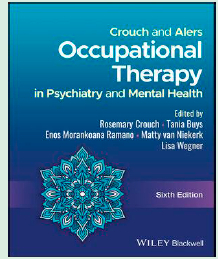
A review of Crouch and Alers Occupational Therapy in Psychiatry and Mental Health. 6th Edition
Dr Jennie McAdam
University of the Witwatersrand, Johannesburg, South Africa. BSc Occ Ther (Wits), M Occ Ther (Pretoria) and PhD (Wits) Jennie Mc Adam has unique experience, having served extensively as an occupational therapy clinician and manager in the public and private health sectors, at a governance level and in higher education. Email: Jenniemcadam.Naude@wits.ac.za. https://orcid.org/0000-0002-1692-5775ps://
TITLE OF THE BOOK
Crouch and Alers Occupational Therapy in Psychiatry and Mental Health. 6th Edition
EDITORS OF THE BOOK
Rosemary Crouch, Tania Buys, Enos Morankoana Ramano, Matty van Niekerk, Lisa Wegner.
The editors are all South African occupational therapists. Rosemary Crouch is an Adjunct Professor, at the School of Therapeutic Sciences, Faculty of Health Sciences, University of the Witwatersrand, Johannesburg and is the Honorary Editor of the 6th Edition. Tania Buys is a Senior Lecturer at the Department of Occupational Therapy, University of Pretoria. Enos Morankoana Ramano is a private occupational therapy practitioner. Matty van Niekerk is the Head of Department of Occupational Therapy at the School of Therapeutic Sciences, Faculty of Health Sciences, University of the Witwatersrand. Lisa Wegner is a professor and former Chairperson of the Department of Occupational Therapy at the University of the Western Cape.
INFORMATION ON THE BOOK
Published: 2025
Publisher: John Wiley & Sons Ltd
ISBN: 9781119878841 (paperback version only)
Number of pages : 494 pages
Price: R848.60
Submitted: 29 May 2025
Reviewed: Not applicable
Accepted: 21 June 2025
Declaration of bias: The reviewer has no bias to declare
THE REVIEW
The sixth edition of 'Crouch and Alers' (the name usually used to refer to this renowned textbook) does not disappoint! Numerous updated chapters have harnessed the fresh perspectives, diverse voices and evident expertise of new contributors, demonstrating the rich depth of occupational therapy expertise in the mental health field in South Africa. While this text eloquently consolidates this area of occupational therapy practice within the South African and African contexts, contributions by international or South African-trained occupational therapists now based elsewhere in the world are a notable addition.
The book once again consists of three sections, with this edition having thirty chapters. All chapters still include key learning points (in their introductions), case studies, illustrations and concluding questions to promote in-depth understanding and application. In addition, the expanded contents pages provide a breakdown of the material covered in each chapter for easy reference.
Section 1: Theoretical Concepts
This section comprises six chapters that lay the theoretical foundation for occupational therapy practice in psychiatry and mental health, including a new one entitled 'Theoretical Perspectives for Mental Health Care Practice'. Theoretical Frameworks, Occupation-based Models and Theoretical Frames of Reference are explained and differentiated, clearly illustrating how the occupational therapy process can be applied using occupational therapy techniques and occupations. This fundamental knowledge base is then deftly built upon in the other five chapters in this section. The updated Chapter 4 'Law, Human Rights and Ethics in Mental Health Care Practice' holds great value for clinicians and occupational therapy service managers navigating the ever-changing and complex service delivery challenges. The updated version of Chapter 6 'Clinical Reasoning in Psychiatric Occupational Therapy', presents design thinking and a discussion of the thorny issue of inter-disciplinary communication. In addition, the process of learning, mastering and evaluating clinical reasoning as shown in Table 6.4 on page 99 will no doubt be relied on by students, novices, experienced clinicians and academics alike for years to come.
Section 2: Specific Issues
The nine chapters in the second section each expand on important aspects of comprehensive and responsive occupational therapy services. Each of the three new chapters position occupational therapy within the broader psychiatric and mental health field, reminding us of the centrality of group work and occupations of collectives to our contribution. Chapter 8, entitled 'Human Ecosystems and Other Disasters: The impact on Health, Wellness and Human Occupation' is timely in the post-pandemic and uncertain world we are all navigating, where climate change and global conflicts increasingly wreak havoc on the occupational wellbeing of vulnerable populations. The delivery of psychiatric and mental health occupational therapy services in an African context is particularly encapsulated in Chapter15 'Spirituality and Mental Health:An Occupational Therapy Perspective'.
Section 3: Children, Adolescents and Adults
The final section of the text comprises fifteen chapters that address OT care in psychiatric and mental health conditions across the lifespan, with the one entitled ' Maternal Mental Health Concerns as a Priority in Occupational Therapy' an important addition. The chapter on 'Trauma and Its Impact on Individuals and Collectives' (Chapter 21) importantly highlights the consequences of Adverse Childhood Experiences (ACEs) and emphasises the need for implementation of a trauma-informed approach at all levels of care. This links to Chapter 26, where the insightful perspectives of practitioners with both clinical and lived experience in 'Working with People with a Diagnosis of 'Personality Disorder' add thought-provoking value to this invaluable publication.
My heartfelt congratulations to the editors and chapter authors for a work that harnesses the growth within the occupational therapy profession in South Africa and tackles relevant emerging local and global practice areas with aplomb. It is undoubtedly a valuable resource, both in totality and piecemeal when selecting individual chapters. The book once again raises the bar as the textbook of choice for psychiatric and mental health occupational therapy in South Africa and more broadly within the African continent.
