Services on Demand
Journal

Article
 English (pdf)
 Article in xml format
 Article references
 Automatic translation
 Send this article by e-mail
Indicators
Related links
-
 Cited by Google
 -
 Similars in Google
Share

 Permalink
Reading & Writing
On-line version ISSN 2308-1422Print version ISSN 2079-8245
Reading & Writing vol.16 n.1 Cape Town 2025
https://doi.org/10.4102/rw.v16i1.548
ORIGINAL RESEARCH
Enhancing South African science education: The impact of concept cartoons on teaching terminology during science investigations in intermediate phase
Warda Abrahams
Department of Education, Faculty of Education, Nelson Mandela University, Port Elizabeth, South Africa
ABSTRACT
BACKGROUND: The study explored how concept cartoons can be used as a teaching tool to improve Grade 4 learners' understanding of scientific terminology. The background highlights the importance of effective teaching tools in the changing educational environment, particularly in Natural Sciences education.
OBJECTIVES: The purpose of the study was to investigate how concept cartoons implemented by Natural Sciences teachers deepened the understanding of scientific terminology in learners when used in investigations.
METHOD: An interview-based, qualitative study was conducted with Grade 4 Natural Sciences teachers using semi-structured interviews and a case study. The data collection involved the use of concept cartoons in teaching scientific terminology, and the teachers' observations and feedback were collected through interviews.
RESULTS: The study identified three themes: (1) Teachers and scientific investigations, (2) Concept cartoons enable scientific talk, and (3) Concept cartoons contribute to teacher learning. The results suggested that concept cartoons function as a valuable resource for teachers, enhancing learners' comprehension and engagement, and embodying intrinsic characteristics of an educative curriculum material.
CONCLUSION: The study concluded that concept cartoons serve as an effective teaching tool for improving Grade 4 learners' comprehension of scientific terminology. Additionally, the study supported professional development of Grade 4 Natural Sciences teachers by deepening their grasp of scientific concepts and enhancing their instructional strategies.
CONTRIBUTION: This study contributed to the field of Natural Sciences education by highlighting the potential of concept cartoons as a teaching tool, and its findings can inform the development of teaching strategies and materials that support the learning of scientific terminology for First Additional Language and Language of Learning and Teaching context. Further exploration is warranted on how concept cartoons may support learners requiring remedial support or facing challenges that hinder their effective learning and comprehension of scientific concepts, ultimately enhancing teacher professional development and improving learning outcomes.
Keywords: concept cartoons; educative curriculum materials; scientific terminology; natural sciences investigations; intermediate phase; scientific investigations; teaching tool.
Introduction
Effective teaching tools are crucial in the changing educational environment and their relevance cannot be overstated (Puntambekar & Hubscher 2005). In particular, the field of Natural Sciences education faces the unique challenge of bridging the gap between complex scientific concepts and the comprehension of Intermediate Phase (IP) learners. To address this challenge, teachers are constantly seeking innovative methods to empower themselves and enhance their content knowledge and learners' proficiency (Wilson, Schweingruber & Nielsen 2015). Utilising concept cartoons as a teaching tool is one of these promising options. Concept cartoons can serve as an effective tool for IP Natural Sciences teachers, both to facilitate the teaching of scientific investigations and to aid in clarifying the definitions of scientific terminology. Concept cartoons provide teachers with innovative tools to present complex scientific concepts in a more accessible and engaging manner, aligning with constructivist teaching methods. For instance, they allow learners to express their views, engage in small group discussions, and collaboratively reach conclusions, thereby enhancing their understanding and retention of scientific concepts (Sanliturk & Zeybek 2022).
As the primary catalyst for change in the classroom, the teacher plays a pivotal role in continuously improving their teaching practices. Pricope (2019) emphasises that teachers often view themselves as visionaries within the field of education, driven by a commitment to innovation. These teachers actively pursue new strategies and approaches, striving for continued improvement and effectiveness in their methods. To gain insight into the process through which teachers acquire knowledge, it is essential to explore how a teacher's personal approach to learning aligns with the school's learning orientation (Bertram 2014). This holds significance because teachers responsible for instructing Natural Sciences in the IP programme may not necessarily possess specialised expertise in Natural Sciences. Consequently, they may lack the in-depth knowledge required to teach science effectively. When teachers have a deepened understanding of concepts, they in turn convey deepened understanding of concepts to their learners. Utilising concept cartoons as a teaching tool is one of the options Natural Sciences teachers can employ to ensure that in-depth understanding of scientific concepts is communicated effectively to the learners.
Teachers have access to a variety of curriculum resources, including textbooks and teacher guides, to support their instruction (Fan et al. 2018). Scheider and Krajcik (2002) emphasise that the primary goal of well-designed curriculum material is to foster teachers' professional development, ultimately improving student learning. Educative curriculum materials (ECM) are specifically designed to enhance teachers' pedagogical skills and deepen their understanding of the curriculum they are teaching, thereby promoting both teacher learning and instructional effectiveness (Bertram 2014). While ECMs are not created according to a specific design, they are characterised by essential elements that facilitate teacher learning.
This understanding is particularly relevant within the South African education system, which is characterised by a complex interplay of language diversity, literacy challenges, and government initiatives aimed at improving educational outcomes (Mtambo & Tshuma 2023). While efforts are made to enhance literacy across all languages, there is a pronounced emphasis on English language instruction. The South African Department of Basic Education (DBE) has implemented programmes specifically targeting English instruction to improve teaching practices and learner outcomes, particularly in the IP (Grades 4-6). Despite these initiatives, inequalities persist in literacy rates, with a substantial proportion of learners unable to read for meaning by age 10 (Mtambo & Tshuma 2023). This highlights the critical need for effective literacy interventions and robust support systems within schools. Integrating ECMs into these interventions could play a vital role in addressing these challenges by equipping teachers with the necessary tools and pedagogical strategies to improve literacy outcomes across diverse contexts.
The study aimed to investigate how concept cartoons implemented by Natural Sciences teachers influenced the teaching of science terminology to learners. This was done by using a case-study design which comprised three Grade 4 Natural Sciences teachers. Therefore, this study sought to address the following question: How does the use of concept cartoons implemented by Natural Sciences teachers deepen understanding of scientific terminology in learners when used in investigations?
Concept cartoons as an educative curriculum material
Concept cartoons are instructive teaching resources that relate to a particular topic in science. When concept cartoons are viewed as ECM, it can enhance logical and scientific thinking in teachers and learners. The idea of concept cartoons was designed by Stuart Naylor and Brenda Keogh (2012), and they define the use of the tool as an innovative way to examine scientific debates using animated characters. It is a method of instructional design to develop learners' critical thinking abilities, enhance scientific vocabulary and broaden their knowledge of science. The cartoon style characters implemented by teachers are designed to engage learners in peer discussions. The speech bubbles incorporate scientific terminology, allowing learners to connect the cartoons to familiar contexts or scenarios, thus enhancing their understanding of scientific vocabulary. The scenarios in the cartoons are based on real-world situations. Concept cartoons are appropriate tools implemented by teachers to foster learners' conceptual knowledge of science, and can improve both teachers' and learners' conceptual understanding of a given concept. In essence, concept cartoons engage learners effectively in open-ended discussions (Kartikasari, Usodo & Riyadi 2022). Learners are drawn to creative and diverse visual materials that engage and challenge their thinking skills. As such, this approach is utilised to enhance the development of scientific vocabulary. Concept cartoons adopt a constructivist approach to science learning, and actively engage learners by facilitating critical thinking and deeper understanding. By interacting with these tools, learners build their own understanding, making lessons more engaging and hands-on. Concept cartoons, initially created to stimulate thinking in both learners and teachers (Naylor & Keogh 2012), encourage critical thinking and lively discussions within the classroom.
Curriculum Assessment Policy Statement and investigative approaches in enhancing science education
Within a South African context, the Curriculum Assessment Policy Statement (CAPS) is a guided resource material for IP teachers that instructs them to apply a methodological approach of 'discovery through carrying out investigations' (DBE 2011:9). The Intermediate Phase Natural Sciences teachers will use developmental techniques from the CAPS document. The purpose of Natural Sciences investigations is that 'learners should be able to complete investigations, analyse problems and use practical processes and skills in designing and evaluating solutions' (DBE 2011:10). These investigative activities enhance a range of skills, including prediction, investigation, and communication. This set of tasks features a range of activities that allows learners to demonstrate their knowledge and skills (DBE 2011). Moreover, teachers should motivate learners to build on previously taught concepts and deepen their understanding of the subject matter during investigations (DBE 2011). According to Concannon et al. (2020), the most effective science learning outcomes are achieved when teachers leverage learners' existing knowledge from the outset of instruction. This will allow them to enhance and master their understanding of the subject (Concannon et al. 2020). For learners to effectively learn and practise scientific investigation, it is essential for teachers to have a comprehensive understanding of investigative methods. To promote meaningful science learning, teachers should actively engage in science activities with their learners (Moeed 2013). Moreover, concept cartoons have the potential to deepen learners' scientific understanding by encouraging them to engage with investigative questions and build scientific vocabulary through observing the investigation. Additionally, ECM can aid teachers in identifying learners' knowledge gaps, engaging learners from diverse backgrounds, and meeting the curriculum's specified outlined learning outcomes (Davis et al. 2017).
Concept cartoons enhance knowledge of teachers
Recent advancements in 21st century education have prompted a re-evaluation of our perceptions of education. With the growing demands of contemporary teaching, it is critical to develop instructional materials that present a fresh perspective and create an environment in the classroom that integrates modern educational and training methodologies harmoniously (Akcanca 2020).
Concept cartoons may potentially enhance teachers' subject knowledge and understanding of science, while also facilitating learners' scientific understanding. Scheider and Krajcik (2002) affirm that ECMs are created to support teacher learning. Concept cartoons offer teachers a structure for incorporating investigative activities into their lessons. Additionally, concept cartoons offer a valuable resource for clarifying potential misconceptions teachers may hold about scientific concepts, by presenting complex ideas in an accessible and straightforward manner (Naylor & Keogh 2012). By utilising concept cartoons, teachers can transform complex and challenging concepts into valuable starting points in order to teach related concepts effectively (Pekel 2021).
The process of teacher learning can be understood through various lenses: teacher development, professional development, or teacher change, which are often seen as interchangeable terms (Bertram 2014). Bertram (2014) identifies three key factors that influence teacher learning: the nature of the development activity, which refers to a specific task aimed at improving teaching skills and knowledge; the individual characteristics and prior experiences of the teacher; and the school context that shapes their working environment. Understanding these factors provides an understanding of how tools like concept cartoons can contribute to both teacher growth and classroom effectiveness.
Methodology and research design
This qualitative study, grounded in a constructivist approach, sought to investigate the challenges faced by Natural Sciences teachers in teaching science terminology. Constructivism, which emphasises the active role of individuals in building knowledge through social contexts (Venter 2001), is rooted in the works of key theorists such as Piaget (1950) and Vygotsky (1978), who highlighted the importance of cognitive development and social interaction in learning. These seminal sources provided the theoretical lens for exploring how teachers' perceptions and interactions with learners shaped their instructional practices. The research aimed to explore participants' opinions, perspectives, and views on incorporating concept cartoons into their teaching practices.
Data collection
The research process adopted a qualitative approach centring on a specific learning problem, namely the difficulty Natural Sciences teachers encounter in teaching scientific terminology to learners. Data were gathered through semi-structured interviews, enabling a thorough exploration of participants' perspectives. This study aimed to investigate participants' opinions and worldviews, aligning with a qualitative research design that seeks to understand how individuals engage with and respond to social or educational challenges (Creswell & Poth 2018).
Semi-structured interviews were conducted with participating teachers, complemented by a Natural Sciences investigative questionnaire, which served as an instrumental tool in the data collection process. The aim was to explore participants' insights, opinions, and perspectives on the use of concept cartoons within their own teaching and learning contexts. The study was situated within schools in the northern area of the Eastern Cape, South Africa, selected because of their socio-economic contexts and the influence of surrounding communities on the learning environment.
A comparison was made among the participants from Grade 4, and the interview transcripts were organised into themes which were derived from common words and phrases participants used to convey their ideas and perspectives in response to the same interview questions. These recurring expressions were combined to address the central phenomena of this study. The interviews, conducted within the teachers' own classroom environments, facilitated the collection of detailed context-rich data. The interviews were designed to gather teachers' observations and insights regarding learners' completion of the Grade 4 Natural Sciences investigative questionnaire (Appendix 1). The questionnaire served as a dual-purpose tool, functioning both as a reflective instrument for teachers and as a focal point for discussion during the interviews. This approach enabled an in-depth assessment of the effectiveness of concept cartoons in enhancing learners' understanding of scientific terminology. Meaningful questions were crafted to generate rich data. After completing the interviews, a spreadsheet was used to organise the data, which were then analysed to identify relevant themes.
The concept cartoon designed specifically for this study was aimed at encouraging large-group classroom discussions and facilitating investigative activities in the classroom for learners. It encouraged learners to explore scientific concepts and answer related questions. The teachers' observations focused specifically on the use and comprehension of scientific terminology by the learners. All participants responded to open-ended questions, which enabled probing and deeper exploration of their views on whether concept cartoons were effective in aiding Natural Science investigations. Emerging themes from the data informed the researcher's ability to make evidence-based comparisons with existing literature.
To ensure participants were well prepared, an introductory workshop was conducted prior to data collection. The workshop clarified expectations, outlined the research potential benefits for participants, and provided guidance on how to effectively implement the Grade 4 Natural Sciences investigative questionnaire in their classrooms.
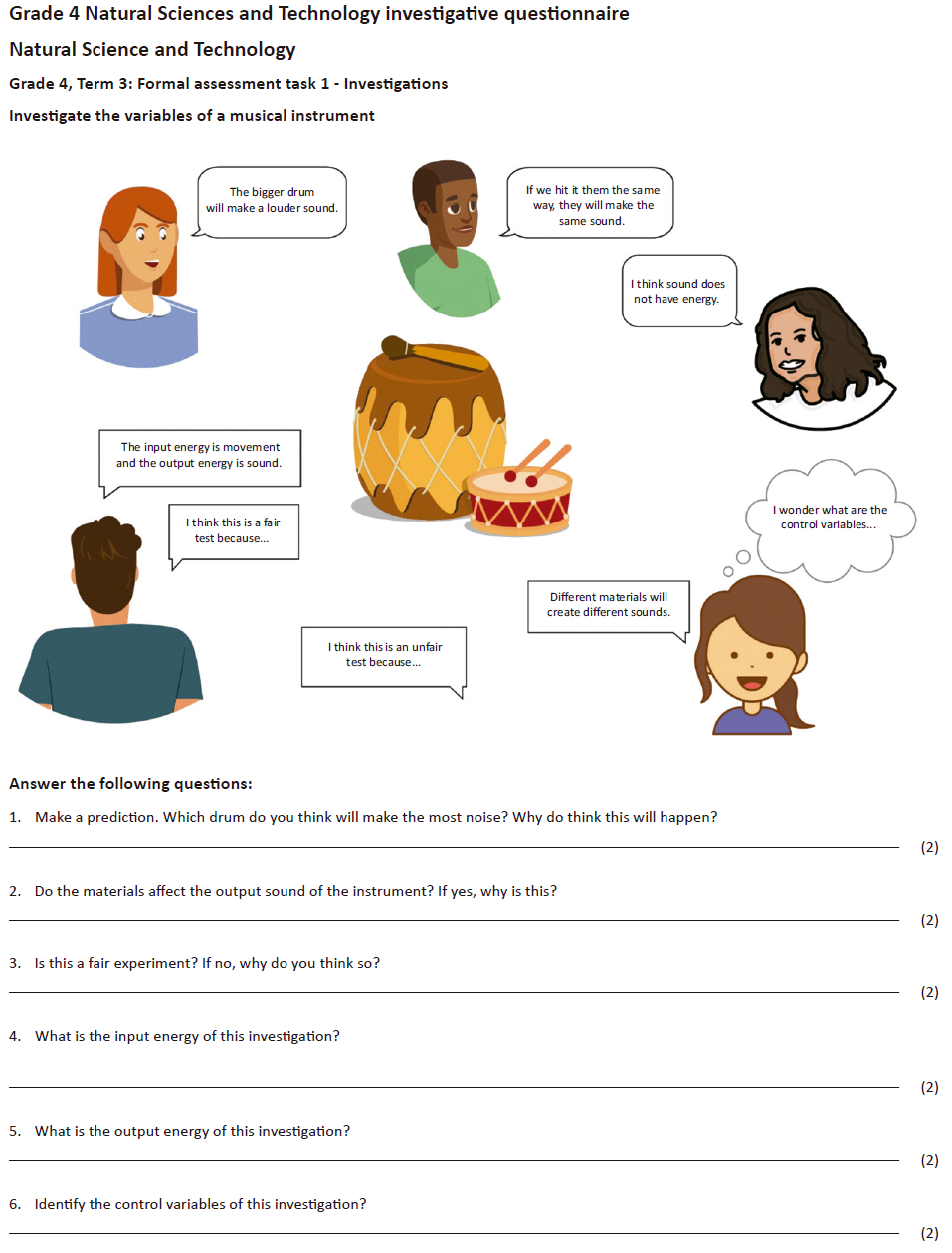
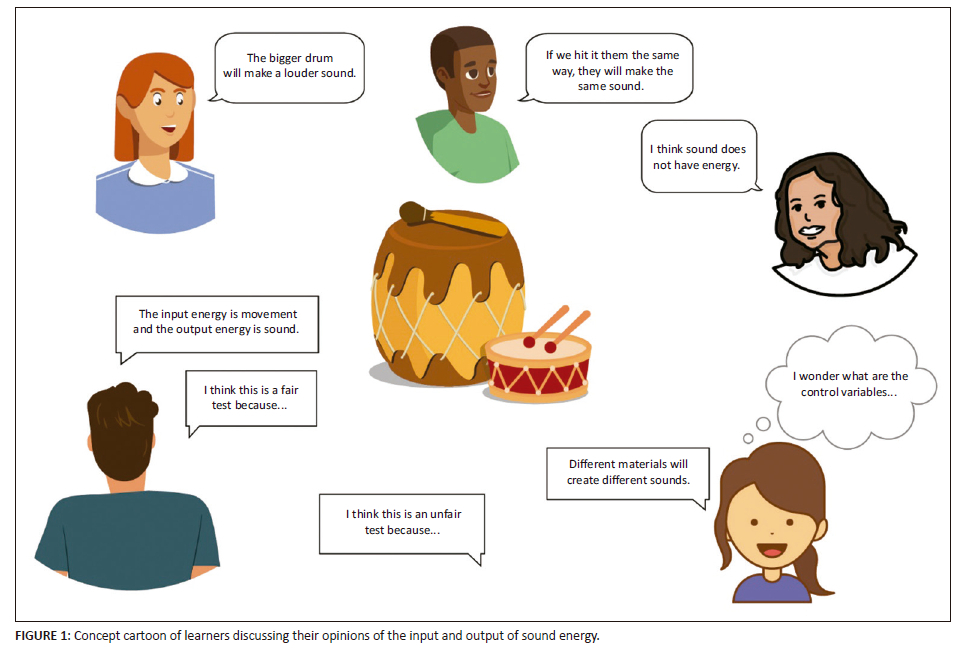
Figure 1 illustrates the Grade 4 Natural Sciences Term 3 practical investigation centred on sound energy. Participants used a concept cartoon to teach learners about sound energy within this investigation. The cartoon depicts learners discussing and debating which drum would produce the loudest sound, encouraging them to engage in dialogue and use scientific vocabulary to understand the input and output energy related to sound.
This concept cartoon introduces various scientific ideas and concepts that learners had been exposed to prior to the investigation. However, these terms are new and are not part of the learners' everyday language. Hinds et al. (2000) suggest that the distinction between the language used in science education and everyday social language affects how learners understand scientific concepts. This can pose a challenge for learners, as these terms are applied in contexts unfamiliar to their social language. For instance, terms like 'control variable' and 'prediction' are uncommon for Grade 4 learners, especially within the schools where the research was conducted, and were not part of their social vocabulary. Additionally, words like 'input' and 'output' were entirely new to the Grade 4 learners, who are accustomed to simpler phrases such as 'put in' rather than 'input'. This unfamiliar phrasing could be confusing and might even seem grammatically incorrect to them.
The Grade 4 teachers observed the discussion, providing guidance to help learners understand the concept cartoon. Following this, the learners were given a practical investigation worksheet (Appendix 1: Grade 4 Investigative Concept Cartoon Questionnaire) to complete. The worksheet included questions related to the cartoon, aimed at assessing how effectively it supported learners' understanding of scientific terminology.
Theoretical framework
The study was grounded in a social constructivist theoretical framework, which posits that learners are continually engaged in building knowledge within a social context (Venter 2001). Social constructivism emphasises the interplay between individual cognition and social interaction, asserting that meaningful learning occurs when learners actively engage with others in shared activities, discussions, and problem-solving processes (Palincsar 1998). Developing scientific concepts in school-aged learners is a practical concern, as it is integral to teachers' responsibility to provide learners with a structured system of scientific knowledge (Vygotsky 1978). According to Vygotsky (1978), this knowledge-building process is scaffolded by the teacher, who serves as a mediator, guiding learners through the Zone of Proximal Development (ZPD) to achieve deeper conceptual understanding. This framework acknowledges that learners' perceptions and interpretations of social activities can vary, and that each learner creates their own unique understanding and meaning of a particular situation (Venter 2001). Additionally, social constructivism informed the study's focus on how teachers' interpretations of their classroom experiences shaped their use of concept cartoons. By situating concept cartoons within this framework, the study recognised that these tools could act as stimuli for collaborative discussions and investigative activities, enabling learners to construct and reconstruct scientific concepts through social interaction. This theoretical framework provided a lens through which teachers' active engagement with scientific terminology could be understood as part of an ongoing process of professional growth. Adopting this framework, the study aimed to gain a deeper understanding of how teachers' worldviews and opinions shape their teaching practices, particularly in relation to the use of concept cartoons, and how these practices contribute to fostering an interactive and learner-centred classroom environment.
Participants
Three IP teachers from Grade 4 were purposively selected to participate in this study. A biographical sheet was used to categorise teachers according to their qualifications and years of experience. The teachers participated in three workshops, building a network of connections and a shared understanding of the grade-specific content. Thereafter, participants had to investigate the use of concept cartoons applied during a Natural Sciences investigation lesson focused on Term 3 content. They were given the chance to ask questions and clear up any uncertainties regarding the investigations. Participants received guidance on how to implement concept cartoons as a teaching tool and on key aspects to observe during the lesson.
Participants indicated that any investigations conducted needed to align with their instructional content and include suitable assessment components. Appendix 1 was meticulously designed to meet Grade 4 assessment criteria and align with the CAPS. This approach aimed to reduce teachers' administrative burdens by providing grade-specific resources that complemented their existing curriculum content. The concept cartoons were designed to improve learners' understanding of terminology related to sound energy for their science investigations. Figure 1 shows the Grade 4 Natural Sciences practical investigation for Term 3, centred on sound energy. The concept cartoon was used with learners to conduct their Grade 4 Natural Sciences practical investigation on sound energy. This involved the learners to discuss and utilise scientific terminology to comprehend the input and output energy associated with sound.
Data analysis
A comparative analysis of data will be conducted to identify initial codes generated based on recurring themes in participants' responses. Next, interview transcripts were reviewed so that themes could be identified from emerging patterns in the codes. Thorne (2000:69), and Lincoln and Guba (1985) outline a method that entails examining a specific piece of data (such as an interview, a statement, or a theme) and contrasting it with other similar or differing pieces to create conceptualisations of the potential relationships among the various data elements. A comparison was conducted across participants from Grade 4, and the data were then organised into thematic categories. These themes were derived from similar words and phrases used by the participants to articulate their ideas and perspectives in response to the interview questions.
This research was both strategic and diagnostic, proposing a specific approach through a workshop aimed at helping Natural Sciences teachers effectively teach scientific terminology to English as a Second Language (ESL) learners. The teaching strategy included the use of ECM, specifically concept cartoons, and the assessment was conducted through interviews to gather feedback on what both teachers and learners gained from their experience with concept cartoons.
Ethical considerations
An application for full ethical approval was made to the Faculty Research, Technology and Innovation Committee of Education (ERIC), Nelson Mandela University and ethics consent was received on 04 April 2017. The ethics approval number is H17-EDU-ERE-005. Additionally, consent was granted from the DBE in the Eastern Cape. Upon receiving permission, the researcher sought consent from the participants who were informed of their right to terminate their participation any time they felt uncomfortable and that there would not be any consequences for such.
To ensure confidentiality, participants were provided with pseudonyms (e.g., 4A, 4B, 4C). This approach protected their identities while allowing for easy reference during data analysis. All three participants responded to open-ended questions, which enabled probing and deeper exploration of their views on whether concept cartoons were effective in aiding Natural Science investigations. Themes emerged from the data, guiding the researcher to formulate well-supported conclusions and draw comparisons with the existing literature.
Findings
The following themes were identified and addressed the research question: How does the use of concept cartoons implemented by Natural Sciences teachers deepen understanding of scientific terminology in learners when used in investigations?
Participants were asked to share their experiences after implementing concept cartoons during science investigations. A breakdown for Grade 4 themes is presented below:
Theme 1: Teachers and scientific investigations
Theme 2: Concept cartoons enable scientific talk
Theme 3: Concept cartoons and teacher learning
Theme 1: Teachers and scientific investigations
Concept cartoons serve as valuable visual teaching tools which teachers have employed to assist learners encountering difficulties in reading during science investigations (Naylor & Keogh 2012). By offering multiple perspectives on scientific questions, concept cartoons empower learners to mentally explore different methods of constructing answers and reaching conclusions (Naylor & Keogh 2012). When integrated into practical investigations, the visual and dialogic elements can stimulate the generation of new scientific knowledge and foster innovative thinking among learners.
Teachers shared their insights regarding the use of concept cartoons in the context of scientific investigations. Teacher 4A noted that the method encouraged 'out of the box' thinking, stimulated learners' understanding of science concepts, and prompted alternative ways of reasoning. Webb, Williams and Meiring (2008:8) affirm that concept cartoons can provoke discussion and stimulate critical thinking. For teacher 4A, using concept cartoons not only broadened her teaching strategies but also facilitated a learning environment where learners felt confident using scientific terminology. This aligns with Putman's (2012:28) assertion that effective teachers tend to explore innovative instructional materials and methods to improve their teaching.
Teacher 4C emphasised that concept cartoons provided 'a new method to teach science terms' and fostered scientific dialogue among learners. Previously, her approach involved having learners compile glossaries and study independently. The integration of concept cartoons, however, enhanced learners' understanding of science concepts through interactive and engaging discussions.
During these investigations, learners took on the role of scientists, questioning and debating the characters depicted in the concept cartoons. Teacher 4B stated that explaining science concepts became 'much easier' using this method and noted improvements in reading and critical thinking. This aligns with the findings of Jamal, Ibrahim and Surif (2018), who suggest that the actions of cartoon characters can facilitate the understanding of complex ideas.
Teacher 4C also observed that learners related to the cartoon characters and found the material more accessible, leading to improved performance in practical investigations. Teacher 4C stated, 'they did they could relate each character, and they understood what they were saying'. Koutnikova (2017) highlights the importance of cartoons in modern teaching strategies, particularly for fostering discussion skills (Naylor & Keogh 2012). Concept cartoons, as noted by Yılmaz, Sağlık and Kadan (2021), are appropriate for all age groups, challenging learners to critically evaluate and discuss diverse perspectives.
Theme 2: Concept cartoons enable scientific talk
A notable characteristic of concept cartoons is its ability to provoke scientific discourse among learners (Naylor & Keogh 2012). In this study, they encouraged learners to think critically while responding to questions. The cartoon style illustration depicted various characters debating a concept or subject. Birisci, Metin and Karakas (2010:3) mention that 'the cartoon style characters are designed to intrigue and provoke discussions and stimulate scientific thinking'. Likewise, Teacher 4A remarked that 'it definitely encouraged scientific talk amongst the learners and was easy to teach science concepts'.
Webb et al. (2013:6) support this and claim that concept cartoons can encourage scientific talk among learners and further add that 'these simple visual representations maximise learner involvement, particularly those learners who are not fluent in formal language and who may be intimidated by scientific terminology'. Teacher 4A noted that 'it was refreshing and a new way of teaching science investigations' and it was 'a new way to teach my learners science terms'.
All three teachers concurred that it enhanced their approaches to teaching science investigations, with 4C claiming that 'it was more relaxing and fun approach to learning science investigations, also learners were able to look at different approaches identify it and relate to it'.
Theme 3: Concept cartoons contributed to teacher learning
According to Scheider and Krajcik (2002), curriculum materials are tools designed primarily to support teacher learning and instruction, ultimately aimed at enhancing teachers' pedagogical skills.
Teacher 4B acknowledged that concept cartoons serve as an ECM, even though she was not familiar with this concept at the time. During the interview, she recognised that concept cartoons are a valuable resource for teachers and that both educators and learners benefit from being introduced to them as part of their learning journey. Teacher 4B mentioned: 'It definitely changed the way I taught scientific investigations'. Teacher 4A affirmed that 'it was a learning experience for me and my learners'. Teacher 4C added: 'It was refreshing and new, teaching materials which enhanced my understanding of the content and improved my science knowledge'.
The statement above implies that concept cartoons, as a teaching tool, serve as a valuable resource for teachers, allowing them to acquire knowledge while using them to enhance learners' comprehension.
Educative curriculum materials facilitate teacher learning, which supports the argument that concept cartoons functioned as an ECM. They viewed concept cartoons as tools that supported and enriched their learning experience.
Discussion
The results of this study, reflected in the answers to the research question, indicate that concept cartoons function as more than instructional tools; they serve as a vital resource for teachers, enhancing learners' comprehension and engagement. Furthermore, these concept cartoons embody intrinsic characteristics of an ECM, suggesting that their role extends beyond basic teaching aids to include a deeper pedagogical framework. This framework highlights effective teaching strategies within the field of IP Natural Science education. By facilitating a deeper understanding of scientific terminology and concepts, concept cartoons contribute to the enhancement of science education, thereby reinforcing their value as essential instruments in the educational process.
This research contributed to the professional development of Grade 4 Natural Sciences teachers by enhancing their understanding of scientific terminology and improving their pedagogical strategies for effectively imparting scientific vocabulary to learners. Therefore, the concept cartoons had the qualities needed to be a teaching resource which benefitted and assisted Grade 4 Natural Sciences teachers during science investigations, specifically with science terminology. Furthermore, concept cartoons aided the teachers in instructing science terminology to many of their learners. The Grade 4 teachers found the teaching material easy to work with and understandable. They observed and completed the Grade 4 investigative questionnaire with learners and noted that using concept cartoons made it easier to teach Natural Sciences investigations.
Conclusion and recommendations
Reflecting on the three themes mentioned, it becomes evident that Grade 4 teachers regard concept cartoons as a learning tool. They recognised and observed the inaccuracies in learners' understanding of scientific terminology and information pertaining to the subject matter. This observation revealed both the prevalent and less common misconceptions that learners held about Natural Sciences content.
Grade 4 teachers gained valuable insights from this research regarding how their learners understand scientific concepts. Teachers noticed the positive impact that concept cartoons had on their learners' understanding of science terminology. This not only improved the teachers' grasp of the subject matter but also sparked fresh ideas for their science teaching methods.
Engaging in this research activity supported the development of reading skills and critical thinking, highlighting its potential for integration with the English curriculum. Concept cartoons not only enrich the Natural Sciences curriculum but can also be implemented as an effective strategy in a First Additional Language (FAL) and Language of Learning and Teaching (LoLT) context. Furthermore, additional research can be undertaken to explore how concept cartoons can support at-risk or special needs learners who are encountering challenges in understanding specific scientific concepts. It is the researcher's hope that incorporating concept cartoons in the classroom will assist in positively shaping the teaching and learning landscape in South Africa.
Acknowledgements
This author would like to thank the teachers who participated in the interviews and contributed to this study.
Competing interests
The author declares that they have no financial or personal relationships that may have inappropriately influenced them in writing this article.
Author's contributions
W.A. is the sole author of this research article.
Funding information
This research received no specific grant from any funding agency in the public, commercial, or not-for-profit sectors.
Data availability
The data supporting the findings of this article are available from the author, W.A., upon reasonable request.
Disclaimer
The views and opinions expressed in this article are those of the author and are the product of professional research. It does not necessarily reflect the official policy or position of any affiliated institution, funder, agency, or that of the publisher. The author is responsible for this article's results, findings, and content.
References
Akcanca, N., 2020, 'An alternative teaching tool in science education: Educational comics', International Online Journal of Education and Teaching (IOJET) 7(4), 58-73. [ Links ]
Bertram, C., 2014, 'Shifting discourses and assumptions about teacher learning in South African teacher development policy', Southern African Review of Education 20, 90-108. [ Links ]
Birisci, S., Metin, M. & Karakas, M., 2010, 'Pre-service elementary teachers' views on concept cartoons: A sample from turkey', Middle East Journal of Scientific Research 5(2), 91-97. [ Links ]
Concannon, J.P., Brown, P.L., Lederman, N.G. & Lederman, J.S., 2020, 'Investigating the development of secondary students' views about scientific inquiry', International Journal of Science Education 42(6), 906-933. https://doi.org/10.1080/09500693.2020.1742399 [ Links ]
Creswell, J. & Poth, C.N., 2018, Qualitative inquiry and research design choosing among five approaches, 4th edn., Sage Publishers Inc., Thousand Oaks, CA.
Davis, E.A., Palincsar, A.S., Smith, S., Arias, A.M. & Kademian, S.M., 2017, 'Educative curriculum materials: Uptake, impact, and implications for research and design', Educational Researcher 46(6), 293-304. https://doi.org/10.3102/0013189X17727502 [ Links ]
Department of Basic Education (DBE), 2011, Curriculum and assessment policy statement, DBE South Africa, Pretoria.
Department of Basic Education (DBE), 2012, National policy pertaining to the programme and promotion requirements of the national curriculum statement grades R-12, DBE, Pretoria.
Fan, L., Trouche, L., Rezat, S. & Visnovska, J., 2018, 'Research on mathematics textbooks and teachers' resources', in ICME-13, International Congress on Mathematical Education, Hamburg.
Hinds, D., 2000, 'Research Instruments', in D. Wilkinson (ed.), The Researcher's Toolkit: The complete guide to practitioner research, Routledge Falmer, London.
Jamal, S.N.B., Ibrahim, N.H.B. & Surif, J.B., 2018, 'Concept cartoon in problem-based learning: A systematic literature review analysis', Journal of Technology and Science Education 9(1), 51-58. https://doi.org/10.3926/jotse.542 [ Links ]
Kartikasari, S., Usodo, B. & Riyadi, 2022, 'The effectiveness of open-ended learning and creative problem solving models to teach creative thinking skills', Pegem Journal of Education and Instruction 12(4), 29-38. https://doi.org/10.47750/pegegog.12.04.04 [ Links ]
Koutnikova, M., 2017, 'The application of comic in science education', Acta Educationis Generalis 7(3), 1-11. https://doi.org/10.1515/atd-2017-0026 [ Links ]
Lincoln, Y. & Guba, E.G., 1985, Naturalistic inquiry, Sage, Thousand Oaks, CA.
Moeed, A., 2013, 'Science investigation that best supports student learning: Teachers' understanding of science investigation', International Journal of Environmental & Science Education 8(4), 537-557. https://doi.org/10.12973/ijese.2013.218a [ Links ]
Mtambo, B. & Tshuma, L., 2023, 'Intermediate phase learners' performance in English: A qualitative analysis', Reading & Writing 14(1), a430. https://doi.org/10.4102/rw.v14i1.430 [ Links ]
Naylor, S. & Keogh, B., 2012, Concept cartoons in science education, pp. 1-9, Millgate House Publishers, Sandbach, Cheshire.
Palincsar, A.S., 1998, 'Social constructivist perspectives on teaching and learning', Annual Review of Psychology 49(1), 345-375. https://doi.org/10.1146/annurev.psych.49.1.345 [ Links ]
Pekel, F.O., 2021, 'The effects of concept cartoons and argumentation-based concept cartoons on students' academic achievements', Journal of Baltic Science Education 20(6), 956-968. https://doi.org/10.33225/jbse/21.20.956 [ Links ]
Piaget, J., 1950, The psychology of intelligence, Routledge and Kegan Paul, London.
Pricope, M., 2019, 'Effective teachers as visionary leaders', Synergies in Communication 1(1), 124-129. [ Links ]
Puntambekar, S. & Hubscher, R., 2005, 'Tools for scaffolding students in a complex learning environment: What have we gained and what have we missed?', Educational Psychology 40(1), 1-12. https://doi.org/10.1207/s15326985ep4001_1 [ Links ]
Putman, S., 2012, 'Investigating teacher efficacy: Comparing preservice and inservice teachers with different levels of experience', Action in Teacher Education 34(1), 26-40. https://doi.org/10.1080/01626620.2012.642285 [ Links ]
Sanliturk, A.D. & Zeybek, G., 2022, 'The effect of using digital concept cartoons in science lesson on students' achievement', Journal of Science Learning 5(1), 1-13. https://doi.org/10.17509/jsl.v5i1.32097 [ Links ]
Scheider, R.M. & Krajcik, J., 2002, 'Supporting science teacher learning: The role of educative curriculum materials', Journal of Science Teacher Education 13(3), 221-246. https://doi.org/10.1023/A:1016569117024 [ Links ]
Thorne, S., 2000, 'Data analysis in qualitative research', Evidence Based Nursing 3, 68-70. https://doi.org/10.1136/ebn.3.3.68 [ Links ]
Venter, E., 2001, 'A constructivist approach to learning and teaching', South African Journal of Higher Education 15(2), 86-92. https://doi.org/10.4314/sajhe.v15i2.25358 [ Links ]
Vygotsky, L.S., 1978, Mind in society: The development of higher psychological processes, Harvard University Press, Cambridge, MA.
Webb, P., Williams, Y. & Meiring, L., 2008, 'Concept cartoons and writing frames: Developing argumentation in South African Science classrooms', African Journal of Research in Mathematics, Science and Technology Education 12(1), 5-17. https://doi.org/10.1080/10288457.2008.10740625 [ Links ]
Wilson, S., Schweingruber, H. & Nielsen, N., 2015, Science teachers' learning: Enhancing opportunities, creative supportive contexts, The National Academies of Sciences Engineering Medicine, Washington, DC.
Yılmaz, M., Sağlık, Z. & Kadan, O., 2021, 'Impact of instruction with concept cartoons on primary school 3rd graders' speaking skills', Education & Science 46(207), 127-147. https://doi.org/10.15390/EB.2021.9259 [ Links ]
 Correspondence:
Warda Abrahams
wabrahams@varsitycollege.co.za
Received: 04 Nov. 2024
Accepted: 11 Feb. 2025
Published: 18 Mar. 2025
Appendix 1