




Services on Demand
Journal

Article
 English (pdf)
 Article in xml format
 Article references
 Automatic translation
 Send this article by e-mail
Indicators
Related links
-
 Cited by Google
 -
 Similars in Google
Share

 Permalink
Journal of Student Affairs in Africa
On-line version ISSN 2307-6267Print version ISSN 2311-1771
JSAA vol.13 n.2 Cape Town 2025
https://doi.org/10.24085/jsaa.v13i2.5281
RESEARCH ARTICLE
https://doi.org/10.24085/jsaa.v13i2.5281
Determining the desire for entrepreneurial education amongst South African university students
Ukumisela umnqweno wemfundo ngobungxowa-nkulu phakathi kwabafundi baseyunivesithi eMzantsi Afrika
Juliet TownesI; Angela Pike-BowlesII; Bramwell K. GavazaIII; Darlington T. ChigoriIV; Gift DongaV; Justice N. MuchineripiVI
ISenior Lecturer: Department of Business Management, University of Fort Hare, South Africa. Email: jtownes@ufh.ac.za. ORCID: 0000-0003-4546-299X
IITime-on-Task Lecturer: Department of Business Management, University of Fort Hare, South Africa. Email: apike-bowles@ufh.ac.za. ORCID: 0000-0003-4811-0455
IIITime-on-Task Lecturer: Department of Business Management, University of Fort Hare, South Africa. Email: bgavaza@ufh.ac.za. ORCID: 0000-0002-3684-5166
IVTime-on-Task Lecturer: Department of Business Management, University of Fort Hare, South Africa. Email: dchigori@ufh.ac.za. ORCID: 0000-0001-6284-1970
Vime-on-Task Lecturer: Department of Business Management, University of Fort Hare, South Africa. Email: gdonga@ufh.ac.za. ORCID: 0000-0001-8263-7205
VITime-on-Task Lecturer: Department of Business Management, University of Fort Hare, South Africa. Email: jmuchineripi@ufh.ac.za. ORCID: 0000-0002-8058-731X
ABSTRACT
Entrepreneurship education is more vital now than ever before, equipping individuals with the skills and mindset to navigate the complexities of today's dynamic business landscape. Higher education institutions need to consider the current state of the labour market and restructure their entrepreneurial curriculums. Supporting entrepreneurship is a national priority. To foster this, higher education institutions must embrace their role and align their programs with the evolving demands of the labour market. The purpose of this study was to determine the desire for entrepreneurship education within institutions of higher education and to ascertain students' opinions on the perceived characteristics of the existing entrepreneurship education curriculum. This study employed a quantitative methodology, administering an online questionnaire to 322 university students. Students at the chosen South African university showed significant interest in entrepreneurship education. By incorporating entrepreneurship education into the higher education curriculum, universities are poised to assume a critical role in shaping and developing future entrepreneurs in South Africa.
Keywords: Entrepreneurship, education, entrepreneurial culture, higher education, curriculum
ISISHWANKATHELO
Imfundo ngobungxowa-nkulu ibaluleke ngakumbi kunangaphambili, kuba ixhobisa abantu ngezakhono kunye nendlela yokucinga efanelekileyo yokukwazi ukujongana nobunzima bendawo yorhwebo etshintsha ngokukhawuleza yanamhlanje. Amaziko emfundo ephakamileyo kufuneka aqwalasele imeko yangoku yentengiso yemisebenzi aze alungiselele kwakhona iinkqubo zawo zemfundo ngobungxowa-nkulu. Ukuxhasa ubungxowa-nkulu yinto ephambili kumgaqo-nkqubo wesizwe. Ukuze oku kuphumelele, amaziko emfundo ephakamileyo kufuneka amkele indima yawo aze ahambelane neemfuno eziguqukayo zentengiso yemisebenzi. Injongo yophando olu yayikukufumanisa umnqweno wokufunda ngobungxowa-nkulu phakathi kwamaziko emfundo ephakamileyo kunye nokuvavanya iimbono zabafundi malunga neempawu ezibonwayo zenkqubo yemfundo ngobungxowa-nkulu ekhoyo. Olu phando lwasebenzisa indlela yohlahlelo yobuninzi, apho kwabuzwa imibuzo ngefom ye-intanethi kubafundi aba-322 baseyunivesithi. Abafundi kwiyunivesithi ekhethiweyo yaseMzantsi Afrika babonise umdla omkhulu kwimfundo ngobungxowa-nkulu. Ngokudibanisa imfundo ngobungxowa-nkulu kwinkqubo yemfundo ephakamileyo, iiyunivesithi zilungele ukudlala indima ebalulekileyo ekwakheni nasekuphuhliseni oosomashishini bakamva eMzantsi Afrika.
Amagama angundoqo: Ubungxowa-nkulu, imfundo, inkcubeko yobungxowa-nkulu, imfundo ephakamileyo, inkqubo yemfundo
Introduction
Entrepreneurship is essential for all economies worldwide, as it drives economic development by reducing poverty, creating jobs, fostering innovation, and promoting long-term sustainability (Carpenter & Wilson, 2022). Entrepreneurship appears within all business cycles, contributing towards business success and sustainability through its own distinct set of principles. Diandra and Azmy (2020) define entrepreneurship as a distinct discipline focused on innovating, developing, and leading new or existing business ideas. The business environment is constantly changing due to the various external factors that impact an economy. Higher education institutions (HEIs) must prioritise nurturing entrepreneurial minds to align with the current expectations of the labour market (Cui, 2021; Harry & Chinyamurindi, 2022).
The South African Department of Science, Technology and Innovation (DSTI) has implemented a policy known as the South African Science Technology and Innovation Decadal Plan 2022-2032. This plan aims to create an innovative environment by promoting entrepreneurship through initiatives such as expanding entrepreneurship curricula in educational institutions across South Africa (Madela, 2024). Additionally, the Department of Higher Education and Training (DHET) supports and encourages this initiative through the deployment of entrepreneurship development programs within technical and vocational education and training (TVET) colleges. Thus, illustrating the importance of entrepreneurship to the South African economy.
Although there has been an increase in accessibility to entrepreneurship programs, there is still inadequate curriculum content specifically focusing on the economic environment in developing versus developed economies (Jardim et al., 2021). Developing effective, economy-focused entrepreneurship curricula will help entrepreneurs identify and acquire the necessary resources to develop their business ideas in response to the demands of a specific market. The current unemployment rate in South Africa is at an all-time high of 33.2% (Statista, 2024). Although a significant portion of the unemployment rate is made up of individuals without a matric certificate, the unemployment rate among university graduates is rising, and they now account for 10% of South Africa's unemployed (Statista, 2024).
Without an updated approach to entrepreneurship in higher education, an economy will experience entrepreneurial stagnation (Olokundun et al., 2018). Consequently, there is an appeal for the higher education domain to consider the current state of the labour market and restructure the entrepreneurial curricula of South African universities to align with it (Harry & Chinyamurindi, 2022). Therefore, the current study responds to such a call for increased entrepreneurship education and a rethinking of the traditional higher education landscape by exploring university students' attitudes and desires regarding a sustainable entrepreneurial curriculum. This will benefit HEIs, increase the employability of university graduates, and help reshape the entrepreneurial landscape of the economy.
According to Cui (2021) and Olokundun et al. (2018), an entrepreneurial curriculum strongly depends on meeting the expectations of its learners and regulating the entrepreneurial landscape of a nation. Through a quantitative approach, the study offers insights into university students' expectations of an entrepreneurial curriculum, including the importance of the degree qualification, necessary skills, and curriculum modules that enhance employability. Additionally, the overall outlook of entrepreneurial education within a higher institution was identified. The results of this study have implications for university students and HEIs across South Africa.
Literature review
Entrepreneurial education
Entrepreneurial education is defined as a platform provided by formal education institutions to impart the skills, knowledge and attitudes that develop and encourage students to engage in entrepreneurial activities (Mohamed et al., 2023). Research and debate on including entrepreneurial education in tertiary education is ongoing. A key question that has been asked is whether entrepreneurship can be taught or learned (Bae et al., 2014). Some scholars have argued that entrepreneurs are born, while others have argued that there is knowledge, skills and attitudes that can be learnt to become an entrepreneur (Nguyen et al., 2019; Puni et al., 2018; Wei et al., 2019).
While some scholars have established that entrepreneurship can be formally taught and learned (Ahn & Winters, 2022; Krisnaresanti et al., 2020; Arifudin, 2022), there is also a view that entrepreneurial education does not mean that one automatically becomes a successful entrepreneur (Olutuase et al., 2023). With small business development and entrepreneurship being considered part of the solution to challenges such as poverty, inequality, unemployment and economic growth, entrepreneurial education has gained considerable attention as a means through which to increase entrepreneurial activity across the world (Di Paola et al., 2023). Similar trends also prevail in South Africa. Formal qualifications in entrepreneurship have been adopted and incorporated into the tertiary education curriculum. Even so, literature on the interest and attitudes of university students towards entrepreneurship qualifications remains scant. This study adopts the theory of planned behaviour (TPB) as the lens for understanding students' inclination to pursue entrepreneurial education in South African universities.
Theory of planned behaviour
The theory of planned behaviour (TPB) is applied in entrepreneurship education research to understand why individuals act in a certain way in relation to entrepreneurship education. Besides entrepreneurship, the theory has gained traction in various other disciplines, including health sciences, environmental sciences, and business management (Ajzen, 2011). This research applies the TPB to understand South African university students' desire for entrepreneurial education. The TPB suggests that university students' intention to pursue entrepreneurial education is influenced by factors such as their attitudes towards entrepreneurship, beliefs and social norms about entrepreneurial education, and their perceived control over becoming qualified entrepreneurs (Ajzen, 1991). Attitudes towards entrepreneurial education refer to beliefs about the costs and benefits of entrepreneurial education, while perceived control refers to beliefs about whether students have access to necessary resources and support to pursue entrepreneurship education (Ajzen, 1991).
Entrepreneurial education perspective
While it is widely agreed that entrepreneurial education is an important factor in promoting entrepreneurial activity, there is no consensus on what entrepreneurial education curricula should include. Prasetya and Azizah (2022) suggest that entrepreneurial education is a difficult discipline to teach due to its variability, complexity and contingency. Regardless, the key role of entrepreneurial education is understood to be the development of knowledge, skills, and competencies necessary to create and grow sustainable business enterprises (Proença & Soukiazis, 2022; Lv et al., 2021). However, Cho and Lee (2018) state that there is no one-size-fits-all entrepreneurial curriculum.
Yousafzai et al. (2021) suggest that the diversity of entrepreneurial education across the world signals the need for a context-specific curriculum. In other words, entrepreneurial education should be tailored to meet the entrepreneurial demands of a particular context. Notable basic elements that should be included in entrepreneurial education include business fundamentals, innovation and creativity, entrepreneurial mindset, as well as network and mentorship (Puni et al., 2018). In realising the importance of entrepreneurial education amongst university students, the DHET has developed programs such as the Entrepreneurship Development in Higher Education (EDHE), which is intended to develop students' entrepreneurial ability (EDHE, 2022). This initiative aligns with the key goals of entrepreneurial education, with an emphasis on mentorship.
Importance of entrepreneurial education
Two main arguments are presented to explain the importance of entrepreneurial education. First, entrepreneurial education is positively related to an individual's intention to venture into entrepreneurship (Nguyen & Nguyen, 2023). In jurisdictions where increasing entrepreneurial activity is a key objective, entrepreneurial education has become a means of turning more people into entrepreneurs (Jena, 2020). The prioritisation of entrepreneurship stems from the realisation that entrepreneurship and the development of business start-ups play an important role in promoting innovation, increasing gross domestic product, and reducing poverty and inequality (Fahinde et al., 2022). Numerous countries, including Japan, China, the United States of America, Ghana, Zimbabwe, and South Africa, have introduced or expanded entrepreneurship education to encourage entrepreneurial activity (Miço & Cungu, 2023; Ntshangase et al., 2023; Olutuase et al., 2023; Osman et al., 2023). It is overwhelmingly accepted by the education sector and policymakers that entrepreneurship education at university is important because it enhances entrepreneurship intention, leading to increased entrepreneurial activity (Ilomo & Mwantimwa, 2023).
Second, entrepreneurial education is important because it imparts knowledge, skills and attitudes that are critical for entrepreneurship endeavours (Licha & Brem, 2018). According to Sang and Lin (2019), entrepreneurial education is crucial because it develops entrepreneurial skills, encourages students to engage in entrepreneurial activities, improves their financial performance as entrepreneurs, and, in doing so, boosts employment and drives economic growth. Extant studies on entrepreneurial education have established a positive correlation between entrepreneurial education and the perceived feasibility and attractiveness of creating new ventures (Iqbal et al., 2022; Zhao et al., 2022).
While there is a sizeable number of scholars who argue that entrepreneurial education has no significant influence on entrepreneurship intention and performance in entrepreneurial ventures (Bae et al., 2014; Cera et al., 2020), the majority of scholars have demonstrated that components/modules of entrepreneurship education which include opportunity recognition, business strategy, business management, business development, financial management, business communication, networking, marketing and relevant digital skills have a positive influence on the performance and sustainability of subsequent business ventures (Bondarenko, 2022; Chahine, 2022; Sang & Lin, 2019).
Furthermore, there is consensus amongst scholars and economists on the important role that entrepreneurship can play in fostering economic growth, innovation and employment (Krisnaresanti et al., 2020). However, this assertion contradicts the works of Lee and Rodríguez-Pose (2021), whose study revealed that entrepreneurship itself does not reduce poverty in some entrepreneurship sectors, such as the tradable sector. The study suggested that for entrepreneurship to yield the desired benefits of reducing poverty, efforts should be made on types of entrepreneurships rather than focusing on overall levels.
By pursuing entrepreneurial education, students acquire knowledge and skills that improve their employability by enhancing their capacity to create their own employment (Amo-Agyemang, 2019). Additionally, entrepreneurs create employment by establishing firms that require labour. With the high unemployment rate amongst South African youth, entrepreneurial careers offer graduates financial independence and a means through which to contribute to the economy by creating jobs (Ndlovu et al., 2023). But this, of course, depends on the existence and/or extent of individuals' entrepreneurial intention. Researchers, including Fabeil et al. (2022) and Melak and Derbe (2022), add that since not everyone is cut out for the formal paid market, self-employment offers graduates the opportunity to be job creators rather than job seekers.
Moreover, research has demonstrated a clear correlation between entrepreneurship education's enhancement of self-efficacy and the development of entrepreneurial ambitions (Masnun et al., 2023). Ahn and Winters (2022) support this idea, noting that formal education, including entrepreneurship education, positively influences entrepreneurial outcomes, such as pursuing self-employment in potential high-growth industries and establishing new businesses. Emotions, namely passion, also hold significant importance in the realm of entrepreneurship education - particularly in the domain of artistic entrepreneurship. These emotions notably influence several aspects, including motivation, collaboration, and resilience (de Ávila et al., 2023).
Attitudes towards entrepreneurship education in higher institutions
Education's benefits to individuals and society at large have resulted in favourable attitudes towards learning (Wei et al., 2019). According to Iwu et al. (2021), attitudes towards entrepreneurial education are developed on the perceived benefits of enrolling for entrepreneurial qualifications. Notable outcomes of entrepreneurial education include enhanced entrepreneurial knowledge and skills (Jena, 2020). Other outcomes include increased knowledge, motivation, abilities, skills and experience as well as greater intuition and ability to develop social networks (Jena, 2020). Education generally builds an individual's cognitive, affective, and behavioural capacities, but specifically, entrepreneurial education shapes an individual's beliefs or attitudes towards employment status, and self-employment in particular (Fahinde et al., 2022). In the context of South Africa, where youth unemployment is on the rise, students should be encouraged to embrace entrepreneurial education.
Research methodology
Research approach
The study employed a quantitative research method. Quantitative research involves asking respondents for their opinions in a structured way to produce statistics correlating to a phenomenon (Creswell & Creswell, 2017). In this case, the desire for entrepreneurial education amongst South African university students. The quantitative research approach was deemed suitable for this study as it assisted with collecting data from a large population, at the same time making it easier to analyse data and produce findings that can be generalised to other similar settings. The quantitative research method has its foundation in the positivistic paradigm utilised in this study. The positivist paradigm aided in ensuring the impartiality and independence of the researchers and assisted with the modification of reality (Nardi, 2018). In this instance, the quest for entrepreneurial education amongst South African university students. Furthermore, given that quantitative data were collected, a descriptive research design was employed for this study. Descriptive information such as demographics, students' intentions and preferences were documented.
Data collection and research instrument
The respondents were recruited through an online survey at a South African university. This type of survey is a research strategy used to compile primary data from respondents through the use of online questionnaires (Brace, 2018). It allows students to complete a questionnaire on their own, negates researcher bias, significantly increases research population size, and, at the same time, achieving an acceptable response rate (Bell et al., 2022). An online questionnaire was administered via a learning management platform, namely Blackboard Collaborate, to collect data. The questionnaire comprised close-ended questions that asked students about their desire for entrepreneurial education.
The research study followed a non-probability convenience sampling technique to access the registered students at the university in the Eastern Cape, South Africa. An estimated population of 16,500 registered students was used. Furthermore, a sample of 322 students was drawn from the above population. The sample size is in the same range as similar studies that were conducted in educational settings. A Likert scale was developed for this study. The scale contained 10 items, which were also used for the pilot study to help with the phrasing of the questions.
Data analysis
The pilot study proved that the study scale is reliable and valid as it surpassed the acceptable values, as discussed below. The data were analysed using statistical applications such as Statistical Package for the Social Sciences (SPSS) version 29. SPSS assisted with descriptive statistics, such as graphs and pie charts, that aided in drawing conclusions from the data. It also assisted in the comparison of data and findings, simultaneously testing inferential statistics such as the reliability and validity of the questionnaire. The reliability of the study was deemed acceptable at a Cronbach alpha of 0.7 and above, as purported by Pallant (2020). To ensure validity, factor loadings of greater than 0.5 were considered significant for this study (Clifton, 2020).
Results
This section presents the findings of the research, considering the two proposed objectives of the study: (1) to determine the desire for entrepreneurship education within HEIs, and (2) to ascertain students' opinions on the perceived characteristics of the entrepreneurship education curriculum. Descriptive analysis was used to examine student responses and their varying perspectives with regards to the two objectives. Distribution tables and bar graphs were employed to enhance the clarity, comprehensibility, and visual appeal of the data presentation thereby facilitating a streamlined interpretation of the study findings. In the subsequent section, the sample characteristics are presented.
Sample characteristics
The demographic profile of respondents was examined to provide insights into their backgrounds, as well as characteristics relevant to entrepreneurship education, and encompassed variables such as gender, level of study, familiarity with entrepreneurship, prior participation in a high school business course, degree of interest in entrepreneurship, and interest in enrolling for an entrepreneurship degree. A total of 322 responses from students were received, and Table 1 summarises the participants' demographic information. These insights provide the foundation for further analysis of their perspectives on entrepreneurship education and related factors.
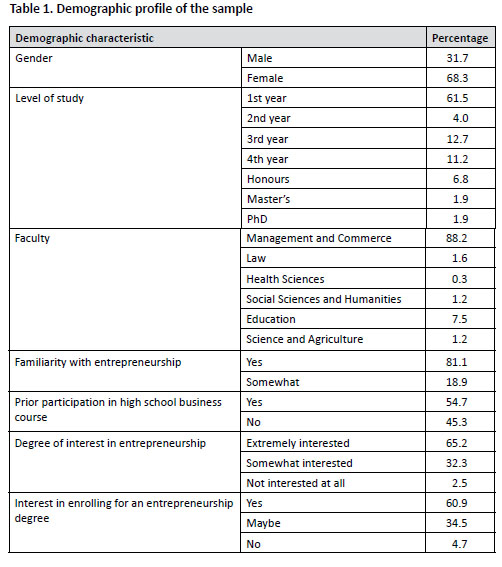
In terms of gender, the survey respondents comprised 31.7% male and 68.3% female students. Most of the respondents (61.5%) were first-year students. Second-year students represented only 4.0%, while third- and fourth-year students comprised 12.7% and 11.2% respectively. Honours, master's, and PhD students made up smaller proportions of the sample, with percentages ranging from 1.9% to 6.8%. Interestingly, the majority of participants (88.2%) were from the Faculty of Management and Commerce. Regarding familiarity with entrepreneurship, most respondents (81.1%) reported being familiar with entrepreneurship, while 18.9% indicated partial familiarity. This high level of familiarity suggests that most students have some understanding of or exposure to entrepreneurial concepts, which could influence their perspectives on entrepreneurship education.
Regarding prior participation in high school business courses, more than half of the respondents (54.7%) reported prior participation, while 45.3% did not. This indicates that a substantial proportion of students have prior exposure to business-related education, which could influence their interest in and readiness for entrepreneurship education at the university level. This is supported by the TPB's premise that a positive attitude towards entrepreneurship education can drive entrepreneurial intention. This is further evident by the significant percentage of respondents (60.9%) who expressed interest in enrolling for an entrepreneurship degree, while 34.5% were undecided (maybe), and 4.7% were not interested. The considerable proportion of students expressing uncertainty underscores the need for further exploration of the factors influencing their decision-making processes regarding entrepreneurship education. Additionally, the small percentage of students indicating disinterest highlights the importance of offering diverse educational pathways that cater to varying interests and career aspirations.
Among the surveyed students, as projected in Table 1, 65.2% expressed extreme interest in starting their own business. Additionally, 32.3% indicated being somewhat interested in entrepreneurial endeavours, while only 2.5% stated that they were not interested at all in starting their own businesses. These findings underscore the importance of integrating entrepreneurship education into the higher education curriculum to equip students with the skills, knowledge, and mindset necessary to succeed as entrepreneurs.
The perceived influence of entrepreneurship education within higher education institutions
The first research objective, relating to the students' perceived role of entrepreneurship education within HEIs, was analysed based on three dimensions: (i) the perceived importance of a formal degree in entrepreneurship, (ii) the significant benefits of studying entrepreneurship at a university, and (iii) the priority level attributed to entrepreneurship education in higher education. This multipronged approach necessitated a more robust assessment of the overall desire for entrepreneurial education among the students. Table 2 presents an analysis of the sample in terms of the perceived importance of a formal degree in entrepreneurship.
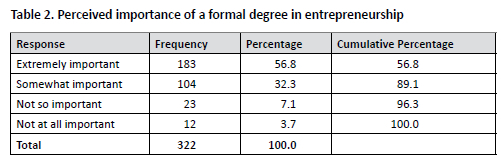
Participants were presented with a questionnaire prompting them to indicate the level of importance they attributed to a university degree in entrepreneurship. Among the surveyed university students, 56.8% considered it extremely important to have a university degree in entrepreneurship. A further 32.3% regarded it as somewhat important, whereas 7.1% viewed it as not so important. Only 3.7% of the students indicated that a university degree in entrepreneurship was not at all important. The findings highlight the need for universities to prioritise the integration of entrepreneurship education into their curricula, ensuring that students are equipped with the necessary skills, knowledge, and mindset to thrive as entrepreneurs in a rapidly evolving economic landscape. By offering tailored entrepreneurship education programs, universities can play a pivotal role in addressing graduate as well as youth unemployment, fostering socio-economic development in South Africa.
To further explore the importance of entrepreneurial education, students' perspectives on the key benefits of studying entrepreneurship at university were gathered. The results (see Figure 1) reveal that 68.6% identified learning how to start and run a successful business as the most significant benefit of studying entrepreneurship at university.
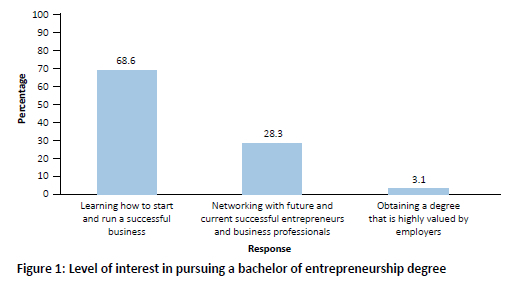
Additionally, 28.3% of the students highlighted the importance of networking with current and future successful entrepreneurs and business professionals. A minority of students (3.1%) considered obtaining a degree that is highly valued by employers as a significant benefit of studying entrepreneurship at university.
These findings underscore the importance of structured entrepreneurship education programs that offer students entrepreneurial learning experiences, enhancing their entrepreneurial competencies and fostering their success in the business world. The substantial proportion of students acknowledging the opportunity to network with successful entrepreneurs and business professionals highlights the imperativeness of fostering connections and mentoring opportunities in the entrepreneurial ecosystem. While fewer students emphasised the value of obtaining a degree highly valued by employers, this aspect remains an important consideration, particularly in terms of signalling credibility and competence in the job market.
Students were further asked to indicate the priority level they attributed to entrepreneurship education. Analysing the results (see Table 3) shows that 51.2% strongly agreed that entrepreneurship education should be a high priority in higher education. An additional 39.4% agreed with this sentiment, indicating a significant consensus among students regarding the importance of prioritising entrepreneurship education. A small proportion of students (8.1%) remained neutral about the issue, while only 1.2% disagreed with the notion of prioritising entrepreneurship education in higher education.
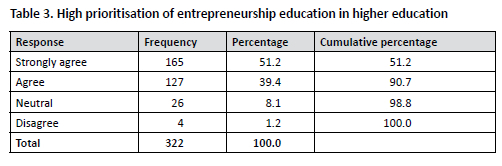
The prioritisation of entrepreneurship education in higher education, as advocated for by the majority of students, reflects a widespread recognition of the importance of entrepreneurship in today's rapidly changing economy.
Perceived characteristics of the entrepreneurship education curriculum
To measure the second objective of the study, participants were asked to indicate their level of agreement with various statements on aspects of entrepreneurship education, and the response options included 5-point Likert items such as: 'Strongly agree', 'Agree', 'Neutral', 'Disagree', and 'Strongly disagree'. Table 4 represents the results of the analysis.
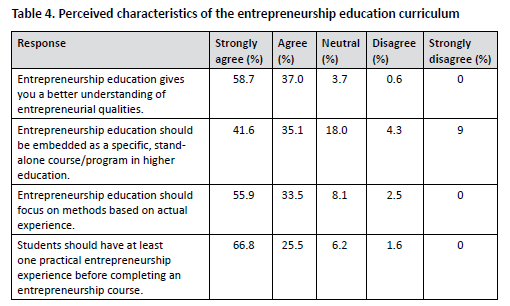
Analysing the results displayed in Table 4 indicates a significant level of agreement among students, with a majority (58.7%) strongly agreeing that entrepreneurship education enhances their understanding of entrepreneurial qualities. A small proportion of the students (3.7%) remained neutral on the issue, while only 0.6% disagreed. The findings demonstrate a strong belief among students regarding the role of entrepreneurship education in improving their understanding of entrepreneurial qualities.
Upon further examination of the students' perspectives on the integration of entrepreneurship education in higher education, diverse views on introducing entrepreneurship education as a specific, stand-alone course or program were observed, with the greatest proportion of the students (41.6%) strongly agreeing. A notable proportion of students (18.0%) adopted a neutral stance towards the proposition, while only a minimal proportion of students (0.9%) strongly disagreed. Despite this dissenting viewpoint, the high percentage of assenting students suggests substantial support for integrating entrepreneurship education as a specific, stand-alone course/program into the university curriculum. This, as proposed by the TPB, might indicate the influence of subjective norms, where institutional encouragement influences students' educational and career aspirations.
Further analysis of students' perceptions on the importance of entrepreneurship education in higher education, particularly focusing on experiential learning methods like project work with real businesses, revealed that a majority (55.9%) strongly agreed. Only 8.1% were neutral, with a minority (2.5%) of students disagreeing. This relatively small dissenting viewpoint among the surveyed students highlights the consensus among the majority regarding the value of practical, hands-on learning experiences in entrepreneurship education in empowering students to apply theoretical knowledge in authentic entrepreneurial contexts. This strong support for practical, hands-on learning experience also suggests that the majority of students view entrepreneurship education as a driver of perceived behavioural control as proffered by the TPB, thus reinforcing their entrepreneurial intentions.
Finally, closely linked to the preceding findings, the students were further asked their level of agreement on whether they should have at least one internal practical entrepreneurship experience, such as drafting a comprehensive business plan before completing an entrepreneurship course. A substantial majority of the surveyed students, 66.8% of the sample, strongly supported this proposition. Additionally, a noteworthy portion of students, comprising 25.5% of the respondents, indicated that they agreed with the idea. Although not as ardent as the former group, this subset of students acknowledges the potential advantages of practical entrepreneurship experience in supplementing the theoretical knowledge gained from entrepreneurship courses. Conversely, a small fraction of students, (6.2%) remained neutral while a minority of respondents (1.6%) expressed disagreement. In summary, these results highlight the importance of practical entrepreneurship experiences, such as drafting business plans, in enriching students' educational outcomes and preparing them for entrepreneurial pursuits.
In terms of the study's primary goal of determining the perceived influence of entrepreneurship education within HEIs and the secondary objective of evaluating students' viewpoints on the characteristics of the entrepreneurship education curriculum, the results collectively underscore a significant and widespread interest in entrepreneurship education among students at the chosen South African university. Consequently, it can be concluded that there is an overwhelming desire for entrepreneurial education among students at the selected South African university. By giving precedence to entrepreneurship education and incorporating it into the higher education curriculum, universities are poised to assume a critical role in fostering the development of future entrepreneurs in South Africa.
Managerial implications
The study advocates for an alignment of higher education with ever-evolving labour market needs. Although theory can be important, curriculum development that emphasises practical skills and industry-specific knowledge is necessary (Yaþar & Aslan, 2021). Strong business partnerships and internships can prepare graduates for the workforce, offering hands-on experience and valuable networking opportunities. With unemployment rates among university graduates rising in South Africa (Ndlovu et al., 2023), this approach can bridge the gap between academia and industry, increasing graduate employability. By restructuring their programs to meet current market expectations, universities can better equip students with the skills and knowledge needed for success in today's economy.
The results emphasise the crucial role of entrepreneurial education in promoting economic expansion, creativity, and job opportunities (Arifudin, 2022; Di Paola et al., 2023). Policymakers and educational institutions must prioritise entrepreneurship education and the development of a more entrepreneurial-minded workforce to enhance entrepreneurial activity and tackle issues like poverty and inequality (Fahinde et al., 2022).
Customising entrepreneurial curricula to a specific market is imperative in higher education. A one-size-fits-all entrepreneurial education is inadequate to its goals (Cho & Lee, 2018). For instance, there is a need to integrate entrepreneurship programs with hands-on experience, where students work directly with start-ups, fostering practical skills and networking opportunities. Similarly, HEIs should consider a blend of academic coursework and real-world application through initiatives which offer resources and mentorship to budding entrepreneurs (Puni et al., 2018; Yousafzai et al., 2021). When HEIs tailor programs to fit diverse student populations' unique needs and interests, universities can ensure relevance and effectiveness.
Fostering creativity and innovativeness is critical to entrepreneurial education (Puni et al., 2018), and HEIs should focus on doing so. Emphasising the development of such attributes enhances critical thinking, problem-solving, and students' resilience in navigating the complexities of entrepreneurial ventures (Cera et al., 2020). An entrepreneurial mindset empowers students to adapt to changing market conditions and seize opportunities, crucial skills necessary for long-term success in the entrepreneurial world (Olutuase et al., 2023). This strategy improves entrepreneurship education by preparing students for business success. HEIs ought to go beyond information distribution, fostering entrepreneurial attitudes and behaviours to better prepare students for the dynamic entrepreneurship environment.
Practical experiential learning, such as project work with real businesses and hands-on entrepreneurship experiences, should be integrated into entrepreneurship curricula (Ntshangase et al., 2023; Olutuase et al., 2023; Osman et al., 2023). This aligns with the literature which suggests that natural entrepreneurial intentions can be developed through regular training sessions and exposure to supportive policies (Nguyen et al., 2019). When HEIs allow students to apply theoretical knowledge in authentic entrepreneurial contexts, universities can better prepare them for entrepreneurial endeavours and enhance their employability (Nabi et al., 2017). For students to get experiential learning, HEIs need to partner with industry stakeholders, such as successful entrepreneurs and businesses, to provide students with networking opportunities, mentorship, and real-world entrepreneurial experiences. These collaborative efforts between academia and industry can enrich entrepreneurship education programs and bridge the gap between theory and practice.
Conclusions, limitations and future research
This study adds to the body of research on entrepreneurship education by examining how students at a South African university perceive entrepreneurship education. The results show how crucial it is for university courses to align with the changing needs of the job market. The results further highlight the importance of mentoring students in entrepreneurship to promoting economic growth, innovation, and jobs. While the study raises critical ideas, it also encountered limitations. Namely, self-report bias, and a cross-sectional design. Although a cross-sectional design was suitable for the objectives of this study, an analytical cause-and-effect relationship between variables was not possible (Wang & Cheng, 2020). To overcome this limitation, a large sample unit that represented the study's population was accessed from a single university in the Eastern Cape, South Africa. Additionally, a reliable and valid research instrument was distributed through which the results of the study were reported with transparency (Maier et al., 2023).
Based on the sample size, self-report bias was initially experienced. This limitation was managed by developing a research instrument that was clear and concise, thus avoiding ambiguity (Lira et al., 2022). Moreover, the research instrument indicated the purpose of the study and emphasised anonymity. Future studies could remedy these problems by using more diverse and representative groups, multiple data collection methods, as well as longitudinal or comparison approaches. The study indicates a strong student interest in entrepreneurial education, emphasising the need for universities to prioritise and enhance the entrepreneurship-related courses they provide. South African universities can significantly contribute to developing business skills, improving the economy, and addressing social issues by implementing this study's management recommendations and suggestions.
While the study does provide valuable insights, employing a cross-sectional design to simultaneously capture students' attitudes and desires towards entrepreneurial education, it is not exhaustive. To establish a more comprehensive understanding, longitudinal studies tracking students' attitudes from enrolment through graduation and into their entrepreneurial endeavours could provide valuable insights into the long-term impacts of entrepreneurship education. The study further highlights the need for students to be informed about the content of entrepreneurship programs, thereby ensuring the curriculum can adapt to changing student needs and interests over time. This could involve regular feedback mechanisms and ongoing evaluation to ensure that entrepreneurship education remains relevant and effective in preparing students for current and future challenges.
Ethics statement
The ethical clearance of this study was obtained from the University of Fort Hare (TOW002-24). Participants of the study signed a voluntary informed consent form prior to completing the questionnaire. To respect anonymity students were allocated pseudonyms.
Potential conflict of interests
There are no conflicts of interests to declare.
Funding acknowledgement
This study did not receive external funding.
References
Ahn, K., & Winters, J. V. (2022). Does education enhance entrepreneurship? Small Business Economics, 61(2), 717-743. https://doi.org/10.1007/s11187-022-00701-x [ Links ]
Ajzen, I. (1991). The theory of planned behaviour. Organizational Behavior and Human Decision Processes, 50(2), 179-211. https://doi.org/10.1016/0749-5978(91)90020-T [ Links ]
Ajzen, I. (2011). The theory of planned behaviour: Reactions and reflections. Psychology & Health, 26(9), 1113-1127. https://doi.org/10.1080/08870446.2011.613995 [ Links ]
Amo-Agyemang, C. (2019). Valorising university education in Ghana. International Journal of African Renaissance Studies - Multi-, Inter- and Transdisciplinarity, 14(2), 55-80. https://doi.org/10.1080/18186874.2019.1697187 [ Links ]
Arifudin, S. (2022). The importance of entrepreneurship learning and business motivation seminars to increase the desire to be an entrepreneur. Akadmik: Jurnal Mahasiswa Humanis, 2(2), 73-81. https://doi.org/10.37481/jmh.v2i2.471 [ Links ]
Bae, T. J., Qian, S., Miao, C., & Fiet, J. O. (2014). The relationship between entrepreneurship education and entrepreneurial intentions: A meta-analytic review. Entrepreneurship Theory and Practice, 38(2), 217-254. https://doi.org/10.1111/etap.12095 [ Links ]
Bell, E., Bryman, A., & Harley, B. (2022). Business research methods (6th ed.). Oxford University Press.
Bondarenko, O. (2022). Entrepreneurship development strategy in Germany. Social Economics, (63), 104-113. https://doi.org/10.26565/2524-2547-2022-63-10
Brace, I. (2018). Questionnaire design: How to plan, structure and write survey material for effective market research (4th ed.). Kogan Page Publishers. https://books.google.co.za/books?id=mSRTDwAAQBAJ&printsec=frontcover&source=gbs_ge_summary_r&cad=0#v=onepage&q&f=false
Carpenter, A., & Wilson, R. (2022). A systematic review looking at the effect of entrepreneurship education on higher education student. The International Journal of Management Education, 20(2), 100541. https://doi.org/10.1016/j.ijme.2021.100541 [ Links ]
Cera, G., Mlouk, A., Cera, E., & Shumeli, A. (2020). The impact of entrepreneurship education on entrepreneurial intention. A quasi-experimental research design. Journal of Competitiveness, 12(1), 39-56. https://doi.org/10.7441/joc.2020.01.03 [ Links ]
Chahine, T. (2022). Social entrepreneurship: Building impact step by step (2nd ed.). Taylor & Francis. https://doi.org/10.4324/9781003094715
Cho, Y. H., & Lee, J.-H. (2018). Entrepreneurial orientation, entrepreneurial education and performance. Asia Pacific Journal of Innovation and Entrepreneurship, 12(2), 124-134. https://doi.org/10.1108/apjie-05-2018-0028 [ Links ]
Clifton, J. D. W. (2020). Managing validity versus reliability trade-offs in scale-building decisions. Psychological Methods, 25(3), 259-270. https://doi.org/10.1037/met0000236 [ Links ]
Creswell, J. W., & Creswell, J. D. (2017). Research design: Qualitative, quantitative, and mixed methods approaches (5th ed.). Sage Publications. https://books.google.co.za/books?id=335ZDwAAQBAJ&printsec=frontcover&source=gbs_ge_summary_r&cad=0#v=onepage&q&f=false
Cui, J. (2021). The impact of entrepreneurship curriculum with teaching models on sustainable development of entrepreneurial mindset among higher education students in China: The moderating role of the entrepreneurial climate at the institution. Sustainability, 13(14), 7950. https://doi.org/10.3390/su13147950 [ Links ]
de Ávila, A. L., Davel, E., & Elias, S. R. S. T. A. (2023). Emotion in entrepreneurship education: Passion in artistic entrepreneurship practice. Entrepreneurship Education and Pedagogy, 6(3), 502-533. https://doi.org/10.1177/25151274221143147 [ Links ]
Diandra, D., & Azmy, A. (2020). Understanding definition of entrepreneurship. International Journal of Management, Accounting and Economics, 7(5), 301-306. https://doi.org/10.5281/zenodo.17217598 [ Links ]
Di Paola, N., Meglio, O., & Vona, R. (2023). Entrepreneurship education in entrepreneurship laboratories. International Journal of Management Education, 21(2), 100793. https://doi.org/10.1016/j.ijme.2023.100793 [ Links ]
Entrepreneurship Development in Higher Education (EDHE). (2022). EDHE newsletter, (2). EDHE. https://edhe.co.za/wp-content/uploads/EDHE_Newsletter_December_2022.pdf
Fabeil, N. F., Langgat, J., Pazim, K. H., & Mahmud, R. (2022). Self-employment among graduates during the Covid-19 pandemic: Necessity or opportunity entrepreneurship driven. Economics and Business Quarterly Reviews, 5(1), 21-28. https://10.31014/aior.1992.05.01.400 [ Links ]
Fahinde, C., Abodohoui, A., Mayuto, R., & Su, Z. (2022). How does institutional context influence entrepreneurship education outcomes? Evidence from two African countries. Entrepreneurship Research Journal, 14(2). https://doi.org/10.1515/erj-2021-0458 [ Links ]
Harry, T., & Chinyamurindi, W. T. (2022). "Still haven't found what I am looking for": Rural black students' perceived work readiness and assessment of labor market access. Education + Training, 64(2), 272-289. https://doi.org/10.1108/ET-10-2021-0387 [ Links ]
Ilomo, M., & Mwantimwa, K. (2023). Entrepreneurial intentions of undergraduate students: The moderating role of entrepreneurial knowledge. International Journal of Entrepreneurial Knowledge, 11(1), 14-34. https://doi.org/10.37335/ijek.v11i1.178 [ Links ]
Iqbal, J., Yi, X., Ashraf, M. A., Chen, R., Ning, J., Perveen, S., & Imran, Z. (2022). How curriculum delivery translates into entrepreneurial skills: The mediating role of knowledge of information and communication technology. PLoS ONE, 17(5), e0265880. https://doi.org/10.1371/journal.pone.0265880 [ Links ]
Iwu, C. G., Opute, P. A., Nchu, R., Eresia-Eke, C., Tengeh, R. K., Jaiyeoba, O., & Aliyu, O. A. (2021). Entrepreneurship education, curriculum and lecturer-competency as antecedents of student entrepreneurial intention. The International Journal of Management Education, 19(1), 100295. https://10.1016/j.ijme.2019.03.007 [ Links ]
Jardim, J., Bártolo, A., & Pinho, A. (2021). Towards a global entrepreneurial culture: A systematic review of the effectiveness of entrepreneurship education programs. Education Sciences, 11(8), 398. https://doi.org/10.3390/educsci11080398 [ Links ]
Jena, R. K. (2020). Measuring the impact of business management student's attitude towards entrepreneurship education on entrepreneurial intention: A case study. Computers in Human Behavior, 107(2), 106275. https://10.1016/j.chb.2020.106275 [ Links ]
Krisnaresanti, A., Julialevi, K. O., Naufalin, L. R., & Dinanti, A. (2020). Analysis of entrepreneurship education in creating new entrepreneurs. International Journal of Entrepreneurial Knowledge, 8(2), 67-76. https://doi.org/10.37335/ijek.v8i2.112 [ Links ]
Lee, N., & Rodríguez-Pose, A. (2021). Entrepreneurship and the fight against poverty in US cities. Environment and Planning A: Economy and Space, 53(1), 31-52. https://doi.org/10.1177/0308518X20924422 [ Links ]
Licha, J., & Brem, A. (2018). Entrepreneurship education in Europe - Insights from Germany and Denmark. International Journal of Entrepreneurship and Small Business, 33(1), 1-25. https://10.1504/IJESB.2018.088641 [ Links ]
Lira, B., O'Brien, J. M., Peña, P. A., Galla, B. M., D'Mello, S., Yeager, D. S., Defnet, A., Kautz, T., Munkacsy, K., & Duckworth, A. L. (2022). Large studies reveal how reference bias limits policy applications of self-report measures. Scientific Reports, 12, 19189. https://doi.org/10.1038/s41598-022-23373-9 [ Links ]
Lv, Y., Chen, Y., Sha, Y., Wang, J., An, L., Chen, T., Huang, X., Huang, Y., & Huang, L. (2021). How entrepreneurship education at universities influences entrepreneurial intention: Mediating effect based on entrepreneurial competence. Frontiers in Psychology, 12, 655868. https://10.3389/fpsyg.2021.655868 [ Links ]
Madela, M. (2024). Science, technology and innovation decadal plan 2022-2032: Scient, technology and innovation enabling inclusive and sustainable South African development in a changing world. Department of Science, Technology and Innovation, RSA. https://www.dsti.gov.za/index.php/documents/strategies-and-reports/189-sti-decadal-plan
Maier, C., Thatcher, J. B., Grover, V., & Dwivedi, Y. K. (2023). Cross-sectional research: A critical perspective, use cases, and recommendations for IS research. International Journal of Information Management, 70, 102625 https://doi.org/10.1016/j.ijinfomgt.2023.102625 [ Links ]
Masnun, A., Charli, C. O., Hartoyo, B., Hidayat, R., & Menhard, M. (2023). Subjective norms and entrepreneurship education towards self-efficacy and entrepreneurship. Journal of Accounting and Finance Management, 3(6), 300-309. https://doi.org/10.38035/jafm.v3i6.170 [ Links ]
Melak, D., & Derbe, T. (2022). Analysis of determinants of youth self-employment career choices. Journal of Small Business and Enterprise Development, 29(6), 886-901. https://doi.org/10.1108/JSBED-10-2021-0435 [ Links ]
Miço, H., & Cungu, J. (2023). Entrepreneurship education, a challenging learning process towards entrepreneurial competence in education. Administrative Sciences, 13(1), 22. https://10.3390/admsci13010022 [ Links ]
Mohamed, M. E., Elshaer, I. A., Azazz, A. M., & Younis, N. S. (2023). Born not made: The impact of six entrepreneurial personality dimensions on entrepreneurial intention: Evidence from healthcare higher education students. Sustainability, 15(3), 2266. https://doi.org/10.3390/su15032266 [ Links ]
Nabi, G., Liñán, F., Fayolle, A., Krueger, N., & Walmsley, A. (2017). The impact of entrepreneurship education in higher education: A systematic review and research agenda. Academy of Management Learning & Education, 16(2). https://doi.org/10.5465/amle.2015.0026 [ Links ]
Nardi, P. M. (2018). Doing survey research: A guide to quantitative methods (4th ed.). Routledge.
Ndlovu, L. D., Krüger, N. A., & Meyer, N. (2023). Unleashing the potential: Exploring internal factors for the success of women entrepreneurs in South Africa's agricultural sector. Journal of Contemporary Management, 19(si1). https://doi.org/10.35683/jcm23015.213 [ Links ]
Nguyen, A. T., Do, T. H. H., Vu, T. B. T., Dang, K. A., & Nguyen, H. L. (2019). Factors affecting entrepreneurial intentions among youths in Vietnam. Children and Youth Services Review, 99, 186-193. https://doi.org/10.1016/j.childyouth.2019.01.039 [ Links ]
Nguyen, Q. D., & Nguyen, H. T. (2023). Entrepreneurship education and entrepreneurial intention: The mediating role of entrepreneurial capacity. The International Journal of Management Education, 21(1), 100730. https://doi.org/10.1016/j.ijme.2022.100730 [ Links ]
Ntshangase, S. D., & Ezeuduji, I. O. (2023). The impact of entrepreneurship education on tourism students' entrepreneurial intention in South Africa. Journal of Teaching in Travel & Tourism, 23(3), 287-305. https://doi.org/10.1080/15313220.2022.2132343 [ Links ]
Olokundun, M. A., Ibidunni, S. A., Falola, H. O., Salau, P. O., & Oyafunke-Omoniyi, C. O. (2018). Entrepreneurship curriculum contents and entrepreneurial development of university students in Nigeria. International Journal of Entrepreneurship, 22(1), 1-9. Retrieved from https://www.abacademies.org/articles/Entrepreneurship-curriculumof-university-students-in-nigeria-1939-4675-22-1-125.pdf [ Links ]
Olutuase, S. O., Brijlal, P., & Yan, B. (2023). Model for stimulating entrepreneurial skills through entrepreneurship education in an African context. Journal of Small Business & Entrepreneurship, 35(2), 263-283. https://doi.org/10.1080/08276331.2020.1786645 [ Links ]
Osman, S. A., Emole, E. O., & Onu, E. V. (2023). Assessing the role of formal education in promoting entrepreneurship. International Journal of Entrepreneurial Knowledge, 11(2), 89-108. https://doi.org/10.37335/ijek.v11i2.197 [ Links ]
Pallant, J. (2020). SPSS survival manual: A step-by-step guide to data analysis using IBM SPSS (7th ed.) McGraw-Hill Education (UK).
Prasetya, H., & Azizah, N. (2022). Entrepreneurship interest: Entrepreneurship education, income expectations and creativity. Jurnal Manajemen dan Bisnis, 11(2), 296-301. https://journal.itbind.ac.id/index.php/jmbi/article/view/47/41 [ Links ]
Proença, S., & Soukiazis, E. (2022). The importance of entrepreneurship on economic development. Evidence from the OECD countries. In P. Sklias & N. Apostolopoulos (Eds.), Proceedings of the 17th European conference on innovation and entrepreneurship (pp. 416-422). Academic Conferences International. https://doi.org/10.34190/ecie.17.1.664
Puni, A., Anlesinya, A., & Korsorku, P. D. A. (2018). Entrepreneurial education, self-efficacy and intentions in sub-Saharan Africa. African Journal of Economic and Management Studies, 9(3), 492-511. https://doi.org/10.1108/ajems-09-2017-0211 [ Links ]
Sang, D., & Lin, J. (2019). How does entrepreneurial education influence the entrepreneurial intention of college students? The moderating and mediating effects of entrepreneurial alertness. International Journal of Emerging Technologies in Learning, 14(8), 139-154. https://doi.org/10.3991/ijet.v14i08.10408 [ Links ]
Statista. (2024). Unemployment rate in Africa 2012 to 2024. https://www.statista.com/statistics/1319860/unemployment-rate-in-africa/#:~:text=The%20unemployment%20rate%20in%20Africa,2024%20at%20around%2030%20percent
Wang, X., & Cheng, Z. (2020). Cross-sectional studies: Strengths, weaknesses, and recommendations. Chest, 158(1), S65-S71. https://doi.org/10.1016/j.chest.2020.03.012 [ Links ]
Wei, X., Liu, X., & Sha, J. (2019). How does entrepreneurship education influence the students' innovation? Testing on the multiple mediation model. Frontiers in Psychology, 10, 1557. https://doi.org/10.3389/fpsyg.2019.01557 [ Links ]
Yaþar, G. C., & Aslan, B. (2021). Curriculum theory: A review study. International Journal of Curriculum and Instructional Studies (IJOCIS), 11(2), 237-260. Retrieved from https://ijocis.epo-der.org/wp-content/uploads/2025/01/11_2_12_2021.pdf [ Links ]
Yousafzai, M. T., Khan, I., & Shah, T. (2021). Developing entrepreneurial learning curricula from a CEO's perspective. City University Research Journal, 11(1), 20-35. https://www.proquest.com/openview/d557ec19631f92ce1b8e0fa6ea136f3f/1?pq-origsite=gscholar&cbl=2068970 [ Links ]
Zhao, Y., Zhao, X., Shi, J., Du, H., Marjerison, R. M., & Peng, P. (2022). Impact of entrepreneurship education in colleges and universities on entrepreneurial entry and performance. Economic Research-Ekonomska Istrazivanja, 35(1), 6165-6184. https://doi.org/10.1080/1331677X.2022.2048189 [ Links ]
Received 2 July 2024
Accepted 3 August 2025
Published 5 December 2025
