Services on Demand
Journal

Article
 English (pdf)
 Article in xml format
 Article references
 Automatic translation
 Send this article by e-mail
Indicators
Related links
-
 Cited by Google
 -
 Similars in Google
Share

 Permalink
Koers
On-line version ISSN 2304-8557Print version ISSN 0023-270X
Koers (Online) vol.90 n.1 Pretoria 2025
https://doi.org/10.19108/koers.90.1.2599
ORIGINAL RESEARCH
Egbert Schuurman: Reformational Philosopher of Technology
Steve Bishop
Research Associate, Union Theological College, Belfast, United Kingdom. https://orcid.org/0000-0002-4547-0597
ABSTRACT
The life and work of Egbert Schuurman (b. 1937), a prominent figure In the field of the Reformational philosophy of technology, is examined. The article briefly discusses Schuurman's background, academic journey, and key works before highlighting key themes of his approach. These themes include the problems of the Enlightenment, particularly its religious dogma of progress and human autonomy, technicism, and an ethics of responsibility. The reception of Schuurman's work is examined, and his Reformational approach is highlighted.
Keywords: Egbert Schuurman; neo-Calvinism; Reformational philosophy; technicism; technology; the Enlightenment
OPSOMMING
Die lewe en werk van Egbert Schuurman (geb. 1937), 'n bekende figuur in die veld van Reformatoriese filosofie van tegnologie, word ondersoek. Hierdie artikel bespreek kortliks Schuurman se agtergrond, akademiese reis en sleutelwerke voordat die hooftemas van sy benadering uitgelig word. Sodanige temas sluit die probleme van die Verligting in, veral die godsdienstige dogma van vordering en menslike outonomie, tegnisisme en 'n verantwoordelikeheidsetiek. Die ontvangs van Schuurman se werke word ondersoek, met die klem op sy Reformatoriese benadering.
Kernbegrippe: die Verligting; Egbert Schuurman; neo-Calvinisme; Reformatoriese filosofie; tegnisisme; tegnologie
1. Introduction
This paper examines the concept of responsible technology within the framework of Christian Reformational philosophy by focusing on the contributions of Egbert Schuurman (b. 1938). Schuurman argues that modern technology cannot be understood apart from its spiritual and historical context. Furthermore, this paper provides an analysis of Schuurman's principal writings and identifies key themes from these to show how they can contribute to a Christian view of technology. Lastly, it explores the question of how responsible and ethical technological development can be achieved when it is grounded in a Reformational Christian worldview as espoused by Schuurman.
The emergence of a philosophy of technology only really began during the early 20th century. There are two significant factors for this. Firstly, engineers and technologists were involved in practical applications and had little concern for philosophy. Secondly, philosophers were unfamiliar with and lacked any expertise in technology. Nevertheless, some did begin to develop such a philosophy. Notable figures included Martin Heidegger (1954), Carl Mitcham and Jim Grote (1984), Jacques Ellul (1964), Langdon Winner (1986), and Albert Borgmann (1987, 2003). Even more neglected was a theology of technology, and not to mention a Christian philosophy of technology. Among the early advocates for a Christian philosophy of technology was Hendrik van Riessen (1911-2000).1 Following in the tradition of Van Riessen is Egbert Schuurman (b. 1937). As Stellingwerff comments: "Schuurman followed in the footsteps of his supervisor H. van Riessen, who developed from his analysis of technology and modern philosophy into a cultural philosopher." (Stellingwerff 1996:132)
Several factors have stifled the development of a Christian approach to a philosophy of technology, including a lack of an ethical approach to technology and the prevailing notion that technology is neutral. Sentiments epitomised by the lyricist Tom Lehrer, who wrote of the German rocket developer, Werner Von Braun (1912-1977): "'Once the rockets are up, who cares where they come down? That's not my department,' says Werner von Braun." This disregard of any ethical considerations is typical of many technologists. It is quite different from the approach of the Reformational philosopher of technology, Egbert Schuurman. Similarly, the National Rifle Association's slogan, "Guns don't kill people, people do" (see also Pitt, 2014:89-101), assumes that technology is neutral. This assumption is in stark contrast to the approach of Schuurman. Schuurman offers a critique of the scientific-technical culture and provides a call to focus on the "spiritual-historical background of technological culture" (Schuurman, 2024:xi).
2. Biography
Egbert Schuurman was born in 1937 in the municipality of Borger. He studied civil engineering at Delft University of Technology, where he worked on soil mechanics (Schuurman, 1964, 1966). While he was there, he was surprised that not one of his professors asked: "What is the meaning of technology?"2 After two years working as an engineer at Delft, he received a special grant to study philosophy at the Free University of Amsterdam.
His doctoral thesis, supervised by Van Riessen, was published as Technology and the future (Schuurman, 1980/1990a). Schuurman is the author of numerous books; a list of some of his English publications can be found in the bibliography. Schuurman's academic career spanned several decades. Until his retirement in 2007, he held professorial positions in Reformational philosophy at Eindhoven University (1972-2004), Delft University (19842007), and at the Agricultural University of Wageningen (1984-2007) in the Netherlands. Additionally, he served as a member of the Dutch parliament's Senate of the Dutch Parliament (Staten-Generaal) from 1983 to 2011, during which time he led the Christian Union Party from 2001 to 2011. As chair of the House Committee on Agriculture, he initiated a debate on genetic modification and its effect on society. He promoted cis-genetic modification but not trans-genetic manipulation, that is, on genes between closely related organisms (cis = same side).
In 1994, he was awarded an honorary doctorate from the North-West University in Potchefstroom, South Africa, and was a recipient of a Templeton award in 1995. In May 2002, he gave a farewell lecture titled "Liberation from the technical worldview-Challenge to a different ethics" at Delft University. He was honoured as an Officer in the Order of Orange-Nassau3 in 2003. In September 2007, he gave a farewell lecture, titled "The challenge of Islamic technological critique", at the University of Wageningen.4
While Schuurman's life and work have been the subject of a biography, it has not yet been made available in English (Van Mulligan, 2017). It is appropriately subtitled: Egbert Schuurman: A dissenting Christian in a secular country.
3. Key works
In the following section, Schuurman's principal works are examined: These are the ones that are available in English.
Technology and the future (1980)
This key work is the English translation based on Schuurman's doctoral thesis. It was originally published as Techniek en toekomst: Confrontatie met wijsgerige beschouwingen in 1972. In this work, he looks at two poles of thought regarding technology: the transcendentalists (the pessimists) and the positivists (the optimists). Friedrich G Jünger, Heidegger, Ellul, and Herman J. Meyer are taken to be typical transcendentalists; they see technology as inevitable, but also a threat to human freedom. On the other hand, the positivists-such as Norbert Wiener, Karl Steinbuch, and Georg Klaus-see technology as promoting freedom.
In Technology and the future, the mentioned philosophers are examined and critiqued. Both the transcendentalists and the positivists accept the dogma of the pretended autonomy of humanity. As Schuurman (1980:314) observes: "In the autonomy of thought lies the ground of the tensions that pervade their philosophies, as well as the reason for their inability to indicate a way of escape from the real problems that modern technology entails."
On the basis of a Christian philosophy, he then discusses the meaning-character of reality, the meaning-dynamis as normativity, and freedom in responsibility, among other key points.
Responsible technology (1986)
In 1983-1984, Schuurman was involved with the Calvin Center, Grand Rapids project on Responsible technology (Monsma, Christians, Dykema, Leegwater, Schuurman & Van Poolen, et al., 1986).5 This was a landmark book as it developed an accessible Reformational Christian approach to technology. The book was written "for the general reader". Two themes-both of which are themes developed by Schuurman-characterise the book: the first, "doing technology is not a neutral activity", and the second, a firm commitment to the belief that technology "must be done under the Lordship of Jesus Christ" (Monsma et al., 1986:ix)
Christians in Babel (1987a)
This small book is a translation of Christenen in Babel.6 In this book, the focus is primarily on the problems and threats that go hand in hand with scientific and technological developments. Schuurman sees a correlation between the development of science and technology and the de-Christianisation of society: "The deification of science and technology goes hand in hand with resistance to the Christian faith." (Schuurman, 1987a:30) He maintains we no longer live in a Christian culture but in a Babel culture: a culture that no longer is concerned with a transcendent God but "has at its disposal tremendous scientific-technological power" and "pulls science, technology, economics and politics into one massive entity" (Schuurman, 1987a:40).
Perspectives on technology and culture (1995a)
In this volume, Schuurman begins by discussing the meaning of technology and technological science and their interrelation with the natural sciences. Technological science, he maintains, is the bridge between technology and science (Schuurman, 1995a:64). He then examines the philosophical-ethical questions before looking at information technology and genetic engineering. The final chapter utilises and adapts Dooyeweerd's humanistic ground-motive (see §6 below).
The technological world picture and an ethics of responsibility (2005)
In this book, Schuurman provides a robust call for a renewed ethic for technology and technological development: an ethic based on a Christian worldview and philosophy of life. The ethic he develops is one of responsibility, a responsibility based on motives, values, and norms. Such an ethic needs a cultural paradigm shift or reorientation to address the deficiencies in current approaches.
Transformation of the technological society (2022)
This book is a translation of Tegendraads nadenken over techniek (2015), a collection of university lectures, including Schuurman's farewell lecture on Islamic criticism of technology. In this book, Schuurman argues for a multi-disciplinary approach to the ethics of technology, given that the uncritical appreciation of technology is so widespread and Western culture has become so dependent on technology. He once again echoes the need to discern what a responsible human approach to technology entails. He examines "technical thinking" or "technical mentality" in Chapter 4. This he sees as the dominant thought pattern of Western culture (64). "Once it becomes dominant, it is inexorable ... [it] reconstructs the totality of reality." (65)
Furthermore, he recognises the paradox of a technological approach: technology enables us to appropriate reality more, but as a result, we become more alienated from reality (Schuurman, 2022:37, 61).
Technology and Christianity (2024)
This work is a collection of numerous articles (including Schuurman, 1979, 1984a, 2008, 2023a, 2023b) and books (Schuurman, 1977, 1987a, 1995a, 2022) that have previously been published. It also contains some newly translated articles.7
4. Key themes
The problems of technology
Technology has provided numerous benefits, not least in healthcare (medical treatments, diagnostics, and patient care); transportation; communication, enabling global connectivity; and the alleviation of drudgery in the workplace, resulting in increased efficiency and productivity. Nevertheless, technology brings with it some serious risks and challenges. It can lead to dehumanisation, de-naturalisation, social isolation (due to reduced face-to-face interaction), job displacement (this can be the result of automation), and inequality in the sense of a digital divide. Furthermore, it can also introduce new ethical dilemmas, particularly in the fields of artificial intelligence, genetic engineering, autonomous weapons, and other emerging technologies. An overreliance on technology may also hamper problem-solving skills and creativity. Lastly, the uncritical use of technology can have negative consequences for the environment and nature.
Technicism
The problem with technology is a consequence of technicism, the pervasiveness of technology. Technicism is the integration of technology in all sectors of society-where it defines and shapes culture-and all areas of life. Technology has become the dominant force in societal and cultural change. Information technology is looked upon as the saviour of life's problems, even the problems it creates. In this regard, Schuurman (2022:42) states the following: Technical development ought not to be allowed to function autonomously. Instead, it must remain a human tool, an assisting instrument. Technical development ought to serve humanity, creation, and, ultimately, God. Furthermore, Schuurman (2022:65) also states: Technical thinking, once it becomes dominant, is inexorable.
Haaksma (1997:187, fn. 71) provides a sound, concise summary of Schuurman's view of technicism:
According to Schuurman, "technicism" is "the spiritual driving force, the predominant motive [...] on the path of progress" in our Western culture, which emerged as "control thinking" through figures like F. Bacon, R. Descartes, and the Enlightenment under the influence of technical and scientific thinking and the artefacts created by it. Following thinkers such as Heidegger, Horkheimer, Ellul and [Hans] Sachsse, Schuurman considers "technicisme" as a basic attitude to be "the spiritual background of scientific-technical culture" and calls this "a new, current interpretation of the intellectual history of the West, the development of which is well represented by philosophy".
The problem of the Enlightenment
As Schuurman (2024:421) explicitly states: "Our culture is historically and spiritually Enlightenment culture." While he acknowledges that good has come out of the Enlightenment, so too has evil. Enlightenment dogma is pervasive: "the current popular world-and-life-view in the West is nourished by the spirit and ideology of the Enlightenment" (Schuurman, 2022:71).
The Enlightenment brought with it two key dogmas: a belief in progress and a belief in human autonomy. Schuurman also sees the need to re-enlighten the Enlightenment.
Belief in progress: The story upon which Western culture and civilisation rests is that of progress. We are continually evolving, progressing into something better. However, progress is something of a double-edged sword. As Terry Pratchett's Granny Weatherwax says: "Don't you talk to me about progress. Progress means bad things happen faster." (Pratchett, 1991:221)
Human autonomy: As he argues in Technology and the future, the failure of both the transcendentalists and the positivists is "the human pretension to autonomy: humanity legislates for itself and is therefore self-willed" (Schuurman, 1980:327)
Enlightening the Enlightenment: Following Rohrmoser (1996), he seeks an "enlightenment of the Enlightenment" (Schuurman, 2022:73). "The 'Aufklárung' [the Enlightenment] must itself be 'enlightened' by the divine light of revelation." (Schuurman, 2022:73)
Responsible technology
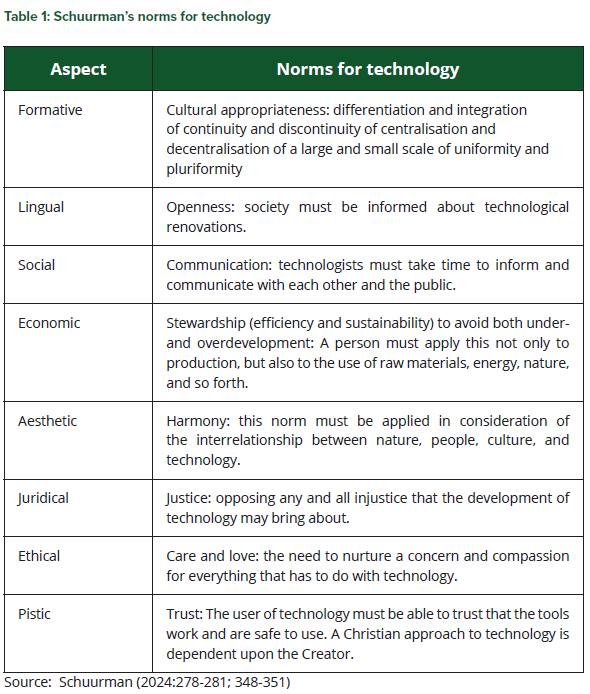
What does Schuurman mean by "responsible technology"? It is technology employed in accordance with the creation ordinances embedded within God's good creation. At least in part, it means following normative principles. These principles include cultural appropriateness, openness and communication, stewardship (efficiency and sustainability), harmony, justice, care and love, and trust. These norms will be examined in more detail below.
The Islamic critique of technology
His valedictory lecture at the University of Wageningen was on the Islamic critique of technology (Schuurman, 2008, 2011, and in 2024). He identifies two main strands within Islam and sees the Islamic critique as having much in common with a Christian critique. Both are critical of Enlightenment ideals. Unfortunately, some Islamic critics identify Christianity with the Enlightenment's view of progress. Both have the garden city in common.
A garden city
It is no coincidence that the cover of Schuurman's Dutch biography is a photograph of him gardening. It has become common to note that the Bible begins in a garden and ends in a city. Still, Schuurman (2010:107) sees the development of responsible technology in terms of a garden city:
The aim of technology should become, not to break down and to reduce reality in order to master and control, but to unfold and cause to flourish. We should nurture the perspective of the living and vibrant garden-city, of a culture that takes care of nature and the environment.
This is good stewardship of technology. Similarly, Schuurman (2006:155) writes: "A responsible cultural and technological development evokes a representation of culture that depicts earth as a garden tended by humans. Technology must be developed within the perspective of the earth as one large garden-city."
From this quotation, it is evident that for Schuurman, technology is to be developed within limits. It is not an unfettered beast. It is to be done responsibly, with an ethics of responsibility.
Ethics of responsibility
This title of Schuurman (2005) indicates another theme that dominates his writings: the need for an ethics of responsibility. For Schuurman (2002:63), ethics is the "activity of human beings in giving a response to all the normative aspects of reality". What is required is an ethic linked to culture, ethos, motives, values, and norms, an ethic that needs a normative framework. However, Schuurman (2022:85) states: "The lack of a normative framework of new technology is especially evident in the introduction of genetic manipulation of plants, animals, and human beings."
Schuurman's approach integrates these themes by positioning them within Reformational philosophy, that is, a philosophy that critiques secular and challenges Enlightenment-influenced views of progress and autonomy. He advocates instead for a responsible, stewardship-based approach to technology that is rooted in Christian principles. His Reformational approach mitigates the risks of technicism and unbridled technological growth. He emphasises a creational grounded and morally responsible development in harmony with divine order.
5. Worldview questions
Walsh and Middleton identify four key questions that shape a pre-theoretical worldview (Walsh & Middleton, 1984:35). These questions are:
• Who am I?
• Where am I?
• What is wrong?
• What is the remedy?
NT Wright-whose work has been influenced by Walsh (Wright, 1992:xix)-adapted the first two worldview questions to make them more communal:
• Who are we?
• Where are we?
In terms of worldviews, Wright (1992:12) describes them as follows:
Worldviews are ... the basic stuff of human existence, the lens through which the world is seen, the blueprint for how one should live in it and above all, the sense of identity and place which enables human beings to be what they are. To ignore worldviews, either our own or those of the culture we are studying, would result in extraordinary shallowness.
In light of the above description, I will now show how Schuurman would answer the questions as listed above in the hope that this will help to show Schuurman's approach. To achieve this, I will also add another question, namely: What is God like?
What is God like? Schuurman is a Reformed Christian. His view of the trinitarian God is one who is "the Origin of all things, ... He binds the creation to His laws" (Schuurman, 1980:327).
Where are we? Following on from his view of God, we are in God's good creation; reality is a creation of God.
Who are we? Humans are the image-bearers of God; as image-bearers, humanity is called to unfold and disclose reality. The cultural mandate of Genesis impels humans to develop and value technology positively (Schuurman, 2024:207).
What is wrong? The problem is not technology, but humanity (Schuurman, 2024:45). The main problem is that humans seek to be gods, rather than depend on the one who is God. Since the Fall into sin, technology has become a seductive power (Schuurman, 2022:36). There is a loss of transcendence: "The perspective of eternity has disappeared completely, signalling a deep rupture between the divine world and earthly reality." (Schuurman, 2022:36) Furthermore, Schuurman (2002:37) also states: "The result of the ideology of technology will be that the growth of material prosperity will continue to pave the way in society for an increasingly individualistic, self-destructive society."
What is the remedy? Salvation can only come through faith in Christ. Technology "needs a firm, transcendent anchoring" (Schuurman, 2024:367). This, Schuurman argues, can only be achieved by acknowledging God as the Origin of creation: "Driven by the motivation of love for God, neighbour and God's creation, we must strive for an ethical approach to technological development." (Schuurman, 2022:43)
We might say that we can take technology out of religion, but not the religion out of technology.8 Technology becomes estranged from a Christian worldview, leading to a de-Christianisation, but that does not mean it has freed itself from religion. Other religious beliefs underlie technology. It is these beliefs that Schuurman has exposed. However, beyond this, technology has also become a religion-albeit without liturgical features-technology is seen as a means to salvation, it can bring heaven to earth. As Schuurman (2022:66) points out: "For the first time in history, technology is being connected to the idea of being a co-creator and a co-redeemer with God."
Although we live in a created reality, a reality that has suffered a broken relationship with God, restoration through the work of Christ is now possible. As Schuurman (2022:73) puts it: "Now we may live with the liberating perspective of a Kingdom of love and peace, a Kingdom within which Nature and human life will ultimately, be eternally filled with the glory of God."
6. A Reformational approach
As is clear in the above section, Schuurman's approach is that of a Reformational philosopher. As he states: "I approach the ethics of technology in the perspective of reformational philosophy-a normative ethics rooted in a Christian-philosophical standpoint." (Schuurman, 2024:380)
In this section, I examine more explicit Reformational themes that he draws upon-modal aspects and the accompanying norms, ground-motives, and the cultural mandate-to see how he has applied them in his work.
Modal aspects
An explicit use of Dooyeweerd's approach is clear in his Technology and the future (Schuurman, 1989:329ff):
In being-as-meaning there is a diversity of meaning so immense that it defies description. This is to be observed in the great number of entities (such as things, plants, animals, people, facts, and events) and in the diverse modes of being, the aspects of the entities (namely, the numerical, the spatial, the kinematic, the physical, the biotic, the psychic, the analytical, the historical or cultural, the linguistic, the social, the economic, the aesthetic, the juridical, and the pistical aspects).
Norms for technology stem from the cosmology of Reformational Philosophy: "Technical inventions take place, I believe, in the environment of God's creation, and relation to His governing, cosmic Law, to which all creation is subject." (Schuurman, 2022:8)
The norms he explicates are as mentioned above: cultural appropriateness, openness and communication, stewardship (efficiency and sustainability), harmony, justice, care and love, and trust. Table 1 shows how these are associated with the later modal aspects.
Ground-motives
It is in Perspectives on technology and culture (Schuurman, 1995a, §§29-33)9, where Schuurman's main discussion of Dooyeweerd's ground-motives is found. He is not an uncritical proponent of them. He regards it as regrettable that Dooyeweerd's exploration of the religious ground-motives is limited to philosophical and scientific thought, rather than extending to cultural implications such as industry, economics, and health care. He writes: "Their cultural implications remained mainly unelaborated in his discussions." (Schuurman, 2023a:351) However, he maintains that religious ground-motives are important in understanding the depth and diversity of Western philosophical thought and socio-cultural realities. He then applies a ground-motive analysis to technological developments. In particular, he examines the nature and freedom ground-motive, encompassing both its scientific ideal and its personality ideal. Schuurman (2023a:352) broadens Dooyeweerd's view by suggesting it is the ideal of scientific-technological control:
The ideal of technical control threatens not just man in his freedom but also nature and the social structures within which people function. As a result of the ideal of control, people reduce reality, and so culture, to scientific-technical categories and deny the distinctive character of things.
In other words, while Dooyeweerd deserves much credit for pointing out the tension in Western philosophical and scientific thought, I would want to emphasize that the tension or inner conflict is one which encompasses Western culture as a whole and does not just concern the intramural world of science.
The cultural mandate
Schuurman (2022:82) prefers the term "creation mandate" to "cultural mandate". Yet, Schuurman (2022:39) still uses "cultural mandate". He rightly observes that "we ought to see the cultural mandate in the light of a wide variety of Bible passages, not just one [Gen 1:28ff]" (Schuurman, 2022:39). One aspect of the cultural mandate that he views as being neglected is the need to learn from animals and not just about them. He also argues: "A cultural mandate without ... praise for the LORD as its constant expression is less than biblical." (Schuurman, 2022:40) He then poses an interesting question: "Why has the cultural mandate in Genesis, as it is usually understood by Protestant Christians, never been used by Jewish people to legitimise technical development?" (Schuurman, 2022:40) He also maintains that the understanding of the cultural mandate simply in terms of control and domination is an Enlightenment influence. An important corrective in this approach is to see the mandate in terms of the garden, in terms of stewardship, that is, "protecting, caring for, and sustaining the earth" (Schuurman, 2022:82).
7. The reception of Schuurman's work
Schuurman was the only doctoral student of Van Riessen who followed him in the philosophy of technology (Haaksma, 1997:185). One of Schuurman's students was Petrus Simons. Schuurman acted as the co-promoter of his thesis (Simons, 2007).10 Simons (2007:5) develops Schuurman's view of agriculture: "This study accepts Schuurman's view that agriculture should use primarily biological methods in order to produce harvests that are sufficient to feed people, without destroying eco-systems."
Simons (2007:83) also seeks "an answer in terms of Schuurman's metaphor of a garden-city". Furthermore, Simons (2007:178-198) discusses Schuurman's view of "technicism" and sees how it relates to economism. As part of this, he discusses Stellingwerff's critiques of Schuurman's Geloven in wetenschap en techniek (see this critique below).
Most of the discussions on Schuurman's work are positive and show agreement with his approach. Testimony to Schuurman's Reformational method is given by Maarten Verkerk, Van der Stoep, and De Vries (2016:16) in their book Philosophy of technology:
Our philosophical orientation is on a Dutch 'school' of which the foundations were laid by Herman Dooyeweerd and his ideas were applied to technology by Hendrik van Riessen. Later Egbert Schuurman took up their line of thinking and worked it out into a critical perspective on technology in which the normativity that is inherent in technology plays an important role.
Verkerk et al. (2016:16) also write of Schuurman: "In the midst of this flood of cultural criticism of technology the person who did point at the way out offered by the Christian faith was Egbert Schuurman, a reformational philosopher." Accordingly, one of the portraits of key philosophers of technology they discuss is that of Schuurman (Verkerk et al., 2016:379-382).
Reviews of Schuurman's work
A one-paragraph review, in Dutch, of Perspectives on technology and culture claims: It is "a thoughtful booklet that testifies to great knowledge and ethical-religious concern." (Struyker Boudier, 1996:9) A review of Technology and the future in the journal Technology and culture is also positive, but with a small reservation (White Jr., 1982:90):
Its basic thesis is radical in the true meaning of that word, however, in that it gets at the deepest roots of Western technological thinking. Yet the impact of the innovative presentation is diminished by the fact that it is over a decade since the original Dutch edition was written and the book fails to deal sufficiently with American and British contributions in the field.
Similarly positive, with caveats, is the review by Lyon (1979:43) of Reflections on the technological society:
Schuurman ought to point out more of the complexities of our situation (for he is clearly aware of them), and show how his work is part of the wider task of general Christian social criticism and action. Nevertheless, this must not be taken as a denial of the strategic usefulness of the book. Again, when he mentions Marxism there is confusion due to brevity. ... But these criticisms are carping. Many (especially engineers) ought to read Schuurman. As the three essays range between technology, the "environmental problem" and revolution, they are of wide appeal.
Stafleu (1996:105-106), in his (Dutch) review of Schuurman's Perspectives on technology and culture, suggests that "He seems to have a blind spot for the rise and impact of medieval technology in Western Europe and its significance for the emergence of natural science in the 16th and 17th centuries". Nevertheless, Stafleu (1996:105) is appreciative of Schuurman's work
Schuurman's strength lies not in historiography but in the analysis of the nature and significance of technology and technology in our century. Those who overlook the historical introduction will find a rich and profound perspective in the rest of the first and the following four chapters.
Stafleu (1996:106) provides a good summary of the book and Schuurman's work: "Schuurman emphasises more than once that his intention is not to condemn technology. However, he believes that the application of technical possibilities must be accompanied by philosophical and ethical considerations, which by their nature are not religiously neutral."
Maatman (1981:21), then of Dordt College, remarks the following in his review of Technology and the future: "Schuurman is much stronger on evaluation and criticism than on a constructive approach, although what he does say relevant to a Christian position is quite good." Overall, Maatman (1981:21) regards it as an "important book".
The critique of Stellingwerff (1999) is the most extensive; he discusses Schuurman's Geloven in wetenschap en techniek (Faith and hope in technology, 2000a). He disagrees with Schuurman on a few minor points, but none of these undermine Schuurman's project. Stellingwerff disputes Schuurman's view of technicism as a renegade salvation, as he thinks that both Schuurman and Van Riessen move too quickly "from the philosophy of technology to the philosophy of culture"(Stellingwerff 1999:138). Stellingwerff also critiques Schuurman for primarily exploring culture from a technological perspective and not critically examining the function of technology beyond control within culture. He writes: "I simply do not believe in a domination of technicism and see many other powers beside technicism, which need to be unmasked" (1999:146). In this regard, Simons (2007193) astutely observes: "Stellingwerff's critique, however, fails to do justice to the far-reaching effects of the inter-linkages of modern mathematical, physical, chemical, biotic and information sciences and technology, as analysed by Schuurman."
Haaksma (1997:166-191), in reflecting on the reception of Van Riessen's work-or rather the lack of it-identifles some factors that are also pertinent to the relative lack of reception of Schuurman's work. Haaksma (1997:173) notes it was only discussed within Van Riessen's own circle. However, this is only partly the case for Schuurman. Reviews appeared in sympathetic journals such as Pro Rege, the International Reformed bulletin, and Philosophia reformata. Still, Schuurman's work seems to have been appreciated a little more widely (see, for example, Struyker Boudier, 1996; White Jr., 1982). His Islamic critique of technology was published in Perspectives on Science and faith-the journal of the American Scientific Affiliation. It was also the subject of a symposium held at the University of Wageningen in 2020 (Jochemsen and Van der Stoep (eds.), 2020). He has also been published in Transdisciplinarity in science and religion-the journal of the Metanexus Institute (Schuurman, 2009b). The fact that Schuurman's work has been translated into English, Chinese, Japanese, Korean, and Portuguese shows his widespread influence. His work has also been mentioned and discussed in numerous books and articles (see, for example, Bishop, 1991; Wauzzinski, 2000; Swearengen, 2007; Basden, 2008; D Schuurman, 2013).
Regarding Van Riessen, Haaksma (1997:174) comments:
The reception of Filosofie en Techniek [Van Riessen (1949)] was therefore not as good as one would expect based on the quality of the work. What reasons can be given for this very mediocre reception? Perhaps the Philosophy of the Cosmonomic Idea, which had provided support for the development of the author's analysis of the structure of technology, was still a hindrance to the reception of this work by the public outside that circle. And yet it was also intended for them because it contained a message even for engineers and philosophers who did not adhere to this philosophy.
This statement is equally applicable to Schuurman. The ignorance, misunderstanding, and maligning of Reformational philosophy have certainly hampered awareness and acceptance of Schuurman's work.
Haaksma (1997:166-191) also suggests: "It may also be the case that the field of technology is still unfamiliar to most practitioners of philosophy." However, this is only partly true of Schuurman. The philosophical climate has slowly changed, and the philosophy of technology is becoming a recognised area of research. Schuurman's work (Schuurman, 1984b) has, after all, been published in Theology and technology (Mitcham & Grote (eds.), 1984) alongside essays by Jacques Ellul and Albert Borgmann, among others. His work is also briefly discussed in Philosophy and technology (Mitcham and Mackey (eds.), 1983).
8. Conclusion
In summary, Schuurman stresses the need for responsible technology. He is neither a technophobe nor a technophile. Responsible technology needs an ethics of technology that is rooted in a Christian worldview and philosophy of life. Understanding technology's spiritual and historical background is vital for understanding and reaching a responsible approach. The main source of technology's problems is humanity, not technology itself (contra Ellul). The Enlightenment shaped scientific and cultural development in a direction antithetical to a Christian approach. Its impact resulted in the elevation of humanity and the belief in human autonomy; this is the problem rooted in technology. The secularisation or de-Christianisation of society is a result of this. An ethics of responsibility based on a Christian worldview is needed for a cultural shift, which is the hope for technology and societal transformation. The purpose of technology is to unfold and develop God's creation, to help the potentialities placed within creation flourish, and to disclose and develop what is inherent in creation (contra postmodernist questioning of metanarratives). This is to be done to the glory of God, coram Deo: "Being busy with technology should mean being busy serving God." (Schuurman, 1980:328)
BIBLIOGRAPHY
Primary sources
Schuurman, E. 1964. The conducts of air bubbles in clay and water. Géotechnique, 14(2):132-137. [ Links ]
Schuurman, E. 1966. The compressibility of an air/water mixture. Géotechnique, 16(4):269-81. [ Links ]
Schuurman, E. 1976. Technology in Christian-philosophical perspective-blessing or curse? International reformed bulletin, 19(4):10-18. [ Links ]
Schuurman, E. 1977. Reflections on the technological society. Toronto: Wedge. [ Links ]
Schuurman, E. 1978. The scientialisation of modern culture. Philosophia reformata, 42:38-48. https://doi.org/10.1163/22116117-90001307 [ Links ]
Schuurman, E. 1979. Technology in a Christian-philosophical perspective (seminar paper). Toronto: ICS (mimeo). [ Links ]
Schuurman, E. 1980a. Technology and the future: A philosophical challenge. Toronto: Wedge. [ Links ]
Schuurman, E. 1980b. Creation and science: Fundamental questions concerning evolutionism and creationism. Theological forum (RES), 8(2):1-10. [ Links ]
Schuurman, E. 1980c. Futurology or eschatology. Vanguard, 10(1):8-11. [ Links ]
Schuurman, E. 1980d. Road to tomorrow: Responsible thought and action. Christian educators journal, 19(4):8-21. [ Links ]
Schuurman, E. 1980e. Concern about science: Responsibility in "applying" science. Translated from the Dutch by Herbert Donald Morton. (In Congresbundel Concern About Science. Amsterdam: Organizing Committee for the [Free University] Centennial Congress Concern about Science. pp. 91-102) [ Links ]
Schuurman, E. 1982. Creation and science: Fundamental questions concerning evolutionism and creationism. Issues, 1:3-7. [ Links ]
Schuurman, E. 1983a. Responsibility in applying science. Research in philosophy and technology, 5:7788. [ Links ]
Schuurman, E., Mouw, R., Botha, D. & Kouwenhoven, A. 1983b. The church, science and technology. Report of the Reformed Ecumenical Synod. Grand Rapids: RES. [ Links ]
Schuurman, E. 1984a. Information society: Impoverishment or enrichment of culture. Potchefstroom: Potchefstroom University / Toronto: ICS. [ Links ]
Schuurman, E. 1984b. A Christian philosophical perspective on technology. (In Mitcham, C. & Grote, J., eds. Theology and technology. New York: University Press of America. pp. 107-123) [ Links ]
Schuurman, E. 1985a. Evolutionism and creationism. Christian renewal, 3(15):10-11. [ Links ]
Schuurman, E. 1985b. Bibliography: Technology. Faith in action, 1(3):8. [ Links ]
Monsma, S.V., Christians, C., Dykema, E.R., Leegwater, A., Schuurman, E. & Van Poolen, L., eds. 1986. Responsible technology. Grand Rapids: Eerdmans. [ Links ]
Schuurman, E. 1987a. Christians in Babel. Lincoln: Paideia Press. [ Links ]
Schuurman, E. 1987b. The modern Babylonian culture. (In Durbin, P., ed. Technology and responsibility. Dordrecht: D. Reidel. pp. 229-243) [ Links ]
Schuurman, E. 1989. Agricultural crisis in context: A reformational philosophical perspective. Pro Rege, 18(1):2-14. [ Links ]
Schuurman, E. 1990. The future: Our choice or God's gift? Wellington: Exile Publications. [ Links ]
Schuurman, E. 1992. Crisis in agriculture: philosophical perspective on the relation between agriculture and nature. (In Ferré, F., ed. Research in philosophy and technology: Technology and the environment. London: Jai Press. pp. 191-213) [ Links ]
Schuurman, E. 1993. Technicism and the dynamics of creation. Philosophia reformata, 58:185-191. [ Links ]
Schuurman, E. 1995a. Perspectives on technology and culture. IRS / Sioux Center: Dordt Press. [ Links ]
Schuurman, E. 1995b. The technological culture between the times. (In Griffioen, S. & Balk, B.M., eds. Christian philosophy at the close of the twentieth century. Kampen: Kok. pp. 185-200) [ Links ]
Schuurman, E. 1995c. Toward a critical evaluation of modern technology in Western agriculture. (In Lugo, E. & Huyke, H.J., eds. Actas 2do Congreso Interameticano de Filosofia de la Technologia. San Juan: Universidad de Puerto Rico. pp. 73-92) [ Links ]
Schuurman, E. 1996a. Religion and politics. (In Cementing relations between South Africa and the Netherlands. Den Haag: Publication of the Stichting Nieuw Zuid-Afrika. pp. 30-31) [ Links ]
Schuurman, E. 1996b. A confrontation with technicism as the spiritual climate of the West. Westminster theological journal, 58(1):63-84. [ Links ]
Schuurman, E. 1996c. What kind of strategies will be applicable in a Christian political party? (In Van der Walt, B.J., ed. Christianity and democracy. Potchefstroom: Potchefstroom University. pp. 202211) [ Links ]
Schuurman, E. 1997. Philosophical and technological problems of technicism and genetic engineering. Society for Philosophy and Technology Quarterly Electronic Journal, 3(1):27-44. https://doi.org/10.5840/techne19973111 [ Links ]
Schuurman, E. 2000a. Faith and hope in technology. Toronto: Clements Publishing. [ Links ]
Schuurman, E. 2000b. Enduring perspective in increasing cultural tensions. (In The art of living: The cultural challenge of the 21st century. Rotterdam: International Association of Christian Artists. pp. 79-81) [ Links ]
Schuurman, E. 2005. The technological world picture and an ethics of responsibility. Sioux Center: Dordt Press. [ Links ]
Schuurman, E. 2006. Struggle in the ethics of technology. Koers - Bulletin for Christian scholarship, 71(1):155-173. https://doi.org/10.4102/koers.v71i1.235 [ Links ]
Schuurman, E. 2008. The challenge of Islam's critique of technology: Perspectives on science and Christian faith. The journal of the American scientific affiliation, 60(4):75-83. [ Links ]
Schuurman, E. 2009a. Technology and the future: A philosophical challenge. Grand Rapids: The Reformational Publishing Project and Paideia Press. [ Links ]
Schuurman, E. 2009b. The ethics of responsibility as a comprehensive approach. Transdisciplinarity in science and religion, 6:391-416. [ Links ]
Schuurman, E. 2010. Responsible ethics for global technology. Axiomathes, 20:107-127. (also in Tensions in the global technological society. Amsterdam: Rodenburg, 2010) [ Links ]
Schuurman, E. 2011. Technology and religion: Islam, Christianity and materialism. Koers -Bulletin for Christian scholarship, 76(2):373-386. https://doi.org/10.4102/koers.v76i2.21 [ Links ]
Schuurman, E. 2016. Courage in politics: The challenge for Christian politicians. Pro Rege, 44(4):20-32. [ Links ]
Schuurman, E. 2021. Enlightenment of the Enlightenment. Findings, 2:24-29. [ Links ]
Schuurman, E. 2022. Transformation of the technological society. Sioux Center: Dordt Press. [ Links ]
Schuurman, E. 2023a. The prevalent technicism in society. (In Strauss, D.F.M., ed. Discovering Dooyeweerd. Lincoln: Paideia Press. pp. 351-356) [ Links ]
Schuurman, E. 2023b. The meaning of technology. (In Strauss, D.F.M., ed. Discovering Dooyeweerd. Lincoln: Paideia Press. pp. 477-482) [ Links ]
Schuurman, E. 2024. Technology and culture: Essays on the interface. Grand Rapids: Paideia Press / Aalten: WordBridge Publishing. [ Links ]
Secondary sources
Basden, A. 2008. Philosophical frameworks for understanding information systems. Hershey: IGI Global. [ Links ]
Basden, A. 2018. Foundations of information systems: Research and practice. Oxford: Routledge. [ Links ]
Bishop, S. 1991. Towards a Christian approach to technology. Spectrum, 23:9-15. [ Links ]
Bishop, S. 2024. Hendrik van Riessen (1911-2000): An introduction. Findings, 7:31-47. [ Links ]
Bishop, S. 2025. Egbert Schuurman: Technology and Christianity: Essays on the Interface. Tydskrif Vir Christelike Wetenskap | Journal for Christian Scholarship, 67(1&2), 101 - 103. [ Links ]
Borgmann, A. 1987. Technology and the character of contemporary life: A philosophical inquiry. Chicago: University of Chicago Press. [ Links ]
Borgmann, A. 1993. Crossing the postmodern divide. Chicago: University of Chicago Press. [ Links ]
Borgmann, A. 2003. Power failure: Christianity in the culture of technology. Grand Rapids: Brazos Press. [ Links ]
Cristãos na Ciência. 2017. Entrevista com Egbert Schuurman (video: interview). https://www.youtube.com/watch?v=vhvMZkUk6DI Date of access: 22 Aug. 2025. [ Links ]
De Vries, M. 2010. Introducing Van Riessen's work in the philosophy of technology. Philosophia reformata, 75(1):2-9. [ Links ]
Dyer, J. 2011. From the garden to the city: The redeeming and corrupting power of technology. Grand Rapids: Kregel. [ Links ]
Ellul, J. 1964. The technological society. New York: Vintage Books. [ Links ]
Gifford, O.P. 1890. The poor successful man. The dawn: A journal of Christian socialism, 3(1):3. [ Links ]
Goheen, M.W. & Glanville, E.G., eds. 2009. The gospel and globalisation: Exploring the religious roots of a globalised world. Vancouver: Regent College Press. [ Links ]
Griffioen, S. 2000. In memoriam Hendrik van Riessen. Philosophia reformata, 65:121-125. [ Links ]
Haaksma, H.W.H. 1997. De oorspronkelijkheid van het werk van H. van Riessen: Deel II-De actuele betekenis van zijn werk. Philosophia reformata, 16(2):166-191. [ Links ]
Heidegger, M. 1954. The question concerning technology and other essays. New York: Harper & Row [ Links ]
Jochemsen, H. & Van der Stoep, J., eds. 2020. Different cultures, one world. Amsterdam: Rozenberg Press. [ Links ]
Lyon, D. 1976. Reading matter. International Reformed bulletin, 74-75:43-44. [ Links ]
Maatman, R.W. 1981. Technology and the future: A philosophical challenge (book review). Pro Rege, 10(1):21. [ Links ]
Mitcham, C. 1994. Thinking through technology: The path between engineering & philosophy. Chicago: University of Chicago Press. [ Links ]
Mitcham, C. & Grote, J., eds. 1984. Theology and technology: Essays in Christian analysis and exegesis. Boston: University Press of America. [ Links ]
Mitcham, C. & Mackey, R., eds. 1983. Philosophy and technology: Readings in the philosophical problems of technology. New York: Free Press. [ Links ]
Morton, D. s.a. Continuing the neo-Calvinist critique of technology: Review of Egbert Schuurman's Technology and deliverance. Research in philosophy and technology, 2:329-340. [ Links ]
Mumford, L. 1934. Technics and civilisation. New York: Harcourt, Brace & World. [ Links ]
Pitt, J.C. 2014. 'Guns don't kill, people kill'; values in and/or around technologies. (In Kroes, P. & Verbeek, P.P., eds. The moral status of technical artefacts: Philosophy of engineering and technology, 17. Dordrecht: Springer, 89-101. [ Links ])
Peloubet, F.N. & Peloubet, M.A. 1878. Select notes on the international Sabbath school lessons for 1879. Boston: Ira Bradley & Co. [ Links ]
Pratchett, T. 1991. Witches abroad (a Discworld novel). London: Victor Gollancz. [ Links ]
Rohrmoser, G. 1996. Landwirtschaft in der Ökologie- und kuturkrise. Gesellschaft für Kultuurwissenschaft. Bietigheim, Baden: GfK. [ Links ]
Schuurman, D. 2013. Shaping a digital world: Faith, culture and computer technology. Downer Grove: IVP Academic. [ Links ]
Simons, P. 2007. Tilling the good earth: The impact of technicism and economism on agriculture. Potchefstroom: North-West University. (Dissertation - DPhil) [ Links ]
Stafleu, M.D. 1996. Book review: E. Schuurman, Perspectives on technology and culture. Philosophia reformata, 61(1):105-107. [ Links ]
Stellingwerff, J. 1999. Wat is technicisme precies? Kritische notities bij E. Schuurman, Geloven in wetenschap en techniek. Philosophia reformata, 64(2):132-147. [ Links ]
Struyker Boudier, C.E.M. 1996. Review of Perspectives on technology and culture by Egbert Schuurman. Tijdschrift voor Filosofie, 58(3):609. [ Links ]
Swearengen, J.C. 2007. Beyond paradise: Technology and the kingdom of God. Eugene: Wipf and Stock. [ Links ]
Van Mulligan, R. 2017. Alleen God kan ons nog redden. Egbert Schuurman: Tegendraads Christen in een seculier land [Only God can still save us. Egbert Schuurman: A dissenting Christian in a secular country]. Amsterdam: Buijten & Schipperheijn. [ Links ]
Van Riessen, H. 1949. Filosofie en techniek. Kampen: Kok. [ Links ]
Van Riessen, H. 1957. The society of the future. Philadelphia: Presbyterian and Reformed. [ Links ]
Van Riessen, H. 1979. The structure of technology. Translated from the Dutch by Donald Morton. Research in philosophy and technology, 2:196-313. [ Links ]
Verkerk, M., Hoogland, J., Van der Stoep, J. & De Vries, M.J. 2016. Philosophy of technology: An introduction for technology and business students. Oxford: Routledge. [ Links ]
Walsh, B.J. & Middleton, J.R. 1984. The transforming vision: Shaping a Christian world view. Downers Grove: InterVarsity Press. [ Links ]
Wauzzinski, R.A. 2000. Disarming Prometheus: The cry for wisdom in our technological society. London: Associated University Press. [ Links ]
White, W. Jr. 1982. Review of Technology and the future: A philosophical challenge by Egbert Schuurman. Technology and culture, 23(1):89-91. [ Links ]
Winner, L. 1986. The whale and the reactor: A search for limits in an age of high technology. Chicago: University of Chicago Press. [ Links ]
Wolters, A. 1985. Creation regained: Biblical basics for a Reformational worldview. Grand Rapids: Eerdmans. [ Links ]
Wright, N.T. 1992. The New Testament and the people of God. London: SPCK. [ Links ]
 Correspondence:
Steve Bishop
stevebishop.uk@gmail.com
Published: 26 September 2025
1 On Van Riessen, see Griffioen (2000), De Vries (2010), and Bishop (2024). Van Riessen's doctoral thesis was written under the supervision of GJ Sizoo and DHTh Vollenhoven at the VU Amsterdam. Van Riessen's Filosofie en techniek appeared in 1949. He is perhaps best known in the English-speaking world for Society of the future (1957).
2 Interview of Schuurman with Dr Gustavo Assi, Executive Secretary of the Brazilian Association of Christians in Science in 2017. Please see the reference list for further details.
3 The Order of Orange-Nassau is a civil and military Dutch order of chivalry. It was founded in 1892 by the queen regent, Emma of the Netherlands. The order is a chivalric one and is conferred on those " who have made a contribution of outstanding value to the community" Order of Orange-Nassau (no date) Royal Honours and Decorations. Available at: https://www.royalhonoursanddecorations.nl/decorations-and-honours/order-of-orange-nassau (Accessed: 26 August 2025).
4 This has been published in several places in slightly different versions (see, for example, Schuurman, 2008, 2022, 2024; Goheen and Glanville (eds.) 2009:199-216).
5 Others involved in this project were Stephen Monsma, Clifford Christians, Eugene Dykema, Arie Leegwater, and Lambert van Poolen.
6 It also appears in Schuurman (2024). Another translation situated in the Antipodean context was published as The future: Our choice or God's gift (Schuurman, 1990). This book contains an additional chapter on genetic modification.
7 For a review, see Bishop (2025).
8 Apologies to Reverend OP Gifford, who wrote: "It took but one night to get Israel out of Egypt, but it took forty years to get Egypt out of Israel." (Gifford, 1890:3)
9 This is also republished in Christianity and technology (Schuurman, 2024, 201-334). This section is almost identical to Schuurman (1995b).
10 The promotor was JJ (Ponti) Venter.