Services on Demand
Journal

Article
 English (pdf)
 Article in xml format
 Article references
 Automatic translation
 Send this article by e-mail
Indicators
Related links
-
 Cited by Google
 -
 Similars in Google
Share

 Permalink
South African Journal of Libraries and Information Science
On-line version ISSN 2304-8263Print version ISSN 0256-8861
SAJLIS vol.91 n.1 Pretoria 2025
https://doi.org/10.7553/91-1-2479
RESEARCH ARTICLES
Reflections on the role of academic literacies in enhancing teaching and learning in a selected programme in South Africa
Ntando NkomoI; Smangele MoyaneII; Tinashe MugwisiIII; Nombuso ZondiIV; Nomfundo MbathaV
ILecturer in the Department of Information and Corporate Management at Durban University of Technology, South Africa ntandon@dut.ac.za ORCID: 0000-0002-1320-5844
IIAssociate Professor in the Department of Information and Corporate Management at Durban University of Technology, South Africa. smangelem1@dut.ac.za ORCID: 0000-0001-9143-5373
IIIAssociate Professor in the Department of Library and Information Science at the National University of Science and Technology, Zimbabwe. tinashe.mugwisi@nust.ac.zw ORCID: 0000-0001-9307-3927
IVLecturer in the Department of Information Systems at Durban University of Technology, South Africa. nombusoz@dut.ac.za ORCID: 0009-0000-5345-3554
VThe work arises from the thesis of dearly departed colleague and friend of the co-authors, Ms Nomfundo Patience Mbatha. In the spirit to honour her legacy and passion for academic literacies, the authors forged on. May her soul continue to rest in eternal peace!
ABSTRACT
Epistemological access to the discourses and practices of academia is needed for students from diverse backgrounds who transitioned into higher education in democratic South Africa. Noting, this paper emphasises the role of academic literacies as a pedagogical approach enabling students to gain epistemological access through the reflections of staff and students. Employing a post-positivist paradigm, the research combined quantitative and qualitative approaches targeting 13 lecturers and 290 undergraduate students. Findings indicate a consensus on the importance of academic literacies with time constraints and lack of stakeholder synergy and cooperation as significant barriers. The paper recommends a shift from traditional study skills approach to a more nuanced delivery mode provided through the New Literacy Studies approach and enhanced collaboration among stakeholders for better teaching and learning outcomes.
Keywords: academic literacies, teaching and learning, staff, undergraduate students, South Africa
1 Introduction
The priority given to access to higher education since the dawn of democracy in South Africa led to more students transitioning from high school to universities. Moganedi and Sithole (2020) report that public higher educational institutions' (HEIs) enrolment more than doubled from 495 356 in 1994 to 1 036 984 in 2017. Similarly, Klarare et al. (2022) forecast that a whopping 300 million students are expected in higher education by 2025, converging from diverse backgrounds every year. This new environment exposes their strengths and shortcomings with respect to teaching and learning. Clearly, access to university has been successful over the years, which created new challenges with regard to pedagogic approaches as students need to gain epistemological access to powerful knowledges of institutions to be able to make meaning of it in different contexts and disciplines and to be able to identify with that knowledge in a way that makes it relevant to them and their environment (Lozano, Merrill, Sammalisto, Ceulemans & Lozano 2017). Academic literacies (ALs) enable students to access discourses and practices of academia (Huang & Archer 2017); however, HIEs tend to ignore or, as others claim, more strongly abdicate the need to give all students access to deep knowledge from an assumption that epistemological access is a requisite for only the disadvantaged and/or underprepared students (du Plooy & Zilindile 2014; Jacobs 2013). In the process, they abdicate their responsibility of providing proper quality teaching and learning to all students (Nayager 2018) and the level of ALs necessary for students to gain access to knowledge continues to be identified as inadequate (Hartman-Caverly 2019).
It would be remiss to claim that the great strides in improving physical access to higher education have been fruitless, instead the issue at hand is that concerns remain regarding improving epistemological access (Pitsoe & Letseka 2018). Also, despite institutional interventions to provide the needed literacies, the desired outcomes are still not achieved (Dooey & Grellier 2020). The argument for failure to provide epistemological access to higher education is that most institutions adopt a study skills pedagogic approach, which construes ALs as surface skills of language, syntax, spelling, semantics, reading, writing and more, that can be easily acquired and transferred, but are required by students with a poor academic background (Clarence & McKenna 2017; Lillis & Scott 2007). Although ALs are important to all students' epistemological access to knowledge, those of a poor academic background tend to need them most (Mashaba 2017). This profile of students tends to be largely black from poor to middle-class families and funded by the National Student Financial Aid Scheme; many of whom are first-generation university entrants. Nevertheless, ALs have been recognised to play a pivotal role in providing epistemological access (Ellery 2016).
This paper presents reflections of a selected South African academic programme's staff and students on the role of academic literacies in enhancing teaching and learning. The objectives formulated were:
• To identify the academic literacies for enhancing teaching and learning.
• To establish the factors influencing the academic literacies exhibited.
2 Informing literature
This section presents the literature review of this study
2.1 Conceptualising academic literacies and their role in enhancing teaching and learning
To understand AL as a concept, it is prudent to start with literacy, as the two concepts overlap in such a way that while some scholars identify a clear distinction, others muddle them up. Conceptually, literacy encompasses several elements, including reading, writing, technology, listening, creativity, talking and viewing, and is a term used loosely in everyday language in many contexts, thus the meanings attached thereof vary widely. Literacy as a concept is not static; its forms and functions are influenced by and reflective of the particular period's happenings (Leu, Kinzer, Coiro, Castek and Henry 2017). Essentially, literacies discourse recognises that there are a multitude of literacies required for diverse environments, including computer literacy, conceptual literacy, critical literacy, cultural, digital, information, media, scientific and many more (Lemley, Hart & King 2019; Huang & Archer 2017). The manifold literacy elements, diversity and multiplicity of literacies bring about no unanimity on their definitions and application (Gravett 2019) and perhaps also how they are framed pedagogically in learning environments. Notwithstanding, the way of thinking about literacy will affect people differently (Keefe & Copeland 2011); the expectation is nonetheless that to succeed in higher education, students should possess literacies and/or ALs.
The contestations over the meaning of the concept AL in higher education highlight the different theoretical backgrounds informing implementation such as adopting a study skill based or AL-based definition. Accordingly, AL research informs institutional pedagogic initiatives and more mainstream education debates on situated practices, overt instruction, critical framing, and transformative practice (Garcia & Mayorga 2018; Leander & Boldt 2013). The focus on literacy studies (ALs) in higher education include the seminal works of Lea and Street (1998; 2006; 2009) and contributions by Crème and McKenna (2010) and (Wong 2017).
The pivotal role of ALs in attaining quality teaching and learning is beyond doubt. For instance, when students fail to conform to literacy practices of their respective disciplines, learning suffers, as they struggle with how meaning is constructed, including the nature of power and authority pertaining to the respective disciplines (Murray & Nallaya 2016). It is therefore important to have an AL framework for pedagogical decisions on the curriculum design (Canton, Govan & Zahn 2018). Seemingly, most South African universities AL practices do not provide epistemic justice to students (Wilmot & McKenna 2018). Also, ALs are still integrated into core teaching and learning practices from first year to postgraduate level, even though their development is critical to students' success in higher education (Lillis & Curry 2013). McKenna (2004) reveals that the dominant understanding in South African universities is that ALs consist of surface language (grammar, spelling, etc.) and that, once students have learnt and mastered these, they will be able to engage with disciplinary academic content without a problem. This led to the dominance of teaching ALs as a service subject offered outside the discipline to first-year students by someone other than the subject lecturer. In addition, lecturers do not feel the need to reflect on their teaching practices that could help develop the ALs of students since add-on language classes are seen as sufficient in developing these ALs; lecturers continue the content-driven way of teaching in their disciplines (Jacobs 2015). Lea and Street (1998) suggest that if literacies can be perceived as cultural and social practices and not as difficulties in writing, it could give better perspectives of ALs and academic learning in general.
2.2 Factors influencing the provision of academic literacies in higher education
The successful provision of ALs in higher education depends on consideration of several factors. They include epistemological access and under-preparedness, first-generation students, high attrition rate, the articulation gap between secondary and higher education and academic support.
Epistemological access is differentiated from formal access to refer to accessing disciplinary knowledge and norms (Menon 2020) and involves bridging the gaps between where the students are and where the lecturers are and making clear the 'rules and conventions' that determine what can be deemed to be knowledge, noting that how knowledge is engaged and developed is discipline specific (McLean 2020). Epistemological access is essential in South African higher education, as it increases throughput in terms of numbers, diversity and quality given the under-preparedness of university entrants (Du Plessis & Gerber 2012).
Underprepared students are those whose academic readiness falls below the expected university level of teaching and learning (Mashaba 2017). Since it is acknowledged widely that university students are underprepared for what is expected of them at higher education level (O'Quin 2020), the level to which students and the institutions are prepared will determine their level of academic interaction (Fomunyam 2019). Lecturers feel the schooling system does not provide students with adequate ALs and shifts the responsibility to universities (Wingate 2018), where teaching methods are inflexible and cater for Western cultures, neglecting African students' cultural values and beliefs (Maphalala & Mpofu 2020; Lillard 2019) further compound this matter. Under-preparedness is also attributed to the gap that exists between school and university literacies (Mashaba 2017). Under-preparedness is often considered from the students' standpoint when lecturers and the university can also be underprepared and stubborn to accept this reality (Jacobs 2015). Research has shown that some practices of developing ALs of students are inadequate (Ngcobo et al. 2016). Niven (2005) maintains that lecturers need to see the possibility of their own under-preparedness and ensure they are well-trained and equipped to provide the ALs required by students at university. Some lecturers tend to perceive the lack of ALs as a school problem or the duty of someone else and not part of their teaching duties (Seligmann & Gravett 2010). Maseko (2015) contends that students need and benefit from the support of academics in developing and enhancing their ALs to successfully gain epistemological access to university knowledge and succeed academically.
Attrition (the rate at which students fail to complete their studies) continues to be a problem globally and, equally, a prevalent factor in student retention in South Africa (Moodley & Singh 2015). Besides, South Africa has many firstgeneration students (FGSs) who have no close family member who has ever attended university and could induct them into university customs and traditions and support them to succeed academically (Ortega 2020; Paulynice 2019). Usually, these do not complete their studies compared to those with a family member or members who have attended university (Diaz 2019).
The mismatch or discontinuity between one educational phase and the next such as learning requirements of high school and higher education is reflected in the actual knowledge and competencies of first-time students at universities in South Africa (Fisher & Scott 2011) and a critical contributing factor to student success. Proposals for curriculum reform seek to bridge the articulation gap (Madinga, Maziriri & Lose 2016).
Given the many deficiencies of the individual students (e.g., FGSs), in institutions such as the educational systems (articulation gap, failure to provide epistemological access, attrition) and wider societal issues, providing adequate academic support is crucial. The support provided to students usually takes the form of supplementary programmes offered to students at risk and students who have been identified as lacking ALs (Boughey & McKenna 2016); however, Wingate (2018) argues that all students must be taught ALs and not only those who have been deemed to have certain academic deficiencies. The commitment of both students and the institution is important for strategies of support to be effective (Moodley & Singh 2015). Staff and student relationships; teaching and learning styles; experiences; and assessment, feedback and personal tutoring are important to ensure student success (Merkel & Brania 2015).
3 Theoretical frameworks for the provision of academic literacies
ALs and ways of viewing them are informed by theoretical foundations. They are considered as a concept and an educational theory "that underlies the academic approach to teaching literacy in higher education" (Wong, Liamputtong, Koch & Rawson 2019). Commonly, ALs are differentiated into surface skills of language, syntax, spelling, semantics, reading, writing and so forth, that can be easily acquired and transferred, known as the study skills model (SSM); and also include student identities, ways of thinking and making meaning known as the academic literacies model (ALM) (Horner 2013; Jacobs 2013). A third theoretical standpoint known as academic socialisation. Academic socialisation views reading and writing as ingrained in the disciplines, thus the aim is to enculturate students to the ways of making meaning in that discipline (Lea & Street 2006). As aforementioned, the approaches, pedagogies or instructional models of teaching ALs in higher education are broadly characterised into the study skills approach, academic socialisation approach and ALs approach (Jacobs 2015; McKenna 2004; Lea & Street 1998). Clearly, in the debates and contestations, ALs are usually seen as dichotomous with study skills (Flowerdew 2020).
With regard to the fundamental differences between the SSM and the ALM, it can be observed that ALs cannot be defined solely as practices, rote skills and/or knowledge; ALs also need to be studied as the terrain of lived experiences that make visible and explicit the other elements, namely identity, ideology, mobilities and technologies (Wargo & De Costa 2017). ALs are "diverse and situated in specific disciplinary contexts and are also ideologically shaped, reflecting institutional structures and relations of power" (Lillis & Tuck 2016). Study skills focus on providing students with the surface issues of language, namely, language rules, syntax, spelling and so forth, while ALs are concerned with practices of inducting students into the respective disciplines, student identities, power relations between the institution, lecturers and students, and the social practices of students and lecturers (Clarence & McKenna 2017; Boughey 2010). ALs are influenced by epistemologies of specific disciplines, power relations, student identities and other social constructs (Flowerdew 2020; Lillis & Curry 2013). Universities mainly use the SSM, which is a stand-alone model that is also referred to as the deficit model to address poor ALs, and it has limitations (Boughey 2010). The ALM is derived from the New Literacy Studies (NLS) theoretical framework (Lea 2017). Chokwe (2013) claims that "the AL model recognises and acknowledges that the background of students is critical and core to teaching and developing academic writing at university ... and may need to be adapted in order to accommodate the changing culture of higher education". It challenges lecturers to rethink teaching and learning practices regarding discipline-specific writing practices (Lillis & Tuck 2016).
This paper adopted the standpoint of Wong (2017) in using ALs as a theoretical concept, pedagogical approach, and overall conceptual approach. Boughey and McKenna (2016) suggest that the ALM can be used as a pedagogical approach in developing students' academic competencies. Boughey (2010) states that students best acquire literacy when it is rooted in academic disciplinary contexts and not as separate attempts to address English Language deficiencies.
What sets the ALs approach apart from other approaches is the extent to which practice is privileged above text (Lillis & Scott 2007). The 'textual bias' pre-identifies the 'problem' as textual and leads to pedagogy and research, which mainly focus on text and, in turn, the policy pedagogical response is also largely textual in nature (Horner 2013). AL research has theoretically and methodologically confronted this textual bias by moving away from text to practice drawing on many traditions, among them the NLS, critical discourse studies and the sociology of knowledge (Paxton 2012). Although research shows that poor ALs remain a challenge in higher education, universities still address the problem with superficial interventions that are add-ons, not part of the main curriculum and not embedded in subjects of the discipline. In the past, student learning research focused on how students can adapt their learning practices to those of the institution, leaving little room to contest existing practices (Lea & Street 1998). Lately, it is argued that there should be no preconceived assumptions on whose literacy practices are appropriate or effective between academics and students in the endeavour to better appreciate the meaning of literacy in the academic context (Lea & Street 2006). AL interventions at teaching and learning level in most HEIs adopt a SSM, which views academic literacies as cognitive skills that emphasise the foundations of language (Wong 2017). Some significant shifts have been made towards using other approaches that are deemed to be more effective in helping students gain epistemological access to knowledge than the one predominantly used (Ellery 2016).
4 Methodology
This paper took a keen interest in public universities in South Africa even though ALs as an agenda is relevant to all HEIs, irrespective of typology. The research site was the Diploma in Business and Information Management (BIM) programme at the Durban University of Technology (DUT). A post-positivist research paradigm allowed combining quantitative and qualitative approaches within a survey research design. Lecturers and diploma students were the study populations targeted. All 13 lecturers in the department were included in the study and all their responses were usable. Randomly sampling from first-, second- and third-year levels totalling 800 resulted in a sample size of 290 undergraduate diploma students at 95% level of confidence and a 5% margin of error (Sekaran & Bougie 2016). Of the 290-student sample, 250 responses were collected and 229 were usable.
Data were collected through self-administered semi-structured questionnaires and analysed using descriptive statistics and thematic content analysis.
5 Presentation and discussion of findings
This section presents the findings of this study
5.1 Determining what academic literacies entail
Viewpoints on what ALs entail differ and are even contentious. Contemporary discourse delimits ALs to the following schools of thought: SSM, also referred to as the deficit model; Academic Socialisation Model; and lastly; AL model anchored in the NLS theory (Wingate 2018; Lillis & Scott 2007). In this regard, the study sought to determine the viewpoint held by both lecturers and students about what ALs are and constitute through them choosing a definition/viewpoint/model they align with from these three.
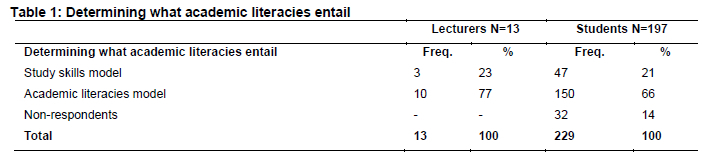
Results in Table 1 show that lecturers' and undergraduate students' definitions of ALs aligned with the AL model by 10 (77%) and 150 (66%), respectively. The SSM posted negligible fewer results. These findings confirmed that in terms of preference, the NLSs' viewpoint to understanding ALs increases an observation that was made by Clarence and McKenna (2017). The researchers' experience, however, is that while understanding of what they are and constitute may point to the ALM, the reality in terms of practice still reflects the dominance of the SSM. This was also identified by Flowerdew (2020).
5.2 The approach adopted and preferred for the provision of academic literacies
The AL model can be viewed as pedagogy to frame curricular and instructional design. In this regard, the chosen model would foreground the variety and specificity of institutional practices and students' struggles to make sense of academic texts (Maldoni 2017).
The study first sought to determine the pedagogy or model adopted for the provision of ALs and, thereafter, the one preferred by both populations. The findings revealed that both lecturers (8: 62%) and undergraduate students (87: 41%) claimed that the institution adopted the ALM. While the results above claim that the ALM is the one adopted, it is not clear which model is adopted.
Regarding model preference for pedagogic reasons, Table 3 shows that lecturers stated the ALM (11: 85%), while students (130: 57%) chose ALM while 67 (29%) chose the SSM.

Table 3 above reveals that lecturers and students are both inclined to the ALM in terms of pedagogy and preference. This contradicts literature which reveals that the SSM is still the dominant method used for teaching by universities internationally (Wong 2017) and in South Africa (Maldoni 2017). Findings confirmed the shift from the SSM, often referred to as the deficit model, to the ALM in terms of the adopted and preferred pedagogy.
On the effectiveness of the current pedagogy being used to provide ALs, 176 (77%) students and 9 (69%) lecturers indicated that the current approaches to the provision of academic literacies were effective. Research has shown that students' conceptions of learning are important factors in determining learning outcomes. A learning approach that focuses on surface issues is associated with poor student results; however, a learning approach that focuses on deep issues coupled with a well-structured subject knowledge base yields better result (Ditcher 2001).
5.3 Initiatives/interventions employed by lecturers and students for the provision of ALs at departmental level
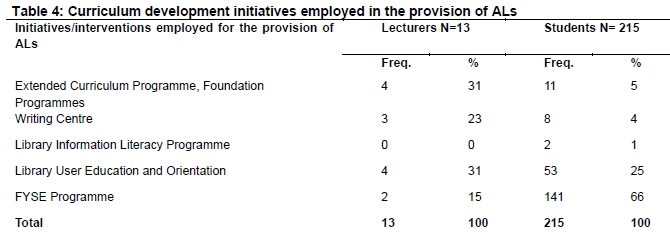
The study sought to ascertain whether lecturers and students were aware of interventions employed in the provision of ALs. All the lecturers were aware of the initiatives. Table 4 shows that 4 (31%) lecturers were aware of the Extended Curriculum Programme and the Library User Education and Orientation Programme, respectively. None of the respondents chose the Library Information Literacy Programme.
With regard to intervention, the students participated in, 215 responded as indicated in Table 4. Most (141: 66%) indicated the FYSE Programme, then the Library User Education Orientation Programme (53: 25%). It is worth noting that Library Information Literacy programme was not selected by lecturers and had the lowest score among students.
5.4 Opinions on the best placed person for the provision of academic literacies
Opinions vary regarding who is best placed to provide ALs; hence, the study investigated whether academics deemed it their responsibility to provide ALs, and those who felt otherwise were asked to identify the most suitable person for the provision of ALs.
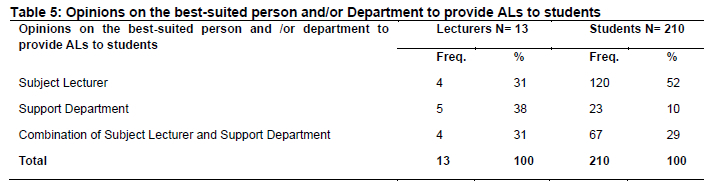
Table 5 shows there were many views regarding who is best suited to provide ALs, with5 (38%) favouring the support department while subject lecturers and a combination of both support department and subject lecturer were also preferred, ranked equally at 4 (31%). Most students120 (52%) mentioned the subject lecturer, with the least 23 (10%) preferring the support department.
According to Jacobs (2013),the placement of ALs away from the subject discipline reflected by lecturers denies students the opportunity to benefit from a more explicit way of thinking about and working with disciplinary knowledge, because it is difficult to think about and work with disciplinary knowledge in refined ways if the people providing ALs are located as outsiders in relation to both students and lecturers. Treating ALs as generic skills has led to the provision of such skills through generic ALs courses separate from mainstream disciplinary curricula (Dooey & Grellier 2020). Contemporary literature places the responsibility of providing ALs with the subject lecturer because the provision of ALs should be about making explicit to students the ways of knowing in the discipline as well as teaching the specific disciplinary forms of expression and conventions for writing (Paxton & Frith 2014). Furthermore, White and Lay (2019) argue that acquiring academic communication skills through the subject matter of a course enhances understanding of that subject matter and its epistemologies.
5.5 Perceptions on assessment of ALs in enhancing teaching and learning
There are varied perceptions regarding whether ALs should be assessed or not. Three specific questions were asked regarding assessment, namely are ALs presently assessed; should they be assessed; and would assessment thereof enhance teaching and learning.
Regarding current assessment, 11 (85%) lecturers indicated that ALs are assessed, which was corroborated by 157 (69%) students while 66 (29%) indicated they are not.
On whether ALs should be assessed, all the lecturers (13: 100%) agreed they should be. Responses from students shows that 108 (47%) felt that ALs should be assessed while 19 (8%) felt that there is no need for their assessment. It was intriguing to note that 103 (45%) students did not answer this question.
Regarding whether assessment of ALs would enhance the quality of teaching and learning, both lecturers and students agreed inordinately. This is shown by 11 (82%) lecturers and 198 (93%) students answered positively.
The above findings confirm that AL courses, particularly their assessment practices, function well in developing students' academic reading and writing skills (Zhou, Zhao & Dawson 2020). For instance, Wingate (2018) found that repeated feedback enabled students to progress fast in their academic writing. There is a need for a more nuanced understanding of the interplay between assessment, students' epistemological beliefs and ALs (Moore & Dison 2019).
5.6 Perceptions on the type of undergraduate student who should be provided academic literacies and those currently being taught
The question on the type of students who should be provided ALs is commonly asked. This comes with the SSM often referred to as the "Deficit Model" of providing ALs, situating the challenges of inadequate ALs with students from poor academic background which in South Africa results in pinpointing the problem to black students and, internationally, with second language English speakers. It was necessary to determine what the current practice is concerning the type of students to whom ALs are provided. Options were provided from which to choose.
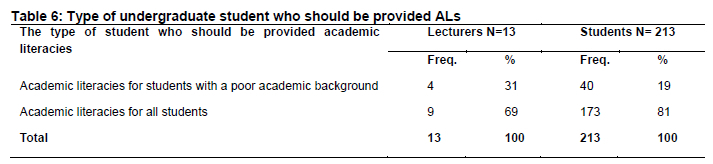
Table 6 above shows that 9 (69%) lecturers and 173 (81%) students believed ALs should be provided to all, regardless of their academic background and did not surmise that only those students with a poor academic background needed ALs as shown by 4 (31%) lecturers and 40 (19%) students. Studies showed that in most HEIs, ALs are predominantly provided to students who have been identified as having a poor academic background and/or are underperforming, and not the entire undergraduate student population. The above findings showed lecturers' and students' preferences were different from the university practices.
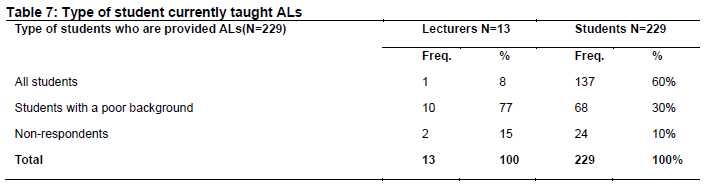
Regarding students who are currently being taught ALs, 10 (77%) lecturers indicated that currently, ALs are taught to students with a poor academic background. This contradicted with students' findings, which indicated that 137 (60%) claimed all students in their department were taught, while 68 (30%) claimed only students with a poor academic background were taught. Klarare et al. (2022) indicate that numerous students enter higher education with relatively little or no experience of academic studies, and previous education does not ensure that students are sufficiently equipped to meet requirements of ALs. Table 7 shows the results.
5.7 Factors influencing the provision of Als
The provision of ALs is influenced by various factors. In recognition of this fact, strong investment has been made into undergraduate programmes to provide academic support within, among others, financial and regulatory constraints in the higher education environment. The study thus sought views regarding factors that influence the provision of ALs. Figure 1 shows responses from lecturers.
The most influential factor for lecturers was skills/knowledge/methods of providing ALs with 12 (92%). The least influential factors were timetable slots and budget availability with 5 (38%).
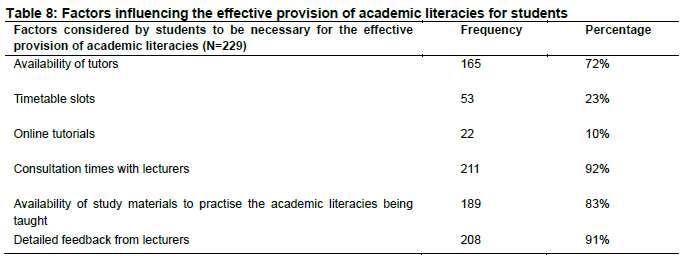
For students, the most influential factors were consultation with lecturers (211: 92%) and feedback from lecturers (208: 91%). This was closely followed by availability of study materials (189: 83%) and availability of tutors (165: 72%). Timetable slots and online tutorials were the least influential with postings of below 25%. Without discounting the critical role of funding, it seems the matters of "know-how" and workloads were influential. This confirms the views expressed by Jacobs (2013) that despite governments and universities' response of providing funding, this has not yielded the desired results. Considering students' perceptions/opinions of various interventions, increased confidence was one of the most reported outcomes.
5.8 Determining whether the university provides support to students and lecturers for the provision of Als
Considering that ALs include values, attitudes, identities, ways of being and so forth of the student, the lecturer and the university, this study sought to determine whether the university provided support to students and lecturers for the provision of ALs. Of the 13 responses, the results showed that 9 (69%) said they received support from DUT to provide ALs and 4 (31%) indicated not receiving support. Supporting and emphasising the importance of ALs to students during lecturers were also measured. The results showed that 170 (74%) students indicated this was emphasised while 55 (24%) students indicated it is not emphasised. Klarare et al. (2022) emphasise that the whole institutional and epistemological context must be interconnected for students to navigate higher education and successfully participate in and contribute to the academic community.
6 Conclusion, recommendations and study implications
The following conclusions were made:
Regarding identifying the practices followed in the provision of ALs, the critical findings were that choices about what ALs are and constitute, leaned towards the ALM, both in understanding and preference; however, anecdotal evidence still pointed to the predominant practice to generally be the SSM. On the preferred pedagogy and that which is currently applied for ALs, the ALM clearly led for lecturers, but less so for students. Overall, findings supported a pedagogical shift underpinned by the New Literacies Framework. The approaches adopted for the provision of ALs were reported to be effective.
It appears there is no clear-cut department deemed best placed to for providing ALs, with much finger-pointing and this was equally so regarding who provides ALs presently; perhaps this indecisiveness points to a need for a multi-stakeholder strategy. Findings showed the role of assessment of ALs in enhancing teaching and learning was beyond doubt, notwithstanding uncertainty regarding whether assessments are conducted and to what extent. Perceptions regarding whether assessing ALs would enhance teaching and learning, respondents clearly claimed that they would, even as there were contradicting views regarding whether they should be assessed, between students and lecturers, reflecting a general hesitation by students believing that assessment would be burdensome.
On the question of to whom ALs should be provided, both populations felt all students and not only those deemed to have a poor academic background and/or underperforming. Questions about the type of student who is provided ALs, contradictions arose, it was indicated the institutional practices still focused on students with a poor academic background.
The factors influencing the provision of ALs varied for lecturers and students. For the first, the most influential factors were skills/knowledge/methods of teaching ALs, workload, lecturer training and assistance with curriculum development, and for the latter, consultation with lecturers, feedback from lecturers, availability of more tutors and study materials mattered more. The study has critical implications for the future of higher education in South Africa at policy, curriculum development and institutional reform level to enhance its quality and relevance.
Some insightful takings from this study include that ALs must be considered as a compulsory curriculum offering extended across academic programmes, and it should be assessed. Assessment can help measure the impact ALs have on teaching and learning. Issues specific to the undergraduate programme investigated were that since students face information explosion and have to contend with the digital environment, retrieval skills and digital literacy are paramount for their teaching, learning and research.
The study recommends bringing together various stakeholders, including subject/discipline lecturers and academic support staff, to assuage challenges and develop sustainable ALs. This includes integrating teaching and learning activities, targeting parallel learning of course materials and developing ALs, beyond study skills.
Further studies could include more institutions in South Africa so that results can be generalised on who needs ALs, curriculum focus and implementation.
References
Refs Boughey, C. 2010. Analysing teaching and learning at the Universities of Technology: A tribute to Terry Volbrecht. Keynote address presented at the Research and Innovation in Teaching and Learning, Cape Peninsula University of Technology.
Boughey, C. and McKenna, S. 2016. Academic literacy and the decontextualised learner. Critical Studies in Teaching and Learning: 4(2): 1-9. https://doi.org/10.14426/cristal.v4i2.69 [ Links ]
Canton, U., Govan, M. and Zahn, D. 2018. Rethinking academic literacies: A conceptual development based on teaching practice. Teaching in Higher Education, 23(6), 668-684. https://doi.org/10.1080/13562517.2017.1400507 [ Links ]
Chokwe, J.M. 2013. Factors impacting academic writing skills of English second language students. Mediterranean Journal of Social Sciences, 4(14): 377-396. https://doi.org/10.5901/mjss.2013.v4n14p377 [ Links ]
Clarence, S. and McKenna, S. 2017. Developing academic literacies through understanding the nature of disciplinary knowledge. London Review of Education, 15(1): 38-49. https://doi.org/10.18546/LRE.15.L04 [ Links ]
Diaz, C.R. 2019. Effects on students' self-efficacy in a Mathematics bridge program. PhD thesis, Texas State University. [ Links ]
Ditcher, A.K. 2001. Effective teaching and learning in higher education, with particular reference to the undergraduate education of professional engineers. International Journal of Engineering Education, 17: 24-29. [ Links ]
Dooey, P.M. and Grellier, J. 2020. Developing academic literacies. Journal of Academic Language and Learning, 14(2): 106-119. [ Links ]
Du Plessis, L. and Gerber, D. 2012. Academic preparedness of students-an exploratory study. TD: The Journal for Transdisciplinary Research in Southern Africa, 8(1), 81-94. https://doi.org/10.4102/td.v8i1.17 [ Links ]
Du Plooy, L. and Zilindile, M. 2014. Problematising the concept epistemological access with regard to foundation phase education towards quality schooling. South African Journal of Childhood Education, 4(1): 187-201. https://doi.org/10.4102/sajce.v4i1.79 [ Links ]
Ellery, K. 2016. Epistemological access in a science foundation course: A social realist perspective. Doctoral thesis. Rhodes University. [ Links ]
Fisher, G. and Scott, I. 2011. Closing the skills and technology gap in South Africa Background Paper 3: The role of higher education in closing the skills gap in South Africa. https://www.glenfisher.ca/downloads/files/Higher%20Education%20in%20SA.pdf
Flowerdew, L. 2020. The academic literacies approach to scholarly writing: A view through the lens of the ESP/Genre approach. Studies in Higher Education, 45(3): 579-591. https://doi.org/10.1080/03075079.2019.1574862 [ Links ]
Fomunyam, K.G. 2019. Students and institutional preparedness for educational encounters: Views of the margin. Education Systems Around the World. IntechOpen. https://doi.org/10.5772/intechopen.85326
Garcia, N.M. and Mayorga, O.J. 2018. The threat of unexamined secondary data: A critical race transformative convergent mixed method. Race Ethnicity and Education, 21(2): 231-252. https://doi.org/10.1080/13613324.2017.1377414 [ Links ]
Gravett, K. (2019). Making learning happen: Students' development of academic and information literacies. In Engaging Student Voices in Higher Education (pp. 175-190). Springer. https://doi.org/10.1007/978-3-030-20824-0_11
Hartman-Caverly, S. (2019). Human nature is not a machine: On liberty, attention engineering, and learning analytics. Library Trends, 68(1), 24-53. Horner, B. 2013. Ideologies of literacy, "academic literacies," and composition studies. https://ir.library.louisville.edu/cgi/viewcontent.cgi?article=1084&context=faculty [ Links ]
Huang, C.W. and Archer, A. 2017. 'Academic literacies' as moving beyond writing: Investigating multimodal approaches to academic argument. London Review of Education, 15(1):63-72. https://doi.org/10.18546/LRE.15.L06 [ Links ]
Jacobs, C. 2013. Academic literacies and the question of knowledge. Journal for Language Teaching, 47(2): 127-139. https://doi.org/10.4314/jlt.v47i2.9 [ Links ]
Jacobs, C. 2015. Opening the curriculum: Moving from the normative to the transformative in teachers' understandings of disciplinary literacy practices. In Working with academic literacies: Case studies towards transformative practice (pp. 131-141). https://wac.colostate.edu/books/lillis/chapter9.pdf
Keefe, E.B. and Copeland, S.R. 2011. What is literacy? The power of a definition. Research and Practice for Persons with Severe Disabilities, 36(3-4): 92-99. https://doi.org/10.2511/027494811800824507 [ Links ]
Klarare, A., Rydeman, I.B., Kneck, Â., Sparen, E.B., Winnberg, E. and Bishol, B. 2022. Methods and strategies to promote academic literacies in health professions: A scoping review. BMC Medical Education, 22:418. https://doi.org/10.1186/s12909-022-03288-9 [ Links ]
Lea, M.R. 2017. Academic literacies in theory and practice. In B. Street and S. May (Eds.), Literacies and language education. Encyc.
Lea, M.R. and Street, B.V. 1998. Student writing in higher education: An academic literacies approach. Studies in Higher Education, 23(2): 157-172. https://doi.org/10.1080/03075079812331380364 [ Links ]
Lea, M.R. and Street, B.V. (2006). The academic literacies model: Theory and applications. Theory Into Practice, 45(4): 368-377. https://doi.org/10.1207/s15430421tip4504_11 [ Links ]
Lea, M.R. and Street, B.V. 2009. Student writing in higher education: An academic literacies approach. In F. Fletcher- Campbell, J. Soler and G. Reid (Eds.), Approaching difficulties in literacy development: Assessment, pedagogy and programmes (pp. 260-294). London: Sage. [ Links ]
Leander, K. and Boldt, G. 2013. Rereading a pedagogy of multiliteracies bodies, texts, and emergence. Journal of Literacy Research, 45(1): 22-46. https://doi.org/10.1177/1086296X12468587 [ Links ]
Lemley, S.M., Hart, S.M. and King, J.R. 2019. Teacher inquiry develops elementary teachers' disciplinary literacy. Literacy Research and Instruction, 58(1): 12-30. https://doi.org/10.1080/19388071.2018.1541882 [ Links ]
Leu, D.J., Kinzer, C.K., Coiro, J., Castek, J. and Henry, L.A. 2017. New literacies: A dual-level theory of the changing nature of literacy, instruction, and assessment. Journal of Education, 197(2): 1-18. https://doi.org/10.1177/002205741719700202 [ Links ]
Lillard, S.S. 2019. What drives underprepared students from the first year on? Doctoral dissertation, Walden University. [ Links ]
Lillis, T. and Curry, M.J. 2013. Academic writing in a global context: The politics and practices of publishing in English. Oxfordshire: Routledge. [ Links ]
Lillis, T. and Scott, M. 2007. Defining academic literacies research: issues of epistemology, ideology and strategy. Journal of Applied Linguistics, 4(1): 5-32. https://doi.org/10.1558/japl.v4i1.5 [ Links ]
Lillis, T. and Tuck, J. 2016. Academic literacies: A critical lens on writing and reading in the academy. In K. Hyland and P. Shaw (Eds.), The Routledge handbook of English for academic purposes (pp. 54-67). Routledge. https://www.routledgehandbooks.com/doi/10.4324/9781315657455.ch03
Lozano, R., Merrill, M.Y., Sammalisto, K., Ceulemans, K. and Lozano, F.J. 2017. Connecting competences and pedagogical approaches for sustainable development in higher education: A literature review and framework proposal. Sustainability, 9(10):11-14. https://doi.org/10.3390/su9101889 [ Links ]
Madinga, N.W., Maziriri, E.T. and Lose, T. 2016. A qualitative inquiry on the challenges facing international students at institutions of higher learning in southern Gauteng, South Africa. In M. Dichaba & O. Sotayo (Eds.), South Africa International Conference on Education Towards Excellence in Educational Practices (pp. 60-71). Pretoria: African Academic Research Forum. [ Links ]
Maldoni, A.M. 2017. A cross-disciplinary approach to embedding: A pedagogy for developing academic literacies. Journal of Academic Language and Learning, 11(1): A104-A124. [ Links ]
Maphalala, M.C. and Mpofu, N. 2020. Examining first-year students' experience of being tutored: A South African case study. Issues in Educational Research, 30(3): 1025-1039. [ Links ]
Maseko, B.N. 2015. Language and identity in the academic performance and portraiture of black BEd Foundation Phase students. Doctoral dissertation, University of Pretoria. [ Links ]
Mashaba, M. 2017. Academic literacy through a restructured curriculum: Possibilities for epistemological access? Master's thesis, University of Johannesburg. [ Links ]
McKenna, S. (2004). The intersection between academic literacies and student identities: Research in higher education. South African Journal of Higher Education, 18(3): 269-280. https://doi.org/10.4314/sajhe.v18i3.25446 [ Links ]
McKenna, S. 2010. Cracking the code of academic literacy: An ideological task. Beyond the university gates: Provision of extended curriculum programmes in South Africa, 8-15.
McLean, M. 2020. Higher education research to investigate epistemic in/justice. In J. McArthur and P. Ashwin (Eds.), Locating social justice in higher education research (pp. 89-103). New York: Bloomsbury. [ Links ]
Menon, K. 2020. Measuring equity of access to higher education in South Africa: Considerations and possibilities. In I. Rensburg, S. Motala and M. Cross (Eds.), Transforming universities in South Africa (pp. 205-228). Leiden: Brill Sense Publishers. [ Links ]
Merkel, J.C. and Brania, A. 2015. Assessment of peer-led team learning in calculus I: A five-year study. Innovative Higher Education, 40(5): 415-428. https://doi.org/10.1007/s10755-015-9334-8 [ Links ]
Moganedi, J. and Sithole, S.L. (2020). An evaluation of the National Skills Development Act No. 97 of 1998 as amended in 2008 (Act 37 of 2008) as a tool against unemployment and poverty alleviation in the Republic of South Africa (RSA). International Conference on Public Administration and Development Alternative.
Moodley, P. and Singh, R.J. 2015. Addressing student dropout rates at South African universities. http://hdl.handle.net/10321/1648.
Moore, J. and Dison, L. 2019. Creating conditions for working collaboratively in discipline-based writing centres at a South African university. Journal of Language Learning, 35(1): 1-14. https://doi.org/10.1080/097383921451008 [ Links ]
Murray, N. and Nallaya, S. 2016. Embedding academic literacies in university programme curricula: A case study. Studies in Higher Education, 41(7): 1296-1312. https://doi.org/10.1080/03075079.2014.981150 [ Links ]
Nayager, A. (2018). A comparative case study of the academic development and student support initiatives and programmes in two schools at the University of the Witwatersrand. Master's thesis, University of the Witwatersrand. [ Links ]
Ngcobo, S., Ndaba, N., Nyangiwe, B., Mpungose, N. and Jamal, R. 2016. Translanguaging as an approach to address language inequality in South African higher education: Summary writing skills development. Critical Studies in Teaching and Learning, 4(2): 10-27. https://doi.org/10.14426/cristal.v4i2.72 [ Links ]
Niven, P.M. 2005. Exploring first-year students and their lecturers' constructions of what it means to read in a humanities discipline: A conflict of frames? South African Journal of Higher Education, 19(4): 777-789. https://doi.org/10.4314/sajhe.v19i4.25654 [ Links ]
O'Quin, M.L. 2020. Understanding the similarities and differences of academic aspirations between regular and specially admitted student-athletes. Master's thesis, California State University. [ Links ]
Ortega, A. 2020. First generation college students' connection to campus involvement at the University of San Diego. https://digital.sandiego.edu/cgi/viewcontent.cgi?article=1052&context=soles-mahel-action.
Paulynice, R. 2019. A comparative study on parental involvement. Doctoral dissertation, Nova Southeastern University. [ Links ]
Paxton, M. 2012. Student voice as a methodological issue in academic literacies research. Higher Education Research & Development, 31(3): 381-391. https://doi.org/10.1080/07294360.2011.634383 [ Links ]
Paxton, M. and Frith, V. 2014. Implications of academic literacies research for knowledge making and curriculum design. Higher Education, 67(2): 171-182. https://doi.org/10.1007/s10734-013-9657-5 [ Links ]
Pitsoe, V. and Letseka, M. 2018. Access to and widening participation in South African higher education. In M. Makhaya, P. Blessinger and J. Hoffman (Eds.), Contexts for diversity and gender identities in higher education: International perspectives on equity and inclusion (pp. 205-228). Bingley: Emerald. [ Links ]
Sekaran, U. and Bougie, R. 2016. Research methods for business: A skill building approach. New Jersey: John Wiley & Sons. [ Links ]
Seligmann, J. and Gravett, S. 2010. Literacy development as 'a marginalised pedagogical service enterprise' or as social practice in the disciplines? Education as Change, 14(1): 107-120. https://doi.org/10.1080/16823201003671565 [ Links ]
Wargo, J.M. and De Costa, P.I. 2017. Tracing academic literacies across contemporary literacy sponsorscapes: Mobilities, ideologies, identities, and technologies. London Review of Education, 15(1): 101-114. https://doi.org/10.18546/LRE.15.L09 [ Links ]
White, S. and Lay, E. 2019. Built-in not bolted-on: Embedding academic literacy skills in subject disciplines. Creative Pedagogies Imprint, 1(2): 33-38. [ Links ]
Wilmot, K. and McKenna, S. 2018. Writing groups as transformative spaces. Higher Education Research & Development, 37(4): 868-882. https://doi.org/10.1080/07294360.2018.1446418 [ Links ]
Wingate, U. 2018. Academic literacy across the curriculum: Towards a collaborative instructional approach. Language Teaching, 51(3): 349-364. https://doi.org/10.1017/S0261444816000264 [ Links ]
Wong, T.S. 2017. Academic literacies in the field of interior architecture: A multimodal analysis. In P.H. Jones and J. Bradley (Eds.), Text-based research and teaching: A social semiotic perspective on language in use (pp. 341-361). Bloomsbury.
Wong, P., Liamputtong, P., Koch, S. and Rawson, H. 2019. Searching for meaning: A grounded theory of family resilience in adult ICU. Journal of Clinical Nursing, 28(5-6): 781-791. https://doi.org/10.1111/jocn.14670 [ Links ]
Zhou, J., Zhao, K. and Dawson, P. 2020. How first-year students perceive and experience assessment of academic literacies. Assessment & Evaluation in Higher Education,45(2): 266-278. https://doi.org/10.1080/02602938.2019.1637512 [ Links ]
Received: 19 September 2024
Accepted: 4 February 2025