Services on Demand
Journal

Article
 English (pdf)
 Article in xml format
 Article references
 Automatic translation
 Send this article by e-mail
Indicators
Related links
-
 Cited by Google
 -
 Similars in Google
Share

 Permalink
South African Journal of Libraries and Information Science
On-line version ISSN 2304-8263Print version ISSN 0256-8861
SAJLIS vol.90 n.1 Pretoria 2024
https://doi.org/10.7553/90-1-2273
RESEARCH ARTICLES
Copyright knowledge of library staff and students in an academic library
Maropene Thomas RamabinaI; Zawedde NsibirwaII
IManager: Information Services at North West University, South Africa. maropene.ramabina@nwu.ac.za ORCID: 000-0002-2685-3912
IISenior Lecturer at the University of KwaZulu-Natal, South Africa. nsibirwaz@ukzn.ac.za ORCID: 0000-0001-8527-1560
ABSTRACT
The study aims to assess the level of copyright knowledge among library staff and law students at the University of Venda (UNIVEN) library in Thohoyandou, Limpopo province, South Africa. The study used a quantitative research approach using a survey to gather data on understanding and awareness of copyright laws on campus. Google Forms was used to collect data. The population consisted of 38 library staff selected using a census sampling method and 112 final-year and postgraduate law students selected using a stratified random sampling method. The results of the study show that UNIVEN law students are more knowledgeable about basic copyright matters such as policies, copyright protection, public domain, copyright limitations, and fair dealing, copyright ownership than library staff. The research findings provided insight into the current level of copyright knowledge among library staff and law students and suggested strategies to improve copyright education and training in libraries. The results of this study will be useful to librarians, academics, and policymakers interested in promoting copyright literacy and compliance in academic libraries.
Keywords: copyright knowledge, library staff, law students, academic library, awareness.
1 Introduction
Copyright is an important legal concept that protects the rights of creators and owners of original works, including books, articles, music, videos, and other creative works (DALRO 2021). Abdulla (2008) argues that the copyright issue is important to the academic and research community since it has an impact on every facet of their academic lives. Everything they produce and use of for their research, teaching, and learning is copyrighted. Because of this, publishers and sellers all over the world, according to Prasad and Hombal (2012), joined forces to develop the necessary safeguards to protect themselves against piracy and infringement. They contend that because of piracy and infringement, copyright owners are unable to recoup their investments in the production of new material and will instead stop investing in either the creation of new content or the continuous exploitation of existing content. "Libraries support copyright because they recognise the need for creators to be rewarded for their work and for creative works to be protected from piracy and other unfair exploitation" (Hackett 2005:3). However, copyright protection extends beyond mere rights holders. Since its inception, copyright has attempted to strike a balance between the need to safeguard authors and the public's right to access material for research, education, and other creative endeavours (Khan 2015).
The primary purpose is to give users quick, convenient access to digital resources wherever and whenever they are needed. Instead of worrying about whether their actions and this access are authorised or valid, library users may be more concerned about how effective and complete this access is (Wu, Chou, Ke & Wang 2010). Although some library users may already be familiar with copyright law in principle, they are typically not aware of its application or the specific licencing arrangements for digital content. As a result, when people use digital material services, they can transgress copyright legislation or a specific licencing agreement. In an academic library setting, copyright issues can arise in various ways, such as when library staff and students reproduce, distribute, or display copyrighted materials for educational or research purposes (Chou, Chan & Wu 2007). Chou, Chan and Wu (2007:1043) further argued that copyright awareness is important for library staff and students because:
Some students copy information directly from websites and turn it in as their original work without citing the source; some carelessly download copyrighted music or movies for their entertainment; some claim that they have to copy software, instead of purchasing legitimate material, in order to finish their homework; and some share and keep forwarding online text, pictures, videos, or animations to their friends and relatives. It seems that students are not fully aware that most online information is copyrighted, and infringement of copyright, whether consciously or not, is a widespread problem among students.
Therefore, library staff and students must understand copyright laws and policies to ensure compliance and avoid potential legal issues. Libraries' activities and students are connected with copyright legislation because they are both users and creators of intellectual works (Fernández-Molina & Muriel-Torrado 2018). Both must be aware of their rights about their works as well as what they can and cannot do with works protected by copyright without infringing the law. Fernández-Molina and Muriel-Torrado (2018:278) also stated that "library staff are in an intermediate position that obliges them to find a balance between the rights of copyright owners and those of their users".
Despite the importance of copyright knowledge, many library staff and students may not understand copyright laws and policies. According to Fernández-Molina and Muriel-Torrado (2018), one of the reasons could be that most information professionals felt that legal issues apply only to lawyers and not to the general public. This lack of knowledge can lead to unintentional copyright infringement, resulting in legal and financial consequences for the library and its users. Therefore, it is necessary to assess the level of copyright knowledge among library staff and students in an academic library and identify areas that need improvement. The study aims to compare the level of copyright knowledge between library staff and senior law students at the UNIVEN library.
2 Background of the study
The study was carried out at UNIVEN, located in Vhembe district of Limpopo province of South Africa. On 18 February 1981, the University of Limpopo, then known as the University of the North, founded UNIVEN as a campus (Ndou 2021). According to Nkomo and Sehoole (2007), UNIVEN is categorised as a rural university that offers theory- and practice-orientated courses because of its geographic location and historical background. In the context of South Africa, Edwards (2015) characterised rural universities as institutions established by the apartheid government to serve the ethnic groups of Sotho, Tswana, Venda, Xhosa, and Zulu. One of South Africa's comprehensive rural universities, UNIVEN aims to offer an information service to its students, faculty and the surrounding community (Tlakula & Fombad 2017).
UNIVEN's graduates are both regionally and internationally competitive (Edwards 2015). It is a university leading in engaged scholarship with four faculties on the main campus, including the Faculty of Science, Engineering and Agriculture, Faculty of Humanities, Social Sciences and Education, Faculty of Management, Commerce and Law, and the Faculty of Health Sciences (Ramabina & Nsibirwa 2023).
3 Research objective
The study aimed to assess the copyright knowledge of both library staff and law students at the UNIVEN Library, with a focus on comparing their understanding of key copyright concepts and identifying any differences and similarities in their copyright literacy levels.
4 Conceptual framework
Conceptualisation drawn from ethical theory was used to support this study. Other concepts used mostly under literature review in the study are thoroughly explained and drawn from copyright legislation and conventions internationally, as well as other local and international literature.
4.1 Conceptualisation of social responsibility by the researchers. Social Responsibility Theory
Social responsibility and inclusivity drawn from ethics are topics that are becoming critical in public discourse and the economic realm, and libraries are no exception. Every organisation or institution, including libraries, must also focus on its obligation to contribute to the well-being of communities and society (Racelis 2018). Hines (2015:2) argues that "librarianship has begun a transformation from a profession concerned primarily with providing access to, storing, and protecting information resources to a profession with an ultimate goal of promoting libraries as community centres connecting people with needed information". In India, libraries have been identified as institutions that play a critical role in the development and education of societies. Libraries educate communities by providing information that is processed into knowledge. According to Mzayiya (2016), those with expertise in intellectual property (IP) concerns, such as librarians and information professionals, have a specific obligation to develop copyright policies, promote awareness of copyright infringement issues, and provide solutions to these difficulties.
Libraries should have a lecture hall, an exhibition lobby and a conference room to organise workshops, lectures, debates, exhibitions, training, music concerts and other social and cultural programmes. Library staff should participate in these community development programmes. Library staff should educate socially responsible community members by providing a safe place to learn, grow, and thrive (Vijesh & Mohanan 2018). Libraries can provide free computer use, meeting rooms, literacy programmes, and help with language skills and job search, in addition to more familiar services (Racelis 2018). Libraries also have the social responsibility of protecting the rights of authors of the resources contained in the library. This can be done by library staff educating each other and their library users about copyright provisions on campus (in the case of an academic library) and in communities (in the case of a public library). Library staff must empower users by educating them on how to use library resources and respect the copyright laws that govern those resources both in hard copy and electronic format. Teaching and educating library users about copyright provisions and monitoring them is part of this social responsibility.
5 Literature review
Copyright law is a critical aspect of intellectual property law that governs the use of creative works. It is an important legal concept that protects the rights of creators and owners of original works, including books, articles, music, videos, and other creative works (UNESCO 2010; WIPO 2016; DALRO 2021). The purpose of copyright law is to strike a balance between the necessity for public access to works and the rights of creators to make a living from them (Polak 2009; Ramabina & Nsibirwa 2023). Nicholson (2012) further emphasised that the purpose of copyright is to serve the greater public interest by giving authors an incentive to create and by encouraging the dissemination of new knowledge. She emphasised that research integrity values are honesty, respect, trust, fairness, and responsibility. It is crucial to know the differences between fair use and fair dealing. Fair use and fair dealing are both legal doctrines that allow for the use of copyrighted material without the permission of the copyright owner under certain circumstances (Masango 2007). Fair use is primarily a doctrine found in the United States copyright law. It allows for the limited use of copyrighted material without permission from the copyright holder for purposes such as criticism, comment, news reporting, teaching, scholarship, or research. Fair dealing, on the other hand, is a legal concept found in the copyright laws of some other countries, such as South Africa, Canada, the United Kingdom, Australia, and others. Like fair use, it allows the use of copyrighted material without permission under certain circumstances, but the specific criteria and limitations may vary depending on the jurisdiction (Hirtle, Hudson & Kenyon 2009).
There are two types of copyright exceptions: fair dealing and library exemptions. Fair dealing is the concept that only a small piece of content protected by copyright should be allowed to be reproduced without violating that material's copyright (Hirtle, Hudson & Kenyon 2009). Fair dealing appears in Section 12 of the South Africa Copyright Act. However, it has not been defined in the Act. In other words, the fair dealing privilege states that material can legally be reproduced with limitation without the copyright owner, especially for educational purposes and for the public good (Darkey & Akussah 2008; Polak 2009). It applies only to a specified list of purposes in the South African Copyright Law. Fair dealing allows individuals to copy printed works which have not gone into the public domain without being charged with copyright infringement (Masango 2005). The doctrine of fair dealing does not apply to all materials used for educational purposes. Certain conditions must be met for fair dealing to apply to protected materials (Khan 2015). The determination of fair dealing is made on a case-to-case basis with an examination of the particular circumstances of each use (Schockmel 1996). Library staff and academic library users need to be taught about copyright and how this complicated and important issue affects them.
There is no consensus on the quantity of material that will qualify as fair dealing (Masango 2005). South African copyright law does not specify how much one may copy within the bounds of fair dealing, but it must be for one's use. Therefore, producing multiple copies is fair dealing (DALRO 2021). Librarians need to know, for example, what a reasonable portion of copying constitutes and what users intend to do with the copyrighted material. Some say that a fair amount means 10% of the work, one chapter of a book or one journal article. However, it is important to note that copying just one page may be unfair if it is the essence of the work (Nicholson 2012). In libraries, the belief is that photocopying a book chapter at a time is allowed (Masango 2005). Section 13 of the South African Copyright Act contains limited exceptions for education and libraries, which have not been updated since 1978 (Nicholson & Kawooya 2008). As amended, "the South African Copyright Act 98 of 1978 governs all aspects of copyright in South Africa. It lays out the rules for what is protected, what it is protected from, how long it is protected for, and who owns copyright" (DALRO 2021). The South African copyright law has not been amended for libraries, archives, education, and research institutions since 1978. The last amendment to the Act was for needle time for musicians in 2002 (Nicholson 2012).
The rule of territoriality states that copyright law protects works in the country where the work was produced (Fernández-Molina, Moraes & Guimares 2017). It meant that the work produced in South Africa is not protected in a foreign country and foreign works were not protected in South Africa. The situation changed drastically from the mid-19th century onwards when countries started to conclude bilateral treaties for reciprocal protection of author rights (UNESCO 2010). Creations of the mind can be enjoyed anywhere at any time and are not confined to a country's boundaries (UNESCO 2010). These treaties such as the Berne Convention, the Universal Copyright Convention (UCC), and the World Intellectual Property Organisation (WIPO) offer more universal protection for all copyright works.
The South African copyright law became outdated because it received little attention from legislators; it failed to consider South Africa's status as a country in the Global South; but instead, it tried to emulate European law (Riby-Smith 2017). This South African Copyright Act 98 of 1978 contained limited exceptions for education and libraries, especially in the digital age. This Act conflicts with the South African Constitution and several other laws which mandate access to information by the public (Nicholson & Kawooya 2008). It is also discriminatory and conflicts with the legislation protecting disabled persons. It does not allow people with sensory disabilities to access public or private information (Nicholson & Kawooya 2008). The South African Department of Trade and Industry (DTI) took the initiative to propose amendments to the current Copyright Act 98 of 1978.
The Copyright Amendment Bill (CAB) was established in 2018 to modernise an increasingly outdated piece of legislation and to overcome the challenges of the South African Copyright Act 98 of 1978, which innocently ignored most of the population to benefit a few (Riby-Smith 2017; Fubbs 2019). Section 12 D (1-8) of the South African Copyright Amendment Bill (CAB) contains valuable educational and research exceptions to address the main gaps in copyright legislation. Because of concerns regarding the validity of the legislation passed by Parliament, the current president of the Republic of South Africa, Cyril Ramaphosa, has submitted the Copyright Amendment Bill and the Performers' Protection Amendment Bill to the National Assembly.
When the Covid-19 pandemic swept across the world in early 2020, most educational institutions around the world were forced to close their classroom doors and take their teaching online. Textbooks were left in student lockers and library books were left untouched on shelves. Teachers had to switch to remote delivery methods to ensure that students could complete the ill-fated semester. "But amidst the rapid move to Zoom Rooms, Course Moodles, home-recorded lectures, and posted PDFs, copyright restrictions reared their heads, casting into doubt the legality of online learning practices that had suddenly become nothing short of necessary" (Craig 2020:1). The most important factors affecting students' participation in online teaching and learning were determined to be their lack of access to a personal computer or smartphone, as well as the Internet, followed by their poor study habits and lack of technology abilities (Chou, Chan & Wu 2007).
The realities of a world battling Covid-19 forced nations to rely more than ever on the Internet for communication, work, commerce, education, and entertainment.
This increased reliance has intensified the need to find answers to many questions regarding the copyright law implications of actions on the Internet. Due to the sudden switch to online education that Covid-19-related restrictions have caused, many educators have been wondering how copyright law exceptions and limitations might apply differently when they teach online rather than when they teach in person in a classroom. Suppose that the lecturer reproduces a video clip and uploads it to the Learning Management Platform for their class (Trimble 2020:1).
Wu et al. (2010) found three major problems or cases that librarians often encountered while promoting digital library resources. They were massive downloading, distribution to unauthorised users such as friends in other universities and going beyond the purpose and character of academic use. Massive downloading, distribution to unauthorised users such as friends in other universities and use outside the scope and character of academic use were identified to be the three main issues or situations that librarians frequently experienced while promoting digital library resources (Wu et al. 2010). Would these actions be covered or permissible under copyright exception or limitation or by fair dealing doctrine? And what country's copyright laws will govern these scenarios?
The importance of many of the issues that the pandemic has brought to the attention of humanity certainly eclipses the importance of any copyright law issues that the situation has highlighted. "But to the extent that the situation provides a sensible lesson for copyright law, the lesson is that a comprehensive review of transnational issues in copyright law is warranted to address questions such as those arising in the scenario above" (Trimble 2020: 407). The unexpected reach is where the issue starts. Nowadays, almost everything that is written, illustrated, performed, or recorded is protected by copyright rules, and the protection lasts for anywhere between fifty and well over a hundred years.
Ramabina and Nsibirwa (2023) argued that libraries, copyright owners, and users can play a role in monitoring and enforcing copyright in libraries because they are closest to the scene. Librarians must recognise their vital and unique role in the social and educational upliftment of illiterate people in the sub-Saharan region (Nicholson 2012). One way of achieving this is through systematic information literacy programmes that include intellectual property (IP) issues as part of the syllabus (Ercegovac & Richardson Jr. 2004). It is the responsibility of everyone (academic departments, authors, libraries and library staff, copyright officers, publishers, and library users) to monitor copyright violations in academic libraries. There is a copyright law in the country and one of its purposes, among others, is to deter people from copyright infringements, and this law binds everyone (Ramabina & Nsibirwa 2023). Digital technology has improved the enforceability of rights by offering copyright owners a variety of technological tools to control the use of their works (UNESCO 2010). Library users are advised to use library resources (databases) because they are carefully selected and are reputable works to avoid using copyrighted or fake works or can also open access resources such as open books, journals, images, music, etc. because they do not have copyright restrictions (Nicholson 2012).
5.1 Copyright awareness in academic libraries
Despite the wide range of copyright issues present in the literature, few studies have examined awareness of copyright-related policies worldwide. In the United States of America (USA), Williamson (1992) studied awareness of copyright by faculty and teaching assistants in a university. Smith et al. (2006) researched awareness of copyright laws at the Faculty of Health Sciences in the United States of America and found that faculty had limited knowledge of copyright laws. Morrison and Secker (2015) examined the knowledge of academic library staff of national and international copyright issues and policies. The findings suggest that the United Kingdom's (UK) professionals' knowledge levels on copyright issues are higher than those in other countries. Participants were found to have high copyright literacy. Also, in the UK, the National Union of Students (NUS) in 2013 explored students' attitudes toward copyright. More than 2000 students from institutions of higher learning were surveyed and it was found that their understanding of copyright issues was limited (Morrison & Secker 2015). A study by Nilsson (2016) on copyright literacy among academic librarians found a general lack of copyright knowledge. Nilsson (2016) recommended that copyright matters in library and information science (LIS) curricula.
5.2 Awareness of copyright knowledge between library staff and students
Few studies have been conducted around the world that compared and described the copyright knowledge of library staff and students. Fernández-Molina and Muriel-Torrado (2018) compared the copyright knowledge of faculty, library staff, and students at the University of Extremadura in Spain. The study aimed to identify and investigate the main differences and similarities in knowledge of the basics of copyright literacy among these sectors. The questionnaire included general copyright issues and questions related to e-learning such as knowledge of the main copyright exceptions and limitations, formal requirements to acquire copyright, duration of copyright, public domain, and copyright licences. None of the sectors had received copyright training. The findings revealed that the three sectors were more familiar with private copying than the exceptions that affected them more directly in their academic/professional activities.
Librarians were the only group with minimally acceptable knowledge of the duration of copyright, and the concept of public domain was the only question where professors got good results. The formal requirements to acquire copyright were confusing for all three sectors, which was surprising, especially for academics and students who regularly produce articles and manuscripts and should be familiar with ownership issues. Copyleft licences are better known by librarians and students, with professors getting unsatisfactory results. In general, librarians achieved better results compared to the other two sectors. However, their copyright knowledge should be improved to take advantage of the exceptions that benefit them and their new role of training and advising their users on copyright issues requires a strong improvement on their knowledge on this subject (Fernández-Molina & Muriel-Torrado 2018).
Using peer assessment, Gould, Lipinski and Buchanan (2005) found that library administrators of research libraries in the USA had a higher awareness of copyright provisions of the 1976 USA Copyright Act than other library staff. Their study found that 73.6% of library administrators were rated as having a high to very high awareness of copyright issues, compared to 54.3% of the other library staff. Regarding familiarity with the provisions of the Copyright Act, 57.3% of library administrators and 42.6% of general library staff were rated as having a high or very high understanding of the provisions. Generally, librarians had less awareness and familiarity with copyright provisions than library administrators (Gould, Lipinski, & Buchanan 2005).
The University of Minnesota Libraries' Copyright Programme surveyed and interviewed faculty, instructors, researchers, librarians, and library employees to document their knowledge of critical areas of copyright law that intersect with common academic practices (Sims 2011). All respondents were found to have considerable weaknesses and gaps in their knowledge around many vital issues. Library staff appeared to have a much more robust understanding of copyright concepts than faculty members. Misinformation and misconceptions about copyright were visible among the participants. The findings show that all campus populations need more education on the complicated issue of fair use (Sims 2011).
Charbonneau and Priehs (2014) examined awareness of various copyright policies, campus copyright partnerships, and academic library training issues. They found that 56.5% of academic librarians, library administrators, and staff felt comfortable with the current copyright policies, especially fair use. This statistic was worrying and it was evident that library staff members in this study need to be made aware of and improve their knowledge of copyright in an academic library context. In South Africa, Masango's empirical study in 2007 appears to be the only study in the country that focuses on awareness of copyright laws. The study population consisted of acquisitions, reference librarians, consortium managers, informed users, and corporate rights holders. Some participants were found to have incorrect perceptions on the part of the participants about the copyright of digital information. When respondents were questioned about copyright and licencing agreements, it was shown that most of them had a high level of ignorance about copyright law. The participants wrongly believed that there were different laws governing print and digital information. They were under the impression that copyright law deals with print information, while licencing agreements deal with digital information (Masango 2007).
In summary, several studies worldwide explore copyright knowledge among library staff and students. Fernández-Molina and Muriel-Torrado's (2018) study at the University of Extremadura found librarians had the best understanding, but confusion persisted across sectors. Gould, Lipinski and Buchanan (2005) observed higher awareness among library administrators in the USA compared to general staff. Sims (2011) at the University of Minnesota identified widespread knowledge gaps among faculty and librarians, with the latter showing better understanding. Charbonneau and Priehs (2014) noted discomfort with copyright policies among academic library staff. Masango's (2007) study in South Africa revealed misconceptions about copyright laws, emphasizing the need for comprehensive education.
6 Methodology
The study adopted a quantitative research approach with a few open-ended questions (which are associated with a qualitative approach) and used the inferential type of quantitative research method. The advantage of quantitative research is that it is conclusive, and therefore its results can be inferred from the rest of the population (Apuke 2017). The main objective of this study was to compare the copyright knowledge of library staff and law students at the UNIVEN Library. The objective determined the study population: library staff and law students from the institution. The researcher targeted all 40 library staff, ranging from library assistants to the library director through the census sampling method, and 132 senior law students selected through the probability sampling method (also referred to as random sampling). It was used to select the sample of final-year and postgraduate students.
Thirty-eight of the 40 library staff participated, yielding a response rate of 95%. The sample size for the final year and postgraduate law student population of 210 was established by referring to the table for determining the sample size created by Krejcie and Morgan (1970). This table provided a final sample size of 132 final-year and postgraduate law students. Of the 132 final-year and postgraduate law students comprising the sample, 112 participated in the study by completing the questionnaire, thus providing another very good response rate of 84.8%. The study focused, in particular, on the copyright knowledge of library staff and library users (fourth year and postgraduate law students) who use these resources daily. The study did not involve academics, administrative staff, or students from other disciplines because the researcher believed that doing so would make the scope too broad. The study focused on 11 similar questions for both sets of participants.
7 Findings and discussions
The section presents the study results starting with background information.
7.1 Background information of the respondents
The section presents results related to the library staff and law students.
7.1.1 Library staff
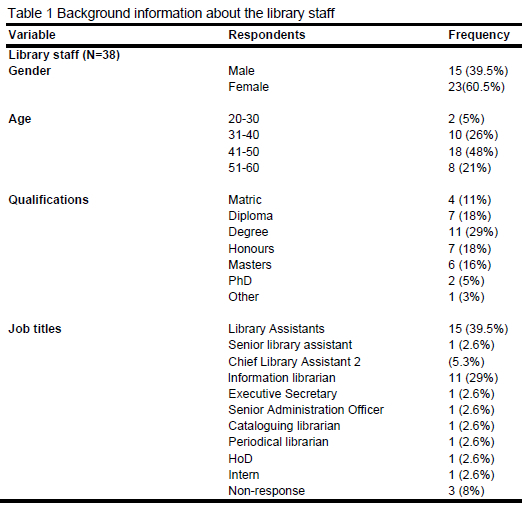
The data in Table 1 for the library staff show that 23 participants (60.5%) were female, while 15 (39.5%) were male at the UNIVEN library. The highest number of participants were between the ages of 41-50, with 18 (48%) indicating that they fall into this age group. The age group with the least respondents was the 20 to 30 year group with two (5%) respondents. There was no respondent over the age of 60 years. In terms of education, 11 (29%) respondents had a degree, and the highest educational qualification was a Ph.D. with two (5%) respondents. Four (11%) of the respondents had the lowest educational qualification, a matric. Most of the respondents were formally well educated, with 89% having some form of tertiary qualification. Regarding job titles, 15 (39.5%) of the respondents were librarians, while the next highest number, 11 (29%) were information librarians. The only job title held by more than one respondent was Chief Library Assistant, held by two (5.3%) respondents.
7.1.2 Senior and postgraduate law students
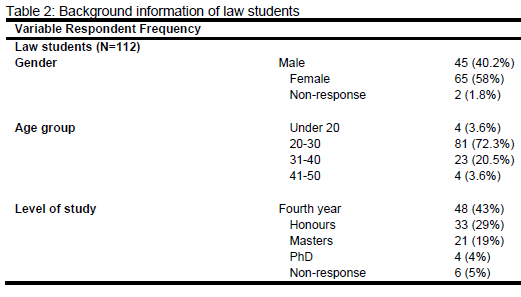
The data in Table 2 show that of the 111 responses, 65 (58%) of the law student respondents were women while 45 (40.2%) were male. Two (1.8%) of the respondents did not answer the question. This means that there are more women than male students at UNIVEN. All student respondents were under 50 years old, with the majority between the ages of 20-30 years (81; 72.3%), followed by the age group of 31-40 with 23 (20,5%) respondents. Most of the student respondents (48; 43%) were in their fourth year, followed by honours students (33; 29%). There were 21 (19%) Master's students and four (4%) who were registered for PhD study.
7.2 The copyright knowledge of library staff versus senior law students
The questionnaires included various questions and issues. However, the objective of the study focused on 11 general copyright questions similar to those of both sets of respondents. The study focused on the main differences and similarities in the knowledge of basic issues of copyright literacy between the two sectors. Both library staff and students (generally) should be aware of what can and cannot be done with copyrighted works without breaking the law (Fernandez-Molina & Muriel-Torrado 2017).
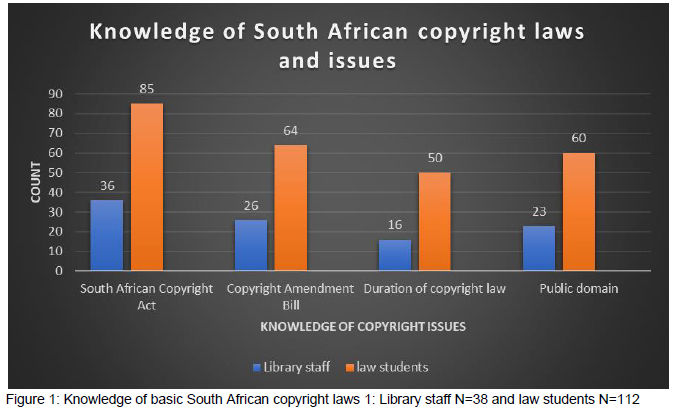
Figure 1 shows that both sets of respondents were familiar with the South African Copyright Act, the Copyright Amendment Bill, the duration of copyright law, and the public domain. The South African Copyright Act concept was the only area in which library staff outperformed law students. The students outperformed the library staff with their knowledge of the Copyright Amendment Bill. Also disappointing was that the respondents differed on the duration of copyright: Most library staff were not sure about the duration of copyright materials, while less than half of the students (45%) knew that it was the author's lifetime and 50 years after the author's death. The researcher anticipated that more library staff would have known about the duration of copyright to advise users correctly. Knowledge of copyright laws for library staff was very disappointing because their new role of training and advising their users on copyright issues requires a strong improvement in their knowledge of this subject (Fernandez-Molina & Muriel-Torrado 2017).
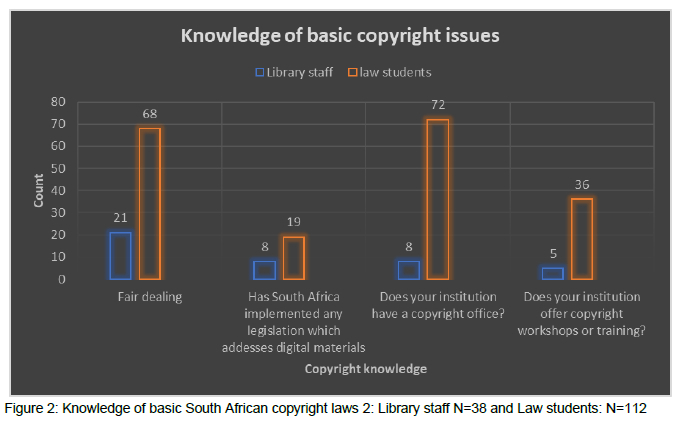
Figure 2 shows that the knowledge of library staff and law students was satisfactory on the aspect of fair use/dealing, one of the limitations or exceptions of the copyright law in Section 12 of the South African Copyright Act. Both sets of participants showed limited knowledge about the availability of copyright workshops. Library staff (55.3%) and law students (45.5%) were uncertain whether they had received copyright training or workshops on campus. The researcher believes that library staff did not know that IP workshops organised by the Directorate of Research and Innovation, library training, and orientation programmes (offered by library staff) also qualify as copyright sessions, and the majority of respondents attended these sessions. Interestingly, some students (32%) agreed that there were copyright workshops on campus and mentioned library staff as the people who offered the sessions. Both sets of respondents were unsure whether there was legislation or an initiative on copyright implementation in the digital environment. The anticipation was that the respondents would say that while the current copyright Act does not address copyright issues in the digital environment, the Copyright Amendment Bill would address this area when it becomes law. Knowledge of the availability of a copyright office on campus for library staff was surprisingly low compared to students who knew about the existence of the office on campus.
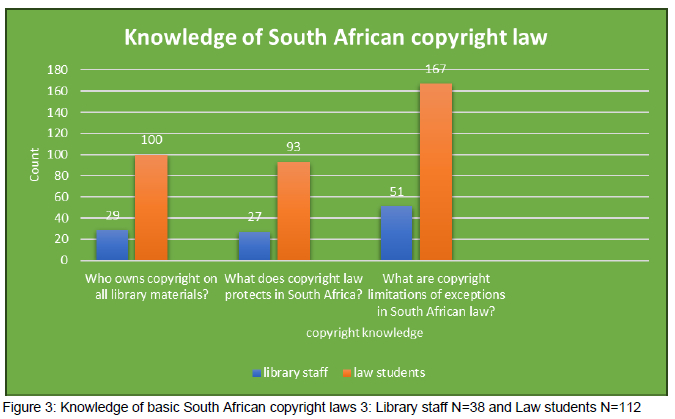
Figure 3 shows that library staff and law student copyright knowledge about ownership was satisfactory. Both sets of respondents knew that the author/creator owns the copyright and that this ownership can be transferred to a third party or entity such as universities, government, companies, publishers, etc. Copyright ownership is the heart of copyright law; it is the foundation of the law, and library staff should be familiar with it to provide relevant advice to users. Most academic libraries have embarked on digitisation projects (accelerated by the pandemic), and copyright ownership is at the heart of these initiatives. One cannot digitise a work without knowing or identifying the copyright owner (Ramabina & Nsibirwa 2023). The study wanted to determine whether the UNIVEN Library staff and senior law students knew what is protected by copyright law because it believes that library staff and students should know something as fundamental as this. The clear majority of both sets of respondents understood that it protects ideas that have been expressed and recorded.
Since copyright law provides authors and creators with a statutory monopoly over their creations, limitations or exceptions are critical for any equal distribution of rights to occur (Nicholson 2012). The study wanted to determine library staff respondents' knowledge about copyright exceptions or limitations that are included under South African copyright law. Judging by the choices it can be concluded that both the library staff and law students were aware of and understood copyright according to the country's copyright law. Most respondents either chose the exception of teaching, research, and libraries or private copying and criticising someone's work.
The results of the study show that UNIVEN law students have much better copyright knowledge than library staff, as they got nine correct answers out of 11 while library staff scored seven out of eleven. However, the copyright knowledge of both sets of participants was still not on the required level, and they will both benefit from attending copyright workshops, webinars, and training. The finding is different from Fernandez-Molina and Muriel-Torrado (2017), who found that librarians were the sector that achieved better results than students and professors, but far from desirable. What is surprising is that; library staff are supposed to be teachers of library users on library issues, including copyright issues. Most copyright workshops and training target students and exclude library staff, who mainly require this knowledge for their daily interactions with students on the topic and also to solve the most elementary matters related to copyright (Fernandez-Molina & Muriel-Torrado 2017).
8 Conclusion and recommendations
The study aimed to compare the copyright knowledge of UNIVEN library staff and law students (final year and postgraduate). The results showed that law students scored higher on basic copyright issues, correctly answering nine out of 11 questions, while library staff scored seven. The findings suggest a need for additional training to improve the understanding of copyright between library staff and senior law students in the context of libraries. According to Schlosser (2009), the ACRL Standards for Libraries in Higher Education advise librarians to collaborate with teaching faculty to teach students skills in "information evaluation, critical thinking, intellectual property, copyright, and plagiarism. Copyright workshops and seminars should be organised for students in their various faculties and departments to educate them about copyright to reduce copyright infringement (Korletey 2014; Ramabina & Nsibirwa 2023). Since the current study only focused on library staff, final year (LLB), and postgraduate law students, it would be ideal for further research on academics, administrative staff, and other students including those from other faculties on campus.
References
Charbonneau, D.H. & Priehs, M. 2014. Copyright awareness, partnerships, and training issues in academic libraries. The Journal of Academic Librarianship, 40(3-4): 228-233. [ Links ]
Chou, C., Chan, P.S. & Wu, H.C. 2007. Using a two-tier test to assess students' understanding and alternative conceptions of cyber copyright laws. British Journal of Educational Technology, 38(6): 1072-1084. [ Links ]
Craig, C. 2020. Copyright limits and learning: lessons from the covid-19 quarantine. [Online]. https://www.ei-ie.org/en/item/23590:copyright-limits-and-learning-lessons-from-the-covid-19-quarantine-by-carys-craig (17 June 2023).
DALRO. 2021. DALRO-Dramatic, Artistic and Literary Rights Organisation. [Online]. http://dalro.co.za/index.php/get-info (16 June 2023).
Darkey, E.M. & Akussah, H. 2008. Academic libraries and copyright issues in Ghana: the University of Ghana in focus. International Journal of Legal Information, 36(3): 432-446. [ Links ]
Du Plooy-Cilliera, F., Davis, C., & Benzuiedenhout, R. 2014. Research matters. Cape Town, Juta. [ Links ]
Edwards, S.D. 2015. The role of rural universities in developing psychology in South Africa. South African Journal of Psychology, 45(1): 50-59. [ Links ]
Ercegovac, Z., & Richardson, J.V. 2004. Academic dishonesty, plagiarism included, in the digital age: A literature review. College & Research Libraries, 65(4): 301-318. [ Links ]
Fernández-Molina, J.C., Moraes, J.B.E., & Guimares, J.A.C. 2017. Academic libraries and copyright: do librarians really have the required knowledge? College & Research Libraries, 78(2): 241. [ Links ]
Fernández-Molina, J.C. & Muriel-Torrado, E. 2018. Copyright literacy in the academic field: analysis of the differences between faculty, students, and librarians. In Information Literacy in the Workplace: 5th European Conference, ECIL 2017, Saint Malo, France, 18-21 September 2017, Revised Selected Papers 5: 276-285). Springer International Publishing.
Fubbs, J. 2019. Breaking the impasse: Copyright AB Indaba. Paper presented at the Indaba Copyright Amendment Bill, Wits University, RSA.
Gould, T.H., Lipinski, T.A., & Buchanan, E.A. 2005. Copyright policies and the deciphering of fair use in the creation of reserves at university libraries. The Journal of Academic Librarianship, 31 (3): 182-197. [ Links ]
Hackett, T., 2005. Learning with libraries and copyright issues. In Information Meeting on Educational content and copyright in the digital age in conjunction with the thirteenth session of the WIPO Standing Committee on Copyright and Related Rights (SCCR).
Horava, T. 2010. Copyright communication in Canadian academic libraries: A national survey/Les modes de communication concernant les droits d'auteur dans les bibliothèques universitaires canadiennes: Une enquête nationale. Canadian Journal of Information and Library Science, 34(1): 1-38. [ Links ]
Hines, S.S. 2015. Connecting individuals with social services: The library's role. Retrieved May 1: 2017.
Hirtle, P.B., Hudson, E. & Kenyon, A.T. 2009. Copyright and cultural institutions: Guidelines for digitisation for US libraries, archives, and museums. Peter B. Hirtle, Emily Hudson and Andrew T. Kenyon, Copyright and cultural institutions: Guidelines for digitization for US libraries, archives, and museums, Ithaca, NY: Cornell University Library Press, Forthcoming, University of Melbourne Legal Studies Research Paper, (434).
Prasad, K.N. & Hombal, S.G. 2012. Digital copyright protection: Issues in the digital library environment. DESIDOC Journal of Library & Information Technology, 32(3). [ Links ]
Ibrahim Khan, H. 2015, A study on the awareness of copyright towards digital content among users PTAR, UiTM Puncak Perdana (Doctoral dissertation, Universiti Teknologi MARA). [ Links ]
Korletey, J. T. 2014. Copyright awareness at KNUST (Master's thesis, Kwame Nkrumah University of Science and Technology, Kumasi, Ghana). [ Links ]
Masango, C.A. 2005. Digital licence agreements and their effects on acquisitions and academic library users. South African Journal of Libraries and information science, 71(2): 127-135. [ Links ]
Masango, C.A. 2007. Perceptions about copyright of digital content and its effects on scholarship: a South African perspective, 84-91.
Morrison, C. & Secker, J. 2015. Copyright Literacy in the UK: a survey of librarians and other cultural heritage sector professionals. Library and Information Research, 39(121): 75-97. [ Links ]
Mzayiya, Z. 2016. The Role of Academic Libraries in South Africa in the Promotion of Copyright Amongst Users: A Case Study of the University of Fort Hare Library (Alice Campus) (Masters dissertation, University of Fort Hare). [ Links ]
Ndou, A.S. 2021. Relationship between access to ICT and the use of electronic library resources by scholars and postgraduate students in a rural-based South African university. South African Journal of Libraries and Information Science, 87(1): 42-50. [ Links ]
Nicholson, D.R. 2012. Accommodating persons with sensory disabilities in South African copyright law (Masters dissertation, Witwatersrand University). [ Links ]
Nicholson, D.R. & Kawooya, D. 2008. The impact of copyright on access to public information in African countries: A perspective from Uganda and South Africa. In IFLA Conference Proceedings 10-14 August 2008, Québec, Canada 2009. pp. 1-24. http://hdl.handle.net/10539/8644.
Nilsson, I.L., 2016. Developing new copyright services in academic libraries. Insights, 29(1): 78-83. [ Links ]
Nkomo, M. & Sehoole, C. 2007. Rural-based universities in South Africa: Albatrosses or potential nodes for sustainable development? International Journal of Sustainability in Higher Education, 8(2): 234-246. [ Links ]
Polak, F.M. 2009, Copyright and digital music collections in South Africa (Masters dissertation). [ Links ]
Racelis, A. 2018. Library services for the poor: theoretical framework for library social responsibility. Pedagogical Research, 3(2): 06. [ Links ]
Ramabina, M. & Nsibirwa, Z. 2023. The awareness of copyright laws at the University of Venda library: Student perspectives. Library Philosophy and Practice 3 (31): 2023. [ Links ]
Riby-Smith, M. 2017. South African copyright law-the good, the bad and the Copyright Amendment Bill. Journal of Intellectual Property Law & Practice, 12(3): 216-225. [ Links ]
Schlosser, M. 2009. Unless otherwise indicated: A survey of copyright statements on digital library collections. College & Research Libraries, 70(4): 371-385. [ Links ]
Sims, N.A. 2011. Lies, damned lies, and copyright (mis) information: Empowering faculty by addressing key points of confusion. Association of College & Research Libraries National Conference.
Smith, K.H., Tobia, R.C., Plutchak, T.S., Howell, L.M., Pfeiffer, S.J. & Fitts, M.S. 2006. Copyright knowledge of faculty at two academic health science campuses: Results of a survey. Serials Review, 32(2): 59-67. [ Links ]
Tlakula, T.P. & Fombad, M. 2017. The use of electronic resources by undergraduate students at the University of Venda, South Africa. The Electronic Library, 35(5): 861-881. [ Links ]
Trimble, M. 2020. COVID-19 and transnational issues in copyright and related rights. IIC-International Review of Intellectual Property and Competition Law, 51(4): 407-410. [ Links ]
UNESCO. 2010. The ABC of Copyright.
Vijesh, P.V.D. & Mohanan, N. 2018. Social Responsibilities of Academic Libraries: Rajagiri College of Social Sciences Library: Kalamassery kerala: A case Study. Publisher: Astral.
Williamson, M.N. 1992, Copyright awareness and compliance as perceived by educators at Central Missouri State University (Doctoral dissertation, Central Missouri State University). [ Links ]
WIPO. 2016. Understanding Copyright and Related Rights, para 'Moral Rights. World Intellectual Property Organization-.[Online] http://www.wipo.int/freepublications/en/intproperty/909/wipo_pub_909.html#moral_rights> (16 June 2023).
Wu, H.C., Chou, C., Ke, H.R. and Wang, M.H. 2010. College students' misunderstandings about copyright laws for digital library resources. The electronic library, 28(2): 197-209. [ Links ]
Received: 23 August 2023
Accepted: 18 June 2024