Services on Demand
Journal

Article
 English (pdf)
 Article in xml format
 Article references
 Automatic translation
 Send this article by e-mail
Indicators
Related links
-
 Cited by Google
 -
 Similars in Google
Share

 Permalink
Journal of the Southern African Institute of Mining and Metallurgy
On-line version ISSN 2411-9717Print version ISSN 2225-6253
J. S. Afr. Inst. Min. Metall. vol.125 n.12 Johannesburg Dec. 2025
https://doi.org/10.17159/2411-9717/3143/2025
PROFESSIONAL TECHNICAL AND SCIENTIFIC PAPERS
Identifying strategic gaps and opportunities in sustainable development initiatives within the South African mining industry
T.C. Maswanganyi; G.L. Smith; R.C.A. Minnitt
School of Mining, University of the Witwatersrand, South Africa. ORCiD: G.L. Smith: http://orcid.org/0009-0006-4799-4032
ABSTRACT
This paper identifies the strategic gaps and opportunities for the South African mining industry's contribution towards advancing sustainable development. Mineral resources companies are confronted by a range of complex social performance challenges, which largely manifest in sporadic community and labour unrest, undermining the sustainability and profitability of these companies. Integrating supply chain management, strategic long-term planning and sustainability planning is identified as a strategic gap that can contribute towards the sustainability of mining companies, if effectively implemented. Contributing towards sustainable development by the South African mining industry is not merely a voluntary requirement on the industry but a legal requirement in terms of the Minerals and Petroleum Resources Development Act No. 28 of 2002. This Act is legislation aimed at advancing socioeconomic development in communities that host mining operations and in areas that provide labour to the South African mining industry. In contributing towards the advancement of sustainable development in mining host communities, not only will mining companies fulfil a legal requirement in terms of the Minerals and Petroleum Resources Development Act, but they will also prevent negative social and economic impacts in those communities. This paper identifies innovative and cost-effective ways of advancing sustainable development by integrating strategic supply chain management, strategic long-term planning, and sustainability planning.
Keywords: sustainable development, strategic supply chain management, strategic long-term planning, procurement spend, host communities, supplier partnerships
Introduction
Managing mining operations in South Africa has never been so complex due to increased unemployment and deprivation in communities that host mining operations, higher mining operating costs, mining-related legislation, and the volatility of commodity prices. Social performance and the broader environmental, social and governance (ESG) requirements enacted upon the mining industry are increasing as the demand for minerals increases to support a transition to low-carbon energies amongst other requirements (Verrier et al., 2022).
According to Verrier et al. (2022), the mining industry should seek to go beyond obtaining the social licence to operate and integrate sustainable development (SD) into their strategic long-term plans and strategic supply chain plans.
This paper describes how key elements of strategic supply chain management and sustainability planning can be integrated into the strategic long-term planning process of mining operations to close a strategic sustainability gap that is required to advance SD.
According to Smith (2011), a strategic long-term plan is defined as "the anticipated life of mining operations across a mining right under a given set of long-term planning parameters and strategic intent". Integrating SD into strategic long-term plans implies that mining companies should strategically include relevant, sustainable development goals (SDGs) as parameters when conducting feasibility studies on mining operations. Integrating SD into strategic long-term plans should happen during feasibility studies and throughout the life of mine (LoM) to leverage on scale benefits while maximising a mining company's contribution towards advancing SD and preventing potential social unrest, which can be hugely disruptive to mining operations. It is imperative that mining companies develop strategic supply chain plans that seek to leverage their procurement spend to support employment and enterprise development in host communities, as outlined in this paper. A strategic supply chain plan should be aligned with strategic long-term plans to be effective. Socio-economic development (SED) plans that are integrated into the LoM, on the other hand, will enable gradual but incremental transfers towards SD from the revenues of mines and those of their suppliers suppliers over the LoM. This notion is consistent with social and labour plans (SLP) legislated through the Minerals and Petroleum Resources Development Act No. 28 of 2002 (MPRDA). To be effective, these socio-economic parameters should be integrated during the development of a mineral asset and maintained throughout the LoM. It is in the best interest of mining companies and their suppliers to contribute towards advancing SD and sustainable mining operations to prevent detrimental.
Sustainability and sustainable development
The concept of sustainable development (SD) has attracted attention in different forms both at a global level, with the United Nations (UN) General Assembly adopting Sustainable Development Goals (SDGs) in 2012 at the Rio + 20 Summit (UN, 2012). According to the Brundtland Report (UN, 1987), sustainability is "meeting the needs of the present generation without compromising the ability of future generations to meet their own needs". Sustainability and SD are used interchangeably in this document as they are in most sustainability literature and in practice.
In 2012 at the Rio + 20 Summit ("The Future We Want"), the UN General Assembly adopted the following expansive definition of sustainable development (UN, 2012):
"We also reaffirm the need to achieve sustainable development by: promoting sustained, inclusive and equitable economic growth, creating greater opportunities for all, reducing inequalities, raising basic standards of living; fostering equitable social development and inclusion; and promoting integrated and sustainable management of natural resources and ecosystems that support inter alia economic, social and human development while facilitating ecosystem conservation, regeneration and restoration and resilience in the face of new and emerging challenges."
If the UN definition of SD and the related SDGs are to prevail, innovative approaches to SD must be sought. It is worth noting that the UN General Assembly's expansive definition of SD as outlined in the aforementioned, incorporates the sustainable management of natural resources and ecosystems to support economic, social, and ecological imperatives. This indicates how broad and essential the concept of sustainability is and how relevant it is to the South African mining industry. Sustainability can also be broadly defined as a continuance, and as such, this paper is inspired by the need for the much-needed continuance of South African mining activities and operations while advancing SD, resulting in mutually beneficial shared value for several stakeholders in the mining industry such as host communities and shareholders.
According to the aforementioned definitions of sustainability, the broader scope of SD includes economic, social, and environmental elements. The scope of this paper is, however, limited to the economic and social elements of SD. It also outlines the role of strategic supply chain management, sustainability planning, and strategic long-term planning in advancing SD by the South African mining industry.
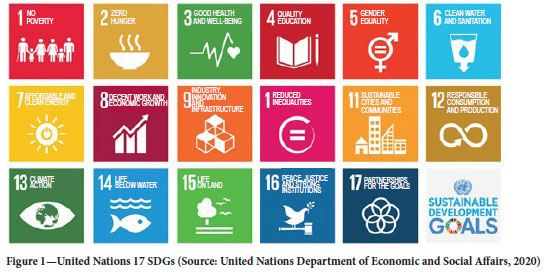
Not only is extensive academic research on sustainability and sustainable development reliant on the UN's SDGs and the related definitions of sustainability as defined in the aforementioned (Dvorakova, Zborkova, 2014; Cuba et al., 2014; Kopacz et al., 2017; Monteiro et al. 2019; Guillen-Gosalbez et al., 2019; Alves et al., 2019; Roukonen, 2020) but organisations also measure their performance against sustainability goals based on SDGs. To this end, most companies have increased their focus on SD to the extent of ensuring representation of the sustainability functions within executive structures of organisations up to board level and the integration of sustainability performance indicators into their annual reports over and above financial and productivity reporting. Good health and well-being (SDG 3), quality education (SDG 4), industry innovation and infrastructure (SDG 9), sustainable cities and communities (SDG 11), and partnerships for the goals (SDG 17) are key examples of SDGs that are of paramount importance to the mining industry as the industry needs a healthy and educated workforce from host communities and beyond.
Innovative solutions are key to ensuring that the mining industry remains sustainable and profitable while driving socio-economic development in communities that host mining operations. The UN's 17 SDGs (UN, 2020) as adopted by 193 heads of state and governments at the 2015 UN Sustainable Development Summit (UN, 2015) are summarised in Figure 1.
The South African mining industry must therefore leverage partnerships with the government and its supplier base amongst other relevant stakeholders (SDG 9 and SDG 17). The ultimate goal should be to support social and economic development in mining host communities to reduce economic dependency on mines as mineral resources are depleted. Sustainability planning within mining companies comprises, amongst other imperatives, identifying and financially providing for social and economic initiatives for the benefit of mining host communities and labour providing communities.
This sort of socio-economic development usually comprises infrastructure development (SGD11), clean water and sanitation (SDG 6), and decent work and economic growth enabled through enterprise and skills development. Leveraging sustainability planning parameters over the LoM will considerably advance SD in mining communities through infrastructure development and job creation.
Sustainable development from a South African perspective
The UN General Assembly's definition of SD is even more relevant to South Africa's socio-economic environment, which is characterised by inequalities, deprivation, and unemployment. According to the Organisation for Economic Co-operation and Development (OECD), South Africa's unemployment rate reached 34.5% in 2022, while the country represents one of the highest inequalities in the world, with the wealthiest 10% holding 85.6% of the net wealth (OECD, 2022). According to Stats SA the unemployment rate has reduced slightly by 0.2% to 32.7% during the fourth quarter of 2022 (Department of Statistics, 2023). This represents one of the highest unemployment rates in the world, with the expanded definition of unemployment, including those who are not actively seeking employment, reaching 42.7% in the same period. The gravity of socio-economic challenges has increased in South Africa in recent years, and the impact of COVID-19 has reportedly regressed the SD efforts such as decent work and economic growth (SDG 8) achieved prior to the pandemic as the South African economy experienced a significant decline in gross domestic product (GDP), which is a measure of economic activity. South Africa's GDP is reported to have declined by 6.4% in 2020 relative to a 0.2% growth in 2019, the largest decline in economic activity since 1946 (Department of Statistics, 2022).
In a journal article entitled, "Creating shared value as a business strategy for mining to advance the United Nations Sustainable Development Goals", Eraser (2019), states that SDGs are reffective of goals that are common and beneficial to both the mining industry and host communities in a global context. Such goals, as stipulated in the 17 SDGs include educated and healthy communities, access to water, energy and infrastructure. Similarly, and in a South African context, Cole et al. (2021) have effectively demonstrated the consistency of the MPRDA with the SDGs by identifying 15 SDG dimensions that are also socio-economic levers in the MPRDA. Advancing SD is therefore not only consistent with advancing SDGs, but it also fulfils the requirement of the MPRDA, which is a legal requirement that seeks to reduce poverty and inequality both in communities that host mining operations and areas that provide labour.
Against this background, there are compelling reasons to embrace and be guided by the principle of the UN's SDGs and the related definitions of sustainability to enable the much-needed contribution to sustainable development by the South African mining industry.
Accordingly, the International Council on Mining and Metals (ICMM) has developed 10 SDG-related principles for mining companies with several South African mining companies having become members of the ICMM. ICMM advocates for integrating the 10 principles, including the advancement of social performance and the engagement of stakeholders on SD, into the corporate strategies of mining companies (ICMM, 2003).
Despite several mining companies subscribing to ICMM principles and being members of the ICMM, mining companies have not been able to effectively implement ICMM principles for the advancement of SD (Tuokuu et al., 2019; Andrews, Essah, 2020). Andrews and Essah (2020) cite mining induced social and environmental issues to include social displacement, mass displacement, loss of livelihoods, acid mine drainage, noise, dust, air, and water pollution. These issues are consistent with those cited by Tuokuu et al. (2019) in a South African context.
Continual community protests prevalent in mining host communities and the numerous amendments to the Mining Charter and related court battles indicate increased expectations for the industry (Minerals Council South Africa, 2020).
Strategic supply chain management
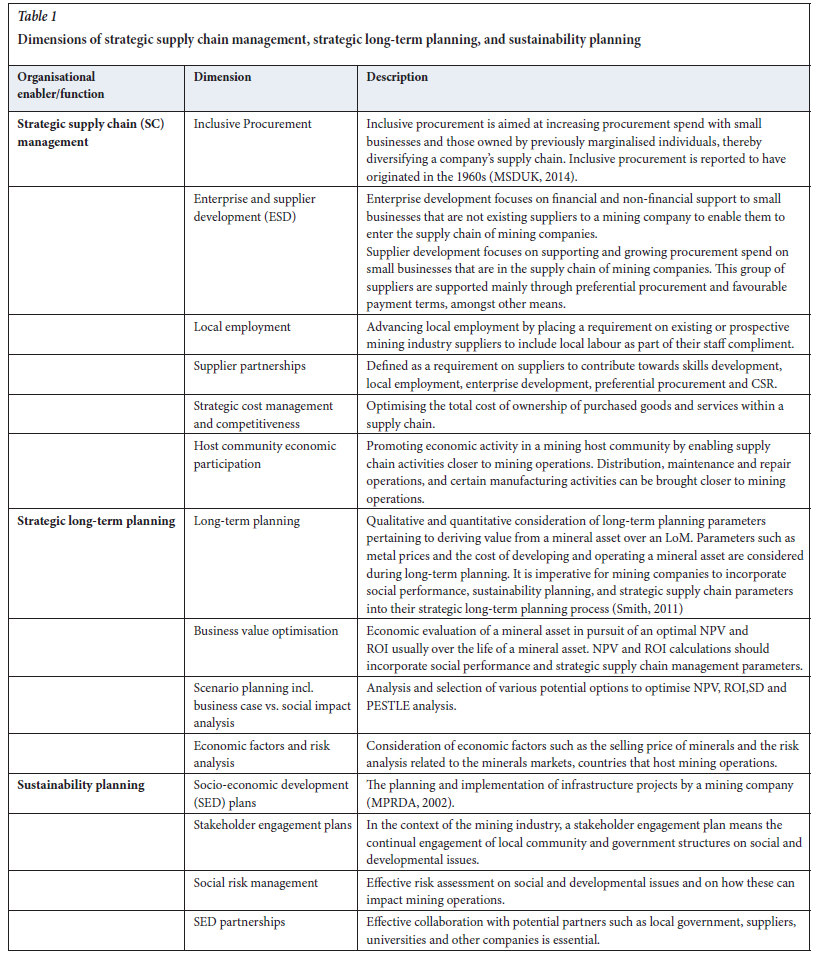
According to Eawcett et al. (2007), an ideal supply chain value chain extends from an organisation's suppliers' suppliers to customers' customers, where the supply chain of a focal organisation should manage the flow of information and materials across the entire supply value chain. Managers typically associate supply chain management (SCM) with better information exchange, shared resources, and win-win relationships among members of a supply chain (Eawcett et al., 2007). According to Monczka et al. (2018), "a supply chain is a set of three or more organisations linked directly by one or more of the upstream or downstream flows of products, services, finances, and information from a source to a customer". Inevitably, supply chains involve a tremendous flow of funds, the value of which can be strategically managed to enable profitability and SD, including social performance. As such, this view of supply chains presents an opportunity to leverage the procurement expenditure across supply chains to support employment. Inclusive procurement is defined in Table 1 of this paper, and enterprise development, amongst other imperatives for the advancement of SD.
SCM has evolved from a transactional purchasing function into a strategic function to include sub-functions such as strategic sourcing, inventory management, environmental, social, and governance (ESG), enterprise and supplier development (ESD), and inclusive procurement, resulting in more complexity and a need for effective management and collaboration within supply chains. An organisation's supply chain management function has become a compelling source of competitiveness. More and more companies compete based on the efficiency of their supply chains (Gurzawska, 2019). Capabilities and opportunities that are prevalent within supply chain networks, including local industrialisation, enterprise and supplier development, and inclusive procurement amongst other supply chain related levers, can significantly support the advancement of SD.
Effectively integrating social performance objectives into feasibility studies, supply chain strategies, strategic long-term plans and the corporate strategies is therefore imperative for the sustainability of mining companies as it can result in cost-effective ways of contributing towards SD over an LoM.
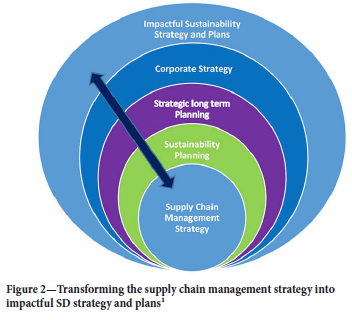
The strategic long-term planning process integrates numerous long-term planning parameters to optimise the value of a mining business, and as such, the strategic integration of the corporate strategy, strategic supply chain, sustainability, and strategic longterm planning strategies of a mining business is imperative, as illustrated in Figure 2. The ultimate goal should be to develop robust and effective supply chain and sustainability strategies that contribute towards job creation, inclusive procurement, enterprise development, and social performance through long-term planning, sustainability planning, and supplier partnerships. This approach will result in impactful and lasting SD beyond mining, contributing towards socio-economic development while reducing unemployment, poverty, and community unrest. Securing the social licence to operate by mining companies is imperative and can be achieved through the effective contribution towards SD by these companies.
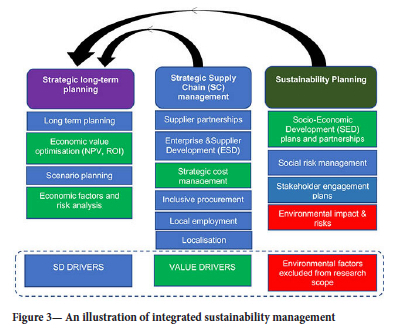
Integrated framework for advancing SD through strategic supply chain management and strategic long-term planning
Strategic supply chain management can be an effective enabler of SD, more so when its strategic nature and potential long-term impact is leveraged and aligned with strategic long-term planning and sustainability planning processes, as reflected in Figure 3. Figure 3 depicts the key dimensions of the strategic SD enablers, being strategic long-term planning, strategic supply chain and sustainability planning. According to the conceptual framework reflected in Figure 3, strategic supply chain and sustainability planning requirements should be integrated into strategic long-term planning parameters. These key dimensions are further described in Table 1. Dimensions, such as long-term planning, can potentially contribute to a mineral asset's sustainability and economic value as sustainability parameters are added to the long-term plans of mining companies and provided for financially. Enhancing the existing strategic long-term planning framework to incorporate strategic supply chain and sustainability planning requirements effectively is therefore imperative for the sustainability of South African mining companies.
Through its procurement spend, which reached R451.9 billion in 2021 (Minerals Council, 2022), the mining industry can effectively advance SD by ensuring that an increased portion of this spend is directed towards skills development, enterprise development, job creation, and corporate social responsibility (CSR) in mining host communities.
This can be achieved by placing contractual obligations on suppliers to the mining industry that requires them to direct a portion of this expenditure towards implementing the strategic supply chain dimensions reflected in Figure 3. Contractual obligations should not only be included in supply agreements between mining companies and their suppliers, but they should also be monitored.
Following here is an explanation of the lack of integration, which has been identified as a strategic gap and opportunity for improvement that needs to be addressed to enable the advancement of SD by the South African mining industry:
> Mining companies tend to apply a reactive approach to sustainable development due to the lack of proactive sustainable development and long-term sustainability planning (Katz, Pietrobelli, 2018; Fraser, 2019; Verrier et al., 2022). In addressing this gap, mining companies should provide for the advancement of SD in their strategic long-term plans to support the sustainability of mining operations throughout the LoM. This implies that each mining company should invest in adequate resources and partnerships to enable the advancement of SD and the sustainability and profitability of mining operations at the beginning of the LoM.
> Strategic long-term plans of mining companies focus largely on technical and commercial parameters that are aimed at maximising financial return on investment (ROI), and such plans do not effectively incorporate long-term sustainable development and strategic supply chain plans (Katz, Pietrobelli, 2018; Fraser, 2019; Soupajarvi, Kantola, 2020; Verrier et al., 2022). Ghost mining towns that remain after mining operations have ceased, high unemployment, and underdevelopment in mining communities in South Africa are testament to this assertion (Marais et al., 2018; Marais, De Lange, 2021). Figure 2 and Table 1 reflect the dimensions that should be integrated into strategic long-term plans to enable economic value and SD.
> Inherent misalignment between strategic long-term planning, strategic supply chain management, and sustainability planning in mining companies continue to undermine these companies' potential to contribute towards SD (Soupajarvi, Kantola, 2020; Verrier et al., 2022). Strategic long-term planning should incorporate social performance plans and performance monitoring of social plans throughout the LoM (Smith, Brooks, 2018; Suopajarvi, Kantola, 2020).
> According to Smith and Brooks (2018), the ability to balance the trade-off between a higher net present value (NPV) estimate and social risk profiles can be of great value to decision makers in the development process of mining projects. More mining companies should also seek ICMM membership and implement ICMM principles within their organisations.
A combination of strategic long-term planning, strategic supply chain management and sustainability planning can be hugely instrumental in the advancement of SD, if effectively integrated and leveraged as potential enablers of SD by mining companies.
The strategic and effective integration of these three strategic enablers or functions within mining companies is imperative to ensuring considerable sustainable development. This integration needs to be effected in a manner that does not undermine the overall NPV and ROI of mining operations. South African mining companies should leverage their purchasing power by encouraging their supplier base to contribute towards socio-economic development in mine communities through inclusive procurement and enterprise development, amongst other levers.
According to the Minerals Council South Africa, the mining industry achieved a combined expenditure of R365.7 billion and R451.9 billion on goods and services during 2020 and 2021, respectively (Minerals Council, 2022). This expenditure can significantly enable SD when effectively leveraged, not only through enterprise development, inclusive procurement, and employment efforts by mining companies and their suppliers but also through other strategic partnerships such as partnerships with funding institutions. Enterprise development and inclusive procurement are effective instruments for advancing SD (SDG 8), amongst others.
Conclusion
This paper has shown that there is a need for the advancement of SD in mining host communities to reduce deprivation in those communities (SHRC, 2016; United Nations, 2020). Contributing towards the advancement of SD in mining host communities by the South African mining industry is described not only as a voluntary sustainability initiative but also as a legislated requirement in South Africa in terms of the MPRDA, which is aimed at advancing socioeconomic development. Despite the alignment in the objectives of the SDGs and the MPRDA, unacceptable levels of deprivation are prevalent in mining host communities as high value minerals continue to be extracted near these communities. Consequently, sporadic community unrests undermine the sustainability of mining operations and host communities. This paper contributes by describing the integration of strategic supply chain management, strategic long-term planning, and sustainability planning enablers or levers as a strategic gap and a novel solution for addressing this problem.
As discussed in this paper, strategic long-term planning should not only take a long-term view in optimising technical and economic long-term parameters needed for the economic exploitation of mineral assets over the LoM, but it should also effectively incorporate parameters for the advancement of SD. Mining assets return value to shareholders over their LoM, and strategic long-term planning is hugely instrumental in optimising the value of the economic return. In the same manner, SD can be effectively advanced in mining host communities over the life of mineral asset, if effectively integrated into the strategic long-term plan of a mine.
In addition, strategic supply chain management needs to be integrated early into strategic long-term plans to effectively leverage the purchasing power of mining companies over the LoM for the advancement of SD. Through this integration, targets for the contribution towards SD by suppliers to the mining industry should be set and planned for, well in advance and monitored. Strategic supply chain management can effectively enable the advancement of SDGs through enterprise development and inclusive procurement, if effectively leveraged and integrated with strategic long-term planning and sustainability planning. It is in the best interest of both mining companies and their suppliers to contribute towards advancing SD and reducing the impact of community unrest. This will result in mutually beneficial relations amongst stakeholders and sustainable mining operations. Enhancing the existing strategic long-term planning framework to incorporate strategic supply chain and sustainability planning requirements is imperative for the sustainability of South African mining companies. This is a potential research topic in mineral economics.
References
Alves, W., Ferreira, P., Araujo, M. 2019. Mining co-operatives: A model to establish a network for sustainability. Journal of Co-operative Organisation and Management, vol. 7, pp. 51-63, Elsevier, 2019. [ Links ]
Andrews, N., Essah, M. 2020. The sustainable development conundrum in gold mining: Exploring 'Open, Prior and Independent Deliberate Discussion' as a community-centered framework. Journal of Resources Policy, vol. 68, p. 101789, ScienceDirect, 2020. [ Links ]
Cuba, N., Bebbington, A., Rogan, J., Millones, M. 2014. Extractive industries, livelihoods and natural resource competition: Mapping overlapping claims in Peru and Ghana. Journal of Applied Geography, vol. 54, pp. 250-261, Elsevier, 2014. [ Links ]
Department of Statistics, South Africa. 2023. Quarterly Labour Force Survey, Quarter 4, 2022, Statistical Release 28 February 2023, P0211, 2023. [ Links ]
Department of Statistics. 2021. GDP: Quantifying SA's economic performance in 2020, Quarter 4:2020, Statistical Release 09 March 2021, P0441. Available [Online] URL <www.statssa.gov.za/?p=14074&gclid=EAIaIQobChMI0OaxgJyhAIVmJftCh3saAAbEAAYASAAEgJGMvDBwE> [ Links ]
Dvorakova, L., Zborkova, J. 2014. Integration of sustainable development at enterprise level. Journal of Procedia Engineering, vol. 69, pp. 686-695, ScienceDirect,2014. [ Links ]
Fawcett, E.S., Ellram, L.S., Ogden, J.A. 2007. Supply Chain Management - From Vision to Implementation, Pearson Education, Inc., Upper Saddle River, New Jersey. [ Links ]
Fraser, J. 2019. Creating shared value as a business strategy for mining to advance the United Nations Sustainable Development Goals. Journal of the Extractive Industry and Society, vol. 6, pp. 788-791, ScienceDirect, 2019. [ Links ]
Guillen-Gosalbez, G., You, F., Glan-Martin, A., Pozo, C., Grossmann, I.E. 2019. Process systems engineering thinking and tools applied to sustainability problems: current landscape and future opportunities. Journal of Current Opinion in Chemical Engineering, vol. 26, pp. 170-179, ScienceDirect, 2019. [ Links ]
Gurzawska, A. 2019. Towards Responsible and Sustainable Supply Chains - Innovation, Multi-stakeholder Approach and Governance, Journal of Philosophy of Management. [Online] Available [Online] <https://doi.org/10.1007/s40926-019-00114-z> [Accessed May 2020]. [ Links ]
International Council on Mining and Metals. 2003. ICMM Sustainable Development framework - ICMM Principles, <https://www.iucn.org/sites/dev/files/import/downloads/minicmmstat.pdf> Accessed 17 January 2021. [ Links ]
Kopacz, M., Kryzia, D., Kryzia, K. 2017. Assessment of sustainable development of hard coal mining industry in Poland with use of bootstrap sampling and copula-based Monte Carlo simulation, vol. 159, pp. 359-373. Journal of Cleaner Production, ScienceDirect, 2017. [ Links ]
Katz, J., Pietrobelli, C. 2018. Natural Resources based growth, global value chains and domestic capabilities in the mining industry. Journal of Resources Policy, vol. 58, pp. 11-20, ScienceDirect, 2018. [ Links ]
Laurence, D. 2020. The devolution of the social licence to operate in the Australian mining industry. Journal of Extractive Industries and Society, 2020. [ Links ]
Marais, L., McKenzie, F.H., Deacon, L., Nel, E., Van Rooyen, D., Cloete, J. 2018. The changing nature of mining towns: Reflections from Australia, Canada and South Africa. Journal of Land Use Policy, vol. 76, pp. 779-788, ScienceDirect, 2018. [ Links ]
Marais, L., De Lange, A. 2021. Anticipating and planning for mine closure in South Africa. Journal of Futures, vol. 125, pp. 102669, ScienceDirect, 2021. [ Links ]
Minerals Council of South Africa. 2022. Integrated Annual Review 2021. Available [Online] URL <https://www.mineralscouncil.org.za/industry-news/publications/facts-and-figures> Accessed November 2022. [ Links ]
Mining Charter. 2018. Broad-based socio-economic Charter for the mining and minerals industry, Department of Minerals Resources, Government Gazette no. 41714, 15 June 2018. [ Links ]
Monczka, R.M., Handfield, R.B., Giunipero, L.C., Patterson, J.L. 2018. Purchasing & Supply Chain Management 6th Edition, Cengage Learning, Channel Centre Street, Boston. [ Links ]
Monteiro, N.B.R.S., Da Silva, E.A., Neto, J.M.M. 2019. Sustainable development goals in mining. Journal of Cleaner Production, vol. 228, pp. 509-520, ScienceDirect, 2019. [ Links ]
MSDUK. 2014. The Road to Inclusive Procurement Available [Online] URL<https://www.msduk.org.uk/static/The-Road-to-Inclusive-Procurement.pdf> Accessed September 2023. [ Links ]
OECD. 2015. "OECD Economic Surveys South Africa-July 2015 Overview", URL< http://www.oecd.org/eco/surveys/South-Africa-OECD-economic-survey-overview.pdf> Accessed June 2023. [ Links ]
OECD. 2022. OECD Economic Surveys South Africa, August 2022 Available [Online] URL<https://www.pwc.co.za/en/assets/pdf/sa-mine-outlook-2018.pdf> Accessed June 2023. [ Links ]
Republic of South Africa. 2002. Minerals and Petroleum Resources Development Act No. 28 of 2002 (MPRDA),Vol 448, Cape Town, 10 October 2002, No, 23922, Availabe [Online] URL<https://mhsc.org.za/sites/default/files/public/legislationdocument/MPRDA%20Act%2028%20of%202002.pdf> Accessed January 2023. [ Links ]
Roukonen, E. 2020. Preconditions for successful implementation of the Finnish standard for sustainable mining. Journal of the Extractive Industry and Society, vol. 7, pp. 611-620, ScienceDirect, 2020. [ Links ]
SHRC. 2016. National Hearing on the Underlying Socio-economic Challenges of Mining - affected Communities in South Africa, South African Human Rights Commission (SHRC) <https://www.sahrc.org.za/home/21/files/SAHRC%20Mining%20communities%20report%20FINAL.pdf> Accessed June 2023. [ Links ]
Suopajarvi, L., Kantola, A. 2020. The social impact management plan as a tool for local planning - Case Study: Mining in Northern Finland. Journal of Land Use. Policy 9, p. 104046, ScienceDirect, 2018. [ Links ]
Smith, G.L. 2011. A conceptual framework for strategic long term planning of platinum mining operations in a South African context, Faculty of Engineering and Built Environment, University of the Witwatersrand, Johannesburg, 2011. [ Links ]
Smith, G.L, Brooks, L. 2018. Incorporation of the socio-cultural dimension into strategic long-term planning of mineral assets in South Africa. Journal of the South African Institute of Mining and Metallurgy, vol. 118, April 2018. [ Links ]
Tuoku, F.X.D., Kpinpuo, S.D., Hinson, R.E. 2019. Sustainable development in Ghana's gold mines: Clarifying the stakeholder's perspective. Journal of sustainable mining, vol. 18, pp. 77-84, ScienceDirect, 2019. [ Links ]
United Nations. 1987. Report of the World Commission on Environment and Development, Brundtland Report WCED, 1987, <https://sustainabledevelopment.un.org/content/documents/5987our-common-future.pdf.> Accessed August 2023. [ Links ]
United Nations. 2012. The Future We Want, Outcome document of the United Nations conference on sustainable development, Rio de Jaeiro, Brazil, June 2012 <https://sustainabledevelopment.un.org/content/documents/733FutureWeWant.pdf> Accessed May 2020. [ Links ]
United Nations. 2015. Transforming our World: The 2030 Agenda for Sustainable Development <https://sustainabledevelopment.un.org/post2015/transformingourworld > Accessed 17 January 2021. [ Links ]
United Nations. 2020. The Sustainable Development Goals Report 2020, <https://unstats.un.org/sdgs/report/2020/The-Sustainable-Development-Goals-Report-2020.pdf> Accessed August 2020. [ Links ]
UPS. 2020. Strategic Sourcing: Building a foundation for success-understanding the difference between sourcing and strategic sourcing and its impact. UPS, 2020. Available [Online] <https://www.ups-scs.com/solutions/white_papers/wp_sourcing.pdf> Accessed May 2020. [ Links ]
Verrier, B., Smith, C., Yahyaei, M., Ziemski, M, Forbes, G., Witt, K., Azadi, M. 2022. Beyond the social license to operate: Whole system approaches for a socially responsible mining industry, Journal of Energy Research and Social Science 83, 102343, 2022. [ Links ]
Zimon, D., Tyan, J., Sroufe, R. 2019. Implementing Sustainable Supply Chain Management: Reactive, Cooperative and Dynamic Models. Journal of Sustainability, vol. 11, pp. 2-22, MDPI, 2019. [ Links ]
 Correspondence:
T.C. Maswanganyi
Email: tinyikocm@yahoo.co.uk
Received: 21 Sept. 2024
Revised: 3 Jun. 2024
Accepted: 25 Nov. 2025
Published: December 2025
1 ln clarifying the difference between corporate strategy, strategic long-term planning and sustainability planning - corporate strategy is the overall business strategy that defined business goals. Strategic long-term planning integrates numerous long-term planning parameters to optimise the value of a mining business and sustainability planning sets out goals to enable a mining company's contribution to sustainability.