Services on Demand
Journal

Article
 English (pdf)
 Article in xml format
 Article references
 Automatic translation
 Send this article by e-mail
Indicators
Related links
-
 Cited by Google
 -
 Similars in Google
Share

 Permalink
Journal of the Southern African Institute of Mining and Metallurgy
On-line version ISSN 2411-9717Print version ISSN 2225-6253
J. S. Afr. Inst. Min. Metall. vol.125 n.7 Johannesburg Jul. 2025
https://doi.org/10.17159/2411-9717/3204/2025
PROFESSIONAL TECHNICAL AND SCIENTIFIC PAPERS
The use of soundless chemical demolition agents in large scale in situ rock breaking applications in the mining industry
I. Maubane; P.L. Ngwenyama
Department of Mining Engineering. University of Pretoria. South Africa. ORCID: I. Maubane: http://orcid.org/0009-0003-1275-4352; P.L. Ngwenyama: http://orcid.org/0000-0002-9568-4964
ABSTRACT
Soundless chemical demolition agents (SCDAs) are proving to be the future of sustainable and environmental-friendly mining. These expansive chemicals become critical when there is a need to break rock close to communities, environmentally sensitive areas, and critical structures and infrastructure. Unlike explosives, the SCDAs do not generate air-blast, ground vibrations, fly-rock, noise, dust, and noxious fumes, which can negatively affect the environment, surrounding communities, sensitive areas, and critical structures and infrastructure. Over the years, several types of SCDA products have been used successfully in the civil and construction industries for the demolition of old and dilapidated buildings near vibrations and environmentally sensitive areas. They have also been used to fragment boulders in the mining and construction industries. However, to date, no study has investigated the applications of soundless chemical demolition on a large-scale in opencast mines. Therefore, this study evaluated whether soundless chemical demolition can break large volumes of in situ rock. This was done by conducting five trials using Nex-Pand soundless chemical demolition agents in four different surface mining sites. Trial 1 was unsuccessful as it was unable to break the rock due to the large confinement between the drilled holes and the use of a hole diameter that was 182% larger than recommended. Trial 2 was a success as it was able to fracture the rock with a crack width that reached 110 mm after 72 hours. Trial 3 generated cracks at the biggest hole diameter of 102 mm. The cracks developed and ceased to increase after 96 hours at a crack width of 100 mm. Trial 4 achieved the smallest crack width due to a very competent rock compared to the other sites. Trial 5 generated cracks at a slower rate than other trials because of the use of Nex-Pand powder at lower ambient temperatures than recommended. These trials proved that soundless chemical demolition agents can replace explosives in areas closer to sensitive infrastructure and communities. This will ultimately enable mines to unlock value and access deposits in these areas.
Keywords: non-explosive rock breaking, soundless chemical demolition, crack development, crack growth and fragmentation
Introduction
For centuries, explosive rock breaking has been an integral part of the mining value chain and has been extensively used across all types of mines (Dzimunya et al., 2023). The use of explosives has been one of the most efficient and cheapest methods for breaking in situ rock in order to access minerals of economic value. Despite all the successes, explosive rock breaking has had some inevitable challenges and disadvantages. Only 20% - 30% of the energy released during detonation is converted into mechanical energy that actually fragments the rock (Malbasic, Stojanovic, 2018). The remaining 70% - 80% of the explosive energy is dissipated in the form of excessive noise, ground vibrations, back breaks, air-blast, and fly-rock (Malbasic, Stojanovic, 2018). These factors have a negative impact on the health and safety of personnel, the surrounding communities, and the environment, and they can cause damage to property, equipment, and infrastructure (Zhou et al., 2018). For example, communities may experience effects such as broken windows and cracked walls due to excessive ground vibrations and air-blast.
Due to these effects, legal limitations have been enacted to regulate the use of explosives in areas closer to property, structures and infrastructure, and surrounding communities. Regulation 4.16 of the Mine Health and Safety Act (MHSA No. 29 of 1996) stipulates that there should not be any blasting operations within a horizontal distance of 500 m from residential structures unless permission has been obtained from the principal inspector of mines. Before the permission can be obtained, the mine is required to conduct a risk assessment and consult with the stakeholders that would potentially be affected by the blasting activities. These limitations are currently imposed on one of the coal mines operating in the Witbank Coalfield (Mine A). Mining activities at this mine are quickly approaching coal reserves situated closer to a community, a farm, and a national road. As a result, this has introduced a new challenge for the mine as the use of explosives for blasting was restricted. This can be seen in Figure 1 where one of the mining areas, referred to as Block 10, has advanced very close to a community, a farm, and a national road. Consequently, coal reserves from the Block 10 area are currently unmined due to blasting zone restrictions imposed by the MHSA.
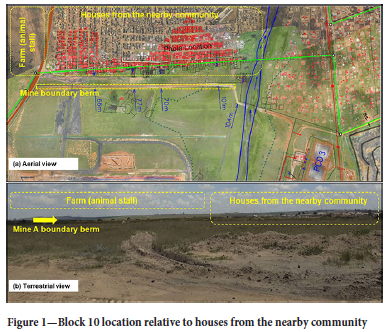
The Block 10 area is located approximately 66 m from the first house in the nearby community. Figure 2is a depiction of the 500 m boundary (red circle) between Block 10, the surrounding community (Re 4 and Re 17), and the national road. The solid purple block shows the Block 10 (Re 10) area, which is planned and scheduled for production. The green lines show the mine boundary, the brown lines show the road infrastructure, and the blue lines show a river stream.
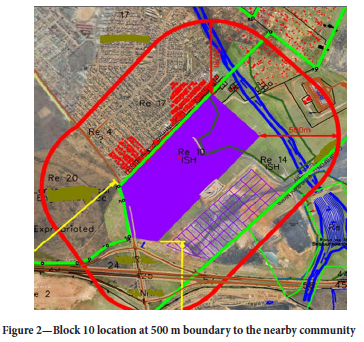
It can be seen in Figure 2that a significant number of community houses and the national road are within the 500 m boundary, hence permission is required before Block 10 can be blasted. The permission to use drilling and blasting to break the rock at Block 10 was not granted at the time of the study, thus the coal resources in Block 10 are still unmined. Block 10 is comprised of three coal seams, namely, the No. 3 seam, the No. 2 seam, and the No. 1 seam. The geology of Block 10 consists of coal, sandstone, and mudstone on the overburden and interburden. The No. 2 coal seam is 5.87 m thick, and 14.54 m deep. It is currently the only viable seam planned to be mined at the current conditions. The uniaxial compressive strength (UCS) of the area ranges from 30 MPa to 74.9 MPa. Coal has the lowest UCS whereas overburden has a high UCS. The No.2 seam has 2.03 million tonnes. These coal resources cannot be accessed using the current rock breaking method. Although the study was based at the coal mine mentioned (Mine A), various other mining sites facing similar challenges formed part of the study in which further experiments and tests were conducted. These sites were unable to conduct normal blasting due to being closer to sensitive infrastructure. This includes a coal mine (Mine B), which could not blast due to the coal deposit being situated within 500 m to a community. Mine C, a platinum mine could not remove in situ rock for the development of slurry dams as the rock is within 50 m of plant infrastructure. Similarly, another platinum mine (Mine D), could not remove in situ rock for the purpose of developing a slurry dam due to being closer than prescribed to a processing plant. These challenges prompted an industry-wide need to find and evaluate non-explosive rock breaking methods that can be used at a large scale when blasting closer to sensitive structures and infrastructure. As such, several types of non-explosive rock breaking methods or techniques were considered and evaluated for their applicability on a larger scale mining operation. These methods include hydraulic impact rock breaking, thermal rock breaking, soundless chemical demolition agents (SCDAs), controlled foam injection, and mechanical splitters (rock splitters). These methods were evaluated based on the safety of the method, the environmental effects, and applicability to the geological conditions at the mining sites.
During hydraulic rock breaking, high-pressure steady or pulsejet water is injected into drilled holes. The high-pressure water supplies the energy required for shattering and cutting rock. This method does not generate any harmful or toxic gases, is non-explosive or destructive, and thus, safer than explosives. Furthermore, it is more effective in splitting unconfined boulders, rather than breaking rock, under confined conditions (Singh, 1998; Genet et al., 2009). The controlled foam injection method makes use of a high-pressure foam (gas and liquid), which is quickly poured to the bottom of the hole to create expansive pressure (Young, Graham, 1999). Although the foam is inert and expands quickly, its use may lead to the generation of fly-rock and air-blast (Singh, 1998). This method is mostly used on short and smaller diameter holes (De Graaf, Spiteri, 2018). The thermal spalling rock breaking method uses high temperatures to weaken and shatter the rock (Yang et al., 2024). The heat is required to erode the surface layer of the rock in the holes. This method is also environmentally friendly; however, it cannot be used to fragment rocks such as sandstone, as an endothermic reaction occurs during heating. The mechanical splitter rock breaking method makes use of a wedge-set that is inserted into drilled holes to generate fractures, which ultimately breaks the in-tension (Li et al., 2024). This method does not generate noise, dust, vibrations, and shock. It is most effective with the presence of a free face and on a typical hole diameter of 63.5 mm and hole depth of 381 mm. It is relatively expensive and generally used in large scale underground applications with limited depth (De Graaf, Spiteri, 2018; De Graaf, 2018). The SCDA method makes use of chemicals that are mixed with water, poured into drilled holes, and allowed to expand over time (Zhong et al., 2023). The SCDA rock breaking method happens during a slower process, making it safer to use and handle. This improves safety by reducing the risk of accidents and injuries. The SCDAs produce minimal noise, vibrations, and dust. They do not produce harmful fumes and fly-rock (Al-Bakri, Hefni, 2021). Furthermore, the chemical product allows for a controlled rock demolition or fracturing process, which minimises the potential for damage to surrounding structures (Natanzi et al., 2016). The chemical product can be applied in different geological mining and construction sites due to their versatility and can be used to break different rock types. They do not require specialised labour, safety measures, and cleaning up after a blast (Maneenoi, Bissen, Chawchai, 2022).
After the evaluations and comparisons of the different non-explosive rock breaking methods, the use of SCDAs was selected as a potential and most suitable method to use for the trial due to their safety, minimal environmental effects, and their versatility to fragment different rock types and be applied in different geological mining and construction sites. However, the SCDAs have not yet been tested to break large volumes of in situ rock. To the best of our knowledge, no study has published research on the application of the SCDAs on a large-scale open-cast mining operation, both locally and globally. Some work has been conducted in underground mines (Habib, Shnorhokian, Mitri, 2022). Therefore, the purpose of the study was to evaluate the applicability of the SCDAs to fragment large volumes of in situ rock. This was done by conducting five trials of SCDAs on four different surface mining sites using Nex-Pand powder. The choice of SCDAs as opposed to the other non-explosive rock breaking methods for this study was motivated by their safety, minimal environmental effects, and applicability to the geological conditions at the mining sites. This proved to be a viable solution for fragmenting rock in sensitive structures and infrastructure. However, the SCDAs have not yet been tested to break large volumes of in situ rock.
Literature review
The SCDAs, often referred to as demolition agents or expansive cements, are powdery substances that expand when mixed with water. The expansion occurs through a chemical hydration process, by the formation and development of ettringite crystals. The SCDAs are mainly used in the mining and construction industries to break concrete or boulders of other types of rock. However, the SCDAs failed to gain mainstream adoption for the selective removal of rock and concrete when they were first introduced in the early 1970s (Al-Bakri, Hefni, 2021). This was due to their proprietary nature (privately owned and controlled) and a lack of guidelines on their usage. Currently, the patents have expired, and more competitive products have entered the market.
Administration process
SCDAs make use of drilled holes. Holes of a certain diameter and depth are drilled in the material or rock to be broken. The SCDA is then mixed with water at a certain ratio depending on the manufacturer's specifications. The slurry is poured into the drilled holes and left to solidify. The solidification period or setting time of the slurry varies according to the type of demolition agent. During the solidification process, the slurry expands in volume. The expansion of the slurry pushes against the walls of the hole and thereby causes cracks to develop on the walls (Gómez, Mura, 1984; Xu et al., 2023). The expansion pressure or force is limited by factors such as the intensity and rate of the chemical reaction, the rock confinement, chemical composition, accuracy of the chemical mix with water content, and the environmental or atmospheric conditions (temperature sensitivity) (De Silva et al., 2016). The maximum expansion pressure depends on the volume of the gas produced and the heat generated from the hydration of calcium oxide (CaO) to calcium hydroxide (Ca(OH)2) in the exothermic reaction. The hydration process can be affected by too little water, but excessive water dilutes the composition, thereby limiting the expansion pressure. The expansion pressure can also be limited when the temperature is too high or too low. The expansion pressure is necessary for generating the cracks between adjacent holes. The interaction mechanism of two neighbouring holes filled with SCDA is shown in Figure 3
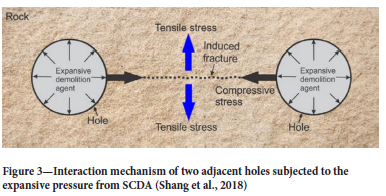
The expansion of the mixture generates pressure that acts on the inside wall of the drilled holes. The pressure results in compression of the rock between the holes, which causes tensile stresses perpendicular to the line connecting the two holes. The rock between the holes will develop fractures when the tensile stress produced during expansion exceeds the tensile strength of the rock being broken (Shang et al., 2018).
Chemical composition
The expansive cements are made of Portland cement and an expansive additive. There are four types of SCDAs. These vary based on the expansive additive. There are type K, type M, type S, and class G cements (Habib, Shnorhokian, Mitri, 2022). Type K, M, and S commonly produce ettringite crystals, which is one of the forces that drives the expansive capability. However, they each vary in the source of the aluminate component and the operating temperature (Habib, 2022). For example, type K operates optimally between -5°C and 10°C, type M at 10°C to 20°C, type S at 20°C to 35°C, and type G at 35°C and higher. This makes Class G ideal for the study and will be discussed as the SCDA powder used in this study. Class G is a type of expansive cement in which Portlandite drives the expansive capability (Arshadnejad, Goshtasbi, Aghazadeh, 2011).
Class G
This expansive cement constitutes 80% - 90% of CaO (lime) (Habib, 2022). Other elements such as silicon (SiO2), aluminium oxide (Al2O3), ferrous oxide (Fe2O3), calcium fluoride (CaF2), and magnesium oxide (MgO) have been added to improve, alter, delay, or control the hydration process (Natanzi et al, 2016). The addition of water to the demolition agent results in a hydration reaction with calcium oxide (CaO). The hydration generates heat and calcium hydroxide under the exothermic reaction (Natanzi et al, 2016). The chemical reaction is given by Equation 1 (Arshadnejad, Goshtasbi, Aghazadeh, 2011).

The hydration reaction of calcium oxide is the root of class G cements expansive force (Habib, 2022). A higher calcium oxide content causes more reaction and higher expansive pressures. High CaO content is the main cause of volumetric expansion. The hydration of lime can create up to 1.9 times the original volume. The generated expansive pressure is dependent on the degree of hydration of CaO. From the chemical reaction in Equation 1, the exothermic reaction creates 15.2 kcal/mol of energy. As a result of the exothermic property, CaO based SCDA can reach a heat of hydration of up to 150°C, such that the boiling water for curing/ solidification can potentially create blowouts (Soeda, Harada, 1994). The likelihood of blowouts occurring during field applications is unlikely as the heat is dissipated into the surrounding environment (Natanzi et.al, 2016). The generated expansion pressure of CaO or lime reaches 30 - 44 MPa. The pressure necessary to fragment soft rock or concrete is 10 - 20 MPa (Al-Bakri, Hefni, 2021).
Parameters affecting the effectiveness of the rock breaking process
Ambient temperature
SCDAs are designed to be applied over a vast range of ambient temperatures. The selection of the correct SCDA type depends on the lowest temperature possible in the area (Huynh, Laefer, 2009). Natanzi et al (2016) proved that high ambient temperatures reach the time to peak SCDA temperature development (hydration heat) faster and results in larger expansive pressures, more rapid pressure gain, and bigger volumetric expansion. The results showed that SCDAs are more successful when applied in the temperature range that they were designed under. Laefer et al. (2010) proved that higher ambient temperatures result in faster cracking and that SCDAs designed to work in cold environments can be used in areas of high ambient temperature to speed up the cracking process. The time to create the first crack varies from a few to almost 24 hours, depending on the hole parameters and the rock properties.
Water used for mixing
Usually, the water temperature should be less than 15°C with a ratio of water to SCDA being 1:3 by weight. The use of too little water will result in inadequate availability of water to correctly hydrate all the SCDA powder, while the use of surplus water will cause free water to remain and possibly compromise SCDA (Hinze, Brown, 1994). Thus, it is important to follow the manufacturer's recommendations when mixing the SCDA with water. Laefer et al. (2010) proved that increasing the water temperature by 152% results in an 18.92% reduction of time to the first crack.
Hole parameters and rock strength
Laefer et al. (2010) proved that a larger burden and distance to free face result in an increased time to first crack and that specimens with artificial seals lead to a reduced time to first crack. A bigger hole diameter, within the manufacturer's recommendations, generates more pressure (Hanif, 1997). Shang et al. (2018) proved that, for the same hole diameter, increasing the hole spacing increases the time that it takes to fracture the rock. Given the same parameters, stronger materials require a closer hole spacing to get similar cracking levels (Arshadnejad et al., 2011). Chemical admixtures improve the rate of stiffening, setting, hardening rate, or early strength (Fu et al.,1995).
Current application of SCDAs in the mining industry and related fields
To date, there is very limited research having been conducted on the applications of the SCDAs in the mining industry. This is the first paper to present experiments or trials of actual findings. But then there is also limited work in related industries that presents field trials of the SCDAs. The SCDAs were initially developed for the construction and civil engineering industries for rock breaking applications where explosives could not be used due to safety, environmental, and regulatory constraints. This included breaking rock close to sensitive infrastructure and demolition of old and dilapidated buildings. Some of the notable work has been focused on reviewing the SCDAs and conducting laboratory experiments to enhance their performance in the construction industry (Hinze, Brown, 1994; Hinze, Nelson, 1996; Gambatese, 2003; Huynh, Laefer, 2009; Habib, 2019; Kim et al., 2021; Zhong et al., 2023). The product has been a success in the demolition of old and dilapidated structures such as hospitals, monuments, schools, buildings near residential buildings, cities, and urban areas. These areas are highly sensitive to vibrations, noises, toxic fumes, dust, and fly-rock where the use of explosives is highly restricted. Some of the SCDA experiments and applications have been focused on breaking reinforced concrete structures without any damages or minimal damages (Jiang et al., 2021; Jiang et al., 2022; Li et al., 2023; Jiang et al., 2023). In mining, limited research work has been conducted and has focused on conducting laboratory experiments for future underground mining applications (Habib, 2019; Habib, 2022; Habib, Vennes, Mitri, 2022; Zhong et al., 2023). Some tests have been conducted for granite and sandstone blocks, which can be associated with fragmenting boulders in opencast mining operations (Sakhno, Sakhno, 2024; Yapici Tanyeri, 2023). These studies have been limited to experiments in laboratories without real life applications. As such, this study aims to conduct actual experiments or tests on actual mining blocks on a larger scale rather than the laboratory experiments.
Methodology
Before this study, SCDAs were only used in the construction industry, near structure demolition applications, small-scale laboratory experiments, and underground tunnelling rock breaking applications. However, to date, no study has tested or experimented on the application of the SCDAs in large-scale rock breaking applications. Therefore, this study was required to first formulate a methodology for the process of fragmenting rock using the SCDAs on a large-scale application. Therefore, the first experiment or trial was used to document the methodology to be used in the other trials. The methodology was developed in the steps illustrated in Figure 4for opencast mining.
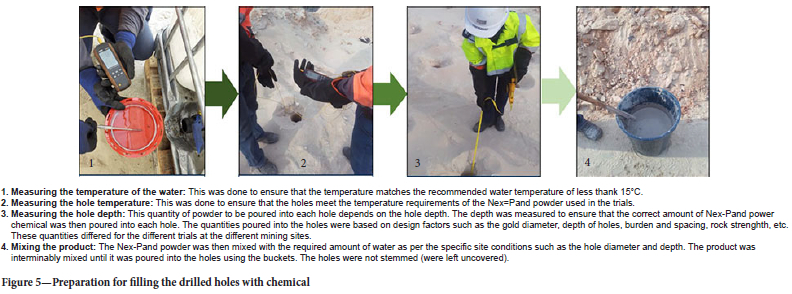
After the block had been prepared, the required holes were drilled using a Pantera 1500id drill rig. The process of pouring the chemical into the drilled holes commenced. Figure 5shows the steps that were followed to mix and pour the chemical into the holes. The aim was to establish a relationship between the crack development and the amount of powder. The development of the cracks can be measured by its length and width development. This will determine the capability of the SCDA to fragment the rock.
Results and discussion of results
In this study, five trials were conducted using two types of Nex-Pand powder. All the powders were of Extreme Summer type. The first two trials made use of a powder designed to work on 30 - 50 mm hole diameters and the last three on 89 - 130 mm hole diameters. More information on the small hole chemical can be found on the company's website (https://www.harlensupplies.co.za/). Information about the large hole chemical is not yet available to the public.
Results of Trial 1 conducted at Mine A
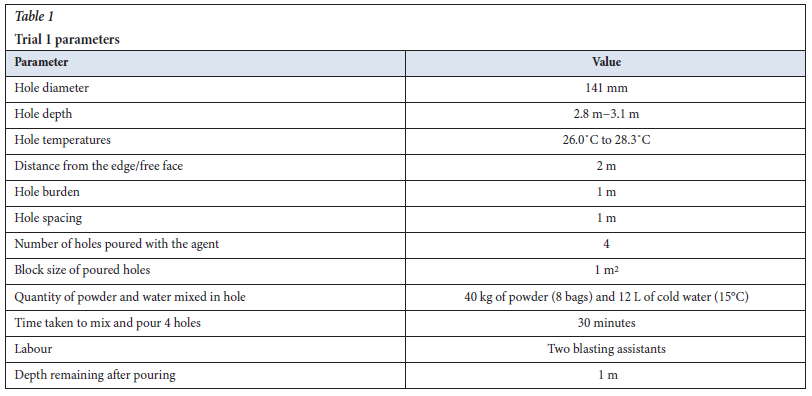
This trial was conducted on sandstone type rock. Table 1shows the parameters used in this trial.
All the holes had a remaining depth of 1 m after pouring. This proved that there were no run-offs after pouring. If there were any run-offs, the resulting depth of the holes would have varied. The small hole Nex-Pand powder used was designed to work on diameters ranging between 30 and 50 mm. The experiment started at 17:00. The holes were left overnight and checked after 15 hours, which was at 08:00 of the following day. The trial was only conducted on four holes to evaluate if this chemical has the potential to break the rock and to document the methodology.
Results after 15 hours
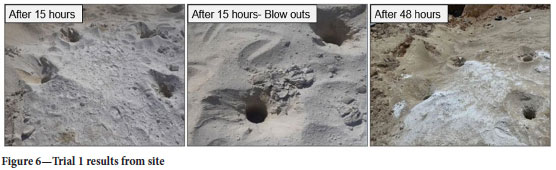
Cracks indicating fracturing were expected. The cracks were to be evaluated in terms of width and length. The crack length from each hole was expected to grow and reach that of the adjacent hole. The growth in length of the cracks was to be in correlation with the growing width of the cracks. The chemical blew out of the holes without generating any cracks.
Results after 48 hours
Although the product in the holes started blowing out, this was a sign of the expansiveness of the product inside the holes. Therefore, it was decided to allow more time to see if the product remaining in the holes would yield any positive results. The holes were then checked at regular time intervals. However, after 48 hours it was realised that there were still no visible cracks between the holes and at the collar of the hole. This suggested that the product had the potential to break the rock but was too confined due to the burden and spacing used. There was not enough compressive stress between the rocks to generate tensile stress that exceeds the tensile strength of the rock. There was a greater rock to compress between the holes. The results from this trial are shown in Figure 6 There were no cracks generated during this trial and thus no fracturing took place.
The trial did not yield the desirable results. Factors explained in literature were evaluated to determine the parameters that led to the generation of no cracks in this trial. The factors are summarised in Table 2
It was found that the actual hole diameter used in the trial was 182% bigger than the theoretical diameter. There were no additions of chemical admixtures to the chemical during the trial. The parameters used correctly did not lead to undesirable results. The trial proved that this chemical has the potential to break the rock, however, a bigger hole diameter and great confinement between the holes led to no crack generation.
Trial 2: Mine B
This trial was conducted on dolomite rock with a tensile strength ranging between 6.2 MPa and 27.4 MPa. This trial was conducted on reduced confinement and hole diameter. The block size was increased to evaluate if the chemical would be able to fragment large volumes of in situ rock. Table 3illustrates the input parameters during the trial.
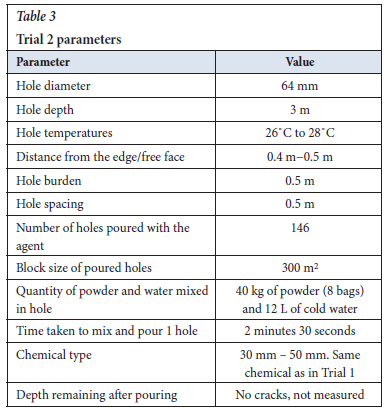
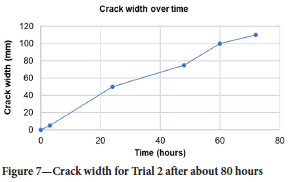
The hole diameter drilled in this trial is 28% bigger than the maximum recommended 50 mm. The hole depth, chemical type, and powder quantity was kept constant as in Trial 1. The chemical fractured the rock. The first crack became visible after 3 hours (with a crack width of 5 mm), shown in Figure 7 The crack width stopped increasing after 72 hours when it reached a crack width of 110 mm.
The crack length reached saturation and stopped increasing after 24 hours, as shown in Figure 8 The crack length reaches saturation when it extends from one hole to the adjacent hole.
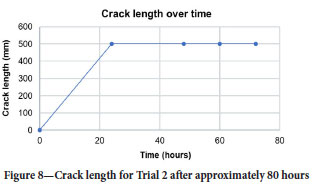
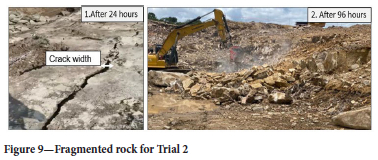
Figure 9(a) shows the type of fracturing observed and the cracks generated by the expansion after 24 hours. The outcomes of the fracturing were measured through the resulting fragmentation. This was to ensure that the broken material could be loaded efficiently. Figure 9(b) shows the resulting fragmentation after the fracturing process was completed. The fragmented rock was loaded by an excavator with a 2.2 m3 bucket capacity a week later. The period that went by before loading was due to the availability of the machine.
The chemical fragmented the rock at a reduced confinement and hole diameter (28% bigger than the manufacturers specifications) compared to Trial 1. The water quantity used for mixing, mixing time, ambient temperature, and type of Nex-Pand powder were used according to specifications.
Trial 3: Mine A
After the unsuccessful trial at Mine A, it was decided to review the design and conduct another trial. This trial was also conducted on sandstone. A different chemical powder was used, one designed for 89 - 130 mm holes. The trial parameters are summarised in Table 4

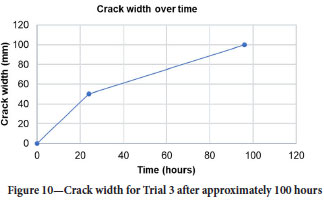
The chemical fractured the rock. The crack width stopped increasing after 96 hours when it reached a crack width of 100 mm, as shown in Figure 10
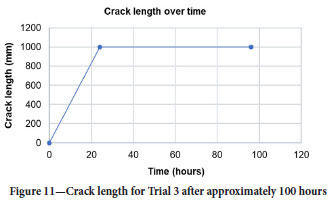
The crack length reached saturation after 24 hours, as shown in Figure 11 This is similar to Trial 2.
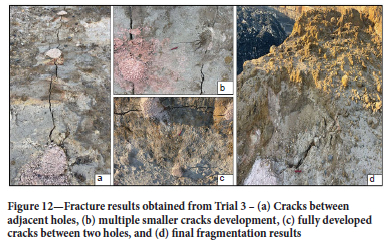
The entire fracturing process is summarised in Figure 12 Figure 12(a) shows how the crack length extends from one hole to the adjacent hole. The chemical was not filled to the collar; however, it rises to the collar during the hydration process allowing the cracks to form from the surface. Figure 12(b) and Figure 12(c) show that the crack length develops first, before the fracturing can proceed in all directions around the perimeter of the hole. This can be observed from the omnidirectional mini-cracks propagation around the holes. When the chemical still has expansion power, that power is used to widen the cracks after the crack length has developed. This shows that to achieve a wider crack, hole spacing should be kept at a minimum, so that the crack length develops faster. Figure 12(d) shows that the chemical fractured the rock to the edge.
The fractured rock was also loaded with an excavator as shown in Figure 13 The chemical was successful in fragmenting the entire depth of the hole.

The chemical was used in the correct hole diameter. The chemical has added chemical admixtures different to the chemical used in the first two trials. The admixtures prevent blow outs. The quantity and type of the chemical admixtures were not available to the public at the time of study, as this is a new product and it is still being tested.
Trial 4: Mine C
This trial was conducted on norite rock. Table 5shows the trial parameters.

Figure 14shows the area that was prepared for Trial 4. Three 45 m blocks were fractured separately. The block was not fractured at once. The holes that had been filled with chemical were fractured first and then moved towards the centre by a few rows at a time.

The chemical fragmented the rock. The crack width stopped increasing after 72 hours when it reached a crack width of 50 mm, as shown in Figure 15
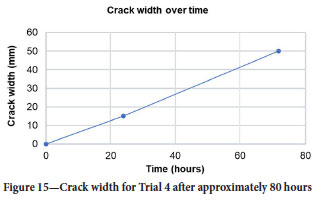
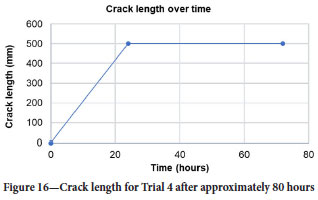
Trial 3 had the smallest spacing when compared to the burden for all trials and the fastest growth in crack width development after 24 hours. This further proves that when spacing (crack length) is kept at a minimum, the crack width will develop at a faster rate as the remaining power is used to widen the cracks. The trial used a hole diameter that is 28% smaller than recommended, this shows that the chemical can also be used in actual hole diameters smaller than the theoretical hole diameter. The chemical also fractured the entire hole depth. Crack length was saturated after 24 hours, as shown in Figure 16
Trial 5: Mine D
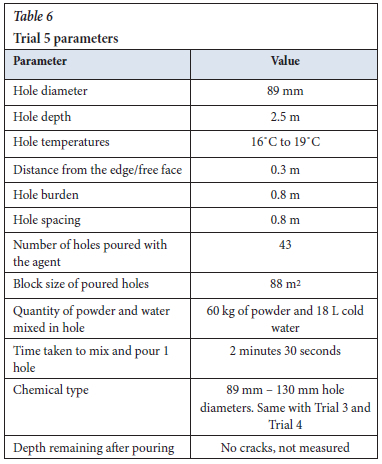
This trial was conducted on dolomite rock with the parameters given in Table 6
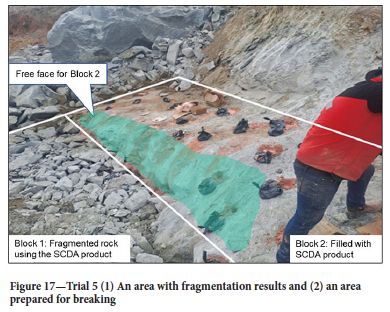
The trial area is shown in Figure 17 consisting of two blocks. The fragmented rock in Block 1 was fractured first to create a free face for Block 2. Block 2 was the drilled-and-filled with the product.
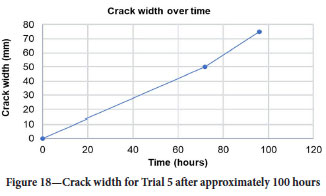
The chemical fractured the rock. The crack width ceased to increase after 96 hours when it reached a crack width of 75 mm, as shown in Figure 18
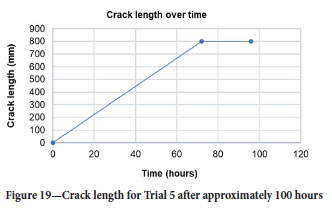
The crack length was saturated after 72 hours, as compared to 24 hours in other trials, shown in Figure 19 This was due to the use of the Nex-Pand powder in a lower ambient temperature than it was designed to work in (25ºC < Temp < 40ºC).
Discussion and analysis of the results
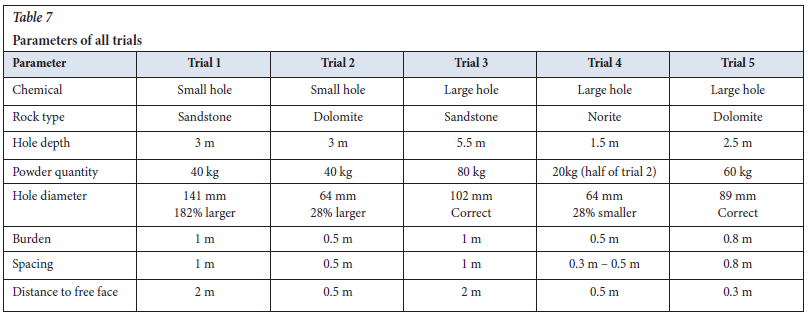
The trials were compared based on rock strength, powder quantity, hole diameter, burden, spacing, and the distance to the free face. Table 7summarises the parameters used in the comparison during the trials.
The crack length is a function of hole burden and spacing. A bigger hole burden and spacing will lead to a longer crack length. Hence, in Figure 20 Trial 3 was observed to having the highest crack length, followed by Trial 5.
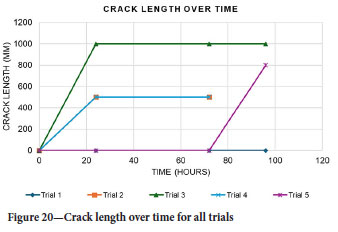
Figure 21shows the crack width for all the trials. Trial 4 was conducted on the hardest rock. It has the smallest crack width. More energy is used to develop cracks instead of widening them. Trial 4 has the same hole parameters (hole diameter, half the depth and powder quantity, and same confinement). However, with Trial 2, the crack width is much smaller than in Trial 2. This is because of rock strength. Norite is stronger than dolomite.
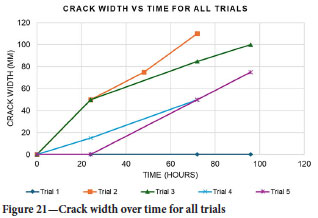
A bigger quantity of Nex-Pand powder per hole generates more expanding pressures. The crack width is expected to be the greatest on holes with higher powder quantity because more pressures are produced. Trial 3 has the highest powder quantity followed by Trial 5, then Trial 2. However, Trial 2 has the greatest crack width as compared to Trial 3 and Trial 5. This is due to the confinement. Trial 2 is less confined compared to Trial 3 and Trial 5. This proves that both confinement and powder quantity affect the crack width, but confinement has the greatest influence on crack width compared to powder quantity. Trial 5 proved that the use of Nex-Pand powder in lower temperatures than designed for would result in a slower generation of cracks. The trials proved that SCDAs can be used to fragment large volumes of in situ rock. They can be applied to fragment the rock in Block 10 at Mine A and in other areas closer to communities and sensitive infrastructure.
Comparing SCDAs to explosives
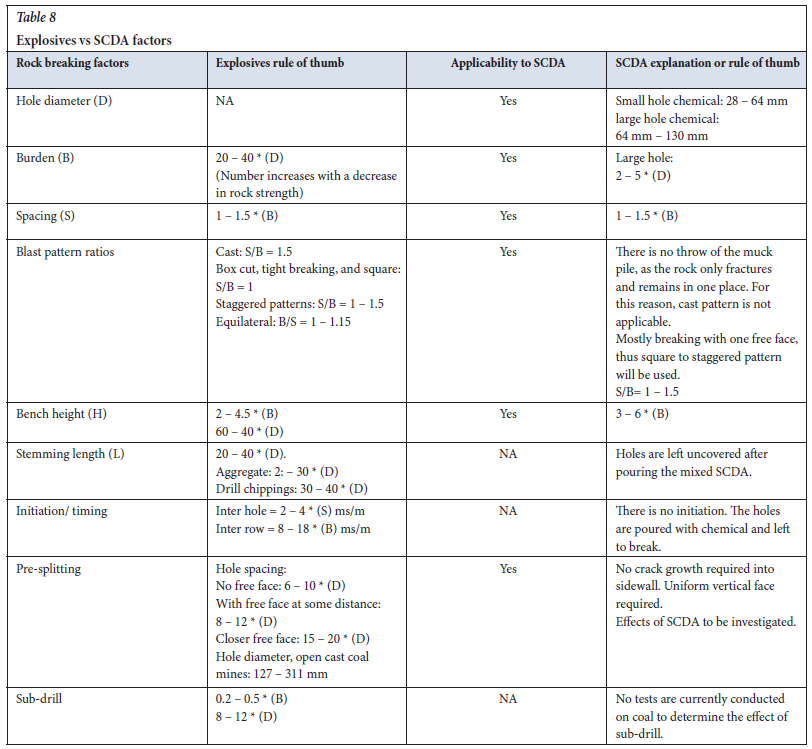
Explosives, unlike SCDAs, provide the ideal fragmentation at a faster rate, however, their use is limited in areas closer to communities and sensitive structures. Table 8compares explosives with SCDAs based on blast design parameters and manner of breaking. When designing a blast, rules of thumb are used. The results of the five conducted trials were used to determine the rules of thumb for SCDAs.
From Table 8 the burden for explosives is significantly more than for SCDAs; this allows for a bigger area to be fragmented when using explosives. The rule of thumb used when determining the spacing for both explosives and SCDAs is the same. Explosives allow for cast blasting pattern, which reduces the handling of the fragmented rock. The rock fragmented using SCDAs remains in one place. There is more material handling with the use of SCDAs. The bench height in both SCDAs and explosives is a function of the burden used. Explosives allow for a longer bench height than in SCDAs. SCDAs do not require stemming. Timing is used in explosives to get the sequence of the blast, however, in SCDAs, the sequence of breaking is controlled by how the chemical is poured into the holes. The block area is not broken at the same time but in rows. The row poured with the chemicals first and left to break will be the first one to fragment, followed by the next row to be poured with the chemical and left to break.
Conclusion
The aim of this study was to investigate if SCDAs can be used to fragment in situ rock on a larger scale for non-explosive rock breaking applications in the mining industry. These expansive products have several advantages over explosives in that they do not cause any ground vibrations, noise, fly-rock, or harmful gases, except for their slow process. Previous studies have only been conducted in the construction and demolition industries with very limited application in the mining industry on a larger scale. In this study, a methodology was developed to conduct five field trials at four different mining sites. Results and observations showed that the chemicals, when mixed with water, expand and rise to the collar of the hole during hydration, but this will either result in blowouts or the development of cracks. When designing an area for the use of SCDAs, the hole spacing should be kept at a minimum to achieve wider cracks and yield good fragmentation results. The crack length develops first and thereafter the remaining expanding power is used to widen the cracks. The powder quantity and rock confinement have the greatest influence on the crack width generated. However, confinement was observed to having the greatest influence on the generated cracks compared to powder quantity. A high powder quantity produces more expanding pressure, resulting in wider cracks. An increase in the confinement can result in much less, to no cracks, due to the tensile stress produced from the powder being less than the tensile strength of the rock. Rocks that have a higher tensile strength require a larger powder quantity and reduced hole burden and spacing to produce the same results as low strength rocks. The use of SCDAs in areas of low ambient temperature than recommended, delays the saturation of crack length. For optimal fragmentation, the SCDAs should be used as per the manufacturer's recommended specifications, as deviations can result in slower to no cracks being generated. The trials successfully proved that SCDAs can replace explosives rock breaking method in areas that are closer to communities and sensitive infrastructure.
Future studies
Further research work is being conducted to optimise the reaction rate to reduce the hydration duration in order to fragment the rock much faster than is the case currently. This will require an investigation of the interaction of the relevant chemical and physical properties. More studies should be conducted to determine ways in which the crack development can be optimised while reducing the powder quantity in the holes. Another study is suggested to investigate the effects of the presence of water in a hole on pressure generation.
Acknowledgements
Dylan Harlen (Sales Executive at Harlen Quarry Supplies): Assistance in data collection.
References
Al-Bakri, A., Hefni, M. 2021. A review of some non-explosive alternative methods to conventional rock blasting. Open Geosciences, vol. 13, no. 1, pp. 431-442. [ Links ]
Arshadnejad, S., Goshtasbi, K., Aghazadeh, J. 2011. A model to determine hole spacing in the rock fracture process by non-explosive expansion material. International Journal of Minerals, Metallurgy and Materials, vol.18, no. 5, pp. 509-514. [ Links ]
De Graaf, W.W. 2018. A Preliminary Evaluation of a Hydraulic Mechanical Splitter as a Means of Breaking Rock in a Deep-Level Mine. Master Dissertation, University of Pretoria, South Africa. [ Links ]
De Graaf, W.W., Spiteri, W. 2018. A preliminary qualitative evaluation of a hydraulic splitting cylinder for breaking rock in deep-level mining. Journal of the Southern African Institute of Mining and Metallurgy, vol. 118, no. 8, pp. 891-897. [ Links ]
De Silva, R.V., Pathegama Gamage, R., Anne Perera, M.S. 2016. An alternative to conventional rock fragmentation methods using SCDA: a review. Energies, vol. 9, no. 11, pp. 958. [ Links ]
Dzimunya, N., Besa, B., Nyirenda, R. 2023. Prediction of ground vibrations induced by bench blasting using the random forest algorithm. Journal of the Southern African Institute of Mining and Metallurgy, vol. 123, no. 3, pp. 123-132. [ Links ]
Fu, Y., Gu, P., Xie, P., Beaudoin, J.J. 1995. Effect of chemical admixtures on the expansion of shrinkage-compensating cement containing a pre-hydrated high alumina cement-based expansive additive. Cement and concrete research, vol 25, no. 1, pp. 29-38 [ Links ]
Gambatese, J.A. 2003. Controlled concrete demolition using expansive cracking agents. Journal of Construction Engineering and Management, vol. 129, no. 1, pp. 98-104. [ Links ]
Genet, M., Yan, W., Tran-Cong, T. 2009. Investigation of a hydraulic impact: a technology in rock breaking. Archive of Applied Mechanics, 79, pp. 825-841. [ Links ]
Gómez, C., Mura, T. 1984. Stresses caused by expansive cement in borehole. Journal of Engineering Mechanics, vol. 110, no. 6, pp. 1001-1005. [ Links ]
Guo, Y., Dyskin, A., Pasternak, E., Li, X., Huang, L. 2024. Mechanics of thermal spallation and fracturing of dry rocks produced by surface heating. Acta Geotechnica, pp. 1-27. [ Links ]
Habib, K.M. 2019. Laboratory investigation into soundless chemical demolition agents for rock breakage in underground mines. Masters Thesis, McGill University, Canada. [ Links ]
Habib, K.M. 2022. Development of explosive-free method for the breakage of hard rock using soundless chemical demolition agents. PhD Thesis, McGill University, Canada. [ Links ]
Habib, K.M., Shnorhokian, S., Mitri, H. 2022. Evaluating the application of rock breakage without explosives in underground construction-a critical review of chemical demolition agents. Minerals, vol. 12, no. 2, pp. 220. [ Links ]
Habib, K.M., Vennes, I., Mitri, H. 2022. Laboratory investigation into the use of soundless chemical demolitions agents for the breakage of hard rock. International Journal of Coal Science & Technology, vol. 9, no. 1, pp. 70. [ Links ]
Hanif, M. 1997. Deformation behavior of rock around a borehole filled with expansive cement. Journal of King Abdulaziz University Engineering Sciences, vol. 9, pp. 93-107. [ Links ]
Harlen, D. 2023. SCDAs administration. Personal communication, 10 January 2023. [ Links ]
Hinze, J., Brown, J. 1994. Properties of soundless chemical demolition agents. Journal of construction engineering and management, vol. 120, no. 4, pp. 816-827. [ Links ]
Hinze, J., Nelson, A. 1996. Enhancing performance of soundless chemical demolition agents. Journal of construction engineering and management, vol. 122, no. 2, pp. 193-195. [ Links ]
Huynh, M.P., Laefer, D.F. 2009. Expansive cements and soundless chemical demolition agents: state of technology review. Proceedings of the 11th Conference on Science and Technology, Ho Chi Minh City Vietnam, October, pp. 21-23. [ Links ]
Jiang, Z., Zheng, W., Li, R., Guo, C. 2021. A computational model for thick concrete slab demolition using soundless chemical demolition agent. Construction and Building Materials, vol. 303, pp. 124430. [ Links ]
Jiang, Z., Zheng, W., Li, S., Sun, L., Xu, C. 2022. Equation of hole arrangement for concrete beam demolition using soundless chemical demolition agent. Journal of Building Engineering, vol. 45, pp. 103311. [ Links ]
Jiang, Z., Zheng, W., Wang, Y., Sun, P., Lu, D., Sun, L. 2023. The use of soundless chemical demolition agents in reinforced concrete deep beam demolition: experimental and numerical study. Journal of Building Engineering, vol. 69, pp. 106260. [ Links ]
Kim, K., Cho, H., Sohn, D., Lee, J. 2021. The use of expansive chemical agents for concrete demolition: Example of practical design and application. Construction and Building Materials, vol. 272, pp. 121849. [ Links ]
Laefer, D.F., Ambrozevitch-Cooper, N., Huynh, M.P., Midgette, J., Ceribasi, S., Wortman, J. 2010. Expansive fracture agent behaviour for concrete cracking. Magazine of concrete research, vol. 62, no. 6, pp. 443-452. [ Links ]
Li, H., Wu, Z., Liu, S., Gu, C., Zhang, X., Xu, P., Zhang, L., Meng, J., Hao, Z. 2024. Rock fracturing mechanism and arrangement of fracturing holes using hydro-mechanical splitters. Engineering Fracture Mechanics, vol. 301, pp. 110055. [ Links ]
Li, R., Tian, W., Qiu, R., Tang, Z., Zhang, X., Wang, W. 2024. Damage characteristic of concrete treated by environmental-friendly soundless chemical demolition method: Hole design parameters regulated demolition mechanism. Structures, vol. 70, pp. 107683. [ Links ]
Li, R., Zheng, W., Tian, W., Yan, Y., Li, G. 2023. A comparative study on the crucial parameters for soundless chemical crushing efficiency of reinforced concrete shear wall: experimental and theoretical investigation. Construction and Building Materials, vol. 363, pp. 129813. [ Links ]
Malbašić, V., Stojanović, L. 2018. Determination of Seismic Safety Zones during the Surface Mining Operation Development in the Case of the "Buvač" Open Pit. Minerals, vol. 8, no.2, pp. 71. [ Links ]
Maneenoi, N., Bissen, R., Chawchai, S. 2022. Influence of admixtures on the performance of soundless chemical demolition agents and implications for their utilization. Journal of Sustainable Mining, vol. 21, no 2, pp. 93-111. [ Links ]
Mine Health and Safety Act (MHSA) 29 of 1996, Republic of South Africa. 1996. Pretoria: Government Gazette No.17242, 14 July 1996. As amended. [ Links ]
Natanzi, A.S., Laefer, D.F., Connolly, L. 2016. Cold and moderate ambient temperatures effects on expansive pressure development in soundless chemical demolition agents. Construction and Building Materials, vol. 110, pp. 117-127. [ Links ]
Sakhno, I., Sakhno, S. 2024. Directional fracturing of rock by soundless chemical demolition agents. Heliyon, vol. 10, no. 4. [ Links ]
Shang, J., Zhao, Z., Aliyu, M.M. 2018. Stresses induced by a demolition agent in non-explosive rock fracturing. International Journal of Rock Mechanics and Mining Sciences, vol. 107, no. 4, pp. 172-180. [ Links ]
Singh, S.P. 1998. Non-explosive applications of the PCF concept for underground excavation. Tunnelling and Underground Space Technology incorporating Trenchless Technology Research, vol. 13, no. 3, pp. 305-311. [ Links ]
Soeda, K., Harada, T. 1994. The mechanics of expansive pressure generation with expansive demolition agents. Concrete Library of Japan Society of Civil Engineers, vol 23, pp.121-135. [ Links ]
Xu, S., Li, R., Li, Z., Ji, X., Suorineni, F.T. 2023. Development of Self-Swelling Tablets as a Substitute for Soundless Cracking Demolition Agents. Cement and Concrete Research, vol. 96, no. 12, pp. 1753-1759. [ Links ]
Yang, F., Liu, W., Zhu, X., Xiang, C. 2024. The rock-breaking mechanism of thermal spalling-assisted rock cutting by PDC cutter. Rock Mechanics and Rock Engineering, vol. 57, no. 2, pp. 993-1012. [ Links ]
Young, C., Graham, C. 1999. Controlled-foam injection - Progress towards automated hard rock excavation. Proceedings of the 5th International Symposium on Mine Mechanization and Automation, Sudbury, Ontario, pp. 39. [ Links ]
Zhong, Z., Tao, P., Zhang, H., Jin, H., Lou, R., Cui, Y., Huang, Q., Liu, J. 2023. Research progress and future prospective of soundless chemical demolition agents (SCDAs) and associated applications. Construction and Building Materials, vol. 409, pp. 134209. [ Links ]
Zhou, H., Xie, X., Feng, Y. 2018. Rock breaking methods to replace blasting. Proceedings of the Institute of Physics Conference Series: Materials Science and Engineering, vol. 322, no. 2, pp. 022014. [ Links ]
 Correspondence:
I. Maubane
Email: ingndseipati14@gmail.com
P.L. Ngwenyama
Email: larrance.ngwenyama@up.ac.za
Received: 30 Nov. 2023
Revised: 25 Jul. 2025
Accepted: 15 May 2025
Published: July 2025