Services on Demand
Journal

Article
 English (pdf)
 Article in xml format
 Article references
 Automatic translation
 Send this article by e-mail
Indicators
Related links
-
 Cited by Google
 -
 Similars in Google
Share

 Permalink
Journal of the Southern African Institute of Mining and Metallurgy
On-line version ISSN 2411-9717Print version ISSN 2225-6253
J. S. Afr. Inst. Min. Metall. vol.125 n.2 Johannesburg Feb. 2025
https://doi.org/10.17159/2411-9717/785/2025
MINESAFE CONFERENCE PAPER
Preventing another health tragedy: A framework to manage diesel particulate matter in underground mines
C.J. BadenhorstI, II; J.D. SwanepoelII; S. HornI
IOccupational Hygiene and Health Research Initiative, North-West University Potchefstroom, South Africa
IIUniversity of Wollongong, Wollongong, Australia
IIID'Sayensi Occupational Hygiene
ABSTRACT
Diesel particulate matter (DPM) is the particulate component of diesel exhaust, which includes diesel soot and aerosols. When released into the atmosphere, DPM can take the form of individual particles or chain aggregates, with most in the invisible sub-micrometer range of 100 nanometres. The main particulate fraction of diesel exhaust consists of fine particles and because of their small size, inhaled particles may easily penetrate deep into the lungs. The rough surfaces of these particles make it easy for them to bind with other toxins in the environment, thus increasing the hazards of particle inhalation.
DPM is a significant health hazard in underground mining operations, where the use of diesel-powered equipment in confined spaces can lead to high levels of exposure among people working in these environments. Classified as a carcinogen by the International Agency for Research on Cancer (IARC), DPM has been linked to severe health effects, including respiratory and cardiovascular diseases, as well as an increased risk of lung cancer. Effective management of DPM is essential not only for protecting people's health but also for ensuring regulatory compliance, maintaining operational efficiency, and safeguarding the long-term viability of mining companies.
Keywords: diesel particulate matter, carcinogen, control, management plan
Introduction
Silicosis litigation in South Africa has been a significant legal battle involving thousands of miners who contracted the disease while working in the mines. In 2011, the South African Constitutional Court ruled that affected mineworkers could claim damages from mining companies under the Occupational Diseases in Mines and Works Act (ODIMWA), leading to the certification of class-action lawsuits. In 2023 a motion was filed in the High Court of South Africa requesting class certification for thousands of prospective class members. The litigation alleges that the responding coal mining companies were aware of the dangers posed to coal miners by coal dust, but failed to protect its workers from high levels of exposure.
Whilst over the last number of years the South African Mining Industry (SAMI) made good progress in reducing exposures in the workplace and achieved a year-on-year reduction in the number of reported cases of occupational disease, the SAMI is still some distance away from achieving 'zero harm' in occupational health. In 2012 the International Agency for Research on Cancer (IARC), declared diesel engine exhaust (DEE) as a human carcinogen, with diesel particulate matter (DPM) being identified as a key contributor to its harmful effects. Twelve years later, the South African Mining Industry still has no occupational exposure limit (OEL) set for DPM and, whilst we have seen some isolated pockets of events to manage harmful exposure to DPM, we have not yet seen a consolidated response to this significant threat to the health of underground miners in SAMI. Could DPM become the next class action or can we as stakeholders prevent another health tragedy in our industry? How can we, as opposed to getting ourselves stuck in endless clinical debates over diagnosis criteria, occupational hygiene measurement methodologies, feasible OELs, and ongoing research projects, move to action?
Effective management of DPM is crucial for ensuring the health and safety of everyone working in underground mining operations. Following an understanding of the unique challenges posed by confined spaces in these environments, it is essential to establish a robust framework for assessing and controlling DPM exposure. This paper outlines a framework of the critical steps required for effectively managing DPM and diesel exhaust emissions overall in the workplace within SAMI.
Underground mining is particularly complicated as mines can be kilometres deep, with high temperatures, confined spaces and ventilation challenges. Operating traditional mining vehicles underground creates even further challenges - the creation of airborne particulates which, when breathed in, can impact the health of people working in these mines for many years.
Background
What is diesel engine exhaust?
Diesel engine exhaust comes from engines burning diesel fuel. It is a complex mixture of gases, vapours, liquid aerosols, and particulate substances. These substances are the products of combustion. The main chemical components of diesel exhaust emissions are:
> Gases and vapours - these are mostly the gases found in atmospheric air like nitrogen, oxygen, water vapour, and carbon dioxide. There are also hazardous chemicals like nitrous oxide, nitrogen dioxide, sulphur dioxide, and carbon monoxide.
> Ultrafine particles known as DPM are elemental carbon (EC) particles that typically have additional hazardous chemicals, such as poly aromatic hydrocarbons (PAHs), or heavy metals adhered to the surface of carbon particles. DPM, specifically elemental carbon (EC), is often used as a surrogate to evaluate diesel emission exposure (Birch, 2014).
DPM can act like a gas and stay airborne for long periods of time. Furthermore, it can penetrate deep into the lungs because of its small size.
DPM is the particulate component of diesel exhaust, which includes diesel soot and aerosols. When released into the atmosphere, DPM can take the form of individual particles or chain aggregates, with most in the invisible submicrometre range of 100 nanometres. The main particulate fraction of diesel exhaust consists of fine particles and because of their small size, inhaled particles may easily penetrate deep into the lungs. The rough surfaces of these particles make it easy for them to bind with other toxins in the environment, thus increasing the hazards of particle inhalation.
Exposures have been linked with acute symptoms, such as headache, dizziness, lightheadedness, nausea, coughing, difficult or laboured breathing, tightness of the chest, and irritation of the eyes, nose, and throat. Long-term exposures can lead to chronic, more serious health problems such as cardiovascular disease, cardiopulmonary disease, and lung cancer.
It is important to note that the IARC classification is based on diesel engine exhaust, which includes DPM. The classification as confirmed carcinogen does not specify DPM as the carcinogen.
Health impacts of DPM
DPM is a significant health threat that people working underground may face daily(Chang and Xu, 2017). The ultra-fine particles in DPM penetrate deep into the respiratory system, bypassing natural defences and reaching the lungs and bloodstream. In the confined, poorly ventilated spaces typical of underground mining, the exposure levels are much higher compared to surface mining, increasing the risks substantially.
DPM containing DEE is classified by the International Agency for Research on Cancer (IARC) as a Group 1 carcinogen (IARC, 2012), linking it directly to lung cancer. DPM presents a real and present risk for people who are exposed to high concentrations of DPM over long periods. Moreover, DPM exposure is associated with severe cardiovascular risks. The fine particles can cause systemic inflammation and oxidative stress, exacerbating conditions like hypertension, and increasing the risk of heart attacks and strokes. For people working underground with physically demanding jobs, these additional health burdens can lead to sudden and potentially fatal health crises.
Other business risks to consider
In addition to the health impacts, DPM exposure presents a range of significant business risks that can threaten a company's long-term viability. These risks extend beyond regulatory compliance and encompass reputational damage, financial implications, and potential legal liabilities. For companies operating in industries with high DPM exposure, such as underground mining, it is crucial to recognise and proactively manage these risks. Addressing these risks through comprehensive DPM management strategies is essential for safeguarding both people and the business.
Regulatory compliance challenges
To protect people's health, some countries have established occupational exposure limits (OELs) for DPM, typically measured as EC. These OELs are becoming increasingly stringent as countries recognise the serious health risks associated with DPM exposure, whilst some countries, like South Africa, have yet to implement OELs aimed at controlling DPM exposure. Globally, regulations mandate regular monitoring of air quality and worker exposure to ensure compliance with these OELs. When an exceedance of the exposure standard occurs, mine operators are required to notify relevant regulatory bodies, take corrective actions, conduct investigations, resample after corrective measures, and review their principal hazard management plans. Maintaining records of monitoring and corrective actions is also required, with retention periods varying by jurisdiction.
Failure to comply with these regulations can lead to legal and financial consequences, including fines, sanctions, and operational shutdowns. Many regulatory bodies are continuously lowering permissible exposure limits for DPM, compelling companies to invest in advanced monitoring and control technologies. For example, the Organisation for Economic Cooperation and Development (OECD) emphasises the need for clear and enforceable OELs that are protective of worker health and feasible to implement, based on scientific, technical and socio-economic considerations.
Non-compliance (Organisation for Economic Co-operation and Development. 2023) not only exposes companies to legal risks, but also damages their credibility and relationships with regulators. To avoid these pitfalls, companies must remain current with regulatory updates and proactively enhance their DPM management practices. This includes implementing effective control strategies, regular monitoring, and adopting available best practices in DPM management to meet or exceed regulatory standards. By doing so, industries can ensure a safer work environment, protect health, and maintain operational continuity.
Financial implications
Unmanaged exposure to DPM can pose financial risks for companies, particularly over the long term. While direct links between DPM exposure and immediate absenteeism or turnover may not be as strong, the long-term health impacts of chronic exposure can lead to increased costs related to health surveillance, case management, and potential compensation or legal claims from affected people. Investing in preventive measures and effective DPM management strategies can help mitigate these long-term financial risks by ensuring compliance with health regulations and reducing the likelihood of chronic health issues that could result in costly legal actions or compensation claims.
Compensation and other legal claims
As DPM is a recognised respiratory irritant and causative agent of lung cancer, people who are exposed and then develop these conditions could have a basis for compensation claims. Depending on jurisdiction, these claims may extend to civil lawsuits based on a failure to maintain a safe and healthy work environment. Class action lawsuits can serve as a means for affected parties to seek justice but also present potential reputational damage and increased regulatory scrutiny for businesses (Jones and Musk, 2021).
The threat of health-related class action suits is significant in industries with high DPM exposure, such as underground mining. Companies that fail to manage DPM risks effectively may face substantial legal repercussions. These lawsuits not only lead to significant financial liabilities but also damage the reputation and trustworthiness of the companies and ultimately, the industry as a whole, which affects long-term business viability.
To mitigate these risks, it is crucial for companies to implement robust DPM management practices, ensuring compliance with health and safety standards and thereby reducing the likelihood of legal claims and associated financial liabilities.
The primary concern associated with DPM exposure is the safety and health of employees. Protecting people from the harmful effects of DPM is not only a moral and legal obligation, but also essential for maintaining a healthy and productive workforce. Beyond this, effective DPM management also helps to mitigate significant business risks, including reputational damage, regulatory compliance challenges, financial implications, and potential compensation and legal claims. By prioritising health through robust DPM management and strict adherence to health and safety regulations, companies can safeguard their employees while also ensuring their long-term viability.
Sources of DPM
The major source of workplace exposure to diesel exhaust is from heavy vehicles that use diesel fuel, such as trucks, buses, trains, tractors, ships, bulldozers, and forklift trucks. Other sources include equipment in mines such as bucket lifts and excavators. All vehicles that use diesel fuel generate diesel exhaust when running, including during workshop repair or servicing, in car parks, when passing security checkpoints, weighbridge control rooms, or in enclosed areas where vehicles operate to load or offload loads and trains.
Diesel exhaust may also be generated from stationary power sources like generators and winch motors, including those mounted to vehicles. These may be used in tunnels, alongside railway lines during maintenance work, and on construction sites.
Levels of exposure can be higher in enclosed, poorly ventilated areas where the concentration of exhaust can build up, like in vehicle repair workshops, tunnels, and partially covered roadways and walkways.
Workers who may be exposed to diesel exhaust include drive-in booth operators, miners, construction workers, oil and gas workers, airline ground workers, forklift drivers, loading dock workers, truck drivers, farm workers, and vehicle maintenance workers.
DPM occupational exposure limit
Currently, no OEL has been set for DPM under the South African Mine Health and Safety Act, Act 29 of 1998.
To ensure that mining operations are aligned with global best practices, it is important to reference international standards for DPM exposure in the absence of local standards. Guidelines set by prominent organisations provide a benchmark for OELs and offer insight into how different regions approach DPM management.
In 2021, the Minister of Employment and Labour promulgated the Regulations for Hazardous Chemical Agents (RHCA, 2021). As part of this update, diesel particulate matter (DPM), which is emitted from diesel engines during combustion, was added to the RHCA with an occupational exposure limit (OEL) of 0.16 mg m3 for total carbon over an eight-hour time-weighted average (Regulations for Hazardous Chemical Agents (RHCA). 2021.) (TWA).
National Institute for Occupational Safety and Health (NIOSH)
NIOSH recommends an exposure limit of 0.1 mg/m3 for DPM measured as elemental carbon (EC) in underground metal and nonmetal mines (NIOSH 2003).
Australian Institute of Occupational Hygienists (AIOH)
AIOH recommends a guideline of 0.1 mg/m3 for DPM measured as EC, to reduce the incidence of ocular and respiratory irritation, with a more protective action level of 0.05 mg/m3 to trigger an investigation and improved controls. This action level is intended to ensure early detection of potential overexposures and prompt implementation of corrective measures to protect worker health. This level is intended to address irritation and not chronic exposure cancer risk. This exposure limit is based on a feasible control of emissions in mines, and not on all adverse health effects. SafeWork Australia will implement an EC exposure limit of 0.01 mg/m3, effective December 1, 2026 (Minerals Council of Australia, 2021).
Control of DPM
Effective management of DPM is crucial for ensuring the health and safety of everyone working in underground mining operations. Following an understanding of the unique challenges posed by confined spaces in these environments, it is essential to establish a robust framework for assessing and controlling DPM exposure.
DPM is unique in associated health hazards as it is generated by human activity and is not naturally occurring, such as respirable crystalline silica. DPM presents several challenges, including:
> Variability in its concentration, composition, and aerodynamic properties.
> Mobility of source (vehicles), as it is not static and can disperse over large areas.
> Requires continuous monitoring and management due to its dynamic nature.
> Influence by factors such as:
• The maintenance and efficiency of diesel engines.
• The type and design of equipment used.
• Efficiency of exhaust after-treatment employed.
• Fuel quality, particularly sulphur content.
DPM control strategies can be divided into three (3) main categories, namely:
a) Prevention of DPM generation: Focuses on optimising engine performance. This includes using cleaner-burning diesel, upgrading to higher-tier engines, and conducting regular engine maintenance to minimise emissions.
b) Prevention of DPM release: Involves capturing or destroying DPM before it is released into the ambient environment. This can be achieved through technologies like diesel particulate filters (DPF) and other exhaust aftertreatment systems.
c) Management of released DPM: Aims to reduce worker exposure through engineering and administrative controls, such as improving ventilation systems, restricting the use of diesel equipment, and providing enclosed operator cabins with appropriate filters.
d) Optimisation of control strategies: Focuses on gathering data through continuous monitoring and risk assessment to adjust and improve existing controls. This involves integrating real-time monitoring technologies to track DPM levels and verify the effectiveness of controls.
DPM control hierarchy
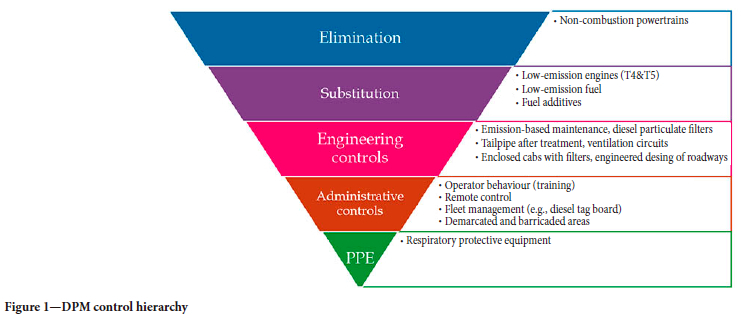
For each control, activities should be established to verify that the controls are operating effectively according to their design, and that processes are in place to ensure the control is effectively managing the risk (Figure 1). Exposure monitoring is not a control, but rather useful to understand the current situation with a risk-based focus. The integration of real-time monitoring technology into monitoring frameworks demonstrates an effective control verification method.
Risk assessment
A baseline risk assessment should be conducted to identify and quantify DPM exposure levels among employees. This process establishes whether a hazard exists and helps prioritise control measures based on the level of risk. Key steps include:
> Identifying and quantifying sources of DPM within the mine.
> Quantifying exposure levels for different areas and workers.
> Prioritising controls based on vehicle emissions profile, exposure duration and concentration.
> Implementing a control improvement plan based on the hierarchy of controls.
Maintaining a DPM source inventory is essential for tracking emission sources and ensuring targeted mitigation efforts. Mines should regularly update their source inventory and use it to inform their control strategies.
Prevention of DPM generation
The controls and processes listed in the following have their primary goal in the prevention of the generation of DPM. These controls and processes are mainly engineering related, with the core aim of improving engine efficiency and the prevention of DPM generation. These include:
> The use of low sulphur content diesel with a maximum allowable concentration of 50 ppm. Diesel handling is an important component of control. Quarterly analyses of diesel should be done, and records kept confirming quality and sulphur content.
> Based on available technology, consideration will be given to the following:
• Replacement of diesel-powered equipment with electrically powered equipment.
• Replacement of lower tier engines with higher tier, more efficient engines.
> An emissions-based maintenance programme shall be implemented:
• Every vehicle should have a service/maintenance plan according to the specifications of the original manufacturer of the equipment (OEM).
• Maintenance plans should be extended after diesel particulate filters are fitted, including engine performance testing and diesel exhaust emissions measurements.
• Engine performance testing should include DPM generation, such as opacity, differential pressure across exhaust aftertreatment, and exhaust temperature testing.
• DPM testing should be used as an indication of overall engine health.
> Exhaust gas temperature should be measured to determine any engine combustion problems, and backpressure values should be used to assess the efficiency of filter regeneration.
> Only low ash lubricants should be used.
The controls listed above are all related to the operation and efficiency of the internal combustion unit utilising diesel as a fuel source, and records of these activities should be maintained.
Prevention of DPM release
The following list of controls and processes have their primary goal in the prevention of the release of DPM from a diesel-powered vehicle into the ambient environment. These controls and processes are mainly engineering related, with the core aim of destroying DPM prior to release into the ambient environment. These include:
> Installation of diesel particulate filters.
> Local extraction ventilation (LEV) systems.
These controls are related to the destruction of generated DPM after generation by the engine, usually in the exhaust system or by capturing the DPM directly from the exhaust system and preventing its release into the ambient atmosphere.
Management of released DPM
The following controls and processes have their primary goal of the management of the generated DPM in the ambient environment. These controls and processes are a mixture of engineering, administrative, PPE and related controls and processes to minimise workers' exposure to DPM. These include:
> Dilution ventilation
Ventilation should be optimised to dilute diesel particulate matter as much as feasible. Provision for an adequate volume flow rate of air is required with the following minimum ventilation design criteria:
- 0.06 m3/s/kW dilution rate to be used when complying with the diesel particulate matter management programme, including the use of higher tier engines such as Tier 3 and 4 engines, DPF catalytic converters, and 50 ppm sulphur in diesel.
- 0.12 m3/s/kW if ventilation dilution is the only control.
> Equipment driver enclosure (heating, ventilation, and air conditioning (HVAC) system).
> Equipment restrictions.
> The number of diesel equipment should be restricted based on the ventilation design.
> Segregation/separation of workforce from diesel equipment, including remote control options.
Personal protective equipment (PPE)
Due to the size and composition of DPM, respiratory protective equipment (RPE) should comply to the following specifications:
> Filtration media must be of an FFP3 (EN 14683) or Level 100 (NIOSH - 42 CFR* 84) efficient particulate filter for negative pressure respirators or high efficiency particulate air (HEPA) filter for powered air purifying respirators (PAPR).
> Filtration media must be rated as an R or P series due to the presence of oil in the DPM.
> R-series filters: These are filters intended for the removal of any particle including oil-based liquid aerosol. They may be used for any solid or liquid airborne particulate hazard. If the atmosphere contains oil, the R-series filter should be used only for a single shift (or for 8 hours of continuous or intermittent use). They are only recommended for disposable respirators that are changed every day.
> P-series filters: These are filters intended for removal of any particle including oil-based liquid aerosols. They may be used for any solid or liquid particulate airborne hazard. NIOSH requires that respirator manufacturers establish time-use limitations for all P-series filters. An international manufacturer of RPE recommends that, in atmospheres containing oil aerosols, P-series filters should be used and reused for no more than 40 hours or 30 days, whichever occurs first, unless the filter needs to be changed for hygiene reasons, is damaged, or becomes difficult to breathe through before the time limit is reached. P-series filters are recommended for all respirators except disposable respirators, as the increased breathing resistance could lead to increased leakage around the respirator.
It is important to note that personal protective equipment (PPE) is the lowest level of the Hierarchy of Controls. This is not because it is the last consideration or the least effective means of protecting people. Properly managed PPE is the difference between life and death in many safety critical industries. It is at the bottom of the Hierarchy of Controls because it is the last line of individual defence and 'it fails to danger.' If PPE is relied upon and does not work, then only the body's own natural protections are left. PPE failure therefore directly exposes a worker to a hazard.
Reviewing and maintaining control measures
Control measures should be reviewed regularly to make sure that they are effective, for example, checking the airflow and filters in ventilation systems and ensuring DPF are effective in removing DPM from exhaust stream. Reviewing risk control measures may include inspecting the workplace, consulting workers, and testing and analysing records and data. It also involves considering whether the use of a higher order control measure is now reasonably practicable.
Control measures should be reviewed and, if necessary, revised:
> When the control measure is not effective in controlling risk.
> Before a change at the workplace that is likely to give rise to a new or different health and safety risk.
> If a new hazard or risk is identified.
> If the results of consultation indicate that a review is necessary.
> If a health and safety representative or worker requests a review.
Control measures must be reviewed on a continuous basis. If a person conducting a business or undertaking has concerns, they should refer back to the risk management steps, review the information, and make decisions about control measures.
A mine should ensure that all the measures provided to control exposure to DPM emitted as part of diesel exhaust emissions in the workplace are maintained in an effective state, kept in efficient working order, and in good repair. Where engineering controls are used, they should be thoroughly examined and tested at regular intervals.
Except for disposable filtering facepiece respirators intended for single shift use, RPE should not be used unless users has had face fit testing, and it has had a recent thorough examination and maintenance.
DPM management plan
The process to reduce DPM emissions should follow some core steps. A mine should be able to streamline a data-driven approach that optimises efficiency. Through defining a solid benchmark, developing sound practices, and carefully analysing relevant data, mines can understand the needs of their machines, and develop a customised emission control system for underground equipment.
A well-structured strategy and diligent implementation are crucial for effectively controlling DPM emissions in mining operations. Establishing a comprehensive DPM management plan helps ensure worker health, regulatory compliance, and operational efficiency. By following the defined steps-define, measure, analyse, improve, control, and verify-mining operations can systematically reduce DPM emissions, enhance workplace safety, and maintain sustainable operational practices. The benefits include improved worker health and safety, reduced legal and financial risks, and enhanced operational performance.
DPM management plan components
A successful DPM management plan is built on a series of critical components, each of which plays a vital role in the overall strategy for reducing emissions. This subsection outlines the key elements of the plan, guiding mining operations through the define, measure, analyse, improve, control and verify process. By following these steps, companies can create a tailored approach to managing DPM emissions, ensuring that all aspects of their operations are optimised for safety, compliance, and efficiency.
This framework should be used in conjunction with other sections of this article to produce a management plan tailored to the company and operation (Figure 2).
Step 1 - Define
The Define step involves capturing the current situation, establishing clear project parameters, and ensuring that all relevant aspects of the operation are considered. This step is also where a dedicated committee is formed to oversee the project, and a compliance review is conducted to ensure that all regulatory requirements are being met.
Capture the current situation:
a) Conduct a comprehensive baseline risk assessment to understand the current levels of DPM emissions and worker exposure.
b) Document all existing control measures, equipment specifications, and operational practices.
Establish project parameters:
a) Define clear objectives and goals for DPM reduction, such as specific emission reduction targets and timelines.
b) Set key performance indicators (KPI) to measure progress and success.
Establish the scope:
a) Determine the full scope of the DPM management plan, including all relevant equipment, areas and processes within the mining operation.
b) Ensure that the plan addresses all sources of DPM and includes measures to control and reduce emissions.
Form a committee:
a) Assemble a dedicated committee with representatives from key stakeholder groups, including management, health and safety officers, maintenance personnel, and worker representatives.
b) Assign roles and responsibilities to ensure accountability and effective communication.
Compliance review:
a) Conduct a thorough review of current compliance with local, national, and international regulations and standards related to DPM emissions.
b) Identify any gaps in compliance and areas that require improvement.
Step 2 - Assess
The assess step involves systematically measuring and collecting data on current levels of DPM emissions and exposure. This phase focuses on gathering accurate and comprehensive information through various monitoring techniques, providing a foundation for identifying areas of concern, and ensuring compliance with exposure limits.
Measure manifold and tailpipe emissions:
a) Perform emissions testing on all diesel-powered equipment to quantify DPM emissions from each machine.
b) Use standardised methods to ensure accurate measurement.
Equipment utilisation:
a) Track utilisation rates of all diesel-powered equipment to identify high-use machines that may contribute significantly to DPM emissions.
b) Collect data on equipment operating hours, fuel consumption and maintenance schedules.
Personnel monitoring:
a) Implement personal monitoring devices to measure individual worker exposure to DPM.
b) Collect data on exposure levels during different tasks and in various work areas.
Area monitoring:
a) Deploy stationary monitoring devices to measure DPM concentrations in key areas of the mine.
b) Ensure continuous monitoring to capture real-time data and identify areas with high DPM levels.
Assess controls:
a) Use the afore-mentioned data that were gathered to assess control adequacy and improvement.
b) Identify areas of high exposure and prioritise controls.
Step 3 - Analyse
This step involves evaluating the data collected during the assess phase to identify key sources of DPM emissions, prioritise risks, and develop targeted control strategies. This phase focuses on turning raw data into actionable insights that guide decision-making and improvements in DPM management.
Develop equipment emission profiles:
a) Analyse the collected emissions data to create a detailed profile for each piece of equipment.
b) Identify high-emission equipment and prioritise them for upgrades or replacements.
Prioritise equipment and work areas:
a) Rank equipment and work areas based on their contribution to overall DPM emissions and worker exposure.
b) Focus initial improvement efforts on the highest-priority items to achieve the greatest impact.
Identify patterns and trends:
a) Look for patterns and trends in the data to understand the factors contributing to high DPM levels.
b) Use this analysis to inform targeted DPM reduction strategies and optimise resource allocation.
Starting with the define, assess and analyse steps is crucial for the successful implementation of DPM reduction initiatives. By capturing the current situation, measuring emissions accurately and analysing the data, mines can develop targeted and effective DPM control systems. This approach ensures that resources are used efficiently, costs are minimised, and health and safety are prioritised. With a solid foundation in place, mines can move forward with confidence, implementing strategies that significantly reduce DPM emissions and improve overall operational performance.
Step 4 - Control
The control step involves taking action to manage DPM. The hierarchy of control should be the foundation of any DPM management strategy, prioritising controls in the following order: Elimination: This is the most effective form of control and involves removing the source of DPM altogether. Strategies include replacing diesel-powered equipment with electric vehicles or implementing automation and remote operation technologies to reduce the need for diesel equipment.
> Substitution: When elimination is not possible, substitution involves replacing high-emission diesel engines with lower emission options. This can include using engines that meet higher emission standards or switching to fuels like ultra-low sulphur diesel (ULSD) or biodiesel blends, which generate fewer particulates.
> Engineering controls: These controls are designed to isolate people from the DPM hazard. Effective engineering controls may include:
> Exhaust gas after-treatment: Implementing technologies like diesel particulate filters (DPF), diesel oxidation catalysts (DOC) and selective catalytic reduction (SCR) systems to capture or convert harmful emissions before they are released into the environment.
> Improving ventilation: Optimising mine ventilation systems, including designing efficient primary and auxiliary ventilation to remove or dilute DPM from work areas.
> Enclosed cabins: Using enclosed operator cabins with high-efficiency particulate air (HEPA) filters to protect workers from direct exposure.
Administrative controls: These involve changing the way work is performed to reduce exposure. This may include:
> Work schedules: Rotating shifts to minimise individual exposure time in high-DPM areas.
> Training and awareness: Educating people on the risks of DPM and safe work practices.
> Monitoring and auditing: Regularly monitoring DPM levels with real-time and personal monitoring devices, conducting audits, and reviewing control measures for effectiveness.
> Personal protective equipment: This should be the last line of defence when other controls are not sufficient. This includes the provision of respirators with appropriate filters and ensuring people are fit tested and trained in its correct use and maintenance.
Step 5 - Verify
The verify step is important in ensuring the effectiveness of a DPM management plan. Once a DPM management plan is in place, it is important to monitor progress and verify that controls are working. This should include the following steps:
a) Set cadence for periodic and systematic monitoring of emissions and controls.
b) Set up and use DPM emissions register or data warehouse/ data visualisation tools.
c) Set up workflow trigger automation, such as alarms and responses to real-time monitoring of emission levels in designated work areas as part of the trigger action response plans (TARP) (Zhang, et al. 2023).
To summarise, the steps to DPM reduction are:
1. Define - Capture the current situation, establish project parameters, establish the scope, committee, compliance review.
2. Assess - Measure the tailpipe emissions, equipment utilisation, personnel monitoring and area monitoring.
3. Analyse - Equipment emission profile, prioritise equipment and work areas.
4. Control - Implement standard operating procedures related to DPM exposure mitigation.
5. Verify - Set cadence for periodic and systematic review of emission by machinery, create equipment emissions register.
Where to start?
Without the first three steps, a mine cannot begin the process of implementing DPM reduction initiatives. Calculating and analysing emissions allows accurate and targeted DPM systems to be applied, which can save time and money.
Benchmark current diesel equipment
> Maintain an up-to-date equipment register, knowing which equipment is in service in which area - Carry out tailpipe emissions testing.
> Identify equipment with the greatest emissions output.
> Use collected data to calculate emissions outputs - Monitor equipment with high fuel usage and emissions outputs.
> Evaluate workplace exposure.
> Consider exposure/emitting time of equipment and location.
> Conduct NIOSH 5040 testing by work area - Assess worker concentration and exposure.
From there, enough data should be available to develop a plan and begin the process of implementing emissions reduction measures. This is highly dependent on the evaluation, and may include rearranging machine schedules, phasing-out certain equipment, or using diesel particular filters and selective catalytic reduction systems.
Lastly, it is imperative that standards are administrated, monitored, and periodically reviewed. Reducing emissions is not a one-off task and will need to be continuously reassessed as businesses and technology change.
To support the development of DPM control management plans the following guidance is provided.
Initial DPM controls
For all mines where workplace exposures are above the DPM OEL, the following control strategy could be considered in a DPM plan:
> Low emission fuel (if available).
> An emissions-based maintenance programme.
> Ventilation strategies consistent with the control of diesel emissions.
> A purchasing policy to buy low emission engines (where available).
> Controls on contractor or hire vehicles to minimise exhaust emissions.
> Workforce and driver education programme.
Secondary management plan
In cases where the initial controls management plan is not effective in reducing emissions to below the DPM OEL, mines could consider implementing one or more of the following:
> Low emission engines.
> Diesel exhaust filters.
> Disposable diesel exhaust filters.
> Air conditioned and filtered operator cabins.
> Alternative power systems (e.g., electric).
> Supply of appropriate respiratory protective equipment to affected workers (as a temporary control).
It should be feasible for the initial management plan to be fully implemented within 6 to 12 months. Secondary management plans (if applicable) will be dependent on equipment availability and thus should be progressed without delay.
Roles and responsibilities
Mine diesel management plan committee
The first step to implementing the mine's DPM Management Programme is assembling a DPM management committee. The programme committee's responsibilities would include monitoring the quality of implementation, effectiveness of the planned activities, and timely reporting to various stakeholders. Each member of the committee should have a defined role. Over time, the committee will be responsible for identifying opportunities for programme improvement.
Occupational hygiene team
The asset's DPM Management Programme must provide fundamental information so that the occupational hygiene and occupational health teams can be assured of the integrity of data and confirm that the asset is not exposing workers to levels that may present a health risk. A DPM Management Programme will provide ongoing information on possible DPM exposures within the workplace.
To meet the mine's DPM Management Programme objectives, the DPM monitoring programme must produce information of consistently high quality. The mine's occupational hygiene team is responsible for assessing exposure risks and developing standard operating procedures for each component of the Occupational Hygiene DPM Programme. Quality control measures need to be in place at each step of the sampling program to allow assessment of data quality. The occupational hygiene team may also be responsible for initiating the incident management procedure based on DPM sampling results.
Ventilation team
Ventilation plays a critical role in the management of DPM concentrations through dilution. The ventilation team is responsible, but not limited to, the following:
> Ensuring sufficient and suitable infrastructure to enable effective ventilation of working places.
> Ensuring sufficient ventilating air of suitable quality, is available to dilute generated DPM.
> Ensuring sufficient ventilating air is available to dilute generated DPM in areas where the DPM is generated.
> Ensuring air contaminated with DPM is removed from the working place in an efficient manner to reduce the number of workers possibly exposed.
> Ensuring that ventilation related infrastructure and airflow controls are maintained and kept operational as required.
Engineering team
Due to the nature of DPM being formed by the internal combustion engine, a large variety of factors can influence the amount of DPM generated. The engineering team is responsible, but not limited to, the following:
> Maintenance of vehicles.
> Maintenance of DPM control devices.
> Maintenance of LEV system components.
> Maintenance of vehicle cabins and filters.
Production Team
The equipment producing DPM is generally utilised by the production teams to move material and equipment to achieve production related goals. The production team is responsible, but not limited to, the following:
> Ensure equipment is used as per OEM recommendations.
> Ensure adherence to operational standards and procedures.
> Identify and report any substandard engine operations to the engineering team.
Conclusion
DPM can be well managed in many underground mines through high-grade protective equipment and ventilation, use of low sulphur fuels, adequate maintenance practices, as well as transitioning to zero-emission equipment, however, failing to manage DPM can cause debilitating illness for people working underground. The moral imperative is clear: addressing DPM exposure prioritises the health and safety of workers and meets regulatory requirements. Protecting people from the harms of DPM means valuing their lives and wellbeing, ensuring they can work safely and return home healthy. Effective DPM management is not just good practice; it is a moral responsibility that reflects a commitment to human dignity and the welfare of our people.
Company leadership in creating a safe and healthy work environment is crucial for managing the risks associated with DPM and ensuring the well-being of all employees.
Acronyms
AIOH Australian Institute of Occupational Hygienists
DEE Diesel exhaust emissions
DOC Diesel oxidation catalysts
DPF Diesel particulate filters
DPM Diesel particulate matter
EC Elemental carbon
HEPA High efficiency particulate air
IARC International Agency for Research on Cancer
LEV Local extraction ventilation
NIOSH National Institute for Occupational Safety and Health
ODIMWA Occupational Diseases in Mines and Works Act
OECD Organisation for Economic Cooperation and Development
OEL Occupational exposure limit
OEM Original equipment manufacturer
PAH Poly aromatic hydrocarbons
PAPR Powered air purifying respirators
PPE Personal protective equipment
RHCA Regulations for hazardous chemical agents
RPE Respiratory protective equipment
SAMI South African Mining Industry
SCR Selective catalytic reduction
References
Chang, P., Xu, G. 2017. A review of the health effects and exposure-responsible relationship of diesel particulate matter for underground mines. International Journal of Mining Science and Technology, vol. 27, no. 5, pp. 831-838. https://doi.org/10.1016/j.ijmst.2017.07.020 [ Links ]
International Agency for Research on Cancer (IARC). 2012. "IARC Diesel Engine Exhaust Carcinogenic"2. Complete list of agents, mixtures and exposures evaluated and their classification, International Agency for Research on Cancer, Lyon. https://monographs.iarc.who.int/list-of-classifications [ Links ]
Organisation for Economic Co-operation and Development. 2023. Establishing Occupational Exposure Limits: Practices and Criteria (OECD, 2023), pp. 15-18. Available at: https://www.oecd-ilibrary.org/establishing-occupational-exposure-limits901f4b5a-en.pdf?itemId=%2Fcontent%2Fpublication%2F901f4b5a-en&mimeType=pdf [ Links ]
Bunn, W.B., Pikelny, D.B., Slavin, T.J., Paralkar, S., Borden, M. 2016. "Health And Productivity as a Business Strategy." Health Affairs, vol. 35, no. 2, pp. 213-221. Available at: Health Affairs. [ Links ]
Jones, O., Musk, B. 2021. The Threat of Health-Related Class Action Suits Due to the Impacts on the Health of Underground Mine Workers. AusIMM Bulletin, October 25, 2021. Available at: Threat of Health-Related Class Action Suits Due to the Impacts on the Health of Underground Mine Workers. [ Links ]
Regulations for Hazardous Chemical Agents (RHCA). 2021. Occupational Health and Safety Act (85 of 1993), GOVERNMENT GAZETTE, No. 44348, 29 March 2021. [ Links ]
NIOSH. 2003. Diesel Particulate Matter (as Elemental Carbon) 5040. National Institute for Occupational Safety and Health. Available at: https://www.cdc.gov/niosh/docs/2003-154/pdfs/5040.pdf [ Links ]
Australian Institute of Occupational Hygiene (AIOH). 2017. Diesel Particulate Matter and Occupational Health issues. Position Paper. Available at: https://www.aioh.org.au/product/diesel [ Links ]
Minerals Council of Australia. 2021. Submission on Safe Work Australia's Releases 2-14 Selected Substances WES. Available at: https://minerals.org.au/wp-content/uploads/2023/01/MCA-Submission-on-SWA-Releases-2-14-selected-substances-WES-12-Feb-2021-final.pdf [ Links ]
Zhang, H., Li, B., Karimi, M., Saydam, S., Hassan, M. 2023. Recent advancements in IoT implementation for environmental, safety, and production monitoring in underground mines. IEEE Internet of Things Journal, vol. 10, no. 16, pp.14507-14526. Available at: https://ieeexplore.ieee.org/document/10104078 [ Links ]
 Correspondence:
C.J. Badenhorst
Email: Cas@occhygienist.com
Received: 30 Oct. 2024
Accepted: 10 Dec. 2024
Published: February 2025
This paper is based on a presentation given at the Southern African MineSafe Conference 2024, 6-8 November 2024, Emperors Palace Convention Centre