Services on Demand
Journal

Article
 English (pdf)
 Article in xml format
 Article references
 Automatic translation
 Send this article by e-mail
Indicators
Related links
-
 Cited by Google
 -
 Similars in Google
Share

 Permalink
South African Journal of Industrial Engineering
On-line version ISSN 2224-7890
S. Afr. J. Ind. Eng. vol.36 n.3 Pretoria Dec. 2025
https://doi.org/10.7166/36-3-3343
GENERAL ARTICLES
Leadership Behaviours as Predictors of an Effective Continuous Improvement Culture in a South African Port Operation
K.R. van der MerweI, ; A. LourensI; N. SchoemanII
IDepartment of Industrial Engineering, Nelson /Mandela University, South Africa
IIContinuous Improvement Department, Transnet Port Terminals, South Africa
ABSTRACT
The South African port sector faces increasing competitive pressures while remaining vital to the Eastern Cape's economic and social development. This study investigated how leadership practices influence the creation of a culture that supports continuous improvement (CI), with the aim of developing a causal framework to strengthen CI implementation. By integrating established theories of organisational culture into contemporary insights into CI, the research addressed the cultural barriers that often undermine successful deployment. A literature review confirmed CI as a proven strategy to improve performance in ports, while highlighting cultural misalignment as a key obstacle. Leadership behaviour was identified as central to fostering a CI culture. Using a quantitative methodology, eight leadership dimensions were examined through a structured questionnaire. Reliability and validity were tested, and the results were statistically analysed. The findings revealed significant positive correlations between CI culture and four leadership dimensions: external interaction, process management, organisational values, and supportive leadership. The study recommends refining the framework by specifying the leadership behaviours that are linked to these factors, and extending the research beyond a single South African port.
OPSOMMING
Die Suid-Afrikaanse hawesektor staar toenemende mededingende druk in die gesig terwyl dit noodsaaklik bly vir die Oos-Kaap se ekonomiese en sosiale ontwikkeling. Hierdie studie het ondersoek ingestel na hoe leierskapspraktyke die skepping van 'n kultuur beïnvloed wat voortdurende verbetering (GI) ondersteun, met die doel om 'n oorsaaklike raamwerk te ontwikkel om GI-implementering te versterk. Deur gevestigde teorieë van organisasiekultuur in kontemporêre insigte in GI te integreer, het die navorsing die kulturele hindernisse aangespreek wat dikwels suksesvolle ontplooiing ondermyn. 'n Literatuuroorsig het GI bevestig as 'n bewese strategie om prestasie in hawens te verbeter, terwyl kulturele wanbelyning as 'n sleutelhindernis uitgelig is. Leierskapsgedrag is geïdentifiseer as sentraal tot die bevordering van 'n GI-kultuur. Deur 'n kwantitatiewe metodologie te gebruik, is agt leierskapsdimensies -deur middel van 'n gestruktureerde vraelys ondersoek. Betroubaarheid en geldigheid is getoets, en die resultate is statisties analiseer. Die bevindinge het beduidende positiewe korrelasies tussen GI-kultuur en vier leierskapsdimensies aan die lig gebring: eksterne interaksie, prosesbestuur, organisatoriese waardes en ondersteunende leierskap. Die bevindinge het beduidende positiewe korrelasies tussen GI-kultuur en vier leierskapsdimensies aan die lig gebring: eksterne interaksie, prosesbestuur, organisatoriese waardes en ondersteunende leierskap.
1. INTRODUCTION
Ports have long been regarded as strategic assets that underpin the economic performance of nations. As gateways for international trade, they facilitate the movement of goods, support industrial competitiveness, and sustain employment. In the South African context, ports are particularly significant for the Eastern Cape, which depends on their ability to channel automotive exports, agricultural commodities, and mineral products to global markets. Simultaneously, these ports support regional development by attracting investment and generating employment in a broad range of industries. Despite this strategic role, South African ports have faced mounting criticism over inefficiency, unreliability, and escalating costs.
The mounting pressure on ports arises not only from increased global competition but also from the growing complexity of supply chains, the rising expectations of shipping alliances and customers, and the imperative to align with sustainability agendas. These difficulties have exposed structural and operational weaknesses that cannot be solved through capacity expansions alone. The conventional response has often been to purchase new equipment, expand terminals, or invest in additional infrastructure. While these interventions might provide temporary relief, they will not resolve the deeper cultural and behavioural issues that compromise consistent performance. Most persistent bottlenecks are not rooted in physical capacity but in the ways in which organisations are managed, how routines are structured, and whether employees feel empowered to improve daily operations.
In this environment, continuous improvement (CI) emerges as an appealing solution. CI is premised on the systematic pursuit of the incremental, ongoing enhancement of processes and outcomes. It is not a one-off programme or an isolated set of tools, but rather a philosophy of constant refinement. When applied effectively, CI has been shown to increase efficiency, reduce waste, and enhance service reliability in manufacturing, healthcare, logistics, and increasingly in the port sector. The tools of CI - such as standardisation, visual management, root-cause analysis, and structured problem-solving - are particularly well suited to the complex flows of port operations. Berth planning, yard coordination, customs clearance, and intermodal transfers all benefit from the discipline of routine improvement.
The global experience also shows that CI often fails to deliver sustained results when treated as a purely technical toolkit. Without cultural alignment, improvement programmes risk being short-lived campaigns that fade once initial enthusiasm dissipates. Organisational culture - defined as the shared assumptions, values, and behaviours that shape how members think and act - is the context in which tools either succeed or falter. Culture determines whether employees embrace change, whether leaders model consistency, and whether new practices are internalised as habits. In this sense, culture functions as both an enabler of and a barrier to CI.
Leadership is the decisive lever in shaping culture for continuous improvement. Leaders not only communicate vision and strategy, but also embody the behaviours and values that employees interpret as cues for what truly matters. In high-performing organisations, leaders demonstrate presence, provide psychological safety, and ensure that resources are allocated to support improvement. They reinforce the message that CI is not a peripheral activity but is central to the mission. Conversely, when leaders are absent, inconsistent, or misaligned, employees quickly detect the gap between rhetoric and reality, leading to cynicism and disengagement.
South African ports illustrate these dynamics vividly. Despite repeated calls for reform, their global performance rankings remain persistently low. According to the World Bank container port performance index [1], Durban, Cape Town, Ngqura, and Gqeberha consistently appear among the worst-performing container ports worldwide, as measured by vessel turnaround times and other operational benchmarks. The Eastern Cape, home to Ngqura and Gqeberha, is especially affected, given its dependence on port efficiency for industrial exports. The Port of Ngqura, commissioned in 2009 as a state-of-the-art trans-shipment hub, symbolises the paradox: despite favourable physical attributes - deep water, modern cranes, and integration into the Coega Special Economic Zone - its efficiency lags behind its international peers. This suggests that physical assets alone do not guarantee competitiveness; cultural and leadership factors are equally decisive.
This article aims to address the gap by investigating how leadership practices influence the development of a culture conducive to CI in South African ports. It builds on well-established theories of organisational culture while extending them to the unique institutional context of state-owned ports in the Global South. A framework was developed that identifies eight leadership dimensions - supportive leadership, process management, employee empowerment, organisational values, reward systems, external interaction, customer focus, and future orientation - and tests their relationship to CI culture through empirical data gathered from the Port of Ngqura. The study's findings refine this framework to highlight four dimensions as particularly significant: supportive leadership, process management, organisational values, and external interaction.
The contribution of this research is twofold. The first is conceptual clarity: by empirically reducing eight possible drivers to four decisive levers, the study clarifies which leadership behaviours matter most in shaping Cl-supportive cultures. The second is practical applicability: the framework provides port leaders with a roadmap for aligning cultural transformation with CI principles, thereby improving operational performance and competitiveness. The implications could extend beyond South Africa, offering insights for other ports and service industries where cultural misalignment hampers improvement efforts.
The remainder of this article unfolds with the literature review contextualising South African ports in the global system, and examining the role of CI, culture, and leadership in driving improvement. The methodology section then explains the research design, data collection, and analysis. The findings are presented and discussed, followed by recommendations and conclusions that translate the evidence into both theoretical insights and practical guidance.
2. LITERATURE REVIEW
This literature review focuses on port operations efficiency, from both an international and a national perspective, as well as the role that CI could play in improving port operations and associated organisational culture change driven by leadership behaviours.
2.1. Port operations: An international perspective
Container terminals must continually increase their productivity and performance as a result of the globalisation of the worldwide container shipping business, greater intermodal sophistication, and increasing rivalry between major ports for cargo throughput. The global economy depends heavily on shipping, and international trade simply could not function effectively without it [2]. This shows that marine transportation is essential for global trade. However, for maritime transportation to be effective, functional and efficient ports are needed. Ports serve as the focal point and junction of all water-based travel routes as well as a means of connecting nations with other regions of the globe. Consequently, ports increase the efficiency of shipping and distribution, and serve as a key conduit for international trade, which is essential for the development of the global economy. Nazarczuk, Uminski, and Brodzicki [3] assert that seaports also play a significant geographic role in determining the placement of exporters. However, to increase trade, key stakeholders need to do more to make ports effective and their operations seamless [4]. A country's growth prospects could be improved by having effective and efficient ports, which are the centre of commerce. Thus, port effectiveness is crucial for enhancing trade facilitation and is a key element in evaluating a nation's trade performance.
Based primarily on quayside performance, and reflecting the experience of container ship operators (the port's primary customers), the fourth release of the worldwide Container Port Performance Index (CPPI) measures relative efficiency of over 400 ports globally. The 10 best ranking ports around the globe for 2023 are listed in Table 1.
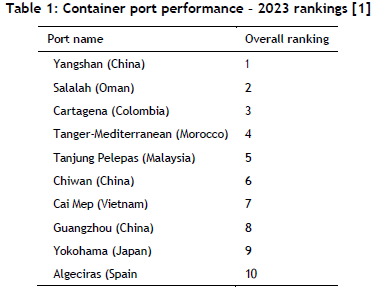
Important participants in the global economy use the CPPI as a baseline for a similar measure of container port performance globally [1]. Chinese ports accounted for three of the top ten positions, while Mediterranean ports accounted for another two; the rest are distributed in other parts of the world.
2.2. Port operations: A national perspective
As stated by the Transnet National Ports Authority (TNPA) [5], the South African government claims that ports serve as crucial engines of development in South Africa. The placement of South Africa on one of the most active global shipping paths, which is crucial for global maritime trade, offers significant potential for the development of the maritime sector. The TNPA owns and manages the South African port structure, consisting of eight international harbours along the nation's shoreline, for the benefit of the state [5]. The TNPA is responsible for the national port system's secure, effective, and profitable operation. The eight ports, located at Ngqura, Durban, Gqeberha, Saldanha, Cape Town, Mossel Bay, Richards Bay, and East London, all have port facilities and sea services from the TNPA as part of its tenancy as landlord of the port sector. Transnet Port Terminals (TPT), a wholly owned subsidiary of the South African government, is responsible for managing these services [5].
Ports are significant entry points, and are crucial to South Africa's logistics and trade system [6] and to supporting South Africa's foreign economy, since most of the country's exports are carried by sea. Bichou [7] points out that wide hinterlands, long transit corridors, and great distances to trade markets characterise the topography of the nation's economy and trade. South African ports are also essential for regional and geographic integration, both inside the country and with neighbouring markets [7]. In South Africa, significant urban and economic clusters are close to several ports. Despite being crucial from a tactical, commercial, and economical standpoint, South African ports remain expensive from a logistical standpoint and ineffective from an operational standpoint [7].
Following a study of the literature on the performance of the nation's container ports, the operational efficiency of South Africa's four primary container terminals, namely Ngqura, Durban, Gqeberha, and Cape Town, was assessed, monitored, dissected, and examined. This was done both over time and in comparison, using comparable benchmarks [7]. Table 2 shows the statistics from the World Bank Container Port Performance Index 2024 Report. The findings indicate that efficiency at South African container ports has declined over the past ten years, whereas efficiency has increased for regional and international comparators.
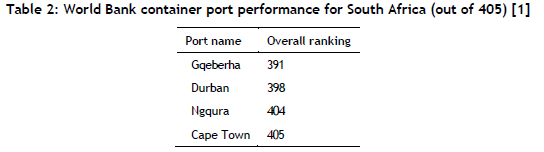
The research ranked the performance of the parastatal Transnet-managed ports in South Africa (Ngqura, Durban, Cape Town, and Gqeberha) in the lowest four per cent out of 405 ports worldwide. To put this into perspective, every port in Africa, including those in Walvis Bay, Dar es Salaam, Mombasa, Dakar, Beira, Lagos, and Maputo, performed better than the ports in South Africa, sometimes by a wide margin. The position of South African ports in relation to other sub-Saharan ports should be a cause for concern, especially when their performance has been consistently below par when comparing the efficiency of sub-Saharan African ports with those in Asia [6].
Research conducted by Bichou [7] reveals that the efficiency of South African container ports, especially during the previous five years, fell 35 per cent short of their full capability and about 20 per cent lower than comparative standards. Several governmental, business, and consultant assessments conducted over the past 20 years have emphasised problems with the efficiency, delays, and congestion of South African container ports. However, studies have focused on quick solutions and tactical alternatives that, although realising minor gains, failed to mitigate fundamental inefficiency and congestion-related problems that led to performance constraints and alignment errors with port tactics, preparation, and ongoing governance [7].
The 2019 UNCTAD [8] report showed that South Africa has a median port stay time for vessels that averages just under two days in comparison with the international standard of 0,88 days. This, together with the literature, strongly suggests that South Africa urgently needs to improve its efficiency if the country wants to meet the international trading standards. The literature findings support the objective of our framework, which is to help to deploy an effective CI culture in a port setting in South Africa to increase port efficiency.
2.3. Continuous improvement, organisational culture, and leadership
Swinehart, Miller, and Hiranyavasit [9] argue that CI is "the ultimate test of an excellent organisation", and describe CI as an organisational culture that aims to eliminate waste from all its systems and procedures. It entails everyone collaborating to create changes without always committing to significant financial investments. Boer, Berger, Chapman, and Gertsen [10] define CI as the deliberate, continuous, and methodical process of gradually altering current processes throughout the whole organisation with the goal of enhancing performance; they add that all organisations require CI in the processes by which they develop and provide their goods and services and in the actual products and services they offer. Mounting evidence indicates that widespread employee involvement helps to facilitate continuous improvement.
Barinua and Sunday [11] maintain that CI refers to performance improvement through several modest, gradual stages. Every company's long-term competitive strategy should include CI because it effectively increases customer focus, product/service quality, productivity, and reduced defects [12]. Organisations that cannot keep up with their competitors' innovations and, by extension, the expectations of their customer base will be left behind in today's fast-paced business world. CI is not something that organisations own or lack; rather, it is a journey to a more positive cultural identity that may encounter roadblocks along the way [13].
Multiple process improvement activities are needed to create a culture of CI [14]. Hoem and Lodgaard [15] argue that this is not an easy undertaking, even though it is frequently cited in the literature as an essential element for corporate success. With respect to this strategy, realising long-term improved results, as opposed to short-term observable benefits, requires a conscious effort to address the need to incorporate CI approaches into the organisational culture [14].
As indicated by Chowdhury [16], organisations with CI cultures have seen benefits in the form of an 80 per cent decrease in defect rates, a 90 per cent decrease in routine breakdowns, and a 50 per cent increase in production output. Every employee must take responsibility for their work and act appropriately, when necessary, on their own behalf and in accordance with the organisation's culture, to ensure that the final products meet quality standards and that any elements that might impede production or quality are immediately eliminated at source [17]. Everyone must endeavour to uphold the credo "First time right", abandon the outdated belief that set job descriptions are "carved in stone", and be ready to exercise a significant amount of flexibility in work activities and obligations as required. According to Singh and Singh [17], companies need to allocate funds for staff education and training in accordance with CI principles if they are to meet these objectives.
Substantial research suggests that the primary obstacle to establishing CI is insufficient management commitment, even though poorly designed procedures and improper tool use may also contribute to problems in this area [15]. Consequently, the establishment of a CI culture inside an organisation depends heavily on the leadership team.
A CI culture needs to be established to sustain CI initiatives in the entire organisation [18]. Workers, mostly operators, use CI to enhance conditions at work, quality, safety, efficiency, startup time, or any other little adjustments for the better. As a result, establishing a CI culture is the foundation of a company's sustainability. Organisations generate constant development that rivals cannot match when they have a shared innovation attitude and the appropriate set of behaviours to support it [19]. When a company prioritises CI, product development, customer service, and profitability almost take care of themselves. According to Osterling and Martin [20], the most significant - and most difficult - cultural change to effect is one that requires long-term leadership efforts. In a CI company, the workforce is free to develop and apply the strategic remedies needed to achieve the ultimate objectives successfully. Leadership is responsible for developing strategy, which frees management from day-to-day operations so that they can focus on assessing employee performance and strategies and clearing operational hurdles, while also greatly expanding their staff's understanding and its degree of fulfilment [15].
Especially relevant to this research are actions that alter organisational culture. It is crucial to distinguish between the factors that encourage change and the external and internal factors that exert pressure on or compel an organisation to change (such as the risks posed by competitors to the South African port sector).
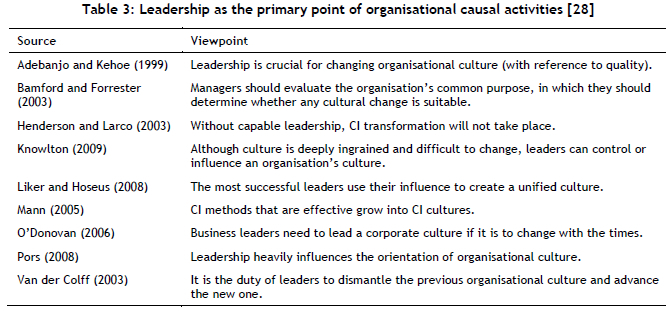
Primarily concerned with what needed to change, this study identified and defined the fundamental source of the activities to provide context for the causal actions that lead to organisational culture change. According to Schein [21], leadership-related behaviours serve as the primary impetus for organisational culture change initiatives. According to the literature cited by Van der Merwe [28], shown in Table 3, researchers are in agreement about this claim.
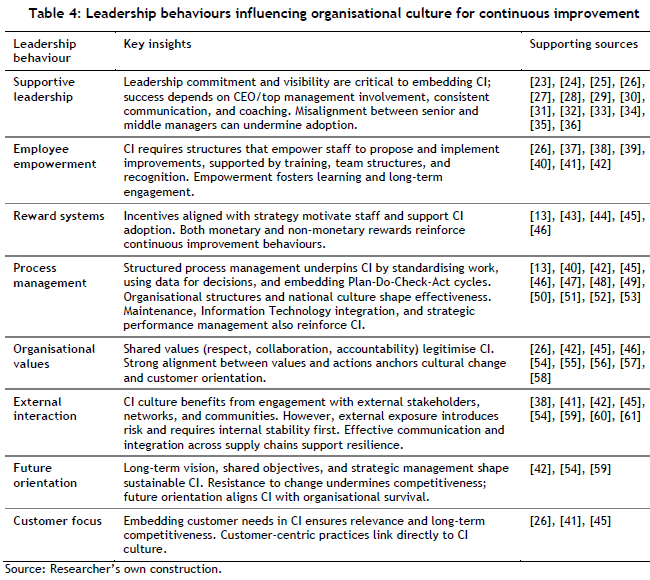
From these criteria, it is evident that leadership actions have a considerable influence on how organisational culture develops. The most obvious contrast is how "manager" and "leader" are used differently. Given the impact that leadership has on an organisation's culture, key characteristics of the associated leadership behaviours were identified from the literature.
The leadership behaviours identified in Table 4 formed the basis for the research instrument used in the research process that is described in the next section.
3. RESEARCH METHODOLOGY
The methodological approach for this study was carefully designed to ensure both theoretical robustness and empirical reliability, allowing the relationships between leadership practices and the cultivation of a CI-supportive culture in the South African port sector to be rigorously examined. Because the research question focused on causal linkages between leadership behaviours and cultural orientations, the design drew on a positivist tradition in which organisational constructs are translated into measurable items and analysed using quantitative methods. Ports, as operationally intensive and data-driven institutions, present a particularly suitable context for such an approach. Their performance is routinely assessed through quantifiable indicators such as berth productivity, vessel turnaround time, and container dwell duration, and their management cultures are often evaluated with survey-based tools. In this light, a survey methodology provided the necessary balance between depth of insight and breadth of coverage, enabling a large sample of employees to contribute data on both leadership behaviours and perceptions of cultural support for CI.
The choice of the Port of Ngqura container terminal (PNCT) as the empirical site was guided by both theoretical relevance and practical feasibility. Theoretically, Ngqura embodies the paradox of modern African ports: it is a relatively new, well-equipped, deep-water terminal, designed with the physical capacity to handle the latest generation of container vessels, yet it has consistently underperformed in international comparative rankings [1]. Practically, the port's manageable workforce size, its role in the Coega Special Economic Zone, and the accessibility of management channels made it an ideal candidate for a detailed organisational study. By focusing on a single case, the research could explore the nuances of leadership behaviour and cultural perception, while retaining the possibility of broader extrapolation to other South African ports facing similar systemic constraints.
A structured questionnaire served as the primary instrument for data collection. It was designed to capture both demographic details and employees' perceptions of leadership behaviours and CI culture. Section A contained biographical questions covering gender, age, organisational role, and tenure - variables that are often linked to differences in cultural receptivity and leadership evaluation [62] [63]. Section B consisted of 62 items distributed among the eight leadership dimensions identified from the literature - that is, supportive leadership, employee empowerment, reward systems, process management, organisational values, external interaction, customer focus, and future orientation - as well as items designed to capture the dependent construct of CI culture. Each item used a five-point Likert scale, ranging from strong disagreement (1) to strong agreement (5), which facilitated quantitative analysis and reduced self-reporting bias. The items were adapted from well-established scales in organisational culture and CI research, but the wording was carefully adjusted to reflect the port context. For example, items concerning "shop floor visits" were reframed as "gemba walks" through container yards or berth operations, while questions about "customer orientation" were rephrased to align with interactions with shipping lines, freight forwarders, and logistics partners. Bias emanating from self-reporting was anticipated and mitigated during the instrument design and administration phases.
A pilot test was conducted with a group of fifteen randomly selected employees from different operational levels at Ngqura with the aim of reducing bias by doing cognitive pretesting. Feedback indicated that the items were clear, contextually relevant, and free from confusing terminology. Importantly, the pilot confirmed that both paper-based and electronic formats were feasible - an essential consideration, given the mix of frontline operators without routine computer access and support staff working in office environments. Following the pilot, no substantial revisions were required, suggesting that the questionnaire enjoyed both face validity and practical usability.
Sampling followed established guidelines for survey research in large organisations [64]. The total workforce at Ngqura numbered about 815 at the time of the study. To achieve adequate statistical power for multivariate techniques such as regression and confirmatory factor analysis (CFA), a minimum sample size of 260 was calculated. Allowing for non-response, 550 questionnaires were distributed, split between paper copies for operational staff and electronic versions for support staff. Distribution was coordinated with shift supervisors and human resources officers to maximise reach. Over a three-month period, 275 usable responses were collected, exceeding the minimum requirement and representing 34 per cent of the total workforce. The final sample composition mirrored the organisation's demographics, with operators forming the largest group (64.4 per cent), supplemented by technicians, supervisors, specialists, and managers. This distribution ensured that the results were broadly representative of the organisation's population.
Data collection was conducted under strict ethical guidelines. Ethical clearance was obtained from Nelson Mandela University's research ethics committee. Participation was voluntary, anonymity was guaranteed, and informed consent was obtained from all the respondents. The paper surveys were collected in sealed envelopes deposited in designated boxes, while the electronic surveys were submitted via a secure online platform. This dual-channel approach balanced accessibility with confidentiality, encouraging candid responses.
Once collected, the data was rigorously analysed in a structured series of steps. Descriptive statistics provided an initial overview of respondents' demographics and mean responses for each leadership dimension and the CI culture construct. Reliability analysis was then performed, with Cronbach's alpha coefficients calculated for each scale. All the constructs exceeded the threshold of .70, indicating strong internal consistency [65]. CFA was used to assess construct validity. Goodness-of-fit indices such as the comparative fit index (CFI) and the standardised root mean square residual (SRMR) demonstrated satisfactory levels, supporting the theoretical model. Following validation, correlation analyses explored the bivariate relationships between the leadership dimensions and CI culture, before multiple regression techniques tested which leadership behaviours uniquely predicted the dependent construct. Finally, analysis of variance examined demographic effects, allowing the study to assess whether cultural receptivity varied by age, gender, tenure, or role.
4. RESULTS
The results of the demographic analysis provide an important context for interpreting the main findings. The workforce at Ngqura was predominantly male (66 per cent), reflecting broader patterns in port operations, where heavy equipment handling and shift work traditionally attract men rather than women. Women nevertheless accounted for a meaningful minority, particularly in support and specialist roles. Age distribution revealed a strong mid-career profile: more than half (53.5 per cent) the respondents fell into the 35-44 age bracket, with a further 21.8 per cent younger than 35, and 24.7 per cent aged 45 or older. Tenure was evenly spread, with around one-third in each of the 1-5 year, 6-10 year, and 11-15 year ranges, and with only a small minority exceeding 16 years of service. From an organisational perspective, this profile suggests a workforce with substantial operational experience, yet still young enough to be open to new cultural orientations.
The attitudinal data from Section B of the questionnaire painted a picture of employees who were generally receptive to CI principles. Among the items capturing the CI culture construct, strong agreement emerged that problems should be treated as opportunities, waste reduction was a source of competitiveness, and feedback - even when critical - could be harnessed to drive learning. Cronbach's alpha for the CI culture scale reached .898, indicating a highly reliable measurement. CFA further confirmed the scale's validity, with CFI values above .95 and SRMR below .05. This provided confidence that the construct had captured the intended cultural orientation.
In contrast, perceptions of leadership behaviours were more critical. Supportive leadership items revealed that employees rarely experienced leaders being present at value-stream meetings, conducting gemba walks, or providing consistent feedback. Many respondents indicated that, while leaders talked about improvement, they were seldom visibly involved in the routines of CI. Empowerment scores were similarly modest: employees felt that they had limited autonomy to identify or solve problems, and few reported that their ideas were systematically implemented. Reward systems were viewed as weak and inconsistent, with little recognition linked directly to improvement work.
The more structural dimensions, however, showed greater promise. Process management items received a higher endorsement, particularly in relation to the importance of measurement and the value of feedback. Yet gaps remained in defining clear measurement guides and allocating resources to improvement initiatives. Organisational values were acknowledged as important but under-communicated; many employees expressed a desire for a clearer articulation and a stronger modelling of values by leaders. External interaction and customer focus scored relatively low, reflecting limited opportunities for staff to engage directly with customers or external stakeholders. Future orientation, while conceptually important, was perceived as distant from daily work, with few employees involved in long-term planning.
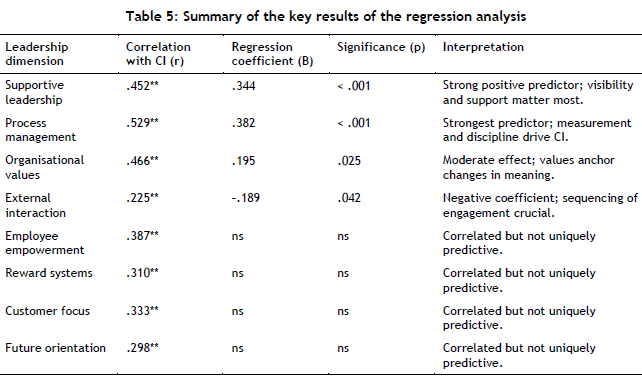
Correlation analysis confirmed that all eight leadership dimensions were positively associated with CI culture at the bivariate level, suggesting that each dimension has at least some role to play. However, regression analysis isolated four dimensions that retained unique predictive power: supportive leadership, process management, organisational values, and external interaction. Supportive leadership displayed a medium positive correlation with CI culture (r = .452, p < .01) and was a significant regression predictor (B = .344, p < .001). Process management showed the strongest relationship (r = .529, p < .01; B = .382, p < .001), underlining the centrality of disciplined processes to sustaining CI. Organisational values correlated moderately (r = .466, p < .01; B = .195, p = .025), suggesting that values function as cultural anchors. External interaction correlated only weakly (r = .225, p < .01), yet its regression coefficient was significant and negative (B = -.189, p = .042) - a counterintuitive finding that is discussed below.
The regression model as a whole was significant (F(8,266) = 20.635, p < .001), explaining a substantial proportion of the variance in CI culture. The reduction of eight candidate leadership dimensions to four decisive levers provides both conceptual clarity and practical focus. Table 5 summarises the key results of the regression analysis.
\Analysis of variance added a further layer of insight by exploring demographic effects. The results indicated a statistically significant difference by age (F(2,272) = 3.285, p = .039). Post-hoc tests revealed that employees in the 35-44 age group reported significantly stronger CI culture scores than those aged 45 and above. This suggests that mid-career employees, with enough experience to understand operational complexities but not yet entrenched in older cultural habits, are especially receptive to CI principles. No significant differences emerged for gender, tenure, or role, implying that receptivity to CI is relatively evenly distributed among the other demographic categories.
CFA of the measurement model provided further evidence of validity. Fit indices were generally strong, with CFI values ranging from .958 to .997 among the constructs and SRMR values below .05 in most cases. Modification indices supported theoretically coherent correlations between similarly worded items, further improving model fit. Together, these results confirmed that the questionnaire was both reliable and valid, and that the causal framework rested on a statistically sound foundation.
The discussion of these findings highlights several important implications. First, the prominence of process management as the strongest predictor of CI culture aligns with both theory and practice in quality management. This finding is compatible with several major organisational culture models. Schein's model [21], for example, implies that durable CI rests on deep "basic assumptions" about disciplined, repeatable work in which formal process management is an artifact/espoused value layer that reflects those assumptions. Without standardised processes, visual controls, and clear metrics, improvement work remains ad hoc and inconsistent. Employees at Ngqura interpreted strong process management as evidence that improvement is embedded in daily routines rather than treated as an occasional campaign.
Second, the significance of supportive leadership underscores the critical role of leader visibility and engagement. Employees consistently noted the absence of leaders in operational spaces. Yet, when leaders are present, coaching, and visibly supportive, employees perceive CI as credible and worthwhile. These findings are supported in the broader literature related to lean and quality management, where leadership commitment is consistently identified as the differentiator between successful and failed improvement efforts [66].
Third, organisational values emerged as a moderate but significant predictor. This reflects the symbolic dimension of cultural change: when improvement is grounded in values such as accountability, collaboration, and respect, it acquires a legitimacy beyond mere performance metrics. Employees' call for more communication and modelling of values indicates that values function as a bridge between technical practices and shared meaning.
The negative coefficient for external interaction is perhaps the most intriguing finding. At face value, one might expect engagement with customers and external stakeholders to reinforce CI by providing feedback and urgency. Yet, in contexts where internal routines are weak, such engagement may create pressure and defensiveness, undermining cultural receptivity. Employees at Ngqura expressed interest in engaging with customers, but regression analysis suggests that such engagement must be sequenced carefully: internal stability and confidence must precede external exposure. This finding refines existing models by highlighting sequencing as a critical variable in cultural transformation.
5. CONCLUSION
Taken together, the evidence suggests that employees at Ngqura are attitudinally ready for CI, but are constrained by gaps in leadership visibility, process discipline, and values communication. The refined framework highlights four decisive levers: supportive leadership, process management, organisational values, and external interaction (with sequencing). These findings contribute to both theory and practice. Conceptually, they clarify which leadership behaviours matter most in cultivating CI culture. Empirically, they validate the framework in the distinctive context of a South African state-owned port. Practically, they provide a parsimonious roadmap for leaders seeking to embed CI.
The practical recommendations derived from this analysis emphasise the need to stabilise processes first, then make leadership visible, anchor decisions in values, and only then expand external engagement. Mid-career employees, especially those in the 35-44 age range, should be leveraged as natural champions of CI. These recommendations acknowledge both the systemic complexity of ports and the human dynamics of cultural change.
The contributions of this study extend beyond immediate practice. By reducing eight theoretical drivers to four validated levers, the research provides conceptual clarity in a field often criticised for its proliferation of constructs. By operationalising CI culture in the South African port context, it extends the applicability of CI theory beyond manufacturing into service-intensive state-owned environments. By specifying a sequenced roadmap, it provides actionable guidance that could be adapted by other ports facing similar problems of competitiveness and cultural misalignment.
The limitations of the study must also be acknowledged. The single-site design constrains its generalisability; further research should test the framework in multiple South African ports and benchmark it against peers in Africa and beyond. Greater granularity in specifying leadership behaviours would enhance its practical utility, allowing clearer identification of the "dose-response" effects of different actions. Comparative studies of state-owned versus privately operated terminals could also illuminate how governance models condition cultural transformation.
In conclusion, the study demonstrates that leadership behaviours are decisive in shaping the cultural conditions for CI in ports. Employees are willing and ready to embrace improvement, but require visible leadership, disciplined processes, clear values, and carefully sequenced engagement. By embedding these elements, South African ports could transform CI from a technical toolkit into a durable cultural practice, positioning themselves for competitiveness in a demanding global trade environment.
REFERENCES
[1] World Bank, "The Container Port Performance Index 2023: A comparable assessment of performance based on vessel time in port," Washington, DC: World Bank, 2024. Available: https://documents.worldbank.org/en/publication/documents-reports/documentdetail/099060324114539683 [Accessed: Sep. 19, 2025]. [ Links ]
[2] International Chamber of Shipping, "Shipping and world trade: Driving prosperity," London: ICS, 2023. Available: https://www.ics-shipping.org/shipping-fact/shipping-and-world-trade-driving-prosperity/ [Accessed: Sep. 19, 2025]. [ Links ]
[3] J. M. Nazarczuk, S. Uminski, and T. Brodzicki, "Determinants of the spatial distribution of exporters in regions: the role of ownership," The Annals of Regional Science, vol. 64, pp. 547-574, 2020. [ Links ]
[4] C. Mlambo, "The impact of Port Performance on Trade: The Case of Selected African States," Economies, vol. 9, no. 4, p 135, 2021. [ Links ]
[5] Transnet National Ports Authority, "Port of Ngqura: A container transhipment hub for sub-Saharan Africa," 2020. [Online]. Available: https://www.transnetnationalportsauthority.net/OurPorts/Ngqura/Documents/Port%20of%20Ngqura%20Brochurev4_SinglePages.pdf [Accessed: Jun. 5, 2023]. [ Links ]
[6] I.I.G. Motau, "An assessment of port productivity at South African container port terminals," MSc dissertation, University of KwaZulu-Natal, Durban, 2015. [ Links ]
[7] K. Bichou, "Development of a strategic plan for port performance improvement in South African container terminals," [Online]. Available: Available from: https://sa-tied.wider.unu.edu/sites/default/files/SA-TIED-Bichou-Report_0.pdf (Accessed: 5 June 2022). [ Links ]
[8] United Nations Conference on Trade and Development (UNCTAD), "Economic Development in Africa Report 2019: Made in Africa: Rules of origin for enhanced intra-African trade," Facts & Figures, Geneva, Switzerland, 26 June 2019. [Online]. Available: https://unctad.org/press-material/facts-figures-0 [Accessed: Aug. 12, 2022]. [ Links ]
[9] K. D. Swinehart, P. E. Miller, and C. Hiranyavasit, "World class manufacturing: Strategies for CI," The Free Library, Jan. 1, 2000. [Online]. Available: https://www.thefreelibrary.com/World%20class%20manufacturing%3A%20strategies%20for%20CI.-a089025104 [Accessed: Sep. 21, 2022]. [ Links ]
[10] H. Boer, A. Berger, R. Chapman, and F. Gertsen, CI Changes: From suggestion box to organisational learning. Aldershot: Ashgate publishing, 2000. [ Links ]
[11] V. Barinua and S. Apochi, "CI and competitive advantage: Theoretical paper," Research Journal of Management Practice, vol. 2, no. 4, pp. 29-40, 2022. [ Links ]
[12] E. Lee, "BSBMGT516 Facilitate continuous improvement," 2017. [Online]. Available: https://www.academia.edu/36951448/BSBMGT516_Facilitate_continuous_improvement [Accessed: Sep. 24, 2021]. [ Links ]
[13] K. J. Fryer and S. M. Ogden, "Modelling continuous improvement maturity in the public sector: Key stages and indicators," Total Quality Management & Business Excellence, vol. 25, nos. 9-10, pp. 1039-1053, 2014. [ Links ]
[14] Deloitte, Building a culture of CI in an age of disruption, 2014. [Online]. Available: Continuous Improvement Culture in Disruptive Times [Accessed: Sep. 23, 2021]. [ Links ]
[15] O. Hoem and E. Lodgaard, "Model for supporting lasting managerial efforts in CI: A case study in product engineering," Procedia CIRP, vol. 50, pp. 38-43, 2016. doi: 10.1016/j.procir.2016.05.020 [ Links ]
[16] C. Chowdhury, "NITIE and HINDALCO give a new dimension to TPM," Udyog Pragati, vol. 22, no. 1, pp. 5-11, 1995. [ Links ]
[17] J. Singh and H. Singh, "Continuous improvement philosophy: Literature review and directions," Benchmarking: An International Journal, vol. 22, no. 1, pp. 75-119, 2015. [ Links ]
[18] R. Kumar and V. Kumar, "Lean manufacturing: Elements and its benefits for manufacturing industry," in Proceedings of National Conference on Trends and Advances in Mechanical Engineering, 2012 pp. 748-755. [ Links ]
[19] B. Gomez, "7 steps to building a continuous improvement culture," Rever, Dec. 11, 2019. [Online]. Available: https://reverscore.com/continuous-improvement-culture/ [Accessed: Jun. 2, 2022]. [ Links ]
[20] M. Osterling and K. Martin, The Kaizen event planner: Achieving rapid improvement in office, service, and technical environments. New York, NY: Productivity Press, 2007. [ Links ]
[21] E. H. Schein, Organizational culture and leadership, 3rd ed., San Francisco, CA: Jossey-Bass, 2004. [ Links ]
[22] K. R. van der Merwe, "The development of a lean culture causal framework to support the effective implementation of lean in automotive component manufacturers in South Africa," Doctor Technologiae (Operations Management) thesis, Nelson Mandela Metropolitan University, Port Elizabeth, South Africa, 2012. [ Links ]
[23] B. de Jager, C. Minnie, J. de Jager, M. Welgemoed, J. Bessant, and D. Francis, "Enabling continuous improvement: A case study of implementation," Journal of Manufacturing Technology Management, vol. 15, no. 4, pp. 315-324, 2004. [ Links ]
[24] J. Oliver, "CI: role of organisational learning mechanisms," International Journal of Quality & Reliability Management, vol. 26, no. 6, pp. 546-563, 2009. [ Links ]
[25] X. Huang, J. C. Rode, and R. G. Schroeder, "Organisational structure and continuous improvement and learning: Moderating effects of cultural endorsement of participative leadership," Journal of International Business Studies, vol. 42, no. 9, pp. 1103-1120, 2011. [ Links ]
[26] P. Verma and J. W. Moran, "Sustaining a quality improvement culture in local health departments applying for accreditation," Journal of Public Health Management and Practice, vol. 20, no. 1, pp. 43-48, 2014. [ Links ]
[27] H. Holtskog, "Continuous improvement beyond the lean understanding," Procedia CIRP, vol. 7, pp. 575-579, 2013. doi: 10.1016/j.procir.2013.06.035 [ Links ]
[28] K. J. Fryer, J. Antony, and A. Douglas, "Critical success factors of continuous improvement in the public sector: A literature review and some key findings," The TQM Magazine, vol. 19, no. 5, pp. 497-517, 2007. [ Links ]
[29] J. L. García, A. A. Maldonado, A. Alvarado, and D. G. Rivera, "Human critical success factors for kaizen and its impacts in industrial performance," International Journal of Advanced Manufacturing Technology, vol. 70, pp. 2187-2198, 2014. doi: 10.1007/s00170-013-5445-4 [ Links ]
[30] C. Jaca, E. Viles, R. Mateo, and J. Santos, "Components of sustainable improvement systems: Theory and practice," The TQM Journal, vol. 24, no. 2, pp. 142-154, 2012. doi: 10.1108/17542731211215080 [ Links ]
[31] W. H. Knol, J. Slomp, R. L. J. Schouteten, and K. Lauche, "Implementing lean practices in manufacturing SMEs: Testing 'critical success factors' using necessary condition analysis," International Journal of Production Research, pp. 1-19, 2018. doi: 10.1080/00207543.2017.1419583 [ Links ]
[32] R. S. McLean, J. Antony, and J. J. Dahlgaard, "Failure of continuous improvement initiatives in manufacturing environments: A systematic review of the evidence," Total Quality Management & Business Excellence, vol. 28, nos. 3-4, pp. 219-237, 2017. doi: 10.1080/14783363.2015.1063414 [ Links ]
[33] M. Trenkner, "Implementation of lean leadership," Management, vol. 20, no. 2, pp. 129-142, 2016. doi: 10.1515/manment-2015-0055 [ Links ]
[34] A. Byrne and J. P. Womack, The lean turnaround: How business leaders use lean principles to create value and transform their company. New York, NY: McGraw-Hill, 2013. [ Links ]
[35] E. Soltani, P. Lai, and N. S. Gharneh, "Breaking through barriers to TQM effectiveness: Lack of commitment of upper-level management," Total Quality Management & Business Excellence, vol. 16, nos. 8-9, pp. 1009-1021, 2005. doi: 10.1080/14783360500163201 [ Links ]
[36] D. A. Waldman, T. Lituchy, M. Gopalakrishnan, K. Laframboise, B. Galperin, and Z. Kaltsounakis, "A qualitative analysis of leadership and quality improvement," The Leadership Quarterly, vol. 9, no. 2, pp. 177-201, 1998. doi: 10.1016/S1048-9843(98)90004-2 [ Links ]
[37] J. Bessant and D. Francis, "Developing strategic continuous improvement capability," International Journal of Operations & Production Management, vol. 19, no. 11, pp. 1106-1119, 1999. doi: 10.1108/01443579910291032 [ Links ]
[38] S. M. Shortell, J. L. O'Brien, J. M. Carman, and R. W. Foster, "Assessing the impact of continuous quality improvement/total quality management: Concept versus implementation," Health Services Research, vol. 30, no. 2, pp. 377-401, Jun. 1995. [ Links ]
[39] E. Broekhuizen and G. Frericks, "Empowering people in a five-shift operation for CI," in 1997 IEEE International Symposium on Semiconductor Manufacturing Conference Proceedings (Cat. No.97CH36023). IEEE, pp. P7-10.. doi: 10.5171/2018.724461 [ Links ]
[40] O. Al-Tabbaa, K. Gadd, and S. Ankrah, "Excellence models in the non-profit context: Strategies for CI," International Journal of Quality and Reliability Management, vol. 30, no. 5, pp. 590-612, 2013. [ Links ]
[41] S. Almaiman and P. McLaughlin, "Facilitating a continuous improvement culture: A literature review," in Proceedings of the 16th International Conference on Manufacturing Research (ICMR), Skövde, Sweden, 2018, pp. 493-498. doi: 10.3233/978-1-61499-902-7-493 [ Links ]
[42] H. Iberahim, H. Mazlinda, M. D. Marhainie, and A. N. Hidayah, "Determinants of sustainable CI practices in mail processing service operations," Procedia - Social and Behavioral Sciences, vol. 219, pp. 330-337, 2016. [ Links ]
[43] R. S. Allen and R. H. Kilmann, "The role of the reward system for a total quality management-based strategy," Journal of Organizational Change Management, vol. 14, no. 2, pp. 110-131, Apr. 2001. doi: 10.1108/09534810110388036 [ Links ]
[44] W. W. Burke, Organization change: Theory and practice, 3rd ed. Los Angeles, CA: SAGE, 2011. [ Links ]
[45] O. E. Firbank, "Exploring the fit between organisational culture and quality improvement in a homecare environment," Health Care Management Review, vol. 35, no. 2, pp. 147-160, 2010. [ Links ]
[46] P. A. Nguyen and A. G. Robinson, "Continuous improvement in Vietnam: Unique approaches for a unique culture," Journal of Asia Business Studies, vol. 9, no. 2, pp. 195-211, 2015. doi: 10.1108/JABS-11-2014-0093 [ Links ]
[47] P. Soare, "Opportunities for driving continuous improvement through TQM, lean and six sigma within business process management," in Proceedings of the International Management Conference, vol. 6, no. 1, pp. 193-202, 2012. [ Links ]
[48] J. vom Brocke and M. Rosemann, "Business process management," in Wiley encyclopedia of management, 3rd ed., vol. 7, Management information systems. Chichester, U.K.: Wiley, 2014. [ Links ]
[49] P. Bubenik, J. Capek, M. Rakyta, V. Binasova, and K. Staffenova, "Impact of strategy change on business process management," Sustainability, vol. 14, no. 17, 11112, 2022. doi: 10.3390/su141711112 [ Links ]
[50] J. Bessant, S. Caffyn, and M. Gallagher, "An evolutionary model of continuous improvement behaviour," Technovation, vol. 21, no. 2, pp. 67-77, 2001. doi: 10.1016/S0166-4972(00)00023-7 [ Links ]
[51] S. Lee, K.-S. Choi, H.-Y. Kang, W. Cho, and Y. M. Chae, "Assessing the factors influencing continuous quality improvement implementation: Experience in Korean hospitals," International Journal of Quality Health Care, vol. 14, no. 5, pp. 383-391, Oct. 2002. doi: 10.1093/intqhc/14.5.383 [ Links ]
[52] E. Lodgaard, J. A. Ingvaldsen, S. Aschehoug, and I. Gamme, "Barriers to continuous improvement: Perceptions of top managers, middle managers and workers," Procedia CIRP, vol. 41, pp. 1119-1124, 2016. [ Links ]
[53] R. Gonçalves, "Business process management as continuous improvement in business process," in The 6th International Scientific Conference Business and Management (BM 2010), Vilnius, Lithuania, May 13-14, 2010. doi: 10.3846/bm.2010.010 [ Links ]
[54] J. Bessant, S. Caffyn, J. Gilbert, R. Harding, and S. Webb, "Rediscovering continuous improvement," Technovation, vol. 14, no. 1, pp. 17-29, 1994. [ Links ]
[55] T. Tabane, A. Bosch, and G. Roodt, "Organisation value-person value congruence and the relation to organisational commitment," South African Journal of Labour Relations, vol. 37, no. 1, pp. 3960, 2014. [ Links ]
[56] R. Lynn, "The importance of continuous improvement," Planview, 2023. [Online]. Available: https://www.planview.com/resources/articles/lkdc-importance-continuous-improvement/ [Accessed: Sep. 24, 2023]. [ Links ]
[57] J. Oliver, "Continuous improvement: Role of organisational learning mechanisms," International Journal of Quality & Reliability Management, vol. 26, no. 6, pp. 546-563, 2009. [ Links ]
[58] N. Jabnoun, "Values underlying continuous improvement," The TQM Magazine, vol. 13, no. 6, pp. 381-387, 2001. [ Links ]
[59] P. K. Ahmed, A. Y. E. Loh, and M. Zairi, "Cultures for continuous improvement and learning," Total Quality Management, vol. 10, nos. 4-5, pp. 426-434, 1999. [ Links ]
[60] G. Anand, P. T. Ward, M. V. Tatikonda, and D. A. Schilling, "Dynamic capabilities through continuous improvement infrastructure," Journal of Operations Management, vol. 27, no. 6, pp. 444-461, 2009. doi: 10.1016/j.jom.2009.02.002 [ Links ]
[61] T. H. Jørgensen, A. Remmen, and M. D. Mellado, "Integrated management systems - three different levels of integration," Journal of Cleaner Production, vol. 14, no. 8, pp. 713-722, 2006. doi: 10.1016/j.jclepro.2005.04.005 [ Links ]
[62] D. R. Denison, Corporate culture and organizational effectiveness. New York, NY: Wiley, 1990. [ Links ]
[63] G. Hofstede, G. J. Hofstede, and M. Minkov, Cultures and organizations: Software of the mind, 3rd ed. New York, NY: McGraw-Hill, 2010. [ Links ]
[64] R. V. Krejcie and D. W. Morgan, "Determining sample size for research activities," Educational and Psychological Measurement, vol. 30, no. 3, pp. 607-610, 1970. [ Links ]
[65] J. C. Nunnally and I. H. Bernstein, Psychometric theory, 3rd ed. New York, NY: McGraw-Hill, 1994. [ Links ]
[66] J. K. Liker and M. Hoseus, Toyota culture: The heart and soul of the Toyota way. New York, NY: McGraw-Hill, 2008. [ Links ]
* Corresponding author: Karl.vanderMerwe@mandela.ac.za
ORCID® identifiers
K.R. van der Merwe
https://orcid.org/0000-0002-8508-7568
A. Lourens
https://orcid.org/0000-0001-9903-9607
N. Schoeman
https://orcid.org/0009-0007-8164-8384