Services on Demand
Journal

Article
 English (pdf)
 Article in xml format
 Article references
 Automatic translation
 Send this article by e-mail
Indicators
Related links
-
 Cited by Google
 -
 Similars in Google
Share

 Permalink
South African Journal of Industrial Engineering
On-line version ISSN 2224-7890
S. Afr. J. Ind. Eng. vol.36 n.3 Pretoria Dec. 2025
https://doi.org/10.7166/36-3-3319
GENERAL ARTICLES
Exploring the Challenges and Opportunities of AI in Decision-Making in Construction Project Management
G. Bikwa; T.J. Bond-Barnard
Department of Industrial Engineering, Stellenbosch University, South Africa
ABSTRACT
This research explores the integration of artificial intelligence (AI) in construction project management, emphasising its effect on decision-making. While AI offers substantial potential to improve efficiency and optimise resources, its adoption in the construction industry faces notable challenges. This study bridges the gap between Al's theoretical potential and its practical application by exploring how it could transform decision-making in resource management, risk assessment, and project scheduling. Using qualitative methods and thematic analysis, the research evaluates current AI usage, identifies key roles, and analyses both difficulties and opportunities. The findings contribute to AI ethics and project management by providing practical guidelines for AI adoption in construction. The study concludes that AI could significantly improve decision-making accuracy, speed, and efficiency, but acknowledges barriers such as high implementation costs, skill shortages, and data quality issues. This comprehensive analysis offers valuable insights into and recommendations for the integration of AI into construction project management.
OPSOMMING
Hierdie navorsing ondersoek die integrasie van kunsmatige intelligensie (Kl) in konstruksieprojekbestuur, met die klem op die effek daarvan op besluitneming. Terwyl Kl aansienlike potensiaal bied om doeltreffendheid te verbeter en hulpbronne te optimaliseer, staar die aanvaarding daarvan in die konstruksiebedryf noemenswaardige uitdagings in die gesig. Hierdie studie oorbrug die gaping tussen KI se teoretiese potensiaal en die praktiese toepassing daarvan deur te ondersoek hoe dit besluitneming in hulpbronbestuur, risikobepaling en projekskedulering kan transformeer. Deur middel van kwalitatiewe metodes en tematiese analise, evalueer die navorsing die huidige KI-gebruik, identifiseer sleutelrolle en analiseer beide uitdagings en geleenthede. Die bevindinge dra by tot KI-etiek en projekbestuur deur praktiese riglyne vir die aanvaarding van KI in konstruksie te verskaf. Die studie kom tot die gevolgtrekking dat KI die akkuraatheid, spoed en doeltreffendheid van besluitneming aansienlik kan verbeter, maar erken hindernisse soos hoë implementeringskoste, vaardigheidstekorte en datakwaliteitskwessies. Hierdie omvattende analise bied waardevolle insigte in en aanbevelings vir die integrasie van KI in konstruksieprojekbestuur.
1. INTRODUCTION
In the ever-evolving landscape of project management, integrating emerging technologies, particularly artificial intelligence (AI), presents exceptional opportunities as well as complex challenges. AI is defined by Merdzanovic et al. [1] as "the ability of computers to simulate human-like thinking and encompasses various technologies, including machine learning, Internet of Things (loT), automation, natural language processing, and robotics". In the realm of construction project management, AI may have a substantial influence on planning, resource allocation, cost, and time management. The central issue is how AI could revolutionise decision-making processes in construction projects. Effective decision-making, defined by Howard and Abbas [2] as "the act of choosing between two or more options, resulting in a binding allocation of resources", is the cornerstone of project success: informed and timely decisions are (to change the metaphor) the bedrock of successful construction projects. As the construction industry navigates complexities such as resource allocation, risk management, and scheduling, the incorporation of AI introduces a novel dimension, promising optimisation and efficiency yet requiring a nuanced understanding of its broader implications. This research stems from recognising AI as a disruptive force with transformative potential in construction project management.
This study draws on the interdisciplinary fields of construction project management, emerging technologies, and decision-making science. By examining this nexus, it aims to connect theory with practical application. To explore this issue and assess the influence of AI on decision-making processes in construction, the research uses qualitative methods and thematic analysis. Abioye et al. [3] note that the construction sector is among the least digitally transformed globally, with many stakeholders acknowledging long-standing resistance to change. Therefore, this study seeks to explore AI's transformative potential to reshape traditional decision-making approaches in construction project management.
The significance of this research is not only practical but also academic. As Industry 4.0 takes hold, with AI and big data playing central roles, project management professionals must adapt to new ways of working. This study contributes to the project management body of knowledge by enhancing the understanding of technology-driven decision-making processes. It also provides important insights for industry leaders, policymakers, and scholars [4].
While previous studies have examined AI applications in various sectors, its specific implications for construction project management have not been fully explored. Abioye et al. [3] highlight the limited adoption of AI in construction compared with other sectors, particularly in the field of decision-making. This research narrows its focus to construction project management, enriching the literature and deepening the understanding of AI's role in the sector.
The incorporation of artificial intelligence (AI) into construction project management decision-making processes presents both difficulties and opportunities. Despite AI's widespread adoption in various sectors, its use in construction project management remains limited. While studies often focus on the benefits and challenges of AI in construction, there is a significant gap in research focusing on its impact on decision-making processes in construction projects. This knowledge gap emphasises the need for comprehensive research that specifically examines how AI influences decision-making in construction. Ghimire et al. [5] discuss the potential benefits and obstacles of generative AI in the construction sector, emphasising the adoption of text-based models. In addition, Mohapatra et al. [6] provide insights into the use of artificial intelligence in construction through a systematic assessment, contributing to a deeper understanding of AI's potential in the industry.
The study aims to accomplish the following objectives:
1. To assess the challenges and opportunities of AI in decision-making processes in construction project management.
2. To understand the extent to which AI is currently used in construction project management decision-making.
3. To explore the role of AI in decision-making processes in construction project management.
To tackle the research problem, the study responds to the following research questions:
1. What are the challenges and opportunities of AI in decision-making processes in project management in the construction industry?
2. Where could AI be used to aid decision-making in construction project management?
3. What role does AI play in decision-making processes in construction project management?
The theoretical and methodological underpinnings of these research questions are discussed in the sections that follow.
2. LITERATURE REVIEW
AI is described as the creation of systems that simulate human intelligence to enhance decision-making and computational efficiency [7, 8]. Initially, AI focused on simulating human cognition, but its applications now extend to autonomous systems [9]. The construction industry has been a laggard in embracing AI technologies. However, recent developments in machine learning techniques and predictive analytics are starting to have an impact on project management, operational efficiency and decision-making procedures [10, 11].
2.1. AI's influence on decision-making
AI revolutionises decision-making, streamlining processes and saving resources [12]. By optimising the allocation of resources, project scheduling, and cost estimation, AI enhances efficiency [12]. AI also uses predictive analytics to predict project outcomes, recognise bottlenecks, and estimate completion dates [13]. In supply chain management, AI optimises processes by predicting material requirements, delivery schedules, and inventory levels, thus reducing costs [12]. Moreover, AI aids in risk mitigation through proactive risk management and contingency planning founded on past data analysis [14]. AI-driven decision support systems offer real-time proposals to project managers, considering multiple factors and scenarios for informed decisions [14].
2.2. Challenges to AI implementation
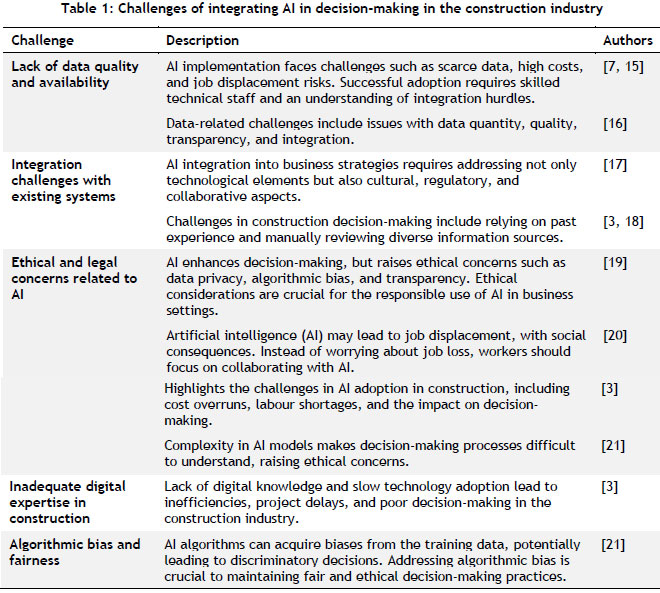
Table 1 below summarises the difficulties associated with AI in decision-making in the construction sector that are identified in the literature. This table consolidates insights from various authors, highlighting the main barriers to effective AI implementation. These challenges must be addressed if AI is to fulfil its promise of revolutionising decision-making in construction. By understanding and overcoming them, AI integration will expand, and its potential to improve efficiency and project outcomes will be fully realised.
2.3. Opportunities of AI in decision-making
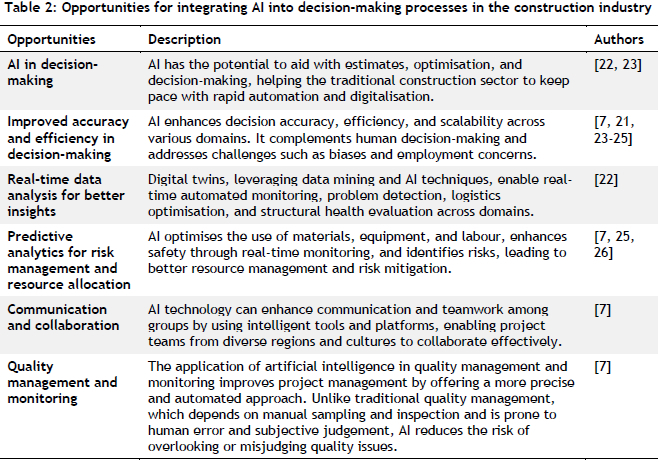
Despite the challenges, AI presents significant opportunities for construction project management. It is widely thought that AI has the potential to meet expectations in fields such as cost estimation, optimisation, and decision-making, thereby helping the traditional construction sector to keep pace with rapid automation and digitalisation [22]. Table 2 lists these opportunities, showing how AI could transform decision-making in the construction sector by enhancing accuracy, efficiency, and collaboration.
Understanding these opportunities lies in their potential to address long-standing inefficiencies in construction project management. By recognising and leveraging AI's capabilities, the industry could overcome many limitations, from decision-making bottlenecks to ineffective resource management. Without tapping into these opportunities, the construction sector risks falling behind in an increasingly digital and automated world.
The opportunities for integrating AI into construction project management offer significant improvements in decision-making accuracy, resource allocation, and communication, and would address many industry inefficiencies. While challenges such as data quality and ethical concerns exist, AI's potential benefits, such as real-time data analysis and predictive analytics, could mitigate these barriers. AI's advantages could help to overcome challenges; this suggests that, with proper strategies, AI adoption could outweigh its obstacles and improve decision-making strategies in the construction industry.
In addition to reviewing the challenges and opportunities for AI in construction decision-making in the literature, the next section discusses various technology adoption models that may apply to this technology.
3. CONCEPTUAL MODEL
The conceptual model developed in this study builds upon the literature to evaluate the challenges and opportunities of incorporating AI into decision-making in the construction industry. Mahinkanda et al. [27] highlight that a robust conceptual framework draws on previous research to identify interrelationships and discover emerging patterns, allowing for comprehensive reviews that are built on theoretical foundations. This study is anchored in several theories, the rational decision-making model, which emphasises optimising outcomes through thorough information assessment [28]; bounded rationality, which recognises the cognitive limitations that influence satisfactory rather than optimal decisions [29]; and satisficing, which posits that decision-makers often settle for "good enough" solutions owing to the impracticality of exhaustive evaluation [30, 31]. In addition, the technology acceptance model (TAM) explains how perceived usefulness and ease of use affect the adoption of AI technologies in construction [32], while the innovation diffusion theory (IDT) addresses how AI innovations spread in the industry [33, 34]. By integrating these theories, the conceptual model provides a nuanced understanding of AI's potential to transform decision-making processes in construction project management, ultimately identifying how AI could address existing difficulties and improve overall project outcomes.
3.1. Theoretical foundations
This study is grounded in the following decision-making theories:
• Rational decision-making model: This model emphasises a thorough assessment of available information to optimise outcomes, assuming perfect cognitive abilities [28]. The rational decision-making model posits that individuals make optimal decisions based on thorough information assessment. This model highlights the limitations of traditional decision-making processes in construction, as decision-makers often face cognitive and informational constraints. These limitations highlight the potential for AI to enhance decision-making by analysing large volumes of data more efficiently than humans can.
• Bounded rationality: This concept acknowledges cognitive limitations and incomplete information, often leading to decisions that are satisfactory rather than optimal [29, 35]. The concept recognises that decision-makers function within the limitations of restricted information and time, and so it directly ties into this study. AI could assist by overcoming some of these limitations, enabling faster and more informed decisions in complex construction environments.
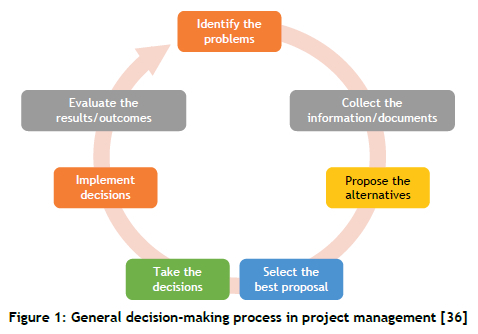
Satisficing: This theory suggests that decision-makers settle for "good enough" solutions owing to the impracticality of evaluating every option exhaustively [30, 31], rather than striving for optimal ones. With AI, there is a paradigm shift towards more accurate and consistent decision-making through algorithmic tools, showing that AI could enhance the traditional decision-making process in construction projects. Khahro et al. [36] describe a decision-making process as a planned method for making choices, guided by pertinent information collected from different stakeholders involved in the project, such as clients, consultants, and contractors. Figure 1 illustrates the general decision-making processes in project management.
• The technology acceptance model (TAM) is another theory that explores how perceived usefulness and ease of use affect technology adoption, which is particularly relevant for understanding AI integration into construction [32]. TAM provides a framework for understanding how construction decision-makers might adopt AI technologies. Perceived usefulness and ease of use are critical factors that influence the adoption of AI in project management. This model helps to explain the attitudes and behaviours of construction professionals when integrating AI into their decision-making processes.
• Innovation diffusion theory (IDT) explains how and why innovations such as AI spread in industries, and addresses the barriers to AI adoption [33, 34]. IDT explains how innovations such as AI are adopted by stakeholders in the construction industry. By applying this model, the study explores how different groups (contractors, clients, and project managers) adopt AI and how this affects decision-making across construction projects.
• Building information modelling (BIM) technologies help to reduce waste and to enhance efficiency, playing a critical role in project management by integrating AI into construction workflows [37]. BIM offers tangible examples of AI's potential to enhance project outcomes through improved communication, lean management, and reduced material waste. It serves as an example of how AI could transform decision-making in the construction industry by facilitating more efficient data-driven processes.
• In Luhmann's systems theory, complexity is defined by several key factors: the differentiation of roles and functions among various project stakeholders such as clients, contractors, and consultants; the internal diversity in an organisation; the dependencies between overarching systems, individual systems, and subsystems; and the effects or processes within a decision-making framework [38]. Integrating AI into numerous industries has resulted in significant advancements, promising transformative effects on operational efficiency, decision-making processes, and overall performance [39]. In construction project management, where complexity and uncertainty often present formidable challenges, the potential of AI to revolutionise decision-making processes is particularly intriguing [40].
3.2. Proposed model
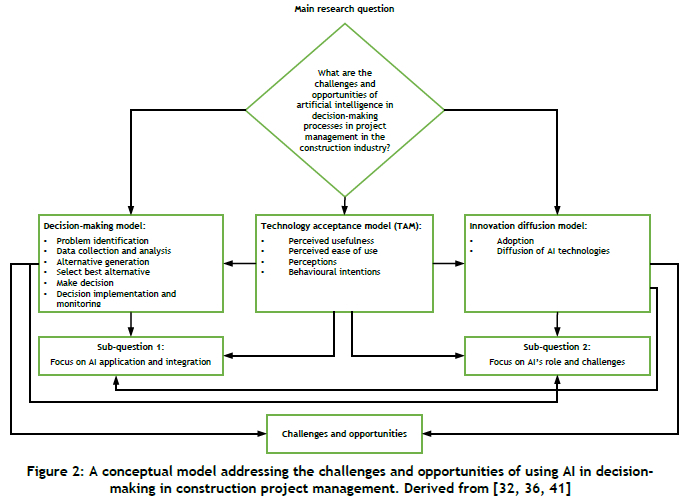
After reviewing the relevant theoretical models, it was decided to base the study on three main models: the TAM, the decision-making model, and IDT, as these were considered most applicable to AI as a technology. The proposed conceptual model below examines how the perceived benefits and ease of use (TAM) influence construction project managers' behavioural intentions to adopt AI, which in turn has an impact on decision-making effectiveness and efficiency. The framework also incorporates innovation characteristics (IDT) and stages of decision-making, mapping AI's role in various decision-making phases. External variables (such as industry norms, economic conditions, and technological infrastructure), social systems, and communication channels serve as moderating aspects, influencing both the adoption and the diffusion of AI in the construction sector. The outcomes highlight the dual nature of AI integration, with opportunities for improved project outcomes and resource management balanced against barriers such as resistance to change and the complexities of AI implementation. This framework provides an in-depth perspective on how AI could transform decision-making in construction project management, while also addressing the potential hurdles to its adoption and use.
The conceptual model addresses the main research question, using IDT, which explains how AI is adopted throughout the industry, influenced by social systems and communication channels; the decision-making model, which examines how AI affects various stages of decision-making to improve effectiveness and efficiency; and the TAM, which emphasises that Al's perceived usefulness and ease of use are vital factors in its adoption and realising its potential.
To develop an answer to the main research questions, several sub-questions were asked, such as "Where could AI be used to aid decision-making in construction project management?" It was determined that AI is applied and integrated with current processes through the decision-making model and IDT. The question directly aligns with identifying where in the decision-making process AI could be most beneficial, such as in data collection, analysis, or generating alternatives. It also touches on both the apparent usefulness (benefits) and ease of use (challenges), as well as on the broader diffusion of AI technologies in the industry. Sub-question 2 asks: "What role does AI play in decision-making processes in construction project management?" We explored AI's role in enhancing decision-making stages, such as data analysis and problem identification, with a focus on its contributions to efficiency and accuracy. It is linked to the TAM and the decision-making model with the perceived usefulness of specific AI applications and their role in various stages of the decision-making process. It is also linked to the IDT, as it addresses the broader adoption of AI in the construction sector, comprising resistance to change and integration difficulties.
The conceptual model integrates the TAM, the decision-making model, and IDT to explore AI's role in construction project management. It reveals how AI adoption, shaped by its perceived benefits and ease of use, could enhance decision-making efficiency. The model also highlights the difficulties of integrating AI, such as resistance to change and industry adoption barriers, providing a comprehensive view of AI's potential to transform and the complexities involved in its implementation in decision-making processes.
4. RESEARCH METHODOLOGY
Building on the proposed conceptual model, this study used interviews with construction professionals to explore AI's challenges and opportunities. Semi-structured questions guided the discussions of AI's impact, challenges, and effectiveness in improving decision-making processes [42-44].
4.1. Research design
The research design incorporated data collection methods, sampling approaches, and instrument design [45]. According to Pandey and Pandey [46], a research design is a blueprint for conducting a study. This research is classified as exploratory, as it aimed to investigate the relatively underexplored area of AI's influence on decision-making in the construction industry. An exploratory approach was especially fitting in this context, since it enabled flexibility and the generation of new insights, which would be crucial when examining a dynamic and rapidly evolving subject such as AI. The study captured firsthand perceptions from construction industry professionals about the integration of AI in decision-making, adopting a qualitative research method that used semi-structured interviews and thematic data analysis. This methodology facilitated a comprehensive examination of the participants' experiences and insights, helping to discover underlying themes and patterns that may not have been evident in quantitative studies. Ultimately, the exploratory nature of this research enabled thorough insight into the challenges and possibilities of AI integration into decision-making in construction project management.
4.2. Research approach
The study used a qualitative research approach to explore participant experiences through interviews [47]. Unlike quantitative methods, which prioritise quantitative data and statistical analysis [48], qualitative research offers rich insights into participants' motivations, perspectives, and contextual factors. A mixed-methods approach was considered but ultimately not pursued, as the qualitative method provided sufficient depth to explore the challenges and opportunities of AI adoption in decision-making [49].
4.3. Data collection method
The research methodology denotes the structured approach used to ensure the reliability and validity of the study [50]. The methodology used in this study comprised the following components:
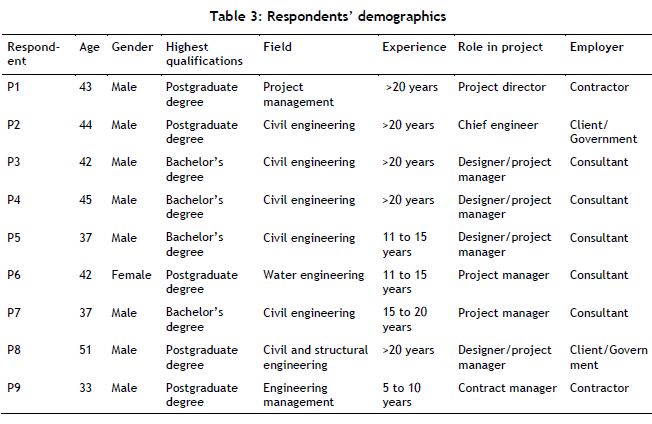
Primary data was collected through semi-structured interviews (the interview questions are provided in Appendix A), which were conducted online via Microsoft Teams. Microsoft Teams was chosen because it is the platform that the university's ethics board recommends for online meetings. The interviews were recorded and transcribed for analysis [51]. Purposive sampling was used to choose participants from the construction industry; we specifically targeted professionals with experience in AI and decision-making [52, 53]. The study involved nine interviews with construction professionals. Through iterative analysis of the interview transcripts, no new themes or insights emerged after the ninth interview, at which point it was decided to stop data collection owing to data saturation occurring [54, 55]. The participants ranged in age from 33 to 51. Years of experience ranged from five to over 20 years, and interviewees held different roles such as project director, chief engineer, project manager, and contract manager in a range of contractor, consultant, and client organisations. Their qualifications included Bachelor's and postgraduate degrees in civil engineering, water engineering, and project management, as shown in Table 3 below. The semi-structured interview guide (Appendix A) focused on AI's impact on decision-making in construction project management. The interviews were conducted after receiving ethical clearance. A pilot study with one participant was also done to test the interview questions and the research process. Since the pilot results indicated no problems, no changes were made to the interview guide or procedures [56].
4.4. Data analysis
The data was analysed using ATLAS.ti version 24. A thematic analysis was done to discover patterns, themes, and insights related to the role of AI in construction project management decision-making [57-59]. The themes were refined and helped to identify emerging patterns. ATLAS.ti's visual tools, such as network diagrams, were used to understand the relationships between themes.
5. RESULTS
Three major themes emerged from the study: (1) challenges of AI integration in construction; (2) roles of AI in decision-making; and (3) uses of AI in construction. These three themes and their sub-themes are discussed below.
5.1. Challenges of integrating AI in decision-making in the construction industry
The key challenges that emerged from the study are categorised into six subthemes. These themes, derived from 41 initial codes, are summarised below. The challenges include job loss, lack of skills, internet connectivity, high cost, slow adoption, and reliance on data quality.
• AI reduces manual labour or leads to job losses
Three participants (P2, P4, and P8) highlighted that AI reduces manual labour, leading to job losses, particularly in countries such as South Africa. P2 noted that AI primarily benefits those skilled in technology, affecting traditional labour. P4 emphasised that AI's efficiency in complex tasks, such as road construction, reduces the need for technicians and raises concerns about future employment. P8 pointed out resistance to AI adoption because of fears of job loss. While AI improves efficiency in planning and construction, it presents significant challenges to job creation, particularly in communities that rely on casual labour.
• Lack of skills and experience
Participants P1, P2, and P3 identified a lack of skills as a significant challenge in adopting AI technologies in construction decision-making. P1 noted that many companies lack trained staff and face high adoption costs, which, along with resistance to change, hamper AI integration. P2 emphasised the importance of proper equipment setup and calibration to avoid errors. P3 recommended continuous professional development and Al-focused training to help current professionals to adapt. P8 highlighted high costs, connectivity issues in rural areas, and a shortage of skilled personnel as key obstacles, especially in South Africa. Overcoming these challenges requires targeted training and investment.
• Internet connectivity issues
Participants P3, P6, and P8 highlighted poor internet connectivity as a major challenge in using AI for decision-making in remote construction sites. Connectivity problems hinder virtual meetings and limit AI deployment, particularly in rural areas. Despite this, AI offers significant benefits and growing value in project management. These could be achieved by investing in infrastructure, especially in rural areas where this challenge is prevalent.
• High costs
The high cost of AI in construction is a significant challenge, as highlighted by participants P1, P3, P6, P7, and P8. P1 and P3 emphasised that AI's initial expense, including software, licences, and equipment, is often justifiable only for high-return projects. P8 added that this cost, along with the need for skilled staff, would increase the financial burden. P6 highlighted the impracticality of multiple licences because of their cost, while P3, P6, and P8 mentioned connectivity issues in remote areas, which would further limit AI's effectiveness.
• Slow adoption
AI acceptance in the construction industry is slow, as highlighted by P1 and P3. P1 attributed this to high costs, lack of skills, and resistance to change. Many companies struggle with training and implementation. P3 stressed the importance of continuous professional development to help professionals to adapt and to use AI technologies effectively.
AI's effectiveness in construction relies on accurate, up-to-date input data, as noted by P3 and P5. P3 highlighted that incomplete or outdated GIS data, particularly in remote areas, would reduce the efficiency of AI tools such as Navisworks. P5 emphasised that AI systems depend on quality input data and require human oversight to ensure accurate outputs.
5.2. The role of AI in decision-making in the construction industry
The study identified the following five key roles for AI-assisted decision-making in the construction sector:
• Accurate decision-making
AI enhances construction management by improving decision-making efficiency and accuracy, as noted by P3 and P8. P3 emphasised that AI reduces human error and manages risks. At the same time, P8 highlighted how AI enables precise, timely insights, and effective collaboration among globally dispersed teams, eliminating the need for physical site visits.
• Human decision support
AI supports human decision-making by reducing errors and optimising processes. Examples include tracking systems in construction equipment to prevent the misuse of equipment (P1). P2 remarked, "Human errors are also minimised." However, dependence on connectivity can be a limitation (P4).
• Rapid decision-making
AI accelerates decision-making by providing timely data and analysis. It simplifies tasks such as design changes by quickly gathering and assessing data, which saves time and effort (P5, P8). Despite some problems with integration, AI's ability to facilitate rapid decision-making is evident (P3, P4).
• Data gathering
AI improves data collection through technologies that offer real-time, accurate information. This enhancement supports decision-making with high-quality data and images (P2, P8). AI's quick and accurate data gathering offers a more realistic basis for decision-making than do conventional methods. This reduces time and effort, especially in design changes, by promptly determining necessity.
• Data analysis
AI excels in automating data analysis, which supports various aspects such as quality control and project planning. It provides accurate models and optimises schedules by analysing data from weather and logistics (P2, P5, P8).
5.3. Uses of AI in decision-making in construction project management
AI has demonstrated transformative effects in various aspects of decision-making in construction project management. From 101 codes, six key subthemes emerged, highlighting the diverse applications of AI; they are discussed below.
• Accurate decision-making
AI significantly enhances accuracy and efficiency in construction, transforming decision-making and project and risk management. P2 highlighted drones equipped with AI tools that improve survey speed and accuracy, while AI-driven tools also assist with budget assessments and desktop studies, and machine learning is used for risk prediction.
• Use of AI in designs
P3 emphasised the use of AI software such as Navisworks for design accuracy. P4 pointed out that AI tools quickly detect errors in design and reduce the need for manual input. AI is transforming the design phase of construction projects, improving accuracy and efficiency during the design, pre-feasibility, and feasibility stages, such as BIM-integrated AI for design. P2 emphasised its usefulness in planning, although its adoption is limited during construction owing to its incompatibility with manual labour. Despite obstacles in the construction industry, AI's advancement could eventually revolutionise both design and construction, reshaping workflows and making traditional roles obsolete while enhancing overall project execution. As AI technology advances, it could reshape traditional roles and streamline processes in construction.
• AI for budget management
AI tools have revolutionised budget management in construction projects, enhancing accuracy and efficiency across phases. In road projects, AI ensures that quality metrics are met, minimising rework and reducing costs (P1).
• Cost reduction
P1, P3, P6, and P8 emphasised that AI tools minimise rework, meet quality standards, reduce costs, and ensure timely project completion. For example, AI tools facilitate virtual meetings, thereby reducing travel expenses but achieving the same objectives.
• Land survey and data collection
AI-powered technologies enhance land surveys in construction by improving accuracy, saving time, and reducing costs. P2, P5, and P8 noted the efficiency of drones fitted with AI technology in predicting pipe routes, conducting surveys in challenging areas, and aiding decision-making, ultimately streamlining project processes.
• Progress tracking
AI tools have improved progress tracking in construction. P2, P3, P4, and P6 highlighted the benefits of real-time tracking, red-flagging issues, and providing timely insights. These tools help to manage resources, enhance decision-making, and keep projects on schedule.
6. CONCLUSION AND RECOMMENDATIONS
This study has explored the challenges and opportunities of artificial intelligence (AI) in decision-making in construction project management. Lean principles were incorporated into the analysis to identify how AI could deliver maximum value to this sector. The TAM and IDT models help to frame how professionals perceive the benefits and simplicity of AI, which have a direct impact on its integration into decision-making processes. In practice, the study highlights real-world challenges, including skill gaps, high implementation costs, and resistance to AI adoption, as well as opportunities such as improved decision-making efficiency and enhanced predictive capabilities in project management. By investigating these areas, the research could equip construction managers, technology providers, and policymakers with actionable insights to integrate AI effectively into the industry.
The research identified a significant gap: AI's integration into construction project management offers opportunities and challenges, yet its application remains less investigated than in other sectors. The findings are based on insights from a review of the literature and primary research on AI's impact on decision-making processes. The literature highlights AI's transformative potential for enhancing decision-making in construction and for improving efficiency, safety, and accuracy. Key findings include these:
• AI helps to optimise resource allocation and to predict risks, enabling informed, data-driven decisions.
• AI offers real-time data analysis, predictive analytics for risk management, and improved project outcomes.
• Barriers include data quality issues, system integration difficulties, ethical concerns (for example, bias), and limited digital expertise in the construction industry.
• Despite the challenges, AI adoption is gradually increasing, suggesting growing potential for its impact on project management.
The research identified significant challenges:
• AI's automation may lead to job losses, particularly in labour-intensive regions such as South Africa, raising social concerns.
• The industry lacks expertise in AI, slowing its adoption and reducing decision-making efficiency.
• Limited internet access in remote sites hampers AI deployment and decision-making efficiency.
• Data quality issues limit opportunities, such as predictive analytics
• AI technologies and their implementation are expensive, limiting access for smaller firms.
Despite these challenges, AI offers substantial opportunities:
• AI improves accuracy, reduces human error, and accelerates decision-making processes.
• AI provides precise insights, aiding project scheduling, resource allocation, and risk management.
This research broadens the current understanding by exploring how AI influences decision-making in construction project management. Although it does not quantify AI's direct effects, it highlights major challenges in AI adoption and analyses how construction workforce dynamics are evolving. These findings should be helpful for developing future education and training initiatives. The study also provides an in-depth analysis of AI's potential advantages, challenges, and applications, serving it a useful resource for industry professionals and scholars.
Concerning its theoretical implications, the study recommends broadening current frameworks by integrating traditional decision-making theories in construction management and AI analytics to improve decision accuracy, speed, and data use. For example, integrating predictive analytics could shift decision models from relying on historical data to real-time, data-informed strategies. The study also highlights the slow adoption of AI in the construction sector, which suggests a need to refine the TAM to address industry-specific barriers, such as high implementation costs and skill shortages. The study also advocates re-evaluating ethical frameworks to tackle potential job losses caused by AI. It proposes updating systems and human-technology interaction theories to reflect AI's growing influence in decision-making and labour dynamics better. Future research could involve comparative studies to assess the effectiveness of AI-based decision models against traditional methods, offering clearer guidance for industry implementation.
From a practical perspective, AI presents opportunities to optimise resource allocation, enhance efficiency, and improve decision-making in construction projects. However, the construction industry must first address skills gaps, high costs, and connectivity issues to benefit fully from AI. Ethical concerns, such as algorithmic bias and job loss, also need careful management. A gradual, strategic approach to AI adoption is advisable to help the industry to adapt.
The study has several limitations, such as its focus on South Africa, a small sample size, and the rapid development of AI technologies. These factors may limit the applicability of the results to other regions. In addition, a deeper exploration of ethical issues and data management practices is necessary. To strengthen the validity of the findings, it is advisable to include strategies such as triangulation by using project documents or outputs from AI tools and doing member checking. The current study did not explicitly include interview questions that measure the constructs of TAM or IDT. We suggest that future research incorporate these measures to connect the methodology and findings more directly to the conceptual model and its decision-making stages.
Future research should investigate emerging AI technologies, their influence on the workforce, and the ethical and legal issues in the construction sector. Actions should be taken to improve data quality and management for more effective AI-driven decision-making.
Recommendations:
• Implement comprehensive training programmes for construction professionals to bridge the AI skills gap.
• Ensure data accuracy and reliability in AI systems while exploring cost-effective solutions to promote broader industry access.
• Address internet connectivity challenges, especially in remote areas, and encourage phased AI adoption to manage costs and resistance.
• Develop ethical guidelines to mitigate the biases and legal issues associated with AI use.
The study builds on the literature by reaffirming AI's potential to revolutionise decision-making in construction project management. It aligns with previous research that highlights challenges such as skill shortages, ethical issues, and the need for strategic planning. The study also provides a more targeted analysis of AI's specific effects on workforce dynamics and decision-making efficiency, offering a nuanced view of AI adoption in the construction sector. CONCLUSION
REFERENCES
[1] I. Merdzanovic, M. Vukomanovic, and D. Ivandic Vidovic, "A comprehensive literature review of research trends of applying AI to construction project management," in Proceedings of the 6th IPMA SENET Project Management Conference "Digital Transformation and Sustainable Development in Project Management," 2023, Zagreb, pp. 230-247. [ Links ]
[2] R. A. Howard and A. E. Abbas, Foundations of decision analysis. Pearson, 2015. [ Links ]
[3] S. O. Abioye et al., "Artificial intelligence in the construction industry: A review of present status, opportunities and future challenges," Journal of Building Engineering, vol. 44, 103299, 2021. [ Links ]
[4] A. Faraji, S. Homayoon Arya, E. Ghasemi, P. Rahnamayiezekavat, and S. Perera, "Building information modeling (BIM), blockchain, and LiDAR applications in construction lifecycle: Bibliometric, and network analysis," Buildings, vol. 14, no. 4, 919, 2024. [ Links ]
[5] P. Ghimire, K. Kim, and M. Acharya, "Opportunities and challenges of generative AI in construction industry: Focusing on adoption of text-based models," Buildings, vol. 14, no. 1, 220, 2024. [ Links ]
[6] A. Mohapatra, A. R. Mohammed, and S. Panda, "Role of artificial intelligence in the construction industry: A systematic review," International Journal of Advanced Research in Computer and Communication Engineering, vol. 12, pp. 24-29, 2023. [ Links ]
[7] Z. Diao, "Project management in the age of artificial intelligence," Highlights in Business Economics and Management, vol. 39, pp. 1119-1125, 2024. [ Links ]
[8] H. Salehi and R. Burgueño, "Emerging artificial intelligence methods in structural engineering," Engineering Structures, vol. 171, pp. 170-189, 2018. [ Links ]
[9] S. L. Epstein, "Wanted: Collaborative intelligence," Artificial Intelligence, vol. 221, pp. 36-45, 2015. [ Links ]
[10] P. Arroyo, A. Schöttle, and R. Christensen, "The ethical and social dilemma of AI uses in the construction industry," in Proceedings of the 29th Annual Conference of the International Group for Lean Construction (IGLC), Lima, Peru, 2021, pp. 12-18. [ Links ]
[11] A. Waqar, "Intelligent decision support systems in construction engineering: An artificial intelligence and machine learning approaches," Expert Systems with Applications, vol. 249, 123503, 2024. [ Links ]
[12] P. Meissner and Y. Narita, "Artificial Intelligence will transform decision-making. Here's how," World Economic Forum, 2023. [ Links ]
[13] S. Pratt, S. Blumberg, P. K. Carolino, and M. R. Morris, "Can language models use forecasting strategies?" arXiv preprint arXiv:2406.04446, 2024. [ Links ]
[14] E. Blessing, "Regulatory compliance and ethical considerations: Compliance challenges and opportunities with the integration of big data and AI," https://hal.science/hal-04972082v1/document, 2024. [ Links ]
[15] M. I. Hashfi and T. Raharjo, "Exploring the challenges and impacts of artificial intelligence implementation in project management: A systematic literature review," International Journal of Advanced Computer Science and Applications, vol. 14, no. 9, pp. 366-376, 2023. [ Links ]
[16] Y. K. Dwivedi et al., "Artificial intelligence (AI): Multidisciplinary perspectives on emerging challenges, opportunities, and agenda for research, practice and policy," International Journal of Information Management, vol. 57, 101994, 2021. [ Links ]
[17] S. Kaggwa, T. F. Eleogu, F. Okonkwo, O. A. Farayola, P. U. Uwaoma, and A. Akinoso, "AI in decision making: Transforming business strategies," International Journal of Research and Scientific Innovation, vol. 10, no. 12, pp. 423-444, 2024. [ Links ]
[18] G. Sharma, R. Karim, O. Samuelson, and K. Simu, "A conceptual model for AI-enabled digitalization of construction site management decision making," in International Congress and Workshop on Industrial AI, 2023, pp. 145-159. [ Links ]
[19] L. G. Conti and P. Seele, "The contested role of AI ethics boards in smart societies: A step towards improvement based on board composition by sortition," Ethics and Information Technology, vol. 25, no. 4, 51, 2023. [ Links ]
[20] G. Cao, Y. Duan, J. S. Edwards, and Y. K. Dwivedi, "Understanding managers' attitudes and behavioral intentions towards using artificial intelligence for organizational decision-making," Technovation, vol. 106, 102312, 2021. [ Links ]
[21] A. Serwar, "The role of artificial intelligence in management decision-making: A critical appraisal," The Journal of Research Review, vol. 1, no. 02, pp. 77-85, 2024. [ Links ]
[22] Y. Pan and L. Zhang, "Roles of artificial intelligence in construction engineering and management: A critical review and future trends," Automation in Construction, vol. 122, 103517, 2021. [ Links ]
[23] M. M. I. Shamim, "Artificial intelligence in project management: Enhancing efficiency and decisionmaking," International Journal of Management Information Systems and Data Science, vol. 1, no. 1, pp. 1-6, 2024. [ Links ]
[24] M. E. Balbaa and M. S. Abdurashidova, "The impact of artificial intelligence in decision making: A comprehensive review," EPRA International Journal of Economics, Business and Management Studies (EBMS), vol. 11, no. 2, pp. 27-38, 2024. [ Links ]
[25] K. Wang, Z. Ying, S. S. Goswami, Y. Yin, and Y. Zhao, "Investigating the role of artificial intelligence technologies in the construction industry using a Delphi-ANP-TOPSIS hybrid MCDM concept under a fuzzy environment," Sustainability, vol. 15, no. 15, 11848, 2023. [ Links ]
[26] M. C. Duica, C. G. Vasciuc, and D. Panagoret, "The use of artificial intelligence in project management," Valahian Journal of Economic Studies, vol. 15, no. 1, pp. 105-118, 2022. [ Links ]
[27] M. M. M. P. Mahinkanda, J. J. Ochoa Paniagua, R. Rameezdeen, N. Chileshe, and N. Gu, "Design decision-making for construction waste minimisation: A systematic literature review," Buildings, vol. 13, no. 11, 2763, 2023. [ Links ]
[28] H. A. Simon, Administrative behavior: A study of decision-making processes in administrative organization. New York: The Macmillan Company, 1947. [ Links ]
[29] H. A. Simon, "A behavioral model of rational choice," The Quarterly Journal of Economics, vol. 69, pp. 99-118, 1955. [ Links ]
[30] H. A. Simon, "Rational choice and the structure of the environment," Psychological Review, vol. 63, no. 2, p. 129, 1956. [ Links ]
[31] T. Snow, "From satisficing to artificing: The evolution of administrative decision-making in the age of the algorithm," Data & Policy, vol. 3, e3, 2021. [ Links ]
[32] S. Na, S. Heo, S. Han, Y. Shin, and Y. Roh, "Acceptance model of artificial intelligence (AI)-based technologies in construction firms: Applying the technology acceptance model (TAM) in combination with the technology-organisation-environment (TOE) framework," Buildings, vol. 12, no. 2, 90, 2022. [ Links ]
[33] C. Budayan and O. Okudan, "Assessment of barriers to the implementation of smart contracts in construction projects: Evidence from Turkey," Buildings, vol. 13, no. 8, 2084, 2023. [ Links ]
[34] E. M. Rogers, "Diffusion of innovations: Modifications of a model for telecommunications," in Die diffusion von innovationen in der telekommunikation, vol 17, M. W. Stoetzer and A. Mahler, Eds., Berlin, Heidelberg: Springer, 1995, pp. 25-38. [ Links ]
[35] M. Knauff and W. Spohn, Eds. Handbook of rationality. Cambridge, MA: MIT Press, 2021. [ Links ]
[36] S. H. Khahro, H. H. Shaikh, N. Y. Zainun, B. Sultan, and Q. H. Khahro, "Delay in decision-making affecting construction projects: A sustainable decision-making model for mega projects," Sustainability, vol. 15, no. 7, 5872, 2023. [ Links ]
[37] X. Qin, Y. Shi, K. Lyu, and Y. Mo, "Using a TAM-TOE model to explore factors of building information modelling (BIM) adoption in the construction industry," Journal of Civil Engineering and Management, vol. 26, no. 3, pp. 259-277, 2020. [ Links ]
[38] J. R. San Cristóbal, "Complexity in project management," Procedia Computer Science, vol. 121, pp. 762-766, 2017. [ Links ]
[39] A. E. H. Gabsi, "Integrating artificial intelligence in Industry 4.0: Insights, challenges, and future prospects - a literature review," Annals of Operations Research, pp. 1-28, 2024. [ Links ]
[40] R. Baltezarevic, "Impact of artificial intelligence on the global economy," Megatrend Revija, vol. 20, no. 3, pp. 13-24, 2023. [ Links ]
[41] T. A. Wani and S. W. Ali, "Innovation diffusion theory," Journal of General Management Research, vol. 3, no. 2, pp. 101-118, 2015. [ Links ]
[42] Q. Wang, F. Zhang, R. Li, and J. Sun, "Does artificial intelligence promote energy transition and curb carbon emissions? The role of trade openness," Journal of Cleaner Production, vol. 447, 141298, 2024. [ Links ]
[43] H. Aladag, "Assessing the accuracy of ChatGPT use for risk management in construction projects," Sustainability, vol. 15, no. 22, 16071, 2023. [ Links ]
[44] B. P. Loo and R. W. Wong, "Towards a conceptual framework of using technology to support smart construction: The case of modular integrated construction (MiC)," Buildings, vol. 13, no. 2, 372, 2023. [ Links ]
[45] A. Gupta and N. Gupta, Research methodology. Agra, India: SBPD Publications, 2022. [ Links ]
[46] P. Pandey and M. M. Pandey, Research methodology: Tools and techniques. Bridge Center: Romania, 2015. [ Links ]
[47] M. M. Hennink, B. N. Kaiser, and M. B. Weber, "What influences saturation? Estimating sample sizes in focus group research," Qualitative Health Research, vol. 29, no. 10, pp. 1483-1496, 2019. [ Links ]
[48] M. J. Goertzen, "Introduction to quantitative research and data," Library Technology Reports, vol. 53, no. 4, pp. 12-18, 2017. [ Links ]
[49] S. Dawadi, S. Shrestha, and R. A. Giri, "Mixed-methods research: A discussion on its types, challenges, and criticisms," Journal of Practical Studies in Education, vol. 2, no. 2, pp. 25-36, 2021. [ Links ]
[50] M. Patel and N. Patel, "Exploring research methodology," International Journal of Research and Review, vol. 6, no. 3, pp. 48-55, 2019. [ Links ]
[51] H. Taherdoost, "Data collection methods and tools for research: A step-by-step guide to choose data collection technique for academic and business research projects," International Journal of Academic Research in Management (IJARM), vol. 10, no. 1, pp. 10-38, 2021. [ Links ]
[52] E. R. Babbie, The practice of social research. Cengage AU, 2020. [ Links ]
[53] M. M. Rahman, "Sample size determination for survey research and non-probability sampling techniques: A review and set of recommendations," Journal of Entrepreneurship, Business and Economics, vol. 11, no. 1, pp. 42-62, 2023. [ Links ]
[54] M. M. Willie, "Population and target population in research methodology," Golden Ratio of Social Science and Education, vol. 4, no. 1, pp. 75-79, 2024. [ Links ]
[55] M. Hennink and B. N. Kaiser, "Sample sizes for saturation in qualitative research: A systematic review of empirical tests," Social Science & Medicine, vol. 292, 114523, 2022. [ Links ]
[56] K. H. Morin, "Clarifying the importance of pilot studies," Journal of Nursing Education, vol. 62, no. 9, pp. 487-488, 2023. [ Links ]
[57] J. W. Creswell and J. D. Creswell, Research design: Qualitative, quantitative, and mixed methods approaches. Sage Publications, 2017. [ Links ]
[58] K. Locke, M. Feldman, and K. Golden-Biddle, "Coding practices and iterativity: Beyond templates for analyzing qualitative data," Organizational Research Methods, vol. 25, no. 2, pp. 262-284, 2022. [ Links ]
[59] L. S. Nowell, J. M. Norris, D. E. White, and N. J. Moules, "Thematic analysis: Striving to meet the trustworthiness criteria," International Journal of Qualitative Methods, vol. 16, no. 1, 1609406917733847, 2017. [ Links ]
* Corresponding author: tarynbarnard@sun.ac.za
ORCID® identifiers
G. Bikwa
https://orcid.org/0009-0002-0427-5637
T.J. Bond-Barnard
https://orcid.org/0000-0003-0853-4480
APPENDIX A
Section B of interview guide: Semi-structured questions
The following sample questions guided the interviews:
Main research question: What are the challenges and opportunities of artificial intelligence in decision-making processes in project management in the construction industry?
• Can you provide insights into how artificial intelligence has influenced decision-making processes in construction project management in the projects that you have worked on in the past or projects that you are currently involved in?
• What challenges have you encountered that emerged from integrating AI into decision-making processes in the construction industry?
• What opportunities does AI present for improving decision-making effectiveness and efficiency in construction project management?
Sub-question 1: Where could AI be used to aid decision-making in construction project management?
• What are some examples of AI applications that you have used or that are currently being used for decision-making in construction project management in your work environment?
• How are AI technologies integrated into existing decision-making workflows in construction projects?
• Can you discuss any notable benefits or challenges associated with the current use of AI in decision-making processes in the construction industry?
Sub-question 2: What role does AI play in decision-making processes in construction project management?
• How does AI enhance your decision-making efficiency and accuracy in construction project management?
• What specific applications of AI have you used to aid decision-making in construction projects in the past and at present?
• What are the challenges you have experienced with integrating AI into decision-making processes in construction project management?