




Services on Demand
Journal

Article
 English (pdf)
 Article in xml format
 Article references
 Automatic translation
 Send this article by e-mail
Indicators
Related links
-
 Cited by Google
 -
 Similars in Google
Share

 Permalink
South African Journal of Industrial Engineering
On-line version ISSN 2224-7890
S. Afr. J. Ind. Eng. vol.36 n.4 Pretoria Dec. 2025
https://doi.org/10.7166/36-4-3238
GENERAL ARTICLES
Implementation of a Lean Manufacturing Approach to Improving Productivity in SMEs: A Case Study in a Cloth Manufacturing Company
T.K. Ramasu*; M.G. Kanakana-Katumba
Department of Industrial Engineering, Tshwane University of Technology, Pretoria, South Africa
ABSTRACT
This study explored the implementation of a lean manufacturing approach to enhance productivity in small and medium-sized enterprises, focusing on a cloth manufacturing company as a case study. The objectives of this approach were to improve production efficiency and to minimise waste while ensuring a clean and safe working environment for employees. The methods used include 5S principles to help eliminate waste production in the form of rejects and reworks and assembly line balancing, with a particular emphasis on improving operational efficiency. The largest candidate rule method yielded significant improvements, reducing the number of workstations from 12 to 4, achieving an efficiency of 87.5%, and lowering the smoothing index to 22.05 compared with the existing system's 29.17% efficiency and 147.78 smoothing index. These findings underscore the potential of lean strategies to optimise production processes and reduce inefficiencies. The study recommends that the company consistently capture, analyse, and monitor key performance indicators to track progress, ensure transparency between management and employees, and sustain growth driven by lean practices. This case study highlights the transformative impact of lean manufacturing on SME productivity and operational excellence.
OPSOMMING
Hierdie studie het die implementering van 'n skraal vervaardigingsbenadering ondersoek om produktiwiteit in klein en mediumgrootte ondernemings te verbeter, met die fokus op 'n lapvervaardigingsmaatskappy as 'n gevallestudie. Die doelwitte van hierdie benadering was om produksiedoeltreffendheid te verbeter en om vermorsing tot die minimum te beperk, terwyl 'n skoon en veilige werksomgewing vir werknemers verseker word. Die metodes wat gebruik word, sluit in 5S-beginsels om te help om afvalproduksie uit te skakel in die vorm van verwerpings en herbewerkings en monteerlynbalansering, met 'n besondere klem op die verbetering van bedryfsdoeltreffendheid. Die grootste kandidaatreëlmetode het aansienlike verbeterings opgelewer, wat die aantal werkstasies van 12 tot 4 verminder het, 'n doeltreffendheid van 87.5% behaal het, en die gladmaakindeks tot 22.05 verlaag het in vergelyking met die bestaande stelsel se 29.17% doeltreffendheid en 147.78 gladmaakindeks. Hierdie bevindinge onderstreep die potensiaal van skraal strategieë om produksieprosesse te optimaliseer en ondoeltreffendheid te verminder. Die studie beveel aan dat The company konsekwent sleutelprestasie-aanwysers vaslê, ontleed en monitor om vordering na te spoor, deursigtigheid tussen bestuur en werknemers te verseker en groei gedryf deur skraal praktyke vol te hou. Hierdie gevallestudie beklemtoon die transformerende impak van skraal vervaardiging op KMO-produktiwiteit en bedryfsuitnemendheid
1. INTRODUCTION
Small and medium-sized sized enterprises (SMEs) continue to face a lot of turbulence, which hinders their overall survival despite the role they play in the economic well-being of every nation. Despite their significant contributions to alleviating poverty, reducing unemployment, and developing the economy [1 -3], a significant 60% to 80% of SMEs in South Africa fail within their first two years of existence [4-6]. The clothing and textile industry, which was previously a source of large-scale job creation in South Africa, has faced immense difficulties owing to the liberalisation of the trade policy that coincided with the dawn of democracy [7, 8]. This policy meant that industries such as clothing and textile, which were previously protected, were now open to competition from countries with lower production costs. The competition led to overall reduced local production and job losses as online shopping gained popularity; and South Africa is still battling to match the low production costs of the international market. Although this has significantly affected the clothing and textile industry, one of the greatest advantages with emerging economies, including South Africa, is that consumers still want the experience of personally assessing the quality of clothing when making a decision to purchase [9].
According to Chang and Cheng [10], SMEs should be promoted to participate in sustainable development. However, for sustainable development plans to be identified and implemented successfully, SMEs require a practical framework and an appropriate management method. The lean approach implemented in the case study is in line with the United Nations (UN) Sustainable Development Goals (SDGs) 4 and 8 to support SMEs in becoming more sustainable, responsible, and competitive in order to drive a more sustainable economy. A lean manufacturing approach was implemented through training and practical guidance. The aim of this study was to assess the effect of implementing a lean manufacturing approach on productivity, using the company as a case study. The objectives of this approach were to improve production efficiency and to minimise waste while ensuring a collaborative, clean, and safe working environment for employees. This was achieved through a blend of classroom training and in-factory consulting, helping the enterprises to integrate international best practices while promoting sustainable economic development and responsible labour practices.
The contribution of this study is to respond to SDG 4 on quality education and SDG 8 on decent work and economic growth. In addition, this study relates sustainable enterprising, competitive enterprising, and responsible enterprising to a lean manufacturing approach.
The next section of this article is the literature review, which surveys the concepts of sustainable enterprising, responsible enterprising, and competitive enterprising. Following the literature review is the method section, which details the steps that were taken to implement successfully the lean manufacturing approach in the selected enterprise. The method section is followed by the case study, which gives insight into the practical application of lean manufacturing. The section after that is the results and the discussion, which are followed by the conclusion.
This case study was undertaken at the company. The organisation was established as a cloth company in Johannesburg, Gauteng province, South Africa in 2000; later it expanded to include other products. The company is made up of production and other functional departments with a total of 165 staff. The production department has about 75% of the entire work force of the organisation. The company produces a wide variety of products daily. The production targets are determined by the nature of the orders, since the company produces products per order and the company only operates one shift.
1.1. Case study
A2C is a clothing manufacturing SME that has faced many difficulties over the past few years. At the core of their problems was the lack of collaboration between employees and supervisors, between supervisors and the production manager, and with management, which greatly affected communication and consequently production. This problem came with a lack of accountability by employees, which led to a large amount of waste and to reworks being generated. Employees and supervisors would hide rejects and reworks, and so management decided to implement the lean approach programme. The aim of the project was to improve productivity, minimise reworks, and strengthen the relationships between employees and management. This came as a result of the large amount of rework and waste consistently produced on the production floor. Despite various interventions that management tried, employee engagement had become a difficult task, and this was costing the organisation. This made it clear that there was gap between management and staff that needed to be bridged. In yet another effort by management to improve the work culture, they realised that their production lines were not organised to distribute tasks evenly in order to optimise the performance of the line. The key improvement focus areas were workplace cooperation, quality improvement, lean manufacturing, and resource efficiency. The cutting department was the model area for the lean approach, and t-shirt production was chosen to show how effective task allocations could improve the overall production output. Figure 1 shows the process flow chart of the t-shirt production.

2. LITERATURE REVIEW
The literature review aims to create a theoretical relationship between sustainable enterprising, competitive enterprising, and responsible enterprising in SMEs. These variables are considered to improve the productivity of SMEs. They could be viewed in a number of ways. First, they can be viewed independently as sustainability, competitiveness, responsibility, and enterprises. Second, they could be viewed in relation to enterprises: the competitiveness, responsibility, and sustainability of enterprises. Third, they could be viewed in relation to sustainable enterprises: as sustainable competitive enterprises and sustainable responsible enterprises. Ultimately, the lean approach is founded on four concepts: sustainability, competitiveness, responsibility, and enterprises. Thus, this study has treated them collectively as a single concept.
2.1. Sustainability
The concept of sustainability has been widely discussed by a variety of scholars, and the conversation about the meaning of sustainability has not yet been closed [11, 12]. According to Brundtland [12], "sustainability" refers to the ability for people to meet their present needs without compromising the ability of future generations to meet their own needs. It is a holistic approach that takes into consideration environmental, social, and economic factors, together with their interdependence, for a better quality of life [13, 14]. Environmentally, sustainability focuses on preserving ecosystems [15] and shifting to renewable energy sources. Sustainability also promotes a circular economy, which entails reusing, repairing, and recycling materials and products to reduce waste [16, 17]. The ultimate goal of sustainability is to create systems that are designed to be regenerative and restorative, contributing to a more balanced and just society while safeguarding the planet for future generations [18].
"Sustaining enterprises" create business models that integrate economic, environmental, and social factors into core strategies in order to make the enterprises viable in the long term. Sustainable enterprises prioritise a balance of profitability, social responsibility, and environmental stewardship [19]. Some of the key elements of sustainable enterprises are adopting circular economy principles to reduce waste by reusing, repairing, and recycling, and using energy-efficient practices to minimise environmental impact [17]. Sustaining enterprises also ensure that supply chains are ethical and resource-efficient [20]. Sustaining enterprises also foster inclusive workplaces, support local communities, and adhere to fair labour standards, thus prioritising social equity [21, 22]. Sustaining enterprises successfully occupy an advantaged position to mitigate risks, enhance brand value, and adapt to evolving consumer preferences, which increasingly favour ethical and sustainable products [23, 24].
Beyond the environment, sustainability also has social and economic dimensions that aim to foster equitable opportunities and well-being for all individuals. This involves promoting fair labour practices, addressing income inequality, ensuring access to essential services such as healthcare and education, and building sustainable economic models that drive growth without depleting resources [25]. The concept of a circular economy is an important aspect of sustainability, as materials and products are reused, repaired, and recycled to minimise waste [16, 17]. The ultimate goal is to create systems that are regenerative and restorative by design, contributing to a more balanced and just society while safeguarding the planet for future generations [18, 26].
2.2. Responsibility
The concept of responsibility in manufacturing enterprises has gained significant momentum, with modern corporate responsibility emphasising environmental sustainability, social responsibility, and ethical business practices. This holistic approach not only aligns with growing public expectations but also enhances competitiveness. Recent studies have examined various aspects of responsibility in manufacturing, such as corporate social responsibility (CSR), environmental stewardship, and enterprise risk management, each contributing to the sustainable growth of enterprises and their positive impact on society.
The impact of CSR on firm value has been explored through different theoretical lenses. Agency theory argues that managers might overspend on CSR to boost personal reputations, potentially diminishing firm value [39]. In contrast, stakeholder theory suggests that CSR initiatives can resolve stakeholder conflicts, ultimately enhancing firm value by aligning interests and fostering trust [40]. Supporting this positive view, substantial research indicates that CSR strengthens corporate sustainability, bolsters investor confidence, and reduces investment risks, ultimately enhancing firm value [41]. CSR initiatives demonstrate responsible resource management, strengthening corporate governance and increasing transparency, which benefits stakeholders by enabling well-informed decisions. These initiatives further enhance a firm's reputation as a secure investment, opening access to affordable funding and solidifying community trust [41].
Moreover, CSR significantly influences employee attitudes, fostering organisational trust and strengthening employees' commitment, satisfaction, and job stability. Internal CSR (ICSR) plays an especially important role in this regard, as managers who prioritise workforce-focused CSR can have a positive impact on organisational health, boost employee loyalty, and create a more supportive workplace environment [42-44]. When employees feel valued, they are more satisfied, motivated, and productive, contributing to overall organisational effectiveness and financial performance [45, 46].
Enterprises are essential to the social and economic fabric, acting as drivers of stability, job creation, and foreign exchange, while also bearing responsibility for environmental impacts. Although enterprise growth is a hallmark of socio-economic progress, production processes can generate pollutants, challenging environmental sustainability. As primary actors in both the market and environmental protection, enterprises play a dual role in advancing national economic goals and preserving ecological well-being [47, 48].
Corporate environmental responsibility (CER) has thus become a core component of CSR, particularly among SMEs, and aims to integrate environmental concerns with all operational facets to foster sustainable growth [49]. Public concerns about environmental issues often drive CER, as companies recognise that environmental violations could tarnish their brand image and reduce market appeal. This motivates businesses to address environmental responsibilities proactively in order to maintain a positive reputation. In addition, rising public concern could lead to stricter regulations, compelling companies to adopt sustainable practices in compliance with these new policies [48, 50]. Stakeholders, including investors, suppliers, and partners, increasingly scrutinise environmental performance, with poor records potentially leading to the withdrawal of support and to financial setbacks. Consequently, SMEs are increasingly motivated to adopt responsible environmental practices, balancing societal expectations with economic stability [48].
3. METHOD
This study used a case study approach based on the need to investigate the effect of the lean approach on a real scenario. A case study is able to provide a wealth of knowledge about the specific context under investigation [1]. The study used a descriptive approach as part of a quantitative research strategy. The analysis was based on a single case study of an SME in which the implementation of the lean approach was analysed, with a focus on 5S implementation (a workplace organization method that seeks to sort, set in order, shine, standardize, and sustain to eliminate waste and improve efficiency through a clean, safe, and productive environment) and assembly line balancing. Data was collected from the production process and through captured images of the model area. This approach to the lean method was systematic. First, a baseline analysis of the enterprise was conducted, followed by two days of workplace cooperation training with 18 members of the organisation, including the CEO, supervisors, operators from different departments, and shopfloor union representatives. Once the training had ended, 5S was implemented, supported by an onsite consultant who also helped the organisation to balance the assembly line. The next step was continually to monitor and assess the impact of the strategies that had been implemented, and then to track the results. This methodology section sets out the processes followed in implementing the strategies that were adopted.
3.1. Enterprise improvement plan
An enterprise improvement plan (EIP) is a customised action plan that is created to meet the unique improvement needs of an enterprise using the structure of the lean approach. The specifications of this plan differ according to the organisation; however, the ElP's core objective remains constant: to outline improvement projects systematically in line with the workplace cooperation module, divide them into actionable tasks, and assign roles, start dates, target completion dates, and actual completion dates. It also includes sections for comments and visual images.
For example, the first project of the company's EIP was to set up an enterprise improvement team (EIT). This project was divided into five tasks:
i. Finalise EIT membership;
ii. Identify members who will summarise sections of the training;
iii. Train additional EIT members on workplace cooperation;
iv. Develop agenda for the EIT; and
v. Conduct the first EIT meeting.
The EIP document serves as a template for that document, and monitors the improvements that the enterprise makes. Ideally, this document should serve as the continuous improvement "bible", as it should be available for traceability purposes, and both guide and incorporate practical ways for future continuous improvement. This gives the organisation a structured way to administer continuous improvement projects and to handle them with a sense of accountability.
The second project was to institute cross-functional management meetings, while the third project was to hold a morning meeting for all employees. The fourth project was to implement 5S in the cutting department (the model area); the fifth project was to improve productivity in the t-shirt section; and the sixth project was to implement a suggestions scheme. The seventh project was to implement the KPIs, followed by measuring absenteeism being the eighth project. The ninth project was to measure customer returns; the tenth project was to measure customer satisfaction; the eleventh project was to measure the productivity of the line; and the final project was to implement 5S in the digital printing department. The projects were undertaken one at a time, and each was broken down into five tasks to be able to measure progress on every task. This plan served as a crucial tracking tool, enabling the effective monitoring of continuous improvement and ensuring that the EIT remained accountable for its designated tasks and milestones.
3.2. Enterprise improvement team
As noted earlier, the two-day training was attended by 18 members of the organisation. Of these, 12 formed the EIT. Alkhaqani [53] emphasises the role played by team training in improving the effectiveness of teamwork. The EIT was charged with the responsibility of sustaining the lean principles that were taught, and driving their adoption on every level of the enterprise, with a specific focus on the model area to ensure that the EIP projects were executed, sustained, and improved. The team met weekly for a maximum of one hour to create a structured yet flexible space to review the progress made on the EIP project, to address any problems that might have been encountered, to brainstorm new improvement initiatives, and to facilitate transparent communication between management and staff. One of the main purposes of this team was to cultivate the spirit of cooperation and effective communication, which plays a crucial role on teamwork [53]. Teamwork, coupled with effective communication, also plays an essential role in delivering high-quality products and services [54].
The EIT was led by a chairperson and a secretary who were a supervisor and an operator respectively. This was deliberately arranged to develop leadership skills and foster diverse perspectives. This approach also promoted shared responsibility and encouraged team members to step into leadership roles, thus empowering the team to be proactive in its goals and collaborative in its approach to enhance the workplace's processes and culture.
The EIT meetings were the first point of contact to improve the cooperation between management and staff, as this platform allowed safe yet professional space for each category to describe what they had observed as hindering cooperation and productivity in the enterprise. These matters were then addressed. The platform also created an environment in which a shared vision could be fostered and transparency and teamwork were nurtured. This made it much easier for the employees in the EIT to get the rest of the employees on board with what was being implemented for sustainability and to involve them in coming up with ideas for improvement.
3.3. Green area meetings
Green area meetings took place in different departments every morning before the shift started. However, the EIP implemented a structured agenda for these meetings. They were kept strictly to 10 minutes, covering essential topics such as daily attendance, feedback from the previous shift, the production plan for the current shift, and any pertinent company updates or employee input. The primary aim of the green area meetings was to align and motivate the team for the day's objectives, fostering teamwork and encouraging employees to contribute ideas to improve the process to meet the day's target. When employee were absent, the meeting served as a forum to discuss and communicate workload adjustments to ensure smooth workflow and to prevent potential bottlenecks in the day's production plan. EIT members also formed part of these meetings. In some instances they were the supervisors who led the meetings and encouraged cooperation from their team, and in other instances they were the operators to encouraged their team members to cooperate actively; but in all instances the EIT was leading by example, encouraging cooperation and teamwork.
Implementing the 10-minute agenda was met with great resistance, as employees already had a culture of using that time to express their dissatisfactions, which made the meetings unproductive and started their day on a grumpy note. However, as time went on, the green area meetings became a great success owing to the influence that trickled down from the EIT in making them understand the essential role that they played as employees in the success of the organisation, and the urgent need for a culture change based on the impact of their behaviour on productivity.
3.4. 5S
The 5S methodology is a fundamental aspect of sustainable enterprising, aimed at enhancing organisational and operational efficiency in the workplace. As shown in Figure 2, it promotes a structured framework for workplace improvement, grounded in five key principles: sort, set in order, shine, standardise, and sustain. This systematic approach supports a well-organised and clean work environment, which in turn boosts productivity and workplace safety, laying a firm foundation for continuous improvement.
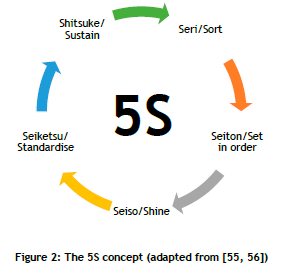
The 5S methodology is founded on the belief that a clean, orderly, and properly labelled workspace enhances productivity, safety, and employee morale. A well-organised environment minimises the time spent searching for equipment and eliminates places where waste can accumulate. The five stages of the 5S methodology, as shown in Figure 2, were implemented as follows [2-5]:
1 Seri (Sort): The first stage of 5S involves sorting through the workstation to remove any items that are not essential to the current tasks. The employees in the cutting department cleared their workstations of all unnecessary materials, which were moved to a central location for sorting purposes. The cutting department also had rejects and reworks belonging to other departments, which were slotted in boxes that contained rolls of material. The materials were categorised according to the kind of material, colour, and texture. The rejects and reworks were categorised according to product type and department.
2 Seiton (Set in order): Once the sorting was completed, the items that remained in the department were arranged for optimal access and use. Storage space was created for the materials to be stored according to colour and type. The cutting department items that were not in immediate use were measured and sent back to procurement. Clear labels were also put on the storage areas according to the product. The goal of this phase was to implement efficient and effective storage solutions that made tools and materials easy to locate and return, with clear labels to ensure consistent organisation.
3 Seiso (Shine): After setting the cutting department in order, the next stage was to clean the area regularly. This included the factory floor, tools, and equipment to ensure that everything was kept in best condition. Routine cleaning allowed for the early detection of issues such as leaks, wear, or malfunctions. Maintaining cleanliness reduced the waste caused by neglect and hiding areas for other departments, and it fostered a culture of accountability, improving both safety and employee morale.
4 Seiketsu (Standardise): When the area had been sorted, organised, and cleaned, the next step was to create standards to maintain these improvements. A 5S audit scorecard was created to ensure consistent organisation, order, and cleanliness in the cutting department. This was displayed on a noticed board in the cutting department for all the members of the department to see their progress for the previous week and to improve where necessary. Visual management tools played a significant role in supporting adherence to standards.
5 Shitsuke (Sustain): The final stage was to embed the 5S principles in the departmental culture. The employees in the cutting department maintained 5S so well that they were able to develop a new process for the collection of excess material on a job that had been cut. This process alone encouraged accountability for the material handling in the cutting department and from the supervisors coming to collect the excess material. It also reduced the amount of waste significantly, as the excess material was now being accounted for. This was a good example of how 5S enabled continuous improvement in the organisation. A 5S audit plan was also developed and implemented.
3.5. Visual boards
The notice board in the cutting department had remained unattended for some time. During the implementation of sustainable enterprising, the production daily schedule and the 5S scorecard were now displayed on the notice board for all the employees to see their daily progress and 5S status. A section was designated for the monthly KPIs to be displayed for the employees to see how well the company was doing, and to find the motivation to keep doing better.
3.6. Assembly line balancing
During the baseline analysis of A2C, it was noted that the production output rate was not consistent and that they were not meeting the desired output. This could have been for a number of reasons, but it was also identified that they had never applied the assembly line balancing technique to minimise workstations and to balance the workload. This meant that the line had been operating with the maximum number of 12 workstations.
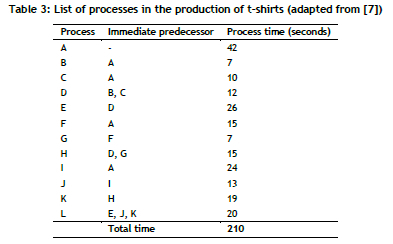
To balance the line, the first step was to identify the processes and the duration that each process took to complete, as shown in Table 1.
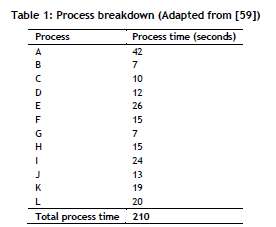
Given the above information, the following calculations were made:
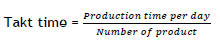
An eight-hour production day consists of 28 800 seconds. The average production rate of t-shirts was 60 t-shirts per hour, which was about 480 t-shirts a day:

The next step was to determine the required number of workstations; this was calculated as follows:
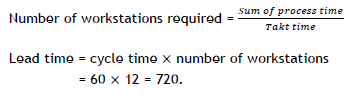
To calculate the efficiency of the process, the process time was divided by the lead time.
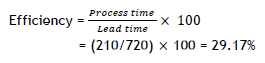
The balance delay, which is the fraction of the process that is spent idle, was then calculated as follows:
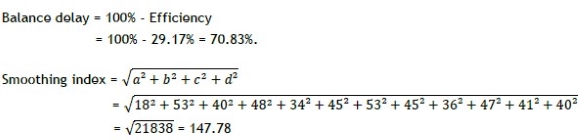
The calculations above were for the current process in The company, which was operating with the maximum number of workstations. However, given that the sum of the process time was 210 seconds, the number of workstations required to maximise production output was calculated as follows:

Because there is no half workstation, the number was rounded up to four workstations.
3.6.1. The heuristic method
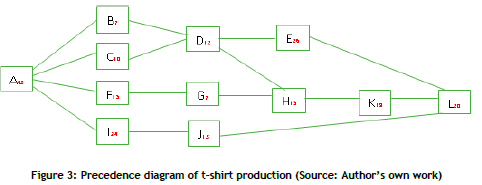
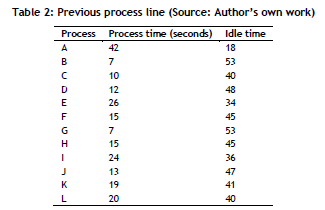
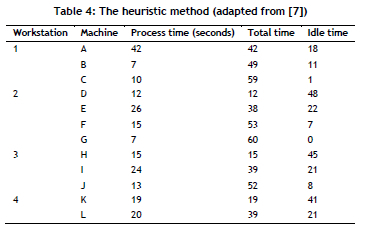
The heuristic method of line balancing was used to minimise imbalances between workers and workloads, helping to achieve the desired production rate [6]. The heuristic technique requires drawing a precedence diagram in a particular way that shows the flexibility offered for moving tasks across from one column to another in order to achieve the maximum possible balance, as shown in Figure 3. This was accomplished by (i) defining the job; (ii) breaking the work down into elements or tasks; and (iii) listing the various steps illustrated in Table 2 [7].
3.6.2. The largest candidate rule
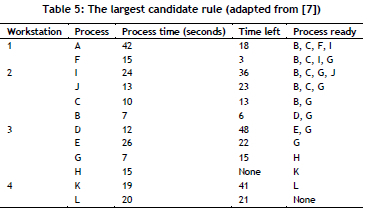
The largest candidate rule was applied in order to allocate the workload equally among the workstations. This rule allows for a smooth flow of work-in-progress (WIP) on the line with the fewest bottlenecks at workstations. This rule accounts for the cycle time and preceding process links [8].

3.6.3. Kilbridge-Wester method
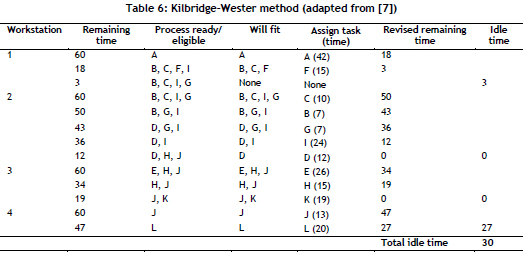
The smoothing index was also calculated, based on the idle time at each workstation, as follows:

4. RESULTS AND DISCUSSION
During the assessment period from April 2024 to August 2024, The company experienced a great improvement in workplace cooperation. Effective communication between employees and management enabled a cooperative environment for implementing the lean approach that was being introduced to the model area and beyond. Information about the organisation's performance was shared with EIT members, and the team worked together to solve production and management problems, and ensured transparency on key issues. "Each one teach one" is an initiative that was taken by one of the EIT members to share the principles and lessons learnt from the training with the employees on the factory floor in their home language. This initiative highlighted the role played by the training to empower staff members, as well as the commitment from the organisation to ensure cooperation and to invest in organisational change initiatives. A quality campaign was planned as a step towards corporate social responsibility to remind employees of the importance of quality and of the implications it would have for the bigger picture. The organisation was not yet able to give employees incentives; however, employee incentives was another approach that was on the cards to ensure that employees knew that they were acknowledged and appreciated for the hard work they put into the company. Key performance indicators were displayed on departmental notice boards and in the entrance foyer, where both internal and external stakeholders would be able to access them.
The 5S implementation created a highly productive environment and saw employees take responsibility and accountability for their department in impressive ways. The employees came up with a strategy to eliminate waste in all the clothing departments. As for the dispatch of cut materials, they created a system according to which they would dispatch more material for a job only on the condition that the supervisor of the department where the material was coming from would bring the reject materials and sign a form for them. Figure 4 shows the state of the model area before and after 5S implementation.
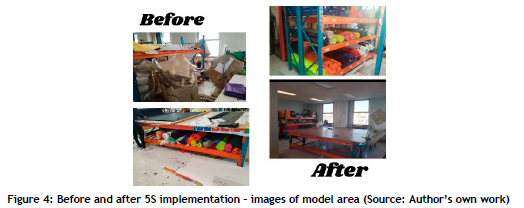
5S was then implemented in eight other departments to reduce waste in the process and to ensure that the workplace was clean. The organisation was able to reduce the floor space that was previously occupied by hidden reworks and rejects, and so to save significantly on their monthly rental. Another successful initiative that resulted from the lean implementation was to identify material from all the hidden rejects and waste that could be salvaged for reuse.
4.1. Assembly line balancing
Table 7 shows the results that were obtained from the various assembly line balancing methods. The efficiency and balance delay remained the same through the heuristic method, the largest candidate rule, and the Kilbridge-Wester method, because all three resulted in the same number of workstations. However, the smoothing index varied because of the idle time that remained at the various workstations through each method. Based on these results, the largest candidate rule was the best applicable method to balance the t-shirt line, because it had the lowest smoothing index.

The largest candidate rule was thus applied. At the first workstation, processes A and F take place; at the second workstation, processes I, J, C, B take place; at the third workstation, processes D, E, J, H take place and; and at the fourth workstation, processes K and L take place. This required the layout of the facility to be adjusted to enable the successful implementation of this method. The results significantly improved the production line by slightly over 100%, and the daily targets were met on time. This fostered a much more competitive production line that, with time, will be able to produce a good profit margin. These results are consistent with a meta-analysis study conducted by Antony et al. [62] that indicated that there was a significant and strong positive relationship between aggregate lean practices and aggregate organisational performance, as well as the operational, financial, market, and environmental performance outcomes. Their study highlighted that these individual practices had the strongest impact on organisational performance, and emphasised the role of moderating variables in the relationship between lean practices and organisational performance [62].
The lean manufacturing practices implemented in this SME (5S and process standardisation) could be understood as organisational capabilities that improve operational performance through waste reduction, enhanced workflow, and quality control. The measurable improvements in lead time, defect rates, and overall productivity thus represented enhanced capabilities that met the valuable, rare, inimitable, and non-substitutable criteria, reinforcing the firm's competitive position.
The results were also consistent with the findings of Afum et al. [30], who demonstrated a significant positive relationship between lean adoption and multiple performance outcomes such as operational, financial, market, and environmental outcomes. However, the current study advances the literature by providing process-level evidence of how specific lean tools could be successfully deployed in a resource-constrained SME environment without requiring extensive capital investment, and so challenging the perception that large-scale funding is required for meaningful improvement.
5. CONCLUSION
The lean manufacturing approach implemented in the company showed great success, and led to positive improvements. The implementation of 5S improved productivity on the production floor, as workers now enjoyed working in a clean and safe environment. The workers were also responsible for maintaining clean and clear workspaces and ensuring that the tools and equipment that they were not using were placed correctly in their allocated spaces according to the labels. This cut down on a lot of time spent searching for tools and improved the workmanship on the factory floor. The reworks and rejects were also reduced significantly after the implementation of the lean approach, coupled with the initiative taken by the cutting department to account for any excess material dispatched. The cooperation of management and staff ensured sustainable, competitive, and responsible enterprising by reducing the overall production cost from manufacturing overheads in areas such as order production time and raw materials. This study has also shown that investing in training employees and including them in conversations about the growth of the organisation would empower them to respond better to new initiatives, and could also play a significant role in how they carry out their work, thus highlighting the benefits of quality education (SDG 4). The improvements made from this study also helped the organisation to retain employees and cut down on unnecessary expenses, which has promoted decent work and contributed to economic growth (SDG 8).
The limitation of this study is that this was a single-case analysis, and so the generalisability of the findings to all SMEs is restricted. The study also captured short-term results, leaving the long-term sustainability of the improvements untested. While the evidence suggests that lean practices could deliver immediate operational benefits, it remains important to investigate whether these gains persist over extended periods and under varying market conditions. It is recommended that The company focus on consistent capturing, analysing, and monitoring of KPIs to be able to trace the progress made by the lean implementation approach in the long term, and to ensure transparency between management and employees about the growth of the organisation. This would create the opportunity for a study that would test the long-term results of this organisation, which could then be compared with the short-term results. A comparative study of various case studies in similar and different industries that use the same lean approach could also be explored to investigate whether these findings persist over extended periods and under varying market conditions, ultimately creating more general findings.
REFERENCES
[1] Ramasu, T., Aigbavboa, C. and Thwala, W. 2024. The influence of intrapreneurship on small and medium enterprises (SMEs) growth in the food manufacturing industry. In J. O. B. Rotimi, W. M. Shahzad, M. Sutrisna, & R. Kahandawa (eds.), Advances in Engineering Project, Production, and Technology - Proceedings of the 13th International Conference on Engineering, Project, and Production Management, 2023, pp. 133-149. [ Links ]
[2] Delmar, F., Davidsson, P. and Gartner, W.B. 2003. Arriving at the high-growth firm. Journal of Business Venturing, 18(2), pp. 189-216. [ Links ]
[3] Moreno, A. M. and Casillas, J. C. 2007. High-growth SMEs versus non-high-growth SMEs: A discriminant analysis. Entrepreneurship and Regional Development, 19(1), pp. 69-88. [ Links ]
[4] Mhlongo, T. and Daya, P. 2023. Challenges faced by small, medium and micro enterprises in Gauteng: A case for entrepreneurial leadership as an essential tool for success. The Southern African Journal of Entrepreneurship and Small Business Management, 15(1), 591. [ Links ]
[5] Leboea, S. T. 2017. The factors influencing SME failure in South Africa. Master's thesis, University of Cape Town, Cape Town, South Africa. [ Links ]
[6] Mthabela, T. E. 2015. Assessing the causal failures of emerging manufacturing SMEs in Johannesburg. University of the Witwatersrand, Johannesburg, South Africa. [ Links ]
[7] Dibben, P., Klerck, G. and Wood, G. 2015. The ending of southern Africa's tripartite dream: The cases of South Africa, Namibia and Mozambique. Business History, 57(3), pp. 461-483. [ Links ]
[8] Wood, G. and Bischoff, C. 2020. Challenges and progress in integrating knowledge: Cases from clothing and textiles in South Africa. Journal of Knowledge Management, 24(1), pp. 32-55. [ Links ]
[9] Cunningham, N. and De Meyer-Heydenrych, C. 2021. Premium versus affordable clothing retailers: What are customer expectations for satisfaction and repurchase intentions? International Journal of Retail & Distribution Management, 49(6), pp. 752-771. [ Links ]
[10] Chang, A.-Y. and Cheng, Y.-T. 2019. Analysis model of the sustainability development of manufacturing small and medium- sized enterprises in Taiwan. Journal of Cleaner Production, 207, pp. 458-473. [ Links ]
[11] Ruggerio, C. A. 2021. Sustainability and sustainable development: A review of principles and definitions. Science of the Total Environment, 786, 147481. [ Links ]
[12] United Nations. 1987. Report of the World Commission on Environment and Development: Our common future. United Nations. [ Links ]
[13] Scheidel, A., Temper, L., Demaria, F. and Martinez-Alier, J. 2018. Ecological distribution conflicts as forces for sustainability: An overview and conceptual framework. Sustainability Science, 13(3), pp. 585-598. [ Links ]
[14] Chofreh, A. G., Goni, F. A., Klemes, J. J., Malik, M. N. and Khan, H. H. 2020. Development of guidelines for the implementation of sustainable enterprise resource planning systems. Journal of Cleaner Production, 244, 118655. [ Links ]
[15] Rockström, J. et al. 2009. Planetary boundaries: Exploring the safe operating space for humanity. Ecology and Society, 14(2), 32. [ Links ]
[16] MacArthur, E. 2013. Towards the circular economy. Journal of Industrial Ecology, 2(1), pp. 23-44. [ Links ]
[17] Kirchherr, J., Reike, D. and Hekkert, M. P. 2017. Conceptualizing the circular economy: An analysis of 114 definitions. SSRN Electronic Journal, 127. [ Links ]
[18] Crump, J. et al. 2019. Systemic policy approaches for cross-cutting issues. In Global environment outlook (GEO-6): Healthy planet, healthy people, United Nations Environment Program (ed.), Cambridge University Press, Ch. 17, pp. 425-452. [ Links ]
[19] lkington, J. 1997. The triple bottom line. In Environmental management: Readings and cases, L. Owen and T. Unwin (eds.), Wiley-Blackwell, Ch. 2, pp. 49-66. [ Links ]
[20] Schaltegger, S., Etxeberria, I. Á. and Ortas, E. 2017. Innovating corporate accounting and reporting for sustainability: Attributes and challenges. Sustainable Development, 25(2), pp. 113-122. [ Links ]
[21] Kramer, M. R. and Porter, M. 2011. Creating shared value. Harvard Business Review, 89(1-2), pp. 62-77. [ Links ]
[22] Rachmawati, T., Basuki, B. and Hamidah, H. 2019. Creating shared value (CSV): The sustainable business model. International Journal of Innovation, Creativity and Change, 8(9), pp. 262-269. [ Links ]
[23] Bocken, N. M., Short, S. W., Rana, P. and Evans, S. 2014. A literature and practice review to develop sustainable business model archetypes. Journal of Cleaner Production, 65, pp. 42-56. [ Links ]
[24] Kennedy, S. and Bocken, N. 2020. Innovating business models for sustainability: An essential practice for responsible managers. In Research handbook of responsible management. Edward Elgar Publishing, pp. 640-653. [ Links ]
[25] Raworth, K. 2017. A doughnut for the anthropocene: Humanity's compass in the 21st century. The Lancet Planetary Health, 1 (2), e48-e49. [ Links ]
[26] Sachs, J., Lafortune, G., Kroll, C., Fuller, G. and Woelm, F. 2022. Sustainable development report 2022. From crisis to sustainable development: The SDGs as roadmap to 2030 and beyond. Cambridge University Press. [ Links ]
[27] Razavi, S. M. H., Nargesi, G. R., Hajihoseini, H. and Akbari, M. 2016. The impact of technological innovation capabilities on competitive performance of Iranian ICT firms. Interdisciplinary Journal of Management Studies (formerly known as Iranian Journal of Management Studies), 9(4), pp. 855-882. [ Links ]
[28] Ishmail, I. C. and Godday, O. O. 2024. Green manufacturing and competitive performance of manufacturing small and medium enterprises in Makurdi Metropolis of Benue State. International Journal of Management Sciences, 12(2), pp. 272-285. [ Links ]
[29] Danielsen, F., Framnes, V. A., Olsen, D. H., Vasilakopoulou, P. and Mikalef, P. 2017. Towards an understanding of big data analytics as a weapon for competitive performance. Master's thesis, University of Agder, Kristiansand and Grimstad, Norway. [ Links ]
[30] Afum, E., Issau, K., Agyabeng-Mensah, Y., Baah, C., Dacosta, E., Essandoh, E., Boateng, E. A. 2023. The missing links of sustainable supply chain management and green radical product innovation between sustainable entrepreneurship orientation and sustainability performance. Journal of Engineering, Design and Technology, 21(1), pp. 167-187. [ Links ]
[31] Bolaji, B., Rahim, M. and Omar, S. 2020. Effect of green supply chain management on organisational performance of selected manufacturing firms in Nigeria. In Proceedings of the International Conference on Industrial Engineering and Operations Management, Nsukka, Nigeria. [ Links ]
[32] Marei, A., Daoudb, L., Ibrahimc, M. and Al-Jabalya, S. M. 2021. Moderating role of top management support in electronic procurement usage of Jordanian firms. Management Science Letters, 11(4), pp. 1121-1132. [ Links ]
[33] Zwingina, C. T., Adegun, E. A. and Efanga, U. O. 2022. Procurement management and its impact on the performance of oil and gas industry in Nigeria. Indo-Asian Journal of Finance and Accounting, 3(2), pp. 175-191. [ Links ]
[34] Mbang, U. B., Ogbo, A. I., Emeh, M. C., Gabriel, O. C. O., Iheonkhan, I. S. and Afolabi, A. A. 2020. Green manufacturing: Rethinking the sustainability of Nigerian manufacturing firms. International Journal of Management, 11(12), pp. 132-142. [ Links ]
[35] Madah, N. A. 2023. The impact of green manufacturing strategies on organization competitive performance: A comparative study of opinions of a sample of departments operating in (Northern Cement Associate) and (Southern Cement State Company). International Journal of Professional Business Review, 8(5), e01532. [ Links ]
[36] Ahmad, N., Lazim, H. M., Shamsuddin, A., Wahab, E. and Abu, N. A. 2019. The relationship between technological capability and manufacturing performance. International Journal of Supply Chain Management, 8(2), pp. 930-938. [ Links ]
[37] Slack, N. and Brandon-Jones, A. 2018. Essentials of operations management. Pearson. [ Links ]
[38] Liepina, R., Lapina, I. and Mazais, J. 2014. Contemporary issues of quality management: Relationship between conformity assessment and quality management. Procedia - Social and Behavioral Sciences, 110, pp. 627-637. [ Links ]
[39] Wirawan, A. W., Falah, L. J., Kusumadewi, L., Adhariani, D. and Djakman, C. D. 2020. The effect of corporate social responsibility on the firm value with risk management as a moderating variable. Journal of Asia-Pacific Business, 21(2), pp. 143-160. [ Links ]
[40] Guo, Z., Hou, S. and Li, Q. 2020. Corporate social responsibility and firm value: The moderating effects of financial flexibility and R & D investment. Sustainability. 12(20), 8452. [ Links ]
[41] Titisari, K. H., Ratnawati, K. and Indrawati, N. K. 2019. The roles of cost of capital, corporate governance, and corporate social responsibility in improving firm value: Evidence from Indonesia. Investment Management and Financial Innovations, 16(4), pp. 28-36. [ Links ]
[42] Gaudêncio, P., Coelho, A. and Ribeiro, N. 2017. The role of trust in corporate social responsibility and worker relationships. Journal of Management Development, 36(4), pp. 478-492. [ Links ]
[43] Gaudencio, P., Coelho, A. and Ribeiro, N. 2021. The impact of CSR perceptions on workers' turnover intentions: Exploring the supervisor exchange process and the role of perceived external prestige. Social Responsibility Journal, 17(4), pp. 543-561. [ Links ]
[44] Khan, S., Ahmad, G. and Salman, Y. 2024. Managers' perceptions of internal corporate social responsibility: Exploring a textile enterprise in Pakistan. American Research Journal of Humanities and Social Sciences, 07, pp. 38-48. [ Links ]
[45] Habaragoda, B. 2018. Corporate social responsibility (CSR) and firm performance: Impact of internal and external CSR on financial performance. Business and Management, 10(3), pp. 156-170. [ Links ]
[46] Zaidi, U. 2024. CSR and employee happiness: A systematic review and critique of organizational cultures for employee satisfaction. Open Journal of Social Sciences, 12(4), pp. 440-457. [ Links ]
[47] Freeman, R. E. 2010. Strategic management: A stakeholder approach. Cambridge University Press. [ Links ]
[48] Liu, X. and Qiu, J. 2024. Does public environmental attentions improve corporate sustainability?: The mediating role of corporate environmental responsibility. Polish Journal of Environmental Studies, 34(2), pp. 1653-1670. [ Links ]
[49] Newman, C., Rand, J., Tarp, F. and Trifkovic, N. 2020. Corporate social responsibility in a competitive business environment. The Journal of Development Studies, 56(8), pp. 1455-1472. [ Links ]
[50] Cai, L., Cui, J. and Jo, H. 2016. Corporate environmental responsibility and firm risk. Journal of Business Ethics, 139, pp. 563-594. [ Links ]
[51] Yin, R. K. 2018. Case study research and applications. Sage. [ Links ]
[52] Ulrich, S. 2016. Implementation guide for SCORE training. International Labour Office. Available at: [Accessed 20 October, 2024]. [ Links ]
[53] Alkhaqani, A.L. 2022. Importance of teamwork communication in nursing practice. Nursing Communications, 6, e2022015. [ Links ]
[54] Leonard, M., Graham, S. and Bonacum, D. 2004. The human factor: The critical importance of effective teamwork and communication in providing safe care. BMJ Quality & Safety, 13(suppl 1), pp. i85-i90. [ Links ]
[55] Rizkya, I., Sari, R. M., Syahputri, K. and Fadhilah, N. 2021. Implementation of 5S methodology in warehouse: A case study. IOP Conference Series: Materials Science and Engineering, 1122(1), 012063. [ Links ]
[56] Makwana, A. D. and Patange, G. S. 2022. Strategic implementation of 5S and its effect on productivity of plastic machinery manufacturing company. Australian Journal of Mechanical Engineering, 20(1), pp. 111-120. [ Links ]
[57] Tahasin, T. A., Gupta, H. S. and Tuli, N. T. 2021. Analyzing the impact of 5S implementation in the manufacturing department: A case study. International Journal of Research in Industrial Engineering, 10(4), pp. 286-294. [ Links ]
[58] Subburaman, K. 2019. A case study of 5S implementation in inspection process. In Proceedings of the International Conference on Industrial Engineering and Operations Management, Bangkok, Thailand. [ Links ]
[59] Khalil, M., Din, M., Ali, A. and Tahir, M. 2024. Enhancing the productivity and assembly line balancing through takt time implementation. 03 May 2024, Preprint (Version 1) available at Research Square. https://doi.org/10.21203/rs.3.rs-4275556/v1 [ Links ]
[60] Boysen, N., Schulze, P. and Scholl, A. 2022. Assembly line balancing: What happened in the last fifteen years? European Journal of Operational Research, 301(3), pp. 797-814. [ Links ]
[61] Manaye, M. 2019. Line balancing techniques for productivity improvement. International Journal of Mechanical and Industrial Technology, 7(1), pp. 89-104. [ Links ]
[62] Antony J., Swarnakar, V., Cudney, E. and Pepper, M. 2021. A meta-analytic investigation of lean practices and their impact on organisational performance. Total Quality Management & Business Excellence, 33(15-16), pp. 1799-1825. doi:10.1080/14783363.2021.2003194 [ Links ]
Submitted by authors 23 Apr 2025
Accepted for publication 18 Aug 2025
Available online 12 Dec 2025
* Corresponding author tlotloramasu@gmail.com
ORCID® identifiers
T.K. Ramasu
https://orcid.org/0000-0002-2774-1007
M.G. Kanakana-Katumba
https://orcid.org/0000-0001-7475-2131
