




Services on Demand
Journal

Article
 English (pdf)
 Article in xml format
 Article references
 Automatic translation
 Send this article by e-mail
Indicators
Related links
-
 Cited by Google
 -
 Similars in Google
Share

 Permalink
Lexikos
On-line version ISSN 2224-0039Print version ISSN 1684-4904
Lexikos vol.35 n.2 Stellenbosch 2025
https://doi.org/10.5788/35-2-2101
ARTICLES
Spelling Variations in A Dictionary of Setswana Personal Names
Spellingvariasie in A Dictionary of Setswana Personal Names
Thapelo J. Otlogetswe
Faculty of Humanities, University of Botswana, Gaborone, Botswana (otlogets@ub.ac.bw) (https://orcid.org/0000-0003-3887-2982)
Goabilwe Ramaeba
Faculty of Humanities, University of Botswana, Gaborone, Botswana (ramaebagn@ub.ac.bw) (https://orcid.org/0000-0002-2379-9703)
ABSTRACT
This paper investigates spelling variation in A Dictionary of Setswana Personal Names (Otlogetswe and Ramaeba 2024), addressing a gap in existing research which has previously focused on general-purpose monolingual Setswana dictionaries (Otlogetswe 2015) but not specialized dictionaries such as the one on personal names. The study draws on orthographic guidelines outlined in the Standard Orthography of 1981 (Ministry of Education 1981) and Mokwalo o o Lolameng wa Setswana (Chebanne et al. 2008), while also tracing the historical development of Setswana orthography to early works by Lichtenstein (1928-1930; 1973) and Livingstone (1875). Using textual analysis, the paper critically examines dictionary headwords to identify and categorize spelling variants. The findings reveal numerous inconsistencies in the spelling of Setswana personal names, influenced by factors such as the coexistence of older and newer orthographic standards, dialectal variation across Setswana-speaking regions, and underlying morphological and phonological processes.
Keywords: spelling variation, a dictionary of setswana personal names, setswana, orthography
OPSOMMING
In hierdie artikel word die spellingvariasie in A Dictionary of Setswana Personal Names (Otlogetswe en Ramaeba 2024) ondersoek, om sodoende 'n gaping te vul in die bestaande navorsing wat voorheen gefokus het op algemene Setswana-woordeboeke (Otlogetswe 2015), maar nie op gespesialiseerde woordeboeke soos die een oor persoonsname nie. Die studie steun op ortografiese riglyne, soos uiteengesit in die Standard Orthography of 1981 (Ministerie van Onderwys 1981) en Mokwalo o o Lolameng wa Setswana (Chebanne et al. 2008), terwyl die historiese ontwikkeling van Setswana-ortografie na vroeë werke deur Lichtenstein (1928-1930; 1973) en Livingstone (1875) teruggespoor word. Met behulp van tekstuele analise ondersoek die artikel woordeboektrefwoorde krities om spellingvariante te identifiseer en te kategoriseer. Die bevindings toon talle inkonsekwenthede in die spelling van Setswana-persoonsname wat beïnvloed word deur faktore soos die gelyktydige voorkoms van ouer en nuwer ortografiese standaarde, dialektiese variasie in Setswana-sprekende streke, en onderliggende morfologiese en fonologiese prosesse.
Sleutelwoorde: spellingvariasie, a dictionary of setswana personal names, setswana, ortografie
1. Introduction and background
Spelling variations are ubiquitous in natural languages, and they have become an essential element of any dictionary since they capture regional nuances, historical contexts, and the dynamic nature of language. In a globalised world, people encounter texts from various regions characterised by multiple variations. Capturing spelling variations can, therefore, go a long way to help readers understand and recognise different spellings, as such reducing confusion in text reception. For instance, English is spoken and used in many countries with different spelling conventions. Knowing that "color" and "colour" are the same word but used in different regions can prevent misunderstandings and minimize confusion. For language learners, encountering different spellings can be challenging. Dictionaries that include variations provide a comprehensive learning tool, helping learners become familiar with regional differences and enhancing their overall language proficiency.
Similarly, Africa is home to a multitude of languages and dialects, each with its own unique spelling conventions. The Centre for Advanced Studies of African Society (CASAS) leads the work to harmonize and standardize language orthographies in Africa to minimise the existence of competing orthographies of the same language (Chebanne et al. 2008, Prah 1998). A typical case study on how to handle spelling variations in an African language dictionary has been discussed by Otlogetswe (2015) looking at variation in the Setswana monolingual dictionary Tlhalosi ya Medi ya Setswana (Otlogetswe 2012). Setswana has borrowed many words from English and Afrikaans, and these words are often spelled in different ways because they are borrowed as they are heard. For example, the word "computer" has been borrowed as khompiutara, khomphiutara, khomputara, komputara, khomputa, or khompiuta. Since there is no language board that Setswana spellings of borrowed words in Botswana, variants remain in the language. Otlogetswe argues that spelling variants should be included in general monolingual dictionaries and that the way they are handled should be informed by frequency information from corpus data.
Dictionaries like the African Pidgin Dictionary (see www.pegeen.com) list spelling variations to ensure users from different regions can find the relevant spelling. For instance, a word might have different spellings in Nigerian, Ghanaian, and Cameroonian pidgin. By including these variations, dictionaries capture and document the rich linguistic diversity of a language. This is particularly important for preserving regional dialects and cultural identities. To help users understand the appropriate context for each spelling variant, African dictionaries can use usage labels and contextual notes (Otlogetswe 2014). These labels might indicate whether a spelling is specific to a particular country or region. For example, the South African National Lexicography Units (SANLU) provide detailed notes on the usage of words in different South African languages, helping users navigate the regional differences. This approach ensures that users can select the correct spelling based on their specific needs and contexts.
Additionally, language evolves over time, and spelling variations often reflect historical changes (Murray 1996). Including archaic or historical spellings in dictionaries helps users understand and trace the development of the language and provides context for older texts. For example, knowing that "jail" was once spelled "gaol" can be useful for reading and understanding historical documents. Some African dictionaries include historical or archaic spellings to provide a comprehensive view of a word's evolution. This is particularly important for languages with rich oral traditions and historical texts. By including these spellings, dictionaries help users understand the historical context and development of the language. For instance, older spellings of Setswana words might be included to aid in the study and appreciation of historical documents.
Spelling variations also support accurate and contextual usage (Motzafi-Haller et al. 2006). Some words have different spellings depending on their context. For example, "dialog" is often used in computing contexts, while "dialogue" is preferred for conversations between people. Dictionaries that include these variations help users choose the correct spelling for their specific context. Lexicographers make editorial decisions about which variants to include in a dictionary based on the word's usage frequency and relevance. For example, if a particular spelling is commonly used in contemporary literature or media, it might be prioritised in the dictionary. This ensures that the dictionary remains relevant and useful for modern users. For instance, the inclusion of both "doughnut" and "donut" in dictionaries reflects their usage in different contexts. The "donut" spelling has been widely used in the USA from the mid-20th century, while the "doughnut" spelling has been used consistently elsewhere.
The inclusion of spelling variations in a dictionary can also go a long way in preserving the cultural heritage of a linguistic group (Scontras et al. 2015). Including spelling variations for indigenous and local terms helps preserve cultural heritage and ensures that these terms are recognised and respected. This is especially important in African dictionaries, where capturing the diversity of languages and dialects is crucial. Proper nouns and brand names often have unique spellings. Including these in dictionaries helps users understand that while these spellings are correct for specific entities, they are not generalisable to other contexts. This distinction is important for accurate communication and brand recognition.
The inclusion of spelling variation also has practical applications. In the digital age spellcheckers and autocorrect tools rely on comprehensive dictionaries (Mulingi 2023). Including spelling variations ensures that these tools can recognise and correct different spellings, enhancing their effectiveness and user experience. As English continues to be a global lingua franca, understanding and recognising spelling variations is essential for effective communication across different regions. Dictionaries that include these variations support global communication by providing a common reference point (https://blog.spellquiz.com/spelling-variants/).
The treatment of spelling variants in Setswana dictionaries provides a useful case study. The dictionaries Thanodi ya Setswana (Kgasa and Tsonope 1995), Thanodi ya Setswana (Mareme 2007), and Tlhalosi ya Medi ya Setswana (Otlogetswe 2012) have all dealt with spelling variation in different ways. These dictionaries reflect the influence of regional dialects and the evolution of the language over time.
As previously indicated, the African Pidgin Dictionary is another example of how spelling variations are handled. This dictionary includes words from various Pidgin English dialects spoken across Africa, such as Nigerian Pidgin and Ghanaian Pidgin (https://peegeen.com/). It lists multiple spellings for words and provides contextual notes to help users understand their regional differences. This approach ensures that the dictionary is a comprehensive resource for speakers of different Pidgin English dialects. The Shona monolingual dictionary developed by the African Languages Research Institute (ALRI) at the University of Zimbabwe grapples with dialectal diversity in Shona (Chabata 2003). It addresses tone marking, sense ordering, and synonym treatment to reflect dialectal nuances. However, representativeness remains a challenge, as some dialects are underrepresented.
In practical lexicography, cross-references are commonly used to guide users from one spelling variant to another (Prinsloo and Van Graan 2021). If a user looks up a word in one spelling, the dictionary might direct them to another variant with a note explaining the regional or contextual differences. This method ensures that users find the information they need, regardless of the spelling they initially searched for. For example, a dictionary might list "catalogue" and direct users to "catalog" with a note on regional preferences.
African dictionaries, however, face unique challenges due to the continent's linguistic diversity and the dynamic nature of its languages. One challenge is the standardisation of spelling in languages that have multiple dialects and regional variations (Baugh 2009). To address this, lexicographers often collaborate with local language experts and communities to ensure that the dictionary accurately reflects current usage and captures variations as synonyms in dictionaries (Chabata 2003). Innovations in technology have also played a significant role in developing African dictionaries. Digital platforms allow for more frequent updates and the inclusion of multimedia elements such as audio pronunciations and video clips. These features enhance the usability of the dictionary and provide a richer linguistic resource for users. African dictionaries handle spelling variations by including regional variants, using usage labels and contextual notes, providing cross-references, including historical spellings, making editorial decisions based on usage, and addressing proper nouns and indigenous terms. These strategies help users navigate the complexities of African languages, ensuring they can find and use the correct spelling for any given context. By reflecting the linguistic diversity and cultural richness of the continent, African dictionaries play a vital role in education and language preservation.
2. Methodology
This paper analyses spelling variations found in names that are headwords in A Dictionary of Setswana Personal Names. The names are analysed based on Standard Orthography of 1981 (Ministry of Education 1981) and Mokwalo o o lolameng wa Setswana (Chebanne et al. 2008). While the historical roots of Setswana orthography may be traced to Lichtenstein (1928) and Livingstone (1875), the Ministry of Education (1981) and Chebanne et al. (2008) present recent rules to Setswana spelling in Botswana. The study uses a textual analysis method to critically assess the dictionary headwords for spelling variants. The results show that there are numerous inconsistencies in the spelling of Setswana personal names. The spellings are motivated by how speakers pronounce the names and not necessarily how they ought to be spelt, according to the standard Setswana orthography. The variations may be clustered into four categories of: (a) vowel variations, (b) consonantal variations, and (c) dialect influenced variations. The final section of the paper deals with names that use discontinued consonants.
Results and discussion
Spelling variations in African personal names are a widespread and multifaceted issue, shaped by linguistic diversity, colonial legacies, orthographic inconsistencies, and sociocultural dynamics. They are a consequence of variation at consonantal and vowel levels as demonstrated in the following sections.
3. Vowel variations in Setswana names
Setswana has seven vowels. These are i, e, ɛ, ʊ, ɔ, u, a (DALL 1999: 17). The seven vowels may be represented as in Table 1:
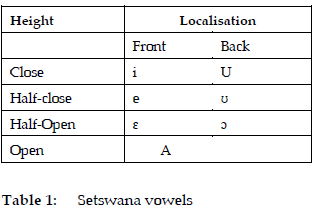
Orthographically, Setswana does not mark a distinction between /ɛ/ and /e/. They are both represented by [e] in normal written texts, except in the Botswana lower primary school syllabus where /ɛ/ is represented by [e] with a circumflex as [ê]. Equally, Setswana orthography does not mark a distinction between /ʊ/ and /ɔ/ except in the same syllabus where the /ɔ/ is represented by [o] with a circumflex as [ô]. From the Botswana upper primary syllabus and beyond, written Setswana does not mark a distinction between /ʊ/ and /ɔ/ and between /ɛ/ and /e/ (Sebina and Otlogetswe 2023a and b). Since Setswana does not mark the /ɛ, e/ and /ʊ, ɔ/ distinction orthographically, there are no names that are spelt with [ê] or [ô]. Just as in common writing, Setswana names use the five orthographic vowels, a, e, i, o, u. This discussion of vowels is relevant to the vowel variations that follow below since several names do not follow standard orthography where vowels are concerned.
3.1 Names that use [i] instead of [e]
Name spelling variation in Setswana is found in names which in their articulation speakers use the half-close front vowel /e/, instead of the close front vowel /i/. This practice is then reflected in the spelling of the same name with one spelt with an /e/ while the same name is also spelt with /i/. Some speakers therefore spell their names as Baaitsi instead of Baaitse, Matshidiso instead of Matshediso, Balibi instead of Balebi, Kelitile instead of Keletile, Baipidi instead of Baipedi, Baoliki instead of Baoleki, Bafiti instead of Bafeti and Goitsimodimo instead of Goitsemodimo. This may be explained in terms of close vowel harmony where the preceding vowel harmonises in height with the following one. The /e/ is therefore pronounced as an /i/. The correct spelling of the name is traceable to the verb from which the name is derived. Baaitse is from itse "know", Matshediso from tshela "live", Balebi from leba "look", Keletile from leta "wait", Baipedi from ipela "celebrate", Baoleki from leka "try/test", Bafeti from feta "pass" and Goitsemodimo from itse "know".
The extracts from the dictionary in Table 2 illustrate how the dictionary treats both the wrong and the correct spellings.
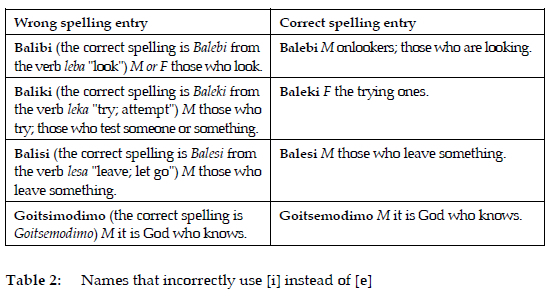
The wrong spelling entry is cross-referenced to the correct spelling entry though the correct spelling entry is not cross-referenced to the wrong spelling. The correct spelling entry could be improved by cross-referencing the wrong spelling entry to make the user aware of the misspelt version in the following manner:
Balebi M on lookers; those who are looking
(usually misspelt as Balibi).
3.2 Names that use [e] instead of [i]
Other spelling variations are introduced in a reversal of the situation discussed in 3.1, where name givers use the half-close front vowel and write /e/ where the close front vowel /i/ should be used, thereby violating the agentive rule that derives -i verbs. Cole (1955: 113) has demonstrated that one way of forming Setswana nouns is from verb stems, by prefixing the class prefixes, while the final vowel of the stem is changed to the agentive marker -i (e.g. mo- + dira + -i = modiri). They, therefore, spell their names as Gabaiphewe instead of Gabaiphiwe, Molapise instead of Molapisi, Baitshenyetse instead of Baitshenyetsi, Molebatse instead of Molebatsi, Kebaitsele instead of Kebaitsile, and Modiege instead of Modiegi. This is possibly because the name givers gave the name by ear as in hypothesised in 3.2 and in their hearing, the /i/ sounded like an /e/. Table 3 further illustrates this:
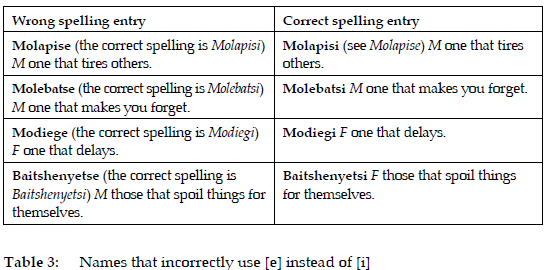
The wrong spelling entry is cross-referenced to the correct spelling entry to direct the users to the correct-spelt entry. The correct spelling entry is not cross-referenced to the wrong spelling entry. As in 3.1 above, the correct spelling entry could be improved by cross-referencing the wrong spelling entry to make the user aware of the misspelt version in the dictionary like this:
Molapisi (see Molapise) M one that tires others
(usually misspelt as Molapise).
3.3 Names that use double [o] instead of [eo]
There are names that use [oo] where the standard orthography [eo] should be used. Such names are prevalent in the central and southern regions of Botswana. This spelling variation is typical of the pronunciation of central and southern Setswana dialects amongst the Ngwaketse, Rolong and Hurutshe. This spelling change mirrors vowel assimilation in Setswana speech where one vowel influences another - typically across syllable boundaries - so that they become more similar in quality. Vowel assimilation maintains phonotactic harmony and ease of articulation in speech. While this is true in speech, spelling rules should not be violated as they have been in some of the names. Vowel assimilation has therefore influenced the spelling of certain names such that we have Kooagile instead of Keoagile, Koobake instead of Keobake, Koobokile, instead of Keobokile, Koolebile instead of Keolebile, Koorapetse instead of Keorapetse and Koobame instead of Keobame. The sound change from [eo] to [oo] is a consequence of total regressive assimilation where a preceding sound becomes the same as the following one. For example,
Ke + obame = Koobame
This process helps maintain phonotactic harmony and ease of articulation in speech. In this instance, the [e] of [Ke] becomes like [o] of [obame] to result in Koobame. Those who spell the names with [oo] instead of [eo], therefore, write as they speak, and do not adhere to the Setswana standard orthography. A Dictionary of Setswana Personal Names has captured both these spelling variations as demonstrated in Table 4:
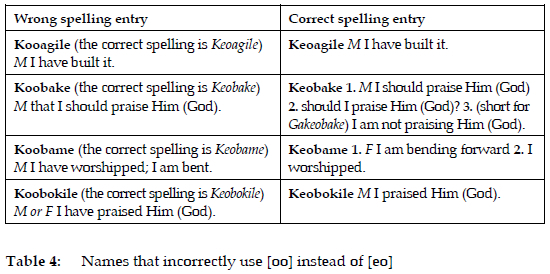
The wrong spelling entry is cross-referenced to the correct spelling entry though the correct spelling is not cross-referenced to the wrong spelling entry. The correct spelling entry could be improved by cross-referencing the wrong spelling entry to make the user aware of the misspelt version in the following manner:
Keobame 1. F I am bending forward 2. I worshipped (usually misspelt as Koobame).
3.4 Names that delete the vowel [e] in the context of the lateral approximant /l/
There is evidence of names where the vowel [e] gets deleted when it occurs between two lateral approximants /l/ as in the word molelo "fire", which is then spelt as mollo, after deleting the vowel [e], and retaining the second vowel [o]. This then results in the first /l/ becoming a tone-bearing syllabic consonant. This gives rise to names such as Mollowakgosi instead of Molelowakgosi and Mollowakgotla instead of Molelowakgotla. While the [e] is elided in speech, such an elision violates standard Setswana orthography (Chebanne et al. 2008: 64) that states that "... tlogelo ya tumanosi fa gare ga bo[l] ga e letlelelwe …" (an elision of a vowel in between a sequence of the lateral /l/ is not permitted.) Table 5 further illustrates this:
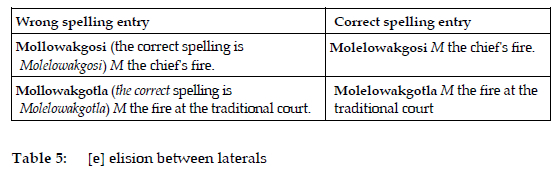
The wrong spelling entry is cross-referenced to the correct spelling entry though the correct spelling is not cross-referenced to the wrong spelling entry. The correct spelling entry could be improved by cross-referencing the wrong spelling entry to make the user aware of the misspelt version in the following manner:
Molelowakgotla M the fire at the traditional court
(usually misspelt as Mollowakgotla).
4. Consonant variations in Setswana personal names
Some name variations are a result of a difference in consonantal use for the same part of a name. Before we delve deeper into consonantal differences, first we present the Setswana consonantal inventory. Setswana has 29 phonemic consonants (Batibo 2013 and DALL 1999: 12) as illustrated in Table 6.
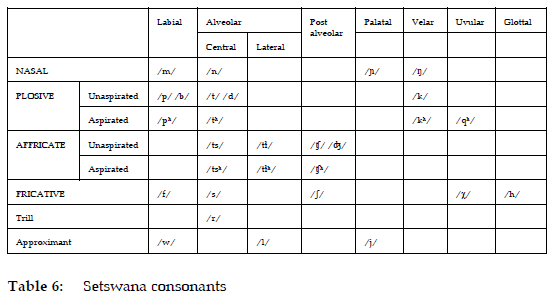
Four of these (ph, th, kh and qh) are aspirated voiceless plosives, three are non-aspirated voiceless plosives (p, t and k), one voiced plosive /b/, three aspirated voiceless affricates (ʧh, tɬh, tsh), three non-aspirated voiceless affricates (ts, tɬ, and ʧ), one voiced affricate (ʤ), five voiceless fricatives (f, s, ʃ, χ, and h), four nasals (m, n, ɲ, and ŋ), and four sonorants (r, l, j and w).
The voiced plosive /d/ is an allophone of /l/ where /d/ is usually followed by close vowel /u/ and /i/ as in dika (surround) and huduga (relocate) while /l/ is followed by open vowels such as /a/ and /o/ as in lala (spend the night) and lole (fought) (see Cole 1955: 28). The exception to this rule is borrowed words such as lithara (liter) and dolara (dollar).
The Setswana consonantal phonemes are represented orthographically with their equivalent forms as demonstrated in Table 7.
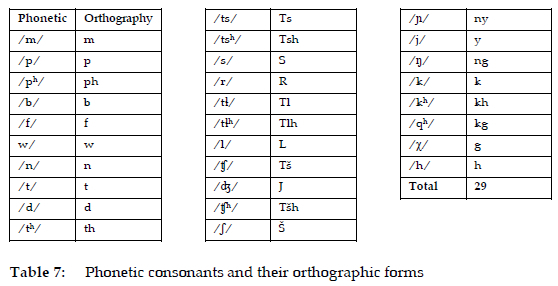
A discussion of Setswana consonantal inventory will prove relevant to sections 4.1-4.3 where consonantal variation in names is discussed.
The use of /h/ instead of /f/
Some name spelling variations in Setswana are because the same name is spelt either with a voiceless, labio-dental fricative [f] in some cases, while in other cases it is spelt with the glottal fricative [h]. Using the sound [h] instead of [f] is a common feature of Setswana speech and there is much confusion in written Setswana about where [h] and [f] should be used (Cole 1955: 26). There is, however, a Setswana morphological rule which illustrates that [h] verbs result with [kh] deverbative nouns and [f] verbs result with [ph] deverbative nouns in strengthening (Cole 1955: 40). For instance, the verb hupela generates the noun khupelo while the verb fenya generates the noun phenyo. The [h] and [f] spelling confusion are pervasive in personal names. This results in names such as Bahedile instead of Bafedile, Bahemedi instead of Bafemedi, Gaehole instead of Gaefole, Hetolang instead of Fetolang and Hetanang instead of Fetanang. One way of determining the correct spelling for each name is therefore to trace it to its original verb. Table 8 further illustrates how these are captured in the dictionary:
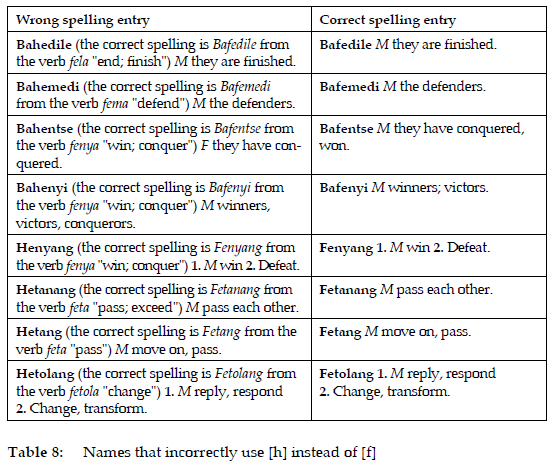
The dictionary entry indicates that the wrong spelling entry is cross-referenced to the correct spelling entry though the correct spelling is not cross-referenced to the incorrect spelling entry. The correct spelling entry could be improved by cross-referencing the wrong spelling entry to make the user aware of the misspelt version in the following manner:
Fetolang 1. M reply, respond 2. Change, transform. (usually misspelt as Hetolang).
In many old Setswana names, instead of choosing either [h] or [f], name givers have used both consonants spelt [fh]. There are therefore many names which use [fh] instead of [f], such as Gadifhele instead of Gadifele, Kefhilwe instead of Kefilwe, Molefhe instead of Molefe, Molefhi instead of Molefi, Nonofho instead of Nonofo, Baikalafhi instead of Baikalafi, and Merafhe instead of Merafe. Table 9 further illustrates this:
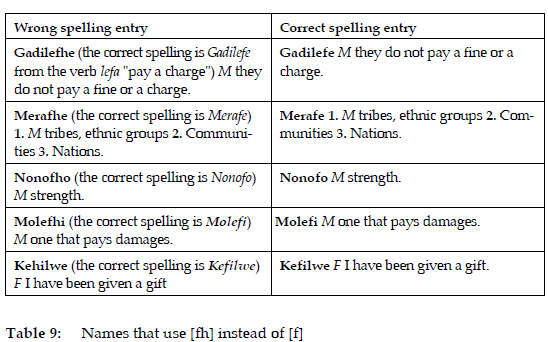
Standard Setswana orthography does not have /fh/. The table indicates that the wrong spelling entry is cross-referenced to the correct spelling entry although the correct spelling is not cross referenced to the wrong spelling entry. The correct spelling entry could be improved by cross-referencing the wrong spelling entry to make the user aware of the misspelt version in the following manner:
Merafe 1. M tribes, ethnic groups 2. Communities 3. Nations. (usually misspelt as Merafhe).
4.1 The use of the [ny] and [n] variants
There is confusion amongst Setswana speakers between words that end with the causative [ny-] and the reciprocal [an-]. For instance, in daily speech there is an enduring confusion between puisano and puisanyo where puisano means a discussion or dialogue and puisanyo strictly speaking is an act of making each other talk. This confusion is reflected in many names which should end in [-n-] but end in [-ny-]. There is therefore Kedibonye instead of Kedibone, Golekanye instead of Golekane, Kebabonye instead of Kebabone, Kemmonye, instead of Kemmone, Gareitsanye instead of Gareitsane, Kelekanye instead of Kelekane and Lesanyang instead of Lesanang. The dictionary captures both spelling variants in its macrostructure as shown in the sampled entries in Table 10.
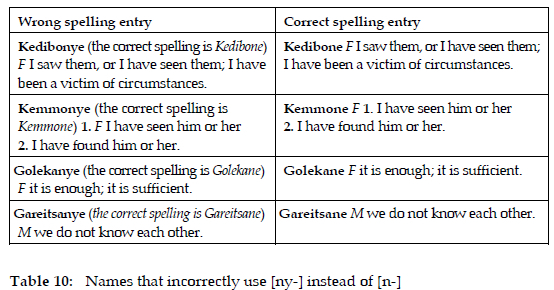
The wrong spelling entry is cross-referenced to the correct spelling entry even though the correct spelling is not cross referenced to the wrong spelling entry. The correct spelling entry could be improved by cross-referencing the wrong spelling entry to make the user aware of the misspelt version in the following manner:
Kedibone F I saw them, or I have seen them; I have been a victim of circumstances (usually misspelt as Kedibonye).
4.2 Names which should have a double [n], or double [m] but lack this feature
In Setswana orthography, the long nasal sound is represented orthographically by doubling the concerned nasal consonant, whether it is /n/ or /m/, while a short nasal is written as a single nasal consonant. Doubling the long nasal in orthography is supported by the fact that one of the nasal consonants is a tone bearing syllabic nasal. Spelling variation is, however, introduced when there is an inconsistency in the writing of a long nasal. Some Setswana names that are pronounced with a long nasal are spelt with a single letter as if they use a short nasal which is represented by a single character. This has caused variation in the spelling of names, with some spelt with a double nasal while others have a single nasal character. The dictionary therefore has Gaofengwe /χáʊ́fɪ́ŋwɪ́/ as well as the correctly spelt Gaofenngwe /χáʊ́fɪ́ŋŋwɪ́/, and Mamosadinyana /mámʊ́sádiɲáná/ as well as the correctly spelt Mmamosadinyana /mmámʊ́sádiɲáná/ as shown in Table 11.
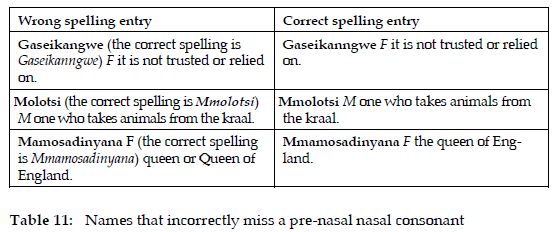
The wrong spelling entry is cross-referenced to the correct spelling entry though the correct spelling is not cross-referenced to the wrong spelling entry. The correct spelling entry could be improved by cross-referencing the wrong spelling entry to make the user aware of the misspelt version in the following manner:
Mmolotsi M one who takes animals from the kraal. (usually misspelt as Molotsi).
5. The impact of Northern Setswana on name spellings
Some spelling variations in the dictionary were brought about by the influence of Northern Setswana. Northern Setswana is a cluster of dialects spoken by Bangwato, Batawana, and Bakhurutshe, amongst other groups who are found in the central, northern and parts of north-eastern Botswana (Cole 1955). Northern Setswana is sometimes referred to as Sengwato in the literature (Tlale 2005, Boyer and Zsiga 2013).
5.1 The loss of /tl/ and /tlh/
Historically, Northern Setswana uses the voiceless alveolar plosive /t/ where the standard language uses the voiceless unaspirated affricate /tl/ and usually replaces the voiceless aspirated affricate /tlh/ consonantal sound (Batibo 1999) with the voiceless aspirated explosive /th/. This is reflected in many words in the Setswana vocabulary as in Table 12 that illustrates the different orthographic representations of some words between Northern Setswana and other Setswana dialects.
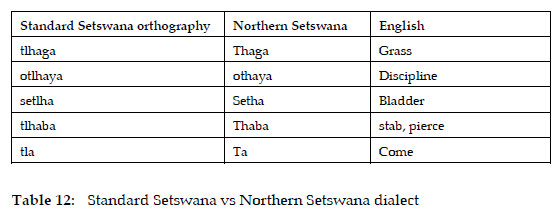
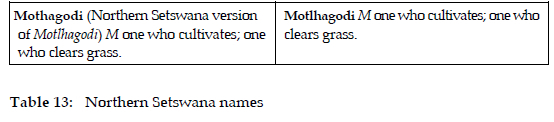
This evolution has had a lasting influence on how speakers of the Northern Setswana dialect spell personal names. The spelling of the personal names, therefore, follows their pronunciation and not the Setswana standard orthography. The dictionary has included spellings of standard Setswana and that of Northern Setswana leading to a variation of names in which the same name is spelt with /tlh/ and /th/. For instance, Tlhalefang and Thalefang, Atlholang and Atholang, Baikatlhodi and Baikathodi, Baiphetlhi and Baiphethi, Batlang and Batang, Batlhaetse and Bathaetse, and Batlhalefi and Bathalefi. The Northern Setswana name spellings are captured in the dictionary as they are so spelt by their owners. This is in line with the recommendations of Setswana Standard Orthography of 1981 which notes that, "As a general rule, proper names of people should be spelled as used by the persons themselves" (p.19). The dictionary, however, cross references the standard spelling entry at each Northern Setswana spelling entry, for the benefit of the user. This is demonstrated in Table 13.
5.2 Conflation of prefix le- and lo-
Northern Setswana also does not make a distinction between the noun class prefix /lo-/ of class 11 and the noun class prefix /le-/ of class 5. The distinctions have been collapsed into singular prefix [le-] of class 5. This difference has been discussed by Cole (1955). All the words which in other Setswana dialects belong to class 11 noun class, in Northern Setswana they are found in class 5. According to general Setswana books (e.g. Mogapi 1984; Cole 1955) and Setswana Standard Orthography, the determination of whether a word takes a [le-] or [lo-] prefix is based on the plural prefix that the word takes (Chebanne et al. 2008). When class 11 nouns are pluralised, they take class 8 prefix [di-] and when class 5 nouns are pluralised, they take the class 6 prefix [ma-] (Cole 1955; Chebanne et al. 2008). This may be summarised as follows:
Singular noun class prefix → Plural noun class prefix
noun class 5 [le-] → noun class 6 [ma-]
noun class 11 [lo-] → noun class 8 [di-]
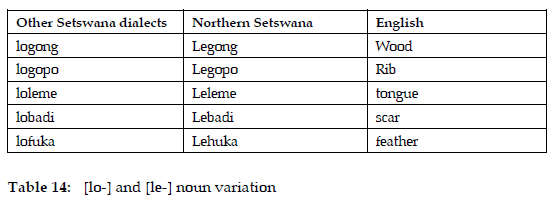
These /le-/ and /lo-/ variations have been extended to personal names, and as result we have the same name with different orthographic representations, for example, Leungo/Loungo, Lerato/Lorato, Losika/Lesika, Lonyatso/Lenyatso, Logong/ Legong and Loapi/Lewapi. If we are to apply the pluralisation rule to determine the correct spellings of the names, then the variations of Lotshwao, Loeto, Loungo and Legong will be incorrect. This is because their pluralisation would flout the standard pluralisation rule. The first three names would take the noun class 8 prefix [di-] to become ditshwao, dieto and diungo, while the last word will take the noun class 6 prefix [ma-] and become magong, all of which are linguistically non-existent in Setswana vocabulary. Table 15 further illustrates this as captured in the dictionary:
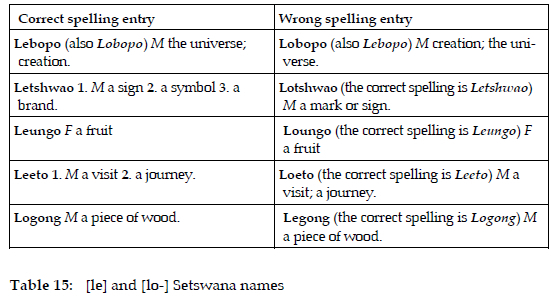
As previously stated, the Northern Setswana name spellings are captured in the dictionary as they are spelt by their owners, as recommended by the Standard Setswana Orthography of 1981, however, both names would be captured twice, one being the correct version.
The wrong spelling entry is cross-referenced to the correct spelling entry though the correct spelling is not cross-referenced to the wrong spelling entry. The correct spelling entry could be improved by cross-referencing the wrong spelling entry to make the user aware of the misspelt version in the following manner:
Leeto 1. M a visit 2. a journey. (usually misspelt as Loeto).
6. Discontinued consonants in Setswana names
An orthographic decision was taken to discontinue the use of certain consonants in the orthography of Setswana. A conference held in Johannesburg, South Africa on April 25, 1937 attended by representatives of the Education Departments of Bechuanaland Protectorate, the Cape, the Orange Free State, and the Transvaal, together with the Inter-University Committee for African Studies, resolved to change how it spelt two consonants: the voiceless postalveolar affricate [ʧh] and the voiceless postalveolar fricative /ʃ/. The conference resolved that [ʧh] which was then spelt as [ch], should henceforth be spelt as [tšh], while /ʃ/ which was then spelt as [sh] was to be spelt as [š]. It was noted that:
The symbol š, with its movable diacritic, was chosen by the Committee to represent the voiceless hushing fricative in preference of the I.P.A. symbol on the principle of avoiding new types, and to the symbol sh on account of the latter's ambiguousness and the difficulties it creates in connection with the representation of the hissing and hushing fricative combinations. It was felt that the symbol š possessed all the advantages of the I.P.A. symbol, without its disadvantages as a new type, and with the added advantage that its movable diacritic indicates, without exaggerating, the dialectal differences between various Tšwana dialects among themselves and between Tšwana and Transvaal Sotho and Basutoland Sotho in general. (Lestrade 1937: 8-9)
While this decision was taken over 80 years ago and has been adopted in much of Setswana writing patterns, it has had no impact on the spelling of Setswana personal names. Batswana still use [ch] and [sh] in the spelling of their names. No name in the Setswana database that informed the writing of A Dictionary of Setswana Personal Names used [tšh] or [š]. This may be because most Batswana are bilingual in Setswana and English which uses the [ch] and [sh] characters and therefore associate the [ʧh] and /ʃ/ sounds with the English [ch] and [sh] representations. The other reason may be related to advances in technology - that [š] is a more challenging character to write on a typewriter or computer. Consequently, [ch] and [sh] have endured in Setswana names. Names that use [ch] or [sh] are therefore entered in the dictionary as they are spelt by their owners. They are not spelt using the agreed post 1937 orthography. However, there is a note in the microstructure of the dictionary on the correct spelling as demonstrated in the examples below:
Chaba M (an old spelling of Tšhaba); nation.
Chabadiile M (an old spelling of Tšhabadiile) nations have gone.
Chabaesele M (an old spelling of Tšhabaesele) a different nation.
Chabaditsile M (an old spelling of Tšhabaditsile) nations have arrived.
Chabaefe M (an old spelling of Tšhabaefe) which nation?
Cheleketo M (old spelling of Tšheleketlo); a struggle; suffering.
Examples from the dictionary of names that use the discontinued [sh] instead of the standard orthography character [š] are shown as follows:
Bashapi (an old spelling of Bašapi) 1. M swimmers 2. those who beat.
Bashi (an old spelling of Baši) M short for Basimane; boys. A pet name for a boy from Bashimane.
Ramasheleng (the correct spelling is Ramašeleng) 1. M the father of shillings 2. the man of shillings
Boshafatso (an old spelling of Bošafatso) M renewal.
Boshula (an old spelling of Bošula - the standard spelling of this word is Bosula) 1. M bad taste 2. evil
Shianyana (the correct spelling is Šianyana) M small boy.
This note on the correct spelling must not be misconstrued as a cross-reference. It does not point to another entry elsewhere in the dictionary. It merely states how an entry would be written in Setswana standard orthography. Entries with discontinued characters [sh] and [ch] are therefore entered in the dictionary exactly the way the owners of the names spell them.
7. Conclusion
This paper has examined spelling variations in A Dictionary of Setswana Personal Names, highlighting the phonological and morphological patterns that underlie these differences. It has shown that many of these variations stem from the influence of distinct Setswana dialects - particularly the northern and southern varieties - on the orthographic representation of personal names. While general dictionaries tend to be normative, adhering to standardized orthographies, this study reveals that formal spelling rules are sometimes bypassed in favor of forms that more closely reflect speakers' individual pronunciations.
Despite the introduction of the phoneme /š/ into Setswana orthography over eighty years ago, this study found no personal names utilizing this symbol. Instead, speakers continue to use [ch] and [sh], which are considered outdated under current orthographic standards. A Dictionary of Setswana Personal Names documents these spelling variants as provided by name givers or bearers, aligning with the 1981 Standard Setswana Orthography's recommendation that personal names be recorded as they are used by individuals.
Ultimately, this paper underscores the ubiquity of variation in natural languages and emphasizes the need for lexicographic strategies that enhance user accessibility. One such strategy proposed here is the documentation of personal names in their authentic forms, supplemented by cross-referencing and informational annotations to guide users through variant spellings.
References
Dictionaries
Kgasa, M. and J. Tsonope. 1995. Thanodi ya Setswana. Gaborone: Longman. [ Links ]
Otlogetswe, T.J. 2012. Tlhalosi ya Medi ya Setswana. Gaborone: Medi Publishing. [ Links ]
Otlogetswe, T.J. and G.N. Ramaeba. 2024. A Dictionary of Setswana Personal Names. Gaborone: Mokala Publishing. [ Links ]
Online Sources
African Pidgin Dictionary. www.pegeen.com
Spelling Variants: Why Are They Important? https://blog.spellquiz.com/spelling-variants
Academic papers and books
Batibo, H.M. 1999. The Grammaticalization Process in Setswana. Afrikanistische Arbeitspapiere (AAP) 59: 131-150. [ Links ]
Batibo, H.M. 2013. The Evolution and Adaptation of Swahili and Tswana Syllable Structures. Legère, K. (Ed.). 2013. Bantu Languages and Linguistics: Papers in Memory of Dr Rugatiri D.K. Mekacha. Bayreuth African Studies 91: 13-34. Bayreuth: Bayreuth University Press.
Baugh, J. 2009. Linguistic Diversity, Access, and Risk. Review of Research in Education 33(1): 272-282. [ Links ]
Boyer, O. and E. Zsiga. 2013. Phonological Devoicing and Phonetic Voicing in Setswana. Orie, Olanike Ola and Karen W. Sanders (Eds.). 2013. Selected Proceedings of the 43rd Annual Conference on African Linguistics (ACAL): Linguistic Interfaces in African Languages, New Orleans, USA, 15-17 March 2012: 43: 82-89. Somerville, MA: Cascadilla.
Chabata, E. 2003. Linguistic Variation in Shona with Special Reference to Monolingual Dictionaries. Lexikos 13: 81-91. [ Links ]
Chebanne, A., T.J. Otlogetswe, P. Seloma, A. Molosiwa, B. Moatlhodi, N. Kgolo and M. David. 2008. Mokwalo o o lolameng wa Setswana. Gaborone: Pentagon Publishers. [ Links ]
Cole, D.T. 1955. An Introduction to Tswana Grammar. Cape Town: Longman. [ Links ]
DALL (Department of African Languages and Literature), University of Botswana. 1999. The Sound System of Setswana. Gaborone: Lightbooks. [ Links ]
Lestrade, G.P. 1937. The Practical Orthography of Tšwana -Recommendations of the Tswana District Orthography Committee. Approved by the Union Advisory Committee on African Studies and Research.
Lichtenstein, H. 1928. Travels in Southern Africa in the Years 1803, 1804, 1805 and 1806. (A reprint of the translation from the original German by Anne Plumptre). Translated by Anne Plumptre. Cape Town: The Van Riebeeck Society. [ Links ]
Lichtenstein, H. 1973. Foundation of the Cape (1811) and About the Bechuanas (1807). Edited and translated by O.H Spohr. Cape Town: A.A. Balkema. [ Links ]
Livingstone, D. 1875-1885. Missionary Travels and Researches in South Africa. London: J. Murray. [ Links ]
Mareme, G.B. 2007. Thanodi ya Setswana. Pietermaritzburg: Nutrend Publishers. [ Links ]
Ministry of Education. 1981. Setswana Standard Orthography of 1981. Gaborone: Ministry of Education, Government of Botswana. [ Links ]
Mogapi, K. 1984. Thutapuo ya Setswana. Gaborone: Longman. [ Links ]
Motzafi-Haller, P., K. Keuthmann and R. Vossen. 2006. Setswana Dialects and Inter-dialectal Variation in the Republic of Botswana. I. Setswapong. Zeitschrift der Deutschen Morgenländischen Gesellschaft 156(1): 9-41. [ Links ]
Mulingi, Y. 2023. Development of Models for Non-word Error Detection for and Correction System for Kiswahili Language. Master's dissertation, Kampala International University, Uganda. [ Links ]
Murray, R.W. 1996. Historical Linguistics: The Study of Language Change. O'Grady, W., M. Dobrovolsky and F. Katamba. 1996. Contemporary Linguistics. An Introduction: 313-371. London/New York: Longman. [ Links ]
Otlogetswe, T.J. 2014. Extracting Business Terms for Dictionary Subject Label. Khumalo, L. (Ed.). 2014. African Languages and Linguistic Theory: A Festschrift in Honour of Professor Herbert Chimhundu: 268-286. Cape Town: CASAS. [ Links ]
Otlogetswe, T.J. 2015. Treatment of Spelling Variants in Setswana Monolingual Dictionaries. Lexikos 25: 262-284. [ Links ]
Prah, K. 1998. Between Distinction and Extinction: The Harmonization and Standardization of African Languages. Cape Town: CASAS. [ Links ]
Prinsloo, D. and N.D. van Graan. 2021. Principles and Practice of Cross-referencing in Paper and Electronic Dictionaries with Specific Reference to African Languages. Lexicography, Journal of ASIALEX 8(1): 32-58. [ Links ]
Scontras, G., Z. Fuchs and M. Polinsky. 2015. Heritage Language and Linguistic Theory. Frontiers in Psychology 6: 1545. [ Links ]
Sebina, B. and T.J. Otlogetswe. 2023a. Vowel Sex-based Symbolism in Setswana Personal Names. Studies in African Linguistics 52(13): 30-44. [ Links ]
Sebina, B. and T.J. Otlogetswe. 2023b. Syllable Structure in Setswana Personal Names. Voprosy onomastiki 20(2): 174-192. [ Links ]
Tlale, O. 2005. The Phonetics and Phonology of Sengwato, a Dialect of Setswana. Unpublished PhD thesis, Georgetown University, Washington, DC.
