




Services on Demand
Journal

Article
 English (pdf)
 Article in xml format
 Article references
 Automatic translation
 Send this article by e-mail
Indicators
Related links
-
 Cited by Google
 -
 Similars in Google
Share

 Permalink
Lexikos
On-line version ISSN 2224-0039Print version ISSN 1684-4904
Lexikos vol.35 n.2 Stellenbosch 2025
https://doi.org/10.5788/35-2-2069
ARTICLES
Exemplification of sensitive words for people with disabilities in monolingual English learner's dictionaries
Toeligting van sensitiewe woorde vir persone met gestremdhede in eentalige Engelse aanleerderswoordeboeke
Meimei Li
Center for Linguistics and Applied Linguistics, Guangdong University of Foreign Studies, Guangzhou, China (lmm19854460393@163.com) (https://orcid.org/0009-0009-5930-191X)
ABSTRACT
This paper investigates how sensitive words related to people with disabilities are exemplified in the "Big Five" monolingual English learner's dictionaries. The findings show that learner's dictionaries tend to be cautious in exemplifying such terms, with notable differences in the number of words exemplified and examples provided, as well as in the inclusion of additional examples. Despite these variations, the "Big Five" consistently offer phrase and sentence examples for sensitive words that serve both decoding and encoding purposes. The analysis reveals that the exemplification of sensitive words is influenced by factors such as part-of-speech, attitude labelling, and word currency. In general, adjectival forms of sensitive words are more likely to be exemplified than their nominal counterparts. Sensitive words that remain in current use tend to have higher exemplification rates than those considered old-fashioned. Neutral or euphemistic expressions are more frequently illustrated with examples than terms that carry negative connotations. This paper argues for broader exemplification of sensitive words, particularly neutral and euphemistic ones, and recommends optimising the presentation and the quality of additional examples.
Keywords: big five, exemplification, sensitive words, people with disabilities, inclusive language
OPSOMMING
Hierdie artikel ondersoek hoe sensitiewe woorde wat verband hou met persone met gestremdhede in die "Groot Vyf" eentalige Engelse aanleerderswoordeboeke toegelig word. Die bevindings toon dat aanleerderswoordeboeke daartoe neig om omsigtig te wees in die toeligting van sodanige terme, met opmerklike verskille in die aantal woorde wat toegelig word en die voorbeelde wat verskaf word, sowel as in die insluiting van bykomende voorbeelde. Ten spyte van hierdie variasie, bied die "Groot Vyf" konsekwent voorbeelde van frases en sinne vir sensitiewe woorde aan wat 'n dekoderende sowel as enkoderende doel dien. Die analise toon dat die toeligting van sensitiewe woorde beïnvloed word deur faktore soos die woordsoort, etikettering wat ingesteldheid oordra, en hoe aktueel die woord is. Oor die algemeen word byvoeglike vorms van sensitiewe woorde meer toegelig as hulle naamwoordelike teenhangers. Sensitiewe woorde wat steeds in gebruik is, word meer dikwels toegelig as dié wat as outyds beskou word. Neutrale of eufemistiese leksikale items word meer dikwels met voorbeelde toegelig as items waaraan negatiewe konnotasies geheg word. Hierdie artikel bepleit breër toeligting van sensitiewe woorde, veral neutrale en eufemistiese woorde, en beveel aan dat die aanbieding en kwaliteit van bykomende voorbeelde geoptimaliseer word.
Sleutelwoorde: groot vyf, toeligting, sensitiewe woorde, persone met gestremdhede, inklusiewe taal
1. Introduction
While the defining and usage labelling of sensitive words in monolingual English learner's dictionaries (MELDs) has been extensively discussed (e.g. Norri 2000, 2020; Van der Meer 2005; Coffey 2010), relatively little scholarly attention has been paid to their exemplification in MELDs. Two studies on the exemplification policy in learner's dictionaries (Stein 2002; Xu 2008) conclude that attitude-labelled and currency-labelled words are more likely to be exemplified than region or subject-marked words. However, both studies selected their target words at random, which naturally led to the inclusion of different types of words. Given the specific nature of sensitive language, findings based on the exemplification of general vocabulary may not be directly applicable to sensitive terms. It is thus unclear: (1) how learner's dictionaries exemplify (or fail to exemplify) sensitive words; (2) whether learner's dictionaries have a consistent exemplification policy for sensitive words; (3) what factors influence the exemplification of sensitive words in learner's dictionaries; (4) how we can improve the exemplification of sensitive words in learner's dictionaries. This paper, therefore, examines the exemplification of sensitive words with varying degrees of social acceptability in the "Big Five" through an analysis of twenty-one terms used to refer to people with disabilities (cripple, deaf mute, developmentally disabled, differently abled, disabled, dumb, epileptic, handicapped, hard of hearing, insane, invalid, mentally handicapped, mentally ill, midget, neurodivergent, psychopath, retard, retarded, spastic, spaz, and visually impaired). These terms were selected because they are frequently cited in previous scholarly research (e.g. Anderson and Fox 1988; Norri 2000, 2020; Allan and Burridge 2006) and institutional language guidelines, such as the WHO's International Classification of Functioning, Disability and Health (WHO 2013), demonstrating both their prominence in public discourse and their relevance to socially sensitive issues. They were looked up in the online editions of the Oxford Advanced Learner's Dictionary of Current English (OALD), the Longman Dictionary of Contemporary English (LDOCE), the Cambridge Advanced Learner's Dictionary (CALD), the Collins COBUILD Advanced Learner's Dictionary (COBUILD), and the second print edition of the Macmillan English Dictionary for Advanced Learners (MEDAL2 2007).1
This article begins with a comparison of the exemplification of sensitive words for people with disabilities in the "Big Five", which is followed by an examination of factors influencing the exemplification in these dictionaries. The study concludes by presenting several tentative suggestions on how to improve the exemplification of sensitive words in learner's dictionaries.
2. Exemplification of sensitive words for people with disabilities in MELDs: Similarities
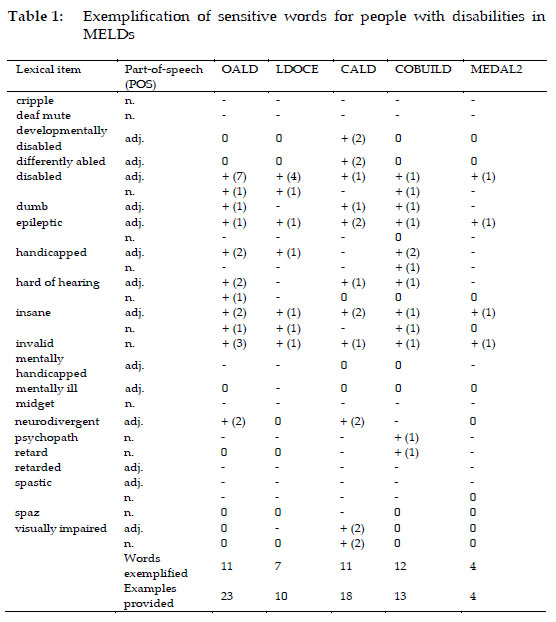
In order to investigate the exemplification policies adopted in MELDs, I examined the inclusion of examples for the sensitive words selected for the present study. The findings are presented in tabular form (see Table 1) to better summarise the similarities and differences between the dictionaries studied. A plus sign in the table means that the word is exemplified in the dictionary. A minus sign indicates that no example is provided for the word. A zero means that the word or the relevant disability sense is not included in the dictionary. The numbers placed within brackets indicate the number of examples given. For adjectives that can be used nominally as collectives (e.g. disabled, handicapped, and insane), I counted their nominal and adjectival uses related to disability as two distinct entries.
Since the websites of the four learner's dictionaries do not indicate the source of the additional examples, it remains unclear whether these examples are automatically extracted from corpora or selected by dictionary compilers. This lack of transparency raises concerns about their reliability. As Rundell (2015) observes, such examples are often subject to little or no filtering in terms of quality or appropriacy. In light of these concerns, this part of the comparison focuses solely on the examples included in the core entry. The additional examples will be discussed separately in Section 3.
A comparison of the exemplification of the selected words in the "Big Five" reveals some similarities in how sensitive words for people with disabilities are exemplified. These similarities pertain to the number of examples provided, the types of examples used, and the functions those examples serve.
2.1 Number of examples
While the importance of examples in dictionaries has been emphasised by many lexicographers (e.g. Zgusta 1971: 263-268; Landau 2001: 305-308; Atkins and Rundell 2008: 452-462), sensitive terms for people with disabilities, particularly those considered offensive (e.g. cripple, deaf mute, midget, retarded, and spastic), appear to be exemplified less frequently in learner's dictionaries. The exemplification of the selected words in the "Big Five" reveals an overall lack of examples and unevenness in the coverage of examples.
Table 2 presents the exemplification frequency of the selected words in five MELDs. The data in the table shows a significant lack of examples for disability-related words in learner's dictionaries. While these dictionaries include between 18 and 25 words, the percentage of exemplified words varies widely, with some dictionaries providing very few examples. The highest rate of exemplification is found in COBUILD (63%), followed by OALD (52%), CALD (44%), LDOCE (32%), and MEDAL2 (22%). This means that even in the best case, more than a third of the words surveyed lack illustrative examples.
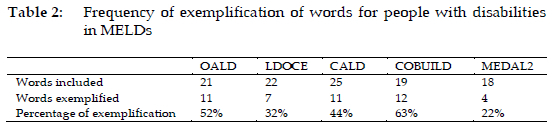
Furthermore, there are significant variations in how specific words are exemplified in different dictionaries. Disabled (adj.), epileptic (adj.), insane (adj.), and invalid (n.) are the only words consistently illustrated with examples in all five dictionaries. In contrast, cripple (n.), deaf mute (n.), midget (n.), retarded (adj.), and spastic (adj.) are not exemplified in any of them. The remaining words are treated differently across the five dictionaries.
One possible explanation for the absence of examples for sensitive terms in learner's dictionaries might be the limited corpus evidence available for such words. Many of these terms, particularly those targeting marginalised groups, occur infrequently in general corpora, making it difficult for lexicographers to extract appropriate corpus examples to illustrate their usage. Moreover, slang terms such as spaz are typically found in spoken language, which tends to be underrepresented in most corpora compared to written language. This further constrains the availability of suitable examples. However, limited corpus evidence alone may not fully account for the dearth of examples. For instance, while cripple (n.) appears 125 times in the British National Corpus (BNC), it is not exemplified in any of the "Big Five", whereas spaz (n.), which appears only once in the BNC, is exemplified in one of them (CALD). This suggests that the lack of examples for sensitive words may not be solely attributable to corpus frequency, and that other factors may also be at play.
A more compelling reason for the scarcity of examples for sensitive words in learner's dictionaries may be some sensitivity concerns. Lexicographers tend to take a cautious approach to sensitive words in case they might be criticised for normalising offensive language. Hughes (2006: 128) discusses the potential risk of including offensive terms in dictionaries:
Although modern dictionaries are predicated on the assumption that they are descriptive - that is, that they should reflect actual usage - there are both lingering and new social pressures about what is appropriate to appear in print. There are also tenacious assumptions that simply by printing an offensive term a dictionary is in some way dignifying the term, relaxing standards, encouraging laxity, or endorsing prejudices.
Dictionaries have to accordingly use various strategies to respond to these pressures, one of the most common being the exclusion of usage examples.
A final possible reason for the limited exemplification of sensitive words might be concern about their potential misuse. Rather than risk reinforcing negative usage or failing to convey the nuanced contexts in which such terms might appear, lexicographers may choose to avoid providing examples altogether, even when corpus evidence is available.
2.2 Types of examples
Learner's dictionaries also show similarities in the types of examples they provide. They all include both phrase examples and sentence examples for words related to people with disabilities. The number of each type of example is shown in Table 3.
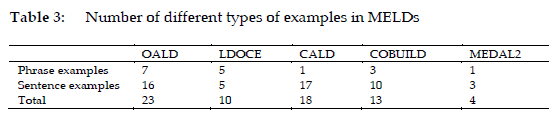
As shown in Table 3, the "Big Five" generally give more sentence examples than phrase examples for the words examined. Phrase examples show typical collocations of the word examined or fixed expressions, such as the examples under dumb, disabled, and epileptic shown in (1), (2), and (3). Sentence examples, on the other hand, place the word in a specific context, as the examples for differently-abled and insane in (4) and (5) show.
(1) a young deaf and dumb man (COBUILD)
(2) a new home for severely disabled people (OALD)
(3) an epileptic fit (CALD)
(4) The same opportunities must be provided to differently-abled employees as to the rest of the workforce. (CALD)
(5) The killer was declared criminally insane. (LDOCE)
Given the particular complexity and sensitivity of sensitive words, it is worth considering that future online learner's dictionaries could benefit from including more sentence examples for such terms. Sentence examples offer valuable contextual cues, such as syntactic patterns, collocational behaviour, and pragmatic implications. For sensitive or potentially offensive terms, understanding the context in which a word is typically used is crucial. By illustrating how a term is used in real-life situations, examples can help learners not only grasp its meaning but also develop the pragmatic competence necessary to avoid inappropriate or harmful usage. Moreover, several dictionary user studies have shown that EFL learners tend to favour full-sentence examples over short segments (e.g. Farina et al. 2019). This preference further supports the recommendation that online learner's dictionaries should consider providing more sentence examples for sensitive words.
2.3 Functions of examples
The functions of dictionary examples have been stressed by many lexicographers (e.g. Fox 1987; Atkins and Rundell 2008). Fox (1987: 137) argues that dictionary examples should "help to reinforce the meaning - not by acting as a reformulation of the definition, but by showing how the word is actually used, in an appropriate context, a typical grammatical structure, and with words that are normally associated with it". Atkins and Rundell (2008: 453-454) summarise the functions of a good dictionary example as including attestation, elucidating the meaning of words, and illustrating contextual features. However, these accounts have been criticised for failing to differentiate examples used for decoding purposes and those for encoding purposes (Humblé 2001; Stein 2002; Frankenberg-Garcia 2012, 2014). Thus, Humblé (2001) argues for a clear distinction between decoding and encoding examples.
The "Big Five" provide both decoding and encoding examples for the words examined, especially for neutral terms. Decoding examples are typically designed to offer contextual clues that help learners comprehend word meanings (Humblé 2001). The following are examples listed under invalid in the "Big Five":
(6) She had been a delicate child and her parents had treated her as an invalid. (OALD)
(7) He was found guilty of murdering his invalid father. (OALD)
(8) Her husband was an invalid and couldn't come to the door to open it. (OALD)
(9) I resented being treated as an invalid. (LDOCE)
(10) Is the invalid in bed? (CALD)
(11) I hate being treated as an invalid. (COBUILD)
(12) He had been an invalid for many years. (MEDAL2)
Examples (6) and (8) provide relatively clear contexts that help users infer the meaning of invalid through contextual cues. In contrast, examples like (7), (9), and (11) either focus on emotionally charged or abstract experiences, making the word's meaning harder to extract. Others, such as (10), lack sufficient context, reducing their effectiveness for modern learners. Ideally, examples provided in dictionaries should be natural, typical, informative, and intelligible (Atkins and Rundell 2008). However, the examples for sensitive words in the "Big Five" vary in clarity and pedagogical usefulness. While some provide meaningful and context-rich usage, others are vague or emotionally complex, potentially hindering comprehension. This variation highlights the importance of careful example selection, especially for potentially offensive words.
In contrast, encoding examples, as pointed out by Humblé (2001), should demonstrate grammatical patterns and collocations of the word. Such examples are mainly given to help facilitate production. Some examples listed under disabled are shown below.
(13) physically/developmentally/intellectually disabled (OALD)
(14) a new home for severely disabled people (OALD)
(15) temporarily/permanently disabled (OALD)
(16) physically/mentally disabled (LDOCE)
(17) severely disabled (=unable to move most of your body) (MEDAL2)
Examples (13) to (17) are all encoding examples because they demonstrate common collocations of disabled with different modifiers (physically, developmentally, intellectually, severely, temporarily, permanently, and mentally). These examples do not seem particularly useful in terms of helping users understand what disabled means. The provision of collocational information is aimed at facilitating users' language production.
It is worth noting that some examples for the words examined can deal with both the decoding and encoding needs of users, as the example for disabled in (18).
(18) If you are elderly or physically disabled, massage can be beneficial. (LDOCE)
The example primarily serves a decoding purpose because it helps users understand the meaning of disabled by linking it to a clear health-related context. However, it also has an encoding function in that it presents a common collocate of disabled, i.e. physically, which could help users produce similar sentences.
To conclude, while users of learner's dictionaries may rarely use sensitive words in their productive language, they still need to understand the meanings and usage of these terms when they encounter them. For offensive and taboo words, a clear usage label may often be sufficient to indicate their sensitive nature, especially given the difficulty of crafting example sentences that effectively convey their negative connotations without reinforcing harmful stereotypes. By contrast, exemplification is particularly important for neutral and euphemistic terms related to disability, as these are more likely to be used productively by learners and their appropriate contexts may not be self-evident. It is therefore essential that learner's dictionaries offer well-considered examples for such terms to support inclusive language use.
3. Exemplification of sensitive words for people with disabilities in MELDs: Main variations
Despite general similarities in the inclusion of illustrative examples in learner's dictionaries, the exemplification of disability-related sensitive terms in the "Big Five" shows notable intra-dictionary and inter-dictionary variations. These differences, to a great extent, reflect underlying editorial attitudes toward sensitive language.
3.1 Variations in the number of exemplified words and included examples
Learner's dictionaries differ from each other in the number of exemplified words for people with disabilities and the number of included examples. As Table 1 shows, COBUILD contains the highest number of exemplified words (12), followed by CALD and OALD, each with 11. LDOCE includes fewer exemplified words (7), while MEDAL2, the only print edition among the five dictionaries, has the fewest, with only four.
The limited exemplification of sensitive terms in MEDAL2 can be partly attributed to its print format, which imposes space constraints that may restrict the number of examples provided. However, this factor alone does not fully explain the lack of exemplification. As previous research has shown, even the online version of MEDAL contains fewer examples than other MELDs, not only for sensitive terms but also for other terms such as academic words (Rees 2024).2 This suggests that the sparse exemplification in MEDAL2 is more likely the result of an overall editorial policy rather than a mere consequence of dictionary format.
The relatively high number of illustrative examples in COBUILD reflects the exemplification policy of the dictionary, which states that "examples would be given for most of the words or senses of words explained in it" (Fox 1987: 137). The policy was proposed when the first edition of COBUILD was being planned and has been followed in later editions.
CALD adopts a more inclusive approach toward emerging vocabulary and euphemisms. It includes and exemplifies terms such as developmentally disabled and differently abled, whereas none of the other dictionaries include these terms. Additionally, among the three dictionaries that include neurodivergent, only CALD and OALD provide examples for the word.
While COBUILD exemplifies the most words, the number of examples provided for each sense is generally limited to one. In contrast, although OALD and CALD exemplify fewer words than COBUILD, they provide a greater number of examples. OALD even gives seven examples for the nominal sense of disabled. CALD generally provides two examples for most senses. MEDAL2, on the other hand, includes only one example per sense. Although LDOCE exemplifies seven words, it gives one example per sense except for the adjectival sense of disabled (with four examples).
3.2 Variations in the inclusion of additional examples
A notable phenomenon of exemplification in online learner's dictionaries is the inclusion of additional examples within the extra sections of the entry. Among the four online learner's dictionaries, three (OALD, CALD, and LDOCE) provide a section of additional examples. Generally, these dictionaries do not provide information on their websites about how examples are selected. It is therefore unclear to users whether these additional examples are automatically generated from corpora or chosen by lexicographers.
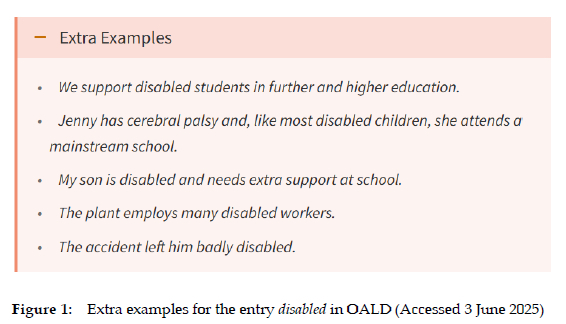
OALD provides a separate Extra Examples section in addition to the examples included in the core entry (for an example, see the Extra Examples for disabled in Figure 1). The Extra Examples column is presented following the sense it illustrates.
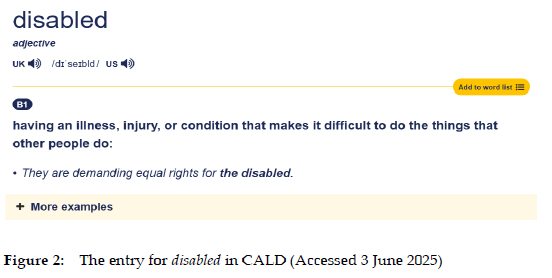
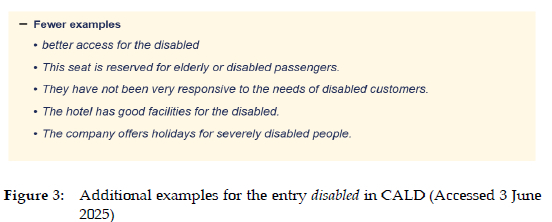
CALD allows users to choose a display of More examples or Fewer examples following the examples provided within the core entry. An example is the entry for disabled shown in Figure 2. There is only one example nested within the core entry. However, if users want to see more examples, they can click on the More examples link, and more examples for the word will be displayed (see Figure 3). Although CALD does not provide any information on the site about the selection of illustrative examples, Wendalyn Nichols, Publishing Manager of the Cambridge Dictionary, confirms that the examples within the core entry in CALD are all chosen by lexicographers in the process of compiling the entries according to the usual principles for learner's dictionaries. The "more examples" are also chosen by lexicographers from the Cambridge International Corpus using Sketch Engine (personal communication, March 28, 2025).
LDOCE usually supplements its examples in the core entry with corpus examples, which are explicitly signalled by the boldface subheading Examples from the Corpus (for an example see Figure 4). LDOCE provides such additional examples for eleven terms surveyed in this study (cripple, deaf mute, disabled, dumb, epileptic, handicapped, insane, invalid, mentally handicapped, psychopath, and visually impaired). However, it is worth mentioning that LDOCE's corpus examples contravene principles of good lexicographic exemplification in several ways, leading to the suspicion that they are automatically generated, with little review from lexicographers. These deviations from good lexicographic exemplification will be examined in detail in the following sections.
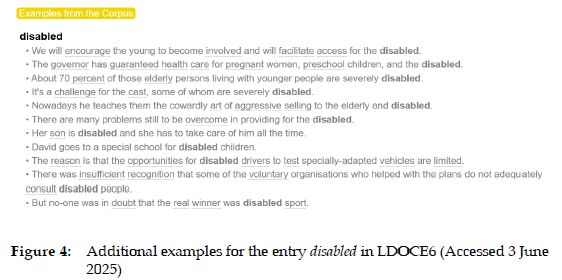
Admittedly, the inclusion of extra examples in online dictionaries may benefit dictionary users, given the fact that "the average dictionary user appreciates examples in dictionaries" (Ptasznik 2023: 33). However, the presentation of additional examples in learner's dictionaries also raises all sorts of questions. While OALD and CALD provide additional examples under the senses they illustrate, LDOCE, by contrast, presents the extra corpus examples at the end of the entry in a way that mixes examples of different senses, making it difficult for users to identify which examples illustrate a particular sense. In other words, users may be confused by the mix of examples for different senses. A more user-friendly approach to presenting corpus-derived examples might be to arrange them under the senses they illustrate or to group these examples according to the order of senses. This would enhance clarity and usability, helping learners better understand word meanings and usage in context.
Another problem is that the additional examples extracted from corpora may contain uncommon words, complex structures, idiomatic phrases, or cultural information which are difficult for learners to understand. For example, the following additional examples for epileptic and invalid are presented on the web page of LDOCE.
(19) Thus epileptic seizures often began with a sustained tachycardia in spite of apnoeic pauses and severe hypoxaemia.
(20) Ten patients had hypoxaemic events induced by epileptic seizures.
(21) The survey attempted to answer critics who have dismissed international comparisons as invalid because of differences in cultural expectations about health care.
(22) As it turns out, the fears that govern such organizations derive in large part from invalid or negative core beliefs.
The highly technical words, such as tachycardia, apnoeic, and hypoxaemia, in the examples for epileptic are difficult for foreign language learners - and maybe native speakers too - to understand. Moreover, the complex sentence structures adopted in these corpus examples, especially the example (21), may confuse learners rather than help them understand the meaning of the word. Such examples are largely useless, as Atkins and Rundell (2008: 461) argue that "if the example is incomprehensible, it is of no value".
However, a more serious problem is that some examples do not correspond to the senses they are intended to illustrate. For example, in examples (21) and (22), invalid is used in the general sense of "wrong" rather than in a context related to disability, and therefore does not represent a sensitive use. This is a common problem in e-lexicography (Frankenberg-Garcia et al. 2021).
A final deficiency of additional examples is that, without human intervention, they may contain grammatical errors, spelling errors, and other problems, as shown by the following example under visually impaired in LDOCE.
(23) Instructions can also be obained in Braille for the visually impaired.
The word "obained" in this example is undoubtedly a misspelling: it should be "obtained". Such an example is unhelpful to dictionary users. It should be noted that all examples provided in dictionaries, whether selected by lexicographers or generated from a corpus, should serve the needs of dictionary users. If learner's dictionaries choose to include additional examples, human proofreading is desirable to ensure that poor-quality examples are eliminated. Admittedly, human intervention comes with financial costs. Given the current challenges facing dictionary publishers, such as increased competition from AI chatbots, declining advertising revenue, and the widespread expectation that dictionaries should be freely accessible, comprehensive manual oversight is often economically unfeasible. Nevertheless, intervention from lexicographers can undoubtedly improve the quality of corpus-derived examples, thereby benefiting foreign language learners.3
4. Exemplification of sensitive words for people with disabilities in MELDs: Main factors
Based on Stein (2002) and Xu (2008), I examined factors that may influence the exemplification of sensitive words for people with disabilities. The analysis indicates that the exemplification of sensitive words in the "Big Five" correlates with the parameters of part-of-speech, attitude labelling, and word currency. This section discusses how the exemplification of selected words varies with respect to these variables.
4.1 Effects of part-of-speech on exemplification
A preliminary analysis of the data in Table 1 reveals that the exemplification rates of sensitive words in the "Big Five" generally vary with the part-of-speech of the word. Adjectival senses of sensitive words are more likely to be exemplified than their nominal counterparts. For example, the adjectival senses of the words such as epileptic, disabled, and insane are consistently exemplified across all five dictionaries, whereas their nominal senses are either not included or not exemplified.
To quantify this exemplification trend, a comparative analysis was conducted (see Table 4). Across the dataset presented in Table 1, there are 14 adjectival terms and 14 nominal terms. The adjectival terms receive a total of 29 instances of exemplification (out of a possible 70), resulting in an average exemplification rate of 41%. In contrast, the nominal terms receive only 16 instances of exemplification (23%). This substantial difference suggests a consistent pattern favouring adjectives in the provision of usage examples.

To determine whether this difference is statistically significant, a chi-square test was performed. The result (χ2 = 4.72, p < .05) confirmed that the association between part-of-speech and exemplification is significant. In other words, the part-of-speech does have a significant effect on the exemplification of sensitive words in learner's dictionaries.
Despite this exemplification pattern, there are still some discrepancies in the exemplification of several words that can be used as both adjectives and nouns across the "Big Five" (e.g. disabled, handicapped, hard of hearing, and insane). The adjectival sense of disabled is exemplified in all five dictionaries, showing consistency in its treatment as an adjective. The nominal sense, however, is exemplified only in LDOCE and COBUILD. For handicapped, the adjectival sense is exemplified in OALD, LDOCE, and COBUILD but left unexemplified in CALD and MEDAL2. The nominal sense of the word is even less frequently exemplified. Only COBUILD provides a phrase example ("... measures to prevent discrimination against the handicapped."). As for hard of hearing, the adjectival use is exemplified in OALD, CALD, and COBUILD but unexemplified in LDOCE and MEDAL2. The nominal sense, however, is included in OALD and LDOCE, with illustrative examples provided only in OALD. The other dictionaries do not include the nominal usage at all. When it comes to the exemplification of insane, the adjectival sense is consistently exemplified in all five dictionaries. The nominal form, however, is inconsistently treated: it is illustrated by one example in OALD, LDOCE, and COBUILD, respectively, but not in CALD. MEDAL2 does not include this sense. In brief, COBUILD tends to exemplify the nominal uses of sensitive words more frequently than other dictionaries, while MEDAL2 exemplifies them the least.
Nevertheless, it is still safe to conclude that adjectival forms of sensitive words are more frequently exemplified than nominal ones. Such differences in the exemplification are largely influenced by the evolution of disability models and disability language. Nominal forms such as a cripple, an epileptic, or a retard are rooted in the moral model of disability, which views "disability [as] a defect caused by moral lapse or sins" (Olkin 1999: 25). The stigma-based language such as a cripple often reflects pity, stigma, or moral judgment (Olkin 2017). Moreover, the expressions like the disabled are favoured by the medical model of disability, which views disability as an inherent medical problem of the individual that must be "cured or eliminated" (Siebers 2008: 3). Using nominal forms with the definite article to group people based on certain characteristics like disability has been criticised for reducing individuals to a single attribute and failing to acknowledge their personhood (Halmari 2011; Dunn and Andrews 2015). The affirmative model represents a more recent and influential approach to understanding disability. It emphasises the positive identity and experiences of disabled individuals. Proponents of the affirmative model advocated for the identity-first language (e.g., blind person and disabled person), acknowledging disability as an integral part of identity, similar to race or gender. To recap, developments in both disability models and disability language offer insight into why adjectival forms of sensitive terms are more frequently exemplified than their nominal counterparts in learner's dictionaries.
4.2 Effects of attitude labelling on exemplification
In order to investigate the effects of attitude labelling on the exemplification of sensitive words for people with disabilities in the "Big Five", I examined the exemplification of the words labelled as having negative connotations by means of usage labels (e.g. "disapproval", "disapproving", "impolite", "not polite", "offensive", "rude", and "taboo") and other devices like definitions and usage notes. The results are tabulated in Table 5. In the Table, "L." means labelling, whereas "Ex" indicates exemplification. In the "L." column, a plus sign means that the word's offensiveness is marked by an attitude label in the dictionary. A minus sign shows that no label is provided for the word. A minus sign placed within brackets indicates that the word's offensiveness is marked by other devices such as definitions or usage notes. A zero means that the word or the relevant disability sense is not included in the dictionary.
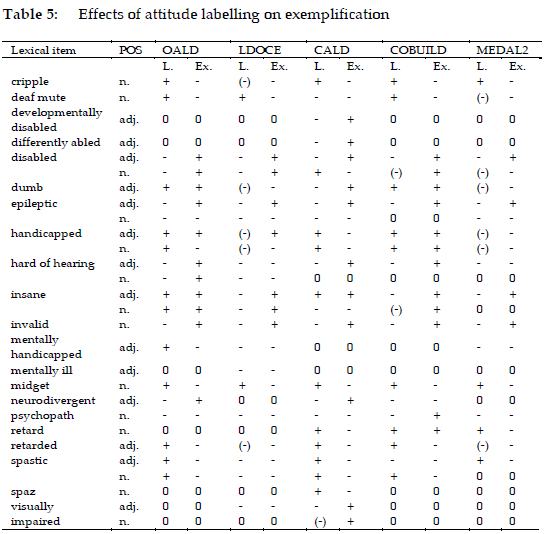
As Table 5 indicates, the "Big Five" show discrepancies in their exemplification of attitude-labelled sensitive words. Among them, CALD, LDOCE, and MEDAL take a more consistent approach by generally refraining from providing examples for words labelled as having negative connotations. COBUILD exemplifies more words in general, with only six of the words lacking examples: cripple, deaf mute, midget, neurodivergent, retarded, and spastic. In contrast, OALD is the most inconsistent, which makes it difficult to identify a clear principle behind its exemplification choices. Some words labelled as having negative connotations, like dumb (in its "unable to speak" sense), are accompanied by illustrative examples, while others (e.g. cripple and deaf mute) are not.
Notwithstanding these differences, the "Big Five" tend to adopt a cautious and selective exemplification of attitude-labelled words. To illustrate this, I tabulated the exemplification rates of attitude-labelled words and unlabelled words in Table 6.
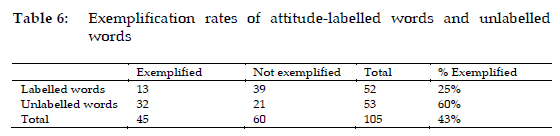
Based on 105 valid instances where the relevant disability-related sense of a word is included, attitude-labelled words have a significantly lower exemplification rate (25%) than unlabelled words (60%). A chi-square test of independence confirmed that this difference is statistically significant (χ2 (1, N = 105) =13.41, p < .001). This suggests that the attitude-labelled words are less likely to be exemplified in the "Big Five" than unlabelled words.
4.3 Effects of word currency on exemplification
Following Stein (2002) and Xu (2008), I also examined the effects of word currency on the exemplification of sensitive words. I surveyed the example allocation of sensitive words labelled as 'old-fashioned' (Lo.). Table 7 presents data on whether each sensitive word is marked as 'old-fashioned' (Lo=+) and whether it is accompanied by an example sentence (Ex=+). The results of the exemplification rates of currency-labelled words and unlabelled words are listed in Table 8.
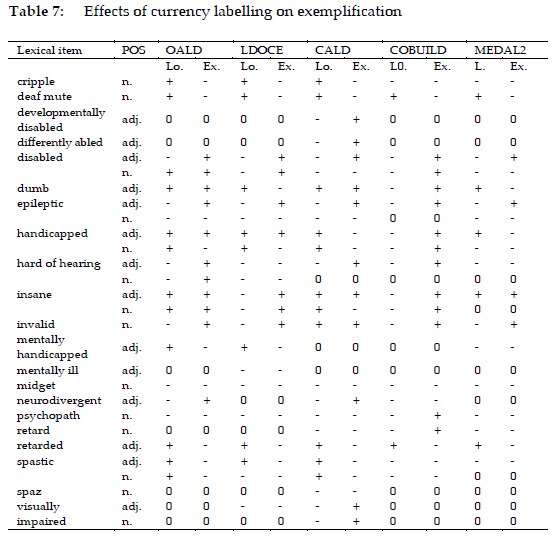

It can be seen in Table 7 that the "Big Five" tend to avoid exemplifying highly offensive terms that are now outdated (e.g. cripple, deaf mute, dumb, midget, mentally handicapped, retarded, and spastic). By contrast, sensitive words that remain in medical, legal, or formal use (e.g. invalid and insane) are generally exemplified in MELDs. Among the 105 dictionary entries included in the analysis, 38 are labelled as old-fashioned, while 67 are unlabelled. Of the labelled entries, only 10 (26%) are accompanied by examples, compared to 35 (52%) of the unlabelled entries. These descriptive results suggest that sensitive words labelled as old-fashioned are less likely to be exemplified than unlabelled words.
To determine whether this observed difference was statistically significant, a chi-square test of independence was conducted. The results revealed a statistically significant association between currency labelling and exemplification rates, χ2 (1, N = 105) = 5.64, p < .05. This indicates that unlabelled words, i.e. more current in usage, are significantly more likely to be provided with examples in learner's dictionaries than words explicitly labelled as old-fashioned.
5. Exemplification of sensitive words for people with disabilities in online MELDs: Some suggestions
Given the importance of examples in learner's dictionaries and the particular nature of sensitive words, improving their exemplification in MELDs is essential. This section thus provides some suggestions on the exemplification of sensitive words in online learner's dictionaries.
5.1 Increasing the exemplification of sensitive words
It may be difficult for learners to grasp the pragmatics of sensitive words without the help of examples. They may run the risk of using these words inappropriately, thereby causing unintended offence to others. It is thus reasonable to argue that learner's dictionaries could exemplify a greater number of sensitive words and increase the number of examples per sense. Traditional print dictionaries, due to space constraints, often grapple with the question of what types of vocabulary should be prioritised in exemplification (Xu 2008). Sensitive words, especially offensive words or taboo words, are seldom exemplified in print dictionaries (for example, in MEDAL2). However, in an era of e-lexicography, storage space is no longer a major problem for lexicographers. Lexicographers should now focus on what types of examples should be provided for different words and how many examples are needed to benefit dictionary users.
Current learner's dictionaries usually provide one or two examples per sense for sensitive words. However, numerous dictionary user studies (e.g. Summers 1988; Laufer 1993; Nesi 1996; Al-Ajmi 2008; Frankenberg-Garcia 2015) have demonstrated the effects of dictionary examples in language learning. Some studies (Frankenberg-Garcia 2014; Ptasznik 2023) show that more examples may benefit dictionary users. Zgusta (1971: 264) states outright that "exemplification is always useful". I would thus argue for an increase in the number of examples per sense for sensitive words (especially neutral and euphemistic terms) in learner's dictionaries.
While storage space is no longer a major limitation in online dictionaries, presentation space remains restricted (Lew in press).4 Providing too many examples within a single entry may lead to information overload, potentially hindering rather than helping users (Lew in press; Gouws and Tarp 2017). Therefore, examples for sensitive words in online learner's dictionaries should be selectively and purposefully chosen to enhance understanding and avoid the dangers of information overload.
5.2 Improving the quality of additional examples
Considering the deficiencies in the additional examples in online learner's dictionaries, there is a clear need to improve the quality of such examples. One efficient solution could be the use of example extraction tools to identify and select good corpus examples. One of the most widely used tools is GDEX (Good Dictionary Examples; Kilgarriff et al. 2008), which was originally developed and used for the Macmillan English Dictionary in 2007 (Kilgarriff et al. 2008; Kosem et al. 2019). Significantly, GDEX can be used to filter out examples that do not meet specific standards. For example, it can control sentence length and word frequencies (Kilgarriff et al. 2008). Therefore, learner's dictionaries could use such example extraction tools to select high-quality corpus examples for sensitive words. For instance, examples could be limited to sentences using the defining vocabulary, which would help avoid the use of uncommon words in examples. Furthermore, human proofreading should be involved to check the quality of corpus-derived examples. This would mostly eliminate typos like obained mentioned above. To sum up, a combination of human intervention and the use of example extraction tools would largely prevent the problems associated with additional examples in current learner's dictionaries and provide real benefit to users.
5.3 Optimising the presentation of additional examples
As discussed earlier, online learner's dictionaries like LDOCE place additional examples at the end of the entry, where examples of different senses are mixed together. This undifferentiated presentation makes it difficult for users, particularly EFL learners, to identify the particular senses different examples exemplify. Yamada (2013: 223) argues that the improvements of information provision in online dictionaries should focus more on "the order, arrangement, hierarchy, and presentation with differentiation and options". It is therefore argued that the presentation of additional examples in learner's dictionaries should be optimised. One possible approach, if the dictionary prefers to group extra examples together as in LDOCE, is to arrange them in the order of the senses they exemplify. Alternatively, as seen in OALD and CALD, the additional examples could be placed immediately after the sense they are intended to illustrate. Furthermore, in the digital environment, dictionaries can implement interactive features that allow users to filter or highlight examples by sense. For example, users could click on a specific sense in the definition area to view only the examples linked to that meaning.
6. Conclusion
This paper has examined the exemplification of sensitive words for people with disabilities in the "Big Five". While online learner's dictionaries tend to provide more examples overall, they remain conservative in exemplifying sensitive medical words. The dictionaries vary in the number of terms exemplified and examples provided, and in the inclusion of additional examples. Despite these differences, the "Big Five" display notable similarities in the types and functions of examples for the words surveyed: all offer phrase and sentence examples that support both the encoding and decoding needs of users. Furthermore, the findings indicate that the exemplification of sensitive words related to disability is largely influenced by three key factors: part-of-speech, attitude labelling, and word currency. First, with regard to part-of-speech, adjectival senses of sensitive words are more likely to be exemplified than their nominal counterparts. Second, sensitive words that remain in current use tend to have higher exemplification rates than those considered old-fashioned. Finally, words that carry negative connotations, typically marked by attitude labels, are less likely to be exemplified than neutral or euphemistic expressions. After a critical examination of the exemplification policies adopted by the "Big Five", this study argues for improving the quality and optimising the presentation of additional examples in online learner's dictionaries. More importantly, it recommends more frequent exemplification of sensitive words, especially neutral and euphemistic terms. As for offensive words, whether they should be exemplified may require further user research.
This study offers a preliminary exploration of the exemplification of sensitive medical words in dictionaries. There are numerous avenues for further research. A survey of users' interpretations of the examples provided for sensitive words in dictionaries would be particularly valuable. Such studies would enable lexicographers to better understand how different users, particularly users with disabilities, interpret and evaluate the lexicographic treatment of sensitive medical words. Besides user research, an investigation into the representation of people with disabilities through sentence examples could also be pursued in future studies. There is also a need for research that could have a greater concern for the rights and experiences of disabled people in lexicography. Such research would contribute to our understanding of disability in lexicographic discourse and promote inclusive language.
Acknowledgements
The author would like to thank Prof. Elsabé Taljard, and three anonymous adjudicators for their insightful comments and suggestions. Special thanks are due to Prof. M. Lynne Murphy of the University of Sussex for her constructive feedback on earlier drafts of this article. This study was inspired by academic discussions with her.
Endnotes
1 The website of the Macmillan English Dictionary for Advanced Learners was shut down on 30 June 2023.
2 I am grateful to one anonymous adjudicator for reminding me that MEDAL has fewer examples for words in general, not just sensitive words.
3 Thanks are due to one anonymous adjudicator who called my attention to this point.
4 Lew (in press) explains that "storage space refers to the capacity to hold the total content of the dictionary, whereas presentation space refers to how much can be presented (displayed, visualized) at a given time to the dictionary user."
References
A. Dictionaries
CALD. Cambridge Advanced Learner's Dictionary.https://dictionary.cambridge.org [3 June 2025]
COBUILD. Collins COBUILD Advanced Learner's Dictionary.http://www.collinsdictionary.com [3 June 2025]
LDOCE. Longman Dictionary of Contemporary English. https://www.ldoceonline.com [3 June 2025]
MEDAL2. 2007. Macmillan English Dictionary for Advanced Learners. Second edition. Oxford: Macmillan Education. [ Links ]
OALD. Oxford Advanced Learner's Dictionary of Current English. https://www.oxfordlearnersdictionaries.com [3 June 2025]
B. Other literature
Al-Ajmi, H. 2008. The Effectiveness of Dictionary Examples in Decoding: The Case of Kuwaiti Learners of English. Lexikos 18: 15-26. [ Links ]
Allan, K. and K. Burridge. 2006. Forbidden Words: Taboo and the Censoring of Language. Cambridge: Cambridge University Press. [ Links ]
Anderson, R.C. and R.A. Fox. 1988. Health Education and the Developmentally Disabled. Journal of the Multihandicapped Person 1(4): 327-333. [ Links ]
Atkins, B.T.S. and M. Rundell. 2008. The Oxford Guide to Practical Lexicography. Oxford/New York: Oxford University Press. [ Links ]
BNC. British National Corpus. http://www.natcorp.ox.ac.uk/ [19 June 2025].
Coffey, S. 2010. 'Offensive Items', and Less Offensive Alternatives, in English Monolingual Learners' Dictionaries. Dykstra, A. and T. Schoonheim (Eds.). 2010. Proceedings of the XIV EURALEX International Congress, Leeuwarden, 6-10 July 2010: 1270-1281. Leeuwarden/Ljouwert: Fryske Akademy - Afûk. [ Links ]
Dunn, D.S. and E.E. Andrews. 2015. Person-first and Identity-first Language: Developing Psychologists' Cultural Competence Using Disability Language. American Psychologist 70(3): 255-264. [ Links ]
Farina, D.M.T.Cr., M. Vrbinc and A. Vrbinc. 2019. Problems in Online Dictionary Use for Advanced Slovenian Learners of English. International Journal of Lexicography 32(4): 458-479. [ Links ]
Fox, G. 1987. The Case for Examples. Sinclair, J.M. (Ed.). 1987. Looking Up: An Account of the COBUILD Project in Lexical Computing: 137-149. London: HarperCollins. [ Links ]
Frankenberg-Garcia, A. 2012. Learners' Use of Corpus Examples. International Journal of Lexicography 25(3): 273-296. [ Links ]
Frankenberg-Garcia, A. 2014. The Use of Corpus Examples for Language Comprehension and Production. ReCALL 26(2): 128-146. [ Links ]
Frankenberg-Garcia, A. 2015. Dictionaries and Encoding Examples to Support Language Production. International Journal of Lexicography 28(4): 490-512. [ Links ]
Frankenberg-Garcia, A., G.P. Rees and R. Lew. 2021. Slipping Through the Cracks in e-Lexicography. International Journal of Lexicography 34(2): 206-234. [ Links ]
Gouws, R.H. and S. Tarp. 2017. Information Overload and Data Overload in Lexicography. International Journal of Lexicography 30(4): 389-415. [ Links ]
Halmari, H. 2011. Political Correctness, Euphemism, and Language Change: The Case of 'People First'. Journal of Pragmatics 43(3): 828-840. [ Links ]
Hughes, G. 2006. An Encyclopedia of Swearing: The Social History of Oaths, Profanity, Foul Language, and Ethnic Slurs in the English-speaking World. New York: M.E. Sharpe. [ Links ]
Humblé, P. 2001. Dictionaries and Language Learners. Frankfurt am Main: Haag und Herchen. [ Links ]
Kilgarriff, A., M. Husák, K. McAdam, M. Rundell and P. Rychlý. 2008. GDEX: Automatically Finding Good Dictionary Examples in a Corpus. Bernal, E. and J. DeCesaris (Eds.). 2008. Proceedings of the 13th EURALEX International Congress, Barcelona, 15-19 July 2008: 425-432: Barcelona: Institut Universitari de Lingüistica Aplicada, Universitat Pompeu Fabra. [ Links ]
Kosem, I., K. Koppel, T.Z. Kuhn, J. Michelfeit and C. Tiberius. 2019. Identification and Automatic Extraction of Good Dictionary Examples: The Case(s) of GDEX. International Journal of Lexicography 32(2): 119-137. [ Links ]
Landau, S.I. 2001. Dictionaries: The Art and Craft of Lexicography. Second edition. Cambridge: Cambridge University Press. [ Links ]
Laufer, B. 1993. The Effect of Dictionary Definitions and Examples on the Use and Comprehension of New L2 words. Cahiers de Lexicologie 63(2): 131-142. [ Links ]
Lew, R. in press. Space Restrictions in Paper and Electronic Dictionaries and Their Implications for the Design of Production Dictionaries. https://wa.amu.edu.pl/~rlew/pub/Lew_space_restrictions_in_paper_and_electronic_dictionaries.pdf [19 June 2025]
Nesi, H. 1996. The Role of Illustrative Examples in Productive Dictionary Use. Dictionaries: Journal of the Dictionary Society of North America 17: 198-206. [ Links ]
Norri, J. 2000. Labelling of Derogatory Words in Some British and American Dictionaries. International Journal of Lexicography 13(2): 71-106. [ Links ]
Norri, J. 2020. Treatment of Words for Illness and Disability in Monolingual English Dictionaries. International Journal of Lexicography 33(3): 227-250. [ Links ]
Olkin, R. 1999. What Psychotherapists Should Know about Disability. New York: Guilford Press. [ Links ]
Olkin, R. 2017. Disability-affirmative Therapy: A Case Formulation Template for Clients with Disabilities. New York: Oxford University Press. [ Links ]
Ptasznik, B. 2023. More Examples May Benefit Dictionary Users. International Journal of Lexicography 36(1): 29-55. [ Links ]
Rees, G.P. 2024. Academic Word Families in Online English Dictionaries. Lexikos 34(1): 437-468. [ Links ]
Rundell, M. 2015. From Print to Digital: Implications for Dictionary Policy and Lexicographic Conventions. Lexikos 25(1): 301-322. [ Links ]
Siebers, T. 2008. Disability Theory. Ann Arbor, MI: University of Michigan Press. [ Links ]
Stein, G. 2002. Better Words: Evaluating EFL Dictionaries. Exeter: Exeter University Press. [ Links ]
Summers, D. 1988. The Role of Dictionaries in Language Learning. Carter, R. and M. McCarthy (Eds.). 1988. Vocabulary and Language Teaching: 111-125. London: Longman. [ Links ]
Van der Meer, G. 2005. On Taboo and Slang in English Pedagogical Lexicography. So You've Been Looking for Them, Have You, Madam? (Dr Johnson). Gottlieb, H., J.E. Mogensen and A. Zettersten (Eds.). 2005. Symposium on Lexicography XI: Proceedings of the Eleventh International Symposium on Lexicography May 2-4, 2002 at the University of Copenhagen: 381-390. Berlin/ Boston: Max Niemeyer. [ Links ]
World Health Organization (WHO). 2013. How to Use the ICF: A Practical Manual for Using the International Classification of Functioning, Disability and Health (ICF). Geneva: WHO. [ Links ]
Xu, H. 2008. Exemplification Policy in English Learners' Dictionaries. International Journal of Lexicography 21(4): 395-417. [ Links ]
Yamada, S. 2013. A Test of the Proposed Framework for Reviewing Online Dictionaries: M-W.com, Dictionary.com, Macmillandictionary.com, Dictionary.cambridge.org, and Oxforddictictionaries. com (sic). Dictionaries: Journal of the Dictionary Society of North America 34: 211-224. [ Links ]
Zgusta, L. 1971. Manual of Lexicography. Berlin/New York: De Gruyter Mouton. [ Links ]
