




Services on Demand
Journal

Article
 English (pdf)
 Article in xml format
 Article references
 Automatic translation
 Send this article by e-mail
Indicators
Related links
-
 Cited by Google
 -
 Similars in Google
Share

 Permalink
Lexikos
On-line version ISSN 2224-0039Print version ISSN 1684-4904
Lexikos vol.35 n.2 Stellenbosch 2025
https://doi.org/10.5788/35-2-2078
ARTICLES
Lexicographic description of a polysemous word in a learner's dictionary based on its lexical prototype
Die leksikografiese beskrywing van 'n polisemiese woord in 'n aanleerderswoordeboek gebaseer op die leksikale prototipe daarvan
Anton Karasev
Département d'Anglais, Laboratoire Ligérien de Linguistique (VETD-DO), Université de Tours, Tours, France (anton.karasev@univ-tours.fr) (https://orcid.org/0009-0005-7311-6922)
ABSTRACT
This paper presents a practical application of the lexical prototype theory to lexicographic practice, proposing a draft model of a learner's dictionary entry for a polysemous word based on its lexical prototype. The lexical prototype (LP) is regarded as the semantic core of a polysemous word that functions at the level of the language system and is represented in actual speech by contextual meanings: the primary meaning (PM), metonymic, and metaphorical senses. Drafting a dictionary entry based on the LP requires reconstructing the LP through analysing the contextual meanings in relation to the PM in order to establish the minimal set of semantic features that are shared by all the senses of the word. The proposed method of lexicographic description of polysemous words offers a new perspective on polysemy as a linguistic phenomenon as well as moves away from the list-based method.
Keywords: lexicography, learner's dictionary, dictionary entry, polysemy, lexical prototype, primary meaning, metonymy, metaphor, cognitive linguistics
OPSOMMING
In hierdie artikel word 'n praktiese toepassing van die leksikale prototipe-teorie in die leksikografiese praktyk aangebied en 'n konsepmodel van 'n aanleerderswoordeboekinskrywing vir 'n polisemiese woord gebaseer op die leksikale prototipe daarvan, word voorgestel. Die leksikale prototipe (LP) word beskou as die semantiese kern van 'n polisemiese woord wat op die vlak van die taalsisteem funksioneer en word in werklike spraak deur kontekstuele betekenisse verteenwoordig: die primêre betekenis (PB), metonimiese, en metaforiese betekenisse. Die opstel van 'n woordeboekinskrywing wat op die LP gebaseer is, verg die rekonstruksie van die LP deur die analisering van die kontekstuele betekenisse in verhouding tot die PM om sodoende die minimale stel semantiese kenmerke wat deur al die betekenisse van die woord gedeel word, te bepaal. Die voorgestelde metode vir die leksikografiese beskrywing van polisemiese woorde bied 'n nuwe perspektief op polisemie as 'n linguistiese verskynsel en beweeg terselfdertyd weg van die lysgebaseerde metode.
Sleutelwoorde: leksikografie, aanleerderswoordeboek, woordeboekinskrywing, polisemie, leksikale prototipe, primêre betekenis, metonimie, metafoor, kognitiewe linguistiek
Introduction
When making a dictionary, a lexicographer faces a difficult task: on the one hand, the work must be theoretically grounded, on the other hand, it is supposed to satisfy the needs of the target audience, which determines the popularity of the dictionary and keeps it in demand (Slonimskaya 1990: 49). As a rule, dictionary users are reluctant to choose what they are not accustomed to. As a result, the structure and content of a lexicographic work are shaped as much by the expectations of the target audience as by linguistic factors. Therefore, dictionary-making is most often built on the achievements of previous generations of lexicographers both in compiling the lexicon and in writing dictionary entries (Jackson 2002: 27). Thus, the current consensus is that polysemy must be presented in the dictionary in a linguistically justified manner (Lodwig and Barret 1967: 53-54). Despite significant progress in the field of cognitive semantics, the methods of lexicographic description of lexical meanings have not changed much over time (Karasev 2014a; Halas 2016: 125). Nearly a century after the first learner's dictionaries came into being - which once stood at the forefront of both practical and theoretical lexicography (Cowie 2007: 14; Jackson 2002: 129) - no significant progress has been made in this field. For example, presenting polysemy as a list of numbered definitions introduced by Palmer has remained largely unchanged since the 1930s (Cowie 2007: 44). This is how practising lexicographers contribute to the development of linguistics: the methods they use to represent the semantic structure of words give rise to discussions whether dictionary definitions correspond to the actual lexical meaning (Arnold 2010: 108). There have been attempts to create lexicographic descriptions based on prototype theory (Halas 2016), and to describe meanings in a way that reflects their mental representations (Rivelis 2009). Opponents of such attempts argue that since we cannot know exactly how meanings are stored in the mind, it is impossible to describe them in the same way a dictionary. If this were to be discovered, the verbal description of meanings would differ significantly from how those meanings are represented in the mind of a native speaker (Zaliznyak 2004). Nevertheless, such an attempt still seems justified and, especially in the field of learner's lexicography, as it may be useful to reconstruct the systemic meaning before examining actual meanings (Guillaume 1973: 143).
This paper proposes a theoretically sound model for a learner's dictionary entry of a polysemous word based on lexical prototype theory (Arkhipov 2003: 79; Levchina 2003:269; Pesina 1998, 2005a, 2005b; Shiryaeva 2008), developed in the works of Arkhipov and his followers. According to this theory, a word's meaning within the language system reflects a generalisation of its various uses in everyday speech. Grasping this generalised meaning can be especially helpful for foreign language learners, as it allows them to recognise connections between specific contextual meanings, or senses, that might otherwise be unclear.
Polysemy in learner's dictionaries
The value of a dictionary lies in its ability to present the linguistic information in a visible, complete diverse manner. It serves as an essential tool of understanding language phenomena as it influences both their perception and, to some extent, linguistic consciousness. One might as well speak of a special "dictionary view" of reality (Devkin 2000: 10, 14-15; Atkins and Rundell 2008: 2). At the same time, a dictionary - especially a learner's dictionary - serves as an authority for the majority of its users. Therefore, it is essential to develop lexicographic principles that ensure descriptions of linguistic phenomena are as accurate and faithful to linguistic reality as possible. In this regard, an important issue is the correspondence between a word's meaning and its dictionary definition. Specifically, it is necessary to understand whether the definition reflects the actual lexical meaning, the reference underlying that meaning, or whether it merely provides a verbal description of a real-world object (Ufimtseva 1984: 135). Another key question concerns the extent to which the lexicographic treatment of polysemous words in dictionaries aligns with linguistic consciousness.
In theoretical literature, as well as in lexicography textbooks, the issue of polysemy and its lexicographic representation is usually described as resolved (Apresyan 1984: 409; Jackson 2002: 88; Dubchinskiy 1994: 10, 24). In these works, the authors outline the existing ways of presenting word meanings in dictionaries. Other researchers describe it as problematic (Hanks 2000: 211-212), though they don't propose specific solutions. Interestingly, the idea of polysemy as existence of several independent, though related meanings of a word has been shaped by dictionary making practice (Apresyan 1984: 186; Katsnelson 2011: 40; Mednikova 2010: 17). This leads to a vicious circle: a practical lexicographer finds theoretical justification for the list-based method of describing polysemy in the linguistic literature, while a theoretical linguist uses dictionary data as a basis for describing the phenomenon of lexical polysemy. It is also interesting to note that English-language lexicography does not seek to establish or highlight the closeness of separate senses of a word within dictionary entries (Litvin 1984: 5-6); instead, more attention is paid to reflecting the relation between lexical units (Soldatov 1997: 120). This leads to the fact that the meanings of polysemous words in monolingual learner's dictionaries of English are often presented as lengthy lists of definitions.
Corpus studies confirm that the meanings of a polysemous word do not exist as 'checklists': "The numbered lists of definitions found in dictionaries have helped to create a false picture of what really happens when language is used." (Hanks 2000: 205). Since human memory doesn't have the capacity to store every variation of the meanings of all known words (Brudny 1971: 19), the information about language units is retained in an individual's memory not as extended dictionary definitions, but in a more compact form, together with the mechanisms that enable the actualisation of meanings in context (Pertsov 2001: 43; 22). Thus, a dictionary presents a purely theoretical scheme which reflects the lexicographer's interpretation of the totality of actualisations of language-system units in speech, created through the "cataloguing" of meanings attested in texts (Arkhipov 2004: 79). This scheme does not represent the actual meaning of the word itself, but rather its "meaning potentials" that is, "potential contributions to the meanings of texts and conversations in which the words are used, and activated by the speaker who uses them" (Hanks 2000: 211). In this sense, the dictionary constitutes a minimised model of the speech usage of language units and does not provide a reliable representation of a word's semantics (Chudinov 2003: 34).
This means that the word meaning at the level of the language system must differ significantly from its realisation in speech. Given that human memory is not "a warehouse of individual traces duplicating the events of the external world, but a creative process of constructing these events" (Zalevskaya 2000: 53), the meaning at the language-system level, regardless of the number of specific meanings recorded in the dictionary, must be sufficiently compact and abstract. Each contextual meaning correlates with the systemic meaning in the same way that an allophone or allomorph relates to a phoneme or morpheme, respectively (Pesina 2005c: 76; Jakobson 1985: 177). The idea of "semantic compactness," as well as the distinction between invariants at the level of language and variants at the level of speech - originally distinguished in phonology and later in morphology - has led to the emergence of hypotheses about the existence of a core meaning, or an invariant meaning of a word at the level of the language system (Arkhipov 2003; Budagov 1947; Shmelev 1973; Smirnitsky 1954: 23; Vinogradov 1947: 34).
This systemic meaning of a word is contrasted with its contextual meanings, or senses. The systemic meaning can be established out of context, while contextual, or derived, meanings are determined only through actual use (Kuryłowicz 1955: 73-81). The systemic meaning contains a certain feature that links various senses of a word and serves as the basis for new derived meanings (Zvegintsev 1957: 205-207). Despite the existence of such studies, their results, with rare exceptions (Rivelis 2009), are not reflected in lexicography.
Polysemy and lexical prototype
Cognitive linguistics, and in particular prototype theory, offers a perspective on polysemy that is more consistent with linguistic consciousness: it views polysemy as the presence of several interrelated meanings within a word, characterized by gradedness, fuzziness, flexibility, and clustering of senses (Geeraerts 2006: 141; Nikitin 2008: 71), all organized around a prototype - the best representative of the semantic structure (Rosch 1978: 54; Lakoff 1984). Among those who support the existence of a general, systemic meaning for polysemous words, prototype theory has led to the hypothesis that such a best representative may be so effective that it can serve as the invariant meaning (Pesina 2005c: 65). I. Arkhipov proposed calling this semantic core the lexical prototype (LP) (Arkhipov 1998: 15). The LP represents a minimal set of semantic features shared by all the senses of the word (Leshcheva 1985: 5). It includes both the essential features associated with the form of the linguistic sign and the results of semantic derivation (Pesina 2005a: 19). Therefore, the LP serves, first, as a sufficient condition for interpreting a word's actual meaning (Pesina 1998: 6; Levchina 2003: 8), and second, as the foundation for the formation of all the meanings of a polysemous word (Pesina 2005c: 79).
Research on polysemy is closely associated with the study of lexical-semantic variation, according to which a same lexeme is represented in different contexts as its lexico-semantic variants (LSVs) (Ufimtseva 1962: 91; Ufimtseva 2010: 31; Yakovlyuk 2009: 156-157). In this framework, the LP operates as the invariant unit at the language-system level (systemic meaning), while each LSV represents its realisation at the level of speech (actual meaning) reflecting the natural mechanisms of semiosis (Karasev 2014c).
The concept of LP has practical applications in lexicography. For example, Arkhipov, Novikov and Pesina (2006) suggest placing the LP at the beginning of a dictionary entry as a generalised systemic meaning of a polysemous word that serves as a motivational basis for all the senses listed below. This dictionary entry is, however, list-based and the LP serves only a supplementary function. Independently of research on the LP, a similar model of a dictionary entry was proposed in (Halas 2016), where a lexicographic description of a polysemous word is based on the radial set model with reference to the prototypical meaning. This entry constitutes a complex hierarchical structure that demonstrates the semantic relationships between the word's senses. Nevertheless, it still does not depart from the traditional list-based method.
As noted above, the LP represents the minimal set of the most essential features sufficient for the adequate interpretation of the contextual meaning (Arnold 2010: 8), and is likely to be the systemic meaning of the word that enables its functioning in speech (Arutyunova 1999: 269).
Within the framework of LP theory, a polysemous word has three types of meanings: the primary meaning (PM), metonymic meanings, and metaphorical meanings. The PM also corresponds to the prototypical meaning in the theory of Brugman and Lakoff (Brugman and Lakoff 1988). The semes underlying metonymic and metaphorical transfers are part of the LP. Since, in real communicative situations, actual meanings are derived based on context, a dictionary entry structured around the LP includes the LP itself as well as examples of the headword in various contexts, accompanied by prompts - similar to signposts in LDOCE - that enable the dictionary user on their own to derive the meaning of each LSV with reference to the LP.
The systemic meaning exists as a part of the cognitive structure of a language speaker, and therefore is hidden from direct access. However, it can be established based on the actual meanings of a word that are catalogued in existing dictionaries (Alefirenko 2005: 110). The LP can be described as the minimal semantic core of the word meaning, which functions at the level of the language system and which can serve as a basis for the construction of a consistent semantic structure of a word (Pesina 1998: 8).
Dictionary definitions provide detailed descriptions of contextual meanings, or LSVs, which offer valuable insight into how language speakers understand meanings, they are especially useful for establishing the LP.
The procedure for establishing the LP involves a componential analysis of dictionary definitions and an interpretation of contextual meanings to identify the semantic components that constitute the features common to all senses. This type of analysis, applied to nouns, verbs, and adjectives, is set out in detail in the dissertation (Karasev 2014a) as well as in related papers (Karasev 2013, 2014b), with no apparent variation across parts of speech. This paper proposes a draft model of a learner's dictionary entry for the verb see based on its LP.
Procedure for establishing the LP
To compile a dictionary entry for a polysemous word based on its LP, the first step is to formulate the LP of this verb. There are two stages of the procedure:
1. Identification of the PM of the word through the analysis of definitions from several dictionaries;
2. Interpretation of the word's LSVs based on the PM, in order to examine how the word's senses relate to PM and determine the minimal set of semantic features that constitute the LP.
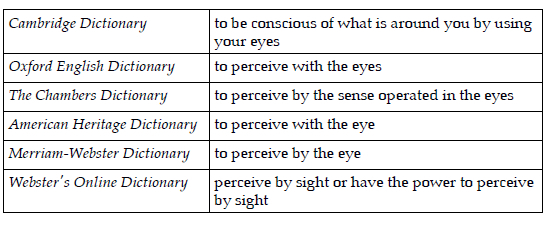
Below are the definitions of the primary meaning of the verb see from seven general-purpose and two learner's dictionaries.
General-purpose dictionaries
Learner's dictionaries
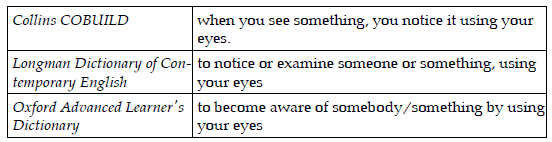
As shown in the tables above, these definitions consistently feature, in various forms, the same semantic component [EYE PERCEPTION]: perceive with the eye(s)/ by sight/by the sense operated in the eyes. Thus, the PM of the verb see can be formulated as: perceive with the eyes. The determinant may be adapted to the context if necessary. All the sentences containing the LSVs of the verb see below were taken from the British National Corpus. The selection of contexts roughly reflects the meanings of the verb see traditionally included in dictionaries.
To further identify the LP, the verb's LSVs are analysed against its PM. For this purpose, the contexts in which the LSVs of see are used were examined in detail.
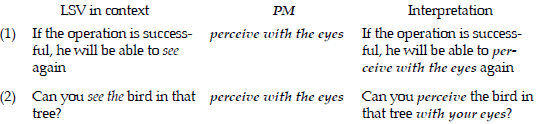
In contexts (1) and (2), the verb see is used in its PM. In (1), the verb is intransitive and means have the power to perceive by sight (MWD), whereas in (2) it is transitive and means have the power to perceive by sight. Since seeing objects is possible only if one has the power of sight and to have the power to perceive by sight implies the ability to see objects, this distinction is irrelevant for the purposes of this study. Therefore, the same meaning is realised in both cases and it corresponds to the PM: see1 - perceive with the eyes.

Context (3) suggests a purposeful action directed at the documentary as its object: obtain the content of the documentary by perceiving it with the eye. This action is based on the physical ability to see, but it is not limited to it and involves the interpretation of what has been seen. The sense of the verb see in the analysed context is metonymic, because the interplay of concepts occurs within the same domain: the eye perception. This is the case of a metonymic transfer: sensory perception - obtaining sensory information as the goal of perception (Ageeva 1990: 10). This contextual meaning of see can be phrased as see2 - watch something (film, television, etc.) by perceiving with it the eyes.
The same mechanism works in contexts (4) and (5):

Unlike see2, the focus in (4) and (5) is on the processing of information: looking at something → perceiving it with the eyes → receiving the information. The same meaning is found in context (6).

This context doesn't imply a requirement to physically observe the passport, but rather to examine its content, that is to look at it in order to obtain information. Since the verb see refers to a purposeful action based on visual perception, this is a metonymic sense that can be presented as follows: see3 - look up, refer to, or find something out by perceiving it with the eyes.

In (7), the verb see is also used in a metonymic sense, as it does not describe eye perception itself, but rather a certain kind of interaction that requires visual perception. This transfer is based on the idea of meeting someone one knows socially or by chance while perceiving them with the eyes, therefore: see4 - visit or meet someone one knows socially or by chance while perceiving them with the eyes.
In a similar sense, the verb see is used in contexts (8) and (9).
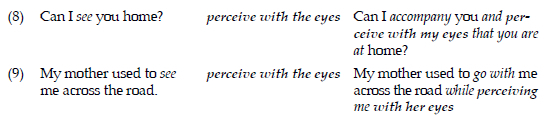
What makes the verb see special is that visual perception is the primary means of obtaining information about the world (Arutyunova 1999: 11; Dretske 1969: 77). That is why it can be used to denote a range of actions that somehow involve visual perception. In contexts (8) and (9), the verb see refers to the idea of accompanying someone somewhere and making sure that they are there by perceiving it with your eyes. In real communication, speakers tend to choose the most economical way of expressing this complex idea using a single word see. The combinability of the verb - see someone somewhere - hints at this concept. Thus, the verb see is used metonymically in a sense directly related to visual perception: see5 - accompany somebody to make sure they get there by perceiving it with the eyes.
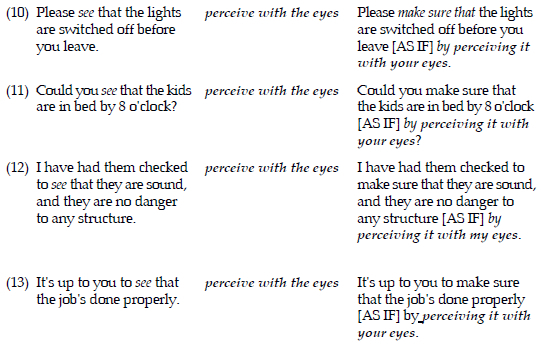
In contexts (10), (11), (12) and (13), the verb see is used in a metaphorical sense, as it is related to the PM through the comparative semantic feature [AS IF]. In forming this meaning, the source domain of eye perception is mapped onto the target domain mental perception, which yields the meaning visually check that something is done. It may seem that in contexts (10) and (11) the verb see is used literally, since the object of visual perception is, at first sight, physically visible objects: lights and kids. However, the position of the direct object of see is not taken by these nouns, but by object clauses, which are always associated with verbs of mental activity. This metaphorical sense of see can be formulated as follows: see6 - make sure that something is done as if by perceiving the result with the eyes.
It is interesting to note in relation to the semantics of the verb see that, due to speakers' capacity of abstract thinking and imagination that stems from it, the boundary between verbally described, actually perceived, and mentally modulated objects is, to some extent, blurred. Thus, a native English speaker uses the verb see not only to refer to actually visible objects but also to imagined objects and situations. As the interpretation of meanings see2, see3, see5 and see6 demonstrates, visual perception is closely connected with the processing of information, which is why English speakers use this verb to refer to mental processes. The same is observed in context (14).

As in examples (10)-(13), in this case there is a contextual cue - an object clause as the direct object. Consequently, the contextual meaning of the verb see is associated with mental activity and belongs to the domain of mental activity or more precisely to its subdomain of information perception. Since the PM of the verb see belongs to the domain of eye perception, the sense found in context (14) is metaphorical. Visual perception is the basis of interaction with the world and the main source of information. Visual images become the foundation for logical reasoning, which is why the processes of visual perception and mental processing are closely related. In such situations, first of all, the [PERCEPTION] seme is actualised, promoting the metaphorical shift from eye perception to mental perception. As a result, the verb see is reinterpreted as a verb of intellectual activity. The resulting metaphorical sense can be worded as follows: see7 - understand something, as if by perceiving it with the eyes.

The sense of see in (15) is metaphorical, as it is derived from the PM on the basis of the comparison feature [AS IF]. This transfer results from the mapping of the eye perception domain onto the mental perception domain. The context provides the following cues. The object of perception is the abstract concept of situation, which is a mental construct. The adverb negatively expresses an attitude, which is not typical of sensory perception, but rather of cognitive information processing. As in the case of see7 first of all the [PERCEPTION] feature is actualised. The mode of perception is determined by the interpreter based on these contextual cues. The difference between this meaning and see7 is that in combination with the circumstance of the mode of action, the meaning of the verb becomes inseparably linked to the attitude expressed by the adverb negatively. The same is observed in example (16).

The adverb differently in (16) specifies the meaning of the verb see, thus serving as a contextual cue that facilitates the interpretation of its sense which can be presented as see8 - consider something in a particular way as if by perceiving it with the eyes.

Contextual cues such as really and as the president indicate that the person referred to by the pronoun she does not hold a leading position in a certain institution. In context (17), as in (15) and (16), the seme [PERCEPTION] is foregrounded, and this LSV of see is associated with intellectual activity. The same sense of see is found in examples (18) and (19).

Such contextual elements as great future and can't see it doing very well trigger an image of entities that do not exist in the physical world but are conceived of as real. Considering this, the sense of see in contexts (17), (18) and (19) can be described as see9 - imagine something which is not true as if by perceiving it with the eyes.
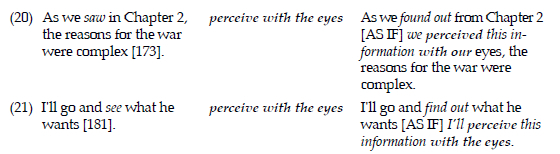
In contexts (20) and (21), the verb see is used metaphorically: the domain of eye perception is mapped onto the domain of obtaining information. The verb see in this context does not refer to eye perception, but rather to the result of obtaining information. This sense is similar to see3 and see7. However, in (20) and (21), the verb is used to describe the result of thought processing of information obtained from a known source. The metaphorical transfer is based on likening visual perception to mental perception. This meaning can be presented as see10 - find something out as if through eye perception.

The direct object of see in (22) refers to an abstract concept - action, which cannot be perceived visually. The metaphorical transfer is based on the mapping of the eye perception domain onto the experience domain: the idea of "seeing" is projected onto the whole perception of combat - experience acquired as if through eye perception. The same sense of see is found in (23):

The semantic transfer in (23) is driven by the same mechanism: experiencing something as if through eye perception. In this case, a twofold understanding is possible. Either the noun region is used metonymically and refers to the people who live in that area, or it is used in its PM with the subject of perception being the region itself. Regardless of the interpretation, the meaning of the verb see remains metaphorical, as it is conditioned by the interaction of independent cognitive domains (cf. the interpretation in (22)). Thus, the meaning of the verb see in (22) and (23) takes the form of see11 - experience something as if by perceiving it with the eyes.
The extensive polysemy of the verb see can likely be attributed to vision being the most dominant of the five senses and, consequently, essential for humans in navigating and interpreting their environment. Everything that falls within an observer's field of vision undergoes cognitive processing (Maturana 1980: 8). This is probably why all the LSVs of the verb see analysed above the include the integral feature [PERCEIVE].
If the verb refers to the information (cognitive change triggered by external causes) that is perceived visually the [WITH THE EYES] seme is present. The object of perception may be an abstract entity, as in contexts (16) and (23). In this case, the observer can only mentally "see" it and perceive the image if it were real (i.e., there is a change in its state caused by internal causes). For a human being whose nervous system is a closed neuronal network, there is no significant distinction between a visual image triggered by internal or external changes in relative neuronal activity (Ritchie 2013: 46). Therefore, actually seeing with the eyes and "as if seeing with the eyes" is essentially the same process. That is why the seme [WITH THE EYES] is necessarily present in the LP formula.
Besides that, since the LP of a polysemous word underlies all of its senses, its formula must encompass both metonymic and metaphorical extensions. Since metonymic transfer is based on contiguity, a metaphorical sense of a verb may be described as action, process or state associated with the PN in some way. Unlike PM, all the metonymic senses of the verb see discussed above are not associated with a state, but rather with a purposeful action - obtaining information. Evidence for this is the use of these LSVs in the imperative mood (e.g., Please see3 who's knocking. See3 chapter 12) or in the Present Continuous (e.g., Did you know that she is seeing3 an older man.)
As the analysis shows, all the LSVs of the verb see are motivated by its nominative and non-derivative meaning. The meaning of see1 is motivated on the basis of direct denotation, so in the dictionary entry it is formulated as:
LITERAL: perceive with the eyes
The meanings of LSVs see2-see5 are metonymic extensions of the PM:
see2 - to watch (film, television, etc.) by perceiving with the eyes
see3 - to look up, refer to, or find something out by perceiving it with the eyes
see4 - to visit or meet someone one knows socially or by chance while perceiving them with the eyes
see5 - to accompany somebody to make sure they get there by perceiving it with the eyes.
Since the meanings of these LSVs are somehow associated with the PM through the idea of contiguity, the generalised formulation for the given senses is as follows:
METONYMIC: to do something associated, in some way, with eye perception.
The meanings of LSVs see6-see11 are formed on the basis of metaphorical transfer:
see6 - make sure that something is done as if by perceiving the result with the eyes
see7 - understand something as if by perceiving it with the eyes
see8 - consider something in a particular way as if by perceiving it with the eyes
see9 - imagine something which is not true as if by perceiving it with the eyes
see10 - find something out as if through eye perception
see11 - experience something as if by perceiving it with the eye
The meanings of these LSVs include the comparison feature [AS IF], which associates it with the PM. In accordance with the conventions of LP theory, when used in the LP formula, this seme takes the form of as it were. The generalised metaphorical meaning of the above LSVs is formulated as follows:
METAPHORICAL: perceive with the eyes, as it were
Thus, the semantic structure of the verb see takes the form of:
LITERAL: perceive with the eyes
METONYMIC: to do something associated, in some way, with eye perception
METAPHORICAL: perceive with the eyes, as it were.
To formulate the LP all the three elements must be combined:
see - perceive with the eyes, or do something associated, in some way, with eye perception, or as it were.
This formula describes in the most general form all three types of meanings of the verb: the PM, metonymic and metaphorical senses. The following signposts are included in the dictionary entry to help infer contextual meanings:
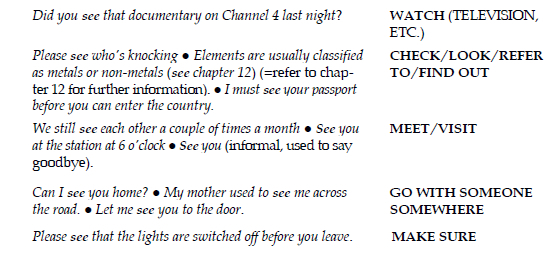
see2 - watch (film, television, etc.) by perceiving with the eyes → WATCH (TELEVISION, ETC.)
see3 - look up, refer to, or find something out by perceiving it with the eyes → CHECK/LOOK/REFER TO/FIND OUT
see4 - visit or meet someone one knows socially or by chance while perceiving them with the eyes → MEET/VISIT
see5 - accompany somebody to make sure they get there by perceiving it with the eyes→ GO WITH SOMEBODY SOMEWHERE
see6 - make sure that something is done as if by perceiving the result with the eyes → MAKE SURE
see7 - understand something as if by perceiving it with the eyes → UNDERSTAND
see8 - to consider something in a particular way as if by perceiving it with the eyes → CONSIDER
see9 - imagine something which is not true as if by perceiving it with the eyes → IMAGINE
see10 - find something out as if by eye perception → FIND OUT INFORMATION
see11 - experience something as if by perceiving it with the eye → EXPERIENCE SOMETHING
Model of a dictionary entry based on LP
Based on the analysis, a dictionary entry for the verb see is compiled:
LEXICAL PROTOTYPE: perceive with the eyes, do something associated with eye perception, or as it were
MEANINGS:
LITERAL: perceive with the eyes.
If the operation is successful, he will be able to see again. ● Can you see thebird in that tree? ● The moment we saw thehouse, we knew we wanted to buy it.
METONYMIC: do something associated, in a certain way, with eye perception
METAPHORICAL: perceive with the eyes, as it were
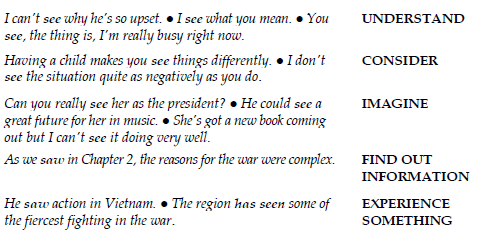
Apart from sharing some features with traditional entries in learner's dictionaries (such as the structure of microentries and the use of signposts), the method of lexicographic description of a polysemous word based on its LP presented in this paper also has a number of differences. The main difference is the absence of a list of definitions. The entry begins with a formula for LP of the headword, followed by the three types of meanings described above. The PM which describes the prototypical sense - perceive with the eyes - serves as the starting point for the formation of all LSVs. Unlike the PM, which refers to a state, in its metonymic senses the verb see denotes actions - watch, look up, visit, etc. - which are nonetheless associated with visual perception.
Metaphorical senses are related to the PM through the feature of comparison [AS IF/AS IT WERE]. The metaphorical nature of the actions falling under this definition is generally determined by the nature of the objects of perception - abstract concepts that are inaccessible to visual perception. Therefore, in all metaphorical uses, the verb see refers to mental processes that the speaker conceptualises as perceive with the eyes, as it were.
The features that underlie metonymic and metaphorical transfers are indicated in the entry by means of signposts. These signposts do not serve as definitions, they are intended to help the dictionary user navigate the entry. Supplemented by illustrative examples, they serve as contextual cues that enable the user to infer the contextual meanings of the polysemous headword. They reveal, clarify and actualise a certain aspect of the LP, which may help the learner to form a comprehensive idea of the word's meaning.
A dictionary entry of this type also offers the user a fundamentally different perspective on the nature of polysemy: the existence of a systemic meaning and its realisations in speech. The generalised and universal character of the LP formula, which encompasses the primary, metaphorical, and metonymic meanings, demonstrates the motivation of the LSVs by the LP and shows the semantic relations between them. It also helps conceptualise the distinction between metonymic and metaphorical meanings.
From a theoretical point of view, a lexicographic description of this type clearly demonstrates the real non-mirroring of the correlation between the levels of language and speech. At the system level, the meaning of a polysemous word exists as an invariant structure - the LP - while at the speech level it is rendered through a context-based meaning of a specific LSV. Thus, it can be assumed that the proposed dictionary entry reflects the cognitive mechanisms of semiosis.
In conclusion, it should be added that the proposed dictionary entry is a theoretical model that can serve as a basis for further lexicographic research. The suggested approach to the lexicographic description of polysemous words does not imply a rejection of traditional methods. A dictionary compiled according to the principles discussed here can be used as an additional tool for describing polysemous words, alongside traditional dictionaries and teaching materials.
References
Ageeva, N.G. 1990. Tipologiya i mekhanizmy glagol'noy metonimii v sovremennom angliyskom yazyke. Unpublished Candidate of Sciences Dissertation. Kiev: Kiev State Pedagogical Institute of Foreign Languages. [ Links ]
Alefirenko, N.F. 2005. Spornye problemy semantiki. Moscow: Gnozis. [ Links ]
American Heritage Dictionary. https://ahdictionary.com/ [10 April 2025]
Apresyan, Yu. D. 1984. Lingvistitcheskoye obespechenye sistemy frantsuzsko russkogo perevoda ETAP-1. Moscow: Institute of Foreign Languages of USSR Academy. [ Links ]
Arkhipov, I.K. 1998. Problemy yazyka i rechi v svete prototipicheskoy semantiki. Problemy lingvistiki i metodiki prepodavaniya inostrannykh yazykov 6: 5-22. [ Links ]
Arkhipov, I.K. 2003. Chelovetchesky faktor v yazyke. St. Petersburg: NIYaK. [ Links ]
Arkhipov, I.K. 2004. Kommunikativny tseitnot i prototipicheskaya semantika. Izvestiya Rossiyskogo gosudarstvennogo pedagogicheskogo universiteta im. A.I. Gertsena 4(7): 75-84. [ Links ]
Arkhipov, I.K., D.N. Novikov and S.A. Pesina. 2006. Organizatsiya I metod postroyeniya slovarnoy statyi na osnove printsypa proto:picheskoy semantyki. Gumanova, M.K. (Ed.). 2006. Proceedings of the 5th International Conference, 'Yazyki v sovremennom mire': 67-73. Moscow: KDU. [ Links ]
Arnold, I.V. 2010. Polisemiya sushchestvitelnogo i leksiko-grammaticheskie razryady. Bukharkin, P.E. (Ed.). 2010. Semantika. Stilistika. Intertekstualnost: 5-24. Moscow: Knizhny dom "LIBROKOM". [ Links ]
Arutyunova, N.D. 1999. Yazyk i mir cheloveka. Moscow: Yazuki russkoy kultury. [ Links ]
Atkins, B.T.S. and M. Rundell. 2008. The Oxford Guide to Practical Lexicography. Oxford/New York: Oxford University Press. [ Links ]
Brudny, A.A. 1971. Znachenie slova i psikhologiya protivopostavleniy. Leontyev, A.A. (Ed.). 1971. Semanticheskaya struktura slova: psikholingvisticheskie issledovaniya: 19-27. Moscow: Nauka. [ Links ]
Brugman, C. and G. Lakoff. 1988. Cognitive Topology and Lexical Networks. Small, S., G. Cottrell and M. Tannenhaus (Eds.). 1988. Lexical Ambiguity Resolution: 477-507. San Mateo: Morgan Kaufman. [ Links ]
Budagov, R.A. 1947. Slovo i ego znachenie. Moscow: Nauka. [ Links ]
Cambridge Dictionary. https://dictionary.cambridge.org/ [10 April 2025]
Chudinov, A.P. 2003. Rossiya v metaforicheskom zerkale: Kognitivnoe issledovanie politicheskoy metafory (1991-2000). Yekaterinburg: UGPU. [ Links ]
Collins COBUILD. http://www.collinslanguage.com/collins-elt-learners-of-english/cobuild#.Ul8XqFCST8k [8 April 2014].
Cowie, A.P. 2007. English Dictionaries for Foreign Learners: A History. (A Reprint of the 1999 edition.) Oxford: Oxford University Press. [ Links ]
Devkin, V.D. 2000. Ocherki po leksikografii. Moscow: Prometey. [ Links ]
Dretske, F.I. 1969. Seeing and Knowing. London: Routledge & Kegan Paul. [ Links ]
Dubchinskiy, V.V. 1994. Iskusstvo sozdaniya slovarey: Konspekt po leksikografii. Kharkov: KhPU. [ Links ]
Guillaume, G. 1973. Principes de linguistique théorique de Gustave Guillaume. Québec/Paris: Librairie C. Klincksieck. [ Links ]
Halas, A. 2016. The Application of the Prototype Theory in Lexicographic Practice: A Proposal of a Model for Lexicographic Treatment of Polysemy. Lexikos 26: 124-144. https://doi.org/10.5788/26-1-1338 [ Links ]
Hanks, P. 2000. Do Word Meanings Exist? Computers and the Humanities 34(1-2): 205-215. [ Links ]
Jackson, H. 2002. Lexicography: An Introduction. London/New York: Routledge. [ Links ]
Jakobson, R.O. 1985. Izbrannye raboty. Moscow: Progress. [ Links ]
Karasev, A.A. 2011. Definitsii v tolkovykh slovaryakh i leksicheskoe znachenie slova. Fetisov, Anatoly (Ed.). 2011. Proceedings of Herzen Readings: Modern Languages Interinuversity Academic Conference, St. Petersburg, Russia, May 19-20, 2011: 188-189. St. Petersburg: Herzen State Pedagogical University of Russia. [ Links ]
Karasev, A.A. 2013. Polysemous Words Monolingual Learner's Dictionary Entry (Lexical-Prototypical Approach). St. Petersburg State Polytechnical University Journal: Humanities and Social Sciences 3(179): 206-210. [ Links ]
Karasev, A.A. 2014a. Biosemioticheskie printsiby uchebnogo odnoyazychnogo slovarya (na materiale sovremennogo angliyskogo yazyka). Unpublished Candidate of Sciences Dissertation. St. Petersburg: Herzen State Pedagogical University of Russia. [ Links ]
Karasev, A.A. 2014b. Uchebnyy odnoiazychnyy slovar' angliyskogo yazyka v svete biosemiotiki. Nauchnoe mnenie 4: 202-209. [ Links ]
Karasev, A.A. 2014c. Yavlenie polisemii s tochki zreniya biosemiotiki. Izvestiya Volgogradskogo gosudarstvennogo pedagogicheskogo universiteta. Filologicheskie nauki 2(87): 16-20. [ Links ]
Katsnelson, S.D. 2011. Soderzhanie slova, znachenie i oboznacheniye. Moscow: Editorial URSS. [ Links ]
Kuryłowicz, J. 1955. Zametki o znachenii slova. Voprosy yazykoznaniya 3: 73-81. [ Links ]
Leshcheva, L.M. 1985. Svyaz' leksicheskikh znacheniy v semanticheskoy strukture (na materiale prilagatel'nykh sovremennogo angliyskogo yazyka). Unpublished Candidate of Sciences Dissertation. Minsk: MGLU. [ Links ]
Levchina, I.B. 2003. Razvitie semanticheskoy struktury sinestezicheskikh prilagatel'nykh. Unpublished Candidate of Sciences Dissertation. St. Petersburg: Herzen State Pedagogical University of Russia. [ Links ]
Litvin, F.A. 1984. Mnogoznachnost' slova v yazyke i rechi. Moscow: Vysshaya shkola. [ Links ]
Lodwig, R.R. and E.F. Barret. 1967. The Dictionary and the Language. New York: Hayden. [ Links ]
Longman Dictionary of Contemporary English. https://www.ldoceonline.com/ [10 April 2025]
Maturana, H.R. 1980. Biology of Cognition. Maturana, H. and F.J. Varela (Eds.). 1980. Autopoiesis and Cognition: The Realization of the Living: 2-62. Dordrecht: D. Reidel. [ Links ]
Mednikova, E.M. 2010. Znachenie slova i metody ego issledovaniya. Moscow: Vysshaya shkola. [ Links ]
Merriam-Webster Dictionary. https://www.merriam-webster.com/ [10 April 2025]
Oxford English Dictionary. https://www.oed.com/?tl=true [10 April 2025]
Pertsov, N.V. 2001. Invarianty v russkom slovoizmenenii. Moscow: Yazyki russkoy kultury. [ Links ]
Pesina, S.A. 1998. Leksicheskiy prototip v semanticheskoy strukture slova. Unpublished Candidate of Sciences Dissertation. St. Petersburg: Herzen State Pedagogical University of Russia. [ Links ]
Pesina, S.A. 2005a. Issledovanie semanticheskoy struktury slova na osnove prototipicheskoy semantiki (na materiale angliyskikh sushchestvitel'nykh). Unpublished Doctor of Sciences Dissertation. St. Petersburg: Herzen State Pedagogical University of Russia. [ Links ]
Pesina, S.A. 2005b. Metodika opredeleniya soderzhatelnogo yadra mnogoznachnogo sushchestvitel'nogo angliyskogo yazyka. Izvestiya Rossiyskogo gosudarstvennogo pedagogicheskogo universiteta im. A.I. Gertsena 5(11): 51-59. [ Links ]
Pesina, S.A. 2005c. Polisemiya v kognitivnom aspekte. St. Petersburg: Herzen State Pedagogical University of Russia. [ Links ]
Ritchie, L.D. 2013. Metaphor. Cambridge/New York: Cambridge University Press. [ Links ]
Rivelis, E.I. 2009. Slovar' v svete kognitivnoy lingvistiki. Studia linguistica cognitiva 2: Nauka o yazyke v izmenyayushcheysya paradigme znaniya: 304-350.
Shiryaeva, A.V. 2008. Prototipicheskaya semantika kak osnovanie sinonimii glagolov. Izvestiya Rossiyskogo gosudarstvennogo pedagogicheskogo universiteta im. A.I. Gertsena 23(54): 269-274. [ Links ]
Shmelev, D.N. 1973. Problemy semanticheskogo analiza leksiki (na materiale russkogo yazyka). Moscow: Nauka. [ Links ]
Slonimskaya, I.M. 1990. Leksikograficheskaya teoriya i leksikograficheskaya pragmatika. Perebeynos, V.I. (Ed.). 1990. Statisticheskaya leksikografiya i uchebnyy protsess: 48-79. Kiev: KGPIIYa. [ Links ]
Smirnitsky, A.I. 1954. K voprosu o slove: Problema tozhdestva slova. Trudy Instituta yazykoznaniya AN SSSR 4: 3-49. [ Links ]
Soldatov, B.G. 1997. Semiotika sinonimicheskogo opredeleniya v angliyskoy odnoiazychnoy leksikografii. Proceedings of Aktual'nye problemy teoreticheskoy i prikladnoy leksikografii the 2nd International Workshop on Lexicography, Ivanovo, Russia, 25-27 September 1997: 60-69. Ivanovo: Ivanovsky State University. [ Links ]
The Chambers Dictionary. https://chambers.co.uk/ [10 April 2025]
Ufimtseva, A.A. 1962. Opyt izucheniya leksiki kak sistemy. Moscow: Nauka. [ Links ]
Ufimtseva, A.A. 1984. K voprosu o tak nazyvaemom definitsionnom metode opisaniya leksicheskogo znacheniya slova. Yartseva, V.N. (Ed.). 1984. Slovo v grammatike i slovare: 134-142. Moscow: Nauka. [ Links ]
Ufimtseva, A.A. 2010. Leksicheskoe znachenie: printsip semiologicheskogo opisaniya leksiki. Moscow: LIBROKOM. [ Links ]
Vinogradov, V.V. 1947. Russkiy yazyk. Grammaticheskoe uchenie o slove. Moscow/Leningrad: Nauka. [ Links ]
Webster's Online Dictionary. http://www.websters-online-dictionary.org/ [8 April 2014]
Yakovlyuk, A.N. 2009. Leksiko-semanticheskiy variant kak svyazuyushchee zveno mezhdu mnogoznachnym slovom v yazyke i ego realizatsiey v rechi. Bulletin of Chelyabinsk State University 34(172): 156-162. [ Links ]
Zalevskaya, A.A. 2000. Vvedenie v psikholingvistiku. Moscow: Rossiyskiy gosudarstvennyy gumanitarnyy universitet. [ Links ]
Zaliznyak, A.A. 2004. Fenomen mnogoznachnosti i sposoby ego opisaniya. Voprosy yazykoznaniya 2: 20-45. [ Links ]
Zvegintsev, V.A. 1957. Semasiologiya. Moscow: Moscovsky Universitet. [ Links ]
