Services on Demand
Journal

Article
 English (pdf)
 Article in xml format
 Article references
 Automatic translation
 Send this article by e-mail
Indicators
Related links
-
 Cited by Google
 -
 Similars in Google
Share

 Permalink
Lexikos
On-line version ISSN 2224-0039Print version ISSN 1684-4904
Lexikos vol.35 Stellenbosch 2025
https://doi.org/10.5788/35-1-2043
LEXICOFOCUS
Digging for -ings: A Survey of Selected (Pseudo)-Anglicisms in Dictionaries of Modern Greek
Op soek na -ing-gevalle: 'n Opname van uitgesoekte (pseudo-) anglisismes in woordeboeke van Moderne Grieks
Anna Vacalopoulou
Institute for Language and Speech Processing, Athena Research Center, Athens, Greece (avacalop@athenarc.gr) (https://orcid.org/0000-0002-1509-2951)
ABSTRACT
Anglicisms, a type of lexical borrowing, occur when a language incorporates English lexical items into its vocabulary, either verbatim or transliterated. Pseudo-Anglicisms are also notable; these appear English due to their form but are not genuinely English. This paper examines the inclusion and treatment of Anglicisms and pseudo-Anglicisms in Modern Greek dictionaries, focusing on nouns that end in -ing, a suffix typical of English morphology. The methodology involves a macrostructural comparison of five Greek dictionaries to assess their inclusiveness in addressing this phenomenon. The microstructural analysis investigates the presence of Greek equivalents within the dictionaries. Findings are cross-checked against a corpus to determine which alternatives Greek native speakers are more familiar with. Additionally, the research explores elements such as the domains, and styles of the identified lexical items to reveal trends in their coinage and usage.
Keywords: neology, neologisms, anglicisms, pseudo-anglicisms, lexical borrowing, greek lexicography, greek dictionaries, critical lexicography
OPSOMMING
Anglisismes, 'n tipe leksikale ontlening, kom voor wanneer 'n taal Engelse leksikale items in sy woordeskat inkorporeer, hetsy woordeliks of getranslitereerd. Pseudo-anglisismes is ook opmerklik; hulle lyk vanweë hul vorm Engels, maar is nie werklik Engels nie. Hierdie artikel ondersoek die insluiting en hantering van anglisismes en pseudo-anglisismes in Moderne Griekse woordeboeke, en fokus op selfstandige naamwoorde wat eindig op -ing, 'n agtervoegsel kenmerkend van die Engelse morfologie. Die metodologie behels 'n makrostrukturele vergelyking van vyf Griekse woordeboeke om hul inklusiwiteit in die hantering van hierdie verskynsel te bepaal. In die mikrostruktuuranalise word die teenwoordigheid van Griekse ekwivalente in die woordeboeke ondersoek. Bevindinge word dubbel gekontroleer teen 'n korpus om te bepaal met watter alternatiewe Griekse moedertaalsprekers meer vertroud is. Daarbenewens word elemente soos die domeine en style van die geïdentifiseerde leksikale items ook ondersoek om tendense in hul skepping en gebruik te onthul.
Sleutelwoorde: néologie, neologismes, anglisismes, pseudo-anglisismes, leksikale ontlening, griekse leksikografie, griekse woordeboeke, kritiese leksikografie
1. Introduction
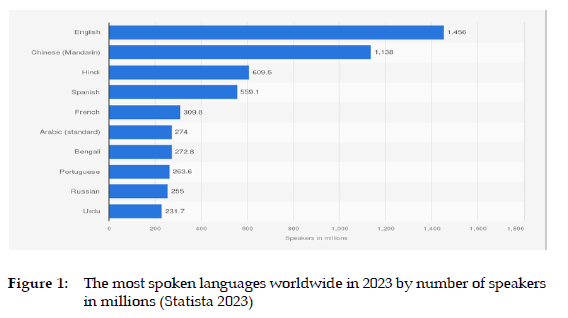
The emergence of Anglicisms and pseudo-Anglicisms in modern languages reflects the dynamic interplay between cultures and languages in a globalised world. The linguistic influence of English on other languages is also known as Anglicisation, and it is a worldwide phenomenon through which English has gradually become more influential over other languages. As a result, English is spoken either as a native or a second language by approximately 17,7% of the world's population (Figure 1). Additionally, proficiency in English is considered an asset in the global market context, leading to an increasing number of people who can use the language to some extent. Although the specific number is hard to calculate, it has been estimated at approximately two billion people globally, approximately one out of four people on the planet (Prior 2024). This percentage is particularly high in Greece, as an impressive 64,5% of the population reports having some knowledge of the English language (Hellenic statistical Authority 2022).
As lexical borrowing reflects the influence of one language system over another, these phenomena echo the predominance of English. Well-established as the lingua franca across numerous countries, peoples, and cultures, English has become a leading exporter of neologisms and a regular starting point for lexical innovation. This paper examines how selected dictionaries of Modern Greek have treated Anglicisms and pseudo-Anglicisms, specifically focusing on nouns formed with the -ing suffix, a typical English formation. Rather than discussing the processes behind the incorporation of these linguistic borrowings by editorial teams, this survey adopts a critical lexicography perspective, focusing on how these borrowings are reflected in existing lexicographic resources.
2. Background
2.1 Collocation analysis: Syntagmatic level
Anglicisms are lexical items borrowed from English and integrated into the lexicon of another language. These borrowings can manifest across various linguistic levels, such as phonology, grammar, morphology, and vocabulary. The global prominence of English, rooted in historical, social, and technological developments, has led to an influx of Anglicisms in numerous languages, including Greek. The rise of Anglicisms on an international level has been particularly notable in key domains that have established common, globally used vocabularies. Such domains are predominantly the following: international business, with terms like μίτινγκ ('meeting') or πρότζεκτ ('project'); technology, with lexical items related to computers and the internet, such as the word κομπιούτερ ('computer') itself, or σέλφι ('selfie'); and the media landscape, which often propagates Anglicisms through popular culture and trends. Furthermore, recent studies in neology reveal a tendency towards the incorporation of new terms in the lexicon of some languages in the context of crises-related discourse (cf. Michalopoulou 2022; Storjohann 2024). Notable examples include the continuing climate crisis, the Ukraine war crisis, and the COVID-19 crisis. Indeed, the pandemic stands out as an example of the rapid introduction of novel lexical items into everyday language around the world. In the case of Greek, this has resulted in the incorporation of Anglicisms such as λοκντάουν ('lockdown') and ράπιντ τεστ ('rapid test'), as well as pseudo-Anglicisms such as 'click away' (not usually transliterated) to denote a newly-introduced method of contactless purchasing.
It is not uncommon for Anglicisms to carry significant social and political implications, influencing language policies in various nations. For instance, the Académie Française, in keeping with its role as the linguistic guardian of France, has regularly warned the nation against the increasing use of English in both the public and private sectors, arguing that it may lead to communication problems and challenge social cohesion (AFP in Paris 2022). Moving from institutional warnings to legal measures, the Italian government proposed a law in 2023 against "the growing Anglomania", anticipating fines of up to €100 000 for the use of foreign vocabulary in official communications of the Italian state (Carbonaro 2023). Along similar lines, the Russian government declared a ban on the use of foreign words by officials when performing their duties, allowing for the use of some "foreign words which do not have widely used corresponding equivalents in Russian" (Reuters 2023). Although no similar official measures have been taken in the Greek context, lexical borrowing is often stigmatised as a danger to the integrity of the Greek language (cf. Anastassiades-Symeonides 2001).
2.2 Incorporation patterns in written Greek
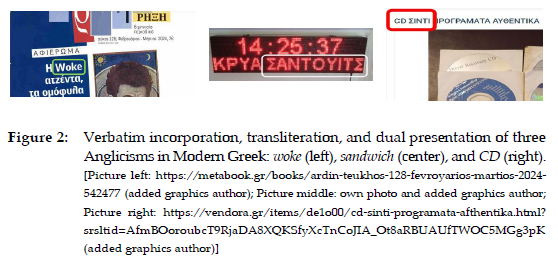
This study focuses on a particular type of Anglicism, namely the incorporation of nouns ending in -ing into Greek vocabulary, which is a common suffix of English morphology but does not traditionally appear in Greek. English loanwords appear in written Greek with varying orthographic representations. They may either be adopted verbatim, spelled out in the Latin alphabet, or may be transliterated into the Greek alphabet (see Figure 2). It is also often the case that both forms appear in language corpora over the same period of time, possibly reflecting an uncertainty about how to best integrate these terms into Greek. These inconsistencies remain in practice, resulting in a hybrid approach to incorporating new terms that reflects ongoing debates about language purity and adaptation.
When lexical borrowings are incorporated into Greek, the general rule is that their spelling should be kept in the simplest possible form, according to official school grammar textbooks. Following these guidelines, the ng consonant cluster in loanwords is to be transliterated as yk, resulting in the loss of the n sound in Greek (Triandaphyllidis et al. 1941: 428). However, there is no consensus regarding this rule's application either in general language corpora or in dictionaries.
2.3 Pseudo-Anglicisms
In addition to genuine Anglicisms, the Greek language also features pseudo-Anglicisms, or false Anglicisms. These are words that seem English but do not exist in the same form or meaning in English. As creations of Greek vocabulary, these terms either have no equivalent in English or carry different meanings from similar-looking English words. Although these are not really loanwords, they still reflect the impact of English on Greek. Well-known examples include ερκοντίσιον ('air-condition' meaning 'air-conditioning'), or μπάσκετ ('basket' meaning 'basketball') and other shortened forms of sports terms. The earlier-mentioned click away (not usually transliterated), is a different type of pseudo-Anglicism coined during the cOvID-19 pandemic to describe a specific contactless purchasing method. This latter example particularly highlights the creative linguistic processes at play within Greek, as it demonstrates how new terms can be created with shifted meanings and specialised usage.
3. The study
3.1 Object of study
The present study focuses on -ing nouns, which are formed from the present participle and gerund forms of verbs, and how these are represented in Greek lexicography. This morphological feature is characteristic of English and has been observed in the vocabulary of other languages where such formations are not typically native. For instance, Harris (2010: 19) and Sabec (2018: 70) identify loanwords ending in -ing as one of the most frequently reported Anglicisms in French and Slovenian respectively. Similarly, -ing formations have been pinpointed as characteristic forms of Anglicisms in Greek by authors such as Xydopoulos (2019: 433). The suffix is also known to produce several pseudo-Anglicisms such as the ones reported by Stamenov (2015: 169-171) in Bulgarian by adding -ing to native words like manastiring ('monastery visit', derived from manastir 'monastery') and balkoning ('jumping off a balcony', from balkon 'balcony'). The variant balconing also exists in Spanish, as do several more -ing pseudo-Anglicisms: edredoning, kitchening, puenting, and sofing (Sánchez Fajardo 2018: 336).
3.2 Methodology
In order to explore the inclusion and presentation of -ing formations in current Greek lexicography, five dictionaries were selected for analysis. These encompass three professionally edited works and two crowd-sourced lexicons. As expected, the professional dictionaries provide a structured approach to lexicography, while the crowd-sourced entries reflect a more spontaneous, though variable, inclusion of neologisms. The lexicographic works that were used are the following:
- Practical Dictionary of Modern Greek1 (HLNG 2014), an institutional work by the Academy of Athens published in print and available online.
- Modern Greek Dictionary2 (LKN 1998), another institutional dictionary by the Centre for the Greek Language available in both print and online formats.
- Big Electronic Dictionary of Modern Greek3 (MILNEG), an online dictionary by a commercial publisher that is regularly updated.
- Slang.gr4, an online, crowdsourced dictionary of Greek slang.
- Wiktionary5, the Greek version of the online, crowdsourced lexicographic project run by the Wikimedia Foundation.
The first step of this study involved the identification of those -ing formations that appear as transliterated entries in the above five dictionaries by searching their electronic versions using wildcards. From the resulting list, proper nouns were excluded unless they are also used in a metaphorical sense (e.g., Browning, a type of machine gun designed by the company of the same name) as were words that are not participle or gerund forms (such as darling, ring, or string). These findings were then categorised as either Anglicisms or pseudo-Anglicisms (by checking their existence and use in English) and analysed according to their orthographic representation. Next, the five dictionaries were compared regarding their treatment of this particular type of formation to determine whether any patterns emerge based on dictionary typology. Finally, the findings were cross-checked against the Greek Web 2019 (elTenTen19) corpus6 to determine which alternatives Greek native speakers are more familiar with. The searches were based on the -ing affix in the Sketch Engine text analysis software in both possible transliterations, i.e., either as -ιγκ /ig/ or as -ινγκ /in/. Again, proper nouns as well as words that are not participle or gerund forms were located and excluded from the results.
3.3 Findings and discussion
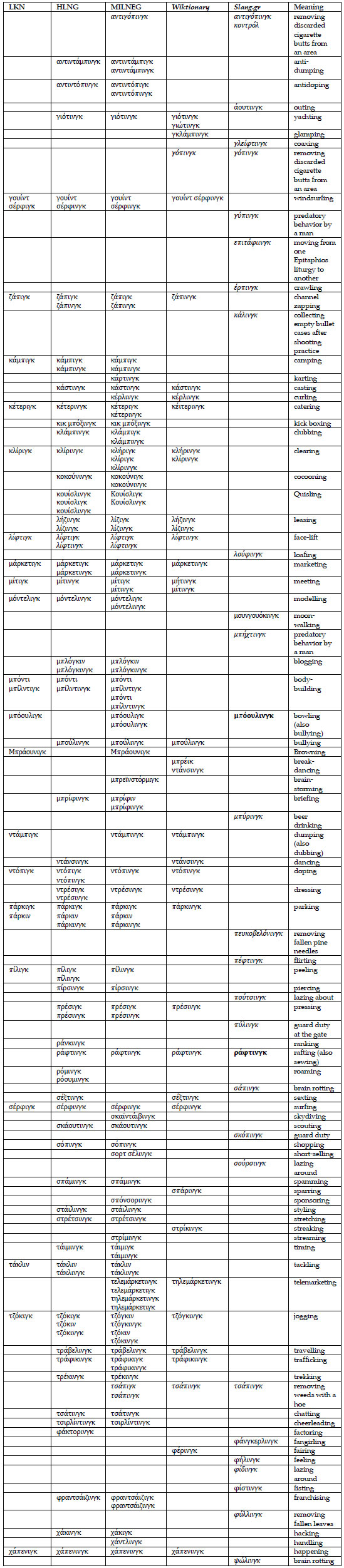
The analysis of the selected dictionaries revealed varied approaches to the inclusion and treatment of -ing nouns. All the items included in the five dictionaries, along with their variant forms, are listed in the Appendix. From a macrostructural perspective, LKN contains 20 lexical items, HLNG includes 51, MILNEG 60, Wiktionary 33, and Slang.gr 28. Table 1 provides an overview of these contents, showing the total number of lexical items ending in -ing included in each dictionary, and highlights which of these are Anglicisms and which are pseudo-Anglicisms.
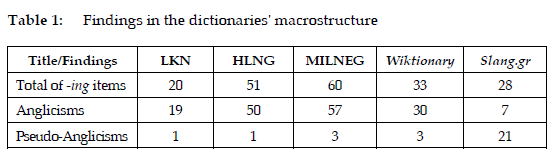
While some dictionaries are more inclusive, others capture only a small subset of this type of vocabulary, such as LKN. This can be attributed to the fact that LKN was originally a paper dictionary, which faced severe space limitations. In contrast, ongoing projects tend to be more comprehensive in documenting these items - whether through professional lexicography (e.g., MILNEG) or voluntary crowdsourcing (e.g., Wiktionary and Slang.gr). The HLNG emphasises the incorporation of loanwords and other neologisms in the dictionary's front matter.
As expected, the majority of -ing entries across most dictionaries are Anglicisms, while pseudo-Anglicisms are less common, though their presence is significant in Slang.gr, where they dominate. Indeed, it is not unusual for a slang dictionary to include lemmas not typically found in general language dictionaries, often with a tendency toward more humorous and imaginative constructions, as pseudo-Anglicisms often are. As Furiassi and Gottlieb (2015: 24) mention, based on an earlier study by Gottlieb (2009), "jocular derivation" is a distinct type of pseudo-Anglicisms.
The -ing entries vary across dictionaries in terms of their orthographic representation. While many words conform to the simplification rules of the official Greek grammar, numerous alternative spellings influenced by the original English lexical items are also noted. Therefore, the suffix was either transliterated as -ιγκ /ig/ (62 instances overall) or as -ινγκ /in/ (190 instances), depending on the editorial policy of each dictionary. Orthographic variants were added sporadically rather than exhaustively. For example, windsurfing only has one variant in each of the four dictionaries in which it appears as an entry (either γουίντ σέρφιγκ or γουίντ σέρφινγκ), whereas parking has multiple variants across different dictionaries (these being πάρκιγκ, πάρκιν, or πάρκινγκ). It could be argued that the existence of multiple spellings of an entry may be attributed to the high frequency of this lemma, although this assumption is not supported by the available literature. Interestingly, none of the lexical items ending in -ing has entry status in all five dictionaries.
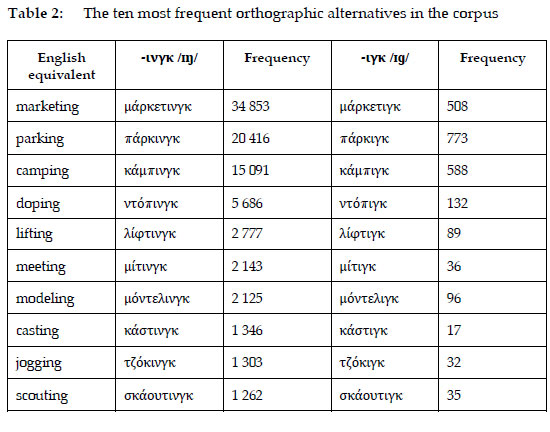
The process of cross-checking the findings against the Greek Web 2019 (elTenTen19) corpus produced some revealing results. The overwhelming majority of instances ending in -ing are spelled according to their English equivalents despite the orthographic rules of the official grammar schoolbooks. Although not all 975 results produced by searching the corpus can be listed here, a small sample containing the ten most frequent items is shown in Table 2. Although some of the dictionaries, most notably LKN,7 adhere to these rules as part of their editorial policy and exclusively transliterate the -ing suffix as -ιγκ /ig/ rather than -ινγκ /in/, corpus findings prove that most Greek speakers are more familiar with the latter form, which coincides with the English spelling and pronunciation. This is indeed attested in the majority of the entries across the other four dictionaries, which seem to have followed a more descriptive approach in dealing with orthography.
As mentioned, the vast majority of pseudo-Anglicisms appear in Slang.gr, following this type of dictionary's tendency toward more jocular content. The analysis indicates that military life, particularly maintenance duties, is one of the most frequent domains for pseudo-Anglicisms in the dictionaries. Such entries include τσάπινγκ "the act of removing weeds with a hoe" (derived from τσάπα 'hoe') and γόπινγκ "the act of removing discarded cigarette butts to clean up an area" (from γόπα 'cigarette butt'). This trend highlights a particular socio-linguistic environment, as it is very common for a new army recruit to be assigned tedious chores like cleaning up military areas by removing unwanted items. Another prominent domain for pseudo-Anglicisms is sexual relationships, with entries such as γύπινγκ and μπήχτινγκ both denoting "predatory behaviour by a man".
4. Conclusion
This study has examined the treatment of -ing formations in five Greek dictionaries, revealing significant variations in their documentation and representation of Anglicisms and pseudo-Anglicisms. The findings highlight several key patterns in Modern Greek lexicography. Firstly, there is considerable variation in the inclusiveness of dictionaries regarding -ing entries, ranging from LKN's conservative approach (20 entries) to MILNEG's more comprehensive coverage (60 entries). Secondly, while Anglicisms dominate in most dictionaries, Slang.gr stands out for its high proportion of pseudo-Anglicisms, reflecting its specialised role in documenting more informal and creative language use.
The orthographic representation of these terms presents a notable disconnect between prescriptive rules and actual usage. While official grammar guidelines recommend simplifying the -ing suffix to -ιγκ /ig/, corpus evidence reveals that Greek speakers predominantly prefer -ινγκ /in/, maintaining closer alignment with English spelling and pronunciation. This preference is reflected in most of the examined dictionaries, except LKN, which strictly adheres to official guidelines.
The analysis of pseudo-Anglicisms reveals particular sociolinguistic patterns, especially in military contexts and informal registers. These formations demonstrate the creative capacity of Greek speakers to adapt English morphological patterns for their own expressive needs. This study contributes to the understanding of how Modern Greek lexicography approaches the documentation of Anglicisms and pseudo-Anglicisms, while also highlighting the dynamic relationship between prescriptive norms and actual language use in the context of English influence on Modern Greek.
Endnotes
1. https://christikolexiko.academyofathens.gr/
2. https://www.greek-language.gr/greekLang/modern_greek/tools/lexica/
3. http://lexicon-neohel.patakis.gr/el/lexikon
4. https://www.slang.gr/
5. https://en.wiktionary.org/wiki/Wiktionary:Main_Page
6. elTenTen19, offered by Sketch Engine (https://www.sketchengine.eu/), contains 2,782,299,354 tokens downloaded in December 2019, and January 2020.
7. It is explicitly stated in the Introduction to the dictionary (p. ιγ) that the official rules have been followed.
References
Dictionaries
HLNG. Practical Dictionary of Modern Greek. 2014. https://christikolexiko.academyofathens.gr/ [20 April 2024].
LKN. Modern Greek Dictionary. 1998. https://www.greek-language.gr/greekLang/modem_greek/tools/lexica/ [20 April 2024].
MILNEG. Big Electronic Dictionary of Modern Greek. http://lexicon-neohel.patakis.gr/el/lexikon [20 April 2024].
Slang.gr. https://www.slang.gr/ [20 April 2024].
Wiktionary. https://en.wiktionary.org/wiki/Wiktionary:Main_Page [20 April 2024].
Other literature
AFP in Paris. 2022. Académie Française Denounces Rise of English Words in Public Life. The Guardian, 16 February 2022.
Anastassiades-Symeonides, A. 2001. Ιδεολογή ματα και δανεισμός [Ideology and Borrowing]. Haris, Y.I. (Ed.). 2001. Δέκα μύθοι για την ελληνική γλώσσα [Ten Myths about the Greek Language]: 63-71. Athens: Patakis.
Carbonaro, G. 2023. Ciao, Hello, No! Italy's Right-wing Government Wants to Ban English Words with €100,000 fines. Euronews, 3 April 2023.
elTenTen19. 2020. Corpus of the Greek Web. https://app.sketchengine.eu/ [20 April 2024].
Furiassi, C. and H. Gottlieb (Eds.). 2015. Pseudo-English. Studies on False Anglicisms in Europe. Berlin: De Gruyter Mouton. [ Links ]
Harris, J. 2010. The Frequency and Distribution of Written and Spoken Anglicisms in Two Varieties of French. Unpublished MA Thesis. Montreal, Quebec: Concordia University. [ Links ]
Hellenic Statistical Authority. 2022. Adult Education Survey. https://www.statistics.gr/en/statistics/-/publication/SJO18/ [1 December 2024].
Michalopoulou, E. 2022. Κατασκευή ηλεκτρονικού σωματοκειμενικού λεξικού νεολογισμών των κρίσεων (οικονομικών, κοινωνικοπολιτικών, υγειονομικών) της περιόδου 2015-2020 [Construction of an Electronic Corpus-based Dictionary of Neologisms of the Crises (Economic, Socio-political, Healthcare) of the Period 2015-2020]. Unpublished MA Thesis. Kalamata: University of the Peloponnese, School of Humanities and Cultural Studies.
Prior, J. 2024. English Language Statistics: How Many People Learn English? DoTEFL, 9 Dec. 2024. https://www.dotefl.com/english-language-statistics/ [8 December 2024].
Reuters. 2023. Russia Bans Government Officials from Using Most Foreign Words. Reuters, 28 Feb. 2023. https://www.reuters.com/world/euirope/russia-bans-govemment-officials-using-most-foreign-words-2023-02-28/ [20 April 2024].
Sánchez Fajardo, J.A. 2018. Towards a Typological Account of Pseudo-Anglicisms. Pragmalinguistica 26: 330-348. [ Links ]
Stamenov, C. 2015. Borrowing Word-Formation: -ing Siuffixation and Blending in Bulgarian. Süpostavitelno Ezikoznanie / Contrastive Linguistics 40(3): 163-197. [ Links ]
Statista. 2023. The Most Spoken Languages Worldwide in 2023 (by Speakers in Millions). https://www.researchgate.net/figure/Figure-N01-The-most-spoken-languages-worldwide-2023-Statista_fig1_388066718 [1 Dec. 2024].
Storjohann, P. 2024. Neologisms and their Functions in Critical Discourse. Book of Abstracts of 6th Globalex Workshop on Lexicography and Neology, GWLN-6, Pretoria, South Africa, July 3, 2024.
Triandaphyllidis, M. et al. 1941. Νεοελληνική γραμματική (της δημοτικής). [Modern Greek Grammar (of Demotic)]. Athens: ΟΕΣΒ [in Greek].
Xydopoulos, G.J. 2019. ξαγγλισμός και νέα ελληνική: η εισαγωγή νέων λεξικών σχημάτων με μεταφραστικό δανεισμό. [Anglicisation in Modern Greek: The Import of New Lexical Patterns through Calquing.] Archakis, Α., N. Koutsoukos, D. Papazachariou and G.J. Xydopoulos (Eds.). 2019. Language Variety: Festschrift for Angela Ralli: 423-435. Athens: Kapa.
* A version of this paper was presented at the 6th Globalex Workshop on Lexicography and Neology (GWLN-6), held on 3 July 2024 at the University of Pretoria, Hatfield Campus, Pretoria, South Africa.
Appendix
The following table includes all the -ing entries that were found in the five dictionaries under analysis, except for entries that consist of proper nouns without a metaphorical meaning or that do not fall under the present participle or gerund forms (such as ring or string). Items in italics are pseudo-Anglicisms, while those in bold have alternative (jocular) senses to the ones of their English equivalents.