Services on Demand
Journal

Article
 English (pdf)
 Article in xml format
 Article references
 Automatic translation
 Send this article by e-mail
Indicators
Related links
-
 Cited by Google
 -
 Similars in Google
Share

 Permalink
Lexikos
On-line version ISSN 2224-0039Print version ISSN 1684-4904
Lexikos vol.35 Stellenbosch 2025
https://doi.org/10.5788/35-1-1977
LEXICONOTES
An Analysis of Word-Formation Processes in Neologisms: A Case Study of the Oxford Advanced Learner's Dictionary
'n Analise van woordvormingsprosesse in neologismes: 'n Gevallestudie van die Oxford Advanced Learner's Dictionary
Aling Shi
School of Foreign Studies, Tongji University, Shanghai, China (shialing2011@163.com); (https://orcid.org/0009-0001-6053-0930)
ABSTRACT
The swift progress of technology and globalization has given rise to an abundance of fresh ideas, sparking the frequent generation of neologisms. This study examines 932 newly added entries in the Oxford Advanced Learner's Dictionary from March 2020 to March 2024, investigating their word formation and features. Besides common processes like compounding, derivation, abbreviation, conversion, and blending, the OALD has included new words formed through less conventional methods like eponymy, onomatopoeia, and variation. Compound nouns mainly consist of two nouns in open compound words, while derivatives are often created through suffixation, and abbreviations are primarily uppercase initialisms. Most converted words are verbs, shifted from nouns. Among blends, the noun usually dominates, with the first word often clipped. And the study reveals diverse origins for new words, with loanwords playing a significant role, and a tendency towards simplicity emerges over time. Researching the word-formation of English neologisms is vital for lexicography because it helps ensure dictionaries accurately reflect language evolution. By understanding how neologisms are formed, lexicographers can effectively document and categorize emerging words, while also aiding vocabulary acquisition by highlighting patterns that enhance learning and usage.
Keywords: neologism, oxford advanced learner's dictionary, quantitative method, qualitative method, word-formation, feature, inclusion
OPSOMMING
Die snelle ontwikkeling van tegnologie en globalisering het gelei tot baie nuwe idees wat die gereelde vorming van neologismes tot gevolg gehad het. In hierdie studie word 932 inskrywings ondersoek wat vanaf Maart 2020 tot Maart 2024 nuut in die Oxford Advanced Learner's Dictionary ingevoeg is deur 'n ontleding van die woordvorming en eienskappe daarvan te doen. Buiten algemene prosesse soos samestelling, afleiding, afkorting, funksiewisseling, en reduksiesamestelling, sluit die OALD ook nuwe woorde in wat deur minder konvensionele metodes soos eponimie, klanknabootsing, en variasie gevorm is. Engelse naamwoordsamestellings bestaan hoofsaaklik uit twee selfstandige naamwoorde wat los van mekaar geskryf word, terwyl afleidings dikwels deur agtervoeging geskep word, en afkortings is hoofsaaklik letterklankwoorde wat uit hoofletters bestaan. Die meeste woorde wat van funksie verwissel, is werkwoorde, wat afgelei is van selfstandige naamwoorde. By reduksiesamestellings domineer die selfstandige naamwoord dikwels, met die eerste woord wat meermaal verkort is. Die studie toon ook diverse herkomste vir nuwe woorde, met leenwoorde wat 'n beduidende rol speel, en 'n geneigdheid tot eenvoud kom mettertyd na vore. Die ondersoek na die woordvorming van Engelse neologismes is noodsaaklik vir die leksikografie aangesien dit help verseker dat woorde-boeke taalontwikkeling akkuraat weerspieël. Wanneer leksikograwe verstaan hoe neologismes gevorm word, kan hulle woorde wat toenemend gebruik word, effektief dokumenteer en kategoriseer, terwyl hulle terselfdertyd woordeskatverwerwing help deur patrone uit te lig wat leer en gebruik verbeter.
Sleutelwoorde: neologisme, oxford advanced learner's dictionary, kwan-titatiewe metode, kwalitatiewe metode, woordvorming, eienskap, insluiting
1. Introduction
Language is inherently dynamic, undergoing continuous transformation across time and space. New words are either invented to meet evolving linguistic needs or borrowed from other languages, and the meanings of old words shift with each passing generation. This perpetual evolution underscores the necessity for lexicography to continually adapt and update dictionaries in order to accurately reflect the changing linguistic needs and preferences of language users. In its latest update, more than 500 new words, phrases, and senses have been added to the Oxford English Dictionary1. All these new words originate from various spheres of life and serve to describe and capture social changes and advancements. T.S. Eliot (1943: 35), a renowned modernist poet and literary critic, once reflected, "For last year's words belong to last year's language, and next year's words await another voice". The rate of linguistic change is intertwined with the pace of social progress. Hence, the purpose of this paper is to analyze neologisms recorded in the OALD in recent years and identify the prevailing types of word formation and their features. In this paper, "new words" and "neologisms" are used interchangeably to denote identical concepts.
Researchers from diverse academic backgrounds present different definitions of neologism. According to Greenough and Kittredge (1901: 78) it is "a new word or phrase that has not yet been fully recognized in the standard variant but has gained undisputed status". Algeo (1991: 2) argues that "a new word is a language form or the use of a language form not included in general dictionaries, this language form can be a single word, a compound or even phrase". Crystal (1995: 455) believes "the term neologism refers to the creation of a new word out of existing elements (post-person, linguist field); also called a coinage". Gao (1998: 11) suggests, "[f]rom a reference standpoint, new words are those vocabularies that have not been documented in any dictionary, some dictionaries, or all existing dictionaries". Hartmann and James (2000: 99) define it as "a word or phrase has entered the language (as a borrowing or a coinage or through semantic change) relatively recently, often commented on and collected in specialized dictionaries". Newmark (2001: 140) puts forward that "neologisms can be defined as newly coined lexical units or existing lexical units that acquire a new sense". A neologism can be initially defined as 'an item newly introduced into the lexicon of a language' (Malmkjsr 2006: 601). According to Boulanger (2010: 63), "neologisms are nothing but the initial stage of a lexical unit, just a useful label to track words throughout the chronological axis of their existence".
For the purposes of this study, drawing on the foundation laid by predecessors, new words are defined as entries in a dictionary either as standalone lexical items or as additional meanings under existing entries. The inclusion of new words in dictionaries underscores the critical role lexicography plays in documenting and standardizing language. Dictionaries not only reflect current usage but also serve as authoritative references for understanding evolving meanings and word formations. The implication for lexicography is that it must remain adaptive, capturing the dynamic nature of language while maintaining clear and coherent entries. Word formation processes - such as compounding, derivation, and blending - are highly relevant to lexicography, as they represent the mechanisms by which new lexical items emerge. Lexicographers must assess the frequency, significance, and stability of these forms before incorporating them, ensuring that dictionaries remain comprehensive and reliable records of language development.
2. Methodological framework
In this study, the methodology involved constructing a detailed corpus of 932 newly introduced lexical items from the "Recent Additions to OALD" section on the official website of the Oxford Advanced Learner's Dictionary (OALD)2. These entries, ranging from 2020 to 2024, were carefully selected as the primary dataset, providing a diverse range of neologisms for scholarly investigation.
The research followed a two-pronged approach, combining quantitative and qualitative methods to ensure a comprehensive analysis of the data. First, in the quantitative phase, each neologism was systematically classified according to its word formation mechanism. This involved identifying whether the word was a result of processes such as compounding, affixation, blending, clipping, conversion, or borrowing. The frequency of each formation type was then calculated to reveal dominant patterns and trends in contemporary English word creation. In the qualitative phase, an in-depth examination of each neologism's syntactic and semantic properties was conducted. This included analyzing how the words function within sentences, their grammatical roles, and any shifts in meaning or nuance compared to similar existing terms. Special attention was paid to how the meanings of these new words reflect current social, technological, and cultural changes.
By integrating both quantitative data - highlighting the structural trends in neologism formation - and qualitative insights into the specific uses and meanings of these words, this methodological approach allowed for a nuanced understanding of the linguistic and cultural dynamics influencing modern English. This framework provided a thorough exploration of the emerging lexical items, revealing key characteristics that contribute to the development of English vocabulary.
3. Studies on word-formation processes of English neologisms
New words in English are not only increasing in number, but also coming from a variety of sources. O'Dell (2016: 95) remarks, "interestingly, it is actually very rare for an English word that is completely new to be formed. Often, repurposing takes place; in other words, a new sense is added to an already existing word".
Bradley (1904) discusses three types of word-formations in English namely composition, derivation and root-creation. Cannon (1978) identifies 21 word-formation categories such as shifts, borrowings, shortenings, initialisms, additions, and affixations in his 13,683-word corpus drawn from the three dictionaries: the 1973 Barnhart Dictionary of New English Since 1963, the 1980 Second Barnhart Dictionary of New English, and the Merriam's 1981 Addenda Section to Webster's Third New International Dictionary of the English Language. Algeo (1991) provides six categories of English word-formation based on neologisms from Among the New Words and they are creating, borrowing, combining, shortening, blending, and shifting. Bauer (1994) categorizes word-formation into abbreviations, condensing, compounding, and affixation in his book Watching English Change. In China, a multitude of scholars equally dedicate their attention to the formation of neologisms (Yang 1997; Lu 1999; Wang 2000; Li 2001; Gao 2001; Yuan 2019), exploring the processes by which new words are coined. Lu (1999) presents a list of word-formation processes that includes blending, compounding, eponym, back-formation and borrowing. Zhou (2000) analyzes neologisms within a 10-year span and reaches a conclusion that new words have three main characteristics which are large quantity, extensive usage, and flexible word-formation method. Wang (2000) takes all neologisms from Oxford Neologisms Dictionary and his findings indicate that the majority of these new words are formed through conventional word-formation methods such as compounding, abbreviation, conversion, back-formation, and onomatopoeia, with only two words being truly newly coined. Chen (2000) works on the word-formation trend of new words in the 20th century. Wang (2005) classifies English neologisms into 12 types which refer to coinage, derivatives, blending, shortening, initialism, functional shift, back-formation, eponym, borrowing, analogy, compounding and secretion. Yang (2008) analyses new words from a cognitive perspective and points out compounding, blending, deriving, conversion and abbreviation as the main word-formation methods of neologisms. Yu et al. (2011) divides the word-formation of neologisms into five categories. The first is neologisms created by putting existing words to new uses, which refers to lexical changes in meanings and word class. The second is neologisms formed by combining existing words or word parts, which refers to compounding, parallel construction, affixation, blending, and words combined as a result of causal pronunciation, and reduplication. The third is a neologism formed by shortening existing words or expressions, which refers to clippings, backformation, abbreviation, shortened compounds, noun phrases, and verb phrases. The fourth is neologisms borrowed from other languages. And the last is a neologism created out of nothing. Gao (2012) suggests six important word-formation methods of new words and they are compounding, derivation, shortening, blending, borrowing and conversion. Liu (2015) discusses the word-formation of cyber neologisms from three angles: flexible word-formation like coinage and borrowing, euphemistic word-formation which refers to the traditional way of word-formation like compounding, and abbreviation like blending.
The discussions above demonstrate that most research on word formation encompasses processes such as coinage, borrowing, compounding, blending, shortening, and back-formation, among others. While scholars generally agree on broad classifications of word formation, there are differences in opinion regarding specific aspects. In the context of lexicography, this paper draws on the OALD collection and the established discourse on word formation to examine processes relevant to dictionary compilation. The focus includes common mechanisms like compounding, derivation, abbreviation, conversion, and blending, as well as less frequent but lexicographically significant processes such as eponymy, onomatopoeia, and variation. These processes highlight the complexity of documenting new lexical items and reflect the need for a comprehensive approach in lexicography to accurately represent language evolution.
4. Word-formation of English Neologisms in the OALD
This section examines the various word formation processes that contribute to the creation of neologisms, including compounding, derivation, abbreviation, conversion, blending, eponymy, onomatopoeia, and variation, all of which are critical from a lexicographical perspective. Compounding and derivation are identified as the primary methods, frequently shaping new entries in dictionaries. Abbreviation and conversion, though less common, are equally significant in expanding the lexicon and necessitate careful consideration by lexicographers. These processes, despite their lower occurrence, play a vital role in enriching the vocabulary and must be adequately documented to reflect language development accurately in lexicographical work.
4.1 Compounding
Jackson (1988: 30) states that "one of the most productive ways in which new words have been coined, especially in modern times, is by the process called compounding". Words that result from compounding are commonly referred to as compounds or compound words. Among recent additions to the OALD, a significant portion, totaling 465 entries, constitutes compound words, representing an impressive 49.89% of the total. From the perspective of orthography, compound words manifest in three primary forms: open, closed, and hyphenated. Within this corpus, open compounds dominate with 347 instances, followed by 61 hyphenated compounds and 57 closed compounds. It is noteworthy that, while the formation of English neologisms generally favors open compounds over closed compounds, the current dataset reveals a significant departure from this expected pattern. From a lexicographic standpoint, this divergence underscores the importance of accurately categorizing and treating different types of compounds in dictionary entries. Lexicographers must carefully document the structure and usage of both open and closed compounds, ensuring that these distinctions are clearly represented to reflect contemporary language trends. This approach aids in providing users with precise definitions and contextual examples, enhancing the overall utility of the dictionary. There are four patterns among open compound words. The first pattern, constituting 94.3% of the total at 327 occurrences, involves open compounds formed by separating ordinary words, such as "capstone project". The second pattern comprises open compound words with hyphens. Typically, in these instances, the left part of the compound employs hyphenation to form adjectival modifiers for the subsequent ordinary words. There are a total of 6 occurrences, exemplified by "ultra-processed food". The third pattern includes three compound words composed of common words and combining forms, such as "back four", and the fourth pattern includes 10 compound words, such as "R number", consisting of ordinary words and letters. In closed compound words and hyphenated compound words, the overwhelming majority of terms are comprised of two common words combined, exemplified by "wingman" and "deaf-blind".
In the OALD, the predominant compound words include compound nouns, compound adjectives, and compound verbs, delineated by their respective quantities and proportions as depicted in Table 1 below. Additionally, "young adult" stands as a dual-functional term, serving both as a noun and an adjective.
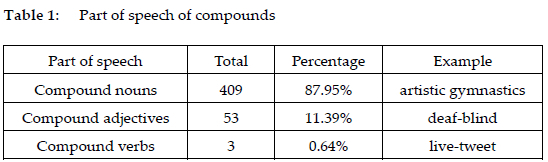
Among the compound nouns, the predominant process involves combining two nouns, followed by compounds formed by pairing adjectives with nouns. This phenomenon likely occurs due to the inherent flexibility and versatility of noun combinations in English. Nouns often serve as the building blocks for compound nouns, allowing for the creation of new concepts and ideas by combining two or more nouns. Additionally, compound nouns formed from adjectives and nouns are also common, reflecting the descriptive nature of compound formations in English. In compound adjectives, the predominant formation involves combining a noun and an adjective, comprising 13 instances, followed by compounds formed by pairing two nouns, totaling 12 instances. And compound verbs predominantly result from the combination of nouns and verbs.
Among all compound words, a total of 31 contain combining forms, such as "agri-food" (agri- comb. form + food n.). Many combining forms used in word formation originate from Latin, Greek, French, and other languages. For instance, "multi-" is derived from Latin, and "hepta-" comes from Greek. These elements are commonly known as "neoclassical elements." Additionally, some combining forms are shortened versions of existing words, like "-ology" from "theology". In lexicographic practice, it is important to carefully document these combining forms, including their linguistic origins and variations, to ensure a thorough and accurate representation of their role in modern compound words.
4.2 Derivation
In the OALD, a total of 123 derivatives are documented. While this figure may appear modest in contrast to the abundance of compound words, it's crucial to acknowledge that derivation serves as a significant cornerstone for the expansion of English vocabulary. Among these derivatives, 72 are nouns, 37 are adjectives, and 14 are verbs. While the distribution trend of word classes is similar to that of compound words, with no instances of words having multiple parts of speech, the abundance of verbs surpasses that of compound words.
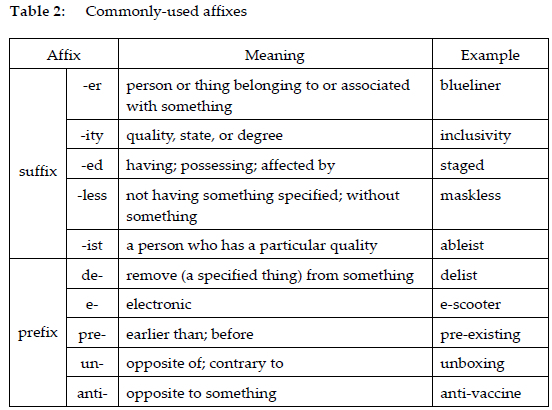
Derivation involves the formation of new words through the addition of prefixes or suffixes. Of these derivatives, 80 are created through the addition of suffixes, with common suffixes listed in Table 2. The remaining 43 words result from prefixation, with common prefixes also detailed in Table 2. The predominance of suffix-derived words over prefix-derived ones may stem from several factors. Firstly, English tends to utilize suffixes more frequently for word formation compared to prefixes. Suffixes often modify the grammatical function or meaning of a word, making them versatile tools for creating new vocabulary. Additionally, suffixes can be added to a wide range of words, allowing for a broader scope of derivational possibilities.
4.3 Abbreviation
According to Bauer et al. (2013: 22), an abbreviation is "a shortened form of a word or phrase that retains the meaning of the original". They classify abbreviations into three types: (1) acronyms, which are pronounced as words and formed from the first letters of a phrase (e.g., NASA); (2) initialisms, which are pronounced as individual letters and formed from the first letters of a phrase (e.g., FBI); and (3) short forms, which are pronounced as a whole word and formed by shortening a longer word (e.g., ad for advertisement). And Gao (2021: 114) points out that abbreviations are mainly presented in three forms: shortened form, initial-ism and acronym, and clipping. This paper centers on the analysis of initialisms, acronyms, and clipped words, based on the actual collection of new words found in the OALD.
In the OALD, there are a total of 55 listed abbreviations. Among these, ini-tialisms comprise 31 entries, making up a significant proportion of 56.36% of the total abbreviations. Of these initialisms, 22 are explicitly labeled as nouns, such as ASMR (autonomous sensory meridian response), while 9 initialisms lack explicit word class labels in the OALD, being only marked as "abbreviation" following the entry, for example, BBD (body dysmorphic disorder). Regarding their written representation, all 54 initialisms are displayed in full uppercase within the OALD. The sole exception is IoT (Internet of Things), where the middle "o" appears in lowercase. These initialisms exhibit diverse applications across various fields, including technology (e.g., IoT, IP), medicine (e.g., MND, ALS), environmental science (e.g., AQI), transportation (e.g., BRT), and gender and sexual orientation (e.g., LGBTQIA+), among others. They serve to condense lengthy terms into concise representations, facilitating ease of communication and memorization, as seen in examples like ASMR and PPE. Many are widely recognized and utilized in both everyday language and professional discourse, while others, like DRS and SOP, have become industry standards within specific domains. Additionally, certain initialisms, such as NFT and IoT, signify emerging concepts and technologies, reflecting ongoing social and technological advancements.
In the OALD, the presence of only 9 acronyms compared to the larger number of initialisms reflects several notable distinctions between the two categories. Acronyms, unlike initialisms, are formed by combining the initial letters of a phrase to create a pronounceable word. This process typically requires a specific combination of words that lend themselves to such formation, which may be less common in comparison to the broad range of terms suitable for the creation of initialism. Additionally, acronyms often arise in specialized fields or contexts where the abbreviated term becomes widely recognized and adopted as a single word with a distinct meaning, as seen with COVID-19 (Coronavirus Disease 2019). While initialisms are prevalent across diverse domains due to their simplicity and efficiency in abbreviation, acronyms tend to emerge in specific niches or during pivotal events, such as in the case of HIIT (High-Intensity Interval Training) within the fitness industry or BRICS (Brazil, Russia, India, China, South Africa) in global economics. Therefore, the relatively limited number of acronyms in the OALD suggests that while they hold significant importance within certain specialized fields and cultural contexts, they may not be as prevalent or as easily formed as initialisms within the broader scope of language usage.
In the OALD, 12 clipped words are identified, primarily consisting of nouns, with the sole exception being the adjective "hetero," derived from "heterosexual." From a lexicographic perspective, these clipped forms highlight two main truncation patterns that must be carefully documented in dictionary entries. The first involves tail-end clipping, where the final portion of the word is removed, as seen in "crypto" (from "cryptocurrency") and "vax" (from "vaccine" or "vaccination"). The second pattern involves clipping from the middle of the word, as illustrated by "alt-rock" (from "alternative rock"). Occasionally, exceptions such as "inspo" (from "inspiration") appear, lacking a clear formation pattern. Lexicographers must pay attention to these diverse clipping processes, ensuring that the truncated forms are accurately recorded and linked to their full forms to provide users with a clear understanding of the word's origin and usage.
4.4 Conversion
Throughout the history of the English language, its vocabulary has undergone significant changes. One of the most notable changes is the disappearance of inflectional endings in most words. Inflectional endings are suffixes or affixes added to a base word to indicate its grammatical function, such as tense, number, and case. Instead of relying on inflectional endings, English users have embraced the conversion method as the most straightforward and efficient approach to generating new words within English. According to Plag (2003: 134), conversion can be defined as "the derivation of a new word without any overt marking".
In the OALD, there are a total of 32 converted words. Within this category, verbs represent the largest group, comprising 13 entries, followed by nouns with 10, and 5 adjectives. Furthermore, there are 4 converted words that serve dual roles as both adjectives and adverbs, exemplified by terms like "trackside". Within converted words, the predominant transformation involves the transition from nouns to verbs. This conversion process reflects the dynamic nature of language, where nouns are adapted to convey actions or processes. For instance, "deadname" originates from the noun "dead name" and is converted into a verb to describe the act of referring to a transgender person by their birth name rather than their chosen name. Similarly, "mentor" transforms from a noun describing a guide or advisor into a verb representing the act of providing guidance or support to someone in their personal or professional development. This phenomenon also sheds light on why verbs dominate among converted words. Verbs, by their nature, encapsulate actions and processes, making them particularly adaptable for linguistic transformation. When nouns are converted into verbs, they often acquire dynamic qualities, allowing language to express a broader range of actions and behaviors.
Furthermore, within converted words, various other forms of conversion occur, including verbs transitioning into nouns, nouns transforming into adjectives, adjectives evolving into nouns, and even combining forms adapting into adjectives. This diverse array of conversion processes highlights the dynamic nature of language evolution, where words undergo transformations to fulfill different syntactic roles and semantic functions.
4.5 Blending
In the OALD, there are 21 blends listed, comprising primarily nouns, with only one adjective, "Paralympic". This adjective is a blend of "para-" from "paraplegic" and "-lympic" from "Olympic". For the sake of convenience in describing the pattern of blends, the first and second source words in the two-word blends are respectively labeled as A and B, with A1 and A2 representing the beginning and end of the first source word, and B1 and B2 representing the beginning and end of the second source word. Table 3 illustrates the different patterns of the blends.
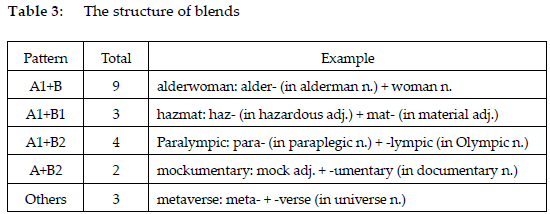
Most blends are created by truncating the end of the first word and merging it with the second word, or by removing parts of both words to form a new term. Additionally, some blends involve combining forms and affixes in the word-formation process. To determine whether a neologism should be added to the dictionary, lexicographers assess factors such as the blend's frequency in written and spoken language, its widespread acceptance, and its relevance to current cultural, social, or technological trends. The blend must demonstrate consistent usage and be recognized across various contexts before being incorporated as an official dictionary entry.
4.6 Other word-formation methods
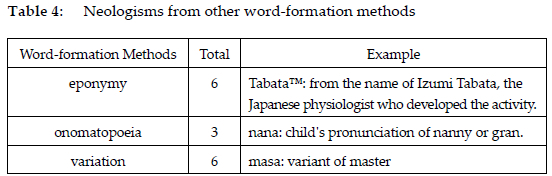
Beyond the commonly observed processes of compounding, derivation, abbreviation, conversion, and blending, the lexicon of the OALD is enriched by the incorporation of new words formed through less conventional means. These include eponymy, where words are derived from the names of people or places, imbuing them with historical or cultural significance. Onomatopoeia contributes words that phonetically resemble the sounds they represent, offering vivid auditory imagery. Variation introduces linguistic diversity through regional or dialectal differences, showcasing the dynamic nature of language across different contexts and communities. These less-common processes not only broaden the scope of vocabulary but also reflect the diverse array of human expression and creativity woven into the ever-changing fabric of language evolution. Table 4 illustrates the number of new words generated through eponymy, onomatopoeia, and variation, accompanied by examples.
4.6 Comparative analysis of the formation of English neologisms
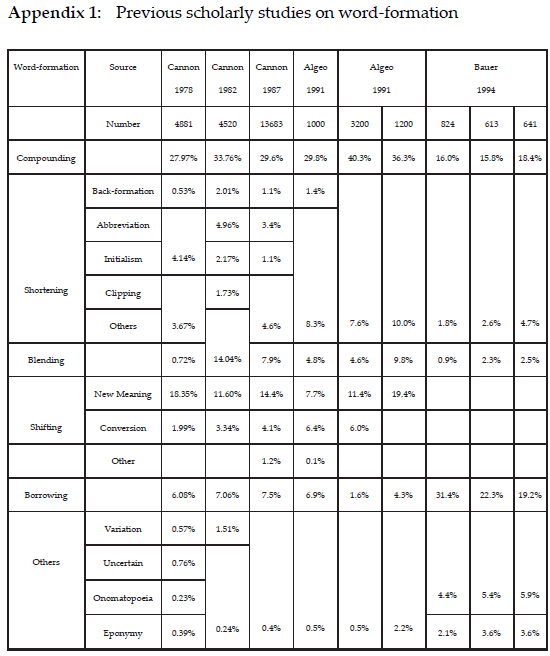
In 1978, Cannon embarked on a comprehensive study delving into the intricacies of English word-formation. He focused on analyzing 6000 Words: A Supplement to Webster's Third New International Dictionary. Subsequently, in 1982, Cannon extended this analysis to encompass 4520 newly coined words found in The Second Barnhart Dictionary of New English. Building upon this foundation, further examination ensued post-1987, encompassing a thorough scrutiny of 13,683 additional neologisms from A Supplement to Webster's Third New International Dictionary. In 1980, Algeo conducted a meticulous analysis by randomly selecting 1000 words from a pool of over 5000 newly coined words found within The Barnhart Dictionary of New English. Moreover, Bauer conducted a parallel investigation, randomly extracting 2082 words from The Supplement to the oxford English Dictionary. These words were then segmented into three distinct temporal periods, demarcated by the years 1913 and 1938, serving as historical benchmarks. This enabled a comprehensive longitudinal analysis within the framework of the discussed morphological principles. The resulting statistical findings are detailed in Appendix 1.
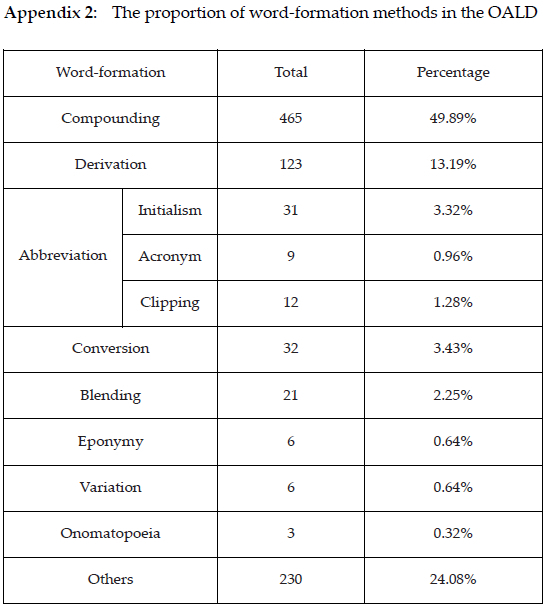
In the OALD, the distribution of word-formation methods, including compounding, derivation, blending, and others, is shown in Appendix 2. Compounds account for nearly half of the total instances, indicating their substantial role in recent lexical expansion. Following compounding, derivation appears with a lower but still significant frequency. Abbreviation, encompassing initialisms, acronyms, and clippings, contributes to word formation as well, albeit to a lesser degree compared to compounding and derivation. Conversion and blending also play roles in word creation, albeit less prominently. Other methods such as eponymy, variation, and onomatopoeia are relatively infrequent. This data underscores the continued importance of compounding and derivation as primary drivers of lexical growth in contemporary English, with other mechanisms serving as supplementary avenues for word formation.
Upon thorough examination, it becomes evident that compounding is the primary method of word formation across various contexts. Particularly within the OALD, the number of words formed through compounding exceeds those formed through derivation. This observation aligns with Cannon and Algeo's research, indicating a consistent trend. However, it contrasts with Bauer's findings. Bauer's methodology was influenced by his belief that newly created words resulting from shifts in meaning often display unique patterns, making systematic classification and statistical analysis difficult and potentially biased. Additionally, Bauer's study utilized random sampling, while Cannon's analysis concentrated on the complete collection of new words in the dictionary. These methodological differences help explain the discrepancies in findings between the studies.
5. The feature of English neologisms in the OALD
5.1 Wide-ranging sources for neologisms
The English lexicon is in a constant state of flux, characterized by ongoing evolution rather than stagnation. Minkova and Stockwell (2009: 5) note that "new words enter the language every day, words acquire or lose meanings, and words cease to be used". Neologisms in English play a pivotal role in mirroring the fluid and dynamic nature of language, serving as tools to encapsulate emerging concepts, technologies, and cultural shifts. As social changes unfold, the emergence of new ideas and phenomena necessitates the creation of precise vocabulary to articulate and convey these developments accurately. Reflecting this dynamism, the OALD regularly updates its entries every quarter, incorporating at least 160 newly coined or revised terms with each update.
These neologisms of the OALD stem from various fields including politics, economics, science, and culture. Economically, terms like "direct-to-consumer" (D2C) and "asset base" represent strategic shifts in business dynamics. "Direct-to-consumer" reflects a change in sales strategies, engaging directly with consumers, while "asset base" indicates financial stability and investment potential. In politics, terms such as "brand identity" and "brand recognition" highlight the marketing-driven nature of contemporary politics, shaping public sentiment. In science, concepts like "deep learning" and "data obfuscation" signify technological advancements in AI and data management, addressing privacy concerns. These linguistic changes reflect social evolution, showcasing progress across various human endeavors. For lexicographers, these entries underscore the necessity of tracking how new terms mirror shifts in societal trends and advancements across various domains. Documenting these neologisms helps to keep dictionaries aligned with current language use and emerging concepts.
5.2 The influx of foreign words into the vocabulary
English, as a universal language, surpasses national borders and linguistic boundaries. In addition to its primary use in countries such as the United States, the United Kingdom, and Canada, English holds official status in 55 other nations and regions, including India, Ghana, Jamaica, and New Zealand. Moreover, more than 100 countries, including China and Russia, have embraced English as their preferred second language, solidifying its worldwide influence. According to Murugova and Evtushenko (2023: 2), "this complex geopolitical process creates a new worldview of modern man, makes great changes in languages, and strengthens the tendency to borrow vocabulary".
Within the OALD, there are precisely 52 loanwords, the number strikingly akin to the influx of novel terms facilitated by abbreviations. These loanwords traverse not only the linguistic realms of Greek, Latin, and French but also extend their roots into diverse language families. Among them are borrowings from Arabic, Korean, Japanese, Vietnamese, and beyond. For instance, "anosmia" hails from Greece, highlighting a loss of sense of smell, while "djembe" originates from French, denoting a West African drum. Additionally, loanwords include "bibimbap" from Korean, a savory mixed rice dish, "Wagyu" from Japanese, referring to prized beef, and "inshallah" from Arabic, conveying the hope for a desired outcome. These loanwords, originating from a variety of languages and carrying significant cultural weight, act as linguistic bridges that enhance the English lexicon. Lexicographers are essential in capturing and detailing these words, ensuring that their meanings and usages are accurately represented and integrated into the dictionary.
5.3 The simplicity of English neologisms
The trend of conciseness in English neologisms epitomizes the evolution of language in the digital era, where brevity and efficiency reign supreme. The proliferation of abbreviations and acronyms, such as "D2C" for direct-to-consumer, reflects the demand for streamlined communication in a fast-paced world driven by technology. Influenced by the Internet and social media in particular, people increasingly gravitate towards shorter forms of expression that can be quickly written, read, and understood. This linguistic efficiency not only saves time and effort but also aligns with the fast-paced exchange of information that defines modern digital communication.
Moreover, the trend towards conciseness in English neologisms mirrors broader social values and preferences. In an age where attention spans are shrinking and information overload is rampant, concise language offers clarity amidst the noise. By condensing complex ideas into succinct terms, English neologisms cater to the need for immediate comprehension and efficient communication across various domains, from business and technology to social media and everyday conversation. Thus, the rise of abbreviated and acronymic neologisms reflects not only linguistic adaptation to the digital landscape but also a broader cultural shift towards brevity and convenience in communication.
6. Conclusion
This research aims to analyze the word formation processes and characteristics of new entries introduced into the OALD lexicon between March 2020 and March 2024. In addition to commonly recognized processes like compounding, derivation, abbreviation, conversion, and blending, the OALD lexicon is enriched by incorporating new words formed through less conventional means, including eponymy, onomatopoeia, and variation. Among compound nouns, the majority are formed by combining two nouns, typically in the form of open compound words. Derivatives mostly arise from the addition of suffixes, while abbreviations primarily consist of initialisms written in uppercase letters. Converted words tend to be predominantly verbs and blends typically involve the removal of part of the first source word and its combination with the complete second source word. Overall, the sources of new words are diverse, with a notable presence of loanwords, and they generally tend to evolve towards simplicity.
The findings highlight the evolving nature of word formation and underscore the need for lexicographers to adapt their methodologies to accurately document new entries. By understanding the diverse processes through which new words are created, lexicographers can ensure that dictionaries remain current and reflective of contemporary language usage. This research contributes to the field of lexicography by providing a detailed analysis of recent word-formation trends and characteristics. It offers insights into the mechanisms behind new entries and their integration into the lexicon, thereby aiding in the development of more comprehensive and accurate dictionary entries. However, the study is limited by its focus on entries from a single dictionary (OALD) and a specific timeframe (March 2020 to March 2024). It does not account for potential variations in word formation trends across different dictionaries or periods. Future research could expand the scope to include additional dictionaries and longer timeframes to provide a broader understanding of word formation trends. Comparative studies could also be conducted to analyze how different dictionaries treat new words and to explore the influence of cultural and technological changes on word formation.
6. Endnotes
1. https://www.oed.com/inlormation/updates/december-2024/
2. https://www.oxfordlearnersdictionaries.com/wordlist/new_words
References
Algeo, J. 1991. Fifty Years among the New Words: A Dictionary of Neologisms, 1941-1991. Cambridge/ New York: Cambridge University Press. [ Links ]
Algeo, J. 1980. Where Do All the New Words Come from? American Speech 55(4): 264-277. [ Links ]
Bauer, L. 1994. Watching English Change: An Introduction to the Study of Linguistic Change in Standard Englishes in the Twentieth Century. London: Longman. [ Links ]
Bauer, L., R. Lieber and I. Plag. 2013. The Oxford Reference Guide to English Morphology. Oxford: Oxford University Press. [ Links ]
Bradley, H. 1904. The Making of English. New York/London: Macmillan. [ Links ]
Cannon, G. 1978. Statistical Etymologies of New Words in American English. Journal of English Linguistics 12(1): 12-18. [ Links ]
Cannon, G. 1982. A Linguistic Analysis of 4,520 New Meanings and New Words in English. Dictionaries: Journal of the Dictionary Society of North America 4: 97-109. [ Links ]
Cannon, G. 1987. Historical Change and English Word-Formation. New York: Peter Lang. [ Links ]
Chen, Jiansheng. 2000. A Study on the Word-Formation Trends of Newly Created English Words in the 20th Century. Journal of Sichuan International Studies University 3: 58-61. [ Links ]
Crystal, D. 1995. The Cambridge Encyclopedia of the English Language. Cambridge: Cambridge University Press. [ Links ]
Eliot, T.S. 1943. Four Quartets. Harcourt, Brace and Co. [ Links ]
Gao, Fengjiang. 2001. The Formation and Characteristics of English Neologisms. Chinese Science & Technology Translators Journal 4: 54-45. [ Links ]
Gao, Yongwei. 1998. Research on Neologisms in English-Speaking Countries in the Past 20 Years. Foreign Languages and Foreign Language Teaching 11: 2. [ Links ]
Gao, Yongwei. 2012. Research on English Neologisms and Dictionaries. Shanghai: Fudan University Press. [ Links ]
Gao, Yongwei. 2021. A 21st Century English-Chinese Dictionary of Neologisms. Shanghai: Fudan University Press. [ Links ]
Greenough, J.B. and G.L. Kittredge. 1901. Words and Their Ways in English Speech. New York: Macmillan. [ Links ]
Hartmann, R.R.K. and G. James. 2000. Dictionary of Lexicography. Beijing: Foreign Language Teaching and Research Press. [ Links ]
Jackson, H. 1988. Words and Their Meaning. London: Routledge. [ Links ]
Li, Ying. 2001. An Analysis of Word-Formation of English Neologisms. Liaoning: Dalian Maritime University. [ Links ]
Liu, Kelan. 2015. Network English Neologisms from a Cultural Perspective. Wuhan: Wuhan University Press. [ Links ]
Lu, Guoqiang. 1999. Modern English Lexicology. Shanghai: Shanghai Foreign Language Education Press. [ Links ]
Malmkjsr, K. (Ed.). 2006. The Linguistics Encyclopedia. London/New York: Routledge. [ Links ]
Minkova, D. and R. Stockwell. 2009. English Words: History and Structure. Cambridge: Cambridge University Press. [ Links ]
Murugova, E. and S. Evtushenko. 2023. Neologisms and its Role in the Development of Modern Sustainable Ecosystemic Society E3S Web of Conferences 420.
Newmark, P. 2001. A Textbook of Translation. Shanghai: Shanghai Foreign Language Education Press. [ Links ]
O'Dell, F. 2016. Creating New Words: Affixation in Neologisms. ELT Journal 70(1): 94-99. [ Links ]
Plag, I. 2003. Word-formation in English. Cambridge: Cambridge University Press. [ Links ]
Wang, Rongpei. 2000. Tracking English Neologisms. Foreign Languages and Foreign Language Teaching 8: 10-14. [ Links ]
Wang, Yin. 2005. Exploration of Cognitive Linguistics. Chongqing: Chongqing Publishing House. [ Links ]
Yang, Bin. 2008. The Doorbell of the Mind: A Cognitive Approach to English Neologisms. Jiangsu: Soochow University. [ Links ]
Yang, Yonglin. 1997. The Expression of Culture in the Formation of English Neologisms: An Analysis of "-gate" and Its Compounds. Journal of Northwest Normal University (Social Sciences) 1: 51-56+104. [ Links ]
Yu, Nini, Zhang, Li, Ping, He, Jian. 2011. The Generation, Formation, and Usage of English Neologisms. Guangzhou: Guangdong People's Publishing House. [ Links ]
Yuan, Ningning. 2019. Trend Analysis of English Word-Formation Based on OED Neologisms. Guandong: Guangdong University of Foreign Studies. [ Links ]