




Services on Demand
Journal

Article
 English (pdf)
 Article in xml format
 Article references
 Automatic translation
 Send this article by e-mail
Indicators
Related links
-
 Cited by Google
 -
 Similars in Google
Share

 Permalink
Lexikos
On-line version ISSN 2224-0039Print version ISSN 1684-4904
Lexikos vol.35 Stellenbosch 2025
https://doi.org/10.5788/35-1-1976
ARTICLES
The Need for a National Terminology Policy for South Africa
Die behoefte aan 'n nasionale terminologiebeleid vir Suid-Afrika
Marietta Alberts
Former Director: Terminology Development and Standardisation, Pan-South African Language Board, South Africa (albertsmarietta@gmail.com)
ABSTRACT
The language policy of a country has an influence on terminology development while it also determines the status of a language and the number of languages to be developed. Although several international and national terminology policies are readily available terminology work is currently not practised in South Africa according to a national terminology policy. The point of departure in terminology work is always conceptual. It is, therefore, important to work according to a subject-oriented terminography approach to harvest terminology. This approach is usually used simultaneously, and in conjunction with other approaches, such as language planning-oriented, translation-oriented, linguistic community-oriented, process-oriented, functional, and interactive approaches to develop the official languages of South Africa. The hegemony of English, however, hampers terminology development in the other official languages. There is a lack of coordination and cooperation among terminology agencies which lead to duplication of projects. The national terminology office, i.e. the Terminology Coordination Section (TCS), National Language Service, Department of Sport, Arts and Culture, is the main beneficiary of a national terminology policy, and it should provide guidelines to other terminology agencies. Terminology policies and the need for a national terminology policy for South Africa are described and the eventual roadmap for the acceptance of the national terminology policy recently drafted, is supplied. A national terminology policy could assist in promoting the official, provincial, and local languages to become functional languages in all spheres of human activity.
Keywords: bilingual, copyright, language for special purposes, language planning-oriented terminography approach, linguistic community-oriented terminography approach, multilingual, policy, polythematic, register, subject-oriented terminography approach, term bank, terminography, terminology, translation-oriented terminography approach
OPSOMMING
Die taalbeleid van 'n land het 'n invloed op terminologieontwikkeling terwyl dit ook sowel die status van 'n taal as die aantal tale wat ontwikkel moet word, bepaal. Hoewel verskeie internasionale en nasionale terminologiebeleide geredelik beskikbaar is, word terminologiewerk nie tans in Suid-Afrika volgens 'n nasionale terminologiebeleid beoefen nie. Die vertrekpunt by terminologiewerk is altyd konseptueel. Dit is gevolglik belangrik om volgens 'n vakgeörienteerde terminografiebenadering terminologie te versamel. Hierdie benadering word gewoonlik saam met ander benaderings, soos taalbeplannings-, vertaalgeörienteerde, taalgemeenskaps-, prosesgeoriënteerde, funksionele en interaktiewe benaderings gebruik om die amptelike Suid-Afrikaanse tale te ontwikkel. Die hegemonie van Engels bemoeilik egter die ontwikkeling van terminologie in die ander amptelike tale. Daar is 'n gebrek aan koördinering en samewerking onder terminologiese instansies wat lei tot die duplisering van projekte. Die nasionale terminologiekantoor, dit is die Terminologiekoördinerings-afdeling (TKA - in die praktyk word slegs die Engelse benaming en afkorting gebruik), Nasionale Taaldiens, Departement van Sport, Kuns en Kultuur is die hoofbegunstigde van 'n nasionale termi-nologiebeleid en behoort riglyne aan ander terminologiese instansies te verskaf. Die uiteindelike roete om die konsep van die nasionale terminologiebeleid te aanvaar, word verskaf. 'n Nasionale terminologiebeleid kan help om die amptelike, provinsiale en plaaslike tale in funksionele tale te ontwikkel wat in alle gebruiksfere van menslike aktiwiteit benut kan word.
Sleutelwoorde: beleid, taalgemeenskapsgeörienteerde terminografiebena-dering, meertalig, register, taalbeplanningsgeörienteerde terminogra-fiebenadering, termbank, terminografie, terminologie, tweetalig, outeurs-reg, vakgeörienteerde terminografiebenadering, vaktaal, veeltematies, vertaalgeörienteerde terminografiebenadering
1. Introduction
The South African terminology practice has an interesting history mainly influenced by different language policies during the various political dispensations. All the indigenous languages (Afrikaans and the Sintu languages) that later became official languages, had to be reduced to writing, had to be standardised, and their spelling, orthographies and word-formation principles had to be developed before any terminology development could start. The previous bilingual policy favoured the development of Afrikaans terminology. Government policy on language promotion prior to 1994 furthermore stipulated that the promotion of the Sintu languages was the task of the former national states and the self-governing regions and not of the South African government. Since 1995 structural and policy considerations have had an important effect on the practice of terminology in South Africa. It has been accepted as a responsibility of the state to also develop and promote the official Sintu languages and, since it became an official language in 2023, also South African Sign Language (SASL).
The terminologist working in a multilingual society such as South Africa is faced with conflicting situations: the multilingual polythematic terminologies should be developed to enhance the multilingual heritage of the country; however, the number of languages makes this impractical and not economically viable and, to add to the problem, few trained terminologists and even fewer terminology posts are available. The development of SASL terminology also poses a big challenge - the conceptual content of various subject fields needs to be depicted by signs and captured as video clips for the dissemination thereof to the deaf and hearing-impaired community.
Terminology plays a crucial role in language development and the promotion of multilingualism. This article discusses the need for a national terminology policy as seen from a South African perspective. Special emphasis is given to the South African situation regarding language policies and consequential terminology approaches in terms of subject-oriented terminography, translation-oriented terminography, language planning-oriented terminography, and linguistic community-oriented terminography.
Terminology is never practiced in isolation and various collaborating bodies assist the national terminology office with terminology development. The aspect of training in the principles and practice of terminology and terminography receives attention, and the influence of copyright and human language technologies on terminology development is discussed.
2. Language planning and language policy
Terminology as a discipline is governed by the language policy of the country (cf. Alberts 2003: 134; Wright 2007: 6; Alberts 2008; Alberts 2010: 599-620; Alberts 2017: 149, 154-157). It is at the service of the language policy of the reigning government, e.g. monolingual, bilingual, or multilingual. The South African situation could be taken as example (cf. Alberts 2017: 156-157):
- previous dispensation (i.e. prior to 1994): bilingual technical dictionaries were compiled (English/Afrikaans);
- present dispensation (i.e. after 1994): multilingual term lists are compiled in the eleven official languages of the country (English, Afrikaans, Setswana, Sesotho, Sepedi/Sesotho sa Leboa, isiNdebele, Siswati, isiXhosa, isiZulu, Xitsonga, Tshivenda).
- since 2023 the South African Sign Language was added as official language and concepts need to be depicted as signs through medium of video clips.
South Africa was, prior to 1994, constitutionally a bilingual country. This meant that special emphasis was placed on the development of English and Afrikaans terminology (cf. Official Languages of the Union Act 8 of 1925; Republic of South Africa Constitution Act 32 of 1961; Republic of South Africa Constitution of Act 110 of 1983). After unification, the Constitution (1996) (cf. Constitution of the Republic of South Africa Act 200 of 1993 (Interim Constitution); Constitution of the Republic of South Africa Act 108 of 1996 (now Constitution, 1996) provides for the equitable use of all the official languages of the country, and for the promotion and development of the historically marginalised indigenous languages (cf. Government Gazette 2012, 2013). According to section 6(1) of the Constitution, the official languages of South Africa are Sepedi/Sesotho sa Leboa, Sesotho, Setswana, Siswati, Tshivenda, Xitsonga, Afrikaans, English, isiNdebele, isiXhosa, isiZulu and, since 2023, South African Sign Language (SASL). Apart from the 12 official languages, the Constitution also recognises other languages such as Khoi and San which should be promoted and developed (cf. Figure 1). The Constitution further requires all official languages to enjoy parity of esteem and be treated equitably.
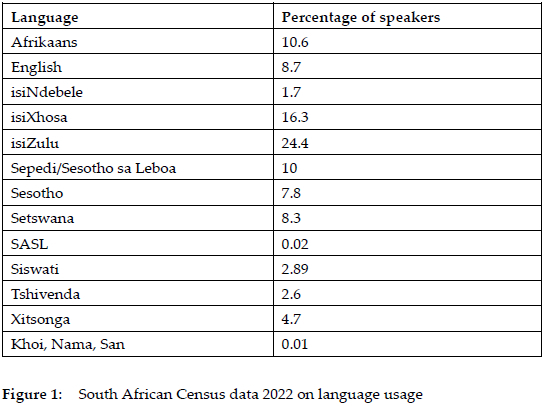
The 2022 census data (cf. Statistics South Africa 2022) regarding language usage in South Africa could be summarised as follows (cf. Figure 1):
A direct relationship exists between language planning, language policy, language practice and terminology development and management (Advisory Panel 2000; Alberts 2003: 134). Terminology occupies a special position within the framework of language and communication, and terminology development is dependent on language planning and language policies (Alberts 2017: 154).
3. Approaches to terminology work
There are various approaches to terminology work that influence terminology development. Most of these approaches are used simultaneously in South Africa.
3.1 Subject-oriented terminography approach
The subject-oriented terminography approach is the traditional way of harvesting and developing terminology. It is usually the methodology used by large terminology offices worldwide, and it is also the traditional method of terminology documentation followed in South Africa.
The point of departure in terminology work is the concept. The objective of the subject-oriented terminography approach is therefore to focus on concepts and the relationship that exists between concepts and conceptual systems and the terms denoting these concepts. There is a one-to-one relationship between concept and term and each concept should preferably be denoted by a specific term in a specific subject area and language. This practice leads to the standardisation of concepts and terms. Standardisation is a process - by frequent usage of source language (SL) and target language (TL) terms these terms penetrate the subject field and language and become standardised (cf. Alberts 2017: 273-300).
The emphasis is placed within the subject-oriented framework on the standardisation of terms and concepts to facilitate effective communication and knowledge transfer within the professional community. In most cases, the subject specialists themselves are responsible for the documentation of specialised terminologies (cf. Alberts 2017: 177-179; Alberts 2019: 60).
This approach can also be regarded as an item-based approach since it limits the terminological research to the structure of languages for special purposes (LSP). The study of word-formation principles is key to this approach, especially the influence of Greek and Latin on terminology creation (cf. Cluver 1989: 150-158; Alberts 2019: 60).
Terminology development goes hand in hand with language development. The first bilingual English/Afrikaans Chemistry dictionary compiled by Dr D.F. Malherbe du Toit was published in 1918. Afrikaans became an official language in 1925. Several technical dictionaries and term lists were since compiled by subject specialists to enable subject-related communication in various subject fields. These subject specialists all worked according to the subject-oriented terminography approach. There were unfortunately several duplications of projects which led to a proliferation of terms for the same subject and/or language. This practice led to miscommunication and a lack of standardisation. Unfortunately, this process is currently repeated for the Sintu languages - various language units and tertiary institutions are creating terms in the official languages, but since these efforts are not properly coordinated, the terminology created by these institutions are also showing a proliferation of terms for the same concept in a given language and subject area (Goosen 2024: 56, 149).
3.2 Language planning-oriented terminography approach
With the language planning-oriented terminography approach the emphasis falls on official intervention in increasing the status of minority languages or languages which have for some or other reason been historically disadvantaged. The underlying belief of this approach is that the use of an unstable language can change with systematic strategic intervention carried out by official bodies. Legislation and other appropriate measures must be put in place to implement the change (cf. Alberts 2017: 181-182). Afrikaans was for instance regarded as a mere kitchen language, but when it became an official language in 1925 its status changed and it became a language of learning and used in various professions.
The language planning-oriented terminography approach is to a certain extent a process-oriented approach and the relationship between language planning and the eventual standardisation of languages is studied (cf. Cluver 1989: 150, 180-193; Alberts 2019: 60).
The language planning-oriented terminography approach can also be regarded as a functional approach since it determines the unique communicative needs of language for special purposes communities. It considers the similarities between terminologies and general vocabulary and between terminography and lexicography (cf. Cluver 1989: 150, 155, 159-173; Alberts 2019: 60).
The language-planning terminography approach is an interactive approach since it places the emphasis on the dynamics of languages for special purposes in its entirety, rather than on its constituent parts. Languages for special purposes are developed through various processes and several factors interact during these activities. One such factor is language politics where it plays a significant role in the development of nationalism, while simultaneously it is the result of nationalism. As such, terminology is influenced by national or official languages, while in turn influencing the development of national or official languages (Cluver 1989: 150, 193-196, 238; Alberts 2019: 60).
Various South African government bodies and other organisations established language bureaux during the bilingual dispensation (i.e. the Department of Culture [later: the Department of National Education]; Transport; SABS; Department of Defence; Iscor; Suid-Afrikaanse Akademie vir Wetenskap en Kuns; Post Office; Wool Board, HSRC; CSIR; etc.). The bilingual policy of the country and language planning prescripts required Afrikaans to be developed as an official language to be on par with the global English language (Botha, Alberts and Kapp 2010)
Terminologists were appointed at the language bureaux to document the terminology of the relevant institution. These bodies all worked according to the language planning-oriented approach and on conceptual/subject-related principles.
To be able to attain the necessary change of status, the Afrikaans language had to have an up-to-date, coherent terminology to ensure professional communication in all subject fields. The objective was to replace terminology imported from languages spoken in technologically advanced and dominant countries with local or native equivalents. The native language is therefore fostered and developed.
As mentioned earlier Afrikaans was once regarded as a so-called "kitchen language" but through inter alia terminology development it became an academic and scientific language. The current multilingual policy of the country requires terminology to be developed in all official languages, especially to develop the official Sintu languages - previously regarded as marginalised languages - to become functional languages in all spheres of human activity. Since 2023 special attention is also given to the development of standardised signs for South African Sign language, captured as video clips.
3.3 Translation-oriented terminography approach
The translation-oriented terminography approach (TOT) is highly developed in institutionally bilingual or multilingual countries and communities. Terminology processing is seen as an activity which supports translation work (cf. ISO 2002; Alberts 2017: 179-180, 210-215; Alberts 2019: 20). This approach establishes terminological equivalents in the various languages which are used as points of reference by translators, and which contributes to the quality of the translated text. One of the major spin-offs of TOT is the creation of multilingual polythematic term banks. Translators consult a term bank for the same reason they consult a dictionary, e.g. to check the spelling of a term, its meaning, its grammatical category, the subject field in which it is used, its synonyms, equivalents in other languages, etc.
In the early 1950's translators at different language bureaux in South Africa started documenting source language (SL) terms and target language (TL) term equivalents to enable them to reuse the terminology in future translation work. They worked according to the translation-oriented terminography approach. This process assisted in the standardisation of SL and TL terms. In South Africa translators are still regarded a major group contributing to terminology development and the standardisation of terms.
3.4 Linguistic community-oriented terminography approach
The linguistic community-oriented terminography approach is a sociolinguistic approach to terminography where the relationship between language for special purposes and the community is determined. Terminology is therefore harvested from rural and urban speech communities and documented (Cluver 1989: 150, 197; Alberts 2017: 180-181).
As noted by Alberts (2010: 615), this process is costly and therefore seldom undertaken. The fact that terms existing in the communities are not documented contributes to the general and erroneous stereotype that the Sintu languages are incapable of naming abstract concepts (ibid.). This is a fallacy. Various terms in a variety of domains already exist in the Sintu languages. The problem is that these terms are not documented in a widely accessible format and therefore not standardised (Alberts 2017: 206). Various text books, study guides and other records containing terminology do exist in the Sintu languages, but are often not shared with the broader community or not available in a centralised term bank, with the result that terminology development happens in silos and therefore not standardised.
The various dialects also contain a wealth of terms which could be harvested and utilized in the standard languages, i.e. the terminology related to animal names, bird names, customs and beliefs, traditional medicines, etc. These terms could be obtained from the older members of the linguistic community. Should these people die their knowledge of terms and related information (i.e. indigenous knowledge systems) dies with them (cf. Alberts 2017: 180-181).
The terminology available in the urban areas should also be documented. Terms are available at language units in translated documents, and at tertiary institutions in textbooks, curricula, master dissertations, and doctoral theses. These terms are new, and if they are not documented (and translated into the relevant official languages where needed), they could not be standardised and disseminated to target users. It is only by documenting terms and related information, standardising the terms and disseminating term lists in various domains and subject areas that the South African indigenous languages will become functional languages in all spheres of professional and academic life.
The current projects at the national terminology office, the Terminology Coordination Section, focus on community needs (i.e. weather terms, basic health, HIV/Aids, Covid-19, election terms) and therefore a linguistic community-oriented terminography approach is followed.
4. Coordination and cooperation
Although the correct terminographical approaches were used to develop terminology in South Africa, there was unfortunately little coordination of projects and every institution developed (and is still developing) the terminology for its own purposes. Several technical dictionaries (i.e. dictionaries for special purposes) were published over the years. There are a duplication of projects and subsequently also a proliferation of terms for the same concept in the same subject and/or language.
Over the years various coordinating bodies were established to coordinate the efforts of the different language bureaux to ensure cooperation and to prevent the duplication of terminological activities:
- In 1958 the Vaktaalkommissie (Terminology Commission) was established to assist with coordination efforts.
- It was replaced in 1966 by the Vaktaalskakelkomitee (Terminology Liaison Committee).
- In 1974 the Koördinerende Vaktaalraad (KOVAK) (Coordinating Terminology Board - COTERM) was established to coordinate the various terminology endeavours of the different language bureaux and to avoid duplication of projects and the proliferation of terms for the same concepts in the same subject and/or language. COTERM replaced all the previous coordinating bodies. The managers heading the big language bureaux at the time were members of COTERM, e.g. Language Bureau of the South African Railways and Harbours Administration, Terminology Division, Department of National Education, Terminology Bureau of the Suid-Afrikaanse Akademie vir Wetenskap en Kuns, Directorate Language: South African Defence Force, the Woordeboek van die Afrikaanse Taal (WAT), the Language Bureaux of Iscor, SABS, SABC, CSIR, as well as, representatives of the Government Printer, The Municipal Translators' Association, translators from the province and the Johannesburg Technical College. The Director: Arts and Culture of the Department of National Education chaired the meetings and the Terminology Division supplied the secretariat (Alberts 2003: 136; Kapp 2009: 129). Each participating institution had to identify core terms related to their core business and supply these to the WAT for inclusion in the comprehensive dictionary for Afrikaans. Copies of all technical dictionaries and term lists had to be supplied to the WAT and South African libraries.
COTERM developed norms for terminology creation, the standardisation of terminographical principles and practice (i.e. terminology work and the compilation of technical dictionaries) and started with the computerisation of the South African terminology practice (Alberts 1983; Alberts 2003: 137).
COTERM did not fulfil its coordinating role and the various language bureaux continued with their own activities.
- In 1984 a research report by the Human Sciences Research Council (HSRC) (cf. Cluver and Scheffer 1984) determined that the national terminology office, at the time the National Terminology Service (NTS) of the Department of Arts, Culture, Science and Technology (DACST), should become the official coordinating terminology office for South Africa. In 1995 the national terminology office was commissioned by the national government to compile multilingual technical dictionaries and terminology lists on national subject-related projects. The Terminology Coordination Section (TCS) commenced operations on 1 April 1998 as a sub-directorate of the National Language Service of the Department of Arts and Culture (DAC). It is currently a directorate of the National Language Service of the Department of Sport, Arts and Culture (DSAC). The TCS is the national terminology office and therefore responsible for the coordination of terminology projects in South Africa. TCS is the largest institution in South Africa that devotes its time entirely to terminology development work and is consequently the primary implementing agency for the national terminology policy.
The terminology practice in South Africa saw many changes over the years that had an influence on terminology development and consequently on the coordination of projects and cooperation with stakeholders:
- Initially bilingual English/Afrikaans translating technical dictionaries were compiled - currently translating and explanatory technical dictionaries are compiled in the 12 official languages of South Africa;
- The terminography process was previously done manually which involved data to be captured on index cards, thereafter the index cards had to be alphabetised in the two languages concerned, then manuscripts were typed, corrected, and then followed by galley proofs and page proofs - all which had to be proofread several times to ensure the correctness of data. Currently terminological data is entered into a database (i.e. a terminology management system). If data is entered correctly there is no need for the drudgery of the repeated proofreading thereof.
- There were during the bilingual dispensation at its peak 26 terminologists working at the national terminology office on English and Afrikaans terminology in a variety of subject areas - mainly in the higher echelons of science and technology. Currently there is only one terminologist per official language employed at the national terminology office (i.e. TCS) although the staff complement provides for two positions per official language with two terminologists employed for isiXhosa only. Since 2022 no terminologists were employed for English and Afrikaans first-language speakers. These posts, as well as that of a SASL terminologist, were advertised but TCS were informed not to proceed with the selection process until a later date - probably after the approval of the draft national terminology policy (Mnisi 2024b).
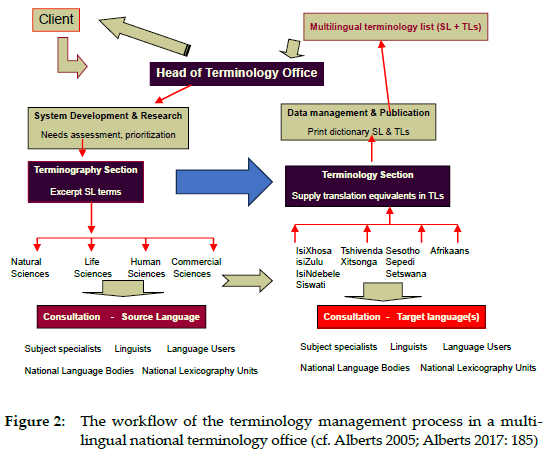
- Primary term creation (practiced by the terminography section) is done in the source language (which is currently English), and secondary term creation is done by the terminology section in the other official languages (cf. Figure 2).
- Previously terminologists were highly skilled workers. Novice terminologists received in-service training and worked under the mentorship of trained senior terminologists. Currently there are few trained terminologists in the principles and practice of terminology and terminography, and in-service training is limited to training in the terminology management system (TMS). The TCS currently uses the Autshumato TMS developed by CTexT. Unfortunately, terminology development initiatives in South Africa do not necessarily use TMSs. Sadly, they use flat files such as Excel sheets and MS Word documents which means that data exchange is extremely difficult.
- Prior to 1996 (i.e. before the multilingual dispensation) the national terminology office had a section called Systems Development and Research (cf. Figure 2; Alberts 2005; Alberts 2017: 185). This section was responsible for needs assessment studies, it had to determine terminology-related priorities, and it kept a national terminology register of all terminology projects to ensure the coordination of projects and the cooperation of various terminology creating entities. The national terminology register (NTR) was non-operational for many years, but was reconfigured during 2023 to meet the current needs concerning cooperation and the prevention of duplication of projects. The new NTR was launched at the National Language Forum in 2023 and is fully functional (Machaba 2024).
- At the time, i.e. prior to 1996, the section Data Management and Publication (cf. Figure 2; Alberts 2005; Alberts 2017: 185) dealt with the database, and with the publications of the technical dictionaries. It also published a Directory of Language Resources, a Catalogue of Technical Dictionaries, and a monthly newsletter, called Termbroker. These resources kept other terminology entities informed of various aspects relating to terminology development, and assisted with coordination and cooperation endeavours.
Despite all these coordination efforts by the national terminology office, i.e. the TCS and its predecessors, there is still a duplication of projects that prevents the standardisation of concepts and their designated terms in the various official languages. One of the reasons for this is the variety of stakeholders who are participating in the strategy towards achieving the goal of developing multilingual terminologies, e.g. the subject specialists, linguists, language units, National Lexicography Units, tertiary institutions, translators, journalists, terminology centrums, i.e. Centre for Political Terminology in Southern Africa (CEPTSA), Centre for Legal Terminology in African Languages (CLTAL), language users, and publishing houses, to name but a few (cf. Figure 3). Some of these bodies create terminology, others evaluate the term creations, e.g. the National Language Bodies of the Pan-South African Language Board (PanSALB). There are, however, no structure, nor norms or a policy in place to regulate these different efforts.
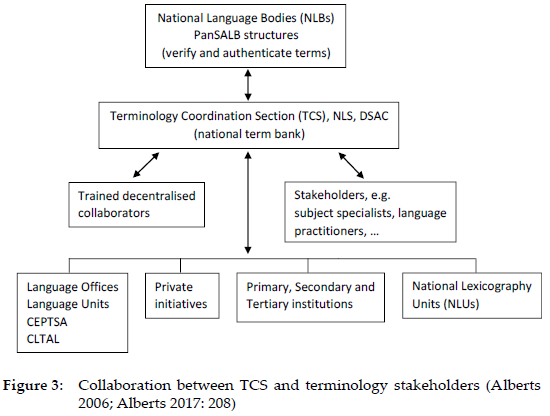
Although there were/are efforts by TCS to ensure cooperation through the coordination of projects, these efforts usually fail because the stakeholders work in silos, and every institution carries on with its own projects which again leads to a proliferation of terms for the same concept in the same subject area and/or language. The reconstructed national terminology register (NTR) managed by TCS to register all terminology projects, enable cooperation, and prevent duplication is currently fully functional and should be able to coordinate terminology-related projects.
5. Terminology policy
5.1 Terminology policies in general
A terminology policy affects everybody who and every institution that needs to understand or acquire specialised knowledge of some kind or other. For this reason, those individuals and institutions that are most dedicated in their commitment to language planning policies are required to be involved. It is, however, also advisable to engage the whole language and subject community in the process of generating policy on terminology (UNESCO 2005: 15; Alberts 2017: 174).
Terminology policy can be defined as a strategy which aims at developing or regulating emerging and existing terminologies (cf. http://www.infoterm/).
Terminology policy-making at a national level is a complex process, one constantly influenced by various factors, such as demographics, cultural, ethno- and geolinguistic factors as well as socio-psychological, economic, political, and legal factors. A terminology policy may therefore serve quite different purposes (cf. Alberts 2017: 174).
In the strategic management context, a terminology policy may be seen as outlining a vision and a set of instruments for:
- fostering the optimal and rational use of a language's referential resources to support specialised communication, and
- managing the intellectual and other property assets of an organisation/ community to advance given goals (cf. Antia 2008: 10).
This characterisation of a terminology policy implies that vision in terminology policy-making may be directed not only at efficiency and effectiveness of special-purpose communication (professional, academic, scientific, and technical communication), but also at a range of added value goals dealing with knowledge. A terminology policy in the strategic management sense also implies that terminology attempts to communicate an overarching vision which then motivates the activities of phases 1-5 of Figure 4.
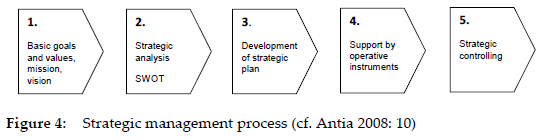
Terminology policy-making seeks to develop goals, values, a mission, and a vision (phase 1) against the backdrop of a strategic environmental analysis of strengths, weaknesses, opportunities, and threats (SWOT analysis) (phase 2), then converts the vision into actions or programmes intended to produce measurable outcomes, i.e. the development of a strategic plan, operative instruments to support the strategic plan, and controlling mechanisms (phases 3-5). The process is cyclical and allows for formative evaluation. A terminology policy may mirror the initial phase or all the phases indicated in Figure 4 (cf. Antia 2008: 10; Alberts 2017: 174-177).
Terminology policy development is also the concern of international organisations. For instance, Subcommittee 1 (SC 1) of ISO/TC 37 drafted a standard: Terminology Policies - Development and Implementation (ISO/CD 29383-1). This draft standard is based in part on the Guidelines for Terminology Policies: formulating and implementing terminology policy in language communities published by the United Nations Educational, Scientific and Cultural Organization (UNESCO) in 2005, a project in which several members of the ISO/TC 37 SC1, including South Africa, collaborated (Alberts 2017: 175).
The ISO standard is designed for terminology policy-makers working in diverse environments, from language planning to for-profit companies. It provides guidance on general principles for the design of an individual policy to be tailored to a specific set of circumstances and it recommends a variety of actions that have proved to be helpful in different situations (e.g. national context (a legal framework)), and in non-governmental organisations (NGO's), private corporations, and small organisations (Alberts 2017: 175).
Language planning and terminology planning are interdependent and complementary activities. There are different phases in the formulating and implementing of a terminology policy, i.e.:
- Step 1: Preparation of terminology policy (survey, awareness-raising, consultation)
- Step 2: Formulation of terminology policy (draft proposal, coordinate with strategic plan)
- Step 3: Implementation of terminology policy (strategies, development plan, presentation, management, publicity, and promotion)
- Step 4: Sustaining the terminology infrastructure (operational plan, business model, frequent monitoring, research, network, flexible infrastructure) (cf. UNESCO 2005: 14-21; Alberts 2010).
Any formally conceived terminology policy is likely to address one or more of the following issues:
- establishment of support mechanisms and promotion activities,
- capacity building through the training of terminology experts,
- the development of terminological products, such as term lists, technical dictionaries, terminology databases and services, and
- standardisation activities (cf. http://www.infoterm; Infoterm 2005).
Terminology development clearly occupies a special position within the framework of language and communication, and terminology development is dependent on language planning and language policies (Layton, Alberts and Sanker 2024).
5.2 The need for a national terminology policy for South Africa
As indicated previously, a terminology policy is determined first and foremost by the language policy of a country. During South Africa's previous bilingual dispensation, terms were documented in English and Afrikaans. The new multilingual dispensation, however, demands that terminology be developed in all 11 official languages (Alberts 2017: 176), and, since 2023, also in South African Sign Language.
As the result of the findings of the Language Plan Task Group (LANGTAG) Report (1996) the terminology section of the Science and Technology branch of the Department of Arts, Culture, Science and Technology (DACST) amalgamated with the translation section from the Arts and Culture branch to form a new National Language Service (NLS). The Terminology Coordination Section (TCS) of the National Language Service, Department of Sport, Arts and Culture (DSAC) is currently the national office commissioned by the national Government to compile multilingual technical dictionaries and terminology lists on national projects (cf. DACST 1996a; 1996b; 1996c; Alberts 2017: 176).
It is important to develop the official languages into functional languages in all spheres of professional life, because transfer, assimilation and retrieval of information should be through the first language (L1). Information is best acquired (the decoding process) and conveyed (the encoding process) through the L1. There is an urgent need for multilingual polythematic terms in all registers - from grassroots level to the higher echelons of science and technology. The national government therefore requires terminology to be developed in the various official languages of the country to communicate with the citizens in the languages they understand best (Alberts 2024: 13).
Terminology work, i.e. terminography, is concerned with the collection, systematisation, description, processing and presentation of concepts and their designations in various subject areas in different language(s). Terminology management is that part of terminology work concerned with the recording and presentation of terminological data in the form of term banks, glossaries, technical dictionaries, term lists, thesauri, or other publications, and online (cf. ISO 1087-1:2000).
Effective academic, economic, scientific, and technical communication skills are developed by using correct and standardised terminology. The availability of multilingual polythematic terminology can, in a sense, be an indicator of a nation's academic and professional achievements and its social, cultural, and educational development. The need for unambiguous communication in the theoretical and applied fields of human activity is constantly growing (Alberts 2017: 173). Terminology, therefore, is a strategic resource and has an important role to play in the functional development of languages and their users - especially in a multilingual country. This is largely because, effective economic, scientific, and technological transfer and assimilation of knowledge and skills among subject specialists and language practitioners together with the communication skills of the citizenry are developed through correct terminology usage (Alberts 2017: 173-174).
The provision of standardised terms and definitions in various target languages assists these languages to enhance their utilization in various subject fields, assisting the languages to become functional languages in all domains of human activity. Even a global language such as English is not functional in all domains and needs continued development of terminologies and terms for new inventions, discoveries, technologies, etc. Terminology work is therefore also an exercise in continual and sustained language development, addressing the availability of concepts in the languages of the users, rather than only in English. All official languages, including South African Sign Language (SASL), have the potential to develop their respective terminologies, and should not be oppressed by the hegemony of English (Layton, Alberts and Sanker 2024).
Once the terminology of the previously marginalised languages is developed into functional terminologies, South Africans will be better equipped with effective communication tools. Languages can benefit immensely in their continual striving towards functionality in all aspects of human endeavours through terminology development projects that can be carried out by terminology offices, private initiatives, publishers, and developers of human language technologies (Layton, Alberts and Sanker 2024).
Unfortunately, there are very few trained terminologists in South Africa. In-service training is often limited to training in the use of terminology management systems rather than in terminology principles (theory), and in methodologies and practice (terminography). Terminology training at tertiary institutions is often limited to modules in lexicography, linguistics, and translation studies.
The TCS currently employs only one terminologist per official language, since 2024 a position for a SASL terminologist is approved. Posts are currently filled when a vacancy arise, but only for one terminologist per official language. No English first-language terminologist is employed although English is currently the documentation language and definitions are supplied in English only (Mnisi 2024a).
The national term bank is currently not operational and the national terminology register was until recently under construction which prevented cooperation with and among other bodies concerned. The various term-creating bodies work in silos. Since there is no coordination of projects every institution develops the terminology for its own purposes - this is reflected in the duplication of projects and subsequently also the proliferation of terms for the same concept in the same subject and/or language as experienced at tertiary institutions, government (local, provincial, national), and private initiatives.
These challenges have arisen in South African terminology development, as documented, and as discussed over several years, and it is these problems which have highlighted the need for a national terminology policy. The challenges therefore include the coordination of terminology activities in the country to ensure consistency and to avoid duplications of effort; systems to support the development and management of terminologies; and the provision of skills development for those working on terminology work at all levels. Also of concern is how terminologies will be made available and used by the subject specialists, and the linguistic and language for special purpose communities whose work can benefit from these terminologies (Layton, Alberts and Sanker 2024).
Another issue concerns the significant backlog in the development of the terminologies of the official languages, including in the digitisation of the published bilingual (English/Afrikaans) technical dictionaries. These dictionaries should be digitalised, revised, updated, and extended for the addition of Sintu language term equivalents, as well as SASL signs. These should be disseminated to target users, such as subject specialists, translators and interpreters, and the linguistic community (Layton, Alberts and Sanker 2024).
The suggested solutions offered in the draft national terminology policy (cf. 5.3) are based on best practice concerning the current South African terminology scenario. The general underlying problems to be addressed by a national terminology policy can be summarised as follows:
- Lack of a national terminology policy
- Lack of uniformity of terminology development methodologies
- Lack of clearly defined roles of stakeholders
- Stakeholders work in silos - no liaison with a lack of guidelines, cooperation
- Lack of a national terminology coordination strategy
- Duplication of projects
- Proliferation of terms for the same concept in the same subject and/or language
- Problems regarding the standardisation of terms - leads to miscommunication
- Management issues
- Inadequate national term bank
- Inoperable national terminology register
- Personnel structure
- Training issues - in-service as well as tertiary training
- Incompatible terminology management systems, and data therefore not interchangeable
- Developers of software/service providers do not always supply technical assistance
- Previously compiled/out of print terminology-related publications should be digitised, revised, updated and other official language terms and SASL signs should be added
- Terminological data is not open and not readily available to all users
- Copyright should not apply to terminology - multilingual polythematic terminology should be open to all users
- Insufficient funding for terminology-related work
- Dissemination
- Various platforms are available to disseminate multilingual polythematic terminological data and they should be utilized, i.e. national term bank, SADiLaR, VivA
- Dissemination should be online and publishing houses, i.e. the Government Printer could be requested to publish hard copies when needed
- Training
- Tertiary institutions should be requested to present terminology training modules. Currently there is only a proper terminology module at the University of Pretoria and at other institutions it forms part of modules of lexicography, linguistics, translation, and interpreting courses.
- Practicing terminologists should be encouraged to enroll for post-graduate terminology training (Layton, Alberts and Sanker 2024).
These underlying problems are the starting point for the process which has led to the drafting of a national terminology policy.
5.3 A national terminology policy for South Africa
There is no existing national terminology policy currently operational in South Africa, even though the UNESCO Guidelines on terminology policies are readily available, and the international ISO TC/37 standard on national terminology policy was adopted as a national SABS TC/37 standard. These guidelines and standards are available and can be applied to South African institutions engaged in terminology-related work (cf. PanSALB 2001; ISO 2005, 2020, 2022; Layton, Alberts and Sanker 2024).
Language management in South Africa is coordinated by the National Language Service (NLS) of the Department of Sport, Arts and Culture. Terminology development is coordinated through the Terminology Coordination Section (TCS), a directorate within the NLS, which has the responsibility to develop and publish terminologies. However, terminology development is not the exclusive domain or responsibility of the TCS and is conducted by several organisations, both within and outside of the three spheres of government (i.e. local, provincial, and national government), tertiary institutions, publishers, and private individuals. For the purposes of the national terminology policy, the TCS, as the national coordination body for terminology in South Africa, is the implementing and coordinating agency (cf. Layton, Alberts and Sanker 2024; Mnisi 2024a).
The TCS therefore needs to establish relationships with all the other bodies concerned. To be functional, the TCS must have fully-trained terminologists in all twelve official languages, receive sufficient funding, and must be supported by a sufficient infrastructure to fulfil its task (cf. Layton, Alberts and Sanker 2024).
The national terminology policy (NTP) for South Africa (cf. Layton, Alberts and Sanker 2024) was drafted in compliance with the Constitution of the Republic of South Africa Act 108 of 1996 (now Constitution, 1996) relevant pieces of legislation, known structures, and prescripts of UNESCO and standardising bodies such as ISO TC/37 and SABS TC/37. The process of drafting a national terminology policy started in August 2023 and a final draft was submitted to the Department of Sport, Arts and Culture in June 2024.
The main objective of the national terminology policy for South Africa is to provide policy makers in government and other institutions with guidelines to support the development of terminology and the implementation of practices and methods in terminology management and terminology work (i.e. terminography) by the national terminology office, i.e. the Terminology Coordination Section (TCS) (cf. Layton, Alberts and Sanker 2024).
This policy is regarded as a strategy in coordination with, and supporting, the general development of such policy for South Africa, including all stakeholders from government (national, provincial, regional, local), organisational, educational (primary, secondary, and tertiary levels), publishing houses or private terminological enterprises. The NTP is evidence based and has a visionary approach. Various steps were recommended to realize the objectives by the implementation thereof (cf. Layton, Alberts and Sanker 2024).
The NTP was drafted after an extensive literature study, consultation with stakeholders (also with the SASL community), and the gathering of information from various sources. Its aim is to provide government, administration, tertiary institutions, publishers, non-profit and profit organisations, and private enterprises with guidelines for the development and implementation of a comprehensive approach to the planning and management of terminology. It further aims to stress the importance of a functional national terminology service that comply with the prescripts of the multilingual policy as prescribed by the Constitution (1996) (cf. Layton, Alberts and Sanker 2024). The aim of the NTP is furthermore to provide the TCS with guidelines and implementation plans to improve its services, its coordination role, and its support to language units, various stakeholders, education (primary, secondary, tertiary), subject specialists, language practitioners, publishers, etc. (Alberts 2024).
The NTP addresses the specific role of terminology, as a concept-based structure. It addresses the coordination and management of terminologies for special contexts to improve the encapsulation of knowledge, communication in subject-related or professional environments, and to provide for concepts and terms to be available in the diverse languages of South Africa. This policy therefore addresses languages for special purposes (LSP), which are located within a specific subject area, domain, discipline, or profession. Arising from this range of issues, this policy has a universal reach throughout society, and the activities which this policy demands are an essential and deep-rooted component of an effective society (cf. Layton, Alberts and Sanker 2024).
Issues raised in terminology work in the past and highlighted during various engagements with the stakeholder community during the national terminology policy development project, included the following gaps which required attention (cf. Layton, Alberts and Sanker 2024):
- Training in the basic principles and practices of terminology and terminography
- Needs assessment studies
- Planning and prioritisation of terminology projects
- Terminography process: excerption/harvesting, documentation, systematisation, standardisation
- Personnel structure
- all official languages should be represented
- If SL is English there should be an English first-language speaker employed to compile English definitions
- vacancies should be filled immediately
- Job performance
- Terminology training
- Trained terminologists should mentor newly appointed terminologists.
- Terminologists should receive training in terminology (theory and principles); terminography (methodology and practices); terminology management system (TMS) - the training should include a range of different types of software for terminology management should the type of software change in future.
- Post-graduate training at a tertiary institution.
- Copyright issues - terminology should not be copyrighted, rather open and available to everyone always.
- Language planning, harmonisation, standardisation.
- Terminology management through a terminology management system (TMS).
- TMS should be compatible with other TMS' to allow data exchange. The format in which the terminological data can be downloaded, exchanged and uploaded onto another terminology management system should also be compatible.
- National term bank (NTB) - currently not operational, but should be a national repository for multilingual polythematic terminology.
- Feedback - a possibility to comment on available terminological data to validate the data - this would help to identify the needs of target users.
- National terminology register (NTR) - coordination of projects to ensure collaboration and avoid duplication.
- Digitisation of published/out of date technical dictionaries/language for special purpose (LSP) dictionaries.
- Revision of published/out of date LSP dictionaries and the adding of term equivalents in the other official languages.
- Dissemination of terms and related information in printed and online format.
- Communication (i.e. printed/online newsletter, terminology forum) with target users such as language units, subject specialists, translators, interpreters, academics, National Language Boards (NLB)s, National Lexicography Units (NLU)s, SADiLaR, etc.
- Collaboration with national target users, role-players, stakeholders, SABS TC/37, tertiary institutions, terminology centrums, private enterprises, publishing houses.
- International liaison (UNESCO, ISO TC/37, tertiary institutions).
The project team addressed these issues in detail and implementation plans were put forward in the national terminology policy as presented to the NLS, DSAC.
The TCS is the largest institution in South Africa that devotes its time entirely to terminology work and is consequently the primary implementing agency for this policy. The policy therefore emphasises the role and responsibilities of the TCS in terms of its coordination role, and that no other institution should overlap with these responsibilities, which may dilute the effectiveness of the TCS, and which may increase the challenges arising from working in silos on problems in the national interest for which integration and coordination are essential characteristics. Although the role and responsibilities of the TCS received attention during the drafting of the NTP, it was noted that the TCS has the infrastructure to execute this task but lacks sufficient capacity and funding to meet its mandate. These were key issues which the NTP sought to mitigate (cf. Layton, Alberts and Sanker 2024).
6. Process for acceptance of the National Terminology Policy
The project team responsible for the drafting of a National Terminology Policy for South Africa, i.e. Dr Roger Layton, Dr Mariëtta Alberts, and Ms. Sholeen Sanker, presented various drafts of the NTP to the NTP steering committee, stakeholders, and collaborators. Comments received from collaborators were included in the final version of the NTP that was presented to DSAC in June 2024.
The inclusion of South African Sign Language at a late stage of the process was a challenge but a very successful workshop was held with the SASL community and they also commented on the draft NLP. The specifications for systems that were incorporated in the draft NTP include the need for terms (written format) and signs (video clips).
The contents of the national terminology policy could only be introduced officially to the South African terminology community once the following process for accepting the NTP is concluded (cf. DSAC 2024):
- The NTP steering committee appointed by the Director General of DSAC had to endorse the NTP
- The NTP steering committee meeting for endorsement of the NTP was scheduled for the middle of July 2024
- After endorsement the NTP would be tabled at the meeting of the Executive Management Team (EMT) of DSAC scheduled for a later date in July 2024
- Thereafter, around September 2024, DSAC would present the NTP to the DG's Forum (Technical Working Group) Social Protection, Community and Human Development (SPCHD)
- By the end of December 2024 DSAC should present the NTP to the Forum of South African Directors-General (FOSAD)/DG SPCHD cluster Technical Committee
- By the end of February 2025 DSAC should present the NTP to the SPCHD Cabinet Committee
- The NTP would then officially be gazetted for public comments - probably by the end of March 2025
- Public comments received would by the end of June 2025 be incorporated into the NTP by DSAC
- An updated version of the NTP would be submitted by DSAC to FOSAD SPCHD by the end of September 2025
- DSAC should be able to submit an updated version of the NTP to the SPCHD Cabinet Committee for its approval by the end of Dec 2025 (Alberts 2024).
Although certain dates for the endorsement process were indicated in the above-mentioned roadmap, the process involves high-ranking officers and is subject to their availability. At the time the calendar of the meetings of all Clusters was according to the DG's office not available, which meant a delay in the progress. However, the TCS team indicated their commitment and dedication to ensure the endorsement of the draft NTP (Mnisi 2024b).
Although the formal roadmap for the approval of the NTP seems to be taking a long time, this process needs to be finalised by the relevant authorities to enable the terminology practice of South Africa to finally work according to a national terminology policy, specifically designed to deal with all the aspects mentioned in the policy dedicated to the entire South African terminology practice.
7. Conclusion
The availability of an operational national terminology policy (NTP), aligned to the Constitution of the Republic of South Africa (1996), all relevant legislation, frameworks and policies predicts a prosperous future for terminology development in South Africa - especially if the recommendations and implementation plans described in the national terminology policy is followed (cf. Layton, Alberts and Sanker 2024). This could lead to effective coordination of terminology development activities nationally. Challenges regarding coordination issues could be resolved by a functional national terminology register (NTR), preventing the duplication of projects, and assuring collaboration among stakeholders. The availability of a national term bank (NTB) as national repository for terminological information and the printing of hard copy dictionaries and/or the online dissemination of terminological data on open platforms could allow access to all citizens as end-users thereof. The various TMS' used by different stakeholders should be interoperable and compatible to allow for terminological data exchange. The NTP should also be able to create synergy among terminology developers by providing a comparative benchmark regarding the involvement of stakeholders and collaborators. It should also through a terminology forum, and regular newsletters ensure proper liaison with terminologists, language practitioners, subject specialists, collaborators, National Language Bodies and National Lexicography Units.
The NTP emphasises the importance of needs assessment studies to determine the terminology needs of the country, to prioritise projects, to coordinate projects, to collaborate, and to establish working relationships with stakeholders.
The NTP stresses the importance of ongoing terminology training (in-service and post-graduate training) in terminology principles, terminography practices and methods, and terminology management systems.
The NTP gives guidelines on the development of the terminology of a variety of subject fields, domains, and disciplines in all registers - from grass-roots level to the higher echelons of science and technology to accommodate the needs of target users, i.e. laypeople, semi-specialists, and experts. The equal development of all official languages into functional languages in all spheres of human activity would adhere to the multilingual dispensation of the country in accordance with Section 6 of the Constitution of the Republic of South Africa (1996) - no language should be left behind.
References
Advisory Panel, Minister of Arts, Culture, Science and Technology. 2000. Language Policy and Plan for South Africa. Final draft. 29 February 2000. Unpublished DACST document.
Alberts, M. 1983. Aspekte van die rekenarisering van vakwoordeboeke. M.A. Thesis. Pretoria: University of Pretoria. [ Links ]
Alberts, M. 2003. Lexicography and Terminology Training at University Level. PanSALB News, April-June 2003: 3-4.
Alberts, M. 2005. National Language Bodies (NLBs) and Technical Committees (TCs). Paper read at the PanSALB Colloquium on National Language Bodies, 11 November 2005, PanSALB, Pretoria.
Alberts, M. 2008. National Language and Terminology Policies - A South African Perspective. eDITion Terminologiemagazin 1(2008) (Deutscher Terminologie-Tag e.V. (DTT), Deutsches Institute für Terminologie Ev (DIT)): 18-21.
Alberts, M. 2010. National Language and Terminology Policies - A South African Perspective. Lexikos 20: 599-620. [ Links ]
Alberts, M. 2017. Terminology and Terminography Principles and Practice. A South African Perspective. Milnerton: McGillivray and Linnegar.
Alberts, M. 2019. Terminologie en terminografie: 'n Handleiding. Pretoria: SAAWK. [ Links ]
Alberts, M. 2024. Current State and Practices of Terminology Development in South Africa. Unpublished preconference workshop presentation delivered at the African Association for Lexicography 28th International Conference, Pretoria, 1 July 2024. Pretoria: University of Pretoria.
Antia, B.E. 2008. Vision and Terminology Policy. eDITion Terminologiemagazin 1(2008). (Deutscher Terminologie-Tag e.V. (DTT), Deutsches Institute für Terminologie Ev (DIT)): 10-13.
Botha, W., M. Alberts and P.H. Kapp. 2010. Historical Experiences in Developing Afrikaans as a Language. Unpublished paper read at the 'Steering Committee: African Languages Round-table', Department of Higher Education and Training, 22 October 2010, Unisa, Pretoria.
Cluver, A.D. de V. 1989. Dictionary of Terminography/ Terminografiewoordeboek. Pretoria: Human Sciences Research Council. [ Links ]
Cluver, A.D. de V. and C.J. Scheffer (Eds.). 1984. RGN-ondersoek na vaktaalaangeleenthede in Suidelike Afrika: Verslag van die ondersoek na organisatoriese aangeleenthede op vaktaalgebied. (Term-1). Pretoria: HSRC. [ Links ]
DACST. 1996a. Proceedings of a LANGTAG Workshop on Issues in Language Development. Focusing on The Future of the Apartheid Language Boards and The Harmonisation and Development of African Languages. 28 March 1996. Pretoria: State Language Services, DACST. [ Links ]
DACST. 1996b. LANGTAG Report. Department of Arts, Culture, Science and Technology, Pretoria.
DACST. 1996c. Information on the Language Plan Task Group (LANGTAG). Pretoria: State Language Services, Department of Arts, Culture, Science and Technology. [ Links ]
Department of Sport, Arts and Culture. 2024. National Terminology Policy Roadmap - 13 June 2024. Unpublished document. Pretoria: Department of Sport, Arts and Culture. [ Links ]
Goosen, M. 2024. 'n Kritiese analise van terminologiebestuur binne die Suid-Afrikaanse konteks. Unpublished PhD dissertation. Pretoria: University of Pretoria. [ Links ]
Government Gazette. 2012. Use of Official Languages Act 12 of 2012. Government Gazette, Vol. 568, No. 35742, 2 October 2012. Cape Town: Government Printer. [ Links ]
Government Gazette. 2013. Use of Official Languages Act - Proposed Regulations. Government Gazette No. 36392, Government Notice 411 of 2013, 26 April 2013: 56-67. Cape Town: Government Printer.
Infoterm. 2005. Available at: http://www.infoterm/
International Standards Organisation (ISO). 2000. ISO 1087-1. Terminology Work - Vocabulary - Part 1: Theory and Application. International Organisation for Standardisation.
International Standards Organisation (ISO). 2002. ISO/TC37/SC2. Translation-oriented Terminography. International Organisation for Standardisation.
International Standards Organisation (ISO). 2005. ISO/CD 29383-1. Guidelines for Terminology Policies. Formulating and Implementing Terminology Policy in Language Communities.
International Standards Organisation (ISO). 2020. ISO/CD 29383-1. Terminology Policies - Development and Implementation.
International Standards Organisation (ISO). 2022. ISO 704:2022 (en). Terminology Work - Principles and Methods.
Kapp, P.H. 2009. Draer van 'n droom. Die geskiedenis van die Suid-Afrikaanse Akademie vir Wetenskap en Kuns, 1909-2009. Hermanus: Hemel-en-See Boeke. [ Links ]
Layton, R., M. Alberts and S. Sanker. 2024. National Terminology Policy. Pretoria: Terminology Coordination Section, National Language Service, Department of Sport, Arts and Culture. [ Links ]
Machaba, H. 2024. SADiLaR Workshop - Preconference Workshop at Afrilex Conference. Private email 2024-06-21.
Mnisi, S. 2024a. Official Name of the Terminology Office, Please. Private emails 2024-08-28, 2024-08-29.
Mnisi, S. 2024b. NTP - Update. Private email 2024-11-14.
Pan South African Language Board (PanSALB). 2001. Guidelines for Language Planning and Policy Development. Pretoria: PanSALB. [ Links ]
Random House. 1987. Random House Dictionary of the English Language. Second Edition, Unabridged. New York: Random House. [ Links ]
Republic of South Africa. 1961. Constitution of the Republic of South Africa. Act 32 of 1961.
Republic of South Africa. 1983. Constitution of the Republic of South Africa. Act 110 of 1983.
Republic of South Africa. 1993. Constitution of the Republic of South Africa. Act 200 of 1993 (interim Constitution).
Republic of South Africa. 1996. Constitution of the Republic of South Africa. Act 108 of 1996.
Statistics South Africa. 2022. South African National Census of 2022. Available at: http://www.statssa.gov.za
Union of South Africa. 1925. Official Languages of the Union. Act 8 of 1925.
United Nations Educational, Scientific and Cultural Organization (UNESCO). 2005. Guidelines for Terminology Policies. Vienna: Infoterm. [ Links ]
Wright, L. 2007. Language Policy and Planning: General Constraints and Pressure. English National Language Body, PanSALB. 2007. English and Multilingualism in South African Society: Papers from the English National Language Body: 6-11. Unpublished document. Pretoria: PanSALB.
