




Services on Demand
Journal

Article
 English (pdf)
 Article in xml format
 Article references
 Automatic translation
 Send this article by e-mail
Indicators
Related links
-
 Cited by Google
 -
 Similars in Google
Share

 Permalink
Scientia Militaria: South African Journal of Military Studies
On-line version ISSN 2224-0020Print version ISSN 1022-8136
SM vol.54 n.2 Cape Town 2026
https://doi.org/10.5787/54-2-1533
ARTICLES
The Battle of Ore and the Geography of Defeat: Civilian Agency and Strategic Reversal in the Nigerian Civil War, August-September 1967
Sunday Moses Adebayo Aloko
Nigerian Defence Academy (NDA), Kaduna, Nigeria
ABSTRACT
The Nigerian Civil War (1967-1970) has attracted extensive scholarship. Much of this literature however favours a narrow set of engagements, such as the Abagana ambush, the capture of Enugu, and the Siege of Owerri. The Battle of Ore (September 1967) was a decisive turning point that halted the Western ambitions of Biafra and redefined the geography and strategy of the war; yet, it remains underexplored in scholarship. The study on which this article reports, interrogated the strategic significance of the Battle of Ore, situating it within the broader historiography of the war and analysing its neglect in existing scholarship. Drawing on archival materials, published memoirs, and secondary sources, the study reconstructed the context, course, and aftermath of the battle. Findings show that Ore represented both the apex and collapse of the Biafran Midwest offensive and marked the shift from military expansion to strategic retreat. The study argued that the battle bolstered federal morale, closed off the Western ambitions of Biafra, and redefined the geography of the war around the southeastern heartland. The research concluded that the historiographical neglect of Ore obscures its importance as a turning point in the conflict. Consequently, revisiting the battle contributes to a better understanding of Nigerian military history, and underscores the value of examining overlooked engagements in African war studies.
Keywords: Nigerian Civil War; Battle of Ore; Midwest Offensive; Civil-Military Relations; Strategic Reversals
Introduction
The Nigerian Civil War (1967-1970) stands, without question, as one of the most intensively examined conflicts in postcolonial Africa. The war emerged from escalating political tensions following Nigerian independence in 1960, including military coups, ethnic violence, and the breakdown of federal authority, culminating in the secession in May 1967 of the Eastern Region as the Republic of Biafra,i under Lieutenant Colonel (Lt Col.) Chukwuemeka Odumegwu Ojukwu. The conflict pitted the federal government under General (Gen.) Yakubu Gowon against Biafran secessionist forces and resulted in a brutal thirty-month war marked by intense military campaigns, humanitarian crises, and widespread civilian suffering. Scholars across disciplines, particularly historians and political scientists, have subjected its origins, trajectories, and consequences to sustained interrogation. The existing historiography has tended to concentrate on a cluster of decisive episodes: the formal declaration of Biafran secession in May 1967, the federal capture of Enugu in October of that year, the ill-fated Biafran invasion of the Midwestern Region, the celebrated Abagana ambush, and the drawn-out Siege of Owerri.1 These episodes have been widely documented in scholarly works and are frequently considered pivotal junctures that determined the military trajectory of the war and also framed its broader humanitarian dimensions.
Even in studies that devote careful attention to the Midwest expedition, the Battle of Ore itself has however remained curiously marginal. The work of the British journalist and historian, John de St. Jorre, The Nigerian Civil War, offers a vivid account of the Biafran advance into the region but passes swiftly from the dramatic thrust westward to the federal counteroffensive, leaving Ore treated less as a decisive battlefield in its own right than as a fleeting waypoint in the larger narrative.2 Similarly, in The Nigerian Revolution and the Biafran War, Alexander Madiebo, a Biafran army commander and participant in the war, recognises the severe logistical constraints that hampered the advance. His analysis, however, situates these difficulties within the broader narrative of the eventual collapse of the expedition rather than isolating Ore as the crucial inflection point where those strains became decisive.3 John Stremlau (a political scientist specialising in African international relations) and Bolaji Akinyemi (a Nigerian diplomat and scholar of foreign policy and diplomatic studies) embed the conflict within the broader frameworks of international diplomacy and federal legitimacy, thereby consigning the operational significance of Ore to the periphery of their analyses.4 Recent scholars, such as Max Siollun, a historian of Nigerian military and political history, and Toyin Falola, one of the most prolific historians of Nigeria and Africa, largely reproduce this pattern in their expansive histories of Nigeria. They argue that the Midwest campaign is acknowledged as both dramatic and consequential; yet, the decisive confrontation at Ore receives scant and unsustained attention.5
Recent scholarly works have furthered interpretations of the war. The literature provides detailed accounts of operational planning, battlefield decision-making, and perspectives from senior Nigerian and Biafran military officers whose command-level experiences offer critical insight into wartime strategy and decision-making. Authors include:
□ Godwin Alabi Isama, a Nigerian army officer and Biafran War veteran;
□ Roy Doron, a historian of the Nigerian Civil War;
□ Luke Nnaemeka, a scholar of Nigerian military history; and
□ Philip Effiong, a former Biafran military officer and commentator.6
These authors corroborate the argument that Ore was a decisive but overlooked turning point, while also expanding the evidentiary base beyond classic secondary sources. While these studies have enriched the understanding of the ideological and humanitarian dimensions of the war, they do not identify the operational dynamics of the Midwest collapse or the tactical significance of Ore, the focus of the current study. As a result, the battle appears in passing rather than as an analytically distinct turning point in scholarly discourse.
This omission leaves a significant lacuna in the historiography of the war. Positioned at the zenith of the Biafran Midwest offensive, the Battle of Ore in Ore, a strategic town in present-day Ondo State in Southwestern Nigeria, occurred during the Nigerian Civil War (1967-1970) between the Federal Military Government (FMG) of Nigeria and the secessionist Republic of Biafra. It represented both the furthest westward thrust of secessionist forces and the abrupt turning point at which their momentum unravelled. It was at once the apex of Biafran military ambition, embodied in the vision of pressing on toward Lagos to destabilise the federal government, and the commencement of a retreat that decisively altered the strategic balance. For all its importance in halting Biafran expansion and invigorating federal morale, Ore however has remained in the shadows, eclipsed by more celebrated engagements and by the overwhelming humanitarian tragedy that came to dominate later narratives of the war. Consequently, only a handful of studies have treated Ore as a decisive juncture where military strategy, political calculation, and local agency converged. The paucity of sustained scholarship has obscured the extent to which the battle shaped federal operational planning, undermined Biafran morale, and redirected the broader trajectory of the war in Southern Nigeria. The current study sought to recover Ore from the margins of historical memory by foregrounding its strategic weight and situating it within the wider narrative of the Nigerian Civil War. In doing so, the researcher aimed not only to enrich Nigerian military historiography but also to demonstrate how overlooked engagements can illuminate the nexus of ambition, miscalculation, and critical turning points in modern African conflicts.
Background: The Civil War and the Midwest Offensive, August-September 1967
As noted earlier, the causes of the Nigerian Civil War have been extensively examined in a wide range of scholarly works. This section, therefore, offers only a concise background, one that intersects directly with the context of the Battle of Ore. Although open hostilities commenced in July 1967, the war was the culmination of entrenched political, ethnic, and structural fissures within the Nigerian federation.7 The January 1966 coup and the counter-coup of July 1966 not only destabilised the fragile postcolonial Nigerian state, barely six years after independence from Britain in 1960, but also deepened mistrust among its major ethnic constituencies. The subsequent massacres of Eastern Nigerians, mostly Igbo, in the north later that year, coupled with the collapse of the Aburi Accord in January 1967, sealed the breakdown of national cohesion and set the stage for secession and conflict. These tensions unfolded within a deeply diverse federation broadly structured around three major regional blocs:
□ The predominantly Igbo Eastern Region;
□ The largely Hausa-Fulani and Muslim Northern Region;, and
□ The mainly Yoruba Western Region.8
In effect, these developments precipitated the secession of the Eastern Region under the leadership of Ojukwu, the Oxford-educated military governor of the Eastern Region. On 30 May 1967, the region proclaimed itself the independent Republic of Biafra.9 This transformed the Nigerian political crisis into an armed confrontation over sovereignty and survival. It should be noted, however, that while the massacres of Eastern Nigerians in 1966 and the failure of the Aburi Accord catalysed the secession of 1967, earlier secessionist attempts, such as the Hausa-Fulani agitation in 1956 and Isaac Boro's 1966 Niger Delta insurgency,10 show that secessionist sentiment was a recurring feature in postcolonial politics in Nigeria. Recognising these earlier secessionist attempts situates Biafran actions within a broader historical pattern of regional dissent, rather than as a singular Igbo initiative in the political history of Nigeria. It also underscores how the Nigerian state, as a cluster of ethnically and regionally distinct territories, faced profound challenges in maintaining unity and central authority.
The FMG, led by Gowon, rejected the secession outright and, following the collapse of negotiations, initiated what it described as a "police action" on 6 July 1967.11 Federal troops launched offensives from the northern axis at Nsukka and from the southern front at Garkem in a bid to compel rapid capitulation by Biafra. These initial advances, however, faced determined resistance from Biafran forces, quickly dispelling federal assumptions that the conflict would be brief or easily contained.12 By the end of July 1967, the conflict had already outgrown the limited expectations of both Biafra and the FMG, giving way to strategic manoeuvres that would fundamentally reshape its course.
Beyond the colonial legacies of regionalism and ethnic fragmentation, it is useful to note that the discovery and growing significance of petroleum in the Niger Delta profoundly shaped the political economy of the Nigerian Civil War. By the mid-1960s, petroleum had become most valuable Nigerian export commodity, surpassing agricultural staples, such as cocoa, palm oil, and groundnuts, as the principal source of foreign exchange earnings and government revenue.13 The concentration of these reserves in the Eastern Region, particularly in the Niger Delta, heightened the stakes of political competition, as oil revenues promised not only fiscal stability but also strategic international value. When the Eastern Region, under Lt Col. Ojukwu, declared the secession of Biafra14 in May 1967, questions of resource ownership and control became inseparable from the politics of sovereignty.15 The federal government, led by Gowon, was determined to prevent the loss of the oil-producing areas, both to preserve the economic foundation of the federation and to safeguard the geopolitical standing of Nigeria.16
Multinational oil companies, especially Shell-BP and Gulf Oil, further complicated the conflict. Their investments and operations rendered the oilfields a central concern for both Biafran and federal authorities, while their tacit alignment with the federal side influenced the diplomatic and economic trajectories of the war.17 For instance, their implicit alignment with Lagos, seen in the decision to pay royalties and taxes to the federal authorities rather than the secessionist regime, strengthened federal claims to legitimacy, and deprived Biafra of crucial revenues.18 This alignment also influenced the diplomacy of Britain and other external actors, making oil not just an economic prize but also a determinant of the political and diplomatic trajectories of the war. In this sense, the war was not merely a struggle over ethnicity, identity, or federalism, but also a contest for control of strategic natural resources and the rents they generated.
Against this backdrop, it may be safe to argue that the discovery and growing economic centrality of oil in the Niger Delta was a decisive factor in both the secessionist calculations of Ojukwu and the determination of the federal government under Gowon to preserve the corporate existence of the Nigerian state. This is because without the prospect of controlling the substantial petroleum resources located within the Eastern Region, Ojukwu might have been less inclined to pursue the path of secession, since oil revenues promised the fiscal base necessary to sustain an independent Biafran state and secure international recognition. On the other hand, in the absence of oil, Gowon and the federal military government might have been more reluctant to conduct an expensive and protracted civil war, as the material and strategic incentives to prevent secession would have been considerably diminished. The political-economic centrality of oil shows how resource endowments can intensify secessionist struggles, situating the Nigerian Civil War within broader debates on the "resource curse" and the intersection of natural resources, conflict, and state power in the African political economy.
For the FMG, the paramount political objective was the preservation of the Nigerian territorial integrity and the prevention of any precedent for secession.19 Gowon's administration was acutely aware of the centrifugal pressures within the federation, and the recognition of Biafra as an independent state threatened to embolden further fragmentation. Militarily, this translated into a strategy of rapid encirclement, the capture of symbolic strongholds, and the gradual attrition of Biafran forces.20 On the Biafran side, the objectives were more layered. For Ojukwu, the struggle extended beyond the defence of secessionist territory, also a political project aimed at securing international legitimacy and recognition of Biafran sovereignty.21 Diplomatically isolated, except perhaps for covert French military support as well as support by foreign non-governmental organisation (NGOs), Biafra relied on military success as a means of projecting viability and cultivating international sympathy. Its immediate military priority, however, was the defence of its borders against the tightening federal encirclement.22 Confronted with the federal advantage in work force and material resources, Biafra turned to asymmetric opportunities to counterbalance its structural vulnerabilities. The Midwestern Region soon emerged as one such opportunity.
The Battle of Ore: Advance and Collapse, August-September 1967
Created out of the Western Region in 1963, the Midwestern Region was an ethnically heterogeneous territory inhabited by Edo, Urhobo, Itsekiri, Isoko, and Anioma Igbo communities. Its delicate political alignments rendered it susceptible to external intervention. For Biafra, the Midwest offered both a potential springboard into the West and a protective buffer for the Igbo heartland.23 In authorising the invasion of the Midwest, Ojukwu sought to advance three interrelated objectives, namely to:
□ Open a western front that would stretch federal forces thin;
□ Destabilise the Yoruba heartland and thereby menace Lagos, the capital of the FMG under Gowon; and
□ Exaggerate the symbolic power of a secessionist state capable of marching on the federal capital.24
As Godwin Alabi Isama, a retired Nigerian Navy officer and military historian, later rightly observed in an interview with Edmond Obilo, a Nigerian journalist and historian, the plan to seize Lagos was 'an impossible mission given the state of Biafra's forces'.25This reflection unravels the overambition that contributed to the eventual collapse at Ore.
The offensive carried considerable symbolic weight. In the Biafran strategic calculus, the capture of Lagos, the Nigerian political nerve centre and seat of federal legitimacy, would not only destabilise the Gowon administration but potentially also compel negotiations under the pressure of national paralysis.26 As Ojukwu declared in a broadcast to the Biafran War Council on 6 September 1967, the mere act of 'planting our flag in Lagos' would -in his view - serve as irrefutable proof to the international community that Nigeria had already been defeated.27 The offensive was conceived as much in psychological terms as in military ones, but its ambitious design rested on precarious assumptions. Biafran leaders anticipated that Midwestern communities would either acquiesce or actively collaborate;28 they presumed federal forces would be too disorganised to mount a swift counterattack. Ojukwu, in particular, relied on Yoruba disaffection with federal neglect to generate support for Col. Victor Banjo, a Yoruba officer appointed to lead the thrust westward.29
It is interesting to note that Banjo remains one of the most controversial figures of the war. A Yoruba officer commanding largely Igbo troops in a politically sensitive theatre, his leadership has been interpreted variously as hesitant, strategically cautious, or politically compromised. Some accounts portray him as overly ambitious and insufficiently aligned with Biafran command cohesion; others suggest he operated under ambiguous directives and severe logistical constraints.30 The opacity surrounding his decisions brings to the fore the broader problem of wartime propaganda and post-war recrimination that complicates the reconstruction of historical events.
On 9 August 1967, Biafran forces crossed the Niger at Asaba, and advanced into the Midwest, with only minimal resistance in the opening stages of the campaign.32 Within 48 hours, Benin City, the regional capital, had fallen to Lt Col. Festus Akagha's 12th Battalion. Federal garrisons disintegrated in the face of the advance, and enabled Biafran units to fan out swiftly toward Sapele, Warri, Agbor, and Auchi (see Figure 1).33 The ease with which Biafran forces overran Benin City in August 1967 was largely a consequence of the thin federal military presence in the Midwest. Several factors account for this vulnerability. Strategically, Lagos did not envisage the Midwest as a principal theatre of operations. Troop concentrations were instead directed toward the Nsukka and Ogoja fronts, where the federal advance into Biafra was expected. Politically, the Midwest was an ethnically heterogeneous region whose loyalty the federal government sought to preserve. A large deployment of northern-dominated federal troops risked inflaming local suspicion and alienation, so garrisons were most likely kept small deliberately. In addition, the Nigerian Army was still reeling from the upheavals of the 1966 coups and subsequent purges, leaving it overstretched and in the process of reorganisation. Most importantly, federal planners seemed to have underestimated the willingness of Biafra to mount an audacious westward offensive across the Niger. These converging factors meant that, when Banjo's force - estimated at 3 000-5 000 men - advanced, with Col. Emmanuel Ifeajuna, an Igbo officer and Biafran strategist playing a major role in planning the operation, the local federal presence was too dispersed and under-strength to mount effective resistance, thereby allowing the city to fall with minimal opposition.34
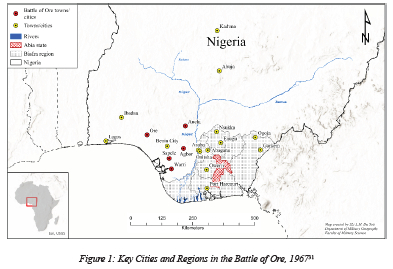
In Benin, Banjo installed a provisional military administration, even as Ojukwu proclaimed that the 'liberation of the Midwest' had flung open the road to Lagos.35 The westward drive funnelled along the Benin-Ore highway, the pivotal corridor into Yoruba territory. Ore, a modest town in present-day Ondo State, emerged as the staging ground for the push toward Lagos. Federal intelligence reports later revealed that Biafran columns intended to press as far as Ibadan within a fortnight.36 The advance, however, soon revealed inherent vulnerabilities. Supply lines stretched thin across the Niger, dependent on a few bridges highly susceptible to disruption. As Ojukwu later conceded, '[w]e underestimated the burden of sustaining troops across alien territory without supply lines.'37
Meanwhile, Federal forces regrouped with striking speed under Col. Murtala Mohammed, a Nigerian army officer, whose leadership proved decisive in countering the Biafran advance at Ore. On 14 August, Gowon declared on Radio Nigeria, 'every inch of Nigerian soil will be recovered'.38 Brigadier (Brig.) David Ejoor, the ousted governor of the Midwest, mobilised loyal officers, while Brig. Rotimi of the Western State cast the struggle in existential terms, '[t]he battle for Ore is the battle for Yoruba survival.'39 This rhetoric galvanised civilian support and transformed Ore into both a military stronghold and a symbolic defensive line. By framing the confrontation in existential terms, federal leaders drew civilian cooperation, fostered regional solidarity, and reinforced Western Nigerian loyalty to the federation at a moment when the Biafran advance threatened Lagos and Nigerian cohesion. In effect, the security of the Yoruba polity was equated with the survival of the Nigerian state. Equally important to take into cognisance is the fact that Rotimi's rhetoric brings to the fore the extent to which Nigerian entrenched ethnic rivalries and mutual suspicions shaped the wartime mobilisation. Little wonder that his equation of the Igbo advance with a threat to Yoruba survival reinforced the perception that the war was an existential contest between the major ethnic polities of Nigeria, and not merely a federal crisis.
In this sense, the Ore episode shows the broader logic of ethnicised insecurity. Had the invasion been reversed, Igbo leaders would probably have invoked similar existential claims to mobilise their populace against any incursion into their territory by the Yoruba. Furthermore, the defence of Ore shows the decisive role of civilian political alignment in determining operational outcomes. For instance, the absence of Yoruba collaboration denied Biafra the political depth necessary to sustain its Western Nigerian gamble. In insurgent and secessionist warfare alike, territorial gains unaccompanied by local legitimacy remain inherently fragile. Yet, while contemporaries recognised Ore's strategic and symbolic weight, historiography has largely marginalised it, privileging campaigns in Eastern Nigeria and humanitarian crises over operations in Western Nigeria, a development that has obscured Ore's role as a decisive turning point, and acting as pointer to the destabilising role of ethnicity in the post-colonial history of Nigeria.
The Biafran advance lost momentum when Banjo hesitated at Ore. Rather than driving swiftly toward Ibadan, the capital of Western Nigeria and a major commercial and political centre, or Lagos, he stalled, seeking political assurances from Yoruba leaders. At his court martial in September 1967, Banjo admitted that he had 'delayed movement beyond Ore' while awaiting signals from Lagos.40 Banjo's caution placed him in direct tension with Ojukwu's explicit instruction to press forward without delay, a divergence that sowed frustration among the men in the field. For officers who had risked everything on the momentum of surprise, the sudden halt was demoralising, a reminder that hesitation in war could prove as lethal as enemy fire. Alexander Madiebo later reflected with stark clarity, 'hesitation at Ore was fatal, the moment for a lightning strike was lost'.41 His testimony captures not only the tactical implications of the pause but also the human cost of uncertainty - soldiers who had marched with the conviction of imminent victory now found themselves stranded in doubt, watching the tide of opportunity ebb away. In this sense, Ore was not simply a battlefield impasse but a psychological rupture in the Biafran campaign, where ambition collided with indecision, and the resolve of men gave way to the paralysis of command dissonance.
The hesitation at Ore laid bare the deeper fissures within Biafran strategy.42 Ojukwu had gambled that Banjo's Yoruba identity would serve as a bridge to local sympathy, softening resistance and perhaps drawing elements of the Western Nigerian elite into tacit support for the secessionist cause. This assumption however collapsed almost immediately. Far from rallying to Banjo, prominent Yoruba figures reaffirmed their commitment to the federal project. In a widely publicised press statement on 27 August 1967, Chief Obafemi Awolowo, an influential Yoruba nationalist and Western Region leader, condemned the incursion as nothing more than 'misguided adventurism'.43 His words carried moral and political weight and showed how ethnic solidarity could not be manufactured through military incursion. For many in Western Nigeria, the presence of Biafran troops on their soil signified not liberation but invasion, eroding whatever slender hope Ojukwu had that shared resentment against the federal centre (i.e. Lagos) might translate into collaboration. In this way, the Ore pause crystallised the gulf between Biafran expectations and Western Nigerian political realities, and turned an anticipated advantage into a profound liability. Banjo's wavering loyalties, caught between obedience to the Biafran high command and Banjo's cautious engagement with Yoruba political actors, produced a paralysis at the very moment when decisiveness was most vital. Banjo's oscillation drained the momentum of the Biafran expedition and blunted what had been conceived as a lightning thrust toward Lagos.
The occupation of the Midwest also backfired politically. On 15 August1967 reports in the Nigerian Observer highlighted acts of sabotage and civilian protests in Benin City, while Midwest leaders, such as Chief Anthony Enahoro,44 a nationalist and politician from the defunct Midwest Region, dismissed the incursion as 'an Igbo occupation force,' a good example of the deep local resistance that undercut Biafra's advance.45 Enahoro's depiction of the Midwest invasion as an Igbo occupation force carried consequences that reverberated far beyond rhetoric. By recasting what Ojukwu had promoted as a "liberation" expedition into an act of ethnic domination, Enahoro undermined the Biafran claim to legitimacy in the Midwest. This reframing eroded any possibility of winning local sympathy, as communities that might have remained ambivalent instead interpreted the incursion as a hostile imposition. The result was widespread civilian hostility, expressed through sabotage of Biafran operations and collaboration with federal counteroffensives.46 In effect, Enahoro's stance alienated the very constituencies whose neutrality or support Biafra desperately required. The point was vividly illustrated in Benin City, where the Nigerian Observer reported demonstrations and acts of sabotage against Biafran administrators as early as 15 August 1967, barely a week after the invasion.47 Consequently, rather than receiving the troops as liberators, local populations perceived them as occupying forces, whose presence posed a direct challenge to community autonomy and political self-determination.
Militarily, the effect was to galvanise local populations against the perceived invading force. Civilian hostility was not confined to sentiment but crystallised into tangible resistance through intelligence leaks, the sabotage of Biafran logistics, and active collaboration with federal counteroffensives. Eyewitness reports indicate that villagers furnished federal officers regrouping in the Western Stateii with valuable information on Biafran troop movements, abandoned vehicles, and vulnerable supply routes. Others deliberately disrupted Biafran logistics, compounding the strain on an expedition already stretched thin.48 The secessionist advance depended precariously on supply lines running across the Niger bridges at Onitsha and Asaba (key Niger River crossings), arteries that were not only militarily exposed but also increasingly imperilled by local sabotage.49 Local resistance in the Midwest further exacerbated Biafran logistical vulnerabilities by obstructing fuel deliveries and sabotaging key transport routes. Federal intelligence reports later documented numerous abandoned Biafran trucks along the Benin-Ore highway, many of them stripped of parts or deliberately disabled by local actors, a material evidence of how civilian hostility translated into direct disruption of the secessionist advance.50 Deprived of the possibility of resupply from antagonistic local communities, Biafran columns gradually lost mobility, with their advance slowing under the weight of isolation and scarcity.
Moreover, local militias and vigilante groups engaged in intermittent harassment of Biafran patrols. While these actions were not decisive in conventional military terms, they reinforced the impression that Biafran troops were encircled in hostile territory. This reflected a psychological imbalance that eroded morale and hastened the unravelling at Ore. Brigadier Rotimi would later concede that 'without the vigilance and cooperation of our people, we could not have reorganised so swiftly', a candid acknowledgment of the decisive role played by civilian resistance in shaping the tempo of federal recovery.51In concrete terms, the steady leakage of intelligence fatally weakened Biafran efforts to consolidate their hold west of the Niger. Such forms of civilian resistance did more than disrupt logistics; they steadily eroded the morale and legitimacy of the invading troops as they pressed toward Ore and, ultimately, Lagos. At the same time, Enahoro's denunciation of the invasion fortified federal claims to be safeguarding Nigerian unity against ethnic sectionalism, thereby consolidating Yoruba and Midwestern allegiance to Gowon's government. Within the broader trajectory of the conflict, the framing of the invasion as an "occupation" proved decisive: it not only ensured the collapse of Biafra's western gamble at Ore but also entrenched the perception of the Igbo as isolated and overreaching, an image that profoundly shaped both their military reversals and their eventual political defeat.
By late August, the contradictions that had plagued the expedition coalesced at Ore. Federal forces, revitalised by reorganisation and the creation of the 2nd Division (federal elite troops) under Mohammed, concentrated along the Benin-Ore highway, transforming the town into the decisive fulcrum of the campaign.52 From 20 August, skirmishes broke out along the approaches to Ore, steadily eroding Biafran momentum.53 Federal troops, drawing confidence from proximity to supply depots and the support of sympathetic civilian populations, fought with a resilience that contrasted sharply with the exhaustion of their opponents. Alexander Madiebo would later acknowledge this asymmetry with candour, '[t]heir supply bases were nearby, ours were across the Niger. Their population was sympathetic, ours was hostile.'54 His reflection underscores how the battlefield imbalance was not merely material but profoundly psychological, as Biafran soldiers confronted the demoralising reality of fighting in an environment that offered neither sustenance nor solidarity.55 Ojukwu himself later acknowledged that crippling shortages of fuel and ammunition stalled the advance and reduced the offensive to a state of paralysis. Federal intelligence reports corroborated this collapse, noting the Benin-Ore highway strewn with abandoned Biafran trucks - mute evidence of an expedition unravelling under the weight of logistical failure.56 By the closing days of August, sustained federal counterattacks broke Biafran resistance at Ore and drove the secessionist columns into a disorderly eastward retreat across the Niger.
The collapse at Ore brought a conclusive end to the Biafran Western Nigerian gamble. What had begun as a bold strategic thrust, conceived to carry secessionist forces toward the Federal Capital Territory, Lagos, instead unravelled in disorderly retreat and disillusionment. In its wake, Biafra relinquished any realistic prospect of westward expansion, and was forced into a defensive posture confined to the southeastern heartland. The FMG, eager to frame the reversal as both military and political vindication, declared in War Communiqué No. 30 of 30 August, 'the Midwest has been cleared of invaders; the unity of Nigeria is restored'.57 The rhetoric not only celebrated a battlefield victory but also projected the triumph as a reaffirmation of the federation itself, signalling a pivotal moment when the tide of the war decisively shifted in favour of the federal cause. Ore thus represented both the zenith and the unravelling of the Biafran offensive vision. It embodied the daring ambition of secessionist strategy while simultaneously laying bare its fundamental vulnerabilities: overstretched supply lines, fractured command loyalties, and an absence of local legitimacy. Federal forces, by contrast, capitalised on their shorter lines of communication, the solidarity of sympathetic populations, and superior morale to convert Ore to a decisive inflection point. Operationally, the ambitious Midwest thrust encapsulated an envisioned manoeuvre strategy that was premised on speed, psychological shock, and the assumption of political collapse in the adversarial rear. Its failure at Ore, beyond any reasonable doubt, shows the risks inherent in offensive operations and aspirations unsupported by secure supply corridors or assured civilian allegiance. What began as a rapid penetration of enemy territory evolved into an exposed salient vulnerable to counterstroke. Yet, the relative neglect of Ore in much of the historiography of the war has obscured its true weight. It was the collapse at Ore, no less than the fall of Enugu or the protracted sieges in the East that definitively confined Biafra to a defensive war, a strategic posture that would dictate the trajectory of the conflict until its end. It is important to note that the researcher does not claim that a single battle was the ultimate reason for the collapse of Biafra, since it occurred early in 1967 when the conflict started. On the contrary, it is posited that the miscalculations that resulted from the collapse of the Biafran Midwest advance were a critical and decisive factor that influenced the later part of the conflict.
Strategic Consequences of the Battle
In a broadcast from Enugu on 4 September 1967, Ojukwu sought to rationalise the setback, insisting that 'our thrust into the Midwest was never conquest but demonstration; an exposure of Nigeria's weakness'.58 His framing attempted to recast a failed gamble as a calculated manoeuver, shifting the narrative from military defeat to political symbolism. Within Biafran command circles, however, the Midwest expedition was increasingly regarded as a reckless overextension.59 The subsequent recall, trial, and execution of Banjo and his associates on charges of treason underscored Ojukwu's determination to reassert control and discipline in the aftermath of the fiasco.60 The purge not only sought to silence dissent but also reflected the deep fractures of trust and authority that the failed campaign had exposed within the Biafran leadership. The purge laid bare the fragility of the Biafran officer corps, exposing fault lines of loyalty and cohesion at a moment when unity was most essential. Rather than consolidating strength, the purge of the Biafran command circles deepened internal divisions at a critical juncture in the Nigerian Civil War.
Conversely, the federal triumph at Ore carried significance well beyond the battlefield. It stabilised the Yoruba region, neutralising fears of secessionist encroachment and consolidating local loyalty to the federal cause. Politically, the victory restored confidence in Gowon's leadership at a moment when doubts about his capacity to hold the federation together had grown acute.61 Strategically, the victory of the federal side marked a shift in momentum, transforming the federal war effort from reactive defence to confident counteroffensive. Contemporary press coverage echoed this sentiment, framing Ore as the moment when 'Nigeria stood firm against disintegration', thereby elevating the battle into a symbol of national resilience.62 Western Nigerian political leaders, notably Awolowo, publicly lauded the defence of Yoruba territory, a gesture that reinforced civilian morale and affirmed the legitimacy of the FMG. For Gowon, whose credibility had been strained by the embarrassment of Biafran penetration into the Midwest, the outcome at Ore provided a critical psychological reversal. What initially appeared as a strategic disaster was reconstituted as a federal triumph, symbolising resilience and national renewal. As De St. Jorre aptly remarks, 'Ore transformed a near catastrophe into a rallying point for federal unity',63 crystallising the importance of the battle as both a military and a political watershed.
The debacle at Ore compelled a fundamental recalibration of the Biafra war strategy. With the prospect of carrying the conflict into Western Nigeria extinguished, Ojukwu acknowledged a decisive shift in priorities. Addressing his War Council on 6 September 1967, he declared that the future of the republic rested 'not on expansion but on endurance'.64 This marked a turning point in Biafran strategy: the dream of swift territorial enlargement gave way to a defensive ethos premised on survival within the besieged southeast. The strategic shift was seen in defensive fortifications around Enugu, Nsukka, and Aba, coupled with an increasing dependence on guerrilla tactics. This retreat, however, carried profound consequences.
□ It relinquished the initiative to federal forces, enabling them to control the tempo and geography of subsequent campaigns.
□ It confined Biafra within shrinking territorial limits, exposing it to the dangers of encirclement and blockade.
□ The retreat eroded the symbolic capital of expansionism, recasting Biafra from a bold revolutionary project into a besieged enclave.
□ As Max Siollun notes, the collapse of the Midwest expedition 'locked Biafra into a defensive war of attrition that it could not win'.65
Federal planners were quick to appreciate the strategic importance of Ore as a decisive juncture. A Ministry of Defence memorandum dated 12 October 1967 declared. 'the rebel failure in the Midwest has confined them to their base; victory will now be a matter of attrition and patience'.66 This signalled a shift in federal operational thinking toward methodical containment and incremental pressure rather than rapid manoeuvre. The strategic rationale underpinning federal operations was further articulated in Gowon's Independence Day broadcast on 1 October 1967, in which he declared, 'the so-called Biafra is now isolated and cut off; our duty is to tighten the noose until rebellion is extinguished'.67 In this respect, it is safe to argue that Ore transformed the conflict from a war of manoeuvre into a war of attrition. Once expansion ceased, material asymmetry favoured the federal side decisively, rendering time itself a strategic asset for Lagos and a liability for Enugu. Gowon's statement underscores both the political and military commitment of the federal side to contain and suffocate the secessionist enclave systematically. In retrospect, the ramifications of the Battle of Ore reverberated well beyond 1967. The encounter effectively confined the war to the Eastern Region, as Biafra made no further substantive attempts to project the conflict westward or northward. Ore decisively transferred the strategic initiative to federal forces and enabled them to dictate the tempo and scope of subsequent operations. After that, federal advances proceeded methodically, gradually eroding Biafran-held territory and ultimately culminating in the surrender by the secessionist state in January 1970. The battle thus marked the transformation of the conflict from one of manoeuver and ambition to a war of attrition under federal control.
The long-term consequences of the Battle of Ore were far-reaching. By extinguishing the Western Nigerian ambitions of Biafra, the engagement not only stabilised the federal political order but also removed the immediate existential threat to Lagos, the nerve centre of the nation. Strategically, it confined the secessionist state, setting the stage for the federal blockade and systematic encirclement that precipitated the humanitarian catastrophe widely associated with the war. Once restricted to its southeastern enclave, Biafra became increasingly vulnerable to famine and deprivation, shaping global perceptions of the conflict.68 As Stremlau observes, 'from Ore onward, international actors ceased to view Biafra as a potential victor and instead debated how to mitigate the consequences of inevitable federal success'.69 In this regard, Ore transcended the label of a mere failed campaign; it constituted a pivotal turning point that reshaped the trajectory of the Nigerian Civil War, and transformed the Midwest offensive from a conflict characterised by bold incursions and expansionist ambition into one defined by attrition, territorial confinement, and the inexorable decline of the Biafran capacity to sustain the war.
Conclusion
The collapse of the Biafran advance at Ore transcended a mere battlefield setback; it marked the decisive juncture at which the strategic logic of the Nigerian Civil War shifted irrevocably. Civilian populations comprised a critical yet often overlooked front in the Battle of Ore. Far from passive observers, Midwestern and Yoruba communities actively shaped the outcome by withholding legitimacy, sabotaging logistics, leaking intelligence, and obstructing Biafran movements. These dynamics magnified the structural vulnerabilities of the invasion, ensuring that Ore became not a springboard to Lagos but the apex and turning point of the Biafran secessionist attempt. In halting the westward thrust, federal forces regained both operational momentum and political legitimacy, while Biafra was consigned to a defensive posture from which it would never recover. Strategically, Ore redefined the geography of the war: it confined the conflict to the southeastern heartland and set the conditions for eventual federal victory. The marginalisation of the Battle of Ore in the historiography of the Nigerian Civil War reflects not insignificance but the dominant focus on humanitarian catastrophes and more conspicuous engagements, such as Abagana and Owerri. This selective emphasis obscures how less celebrated but strategically decisive battles shaped the trajectory of the war and contested the narrative of inevitability, and points to the fact that the defeat of Biafra hinged on contingent reversals on the battlefield.
Repositioning Ore within the broader study of the Nigerian Civil War illuminates how turning points are not always the most visible or widely remembered engagements. This underscores the importance of analysing African conflicts through the granular realities of military operations, local civilian dynamics, and contested legitimacy, rather than exclusively through humanitarian or diplomatic perspectives. From this perspective, Ore emerges as a critical yet overlooked turning point in both Nigerian and African military history. Beyond its historical significance, the battle carries enduring contemporary lessons: the dangers of military overextension, the decisive influence of civilian support on operational outcomes, and the consequences of fractured leadership during crises. In addition, the outcome of the battle underlines the dangers of ambitious political and strategic assumptions without sufficient means to execute them. In this light, the battle of Ore remains not only a critical episode of the past but also a compelling case study in the enduring dynamics of strategy, civil-military relations, and the conduct of modern warfare.
Endnotes
* Sunday Moses Adebayo Aloko (PhD) lectures in the Department of History and War Studies, Nigerian Defence Academy (NDA), Kaduna, Nigeria, and is a fellow of the Ife Institute of Advanced Studies (IIAS), Obafemi Awolowo University (OAU), Osun State, Nigeria.
i The Republic of Biafra collapsed on January 15, 1970, when Major General (Maj. Gen.) Philip Effiong, its deputy leader and acting head, officially surrendered. This followed Ojukwu's departure to Côte d'Ivoire (Ivory Coast) on 10 January 1970. He left seeking a "peaceful settlement" and to avoid the total annihilation of his people as the secessionist state faced imminent military defeat.
ii The Western State was created on 27 May 1967 by the military government of Gen. Yakubu Gowon via the States Creation and Transitional Provision) Decree No. 14. It replaced the old Western Region, excluding Lagos, the Federal capital of Nigeria at the time, as part of a move to restructure Nigeria just before the outbreak of the Civil War from four regions into twelve states.
1 For details, see J de St. Jorre, The Nigerian Civil War (London: Hodder & Stoughton, 1972); [ Links ] M Siollun, Oil, Politics and Violence: Nigeria'sMilitary Coup Culture (1966-1976) (New York: Algora, 2009); T Falola & MM Heaton, A History of Nigeria (2nd ed.) (Cambridge: Cambridge University Press, 2022); CJ Maduekwe, The Nigerian Civil War, 1967-1970: History, Memory, and Nation-building (Lanham: Lexington Books, 2020); CJ Korieh, The Nigeria-Biafra War: Genocide and the Politics of Memory (Amherst: Cambria Press, 2012), 45-50; AO Uzokwe, Surviving in Biafra: The Story of the Nigerian Civil War, Over Two Million Died (Lincoln: iUniverse, 2003); AA Nwankwo & SU Ifejika, The Making of a Nation: Biafra (London: C. Hurst, 1969).
2 De St. Jorre, The Nigerian Civil War, 145-160.
3 AA Madiebo, The Nigerian Revolution and the Biafran War (Enugu: Fourth Dimension, 1980), 140-155. [ Links ]
4 J Stremlau, The International Politics of the Nigerian Civil War, 1967-1970 (Princeton: Princeton University Press, 1977), 85-100; [ Links ] B Akinyemi, Foreign Policy and Federalism: The Nigerian Experience (Ibadan: Ibadan University Press, 1974), 120-127.
5 Siollun, Oil, Politics and Violence, 110-120; Falola & Heaton, A History of Nigeria, 181-186.
6 G Alabi-Isama, The Tragedy of Victory: On-the-spot Account of the Nigeria-Biafra War in the Atlantic Theatre (Ibadan: Spectrum Books, 2013), 45-47; R Doron, Biafra: A Military History (London: Pen & SwordMilitary, 2025), 102-108; L Nnaemeka & P Effiong, The Untold Story of the Nigeria-Biafra War (Lagos: Heritage Press, 2025), 76-82.
7 The origins of the Nigerian Civil War are deeply rooted in the political and structural legacies of colonial rule. British colonialism brought together 250 diverse ethnic nationalities into a single politico-administrative unit through the 1914 amalgamation of the Northern and Southern protectorates. This artificial union, which was primarily motivated by administrative convenience and imperial economic interests, ignored pre-existing cultural, religious and political distinctions of the people. By implication, colonial governance deeply entrenched regional disparities by pursuing policies of indirect rule in Northern Nigeria, missionary-driven Western education in the South and uneven economic development across the regions. By the late colonial period, these asymmetries had produced an elite class fragmented along ethnic and regional lines, with the North politically dominant, the West economically vibrant and the East educationally advantaged. The colonial state further reinforced regionalism through the Richards (1946), Macpherson (1951) and Lyttleton (1954) constitutions, which devolved power to regional governments but failed to foster a sense of national cohesion among them. At independence in 1960, therefore, Nigeria inherited a fragile federal structure marked by weak national integration, deep mistrust among regions and political competition framed largely along ethnic and sectional lines. These structural contradictions that began during colonial rule laid the foundation for the postcolonial crises that culminated in the breakdown of the First Republic (1960/63-1966), successive military coups and ultimately the secessionist attempt by Biafra in 1967. For details, see TN Tamuno, Nigeria andElective Representation, 1923-1947 (London: Heinemann, 1966) and JS Coleman, Nigeria: Background to Nationalism (Berkeley: University of California Press, 1958).
8 The Aburi Accord was a peace meeting held at Aburi, Ghana in January 1967. It involved Nigeria's Supreme Military Council under Lieutenant Colonel (Lt Col.) Yakubu Gowon and Eastern Region delegates led by Lt Col. Chukwuemeka Ojukwu. The agreement sought to resolve the constitutional and political crisis by decentralising power, granting wide autonomy to the regions and requiring unanimous agreement of the Supreme Military Council for major national decisions. While Ojukwu interpreted the accord as conferring a confederal arrangement that safeguarded Eastern autonomy, Gowon's government later issued Decree No. 8, which modified its provisions and effectively nullified the spirit of the agreement. The collapse of Aburi eroded trust and deepened Eastern fears of marginalisation. The resultant fear paved the way for secession. For details, see House of Assembly Debates, Federal Republic of Nigeria, January 1967, cols. 12-16; Madiebo, The Nigerian Revolution, 65-70; Ojukwu, Because I Am Involved, 56-58.
9 Madiebo, The Nigerian Revolution, 65-70.
10 Coleman, Nigeria: Background to Nationalism, 112-115; Tamuno, Nigeria and Elective Representation, 210-215; R Akpuda, Isaac Boro and the Niger Delta Insurgency (Lagos: Macmillan Nigeria, 1980), 35-40.
11 De St. Jorre, The Nigerian Civil War, 153.
12 H Ekwe-Ekwe, The Biafra War: Nigeria and the Aftermath (Lewiston: Edwin Mellen, 1990), 112.
13 M Watts, Petro-violence: Community, Extraction, and Political Ecology of a Mythic Commodity (Chicago: University of Chicago Press, 2001), 50-55.
14 The name Biafra was derived from the Bight of Biafra, the coastal bay along present-day southeastern Nigeria and Cameroon. The term carried both geographic and symbolic resonance. Geographically, it located the new state within the oil-rich Niger-Delta and coastal hinterland. Symbolically, it evoked a distinct identity separate from the Nigerian federation. By appropriating a name associated with international cartography and maritime trade, Ojukwu and his advisers sought to lend legitimacy and recognition to the secessionist entity, and to distinguish it from the ethnic designation "Igbo" and project it as a multi-ethnic Eastern state. For details, see De St. Jorre, The Nigerian Civil War, 61-62; F Forsyth, The Biafra Story (London: Penguin, 1969), 58-60.
15 De St. Jorre, The Nigerian Civil War, 105-128.
16 Tamuno, Nigeria and Elective Representation, 215-220; see also C Obi, The Oil and the Minority Question in Nigeria (Ibadan: JDP, 1997), 24-28.
17 Watts, Petro-violence, 50-55; Obi, The Oil and the Minority Question, 31-34; De St. Jorre, The Nigerian Civil War, 120-123.
18 Watts, Petro-violence, 50-55.
19 Madiebo, The Nigerian Revolution, 65-70.
20 Siollun, Oil, Politics and Violence, 123.
21 C Ojukwu, Because I Am Involved (Ibadan: Spectrum Books, 1989), 88-89.
22 Ojukwu, Because I Am Involved, 91-98.
23 Nwankwo & Ifejika, The Making of a Nation, 112-115.
24 De St. Jorre, The Nigerian Civil War, 138-140.
25 A Isama, interview with Edmond Obilo, 'State Affairs', YouTube, 2013. <https://www.youtube.com/watch?v=hJ3UGlOI7aY> [Accessed on 20 June 2025].
26 Ojukwu, Because I Am Involved, 56-58.
27 C Ojukwu, Message to the Biafran War Council, Biafra Broadcasting Service (hereafter BBS) Archives, Tape 18/67, 6 September 1967. The BBS transcripts cited in this study are preserved in private collections and digitised recordings circulated among researchers of the conflict. While not formally catalogued in a national archival repository, they constitute contemporaneous broadcast material produced by the Biafran authorities during the war.
28 However, it is important to note that at the outbreak of hostilities, both the Western and Mid-West regions attempted to maintain neutrality, barring the deployment of troops from their territories against Biafra.
29 Madiebo, The Nigerian Revolution, 141-144. Victor Banjo, a Yoruba officer in the otherwise ethnically polarised Nigerian Army, provides a striking example of how individual trajectories could produce "accidental" allegiances during the Civil War. By 1966, Banjo was one of the few Yoruba officers among a military dominated by Northerners and Easterners. After the January 1966 coup, he was detained by forces loyal to Major-General Aguiyi-Ironsi and later imprisoned under successive regimes, including the Gowon administration, despite personal loyalty to both Ironsi and Gowon. When Ojukwu declared Biafra's independence, he ordered Banjo's release and appointed him General Officer commanding a Biafran division. Banjo's ultimate alignment with Biafra was therefore less a product of ethnic or ideological conviction than a consequence of circumstance, imprisonment and coercive political dynamics that illustrate how the war could compel officers into roles that were neither anticipated nor fully voluntary. For details, see D Babarinsa, 'Banjo, the Accidental Biafran', The Guardian, 1 July 2021.
30 See R. Doron, 'The Nigerian Civil War and Its Legacies,' in The Oxford Handbook of Nigerian History, ed. T Falola & MM Heaton (Oxford: Oxford University Press, 2022), 399-420; O Ignatus, Battle of Biafra: British Intelligence and Diplomacy in the Nigerian Civil War (Washington, DC: Academica Press, 2022); T Falola & O Ezekwem (eds), Writing the Nigeria-Biafra War (Woodbridge: James Currey, 2016); Nnaemeka & Effiong, The Untold Story; Alabi-Isama, The Tragedy of Victory, 45-67.
31 Map created by 2Lt LM du Toit, Department of Military Geography, Faculty of Military Science, Stellenbosch University.
32 Daily Times of Nigeria, 10 August 1967, 1. The exact casualties of the invasion remain unclear.
33 Federal Military Government, War Communiqué No. 15, National Archives Ibadan (hereafter NAI), 9 August 1967.
34 R Luckham, The Nigerian Military: A Sociological Analysis of Authority and Revolt, 1960-67 (Cambridge: Cambridge University Press, 1971), 221-223.
35 Ojukwu, BBS, Tape 12/67, 4 September 1967.
36 Federal Military Government, Captured Enemy Document on Ore Operations, National Defence College Archives, Abuja, September 1967.
37 Ojukwu, Because I Am Involved, 62.
38 Y Gowon, Radio Nigeria broadcast, 14 August 1967, transcript in Daily Times, 15 August 1967, 1.
39 Brigadier Rotimi, 'Western State Broadcast', Nigerian Observer, 17 August 1967, 2.
40 Proceedings ofthe Special Military Tribunal for Lt Col. Victor A Banjo, Banjo Court-Martial Files, Eastern National Archives, Enugu, 22 September 1967).
41 Madiebo, The Nigerian Revolution, 147.
42 Victor Banjo's hesitation to advance westward after the unexpected fall of Benin City stemmed less from tactical uncertainty than from political disagreement with Ojukwu. He objected to the imposition of Lt Col. Albert Okonkwo, an Igbo officer, as Military Governor of the newly declared Republic of Benin, insisting that a Midwestern figure should lead. Ojukwu's letter dated 22 August 1967 further underscored his intention to retain control over all political measures, appointments and even the governance of Lagos in the event of its capture. On the other hand, Banjo seems to have envisioned himself as a partner rather than a subordinate. Consequently, he resisted these terms, leading to tensions within the Biafran leadership and military ranks. This protracted disagreement delayed the advance beyond Benin and gave federal forces under Murtala Mohammed and Olusegun Obasanjo time to regroup and halt the offensive at Ore. For further details, see Babarinsa, 'Banjo, the Accidental Biafran'.
43 O Awolowo, Press Statement, Lagos, 27 August 1967, Awolowo Papers, University of Ibadan Archives.
44 In this context, the title "Chief refers to a prominent political and community leader rather than a traditional or military rank, distinguishing civilian leadership from the ranks of officers such as Colonel or General.
45 Nigerian Observer, 15 August 1967, 3; Chief A Enahoro, quoted in Daily Times of Nigeria, 16 August 1967, 1.
46 Nigerian Observer (Benin City), 15 August 1967, 3; Madiebo, The Nigerian Revolution, 147-150.
47 Nigerian Observer (Benin City), 15 August 1967.
48 Nigerian Observer (Benin City), 15 August 1967.
49 The Niger River bridges at Onitsha and Asaba were among the most critical logistical arteries in the Nigerian Civil War. As the only direct east-west crossings linking the secessionist Eastern Region to Midwestern Nigeria and beyond, they served as lifelines for troop movement, fuel convoys and military supplies. The Biafran incursion into the Midwest in August 1967 depended almost entirely on these crossings for reinforcement and resupply. Their fragility, one bridge at Onitsha being a narrow pre-war colonial structure and the other at Asaba, less developed, meant that any disruption imperilled the invading forces. Federal bombing campaigns later targeted these choke points, underscoring their centrality in determining the depth and sustainability of Biafra's offensive.
50 Federal Military Government, War Communiqué No. 29, NAI, 28 August 1967.
51 Brigadier Rotimi, Broadcast to the People of Western State, Radio Nigeria, 18 August 1967.
52 Stremlau, The International Politics, 96-101.
53 The federal counteroffensive involved between 6 000 and 8 000 soldiers, which outnumbered the Biafran forces on the ground. Casualties during the counteroffensive that recaptured Benin in September 1967 remain uncertain. Contemporary federal communiqués acknowledged only unspecified 'losses sustained in action' (Daily Times [Lagos], 21 September 1967), while Biafran and sympathetic accounts inflated the figure to 'thousands' to dramatise the resistance (Forsyth, The Biafra Story, 188-190). Later analyses, drawing on military records, place federal losses in the low hundreds, with Biafran casualties considerably higher, running into the low thousands due to their longer retreat and logistical weakness (Nigerian Army, Report on the Recapture of the Mid-West (Lagos: Federal Military Government, 1968); Luckham, The Nigerian Military, 225-227.
54 Madiebo, The Nigerian Revolution, 150.
55 Madiebo, The Nigerian Revolution, 150.
56 Federal Ministry of Defence, Memorandum on the Military Situation, Ministry of Defence Archives, Lagos, 12 October 1967.
57 Federal Military Government, War Communiqué No. 30, NAI, 30 August 1967.
58 Ojukwu, BBS, Tape 12/67, 4 September 1967.
59 Ojukwu, Because I Am Involved, 88-89.
60 Proceedings of the Special Military Tribunal for Lt Col. Victor A. Banjo, Banjo Court-Martial Files, Enugu National Archives, 22 September 1967, 33.
61 General Y Gowon, Independence Day Broadcast, NAI, Gowon Papers, File 1/10/67, Lagos, 1 October 1967.
62 Daily Times of Nigeria, 28 August 1967, 1.
63 De St. Jorre, The Nigerian Civil War, 138-140.
64 Ojukwu, BBS, Tape 18/67, 6 September 1967.
65 Siollun, Oil, Politics and Violence, 162.
66 Federal Ministry of Defence, Memorandum on the Military Situation, Ministry of Defence Archives, Lagos, 12 October 1967, File No. CW/67/48.
67 Gowon, Independence Day Broadcast.
68 After the federal recapture of the Midwestern Region and the Niger Delta oilfields, Biafra was confined to its southeastern enclave and was effectively cut off from the sea and major supply routes. This encirclement enabled Lagos to implement a systematic blockade - naval, land and later air - that denied the secessionists access to food, medicine and arms. The strategy aimed less at rapid battlefield victory than at gradual attrition aimed at suffocating Biafra's capacity to sustain its war effort. By 1968, this had produced famine on a massive scale, a grim by-product of a deliberate federal policy of containment. The blockade had precipitated severe famine and malnutrition, particularly among children, images of which were broadcast globally and generated unprecedented humanitarian mobilisation by churches, NGOs and relief agencies. The humanitarian disaster shaped international perceptions of the war and also helped to reframe the conflict in moral rather than purely political terms that positioned Biafra as a symbol of suffering and resistance. See the following texts for details: Forsyth, The Biafra Story, 128-145; S Cronje, The World and Nigeria: The Diplomatic History of the Biafran War, 1967-1970 (London: Sidgwick & Jackson, 1972), 212-220 and C Achebe, There Was a Country: A Personal History of Biafra (New York: Penguin, 2012), 193-200.
69 Stremlau, The International Politics, 98.
