




Services on Demand
Journal

Article
 English (pdf)
 Article in xml format
 Article references

 Automatic translation
 Send this article by e-mail
Indicators
Related links
-
 Cited by Google
-
 Similars in Google
Share

 Permalink

Scientia Militaria: South African Journal of Military Studies
On-line version ISSN 2224-0020Print version ISSN 1022-8136
SM vol.54 n.2 Cape Town 2026
https://doi.org/10.5787/54-2-1522
ARTICLES
Strategic Dependency and Isolation: South Africa, Israel, and the Limits of Defence Autarky in the 1970s and 1980s
Nicolas Wolbrandt
Department of History (War and Conflict Studies), University of Potsdam, Germany
ABSTRACT
South African military-technical co-operation with Israel continued and intensified throughout the 1970s and 1980s, despite the goal of achieving defence industrial autarky as stated by South Africa. During this period of increasing international isolation -marked by the United Nations arms embargo, regional destabilisation, and the loss of key allies - South Africa faced critical capability gaps, particularly in its air force and navy. Collaboration with Israel provided not only weapon systems but also the technological know-how to strengthen domestic production. Israeli support enabled the development of drones, ballistic missiles, and upgrades to tanks, aircraft, and naval platforms, aligning with the South African autarky ambitions. Employing RL Schweller's neoclassical realist framework, the study on which article is based explored how domestic limitations and international pressures influenced South African arms procurement strategies.
The current study found that states do not pursue defence industrial autarky at all costs; rather, co-operation is evaluated based on the urgency of defence needs, external exclusivity of offered technology, and relative military advantage gained over regional and international competitors. States with limited mobilisation capacity may rely on selective external partnerships to counterbalance structural constraints. The article therefore also highlights the limits of international sanctions when enforcement mechanisms are undermined by geopolitical alliances, such as Israeli backing from the United States as a United Nations Security Council veto power.
Keywords: Israel; South Africa; Cold War; SADF; Defence Autarky
Introduction
In December 1990, the United Nations (UN) General Assembly condemned the military co-operation between Israel and South Africa. The focus was particularly on projects in missile and nuclear technology, which the UN body considered to be a violation of the mandatory arms embargo against South Africa at the time.1 In November 1989, the General Assembly had already formulated the request, 'that Israel desist from and terminate forthwith all forms of collaboration with South Africa, particularly in the military and nuclear fields'.2 These statements seem to have confirmed the characterisation of the relations as an 'unspoken alliance'3 during apartheid. At the same time, this stands in stark contrast to the current soured relations. In December 2023, the preliminary low point was marked by the South African (SA) institution of proceedings against Israel at the International Court of Justice due to alleged violations of international law in the Gaza Strip.4
The issue therefore remains as to which approach is suitable for explaining the bilateral co-operation between South Africa and Israel during the Cold War, in which the SA military saw active action against its northern neighbours as part of the South African Border War (SABW). First, already in the 1960s, South Africa faced increasing international isolation, which foreshadowed the mandatory 1977 sanctions by the United Nations.5 Anticipating severe difficulties in the international acquisitions of arms, South Africa began to pursue independence from foreign arms manufacturers as early as the 1960s by expanding its own defence industrial base; thus, ostensibly closing off areas for possible defence-technology co-operation with other countries. Numerous technical similarities found in Israeli and SA weapon systems from the 1970s and 1980s nevertheless prompted the assumption of intensive bilateral co-operation despite the aim of defence autarky.6 Second, it remains unclear why two geographically distant regional powers with no immediate common enemy or neighbouring territory should establish close co-operation.7 Third, it is unclear to what extent the aforementioned statements of the General Assembly on nuclear proliferation can be upheld. In 1993, the then State President, Frederik Willem de Klerk, denied that South Africa had ever co-operated with other nations on nuclear technology.8Existing explanations provide only limited insights into these three mysteries.9
The study on which this article reports, therefore examined, from an SA perspective, foreign and domestic policy incentives that influenced the initiation of defence-technology projects with Israel. The article also sheds light on why co-operation was consolidated despite international sanctions and the goal of arms self-sufficiency. The outlined research interest was reflected as follows: Why did arms co-operation with Israel consolidate until the end of the 1980s despite the SA goal of arms self-sufficiency?
This question is addressed based on RL Schweller's neoclassical realism, a grand theory of international relations (IR). The core assumptions on the primary drivers of foreign and security policy are briefly outlined and applied to the geopolitical and domestic context of Southern Africa during the Cold War (1945-1991). Particular attention is given to the SABW, which South Africa fought for more than twenty years (1966-1990) against its northern neighbours. On this basis, a theoretical expectation was developed concerning whether, and to what extent, potentials for arms co-operation with other states - including Israel - remained as a result of the domestic political reaction to the external geopolitical pressures.
The comparison of this theoretical expectation with the actual SA policy follows, where the extent to which armament needs were met by domestic and third-country producers is analysed. This facilitated the assessment of why arms projects with Israel were initiated and the extent to which South Africa benefitted from them at strategic, operational, and tactical level. Finally, the conclusion addresses the research question and discusses the strengths and limitations of neoclassical realism in the current case. Based on the findings, implications of the circumvention of international arms embargoes through bilateral state co-operation are also discussed.
The current study pursued the research hypothesis that the pursuit of co-operation with Israel did not contradict the ultimate goal of defence autarky10 but instead placed South Africa on a path to attaining it. In the context of ever-growing incentives to rearm caused by the increasing international isolation, this approach permitted strategic capability developments in the industry and tactical-operational advantages in the combat missions of the South African Defence Force (SADF) in the northern neighbouring states, in particular in Angola, Zimbabwe and Mozambique. For South Africa, external co-operation was imperative given major qualitative and quantitative deficits in the industry caused by lost innovational potential as a result of apartheid policies, arms embargoes, subsequent technological isolation, and the deliberate exclusion of the non-white11 population from higher education.
A key research challenge is the apparent withholding of planning documents and bilateral correspondence from the time by Israeli archival authorities. In contrast, South Africa has already made substantial archival releases, providing access to crucial reference documents related to the co-operation. Additionally, there are extensive publications by academic journals and research institutes that have already addressed specific aspects of South African-Israeli relations during the apartheid period. In contrast, comprehensive analyses in monographs, such as The Israel Connection: Who Israel Arms and Why by Benjamin Beit-Hallahmi or The Unspoken Alliance: Israel's Secret Relationship with Apartheid South Africa by Sasha Polakow-Suransky, tend to take a broader approach in terms of time and scope. The latter, making impressive use of archival documents, is the most recent comprehensive reflection of the bilateral arms co-operation with a research horizon starting as early as the 1930s.12 No publication on the bilateral relations has however used IR theory to examine geopolitical drivers and their domestic transmission in bilateral armaments projects. In this regard, the current study sought to contribute to a refined understanding of the field.
The Road to Defence Industrial Co-Operation - RL Schweller's Neoclassical Realism
Although realism as an IR theory has produced several competing strands, there are specific assumptions that can be identified as characteristic of realism:
□ States are the main actors in the anarchic international order;
□ This results in the necessity to ensure state survival through military, political, and economic capabilities;
□ Under conditions of anarchy, the build-up of capabilities (balancing) typically leads to a security dilemma between nations, which in turn triggers counterbalancing; and
□ Institutions and norms play at most a secondary, primarily instrumental, role in interstate relations.13
Schweller's neoclassical realism uses defensive neorealism, as developed by Kenneth N Waltz, as a reference point for his theory. Waltz views balancing as a structurally determined automatism and therefore a necessary response within the anarchic international system.14In contrast, Schweller assumes that such a balancing reaction may fail to occur if inhibited by national decision-making processes. By examining the domestic transmission of external impulses, Schweller seeks to explain why states have repeatedly responded inadequately - or sometimes excessively - to threats throughout history.15
Unlike the broader scope of capabilities found in neorealism, Schweller focuses mainly on military capabilities, '[b]alancing means the creation or aggregation of military power through internal mobilisation or the forging of alliances.'16 The outcome of such process depends on the extent to which domestic actors are willing and able to support this course of action. According to Schweller, willingness is primarily determined by the elite cohesion and the elite consensus on the existence of a threat. The ability to mobilise resources, on the other hand, is contingent on the vulnerability of the government or regime and the degree of social cohesion.17 When facing a fragmented society, an illegitimate and therefore vulnerable leadership will, for instance, find it difficult to establish domestic consensus on the existence of an external threat. In such situations, it is likely that the elite will resort to co-operation with other states to counterbalance the threat instead of engaging in a domestically risky resource mobilisation.18 From the perspective of neoclassical realism, bilateral armament projects can thus be interpreted as a possible indication of domestic mobilisation deficits.
From a realist perspective, an anarchic international order creates a persistent incentive to avoid external dependencies, including those generated by arms imports. Relying on such imports from abroad may negatively affect the ability of a nation to ensure its survival in the international arena, especially if these imports are later discontinued by the supplier for political reasons. In this regard, the international system creates a natural impetus for achieving arms autarky.
Arguably, the impetus is not absolute but weighed by the political decision-making elite against the expected benefits of the respective armament co-operation. The researcher, drawing on Schweller's logic, argues that arms imports from abroad are likely to be particularly beneficial to the state in cases where -
□ Such arms imports meet urgent military needs (urgency criterion);
□ Arms imports provide substantial military advantages in terms of quality and/or quantity relative to another state (relative benefit criterion); and
□ There are no suitable domestic suppliers available (external exclusivity criterion).
It can thus be expected that such imports from abroad are unlikely if the goods are not urgently needed, offer no relative benefits, and can readily be supplied by domestic producers.
A state may, for instance, find itself compelled to procure air defence systems from abroad if:
□ A neighbouring state regularly carries out air strikes (urgency);
□ Such air defence systems are realistically capable of repelling such attacks (relative benefit); and
□ No domestic producer is available (external exclusivity).
If the air defence systems can be readily produced by domestic suppliers in a comparable quality and quantity, no pressing need for acquisitions from abroad arises.
South African Push towards External Co-operations
This section reports on the drivers that incentivised South Africa to pursue defence-industrial co-operation with foreign partners. Particular attention is given to the threat to the SA regional hegemony and to domestic mobilisation deficits.
Foreign Policy: Regional Hegemony in Southern Africa
During the 1980s, Southern African states showed distinct disparities in economic performance, as measured by the gross domestic product (GDP). The combined GDP of all member states of the Southern African Development Coordination Conference (SADCC) - Angola, Botswana, Lesotho, Malawi, Mozambique, Eswatini, Tanzania, Zambia, Zimbabwe (formerlyRhodesia)i - never exceeded 43 per cent of the SA economic output. Angola, consistently the second-largest economy in the region, achieved less than 16 per cent of the GDP of its dominant southern neighbour, even at the time of the smallest gap in 1988.19
This economic gap was also evident in military funding, with South Africa consistently spending at least three times more annually than the combined defence expenditures of all SADCC countries in the 1980s. The SA defence budget nearly quadrupled between 1970 and 1988, underscoring its capacity to maintain a substantial military advantage over its regional neighbours.20 This allowed the SADF to increase its manpower from 50 000 in 1970 to 200 000 by 1985.21 Despite this significant expansion, South Africa retained substantial reserves in the scalability of its military expenditures, with defence spending as a percentage of GDP fluctuating between 2,33 per cent (1970) and 5,26 per cent (1977) over the period between 1970 and 1990. In contrast, the Angolan defence budget reached a peak of22,25 per cent of its GDP in 1987, while that of Tanzania peaked at 10,11 per cent in 1978.22
These high shares did not alter the stark differences in combat power. In 1986, the Stockholm International Peace Research Institute (SIPRI) noted, '[i]n military terms, South Africa is vastly superior to its neighbours in the region. Substantial arms deliveries by the Soviet Union in the past have not reduced this superiority.'23 The strategic advantage of South Africa was further solidified by its status as the only nuclear power on the continent, with a highly secretive arsenal of six nuclear warheads. Until the end of apartheid, a public disclosure of the existence of the weapons was reserved for deterrence purposes in the event of an existential threat that could not be countered by conventional means.24
In summary, the regional polarity reveals an SA hegemonic position during the Cold War. Consequently, there were no systemic incentives for counterbalancing or any significant deviation from the status quo in armament policy. It would thus be difficult to explain the initiation of new armament projects with Israel between 1970 and 1990 based purely on the regional polarity. Accordingly, the next section reports on how SA regional hegemony was challenged by regional and international developments.
Hegemony in Danger: Loss of Regional Allies and Growing International Hostilities
Until the mid-1970s, trilateral co-operation with the Rhodesian regime at the time and Portugal in its erstwhile colonies, Angola and Mozambique, was the temporary key element of SA security policy to preserve a cordon sanitaire25 surrounding its borders. Supporting Portugal in its counterinsurgency operations therefore received paramount priority, with South Africa allocating half of its defence budget to this cause in 1970, and providing air force support to Portuguese and Rhodesian forces from 1968 onwards.26In order to reduce the geographical freedom of movement of liberation fighters, this approach was complemented by offers of support to states on the northern periphery, with decent success, as evidenced by the establishment of diplomatic relations with Malawi in 1967 and the signing of a security agreement with Swaziland (Eswatini) in 1982. The overarching goal of these efforts was to weaken African liberation movements.27
After the end of Portuguese colonial rule in Angola and Mozambique in 1975, the goal of preserving the remaining cordon sanitaire was pursued in co-operation with the Rhodesian regime until the end of the 1970s. Even without diplomatic recognition, South Africa regarded the Salisbury-based government under Ian Smith as a military partner in the fight against the armed wing of the exiled African National Congress (ANC) fighting against the apartheid rule in South Africa.28 Between 1967 and 1979, South Africa provided nearly half of the arms supplied to Rhodesia free of charge. From 1978 onwards, the SADF also intensified its land- and air-based operations against both the Zimbabwe People's Revolutionary Army (ZIPRA) and the Zimbabwe African National Liberation Army (ZANLA).29 The 1980 electoral victory of Robert Mugabe, following the Lancaster House Agreement, brought this co-operation to a sudden end. Intervention plans aimed at preventing Zimbabwean independence were abandoned, particularly to avoid the imposition of stricter UN sanctions.30
The loss of the Rhodesian regime as a regional partner for South Africa continued the trend of increasing bilateral and multilateral isolation of South Africa. As early as 1975, the United Kingdom terminated the Simon's Town Agreement, which had been in place since 1955. This not only led to the closure of the last British naval base in South Africa but also ended the role of Britain as the main arms supplier to the South African Navy (SAN).31 To make matters worse, London and Washington supported the mandatory arms embargo imposed against South Africa by Resolution 418 in 1977, which went far beyond the voluntary arms sanctions of 1963. In the Security Council, both veto powers also supported tightening the embargo in 1984 and 1986.32
The isolation was further entrenched by South Africa's own failures. Although economically connected to Botswana, Lesotho and Eswatini through the Southern African Customs Union (SACU), South Africa was neither able to establish a common currency within the framework of the Rand Monetary Area (RMA) permanently nor to attract new member states.33 This was exacerbated by the fact that the other SACU member states (Botswana, Lesotho and Eswatini) tried to reduce their dependency on the SA economy and infrastructure for trade.34
The proposal by South Africa in 1979 to act as a protector state for the nations of Southern Africa - offering economic benefits in return - was also met with widespread rejection by neighbouring states.35 As a response against the SA regional hegemony, the SADCC was established in 1980, comprising Angola, Botswana, Lesotho, Malawi, Mozambique, Eswatini, Tanzania, Zambia and Zimbabwe.36 Although the SADCC primarily focused on economic and political coordination and did not include mutual defence obligations, both Zimbabwe and Malawi decided by the mid-1980s to deploy troops permanently to Mozambique to protect land routes against forces of the South African-supported RENAMO (Resistência Nacional Moçambicana [Mozambican National Resistance]).37
By supporting insurgent movements in Mozambique and Angola in the 1980s, South Africa pursued the goal of sustained destabilisation by territorial control and disruption of energy supplies. To this end, the SADF mainly conducted commando operations targeting transport routes and power lines in neighbouring countries.38 A particular focus was Angola, which became the theatre of several large-scale SADF operations beginning in 1974. The SADF thereby hoped to eliminate Angola as a safe haven for insurgents operating against SA forces in Namibia.39 A significant achievement for South Africa was that the vigorously supported UNITA (União Nacional para a Independência Total de Angola), the Angolan nationalist movement, managed to maintain control over roughly one third of the country by 1987.40
The increasing build-up of Cuban forces in Angola - in support of the socialist Movimento Popular de Libertação de Angola (MPLA or Popular Movement for the Liberation of Angola), which assumed leadership of the newly independent state in 1975 - proved to be a growing challenge for the SADF. The Cuban efforts started even before Angolan independence in 1974 with an initial detachment of only 650 special forces, and reached its peak in 1988 with the operational deployment of two full divisions.41 According to estimates, there were already 25 000 to 30 000 Cuban forces in the country in 1987.42An advantage for Cuban detachment was its access to an increasingly extensive arsenal of tanks, artillery pieces, and radar-guided air defence systems. The latter significantly restricted SA air operations against hostile ground forces and Cuban fighter jets.43
Unlike the Cubans, the Soviet Union - supporting the socialist Angolan government against South Africa - kept to the sideline and confined its support to advisory services, technical support, logistics, and arms deliveries - including modern tanks, aircraft, surface-to-air missiles, and helicopters - to the official Angolan forces.44 To make matters worse, South Africa was confronted with a significant increase in the number of Angola-based insurgents from the Namibian South West Africa People's Organization (SWAPO) and the South African National Congress (ANC) until the mid-1980s.45
In summary, under the condition of increasing bilateral and multilateral isolation, the altered regional system provided considerable incentives for South Africa to rearm and defend its hegemony. This was particularly due to the loss of Portugal in 1975 and the Rhodesian regime by the end of the 1970s as central partners in the temporary preservation of the cordon sanitaire and the considerable increase in Cuban forces in Angola. Both developments generated a growing demand for arms across a wide range of capabilities. Not only did the SADF need to maintain increasing quantities of weapons systems and ammunition for land-, air-, and sea-based operations, but there was also a rising need to supply non-state actors - primarily RENAMO and UNITA - in order to destabilise the northern neighbours. The extent to which South Africa was both willing and able to rearm is considered in the following sections.
Domestic Transmission: Lost Potentials and Limited Mobilisation
During the 1970s, the threat perception of the SA political-military elite and their consensus on the necessary course of action were not fully aligned, as epitomised by the significant dissent between Prime Minister BJ Vorster and his defence minister, PW Botha. Unlike Vorster, Botha advocated for a substantial expansion of military engagement in neighbouring countries following the end of Portuguese colonial rule in Angola and Mozambique in 1975.46 This tension only eased after Botha became prime minister in 1978 and consolidated his power through a process characterised by institutional and intra-party centralisation.47 This success was also reflected in the implementation of the "Total Strategy":
During the 1980s Pretoria48 fashioned a 'total strategy' that was meant to mobilize the combined political, economic, and military resources of the state against what it perceived as a Soviet-planned 'total onslaught.'49
According to a 1982 letter addressed to his Israeli counterpart, Ariel Sharon, Botha's defence minister, MA Malan, shared a concurring perception of the threat, '[m]y country has continually been under pressure for many years [...] as a result of this onslaught by the Soviet Union.'50 It also proved advantageous that the ruling National Party (NP), based on whites-only elections, consistently held an absolute majority in the House of Assembly during the 1970s and 1980s. This gave the NP free rein, particularly in the area of foreign and security policy, which meant that it was not forced into restraint or compromise by any coalition partners.51 Alongside the previously described consolidation of Botha's power, this can be regarded as an indicator of a strong 'elite cohesion'.
Despite their recognisable willingness, the SA political-military elite were unable to mobilise domestic economic resources fully, given the unequal labour market participation, which, on the one hand, resulted from the apartheid legislation banning non-whites from higher education as well as certain occupations and, on the other hand, stemmed from educational disparities between English-speaking and Afrikaans-speaking whites. This negatively affected economic development.52
In 1980, for instance, despite making up nearly 82 per cent of the population, non-whites accounted for only 14,4 per cent of university graduates. A similarly bleak picture emerged at non-university level: in 1981, only 13,4 per cent of those enrolled at technikons were non-white. This striking imbalance was particularly evident within the workforce already in employment, especially in professions of considerable importance to the arms industry. In 1981, although non-whites made up 70 per cent of the SA working-age population, only 7 per cent of posts for industrial chemists were held by non-whites - and among engineers, the figure was even lower, at just 1,4 per cent.53
The SA arms industry played a significant role in opening the labour market to non-whites starting in the early 1980s, aiming at increasing production capacities to meet the steadily growing demands of the SADF. In effect, technical colleges and technikons saw a nearly 435 per cent increase in the number of black students between 1980 and 1988,54 which distinctly evidenced the vast untapped human resources and the lost technological potential in the era before 1980 that could have been used for cutting-edge military innovations. Even after apartheid, in a 1995 publication, the National Commission on Higher Education stated:
Not only is South Africa's output in natural science, engineering and technology low by international standards, but about 80% of South Africa's present human resources in these fields are white. These distortions, a direct result of the failure of the educational system led to a severe shortage of graduates in natural science, engineering and technology, considered to be the intellectual engine of economic development.55
The internal structure of the military also reflected a fragmented society that only inadequately tapped into existing potential. Conscription, introduced in 1967, applied only to white males.56 Additionally, Afrikaans-speaking whites were over-represented in both the army and the air force.57 Despite increasing demands - the SADF manpower grew from 50 000 in 1970 to 200 000 in 1985 - the government did not undertake a large-scale opening of the armed forces to non-whites. Instead, the government extended the conscription period for white males to 24 months, including subsequent annual call-ups of three months each. Despite this emphasis on white mobilisation, owing to manpower shortages, the army formed regionally oriented units for black soldiers in 1975. These units were regularly deployed in counterinsurgency operations in neighbouring countries, mostly in Angola and Mozambique.58
In contrast to the army, the SAN only allowed "coloureds" and Asians and Indians to enlist but barred black soldiers from serving until 1991. These selective openings mostly applied to enlisted ranks and non-commissioned officers (NCOs), while non-whites remained under-represented in the SADF officer corps, and were promoted less frequently by design. Even after apartheid had ended, a 1996 personnel statistic showed that 84 per cent of all general and admiral posts were held by whites; in the air force and navy, the figure was even 100 per cent.59
In summary, Schweller's assumption - that states with low social cohesion and high regime vulnerability find it difficult to mobilise their resources fully against an external threat - has essentially proved true in this case but should be put in a broader context. In this case, mobilisation issues stemmed from the deliberate exclusion of non-whites from academic education, thereby hampering the innovational potential of the population that could have brought about additional cutting-edge military technology. This lost potential - both in quantity and quality - further deepened in the arms industry and the SADF, where South Africa placed disproportionate emphasis on whites.
Implications for Arms Policy: Compensating the Limited Mobilisation
In sum, the elite, primarily driven by PW Botha's "Total Strategy", were willing but unable to fully mobilise domestic resources for conventional rearmament against their northern neighbours as well as insurgent movements and their international allies. This required alternative forms of balancing, most notably after losing the key allies, Portugal and the Rhodesian regime, by the end of the 1970s.
At strategic level, promising better chances of regime survival, the SA nuclear weapons programme presented an alternative to a personnel-intensive conventional armament. The technological demands involved in developing a nuclear arsenal simultaneously created opportunities for co-operation with states that already possessed relevant expertise, and accordingly incentivised collaboration with Israel in the nuclear field. At operational military level, additional co-operation potentials with the Israeli defence industry were apparent, particularly in meeting the outlined armament needs for the SADF offensive combat operations in the northern neighbouring countries and the support of the insurgent movements, UNITA in Angola and RENAMO in Mozambique.
It must however be take into consideration that recurring arms purchases create dependencies on other states, which contradicts the systemic impetus to avoid such dependencies. This impetus is not absolute, and must be weighed against the expected benefits of the respective arms projects. Based on the criteria of urgency, external exclusivity, and relative benefit outlined before, SA defence co-operation with Israel can be explained as follows:
□ First, there must have been urgent needs that were impossible to be met either domestically or by third-party countries (also called "third countries") abroad. The mandatory UN arms embargo of 1977 probably limited the number of potential suppliers greatly.
□ Second, the arms and services obtained from Israel had to offer a relative advantage in regional operations and combat (e.g. greater effectiveness in air, naval and ground operations).
□ Third, from a theoretical standpoint, it was expected that South Africa sought to minimise potential negative effects of dependence on Israeli imports, such as dependence on maintenance services and ammunition supplies.
South African-Israeli Armaments Co-Operation
The sections below first report on the domestic production deficits of the defence industry that paved the way for co-operation with Israel in the 1970s. In the subsequent analysis of the projects with Israel, a distinction is made between conventional and nuclear defence co-operation.
Limits of Domestic Armaments Production
As early as 1964, South Africa, under the initiative of PW Botha - then serving as minister of defence - established the Armaments Production Board as a coordination agency for the defence industry. The objective was to achieve close alignment between government authorities and the private sector.60 Simultaneously, extensive licensing agreements were signed to enable the domestic production of foreign military technology. This endeavour started from scratch, with notable production capacities being largely non-existent at the time, as South Africa had dismantled most of these capabilities following the Second World War and subsequently relied primarily on British weapon acquisitions.61
Since the government was dissatisfied with its purely coordinating role, it established the Armaments Development and Production Corporation (Armscor) in 1968 as a state-led entity. Armed with extensive powers, Armscor operated in a dual capacity: coordinating private defence-technology companies while also independently developing state-owned production capacities. In 1976, the agency assumed additional responsibility for meeting all the armament needs of the SADF.62
This industrial and institutional expansion enabled South Africa, under the growing pressure of international isolation, to articulate the goal of defence-technological self-sufficiency in its 1977 defence policy white paper.63 Already by 1980, the arms industry had recorded an inflation-adjusted increase in production value of over 826 per cent over a ten-year period,64 leading to a significant decrease in arms imports over the same period.65
To achieve autarky, it was nonetheless essential to acquire foreign technology, primarily through bilateral licensing agreements and arms purchases.66 Armscor also relied on captured weapons from Angola, industrial espionage, and foreign-recruited experts to enhance its own capabilities.67 This combined approach enabled the industry not only to replicate foreign weapon systems but also to increase their combat effectiveness through further developments. Costly domestic standalone development of weapon systems could therefore largely be avoided.68
By the late 1980s, Armscor had succeeded in consistently providing a broad product range to the ground forces, including combat vehicles, anti-tank missiles, small arms and corresponding ammunition, communication technology, and electronic warfare (EW) equipment.69 Even nominally, South Africa nearly reached its goal of defence self-sufficiency. According to figures from 1988, domestic suppliers covered more than 95 per cent of the SADF defence-technology needs at the time.70
Irrespective of this quantitative measure, the domestic industry had considerable difficulties in producing spare parts and cutting-edge weapon systems for the air force, while the Soviet Union and Cuba increasingly provided air defence systems to the Angolans. As a result, the South African Air Force (SAAF) began to lose its air superiority over Angola by the mid-1980s.71 These innovational shortfalls in the air force are not unsurprising, given that development in this field involves high levels of technological complexity. Due to these complexities, new developments for the air force (fighter jets, air defence systems, missiles) could build less readily on existing civilian industrial capacities and required dense interdisciplinary concentrations of highly specialised expertise - which South Africa lacked painfully both in quality and in quantity.72
Negative repercussions from the lack of a sophisticated defence industrial base became evident not only at operational but also at strategic level. While South Africa continued to adhere to the nuclear weapons programme as a last resort against existential external military threats, growing deficiencies in the air force, owing to technological obsolescence, led to doubts about the suitability of the Buccaneer and Mirage fighter aircraft as delivery systems for nuclear warheads. Consequently, the Ministry of Defence designated ballistic missiles, still under development, as the future delivery systems for nuclear warheads.73
In summary, ideal conditions for co-operation with Israel emerged in the mid-1970s because foreign technology was indispensable in nearly all areas to achieve defence autarky. At the same time, the pool of states willing to sell such technology steadily dwindled, and was effectively shut down by the mandatory UN embargo in 1977. Major progress in military technologies was achieved only with foreign support. Even in the late 1980s, South Africa was still a far cry from developing sufficient production and maintenance capabilities for high-value weapon systems, such as fighter jets and ballistic missiles, although the country had an urgent need at both strategic and operational level.
Institutional Embedding: Coated in Secrecy
In April 1975, then Defence Ministers PW Botha and Shimon Peres, representing South Africa and Israel, signed the Security and Secrecy Agreement (SECMENT)74without specifying an expiry date. According to item 2 of the agreement, it covered 'information, know-how and materials, whether oral or written, and [...] schematics, plans and drawings'.75 Already at a follow-up meeting, both sides agreed on procedures for the unidirectional purchase of defence equipment - by South Africa, but not by Israel. Notably, the provisions explicitly allowed the option to purchase such goods not only from but also through Israel from third countries.76
Several reciprocal visits at the level of prime minister, defence minister and foreign minister marked the subsequent period. The respective chiefs of the SADF and their representatives also took part in the bilateral co-operation by travelling to Israel several times (see Table 1 below).
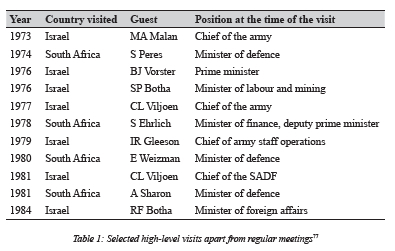
This high-level exchange was flanked by semi-annual technical discussions at working level.78 According to SA calculations in 1983, the total value of arms imported from Israel over a decade had already exceeded one billion US dollars (US$). In 2024 purchasing power terms, this would correspond to a value of between US$3,23 billion and US$7,93 billion.79
Despite the mandatory UN sanctions against South Africa since 1977, Israel maintained its co-operation. This intention was also underlined by the then minister of defence, Moshe Arens, in a letter to his SA counterpart in 1983, referring to ongoing projects:
Let me assure you that I fully recognize the importance of pursuing reciprocal purchases with respect to mutual programs of this nature and that I actively support all efforts undertaken to this end.80
Except for the foreign ministry, the Israeli cabinet did not support a potential termination of the bilateral defence co-operation. A limited change of position only took place after Israel ran the risk of being cut off from US military aid due to its arms sales to South Africa as a result of new legal anti-apartheid regulations in the United States from October 1986.81 In March 1987, the decision was therefore taken not to conclude any new contracts with South Africa. The fulfilment of existing contracts remained unaffected.82 It can be inferred that the bilateral state-level knowledge exchange between the two states was also allowed to continue, as the 1975 agreement governing this co-operation, as mentioned earlier, had no expiry date.
In conclusion, the co-operation at the time did not constitute a conventional alliance with mutual assistance obligations. Instead, the 1975 agreement precisely reflected the nature of the mainly commercial co-operation, which was largely shaped by the leaders of both countries. Remarkably, Israel continued this co-operation despite mandatory UN sanctions, and actively sought to consolidate it, even in the face of growing opposition from the United States starting in 1986.
Conventional Defence-Technology Co-Operation
In the section below, the extent to which the army, air force, and navy benefited from co-operation with Israel is discussed. Particular consideration is given to whether this brought South Africa closer to the goal of defence autarky.
South African Navy: Off to New Shores with Israeli Assistance
In August 1974, South Africa signed a purchase contract for an initial six Reshef-class missile fast boats, which were to be produced in Israel and under licence in South Africa (three units each), involving Armscor. Despite their small displacement of 450 tonnes, the strength of the boats lay not only in their maximum speed of 34 knots but also in their armament with six to eight Israeli-made anti-ship missiles. Within the SAN, the purchase decision was controversial and much criticised because, unlike the ageing British-origin frigates and destroyers, the boats lacked anti-submarine warfare capabilities.83
As no viable alternatives existed due to the international isolation, the internal criticism remained inconsequential: the United Kingdom, the Netherlands, and Portugal (since the Carnation Revolution in 1974) all refused to sell ships to South Africa. The purchase contract for two A69-class frigates, already concluded in February 1976, was cancelled by France immediately after the United Nations imposed mandatory sanctions on South Africa in 1977.84
In contrast to the growing community of states unwilling to supply naval technology to the pariah of Africa, Israel initiated extensive technology transfer even before delivering the boats to enable SA shipyards to produce them without continuous foreign support. The transfer included information about the weapon systems of the boats, related ammunition, and EW equipment. South Africa also received support in developing its naval bases.85 The delivery of the boats manufactured in Haifa, Israel, took place as early as 1977, while the Sandock Austral shipyard in Durban, South Africa, only reported the commissioning of the third boat built under licence in 1980. By 1986, the technology acquisition eventually enabled South Africa to produce and commission three additional boats of the same type domestically.86
All units were pooled in the designated flotilla in Durban, which conducted amphibious operations in conjunction with specialised maritime land forces, including at least 21 operations against Angola and 31 against Mozambique until the end of apartheid. Compared to the army and air force, the SAN played a relatively small role in the SABW.87 Nevertheless, the flotilla carried out several successful long-distance operations against oil storage and transportation facilities in Angolan and Mozambican ports.88 Naval operations against such infrastructure formed a key link to attacks by the SADF and the allied UNITA and RENAMO insurgents on the railway network used by the SADCC states. As a result, these states were continuously forced to divert their trade routes to SA harbours, which provided economic benefits to South Africa.89
In conclusion, Israel made a valuable contribution to the urgently needed preservation of the operational capability of the SAN against Angola and Mozambique. This is all the more significant since the last British-built frigate was decommissioned in 1985, and without the acquisition of the missile fast boats, it would likely have marked the end of naval combat operations.90 At the same time, the technology transfer facilitated the development of the naval capabilities of the defence industry, bringing it closer to the goal of self-sufficiency, thereby avoiding future dependency on foreign suppliers.
South African Air Force: Avoiding the Unavoidable End of Close Air Support
Since the 1960s, the SAAF had been using French-made Mirage III fighter jets, the number of which grew to 58 over the years. A key operational focus was close air support and reconnaissance for the ground forces.91 The end of this operational role seemed unavoidable, as France prohibited its own industry from concluding arms deals with South Africa at the beginning of the 1980s, thereby also ending French support for the maintenance of the SAAF Mirage fleet.92
Israel immediately stepped in, and successfully offered extensive combat capability upgrades to the avionics and weapons systems in 1981. According to an estimate by the then chief of the SADF, Constand Viljoen, the total costs of these upgrades amounted to approximately US$2 billion.93 The SAAF planned to complete the modernisation process by 1995.94 Of the 58 SAAF Mirage III aircraft, 28 were ultimately upgraded with extensive Israeli support and served under the designation "Cheetah". In addition, 43 new Cheetah jets were manufactured based on almost identical airframes from Israel, which came from the production series of the national Mirage derivatives Kfir and Nesher.95Furthermore, an estimated 16 fighter jets were equipped with aerial refuelling probes to extend their range.96
Providing entirely new capabilities, three Boeing 707 aircraft previously used by Air France were procured via a Belgian company and converted into tanker aircraft for use by the SAAF. These were additionally equipped with sensors for electronic signals intelligence, e.g. against radar-based air defence systems. The necessary work for these modifications is believed to have been carried out in Israel.97
Unmanned aerial vehicles (UAVs) - a technological novelty at the time - were also part of the defence co-operation. In the early 1980s, Israel supplied five Scout drones, on the basis of which South Africa developed its own versions (Seeker 2B and 2C). Lacking armament, their role was limited to battlefield reconnaissance in Angola and Mozambique. The key advantage of these drones was their ability to transmit aerial images in real time, allowing targets to be identified immediately and attacked by artillery and manned SAAF aircraft.98 In 1986, South Africa established a dedicated UAV squadron as an organisational framework for the Scout and Seeker drones. The latter entered active service starting in 1987.99
In summary, SA dependency on Israel in the field of air operations increased from the 1980s onwards. South Africa probably discounted potential drawbacks of this dependency due to the clear benefits of preserving and enhancing its aerial capabilities against the northern neighbours. Most importantly, the country could not forgo the use of its Mirage fleet, and gained new capabilities against its regional adversaries through the likely Israeli-led conversion of the multi-role Boeing 707. The co-operation therefore increased the operational range of the SAAF and provided the additional capability to conduct reconnaissance on radar-based air defence systems in Angola and Mozambique in conjunction with the newly acquired UAVs. Given the technological backlog at the time, it seems impossible that the SA defence industrial base would have been capable of comparable capability developments without foreign assistance.
Army: The Overlooked Co-Operation
Three months after signing the 1975 co-operation agreement, South Africa and Israel concluded a contract for Israeli-made tank engines and ammunition with a total value of USD196,83 million.100 A further order for ammunition followed in 1977, totalling US$370 million.101 In addition to armaments purchases, several technology transfers also took place. The upgrading and retrofitting of Centurion tanks, originally of British manufacture, for instance, is said to have been based on Israeli blueprints.102 This seems plausible, as South Africa and Israel were already negotiating a licensing agreement for a tank designated by a code name as early as 1975.103
Independently of this, the SA industry received the authorisation to produce the Israeli Galil assault rifle under licence and rebrand it as "Vektor".104 The Army also benefitted directly from advisory and training services provided by the Israeli military, which placed a distinct emphasis on practical operational scenarios, such as counter-insurgency and airborne assault.105
Overall, within the bilateral co-operation, army-related armament projects constituted a relatively small proportion, which can be interpreted as a form of transitional support until SA defence autarky was achieved by the early 1980s. Once accomplished, no sufficient incentives were left for South Africa to intensify co-operation with Israel and therefore deepen the dependency.
Nuclear Co-Operation
Already in 1975, delivery systems for SA nuclear weapons were the subject of bilateral discussions. South Africa, particularly influenced by its air force command, expressed interest in Israeli Jericho ballistic missiles.106 In February 1979, Armscor and the chief of the SADF each sent a representative to Israel upon invitation, where an Israeli Air Force test launched a Jericho I missile to a range of approximately 500 km.107 Following the visit, the SADF representative, Major General Ian Gleeson, stated in his report in March 1979 that the SADF had not yet identified an operational need for such weapon systems, but that a potential bilateral collaboration could be discussed during a follow-up visit.108 As discussed earlier, the SADF eventually made the decision to designate ballistic missiles as the future delivery system of nuclear weapons in the mid-1980s.
Based on Israeli blueprints, South Africa made recognisable progress by the end of the 1980s, when Armscor was able to produce a ballistic missile with an estimated range of 2 500 km for the first time in 1987, which would have been sufficient to strike all SADCC states. The technical specifications and design suggest that this was a variant of the Jericho II missile. South Africa conducted its first test launch over a distance of 1 450 km in July 1989 at the Overberg test range.109
The ban on new arms contracts with South Africa issued by the Israeli cabinet in Jerusalem in 1987 did not apply to the missile programme, as the corresponding agreement had already been concluded a few years earlier.110 Consequently, continuation of the programme could have been possible until well into the 2000s had it not been for the end of apartheid and the corresponding nuclear disarmament. Indeed, the nuclear capability plan, which included the missile programme, envisioned a planning horizon extending to 2006 and was approved by the SA minister of defence, Magnus Malan, in August 1987.111
It remains doubtful whether Israel was directly involved in the production of nuclear warheads. In 1977, Israel allegedly lent 20 grams of tritium to South Africa, which, despite its suitability for producing thermonuclear warheads, was never utilised. Instead, South Africa focused on developing nuclear fission bombs, manufacturing a total of six between 1986 and 1989. The seventh warhead was never completed due to the termination of the nuclear weapons programme by President de Klerk shortly after taking office in September 1989.112 The construction of enrichment facilities for weapons-grade uranium, initiated in 1974, appears to have been primarily the result of scientific collaboration with the West German Society for Nuclear Research in Karlsruhe, given the technical similarities.113
Although South Africa had already enriched 64 kg of weapons-grade uranium by 1979, 114 it still lacked the technological capability to design a low-yield bomb, and instead used the uranium for two warhead demonstration devices completed in 1979 and 1982.115 The suspected low-yield nuclear explosion of 2-4 kilotons over the southern Indian Ocean in September 1979 was therefore most probably not a detonation of a South African-built warhead. Rather, as Peter Liberman points out, '[s]ince no other known nuclear power or threshold state had both the incentive and the capability to conduct such a test, suspicion has fallen largely on Israel.'116 The proximity of the detonation to the SA coastline, however, indicates the possibility that the test had a joint nature with logistical support by South Africa.
In summary, even in the nuclear domain, South Africa demonstrated strong tendencies towards avoiding dependency, consistent with theoretical expectations. Despite initial expressions of interest in Israeli ballistic missiles during the 1970s, the co-operation was only consolidated in the following decade. This delay likely correlated with the anticipated phasing out of the nuclear role of SAAF fighter aircraft, which became foreseeable only from the beginning of the 1980s, creating an urgent need for alternative delivery systems. From an SA perspective, forgoing co-operation with Israel in missile technology would have significantly restricted the deployability of its nuclear weapons against a potentially existential threat. Doubts remain whether the co-operation in nuclear weapons design and production extended beyond the Israeli provision of tritium to South Africa. This is particularly true concerning the domestic uranium enrichment programme, which was significantly supported, if at all, only by German expertise.
Conclusion
The study on which this article is based, followed the hypothesis that the pursuit of co-operation with Israel did not contradict the goal of defence autarky but instead placed South Africa on a path to attaining it. During the 1970s and 1980s, the hegemonic position of South Africa in Southern Africa was increasingly challenged by the loss of Portugal and the Rhodesian regime as key partners in maintaining the cordon sanitaire, the termination of the Simon's Town Agreement by London, mandatory UN arms sanctions starting in 1977, failures in establishing regional co-operation formats, and the build-up of Cuban and Soviet forces, particularly in Angola, starting in the mid-1970s. South Africa therefore pursued the objective of defence autarky, as evidenced by the establishment of domestic industrial production capacities led by Armscor, significantly scaling up in the 1970s.
Due to the deliberate exclusion of non-whites from higher education, South Africa was only partially able to utilise the human potential for the defence industry, leading to severe innovation and production deficits in cutting-edge military technology, especially in the air force and navy. This inherent quantitative-qualitative limitation made it impossible to mobilise the military-industrial base fully against regional enemies.
Consequently, alternative forms of counterbalancing, such as foreign arms sales, were imperative but increasingly hampered by the reluctance of France, the United Kingdom and Portugal - erstwhile arms suppliers to South Africa. This placed Israel, having both the willingness and the capabilities to replace these nations, in a unique position. Projects were most likely in areas where South Africa had urgent unmet needs for arms that could be deployed effectively against regional adversaries.
In parallel, autarky remained a key objective even during the intensified defence co-operation with Israel following the signing of the 1975 agreement, which did not limit the signatories in terms of acquisitions. Instead, South Africa demonstrated a strong interest in developing industrial capabilities for independent production, upgrading, retrofitting, and maintenance. With Israeli support, the SA defence industry acquired the necessary expertise to manufacture, among other things, missile fast-attack craft, drones, and ballistic missiles, as well as to carry out capability upgrades on existing Centurion tanks and Mirage fighter-bombers.
The bilateral co-operation witnessed most of its dynamic in areas in which South Africa had urgent needs that Israel was able to meet. This logic mostly applied to the navy and air force, both of which faced an impending total loss of operational capability, particularly against Angola and Mozambique, caused by the technological obsolescence of the armament. This was largely due to the UN arms embargo from 1977 and the lack of industrial capacity to modernise ageing weapon systems. Additionally, the SAAF had originally assigned a nuclear role to its fighter aircraft, a role it had to abandon in the mid-1980s due to the increasing air defence capabilities of Cuban and Soviet forces. Only with the help of Israeli missile technology was an effective alternative found, which, according to SA planning, was intended to remain in use at least until 2006.
The overall technological rationale extended beyond merely preserving capabilities of the air force and navy. The upgrading of the Mirage fleet and the conversion of 707 tanker and reconnaissance aircraft enabled the SAAF to operate over an extended range and to conduct reconnaissance on Cuban and Soviet air defence systems. The provision of drones gave the SADF exclusive advantages in land-based operations against regional adversaries, thanks to faster reaction times and improved reconnaissance outcomes. Additionally, maritime operations were enhanced through the inclusion of Israeli missile fast-attack craft, which mainly targeted port facilities in SADCC states.
In contrast to the air force and navy, by the early 1980s, the SA defence industry was largely capable of meeting the needs of the army. This explains why, apart from the transitional support - Israeli ammunition and engine supplies - there was no significant intensification of collaboration in this sector. The innovational edge of the army was largely due to lower technological complexities. This contrasted with the air force and navy, where even an intensified focus on flagship projects, such as the missiles and the nuclear weapons, could not compensate for the significant innovation deficits, thus requiring substantial foreign support.
As the current study focused on the role of South Africa, future studies on the bilateral relations in the Cold War - possibly fuelled by Israeli archive declassifications - could further analyse the Israeli rationale and technological logic behind the co-operation. Research on the nuances of SA policy thinking about autarky has equally great potential, especially around long-term plans for the twenty-first century made in the late 1980s after formal imposition of sanctions by Israel in 1987.
In the current case, RL Schweller's neoclassical realism accurately explained the necessity for alternative forms of balancing as a consequence of limited resource mobilisation capabilities. The causal link merits deeper investigation, as the theory puts strong emphasis on the logic of mobilising against imminent threats (short-term mobilisation). The theory however rather neglectfully considers the causality between low social cohesion and lost technological potentials (medium- and long-term mobilisation).
Finally, the case also demonstrates that, to circumvent arms embargoes, the support of a single state possessing relevant technological expertise may suffice. The enforcement of such sanctions violations is further complicated when the supporting state - such as Israel in this instance - has the backing of a veto power in the UN Security Council. This implies that enforcement of sanctions is insufficient when relying solely on the normative binding effect of international law; rather, the enforcement requires the multilateral and transnational use of political, economic and military instruments.
Endnotes
* Nicolas Wolbrandt is an author focusing on Middle East politics and international state and non-state arms co-operation, with his latest book covering the Israeli-Iranian confrontation in Syria between 2011 and 2024. Furthermore, he is also affiliated with the Department of History (War and Conflict Studies) at the University of Potsdam.
i Unlike most other states in the list, which underwent a simple postcolonial name change upon independence, Rhodesia is a special case. The territory did not undergo a mere change of name. From 1965 until 1980, the territory existed as the unrecognised Republic of Rhodesia under white-minority rule following its Unilateral Declaration of Independence from Britain. The territory achieved internationally recognised independence as the Republic of Zimbabwe on 18 April 1980. When this study refers to Rhodesia as a co-operating entity, it uses the term "Rhodesian regime" to reflect this distinct historical context.
1 United Nations General Assembly, 'Resolutions and Decisions Adopted by the General Assembly During its Forty-fifth Session: Volume I', 1991, 43. <https://docs.un.org/en/a/45/49>[Accessed on 4 January 2025].
2 United Nations General Assembly, 'Resolutions and Decisions Adopted by the General Assembly During its Forty-fourth Session: Volume I', 1990, 36. <https://docs.un.org/en/a/44/49> [Accessed on 29 December 2024].
3 See S Polakow-Suransky, The Unspoken Alliance: Israel's Secret Relationship with Apartheid South Africa (New York: Vintage Books, 2010). [ Links ]
4 International Court of Justice, 'The Republic of South Africa Institutes Proceedings Against the State of Israel and Requests the Court to Indicate Provisional Measures', 2023, 1. <https://www.icj-cij.org/sites/default/files/case-related/192/192-20231229-pre-01-00-en.pdf> [Accessed on 12 December 2024].
5 NC Crawford, 'How Arms Embargoes Work', in NC Crawford & A Klotz (eds), How Sanctions Work: Lessons from South Africa (Basingstoke: Macmillan, 1999), 52. [ Links ]
6 On the goal of defence autarky, see G Myre, 'Forced into Self-reliance, South Africa Now a Weapons Exporter', The Associated Press, 16 November 1988. [ Links ] On the doctrinal foundations of defence autarky, see A Moravcsik, 'Arms and Autarky in Modern European History', Daedalus, 120, 4 (1991), 23-45.
7 The Soviet Union could, at best, be considered an indirect adversary for both states.
8 United Nations Disarmament Commission, 'Letter Dated 22 April 1993 from the Permanent Representative of South Africa to the United Nations Addressed to the Chairman of the Disarmament Commission', 1993, 6. <https://docs.un.org/en/A/CN.10/179> [Accessed on 10 December 2024].
9 The limited explanatory power is primarily due to the distinct focus of the approaches on ideological similarities between Jerusalem and Pretoria and on overlapping interests between state arms manufacturers and the respective military command. For a presentation of selected explanatory approaches, see Y Alsheh, 'Dirty Scapegoats: Explaining Israel's Ties with South Africa During the 1970s and 1980s', Southern Journal for Contemporary History, 38, 1 (2013), 25-26.
10 "Defence autarky" (synonym: arms autarky) describes the state in which a country can fully meet its demand for military equipment through domestic production rather than through imports from abroad. RA Bitzinger, 'New Ways of Thinking About the Global Arms Industry: Dealing with "Limited Autarky"', Australian Strategic Policy Institute, 5 November 2015. <https://www.aspistrategist.org.au/new-ways-of-thinking-about-the-global-arms-industry-dealing-with-limited-autarky/> [Accessed on 15 April 2026].
11 The terms "white", "black", "coloured" and "Asian" are used here solely in an analytical sense to reflect the legal classifications in force at the time. The author does not in any way endorse or adopt these distinctions.
12 B Beit-Hallahmi, The Israeli Connection: Who Israel Arms and Why (New York, Pantheon Books, 1987); Polakow-Suransky, The Unspoken Alliance.
13 M Zuern, 'Neorealistische und Realistische Schule', in A Boeck (ed.), Lexikon der Politik - Band 6: Internationale Beziehungen (Munich: C.H. Beck, 1994), 309-311. Conceptually, the security dilemma traces back to JH Herz, 'Idealist Internationalism and the Security Dilemma', World Politics, 2, 2 (1950), 157-180.
14 RL Schweller, 'Unanswered Threats: A Neoclassical Realist Theory of Underbalancing', International Security, 29, 2 (2004), 162-163.
15 Schweller, 'Unanswered Threats', 200-201.
16 Schweller, 'Unanswered Threats', 166.
17 Schweller, 'Unanswered Threats', 169.
18 Schweller, 'Unanswered Threats', 174-175, 180.
19 The World Bank, 'GDP (Constant 2015 US$) - Angola, Botswana, Lesotho, Malawi, Mozambique, Eswatini, Tanzania, Zambia, Zimbabwe, South Africa', 2024. <https://data.worldbank.org/indicator/NY.GDPMKTPKD?end=1990 & locations=AO-BW-LS-MW-MZ-SZ-TZ-ZM-ZW-ZA & start=1980> [Accessed on 26 December 2024]. Besides Angola and Mozambique, Botswana, Lesotho, Malawi, Zambia, Swaziland (today Eswatini), Tanzania and Zimbabwe were also members of the SADCC. GM Khadiagala, 'Regional Dimensions of Sanctions', in Crawford & Klotz, How Sanctions Work, 254.
20 Stockholm International Peace Research Institute (hereafter SIPRI), 'SIPRI Military Expenditure Database: South Africa, Angola, Botswana, Lesotho, Malawi, Mozambique, Eswatini, Tanzania, Zambia, Zimbabwe, Constant (2022) US$ m., 1970-1990', 2024. <https://milex.sipri.org/sipri> [Accessed on 3 January 2025].
21 TJ Stapleton, A Military History of South Africa: From the Dutch-Khoi Wars to the End of Apartheid (Santa Barbara: ABC-CLIO, 2010), 158.
22 SIPRI, 'SIPRI Military Expenditure Database: South Africa, Share of GDP, 1970-1990', 2024. <https://milex.sipri.org/sipri> [Accessed on 3 January 2025].
23 SIPRI, World Armaments and Disarmament: SIPRI Yearbook 1986 (New York: Oxford University Press, 1986), 343.
24 BR Smedts, 'Proliferation in Africa: Present and Future Implications', African Security Review, 19, 2 (2010), 15. On the disclosure policy, see T McDonnell, 'Nuclear Pursuits: Non-P-5 Nuclear-armed States, 2013', Bulletin of the Atomic Scientists, 69, 1 (2013), 68.
25 "Cordon sanitaire" is a synonym for a buffer zone used by states to ward off threats before they reach their borders. In this case, South Africa sought to counter transnational movements and efforts aimed at ending apartheid. To this end, it tried to establish a buffer zone. RA Gibb, 'Imposing Dependence: South Africa's Manipulation of Regional Railways', Transport Reviews, 11, 1 (1991), 22.
26 J Miller, 'Things Fall Apart: South Africa and the Collapse of the Portuguese Empire, 1973-74', Cold War History, 12, 2 (2012), 188.
27 RA Gibb, 'Imposing Dependence: South Africa's Manipulation of Regional Railways', Transport Reviews, 11, 1 (1991), 23, 26.
28 G Baines, 'The Arsenal of Securocracy: Pretoria's Provision of Arms and Aid to Salisbury, c.1974-1980', South African Historical Journal, 71, 3 (2019), 427.
29 Baines, 'The Arsenal of Securocracy', 435-136.
30 Baines, 'The Arsenal of Securocracy', 426.
31 T Potgieter, 'The Secret South African Project Team: Building Strike Craft in Israel, 1975-79', Scientia Militaría: South African Journal of Military Studies, 32, 1 (2004), 121-122. Under this agreement, the United Kingdom transferred its Cape naval facility and command of the South African Navy to Pretoria, while agreeing to sell £18 million worth of naval equipment - including destroyers, frigates, minesweepers and coastal defence aircraft - and securing continued access for Royal Navy vessels. For South Africa, the agreement strengthened sovereignty and naval capabilities, complemented by the acquisition of transport aircraft in the early 1960s that significantly enhanced the lift capacity of the South African Air Force. See Stapleton, A Military History, 154.
32 Crawford, 'How Arms Embargoes Work', 52. The sanctions were initially justified because of apartheid but later extended to include the illegal occupation of Namibia and the continued military aggression against neighbouring countries. On the UN's position on Namibia, see SIPRI, World Armaments and Disarmament: SIPRI Yearbook 1989 (New York: Oxford University Press, 1989), 455.
33 A Zacarias, 'SADC: From a System to Community of Security?', African Security Review, 7, 6 (1998), 45-46. On the monetary union, see JY Wang, I Masha, K Shirono & L Harris, 'The Common Monetary Area in Southern Africa: Shocks, Adjustment, and Policy Challenges', IMF IMF Working Paper No. 7, 2007. <https://www.imf.org/external/pubs/ft/wp/2007/wp07158.pdf> [Accessed on 2 February 2025].
34 Gibb, 'Imposing Dependence', 19.
35 Baines, 'The Arsenal of Securocracy', 435.
36 KD Hwang, 'The Historical Evolution of SADC(C) and Regionalism in Southern Africa', International Area Studies Review, 10, 1 (2007), 61.
37 SIPRI, World Armaments and Disarmament: SIPRI Yearbook 1985 (London: Taylor & Francis, 1985), 321. On the Malawian troop deployment, see Gibb, 'Imposing Dependence', 34.
38 Khadiagala, 'Regional Dimensions of Sanctions', 254-255.
39 Gibb, 'Imposing Dependence', 35.
40 SIPRI, World Armaments and Disarmament: SIPRI Yearbook 1987 (New York: Oxford University Press, 1987), 314.
41 Stapleton, A Military History, 170-171, 184-185.
42 SIPRI, Yearbook 1987, 314.
43 Stapleton, A Military History, 184-185.
44 Stapleton, A Military History, 177-178.
45 SIPRI placed the number of SWAPO insurgents at 6 000 to 9 000, while the ANC was reported to have 10 000 insurgents. SIPRI, World Armaments and Disarmament: SIPRI Yearbook 1988 (New York: Oxford University Press, 1988), 295.
46 Baines, 'The Arsenal of Securocracy', 424-425.
47 NC Crawford, 'Trump Card or Theater? An Introduction to Two Sanctions Debates', in Crawford & Klotz, How Sanctions Work, 8. See also Gibb, 'Imposing Dependence', 24.
48 Pretoria is the administrative capital of South Africa, serving as the seat of the executive branch of government. The city is situated in the northern part of Gauteng, roughly 56 km north-northeast of Johannesburg.
49 Stapleton, A Military History, 153.
50 Wilson Center Digital Archive (hereafter WCDA), 'Letter from South African Defence Minister Magnus Malan to Israeli Defense Minister Ariel Sharon', 26 April 1982, 1. <https://digitalarchive.wilsoncenter.org/document/116771> [Accessed on 20 October 2024].
51 Inter-Parliamentary Union (hereafter IPU), 'South Africa National Assembly: Election Results - 1970', 2025. <https://data.ipu.org/election-summary/PDF/SOUTH_AFRICA_1970_E.PDF> [Accessed on 3 February 2025]; IPU, 'South Africa National Assembly: Election Results - 1974', 2025. <https://data.ipu.org/election-summary/PDF/SOUTH_AFRICA_1974_E.PDF> [Accessed on 3 February 2025]; IPU, 'South Africa National Assembly: Election Results - 1977', 2025 <https://data.ipu.org/election-summary/PDF/SOUTH_AFRICA_1977_E.PDF> [Accessed on 3 February 2025]; IPU, 'South Africa National Assembly: Election Results - 1981', 2025. <https://data.ipu.org/election-summary/PDF/SOUTH_AFRICA_1981_E.PDF> [Accessed on 3 February 2025]; IPU, 'South Africa National Assembly: Election Results - 1987', 2025. <https://data.ipu.org/election-summary/PDF/SOUTH_AFRICA_1987_E.PDF> [Accessed on 3 February 2025]; IPU, 'South Africa National Assembly: Election Results - 1989', 2025. <https://data.ipu.org/election-summary/HTML/2291_89.htm> [Accessed on 3 February 2025].
52 On participation in the labour market, see M Mariotti, 'Labor Markets During Apartheid in South Africa', Australian National University, 2009, 5-6. <https://cbe.anu.edu.au/researchpapers/econ/wp503.pdf> [Accessed on 1 January 2025].
53 PN Pillay, 'The Development and Underdevelopment of Education in South Africa', University of Cape Town, 1984, 25, 29-30. <https://www.opensaldru.uct.ac.za/bitstream/handle/11090/366/1984_pillay_ccp95.pdf?sequence=1> [Accessed on 15 February 2026].
54 Crawford, 'How Arms Embargoes Work', 59-60.
55 National Commission on Higher Education, 'Report: A Framework for Transformation', 1996, 34. <https://www.che.ac.za/sites/default/files/publications/Chapter%203.pdf> [Accessed on 13 January 2026].
56 Mandatory service had already existed before this, but initially only affected a small proportion of potential conscripts and was increasingly extended, particularly in the course ofthe 1960s, before becoming conscription in 1967. G Callister, 'Patriotic Duty or Resented Imposition? Public Reactions to Military Conscription in White South Africa, 1952-1972', Scientia Militaría: South African Journal of Military Studies, 35, 1 (2007), 51-52.
57 Stapleton, A Military History, 153.
58 Stapleton, A Military History, 156-158.
59 MB Khanyile, 'The Ethnic Factor in the SA National Defence Force: Recruitment Strategies Revisited', Politeia, 16, 1 (1997), 82-83. On the composition of the officer corps in 1996, see Khanyile, 'The Ethnic Factor', 86.
60 JP Dunne, 'The Making of Arms in South Africa', The Economics of Peace and Security Journal, 1, 1 (2006), 40-41.
61 Crawford, 'How Arms Embargoes Work', 53.
62 Dunne, 'The Making of Arms', 40-41.
63 Crawford, 'How Arms Embargoes Work', 53-54.
64 D Botha, 'South Africa's Defence Industry: Charting A New Course?', Institute for Security Studies, 2003, 1. <https://www.files.ethz.ch/isn/112155/PAPER78.PDF> [Accessed on 2 January 2025].
65 JP Dunne, G Lamb & E Nikolaidou, 'The Development of South Africa's Arms Industry', University of Cape Town, 2019, 7. <https://commerce.uct.ac.za/sites/default/files/media/documents/commerce_uct_ac_za/869/prism-workingpaper-2019-2-dunne-et-al.pdf> [Accessed on 2 January 2025].
66 SIPRI, World Armaments and Disarmament: SIPRI Yearbook 1980 (London: Taylor & Francis, 1980), 112.
67 D Hearst & D Fairhall, 'South Africa Offered £1 Million for Details of Blowpipe', Guardian Weekly, 30 April 1989. For personnel recruitment abroad, see A Robinson, 'Armscor, Symbol of South Africa's Outsider Status', Financial Times, 26 April 1989.
68 A Wessels, 'The United Nations Arms Embargo Against South Africa, 1977-1994', War & Society, 29, 2 (2010), 147.
69 Botha, 'South Africa's Defence Industry', 1-2.
70 Myre, 'Forced into Self-reliance'.
71 Crawford, 'How Arms Embargoes Work', 64-65.
72 For a comprehensive study on defence-technological development processes, see SP Rosen, Winning the Next War: Innovation and the Modern Military (Ithaca: Cornell University Press, 1991).
73 D Albright & A Stricker, Revisiting South Africa's Nuclear Weapons Program: Its History, Dismantlement, and Lessons for Today (Washington, DC: Institute for Science and International Security Press, 2016), 139.
74 WCDA, 'Israel-South Africa Agreement (ISSA)', 3 April 1975, 1. <https://digitalarchive.wilsoncenter.org/document/114147> [Accessed on 20 October 2024].
75 WCDA, 'Israel-South Africa Agreement', 1-2. However, the specification of the topics is blacked out without exception in this archival record.
76 WCDA, 'Notes and Agenda Related to Israel-South Africa Meeting', 1 July 1975, 13-14. <https://digitalarchive.wilsoncenter.org/document/116600> [Accessed on 20 October 2024]. [Page numbers equal scanned pages.]
77 In chronological order: Polakow-Suransky, The Unspoken Alliance, 75; Polakow-Suransky, The Unspoken Alliance, 80; O Ojo, 'Israeli-South African Connections and Afro-Israeli Relations', International Studies, 21, 1 (1982), 44; Polakow-Suransky, The Unspoken Alliance, 121-122, 125; Polakow-Suransky, The Unspoken Alliance, 103; Anon., 'Israeli Defense Minister Reported in Visit to South Africa', The Associated Press, 19 March 1980; WCDA, 'Memorandum South African Defence Force, Report on Special Visit to Israel: 19 to 23 February 1979', 13 March 1979, 1. <https://digitalarchive.wilsoncenter.org/document/116657> [Accessed on 20 October 2024] [translated]; E Navon, 'From Kippur to Oslo: Israel's Foreign Policy, 1973-1993', Israel Affairs, 10, 3 (2004), 33; Polakow-Suransky, The Unspoken Alliance, 145; D Middleton, 'South Africa Needs More Arms, Israeli Says', The New York Times, 14 December 1981; A Max, 'Israel Wants Toned-down Ties with South Africa', The Associated Press, 6 December 1984.
78 WCDA, Malan to Sharon, 2.
79 WCDA, 'Letter from South African Defence Minister Magnus Malan to Israeli Defense Minister Moshe Arens', 18 May 1983, 1. <https://digitalarchive.wilsoncenter.org/document/letter-south-african-defence-minister-magnus-malan-israeli-defense-minister-moshe-arens-0> [Accessed on 5 January 2025]. The document refers to arms imports of more than US$ 1 billion over 'the last decade'. Assuming a range from 1970 to 1982, the inflation-adjusted equivalent of US$ 1 dollars therefore lies between 7,93 billion and 3,23 billion (December prices). For details on the calculation, see US Bureau of Labor Statistics, 'CPI Inflation Calculator', 2025. <https://www.bls.gov/data/inflation_calculator.htm> [Accessed on 10 January 2025].
80 WCDA, 'Letter from Israeli Defense Minister Moshe Arens to South African Defense Minister Magnus Malan (Redacted)', 7 April 1983, 1. <https://digitalarchive.wilsoncenter.org/document/116777> [Accessed on 20 October 2024].
81 TL Friedman, 'Israelis Reassess Supplying Arms to South Africa', The New York Times, 29 January 1987.
82 A Fisher, 'Israel Declares Partial Boycott of South Africa', The Associated Press, 19 March 1987.
83 Potgieter, 'The Secret South African Project Team', 124-125.
84 Wessels, 'The United Nations Arms Embargo', 141, 144. On the frigates, see SIPRI, World Armaments and Disarmament: SIPRI Yearbook 1977 (Stockholm: Almqvist & Wiksell International, 1977), 338.
85 Potgieter, 'The Secret South African Project Team', 126, 132.
86 Wessels, 'The United Nations Arms Embargo', 145-147.
87 Some operations of the flotilla were apparently also carried out by submarines of the South African Navy. L Steyn, 'SAS Isaac Dyobha's Last Voyage', SA Naval Museum, 21 May 2022. <https://web.archive.org/web/20250210041217/https://sanavymuseum.co.za/2022/05/21/sas-isaac-dyobhas-last-voyage/> [Accessed on 10 February 2025].
88 A Mouton, 'Iron Fist from the Sea: South Africa's Seaborne Raiders, 1978-1988', African Historical Review, 48, 1 (2016), 159-160.
89 Gibb, 'Imposing Dependence', 34.
90 For the decommissioning of the last frigate, see Anon., 'Senior Academic Reflects on History of the SA Navy', defenceWeb, 18 May 2022. <https://www.defenceweb.co.za/featured/senior-academic-reflects-on-history-of-the-sa-navy/> [Accessed on 10 January 2025].
91 M Reid, 'The Dassault Mirage III in South African Air Force Service: Part 1', South African Air Force, 2022, 8-11. <https://www.saairforce.co.za/pdf/Mirage%20III%20in%20SAAF%20Service%20-%20Part%201.pdf> [Accessed on 23 December 2024].
92 V Moukambi, Relations Between South Africa and France with Special Reference to Military Matters, 1960-1990 (PhD Dissertation, Stellenbosch University, 2008), 237.
93 Polakow-Suransky, The Unspoken Alliance, 145-146, 151, 183.
94 Polakow-Suransky, The Unspoken Alliance, 224.
95 M Reid, 'South African Air Force Mirage III and Cheetah: External Fuel Tanks', South African Air Force, 2023, 3, 6. <https://www.saairforce.co.za/pdf/Mirage%20III%20in%20SAAF%20Service%20-%20Part%209.pdf> [Accessed on 22 December 2024]. On the Nesher variant, see Y Katz, 'De Gaulle and Israel's Technological Revolution', Jerusalem Post, 2 June 2017.
96 M Reid, 'Cheetah E: In South African Air Force Service', South African Air Force, 2024, 3, 4. <https://www.saairforce.co.za/pdf/South%20African%20Air%20Force%20Cheetah%20E.pdf> [Accessed on 22 December 2024] It is nonetheless assumed that the probes were not used continuously.
97 Anon., 'SAA Denies SAAF Will Be Getting Three of Its Aircraft', defenceWeb, 6 October 2020. <https://www.defenceweb.co.za/aerospace/aerospace-aerospace/saa-denies-saaf-will-be-getting-three-of-its-aircraft/> [Accessed on 10 January 2025].
98 K Chandler, 'Apartheid Drone: Infrastructures of Militarism and the Hidden Genealogies of the South African Seeker', Social Studies of Science, 52, 4 (2022), 519.
99 D Gettinger, 'The Drone Databook', Center for the Study of the Drone at Bard College, 2019, 265. <https://dronecenter.bard.edu/files/2019/10/CSD-Drone-Databook-Web.pdf> [Accessed on 10 February 2025].
100 WCDA, Notes and Agenda, 24, 26. [Page numbers equal scanned page.] Adjusted to 2024 purchasing power, this would correspond to a value of more than US$1,1 billion. See US Bureau of Labor Statistics, 'CPI Inflation Calculator'.
101 Polakow-Suransky, The Unspoken Alliance, 103.
102 Crawford, 'How Arms Embargoes Work', 62.
103 WCDA, Notes and Agenda, 25, [Page number equals scanned page.]
104 Anon., 'South Africa to Evaluate the New IMI 5.56 mm Round', defenceWeb, 26 March 2018. <https://www.defenceweb.co.za/land/land-land/south-africa-to-evaluate-the-new-imi-556-mm-round/> [Accessed on 10 January 2025].
105 Polakow-Suransky, The Unspoken Alliance, 97-98, 144.
106 Polakow-Suransky, The Unspoken Alliance, 82.
107 WCDA, Memorandum, 1-2.
108 WCDA, Memorandum, 4.
109 Nuclear Threat Initiative, 'South Africa Missile Overview', 2017. <https://www.nti.org/analysis/articles/south-africa-missile/> [Accessed on 20 October 2024].
110 Polakow-Suransky, The Unspoken Alliance, 216.
111 Albright & Stricker, Revisiting South Africa's Nuclear Weapons Program, 140-142.
112 A first warhead for design tests was already developed in 1979. Albright & Stricker, Revisiting South Africa's Nuclear Weapons Program, 42, 114.
113 D Fig, 'Sanctions and the Nuclear Industry', in Crawford & Klotz, How Sanctions Work, 83-84.
114 Albright & Stricker, Revisiting South Africa's Nuclear Weapons Program, 52.
115 P Liberman, 'Israel and the South African Bomb', The Nonproliferation Review, 11, 2 (2004), 57. Albright & Stricker, Revisiting South Africa's Nuclear Weapons Program, 114.
116 Liberman, 'Israel and the South African Bomb', 57.
