




Services on Demand
Journal

Article
 English (pdf)
 Article in xml format
 Article references

 Automatic translation
 Send this article by e-mail
Indicators
Related links
-
 Cited by Google
-
 Similars in Google
Share

 Permalink

Yesterday and Today
On-line version ISSN 2309-9003Print version ISSN 2223-0386
Y&T n.36 Vanderbijlpark Jul. 2026
https://doi.org/10.17159/2223-0386/2026/n36a18
ARTICLES
Silencing Struggles through Colonial-Apartheid Amnesia in Planning Education: Lessons from the 1976 Soweto Uprising
KJP Sebola-Samanyanga
University of Pretoria, Pretoria, South Africa. jackson.sebola@up.ac.za; Orcid: https://orcid.org/0000-0002-5292-5617
ABSTRACT
The 1976 Soweto Uprising serves as a lens for examining the resistance of South African youth against an educational system designed to erase historical memory and impose colonial knowledge frameworks. The Uprising's central insight, that curricula are sites of political contestation and epistemic violence, frames the critique presented here. Five decades later, a structurally similar erasure persists within urban and regional planning education in South Africa. Drawing on Rüsen's typology of historical consciousness and the decolonial perspectives of Mignolo and Quijano, this article employs document analysis, discourse analysis, and analyses of silence to interrogate The South African Council for Planners (SACPLAN's) Guidelines for Competencies and Standards for Curriculum Development. Just as Bantu Education entrenched colonial subjectivity through pedagogical design, these guidelines are examined for their role in normalising an ahistorical professional formation, which this article terms curricular complicity. Five systemic silences are identified: (i) the profession's colonial origins; (ii) complicity in racialised spatial violence during the apartheid era; (iii) the ongoing racialisation of post-apartheid space; (iv) the existence of epistemic alternatives to Euro-Western planning theory; and (v) second-generation curricular complicity stemming from unreflexive pedagogy. Together, these silences contribute to the emergence of the ahistorical planner: technically skilled, yet historically unconscious. The article argues that SACPLAN needs to establish historical consciousness as a foundational, non-negotiable requirement of planning education in post-apartheid South Africa.
Keywords: Historical consciousness; Planning education; Soweto Uprising; Curriculum development; Apartheid spatial legacies; Professional competencies.
Introduction
On 16 June 1976, thousands of Black South African learners took to the streets of Soweto in protest against the imposition of Afrikaans as a medium of instruction. This Uprising represented a fundamental rejection of an educational system designed to perpetuate epistemicide and apartheid's dehumanising logic (Phiri, 2024). The learners understood what Fanon (1963) had articulated: colonialism extends beyond physical brutality to encompass the systematic erasure of indigenous knowledge systems, historical memory, and the consciousness of colonised peoples. Fifty years later, a structurally similar erasure persists within urban and regional planning education, one that risks rendering the Soweto learners' sacrifice inconsequential.
The Soweto Uprising was, in the deepest sense, an educational event, a moment in the history of schooling, youth consciousness, and the politics of knowledge. Given the history of education, which concerns how curricula shape subjectivity, how professional formation transmits ideological assumptions, and how educational institutions reproduce or resist structures of domination, the curriculum of planning education in post-apartheid South Africa is concerning. Bantu Education's lesson is that pedagogy is never innocent. The curriculum produced the racialised subject; it trained the compliant body; it normalised the hierarchy. The question this article poses is whether contemporary planning education has inherited that lesson or the structure.
This article examines how historical consciousness, or its systematic absence, becomes institutionalised within planning education curricula. History education scholarship has long argued that cultivating historical consciousness is foundational to democratic citizenship and to understanding how the present is constituted by the past (Seixas & Morton, 2013; Grever & Adriaansen, 2019). Msila (2007) has demonstrated that historical memory in post-apartheid South Africa is deeply contested, and that educational institutions bear particular responsibility for how that memory is curated or suppressed. This article extends those arguments, insisting that planners cannot serve spatial transformation without a historically grounded understanding of what must be transformed, and why.
It has come to my attention, through academic facilitation engagement with planning students at several South African universities, including the University of Witwatersrand, the University of Pretoria, and the University of Johannesburg, that young aspiring planners increasingly echo the view that colonialism and apartheid are historical artefacts that require no sustained professional engagement. While appearing pragmatic and future-oriented, this perspective reveals a historical amnesia that undermines the very transformation many aspiring planners champion. The 'why' question is precisely what historical consciousness answers. Without it, how can young planners effectively address South Africa's persistent spatial fragmentation and socio-economic inequality when, as Mamdani (1996) and Fraser (2007) have demonstrated, we inhabit the colonial-apartheid presence?
The central argument advanced in this article is that the South African Council for Planners (2014b) (SACPLAN's) Guidelines for Competencies and Standards for Curricula Development inadvertently institutionalise historical amnesia by omitting explicit engagement with South Africa's colonial and apartheid history as a core professional competence. This omission is not benign; it represents the ongoing reproduction of colonial power relations through seemingly neutral technical frameworks. By failing to mandate critical engagement with the historical conditions that produced South Africa's contemporary spatial reality, SACPLAN's guidelines indirectly preserve epistemic racism, wherein Euro-Western planning paradigms are universalised. In contrast, local historical specificity is marginalised (Munyaradzi, 2024).
This work provides three contributions. First, it applies historical consciousness theory to planning education, demonstrating how its absence preserves colonial epistemologies. Second, it responds to calls by scholars such as Mbembe (2015), Ndlovu-Gatsheni (2018), Makakavhule and Landman (2025), and Sebola-Samanyanga et al. (2025) for South African scholarship to confront the ongoing coloniality of knowledge production within institutions. Third, it provides evidence of mechanisms through which planning institutions inadvertently reproduce colonial-apartheid logics, and calls for historical consciousness to become foundational to planning education and practice.
Methodology
A qualitative research design situated within a decolonial theoretical framework is adopted. The methodology centres on document analysis, interrogating SACPLAN's Guidelines for Competencies and Standards for Curricula Development (2014b), the Consolidated Report on Competencies and Standards (2014a), and historical planning profession documents, including founding texts of the South African Institute of Town and Regional Planners (SAITRP). Three analytical strategies are employed: genealogical analysis traces institutional evolution from colonial origins through to SACPLAN; discourse analysis examines specific language in SACPLAN's competency documents, attending to how terminology such as 'transformation', 'undo', and 'correct' acknowledges historical injustice abstractly while depoliticising its origins; and silence analysis, following Trouillot's (2015) methodology, identifies systematic omissions, treating absences not as neutral oversights, but as structurally significant erasures. The five silences identified in the findings section emerge from this analytic procedure.
Background
Bantu Education as curriculum and ideology
The Soweto Uprising did not emerge from a single grievance, but from the accumulated weight of Bantu Education. This system was simultaneously a curricular project, an ideological formation, and a mechanism of political control. To understand the Uprising as an educational-historical event, one must engage with Bantu Education's deliberate architecture. Hendrik Verwoerd, as Minister of Native Affairs, articulated the system's purpose with rare candour: education should not mislead Africans by "showing them the green pastures of European society in which they are not allowed to graze" (Verwoerd, 1975 (1954): 266; Horrell, 1969; Clark & Worger, 2016). The Bantu Education Act of 1953 formalised this vision, transferring responsibility for African schooling from provincial authorities to the Department of Native Affairs, effecting a decisive shift in the epistemological orientation of Black schooling.
Christie and Collins (1982) demonstrate in their analysis that Bantu Education was a differently constituted education, structured to reproduce a racialised division of labour. The curriculum was designed to produce docile, low-skilled labour for white capital, while simultaneously foreclosing African intellectual and political aspiration. Textbooks were vetted for politically dangerous content; the history taught in Black schools was a history of benevolent colonialism and tribal primitivism (Hyslop, 1999). What was taught, and crucially, what was not taught, produced a particular kind of subjectivity, one oriented to acceptance of one's ordained social position rather than to critically interrogating of the structures that produced it.
The language question was not incidental, but architectural. Afrikaans was imposed as a vehicle of ideological interpellation. Wa Thiong'o (1986) theorises the colonisation of the mind precisely through language: when a colonised person is compelled to think, dream, and know in the coloniser's tongue, their relationship to their own historical consciousness is severed. The Soweto learners understood this with a sophistication that most educationists took decades to articulate. As Ndlovu (2006) documents in his detailed historiographical account, the protests that began on 16 June 1976 were not spontaneous; they were organised by the South African Students Movement (SASM), which had been developing a critique of Bantu Education's ideological function for several years. The Uprising, properly understood, was the political expression of a developing historical consciousness among Black youth.
Hyslop (1999) provides a crucial corrective to purely structural accounts of the Uprising, insisting on the significance of student agency. He demonstrates that by the mid-1970s, Black Consciousness ideology, transmitted through organisations such as SASM and the South African Students Organisation (SASO), had generated a generation of learners capable of diagnosing the ideological function of their own schooling. The language policy was the precipitating cause, however, the Uprising's depth reflected a broader educational politics; a rejection of an entire knowledge system designed to produce compliant subjects rather than historically conscious citizens. This pedagogical politics is the dimension of 1976 that is directly relevant to planning education today.
The parallels this article draws are structural and specific. Bantu Education produced the ahistorical African subject by design, a subject capable of performing assigned functions but incapable of interrogating the system that assigned them. Contemporary planning education, this article argues, risks producing the ahistorical planner: technically capable of executing spatial interventions, yet unable to interrogate the historical production of the spatial conditions those interventions address. The mechanism in Bantu Education was explicit political control over curriculum; the mechanism in contemporary planning education is the ostensibly neutral professional competency framework that omits historical consciousness from its requirements. The outcomes, while different in degree and intent, share a structural logic, the production of professional subjects whose horizons of understanding are calibrated to prevent fundamental critique.
The educational politics of 1976 illuminate curriculum, pedagogy, and professional formation in the present in a further, more concrete sense. The Soweto Uprising, through its analysis, memory, and ongoing historiography, generated a body of educational and political thought about the relationship between knowledge, power, and subjectivity. Scholars such as Nkondo (1976), Biko (1978), and subsequent interpreters have theorised how schooling either liberates or domesticates. If planning education draws on this tradition, it recognises that the curriculum is not a neutral transmission of professional knowledge, but a site where particular subjectivities are produced. The curriculum either enables the planner to ask 'whose interests does this spatial intervention serve and what historical injustice does it respond to?', or it forecloses that question. The Soweto Uprising provides the historical and theoretical warrant for insisting that the question must remain open.
Student agency, language policy, and educational resistance in 1976
Scholarship on the Soweto Uprising has evolved considerably since the first wave of accounts that emphasised the spontaneous character of the revolt. Brooks and Brickhill (1980), writing in the immediate aftermath, provided an early account of the mobilisation structures. Karis and Gerhart (2010) documented the Black Consciousness Movement's intellectual formation, situating the Uprising within a longer trajectory of youth politics. More recent scholarship, particularly Ndlovu's (2006) authoritative historiography in The Road to Democracy in South Africa, reconstructs the organisational networks that made the Uprising possible and emphasises that the participants possessed a developed critique of Bantu Education as an ideological system.
This historiography matters for the current article's argument about planning education for two reasons. First, it demonstrates that the Soweto learners were agents of a sophisticated educational politics, not simply victims of a bad curriculum. They had developed a historical consciousness of their own situation, including consciousness of how the curriculum functioned ideologically, and acted on that consciousness. Second, it demonstrates that curriculum is always a political question, the language policy was not an administrative convenience, but a deliberate epistemic intervention, and the learners understood it as such. This understanding, that curriculum shapes the possibilities of thought, that professional formation transmits ideological assumptions, and that resistance to unjust curricula is a legitimate educational-political act, is what contemporary planning education must recover.
Colonial-apartheid planning in South Africa
To understand contemporary colonial-apartheid amnesia in planning education, one must first confront the profession's deep-seated colonial roots in South Africa (see Table 1).
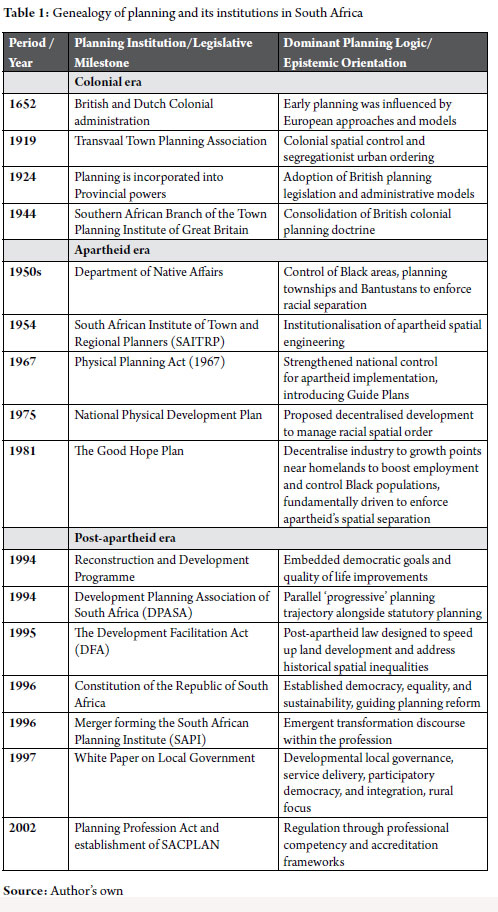
Planning's prejudiced foundations were laid during both the British colonial rule and the apartheid era. The establishment of the Transvaal Town Planning Association in 1919 marked the beginning of an organised planning fraternity, explicitly modelled on British planning legislation (Lewis & Nel, 2025). Planning was defined through land-use management, health, hygiene, and traffic management, seemingly neutral technical concepts that functioned as proxies for racial segregation and slum control (Muller, 1991).
The transition from the colonial to the apartheid era in 1948 did not represent a turn, but rather the formalisation and intensification of these colonial spatial practices. Planning became increasingly technocratic, focusing on the what and how of development control. As Muller (1991:22) observed, most planners were complacent, "turning a blind eye to the social consequences attaching to apartheid legislation". This blind eye was not a passive omission, but an active professional stance that prioritised technical competence over moral accountability.
Wendy Ovens provides a crucial testimony: "Because planners had been so instrumental in the construction of the apartheid, after 1994 there tended to be a diminished status for planners… the core set of planners that were available were those that were not trusted due to the historic role of planning" (Ovens, 2007:47). This reveals a serious blind spot: while attention focused on transforming professional bodies, insufficient interrogation occurred regarding the transformation of planning knowledge itself (Sebola-Samanyanga et al., 2025).
The post-1994 transition sought to transform this legacy. On 25 June 1996, the SAPI was established through the amalgamation of SAITRP and DPASA (Van Zyl, 1997; Lewis & Nel, 2025). As Mbembe (2001) argues, the post-colony is characterised by a temporal complexity in which colonial pasts actively constitute post-colonial presents. For South African planning, this means that the profession's colonial-apartheid genealogy is not archived history, but a structurally present condition. The current article argues that planning cannot redress what it refuses to remember.
Theory and literature
Historical consciousness and decolonial theory
This article employs historical consciousness as a primary theoretical lens, understood both as an analytical concept and as an ethical-political commitment. Historical consciousness refers to the ways individuals and collectives understand their temporal embeddedness, how they interpret the past, situate themselves in the present, and imagine possible futures (Rüsen, 2004). In post-colonial contexts, historical consciousness must be theorised through decolonial frameworks that account for how colonial power has shaped historical memory and knowledge production.
Ndlovu-Gatsheni (2013) articulates a specifically African conception of historical consciousness grounded in recognition that colonialism and its afterlives systematically disrupted indigenous temporalities and historical sensibilities. Coloniality, as Quijano (2007) theorises, encompasses interlocking systems, the coloniality of power, knowledge, and being, that continue to structure social reality even after formal decolonisation. Rüsen's (2004) typology identifies four modes through which individuals make sense of historical time: Traditional consciousness (the past provides normative models); Exemplary consciousness (history offers general rules); Critical consciousness (present experiences call inherited traditions into question); and Genetic consciousness (change itself becomes the principle for understanding temporal development). For a post-colony, developing critical and genetic historical consciousness is essential for disrupting colonial temporal logics.
It is important to acknowledge the theoretical tension in bringing Rüsen's framework into dialogue with decolonial thought. Rüsen works within a broadly European hermeneutic tradition; Mignolo (2007; 2011; 2023) and Quijano (2007) operate from a decolonial epistemological tradition, attending to how colonial power structures the very conditions of knowledge production. Rather than treating this tension as a problem to be resolved, this article holds it productively: Rüsen's typology provides a diagnostic taxonomy for identifying which modes of temporal orientation a curriculum cultivates or suppresses, while Mignolo and Quijano supply the power-critical analysis of why certain temporalities are systematically marginalised within Euro-Western knowledge frameworks.
Epistemic justice, as theorised by Fricker (2007) and extended by De Sousa Santos (2015) through the concept of epistemicide, requires recognition that colonial violence included the systematic destruction of non-Western knowledge systems. For planning, epistemic justice demands fundamentally interrogating whether Euro-Western planning theories, developed to manage European industrial cities, are adequate for addressing spatial injustice in post-colonial African cities shaped by colonial conquest.
History of education under apartheid and historical consciousness
As established in the Background, Christie and Collins (1982) and Hyslop (1999) demonstrate that Bantu Education's curriculum was designed to produce docility, and was met with sophisticated learner resistance. The theoretical contribution added here is Biko's (1978) Black Consciousness framework: circulating among student activists in the years preceding the Uprising, it supplied the intellectual apparatus through which young people could diagnose their own educational subordination and articulate a counter-vision.
The language policy controversy crystallised the epistemological stakes of Bantu Education. Heugh (2000) demonstrates that the imposition of Afrikaans in 1975 was understood by teachers and learners alike as a deepening of the epistemological injury already inflicted by Bantu Education's curricular content. The curriculum had already told Black learners that their history, their languages, and their knowledge systems were inferior; Afrikaans as a medium of instruction added linguistic displacement to epistemological dispossession.
Curriculum control under apartheid extended to the formation of professional knowledge. As Nkondo (1976) argued in the immediate wake of the Uprising, the production of professionals through apartheid education was the production of a particular kind of professional, one oriented to serving the apartheid system's needs rather than to critically interrogating it. This observation is directly applicable to planning education. The planners trained in South African universities during the apartheid era were not simply trained in neutral technical competencies; they were trained within an epistemological framework that normalised racial spatial order. Muller (1991) and Parnell and Mabin (1995) have documented how planning's technical vocabulary, spatial efficiency, development control, and slum clearance served ideological purposes while appearing scientifically neutral. Curriculum control and professional formation were, in this respect, continuous with Bantu Education's broader project.
Scholarship on history education in South Africa provides the second scholarly context within which this article's argument is situated. Following the transition to democracy in 1994, the question of what history to teach, and how to teach it became a major site of curriculum contest; this question is deliberated to this day. Kros (2010) provides a detailed account of the negotiations over history curriculum in the 1990s, demonstrating that the question of whose history counts as canonical knowledge was not resolved by democracy, but rather became an ongoing site of struggle. Msila (2007) has examined how historical memory is negotiated in post-apartheid schools, arguing that educational institutions bear particular responsibility for whether the past is engaged critically or suppressed.
Seixas and Morton (2013) identify several key dimensions of historical thinking: historical significance, evidence, continuity and change, cause and consequence, historical perspective, and ethical judgment. These competencies are directly applicable to planning education. Planning decisions require assessing which spatial conditions are historically significant, what evidence exists for their causes, how to understand continuity and change in spatial inequality, and what ethical judgments are required in responding to historical injustice. A competency framework for planning education that does not mandate historical thinking in this sense is not only incomplete; it is inadequate.
Samuel (2008) has examined the challenges facing history teachers in post-apartheid South Africa, documenting how teachers navigate between official curriculum frameworks, institutional cultures, and the competing demands of historical consciousness and nation-building. Samuel's work highlights the institutional mechanisms through which historical memory is managed in educational settings, mechanisms directly relevant to understanding how SACPLAN's competency framework manages the memory of planning's apartheid history. The parallel is instructive; just as history teachers sometimes retreat to safe, depoliticised narratives to manage the discomfort of contested history, planning's competency framework retreats to technical language to manage the discomfort of the profession's colonial-apartheid inheritance.
Nuttall and Coetzee (1998), in their collection on negotiating the past in post-apartheid South Africa, argue that the past is not simply something to be acknowledged or archived, but an active force in constituting the present. Their argument is directly relevant to this article; that planning education's refusal to engage with the colonial-apartheid past is not a neutral omission, but an active production of a present in which that past cannot be interrogated. The ahistorical planner is produced by an educational system that has decided, at the institutional level, that the past need not be faced.
The Soweto Uprising in educational historiography
Much of the existing literature situates the Uprising primarily within political history, the history of the liberation struggle, the crisis of apartheid legitimacy, the emergence of Black Consciousness, or the international dimensions of South African resistance (Karis & Gerhart, 2010; Lodge, 1983). This framing is important; however, Ndlovu's (2006) account in The Road to Democracy in South Africa is more closely aligned with the argument advanced in the article. His analysis demonstrates that the students were engaged in a sophisticated critique of curriculum and pedagogy, not simply protesting against Afrikaans as a language, but against the entire epistemological orientation of Bantu Education.
Bonner and Segal (1998) situate the Uprising within the longer social history of Soweto, demonstrating that the educational protests of 1976 were continuous with a longer tradition of community resistance to the conditions of life under apartheid. Their account is important for understanding how the Uprising connected educational politics to spatial politics, the same system that designed Bantu Education also designed the townships, the pass laws, and the spatial geography of racial subjugation. This connection is precisely what makes the Soweto Uprising analytically productive for a critique of planning education. The spatial dispossession that planners are tasked with addressing today is the same dispossession against which the Soweto learners rose in 1976.
Hyslop's (1999) analysis of the classroom struggle provides a crucial conceptual contribution. He demonstrates that student agency in 1976 was not simply reactive, but constitutive; the learners did not simply resist an imposed curriculum, they actively generated an alternative educational politics rooted in historical consciousness and political solidarity. This insight resonates with this article's argument about planning education. The call is for both planning students to be given more historical information and for planning education to cultivate the kind of historical consciousness that enables critical interrogation of the profession itself. The Soweto learners' example demonstrates that such consciousness is possible and has genuine transformative consequences.
Crucially, the Soweto Uprising illuminates the relationship among curriculum, language, professional formation, and political subjectivity in ways directly applicable to planning education today. The Uprising demonstrated that curriculum is never just technical; it produces subjects with particular orientations toward the social world, particular capacities for critique or compliance, and particular relationships to historical memory. Bantu Education produced a curriculum designed to foreclose political subjectivity; the learners of 1976 refused that foreclosure. Contemporary planning education, by omitting historical consciousness from its competency requirements, risks producing a similarly foreclosed professional subjectivity.
There are, of course, limits to this comparison that must be acknowledged. Bantu Education was a consciously racist project, designed with explicit ideological intent to subordinate African intellectual development. Contemporary planning education does not operate from such intent; SACPLAN's omission of historical consciousness is, as this article consistently argues, inadvertent rather than deliberate. The scale of violence is not equivalent; Bantu Education was a system of mass educational dispossession enforced by a police state; the omissions in SACPLAN's competency framework are institutional oversights operating in a democratic constitutional order. While these distinctions matter, they do not dissolve the structural parallel; both systems produce professional or educational subjects whose historical consciousness is constrained by what the curriculum omits. The parallel is structural, not moral; it illuminates a mechanism, not an equivalence.
Coloniality of planning knowledge and transformation
Planning was not, and is not, politically neutral. In South Africa, this relationship was explicit during apartheid. Planners provided technical expertise that made racial segregation appear rational and scientific rather than ideological and violent. Planning's technical language, spatial efficiency, land-use optimisation, and development control obscured the racist purposes these techniques served (Parnell & Mabin, 1995). Post-apartheid transformation has involved changing terminology and introducing concepts such as spatial justice, equality, and transformation; however, as Sihlongonyane (2015) demonstrates, these function as empty signifiers without historical grounding.
A critical distinction must be established between transformation and decolonisation. Transformation suggests changing form while potentially maintaining essential characteristics. Decolonisation requires fundamental rupture; dismantling colonial power relations and creating genuinely new social formations (Fanon, 1963; Ndlovu-Gatsheni, 2013). Planning in South Africa may be transforming, but not yet decolonising. Demographic representation has improved; progressive policy language has been adopted. However, the epistemic foundations of planning knowledge remain Euro-Western; spatial theories developed for European contexts continue to dominate curricula; and historical consciousness of planning's colonial-apartheid genealogy is not mandated as core professional competence.
Mignolo (2007) distinguishes between decolonisation, which is political independence, and decoloniality, which is the ongoing process of dismantling colonial power relations in knowledge, being, and social organisation. South Africa achieved political decolonisation in 1994, yet, decoloniality remains incomplete. Planning's transformation discourse has focused on increasing racial representativeness while inadequately addressing epistemic decoloniality, the transformation of planning knowledge itself. Genuine decolonisation, as Mbembe (2016) articulates, requires a process of (re)membering, not recalling the past, but (re)constituting dismembered knowledge systems, spatial imaginaries, and African identities.
SACPLAN's competency frameworks directly shape what planning schools teach and what knowledge is validated as essential for professional practice. Sebola-Samanyanga et al. (2025) demonstrate how colonial epistemic frameworks persist in higher education despite decolonisation calls following the #FeesMustFall and #RhodesMustFall movements, arguing that decolonisation requires not superficial curriculum adjustments, but a fundamental epistemic transformation centring African knowledge systems and historical consciousness. Lewis and Nel (2025:101) state that "the Standards and Competencies project has probably been one of the most transformative actions undertaken by SACPLAN", noting that these standards "impact planning education, registration, and practice". This underscores the significance of competency frameworks and, therefore, the particular consequences of their omissions.
Findings
Document analysis: SACPLAN competency guidelines
A systematic analysis of SACPLAN's Guidelines for Competencies and Standards for Curriculum Development reveals a striking absence. South Africa's colonial and apartheid history is nowhere explicitly identified as a core professional competence. The guidelines specify numerous technical competencies, land-use management, spatial analysis, environmental assessment, project management, and many others, however, historical consciousness is absent (see Table 2).
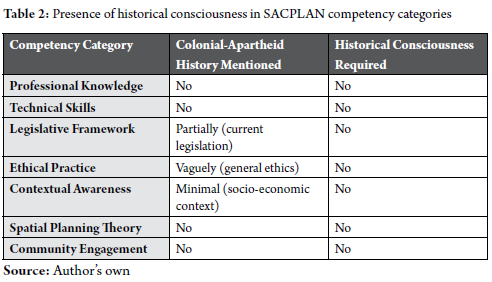
Under Professional Knowledge, the guidelines specify "knowledge of planning systems, theories, principles and methods" (SACPLAN, 2014b:8), however, there is no reference to colonial or apartheid history. Under the Legislative Framework, current post-apartheid legislation is cited as required knowledge, however, the apartheid-era legislative architecture that produced the spatial conditions contemporary legislation must address, is absent. This is a particularly significant silence. The Spatial Planning and Land Use Management Act (SPLUMA)'s spatial justice principle cannot be understood without understanding the colonial-apartheid laws it responds to (Spatial Planning and Land Use Management Act [SPLUMA], 2013). Under Professional Ethics, adherence to the code of professional conduct is required, however, there is no mandate to engage with planning's historical violations of professional ethics during apartheid.
The framework, thereby, aims to produce the ahistorical planner, that is historically unconscious, and unable to critically interrogate the colonial-apartheid planning presence.
Discourse analysis: Transformation terminology
Examination of institutional documents reveals that transformation discourse consistently favours the language of 'undoing' and 'correcting' rather than 'redressing' and 'repairing'. As Sihlongonyane (2015) identifies, terms such as transformation, undo, correct, address, and improve recur, however, function as empty signifiers, deployed without sufficient historical grounding. Where 'undo' implies a technical reversal requiring no moral reckoning, 'redress' implies acknowledging an injustice and accepting a duty to repair. This linguistic choice positions planning's colonial-apartheid past as a technical malfunction rather than a structural wrong demanding moral accountability. This discursive pattern enables what appears to be progressive transformation rhetoric, while maintaining colonial-apartheid amnesia.
Silence analysis: What remains unsaid
Following Trouillot's (2015) methodology, examination of SACPLAN documents reveals five systematic erasures:
While competency guidelines acknowledge unjust spatial policies, colonialism is not mentioned once. By silencing colonialism, transformation discourse gives the impression that planning's problems began in 1948, when in fact, they originated with colonial conquest. This silence enables apartheid to be treated as an aberration from otherwise legitimate planning rather than an intensification of colonial spatial control.
Literature demonstrates that "planners had been so instrumental in the construction of the apartheid space economy" (Ovens, 2007:47), yet there is minimal engagement with mechanisms of this complicity. How did planning education produce professionals willing to collaborate with the apartheid regime? Without confronting this question, the risk persists of reproducing complicity under new terminology.
Competency guidelines address spatial transformation without explicitly naming race as the organising principle of South African space. As Mamdani (1996) argues, apartheid was a system of racial governance that continues shaping spatial relations even after legal abolition. By avoiding explicit racial analysis, competency frameworks enable graduates to address poverty and inequality as general technical problems rather than the ongoing effects of racialised dispossession.
Competency guidelines validate Euro-Western planning theories while not mandating engagement with African urbanisms, indigenous spatial governance systems, or ubuntu-informed approaches to communal space. This silence preserves epistemic colonialism; European knowledge is validated as universal professional knowledge while African knowledge remains marginalised as cultural particularity.
SACPLAN documents focus on apartheid-era planners' complicity, however, remain silent about the unconscious transmission of colonial-apartheid epistemic frameworks by planners and educators trained within apartheid-era institutions who continue teaching at South African universities today. The mechanism is Bourdieu's (1990) habitus, durable dispositions acquired through socialisation, which structure pedagogical choices below the threshold of individual intentionality. Ndlovu-Gatsheni (2018) identifies this as the coloniality of knowledge, the persistence of colonial epistemic frameworks through the ordinary reproduction of academic culture.
These silences are not accidental, but systematic. They enable a transformation discourse that acknowledges historical injustice while avoiding confrontation with the fact that planning knowledge itself remains rooted in colonial-apartheid assumptions. The effect is colonial-apartheid amnesia masquerading as transformation.
Discussion
Colonial-apartheid amnesia as epistemic violence
The findings demonstrate that SACPLAN's competency frameworks institutionalise historical amnesia by failing to mandate colonial-apartheid history as a core professional competence. This omission constitutes what De Sousa Santos (2015) terms epistemicide, the systematic destruction of knowledge systems. By rendering historical consciousness optional rather than foundational, competency frameworks enable the production of planners who can technically execute spatial interventions without understanding the historical conditions those interventions must address.
The parallel to Bantu Education is analytically instructive, though the distinction it illuminates is as important as the similarity. Verwoerd designed Bantu Education as a consciously racist project, explicitly intended to limit African intellectual development and produce docile labour for white capital. Contemporary planning education does not operate from such intent; SACPLAN's omission of historical consciousness is inadvertent. However, this distinction sharpens rather than weakens the critique; if colonial-apartheid amnesia in planning education were a product of explicit racism, it could be addressed through personnel change. The more troubling reality is that it operates structurally, through ostensibly neutral professional frameworks that carry colonial epistemic logics without announcing them. Bonilla-Silva's (2021) concept of racism without racists is pertinent; a system can produce racialised outcomes through colour-blind mechanisms that feel entirely legitimate to all participants. This is why mandating historical consciousness in competency frameworks is a structural imperative, not a gesture.
Hyslop's (1999) analysis of the Soweto Uprising provides a further analytical resource here. Hyslop demonstrates that the Soweto learners did not simply resist bad policy; they generated an alternative political subjectivity rooted in historical consciousness. The lesson for planning education is not only diagnostic, it is constructive; historical consciousness, once cultivated, and generates the capacity for critical professional practice. A planner with historical consciousness of how the Group Areas Act produced the spatial configurations they are tasked with transforming is a fundamentally different professional from one who understands those configurations as natural or economic. The Soweto Uprising demonstrates that this kind of consciousness is possible; that it can be collectively developed; and that it has transformative political consequences. Planning education that cultivates such consciousness would not be honouring an analogy; it would be drawing on a directly relevant tradition of educational-political thought.
Planning education's lessons from the 1976 Soweto Uprising
The Soweto Uprising helps theorise the relationship between curriculum, language, professional formation, and political subjectivity in ways that bear concretely on planning education decolonisation. First, it demonstrates that the medium of professional knowledge is not neutral. Just as Afrikaans was not simply a language, but an epistemological vehicle, the theoretical frameworks through which planning knowledge is transmitted, predominantly Euro-Western, are not neutral conduits, but shaped by particular historical and political formations. A curriculum that transmits spatial theory exclusively through the works of Ebenezer Howard, Jane Jacobs, Danial Burnham, Donald Appleyard, Patrick Geddes, Le Corbusier, and Kevin Lynch without equivalent engagement with African spatial philosophers or indigenous land governance systems is not providing neutral professional knowledge; it is reproducing a particular epistemological orientation, one formed within European industrial modernity and not designed for post-colonial African urban conditions.
Second, the Uprising demonstrates that learner agency in relation to curriculum is a legitimate educational-political act. Ndlovu's (2006) historiography makes clear that the 1976 students were not simply protesting; they were enacting an alternative educational politics rooted in the conviction that education either serves liberation or domination. Planning education that takes this lesson seriously should approach curriculum development in a way that recognises students as the very agents who will, at first hand, be dealing with the redress of past socio-economic and spatial injustices.
Third, the history of Bantu Education and school resistance might reshape the curriculum of planning education in the following ways: (i) the colonial-apartheid history and legislative architecture should be core mandated knowledge, because planners cannot understand what SPLUMA's spatial justice principle is responding to without understanding the legal instruments of dispossession it responds to; the genealogy of planning's professional institutions, as documented in Table 1, should be part of professional knowledge, enabling planners to understand that SACPLAN does not exist in a historical vacuum, but inherits an institutional culture formed within colonial and apartheid spatial practice and therefore, needing a conscious and deliberate colonial-detoxification; and African urbanisms, indigenous land governance systems, and ubuntu-grounded approaches to communal space should be introduced as foundational knowledge rather than as supplementary cultural material.
Critical planning education questions
Ovens' (2007:47) statement that apartheid-era planners were "not trusted due to the historic role of planning" raises questions about professional responsibility that remain unresolved. During apartheid, planning was taught as a doctrine; these teachings informed laws and policies that enabled planners to implement racial segregation with technical legitimacy. The Silence analysis demonstrates that SACPLAN's competency frameworks remain silent about this history of complicity. Without explicitly confronting inherited epistemic planning frameworks, the threat persists of intergenerational transmission of colonial-apartheid ideologies even among academics who sincerely reject explicit racism.
The irony that structures planning in democratic South Africa must be named plainly. Most planning work directly addresses colonial-apartheid spatial injustices, yet planning education risks producing graduates who view colonial-apartheid as historical artefacts requiring no sustained engagement (Sebola-Samanyanga, 2026). On any given day, planners implement spatial transformation policies, facilitate land restitution, design integrated human settlements, and develop socio-economic redress frameworks, all in response to the legacy of colonial-apartheid. Technical competence divorced from historical consciousness produces interventions that may be technically sophisticated, but socio-politically naive, addressing symptoms rather than structural causes.
Racism, as Bonilla-Silva (2021) theorises, is more than individual prejudice; it is a structural system that can operate through formally race-neutral mechanisms. Planning's technical rationality can continue producing racialised spatial outcomes while claiming neutrality. Standards of efficiency, order, and development can encode racial preferences while appearing objective. This is why historical consciousness is essential; without understanding how technical planning concepts historically served racist purposes, young planners remain vulnerable to perpetuating racialised outcomes through apparently neutral technical practice. A transformation that addresses demographic representation without addressing epistemic foundations leaves racist logics embedded in professional knowledge systems.
Conclusion
Half a century after the Soweto Uprising, this article illustrates that a structurally analogous form of educational erasure persists within South African planning education. This phenomenon arises not from intentional design, but from the inadvertent institutionalisation of colonial-apartheid amnesia within professional competency frameworks. The Soweto Uprising serves as a foundational analytical context. It demonstrated that the curriculum is a site for political contestation, where education can either promote liberation or reinforce domination. It emphasised that historical consciousness is a necessity, and that resistance to epistemologically unjust curricula constitute a legitimate educational act. Planning education that acknowledges the Uprising should actively draw on these insights and engage with them.
The implications for curriculum reform are concrete. SACPLAN must revise its competency guidelines to explicitly mandate comprehension of South Africa's colonial-apartheid history as a foundational professional requirement, not as a contextual supplement to technical skills, but as the epistemological ground from which technical competence must develop. Planning schools must confront the theoretical monoculture of Euro-Western paradigms and create genuine space for African epistemologies, indigenous spatial philosophies, and ubuntu-grounded approaches as foundational knowledge.
The Soweto learners of 1976 refused an educational system designed to produce historical amnesia. Planning education, fifty years later, must make the same refusal. As Fanon (1963:146) wrote: "Each generation must discover its mission, fulfil it or betray it, in relative opacity." The mission confronting this generation of planning educators and professional bodies is to ensure that historical consciousness becomes foundational to the planning profession; that colonial-apartheid is recognised not as a closed chapter, but as an ongoing structural condition requiring sustained critical engagement.
References
Biko, S 1978. I write what I like: Selected writings. University of Chicago Press. [ Links ]
Bonilla-Silva, E 2021. Racism without racists: Color-blind racism and the persistence of racial inequality in America. Bloomsbury Publishing PLC. [ Links ]
Bonner, P and Segal, L 1998. Soweto: A history. Maskew Miller Longman. [ Links ]
Bourdieu, P 1990. The logic of practice. Stanford University Press. [ Links ]
Brooks, A and Brickhill, J 1980. Whirlwind before the storm: The origins and development of the Uprising in Soweto and the rest of South Africa from June to December 1976. International Defence and Aid Fund for Southern Africa. [ Links ]
Christie, P and Collins, C 1982. Bantu Education: Apartheid ideology and labour reproduction (pp. 160-183). In: P Kallaway (eds.). Apartheid and education: The education of Black South Africans. Braamfontein: Ravan Press. [ Links ]
Clark, NL and Worger, WH 2016. South Africa: The rise and fall of apartheid. Routledge. [ Links ]
De Sousa Santos, B 2015. Epistemologies of the South: Justice against epistemicide. Routledge. [ Links ]
Fanon, F 1963. The wretched of the earth. Grove Press. [ Links ]
Fraser, A 2007. Land reform in South Africa and the colonial present. Social & Cultural Geography, 8(6):835-851. [ Links ]
Fricker, M 2007. Epistemic injustice: Power and the ethics of knowing. Oxford University Press. [ Links ]
Grever, M and Adriaansen, RJ 2019. Historical consciousness: The enigma of different paradigms. Journal of Curriculum Studies, 51(6):814-830. [ Links ]
Heugh, K 2000. The case against bilingual and multilingual education in South Africa (Vol. 3). Cape Town: PRAESA Occasional Papers, 6. [ Links ]
Horrell, M 1969. Bantu Education to 1968. South African Institute of Race Relations. [ Links ]
Hyslop, J 1999. The classroom struggle: Policy and resistance in South Africa 1940-1990. University of Natal Press. [ Links ]
Karis, T and Gerhart, GM 2010. From protest to challenge: A documentary history of African politics in South Africa, 1882-1990. Indiana University Press. [ Links ]
Kros, C 2010. The seeds of separate development: Origins of Bantu Education. Unisa Press. [ Links ]
Lewis, M and Nel, V 2025. Institutional change and transformation of the planning profession. In: D du Plessis (ed.). Territorial governance and spatial transformation in post-apartheid South Africa (pp. 87-111). Local and Urban Governance. Springer, Cham. [ Links ]
Lodge, T 1983. Black politics in South Africa since 1945. London: Longman. [ Links ]
Makakavhule, K and Landman, K (eds.) 2025. Decolonising the built environment: Process, product, and pedagogy. Routledge. [ Links ]
Mamdani, M 1996. Citizen and subject: Contemporary Africa and the legacy of late colonialism. Princeton University Press. [ Links ]
Mbembe, A 2001. On the postcolony. University of California Press. [ Links ]
Mbembe, A 2015. Decolonising knowledge and the question of the archive. Lecture transcript, University of the Witwatersrand. [ Links ]
Mbembe, A 2016. Decolonising the university: New directions. Arts and Humanities in Higher Education, 15(1):29-45. [ Links ]
Mignolo, WD 2007. Delinking: The rhetoric of modernity, the logic of coloniality and the grammar of decoloniality. Cultural Studies, 21(2-3):449-514. [ Links ]
Mignolo, WD 2011. The darker side of Western modernity: Global futures, decolonial options. Duke University Press. [ Links ]
Mignolo, W 2023. The colonial matrix of power. In: CO Christiansen, ML Machado-Guichon, S Mercader, OB Hunt, and P Jha (eds.). Talking about global inequality: Personal experiences and historical perspectives (pp. 46-39). Cham: Springer International Publishing. [ Links ]
Msila, V 2007. From apartheid education to the revised national curriculum statement: Pedagogy for identity formation and nation building in South Africa. Nordic Journal of African Studies, 16(2):146-160. [ Links ]
Muller, J 1991. Professionalism, community, and empowerment. Town and Regional Planning, 31:20-24. [ Links ]
Munyaradzi, J 2024. A historical review of African scholarship and the decolonial discourse: Challenges and prospects. The Thinker. 99(2):1-23. [ Links ]
Ndlovu, SM 2006. The road to democracy in South Africa: Volume 2 1970-1980. Pretoria: Unisa Press. [ Links ]
Ndlovu-Gatsheni, SJ 2013. Empire, global coloniality and African subjectivity. Berghahn Books. [ Links ]
Ndlovu-Gatsheni, SJ 2018. Epistemic freedom in Africa: Deprovincialization and decolonisation. Routledge. [ Links ]
Nkondo, GM 1976. Turfloop testimony: The dilemma of a Black university in South Africa. Johannesburg: Ravan Press. [ Links ]
Nuttall, S and Coetzee, C 1998. Negotiating the past: The making of memory in South Africa. Oxford University Press. [ Links ]
Ovens, W 2007. Towards a JIPSA business plan for strengthening urban planning skills in South Africa: Assessment of planning skills in South Africa. Draft report (September 2007). [ Links ]
Parnell, S and Mabin, A 1995. Rethinking urban South Africa. Journal of Southern African Studies, 21(1):39-61. [ Links ]
Phiri, MZ 2024. The ideology of epistemicide. In: JS Sanni and MZ Phiri (eds.). Monuments and memory in Africa. Routledge. [ Links ]
Quijano, A 2007. Coloniality and modernity/rationality. Cultural Studies, 21(2-3):168-178. [ Links ]
Rüsen, J 2004. Historical consciousness: Narrative structure, moral function, and ontogenetic development. Theorising Historical Consciousness, 4:63-85. [ Links ]
SACPLAN (South African Council for Planners) 2014a. Consolidated report on competencies and standards. Document number 8/4/1/C&S/SQ/12-2014, Midrand. [ Links ]
SACPLAN (South African Council for Planners) 2014b. Guidelines for competencies and standards for curricula development. Document number 8/4/1/C&S/Curr/12-2014. SACPLAN, Midrand. [ Links ]
Samuel, M 2008. Accountability to whom? For what? Teacher identity and the force field model of teacher development. Perspectives in Education, 26(2):1-14. [ Links ]
Sebola-Samanyanga, KJP 2026. Spatial epistemologies: Towards critical consciousness in South Africa's built environment education. SURE-Built 2025. Springer, Cham. [ Links ]
Sebola-Samanyanga, KJP, Nkosi, HZ, and Peter, K 2025. The lingering coloniality of knowledge: Challenges to decolonising South African universities. Yesterday and Today, 34(1):203-223. [ Links ]
Seixas, P and Morton, T 2013. The big six historical thinking concepts. Toronto: Nelson Education. [ Links ]
Sihlongonyane, MF 2015. Empty signifiers of transformation in participatory planning and the marginalisation of black people in South Africa. Planning Practice and Research, 30(1):83-100. [ Links ]
South African Government 2013. Spatial Planning and Land Use Management Act 16 of 2013. Pretoria: Government Printer. [ Links ]
Trouillot, MR 2015. Silencing the past: Power and the production of history. Beacon Press. [ Links ]
Van Zyl, J 1997. The amalgamation process and the planning profession in South Africa. Town and Regional Planning, 44:46-51. [ Links ]
Verwoerd, HF 1975 (1954). "Speech in the Senate, June 7 1954", in Brian Rose and Raymond Tunmer (eds.), Documents in South African Education. Johannesburg: A.D. Donker, 260-266. [ Links ]
Wa Thiong'o, N 1986. Decolonising the mind: The politics of language in African literature. James Currey. [ Links ]
