Services on Demand
Journal

Article
 English (pdf)
 Article in xml format
 Article references
 Automatic translation
 Send this article by e-mail
Indicators
Related links
-
 Cited by Google
 -
 Similars in Google
Share

 Permalink
The African Journal of Information and Communication
On-line version ISSN 2077-7213Print version ISSN 2077-7205
AJIC vol.35 Johannesburg 2025
https://doi.org/10.23962/ajic.i35.21309
RESEARCH ARTICLES
Detection of GenAI-produced and student-written C# code: A comparative study of classifier algorithms and code stylometry features
Adewuyi Adetayo AdegbiteI; Eduan KotzéII
IPostdoctoral Research Fellow, Department of Computer Science and Informatics, University of the Free State, Bloemfontein, South Africa; and Lecturer, Adekunle Ajasin University, Akunba Akoko, Ondo State, Nigeria. https://orcid.org/0000-0001-8195-1382
IIAssociate Professor and Head of Department, Department of Computer Science and Informatics, University of the Free State, Bloemfontein, South Africa. https://orcid.org/0000-0002-5572-4319
ABSTRACT
The prevalence of students using generative artificial intelligence (GenAI) to produce program code is such that certain courses are rendered ineffective because students can avoid learning the required skills. Meanwhile, detecting GenAI code and differentiating between GenAI-produced and human-written code are becoming increasingly challenging. This study tested the ability of six classifier algorithms to detect GenAI C# code and to distinguish it from C# code written by students at a South African university. A large dataset of verified student-written code was collated from first-year students at South Africa's University of the Free State, and corresponding GenAI code produced by Blackbox.AI, ChatGPT and Microsoft Copilot was generated and collated. Code metric features were extracted using modified Roslyn APIs. The data was organised into four sets with an equal number of student-written and AI-generated code, and a machine-learning model was deployed with the four sets using six classifiers: extreme gradient boosting (XGBoost), k-nearest neighbors (KNN), support vector machine (SVM), AdaBoost, random forest, and soft voting (with XGBoost, KN N and SVM as inputs). It was found that the GenAI C# code produced by Blackbox.AI, ChatGPT, and Copilot could, with a high degree of accuracy, be identified and distinguished from student-written C# code through use of the classifier algorithms, with XGBoost performing strongest in detecting GenAI code and random forest performing best in identification of student-written code.
Keywords: C# code, generative AI (GenAI) code, student-written code, machine-learning, code classification, code stylometry features
1. Introduction
Artificial intelligence (AI) has recently advanced significantly in several domains, transforming businesses, industries, and academia with its power, especially with the advent of large language models (LLMs) (Makridakis, 2017). Software development is one field where AI is having a strong influence (Kuhail et al., 2024). Generative artificial intelligence (GenAI) code is rapidly progressing due to advancements in natural language processing (NLP) and deep neural language models. GenAI code is autonomously generated source code (such as Python, C++, or C#) based on high-level requirements, specifications, or samples using machine-learning methods, especially deep-learning models (Odeh et al., 2024). The algorithms learn to produce new code that satisfies predetermined standards through the use of enormous repositories of pre-existing code, computer languages and patterns (Song et al., 2019).
The proliferation of GenAI code is fuelled by a few key technologies. LLMs, such as OpenAI's GPT (generative pre-trained transformer) series, have shown impressive capacities for comprehending and producing text that resembles human-written text (Cao et al., 2023). When used in code creation, these models can transform plain-language descriptions of desired functionality into executable code. Neural architectures are a crucial element in the production of code that satisfies predetermined requirements, and architectures are created specifically for code-creation activities (Dehaerne et al., 2022). The models learn to map input-output pairings, such as code snippets and their accompanying functionality. Code semantics, syntax, and patterns can be analysed and understood by such AI models when trained on extensive code repositories (Wan et al., 2023). In this field, transformers (Vaswani et al., 2017), convolutional neural networks (CNNs), and recurrent neural networks (RNNs) are model variants that are often used.
Thus, AI models can generate code that respects coding standards and complies with best practices (White et al., 2023) in the form of patterns, to solve common problems when using LLMs. Integrated development environments (IDEs) and code editors with AI capabilities such as Microsoft Copilot (Nghiem et al., 2024) offer intelligent and instantaneous code completion, recommendations and corrections (Cao et al., 2023). Through context, user behaviour, and pre-existing code analysis, these technologies improve developer efficiency and decrease mistakes. In codebases, AI algorithms can recognise common errors, anti-patterns, and code smells (potentially problematic code), and automatically recommend optimisations, refactorings, or repairs (Zhang et al., 2022).
While GenAI code is showing great promise, several issues and concerns need to be considered. Retaining good quality, correctness, and semantic meaning in produced code is still a challenge (Krasniqi & Do, 2023). AI models trained on biased or incomplete datasets may produce unfair or undesirable results (Varona & Suárez, 2022). Also, in the educational setting, there is the problem of students presenting GenAI code as their own when submitting computer-programming assignments, and this undermines the development of efficient and effective programmers. Accordingly, for educational institutions to maintain educational standards in their computer-programming courses, it is necessary to have tools that can assist educators in detection of possible student submission of assignments comprising AI-generated code instead of code written by the student. In line with this need for detection tools, the study presented in this article tested the ability of classifier algorithms to distinguish between AI-generated C# code and C# code written by first-year students at the University of the Free State, South Africa.
2. Literature review
A branch of software engineering called "code stylometry" examines programmers' writing styles and habits by analysing their source code (ShaukatTamboli & Prasad, 2013; Zafar et al., 2020). Code stylometry assigns authorship to sections of code based on their stylistic characteristics, much like the use of text stylometry in NLP, which examines writing styles to identify authors of texts (Benzebouchi et al., 2019; Ding et al., 2019). Code stylometry uses a variety of linguistic and structural elements taken from source code to describe programmers' writing styles (Odeh et al., 2024; Tereszkowski-Kaminski et al., 2022). These code stylometry features include lexical, structural, statistical, and syntactic features. Lexical features comprise vocabulary choices, comments, and programming construct usage. Structural features describe the arrangement of control structures, loops, and function definitions. Statistical features explain token distributional properties, language construct frequencies, and code metrics. Syntactic features, which are patterns in code structure, include indentation, naming conventions, and code organisation.
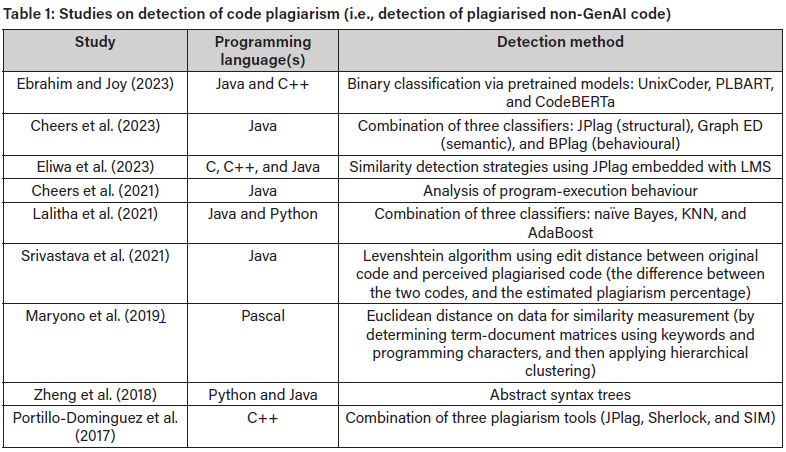
Code stylometry methodologies include elements of machine-learning, statistical analysis and NLP. To find patterns in code and determine authorship, researchers use methods including authorship attribution models, clustering algorithms, and classification techniques (Kalgutkar et al., 2019). A wide range of applications for code stylometry can be found in: authorship attribution; software evolution (which analyses the evolution of code-writing styles over time to understand developer behaviour, project dynamics, and software quality); code reuse and plagiarism detection (which compares writing styles and code patterns); and security analysis, forensics, malware analysis, and cyber-attack attribution (Caliskan et al., 2018; Czibula et al., 2022). Code stylometry tools are, thus useful for determining programmers' writing styles and code authorship (Tereszkowski-Kaminski et al., 2022). Source-code plagiarism is a critical issue in programming, and several studies have been conducted to explore detection methods. Table 1lists key successful studies of code-plagiarism detection and the detection methods used.
GenAI production of programming code originated in early work on symbolic AI and automated programming. Early efforts focused on rule-based systems, expert systems, and genetic programming techniques. Notable progress was then achieved with the introduction of LLMs and deep-learning architectures. Today's GenAI-coding uses a variety of techniques and methods (Odeh et al., 2024; Raiaan et al., 2024). Natural language descriptions of functionality can be interpreted by NLP models, such as OpenAI's GPT series, and converted into executable code. Symbolic AI approaches produce code by combining statistical techniques with rule-based systems (Kotsiantis et al., 2024; Raiaan et al., 2024).
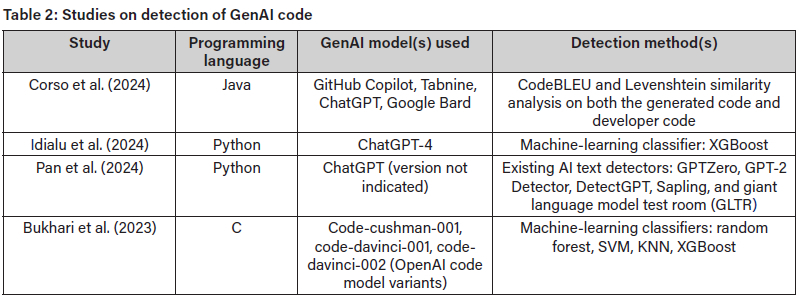
In the education context, according to Idialu et al. (2024), even without AI use, programming courses already suffer from high levels of plagiarism and contract-cheating (a situation where students give their tasks and assignments to an expert to solve the given problems). The use of AI tools for code generation (e.g., GitHub Copilot, Tabnine, Gemini, ChatGPT, Blackbox.AI, Mistral, Microsoft Copilot) is now further undermining academic integrity in such courses. The ease with which GenAI tools can generate code has produced a new form of academic dishonesty, with students submitting GenAI code as their own work (Kazemitabaar et al., 2024). Thus, it has now become necessary for academic instructor to find ways to detect possible AI-based plagiarism of code. Table 2lists studies that have succeeded in detecting GenAI-produced Python, Java and C code as produced by LLMs including ChatGPT models, GitHub Copilot and others.
The study set out in this article focused on detection of GenAI C# code, and on distinguishing between GenAI and student-written C# code, because, to our knowledge, no such studies had previously been carried out in the South African educational context.
3. Study design
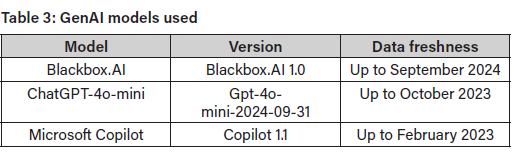
The GenAI C# code used in the study was produced by the Blackbox.AI, ChatGPT, and Microsoft Copilot LLMs, and the student-written code was produced by university students. Table 3lists the versions used for each of the GenAI models.
The study tested the ability of six classifiers-extreme gradient boosting (XGBoost), k-nearest neighbors (KNN), support vector machine (SVM), AdaBoost, random forest, and soft voting (with XGBoost, KNN and SVM as inputs)-to distinguish between GenAI C# code and student-written C# code. These six classifiers were selected based on their successful application in existing studies of code stylometry.
XGBoost constructs decision trees iteratively optimising an objective function to strike a balance between prediction accuracy and model simplicity (Bukhari et al., 2023; Idialu et al., 2024). KNN is an instance-based learning algorithm that classifies data points based on the majority class of their nearest neighbours, identifying the k closest points in the feature space to a new example and assigning the most common class label among them. This method relies on the assumption that similar data points exist in proximity (Bukhari et al., 2024). SVM constructs a hyperplane, or set of hyperplanes, in a high-dimensional space to separate different classes, optimising the distance between the hyperplane and the nearest points of each class, called support vectors. By maximising this margin, SVM ensures robust classification focusing on generalisation to unseen data (Bukhari et al., 2024).
AdaBoost combines multiple weak classifiers, typically decision trees, to form a strong classifier focusing on misclassified examples by adjusting their weights, thereby forcing subsequent classifiers to pay more attention to complex cases. Each classifier contributes to the final prediction with a weight proportional to its accuracy. Random forest builds an ensemble of decision trees by training multiple trees on random subsets
of the training data and features. This ensemble approach reduces the risk of overfitting and enhances the model's generalisation capabilities (Bukhari et al., 2024). Soft voting is an ensemble method that combines predictions from three base models, namely XGBoost, KNN, and SVM, to improve overall performance. Prediction is based on the average probabilities assigned by the models (Lalitha et al., 2021). All classifiers were trained using their default hyperparameters without additional tuning. The study also used SHAP (SHapley Additive exPlanations) to help explain the performance of the classifiers (Lundberg & Lee, 2017).
Ethical clearance
Ethical clearance for this study was granted by the General/Human Research Ethics Committee of the University of the Free State, South Africa, and the ethical clearance number is UFS-HSD2024/0601.
Data collection
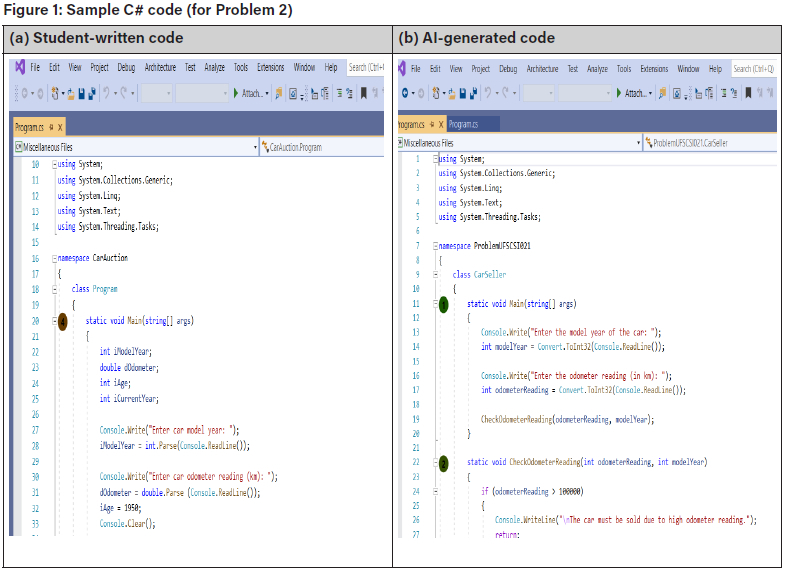
During data collection, C# code files (*.cs) were extracted from Visual Studio C# solution files submitted in response to nine problems by 314 first-year Computer Science students at the Bloemfontein campus of the University of the Free State. The solution files, a sample of which is shown in Figure 1(a), were written in a controlled environment under the supervision of lecturers and student assistants, thus ensuring that the code produced was purely student-written. The same nine problems were presented (by a separate group of 219 students) to Blackbox.AI, ChatGPT, and Microsoft Copilot to solve, and this allowed for the collection of GenAI-generated C# code data, a sample of which is shown in Figure 1(b).
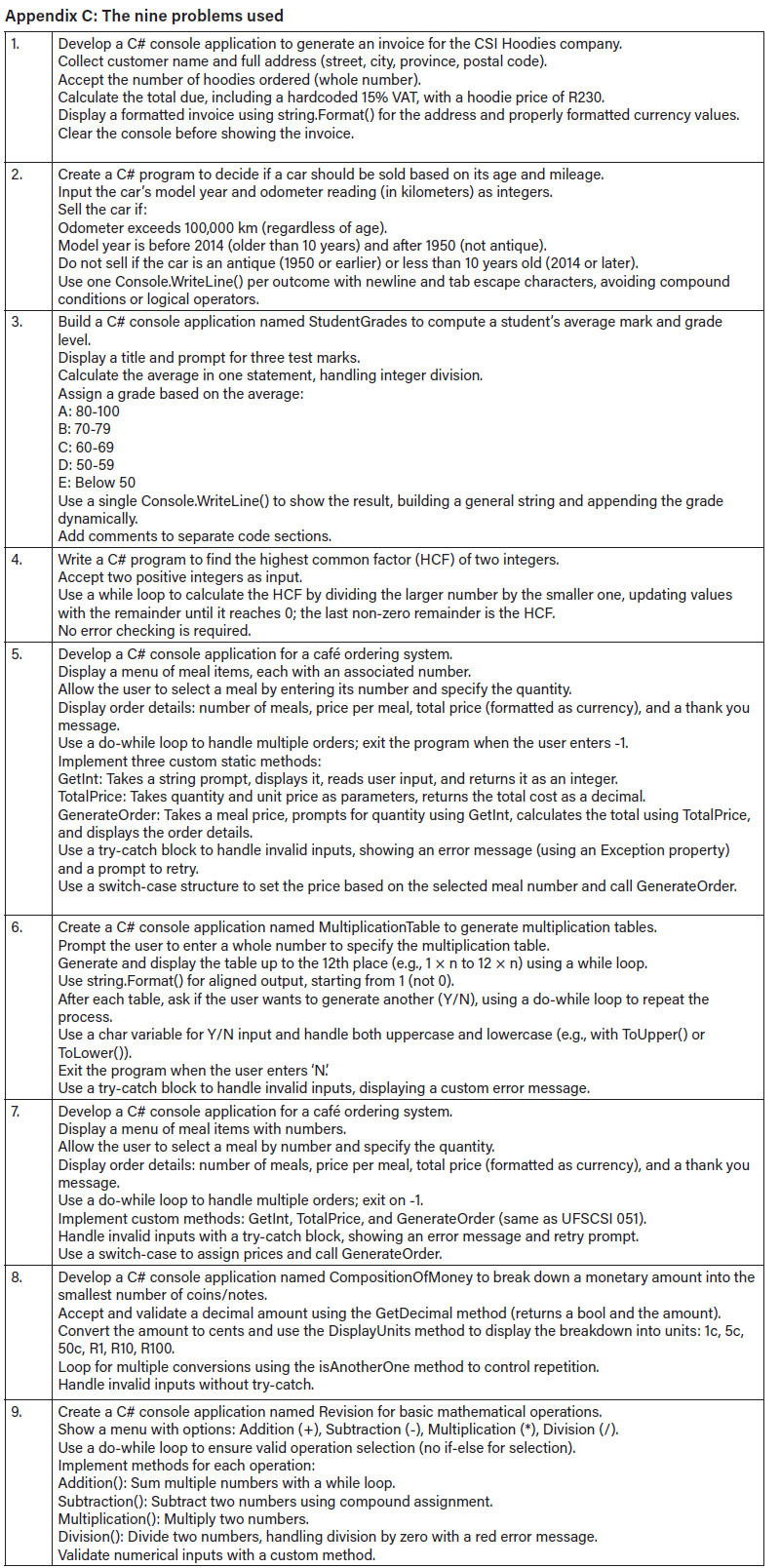
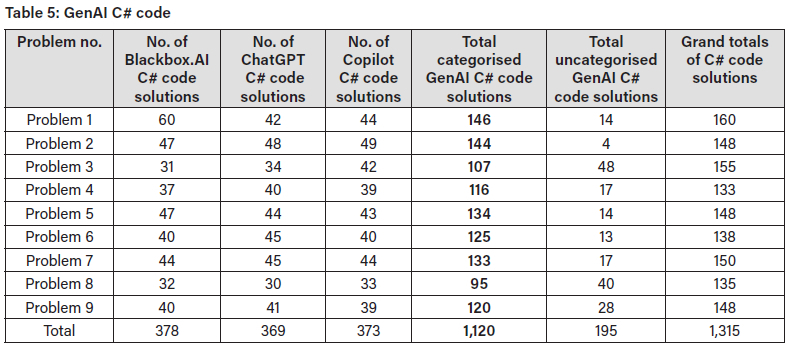
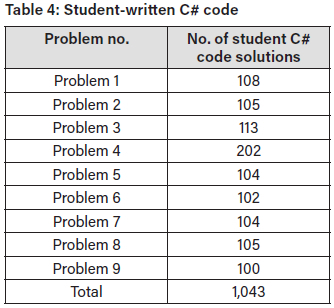
The nine problems were labelled Problem 1 through 9 (Appendix C), with the ordering in ascending order of difficulty, i.e., Problem 9 was the most difficult. In the student-written C# code dataset, there were 1,043 solutions across the nine problems (Table 4. In the GenAI C# code dataset (Table 5, there were 1,120 GenAI C# categorised code solutions across the nine problems, and 195 uncategorised code solutions in total. (The uncategorised code solutions were those for which the GenAI model could not be clearly identified.)
Feature extraction
Modified Roslyn API1 was used to extract the code metrics. For use of modified Roslyn API, the code must be written in visual code by creating a .NET console app with the addition of Microsoft.CodeAnalysis, Microsoft. CodeAnalysis.CSharp, and Microsoft.CodeAnalysis.CSharp.Syntax. The modified Roslyn code read the contents of the C# files into a string and then parsed the C# code into a syntax tree by using its syntax walk to analyse and extract features such as InterpolatedStringCount, StatementCount, MethodCount, ClassCount, VariableDeclarationCount, which are significant to code analysis as regards structure, syntax and semantics. The modified Roslyn API checked through the syntax tree to extract the code metric features, which are embedded into the modified Roslyn code. The extracted metrics were aggregated into a data structure for analysis, with the extracted features saved into an Excel file.
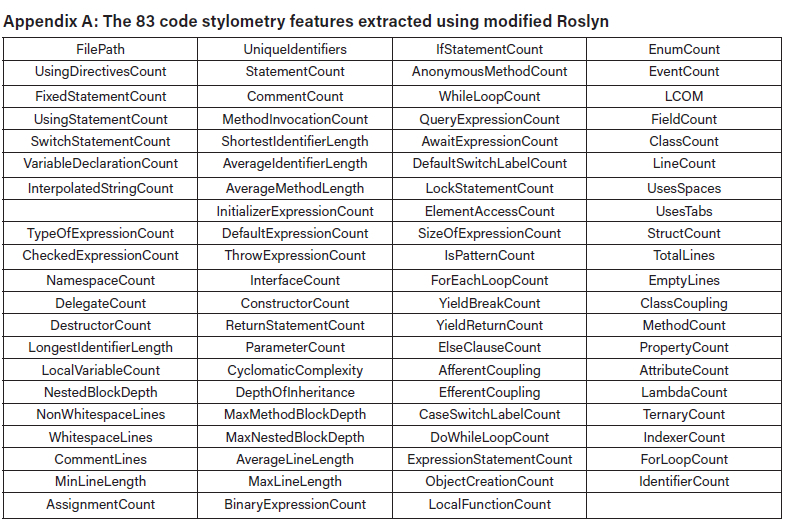
Eighty-three code stylometry features (Appendix A) extracted from the modified Roslyn API were used to train and evaluate the classifiers. The metrics fell into four categories, namely lexical, syntactic, layout, and semantic. Lexical features focus on individual tokens in the code such as keywords, identifiers, operators, and literals, reflecting the vocabulary and basic elements used. Extracted examples included UniqueIdentifiers, AverageIdentifierLength, and InterpolatedStringCount. Syntactic features capture the structural organisation of the code, including arrangement of statements, control flow constructs, and the syntax tree. The syntactic features extracted included IfStatementCount, MethodCount, NestedBlockDepth, and NamespaceCount. Layout features differentiate code based on formatting consistency, and the features extracted included NonWhitespaceLines, TotalLines, LineCount, and AverageLineLength. Semantic features capture the meaning or behaviour of the code, such as data flow, control flow, or implemented logic, and extracted features included MethodInvocationCount, CyclomaticComplexity, and ExpressionStatementCount.
CsvHelper and CsvHelper.Configuration were used to extract these code stylometry features into an Excel file for easy training and testing on the six classifier models. The command prompt was used to run the extraction command, with the directory set to the location of the modified Roslyn Visual Studio file. The "dotnet restore" command was run to check and read the .csproj in the project folder, and then the needed package from NuGet was downloaded into the solution package, and this command addressed any version conflicts. After this, the "dotnet build" command was used to compile the source code into a code that could be executed by .NET runtime and also checked for errors. Finally, the "dotnet run" command was used at the command prompt template, followed by a double quotation of the folder directory housing and saving the C# code files to extract the code stylometric. A confirmation message appeared in the command prompt, indicating the creation of the Excel file and successful writing of the code metrics.
Creation of four datasets
The experiment used 80% of the collected data for training and 20% for testing. All training was performed using group five-fold cross-validation with five splits: in each split, one fold was used for testing and the other four for training. Splitting ensured that no data point from any group appeared in both the training and testing sets. For all models, the number of estimators (n_estimators) was set manually to 100, and no hyperparameter search was performed. This default value provides a good balance between performance and computational cost.
Data was arranged into four sets:
• Set 1 comprised student-written code and a combination of Blackbox.AI, ChatGPT, and Copilot code.
• Set 2 comprised student-written code and Blackbox.AI code.
• Set 3 comprised student-written code and ChatGPT code.
• Set 4 comprised student-written code and Microsoft Copilot code.
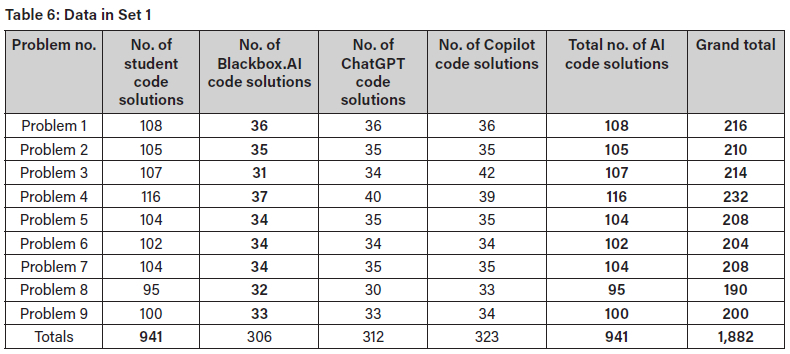
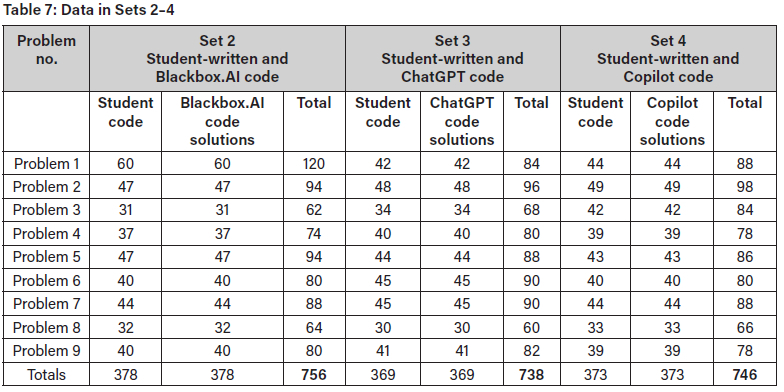
After feature extraction, the data used ensured a balance between the student-written code and the GenAI code across each problem. The data used for the training and testing of each set included 1882, 756, 738, and 746 code solutions for Set 1, Set 2, Set 3, and Set 4, respectively. The training data for Set 1 is outlined in Table 6 The training data for Sets 2-4 is given in Table 7
Testing of the classifier algorithms
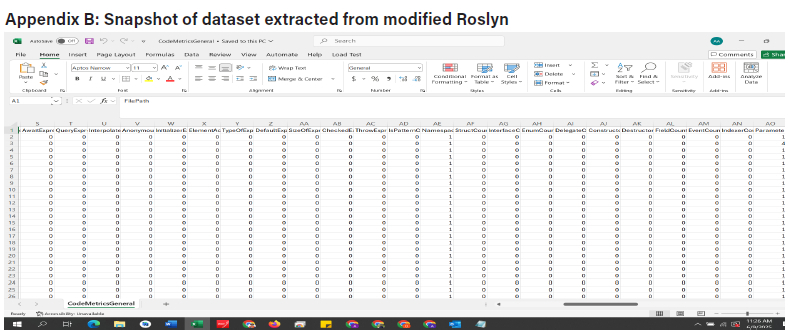
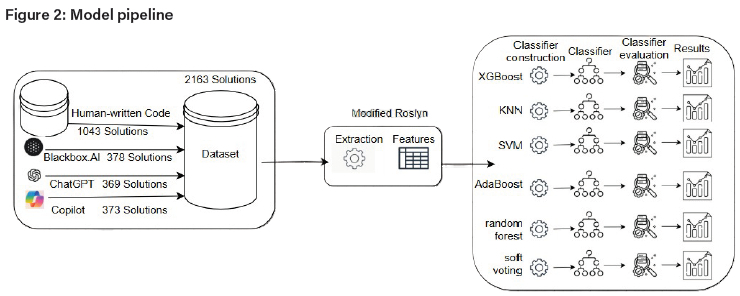
In this study, no preprocessing or encoding was applied to the datasets prior to training the classifiers, because the 83 code stylometry features extracted using modified Roslyn were inherently numerical and continuous, thus representing quantitative properties of the code with no categorical variables (Appendix B). There were no missing values in the dataset, as all 83 features were successfully extracted. A machine-learning model (Figure 2 that sought to distinguish between GenAI C# code and student-written C# code was constructed, using the six aforementioned classifiers: XGBoost, KNN, SVM, AdaBoost, random forest, and soft voting (with XGBoost, KNN and SVM as inputs).
Performance metrics
The performance of each classifier was measured using five metrics: accuracy, recall, precision, F1 score, and AUC-ROC (area under the curve-receiver operating characteristic).
Accuracy gives an overall measure of correctness and, to avoid giving misleading information, the datasets in this studv were balanced with equal amounts of GenAI code and student-written code.

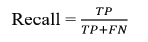
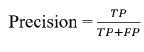
Where TP represents correctly identified GenAI code; TN represents correctly predicted human-written code; FP represents incorrectly classified GenAI code; and FN stands for incorrectly classified human-written code.
Recall measures the actual Gen AI code that is correctly identified, and a high recall indicates that GenAI code is rarely missed.
Precision measures the instances predicted as GenAI code that are actually GenAI. High precision indicates the low possibility of human-written code being classified and flagged as GenAI code.
F1 score is the harmonic mean of precision and recall, which checks the balance between detecting GenAI code and reducing the possibility of human-written code classified as GenAI code.
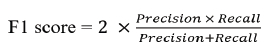
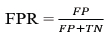
AUC-ROC valuates the model's ability to differentiate between GenAI and human-written code across different classification thresholds.

Where TPR is the true positive rate and the same as recall, and FPR is the false positive rate,
4. Results and discussion
Set 1
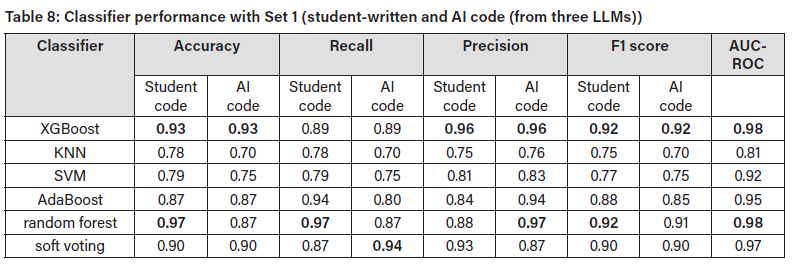
In the test results for Set 1, which combined student-written code and code produced by all three LLMs (Blackbox.AI, ChatGPT, and Microsoft Copilot), it was found that random forest performed best for student-code detection with accuracy of 0.97, supported by recall of 0.97, precision of 0.88, and F1 score of 0.92 (Table 8. This strong performance indicates that random forest effectively identified nearly all the student-written code, with minimal false negatives (i.e., student code misclassified as AI-generated). For the AI-generated code, XGBoost performed best with accuracy of 0.93, recall of 0.89, precision of 0.96, and F1 score of 0.92. Both random forest and XGBoost achieved an AUC-ROC of 0.98, indicating strong discrimination between student and AI code across various thresholds.
Set 2
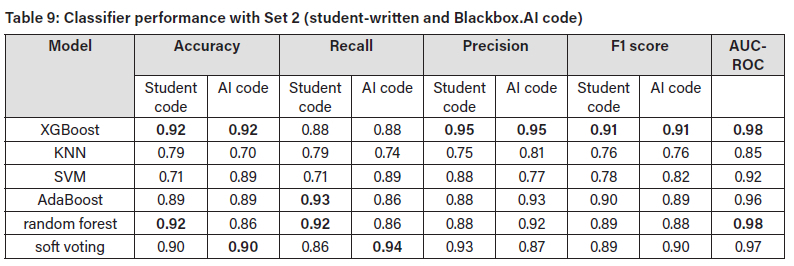
In the test results for Set 2, which combined student-written and Blackbox.AI-produced code, it was found that XGBoost and random forest performed best for student-code detection with accuracy of 0.92 (Table 9. Also, for the student code, XGBoost had recall of 0.88, precision of 0.95, and F1 score of 0.91, while random forest had recall of 0.92, precision of 0.88, and F1 score of 0.89. XGBoost's higher precision indicated fewer false positives, while random forest's higher recall suggested that it was slightly better at capturing all student code. For the Blackbox.AI-generated code, XGBoost was the best classifier, with accuracy of 0.92, recall of 0.88, precision of 0.95, and F1 score of 0.91. These metrics suggest that Blackbox.AI-generated code has distinct features that XGBoost effectively leverages. Both XGBoost and random forest achieved an AUC-ROC of 0.98, reinforcing their strong performance on this set.
Set 3
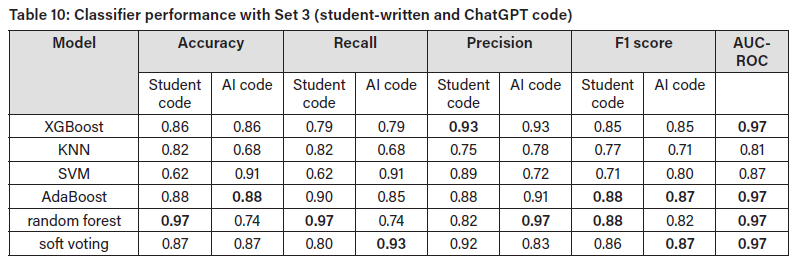
In the test results for Set 3, which combined student-written and ChatGPT-produced code, it was found that random forest performed best for student-code detection with accuracy of 0.97, recall of 0.97, precision of 0.82, and an F1 score of 0.88 (Table 10. For detection of ChatGPT-generated code, AdaBoost was the best classifier with accuracy of 0.88, recall of 0.85, precision of 0.91, and F1 score of 0.87. The lower recall compared to other sets suggests that ChatGPT code is harder to detect, potentially due to student-like characteristics. XGBoost, AdaBoost, random forest, and soft voting all achieved an AUC-ROC of 0.97, indicating robust class separation despite the challenges posed by ChatGPT code.
Set 4
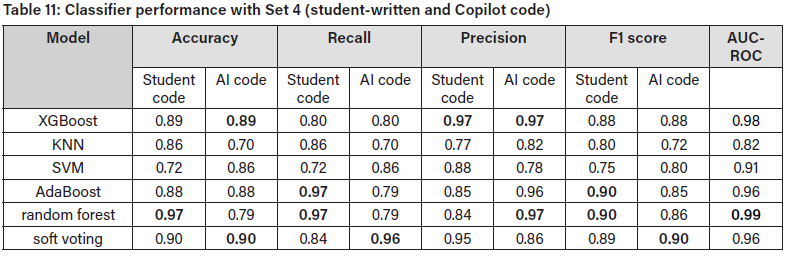
In the test results for Set 4, which combined student-written and Microsoft Copilot-produced code, it was found that random forest performed best for student code detection with accuracy of 0.97, recall of 0.97, precision of 0.84, and F1 score of 0.90 (Table 11. For the Copilot-generated code, the soft voting classifier performed best with accuracy of 0.90, recall of 0.96, precision of 0.86, and F1 score of 0.90. Random forest achieved the highest AUC-ROC of 0.99, followed by XGBoost with 0.98 and AdaBoost and soft voting with 0.96.
Results across the four sets
The results across the four sets indicated that with respect to the AI-generated code, the Blackbox.AI code was the easiest to detect, as demonstrated by the high accuracies in Set 2. ChatGPT (Set 3) and Copilot (Set 4) were more challenging, with lower detection accuracies for AI-generated code. This suggests that Blackbox.AI produces code with stylistic or structural features that are more distinct than
ChatGPT and Copilot when compared to student code. ChatGPT and Copilot apparently generate code that more closely mimics human patterns, possibly due to their advanced language-modelling capabilities. XGBoost dominated AI code detection in Sets 1 and 2 (accuracies of 0.93 and 0.92), while AdaBoost and voting classifier were better suited to Sets 3 and 4 (accuracies of 0.88 and 0.90), respectively. XGBoost's optimisation of decision trees appears to make it more attuned to optimising patterns in Al-generated code, as suggested by the results from Sets 1 and 2. Also notable was the fact that for detection of Al-generated code, the use of the soft voting classifier, which integrates inputs from three classifiers, markedly improved the recall rate.
The results also indicated that the student-written C# code was generally easier to detect than the GenAI C# code, as most classifiers demonstrated superior or equivalent accuracy in identifying the student-written code. This finding may reflect greater variability in student coding styles, making them easier to distinguish from the more uniform Al-generated code. Random forest consistently excelled in student-code detection across Sets 1, 3, and 4, and tied with XGBoost in Set 2, showing its robustness for identifying student code. Random forest's superior performance can be attributed to its algorithmic strength, which reduces overfitting and enhances generalisation, making it well suited to capturing diverse patterns in student-written code.
Feature analysis
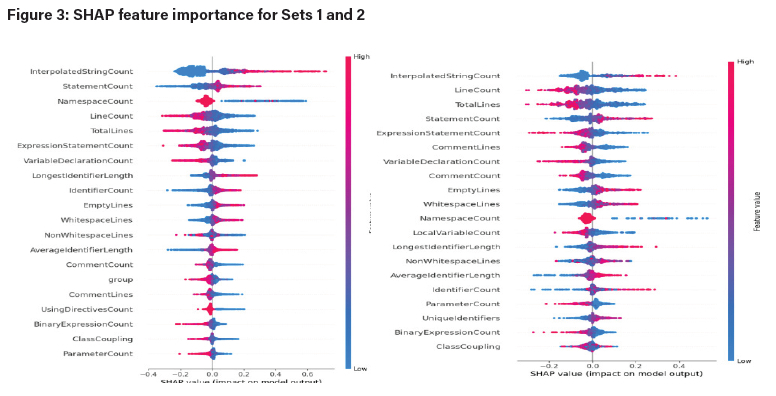
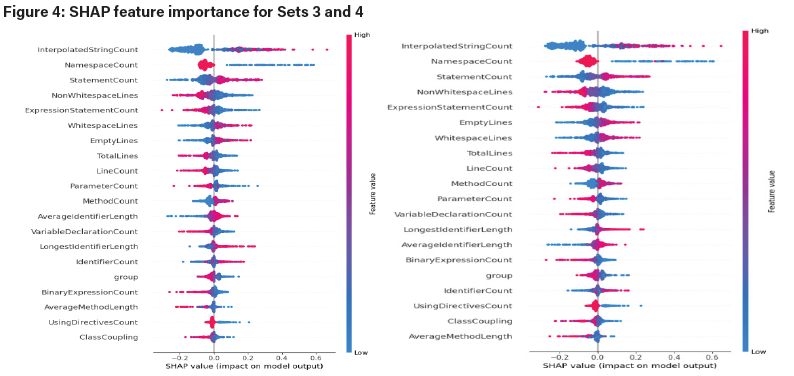
SHAP was used to further explain the outputs of the machine-learning models, through assigning an importance value to each feature for prediction, i.e., showing the features that were most influential in identifying and classifying the Al-generated code and the student-written code.
For Set 1, the five most important features were InterpolatedStringCount, StatementCount, NamespaceCount, LineCount, and TotalLines. For Set 2, the five most important features are InterpolatedStringCount, LineCount, TotalLines, StatementCount, and ExpressionStatementCount. For Set 3, the five most important features were InterpolatedStringCount, NamespaceCount, StatementCount, NonWhitespaceLines, and ExpressionStatementCount. For Set 4, the five most important features were InterpolatedStringCount, NamespaceCount, StatementCount, NonWhitespaceLines, and ExpressionStatementCount.
InterpolatedStringCount is the number of interpolated strings such as $"Hello, {name}" in the C# code. GenAI code tends to use more of these strings for dynamic values, while human-written code tends to have more concatenation methods. StatementCount is the number of statements in the C# code. GenAI code uses more dense lines of code than the corresponding human-written code, showing structural differences. NamespaceCount is the number of namespaces used in the C# code. GenAI code tends to use a limited number of namespaces and to use an optimised relevant one, while human-written code tends to include unnecessary and even unused namespaces, thus having more namespaces than GenAI code.
NonWhitespaceLines are the lines in the C# code that contain actual code or comment. GenAI code tends to have more NonWhitespaceLines than human-written code. TotalLines measures the overall length of C# code. GenAI code tends to have fewer lines of code than its human-written counterpart. ExpressionStatementCount is the number of expression statements in the C# code, e.g., expressions such as assignments, compound, type casting, function return, and conditional statements. GenAI code tends to have more such statements than human-written code because GenAI code seeks to explicitly state each operation for clarity. LineCount is the total number of lines in the C# code, and GenAI code tends to use fewer lines than human-written code.
As seen in the SHAP feature-importance graphs below for Sets 1 and 2 (Figure 3 and Sets 3 and 4 (Figure 4, the most important features across the four sets were InterpolatedStringCount and StatementCount, which both appear in the top five features for each set.
Comparison with other similar studies
Table 12compares the classifier accuracy, for detection of GenAI code, that was found in this C#-based study with accuracies detected in similar studies focused on different programming languages. As seen in the table, the approach in this study, which leveraged a comprehensive feature set and advanced classifiers, achieved higher accuracies than the models used in the Bukhari et al. (2023), Idialu et al. (2024), and Pan et al. (2024) studies of GenAI code detection in the Python and C programming languages.
The feature extraction in the Bukhari et al. (2023) study includes only lexical and syntactic features, while Idialu et al. (2024) add the layout features to the two features considered by Bukhari et al. (2023). Our study focused on a larger list of code stylometry features (comprising 83 lexical, syntactic, layout, and semantic features) than those included by Idialu et al. (2024) and Bukhari et al. (2023), and we can conclude that this wider range of features was integral to the higher classifier accuracy achieved in our study.
5. Conclusions
This study has demonstrated that GenAI C# code produced by Blackbox.AI, ChatGPT, and Copilot can, to a great extent, be identified, and distinguished from student-written C# code, through use of classifier algorithms. The random forest and XGBoost classifiers performed best, with Blackbox.AI C# code being the easiest to detect. This study's focus on the C# programming language helps to fill a research gap, as GenAI code detection in C# is a relatively unexplored area in the education sector in South Africa and globally. This study is also significant in several other respects.
Implications for educators
The study findings also have the potential to assist educational institutions and educators in developing tools for detection of potential use of GenAI code in student assignments. Student use of AI tools for programming and software course assignments can be expected to decrease if detection systems are in place, which in turn will help maintain adherence to academic standards. SHAP identification of features in student assignments can also help to reveal patterns in students' coding behaviours, enabling targeted interventions to improve foundational programming skills. Students can also be encouraged to critically evaluate the strengths and limitations of GenAI code, which will improve their critical thinking skills.
Implications for researchers
Through its use of a large list of code stylometry features (comprising 83 lexical, syntactic, layout, and semantic features), this study has highlighted certain features that were particularly important to the detection of GenAI C# code and to distinguishing between AI-generated and student-written code. Researcher identification of more important features can increase the optimisation of GenAI detection algorithms for programming tasks across varying coding styles and structures. Interdisciplinary studies can follow from this research, as GenAI code detection is at an intersection of NLP, cybersecurity, software engineering, ethics, and education. Future research could incorporate broader sets of coding problems, and broader sources of human-written C# code. The code could be sourced from different educational levels or institutions, as well as from professional developers, to improve the generalisability of the results.
Implications for software developers
Improved detection of GenAI code can help software developers to understand the structure, style and logic of AI-generated code contributions to software. With improved detection and understanding of GenAI code, developers can more easily collaborate in an environment that allows for contributions from both GenAI tools and human developers. Developers can focus more on refining AI contributions, while preserving the nuances of human creativity. Enhanced detection of GenAI code can also help developers to strengthen application security and cybersecurity, particularly with respect to malicious actors who use GenAI to produce scripts used in attacks. When GenAI code is detected early, pre-emptive measures can be put in place to reduce vulnerabilities and safeguard systems against evolving threats.
Limitations of the study
A limitation of this study was that the human-written code dataset was collated from first-year programming students from only one campus of one university: the University of the Free State, South Africa. Thus, this code does not represent the diversity of human-written C# code, which limits the generalisability of the study findings. A larger, more diverse dataset would have provided a better representation of human-written C# code. Furthermore, the nine problems in terms of which the human-written and GenAI C# code was prepared presented potential limitations. The problems could have imposed biases and are unlikely to have fully captured the nuances and complexities of software development, e.g., matters of performance optimisation, security vulnerabilities, maintainability, and real-world applicability.
Funding declaration
No funding was received for this study or for preparation of the article.
Data availability
Data will be made available upon request to the first-listed author at adewuyi.adegbite@gmail.com.
AI declaration
GenAI tools were used for data collection of GenAI C# code, with the versions stated in the article.
Competing interests declaration
The authors have no competing interests to declare.
Authors' contributions
A.A.A.: Conceptualisation; methodology; data collection; sample analysis; data analysis; validation; data curation; writing - initial draft; writing - revisions; student supervision; project management.
E.K.: Conceptualisation; methodology; data collection; writing - revisions; student supervision; project leadership; project management; funding acquisition.
References
Benzebouchi, N. E., Azizi, N., Hammami, N. E., Schwab, D., Khelaifia, M. C. E., & Aldwairi, M. (2019). Authors' writing styles based authorship identification system using the text representation vector. In 16th International Multi-Conference on Systems, Signals and Devices (SSD 2019) (pp. 371-376). https://doi.org/10.1109/SSD.2019.8894872
Bukhari, S., Tan, B., & De Carli, L. (2023). Distinguishing AI- and human-generated code: A case study. In SCORED 2023 - Proceedings of the 2023 Workshop on Software Supply Chain Offensive Research and Ecosystem Defenses (pp. 17-25). https://doi.org/10.1145/3605770.3625215
Caliskan, A., Yamaguchi, F., Dauber, E., Harang, R., Rieck, K., Greenstadt, R., & Narayanan, A. (2018). When coding style survives compilation: De-anonymizing programmers from executable binaries. In 25th Annual Network and Distributed System Security Symposium (NDSS 2018). https://doi.org/10.14722/ndss.2018.23304
Cao, Y., Li, S., Liu, Y., Yan, Z., Dai, Y., Yu, P. S., & Sun, L. (2023). A comprehensive survey of AI-generated content (AIGC): A history of generative AI from GAN to ChatGPT. Journal of the ACM, 37(4). http://arxiv.org/abs/2303.04226 [ Links ]
Cheers, H., Lin, Y., & Smith, S. P. (2021). Academic source code plagiarism detection by measuring program behavioral similarity. IEEE Access, 9, 50391-50412. https://doi.org/10.1109/ACCESS.2021.3069367 [ Links ]
Cheers, H., Lin, Y., & Yan, W. (2023). Identifying plagiarised programming assignments with detection tool consensus. Informatics in Education, 22(1), 1-19. https://doi.org/10.15388/infedu.2023.05 [ Links ]
Corso, v., Mariani, L., Micucci, D., & Riganelli, O. (2024). Generating Java methods: An empirical assessment of four AI-based code assistants. In Proceedings of the 32nd IEEE/ACM International Conference on Program Comprehension (ICPC 2024). https://doi.org/10.1145/3643916.3644402
Czibula, G., Lupea, M., & Briciu, A. (2022). Enhancing the performance of software authorship attribution using an ensemble of deep autoencoders. Mathematics, 10(15). https://doi.org/10.3390/math10152572 [ Links ]
Dehaerne, E., Dey, B., Halder, S., De Gendt, S., & Meert, W. (2022). Code generation using machine learning: A systematic review. IEEE Access, 10(July), 82434-82455. https://doi.org/10.1109/ACCESS.2022.3196347 [ Links ]
Ding, S. H. H., Fung, B. C. M., Iqbal, F., & Cheung, W. K. (2019). Learning stylometric representations for authorship analysis. IEEE Transactions on Cybernetics, 49(1), 107-121. https://doi.org/10.1109/TCYB.2017.2766189 [ Links ]
Ebrahim, F., & Joy, M. (2023). Source code plagiarism detection with pre-trained model embeddings and automated machine learning. In International Conference Recent Advances in Natural Language Processing (RANLP) (pp. 301-309). https://doi.org/10.26615/978-954-452-092-2_034
Eliwa, E., Essam, S., Ashraf, M., & Sayed, A. (2023). Automated detection approaches for source code plagiarism in students' submissions. Journal of Computing and Communication, 2(2), 8-18. https://doi.org/10.21608/jocc.2023.307054 [ Links ]
Ghosal, S. S., Chakraborty, S., Geiping, J., Huang, F., Manocha, D., & Bedi, A. S. (2023). Towards possibilities and impossibilities of AI-generated text detection: A survey. arXiv preprint. https://doi.org/10.48550/arXiv.2310.15264
Idialu, O. J., Mathews, N. S., Maipradit, R., Atlee, J. M., & Nagappan, M. (2024). Whodunit: Classifying code as human authored or GPT-4 generated - A case study on CodeChef problems. https://doi.org/10.1145/3643991.3644926
Kalgutkar, V., Kaur, R., Gonzalez, H., Stakhanova, N., & Matyukhina, A. (2019). Code authorship attribution: Methods and challenges. ACM Computing Surveys, 52(1). https://doi.org/10.1145/3292577 [ Links ]
Kazemitabaar, M., Ye, R., Wang, X., Henley, A. Z., Denny, P., Craig, M., & Grossman, T. (2024). CodeAid: Evaluating a classroom deployment of an LLM-based programming assistant that balances student and educator needs. In CHI '24: Proceedings of the 2024 CHI Conference on Human Factors in Computing Systems. https://doi.org/10.1145/3613904.3642773
Kotsiantis, S., Verykios, V., & Tzagarakis, M. (2024). AI-assisted programming tasks using code embeddings and transformers. Electronics, 13(4), 1-25. https://doi.org/10.3390/electronics13040767 [ Links ]
Krasniqi, R., & Do, H. (2023). Towards semantically enhanced detection of emerging quality-related concerns in source code. Software Quality Journal, 31(3), 865-915. https://doi.org/10.1007/s11219-023-09614-8 [ Links ]
Kuhail A. M., Mathew, S. S., Khalil, A., Berengueres, J., Jawad, S., & Shah, H. (2024). "Will I be replaced?" Assessing ChatGPT's effect on software development and programmer perceptions of AI tools. Science of Computer Programming, 235, 103111. https://doi.org/10.1016/j.scico.2024.103111 [ Links ]
Lalitha, L. V. K., Sree, V., Lekha, R. S., & Kumar, V. N. (2021). Plagiat: A code plagiarism detection tool. EPRA International Journal of Research and Development (IJRD), 7838, 97-101. [ Links ]
Li, Z., Jiang, Y., Zhang, X. J., & Xu, H. Y. (2020). The metric for automatic code generation. Procedia Computer Science, 166, 279-286. https://doi.org/10.1016/j.procs.2020.02.099 [ Links ]
Lundberg, S. M., & Lee, S.-I. (2017). A unified approach to interpreting model predictions. In Advances in Neural Information Processing Systems 30 (NIPS 2017). https://arxiv.org/abs/1705.07874
Makridakis, S. (2017). The forthcoming Artificial Intelligence (AI) revolution: Its impact on society and firms. Futures, 90, 46-60. https://doi.org/10.1016/j.futures.2017.03.006 [ Links ]
Maryono, D., Yuana, R. A., & Hatta, P. (2019). The analysis of source code plagiarism in basic programming course. Journal of Physics: Conference Series, 1193(1). https://doi.org/10.1088/1742-6596/1193/1/012027 [ Links ]
Nghiem, K., Nguyen, A. M., & Bui, N. D. Q. (2024). Envisioning the next-generation AI coding assistants: Insights and proposals. In 2024 First IDE Workshop (IDE '24). https://doi.org/10.1145/3643796.3648467
Odeh, A., Odeh, N., & Mohammed, A. S. (2024). A comparative review of AI techniques for automated code generation in software development: Advancements, challenges, and future directions. TEM Journal, 13(1), 726-739. https://doi.org/10.18421/tem131-76 [ Links ]
Pan, W. H., Chok, M. J., Wong, J. L. S., Shin, Y. X., Poon, Y. S., Yang, Z., Chong, C. Y, Lo, D., & Lim, M. K. (2024). Assessing AI detectors in identifying AI-generated code: Implications for education. https://arxiv.org/abs/2401.03676
Portillo-Dominguez, A. O, Ayala-Rivera, V., Murphy, E., & Murphy, J. (2017). A unified approach to automate the usage of plagiarism detection tools in programming courses. In ICCSE2017 - 12th International Conference on Computer Science and Education, ICCSE, 18-23. https://doi.org/10.1109/ICCSE.2017.8085456
Raiaan, M. A. K., Mukta, M. S. H., Fatema, K., Fahad, N. M., Sakib, S., Mim, M. M. J., Ahmad, J., Ali, M. E., & Azam, S. (2024). A review on large language models: Architectures, applications, taxonomies, open issues and challenges. IEEE Access, 12(February), 26839-26874. https://doi.org/10.1109/ACCESS.2024.3365742 [ Links ]
ShaukatTamboli, M., & Prasad, R. (2013). Authorship analysis and identification techniques: A review. International Journal of Computer Applications, 77(16), 11-15. https://doi.org/10.5120/13566-1375 [ Links ]
Song, X., Sun, H., Wang, X., & Yan, J. (2019). A survey of automatic generation of source code comments: Algorithms and techniques. IEEE Access, 7, 111411-111428. https://doi.org/10.1109/ACCESS.2019.2931579 [ Links ]
Srivastava, S., Rai, A., & Varshney, M. (2021). A tool to detect plagiarism in java source code. Lecture Notes in Networks and Systems, 145, 243-253. https://doi.org/10.1007/978-981-15-7345-320 [ Links ]
Tereszkowski-Kaminski, M., Pastrana, S., Blasco, J., & Suarez-Tangil, G. (2022). Towards improving code stylometry analysis in underground forums. In Proceedings on Privacy Enhancing Technologies, 2022(1), 126-147. https://doi.org/10.2478/popets-2022-0007
Varona, D., & Suárez, J. L. (2022). Discrimination, bias, fairness, and trustworthy AI. Applied Sciences, 12(12). https://doi.org/10.3390/app12125826 [ Links ]
Vaswani, A., Shazeer, N., Parmar, N., Uszkoreit, J., Jones, L., Gomez, A. N., Kaiser, L., & Illia, P. (2017). Attention is all you need. In I. Guyon, U. V. Luxburg, S. Bengio, H. Wallach, R. Fergus, S. Vishwanathan & R. Garnett (Eds.), Advances in Neural Information Processing Systems 30: Annual Conference on Neural Information Processing Systems (pp. 5998-6008). https://doi.org/10.48550/arXiv.1706.03762
Wan, Y., He, Y., Bi, Z., Zhang, J., Zhang, H., Sui, Y., Xu, G., Jin, H., & Yu, P. S. (2023). Deep learning for code intelligence: Survey, benchmark and toolkit. Arxiv.Org, 1(1), 771-783. https://arxiv.org/abs/2401.00288 [ Links ]
White, J., Hays, S., Fu, Q., Spencer-Smith, J., & Schmidt, D. C. (2023). ChatGPT prompt patterns for improving code quality, refactoring, requirements elicitation, and software design. https://doi.org/10.1007/978-3-031-55642-54
Zafar, S., Sarwar, M. U., Salem, S., & Malik, M. Z. (2020). Language and obfuscation oblivious source code authorship attribution. IEEE Access, 8, 197581-197596. https://doi.org/10.1109/ACCESS.2020.3034932 [ Links ]
Zhang, H., Cruz, L., & van Deursen, A. (2022). Code smells for machine learning applications. In Proceedings -1st International Conference on AI Engineering - Software Engineering for AI (CAIN) 2022 (pp. 217-228). https://doi.orq/10.1145/3522664.3528620
Zheng, M., Pan, X., & Lillis, D. (2018). CodEX: Source code plagiarism detection based on abstract syntax trees. CEUR Workshop Proceedings, 2259, 362-373.