




Services on Demand
Journal

Article
 English (pdf)
 Article in xml format
 Article references
 Automatic translation
 Send this article by e-mail
Indicators
Related links
-
 Cited by Google
 -
 Similars in Google
Share

 Permalink
SAIEE Africa Research Journal
On-line version ISSN 1991-1696Print version ISSN 0038-2221
SAIEE ARJ vol.116 n.4 Observatory, Johannesburg Dec. 2025
A Deep Learning-Based Channel Estimation Scheme for Cell-Free Massive MIMO Systems
Malcolm SandeI; Giscard BininiII
IMember, IEEE; Faculty of Science and Technology at the Independent Institute of Education (IIEMSA), South Africa, e-mail: msande@iiemsa.co.za
IIFaculty of Science and Technology at the Independent Institute of Education (IIEMSA), South Africa, e-mail: gmbinini@iiemsa.co.za
ABSTRACT
Cell-free massive multiple-input-multiple-output (MIMO) is a technique that couples the cell-free network architecture and massive antenna arrays. In cell-free massive MIMO, multiple access points (APs) are collocated to serve fewer user equipment (UEs), which results in a system with more APs than UEs. To achieve optimum transmission performance, massive MIMO requires knowledge of accurate channel state information (CSI). However, the conventional method of CSI estimation, based on minimum mean square error, suffers from high computational complexity, pilot contamination, and noise interference, which degrade the performance of the system. In this paper, we propose a deep learning-based channel estimation approach that makes use of a deep neural network to provide a scalable and efficient channel estimation scheme. Simulation results showed that the proposed scheme consistently outperformed conventional cell-free massive MIMO, small cell network, and cellular massive MIMO architectures.
Index Terms: Cell-free massive MIMO, channel estimation, deep learning, deep neural network, SDG 9.
I. INTRODUCTION
The exponentially increasing demand for mobile internet access, cloud-based services, and real-time data analytics presents a need for matched advancement in wireless communications. This demand has led to the introduction of multiple-input-multiple-output (MIMO) systems [1]. As part of 5G enabling technologies, massive MIMO was then developed for cellular communications [2], [3]. Massive MIMO is a technique where a base station (BS) with an array of hundreds of localized or distributed antennas serves many tens of users in the same time-frequency resource [4]. This has been shown to provide enhanced spectral efficiency and energy efficiency. Other benefits of massive MIMO include reduced costs, reduced latency, increased reliability, and higher degrees of freedom [5], [6].
Despite the aforementioned benefits of massive MIMO, the cellular architecture poses some challenges, particularly the pilot contamination problem. Pilot contamination is coherent interference that results from the reuse of pilot sequences in adjacent cells in a wireless cellular network [7]. To overcome the challenges of inter-cell interference, there has been a gradual shift from traditional cellular networks to cell-free networks. In this cell-free architecture, access points (APs) cooperate to jointly serve user equipment (UEs) with the aim of reducing interference and increasing throughput [8]. Coupling the cell-free network architecture and antenna arrays is a scheme well known as cell-free massive MIMO. In cell-free massive MIMO, multiple APs are collocated to serve fewer UEs, which results in a system with more APs than UEs [9]-[11]. The APs coordinate to serve the UEs through coherent transmission and reception while applying some concepts from cellular massive MIMO. The cell-free network architecture offers the advantage of improved robustness against signal blockage since UEs are in close proximity to multiple APs, which enhances network reliability [12]. By promoting cooperative operation among APs, the cell-free massive MIMO system offers a more dependable and efficient data transmission framework, capably meeting the ever-increasing demand for high-quality wireless communication services. As technology continues its relentless evolution, cell-free massive MIMO stands poised to revolutionize the wireless communication landscape, laying the foundation for seamless and robust future generation networks [13].
To achieve optimum throughput and spectral efficiency performance, massive MIMO precoding and beamforming techniques require accurate channel state information (CSI) [13]. However, obtaining accurate CSI is a challenging task due to the complex mathematical modeling, processing, and computation [14]. A notable computational challenge emerges in the form of channel modeling, a pivotal factor in this context. This challenge is exacerbated by pilot contamination, as well as background noise. While many research works, which include [14] - [16], have explored various approaches to model the channel, the frequently used minimum mean square error (MMSE) channel estimation approach has its limitations, particularly concerning interference and noise robustness. These limitations result in certain parts of the channel remaining unaccounted for by the model. Consequently, there has been a shift towards the application of machine learning (ML) techniques to achieve more adaptable channel modeling in massive MIMO systems.
The integration of ML techniques into the channel estimation (CE) process for cell-free massive MIMO systems has been identified as a pivotal approach to address the challenges aforementioned [17]. This approach is capable of developing a channel estimator that can derive the complete MIMO channel matrix in a single forward pass analysis of incoming preambles, irrespective of the system's antenna count [18]. Notably, the incorporation of ML techniques in massive MIMO systems introduces consistent computational costs, regardless of the number of antennas. This makes it desirable for application in scalable massive MIMO systems. Moreover, it facilitates seamless adaptation to evolving data, ensuring responsiveness to changing environmental conditions. Consequently, this approach results in reduced computational complexity post-training and shorter estimation times compared to conventional qualitative methods.
In this paper, we propose a deep learning (DL) approach for CE in cell-free massive MIMO systems. With the proposed method, we explore how DL can significantly enhance CE in cell-free massive MIMO systems, considering factors such as the received signal strength, power losses in the channel, and the signal-to-interference-plus-noise ratio (SINR) of the estimated channel. The DL model can generalize across a variety of conditions, such as different interference levels, user mobility, and dynamic channel characteristics, due to its ability to learn from diverse training datasets [17]. On the other hand, traditional methods often require re-tuning or re-optimization for each new scenario. As discussed in the subsequent section, existing literature suggests that DL-based methods are more robust to noise, pilot contamination, and other imperfections in the received signal. Unlike traditional linear estimators, the DL-based approach can effectively capture and exploit the non-linear relationships in the channel dynamics, leading to more accurate predictions and improved performance under complex scenarios.
A. Related Works
In conventional massive MIMO systems, the UEs leverage the channel hardening feature to enable downlink data decoding based on statistical CSI by modeling the channel deterministically when the number of antennas is large [19], [20]. However, this approach is less favorable for cell-free massive MIMO systems due to the geographical distribution of the APs and the fact that the UEs only connect to a subset of APs. The challenge of accurately modeling the channel in cell-free massive MIMO systems has driven research efforts to develop more efficient CE methods [21]. Most literature adopts the MMSE for CE, but this approach also introduces interference in the channel. As such, ML techniques can be leveraged to address these issues.
DL-based architectures for CE and hybrid beamforming in millimeter wave (mm-wave) massive MIMO were presented in [22] and [23]. The approach proposed in [22] uses convolu-tional neural networks (CNNs), which take the received signal as input and yield channel estimates and the beamforming matrices as output. The approach in [23] applies the sparse Bayesian learning algorithm to unfold tailored DNNs. Another DL-based architecture for CE in massive MIMO was presented in [24]. Here, the proposed DNN architecture uses a multi-layer perceptron approach to construct a channel estimator that estimates each of the sub-channels in the massive MIMO channel matrix independently. In this case, the DNN model takes the received time-domain preamble sequence as input. In [25], the authors adopted a deep residual learning approach and modeled the CE in intelligent reflecting surface-assisted multiuser communication (IRS-MUC) systems as a denois-ing problem. Here, a deep residual network-based MMSE estimator is firstly derived in terms of Bayesian principles, then a CNN-based deep residual network is applied for CE in the IRS-MUC system. In this CNN-based framework, a CNN denoising block was designed to exploit the spatial features of the noisy channel matrices as well as the additive nature of the noise simultaneously. Experimental results showed that these aforementioned approaches provided better SE performance, reduced computational cost, more efficient pilot use, and greater robustness to CSI errors compared to state-of-the-art optimization methods. However, it is worth noting that the methods presented in [22] - [25] did not consider the cell-free framework.
ML-based schemes for power control and resource allocation in cell-free massive MIMO systems have been presented in [26] - [31]. In [26], the authors applied a DNN to develop a joint power control and resource allocation solution framework to solve the sum rate maximization problem. This method was shown to achieve near-optimal sum rate performance with significantly lower complexity that does not scale exponentially with the number of APs and UEs as does the traditional methods. On the other hand, the authors of [30] used a DNN-based approach to solve a max-min power allocation problem in a microwave cell-free massive MIMO network. In terms of power allocation and error performance, the DNN-based approach exhibited reduced time complexity while achieving near-optimal performance, which is achieved by a bisection method-based heuristic algorithm. Furthermore, DRL-based algorithms for power control in cell-free massive MIMO have been proposed in [28] and [31]. In particular, both schemes apply the deep deterministic policy gradient (DDPG) method in their DRL-based schemes. In [28], "different partial state space designs were investigated for each mobility use case, so as to achieve the best trade-off between network performance and required learning complexity." In [31], the authors proposed a multi-agent DDPG method with centralized training and decentralized execution to optimize the power allocation. The simulation results from both these DRL-based methods showed that the proposed method outperforms other reinforcement learning-based schemes in terms of sum rate performance and user satisfaction.
The authors of [32] presented a comprehensive review of the state-of-the-art DL methods that have been applied to various problems in cell-free massive MIMO systems. In terms of DL applications for CE in cell-free massive MIMO, a flexible noise-reducing CNN framework named FFDNet was presented in [33]. "The results showed that the time spent for the FFDNet training is much less than the time that is needed from the state-of-the-art channel estimators, such as CNN, achieving at the same time similar performance" [32]. To improve the performance of the FFDNet scheme, the authors in [21] proposed a cascade of a set of DNNs, one for each class of channels identified during the system modeling. This scalable DL-based method was shown to provide better spectral efficiency performance compared to traditional approaches.
B. Summary of Contributions
This paper proposes a DL approach for CE in a cell-free massive MIMO scenario that employs dynamic cooperation clustering (DCC). The proposed approach utilizes a combination of a localized DCC matrix and MMSE for the training process of the deep neural network (DNN). This was shown to effectively mitigate the effects of pilot contamination. The contributions of the paper can be summarized as follows:
•DL-based CE model: We propose a cell-free massive MIMO network architecture that employs a DNN within the DCC framework for channel estimation to mitigate the effects of pilot contamination effectively. In the proposed approach, the channel matrix is accurately estimated by leveraging similarities in channel dynamics across spatial dimensions and applying a DNN model whose weights are efficiently trained to be shared across the APs that are serving a given UE.
•Scalable DNN-based approach: We present a DNN-based DL approach to solve the mean square error (MSE) minimization problem in the proposed cell-free massive MIMO network architecture. An algorithm for the DL-based CE approach using a DNN is developed and implemented. The aim of the DL-based framework and algorithm is to improve the MSE performance and scalability for the uplink centralized cell-free massive MIMO model.
C. Outline
The rest of this paper is organized as follows; Section II presents the proposed DL-based cell-free massive MIMO system model, Section III discusses the distributed scalable receive combining schemes that were implemented for the evaluation of SE performance. Section IV presents the proposed DL approach for CE in cell-free massive MIMO. Section V discusses the simulation results and Section VI gives concluding remarks and recommendations for future work.
II. System model
In terms of the cell-free massive MIMO network model, we make use of the DCC framework. In the DCC framework, a UE is only served by APs that are in a set Lk = {1,...,L}, each equipped with N antennas. This set of APs adapts to time-variant characteristics, such as UE locations, quality of service (QoS) requirements, and interference conditions. We consider the uplink data transmission for the time division duplexing (TDD) protocol. In the TDD protocol, channels are assumed to be constant throughout one coherence block and change independently from one block to another [12]. In each coherence block, τp samples are reserved for uplink pilot signaling. The τp pilots are defined to be mutually orthogonal and they are assigned among the UEs in a reusable manner that aims to reduce the effect of pilot contamination if the number of UEs is greater than τp. In the cell-free massive MIMO network scenario, each AP estimates the channel responses from every UE within each time-frequency block. As aforementioned, this estimated CSI is then utilized for the beamforming process.
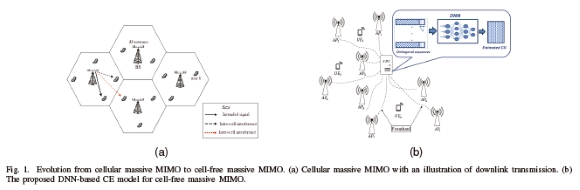
In our model, we leverage the parallel nature of DNNs, in particular the feed-forward neural network (FFNN) framework. The idea behind the proposed approach is to estimate the channel matrix by leveraging similarities in channel dynamics across spatial dimensions and then use a DNN model whose weights are efficiently trained to be shared across the APs that are serving a given UE. Figure 1 shows the evolution from the cellular massive MIMO network structure to the cell-free massive MIMO network structure. Fig. 1(a) illustrates the conventional cellular massive MIMO with an example downlink transmission while Fig. 1(b) illustrates the proposed DNN-based CE model for cell-free massive MIMO, where the approach aims to retrieve the complete CSI matrix.
"A realistic performance assessment of any MIMO technology requires the use of a channel model that reflects its main characteristics" [12]. For the analysis of wireless channels, it was shown that both deterministic and stochastic channel models can be used. In this work, we assume the correlated Rayleigh fading channel model for non-line-of-sight (NLoS) communication, where the channel gain between AP l and UE k is given by

where Rkl is the spatial correlation matrix between UE k and AP l. Let τp ϵ 1,..., τρ denote the index of the pilot assigned to UE k and Pk be the number of UEs that use the same pilot as UE k. The correlated received pilot signal vector at AP l can be expressed as [12]

where pi represents the uplink transmit power of UE i, and nTkl ~Nc(0n ,σ2ΙΝ) represents noise. Based on the received signal, the APs perform operations to decode the desired signal from the UEs, where the received signal is a superposition of the pilot signal and the transmitted message from the UEs given by
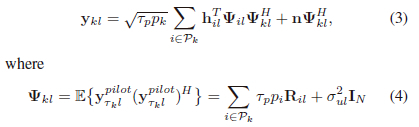
is the correlation matrix of the received signal in (2). The MMSE channel estimate based on the received signal is then given by

When using the DCC framework, the dynamic cluster matrices are utilized, which are modelled as

For each UE, individual pilot signals are processed by the CPU to compute partial MMSE estimates for collective channels from all UEs to the APs serving UE k, and the estimated received signal is given by
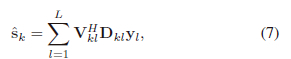
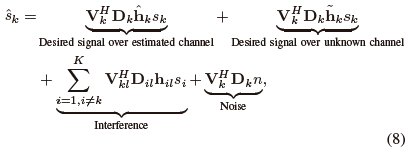
where sk is the signal transmitted by UE k. The CPU optimizes Dk to maximise the spectral efficiency (SE). From (8), we can derive the SE when we consider the first term as the desired signal and treat the other terms as SINR, and the SE for UE k can be expressed as

where  is a factor that indicates the portion of each coherent block allocated for uplink data transmission, and the effective SINR is given by

The CE accuracy is typically quantified by consideration of the normalized mean square error (NMSE) because the relative size of the error, not the absolute size, is of more significance. In terms of the channel between AP l and UE k, the NMSE is given by [12]
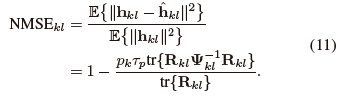
In general, a reasonable estimator provides an NMSE between 0 and 1, where the NMSE is 0 when perfect estimation is achieved while it is 1 if pk =0. Thus, smaller NMSE values are preferable.
III. Scalable Distributed Uplink Combining Schemes
In this section, we discuss some sub-optimal but scalable combining schemes for the uplink transmission in a cell-free massive MIMO scenario that employs DCC as adopted from [12]. The distributed uplink operation comprises two stages. In the first stage, each AP performs local CE using the received pilot signals. The AP can then use the local channel estimates to determine a local receive combining vector vkl.In the second stage, the CPU combines the local data estimates of all APs to compute a final estimate of the UE data using a linear combination of the local estimates.
A. LP-MMSE
The local partial MMSE (LP-MMSE) is a scalable distributed combining scheme for cell-free massive MIMO transmission that is derived from the scalable partial MMSE (P-MMSE), which was designed for centralized operation. The LP-MMSE at an AP l is defined based only on the channel estimates and statistics of UEs that are served by this AP. The local combining vector in this case is given by

The number of multiplications in both the CE and the combining vector computation of the LP-MMSE scheme is independent of the number of users, K. This makes the LP-MMSE a scalable solution as K → ∞. It is also worth noting that compared to P-MMSE, the LP-MMSE scheme has significantly lower computational complexity per UE.
B. Large-Scale Fading Decoding
The optimal large-scale fading decoding (opt LSFD) has also been adapted to create a scalable non-optimal scheme.
The approach to creating scalable LSFD basically omits the weights in the opt LSFD. This has the advantage that the CPU requires no statistical parameters to compute the data estimates, however, the drawback of this approach is that equal importance is given to all APs when computing the data estimates, where some APs might suffer from high interference or low SINR. To obtain a near-optimal solution, a smilar approach to that of P-MMSE can be taken, where only the UEs that are served by partially the same APs as UE k are considered. The approximate opt LSFD vector, which is termed the nearly optimal LFSD (n-opt LFSD) is then given by

The number of complex multiplications that are required to determine  is the same as those that are required for the optimal approach. However, the n-opt LSFD scheme requires knowledge of a smaller number of statistical parameters, which is independent of K, and this makes its fronthaul signaling load scalable.
IV. Proposed DL-based approach
DL is an ML technique that employs neural networks, and a DNN is structurally a multi-layer neural network that contains two or more hidden layers [37]. Each hidden layer consists of a non-linear transformation of the output of the previous layer, and the sequence of these transformations leads to learning different levels of abstraction. FFNNs are a class of unsupervised learning techniques that are employed for predicting and detecting successive sequences. An FFNN consists of an input layer, hidden layer(s), and an output layer, which are all arranged in parallel. The hidden layers act as temporary storage for the network at specific time instances and they can represent time dependencies within sequences, which are typically achieved with fewer neurons.
A. Channel Estimation using an FFNN
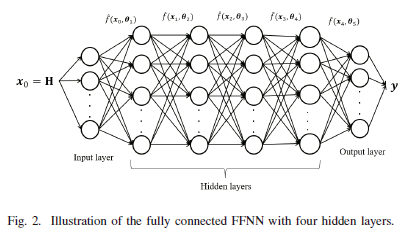
Figure 2 shows the structure of the proposed FFNN architecture with four hidden layers. In this illustration of a fully connected FFNN, the first layer is given the input values/features in the form of a column vector x0,which represents the input sample vector of channel gains, H. The values of the first hidden layer are a transformation of the input values through a non-linear parametric function given by

where σ is the activation function, and for the Ith hidden layer, Wl and bl are the weights matrix and bias vector, respectively. The input to each neuron is a weighted sum, and this sum is then passed through a non-linear function represented as

where k and y denote the knowledge module function and the DNN's output, respectively. In the context of CE in cell-free massive MIMo systems, the input dataset typically consists of received pilot sequences from different Aps with varying SINR, as illustrated in Fig. 1(b).
The proposed scheme consists of an input layer with 186 neurons that passes the data through four hidden layers before the output layer. The hidden layers have learnable weights that pass data to the next layers with updated weight and bias parameters. The output layer is the regression layer, which is crucial for improving cell status, network weights, and biases. The regression layer can predict responses in a trained regression network and compute the MSE for regression operations as follows

where r is the number of responses, yTj is the target output, and f (k(x),θ) is the predicted output response function for response j.
B. DL Algorithm for CE in Cell-Free Massive MIMO
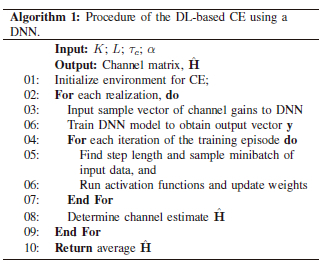
The proposed DNN-based technique for CE is outlined in Algorithm 1.
V. Numerical Results
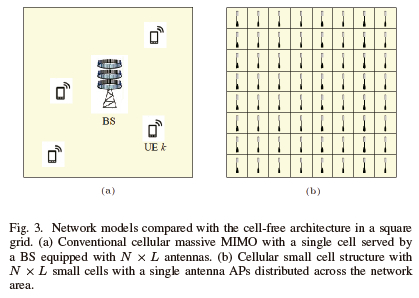
The performance of the DNN approach was compared to that of cellular massive MIMO as well as small cell networks through simulations performed in MATLAB software. Figure 3 illustrates the two network scenarios that the proposed architecture was compared with as adapted from [12]. In the conventional cellular massive MIMO scenario, we consider a single-cell setup equipped with N × L antennas. The second scenario is a cellular small cell structure, where N × L small cells with a single antenna AP are distributed across the network area. The third scenario is the cell-free architecture as presented in section II.
The simulation scenarios comprised two parts: firstly, a statistical approximation of channel parameters, which served as both training data and as a baseline for evaluating the efficacy of the proposed approach. Secondly, the implementation of the FFNN to estimate the channel, with testing and validation data derived from the MMSE received signals. The training rate was set to be 0.001, and the training process stopped if the training error remained fixed in 5 sequential epochs. A mini-batch size of 125 was used, and the rotation and flip-based data augmentation was also adopted during training. The dataset used for training, validation, and testing of the DNN model was split in a 70%-15%-15% ratio, respectively. The split was performed randomly, ensuring that each subset contained a balanced representation of the various input conditions and SINR levels observed in the network. The stochastic gradient descent (SGD) method was employed for training the DNN. This optimizer was selected for its simplicity and effectiveness in handling large-scale data while avoiding overfitting through controlled updates [38].
A. Average NMSE Performance Evaluation
Table I gives a summary of the simulation parameters that were implemented for the average NMSE performance evaluation. The UEs are assumed to be randomly distributed within the coverage area, while the APs follow a hard-core point process placement. The Rayleigh fading model is adopted for the simulations, where the correlation matrix was computed using the local scattering spatial correlation model presented in [12].
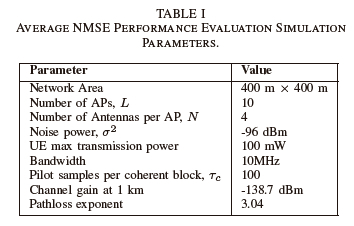
Figure 4 shows the average NMSE performance for a single-user case. In terms of the cellular massive MIMo, a single-cell scenario featuring a massive MIMo BS with 40 antennas was employed in the experimental setup. Compared to the cellular massive MIMo, the cell-free approach can be seen to provide improved NMSE performance. For low transmit power levels, the small cell cellular network setup NMSE performance is more or less the same as that of the cell-free massive MIMo setup. However, as the transmit power increases to more than 10 mW, the small cell cellular network setup can be seen to provide better performance. When looking at the performance of the two cell-free massive MIMo approaches, it is seen that the DL-based approach provides improved performance compared to the conventional MSE channel estimation approach.
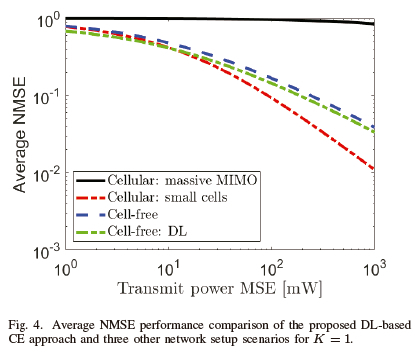
The results of Fig. 4 show that it is preferable to have multiple distributed APs instead of having a single BS with a large array of co-located antennas as is the case in conventional cellular massive MIMo. The better performance of the small cell network architecture, particularly at higher transmit power levels, can be attributed to the fact that in this case, the AP with the lowest NMSE is always chosen. "However, this does not mean that the cell-free architecture will achieve a lower communication performance, but only that the varying estimation quality must be taken into account when the cell-free network is combining the received signals from multiple APs" [12].
The simulation setup of Fig. 4 was extended to a multi-user case and the result for the case of K = 5 is shown in Fig. 5. The multi-user scenario introduces additional complexity to the system and this complexity significantly impacts the performance of the small cell network architecture. It can be seen in Fig. 5 that the small cell architecture exhibits the worst average NMSE performance in the multi-user case. This performance degradation is a result of the increased effects of pilot contamination and interference, which the small cell network cannot handle effectively.
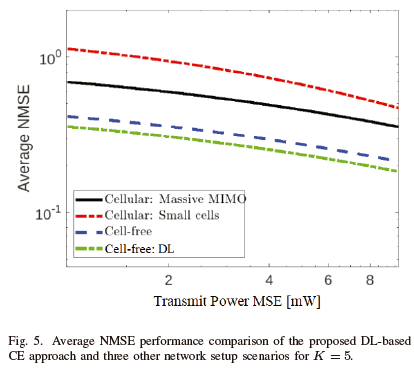
In the multi-user scenario, it was observed that both cellular massive MIMO and cell-free massive MIMO architectures exhibited improved average NMSE performance. The proposed DL-based CE approach provided the best NMSE performance compared to the other architectures. This shows the capability of the DNN-based approach to adapt to varying environments that are typically experienced in mm-wave wireless communications.
B. Spectral Efficiency Performance Evaluation
In this section, we evaluate the SE performance of the proposed DL-based CE approach when used with the scalable combining schemes that were described in Section III. The SE performance was also compared with that of cellular massive MIMo and small cell network architectures as well as with the performance of a centralized combining scheme, P-MMSE. Table II gives a summary of the simulation parameters that were implemented for the SE performance evaluation, including parameters for the cellular networks. To match the total number of antennas of the cellular architectures, the number of APs of the cell-free massive MIMO network is either 400 or 100. For the case of L = 400, each AP will have a single antenna, whereas for L = 100, the number of antennas per AP, N = 4.
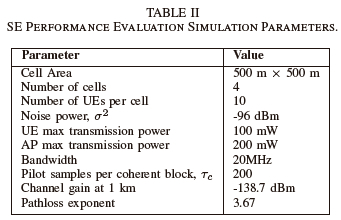
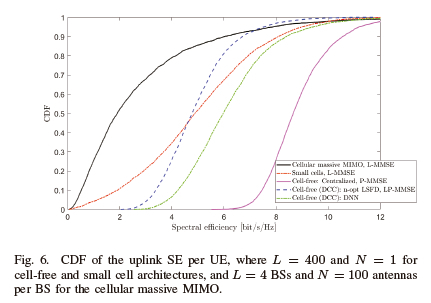
Figure 6 shows the uplink SE performance result for the case of L = 400 and N =1. The result shows that the centralized cell-free architecture implementing P-MMSE combining provides the best SE performance. The distributed cell-free network architecture that implements DCC coupled with n-opt LFSD and LP-MMSE provides nearly the same median SE as the small-cell network architecture, however, it gives significantly higher SE for the weaker UEs. The proposed DNN-based cell-free architecture provides superior SE performance for both weaker and stronger UEs compared to the cell-free framework with n-opt LFSD and LP-MMSE. This improved performance is quite significant for the median SE. This reflects the enhanced CE quality that the DNN approach introduces, effectively reducing the performance disparity between the weakest and strongest UEs. This shows that the proposed DNN-based CE scheme provides an improved CE quality that is applicable in distributed cell-free massive MIMO systems.
For the case of L = 100 and N = 4 for the cell-free and small-cell network architectures, the uplink SE results are shown in Fig. 7. In this scenario, while the centralized cell-free architecture's SE performance degrades (as evidenced by the leftward shift of its CDF curve), the DNN-based DCC architecture shows a slight rightward shift, indicating an improvement in SE performance. In addition, the distributed cell-free architectures and the small cell network curves also shifted right, thus reducing the performance gap between the centralized and the distributed cell-free operations. This shows that the DCC implementation of the DNN-based CE scheme is particularly effective in distributed setups when additional antennas per AP are employed, leveraging multi-antenna diversity to boost SE.
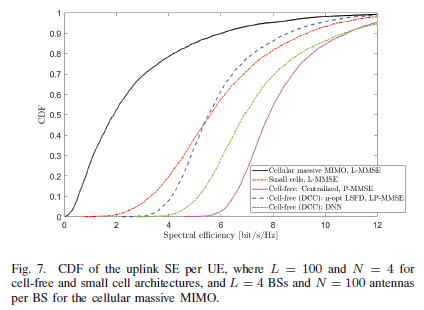
The proposed DNN-based CE scheme demonstrates clear superiority over conventional distributed approaches, providing substantial SE benefits, especially for weaker UEs. This improved performance indicates that the DNN-based architecture not only supports enhanced median SE but also ensures a more balanced and reliable uplink SE distribution. The scalability of the proposed approach is demonstrated in the SE results presented in Fig. 6 and Fig. 7. The results indicate that the DL-based CE method effectively leverages multi-antenna diversity to enhance SE, even in large-scale setups. The distributed nature of the proposed architecture, coupled with the use of DCC, ensures that the computational and communication overhead remains manageable as the network scales. The scheme's ability to adapt effectively to configurations with single or multiple antennas per AP makes it a compelling choice for modern distributed cell-free massive MIMO systems, striking a good balance between performance and implementation complexity.
The superior performance of the DNN-based CE approach could be attributed to various factors. Unlike traditional CE methods which rely on explicit mathematical models, the FFNN learns directly from data. This data-driven approach allows the DL-based model to handle noise and interference more effectively. Furthermore, the FFNN learns non-linear transformations of the input data through its multiple hidden layers. This enables it to model complex relationships in the channel that traditional linear estimators cannot capture. In addition, the activation functions (e.g., ReLU or sigmoid) in each layer introduce non-linearity, allowing the model to approximate the true mapping between inputs (pilot signals) and outputs (channel estimates).
VI. Conclusion and Future Work
This paper proposed a DL-based CE approach for a cellfree massive MIMO network architecture operating with the DCC framework. The proposed approach was shown to be desirable for application in scalable cell-free massive MIMO systems. Simulation results showed that the proposed approach achieved improved performance compared to conventional MMSE-based CE in cell-free massive MIMO. In terms of average NMSE performance, the proposed system achieved 4% lower NMSE in the single-user case, while in the multi-user case, it showed a 10% reduction. Although the centralized cell-free architecture provides the best SE performance, its major drawback is that it is not scalable as the number of UEs increases. The simulation results also showed that the performance of the cell-free DCC approach is improved when APs make use of multiple antennas compared to single-antenna APs. In addition, the proposed DNN-based CE scheme was shown to consistently outperform both conventional cell-free massive MIMO and small cell network architectures. Although centralized cell-free systems with P-MMSE achieved the highest absolute SE, the DNN-based distributed approach comes close, demonstrating that the DNN-enhanced CE approach can narrow the gap between centralized and distributed solutions while providing lower complexity and greater scalability.
For future work, analysis of the robustness of the DL approach under varying user mobility scenarios and channel conditions could be carried out. In addition, performance comparison of the DL-based approach with other ML techniques for CE in cell-free massive MIMO could be carried out. It is also suggested to investigate a cooperative learning approach to build up on the work presented in this paper. Implementing cooperative learning among APs or among UEs in the cell-free massive MIMO network that implements ML techniques could improve the system performance in various aspects. Furthermore, looking into a deep reinforcement learning approach that investigates the potential of cooperative learning as was investigated in [39] for a mm-wave integrated access and backhaul network.
REFERENCES
[1] I.F. Akyildiz, D.M. Gutierrez-Estevez and E.C. Reyes, "The Evolution to 4G Cellular Systems: LTE-Advanced," Physical Communication, vol. 3, no. 4, pp. 217-244, Dec. 2010. [ Links ]
[2] M. Kountouris and N. Pappas, "HetNets and Massive MIMO: Modeling, Potential Gains, and Performance Analysis," in IEEE-APS Conference on Antennas and Propagation in Wireless Communications (APWC), pp. 1319-1322, Sep. 2013.
[3] K. Hosseini, J. Hoydis, S. ten Brink, and M. Debbah, "Massive MIMO and Small-cells: How to Densify Heterogeneous Networks," in IEEE International Conference on Communications, 2013, pp. 5442-5447.
[4] E.G. Larsson, O. Edfords, F. Tufvesson and L. Marzetta, "Massive MIMO for Next Generation Wireless Systems," IEEE Communications Magazine, vol 52, no. 2, pp. 187-195, Feb. 2014. [ Links ]
[5] M.M. Sande, S. Hamouda, and B.T. Maharaj, "Fast Converging Robust Beamforming for Massive MIMO in Heterogeneous Networks," IEEE Access, vol. 6, pp. 23918-23928, 2018. [ Links ]
[6] M.M. Sande and B.T. Maharaj, "Efficient Robust Beamforming for Downlink Transmission in Massive MIMO Systems," in IEEE 87th Vehicular Technology Conference (VTC Spring), 2018, pp. 1-5.
[7] H.Q. Ngo, T.L. Marzetta, and E.G. Larsson, "Analysis of the Pilot Contamination Effect in Very Large Multicell Multiuser MIMO Systems for Physical Channel Models," in IEEE International Conference on Acoustics, Speech and Signal Processing(ICASSP), 2011, pp. 3464-3468.
[8] J. Zhang, S. Chen, Y. Lin, J. Zheng, B. Ai, and L. Hanzo, "Cell-free massive MIMO: A new next-generation paradigm," IEEE Access, vol. 7, pp. 99878-99888, Jul. 2019, doi: 10.1109/ACCESS.2019.2930208. [ Links ]
[9] Z. H. Shaik, Cell-Free Massive MIMO: Distributed Signal Processing and Energy Efficiency, Licentiate Thesis, Linkoping University, 2022. [ Links ]
[10] E. Nayebi, A. Ashikhmin, T. L. Marzetta, and H. Yang, "Cell-Free Massive MIMO Systems" in 49th Asilomar Conference on Signals, Systems and Computers, 2015, pp. 1-5.
[11] H. I. Obakhena, A. L. Imoize, F. I. Anyasi, and K. V. N. Kavitha, "Application of cell-free massive MIMO in 5G and beyond 5G wireless networks: a survey," Journal of Engineering and Applied Science, vol. 68, no. 1, Dec. 2021. doi: 10.1186/s44147-021-00014-y. [ Links ]
[12] O. T. Demir, E. Bjornson, and L. Sanguinetti, "Foundations of user-centric cell-free massive MIMO," Foundations and Trends in Signal Processing, vol. 14, no. 3-4, pp. 162-472, Jan. 2021. [ Links ]
[13] H. Yang and T.L. Marzetta, "Performance of Conjugate and Zero-Forcing Beamforming in Large-Scale Antenna Systems," IEEE Journal on Selected Areas in Communications, vol. 31, no. 2, pp. 172-179, Feb. 2013. [ Links ]
[14] T. L. Marzetta, E. G. Larsson, Y. Hong, and H. Q. Ngo, Fundamentals of Massive MIMO, Cambridge University Press: UK, 2016.
[15] E. G. Larsson, O. Edfors, F. Tufvesson, and T. L. Marzetta, "Massive MIMO for Next Generation Wireless Systems," IEEE Communications Magazine, vol. 52, no. 2, pp. 186-195, Feb. 2014. [ Links ]
[16] E. Balevi, A. Doshi, and J. G. Andrews, "Massive MIMO Channel Estimation with an Untrained Deep Neural Network," IEEE Transactions on Wireless Communications, vol. 19, no. 3, pp. 2079-2090, Mar. 2020. [ Links ]
[17] S. Buzzi and C. D'Andrea, "Cell-free massive MIMO: User-centric approach," IEEE Wireless Communications Letters, vol. 6, no. 6, pp. 706-709, Dec. 2017, doi: 10.1109/LWC.2017.2734893. [ Links ]
[18] S. Unnikrishnan, S. Surve, and D. Bhoir, Eds., "Advances in Computing, Communication, and Control," in Communications in Computer and Information Science, vol. 361, Springer: Berlin, 2013. doi: 10.1007/978-3-642-36321-4.
[19] D. D. Souza, M. M. M. Freitas, G. S. Borges, A. M. Cavalcante, D. B. Da Costa, and J. C. W. A. Costa, "Effective Channel Blind Estimation in Cell-Free Massive MIMO Networks," IEEE Wireless Communications Letters, vol. 11, no. 3, pp. 468-472, Mar. 2022, doi: 10.1109/LWC.2021.3132418. [ Links ]
[20] Z. Chen and E. Bjornson, "Channel hardening and favorable propagation in cell-free massive MIMO with stochastic geometry," IEEE Trans. Commun., vol. 66, no. 11, pp. 5205-5219, Jun. 2018. [ Links ]
[21] N. Athreya, V. Raj, and S. Kalyani, "Beyond 5G: Leveraging Cell Free TDD Massive MIMO Using Cascaded Deep Learning," IEEE Wireless Communications Letters, vol. 9, no. 9, pp. 1533-1537, Sep. 2020, doi: 10.1109/LWC.2020.2996745. [ Links ]
[22] A. M. Elbir, K. V. Mishra, M. R. B. Shankar, and B. Ottersten, "A Family of Deep Learning Architectures for Channel Estimation and Hybrid Beamforming in Multi-Carrier mm-Wave Massive MIMO," IEEE Transactions on Cognitive Communications and Networking, vol. 8, no. 2, pp. 642-657, Jun. 2022. [ Links ]
[23] J. Gao, C. Zhong, G. Y. Li, and Z. Zhang, "Deep Learning based Channel Estimation for Massive MIMO with Hybrid Transceivers," IEEE Transactions on Wireless Communications, vol. 21, no. 7, pp. 5162-5174, Jul. 2022, doi: https://doi.org/10.1109/TWC.2021.3137354. [ Links ]
[24] M. Belgiovine, K. Sankhe, C. Bocanegra, D. Roy, and K. R. Chowdhury, "Deep Learning at the Edge for Channel Estimation in Beyond-5G Massive MIMO," IEEE Wireless Communications, vol. 28, no. 2, pp. 19-25, Apr. 2021, doi: 10.1109/MWC.001.2000322. [ Links ]
[25] C. Liu, X. Liu, D. W. K. Ng, and J. Yuan, "Deep Residual Learning for Channel Estimation in Intelligent Reflecting Surface-Assisted Multi-User Communications," IEEE Transactions on Wireless Communications, vol. 21, no. 2, pp. 898-912, Feb. 2022, doi: 10.1109/TWC.2021.3100148. [ Links ]
[26] N. Rajapaksha, K. B. S. Manosha, N. Rajatheva, and M. Latva-aho, "Un-supervised Learning-Based Joint Power Control and Fronthaul Capacity Allocation in Cell-Free Massive MIMO With Hardware Impairments," IEEE Wireless Communication Letters, vol. 12, no. 7, pp. 1159-1164, Jul. 2023. [ Links ]
[27] N. Rajapaksha, K. B. S. Manosha, N. Rajatheva, and M. Latva-aho, "Deep Learning-based Power Control for Cell-Free Massive MIMO Networks," in IEEE International Conference on Communications, 2021, pp. 1-7.
[28] X. Zhang, M. Kaneko, V. A. Le, and Y. Ji, "Deep Reinforcement Learning-based Uplink Power Control in Cell-Free Massive MIMO," in 20th Consumer Communications & Networking Conference (CCNC), 2023, pp. 1-6.
[29] Y. Zhang, J. Zhang, Y. Jin, S. Buzzi, and B. Ai, "Deep Learning-Based Power Control for Uplink Cell-Free Massive MIMO Systems," in IEEE Global Communications Conference (GLOBECOM), 2021, pp. 1-5, doi: https://doi.org/10.1109/GLOBECOM46510.2021.9685827.
[30] Y. Zhao, I. G. Niemegeers, and S. H. De Groot, "Power Allocation in Cell-Free Massive MIMO: A Deep Learning Method," IEEE Access, vol. 8, pp. 87185-87200, May 2020, doi: 10.1109/ACCESS.2020.2992629. [ Links ]
[31] Y. Zhao, F. Zhang, Y. Gao, C. Fu, "Power Allocation in Cell-Free mmWave Massive MIMO: Using Deep Deterministic Policy Gradient," 6th World Conference on Computing and Communication Technologies, 2023, pp. 78-82.
[32] L. A. Iliadis, Z. D. Zaharis, S. Sotiroudis, P. Sarigiannidis, G. K. Kara-giannidis, and S. K. Goudos, "The road to 6G: a comprehensive survey of deep learning applications in cell-free massive MIMO communications systems," Eurasip Journal on Wireless Communications and Networking, vol. 2022, no. 1, Dec. 2022. doi: 10.1186/s13638-022-02153-z. [ Links ]
[33] Y. Jin, J. Zhang, S. Jin, B. Ai, "Channel estimation for cell-free mmWave massive MIMO through deep learning," IEEE Trans. Veh. Technol., vol. 68, no. 10, pp. 10325-10329, Oct. 2019. [ Links ]
[34] M. Gaballa, M. Abbod, and A. Aldallal, "Investigating the Combination of Deep Learning for Channel Estimation and Power Optimization in a Non-Orthogonal Multiple Access System," Sensors, vol. 22, no. 10, pp. 1-26, May 2022. [ Links ]
[35] O. T. Demir, M. Masoudi, E. Bjornson, and C. Cavdar, "Cell-Free Massive MIMO in Virtualized CRAN: How to Minimize the Total Network Power?," IEEE International Conference on Communications (ICC), 2022, pp. 159-165.
[36] E. Bjornson and L. Sanguinetti, "Making Cell-Free Massive MIMO Competitive with MMSE Processing and Centralized Implementation," IEEE Transactions on Wireless Communications, vol. 19, no. 1, pp. 77-90, Sep. 2019. [ Links ]
[37] Y. Bengio, "Learning Deep Architectures for AI," Foundations and Trends in Machine Learning, vol. 2, no. 1, pp. 1-127, Jan. 2009. [ Links ]
[38] M.C. Hlophe and B.T. Maharaj, "Spectrum Occupancy Reconstruction in Distributed Cognitive Radio Networks using Deep Learning," IEEE Access, vol. 7, no. 3, pp. 14294-14307, Jan. 2019. [ Links ]
[39] M.M. Sande, M.C. Hlophe, and B.T. Maharaj, "Access and Radio Resource Management for IAB Networks Using Deep Reinforcement Learning," IEEE Access, vol. 9, pp. 114218-14234, Aug. 2021. DOI: 10.1109/ACCESS.2021.3104322 [ Links ]

Malcolm Sande is a senior lecturer in electronic engineering at IIEMSA, a campus of the Independent Institute of Education. He is also a senior head of programme in electrical & electronic engineering and the chair of the Engineering Learning Centres & Engineering Societies Committee in the IIE's Faculty of Science and Technology. He obtained his PhD in Electronic Engineering from University of Pretoria in 2023. His research interests are in wireless communications as well as applications of machine learning techniques in telecommunications.

Giscard Binini is the Engineering Programme Head at IIEMSA, a campus of the Independent Institute of Education. He received his Doctorate in Electrical Engineering from the Tshwane University of Technology, Pretoria, and a Master in Science at ESIEE-Paris through the French South African Technology Institute (F'SATI) in Electrical Engineering. He has a passion for energy management, energy efficiency, and systems optimization. His research focuses on the application of optimization techniques in engineering.
