Services on Demand
Journal

Article
 English (pdf)
 Article in xml format
 Article references
 Automatic translation
 Send this article by e-mail
Indicators
Related links
-
 Cited by Google
 -
 Similars in Google
Share

 Permalink
Water SA
On-line version ISSN 1816-7950Print version ISSN 0378-4738
Water SA vol.52 n.2 Pretoria Apr. 2026
https://doi.org/10.17159/wsa/2026.v52.i2.4224
RESEARCH PAPER
The nexus of technology, finance, and governance in South African wastewater management: a systematic literature review
Zikhona Necolette NgqulaI; Jacqueline Borel-SaladinII
IEnvironmental Humanities South, University of Cape Town, Private Bag X3, Rondebosch 7701, Cape Town, South Africa
IIHuman Sciences Research Council, Private Bag X9182, Cape Town 8000, South Africa
ABSTRACT
South Africa's wastewater treatment facilities (WWTWs) are facing a growing crisis. According to the Green Drop Progress Assessment report, which served as the baseline for operational planning in 2024, 64% of WWTWs are classified as being in a high or critical risk state. This decline is driven by a mismatch between infrastructure investment, governance capacity, and technological choices, compounded by the failure of most municipalities to produce Wastewater Risk Abatement Plans. A systematic literature review (SLR) of 39 peer-reviewed and grey literature sources was conducted, guided by the PRISMA framework, to analyse South African wastewater services and WWTWs. The findings highlight a crucial trade-off between energy-intensive mechanical systems and resilient nature-based solutions. Additionally, barriers in financing and regulatory enforcement create a gulf between innovation and practical implementation. This paper presents a phased strategic plan: immediate regulatory enforcement to stabilise existing assets; medium-term integration of renewable energy and decentralised systems to enhance resilience; and long-term financial restructuring to attract private-sector investment.
Keywords: wastewater treatment, nature-based solutions, South Africa, infrastructure financing, innovation, water security
INTRODUCTION
Access to safe water and appropriate sanitation is a crucial global development priority, as highlighted in the Sustainable Development Goals (SDGs). Specifically, SDG 6 emphasises the need to improve water quality, reduce pollution, and enhance wastewater treatment and reuse by the year 2030 (United Nations, 2015). Wastewater treatment is integral to achieving these objectives, as it not only protects aquatic ecosystems but also reduces public health risks and supports sustainable water supply for both human and ecological needs (Cunningham and Gharipour, 2018). By prioritising these efforts, it is possible to work towards a healthier, more sustainable future for everyone.
Wastewater management worldwide faces significant challenges due to ageing infrastructure, rapid urbanisation, and the emergence of contaminants that conventional treatment systems are ill-equipped to handle (Foley et al., 2010; Kasonga et al., 2021). In South Africa, these challenges are particularly severe, as the country's water and wastewater infrastructure suffer from chronic under-investment, deteriorating assets, and capacity shortages. According to the 2022 Green Drop Report, only 23 out of South Africa's 850 wastewater treatment works (WWTWs) comply with acceptable standards, while 334 are classified as high-risk and urgently require intervention (DWS, 2022). This deterioration in infrastructure not only leads to widespread surface-water pollution but also escalates treatment costs, compromises ecological health, and exposes communities to waterborne diseases (Du Plessis, 2023; Edokpayi et al., 2017).
South Africa faces significant water scarcity, with an estimated annual water requirement of around 15 to 16 billion cubic meters (m3) and a reliable supply of approximately 14.5 billion m3. This situation generates a projected national water deficit of 17% by 2030 (DWS, 2018a; WRC, 2015). Water usage varies significantly across different sectors: agriculture accounts for about 60% of total national consumption, followed by the domestic and municipal sectors at 27%, industry and mining at 7%, and power generation at 2% (DWS, 2018a). Currently, non-conventional water resources such as water reuse, desalination, and treated mine-water contribute less than 2% to the national supply, despite their increasing strategic importance (WRC, 2015; DWS, 2018b). This challenging water situation highlights the urgent need to strengthen wastewater treatment capacity, enhance water reuse initiatives, and implement innovative strategies to ensure long-term water security. While national water scarcity motivates resource recovery and treated effluent reuse, the present review examines the performance and enabling environment of wastewater treatment works (WWTWs) rather than potable supply, underscoring the critical role of effective wastewater management in addressing the water deficit.
Historically, South Africa has depended on large, centralised water and wastewater systems, dams, bulk pipelines, and treatment plants that have generally preferred incremental upgrades over transformative approaches (Ajami et al., 2014). However, the increasing challenges of water scarcity, climate variability, and rising pollution levels have rendered these traditional systems inadequate (DWS, 2018a). To effectively address these issues, a shift towards specific forms of innovation is essential. In this paper, 'innovation' is defined in three interrelated categories:
-
Technological innovation, including advanced solutions like membrane bioreactors (MBRs), constructed wetlands, anaerobic digestion, and fungal bioreactors, which have the potential to degrade emerging contaminants effectively.
-
Institutional and governance innovation: this encompasses necessary regulatory reforms, the implementation of adaptive governance models, and enhanced compliance monitoring to manage water resources better.
-
Financial and operational innovation: this involves the development of sustainable funding models, cost-recovery mechanisms, and public-private partnerships (PPPs) to ensure the long-term viability and efficiency of water systems.
By concentrating on innovative strategies, South Africa can more effectively address its water challenges and develop a more resilient water management framework. These innovations have the potential to improve effluent quality, enhance operational efficiencies, and minimise environmental harm. Environmental harm is defined here as measurable ecological degradation, which includes issues such as eutrophication, fish kills, reduced biodiversity, and chemical contamination of rivers and wetlands (Foley et al., 2010; Kasonga et al., 2021).
South Africa has a well-established research landscape, significantly supported by contributions from diverse institutions, including the Water Research Commission (WRC), the Department of Water and Sanitation (DWS), the Council for Scientific and Industrial Research (CSIR), various universities, and water utilities (Amis and Lugogo, 2018; WRC, 2015). These institutions play a vital role in generating evidence, piloting innovative technologies, and providing strategic guidance for the water sector. Research findings are communicated through various national reports, such as the Green Drop Report and the National Water and Sanitation Master Plans, as well as through policy briefs, technical guidelines, and industry conferences like those organised by the Water Institute of Southern Africa (WISA). While these communication mechanisms are crucial for knowledge transfer, the uptake of this evidence remains inconsistent. Furthermore, significant gaps in policy implementation persist, particularly at the municipal level, where technical capacity and financial constraints are most pronounced (Habiyaremye, 2020).
Although significant research has been conducted on both technological innovation and water governance, these topics are frequently analysed separately. Limited work explores how technological, institutional, and financial factors interact to shape wastewater treatment performance in South Africa. Furthermore, emerging contaminants, ageing assets, and governance fragmentation necessitate integrated approaches that consider infrastructure, policy, finance, and innovation simultaneously.
This systematic review addresses these gaps by critically evaluating evidence on wastewater treatment challenges, technological innovations, and governance and investment barriers affecting WWTWs in South Africa. The review synthesises findings on:
-
The condition and performance of existing infrastructure
-
The adoption, scalability, and limitations of new technologies
-
Governance and institutional constraints
-
Financial and operational requirements for sustainable wastewater management
By integrating these aspects, the review highlights key opportunities to improve wastewater treatment systems, enhance ecological and public health outcomes, and support long-term water security.
Rationale and scope of the review
Despite being a leading global contributor to research in water and wastewater management, South Africa faces challenges in translating this research into scalable, practical innovations (Amis and Lugogo, 2018; Pouris, 2013). This gap between innovation and implementation is troubling, mainly due to growing pressures on national water systems such as ageing infrastructure, increasing population, water scarcity, and climate variability.
The declining performance of wastewater treatment poses a significant threat to the ecological health of rivers, wetlands, and estuaries. This decline has documented adverse effects on biodiversity, public health, and long-term social sustainability (Cunningham and Gharipour, 2018; Edokpayi et al., 2017). The ongoing discharge of inadequately treated effluent highlights the urgent need for more effective and sustainable management approaches.
Despite progress, several systemic challenges continue to impede advancement. These challenges include:
-
Insufficient financial support and underinvestment in infrastructure
-
Fragmented governance with overlapping responsibilities
-
A lack of technical expertise to implement and maintain advanced treatment technologies
These barriers collectively widen the innovation-implementation gap, limiting the country's ability to adopt sustainable wastewater solutions at scale.
Therefore, the primary objective of this systematic literature review is to critically analyse how investment patterns, governance practices, and technological innovations intersect to impact WWTW performance. Specifically, this review aims to:
-
Critically analyse how investment patterns, governance practices, and technological innovations impact the performance of wastewater treatment plants in South Africa
-
Identify the key structural and operational challenges that hinder the adoption of sustainable and innovative wastewater treatment technologies
-
Assess the opportunities for strengthening the connection between research, innovation, and implementation, focusing on policy alignment, funding mechanisms, and capacity development
-
Provide evidence-based, phased recommendations to enhance ecological health, improve social habitability, and promote long-term water security in the South African context
Definitions used in this review are as follows: Water services consist of two distinct areas: (i) the supply and distribution of potable (drinking) water, and (ii) the collection, treatment, and discharge/reuse of wastewater, which includes municipal sewage and industrial effluent. This review focuses solely on wastewater treatment works (WWTWs) and examines the governance, financing, and technological choices that influence their performance in South Africa. References to national water-supply constraints are included only as context, primarily to highlight the need for treated wastewater reuse. Studies that concentrate on drinking-water treatment, raw water augmentation, non-revenue water in distribution, or seawater desalination are excluded unless they specifically analyse outcomes related to WWTWs or the reuse of treated effluent.
METHODOLOGY
This study used a systematic literature review (SLR) to identify, evaluate, and synthesise evidence on how investment, governance structures, and technological innovation affect wastewater treatment performance in South Africa. SLRs provide a transparent and replicable method for reviewing existing knowledge, minimising bias, and ensuring comprehensive coverage of the most relevant literature (Singh et al., 2023). The review was guided by the 'preferred reporting items for systematic reviews and meta-analyses' (PRISMA) framework to ensure methodological rigour and clarity in reporting.
Scoping of the review
The review concentrated on literature related to WWTWs in South Africa and other developing countries that face similar challenges in infrastructure, governance, and technology. Specifically, the review examined the following aspects:
-
Investment trends in wastewater treatment infrastructure
-
Governance and policy frameworks that influence the performance of WWTPs
-
Research, development, and innovation (RDI) activities
-
The role of technology and alternative treatment solutions in enhancing ecological and social outcomes
This focus aligns directly with the research objectives by connecting infrastructure performance to systemic constraints in governance and innovation.
Search strategy
Scopus was chosen as the primary database for identifying peer-reviewed academic literature due to its extensive coverage of interdisciplinary water research, which significantly surpasses that of comparable databases such as Web of Science (Pranckutė, 2021). Additionally, its robust indexing standards contribute to its selection (Schotten et al., 2017). The strict content curation process, overseen by an independent Content Selection and Advisory Board, minimises the risk of including low-quality or predatory studies. Furthermore, Scopus's advanced metadata capabilities ensure a rigorous, transparent, and reproducible review process (Donthu et al., 2021).
Although Scopus served as the primary source, supplementary searches were conducted in Google Scholar, Water Research Commission (WRC) repositories, and South African government portals to capture relevant grey literature, policy documents, and technical reports.
A simplified and replicable keyword strategy was used. Keywords and Boolean operators included combinations of:
-
"wastewater treatment"
-
"wastewater treatment works"
-
"WWTP"
-
"WWTW"
-
"water innovation"
-
"treatment plant technology"
-
"infrastructure investment"
-
"RDI"
-
"water governance"
-
"policy frameworks"
-
"South Africa"
-
"funding"
-
"sustainability"
Search strings were slightly adapted across platforms for compatibility while maintaining a consistent theme. This strategy ensured comprehensive coverage of literature related to the technological, governance, and investment aspects of wastewater treatment.
Comprehensive inclusion/exclusion criteria
Inclusion criteria
A publication window of 2014 to 2024 was chosen for the quality assessment of relevant literature. The inclusion criteria included the following:
-
Peer-reviewed journal articles, books, and book chapters
-
Grey literature, such as WRC reports and national policy documents
-
Studies that address the performance, governance, funding, or technological innovation of wastewater treatment works (WWTWs)
-
Research focused on South Africa or similar contexts in developing countries
Grey literature was assessed based on three main criteria: institutional credibility (for example, the Water Research Commission and the Department of Water and Sanitation), methodological transparency, and relevance to wastewater governance or infrastructure. This approach ensured that only authoritative and rigorously prepared documents were included in the review. A total of 13 grey literature sources were incorporated, including South African policy reports, technical guidelines, and international comparative documents that focused on technology performance and financing models. These non-peer-reviewed sources were primarily utilised to provide policy context and operational benchmarks, thereby complementing the academic evidence base. Their inclusion was justified due to their direct relevance to South African conditions and their ability to fill gaps where peer-reviewed data were scarce.
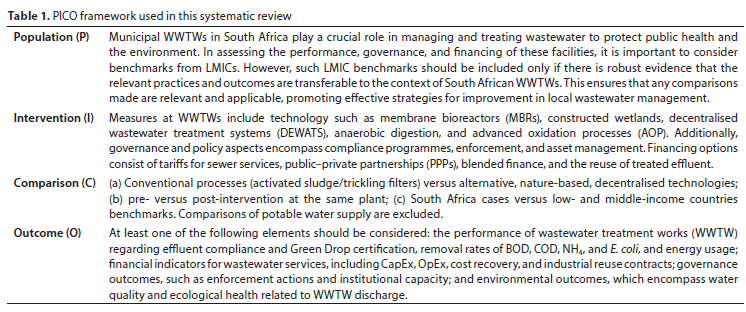
To ensure a systematic and replicable approach, this review employed the PICO (population, intervention, comparison, outcome) framework to define the scope of the studies clearly included (Amir-Behghadami and Janati, 2020) (Table 1) The criteria for inclusion focused on WWTWs in South Africa with low- and middle-income countries (LMIC) benchmarks admitted only when clearly transferable to WWTW performance/governance/financing.
This review primarily focuses on South Africa; however, it includes a limited number of studies from the Global North and other developing regions when they provide valuable performance data on technologies or financing models applicable to South African conditions. These studies were not analysed for policy transfer but were used to benchmark technical parameters (such as pollutant removal rates and lifecycle costs) and to identify global best practices. To remain objective, these studies were qualitatively weighted and referenced only to illustrate technology performance or comparative governance approaches. The main synthesis and recommendations, however, are based on South African evidence.
Exclusion criteria
Potablewater topics (drinking water treatment, desalination for supply, non-revenue water in distribution), unless they analyse outcomes at WWTWs or treatedeffluent reuse contracts, were excluded, as well as chemical composition studies without governance/financing/plant performance outcomes. Specific terms such as "water management" and "water R&D personnel" were excluded from the literature search using the Boolean operator "NOT". All sources, databases, and institutional repositories were filtered to include only texts in the English language. Non-peer-reviewed journal articles, such as research notes, research letters, and short communications, were excluded. Furthermore, the exclusion list consisted of the following criteria:
-
Research that does not offer empirical evidence or policy analysis in connection with wastewater treatment.
-
Research conducted solely in developed countries and lacking applicability due to their vastly different policy landscapes and levels of innovation in comparison to developing countries such as South Africa or similar environments.
-
Technical studies of restricted scope (for example, chemical composition studies) that don't consider issues of governance, funding, or large-scale infrastructure. We also excluded methodological papers that focused solely on effluent discharge and treatment methods, as well as studies sampling wastewater, unless they provided an analysis of the investments made in the treatment facilities.
This strategy ensured a focused search on the areas of interest specific to this study in relation to wastewater treatment, while excluding unrelated topics such as general water infrastructure.
Data extraction and management
Relevant articles identified in the Scopus database were exported to both Zotero and Covidence for further management. Zotero served as the primary reference management tool, while Covidence was utilised as an automation tool to streamline the screening and selection process of the articles. An XML file was uploaded containing all the articles to Covidence, which played a critical role in efficiently identifying and removing duplicates, as well as excluding irrelevant studies that did not meet the predefined inclusion criteria. This systematic approach ensured a rigorous and organised review process, enhancing the reliability and accuracy of the study selection.
The data collected from each study included the following elements:
-
The context and location of the study
-
The type of wastewater technology being assessed
-
Themes related to governance and investment
-
Outcomes concerning environmental quality or plant performance
-
Identified research, development, and innovation (RDI) gaps or implementation challenges
This approach ensured consistency and traceability throughout all stages of the review.
Screening process and PRISMA flow
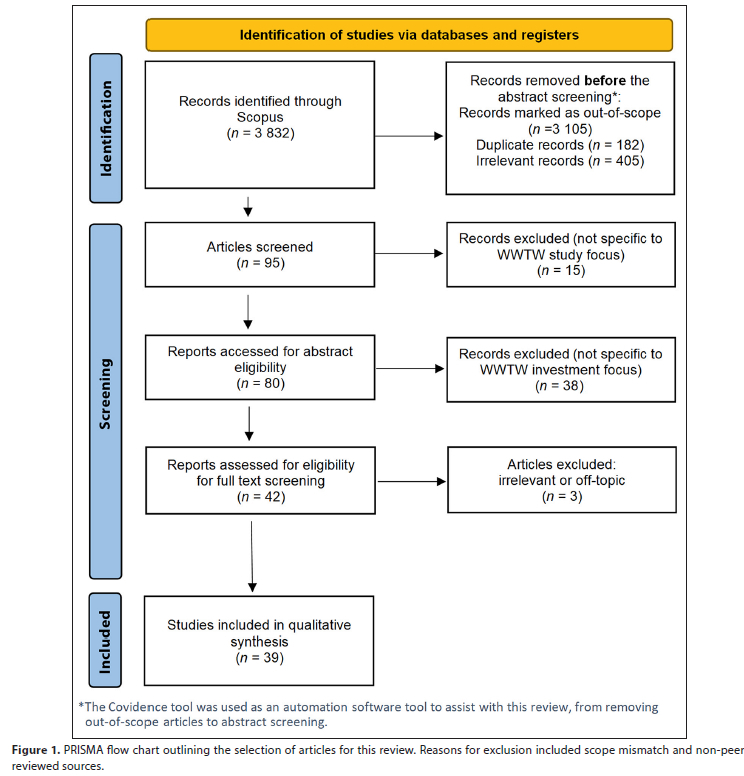
The initial keyword search in Scopus returned 3 832 results. Then, information was extracted from studies that met the eligibility criteria according to the PICO framework outlined above. After importing these records into Covidence, the following steps were completed:
-
3 150 records were removed during the initial screening due to being out of scope.
-
182 duplicates were automatically removed.
-
405 records were excluded after abstract screening.
-
95 records were retained for title and abstract review.
-
80 records were screened at the abstract stage.
-
42 full texts were assessed for eligibility.
-
39 records were included in the final qualitative synthesis.
The PRISMA flow diagram (Fig. 1) summarises the processes of identification, screening, eligibility assessment, and final inclusion.
RESULTS
The review process included records from various regions around the world, with 64% originating from South Africa. Studies from other countries, including Saudi Arabia, Ukraine, Egypt and Mexico, each contributed 3% of the total records. Additionally, comparative studies between the Global North and Africa also represented 3% of the dataset. Furthermore, 23% of the records offered global perspectives and were not specific to any single country. While the primary focus is on South Africa, the inclusion of comparative studies from similar developing economies, such as Mexico and Egypt, indicates that the challenges identified, particularly those related to infrastructure financing and governance, are relevant to other nations experiencing rapid urbanisation and resource constraints.
Thematic distribution of studies
The Critical Appraisal Skills Programme (CASP) (CASP, 2023), which provides a specific checklist tailored for systematic reviews, was utilised as the critical appraisal tool to ensure that only high-quality studies were included.
This appraisal tool was essential for assessing the studies, as it allowed for evaluation based on methodological rigour, data reliability, relevance, and risk of bias. Each study was scored according to CASP criteria, and those that did not meet the established quality threshold were excluded. Only studies that met these predefined quality standards were included in the final analysis, thereby ensuring the robustness and credibility of the review findings. An exemplar CASP checklist and scoring system can be found in the Appendix, which provides further explanation of the appraisal tool and analysis specific to this study.
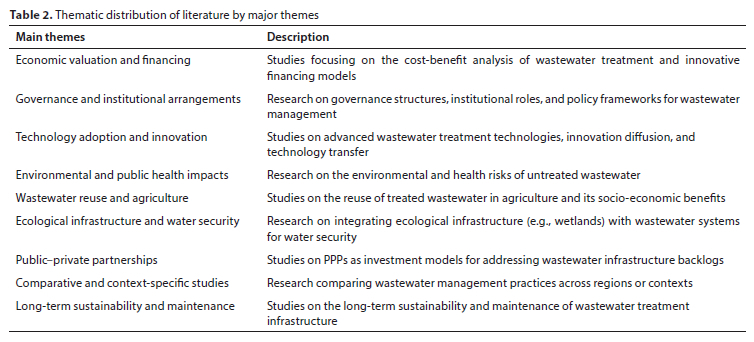
Consequently, Table 2 illustrates the thematic distribution of the selected studies was categorised into 9 distinct main themes, revealing the diverse subject areas that reflect the multidisciplinary nature of the field.
The records mainly focus on 3 areas: economic valuation, governance, and technological innovation in wastewater management. Together, these topics account for 50% of the studies reviewed. Although there has been substantial attention to addressing financing gaps and technology adoption, other critical areas, such as long-term sustainability and maintenance and comparative research, have received less emphasis.
Technological performance and infrastructure efficacy
The findings reveal a clear divide in the technological approaches adopted in South Africa and comparable developing regions. Existing literature broadly classifies these interventions into two categories: energy-intensive mechanical systems (Gkotsis et al., 2014; Nwokediegwu et al., 2024) and nature-based solutions (NBS) (Rebelo et al., 2021; Shah et al., 2024).
Mechanical systems, such as membrane bioreactors (MBRs), demonstrate exceptional treatment performance. Research by Hai et al. (2014) reports that well-designed and properly operated MBRs consistently achieve pollutant removal rates exceeding 95% for suspended solids and microbial contaminants. However, despite their technological advantages, MBRs face operational challenges in resource-constrained contexts. Studies focusing on the Southern African Development Community (SADC) region identify energy instability and shortages of skilled labour as critical vulnerabilities that limit the reliability and scalability of these advanced systems (Edokpayi et al., 2017).
NBS present a different operational profile. Although constructed wetlands exhibit slightly lower and more variable pollutant removal efficiencies, typically ranging from 80% to 90% for organic contaminants, they are appealing alternatives due to their resilience (Shah et al., 2024). Quantitative assessments show that horizontal-flow wetlands typically require 3-5 m2 per person equivalent (PE), while vertical-flow systems need only 1-2 m2 per PE (Mena et al., 2008). While these systems require more land compared to compact mechanical technologies, their near-zero energy requirements and independence from electricity significantly reduce vulnerability to power outages, thereby enhancing reliability in rural environments.
Economic valuation and cost implications
The economic analysis within the reviewed literature highlights a significant disparity between capital expenditures (CapEx) and operational expenditures (OpEx) across different technologies. A key finding is the cost-competitiveness of ecological infrastructure. Comparative cost analyses in the South African context estimate the lifetime cost of treating water with constructed wetlands at approximately 5.37 ZAR/m3 (Bassi et al., 2022, p. 27). This figure is comparable to, and often lower than, the lifecycle costs of upgrading ageing grey infrastructure, which faces rising maintenance costs due to corrosion and mechanical failure (Swartz et al., 2022).
Funding mechanisms primarily rely on public grants, while public-private partnerships (PPPs) have not been widely adopted in the water sector compared to the energy sector. High levels of non-revenue water (NRW), a key metric in potable water distribution, reduce municipal revenue streams and indirectly impact wastewater budgets. For wastewater treatment works (WWTWs), a similar challenge exists in recovering sewer service charges and establishing reuse tariffs for treated effluent. Without reliable cost-recovery mechanisms for wastewater services, PPPs remain financially unappealing. (DWS, 2018b; Ruiters and Amadi-Echendu, 2022).
Regulatory compliance and governance standards
Governance-focused studies provided extensive quantitative data on compliance status. Findings reference the Department of Water and Sanitation's reports, noting a significant decline in regulatory compliance over the last decade. An analysis of governance literature indicates that non-compliance is rarely attributed to a lack of legislation. Instead, most studies related to governance point to "institutional fragmentation" and "lack of enforcement capacity" as the main reasons for failures (DWS, 2017; Seema and Kibuuka, 2017). The findings suggest that, although the National Water Act (1998) establishes a strong legal framework, municipalities, particularly in secondary and tertiary cities, often lack the capacity to implement these regulations effectively, especially in terms of technical maintenance and financial management.
DISCUSSION
The literature indicates a significant disconnect between policy intent and operational reality in South Africa's wastewater sector. Although advanced technologies and a strong regulatory framework are available, this review reveals that financial constraints and fragmented governance are the main obstacles to practical implementation. Improving wastewater infrastructure requires a shift away from merely investing capital; it calls for stricter enforcement of regulations, enhanced collaboration between the public and private sectors, and the strategic use of decentralised treatment methods. By developing cohesive policies and encouraging innovation, South Africa can improve its wastewater management technologies to ensure long-term water security in the face of increasing environmental and economic challenges.
Implications of technological trade-offs: mechanical efficiency vs. operational resilience
Wang et al. (2014) and Edokpayi et al. (2017) point out that WWTWs are often outdated and inadequate to meet the increasing demands resulting from urbanisation. The review highlights a critical trade-off between 'advanced' mechanical technologies and 'nature-based' solutions, which must be considered in light of local infrastructure constraints.
The review emphasises a significant trade-off between energy-intensive mechanical systems and resilient, nature-based solutions for wastewater treatment. MBRs, known for their exceptional pollutant removal capabilities, are particularly well-suited for densely populated urban environments. However, their reliance on continuous electricity supply and the associated high operation and maintenance (O&M) costs present considerable challenges, especially in the context of South Africa's frequent load-shedding events. This dependence raises concerns about their practicality and sustainability in areas where power outages are common (Zziwa et al., 2023; Bassi et al., 2022; DWS, 2023a)
In contrast, constructed wetlands emerge as a viable alternative that offers low-energy resilience and competitive lifecycle costs. These systems utilise natural processes to treat wastewater, making them less susceptible to disruptions in power supply. However, a key challenge for constructed wetlands lies in their land requirements, which can limit their scalability and implementation in urban settings where space is at a premium (Milićević et al., 2024; Bassi et al., 2022)
These contrasting approaches highlight the necessity for context-specific strategies that effectively balance technical performance with the operational realities faced by communities. Policymakers and planners must consider these factors to develop integrated solutions that meet both environmental and socio-economic needs.
Decentralised wastewater treatment systems (DEWATS) have emerged as a viable alternative for rural and peri-urban areas where centralised grid connections are unfeasible. A notable example in South Africa is the implementation of DEWATS by the eThekwini Municipality, which has successfully shown how decentralised systems can effectively serve informal settlements (Milićević et al., 2024). These systems help reduce reliance on overburdened centralised facilities and promote local water reuse. To address the energy vulnerabilities of mechanical systems, investment in renewable energy integration is essential; solar-powered wastewater treatment facilities have proven effective in reducing operational costs while ensuring continuity during grid failures.
The financial and governance nexus
While technological solutions are available, the sector is underfunded and hindered by governance challenges. The National Water and Sanitation Master Plan (NW&SMP) prioritises wastewater management; however, there remains a significant financing gap (DWS, 2017). Public financing is often diverted to address immediate water supply issues, leaving treatment infrastructure vulnerable to breakdowns. This situation is exacerbated by inconsistent regulatory enforcement.
To bridge these investment gaps, innovative financing tools are needed. PPPs have been recognised as a mechanism to leverage private sector investment, but their implementation in the water sector has lagged behind that in the energy sector (Ruiters and Amadi-Echendu, 2022). The Renewable Energy Independent Power Producer Procurement Programme (REIPPPP) serves as a successful case study in South Africa, having attracted billions in private investment for grid infrastructure (GreenCape, 2024; Ruiters and Amadi-Echendu, 2022). However, this success has not been mirrored in water infrastructure, due to specific revenue uncertainties. Unlike the electricity sector, which has centralised and secured revenue streams, municipal water tariff collection is often inefficient. In many municipalities, non-revenue water (NRW) rates exceed 41%, making the financial models necessary for private investment unviable under current frameworks (DWS, 2018b).
Despite facing various challenges, several initiatives in South Africa highlight the practical potential of innovative financing and reuse strategies. One notable example is Durban's Southern Wastewater Treatment Works, which operates under a 20-year public-private partnership with Veolia Water Technologies South Africa. This partnership enables industrial water reuse and cost recovery through long-term off-take agreements. The tertiary treatment plant processes 47.5 ML/d of municipal wastewater, treating it to a near-potable standard for industrial use. Major clients include Mondi and the South African Petroleum Refinery (SAPREF). This concession model has facilitated cost recovery through these long-term agreements, leading to a 52% reduction in industrial water tariffs. Additionally, it covers nearly all operation and maintenance costs, achieving water security alongside economic and environmental benefits without burdening municipal capital budgets (Veolia, 2023; World Bank, 2018).
Similarly, the Siza Water concession in the Ilembe District is a prime example of how private participation under the Municipal Finance Management Act (MFMA) can sustain municipal water services while addressing tariff and governance challenges (Robbins, 2004). On a larger scale, Cape Town's Faure New Water Scheme utilises multi-barrier membrane bioreactor technology for potable water reuse, demonstrating both its technical feasibility and the importance of public acceptance (GreenCape, 2024).
Looking ahead, national programmes are beginning to address these gaps. The Water Partnerships Office (WPO), a ring-fenced entity housed within the Development Bank of Southern Africa (DBSA), in partnership with DWS and the South African Local Government Association (SALGA), has been established under the National Water Partnerships Programme to develop standardised PPP frameworks, prepare bankable municipal water projects, and secure blended finance (Lübbe, 2024). Through a programmatic approach centred on risk allocation, funding structuring, and performance benchmarks, the WPO aims to simplify the PPP process and reduce transaction costs. This initiative offers a viable pathway to scale private investment in wastewater infrastructure and strengthen public-private collaboration across municipalities. These cases collectively underscore that while structural and regulatory hurdles persist, targeted reforms and risk-sharing mechanisms can unlock private capital and accelerate innovation in South Africa's water sector.
Moreover, legal and institutional barriers limit the effectiveness of PPPs. These challenges include poorly structured agreements and ambiguous asset ownership regulations concerning decentralised systems (Seema and Kibuuka, 2017). For a country like South Africa, achieving greater regulatory certainty, especially regarding water reuse tariffs and private sector involvement, is crucial to overcoming these challenges. The National Water Investment Framework emphasises the need for asset lifecycle modelling to accurately determine annual financing requirements, indicating that without long-term planning the backlog in infrastructure development will persist.
Environmental health and ecological infrastructure
The review highlights a strong link between improved performance of wastewater treatment works (WWTW) and environmental protection. Singh et al. (2023) emphasise that effectively treated wastewater significantly reduces chemical contaminants and pathogens. This is particularly important in South Africa's mining regions, where acid mine drainage (AMD) pollutes water sources with heavy metals. Investments in passive treatment technologies, such as phytoremediation, where plants absorb contaminants, have been identified as cost-effective methods for addressing AMD-related pollution (Edokpayi et al., 2017; Rebelo et al., 2021).
In addition to mechanical treatment, restoring ecological infrastructure provides a complementary strategy for enhancing water security. Rebelo et al. (2021) and Webster et al. (2024) indicate that restoring ecological infrastructure is often more cost-effective than building new grey infrastructure. It is estimated that restoring key water source areas and wetlands could meet up to 24% of the country's water supply needs by 2050 (Webster et al., 2024).
However, progress in adopting these green infrastructure solutions is hindered by a lack of technical support and data demonstrating their effectiveness to municipal engineers. To overcome these challenges, holistic approaches are needed that improve coordination among environmental management, finance, and urban planning departments. This would help secure funding through joint budget proposals.
Bridging the gap: from innovation to implementation
The gap between innovation in wastewater treatment and its implementation on a large scale reveals ongoing inconsistencies in governance and financial models. Although research, development, and innovation (RDI) offer promising solutions such as AI-equipped monitoring systems and bioremediation processes, adoption has been slow due to bureaucratic delays and a lack of technical expertise (Patoucha and Gareiou, 2024). To enhance the role of RDI, it is essential to create policy coherence that integrates research findings into national water policy. Increasing investment in RDI should focus not only on developing technology but also on establishing governance models that ensure the financial viability of decentralised and nature-based systems. Additionally, public awareness campaigns are crucial for promoting the acceptance of water reuse, which remains a social hurdle despite its technical feasibility. Ultimately, bridging this gap requires a unified strategy where technological innovation is supported by adaptive governance and sustainable financing models.
CONCLUSION
This systematic review has highlighted that the decline of South Africa's WWTWs is not simply a technical issue but rather a symptom of a broader systemic misalignment between infrastructure investment, governance capacity, and technological choices. While the National Water Resource Strategy and Green Drop reports emphasise the urgency of this crisis, this study enhances our understanding by explicitly connecting these isolated challenges (DWS, 2023b; DWS, 2023a; DWS, 2022). The analysis reveals that without addressing the financial and operational 'enabling environment', even the most advanced technological solutions will struggle to be effectively implemented.
The synthesis of evidence reveals a critical paradox in South Africa's water management. Despite having a strong research landscape and access to advanced technologies such as MBRs, implementation is hindered by local resource limitations. Additionally, the study indicates that financial mechanisms, particularly PPPs, are currently ineffective in the water sector. This is primarily due to high non-revenue water rates, which undermine investor confidence.
To bridge the gap between innovation and implementation, a phased strategic approach is necessary. Based on the evidence reviewed, the following recommendations are proposed:
-
Short-term strategies (immediate stabilisation): It is essential to focus on restoring the operational functionality of existing assets. This involves enforcing strict regulatory compliance as outlined in the Green Drop reports and prioritising the transfer of technical skills to municipal operators for effectively managing hydraulically overloaded systems. Immediate funding should be allocated to basic maintenance rather than new capital projects in order to halt the rapid decline of critical infrastructure.
-
Medium-term strategies (operational resilience): Incorporate renewable energy sources, such as solar photovoltaics (PV), into mechanical treatment plants to reduce load-shedding risks. Pilot decentralised, nature-based systems in peri-urban and rural areas where grid access is limited.
-
Long-term strategies (structural transformation): To ensure sustainable financing, the water sector needs to restructure its revenue models to make PPPs viable. This requires a national programme aimed at reducing non-revenue water, which will help secure the revenue streams necessary to attract private capital. Additionally, policy frameworks should be harmonised to recognise water reuse not just as an emergency alternative, but as an essential component of the national water strategy.
This review has argued that achieving sustainable water security requires more than just engineering solutions; it necessitates the integration of technological performance data with financial and governance analysis. The key contribution of this work is the identification of a hybrid approach that balances advanced mechanical solutions with resilient ecological infrastructure, all supported by a governance framework that ensures financial viability. It is essential to shift from reactive crisis management to proactive, evidence-based planning to protect South Africa's water resources from future economic and environmental uncertainties.
ACKNOWLEDGEMENTS
The authors extend their appreciation to the Wenner-Gren Foundation for the Dissertation Fieldwork Grant awarded to Zikhona Ngqula, which supported the anthropological research underlying this study.
AUTHOR CONTRIBUTIONS
Zikhona Ngqula was responsible for the conceptualisation of the study, development of the methodology, validation, formal analysis, and the writing of the original draft manuscript, including revisions and finalisation of the paper. Jacqueline M Borel-Saladin contributed to the formal analysis and provided critical input through reviewing and editing the manuscript.
DECLARATION OF COMPETING INTEREST
The authors declare that they have no known competing financial interests or personal relationships that could have appeared to influence the work reported in this paper.
DATA AVAILABILITY
No data were used for the research described in the article.
ORCIDS
Zikhona Necolette Ngqula https://orcid.org/0000-0003-2150-3670
Jacqueline Borel-Saladin https://orcid.org/0000-0003-3060-9127
REFERENCES
AJAMI N, BARTON H and VICTOR DG (2014) The path to water innovation. The Hamilton Project, Discussion paper 2014-06. Stanford Woods Institute for the Environment. URL: https://waterinthewest.stanford.edu/sites/default/files/path_to_water_innovation_thompson_paper_final.pdf (Accessed 3 October 2024). [ Links ]
AMIR-BEHGHADAMI M and JANATI A (2020) Population, intervention, comparison, outcomes and study (PICOS) design as a framework to formulate eligibility criteria in systematic reviews. Emerg. Med. J. 37 (6) 387. https://doi.org/10.1136/emermed-2020-209567 [ Links ]
AMIS MA and LUGOGO S (2018) The South African water innovation story. WRC Report No. TT 743/17. Water Research Commission, Pretoria. URL: https://www.wrc.org.za/mdocs-posts/the-south-african-water-innovation-story/ [ Links ]
BASSI A, BECHAUF R, CASIER L, GOUETT M and UZSOKI D (2022) Sustainable asset valuation (SAVi) of wastewater treatment infrastructure in South Africa. National Business Initiative (NBI) and International Institute for Sustainable Development (IISD). URL: https://www.iisd.org/publications/report/savi-wastewater-treatment-infrastructure-hartenbos-estuary-south-africa (Accessed 30 October 2024). [ Links ]
CASP (Critical Appraisal Skills Programme) (2023) CASP systematic review checklist. URL: https://casp-uk.net/casp-tools-checklists/systematic-review-checklist (Accessed 6 April 2025). [ Links ]
CUNNINGHAM C and GHARIPOUR M (2018) Pipe dreams: urban wastewater treatment for biodiversity protection. Urban Sci. 2 (1) 10. https://doi.org/10.3390/urbansci2010010 [ Links ]
DONTHU N, KUMAR S, MUKHERJEE D, PANDEY N and LIM WM (2021) How to conduct a bibliometric analysis: an overview and guidelines. J. Bus. Res. 133 285-296. https://doi.org/10.1016/j.jbusres.2021.04.070 [ Links ]
DU PLESSIS A (2023) Continued decay of South Africa's basic water and sanitation infrastructure and service delivery. In: South Africa's Water Predicament. Water Science and Technology Library 101. Springer, Cham. https://doi.org/10.1007/978-3-031-24019-5_5 [ Links ]
DWS (Department of Water and Sanitation, South Africa) (2017) National Water Investment Framework. Department of Water and Sanitation, Pretoria. [ Links ]
DWS (Department of Water and Sanitation, South Africa) (2018a) National Water and Sanitation Master Plan: Volume 1 - Call to Action. Department of Water and Sanitation, Pretoria. [ Links ]
DWS (Department of Water and Sanitation, South Africa) (2018b) National Water and Sanitation Master Plan: Volume 2: Plan to Action. Department of Water and Sanitation, Pretoria. [ Links ]
DWS (Department of Water and Sanitation, South Africa) (2022) 2022 Green Drop Report. Pretoria: Department of Water and Sanitation, Pretoria. URL: https://ws.dws.gov.za/iris/releases/Report_DPW_Rev02_29Mar22_MN%20web.pdf (Accessed 30 September 2024). [ Links ]
DWS (Department of Water and Sanitation, South Africa) (2023a) Green Drop Watch Report 2023. DWS, Pretoria. URL: https://ws.dws.gov.za/iris/releases/GDWR.pdf (Accessed 20 September 2024). [ Links ]
DWS (Department of Water and Sanitation, South Africa) (2023b) National Water Resource Strategy (NWRS) III. Department of Water and Sanitation, Pretoria. [ Links ]
EDOKPAYI JN, ODIYO JO and DUROWOJU OS (2017) Impact of wastewater on surface water quality in developing countries: a case study of South Africa. In: Tutu H (ed.) Water Quality. https://doi.org/10.5772/66561 [ Links ]
ETHEKWINI WATER AND SANITATION (2024) Water reuse for eThekwini: Ensuring water security for tomorrow. eThekwini Municipality, Durban. [ Links ]
FOLEY J, DE HAAS D, HARTLEY K and LANT P (2010) Comprehensive life cycle inventories of alternative wastewater treatment systems. Water Res. 44 (5) 1654-1666. https://doi.org/10.1016/j.watres.2009.11.031 [ Links ]
GKOTSIS P, BANTI D, PELEKA E, ZOUBOULIS A and SAMARAS P (2014) Fouling issues in membrane bioreactors (MBRs) for wastewater treatment: major mechanisms, prevention and control strategies. Processes 2 (4) 795-866. https://doi.org/10.3390/pr2040795 [ Links ]
GREENCAPE (2024) Large-scale Renewable Energy Market Intelligence Report 2024. GreenCape, Cape Town. URL: https://greencape.co.za/wp-content/uploads/2024/04/Large-scale-RE-MIR-2024-digital.pdf [ Links ]
HABIYAREMYE A (2020) Water innovation in South Africa: mapping innovation successes and diffusion constraints. Environ. Sci. Polic. 114 217-229. https://doi.org/10.1016/j.envsci.2020.08.011 [ Links ]
HAI F, RILEY T, SHAWKAT S, MAGRAM S and YAMAMOTO K (2014) Removal of pathogens by membrane bioreactors: a review of the mechanisms, influencing factors and reduction in chemical disinfectant dosing. Water 6 (12) 3603-3630. https://doi.org/10.3390/w6123603 [ Links ]
KASONGA TK, COETZEE MA, KAMIKA I, NGOLE-JEME VM, NDOMBO M and MOMBA B (2021) Endocrine-disruptive chemicals as contaminants of emerging concern in wastewater and surface water: a review. J. Environ. Manage. 277 111485. https://doi.org/10.1016/j.jenvman.2020.111485 [ Links ]
LÜBBE J (2024) Water Partnerships Office overview: increasing private sector participation in water services. PowerPoint presentation. Business Unity South Africa. URL: https://www.busa.org.za/wp-content/uploads/2024/11/WPO-overview-Nov-2024.pdf (Accessed 10 December 2025). [ Links ]
MENA J, RODRIGUEZ L, NUÑEZ J, FERNÁNDEZ FJ and VILLASEÑOR J (2008) Design of horizontal and vertical subsurface flow constructed wetlands treating industrial wastewater. Water Pollut. IX 1 555-564. https://doi.org/10.2495/WP080551 [ Links ]
MILIĆEVIĆ D, MILIĆEVIĆ M and TRAJKOVIĆ R (2024) Decentralised wastewater treatment - a sustainable solution for protecting water resources from pollution. J. Faculty Civ. Eng. Archit. 39 35-46. https://doi.org/10.62683/ZRGAF39.35-46 [ Links ]
NWOKEDIEGWU ZQS, DADA MA, DARAOJIMBA, OH, OLIHA JS, MAJEMITE MT and OBAIGBENA A (2024) A review of advanced wastewater treatment technologies: USA vs. Africa. Int. J. Sci. Res. Arch. 11 (1) 0333-0340. https://doi.org/10.30574/ijsra.2024.11.1.0071 [ Links ]
PATOUCHA A and GAREIOU Z (2024) The role of artificial intelligence in environmental sustainability. E3S Web of Conferences 585 11011. https://doi.org/10.1051/e3sconf/202458511011 [ Links ]
POURIS A (2013) A pulse study on the state of water research and development in South Africa. WRC Report No. 2199/1/12. Water Research Commission, Pretoria. [ Links ]
PRANCKUTĖ R (2021) Web of Science (WoS) and Scopus: The titans of bibliographic information in today's academic world. Publications 9 (1) 12. https://doi.org/10.3390/publications9010012 [ Links ]
REBELO AJ, HOLDEN PB, ESLER K and NEW MG (2021) Benefits of water-related ecological infrastructure investments to support sustainable land-use: a review of evidence from critically water-stressed catchments in South Africa. R. Soc. Open Sci. 8 (4) 201402. https://doi.org/10.1098/rsos.201402 [ Links ]
ROBBINS G (2004) A water sector public-private partnership case study: Ilembe District Municipality (formerly Dolphin Coast) - Siza Water Company. URL: https://sds.ukzn.ac.za/files/RR63.pdf (Accessed 10 December 2025). [ Links ]
RUITERS C and AMADI-ECHENDU J (2022) Public-private partnerships as investment models for water infrastructure in South Africa. Infrastruct. Asset Manage. 9 (4) 180-193 https://doi.org/10.1680/jinam.21.00013 [ Links ]
SEEMA N and KIBUUKA P (2017) Innovative financing mechanisms for government to leverage private sector investment in infrastructure for sustainable development in South Africa: case study in the water sector. Public Munic. Fin. 6 (3) 33-44. https://doi.org/10.21511/pmf.06(3).2017.04 [ Links ]
SHAH AM, LIU G, NAWAB A, LI H, XU D, YEBOAH FK, YANG Q and ZHANG L (2024) Sustainability and resilience interface at typical urban green and blue infrastructures: costs, benefits, and impacts assessment. Front. Sustain. Cities 6 1453829. https://doi.org/10.3389/frsc.2024.1453829 [ Links ]
SINGH BJ, CHAKRABORTY A and SEHGAL R (2023) A systematic review of industrial wastewater management: evaluating challenges and enablers. J. Environ. Manage. 348 119230. https://doi.org/10.1016/j.jenvman.2023.119230 [ Links ]
SWARTZ CD, COOMANS CJ, MULLER HP, DU PLESSIS JA and KAMISH W (2022) A water reclamation and reuse guide for South African municipal engineers. WRC Report No. TT 882/22. Water Research Commission, Pretoria. [ Links ]
UNITED NATIONS (2015) United Nations Sustainable Development Goals. United Nations, New York. URL: https://sdgs.un.org/goals (Accessed 28 September 2024). [ Links ]
VEOLIA WATER TECHNOLOGIES SOUTH AFRICA (2023). Durban Water Recycling Project. URL: https://www.veoliawatertechnologies.co.za/durban-water-recycling (Accessed 10 December 2025). [ Links ]
WANG H, WANG T, LI BZ, LI F, TOURE B, OMOSA IB, CHIRAMBA T, ABDEL‐MONEM M and PRADHAN M (2014) Water and wastewater treatment in Africa - current practices and challenges. CLEAN Soil Air Water 42 (8) 1029-1035. https://doi.org/10.1002/clen.201300208 [ Links ]
WEBSTER KME, TURPIE JK and LETLEY GK (2024) Viability of Investing in Ecological Infrastructure in South Africa's Water Supply Areas. S. Afr. J. Sci. 120 (5/6). https://doi.org/10.17159/sajs.2024/17378 [ Links ]
WORLD BANK (2018) Case study: public-private partnership for wastewater reclamation in Durban, South Africa. World Bank Group, Washington, DC. URL: https://ppp.worldbank.org/public-private-partnership/library/durban-water-recycling-case-study (Accessed 10 December 2025). [ Links ]
WRC (Water Research Commission) (2015) South Africa's Water Research, Development and Innovation (RDI) Roadmap: 2015-2025. WRC Report No. 2305/1/15. Water Research Commission, Pretoria. [ Links ]
WRC (Water Research Commission) (2022) Water Research Commission Annual Report 2021/2022. WRC Report No. RP89/2022. Water Research Commission, Pretoria. [ Links ]
ZZIWA A, DAVID M, SSEMPIRA EJ and KIZITO SS (2023). Transforming agriculture: innovations in sustainable wastewater reuse - a review. Int. J. Sci. Adv. 4 (6) 1038-1048. URL: https://www.ijscia.com/transforming-agriculture-innovations-in-sustainable-wastewater-reuse-a-review/ [ Links ]
 Correspondence:
Zikhona Ngqula
Email: necolletengqula@gmail.com
Received: 2 June 2025
Accepted: 2 April 2026
APPENDIX
CASP CHECKLIST
Section A: Are the results of the review valid?
1. Did the review address a clearly focused question? Yes. Comments: Yes - The review examined strategies (investment, policy reform, innovation) to improve wastewater treatment works (WWTWs) in South Africa, aligned with SDG 6.
2. Did the authors look for the right type of papers? Yes. Comments: Yes, peer-reviewed articles, policy documents, and grey literature (2014-2024) covering technology, governance, and economics were included.
3. Do you think all the important, relevant studies were included? Yes. Comments: Bibliographic databases were used, follow up from reference lists, and grey literature was included.
4. Did the review's authors do enough to assess quality of the included studies? Yes. Comments: Yes - CASP tool evaluated methodological rigor, bias, and relevance; low-quality studies were excluded.
5. If the results of the review have been combined, was it reasonable to do so? Can't Tell. Comments: Results were synthesized qualitatively rather than through meta-analysis.
Section B: What are the results?
6. What are the overall results of the review? Comments: The systematic review reveals that South Africa's wastewater treatment works (WWTWs) are severely tested, including having old infrastructure, fiscal constraints, and fragmented administration, where only 23 out of 850 plants are in good condition. Emerging technologies like nature-based solutions, membrane bioreactors (MBRs), and decentralised systems are promising but are challenged by high costs, energy dependency, and limited technical expertise. Improved WWTWs can potentially avoid pollution, protect ecosystems, and advance public health, but wastewater reuse is undermined by policy gaps and public resistance. Different and creative financing such as PPPs, and more stringent policies enforced, are central in ending these. The review suggests that integrated combinations of technological transformation, governance reform, and green investment need to bring about long-term water security in South Africa.
7. How precise are the results? Comments: Moderate - Dominant South African focus (64% of studies) limits global generalizability but ensures local relevance.
Section C: Will the results help locally?
8. Can the results be applied to the local population? Yes. Comments: Yes, with context-specific considerations - The review's findings are highly relevant to South Africa due to the local focus of 64% of included studies addressed South Africa directly, ensuring alignment with regional challenges.
9. Were all important outcomes considered? Can't Tell. Comments: Partially - Environmental/health benefits were prioritised; long-term sustainability and equity gaps were noted. The review successfully covers the most critical technical, environmental and governance outcomes, but could enhance its policy relevance by more explicitly addressing social equity and climate resilience dimensions. The outcomes align well with SDG 6 targets but could benefit from stronger connections to other SDGs (1, 5, 10, 13) for a more holistic assessment. The review considered key outcomes such as environmental protection, public health benefits, economic feasibility, governance challenges, and technological adoption in wastewater treatment. However, it did not fully explore long-term sustainability assessments, social equity implications, or detailed cost-benefit comparisons between centralized and decentralized systems. While comprehensive in scope, these gaps suggest opportunities for further research to strengthen policy and implementation strategies.
10. Are the benefits worth the harms and costs? Yes. Comments: Yes - Benefits (health, ecology, water security) outweigh costs if policies/financing address implementation barriers. The review concludes that the benefits of upgrading South Africa's wastewater treatment infrastructure (improved public health, environmental protection, and water security) outweigh the costs (financial and operational). While there are challenges (high capital costs, complexity, and social acceptance barriers), the long-term implications of inaction (ecological deterioration, health crisis, and water shortage) are far more serious. Phased reforms, targeted financing, and stakeholder engagement can maximize benefits while reducing costs through strategic implementation.