Services on Demand
Journal

Article
 English (pdf)
 Article in xml format
 Article references
 Automatic translation
 Send this article by e-mail
Indicators
Related links
-
 Cited by Google
 -
 Similars in Google
Share

 Permalink
Water SA
On-line version ISSN 1816-7950Print version ISSN 0378-4738
Water SA vol.51 n.3 Pretoria Jul. 2025
https://doi.org/10.17159/wsa/2025.v51.i3.4153
RESEARCH PAPER
Field-scale application of constructed wetlands for treating surface water contaminated by an informal settlement
Emily NicklinI; Kalpana MarajII; Kevin WinterI
IDepartment of Environmental and Geographical Science and Future Water Institute, University of Cape Town, Rondebosch 7700, South Africa
IIDepartment of Chemical Engineering and Future Water Institute, University of Cape Town, Rondebosch 7700, South Africa
ABSTRACT
The rapid expansion of informal settlements near South African water bodies has led to a significant decline in water quality. Runoff from inadequate sanitation and drainage systems contaminates rivers, wetlands and groundwater, posing risks to aquatic ecosystems and human health. Addressing these challenges requires innovative, low-cost solutions such as nature-based infrastructure (NBI), which can be implemented in a decentralised manner. Among these, constructed wetlands (CWs) stand out as potentially effective NBI solutions, providing a sustainable approach for water treatment without relying on additional chemicals or energy. They can remove pollutants such as total suspended solids (TSS), organic matter, nutrients and heavy metals, although their efficacy depends on site-specific conditions and water quality characteristics. Despite their potential, research on field-scale CWs for treating surface water polluted by informal settlements remains limited. This study evaluates the performance of a field-scale CW, incorporating vegetated and non-vegetated cells, to treat surface water from an informal settlement. Rigorous monitoring and operational protocols were implemented to optimise CW efficiency and enhance water quality for irrigation and environmental discharge. The CW effectively reduced ammonia nitrogen (NH3-N), orthophosphate (PO43-) and Escherichia coli (E. coli) concentrations by up to 84%, 75% and 100%, respectively. The treated water met standards for irrigation reuse, although additional disinfection was required in some cases. While the findings highlight CWs' potential, uncertainties persist about their sustained performance under fluctuating water quality and pollutant loads typical of informal settlement runoff. Further research is therefore needed to understand temporal water quality variations, optimise CW operation under peak pollutant loadings, and address emerging contaminants in surface waters affected by informal settlements.
Keywords: constructed wetlands, informal settlements, contaminated runoff, water quality, water reuse
INTRODUCTION
In developing countries such as South Africa, the rapid expansion of low-income, non-sewered settlements along urban and peri-urban waterways is causing a decline in water quality due to contaminated runoff from inadequate sanitation and drainage systems (Gqomfa et al., 2022; Morole et al., 2022; Winter et al., 2023). These settlements generate approximately 490 000 m3 of greywater daily (Carden et al., 2007). Without formal drainage infrastructure, this greywater often mixes with sewage, resulting in runoff that contains high levels of pollutants, with chemical oxygen demand (COD) concentrations ranging from 1 500 to 8 500 mg/L, oil and grease concentrations from 30 to 2 000 mg/L, electrical conductivity (EC) from 50 to 1 500 mS/m, and bacteriological quantities comparable to raw sewage (Armitage et al., 2009).
Urbanisation plays a significant role in the rapid growth of informal settlements (Williams et al., 2019). People shifting from rural to urban areas, often unable to afford formal housing, resort to constructing shacks in vulnerable locations such as wetlands and riverbanks. Despite the national government's efforts to address this growing demand through increased social housing construction, approximately 12.2% of the South African population lived in informal settlements in 2023 (StatsSA, 2023). Projections indicate that by 2030, 71% of South Africans will reside in urban areas, rising to 80% by 2050 (UN-Habitat, 2014). This anticipated growth will increase the demand for basic services, housing and infrastructure, placing additional pressure on an already constrained system.
Addressing water pollution arising from poorly serviced informal settlements presents numerous challenges. Technical constraints such as irregular morphology, challenging topography and limited finance hinder progress (Van der Merwe and Simha, 2023). In addition, local authorities often hesitate to invest in reticulating these settlements to formal sanitation and drainage networks because land occupation is illegal or tenure is insecure. Consequently, the discharge of sewage and greywater from these settlements, sometimes mixed with stormwater, results in contaminated runoff that enters nearby water bodies.
Nature-based infrastructure (NBI) solutions have emerged as potentially viable decentralised options for addressing urban and peri-urban water challenges (UNEP, 2023), particularly in catchments with informal settlements where conventional sewerage and drainage infrastructure is often absent or dysfunctional (Sinharoy et al., 2019). These solutions include a diverse range of techniques, including water-sensitive urban design (WSUD), low-impact development (LID) and the preservation of natural wetlands, waterways and estuaries within urban landscapes (Oral et al., 2020). By replicating natural processes, NBI solutions eliminate the need for energy or chemicals and require less capital investment than conventional infrastructure (UNEP, 2023). This makes them particularly suitable for resource-constrained environments such as informal settlements, where access to electricity and water is severely limited (ADB and RISE, 2021). Moreover, they operate passively and are easy to maintain, requiring minimal technical expertise and lower capital investment than conventional approaches.
The most prevalent and widely accepted NBI solution for managing urban water pollution is constructed wetlands (Oral et al., 2020). Constructed wetlands (CWs) use a combination of vegetation, soil and microorganisms to effectively remove various environmental pollutants, including contaminants such as total suspended solids (TSS), organic matter, nutrients and heavy metals (Bavor and Schulz, 2020; Saeed et al., 2021). CWs have shown high pollutant removal rates, capable of eliminating up to 88% of TSS, 92% of biological oxygen demand (BOD5), and 83% of COD even after more than 20 years of use (Vymazal, 2019). Their effectiveness in nutrient removal varies, with systems achieving removal rates between 46% and 90% for total phosphorus and 16% and 84% for total nitrogen (Malaviya and Singh, 2012). CWs can also remove both organic and inorganic pollutants, including pesticides (Chen et al., 2022), heavy metals (Saeed et al., 2021) and pharmaceuticals (Ilyas and Van Hellebusch, 2019; Ilyas et al., 2021; Zraunig et al., 2019), among others.
Despite their promising performance, the implementation, operation and maintenance of CWs for treating polluted surface waters at a field scale remain limited, particularly in informal settlement contexts (Diep et al., 2022). Such environments present unique challenges, including highly variable water quality from mixed wastewater sources, constraints on space and resources, maintenance difficulties, and the risk of system overloading (Prescott et al., 2021). One notable initiative is the RISE project, which trials NBI solutions to improve water quality and reduce health risks across 24 informal settlements in Fiji and Indonesia (Ramirez-Lovering et al., 2018; Leder et al., 2021).
However, most publications from this project focus on the design and implementation of NBI solutions, with limited focus on measurable water quality improvements. In southern Africa, examples are even rarer. One exception is the URBWAT project in Johannesburg's Alexandra informal settlement, which uses CWs to treat contaminated runoff, including greywater, sewage and 'night soil' (Sheridan et al., 2023). By incorporating field water quality measurements, this project provides tangible evidence of CWs' treatment potential in informal settlements. However, more research is needed to assess the NBI solutions' performance in these contexts and further optimise their design and operation at the field scale.
This study examines the performance of a field-scale CW comprising both vegetated and non-vegetated cells in treating surface water contaminated by discharge from an informal settlement. By implementing a rigorous monitoring and operating protocol, the study aimed to optimise the treatment efficiency and best practices of field-scale CWs designed for treating surface water polluted by informal settlements. These findings inform guidelines for operating the CW system effectively to enhance water quality, ensuring that the treated effluent meets standards suitable for irrigation reuse and environmental discharge.
METHODS
Study site
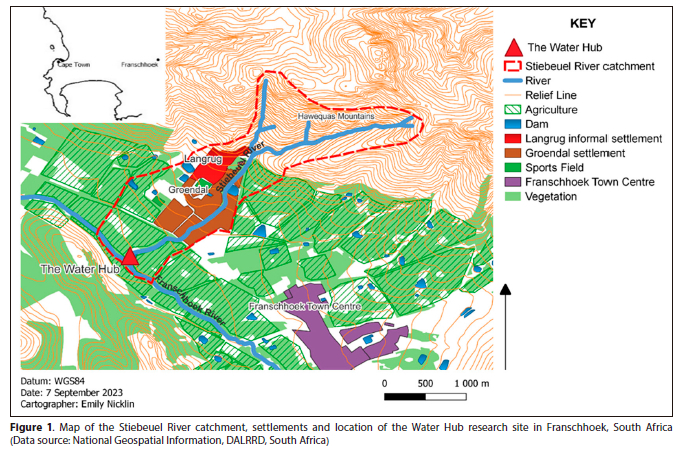
The study was conducted in the Stiebeuel River catchment in Franschhoek, in the Western Cape Province of South Africa (Fig. 1). Winter et al. (2023) documented the characteristics of the catchment in a previous paper, which highlighted the water quality impacts of an upstream informal settlement, Langrug, on the Stiebeuel River and assessed the treatment performance of a constructed wetland (CW) system at a downstream location known as the Water Hub research centre. In summary, Langrug is an informal settlement in the Stiebeuel River catchment.
A report from 2016 estimated that Langrug was inhabited by approximately 8 100 people who reside in makeshift dwellings constructed from various materials such as corrugated iron, wood, plastic sheeting and scrap materials (Stellenbosch Municipality, 2018/9). The settlement has limited access to basic services and infrastructure, with only 19 tap stands and 38 waterborne ablution toilets that are often dysfunctional. The absence of a formal stormwater drainage system contributes to the continuous flow of a mixture of black- and greywater along the streets, sometimes infiltrating homes and eventually reaching the Stiebeuel River (Armitage et al., 2009).
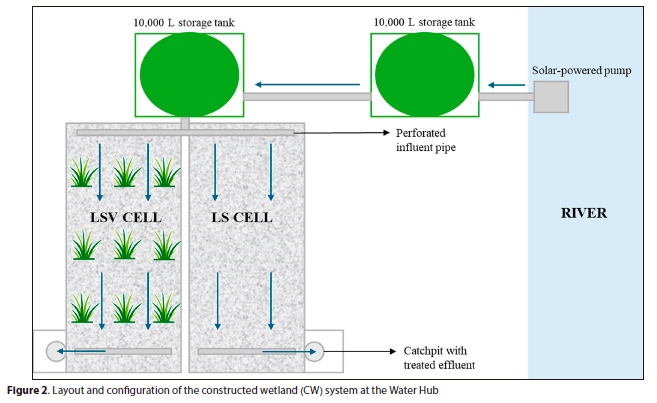
The Water Hub, a former decommissioned wastewater treatment plant, was repurposed as a testing site for nature-based infrastructure (NBI) solutions, specifically horizontal, subsurface flow CWs designed to treat polluted surface water from the surrounding catchment. Water is abstracted from the adjacent Stiebeuel River using a solar-powered pump and temporarily stored in two 10 000 L storage tanks before being gravity-fed into the CW system. The water then percolates through the substrate in a predominantly horizontal flow direction, approximately 10 cm below the media surface.
The CW system consists of 6 cells, each measuring 16 m in length, 3 m in width and 0.63 m in depth. These cells are retrofitted from an old sludge drying bed (Fig. 2) and lined with a 4 mm low-density polyethylene (LDPE) material to prevent exfiltration into the groundwater. The cells are filled with various natural media, including large stone aggregate (17-19 mm in diameter, 0.54 voidage), small stone aggregate (7-9 mm in diameter, 0.46 voidage) and peach pips. Only the two cells filled with large stone aggregate were considered, as they demonstrated the best performance to date. One of the large stone cells was planted with indigenous wetland plants, including Phragmites australis, Typha capensis and Cyperus textilis. In contrast, the other, which also contained large stone aggregate, remained unplanted and served as a control for comparison.
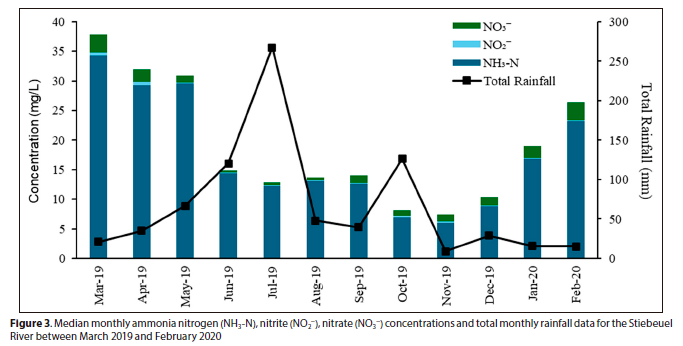
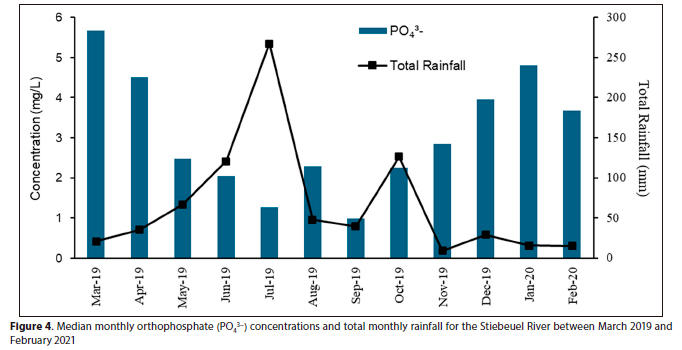
A previous study monitored the monthly nutrient concentrations in the Stiebeuel River from March 2019 to February 2020. Figures 3 and 4 illustrate the median monthly total inorganic nitrogen concentration, which consists of ammonia nitrogen (NH3-N), nitrite (NO2-) and nitrate (NO3-), as well as orthophosphate (PO43-) in the Stiebeuel River, along with the total monthly rainfall that was recorded at the Water Hub. The selection of median concentrations, as opposed to mean concentrations, provides a more robust presentation of the data because of the considerable variability that was observed in the concentration of nutrients.
The results showed that nutrient concentrations were higher during the dry seasonal flow conditions than the wet seasonal flow conditions and that the median nutrient concentrations generally exceeded the limits recommended by the South African water quality guidelines for aquatic ecosystems and irrigation (DWAF, 1996a, b). This was concerning given that the Stiebeuel River discharges into the Franschhoek and Berg Rivers where surface water is abstracted for small-scale and commercial farming. These larger water bodies play a pivotal role in the region's agriculture, notably in the cultivation of grapes for wine production and fruit farming (Cullis et al., 2018).
In their preliminary analysis of the CW system's remediation of the Stiebeuel River, Winter et al. (2023) provided insights into the system's ability to reduce concentrations of key nutrients, such as total inorganic nitrogen and orthophosphate. However, inconsistencies in the CW system's operation and monitoring protocols were noted, primarily due to limited solar energy capacity at the time of the study and gaps in understanding nutrient degradation in the system.
Study design
The constructed wetland (CW) system was operated in batch mode, adopting a fill-and-draw approach. A solar-powered pump abstracted approximately 20 000 L of water from the Stiebeuel River, temporarily storing it in two 10 000 L water tanks. Subsequently, the water was released to supply two cells - one vegetated (LSV) and one non-vegetated (LS) - and retained for up to 7 days after which the water (treated effluent) was used to irrigate a small-scale vegetable garden with the larger proportion being released into the Stiebeuel River. This operation mode was selected because it could be achieved with constrained solar power rather than a continuous feed.
During each batch cycle, grab samples were collected from the inlet (i.e., the storage tank) before water was released into the CW system. Effluent samples were then collected from the outlets of both the LS and LSV cells (i.e. the catchpits exiting the filtration media of each cell) at the end of Days 1, 3, 5 and 7. This sampling protocol resulted in a total of 9 samples for each batch cycle. These samples provided a comparison for determining the effect of different retention times (1, 3, 5 and 7 days) on the overall treatment performance. A total of 13 batch cycles were conducted over the dry-season flow conditions - from December 2020 to March 2021 - in the Stiebeuel River, which coincided with elevated pollutant levels as described earlier. To minimise external influences, the batch cycles were conducted under dry and warm (15-25°C) conditions, minimising the effects of temperature and rainfall on the system's treatment performance.
Sampling procedure and analytical methods
Grab samples were collected from the inlet and outlet of the constructed wetlands (CWs) using the following procedure:
• All sampling equipment was sterilised with an autoclave.
• Sterilised glass vessels (1-L Schott bottles) with securable lids washed and rinsed thoroughly with deionised water were used as the sample vessels.
• Each sample vessel is rinsed 3 times with the water to be sampled before finally being filled and the lid secured tightly.
• The sample vessels were stored in a cooler box and immediately transported to the laboratory. Samples that were not immediately analysed were filtered and kept in the freezer at -20°C.
• Latex gloves were used to maintain hygienic standards and reduce any possible contamination from the sampler's hands.
A HACH DR2700 benchtop spectrophotometer and reagent set were used to determine the concentration of ammonia nitrogen (NH3-N), nitrite (NO2-), nitrate (NO3-) and orthophosphate (PO43-). The following methods were used (HACH Company, 2008):
• The Salicylate Method was used to determine NH3-N concentrations.
• The Diazotization Method was used to determine NO2 concentrations.
• The Cadmium Reduction Method was used to determine NO3 concentrations.
• The Ascorbic Acid Method was used to determine PO43- concentrations.
Separate grab samples were collected for the analysis of E. coli. At the start of each batch cycle, one grab sample was collected from the inlet, and at the end of each cycle, samples were collected from the outlets of both cells, resulting in 3 samples for every batch cycle. The number of samples tested for E. coli was limited compared to the nutrient analysis due to the high costs linked to their analysis. E. coli bacteria were analysed using the Idexx Colilert-18/Quanti-Tray method following the manufacturer's protocol, and the results were recorded as the most probable number (MPN) (number/100 mL). The Colilert-18/Quanti-Tray method for detecting total coliforms and E. coli was done according to ISO 9308-2:2012.
RESULTS AND DISCUSSION
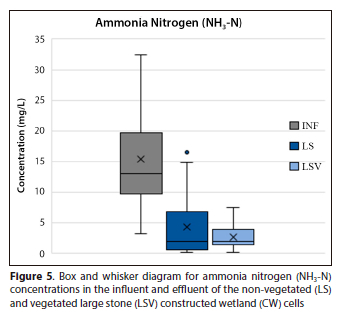
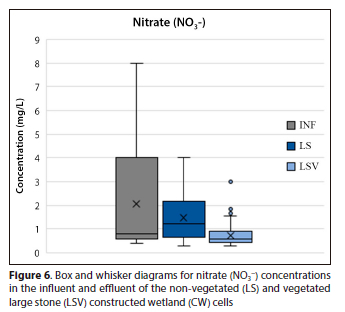
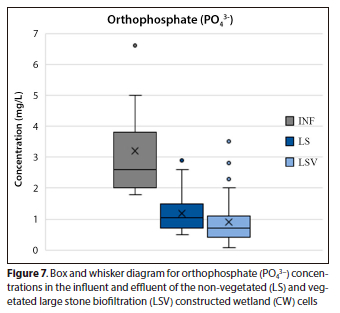
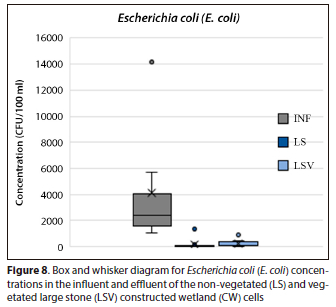
Box and whisker plots were used to analyse and present the distribution of data for ammonia nitrogen (NH3-N), nitrite (NO2-), nitrate (NO3-), orthophosphate (PO43-) and Escherichia coli (E. coli) concentrations observed in the influent and effluent of the non-vegetated large stone (LS) and vegetated large stone (LSV) cells of the constructed wetland (CW) system (Figs 5, 6, 7 and 8). A Shapiro-Wilk statistical test indicated that the data were not normally distributed; thus a non-parametric test (Wilcoxon signed rank) was used to assess whether there was a statistically significant difference between the influent and effluent pollutant concentrations in the LS and LSV cells. The null hypothesis (fi0) states that there is no significant difference between the pollutant concentrations in the influent and effluent of the cells, or between the effluent pollutant concentrations of the cells. In addition, line graphs were used to illustrate nutrient degradation over the 7-day retention period (Figs 9 and 10) and a regression analysis was used to determine the effects of varying influent pollutant loadings on pollutant removal by the cells.
Nitrogen removal
The median NH3-N concentrations in the effluent of the LS (1.95 mg/L) and LSV (1.92 mg/L) cells were significantly lower than the median influent NH3-N concentration (15.32 mg/L) (Fig. 5). This indicates a significant reduction in NH3-N by the LS (W = 0, p < 0.05) and LSV ( W = 2, p < 0.05) cells, with median percentage reductions of 83% and 84%, respectively. Nitrification, plant or microbial uptake and adsorption are cited as the main NH3-N removal mechanisms in CWs (Vymazal, 2007). However, since there was no statistically significant difference in the effluent NH3-N concentrations between the LS and LSV cells (W = 1 322.4, p = 0.85), it can be inferred that plants did not contribute significantly to NH3-N removal. Instead, microbial uptake and adsorption likely played a more dominant role. This finding may be explained by the high influent nitrogen load, which likely exceeded the capacity of plant uptake mechanisms. A similar observation was reported by Rogers et al. (1991) in small experimental wetlands subjected to increasing volumes and concentrations of nitrogen-rich, primary-settled wastewater. In this study, high nitrogen loads reduced plant growth and metabolism, leading to a decline in the overall performance of NH3-N and total nitrogen removal (Rogers et al., 1991).
By contrast, the effluent NO3- concentration in the LSV cell (0.60 mg/L) was slightly lower than in the influent (Fig. 6). Similar findings were reported by Sheridan et al. (2023) who observed a net reduction in NO3- in the CWs used to treat greywater in Alexandra informal settlement (1.8 mg/L of NO3- was observed in the outlet compared to 2.1 mg/L in the inlet). The authors attributed this decrease to the strongly reducing conditions in the CW. Consequently, the reducing conditions in the LSV cell were likely enhanced by root activity (i.e., the release of organic compounds) or through the decomposition of organic matter, and the uptake of oxygen by the plants (Marschner, 2021). The results of the Wilcoxon signed rank test, which showed a statistically significant difference in NO3- concentrations between the effluent of the LS and LSV cells (W = 706.5, p < 0.05), support this explanation.
A regression analysis using Pearson correlations was conducted to analyse the effect of higher influent NH3-N concentrations on the treatment efficiency of NH3-N in the cells. The results revealed that effluent NH3-N concentrations in both the LS (r = 0.7, p < 0.05) and LSV (r = 0.5, p < 0.05) cells were positively correlated with influent NH3-N concentrations. This indicates that a higher influent pollutant concentration decreased NH3-N removal in the cells. Comparable findings were reported by Wang et al. (2019), who noted reduced removal efficiencies in CWs subjected to higher influent pollutant loads. They attributed this reduction to the limited saturation capacity of the substrate and the insufficient size of the microbial population to fully use the available NH3-N.
Orthophosphate removal
The median orthophosphate (PO43-) concentrations in the effluent of the LS (1.04 mg/L) and LSV (0.70 mg/L) cells were lower than the median influent PO43- concentration (2.60 mg/L) (Fig. 7). These results were supported by the Wilcoxon signed rank test, which revealed a significant reduction in PO43- by both the LS ( W = 0, p < 0.05) and LSV ( W = 0, p < 0.05) cells, with percentage reductions of up to 61% and 75%, respectively. By contrast, Sheridan et al. (2023) reported an average PO43- concentration of 5.3 mg/L in the effluent of CWs used to treat greywater from Alexandra informal settlement. As a result, the mean percentage reduction was only 4%, given that the influent concentration was 5.5 mg/L.
Soluble reactive phosphorus, such as PO43-, is typically converted into tissue phosphorus or may become sorbed to wetland sediment and biofilm (Vymazal, 2007). Results from the Wilcoxon signed rank test indicated a statistically significant difference in effluent PO43- concentrations between the LS and LSV cells (W = 830, p < 0.05). The LSV cell demonstrated a higher pollutant removal efficiency (75%) compared to the LS cell (61%). These results confirm the significant role of plants in PO43- removal within the CW system. PO43- is essential for plant growth, and plants take up PO43- from the soil through a process known as phosphate uptake (Vymazal, 2007). Significant removal was also observed in the LS cell (W = 0, p < 0.05), suggesting that PO43- was also sorbed onto the stone substrate and biofilm.
Escherichia coli (E. coli) removal
The median concentrations of E. coli in the effluent from both the LS (5 CFU/100 mL) and LSV (89 CFU/100 mL) cells showed a significant reduction compared to the median influent E. coli concentration (2 419 CFU/100 mL) (Fig. 8). These results were confirmed by the Wilcoxon signed rank test, which indicated that the LS (W = 0, p < 0.05) and LSV (W = 0, p < 0.05) cells significantly reduced the concentration of E. coli, achieving percentage reductions of up to 100% and 95%, respectively. Several feasibility studies have also demonstrated effective microorganism removal from stormwater, with E. coli and faecal coliform removal exceeding 90% (Rusciano and Obropta, 2007; Hathaway et al., 2009; Chandrasena et al., 2016). Even non-vegetated CWs have shown E. coli removal rates of over 90%, primarily through entrapment in the top layer of the filter media (Zhang et al., 2011).
In general, faecal microorganisms are removed by CWs through mechanisms such as straining, adsorption, inactivation/die-off due to temperature and moisture, predation and competition (Zhang et al., 2011). Plants can also contribute to the removal of faecal microorganisms through physical filtration, capturing E. coli in their vegetation, root systems, and associated biofilms (Alufasi et al., 2017). However, the Wilcoxon signed rank test results indicated a statistically significant difference between the LS and LSV cells (W = 0, p < 0.05), with the LS cell showing slightly greater removal than the LSV cell.
This difference in performance can be explained by the findings of Rusciano and Obropta (2007), who noted that plants in CWs can interfere with microbial removal by promoting the growth of beneficial bacteria and facilitating the adsorption and predation of pathogens in the rhizosphere-influenced soil. In addition, decayed roots can create macropores or channels in the media, reducing the filtration capacity (Hatt et al., 2009). Consequently, the reduced E. coli removal performance in the LSV cell compared to the LS cell suggests that the stone media played a more crucial role in E. coli removal through straining and adsorption.
Another important factor contributing to the removal of E. coli by the cells was the batch operating mode. A study by Li et al. (2012) evaluated different CW designs, including various filter media, media depths, and the presence of a saturation zone, along with operational conditions such as drying/wetting cycles and inflow concentrations. The study concluded that E. coli removal is significantly influenced by these drying and wetting conditions. During the drying phase, E. coli removal is enhanced through microbial die-off, exposure to UV radiation, and the accelerated breakdown of organic matter due to increased oxygen availability (Li et al., 2012). Conversely, in the wetting phase, E. coli is removed via resuspension, hydraulic retention time (HRT), and the prevalence of anaerobic conditions. In the case of the LS and LSV cells, the combination of these factors influenced E. coli removal, as the cells experienced both drying and wetting conditions during the fill and draw stages of the batch operation cycle.
Effect of retention time
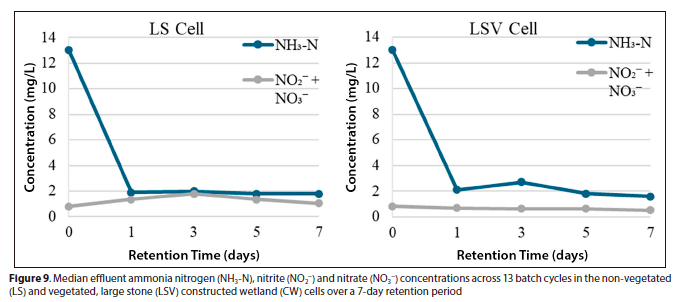
Figure 9 illustrates the total inorganic nitrogen concentration in the LS and LSV cells over a 7-day retention period. During the initial 24 hours, there was a rapid reduction in NH3-N concentration from 13 mg/L to 1.9 mg/L in the LS cell and 2.1 mg/L in the LSV cell. These results indicate that the highest NH3-N reduction occurred within the first 24 hours, with concentrations stabilising from Day 3 onwards.
Small increases in NO2- and NO3- concentrations following the reduction in NH3-N within the first 24 hours in the LS cell suggest that nitrification was the predominant process during this period (Fig. 9). In contrast, nitrification was less evident in the LSV cell, as there were no significant increases in NO2- and NO3- concentrations over the 7-day retention period. Instead, the initial reduction in NH3-N in the LSV cell can mainly be attributed to the adsorption of NH3-N by the biofilm and stone substrate, as well as the reducing conditions created by the plants. The stabilisation of NH3-N in both cells after the initial 24 hours suggests that nitrification was likely limited thereafter, potentially due to saturation of the biofilm and stone substrate. However, further investigation into the internal conditions of the cells is needed to better understand the factors influencing nitrification. For instance, analysing pH variations could provide valuable insights into nitrification processes, as nitrification is typically associated with a decrease in pH and occurs optimally within a pH range of 6.6. and 8.0 (Vymazal, 2007).
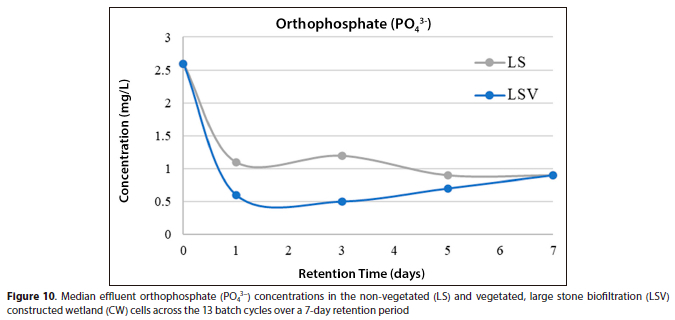
In Fig. 10, PO43- concentrations show a significant decline from 2.6 mg/L to 1.1 mg/L and 0.6 mg/L in the LS and LSV cells, respectively, within the first 24 hours of retention. Subsequently, concentrations remained relatively stable until Day 3. While PO43-levels in the LS cell effluent stabilised after Day 3, those in the LSV cell effluent began to increase. This trend can be attributed to the short-term storage of phosphorus in plants, where a substantial amount is released during litter decomposition (Vymazal, 2007). It is also possible that, after flooding, PO43- was initially adsorbed, but as the flooding duration increased and oxygen was depleted from the system, anoxic conditions may have prevailed, leading to the release of PO43- (Dunne and Reddy, 2005).
Water reuse potential
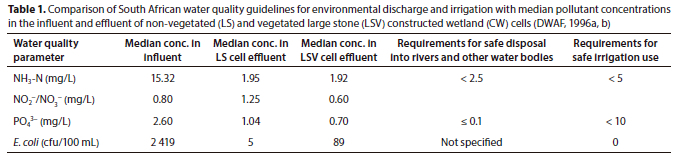
The water reuse potential of the treated effluent was assessed by comparing the water quality results to the South African water quality guidelines for environmental discharge and irrigation use (Table 1). These guidelines established water quality targets that were used to evaluate the treatment performance of the constructed wetland (CW) system.
The treated effluent from the LS and LSV cells achieved total inorganic nitrogen and orthophosphate (PO43-) levels within the recommended ranges for irrigation reuse, but not environmental discharge (Table 1). However, E. coli concentrations in the effluent occasionally exceeded the recommended limits (< 0 CFU/100 mL) for irrigation reuse, requiring additional disinfection in some cases. Notable variability was also observed in the ammonia nitrogen (NH3-N) concentrations (σ = 4.77 and σ = 1.77) and E. coli concentrations (σ = 351.03 and σ = 241.45) in the LS and LSV cells, respectively. Regression analysis revealed that this variability was directly linked to highly fluctuating influent NH3-N (σ = 8.69) and E. coli concentrations (σ = 4 422).
These findings highlight uncertainties in the consistent performance of CWs under variable water quality conditions typical of surface waters affected by informal settlements. Long-term studies are therefore recommended to evaluate the CWs' efficiency across a wider range of pollutant concentrations, particularly at higher levels. This is especially critical for water reuse of surface waters impacted by pollution from informal settlements, where water quality is unpredictable.
CONCLUSION
This study provides an investigation into the application of field-scale constructed wetlands (CWs) for treating surface water contaminated by runoff from an informal settlement in the Stiebeuel River catchment, Franschhoek, South Africa. Over 3 months, consistent water quality testing of both influent (the Stiebeuel River) and effluent water from a batch-fed CW system demonstrated effective removal of ammonia nitrogen (NH3-N), orthophosphate (PO43-) and Escherichia coli (E. coli) from highly contaminated surface water. The vegetated cell was slightly more effective at removing PO43-, but NH3-N and E. coli removal were comparable between vegetated and non-vegetated cells, indicating that adsorption onto the filtration media and microbial processes, rather than plant uptake, were the primary removal mechanisms for these pollutants. Although the effluent water quality met national standards for irrigation reuse in most cases, the highly variable water quality of surface waters impacted by runoff from informal settlements raises concerns about CWs' ability to manage high pollutant loadings. Further research is therefore needed to assess the performance and lifespan of CW filtration media, the feasibility of continuous operation for larger volumes of contaminated water, and the effectiveness of these systems in removing contaminants of emerging concern (CECs) commonly found in surface waters affected by informal settlements.
ACKNOWLEDGEMENTS
This study was funded by the UKRI GCRF through the AURA Centre of Excellence RESBEN project with support from the University of Cape Town's Future Water Institute. We are grateful to the anonymous reviewers for their insight and constructive suggestions, which enhanced the clarity and quality of this manuscript.
AUTHOR CONTRIBUTIONS
Emily Nicklin: conducting the field experiment, laboratory analytical work and writing the paper draft. Kevin Winter: supervision of the field experiment, and review part. Kalpana Maraj: data collection and laboratory analytical work.
ORCIDS
Emily Nicklin: https://orcid.org/0000-0001-7196-1202
Kevin Winter: https://orcid.org/0000-0001-6859-9732
Kalpana Maraj: https://orcid.org/0000-0002-6698-9494
REFERENCES
ADB and RISE (2021) Water-Sensitive Informal Settlement Upgrading: Description of Technologies. Asia Development Bank and Monash University. [ Links ]
ALUFASI R, GERE J, CHAKAUYA E, LEBEA P, PARAWIRA W and CHINGWARU W (2017) Mechanisms of pathogen removal by macrophytes in constructed wetlands. Environ. Technol. Rev. 6 (1) 135-144. https://doi.org/10.1080/21622515.2017.1325940 [ Links ]
ARMITAGE N P, WINTER K, SPIEGEL A and KRUGER E (2009) Community-focused greywater management in two informal settlements in South Africa. Water Sci. Technol. 59 2341-2350. https://doi.org/10.2166/wst.2009.294 [ Links ]
BAVOR HJ and SCHULZ TJ (2020) Sustainable suspended solids and nutrient removal in large-scale, solid matrix, constructed wetland systems. In: Constructed Wetlands for Water Quality Improvement. CRC Press, Boca Raton. 219-222. https://doi.org/10.1201/9781003069997-26 [ Links ]
CARDEN K, ARMITAGE N, WINTER K, SICHONE O, RIVETT U and KAHONDE J (2007) The use and disposal of greywater in the non-sewered areas of South Africa: Part 1 - quantifying the greywater generated and assessing its quality. Water SA 33 (4) 425-432. https://doi.org/10.4314/wsa.v33i4.52937 [ Links ]
CHANDRASENA GI, DELETIC A and MCCARTHY DT (2016) Biofiltration for stormwater harvesting: Comparison of Campylobacter spp. and Escherichia coli removal under normal and challenging operational conditions. J. Hydrol. 537 248-259. https://doi.org/10.1016/j.jhydrol.2016.03.044 [ Links ]
CHEN C, LUO J, BU C, ZHANG W and MA L (2022) Efficacy of a large-scale integrated constructed wetland for pesticide removal in tail water from a sewage treatment plant. Sci. Total Environ. 838 156568. https://doi.org/10.1016/j.scitotenv.2022.156568 [ Links ]
CULLIS J, HORN A, ROSSOUW N, KUNNEKE M, FISHER-JEFFES L, HOFFMAN W, KLOPPERS W and SEELIGER L (2018) Berg River study points to importance of monitoring in managing catchments. The Water Wheel 17 (4) 33-35. https://hdl.handle.net/10520/EJC-102906a628 [ Links ]
DWAF (Department of Water Affairs and Forestry, South Africa) (1996a) South African Water Quality Guidelines (Second Edition). Volume 1: D Use: Irrigation. Department of Water Affairs and Forestry, Pretoria. [ Links ]
DWAF (Department of Water Affairs and Forestry, South Africa) (1996b) South African Water Quality Guidelines (Second Edition). Volume 7: Aquatic Ecosystems. Department of Water Affairs and Forestry, Pretoria. [ Links ]
DIEP L, PARIKH P, DOS SANTOS DUARTE BP, BOURGET AF, DODMAN D and MARTINS JRS (2022) "It won't work here": Lessons for just nature-based stream restoration in the context of urban informality. Environ. Sci. Polic. 136 542-554. https://doi.org/10.1016/j.envsci.2022.06.020 [ Links ]
DUNNE EJ and REDDY KR (2005) Phosphorus biogeochemistry of wetlands in agricultural watersheds. In: Nutrient Management in Agricultural Watersheds. Wageningen Academic, Wageningen. https://doi.org/10.3920/9789086865581_015 [ Links ]
GQOMFA B, MAPHANGA T and SHALE K (2022) The impact of informal settlement on water quality of Diep River in Dunoon. Sustainable Water Resour. Manage. 8 (1) 27. https://doi.org/10.1007/s40899-022-00629-w [ Links ]
HACH Company, 2008. HACH Water Analysis Handbook (7th edn). Hach Company. Loveland, Colorado. [ Links ]
HATHAWAY JM, HUNT WF and JADLOCKI S (2009) Indicator bacteria removal in storm-water best management practices in Charlotte, North Carolina. J. Environ. Eng. 135 (12) 1275-1285. https://doi.org/10.1061/(ASCE)EE.1943-7870.0000107 [ Links ]
HATT BE, FLETCHER TD and DELETIC A (2009) Hydrologic and pollutant removal performance of stormwater biofiltration systems at the field scale. J. Hydrol. 365 (3-4) 310-321. https://doi.org/10.1016/j.jhydrol.2008.12.001 [ Links ]
ILYAS H and VAN HULLEBUSCH ED (2019) Role of design and operational factors in the removal of pharmaceuticals by constructed wetlands. Water 11 2356. https://doi.org/10.3390/w11112356 [ Links ]
ILYAS H, MASIH I and VAN HULLEBUSCH ED (2021) The anaerobic biodegradation of emerging organic contaminants by horizontal subsurface flow constructed wetlands. Water Sci. Technol. 83 (11) 2809-2828. https://doi.org/10.2166/wst.2021.178 [ Links ]
JING SR, LIN YF, LEE DY and WANG TW (2001) Nutrient removal from polluted river water by using constructed wetlands. Bioresour. Technol. 76(2) 131-135. https://doi.org/10.1016/S0960-8524(00)00100-0 [ Links ]
LEDER K, OPENSHAW JJ, ALLOTEY P, ANSARIADI A, BARKER SF, BURGE K, CLASEN TF, CHOWN SL, DUFFY GA, FABER PA and FLEMING G (2021) Study design, rationale and methods of the Revitalising Informal Settlements and their Environments (RISE) study: a cluster randomised controlled trial to evaluate environmental and human health impacts of a water-sensitive intervention in informal settlements in Indonesia and Fiji. BMJ Open 11 (1) p.e042850. https://bmjopen.bmj.com/content/11/1/e042850.abstract [ Links ]
LI YL, DELETIC A, ALCAZAR L, BRATIERES K, FLETCHER TD and MCCARTHY DT (2012) Removal of Clostridium perfringens, Escherichia coli and F-RNA coliphages by stormwater biofilters. Ecol. Eng. 49 137-145. https://doi.org/10.1016/j.ecoleng.2012.08.007 [ Links ]
MALAVIYA P and SINGH A (2012) Constructed wetlands for management of urban stormwater runoff. Crit. Rev. Environ. Sci. Technol. 42 (20) 2153-2214. https://doi.org/10.1080/10643389.2011.574107 [ Links ]
MARSCHNER P (2021) Processes in submerged soils-linking redox potential, soil organic matter turnover and plants to nutrient cycling. Plant Soil 464 (1-2) 1-12. https://doi.org/10.1007/s11104-021-05040-6 [ Links ]
MOROLE MS, YESSOUFOU KY, BUFO SA, RAMPEDI IT and MODLEY LS (2022) The impact of informal settlements on the surface water quality: a baseline analysis of the Kaalspruit in Tembisa township, South Africa. Urban Water J. 20 (10) 1756-1765. https://doi.org/10.1080/1573062X.2022.2099289 [ Links ]
ORAL HV, CARVALHO P, GAJEWSKA M, URSINO N, MASI F, HULLEBUSCH EDV, KAZAK JK, EXPOSITO A, CIPOLLETTA G, ANDERSEN TR and FINGER DC (2020) A review of nature-based solutions for urban water management in European circular cities: a critical assessment based on case studies and literature. Blue-Green Syst. 2 (1) 112-136. https://doi.org/10.2166/bgs.2020.932 [ Links ]
PRESCOTT MF, DOBBIE MF and RAMIREZ-LOVERING D (2021) Green infrastructure for sanitation in settlements in the global south: A narrative review of socio-technical systems. Sustainability 13 (4) 2071. https://doi.org/10.3390/su13042071 [ Links ]
RAMÍREZ-LOVERING D, PRESCOTT M and KAMALIPOUR H (2018) RISE: A case study for design research in informal settlement revitalisation interdisciplinary design research in informal settlements. In: Annual Design Research Conference 2018. University of Sydney. 461-478. URL: https://research.monash.edu/en/publications/rise-a-case-study-for-design-research-in-informal-settlement-revi [ Links ]
ROGERS KH, BREEN PF and CHICK AJ (1991) Nitrogen removal in experimental wetland treatment systems: evidence for the role of aquatic plants. Res. J. Water Pollut. Cont. Fed. 63 (7) 934-941. https://www.jstor.org/stable/25044090 [ Links ]
RUSCIANO GM and OBROPTA CC (2007) Bioretention column study: Fecal coliform and total suspended solids reductions. Trans. ASABE 50 (4) 1261-1269. https://doi.org/10.13031/2013.23636 [ Links ]
SAEED T, ALAM MK, MIAH MJ and MAJED N (2021) Removal of heavy metals in subsurface flow constructed wetlands: Application of effluent recirculation. Environ. Sustain. Indic. 12 100146. https://doi.org/10.1016/j.indic.2021.100146 [ Links ]
SHERIDAN C, BODE-ALUKO C, KAPPELMEYER U, METSON G, RAWHANI T, STEPHENSON R, THATCHER A and TONDERSKI K (2023) Accessible greywater solutions for urban informal townships in South Africa. Water Research Commission, Pretoria. https://doi.org/10.13140/RG.2.2.12822.97609 [ Links ]
SINHAROY SS, PITTLUCK R and CLASEN T (2019) Review of drivers and barriers of water and sanitation policies for urban informal settlements in low-income and middle-income countries. Utilities Polic. 60 100957. https://doi.org/10.1016/j.jup.2019.100957 [ Links ]
STATSSA (Statistics South Africa) (2023) General Household Survey 2023. Statistical Release P0318. Statistics South Africa, Pretoria. URL: https://www.statssa.gov.za/publications/P0318/P03182023.pdf (Accessed 20 October 2024). [ Links ]
STELLENBOSCH MUNICIPALITY (2018/9) Annual Oversight Report. Stellenbosch Municipality. URL: https://stellenbosch.gov.za/download/annual-report-2018-2019/ (Accessed 20 October 2024). [ Links ]
UNEP (United Nations Environment Programme) (2023) Nature-based Infrastructure: How natural infrastructure solutions can address sustainable development challenges and the triple planetary crisis. Geneva. URL: https://content.unops.org/publications/Nature-based-Infrastructure_EN.pdf (Accessed 22 October 2024). [ Links ]
UN-HABITAT (United Nations Habitat) (2014) The state of African Cities 2014: re-imagining sustainable urban transitions. United Nations Human Settlements Programme, Nairobi. URL: https://unhabitat.org/sites/default/files/download-managerfiles/State%20of%20African%20Cities%202014.pdf (Accessed 20 October 2024). [ Links ]
VAN DER MERWE G and SIMHA P (2023) Approaches for bridging the sanitation delivery gap in urban informal settlements in Namibia. City Environ. Interact. 20 100120. https://doi.org/10.1016/j.cacint.2023.100120 [ Links ]
VYMAZAL J (2007) Removal of nutrients in various types of constructed wetlands. Sci. Total Environ. 380 (1-3) 48-65. https://doi.org/10.1016/j.scitotenv.2006.09.014 [ Links ]
VYMAZAL J (2019) Is removal of organics and suspended solids in horizontal sub-surface flow constructed wetlands sustainable for twenty and more years? Chem. Eng. J. 378 122117. https://doi.org/10.1016/j.cej.2019.122117 [ Links ]
WANG R, ZHAO X, LIU H and WU H (2019) Elucidating the impact of influent pollutant loadings on pollutants removal in agricultural waste-based constructed wetlands treating low C/N wastewater. Bioresour. Technol. 273 529-537. https://doi.org/10.1016/j.biortech.2018.11.044 [ Links ]
WILLIAMS DS, MÁÑEZ COSTA M, SUTHERLAND C, CELLIERS L and SCHEFFRAN J (2019) Vulnerability of informal settlements in the context of rapid urbanization and climate change. Environ. Urbanization 31 (1) 157-176. https://doi.org/10.1177/0956247818819694 [ Links ]
WINTER K, MGESE S, NICKLIN E and MARAJ K (2023) Treating and reusing polluted runoff from an informal settlement, South Africa. WaterPract. Technol. 18 (4) 796-809. https://doi.org/10.2166/wpt.2023.045 [ Links ]
ZHANG L, SEAGREN EA, DAVIS AP and KARNS JS (2011) Long-term sustainability of Escherichia coli removal in conventional bioretention media. J. Environ. Eng. 137 (8) 669-677. https://doi.org/10.1061/(ASCE)EE.1943-7870.0000365 [ Links ]
ZRAUNIG A, ESTELRICH M, GATTRINGER H, KISSER J, LANGERGRABER G, RADTKE M, RODRIGUEZ-RODA I and BUTTIGLIERI G (2019) Long term decentralized greywater treatment for water reuse purposes in a tourist facility by vertical ecosystem. Ecol. Eng. 138 138-147. https://doi.org/10.1016/j.ecoleng.2019.07.003 [ Links ]
 Correspondence:
Emily Nicklin
Email: nckemi001@myuct.ac.za
Received: 11 July 2024
Accepted: 9 June 2025