Services on Demand
Journal

Article
 English (pdf)
 Article in xml format
 Article references
 Automatic translation
 Send this article by e-mail
Indicators
Related links
-
 Cited by Google
 -
 Similars in Google
Share

 Permalink
Journal of Contemporary Management
On-line version ISSN 1815-7440
JCMAN vol.13 n.1 Meyerton 2016
RESEARCH ARTICLES
Human Resource Management research in South Africa: a bibliometric study of authors and their collaboration patterns
S RuggunanI; R SooryamoorthyII
IDiscipline of Human Resources Management, University of KwaZulu-Natal ruggunans@ukzn.ac.za
IIDiscipline of Sociology, University of KwaZulu-Natal
ABSTRACT
Human Resources Management (HRM) as a scholarly discipline in South Africa has 60 years of history. The key outlet for scientific publications of HRM research in the country is the South African Journal of Human Resources Management (SAJHRM).
This article analyses the publications that appeared in SAJHRM since its inception in 2003 to 2013. This is to examine the significance of the important variables concerning authorships (race, gender, sector and institution), collaboration. There has been no systematic study to understand the characteristics of authors and their patterns of collaboration in HRM in South Africa. This article presents a bibliometric study covering all the articles published in SAJHRM from 2003-2013. The publication records of the articles were downloaded and key variables were analysed using a computer programme.
The findings provide the unique bibliometric features of HRM research in the country over the last decade. The findings contribute to the understanding of unique bibliometric features of the scientific publications in HRM specific to South Africa. It also adds to the knowledge about the demographic and institutional characteristics of scholars who publish in the journal. The identity and location of knowledge producers in the discipline assists us in understanding who the key knowledge producers are in HRM, where they are located and their collaborative efforts. This has implications for understanding how HRM as a discipline is epistemologically shaped in the South Africa as well as implications for management of research outputs of HRM departments.
Key phrases:bibliometrics; biographical; collaboration; human resources management; knowledge production; management studies; South Africa.
1. INTRODUCTION
As a dynamic field human resource management (HRM) at the international level has been evolving at a fast pace (García-Lillo, Úbeda-García & Marco-Lajara 2016:28; Kamoche 2002:996; Veeran 2011:1090). This trend has been reflected in Africa where there has been a great increase in the production of publications in HRM (Gallardo-Gallardo & Thunnissen 2016:40; Kamoche, Chizema, Mellahi & Newenham-Kahindi 2012:2833).
But at the same time there has not been any serious attempt to understand the content and the importance of these publications both for HRM and for the country. This is evidenced by work of Curry and Van de Walle 2016; Fari and Ocholla 2016; White III, Guldiken, Hemphill, He and Khoobdeh 2016, for example, that contend, that there is a poor transfer of knowledge from academic publications to management practice. Management academics mostly are publishing for academic rather than policy or practitioner audiences.
In an introduction to the special issue on HRM in Africa, Kamoche (2002) noted that a gap exists in our understanding of the complexities of HRM as a field of academic research in Africa. Kamoche (2002, 2011) also underlined the need to identify the characteristics of HRM on the continent, which has long been neglected. Harvey (2002:1120), quoting other scholars like Adonisi (1993), and Kamoche (2000), confirmed that there was a lack of documented knowledge on HRM on the African continent. It is true that there has not been much interest among researchers doing research on human resource matters in Africa south of the Sahara (Schutte, Barkhuizen & Van der Sluis 2016:232; Van der Westhuizen 2005:150).
However, there has been a demand to take stock of the research publications on HRM in Africa, from both the intellectual and the practical viewpoints (Homberg & Vogel 2016:750); Horwitz 2014:1107). This is particularly important as HRM in Africa is unlikely to correspond to other nations (George, Corbishley, Khayesi, Haas & Tihanyi 2016; Wood et al. 2011) and several unique features of HRM in Africa can be found if examined. It is in this regard that bibliometric studies of research production are important. Bibliometrics goes beyond merely providing descriptive biographical details of authors but also examines patterns of collaboration amongst researchers. Whilst descriptive frequencies are provided Bibliometrics is also interested in inferential analysis between biographical details of authors. For example, how does gender or race mediate the productivity of authors. Bibliometrics also allows us to identify patterns of collaboration. These findings are important for research management at universities from a policy perspective.
The lack of interest in HRM research in Africa in general is more relevant for South Africa which has undergone significant changes in the realm of human resources, particularly since its transformation from apartheid to democracy in 1994. HRM is an integral function for all South African organizations (Van Rensburg, Basson & Carrim 2011a).
For a host of reasons HRM in South Africa is important in terms of its apartheid legacy, the racial segmentation of labour, skilled labour, the higher proportion of the population under the age of 30, the human development index, labour relations and many others (Akinnusi 2008:30; Grobler & Wärnich 2002:20; Horwitz 2002:1106). HRM as an occupation possessing the core elements of a profession has strengthened its position in South Africa recently (Van Rensburg, Basson & Carrim 2011b; Van der Westhuizen 2008:15).
Since its new political phase of democracy, South Africa has established different systems of HRM, particularly to retain the skilled personnel within the country (Van der Westhuizen 2008:16). South Africa introduced its first national human resources development strategy in April 2001 to focus on human development, supply of quality-skills, and integrate the strategies with other relevant departments (Kraak 2010:70; Marais & Pienaar-Marais 2016:167).
There have been some attempts to examine the management practices, organizational capacities and potentials in South African organizations (Gomes et al. 2011; Louw & Jackson 2008:38). Coetzee & Van Zyl (2014:10) carried out a content analysis of the articles published in The South African Journal of Industrial Psychology, a journal that is allied to HRM. Some, like Gbadamosi (2003:276), have looked at the organizational commitment of human resource managers in Africa, and found that they are not only careerists but also hold a caring approach to their employees. Wood and Mellahi (2001:230) and Ruggunan (2016:16) provided an overall view of the HRM in relation to the national culture and its political and labour contexts in the country.
McFarlin, Coster and Mogale-Pretorius(1999:70) and Ruggunan (2016) discussed the barriers to the development of management in South Africa that had several handicaps due to its apartheid legacy while Wood and Els (2000:115) viewed some of the challenges in HRM in the country. The importance of HRM policies has also been underlined in some studies (Merigó, Rocafort & Aznar-Alarcón 2016; Van Dijk 2005:170) Apart from these there has not been any attempt to examine the interests of scholars in HRM and the research being done currently in the country.
This preliminary analysis is presented here to fill this gap by choosing an established journal in HRM which is published from South Africa. It is anticipated that the analysis will provide some useful insights into HRM in the country and the directions it is taking in academic research.
Specifically, this article seeks to find answers to the following questions:
1. What specific demographic (race and gender) features of the authors who have contributed to the journal can be discerned in these publications?
2. Are there any sectoral and institutional affiliations evident amongst the authors who published in SAJHRM?
3. Do any patterns exist in the collaboration of authors involved in the production of articles in the journal?
2. BIBLIOMETRIC ANALYSIS OF DATA
This article is based on the bibliographic records of the publications carried in the Journal of Human Resources Management (SAJHRM). The journal came into being in 2003 as there were no other journals in South Africa that focussed on topics such as HRM. All the articles published since the SAJHRM's inception are preserved on its website which is now open to free access. For the purposes of analysis all articles published from 2003 to 2013 were accessed and downloaded. This was necessary to gather the full bibliographic information of each of the articles. A total of 259 articles were collected and downloaded.
Whilst a range of other South African journals exist that publish HRM research, these tend to publish a broader spectrum of management studies research ranging from supply chain management research to general management and marketing research. Further the SAJHRM was the first academic journal in South Africa to focus specifically on HRM only research. As such the SAJHRM is targeted specifically at HRM specific research. This means it provides a more discipline specific point of entry than a general management journal may do for example. This study is also exploratory and as such the focus on one journal assists in refining research questions and methodology as we add further relevant journals to future studies.
Once the articles were made available, a number of basic variables were drawn from these records: published year, authors' demographics, affiliation, collaboration, and keywords of the topics of the articles. From this basic information new variables were created and transformed for the analysis using a computer software programme. The demographic variables of gender and race were to be gathered from the records. The methodology involved in classifying the race and gender of authors involved both researcher (in consultation with peers) classifying authors based on publically available biographical information about authors. Where it was not possible to make a classification, we used the classification not applicable (N/A) to indicate missing values. We fully realise the subjective and complex nature of racial classification, however racial classification continues to play an important part in post-Apartheid South Africa.
We adopted a multipronged approach to gain accurate information on these variables. Firstly, the list of authors was compiled to check with peers as to both their gender and race. In the second stage we used the official websites of authors' host institutions to verify authors' demographic details and affiliations. This was combined with a search using search engines to confirm. In cases where these variables were uncertain we treated them as missing values. Appropriate statistical procedures have been employed to analyse and interpret the data. As the focus of the article is broadly to track the trends and patterns in publications over a period of time, the published years were regrouped into the two classes of 2003 to 2008 and 2009 to 2013.
ERIC, JSTOR, Google Scholar and EBSCO host data bases were used to do online searches for our literature review and to generate our conceptual framework of Bibliometrics.
Through doing this we found that there is a paucity of bibliometric studies on management research and HRM research in South Africa. As a consequence, we consider this study to be exploratory and draw on the limited literature that is relevant for this study. Both authors searched the data bases independently using agreed upon keywords. We then met to compare our search results and then continued the process. It was thus an iterative process until the returns on our searches was saturated.
3. ANALYSIS
The analysis followed two classes of the year of publication of the articles published in SAJHRM during 2003 to 2008 and 2009 to 2013. The journal first began publishing online in 2003, so we chose a five-year period for the first class. The second class from 2009 to 2013 provides a basis of comparison with the first class. As in the majority of cases there was more than one author per publication, the details of all authors had to be captured for analysis. The mean number of authors per publication was 2.21. The maximum number of authors in the publications for the period was four and therefore the details of all four authors were collected for in-depth analysis.
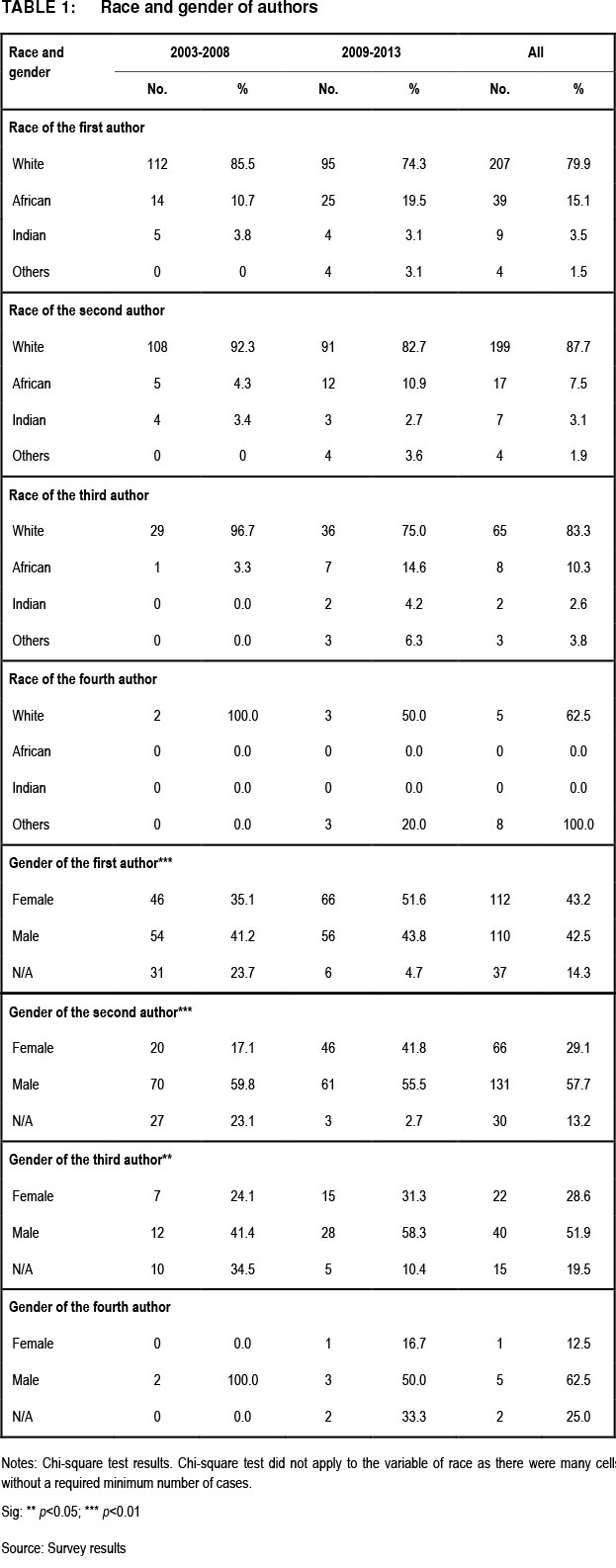
The average number of articles per year was 23.5. The highest number of publications was 31, published in 2012, while the lowest number of 12 articles appeared in the 2008 volume of the journal. The percentages of publication per year varied between 4.6 and 12 during the period of analysis. Table 1 presents the demographics, race and gender, of all authors (first, second, third and fourth).
4. RACE AND GENDER
Numerically, white authors predominated in the number of the publications chosen for analysis. About 80 per cent of the articles published during 2003 to 2013 had white academics / researchers listed as the first author of the publications. The percentage of these as second authors rose to 88 in the publications during 2003 to 2013. While it was 83 per cent for the third author, the percentage declined to 63 for the fourth author in the publications for the entire period of analysis. African authors followed in all the first three author order of publications. Their percentage of contribution to the racial configuration of authors was 15, 7.5 and 10 for the first, second and third authors respectively. Indian authors formed the third major racial category for the first two, with 3.5 (first) and 3.1 (second) per cent. African and Indian authors constituted only 15, 8, and 10 percentages of total publications in terms of first to third order of authors.
A different pattern emerged in the two time periods of analysis, 2003 to 2008 and 2009 to 2013. In 2003 to 2008 and among the first authors, white authors constituted 86 per cent, but this declined by 11 per cent during 2009 to 2013 (Table 1). The same pattern was repeated among the second authors. The decline between the two periods of analysis was about nine per cent for the white and second authors. In the case of third authors the decline in the percentage of white authors between the periods of analysis was 22 percentage points, doubling the decrease from the second order of authors. The decline continued further to 50 per cent in fourth order for white authors.
A racial shift of authors was evident from 2009 onwards. The share of African authors registered substantial increases in 2009 to 2013 for the first three order of authors. For the first authors, the contribution of Africans in 2003 to 2008 was 11 per cent which by 2009 to 2013 increased to nearly 20 per cent. This level of increase has not occurred in any of the other racial groups. In the second order of authors, it was four per cent and 11 per cent respectively for the two periods of analysis while the increase for the third authors grew by 12 per cent for African authors. There were not any African authors listed as the fourth author in the publications that were written by four authors. This applied to other racial groups of authors as well, as most of the articles had only 2-3 authors per publication.
For Indian authors, the obvious trend was one of decline for all author order of the first, second, third and fourth between the two time periods of analysis. Their share of authorship for the first and second authors was in the region of three per cent, the lowest among all the three racial categories of whites, Africans and Indians. An insignificant number of Indian authors was in the third and fourth order of authors. Others in the category included Asians and other racial groups, which were insignificant in number.
The gender of the first four authors was organized as in Table 1. Among the first authors of all articles the male-female split was almost equal. In the second order of authors, males predominated significantly over female authors. This trend is carried over to the third and fourth order of authors. The association in chi-square test was evident in favour of male authors for the period of analysis. Between 2003 to 2008 and 2009 to 2013 a shift in the gender composition of authorship was apparent. The proportion of female authors rose from 35 to 52 per cent for first authors. In the class of second authors the increase was from 17 to 42 per cent. Among the third authors the increase was from 24 to 31 per cent. The growth was 17 per cent for the fourth authors.
5. SECTOR
Authors belong to different sectors. All authors of every publication were examined for their sectoral affiliation.
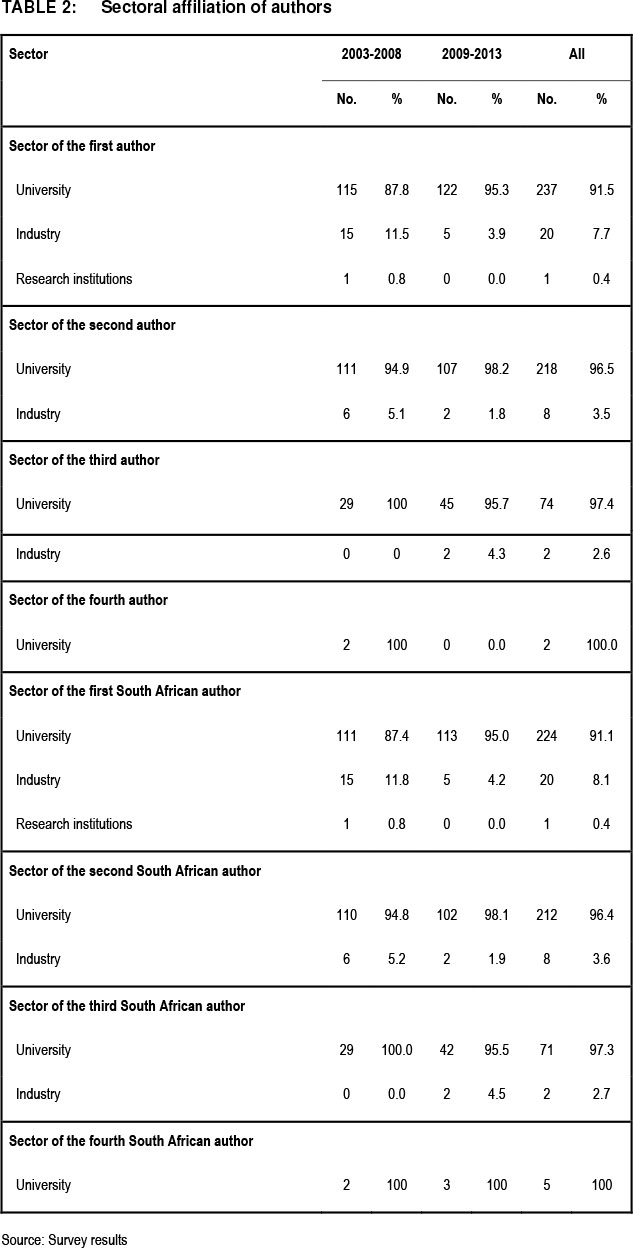
The sectors of authors are shown in Table 2.
The university sector is more prominent in the affiliation address of authors for all the first to fourth authors. More than 90 per cent of the first authors were associated with universities. The industrial sector participated in about eight per cent of the total articles published in the journal as far as the first authors were concerned. Less than one per cent of the authors came from research institutes.
The percentage of authors from the university sector for second, third and fourth authors was between 97 and 100. For the sector of South African authors, the trend also remained unchanged except for a small increase in the share of authors representing industry (only for the third authors). Between the two time periods (2003 to 2008 and 2009 to 2013) of analysis it was obvious that there had been an increase in the number of authors from the university sector for first and second authors. The contribution of authors from industry declined recently.
The pattern was similar for South African authors as well (when compared to all authors who were both South African and non-South African). The data also showed the sector of South African authors, as against those who were affiliated to organizations abroad. As the large majority of them were South African authors the pattern in terms of sector did not vary. They were mostly from the university sector, irrespective of the order of authors.
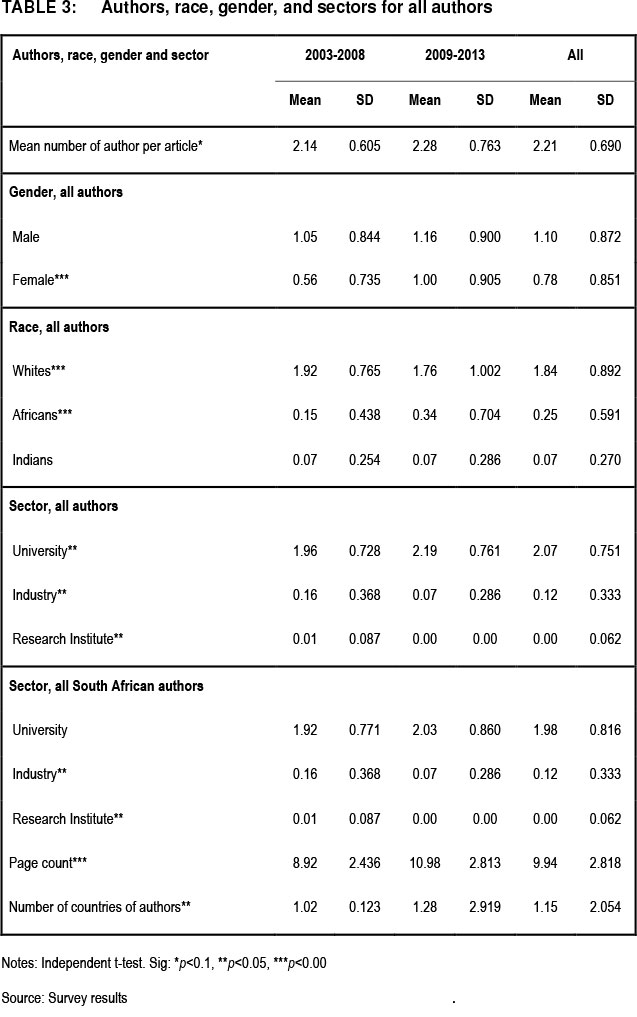
More demographic details of the authors can be considered. Table 3 presents the summated count of race, gender and sector for all authors listed on the articles.
For these measures the respective variables for 1-4 authors were counted individually for each publication. There was an average of 2.21 authors per publication. The average number of authors per article increased significantly (p<0.1) by 0.14 percentage points from the first period of 2003 to 2008 to the second period of analysis of 2009 to 2013.
6. RACE, GENDER AND SECTOR OF ALL AUTHORS
The gender composition of authors has a higher mean value for male authors by about 0.32 percentages (1.10 for male and 0.78 for female authors). This means that more than one author per publication was male while it was less than one for females. The mean value of female authors during 2009 to 2013 had almost doubled, increasing from 0.56 during 2003 to 2008 to 1.0 during 2009 to 2013.
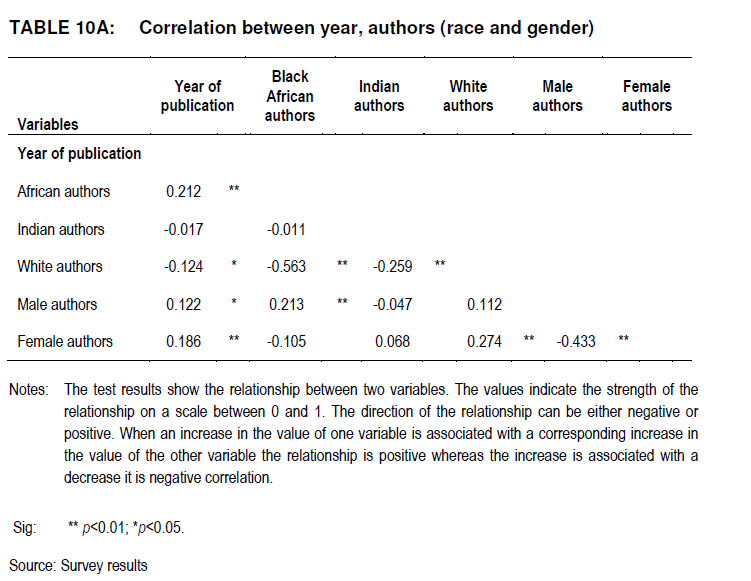
Although female authors were not as frequent as male authors, in the production of articles their number grew steadily in recent years. This difference is statistically significant (p<0.001) in the independent t-test. Further to this, a correlation test between the count of female authors and the years of publication (raw data, not classified into 2003 to 2008 and 2009 to 2013) was run which showed positive correlation (r =0.186, p<0.01).
With regard to the race of authors for all publications, it was evident that white authors held a higher mean value than African or Indian authors (Table 3). It is about seven times higher than the count for African authors and 26 times over Indian authors. However, and as seen earlier, the number of white authors in the publications declined in recent years from 1.92 to 1.76 between 2003 to 2008 and 2009 to 2013.
In contrast, for African authors it was one of increase over the years, from 0.15 to 0.34 during the two periods. Their contribution has thus more than doubled. In both these racial groups the difference was statistically significant at 0.001 level. The growth in the number of African authors over the years was obvious in the correlation test as well (r = 0.212, p<0.01). It was stable for Indian authors over these two time periods.
Sectorally, as presented earlier, more of the authors were affiliated to universities than to any of the other sectors. The difference in the participation of sectors was seemingly great, with mean values in the order of 2.07, 0.12 and 0 for the university, industry and research institute sectors respectively. For the university sector, the increase between the two time periods was statistically significant (1.96 to 2.19). In other words, the contribution from the university sector has continued to grow significantly over the years.
Between the two periods, the increase in the mean values was at the rate of 11 per cent. In the case of the authors who published articles in the journal from the industrial sector, the average mean value was down from 0.16 to 0.07. This is a decline of over 100 per cent. This decline was statistically significant in the independent t-test (p<0.05). The representation of the research institute sector was insignificant in the publications carried in SAJHRM. Here again, a decline had been noticed during the periods of analysis.
The sectors for South African authors exhibited a similar pattern. Most of the authors were from universities and only a few were drawn from industry. The contribution of research institutes to articles in the journal was negligible. Although there was an increase in the number of authors coming from universities, in the recent years the difference was not statistically significant in the t-test. No relationship was seen in the correlation test as well.
The length of the articles was also examined. It increased from nine to 11 pages over the two periods of 2003 to 2008 and 2009 to 2013. This is an increase of over 25 per cent. Apart from the policies of the journal regarding the length of submission, this data does not add to any new information about the publications in the field of HRM.
As to the number of countries involved in the production of publications, some trends are visible in the data. It is an index that suggests both collaboration and internationalization of a subject. Collaboration has been increasing significantly since 2003, from 1.02 to 1.28 countries per publication. This is an increase of about 80 per cent from 2003 to 2008. This collaborative dimension, which has been recognized as a recipe for the growth of a subject, warrants further examination.
7. COLLABORATION
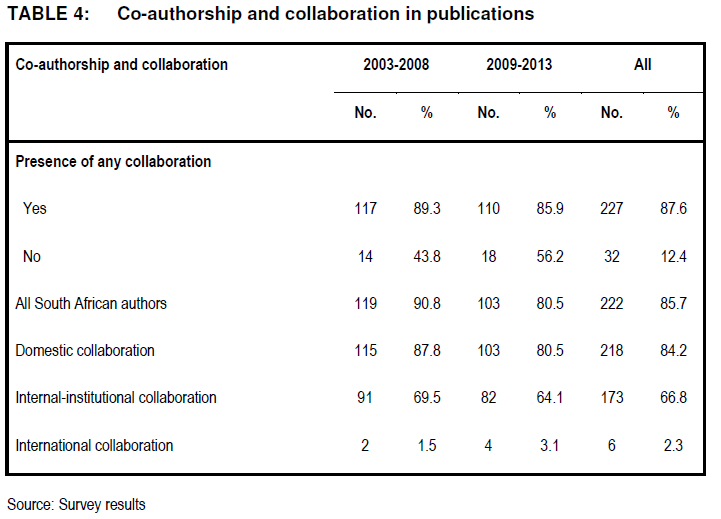
Table 4 presents the breakdown of collaboration in terms of the categories of collaboration. As noted earlier, an average of 2.28 authors worked on a publication that was carried in the journal. Of all the articles considered for analysis, 227 of them had the participation of more than one author in their publications (Table 4). These collaborated articles formed 88 per cent of the total count of articles. Compared to the first period (2003 to 2008), the percentage of collaborated articles declined by about four points in the more recent time period of 2009 to 2013. This is confirmed in the correlation test between the year of publication and presence of collaboration which was found to be negative. Further dimensions of this collaboration are shown in Table 4. Collaboration can be domestic, international or both.
The majority of the articles that came out of domestic collaboration were the publications of scholars within the same organisation (67%), referred to as internal-institutional collaboration. There were only two per cent of the publications that reflected the international collaboration of authors. Of these, two articles had both domestic and international collaboration.
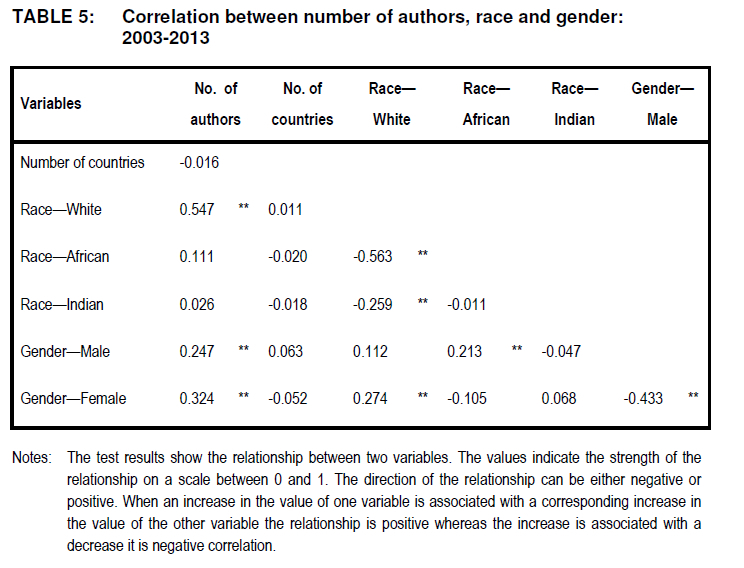
With whom do the scholars collaborate? The results of the Pearson's correlation test presented in Tables 5 through 7 provide the answers. The variable, namely the number of authors, is significantly and positively associated with white authors (p<0.01). A negative relationship prevailed between white and African authors, and between white and Indian authors. Male authors are associated with the number of authors and African authors. Female authors were positively associated with the number of authors and white authors while negatively associated with male authors (Table 5).
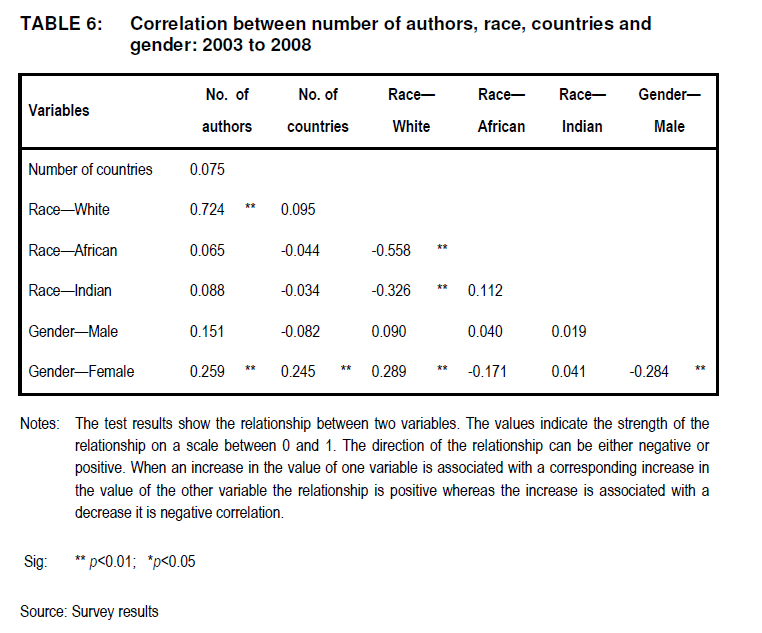
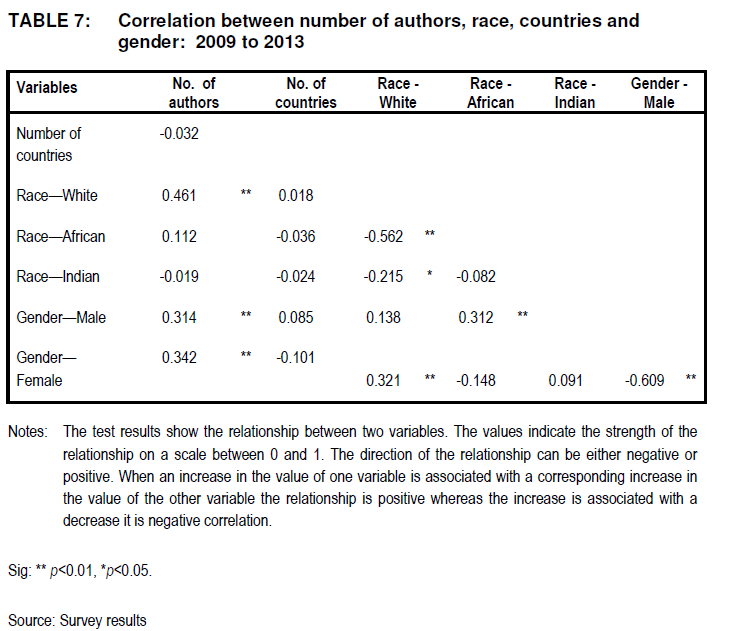
Is this trend different in the two time periods of analysis? In order to find out the difference in the two time periods, separate correlation matrices were created. They are shown in Tables 6 and 7, referring to 2003 to 2008 and 2009 to 2013 respectively.
In the first period of 2003 to 2008 (Table 6), the number of authors was correlated with white and female authors. What was missing was the number of authors and male authors that were correlated in the data for the whole period. Female authors were significantly related to the number of countries, which was not the case for the data covering the period of 2003 to 2013.
As seen earlier, white authors were positively correlated with female authors, and negatively with African and Indian authors. In line with the whole period, the gender of authors was negatively correlated.
The correlation coefficients shown in Table 7 inform the relationships between variables for 2009 to 2013. The number of authors is positively associated with white, male and female authors. No association with the number of countries was evident, contrary to what was seen in the previous years between 2003 and 2008.
A similar trend was revealed in this period for the negative association between white authors and African and Indian authors, while a positive correlation existed between white authors and female authors. African and male authors were significantly associated, which was not present in the previous years of 2003 to 2008.
8. INSTITUTIONAL ORIGIN
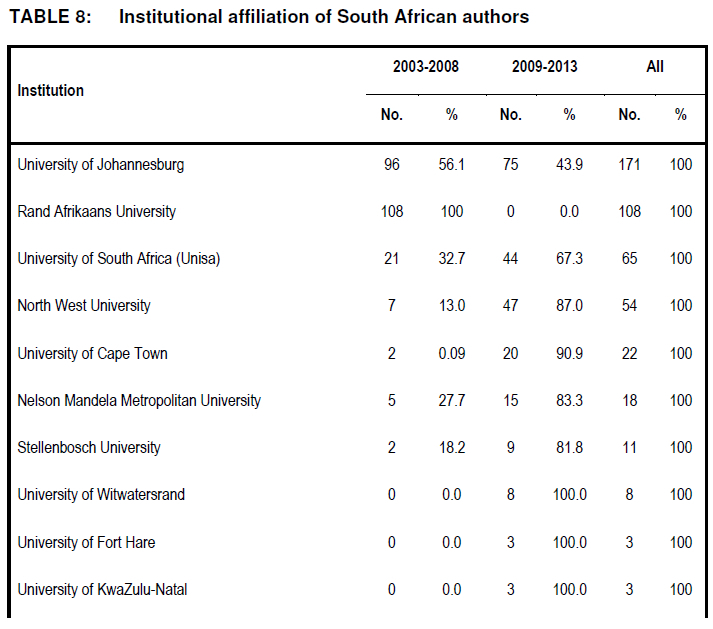
The data on the affiliation of authors presents the institutional contribution of articles in the journal. Being part of the merger plan, some universities in the country have been merged to form new institutions. The major institutions to which authors of publications were affiliated are given in Table 8.
According to this data, the University of Johannesburg has emerged as the top publisher in SAJHRM with a total of 171 articles. This is 66 per cent of all the articles that appeared in the journal during the period.
Rand Afrikaans University (in 2005 it merged with the Witwatersrand Technikon and the Soweto and East Rand campuses of Vista University, with the new entity being named the University of Johannesburg) was in second position with 108 articles (41.7%). Other significant players in the production of articles in HRM were the University of South Africa (Unisa) (65, 25.0%), North West University (54, 20.8%), the University of Cape Town (22, 8.5%) and the Nelson Mandela Metropolitan University (18, 6.9%).
Some trends between the time periods are apparent. For instance, the count of articles by authors at the University of Johannesburg declined in the second period of analysis (2009 to 2013). This reduction was 12 percentage points over the previous period. The number of articles contributed by UNISA doubled during 2009-13. Three other universities had also improved their standing in the publication of articles in SAJHRM over the years. They were the North West University, the University of Cape Town and the Nelson Mandela Metropolitan University.
9. PROGRAMMES
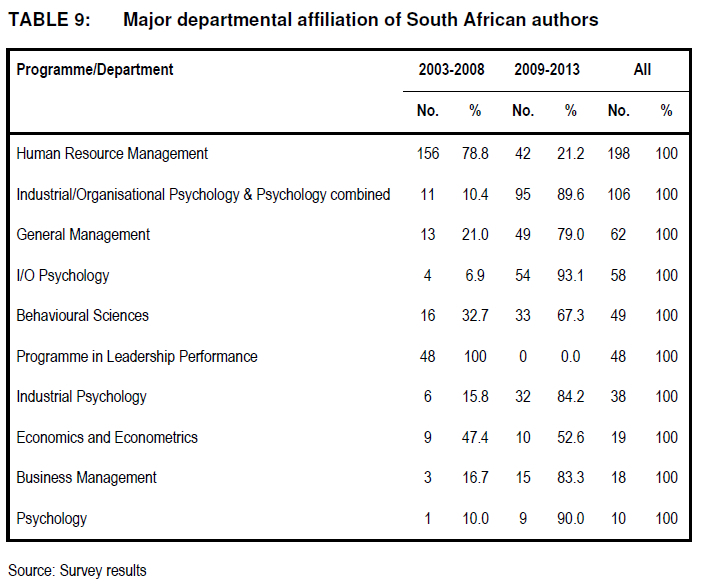
Authors came from a variety of programmes and departments, from Human Resource Management to Economics and Econometrics (Table 9).
More than three quarters of the articles originated from the department/programme of HRM at different institutions in the country. The department/programme of Industrial Organisational Psychology and Psychology jointly produced another 41 per cent of articles. Other prominent departments/programmes included Management Studies, Behavioural Sciences, Leadership Performance, and Industrial Psychology. They are the major contributors to HRM research in South Africa.
The methodological orientations of the published articles showed that they were mostly quantitative (57%), followed by qualitative methodologies. There were 37 articles which employed qualitative methodologies. There were very few articles that were theoretical in nature. Within the periods, the number of articles that used quantitative methodologies increased while that of qualitative methodologies decreased.
Finally, the existing relationship between the key variables that are relevant in HRM research in South Africa was examined. This provided an in-depth understanding of the scientific production of HRM publications in the country.
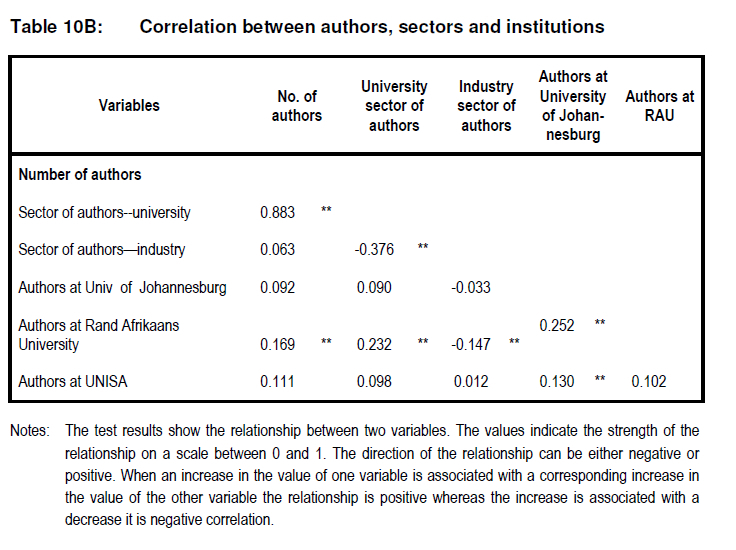
The variables analysed were the year of publication, race and gender of authors, the number of authors involved in the production of a publication, the major sectors to which the authors were affiliated, and the prominent institutions where the publications originated. The data generated by this analysis is shown below in tables 10A and 10b respectively.
As presented in these tables the correlation coefficients showed that the year of publication was positively correlated with African authors, female authors and the university sector.
Three other variables that significantly but negatively correlated with the year of publications were white authors, the industry sector and the Rand Afrikaans University. African authors were positively associated with male authors. White authors had association between female authors, the number of authors per publication, university sector, University of Johannesburg, and Rand Afrikaans University.
Three other variables that significantly but negatively correlated with the year of publications were white authors, the industry sector and the Rand Afrikaans University. African authors were positively associated with male authors. White authors had association between female authors, the number of authors per publication, university sector, University of Johannesburg, and Rand Afrikaans University.
Male authors were correlated positively with the number of authors per publication, university sector and the University of Johannesburg. Female authors, on the other hand, were associated with three variables, namely the number of authors per publication, university sector and UNISA. The variable of the number of authors per publication was correlated with the university sector and the Rand Afrikaans University.
10. DISCUSSION
The analysis of the publication records of the articles published in a prominent HRM journal in South Africa presented above reveals some unique characteristics of HRM research publications produced in the country. If the journal is taken as a sample of HRM research in South Africa, many of the findings arrived at in the analysis can be generalised for the current situation of HRM in the country.
For the first time, the analysis provides useful insights into the status of HRM in South Africa as revealed in the research publications for the last 10 years. This bibliometric analysis also assists us in understanding the characteristics of authors involved in the production of HRM knowledge on a national basis. As stated earlier, the analysis was intended to understand the general trends in the publication of articles in the selected journal of SAJHRM, the demographic features of the authors who wrote these articles, their sectoral and institutional affiliation, and the element of collaboration involved in the production of publications.
The statistically significant increase in the number of authors per publication points to the fact that authors have become more collaborative than before. More authors joined together to write articles in recent years than they did in the past. Studies have emphasised the importance of collaboration in the increased levels of productivity of publications (Abramo, Angelo & Costa 2009; Lee & Bozeman 2005; Ponomariova & Boardman 2010; Sooryamoorthy 2014). Authors may consider collaboration as a means to expand their potential for publication productivity, which is being emphasized in universities across the country (Sooryamoorthy 2010:49). It has also become an important criterion for the allocation of funds to the universities by the government (Sooryamoorthy 2010:56)
10.1 Gender and authorship
Another key finding is the gender side of the publications in the journal. It is clear from the analysis that men dominate in the publication of articles in the journal for the entire period from 2003 to 2013.
Although no reversal of this pattern was observed, women authors involved in authoring articles in the journal increased substantially in the second period of analysis, 2009 to 2013. This increase in recent years was also obvious, as shown in the correlation test. What does this imply?
A notable increase in the number of women authors in the publications of articles suggests that more and more women researchers are publishing in the area of HRM through SAJHRM. The increased percentage of women authors in the second period of 2009 to 2013 further points to the reality that more women are entering the field of HRM in relation to the past, conducting research and publishing articles.
In the order of authors this trend was obvious, particularly for the first, second and third authors. It is also a sign that the gender dimension of the scholars has shifted in the field of HRM in the country. This might be an indication, as revealed in the data of the association between gender and year of publication, that in the coming years the number of women scholars who publish their work through this outlet will increase. This could also reflect the feminisation of the academic labour market in South Africa, with more women appointed as lecturers in the social sciences (Ruggunan 2016:113).
10.2 Race and authorship
White authors are in the forefront of the production of articles as revealed in the correlation of the number of publications and white authors. While the predominance of white authors in the articles carried in the journal continued to remain at a sustained level, authors of other racial backgrounds have shown a changing proportion of their contribution to journal publications.
Most strikingly, it is the change that has occurred in the share of the publications of African authors between the two time periods of analysis. This has doubled since 2003 to 2008. On the other hand, the proportion of Indian authors has not shown any difference between the periods of analysis. It remained at the same level in recent years. This finding is to be viewed in relation to the transformation that has been taking place in the higher education sector in the country.
During the apartheid era, the higher education system in the country was fragmented and divided along racial lines (Grange 2002). As a means of racial and economic redress, a number of policies such as affirmative action has been implemented to support racial transformation of public institutions such as our public universities. The previously disadvantaged groups (Africans and Indians) are now being encouraged and supported to enter academia. Nevertheless, the change has not been obvious in comparison to the existing proportion of white authors in the field of HRM. At the existing level and pace it will take several years for the previously disadvantaged groups to be racially representative in the field of HRM.
The findings further suggest that in the production of articles that are published in the journal there are some racial affinities and associations. For instance, white authors publish preferably with other white authors where co-authorship is concerned. The negative association between white and African authors and between white and Indian authors strengthens the close racial affinities and association among races in the production of research publications in the journal. This is a kind of endogamous and segregated type of partnership in research and publications. Between the two periods when they were separately treated, no change from this general trend was seen. This means the trend continues unabated. However, one must be careful of an overly racial explanation of this phenomenon. Research expertise is developed over a number of years and to a large extent our universities reflect historical racial patterns of expertise. As expertise across all races is developed over the long term, these patterns may change.
Certain insightful inferences can also be made from the analysis. From the correlation between the year of publication and African authors it is clear that African authors have begun to publish their research more in recent years than previously. More African authors have tended to produce publications, which gives rise to a trend that can be a consequence of the transformation that has been taking place in the country in general and in the higher education sector in particular.
On the other hand, the negative correlation between the year of publication and the number of white authors reflects the declining number of publications produced by white authors in recent years. The data also shows the relationship between race and institution. White authors who published in the journal were mostly from the University of Johannesburg and the former Rand Afrikaans University, rather than from any other single institution. One reason for this could be that the journal was established at RAU (currently UJ) though it has since shifted its editorship to the University of Pretoria and is independently administered by an open access online company (see internet link: SAJHRM). Further work has to done to establish how well known the journal is outside UJ and former RAU academic circles. However, the current editorial board of the journal reflects a nationally and globally diverse set of members. The dominance of male authors has also been revealed in the correlation analysis.
10.3 The relationship between gender and race of authors
The relationships that exist between the race and gender of authors signify the way scholars collaborate with each other. This has implications for the transformation agenda of the country which is underway in higher education institutions. The greater correlation coefficient between the number of authors and white authors is about white authors collaborating with many authors. A possible reason for this could be that white authors have increased seniority due to historical trends in university employment and thus are able to mentor and work with colleagues as a form of mentorship. Further investigation needs to done into this trend. This is not the case with any other races used in the analysis. In recent years this trend has shifted slightly as the coefficient was less than that of the previous period. Both genders seem to be related to the number of authors.
This means gender differentiation cannot be established in the number of authors involved in the production of publications, except during 2003 to 2008 where male authors were not related. The number of articles by both male and female authors, at varying levels, has been increasing in recent years. The higher coefficient for female authors means they are increasing at a pace higher than male authors. Interestingly, the male-female collaboration in the production of research publications is missing. This lack of collaboration between genders has been strengthened further in recent years as manifested in the increase in the coefficient value. Among female authors the predominant racial group is white.
Negative relationships between the racial categories of authors suggest that collaboration is very homogenous. Authors tend to work with the same racial groups and not with scholars outside their own groups.
The correlation between the year of publication and African authors indicates that as the year progresses from 2003, the number of African authors who published in the journal increases. More Africans are now publishing in the journal as compared to previously. The number is higher for males than for females. The negative relationship between the year of publication and white authors signifies that their contribution to the journal is declining in comparison to their contribution in the previous years. This could be result of racial transformation at South African universities that see fewer white academics employed but could also reflect retirements of senior white academics.
Three factors are significant in regard to the publications of white authors. One, there is an increasing number of female authors among them who are now publishing in the journal. Two, they collaborate with more authors for the production of each publication. Most of them are affiliated to the university sector, particularly to the University of Johannesburg and Rand Afrikaans University.
Male authors in general work with more authors in the production of articles for the journal, are based at universities and are affiliated to the University of Johannesburg. Female authors are also found to work with more authors, are based at universities, in particular at UNISA (University of South Africa) rather than at the other universities used in the correlation analysis. The university sector tends to involve more than one author in the production of articles, particularly at the Rand Afrikaans University.
10.4 Employment sectors of authors
The total count of the sector of all authors indicated that university was the predominant sector, followed by industry and research institutes. The university sector continues to consolidate its dominant position year after year. The number of authors from universities continued to increase over the years. The journal remains as a major outlet for academics to publish their research rather than for those who work in industrial organisations or research institutes.
Unlike in the natural sciences and the social sciences, there are not many research institutes in the country where HRM research is being undertaken. Evident in the data is the fact that the current research being done in the field of HRM largely originates at higher education institutions. Little research in the field is being undertaken by those employed in the industry sector or in research institutes. How can this be explained in the context of South Africa?
HRM research is concentrated at universities where publication is part of the requirements of academics for their career advancement and progression (Ruggunan 2016:114). This is not so in the case of industry and research institutes.
There is a strong corporate sector as well as large government departments in the country where HRM forms integral parts of their system. However, if the data is any indication, little interest is shown from these sectors. It could also possibly be that there are not many who work in research institutes as there are immense opportunities for qualified HRM personnel to find positions in sectors like universities or industry. It is not clear from the data why authors from research institutes are not publishing in SAJHRM. Perhaps this has something to do with the profession, with no career motivation for those working in sectors other than the university to do research or publish.
This is not the case with those in the natural sciences. A study has shown that publications in South Africa also originate from sectors like industry, government and hospitals (Sooryamoorthy 2010). Although the contributions to research and publications from the university sector have been predominant, the contributions of other sectors have not been insignificant. This must therefore be treated as a discipline-specific issue about the production of knowledge in HRM in South Africa.
11. CONCLUSION
This article has demonstrated some major trends in the knowledge production of HRM research in South Africa based on a bibliometric analysis of a key outlet of HRM research, the South African Journal of Human Resources Management. Race, gender and institutional affiliation serve as proxies and indicators of who major knowledge producers are in South Africa and where they are located.
This article has demonstrated that there are shifting patterns in the racial and gender composition of authors of articles in the SAJHRM. Authorship in the journal continues to be dominated by Gauteng based universities. Patterns of collaboration also intersect with gender and race of authors in complex ways. If the identity and location of knowledge producers shapes the type of knowledge produced in a discipline, then bibliometric studies are valuable tools to providing a landscape of a discipline.
This has implications for understanding how HRM as a discipline is epistemologically shaped in the South Africa (albeit from a sample of one discipline specific journal) as well as implications for management of research outputs of HRM departments to indicate two contributions. First, that the identities of authors and their locations influence the type of knowledge produced (for example male researchers may be less interested in gender issues than female issues for example or that empirical work is mainly located in Gauteng given that most authors in the SAJHRM are located in Gauteng located universities) in HRM and second that there are policy implications for research management in HRM departments.
For example, it may be useful to know why women are not as productive as men, or Black authors not as productive as White authors. These have implications for career mobility since publication outputs are becoming key criteria for promotion through academic ranks. Findings from a study like this may alert managers of departments and universities to find out what challenges exists in terms of who is producing and not producing publication outputs. Research managers can then ascertain best practice policies from those that are producing whilst also identifying the challenges facing less productive groups. Research management decisions are therefore empirically grounded based on findings such as ours. Given the increasing need for transformation (in terms of race and gender), a discipline specific bibliometric analysis of key journals in a specific field is an important analytical and empirical tool in research management of HRM as a discipline.
Given the exploratory nature of the study, this is an important starting point to understand the nature and politics of knowledge production in this discipline. Future work in this area also needs to provide a content analysis of the key themes that emerge in HRM research.
REFERENCES
ABRAMO G, D'ANGELO CA & COSTA FD. 2009. Research collaboration and productivity: is there correlation? Higher Education 57(2) 155-171. [ Links ]
AKINNUSI DM 2008. Benchmarking of human resource management in the public sector: prospects, problems and challenges. South African Journal of Human Resource Management 6(2):25-31. [ Links ]
COETZEE M & VAN ZYL LE. 2014. A review of a decade's scholarly publications (2004-2013) in the South African Journal of Industrial Psychology. SA Journal of Industrial Psychology/SA Tydskrif vir Bedryfsielkunde 40(1):1-16. [ Links ]
CURRY D & VAN DE WALLE S. 2016. A bibliometrics approach to understanding conceptual breadth, depth and development: the case of new public management. Political Studies Review doi:10.1177/1478929916644869. [ Links ]
FARI S & OCHOLLA D. 2016. Nature, patterns and trends of research collaboration among academics in selected universities in Nigeria and South Africa. Mousaion 34(1):1-22. [ Links ]
GALLARDO-GALLARDO E & THUNNISSEN M. 2016. Standing on the shoulders of giants? A critical review of empirical talent management research. Employee Relations 38(1):31-56. [ Links ]
GARCÍA-LILLO F, ÚBEDA-GARCÍA & MARCO-LAJARA, B. 2016. The intellectual structure of human resource management research: a bibliometric study of the international Journal of Human Resource Management, 2000-2012. The International Journal of Human Resource Management:1-30 http://dx.doi.org/10.1080/09585192.2015.1128461. [ Links ]
GBADAMOSI G. 2003. HRM and the commitment rhetoric: challenges for Africa. Management Decision 41(3): 274-280. [ Links ]
GEORGE G, CORBISHLEY C, KHAYESI J, HAAS M & TIHANYI L. 2016. Bringing Africa in: promising directions for management research. Academy of Management Journal 59(2):377-393. [ Links ]
GOMES E, COHEN M & MELLAHI K. 2011. When two African cultures collide: a study of interactions between managers in a strategic alliance between two African organizations. Journal of World Business 46(1):5-12. [ Links ]
GROBLER P & WÄRNICH S. 2002. Managing human resources in South Africa: a guide for internationals, Journal of Transnational Management Development 7(4):5-25. [ Links ]
HARVEY M. 2002. Human resource management in Africa: Alice's adventures in wonderland. The International Journal of Human Resource Management 13(7): 1119-1145. [ Links ]
HOMBERG F & VOGEL R. 2016. Human resource management (HRM) and public service motivation (PSM) Where are we, and where do we go from here? International Journal of Manpower 37(5):746-763. [ Links ]
HORWITZ F. 2014. Human resources management in multinational companies in Africa: a systematic literature review. The International Journal of Human Resource Management DOI: 10.1080/09585192.2014.934899. [ Links ]
HORWITZ FM, BROWNING V, JAIN H & STEENKAMP AA.2002. Human resource practices and discrimination in South Africa: overcoming the apartheid legacy. The International Journal of Human Resource Management 13(7):1105-1118. [ Links ]
KAMOCHE K. 2002. Introduction: human resource management in Africa. International Journal of Human Resource Management 13(7):993-997. [ Links ]
KAMOCHE K. 2011. Contemporary developments in the management of human resources in Africa. Journal of World Business 46(1):1-4. [ Links ]
KAMOCHE K, CHIZEMA A, MELLAHI K & NEWENHAM-KAHINDI A. 2012. New directions in the management of resources in Africa. The International Journal of Human Resource Management 23: 2825-2834. [ Links ]
KRAAK A. 2010. A critique of South Africa's national human resources development strategies. Southern African Review of Education 16(1):59- 82. [ Links ]
LEE S & BOZEMAN B. 2005. The impact of research collaboration on scientific productivity. Social Studies of Science 35(5):673-702. [ Links ]
LE GRANGE L. 2002. Challenges for higher education transformation in South Africa: integrating the local and the global. South African Journal of Higher Education 16(1):67-73. [ Links ]
LOUW L & JACKSON T. 2008. Managing culture and change in South African organisations: The way forward for sub-Saharan Africa. Africanus 38(1):29-42. [ Links ]
MARAIS HC & PIENAAR-MARAIS M. 2016. Analysis of Research methodology in business and management studies as reflected in the ECRM 2015 proceedings. In ECRM 2016 - Proceedings of the 15th European Conference on Research Methodology for Business Management": ECRM 2016 (p. 167). Academic Conferences and Publishing. [ Links ]
MCFARLIN DB, COSTER EA & MOGALE-PRETORIUS C. 1999. South African management development in the twenty-first century moving toward an Africanized model. The Journal of Management Development 18(1): 63-78. [ Links ]
MERIGÓ J, ROCAFORT A & AZNAR-ALARCÓN J. 2016. bibliometric overview of business & economics research. Journal of Business Economics and Management 17(3):397-413. [ Links ]
PONOMARIOVA BL & BOARDMAN PC. 2010. Influencing scientists' collaboration and productivity patterns through new institutions: university research centers and scientific and technical human capital. Research Policy 39(5):613-624. [ Links ]
RUGGUNAN S. 2016. Decolonising management studies: a love story. In Goldman G. Critical management studies in the South African context. Pretoria: AOSIS Publishers (Forthcoming) [ Links ]
SAJHRM see SOUTH AFRICAN JOURNAL OF HUMAN RESOURCE MANAGEMENT see also Internet: http://www.sajhrm.co.za/index.php/sajhrm/pages/view/about#3 [ Links ]
SCHUTTE N, BARKHUIZEN N & VAN DER SLUIS L. 2016. The development of a human resource management (HRM) professional competence model: a pilot study. Journal of Psychology in Africa 26(3):230-236. [ Links ]
SOORYAMOORTHY R. 2010. Medical research in South Africa: a scientometric analysis of trends, patterns, productivity and partnership. Scientometrics 84(3):863-885. [ Links ]
SOORYAMOORTHY R. 2014. Publication productivity and collaboration of researchers in South Africa: new empirical evidence. Scientometrics 98:531-545. [ Links ]
SOUTH AFRICAN JOURNAL OF HUMAN RESOURCE MANAGEMENT. 2016. About SAJHRM. [http://www.sajhrm.co.za/index.php/sajhrm/pages/view/about; downloaded 16-12-07. [ Links ]]
VAN DER WESTHUIZEN EJ. 2005. Managing people in the twenty-first century: integrative public human resource management in sub-Saharan Africa. Politeia 24(2):142-160. [ Links ]
VAN DER WESTHUIZEN EJ. 2008. Gaps and paradoxes in theory and practice: the public sector human resource management discourse in South Africa. Politeia 27(3):1-20. [ Links ]
VAN RENSBURG H, BASSON J & CARRIM N. 2011a. The establishment and early history of the South African Board for People Practices (SABPP) 1977-1991. SA Journal of Human Resource Management/SA Tydskrif vir Menslikehulpbronbestuur 9(1). doi: 10.4102/sajhrm.v9i 1.322. [ Links ]
VAN RENSBURG H, BASSON J & CARRIM N. 2011b. Human resource management as a profession in South Africa. SA Journal of Human Resource Management/SA Tydskrif vir Menslikehulpbronbestuur 9(1), doi: 10.4102/sajhrm.v9i1.336. [ Links ]
VAN DIJK HG. 2005. Facilitating human resource development in the South African constitutional dispensation. Politeia 24(2):161-175. [ Links ]
VEERAN P. 2011. The impact of globalisation on human resource management policies and procedures in the South African public service. Journal of Public Administration 46(3), 1086-1098. [ Links ]
VAN DER WESTHUIZEN C, VAN VUUREN LJ & VISSER D. 2003. Human resource management as a profession in South Africa: practitioners' perspectives. South African Journal of Human Resource Management 1(2):1-12. [ Links ]
WHITE I, GULDIKEN O, HEMPHILL T, HE W & KHOOBDEH MS. 2016. Trends in international strategic management research: from 2000 to 2013: text mining and bibliometric analyses. Management International Review 56(1):35-65. [ Links ]
WOOD G & ELS C. 2000. The making and remaking of HRM: the practice of managing people in the Eastern Cape Province, South Africa, The International Journal of Human Resource Management 11(1):112-125. [ Links ]
WOOD G, DIBBEN P, STRIDE C & WEBSTER E. 2011. HRM in Mozambique: homogenization, path dependence or segmented business system? Journal of World Business 46(1): 31-41. [ Links ]
WOOD G & MELLAHI K .2001. Human resource management in South Africa. In Budhwar PS & Debrah YA (eds.) Human resources in developing countries. London, UK: Routledge. pp 222-237. [ Links ]
* corresponding author