




Services on Demand
Journal

Article
 English (pdf)
 Article in xml format
 Article references
 Automatic translation
 Send this article by e-mail
Indicators
Related links
-
 Cited by Google
 -
 Similars in Google
Share

 Permalink
Journal of Contemporary Management
On-line version ISSN 1815-7440
JCMAN vol.13 n.1 Meyerton 2016
RESEARCH ARTICLES
Factors that have an impact on the future of trade unions in South Africa
M UysI, *; M HoltzhausenII
IDepartment of Human Resource Management, University of South Africa uysm@unisa.ac.za
IIDepartment of Human Resource Management, University of South Africa holtzmme@unisa.ac.za
ABSTRACT
This article deliberates the current state of trade unionism in South Africa.
Firstly, it considers the outcomes of research that was conducted in 2011. The objective of the study was to reflect on the viewpoints of South African trade union leaders on factors influencing the future of trade unions as organisations. An empirical study was conducted with a purposive, voluntary non-probability sample (N = 10) of trade union officials in managerial positions in registered trade unions in South Africa. The data collection method was semi-structured interviews. Data analysis was conducted through structural coding. The results indicated that a varied number of factors might influence the future of these dynamic organisations in the South African labour relations context.
Secondly, a synopsis is given of academic literature that was scrutinised to determine aspects which have affected trade unionism in South Africa over the past five years.
Finally, the article concludes by deliberating on the possible impact of the identified factors (in both the literature and the empirical study) on trade unionism over the past five years (2011-2016); and how trade union organisations reacted to these factors - if at all.
Key phrases: labour unions; trade unions; trade union federations; trade unionism; trade union membership numbers; trade union organisations; trends in trade unionism
1. INTRODUCTION
It is generally accepted that the development and, by implication, the history of employment relations in every country is unique, since innumerable variables contribute to the evolution thereof (Nel, Kirsten, Swanepoel, Erasmus & Jordaan 2016:124). South African employment (labour) relations have a rich history interwoven within the country's socio-political and economic environment, within which unions played a very influential role. These unions and their federations continue to shape a democratic, post-apartheid South Africa through their conduct and through their political alliance with the ruling government (see, for instance, Chamberlain, Ncube, Mahori & Thorn 2014:1,13-14; Hurt 2014:95-97; Lambert 2013:94-97; McKinley 2015:457; Nattrass & Seekings 2016:89; United Democratic Front 1988:14; Webster 2013:211). At the same time, trade unions are also influenced by their internal and external environment (Dunlop 1958). This article argues that trade unions - similar to any other organisation - should thus recognise the potential effect of broader environmental influences on their organisations (Jayeoba, Ayantunji & Sholesi 2013:103; Nel et al. 2016:13; Venter, Levy, Bendeman & Dworzanowski-Venter 2014:13).
In fact, the mark of a successful organisation is its ability to anticipate change and respond accordingly (Venter et al. 2014:35). An understanding of the impact of both internal and external influences on every component of an organisation is critical to sound management (Venter et al. 2014:35). This is true for trade union organisations as well (Anon 2016:15). Recent decades have seen profound changes in the social and economic environment in many countries (Barker 2015:95).
Industrial restructuring, growth in flexibility, changes in workplace practices and an increase in job insecurity have a huge effect on unions' ability to organise workers (Standing 1999, cited in Gordon 2015:330). Additionally, many other factors contribute to the future of trade unions as organisations. According to the literature, these factors include, but are not limited to globalisation, women entering the workforce, high levels of unemployment and employees' skill levels (Barker 2015:93-95; Bendix 2015:156; Holtzhausen 2015:12; Visagie, Uys, Linde & Havenga 2012:11101-11106).
In many developed countries, these changes have had an extremely negative impact on trade union organisations as membership numbers have been severely eroded (see for instance Barker 2015:95; Chun & Williams 2013:3). A key example of this erosion is evident in the decrease in trade union density in most European Union (EU) countries (Faniel 2012:15; Visagie et al. 2012:11097).
Although South African trade unionism is relatively strong1, with union membership numbers high compared to international standards and extremely high compared to developing countries (Barker 2015:96), indications are that union membership is declining in South Africa (Barker 2015:97; Holtzhausen 2015:12; Visagie et al. 2012:11100). According to statistics published by the Labour Force Survey during the first quarter of 2015 approximately 3.5 million, or about 32% of employees in the formal, non-agricultural sector belonged to trade unions, which means that unions remain a strong force to be reckoned with. Nevertheless, a decline in union membership of 84 000 members was still evident between the first quarter of 2014 and the first quarter of 2015 (LFS 2015:11, cited in Gordon 2015:341).
The downward trend in membership numbers raises the important question of whether trade unions in South Africa have reason to believe that their very existence and the influence they exert, are being threatened in any way. Hence, the factors influencing trade union development in South Africa were researched (Uys 2011).
The authors of this article firstly revisited research undertaken in 2011, and considered the pressures and factors identified by the trade union leaders at the time. Secondly, a literature review was undertaken to ascertain some of the most important issues affecting unions over the past five years (2011-2016). In this article we consider how unions responded - if at all -to the challenges they identified.
The article makes an important contribution to the body of knowledge on labour relations in South Africa. It identifies some of the most important trends trade unions need to take cognisance of in the management of their organisations, whilst at the same time also broadening our knowledge on how trade union leaders regard their future, and how they deal with these challenges in the management of their organisations.
2. THEORETICAL FRAMEWORK
Trade union organisations are challenged by the micro- and macro-environment within which they operate. Dunlop's seminal work on his Industrial Relations Open Systems Theory (Dunlop 1958), as well as later works which critiqued and expanded on his theory (Blain & Gennard 1970; Flanders 1965; Hameed 1982; Hyman 1975), argue that industrial relations function as an open system. This system comprises a group of actors (employers, employees and the state) governed by a set of complex rules in an environmental context which directly affects it.
Dunlop (1958) thus argued that the industrial (employment) relations system is a subsystem of a wider social system. Nel et al. (2016:13) explain that employment relations is as an intricate, open system within which relationships and interactions take place between employers, employees and the state, and the representatives of these primary role-playing parties. Similar to any other organisation, trade unions function within this open system and will inevitably be influenced by their environment. This article is grounded in Dunlop's theory.
The relationship between employees and employers is influenced by several factors, including the labour market, the organisation's functions or activities, and the organisational norms that determine the expectations of employees and employers (Bidwell, Briscoe, Fernandez-Mateo & Sterling 2013:63). Trade unions play a significant role in influencing this relationship (Ahmad 2012:368).
Trade unions are membership organisations - they exist because of their members, they are made up of members, they serve their members' interests and they are governed by their members (Nel et al. 2016:107). International labour standards acknowledge and accept that mechanisms should be implemented to protect employees against exploitation (Barker 2015:89) and to improve and support their well-being by defending their rights (Chamberlain et al. 2014:3). In fact, these are regarded as some of the main reasons for the existence of trade unionism, and crucial factors for economic and social balance (Barker 2015:89).
Moreover, trade unions are influential partners in decision making, with the ability to provide continuous improvements in the work and life circumstances of their members (Bãlãneasa 2013:262). However, with the increase in globalised economic activity, employment practices have changed drastically in the last few decades (Bäläneasa 2013:258; Bidwell et al. 2013:79) - and trade unions are not protected from these changes and challenges (Holtzhausen 2015:18; Vettori 2005:295).
In the 20th century, trade unions were significant labour market and political role players in the majority of industrialised countries (Schnabel 2013:255). But now, in the 21st century, speculation exists that organised labour might be heading for extinction (The Economist, 21 September 2006, in Schnabel 2013:255).
Trade unions in South Africa still have fairly high membership numbers in comparison with other countries, but statistically there is a definite downward trend in union membership numbers, especially in the manufacturing, construction, finance, and agricultural sectors (Bhorat, Naidoo & Yu 2014:5; Holtzhausen 2015:21; Visagie ef al. 2012:11100-11101).
These organisations are strong and play a significant role within South Africa. Nonetheless, data from a public opinion study collected by the South African Social Attitudes Survey for the period 2011-2013 suggests distrust by the majority of the public in organised labour (Gordon 2015:325). Schnabel (2013:255) claims that the survival of trade unions and their influence are dependent on their capacity to draw and cultivate loyal members.
To this end, it is vital to know which factors influence and determine the stability of trade union organisations.
3. RESEARCH METHODOLOGY
3.1 Research design
This article firstly reports on the findings of a qualitative research study (Uys 2011). Semi-structured interviews were conducted in two phases (explained in more detail below) to collect data in that study. Secondly, a literature study was undertaken during 2016 to consider developments in trade unionism since then - in other words, during the five-year period from 2011 to 2016. The authors reflect on the developments and events of the past five years, bearing in mind the issues highlighted by union leaders during the qualitative study.
3.2 Participants
A non-probability purposive voluntary sampling technique was used to establish first contact with the trade union officials. This sampling technique is used to select specific potential participants who will best be able to answer the research questions (Saunders & Lewis 2012:138).
Hence, leaders of registered trade unions in South Africa were invited to participate. The selection criteria used to determine which participants could be included in the sample were as follows: the participants had to be in a managerial position in a registered trade union in South Africa; they had to be willing to participate in the study; and they had to be willing to be interviewed while being recorded on an audio voice-recording device.
A second non-probability sampling technique, known as snowball sampling, emerged later, after the interviewing process had already commenced. Snowball sampling occurs when subsequent sample members are identified by earlier sample members for potential participation (Saunders & Lewis 2012:139).
The final sample included representation from ten registered South African trade unions in the public and private sectors - specifically, three general trade unions, five white-collar occupational trade unions and two industrial trade unions (as detailed in Table 1 below).
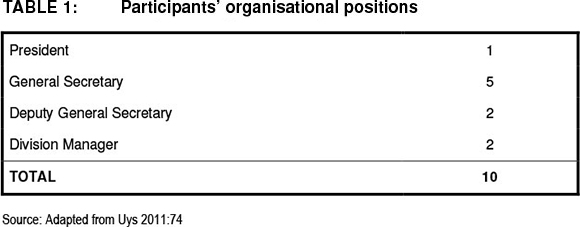
Data was collected until data saturation had been reached after 10 interviews had been conducted. The interviews were then transcribed to enable the researcher to analyse the information.
3.3 Data collection and research procedure
The data collection of the qualitative research study took place in 2011 (Uys 2011). All the interviews were face to face and were audio voice recorded after voluntary informed consent had been obtained from the respective participants, thus ensuring that no information would be lost during the interview.
The trustworthiness of the study and the presentation of the data was taken into consideration by endeavouring to honour Guba and Lincoln's {1981, as cited in King & Horrocks 2010:160) suggested four criteria forjudging the soundness or trustworthiness of a qualitative research study: credibility, transferability, dependability and confirmability.
Following the empirical data collection which took place in 2011, a literature review was undertaken in 2016 to determine which factors still influence trade union organisations currently and to establish if any additional influences have emerged since the original data collection.
3.4 Data analysis and ethical considerations of the research
For the qualitative research study (Uys 2011), the first step in the data analysis was to transcribe all the data. The interviews were transcribed by an independent transcriber. The transcriber signed a confidentiality agreement before transcribing the raw data. Transcription is the process of converting recorded material into text and, as such, is usually a necessary precursor to commencing the analysis of interview data (King & Horrocks 2010:142-143). The data analysis was done in accordance with the technique of structural coding as described by MacQueen, McLellan-Lemal, Bartholow and Milstein (2008, as cited in Saldaña 2009:66-70). This entails reading the transcripts intensively, identifying underlying themes relating to the research questions, writing these themes down, investigating the themes and identifying categories and subcategories from the themes, and translating these themes and subthemes into scientific descriptions.
A co-coder was used to ensure the trustworthiness of the study. The co-coder extracted themes separately from the researcher, using the same technique. A consensus discussion was held to finalise the categories and subcategories.
The participants were made aware that they were free to withdraw from the research without being penalised if they decided to do so. Each participant received either an electronic or a hard copy of the research findings (Uys 2011:77).
Finally, the researcher assured and maintained complete confidentiality regarding any identifiable information of the participants acquired during the research process (Uys 2011:78). The participants' names, as well as the names of the trade unions, were known only to the researcher and the transcriber, and these were replaced with codes.
4. RESEARCH FINDINGS OF THE EMPIRICAL STUDY
The primary objective of the empirical study (Uys 2011) was to identify what factors, according to trade union leaders, would influence the future of trade unions as organisations in South Africa. Attention was also devoted to subjects that received a great deal of consideration in the literature. To this end, each interview consisted of the following two phases:
Phase 1:
During this phase, trade union officials were asked the following question: ''Do you as a trade union representative and leader in the trade union industry think certain factors contribute to the existence of trade unions as organisations?" The question was asked to ascertain their views on possible factors which could impact on the future of trade unionism in South Africa. During this phase, no mention was made of any additional factors which may influence their unions' existence, to ensure that participants were not partial in their opinions.
Phase 2:
During this phase of the interview, participants were prompted to respond to additional themes identified in a theoretical study undertaken by the researcher. These themes consisted of important phenomena influencing trade unions as organisations, but which were not spontaneously mentioned by all the trade union officials during the first phase of the interview.
A set of 17 standard questions served as a guide to ensure that all themes were covered in either phase 1 or 2. In other words, if the participants referred to a theme identified in the literature during phase 1 of the interview, the question on that specific theme was not posed again during phase 2 of the interview. However, if the participants did not mention a theme spontaneously during phase 1, a question on that theme was posed during phase 2. This ensured that all the identified themes were covered during the interview.
This method was followed to allow trade union leaders to respond to the research question without being led in any specific direction; and only thereafter were their opinions tested on the information found in the literature study. According to Saunders and Lewis (2012:151), the order in which the questions are asked may vary across interviews, depending on the responses of the participants. This research design was thus ideal for the approach followed during the interview process.
In this article, the results are discussed per theme, as identified during these two phases. The first seven themes were identified by the participants during phase 1 as important to the future of trade unionism.
4.1 Theme 1: Quality of, and type of services delivered by trade unions to members
The theme of the quality of service delivery to members emerged as the most important element during phase 1 of the research, as seven of the ten participants identified it as a significant factor influencing trade unionism at the time, and possibly in the future. According to trade union officials, good service delivery to members is a vital factor to ensure their future as organisations, as it increases the probability of employees remaining or becoming members of the trade union.
In addition, the majority of participants (six of the ten) commented during phase 1 of the interview that trade unions as organisations needed to change and adapt in order to survive and keep abreast of the challenges they face. They needed to expand on the services offered to members. Unions should not only focus on collective bargaining, but also on offering relevant individual support to members.
According to the trade union officials, people do not join trade unions for the same politically driven reasons as before South Africa became a democratic society. Some trade union leaders indicated that the reason why employees join trade unions currently is mainly for protection from exploitation, the services rendered to union members on an individual basis, and for the improvement of employees' employment conditions.
All of the participants agreed that if unions were not able to adapt and change according to the challenges they face, they would not survive in future. The chances of non-union members joining trade unions would improve as unions offered sufficient and satisfactory services. Employees want to know that the trade union is acting in their best interest.
4.2 Theme 2: Legislative aspects of trade unionism
During phase 1, six of the ten interviewees mentioned the importance of legislative regulations for trade unionism. Several participants indicated that trade unions should have impeccable knowledge of the relevant legislation to be able to assist their members timeously and efficiently. Some of the trade union officials also expressed their concerns about certain aspects of the Labour Relations Act (LRA), which they perceived to be unjust.
4.3 Theme 3: Trade union challenges emanating from the South African economy
Also during phase 1 of the interviews, a number of participants mentioned the importance of the economy for trade unionism. Specifically, a number of subthemes were identified as potential threats, namely atypical employment (five participants), the recession and job insecurity (four participants), the changing economy (three participants), and lastly, the potential threat of unemployment (three participants).
Each of these subthemes is explained below.
4.3.1 Subtheme 1: Atypical employment
Five of the participants indicated that atypical employment was a factor that was of concern to them. This type of employment can cause serious damage to trade unions as organisations because of outsourcing, subcontracting, and the difficulty of recruiting and collectively negotiating for members in the changed work environment.
The following quotation explains this:
"... [a] factor which also played [a] role is that companies said that I focus on my core business, the rest I contract out. So that means that a big part of the labour force is just contract workers ... So the result is that the permanent employees where the trade union was traditionally organised, is no longer there, a lot of them is contract workers."
When probed during phase 2 of the interviews on the effect of globalisation, atypical employment was again mentioned, indicating that to their minds, the traditional employment relationship is destroyed by globalisation, and that it is within these traditional employment relationships where trade unions usually organise their affairs. The effect or indirect impact of atypical employment on the strength of trade unions as organisations is thus negative.
4.3.2Subtheme 2: The recession and related job insecurities
An added financial pressure threatening the continued existence of trade unions is the worldwide economic recession, which is resulting in high levels of retrenchments in organisations.
Nonetheless, in response to questions asked about job insecurity and the influence it might have on trade unions, all participants confirmed that it plays a positive role when employees are deciding whether or not to join a trade union. All participants were convinced that there is an increase in employees joining trade unions when they experience a lack of security in the workplace.
4.3.3Subtheme 3: Changing economy
Three of the participants indicated that changes in the economy posed enormous challenges for trade unions:
"... there started a new economic revolution in the world ... named the information revolution ... and the information revolution changed the world of work and economy totally and completely";
"... with the arrival of the internet the economy actually changed radically and it now is characterised as the information era. And the information era will change the world of trade unions forever"; and lastly
"... the information revolution has replaced the industrial era as the dominant economic paradigm in the world."
The participants identified the focus shift from the industrial era to the information era2 as the reason for this threat, because trade unions came into existence in the previous era on account of the perceived injustices resulting from the industrial revolution. Trade unions then emerged as organisations that protected employees from exploitation.
However, the prevention of exploitation of workers is now not the only focus of trade unions, and trade unions need to adapt to additional challenges brought about by the information era.
4.3.4 Subtheme 4: Unemployment
During phase 1 of the interviews it was mentioned that the high level of unemployment in South Africa places an enormous financial burden on the economy.
However, during phase 2, when prompted on the effect of unemployment on trade unionism, the following topics emerged. All of the trade union leaders interviewed believed that the high unemployment levels in South Africa have a negative impact on trade unions. They explained that when there are fewer people in employment, the opportunity to enlist new members decreases.
The indirect implication is that should unemployment increase further, this could be extremely damaging to trade unions as organisations and - as pointed out by participants -fewer members mean less power.
Furthermore, trade union officials expressed concerns about individuals who might have the wrong perception of trade unions and their attitudes towards unemployment in South Africa. The participants indicated that they are concerned and care about the unemployed and that those who perceive them as organisations who care only for their members, are mistaken.
4.4 Theme 4: Potential impact of trade union federations
Many of the registered trade unions in South Africa belong to trade union federations. The possible impact of trade union federations on the continued existence of trade unions as organisations emerged as a fifth theme during phase 1 of the interviews. Even though some of the participants acknowledged the value of trade union federations in ensuring the future of trade unions as organisations, some concerns were also voiced. Some of the participants felt that the alliance between trade union federations and the South African government and ruling party could have negative implications in the future:
''... for as long as there is still rapport, this alliance between COSATU and the ruling party, the trade union movement is likely to be sustained so to speak ... but once that element can disappear... that is obviously a threat...";
"... I think trade unions that are too much politically orientated and lean over too much to a particular political party, they will have problems at some stage, because you cannot serve two gods, you cannot serve your members and the political party."
4.5 Theme 5: Potential impact of employers on trade unionism
Another interesting theme that emerged during phase 1 of the interviews was that trade union officials were convinced that the attitude of employers could play a role in the continued existence of trade unions as organisations. While some focused on the assumption that bad employers will do all they can to prevent employees from joining unions, others acknowledged that when employment conditions are really good and employers are accommodating, trade unions may become irrelevant.
Still, regardless of the reason put forward by the participants, it became clear that trade union officials felt that employers play a key role in the continued existence of trade unions.
4.6 Theme 6: Society's perceptions of trade unions
Four of the participants indicated during phase 1 that the perceptions that trade union members and society in general have about trade unions as organisations may have an impact on the growth or decline of the trade union movement.
For instance:
"... even when we think our service is good, but our members do not think so ... trade union service must be good from a member's perspective";
"... I think one of the biggest contributing factors is the perceptions of people with society's perceptions about trade unions, especially in South Africa";
"... the way in which trade unions handle themselves, reinforce those perceptions. Whether it is a positive perception or negative. Our behaviour as trade unions determine in which direction we drive those perceptions."
4.7 Theme 7: Impact of different political and economic ideologies on trade union approaches
The last theme that emerged from the first phase of the interviews was that there are two distinct approaches to the trade union movement in South Africa. Through political and economic theories and perspectives, socialist and capitalist approaches to the perspectives held by the various trade unions are formed. These two schools of thought often have conflicting opinions and viewpoints on matters important to the trade unions.
For instance, participants in favour of capitalism made the following observations:
"Now this viewpoint is exactly the opposite of X (referring to a trade union federation which is in the socialism tradition) ... and on this matter we differ radically from X";
"And I think the socialists are fighting against a tide of history. You know they are not going to win that battle ... They can win here and there at a tactical level, but the more they win at a tactical level, the more they will lose on a strategic level. In other words if they get their way this morning, the government gives them their way, with all labour legislation and the increased government employment, and that stuff, it will affect the economy so negatively that at the end of the day trade unions [are] going to have fewer members, less work and smaller salaries... that is why I very, very strongly believe in the market economy. I do not think socialism has the solution"; and
"... The difference between our model and their model is that they will try to use their political power to force the government to get more welfare... We will rather invest in training."
Conversely, the following is an example of a statement made by a trade union official who supported socialism:
"... we are operating under a very high complex and influential economic system called capitalism ... exploitation is ... from the capitalist system."
The seven themes above were all identified during phase 1 of the interviews. However, as explained before, once the interviewees had concluded their initial responses about factors that have an impact on trade unions, phase 2 of the interviewing commenced. During this phase, participants were prompted for their opinions on important themes relating to the existence of trade unionism as identified in the literature. This was done to confirm whether trade unionists concurred with the information provided in the literature. The following themes (8 to 15) - all raised during phase 2 of the interviews - were thus based on the literature review, which preceded the interviews.
4.8 Theme 8: Globalisation
The effect of globalisation on trade unionism was not mentioned by any of the participants during phase 1 of the interviews. Nonetheless, when probed on the topic of globalisation during phase 2 of the interviews, the representatives indicated strongly that it plays an important role in the existence of trade unions as organisations and that most of the trade union officials experience globalisation as a threat to their organisations.
The following quotations from the interviewees reflect this:
"... globalisation is the biggest destroyer of trade unions";
"... globalisation is just another way of exploiting people ... I have no doubt that it will have an impact on the continued existence of trade unions, especially in your developing countries";
"... that is having a negative impact on jobs and the service. And the jobs are, there are no jobs, there are no trade union memberships. It is as simple as that"; and
"... because of globalisation that production process improves so quickly and that more are produced with less and less people. And that is deadly for trade unions."
As mentioned above, the influence of globalisation on the traditional employment relationship (e.g. the influence of atypical employment practices on unionism) was cited as a cause for concern by most of the participants.
According to the participants, they were responding to this crisis in a highly constructive manner. A number of the participants stated that the influence of globalisation on the trade union movement could be better understood and managed by improving relationships with international organisations and trade unions from other countries. It became clear from their responses that they perceived the mutual influence that international trade unions have on each other as positive. Most of the participants indicated that they were establishing ties with trade unions in other countries. This would help them to address the challenges posed by globalisation in a positive and practical manner.
4.9 Theme 9: Age of trade union members
The majority of the participants indicated that they found the increasing age of trade union members to be troublesome. The findings indicated that all the participants agreed that it is important for the continuity of the trade union movement to have young people joining their ranks.
However, they found it challenging to attract young people to join trade unions, because young employees seemed to be less inclined to join unions when first entering the workforce. In addition, young people seemed less accessible, because they were employed in sectors where the trade unions usually do not operate:
"... a lot of young people who enter into the economy, do not enter the economy in the old industrial sectors and that is where trade unions are organised. So you have less access to some young people"; and
"... we have suddenly [woken] to the fact that the youth of today are not really into the union. We are now trying some strategies to attract the youth into the trade union."
Although a few participants indicated that they did have young people joining their unions, it became clear from the interviews that older employees were more concerned with trade unions than younger employees. It would seem that the older employees feel devoted to a trade union, while young employees are not that concerned with or loyal to the trade union movement:
"... your younger members ...do not join immediately ... they first want to see what this union means to him, what is it going to mean to him ... they do not join immediately."
"... older people still do the trade union thing and the younger people are not interested at the moment...."
The implication of this trend is that when the older employees exit the labour sector though retirement, the membership base of unions may become eroded. Yet the participants mentioned that they were addressing this problem and that they were implementing a number of strategies to attract new and young members.
4.10 Theme 10: Skills levels of employees
Participants were also prompted to ascertain their views on the influence of the skills levels of employees on trade unionism. The responses of the participants differed somewhat. While some were convinced that the skills levels of employees were on the rise, others felt that although there was an increase in skills levels, these were not the right skills, or that the skills levels of employees were not on the increase at all.
Participants who thought that the skill levels of employees were improving, stated that it was because of the collaboration between trade unions and employers and the implementation of the Skills Development Act (1998) and other relevant legislation. This is understandable when one considers that trade unions do everything in their power to ensure employers comply with legislation. However, they also pointed out that this might cause an oversupply of skilled labour in one sector, while skill shortages may still remain in other sectors. One of the participants specifically referred to this as a 'skills mismatch'.
Interviewees also indicated that the lack of skills among employees made it difficult for such individuals to find employment, a factor which hampers union membership.
4.11 Theme 11: Women entering the workforce
Trade union officials perceived the increase in the number of women entering the workforce as a positive, but different challenge for trade unions. Women members have unique needs:
".., If you look at a woman then her needs frequently go a bit further and she says that she has the requirement to maybe work hours that are not from eight to four."
The participants viewed this as an opportunity to adapt and change in order to meet these needs:
"... due to inequalities in the country ... the women have a lot in front of them to struggle for and they would definitely need a vehicle which will assist in putting their women rights forwards within the workplace. And the trade union happens to be that vehicle."
Trade unions are particularly challenged to provide services that benefit women in the workforce.
Officials also mentioned the need for addressing stereotypes relating to trade unionism and females. The first of these is that women are not equal to men, and secondly, that trade unions are organisations for men. All of the participants stated that these stereotypical notions need to be addressed and that these misconceptions should be rectified, as reflected in the quotations below.
"... because trade unions are seen as a men's thing a lot of the time, they still have a men 's image and a lot of the women was not so pro-trade-union orientated"; "... a few years back they (referring to trade unions) were still seen as old gentlemen's clubs. So you had a number of middle-aged old men which made the decisions";
"... trade unions will not be able to function on their old traditional men's way and then expect that there must be women joining... they were actually never institutions for women in the past."
4.12 Theme 12: Trade unions in developed and developing countries
When prompted about the differences between unions in developed versus developing countries, the trade union leaders all agreed that the roles played by trade unions in developed counties differ dramatically from the roles played by trade unions in developing countries. The trade union representatives indicated that trade unions in developed countries do not face the same challenges as trade unions in developing countries, as the issues encountered by trade unions in developing countries are no longer issues in developed countries.
One trade union leader explained this as follows:
"... the role that trade unions play there (referring to a developed country) is totally different to the role which we play ... the reason is simply that they have passed the bread and butter issues."
4.13 Theme 13: Technology and the changing work environment
The trade union representatives felt that the changing work environment (e.g. outsourcing and employees becoming more sophisticated) is undermining collective bargaining in the workplace and they therefore see the changing work environment and the increase in technology as major threats to the trade union movement.
Nonetheless, some participants acknowledged the benefits of certain forms of technology that are available, specifically communication systems. They indicated that these systems were assisting the trade unions as organisations to stay in contact with every union member on a regular basis, and that not embracing the technology would be to their own disadvantage.
4.14 General
In conclusion, interviewees were asked their opinion on the level of trade unionism in South Africa. The trade union representatives had conflicting views on this matter and no definite consensus could be reached. While some were convinced that trade union membership numbers are rising in South Africa, others seemed to believe that there is a decline in trade union membership.
Those who saw growth in unionism in the country supported their argument by saying that this is still a developing country and trade unions therefore still play a key role in labour relations.
The participants who believed that there is a decline in trade union membership argued that trade unions around the world are on the decline because of the changing economy, and the same tendency is evident in South Africa. Another opinion voiced by some participants was that there is neither definite growth nor decline.
5. AN ANALYSIS OF THE LITERATURE OVER THE FIVE-YEAR PERIOD 2011 to 2016
The subsequent sections are devoted to highlighting factors which have influenced trade unions as organisations over the past five years (2011 -2016), as portrayed in the literature.
5.1 A globalised economy
The first democratic South African elections in 1994 resulted in the South African economy being reintegrated into the global world. Whilst unions celebrated this victory, this process also negatively affected union organisation (Buhlungu 2010:162, as cited in Hurt 2014:96).
According to Webster (2015:34), globalisation is a constraint that erodes the regulatory framework of labour and undermines the standard employment relationship - the very aspects which shaped the nature of labour relations during the latter half of the twentieth century. Bäläneasa (2013:261) agrees that multinational organisations diminish unions' ability to regulate employment relations through collective bargaining. While trade unions understand and value multinational organisations, they are concerned about the size, expansion and range of these organisations, as it is argued that these multinational organisations often choose to circumvent union recognition. Even when they recognise trade unions for collective bargaining, numerous strategies can be adopted to counterwork the influence and actions of trade unions (Bäläneasa 2013:259).
It is essential for the government of a developing country such as South Africa to comprehend the potential impact of globalisation on employment, working conditions and poverty reduction (Jayasuriya 2008:1). Scholars argue that the growing global economic activity caused by changing working relations emanating from liberalised labour markets, the flexibility of employment, weak collective bargaining agreements and immobilised trade unions may be partially responsible for pressures experienced by these organisations (Ahmad 2012:368; Bălăneasa 2013:258).
5.2 Alternative work relationships
Statistics show that the nature of employment is changing and that various forms of atypical employment are on the increase (Holtzhausen 2015:21-23). Examples are evident in the increasing use of labour brokers, casualisation and the outsourcing of many tasks or functions which were previously part of the organisation (Ahmad 2012:369; Bidwell et al. 2013:69; Mmolaeng & Bussin 2012:78). Labour brokerage and casualisation are often blamed for forcing down workers' wages and conditions of employment (Mmolaeng & Bussin 2012:79). The implication is that cheaper labour is available outside the traditional employment relationship where trade unions function. This weakens trade unions as they have limited authority in the outside companies (Ahmad 2012:369; Mmolaeng & Bussin 2012:78).
Additionally, labour unions focus their long-term strategies on employees in standard employment relationships, while only giving limited focused support to atypical employees (Webster 2013:228). In fact, according to Webster (2015:27), they are "... failing the agenda of marginalization, inequality and poverty which might have enabled them to organize workers currently excluded from union membership" (Webster 2015:27).
Trade unions should consider the implications of a single national minimum wage as it may lead to further job losses in South Africa, and an increase in atypical employment. The Minister of Labour, Mrs Mildred Oliphant also cautions:
Trade unions will need to be mindful of the risks that the introduction of a national minimum wage can pose to collective bargaining arrangements. While the commitment to introduce a national minimum wage is unquestionable, we must be careful that it does not supplant collective bargaining (Department of Labour 2016a:lnternet).
However, there is an argument to the contrary. It is generally accepted that the increase in atypical forms of employment leads to greater job insecurity, and the literature shows that this factor may benefit trade unionism, as job insecurity may stimulate and reinforce trade union membership (De Cuyper, De Witte, Sverke, Hellgren & Näswall 2014:579). The main argument is that potential and current union members seek social protection, including protection against loss of stable employment (De Cuyper et al. 2014:579).
5.3 The composition of the workforce and trade unions
According to Webster (2013:224), unions are "highly fragmented racially, occupational^, politically and by organisational style". This is so for a variety of reasons.
There has been a worldwide shift in employment from manufacturing (the traditional union stronghold) to the service sector, where there is a lower union density (Ahmad 2012:369; Schnabel 2013:258). In addition to these sectoral changes, the composition of the workforce has changed (Schnabel 2013:260) - a matter partly dealt with in section 5.2 above. Furthermore, the social composition of the union movement is changing as the workforce includes more educated and skilled employees, and people in leadership positions are becoming more career oriented (Webster 2013:223).
In addition, the gradual increase in the employment of women, foreign-born employees, white-collar employees and highly skilled individuals is likely to reduce unionisation since some of these groups have a lower attachment to the labour force, while others are more individualistic, and all of them seem to be more problematic (and more costly) to organise (Visser 2006, cited in Schnabel 2013:260).
In South Africa, the age of union members also plays a role. Gordon (2015:330) argues that the post-apartheid younger generation have been less exposed to the culture of trade union traditions and are therefore more likely not to be involved in traditional trade union structures. In addition, some scholars argue that although middle-aged workers are still loyal to unions, much older members are also less attracted (see for instance Ntuli & Kwenda 2014:334).
As mentioned above, another significant change in the workplace relates to women, whose labour-force participation rate is on the increase, especially in vulnerable employment categories (Ledwith 2011:3). Yet unions often fail to acknowledge the importance of women in the labour force and do not support the rights of women, thus passing up the opportunity to strengthen the unions (Building and Woodworkers' International 2014:11).
According to this report by Building and Woodworkers' International (2014:11), globally a minority of women find themselves in union leadership structures and other union committees - with the exception of women's committees. These women's committees often do not have the necessary resources, knowledge and skills to function effectively and they lack autonomy. Ledwith (2012:186) aptly summarises this phenomenon as follows:
The story of the persistence of women's subordinate position in trade unions is one that is continuously being told. This is in spite of over 100 years of union attention to the issue, a speeding up of concerns about the gender deficit in the years since the second wave of feminism of the 1970s, increased participation of women in the workforce, and 21st century fears for union futures in the face of steady decline in power and membership. It is a story of exclusionary masculinized unionism versus demands for an inclusive gender, and more recently diversity, politics.
Ledwith (2011:3) points out that this is in spite of intentions to manage gender inclusion through constitutional and rule-book measures, and considerable work by women trade unionists themselves to change this. Unions' programmes and services are not gender oriented, thus failing to be responsive to the specific needs and interests of women members (Building and Woodworkers' International 2014:11,18; Ledwith 2011:3; Ledwith 2012:188).
Often working mothers find it difficult to cope with the demands of being trade unionists due to the workings of the union. Unions remain predominantly male oriented (Ledwith 2012). Nonetheless, the report by Building and Woodworkers' International (2014:5) also captured some positive developments in the workings of women's committees that are more active and functional - in how women are increasingly voicing their concerns both at national and international platforms, and how male unionists are gradually accepting the concerns and gender issues of women.
5.4 The growing small-business sector
Organisations in South Africa seem to be employing smaller numbers of employees (Holtzhausen 2015:23). As in the informal sector, trade unions find it difficult to organise within the small business sector (Holtzhausen 2015:23) and employees working in large firms are more likely to join a union (Ntuli & Kwenda 2014:334).
5.5 Favourable labour legislation
A factor that works in favour of trade unionism in South Africa is the favourable view South African labour legislation takes of trade unionism. Vettori (2005) argued many years ago that labour legislation in South Africa had adopted several strategies to sustain trade union power. She argued that some of the strategies include the provision for both agency-shop and closed-shop agreements, the legitimacy of secondary strikes, and organisational rights of trade unions including the collection of membership fees and shop-steward elections. These are all still valid, and have, in fact since been strengthened by amendments to the Labour Relations Act 66 of 1995 (LRA) during 2014, something which may have a further positive impact on union strength.
5.6 Political interplay and an increase of conflict
In South Africa, trade unionism and politics are uniquely intertwined because of the country's historical, social, political, legal and economic background (Budeli 2012:459; Chamberlain et al. 2014:9). Trade unions have been part of the struggle for the eradication of apartheid and the struggle for equality and better working conditions and standards of living for South African employees (Schutte & Lukhele 2013:70). In fact, political parties such as the United Democratic Front (1988:14) stated outright that "...it is up to the unions ... to ensure that the organised workers are fully involved in the process of struggle". This confirms the statement of Budeli (2012:454,456) that trade unionism in South Africa is complicated and cannot be studied effectively if it is separated from its association with national politics.
Trade unions and trade union federations therefore have an influence on the socio-economic and political climate in South Africa. As pressure groups, trade unions will always attempt to influence politics or government in favour of labour, in order to support the interests of general society (Budeli 2012:479). Trade union federations play an even more significant role. Milbrun, as cited in Budeli (2012:456), argues that individual trade unions are associated predominantly with improving employment conditions and providing services to their members, while federations are inclined to be more involved in associations with national political parties (Budeli 2012:456).
This role was reconfirmed when South Africa became a democratic society, with the COSATU (Congress of South African Trade Unions) federation forming part of the Tripartite Alliance with the African National Congress (ANC) (the ruling party) and the South African Communist Party (SACP), and through the involvement of shop stewards, trade union members and officials in the structures of the ANC and SACP (Nattrass & Seekings 2016:89).
There are four main trade union federations in South Africa who collectively represent 98% of unionised workers (Chamberlain et al. 2014:7), and of these COSATU is the largest and most powerful (Budeli 2012:458-459). However, the tripartite alliance, and indeed COSATU, is experiencing several difficulties. COSATU has become fragmented, as is evident from numerous events. In 2014 the National Union of Metalworkers of South Africa (NUMSA), the largest trade union in South Africa and, in fact, on the African continent (McKinley 2015:457) was expelled from COSATU (Nattrass & Seekings 2016:90). This, in turn, resulted in NU MSA failing to support the ANC during the 2014 elections (Nattrass & Seekings 2016:90). In addition to the expulsion of NUMSA, the federation's General Secretary, Zwelinzima Vavi, was removed from office only one year later (Mafisa 2015:2; Schutte & Lukhele 2013:70).
This divide within COSATU weakens the influential political tripartite alliance (Schutte & Lukhele 2013:70). Besides the internal troubles experienced by COSATU, the alliance is being threatened by a divide in the support of the ANC leader Jacob Zuma. In fact, the former General Secretary of COSATU publically criticised its ally, the ANC, for the apparent corruption and for the poor leadership demonstrated by president Zuma in ignoring corruption within the party (Venter 2014:22).
After the 2016 local elections, during which the ANC experienced an 8% decline in support, the majority of COSATU affiliates indicated that president Jacob Zuma should resign. This was done at a central executive committee meeting, behind closed doors (Marrian 2016:lnternet). However, at the beginning of November 2016 the National Education, Health and Allied Workers' Union (NEHAWU) was the first COSATU-affiliated trade union to publicly announce its opposition against the ANC leader, president Jacob Zuma (Herman 2016:lnternet; Mokone & Hunter 2016:lnternet).
NEHAWU is the largest, and one of the most influential trade unions within the federation (Marrian 2016:lnternet). Given the size of NEHAWU, it has the potential to influence other unions within the alliance to do the same, and it has the power to appeal for the official position of COSATU (Mokone & Hunter 2016:lnternet).
The political position taken by NEHAWU will inevitably have an impact on the tripartite alliance, but also has the potential to cause further fragmentation within the federation. The public position of NEHAWU will certainly cause friction between itself and the South African Transport and Allied Workers Union (SATAWU), as well as with the federation's president, Sdumo Dlamini, who remains loyal to the ANC leader irrespective of the shift in perceptions of the ANC leader within the federation (Marrian 2016:lnternet).
Budeli (2012:478) disagrees with this, explaining that although the level and strength of the ANC's support has declined considerably over the years and will probably decline further, COSATU has benefited significantly from ANC leadership, and will therefore remain dedicated to the ANC, at least for the foreseeable future. Ironically, it is argued that if trade unions were to disengage from political parties and concentrate on the advancement of their members, rather than a political agenda, the trustworthiness of the South African labour movement would improve, while simultaneously releasing government to pursue stronger policies on labour matters (Schutte & Lukhele 2013:71).
Strike action as a result of a deterioration in service delivery, together with a decline in productivity, has created a degree of economic volatility in South Africa and has reduced government profits (Mmolaeng & Bussin 2012:77; Schutte & Lukhele 2013:73). Alexander (2012, cited in Webster 2015:28) states that South Africa can be seen as "the protest capital of the world", because protests are a "rebellion of the poor", and this behaviour is connected to labour-related demands for higher wages, employment and improved service delivery.
Government can, however, not improve the environment in order to create sustainable opportunities for the unemployed within this volatile economy (Schutte & Lukhele 2013:71). Numerous international organisations such as the International Monetary Fund (IMF) and the World Bank have urged the ANC to restrain the trade unions in order to steady the economic climate (Schutte & Lukhele 2013:71).
Another aspect that has a detrimental effect on the stability of the economy and social welfare of a developing country such as South Africa, is difficult negotiations, which often lead to strike actions (Mmolaeng & Bussin 2012:70; Schutte & Lukhele 2013:69). This is even more so when strikes continue indefinitely and turn violent. There has been a substantial increase in the number of strikes and protests in South Africa, but one of the most upsetting developments is the dramatic rise in the levels of violence displayed during protest actions (Webster 2015:28). The latter half of 2012 was considered to be one of the most turbulent times for trade unions in South Africa post-democratisation (Bond 2013:571; Venter 2014:21). Labour unrest reached its climax with the killing of 34 mineworkers at Lonmin's Marikana platinum mine, subsequent wildcat strikes in the same and other industries, as well as farmworker protest actions in the Western Cape (Bond 2013:571).
The first infamous incidence of violent strike action, the Marikana Massacre in August 2012 at Lonmin mines, brought to the fore the changing nature of employment relations in South Africa (Alexander 2013:605; Bond 2013:571; Chinguno 2013:639). Since then, labour conflict has escalated to become an (almost) everyday feature in South Africa (Schutte & Lukhele 2013:69) and is often characterised by violence in claim-making (protesting) (Chinguno 2013:639). The Marikana strike served to highlight South Africa's changing employment relations climate, which is now characterised by fragmentation and instability (Chinguno 2013:645).
The current increasing strike actions are tainted by violence and intimidation at different levels, including intra- and inter-union, vertical and horizontal, and between employees and the state (police) (Chinguno 2013:642). Two examples will be discussed - the Marikana Massacre and the Western Cape Farmworkers' strike.
The Lonmin strike and the subsequent wildcat strikes were organised by rank-and-file committees (Alexander 2013:615). These strikes were characterised by high levels of violence, which occurred on the back of conflict between two rival trade unions {Sam 2014:2; Venter 2014:21) - the National Union of Mineworkers (NUM) and a new union, the Association of Mineworkers and Construction Union (AMCU). NUM failed to hold on to its organising privileges at the Lonmin platinum mine as employees increased their support for AMCU, because they (the employees) perceived NUM to be functioning too close to management. This resulted in NUM's representation figures dropping from 66% to 49% (Venter 2014:21).
The second incidence of wildcat strikes and protest actions which turned violent in South Africa during this period was the farmworkers' strike in the Western Cape. Towards the end of 2012 and beginning of 2013, thousands of farmworkers and their allies in the Western Cape participated in a historic series of explosive wildcat strikes and protest actions (Andrews 2014:1; Hattingh 2013:lnternet; Wilderman 2014:1).
The nature and magnitude of the explicit and confrontational collective protest actions was unique and unparalleled from farm workers (Wilderman 2014:11) and was motivated by a deep-seated anger and frustration, and the deprivation and extreme poverty experienced by these employees (Andrews 2014:1; Hattingh 2013:lnternet).
The widespread protests began in De Dooms in November 2012 and by early December 2012 had escalated to more than twenty towns across the Western Cape, involving tens of thousands of employees, unemployed, youth, and other supporters of the poor in the rural areas (Andrews 2014:1; Wilderman 2014:9). The strikes and protest actions were characterised by manifest conflict, signifying that these employees and their supporters adopted an open, confrontational, and adversarial approach (South African History Online 2015:lnternet; Wilderman 2014:1-2).
The precise nature and scale of the protests varied across towns, but generally the protest actions involved marches, the blocking of roads, obstruction of railroads, a refusal to work, the burning of vineyards and, in many instances, the destruction of property as well as clashes with the police (Hattingh 2013; South African History Online 2015:lnternet; Wilderman 2014:9). These violent clashes caused police to use tear gas, stun-grenades and rubber bullets to disperse protesters, and at least 3 people were killed in these confrontations (Hattingh 2013:lnternet; South African History Online 2015:lnternet).
These strike actions by farm workers were predominantly self-organised and initially transpired outside of trade unions and political parties (Hattingh 2013:lnternet). In fact, trade union representation in the farming industry in the Western Cape is relatively small, with only approximately 3% of farm workers belonging to a trade union (Hattingh 2013:lnternet; South African History Online 2015:lnternet), making this violent action even more significant.
Nevertheless, soon after the start of these uprisings local politicians and prominent trade union officials joined the scene (Hattingh 2013:lnternet). Officials from the Black Association of the Wine and Spirit Industry (BAWSI), the Agricultural Workers Union of South Africa (BAWUSA) and COSATU, together with its affiliate, the Food and Allied Workers Union (FAWU), became involved at an early stage (Hattingh 2013:lnternet).
With the entry of these role players into the strike action, the situation became more contentious, with transpiring political agendas and personalities frequently trying to attract attention to increase their own and their organisations' profiles (Hattingh 2013:lnternet). There was now a gradual shift of influence away from the employees themselves and the strike committees that were formed, and the trade union officials became the public 'face' of the strike (Hattingh 2013:lnternet). The agendas of the trade unions could be questioned, since they had the ability to influence the strikes in profound and unhealthy ways which were not always to the advantage of the employees in practice (Hattingh 2013:lnternet). For many of these trade unions it was an opportunity and a method to recruit union members in the farming industry (Hattingh 2013:lnternet).
Between November 2012 and January 2013 the trade unions repeatedly suspended the strikes undemocratically, but this was only partially successful, as there were recurrent upsurges in the strike actions by farm workers (Hattingh 2013:lnternet). The protest actions and wildcat strikes finally ended towards the end of January and beginning of February with the announcement of a new sectoral determination specifying a new minimum wage for farmworkers, to be implemented in March 2013 (Andrews 2014:3; Wilderman 2014:11).
Ironically, according to industrial relations theory (Chinguno 2013:639), conflict and strike violence should be managed through institutionalisation. Indeed, strike violence during apartheid was formerly explained by the lack of institutionalisation of labour conflict for black employees (Chinguno 2013:639). In both the above examples this theory seems to be contradicted.
With the Marikana disaster, employees were organised in trade unions, but chose to act independently and unconstitutionally. With the Western Cape protest actions and wildcat strikes, where trade union representation was virtually non-existent, the entry of trade unions (institutionalisation) caused additional frustrations and made the situation more volatile. What is even more alarming is the findings of the study published in 2012 by the trade union federation, COSATU, which indicated that 60% of the participants believed that the use of violence was a necessary strategy for strike action (Naledi 2012, as cited in Chinguno 2013:640).
The Marikana incident, as well as the upsurge in aggression during strike action over the past five years, has demonstrated the possibility that established labour institutions and worker organisations can be undermined (Chinguno 2013:645; Sam 2014:85). For trade union organisations, such actions are a powerful reminder that if they become too removed from the employees they are supposed to serve, their members might act independently or defect to another union (Alexander 2013:615).
Additionally, trade unions should take cognisance of the detrimental effect that unprotected collective action can have on the unions as organisations. Trade unions receive heavy penalties for engaging in unprotected forms of collective action and several trade union leaders are faced with retribution for such activities, which may include dismissal and, in extreme circumstances, the loss of their lives (Chun & Williams 2013:3).
One recent example of a penalty imposed on a trade union and its members is the labour court decision in the case of Algoa Bus Co (Pty) Ltd ν Transport Action Retail & General Workers Union & others (2015) 36ILJ 2292 (LC). The Algoa Bus company claimed for financial losses incurred during the unprotected strike and after due consideration the court ordered the trade union and its members to reimburse Algoa Bus company over a specific period of time (Grogan, Maserumule & Govindjee 2016:106-107).
In the light of the above discussion, it is encouraging to know that collaborations are currently taking place in NEDLAC on proposals aiming to bring about greater labour stability in South Africa (Business Day 2016:lnternet). These proposals relate to additional labour law amendments (e.g. strike ballots); a code of conduct on collective bargaining; an accord on labour peace; and a declaration on good faith bargaining.
The above section highlighted some of the challenges faced by the trade union movement in South Africa, as pointed out in the literature. Some of these issues were also considered in the interviews with trade union members, as detailed above.
6. A REFLECTION ON, AND DISCUSSION OF THE FINDINGS
The literature review conducted for the period 2011 to 2016 confirmed many of the challenges trade unions as organisations are facing, as mentioned during the interviews held with trade union leaders (Uys 2011). These (often global, but more specifically South African) challenges include, amongst others, globalisation and its impact on the world of work, the average age of trade unionists, the skills levels of employees in South Africa and more women entering the labour market. Unions are also aware of political interplay and the impact of labour legislation on their continued existence. These and other issues are briefly discussed below.
6.1 The quality and type of services unions provide
The importance of service delivery is confirmed in the literature, and was also the most important concern mentioned by the majority of union leaders interviewed. The focus is currently on a shift in both the quality and type of services trade unions provide to their members. The current social distance between union leaders and members is widely acknowledged. As a case in point, the Department of Labour's 2012-2013 Annual Labour Market Bulletin reported that many employees voice frustration with union leadership, accusing their leaders of not only being too close to management, but also of being too willing to compromise on the demands made by members (Sidimba 2013, in Webster 2015:33).
Chamberlain ei al. (2014:3) aptly describe unions as historically formed in reaction to "mechanisms of pauperisation", such as low wages and unfair working conditions. Chamberlain ei al. (2014:3) argue that unions have the ability to fulfil their primary role, whilst simultaneously contributing to improving the general well-being of their members both in and outside the work environment. In this regard, there seems to be a change in the conduct of unions in some areas: whereas unions in the past focused mainly on bread-and-butter issues, some current examples exist of unions addressing other needs.
One example of such services is offering financial services and education to members. Through caring about their members' welfare, unions improve their chances of attracting and retaining members. Unions may also benefit financially from such services through allocated commissions or fees they may receive. According to the study done by Chamberlain et al. (2014:iii), trade unions in many countries have increasingly showed an interest in accessing formal financial services for workers who are unable to access these services themselves. Unions may also consider educating their members on financial matters.
In a survey (Chamberlain et al. 2014:iii) conducted by the International Labour Organization (ILO) among 166 trade unions from 109 countries representing 441.6 million workers worldwide, it was found that 60 per cent of unions provided their members with some financial services, while 68 per cent indicated that they would be interested to offer or improve such services in the future. Such a service could prove very valuable in South Africa, as the country is said to have low levels of financial literacy (Bouhail 2012, in Chamberlain et al. 2014:15), high levels of debt and unsecured lending, as well as low savings rates (Chamberlain et al. 2014:15). The research shows that South African labour unions play a meaningful role in making financial services more accessible for both their members and the broader population.
Furthermore, South African unions are increasingly offering financial education to their members, although all the unions participating in the study indicated that they do so through a service provider. NUMSA was the one exception to this, as they work in conjunction with the Financial Services Board, Consumer Education Division, and the National Credit Regulator to develop programmes to facilitate the provision of broader financial education to union members (Chamberlain etal. 2014:14).
Nonetheless, unions should consider the kinds of services they render and the influence they hold. In a study conducted with school principals in South Africa, the principals complained about unions who take away their prerogative to manage their schools (Msila 2014:265-266). The participants in that study complained that unions disregarded their requests to hold meetings outside of school hours, and forced principals to appoint staff of the union's choice. Unions also need to address these complaints in considering what services they provide and how they provide these services to their members.
6.2 Legislative changes
During the empirical research (Uys 2011) unions indicated their commitment to lobbying for legislative changes regarding atypical employment contracts, and for affording organisational rights to minority unions. The latter was directed at section 18 of the LRA (dealing with the organisational rights of unions), which allowed the "...effective exclusion of minority unions through manipulation by majority unions in collusion with the employer of recognised collective bargaining units" (Kruger & Tshoose 2013:319).
Unions successfully lobbied for these changes and the Amended Labour Relations Act No 6 of 2014 (Republic of South Africa 2014) is generally regarded as favourable for unions. Minority unions are afforded more protection through the amendments pertaining to organisational rights, with additional categories added to those of majority and sufficiently representative unions. In addition, amendments were also passed to protect the vulnerable employment sector through new regulations on temporary employment services (known as labour brokers) and other forms of employment contracts (Nel et al. 2016:166). The legislative changes agreed upon during the last round of amendments to the LRA in 2014, confirm the power unions and their federations still hold in South Africa.
6.3 The changing work environment
As seen in the academic literature, trade union leaders perceive the changing work environment and an increase in technology as threats to the trade union movement. The changing work environment is undermining collective bargaining as more individual employment contracts are negotiated between employees and employers, often in the format of atypical employment contracts. Although the legislative amendments referred to above can be seen as a major breakthrough for unions on this matter, more effort in this regard is necessary on the part of the unions.
Buhlungu (2010:98, in Hurt 2014:102) cautions of the dangerous effect which may result from trade unions becoming 'even more isolated and vulnerable to charges of being a privileged and self-serving minority that does not speak for the rest of the working class'. It is evident that unions need to consider how they will address the challenge of recruiting members in atypical employment positions, thereby acting as a stronger voice for these employees. Changes in technology should be embraced and used to strengthen union numbers.
6.4 Facing trade union realities in a developing country
South African trade unions also have to deal with the problems of a developing country. The role of trade unions in developing countries is vastly different from their role in developed countries. In developing countries, trade unions still have to deal with issues that are no longer important to trade unions in developed countries. The financial state of those countries is better and the level of unemployment is extremely low compared to that in South Africa. Society's regard for unionism in South Africa is also under threat, as the assumption is made that the unions do not care for the unemployed.
However, indications are that South African trade unions use their collective bargaining power to improve the welfare of both their members and the broader population by influencing policy matters (e.g. the Financial Sector Charter) - mostly through the alliance of some unions with the ruling party, and through institutionalised dialogue structures such as the National Economic Development and Labour Council (NEDLAC) (Chamberlain et al. 2014:iv).
For instance, the unions provided key inputs into strategy documents such as the National Development Plan during its formation, and also continue to engage with government around the outcomes of the plan when they believe that the interests of their members are not being met (National Planning Commission 2013, as discussed in Chamberlain et al. 2014:13-14). To make this possible, strong unions (e.g. NUM) and/or union federations (e.g. COSATU) utilise policy units which do research to enable these institutions to effectively lobby on policy matters in forums such as NEDLAC. Nonetheless, both the alliance with the ruling party and NEDLAC could be utilised more effectively (see, for instance, Webster 2015:30-33).
6.5 The 'good employer' dilemma
Another dilemma mentioned by trade union leaders is the attitude of employers towards their employees. Trade unions fight for better working conditions for their members. However, when employers treat their employees well, the need for trade union representation diminishes, and the union's membership declines. In reality, one could argue that when unions succeed in their role, their membership declines.
6.6 Political interplay and rising conflict levels
Although the political emphasis in unions has changed since the demise of apartheid, politics still feature strongly on union agendas and it is clear from both the literature review and the empirical research (Uys 2011) that politics have a great impact on these organisations. With the democratisation of South Africa trade unions remained important institutions, as was evident when COSATU formed a tripartite alliance with the ruling party.
However, there seems to be some serious challenges in this relationship. The tripartite alliance is based on the mutual benefit of all the stakeholders, and the mutual assurance of their support and loyalty. Without this implicit loyalty, the relationship can quickly turn sour. The expulsion of NUMSA and the removal of the former General Secretary created uncertainty within the federation and it has also had a negative impact on the ANC, who lost the support given to the party by NUMSA.
Coupled with this setback is the formal position taken by NEHAWU to no longer support the current leader of the ANC. The reality is that a divide can develop between trade unions within the federation, causing a real threat to unity and COSATU. NEHAWU is one of the strongest trade unions within the federation and will expect COSATU to take an official position on this matter. Regardless of the official position taken by COSATU, the predicament remains that trade unions that are not in favour of the chosen position might break away from the federation. Yet this is not the only threat COSATU is faced with. A decision to no longer support the leader of the ANC can damage the tripartite relationship and ultimately the power the federation currently enjoys. The research confirmed the divide between the various parties, and it is clear that union members feel that trade unions often focus too much on politics, thereby at times neglecting issues of workplace importance.
In addition, the relative slow changes in the country since 1994 and continued high unemployment and poverty levels, result in community frustrations, which boil over into the workplace. Answers are sought, and any means will currently be utilised to get them - be it through the violent strike action, protest actions or wildcat strikes of employees; and the unemployed seem to believe that it is the only way that their voices will be heard. Employees frequently take a militant position when making claims, and this often happens outside the structures of trade unions.
This behaviour should be condemned by trade unions. These behaviour patterns of employees have far-reaching and detrimental consequences for society at large. If this crisis is not addressed by trade union organisations, it will inevitably damage their reputation as custodians of justice and equality for all employees and the broader society. They should furthermore consider the repercussions of unprotected strike actions on the unions as organisations, for example financial penalties on the trade union and its members.
It is clear that the political turmoil in South Africa, combined with the involvement of the unions and their federations in the country's politics, pose a major challenge for South African trade unions and their federations. It is hoped that the current discussions at NEDLAC will have the desired effect of greater labour stability.
6.7 Societal and members' perceptions of unions
The unions indicated that society's perception of them is very negative, and the literature published over the period 2011 to 2016 confirms this viewpoint. The trade union leadership are increasingly being accused of being corrupt and out of touch with their members (see, for instance, Gordon 2015:331 and McKinley 2015:460). Gordon (2015:331-332) points to Buhlungu (2008) and Masondo (2013), who refer to a leadership crisis, noting for instance that shop stewards often place their focus on how their positions may benefit them materially. This is perceived by union members as a sell-out to management and a misuse of trade union funds. Moreover, the social and political gap between highly paid union leaders and officials versus ordinary members has widened (McKinley 2015:462), contributing to feelings of mistrust.
A 2012 opinion survey amongst 3030 COSATU members also found that they view their leaders as corrupt (Gordon 2015:332). Gordon (2015:332-333) points to a lack of confidence in the South African union movement which is increasingly evident amongst a substantial proportion of the general public. In addition, Gordon (2015:338) argues that the unions' alliance with government has further contributed to the public's general mistrust in the labour movement, because the public associates the unions with government institutions in which trust is generally severely lacking.
Gordon (2015:340) maintains that if unions want to regain trust, they should focus on a social unionism agenda with an emphasis on union democracy, increased engagement with the working class, and strong community network alliances. However, it is argued that this is hampered by unions' strong alliance to the ANC ruling party (Masiya 2014:455-457). McKinley (2015:460) adds that unions do not know how to relate to independent community organisations.
These organisations have become largely self-sufficient and seem unable or unwilling to change this situation. According to this author, this resulted in the mutual ignorance of labour and community, where neither side seeks knowledge and information about the other. This in turn, McKinley (2015:460) contends, results in communities raising profound criticism of (specifically COSATU-affiliated) unions, as no practical support from these unions is experienced.
Clearly these matters need to be seriously considered by the union leadership.
6.8 Globalisation
Although the unions indicated that they respond to the threats of globalisation by, amongst others, endeavouring to build relationships with international trade union federations, Hurt (2014:103) points out that unions' attempts to create transnational solidarity continue to be restricted by multiple challenges. One such challenge lies within the unions themselves. For instance, in 2012, the then COSATU General Secretary, Zwelinzima Vavi, acknowledged that despite COSATU and their union affiliations' efforts, international issues do not enjoy priority within the organisation (COSATU 2012c, cited in Hurt 2014:103).
Unions also need to consider the wider challenges stemming from globalisation. Webster (2015: 34) argues as follows on this matter:
What forms of control over these work processes emerge in the South is difficult to foresee, but what is clear is that the future of industrial relations will ... be determined by how key actors in the world of work respond to the marginalized workers of the world. It is also an opportunity for new forms of organization and institutional innovation.
6.9 Changes in the composition of union membership
Union leaders mentioned three specific changes relating to the composition of union membership and the implications of these changes for the continued existence of strong trade unions. They are the increase of women in the workplace, the difficulty of attracting younger generation trade union members, and the effect of the changing skills level of the South African population on union membership. These issues were also confirmed in the literature review.
Firstly, the union leaders confirmed what is maintained in the literature, namely that unions more easily attract middle-aged workers than younger workers. Still, little evidence exists of how unions are addressing this matter.
Secondly, reference was made to the necessity of changing the culture of unions to a more gender-neutral environment and offering services to women members, who have unique needs. Although COSATU adopted a wide-ranging Gender Policy in 2000, and a number of gender-related policy documents have since seen the light (see www.cosatu.org.za), little has changed over the years in this regard. It is clear that the implementation of these policies is progressing slowly (COSATU 2016:8):
Important progress has been made by the federation in the development of policies and resolutions to advance gender equality. However, Congress after Congress has been presented with Secretariat Reports lamenting the lack of progress on gender issues and the lack of implementation of resolutions. Despite the very public and open acknowledgement of this failure, very little has been done to address this state of affairs.
Thirdly, during the research participants were prompted to air their views on the influence of employees' skills levels on trade unionism. Although most participants acknowledged the increased levels of skills, others felt that the wrong skills were being pursued, or that no increase in skills could be seen. In this regard, the unions only mentioned that a lack of skills among employees made it difficult for such individuals to find employment, a factor which may hamper union membership.
However, Ntuli and Kwenda (2014:334,341) argue that employees - regardless of education level - may seek the protection of a union when confronted with employer exploitation. These scholars maintain that unions have been weakening, with one possible reason being the skills-biasedness - towards higher skilled employees - of the labour market. Considering the high unemployment rates in South Africa, unions may also find it difficult to bargain for higher wages, as most of their members have low education levels and are vulnerable to unemployment.
6.10 Managerial implications of trends in trade unionism
The managerial implications of these findings should be considered from two perspectives -firstly, from the perspective of trade unions as organisations that have to be managed, and secondly, from the perspective of employers who deal with the trade unions in their organisations.
As organisations that need to be managed, trade unions have to recognise the fact that they are facing a number of challenges from the external environment and the changed labour market, and have to adapt their strategies and modus operandi in order to address these challenges. Trade unions should adapt to a new type of employee with different demands and viewpoints, as well as to the changing needs of the younger generation, a variety of skills levels and women entering the workplace. Members are asking for additional services, and want to know that both unions and union federations are voicing their specific concerns. Unions and federations should also realise that changes in South Africa's politics necessitate changes in their strategies and that their focus should no longer be predominantly political. In addition, the reality of functioning within difficult economic times and within an era of globalisation necessitates different strategies on the part of unions.
Managers of organisations with trade union representation in their workplace should also be aware of the changing needs of unions and the problems they face, because these affect their employees. An example would be the specific needs of women in the labour market. Furthermore, the strength of a trade union has an impact on the collective bargaining practices in organisations. Union strength may also affect workplaces through lobbying on legislative matters. The amended legislative regulations on temporary workers in South Africa serve as one example of what was achieved by unions that strongly advocated for these changes through protest action and presentations at relevant institutions.
The effects of the Marikana incident and subsequent trends of increased violent behaviour by striking workers hold serious implications for employers. Managers need to take cognisance of these trends and should ensure that the organisation is able to sustain such happenings. Having a well-developed contingency plan in place, irrespective of the legitimacy of the strike, is essential to manage labour relations in such turbulent circumstances.
7. LIMITATIONS OF THE STUDY AND SUGGESTIONS FOR FUTURE RESEARCH
The research on which this article was partly based (Uys 2011), adopted a qualitative approach, limiting the number of participants in the study. The only data-collection method used in the course of the empirical study of this research project was interviews. Other data-gathering methods, for example group interviews or focus groups, might provide additional information on the views of trade union leaders about factors influencing trade unions as organisations.
Furthermore, this qualitative research project could serve as the foundation for future quantitative studies in which the number of participants could be increased. The themes identified in the research could be used to formulate hypotheses for quantitative research on the future of trade unions as organisations.
In addition, no effort was made to control the race, socioeconomic status, gender, language or age of participants. Coincidentally, all the participants in this research study were males. The limitation then, was that no comparisons could be made between male and female responses. Also, even though the responses and views of females might have been different, these could not be represented in the findings. Female views could provide different perspectives in future studies. As for language, the interviews were conducted in either Afrikaans or English, and some of the participants might have been able to express themselves better in their own home language.
8. CONCLUSION
In many respects, the South African labour movement remains a force to be reckoned with. Labour relations around the world and also in South Africa are complex and function within an ever-changing environment, with various factors influencing these relationships. Trade unions have played a key role in South African labour relations and will probably continue to do so - at the very least for the foreseeable future.
In order to contribute to the labour market and combat the decline in membership numbers often experienced, unions should take cognisance of the findings of this and other relevant studies. The volatile world of work as we experience it today necessitates a strategic approach for all organisations, including trade union organisations.
The general objective of the original study was to determine what factors will affect the future of trade unions as organisations in South Africa, according to trade union leaders. The results showed a diverse number of influences on these dynamic organisations in the South African labour relations system. These influences were then considered to see what effect they had had on industrial relations and the trade union movement during the past five years. It became clear that many of the issues union leaders referred to during the research in 2011, did indeed affect South African unions and the way they operate. This confirms the relevance of Dunlop's Open Systems Theory that internal and external environmental influences should be considered by all managers of organisations, including trade unions. Although some of the issues appeared to be less of a priority for union members to address, it is clear that unions are not in a position to ignore the challenges they face.
REFERENCES
AHMAD J. 2012. Dynamics of employment relations and employee unionization in the banking industry. Indian Journal of Industrial Relations 48(2):368-372. [ Links ]
ALEXANDER P. 2013. Marikana, turning point in South African history. Review of African Political Economy 40(138):605-619. [ Links ]
ALGOA BUS CO (PTY) LTD V TRANSPORT ACTION RETAIL & GENERAL WORKERS UNION & OTHERS. 2015. 36ILJ 2292 (Labour Court). [ Links ]
ANDREWS M. 2014. Sleeping giant is stirring: farmworkers in South Africa, [Internet: http://www.sahistory.org.za/archive/sleeping-giant-stirring-farmworkers-south-afhca-mercia-andrews-2014#sthash,QxxyYWeZ.dpuf; downloaded on 2016-11-09. [ Links ]]
ANON. 2016. The changing landscape of employment relations. HR Voice April: 15 [Internet: http://sabpp.co.za/hr-voice-april-2016-1; downloaded on 2016-04-07. [ Links ]]
BÄLÄNEASA MC. 2013. Multinational companies and their attitude towards union activity. USV Annals of Economics and Public Administration 13(1 [17)):258-263. [ Links ]
BARKER FS. 2015. The South African labour market: theory and practice. 5th ed. Pretoria: Van Schaik. [ Links ]
BENDIX S. 2015. Labour relations: a Southern African perspective. 61h ed. Cape Town: Juta. [ Links ]
BHORAT H, NAIDOO Κ & YU D. 2014. Trade unions in an emerging economy: the case of South Africa (No. 2014/055). Helsinki, Finland: United Nations University, World Institute for Development Economics Research (UNI-WIDER). [Internet: https://www.wider.unu.edu/publication/trade-unions-emerging-economy; downloaded on 2016-10-12. [ Links ]]
BIDWELL M, BRISCOE F, FERNANDEZ-MATEO I & STERLING A. 2013. The employment relationship and inequality: how and why changes in employment practices are reshaping rewards in organizations. The Academy of Management Annals 7(1 ):61 -121. [ Links ]
BLAIN A & GENNARD J. 1970. Industrial relations theory: a critical review. British Journal of Industrial Relations 8(3):389-407. [ Links ]
BOND P. 2013. Debt, uneven development and capitalist crisis in South Africa: from Moody's macroeconomic monitoring to Marikana microfinance mashonisas. Third World Quarterly 34(4):569-592. [ Links ]
BUDELI M. 2012. Trade unionism and politics in Africa: the South African experience. Comparative and International Law Journal of Southern Africa 45(3):454-481. [ Links ]
BUILDING AND WOODWORKERS' INTERNATIONAL. 2014. Building women power through trade unions: research study on women in the BWI sectors. [Internet: http://www.bwint.org/pdfs/EQ-research-en.pdf; downloaded on 2016-11-09. [ Links ]]
BUSINESS DAY. 2016. Labour pulls plug on second ballot. [Internet: https://www.mylexisnexis.co.za/lndex.aspx; downloaded on 2016-11-24. [ Links ]]
CHAMBERLAIN D, NCUBE S, MAHORI Ν & THOM M. 2014. Labour unions and financial inclusion in South Africa. How labour unions facilitate the provision of financial services for their members (Working Paper No. 61). Geneva: International Labour Organisation. [ Links ]
CHINGUNO C. 2013. Marikana: fragmentation, precariousness, strike violence and solidarity. Review of African Political Economy 40(138):639-646. [ Links ]
CHUN JJ & WILLIAMS M. 2013. Labour as a democratizing force? Lessons from South Africa and beyond. Rethinking Development and Inequality 2(1 ):2-9. [ Links ]
COSATU. 2016. Gender, politics and trade unions. [Internet: http://www.cosatu.org.za/docs/policy/2016/Gender-Politics-and-Trade-Unions.pdf; downloaded on 2016-11-09, [ Links ]]
DE CUYPER N, DE WITTE Η, SVERKE Μ, HELLGREN J & NÄSWALL Κ. 2014. Felt job insecurity and union membership: the case of temporary workers. Dnjstvena Istrazivanja 23(4):577-591. [ Links ]
DEPARTMENT OF LABOUR. 2016a. Keynote address by the Minister of Labour, Mrs Mildred Oliphant, on the occasion of the FEDUSA 6th National Congress, aptly themed; "decent work and decent life for all." [Internet: http://www.labour.gov.za/DOL/media-desk/speeches/2016/keynote-address-by-the-minister-of-labour-mrs-mildred-oliphant-on-the-occasion-of-the-fedusa-6th-national-congress-aptly-themed-201cdecent-work-and-decent-life-for-all.201d/?searchterm=national%20minimum%20wage; downloaded on 2016-11-30. [ Links ]]
DEPARTMENT OF LABOUR. 2016b. List of registered trade unions in South Africa on 1 November 2016. [Internet: http://www.labour.gov.za/DOL/documents/useful-documents/labour-relations/federations-may-2013; downloaded on 2016-11-09. [ Links ]]
DUNLOP JT. 1958. Industrial relations systems. New York, NY: Holt Rinehart & Winston. [ Links ]
FANIEL J. 2012. An identity construction perspective on careers of Swedish international itinerants. Management Revue 23(1): 14-31. [ Links ]
FINNIS JA. 2003. Learning in the information age. [Internet: www.twinisles.com/dev/research/learninfoage.htm; downloaded on 2011-04-29. [ Links ]]
FLANDERS Α. 1965, Industrial relations: what is wrong with the system? An essay on its theory and future, London, UK: Faber. [ Links ]
GORDON SL. 2015, Individual trust and distrust in South African trade unions: a quantitative analysis, 2011-2013. South African Journal of Political Studies 42(3):325-343, [ Links ]
GROGAN J, MASERUMULE Ρ & GOVINDJEE A. 2016. Juta's annual labour law update. Claremont, Cape Town: Juta. [ Links ]
HAMEED SMA. 1982, A critique of industrial relations theory, Relations Theory 37(1):389-407. [ Links ]
HATTINGH S. 2013. Reaping what you sow: reflections on the Western Cape farm workers strike. [Internet: https://zabalaza.net/2013/02/09/reaping-what-you-sow-reflections-on-the-western-cape-farm-workers-strike/; downloaded on 2016-11-09, [ Links ]]
HERMAN P. 2016. Nehawu calls on Zuma to resign. [Internet: http://www.news24.com/SouthAfrica/News/nehawu-calls-on-zuma-to-resign-20161101; downloaded on 2016-11-09. [ Links ]]
HOLTZHAUSEN M. 2015, Reρresentíνity: the Achilles heel of bargaining councils. South African Journal of Labour Relations 39(2):11-42. [ Links ]
HURT SR. 2014. The Congress of South African Trade Unions and free trade: obstacles to transnational solidarity, Globalizations 11(1):95-105, [ Links ]
HYMAN R. 1975. A Marxist introduction to industrial relations. London, UK: Macmillan. [ Links ]
JAYASURIYA R. 2008, The effects of globalisation on working conditions in developing countries. World Bank Employment Policy: primer notes, 2008(9):1-6. [Internet: http://web.worldbank.org/WBSITE/EXTERNAL/TOPICS/EXTSOCIALPROTECTION/EXTLM/0„contentMDK:2169 2675~menuPK:588063~pagePK:148956~piPK:216618~theSitePK:390615HsCURL:Y,00.html; downloaded on 2016-05-11] [ Links ]
JAYEOBA Fl, AYANTUNJI Ol & SHOLESI OY. 2013, A critique of the systems theory of JT Dunlop, International Journal of Academic Research in Economics and Management Sciences 2(2):97-106, [ Links ]
KING N & HORROCKS C.2010. Interviews in qualitative research. London, UK: Sage. [ Links ]
KRUGER J & TSHOOSE CI. 2013, The impact of the Labour Relations Act on minority trade unions: a South African perspective, Potchefstroom Electronic Law Journal 16(4):285-326. [Internet: http://dx.doi.org/10.4314/pelj,v16i4.7; downloaded on 2016-10-12. [ Links ]]
KWEYAMA K & MUSABAYANA JT. 2016, The enabling environment for sustainable enterprises in South Africa. Geneva: International Labour Office, [ Links ]
LAMBERT R. 2013. Agent of the market, or instrument of justice? Redefining trade union identity in the era of market driven politics. Labor History 54(1 ):88-103. [ Links ]
LEDWITH S. 2011. Gender and trade unions: a research report [preliminary] by Global Labour University alumni. [Internet: http://www.global-labouruniversity.org/fileadmin/GLU_research_projects/Gender_and_trade_unions/Summary_report_for_GLU_webpage_Mar_2011_1_.pdf; downloaded on 2016-11-09. [ Links ]]
LEDWITH S. 2012. Gender politics in trade unions: the representation of women between exclusion and inclusion. Transfer; European Review of Labour and Research 18(2):185-199. [ Links ]
MAFISA I. 2015. Unions' survival rests on workers. The New Age online newspaper. [Internet: http://www.thenewage.co.za/; downloaded on 2016-05-11. [ Links ]]
MARRIAN N. 2016. Zuma's position now 'untenable' and he must resign: Nehawu. [Internet: http://www.timeslive.co.za/politics/2016/11/01/Zumas-position-now-untenable-and-he-must-resign-Nehawu; downloaded on 2016-11-09. [ Links ]]
MASIYA T. 2014. Social movement trade unionism: case of the Congress of South African Trade Unions, Politikon 41(3):443-460. [ Links ]
MCKINLEY DT. 2015. Labor-community alliances in South Africa: reclaiming (some of) the past, inventing the future? The South Atlantic Quarterly 114(2):457-466. [ Links ]
MMOLAENG M & BUSSIN M.2012. Drivers of public sector unions' wage demands in a low-inflation and recessionary environment in South Africa. South African Journal of Labour Relations 36(1):69-85. [ Links ]
MOKONE T Τ & HUNTER Q. 2016. Nehawu calls on Zuma to step down. [Internet: http://www.timeslive.co.za/thetimes/2016/11/02/Nehawu-calls-on-Zuma-to-step-down; downloaded on 2016-11-09. [ Links ]]
MSILA V. 2014. Teacher unionism and school management: a study of (Eastern Cape) schools in South Africa. Educational Management Administration & Leadership 42(2):259-274. [ Links ]
NATTRASS Ν & SEEKINGS J. 2016. Trade unions, the state and 'casino capitalism' in South Africa's clothing industry. Review of African Political Economy 43(147):89-106. [ Links ]
NEL P, KIRSTEN M, SWANEPOEL B, ERASMUS B & JORDAAN B. 2016. South African employment relations: theory and practice. 81h ed. Pretoria: Van Schaik, [ Links ]
NTULI M & KWENDA P. 2014. Labour unions and wage inequality among African men in South Africa. Development Southern Africa 31 (2):322-346. [ Links ]
REPUBLIC OF SOUTH AFRICA. 2014. Act 6 of 2014: Labour Relations Amendments Act. Government Gazette (590)37921. Cape Town: Government Printer. [ Links ]
SALDANA J. 2009. The coding manual for qualitative researchers. London, UK: Sage. [ Links ]
SAM LK. 2014. The impact of violence and intimidation on strike actions and their effect on union membership in the platinum mining industry. Pretoria: University of Pretoria. (Master's dissertation. [ Links ])
SAUNDERS M & LEWIS P. 2012, Research methods for business students, 6th ed, Harlow, UK: Pearson, [ Links ]
SCHNABEL C. 2013. Union membership and density: some (not so) stylized facts and challenges. European Journal of Industrial Relations 19(3):255-272. [ Links ]
SCHUTTE M & LUKHELE S. 2013. The real toll of South Africa's labour aggressiveness. Africa Conflict Monthly Monitor November:69-73. [ Links ]
SOUTH AFRICAN HISTORY ONLINE. 2015. History of labour movements in South Africa. [Internet: http://www.sahistory.org.za/article/western-cape-farm-workers-strike-2012-2013; downloaded on 2016-11-09. [ Links ]]
UNITED DEMOCRATIC FRONT. 1988. The role of the trade unions in the national liberation struggle (No. AL2431). [Internet: http://www.aluka.org/stable/10.5555/al.sff.document.art19830000.043.027; downloaded on 2016-10-12. [ Links ]]
UYS M. 2011. Factors influencing the future existence of trade unions in South Africa. Potchefstroom: North-West University. (Master's dissertation. [ Links ])
VENTER J. 2014. Conflict in the trade union environment in South Africa: implications for the ANC and the 2014 election. Woord en Daad/ Word and Action 53(425):21-24, [ Links ]
VENTER R, LEVY A, BENDEMAN Η & DWORZANOWSKI-VENTER B. 2014. Labour relations in South Africa. 5th ed. Cape Town: Oxford University Press. [ Links ]
VETTORI S. 2005. The Labour Relations Act 66 of 1995 and the protection of trade unions. South African Mercantile Law Journal 17(3):295-304. [ Links ]
VISAGIE JC, UYS M, LINDE HM & HAVENGA W. 2012. A comparative analysis of current trade union trends in the European Union and South Africa. African Journal of Business Management 6(44):11095-11109. [ Links ]
WEBSTER E. 2013. The promise and the possibility: South Africa's contested industrial relations path. Transformation; Critical Perspectives on Southern Africa 81/82:208-235. [ Links ]
WEBSTER E. 2015. The shifting boundaries of industrial relations: insights from South Africa. International Labour Review 154(1):27-36. [ Links ]
WILDERMAN J. 2014. Farm worker uprising in the Western Cape: a case study of protest, organising, and collective action. Johannesburg: University of the Witwatersrand. (Master's dissertation. [ Links ])
* corresponding author
1 For instance, according to Kweyama and Musabayana (2016:73), 183 unions were registered with the Department of Labour in September 2014, whilst the November 2016 figures indicate that there are currently 194 registered unions (Department of Labour 2016b:lnternet).
2 The information era, also known as the information age, new economy and information society, is characterised by a dramatic and rapid improvement in information and communication technology (Finnis 2003: Internet.)
