Services on Demand
Journal

Article
 English (pdf)
 Article in xml format
 Article references
 Automatic translation
 Send this article by e-mail
Indicators
Related links
-
 Cited by Google
 -
 Similars in Google
Share

 Permalink
South African Journal of Higher Education
On-line version ISSN 1753-5913
S. Afr. J. High. Educ. vol.40 n.2 Stellenbosch Apr. 2026
https://doi.org/10.20853/40-2-6792
GENERAL ARTICLES
Assessing the capacity of community education and training colleges to support local government skills development initiatives
G. van der WaldtI; D.J. FourieII; C. MalanII
IPublic Governance, North-West University, Potchefstroom, South Africa. https://orcid.org/0000-0001-9458-1982
IISchool of Public Management and Administration, Faculty of Economic and Management Sciences, University of Pretoria. Pretoria, South Africa; ORCID: D.J. Fourie: https://orcid.org/0000-0002-8672-8734; C. Malan: https://orcid.org/0000-0002-5533-2470
ABSTRACT
This article reports on the assessment of the capacity of Community Education and Training Colleges (CETC) to facilitate skills development initiatives within South African municipalities. With a focus on the vital role of local government in driving socio-economic development, particularly in the context of a rapidly changing workforce landscape, understanding the effectiveness of CETCs in supporting local government's skills development endeavours is crucial. The study employed an empirical approach, utilising a combination of document analysis, semi-structured interviews and questionnaires to gather insights from stakeholders involved in both the CETC system and local government. Through a structured analysis of data collected the study aimed to provide a comprehensive assessment of the current state of collaboration between CETCs and the Local Government Sector Education and Training Authority (LGSETA) in advancing the skills development agenda. The findings of the study offer valuable insights for education administrators and local government officials, informing strategies to enhance the more effective alignment between CETC educational programmes and the scarce skills identified by the LGSETA, ultimately contributing to more effective skills development outcomes and employment opportunities.
Keywords: Community Education and Training (CET) colleges, capacity assessment, local government, Local Government Sector Education and Training Authority (LGSETA), skills development, educational programmes
INTRODUCTION
The 2013 White Paper for Post-School Education and Training provides for the establishment of community education and training colleges (CETC) to improve the employability and skills of post-school youth and adults and to facilitate further education at Technical Vocational Education and Training (TVET) colleges or universities. The National Department of Higher Education and Training (DHET) has established nine community colleges in each province, including 3 279 adult education and training centres. The government aims to increase youth and adult involvement in CETC to one million by 2030. CETC educational programmes are mainly aimed to provide post-school education and training to enhance employability and progression to TVET colleges and universities, and thereby promote social capital and sectoral skills needs. However, broader systemic and institutional capacity concerns hamper the ability of CETCs to fulfil this role. These concerns include insufficient infrastructure, limited managerial capacity, lack of experienced and qualified staff capable of transferring skills, unsatisfactory conditions of service, limited financial resources, and poor administrative and student record capacity (DHET 2023; HRSC 2017; PMG 2020; Simkins 2019). These and other concerns in general frustrate the ability of the local government sector to implement skills development initiatives. This situation has necessitated the Local Government Sector Education and Training Authority (LGSETA) to investigate the overall capacity of CETC to support it in its drive for skills development in municipalities (LGSETA 2023c).
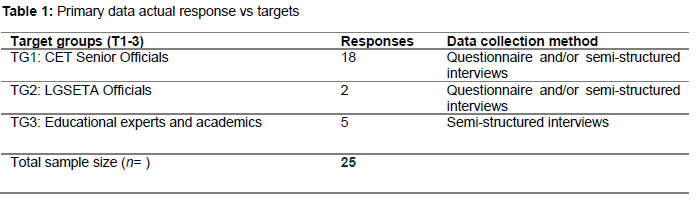
This article reports on findings of an empirical survey conducted among CETCs in South Africa to assess their capacity with specific reference to supporting local government skills development initiatives. The assessment includes an analysis of data obtained from the LGSETA's annual reports to ascertain the level of alignment between skills programmes offered by CETCs and the critical and scarce skills identified by the LGSETA for the local government sector. Semi-structured interviews were conducted with three target groups, namely senior CETC officials, LGSETA officials and educational experts and academics in the field of community education and training (n=25). Through data triangulation recommendations are made to further facilitate capacity building of CETCs.
LITERATURE REVIEW
There is a growing global concern about providing effective continuing education and training (CET) to support and sustain the employability of working-age populations (UNESCO 2020). CET serves as an intervention that equips adult learners by providing skills and knowledge to assist them in entering the labour market and performing more efficiently (Belete et al. 2022; Land and Aitchison 2017). Furthermore, adult education has been shown to have an impact on the removal of passivity in adults by offering them a second chance to attain knowledge that will not only benefit them but also their communities (Boeren and Rubenson 2022; Samy 2019). CET not only enhances workplace viability but also aids in achieving the government's economic and social goals. In this regard, educational institutions, such as CETC, organise educational provisions based on intended goals, resources, capacities, and institutional imperatives. Leow et al. (2022) confirm that effective engagement and outcomes are strongest when CET is aligned with working-age adults' goals, needs, and readiness to participate.
In South Africa, CETCs were launched in 2015 as a new initiative in the Post-School Education and Training (PSET) sector alongside Technical and Vocational Education and Training (TVET) colleges and universities (Manota 2021; Simkins 2019). They were intended to serve as administrative hubs whose main purpose was to help drive community education and training and, ultimately, the establishment of District-Based Community Education and Training Colleges in each province (Belete et al. 2022; Hendricks and Aploon-Zokufa 2021). The CET sector currently comprises 1 791 centres, disaggregated into 200 community learning centres and 150 satellite learning centres (DHET 2023). CETCs fall under the hospice of the Department of Higher Education and Training (DHET) and are funded and administered in terms of the Continuing Education and Training Act 16 of 2006 (CET Act) (Manota 2021). CETCs specifically aim to address the knowledge and skills needs of unemployed people, and those employed but in low or semiskilled occupations. As such, it is expected that CETCs align their educational programmes with public programmes such as the Expanded Public Works Programme and the Community Works Programme where they provide classroom and workshop-based learning and work-integrated learning opportunities. The CETCs have a varied scope of curricula that should be aligned to each community's and sector's needs (Nsele 2019).
A further layer of support comes from sector education and training authorities (SETAs) which fund, gather information and act as intermediaries on skills development and workplace-based learning (DHET 2021). Chapter 3 of the Skills Development Act 97 of 1998 outlines the functions of SETAs to, amongst others, develop and implement a sector skills plan, promote learnerships and collect and disburse skills development levies per sector. There are currently 21 SETAs functioning within the South African landscape, of which the LGSETA is aimed at assisting local government employees, the unemployed, ward councillors and traditional leaders working within the structures of local government (LGSETA 2023a; Nsele 2019). The focus is to ensure that learners are adequately trained and educated to meet the skills requirements of the local government sector (LGSETA 2023a).
The LGSETA's 2023/2024 strategic plan sets the following mission: "To build local government's ability to meet its development needs through innovative approaches, effective capacity building and strategic partnerships" (LGSETA 2023b). To this end, the strategic plan makes specific provision for partnerships with CETCs and to support these colleges through skills development intervention and access to adult education and training programmes, inclusive of bursaries to lecturers, infrastructure support, and information and communication technology connectivity.
On an annual basis, the LGSETA publishes a list of critical and scarce skills. The analysis is based on skills gaps, occupational shortages and strategic occupations. The data used to inform the analysis are gleaned from Workplace Skills Plans, Annual Training Reports and Statistics South Africa. A hard-to-fill vacancy refers to a vacancy that normally takes longer than the specified period (e.g., 6 months) to be filled by a suitably experienced and qualified candidate. This is partly due to the demand for workers in certain occupations being higher than the supply of workers who are willing and able to work under existing work and employment conditions (LGSETA 2021). A skills gap exists when employees are judged by their employer not to be fully proficient or when employees, through self-assessments, are of the opinion that they require more suitable skills to effectively perform their jobs (LGSETA 2021). Skills gaps are usually experienced when employers appoint individuals without the required qualifications, skills or experience. It may also be due to workers not being adequately upskilled to match new job responsibilities and changing conditions.
Comparing the list of current skills programmes on offer by CETCs with the critical and scarce skills identified by LGSETA is essential to ascertain the capacity of CETCs to address the LGSETA skills development requirements.
RESEARCH METHODOLOGY
The study was commissioned by the LGSETA and focused on answering the following research question: To what extent is the capacity of Community Education and Training Colleges adequate in supporting local government skills development initiatives? CETC capacity in this context refers to the ability of colleges to use resources effectively and efficiently in order to achieve its goals (Makkar et al. 2018). It implies that colleges have the required decision-making processes, infrastructure, systems, human resources, finances, and technology to successfully offer suitable educational programmes (Cox et al. 2018; Mladenova 2022; Stensaker 2021).
Following a qualitative research design, the study was divided into four phases. Phase 1 entailed a conceptual, contextual and situational analyses by means of a literature review and desktop analysis pertaining to CETCs in the context of skills development agenda in the local government sphere. This phase included an analysis of statutory and regulatory prescripts, as well as a document analysis of official guidelines, opinion papers, and LGSETA strategic and annual performance reports.
Phase 2 entailed an empirical survey employing primary data collection methods where focus was placed on gathering insights from three target groups regarding the degree to which the CETCs are supporting local government, their capacity in terms of lecturers and learning material as well as the LGSETA support at present in this regard. Target group 1 comprised of CETC senior officials to obtain accurate and up-to-date information pertaining to the extent in which colleges contribute to skills development initiatives in the local government sphere and to identify typical challenges impeding colleges from responding to the local government skills development interventions. These senior officials were purposively sampled based on their direct involvement in the design, development, and implementation of the LGSETA training programmes. Additionally, they were selected to ensure representation across different geographical locations of the CETCs, as well as variation in institutional size and the number of enrolled learners. The inclusion of target group 2, namely representatives of LGSETA tasked with CETC matters, purposively sampled, was necessary to establish the role of the LGSETA in supporting colleges in the context of lecture development. Target group 3, namely educational experts and academics in the field of community education and training, served as a reference group to verify and cross-check the input obtained from managers of CET colleges. The main limitation of the study was the relatively small sample size within the CET sector, which currently consists of 1 791 centres, including 200 community learning centres and 150 satellite learning centres. Due to financial and time constraints, it was not possible to obtain a fully representative sample of the entire sector. Table 1 reflects the actual number of responses per target group.
Participants (interviews) and respondents (questionnaires) were contacted telephonically and via email. Both interviews and questionnaires were conducted and administered online by means of MS Teams and SurveyMonkey.
During phase 3 of the survey primary data was collated and verified. Activities included data entry for paper-based or online questionnaires; coding of open responses by means of ATLAS.ti (version 23); numerical data entry using MS Excel spreadsheets; management of missing values; data modification; data correction and validation. A two-way ANOVA (Analysis of Variance) statistical test was used to compare means between the three target groups, specifically to assess if there are differences in responses between them. T-tests were not used since it is more suitable for comparing means between two groups.
The final phase, phase 4, entailed the final verification and cross-referencing of findings, the identification of key observations made by the research team during the process, as well as the completion of the final research report.
RESULTS
The demographical profile of CETC senior officials (TG1) is reflected in Graph 1 with specific reference to their current position or job title.
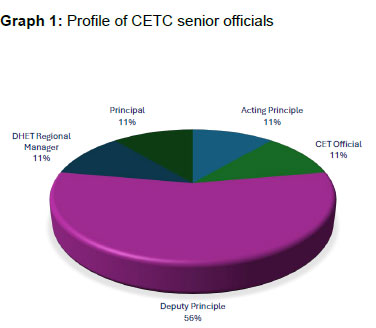
The majority of participants is more than 10 years in their position and have more than 10 years relevant experience. This ensured that rich data could be gathered. Figure 1 illustrates the geographical location of CETCs.
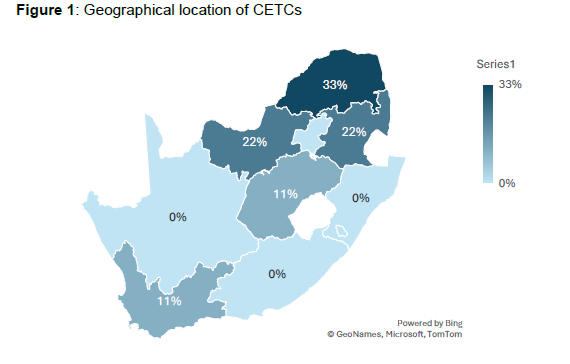
The majority of CETCs that participated in the survey is located in the Limpopo province (33%), followed by Mpumalanga and the North-West provinces (22% each), and the Free State and Western Cape (11% each).
FINDINGS: CETC CAPACITY
Participants and respondents provided varied but valuable insights regarding the current degree to which CETCs contribute to skills development. LGSETA respondents (TG1) and local government experts (TG3) were of the opinion that CETCs do make a contribution but not at the level of other PSET entities such as TVET colleges. These respondents cited financial constrains as the reason why it has not reached their maximum capacity.
In general, the focus of CETC educational programmes appears to be on the provisions of skills development across all municipal communities with the aim to add to an already existing skills (upskill), to further develop existing skills in communities (re-skill), and to attain occupationally directed skills to create jobs. This provides opportunities for especially young and older people who never had an opportunity to access education and training at formal institutions. Most respondents (67,5%) noted that CETCs contribute in general to skills development by serving as alternative avenue to matriculants who do not have the academic or financial means to be absorbed into tertiary institutions. As such they obtain practical skills to be absorbed in the labour market.
For the local government sector in particular, CETCs act as vocational support structures to offer tailor-made training and SAQA-registered programmes for prospective municipal officials. The contribution to skills development initiatives in the local sphere of government expressed include the design of tailor-made programmes, fostering community involvement and engagement in skills development initiatives, and CETCs work with local businesses and industries to facilitate job placements for individuals who have acquired new skills. However, the majority of CETC respondents (65,4%) indicated that they do not have any formal partnerships with a municipality. They reported that the lack of a formal platform to communicate with municipal employees and councillors influence their decisions on training planning, and therefore no statistics of focused local municipal training could be provided.
FINDINGS: CETC CHALLENGES
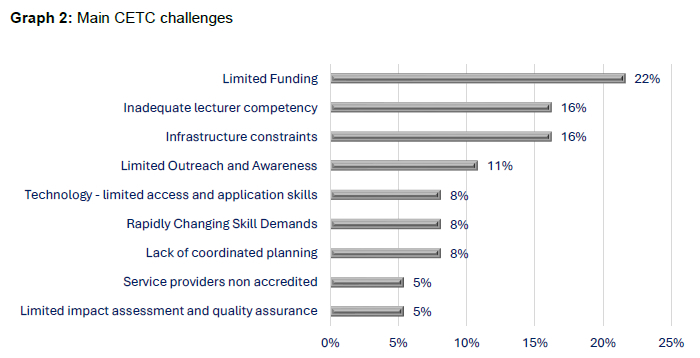
Respondents and participants were requested to provide their views on the main challenges faced by CETCs towards improving community skills in response to local government skills requirements. The three main challenges identified, as per Graph 2, are the lack of funding (22%), inadequate competencies of lecturers (16%), and infrastructure constraints (16%). Other challenges include the changing skills demand, lack of coordinated planning between the CETCs, local government and other stakeholders, as well as technology challenges.
FINDINGS: CETC CONTRIBUTION TOWARDS ADDRESSING LGSETA SKILLS NEEDS
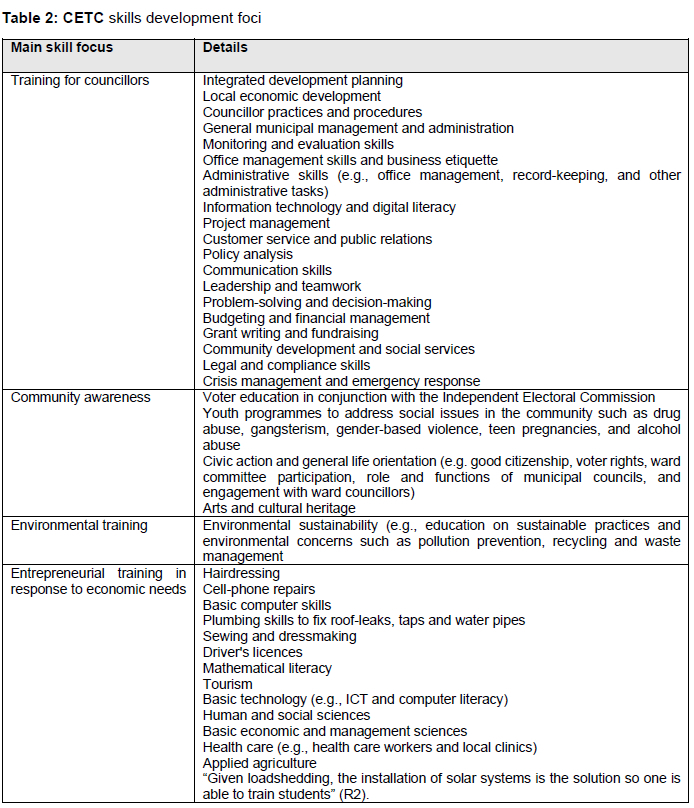
In response to the question, "What specific skills do you believe CETCs can significantly contribute to the promotion of skills development initiatives in the local government sector?", respondents and participants provided a comprehensive list (Table 2).
To establish the extent to which local government employees participate in the design and development of skills development programmes offered by a CETC, the responses provide insight into each of the needs identified above.
The majority of respondents indicated that no engagement happens with the municipality to plan for adult education and training (AET). The responses varied between no engagement (85%), to instances where the CETC has now started to engage some municipalities in planning for educational programmes or to obtain input from the DHET. An example cited in this regard is the Higher Health Initiative (15%). Sixty-seven percent of respondents indicated that local government employees attend on their own initiative and enrol at CETC centres as individuals and not as local government employees. The example mostly cited in this regard is the attendance of the AET L1 - L4 programmes for Literacy (Reading and Writing) as designed by Umalusi. Twenty-three percent indicated that these programmes are offered in line with the assessment of scarce and critical skills documented in the DHET in their Skills Sector Plan which is done in consultation with the respective SETAs.
Respondent 2 commented that CETCs should organise forums or workshops where local government officials and employees can engage in discussions about the specific skills and competencies that would benefit youth in the community. These skills and competencies should not only be aimed at skills development but also include general life orientation to assist in addressing social ills such as teenage pregnancies and gangsterism. Collaboration with external organisations, non-profits, or educational institutions was also cited as an option to play a role in the design of programmes for school-dropouts. One respondent (R4) remarked that the involvement of local government employees in planning of CETC skills training might participate in forming and managing these partnerships. The development of mentorship and internship programmes can ensure that the skills development initiatives are aligned with the practical challenges faced by youth dealing with dropout and drug abuse. This participatory approach may help ensure that programmes are tailored to address identified local needs. All CETC respondents indicated that there are no other programmes currently taking place based on inputs gained from local government employees.
FINDINGS: LGSETA CAPACITY SUPPORT TO CETCS
Respondents provided detailed responses on their views regarding the role the LGSETA should play to further build capacity of CETCs. These verbatim responses included the following, in no particular order:
"The LGSETA should provide training to CETC lecturers and assessors" (R4). "LGSETA funded training programmes for CETC lecturers and instructors should be aimed at enhancing their capacity in developing and delivering focused learning content, covering instructional design, pedagogical techniques, and effective use of technology in education" (R7).
"The LGSETA should involving young public administration graduates in internships and work placements" (R10)
"They must provide financial support for curriculum development-related skills programmes" (R2).
"The LGSETA should collaborate with CETCs to develop relevant and accredited training curricula for the local government sector. This includes identifying key competencies, learning outcomes, and programme structure" (R22).
"The LGSETA should provide guidance to ensure the learning content and study materials are relevant to industry standards and practices, staying updated on changes in the sector. The content should also be aligned with regulatory requirements. The funding for this development will address LGSETA's strategic priorities, ensuring that the training meets industry standards and meets the specific needs of the local government sector" (R23).
"The LGSETA should assist CETCs in acquiring infrastructure, including funding for classrooms, libraries, and laboratories, to create a conducive learning environment" (R24).
"They should promote technology integration into learning materials, promoting e-learning platforms and digital resources for enhanced accessibility and engagement. Additionally, funding for ICT labs will enable virtual training, including train-the-trainer programmes (R9).
"The LGSETA can help CETCs to develop strategic plans that align with local government sector goals, identifying skill priorities, setting targets, and planning for long-term sustainability" (R1).
"The LGSETA can conduct a needs analysis to identify skills gaps and training requirements, enabling tailor-made training programmes for staff and lecturers" (R7).
"The GSETA should provide guidance on determining skill needs for municipalities in the relevant province, district, and local municipality. They should also engage CETCs to conduct trainer needs assessments and support the development of tailored "train-the-trainer" programmes" (R3).
"The LGSETA should provide skills assistance to improve management and administration of learning sites, assists CETCs in human resource development, and facilitates professional development opportunities for staff and lecturers. These include workshops, seminars, and training programmes to enhance teaching methodologies, curriculum design, and other relevant skills" (R25).
"The LGSETA is responsible for accrediting training programmes offered by CETCs, ensuring that the learning content aligns with the National Qualifications Framework (NQF), which is crucial for the recognition and accreditation of qualifications and certifications obtained through these programmes. The SETA should provide regular updates on "fly-by-night" institutions that do not offer accredited, registered programmes, as this is essential for the recognition and accreditation of these qualifications and certifications" (R23).
"The LGSETA is responsible for enhancing the quality of education and training provided by CETCs by setting standards, monitoring program delivery, and conducting assessments to ensure staff and lecturers meet required competencies. They should also monitor and evaluate the effectiveness of training programmes, assessing their impact on staff and lecturers' skills development and making necessary adjustments for continuous improvement. Additionally, LGSETA should establish mechanisms for collecting feedback on learning materials to identify areas for improvement and ensure content remains responsive to local government sector needs" (R3).
"The LGETA should assists in the placement of successful learners in municipalities and encourages CETCs to actively engage with the local community. This collaborative approach helps centres learn from each other's experiences and implement successful strategies, enhancing their reach and impact" (R12).
"The LGSETA may support research initiatives and innovative skills development practices in CETCs, encouraging them to explore new teaching methodologies, technologies, and approaches to enhance staff and lecturers' learning experience, and monitoring learner performance to adjust CETC programmes accordingly" (R9).
DISCUSSION
From the responses obtained it is evident that the capacity of CETCs to address local government skills development initiatives is constrained by several factors. This was confirmed by all three target groups. LGSETA respondents in general are of the opinion that CETCs do contribute to skills development but not on the same levels as other public sector education and training entities like TVET colleges, citing financial, managerial, administrative and infrastructure constraints as the key reasons for not reaching maximum capacity levels. Especially the lack of funding for skills training gaps in CETCs is a significant issue, with a discrepancy in funding available from the National Treasury compared to those offered to universities and TVET colleges. This lack of financial resources generally hinder the development and sustainability of skills development programmes, including budgetary constraints for technology infrastructure upgrades and for study material development. Late payments also negatively impact cash flow management. Most learning sites are leased, and the CETCs often relies on the willingness of the property owner to make certain concessions.
It is interesting to note that some CETCs focus on non-credit bearing programmes whilst others reported that the main enrolments are for academic courses rather than skills development programmes. CETC respondents emphasised the fact, however, that colleges offer opportunities for community members, particularly young people and older individuals, do benefit from skills development in general. As such, CETCs increase accessibility to learning opportunities, especially in areas where access to traditional educational institutions is limited. While there are pockets of excellence to be found, much more is required to ensure that CETCs fulfil their statutory obligations and strategic intend. It is evident that more support from the Department of Higher Education and Training as well as from the respective SETAs would allow the CETCs to more successfully fulfil their skills development mandate.
Responses from LGSETA officials showed that CETCs are viewed as valuable partners to provide vocational support for the local government sector, offering tailored training and South African Qualification Authority-registered programmes for municipal officials. As such, they contribute to skills development initiatives by collaborating with municipalities to design and implement programmes that address local skills needs. The survey disclosed, however, that such partnerships are rather sporadic and not common (only 35% of CETC respondents indicated that some partnerships with individual municipalities do exist). Such partnerships could facilitate better alignment between CETCs programmes, LGSETA skills development initiatives, and national government skills development interventions. This may result in local government employees and councillors more successfully engaging CETCs on skills development planning, better coordination, and the more effective utilisation of available resources. The fact that 67 per cent of respondents attend CETCs as individuals, not as local government employees highlighted the need for better coordination. Partnerships could also ensure improved engagement with local businesses and industries to facilitate job placements for individuals who have successfully completed CETC skills programmes. Mechanisms such as joint forums for skills development planning, membership on municipal training committees, LGSETA workshops, municipal internships, and mentorship programmes should be exploited to further foster collaboration between CETCs and the local sphere of government.
In response to the question: "What specific skills do you believe CETCs can significantly contribute to the promotion of skills development initiatives in the local government sector?" respondents provided a comprehensive list. The main themes revolve around councillor training, community awareness programmes, environmental orientation, and entrepreneurial skills development in response to the significant financial and economic constraints that rural communities generally experience. A more nuanced analysis is probably more appropriate to distinguish between core, job-related skills and supplementary or complementary skills such as communication, time management and creative thinking in supporting technical training for a more holistic approach to skills development.
LGSETA's role is especially emphasized in skills development for lecturers and assessors, involving young public administration graduates in internships, and providing financial support for curriculum development. It also funds CET managers to be trained in municipal concerns and functions such as integrated development plans, local economic development strategies, and to provide training programmes for CETC lecturers and instructors to enhance their capacity in developing and teaching specialised municipal content. LGSETA can further assist CETCs in developing strategic plans, identifying community development priorities, setting performance targets, and planning for long-term sustainability of municipalities. They can also conduct a needs analysis to identify skills gaps and training requirements, enabling tailor-made programmes for staff and lecturers. LGSETA also provides skills assistance for improving the management and administration of learning sites, human resource development, and professional development opportunities for staff and lecturers.
Approximately 30 per cent of instructors in the CET system lack the necessary qualifications, and another 34 per cent have academic degrees but no professional or sector-specific training. According to the Department of Higher Education and Training (DHET 2023), just 36 per cent of current CET teachers meet the requirements for the CET sector both professionally and intellectually. It is furthermore evident that lecturers are not suitably trained to offer vocational skills development programmes but are rather more trained for academic or theory-focused teaching. In addition, LGSETA officials held the view that not all CETC lecturers have the capacity to grasp the nature and scope of local government's needs, and they generally struggle to align programme content with high-demand scarce skills occupations in municipalities. It should also be noted that local government skill requirements are not static but are constantly evolving due to social and demographical trends, community development priorities, technological advancements, economic conditions and political dynamics. To constantly adjust programme content to fit these realities demand continuous engagement between CETCs and the LGSETA. However, the absence of a formal forum or communication platform to foster coordination between CETCs and the LGSETA hamper such engagements. While LGSETA respondents confirm that CETCs in general offer valuable programmes, there is a general misalignment between the skills programmes currently being offered and the critical and scarce skills identified by the LGSETA. Hardly any programmes directly address the identified skills gaps, which suggests that, within the currently offering, CETCs are not able to significantly contribute to the skills development initiatives in the local government sector. This is certainly an area that deserve high-level political and managerial engagement.
A further concern raised is the fact that CETCs are not readily accessible. The geographical spread of CETCs in the country often discourage prospective learners in rural areas to attend programmes due to the high costs associated with traveling and the fact that there are no study subsidies for transport. Furthermore, inadequate access to technology infrastructure (e.g., Internet, wifi and social media platforms) and other learning tools often hamper the delivery of training programmes online. Inadequate technological infrastructure and systems also constraint the administrative capacity of CETCs to keep accurate student records, coordinate processes between the different learning centres, conduct quality control, and facilitate the assessment of learners. Learner tracer studies are rarely conducted by CETCs and often contract service providers that are not accredited by the LGSETA or any other SETA.
It was emphasised that CETCs should not only focus on skills development for occupational readiness but also address social ills such as teenage pregnancies, drug and alcohol abuse, gangsterism, and gender-based violence. The content of training programmes should potentially be extended to include broader socio-economic and political dynamics enhancing learners' comprehension of these concerns and enabling them to meaningfully contribute to potentially solutions to these ills. It also seems that CETCs can benefit in this regard by continuously engaging municipalities in establishing community development priorities and by encouraging the youth to become involved in skills development. They could also benefit from collaboration with civil society organisations, non-profits, or educational institutions that play a role in designing focused educational and skills development programmes. This may also inform national policy regarding the role and functioning of CETCs.
It is evident that the LGSETA play a crucial role in South Africa's skills development landscape. Respondents' rating of the current LGSETA successes in terms of the contributions to skills development in general and support to CETCs in particular vary from poor (38%) to excellent (25%). The LGSETA has capacitated 6 provincial CETCs with various skills development initiatives aimed at upskilling CETC staff as well as learners. These initiates included the 4IR exchange programme, focused pedagogical skills, industry knowledge, project management for Centre Managers, and the effective use of technology in teaching. Workshops and seminars focus on key areas for lecturers, such as curriculum design, assessment methods, and industry-relevant content. However, attendance rates are relative low due to several work-related challenges.
RECOMMENDATIONS
Based on the responses obtained from the primary sources as well as the literary sources included in this survey, several recommendations can be made to improve the capacity of CETCs.
In the first instance, it is recommended that the national government should ensure that CETCs operate in a similar way as TVET colleges, with well-maintained buildings and infrastructure. Infrastructure expansion and maintenance are essential and the DHET should eventually transfers ownership to the CETCs to facilitate the more effective utilisation of buildings for full-time training. Once the CETC owns the building, they can offer accredited learnerships and skills programmes based on the municipal area's main socio-economic development needs. In this regard, the DHET should increase both the CETC and LGSETA budgets and provide stipends to unemployed CET learners.
Secondly, the LGSETA should record best practices nationally and internationally to benchmark tuition rates, teaching methods, and study material content. The LGSETA should also help CETCs identify gaps and support their performance assessments. Additionally, the LGSETA should enhance curriculum management and administration skills for advanced interventions. A comparative study exploring the skills challenges in South African local government alongside those in other African countries, highlighting both similarities and differences, is therefore recommended. In addition, regional cooperation and knowledge-sharing between countries could help address common skills gaps in the local government sector.
Thirdly, the capacity of CETCs can be improved through collaboration with industry professionals and academics for the design and development of non-credit-bearing skills programmes. Specialised training curricula can be created to cater for the unique skill requirements of different municipal areas. Both hard skills (e.g. welding, construction, and dress-making) and soft skills (e.g., leadership, teamwork, communication, and problem-solving) should receive attention in this regard. LGSETA should provide CETCs with guidelines for conducting regular assessments to identify emerging skill gaps, technological advancements, and evolving skills requirements.
A fourth recommendation is to explore remote learning options and assessment alternatives by adopting suitable educational technologies such as webinars, online courses, and digital information resources. To make learning more accessible and engaging, gamification, simulations, and real-world case studies should be investigated as teaching modalities. By incorporating suitable technologies, CETCs can enhance the geographical spread and impact of their programmes and improve the overall effectiveness of local government skills development. CETC instructors should be provided with continuous opportunities for professional growth to stay updated on industry trends and teaching methodologies.
Fifthly, a formalised engagement platform should be established to serve as a forum for stakeholder partnerships. This platform should foster joint planning and coordination for the design and implementation of skills development programmes. LGSETA should partner with CETCs and facilitate industry-embedded learning experiences through internships, practical projects, and partnerships. The engagement platform should also assist CETCs to partner with municipalities, national and provincial departments, development agencies, non-governmental organisations and civil society organisations to more successfully align training programmes with local socio-economic development and workforce needs.
Finally, broader awareness and civic education about the role of CETCs are required to capitalise on available funding opportunities and increase private investment in skills development. Such awareness programmes should make provision for the publication of regular objective assessments of the effectiveness of CETC skills programmes. Stakeholders can thus monitor progress made by CETCs and further stimulate financial investment and resource allocation to CETCs.
CONCLUSION
This article was aimed at assessing the current capacity of CETCs in addressing local government skills needs. The analysis of several LGSETA strategic plans and reports as well as other relevant documents confirmed the LGSETA commitment towards supporting CETCs as part of their core functions. The study highlighted the critical role that CETCs play in addressing skills gaps and fostering socio-economic development at the local sphere of government. Despite challenges such as limited funding and institutional constraints, both CETCs and the LGSETA demonstrated a strong commitment to collaboration in delivering relevant training programmes and skills development initiatives. The study furthermore underscores the importance of strengthening partnerships and enhancing communication channels between CETCs and municipalities. By fostering closer collaboration and sharing resources and expertise, both parties can maximise their impact on skills development outcomes and better address the evolving needs of communities. Furthermore, the study identified areas for capacity improvement, including the need for additional funding, greater alignment between CETC curricula and the skills requirements of local government, as well as the importance of enhancing support structures for learners, particularly those from marginalised backgrounds.
The study contributes to the ongoing dialogue surrounding skills development in South African municipalities by providing evidence-based insights and recommendations for enhancing the capacity of CETCs in supporting local government initiatives. By leveraging the findings of this study, political decision-makers, educational and skills development institutions as well as local government officials can work together to build stronger partnerships, improve programme offerings, and ultimately drive more inclusive and sustainable development outcomes for communities across South Africa. Without such partnerships, CETCs will struggle to build its capacity and to remain relevant in the sector.
REFERENCES
Belete, S., C. Duke, H. Hinzen, A. Owusu-Boampong and H. P. Khau. 2022. "Community Learning Centres (CLCs) for Adult Learning and Education (ALE): development in and by communities." International Review of Education 68(2): 259-290. https://doi.org/10.1007/s11159-022-09954-w [ Links ]
Boeren, E. and K. Rubenson. 2022. "The Global Report on Adult Learning and Education (GRALE)." International Review of Education 68(2): 293-308. https://doi.org/10.1007/s11159-022-09945-x [ Links ]
Cox, K., S. Jolly, S. van der Staaij and C. van Stolk. 2018. Understanding the Driver of Organisational Capacity. Santa Monica, CA: RAND Saatchi Institute. https://www.rand.org/content/dam/rand/pubs/research_reports/RR2100/RR2189/RAND_RR2189.pdf [ Links ]
DHET. 2021. Annual Report 2020/21. Pretoria: Department of Higher Education and Training. [ Links ]
DHET. 2023. Community Education and Training. Pretoria: Department of Higher Education and Training. https://www.dhet.gov.za/SitePages/CommunityCollege.aspx. [ Links ]
Hendricks, N. and K. Aploon-Zokufa. 2021. "A 'curriculum moment' for Adult and Community Education and Training: Acknowledging the voices and experiential knowledge of lecturers and students at community learning sites." Journal of Vocational, Adult and Continuing Education and Training 4(1): 1-15. https://hdl.handle.net/10520/ejc-jovacet_v4_n1_a1 [ Links ]
HRSC. 2017. Challenges facing Adult Education and Training in the Local Government Sector, South Africa. Pretoria: Human Sciences Research Council and LGSETA. https://cdn.lgseta.co.za/resources/performance_monitoring_and_reporting_documents/AET%20Research%20Project.pdf [ Links ]
Land, S. and J. Aitchison. 2017. The Ideal Institutional Model for Community colleges in South Africa: A Discussion Document. Durban: Durban University of Technology. https://www.researchgate.net/publication/335202600_THE_IDEAL_INSTITUTIONAL_MODEL_FOR_COMMUNITY_COLLEGES_IN_SOUTH_AFRICA_A_DISCUSSION_DOCUMENT [ Links ]
Leow, A., S. Billett, A. H. Le and S. Chua. 2022. "(2022) Graduates' perspectives on effective continuing education and training: participation, access and engagement." International Journal of Lifelong Education 41(2): 212-228. https://doi.org/10.1080/02601370.2. [ Links ]
LGSETA. 2021. Sector Skills Gaps and Occupational Shortages Guide 2020/2021. Pretoria: Local Government Sector Training and Education Authority. [ Links ]
LGSETA. 2023a. Sector Skills Plan 20222/2023. Bedfordview: Local Government Sector Training and Education Authority. https://cdn.lgseta.co.za/resources/sector_skills_plan/LGSETA_Sector%20Skills%20LAYOUT%202022-23.pdf [ Links ]
LGSETA. 2023b. Strategic Plan of the Local Government Sector Education and Training Authority, 2023/24. Bedfordview: Local Government Sector Training and Education Authority. https://lgseta.org.za/wp-content/uploads/2024/02/Strategic-Plan-2023-24.pdf [ Links ]
LGSETA. 2023c. Terms of Reference - Exploring the capacity of CET colleges to support local government skills development initiatives. Bedfordview: Local Government Sector Training and Education Authority. [ Links ]
Makkarm S. R., A. Haynes, A. Williamson and S. Redman. 2018. "Organisational capacity and its relationship to research use in six Australian health policy agencies". PLoS One 13(3):e0192528. https://doi.org/10.1371/journal.pone.0192528. [ Links ]
Manota, M. 2021. "The Community Education and Training (CET) Sector: The Sector on a wrong Trajectory?" African Journal in Education and Transformation 1(1): 64-67. [ Links ]
Mladenova, I. 2022. "Relation between Organizational Capacity for Change and Readiness for Change". Administrative Sciences 12(4): 135. https://doi.org/10.3390/admsci12040135 [ Links ]
Nsele, N. N. 2019. Investigating the responsiveness of the KwaZulu-Natal community education and training college curriculum to the economic development of Dr Nkosazana Dlamini Zuma Local Municipality. (Doctoral dissertation). Durban: University of KwaZulu Natal. https://ukzn-dspace.ukzn.ac.za/bitstream/handle/10413/20852/Nsele_Nomalanga_%20Ntokozo_2019.pdf?sequence=1&isAllowed=y [ Links ]
PMG. 2020. Community Education and Training (CET) colleges update. Cape Town: Parliamentary Monitoring Group Higher Education, Science and Innovation. https://pmg.org.za/committee-meeting/29888/ [ Links ]
Samy, L. 2019. The functioning of Community Adult Education and Training Colleges to uplift the livelihoods of adult learners: a qualitative case study of a college in Johannesburg. (Doctoral dissertation). Johannesburg: University of the Witwatersrand. https://wiredspace.wits.ac.za/server/api/core/bitstreams/c3f4e556-2f82-44a4-a4d6-4e07d659f5a4/content. [ Links ]
Simkins, C. 2019. South Africa's Community Education and Training Colleges. Johannesburg: Helen Suzman Foundation. https://hsf.org.za/publications/hsf-briefs/south-africa2019s-community-education-and-training-colleges [ Links ]
South Africa. 1998. Skills Development Act no 97 of 1998. Pretoria: Government Printer. [ Links ]
South Africa. 2006. Continuing Education and Training Act no 16 of 2006. Pretoria: Government Printer. [ Links ]
South Africa. 2013. White Paper for Post School Education and Training: Building an expanded, effective and integrated post-school system. Pretoria: Government Printer. https://www.dhet.gov.za/SiteAssets/Latest%20News/White%20paper%20for%20post-school%20education%20and%20training.pdf [ Links ]
Stensaker, B. 2021. "Building institutional capacity for student competencies: An organizational perspective". International Journal of Chinese Education, 10(1). https://doi.org/10.1177/22125868211006200 [ Links ]
UNESCO. 2020. Trends in Adult Learning and Education in Africa: Findings from the 4th Global Report on Adult Learning and Education. New York, NY: UNESCO Institute for Lifelong Learning. [ Links ]