



Services on Demand
Journal

Article
 English (pdf)
 Article in xml format
 Article references

 Automatic translation
 Send this article by e-mail
Indicators
Related links
-
 Cited by Google
-
 Similars in Google
Share

 Permalink

South African Journal of Higher Education
On-line version ISSN 1753-5913
S. Afr. J. High. Educ. vol.40 n.2 Stellenbosch Apr. 2026
https://doi.org/10.20853/40-2-6924
GENERAL ARTICLES
Effects of demographics and class attendance on student performance in the department of finance: evidence from previously disadvantaged university
A. A. ObaladeI; F. DubeII
IDepartment of Finance, University of the Western Cape, Bellville, South Africa. https://orcid.org/0000-0001-6062-1632
IIDepartment of Finance, University of the Western Cape, Bellville, South Africa. https://orcid.org/0000-0001-8687-8540
ABSTRACT
This study explored the effects of demographics and class attendance on student performance in the Department of Finance at the University of the Western Cape (UWC) in the 2023 academic session. Student performance is measured by continuous assessments and final marks, while demographic factors are measured by gender, population group1, marital status, study type, residence type, and rate of attendance. The study employed a dummy regression analysis and found that certain demographic factors impact student performance. Firstly, this study demonstrated that female students outperformed the male students, especially in the undergraduate modules. Secondly, population group 2 emerged as the best performer when compared to group 52. Thirdly, never married students outperformed the single students at undergraduate3 and postgraduate levels. Fourthly, there is no categorical difference in student performance based on residence type. Fifthly, the part-time students underperformed relative to the full-time students despite the former being allowed to register half as many credit units as the latter. Lastly, the performance of students with ≥70 per cent class attendance far exceeds their counterpart. These findings support the consideration of additional support for male, population group 5, single and part-time students as well as attraction of group 3 candidates in the Department of Finance by relevant stakeholders, namely the university, funding organisations, family, and partners. Finally, introduction of ≥70 per cent attendance as a requirement for student's participation in assessments will boost performance and throughput rate in the discipline of finance. The results of this study speak directly to our learning and teaching (L&T) practices, specifically the finding that students who attend classes more perform better than those who attend less frequently. In the context of the post-COVID-19 cohort who were used to distance learning, this finding calls for academics to consider the adoption of more active learning approaches, which motivates more in-class participation that is aimed at increasing lecture attendance.
Keywords: demographics, class attendance, student performance, department of finance
BACKGROUND AND CONTEXT OF THE RESEARCH
While at the UWC Autumn Graduation 11 on 21 April 2023, watching some female Finance Honours students obtain Magna Cum Laude and Cum Laude in Bachelor of Commerce degrees was fascinating. As if that was not enough, the Vice Chancellor provided further intriguing and important statistics in his concluding remarks when he noted that seven women and four men had graduated with a doctoral degree, while two-thirds of the graduates were women (Pretorius, 2023). This observation arouses curiosity and reflection on experiences in the class and interaction with students in the Department of Finance. This prompted the evaluation of the demographic effects (gender, population group, marital status, class attendance, programme stream, study type, university residence) on student performance in the Department of Finance. This research idea is relevant in the South African and UWC context, where equality is of utmost importance and entrenched in the Freedom Charter and the constitution (Obalade, 2022).
Establishing an inclusive higher education environment occupies a strategic place in post-apartheid South Africa (Bozalek and Boughey, 2012). Equal access to education is one of the key components of the Freedom Charter. There are three population groups (2, 3, and 5) in the Department of Finance; however, two groups (2 and 5) are dominant. These statistics suggest that the erstwhile disadvantaged population groups are largely represented in the Department of Finance at UWC. This supports the role of UWC as one of the historically disadvantaged universities in South Africa. In South Africa, financial education and literacy constitute two of the scarce skills areas. Departments of Finance and related disciplines are the major suppliers of these critical skills (Bank SETA, 2020).
Investigation of demographic factors and class attendance has become increasingly important in the post-COVID-19 era, with students finding it difficult to return to face-to-face lectures. The year 2023 was selected because it was the year UWC reverted to face-to-face learning after three years of online learning, and the Department of Finance had to deal with numerous student queries, some of which were related to the selected demographic variables. This is evidenced by extracts from four selected students' requests, queries, or explanation emails below:
Student A explained the reasons for not attending first three lectures in the first semester of 2023:
"Thank you for contacting me. I was not aware of that prior to me registering for my honours as I was still under the impression that classes will be conducted online and term tests and final exams will be in person. In January, I had desperately accepted an employment offer in ..... I am the only breadwinner in my household thus this decision was best necessary for the family."
Student B requested adjustment to continuous assessment in order to qualify for examination:
"......In addition to these challenges, ......, and I don't have family in Cape Town. The main reason for my academic fall behind was because I was struggling with transport fare since I am squatting with a friend in Khayelitsha."
Student C motivated and requested a change from the full-time to part-time programme:
"I have made a horrible mistake by changing my programme from part-time to full-time. This decision has since impacted me negatively.... The third and last reason I would like to defer the two modules is because I am placing my children under pressure as I need to attend class 4 times a week. Please bear in mind that I have four children aged 15, 11, 5 years and one 8-month-old baby. This does not mean that I will not attend class at all, thus, dropping the 2 courses will alleviate some pressure off my eldest daughter who babysits the baby while I attend."
Student D motivated and requested online classes:
"I am enquiring about the feasibility of me catching up if in-person classes are missed, or rather to seek permission to attend some online classes ... I work in the .... and registration is a very busy time - I do not see myself able to travel to campus on time."
Further to this, students have linked their poor continuous assessment (CAM) performance to their inability to attend lectures due to financial and accommodation challenges. Others have juggled between part-time and full-time study to cope with work, studies, and family responsibilities, such as caring for children, a situation that is more problematic for single parents. At the same time, some students have accepted full-time jobs and study offers, and expected the university to accommodate them through the provision/continuation of online classes. It is difficult to generalise the perception that the above factors will affect performance without empirical evidence.
LITERATURE REVIEW
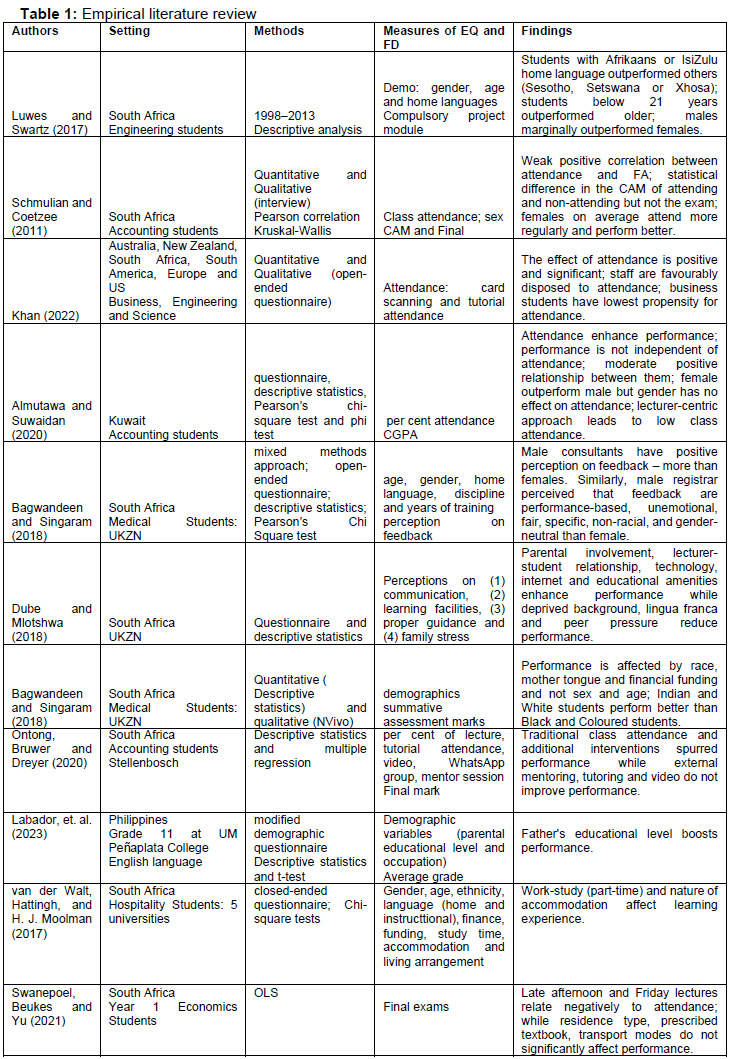
The journey towards understanding the factors that influence student performance is an ongoing one that dates back to the early 1970s with Spady's (1970) and Tinto's (1975) theory, which acknowledged that personal elements such as gender, ethnicity, and family background (amongst others) are role players in academic performance. Five years later, Bean (1980) further developed Tinto's (1975) theory with the Model for Student Attrition (MSA) theory. The MSA theory assessed the reasons behind students dropping out of institutions of higher education through the lens of a student's institutional commitment and satisfaction. The results showed that for women, performance, campus organisation participation, having a job on campus, the availability of alternative opportunities of employment, and being a resident of the state are some of the determinants influencing dropouts. For men, Bean (1980) found that development, routinisation, and student housing are some of the factors that affect dropout rates. Although the theories proposed by Spady (1970), Tinto (1975), and Bean (1980) focus on understanding why students drop out, they also have a strong link to student performance, which is why they are widely cited in studies investigating the factors influencing student performance.
The Biggs 3P model is another commonly cited theory that attempts to explain the determinants of student academic success through three sets of factors, namely: presage, process, and products or performance (Carpenter and Kraus, 2020). The presage factor is the most relevant for this study as it proposes that academic performance is influenced by elements that are exclusive to the university environment. For instance, gender, age, race, language, and previous academic performance are some of the personal presage factors that the Biggs 3P model posits affect student performance (Kanashiro et al. 2020). All of these aforementioned theories of student performance inspired a wave of literature exploring the applicability of these theories within various tertiary educational contexts. In the South African context, Sommerville and Singaram (2018) assessed whether any relation exists between demographic factors and academic performance for medical students from the University of KwaZulu-Natal. The study found that race and gender were the only demographics that had a significant relation with academic performance. More specifically, Indian and White students were observed to perform better than Black students, whilst female students demonstrated superior academic results compared to their male peers. Language and age had no relation with academic performance. In contrast to this, Maraschin (2008) who assessed first year psychology students from the University of the Witwatersrand, found that those who spoke English as their home language performed better than those who spoke other languages. The overarching finding of this study was that the socio-economic status of a student heavily influenced their performance. More specifically, students from a middle- and upper-class background outperformed those from a lower socio-economic background. Similarly, the performance of first year students from the University of the Western Cape were found to be impacted by personal factors such as accommodation status, employment status, family matters and language (McGhie, 2012). For second-year nursing students from the UWC, however, ethnicity, gender and age have no relationship with academic performance (Mthimunye, Pedro and Daniels, 2018).
In the international context, the exploration of this topic has been vast. For one, Alhajraf and Alasfour (2014) investigated the elements that impact the performance of Kuwait business students. The results indicated that age and gender have a significant influence on academic performance. Similar to Sommerville and Singaram's (2018) results, Alhajraf and Alasfour (2014) found that female students outperform the males which was related to the women being less socially active than men. There were no detailed results comparing the performance of the different age groups. In a more similar recent study, Tabassum and Akhter (2020)discovered that students of adolescent age (19 years) and those considered to be mature adults (39+) displayed higher performance than students categorised as middle adults (19-39 years). The results of this study also concurred with existing literature that female students show superior academic performance compared to their male counterparts. Interestingly, Tabassum and Akhter (2020) also found that the difference in the performance of married and unmarried students was not significant for Pakistani students. However, from the results of that article, it was deduced that married students with larger families showed poorer performance than those with smaller families and no children at all. Tabassum and Akhter (2020) further found that the sibling position that the student holds in their family (first born, second born etc.) also played an influential role in a student's performance.
This further emphasises the depth at which demographic characteristics impact a student's performance at university. Regarding first year Ecuadorian students, however, Pozo-Burgos et al. (2022) found that gender, age household income, and area of residence do not explain the variation in academic performance but rather that the father's educational level and economic status are directly related to a student's academic performance. Gender and status of Al Ain University students in the United Arab Emirates, on the other hand, had a very minimal influence on academic performance (El Refae, Kaba and Eletter, 2021).
Regarding student attendance, Singh (2020) found that, for accounting students, attendance was the only factor that significantly influenced academic performance. This was the same for accounting students from the University of the Witwatersrand according to the results of Papageorgiou (2019). In an earlier study, Thatcher, Fridjhon and Cockcroft (2007) reached the same conclusion for undergraduate psychology students, with results showing that students who attend regularly show higher performance than those who seldom attend or don't attend at all. This was in line with Khan (2022) whose analysis included students from New Zealand, Australia, Europe, South Africa and the Unites States. On the contrary, Guleker and Keci (2014), found that attendance is not a predictor of performance as their results showed that Albanian civil engineering students who attend class frequently may still fail and those who do not attend are capable of passing.
The review of existing literature shows that the majority of the studies on this topic concur that demographics do play a key role in student performance. However, the influence of certain demographic factors on student performance seems to differ according to the discipline being observed and the environment in which the university is. This speaks to the rich demographic diversity, specifically within the South African context, that cannot be generalised. Additionally, finance students have not been observed as closely as other disciplines such as accounting and health sciences. A limit therefore exists in the understanding of whether demographic factors influence the performance of finance students from the UWC. The 2019 COVID pandemic brought about an unprecedented transformation in economic conditions of the average South African household, which had asymmetric effects on the various demographic groups in the country. It is therefore crucial to assess the demographic factors that may have an influence on student performance as this understanding could assist in informing and improving L&T practices.
EMPIRICAL STRATEGY
In other to achieve the objective of this study, we employed cross-sections of student performance data for the 2023 academic year. The year 2023 was selected because UWC reverted to face-to-face learning after three years of online learning and the department had to deal with a lot of queries, some of which are related to the selected demographic variables4.
Population and sample
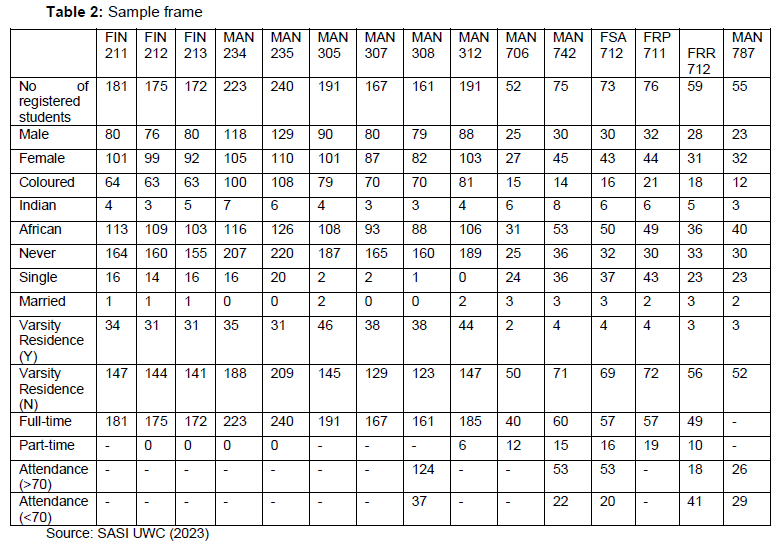
This study focused on the registered students for all undergraduate (MAN234, MAN235, MAN305, MAN307, MAN308, Man312) and postgraduate (FRP711, FRR712, MAN742, MAN745, MAN704, MAN706, FSA712) finance modules5 in 2023. Thus, for this study, the registered students for these modules constituted the population and the sampling technique was purposive. Consequently, the sample frame for the study was based on the specific module as presented in Table 2.
Regression analysis
This study adopted the dummy variable regression. We determined categorical performance of students based on sex, population group, marital status, residence, study type, and class attendance, using regression analysis with dummy variables. Dummy variables are variables that assume values of 0 and 1. When the explanatory variables in a regression model are exclusively dummies, they are called ANOVA models (Gujarati and Porter, 2020). Dummy regression analysis is usually applied to differentiate mutually exclusive or treatment groups (Ekong et al., 2021). This study specified six dummy variable regressions taking cognizance of the sex, population group, marital status, residence TYPE, study type, and class attendance,
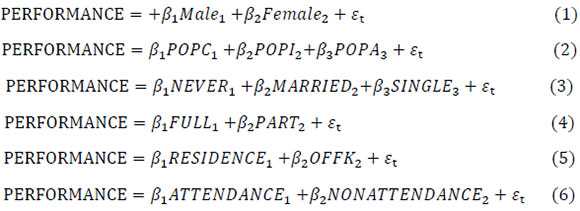
where PERFORMANCE was the dependent variable proxied using continuous assessment (CAM) and final marks, respectively (FINAL). β1 and β2 stand for average performance of male and female (or full- and part-time; attending and nonattending; university resident and off campus6) students, respectively in equation 1 (or 4, 5, 6). β1, β2 and β3 stand for average performance of Coloured, Indian and Black African (or never married, married, and single) students respectively in equation 2 (or 3). Exclusion of the intercept term from equations 1, 2, ...., 6 ensured that our model is free from perfect collinearity or a dummy variable trap. Thus, this study derived the mean performance for each category by including a dummy for each category (Gujarati and Porter, 2020). In equation (1), the dummy is equal to 1 when the performance (CAM or FINAL) belongs to a male or zero otherwise (female). Similarly, the dummy is equal to 1 when the performance (CAM or FINAL) belongs to a female or zero otherwise (male). This principle applies to all other equations.
INTERPRETATION OF RESULTS
The regression results from the estimated models (1, 2, ..., 6) are presented in this section. We take into consideration the year level and different demographic factors.
Gender effect in student performance
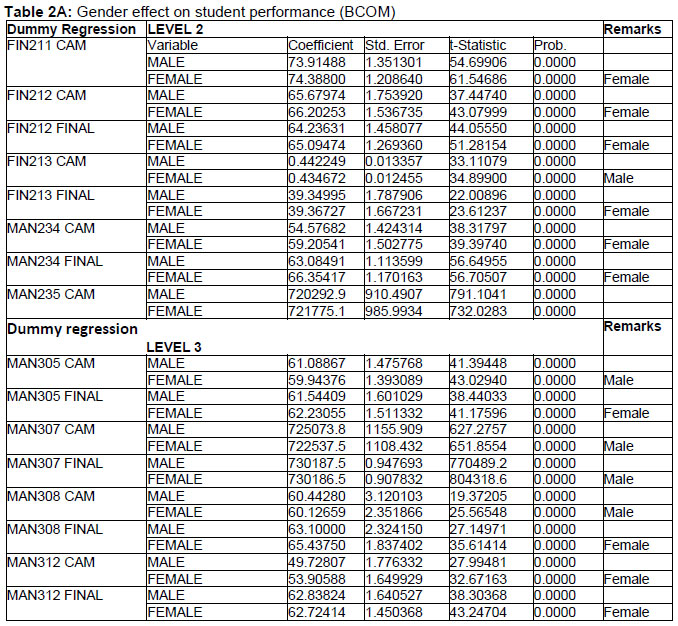
Table 2A presents the gender effect on student performance for CAM and FINAL. The analysis of the sex effect in the undergraduate modules suggests that female students outperformed their male counterparts, especially at year level 2. This is demonstrated by females' superior performance in 10 out of the 15 mark components. The difference is marginal in the few modules where males outperformed females.
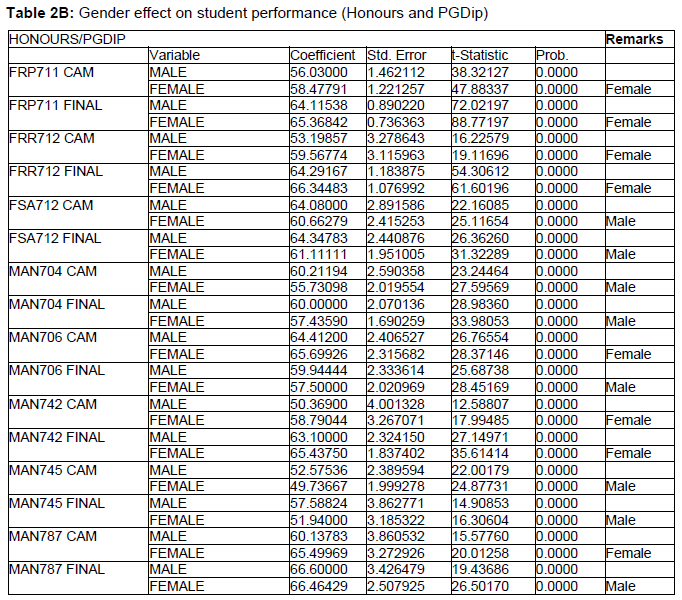
Table 2B shows the gender effect on performance for eight Honours and Postgraduate Diploma modules. In this instance, the performance of males and females was on par in terms of number of modules where they outperformed their counterpart. Moreover, when the undergraduate and postgraduate modules are considered, females have an edge over their male counterpart.
Population group effect on student performance
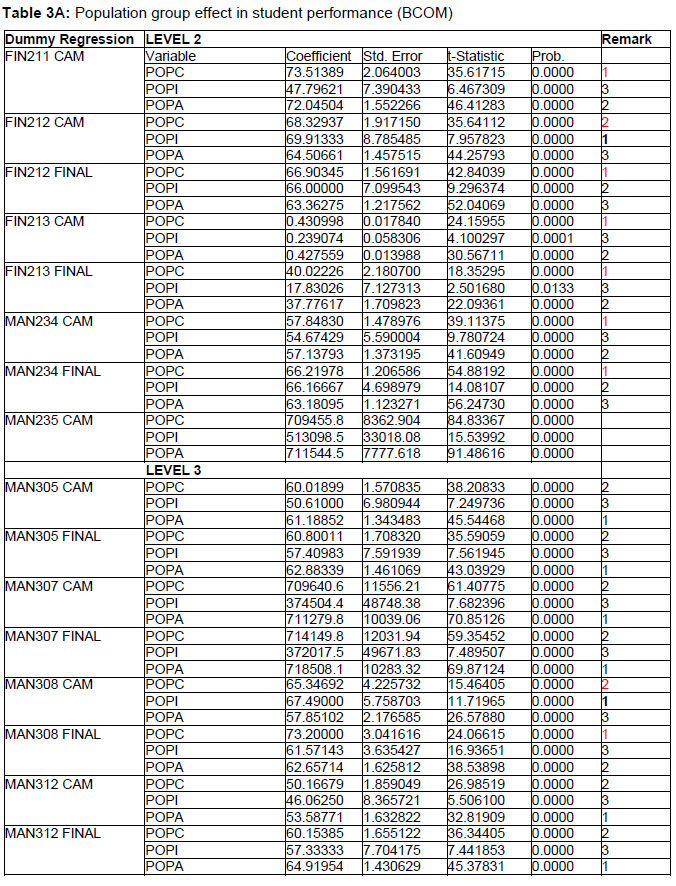
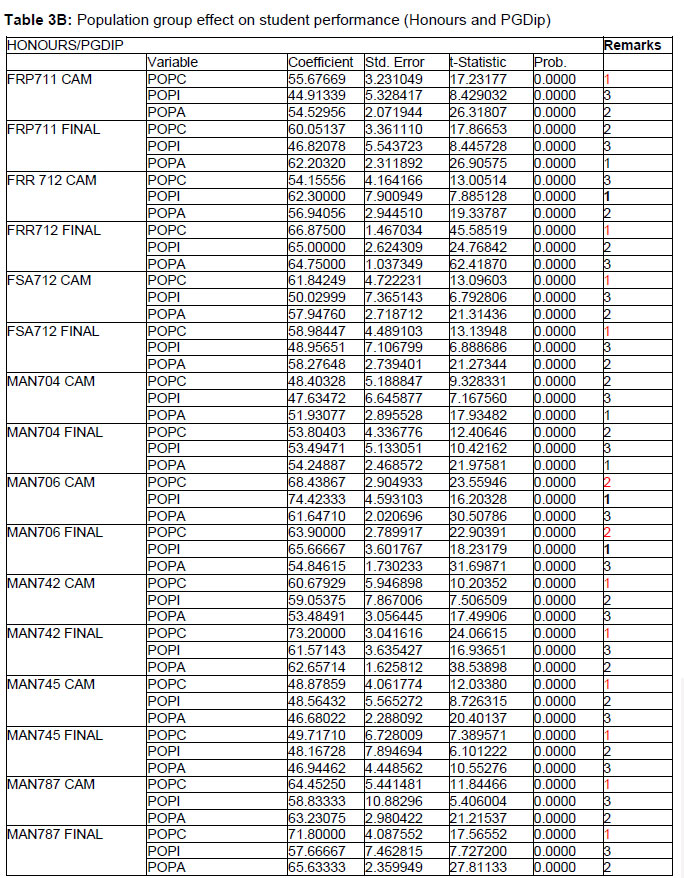
Subsequently, the study delved into the population group's effect on student performance. Although extant studies (Luwes and Swart, 2017) considered the effect of home language on performance, the population group provides a more nuanced basis for categorisation and various government parastatals and departments usually adopt it. Table 2 shows that the number of students belonging to group 3 is negligible, hence it was safe to leave the group out of the analysis and concentrate on dominant groups (2 and 5). However, the dummy regression approach employed for our analysis could address the small sample effect such that the outcome for the two dominant groups remained unchanged with or without the marginal group. Incidentally, the results in Table 3A show that group 3 (POPI) appears as the best performer in two and worst performer in 10 of the observed 15 mark components of the undergraduate Finance modules. Similarly, group 3 appears as the best performer in three and worst performer in nine of 16 postgraduate mark components as shown in Table 3B. As a result, it was safe to focus on the two dominant population groups.
It can be seen that population group 2 outperformed group 5 in all seven level two mark components while group 5 outperformed group 2 in six of the eight level three mark components. Furthermore, group 2 outperformed group 5 in 12 of the 16 observed mark components associated with postgraduate modules. This analysis portends a higher rate of performance for population group 2 relative to others.
Marital status effect on student performance
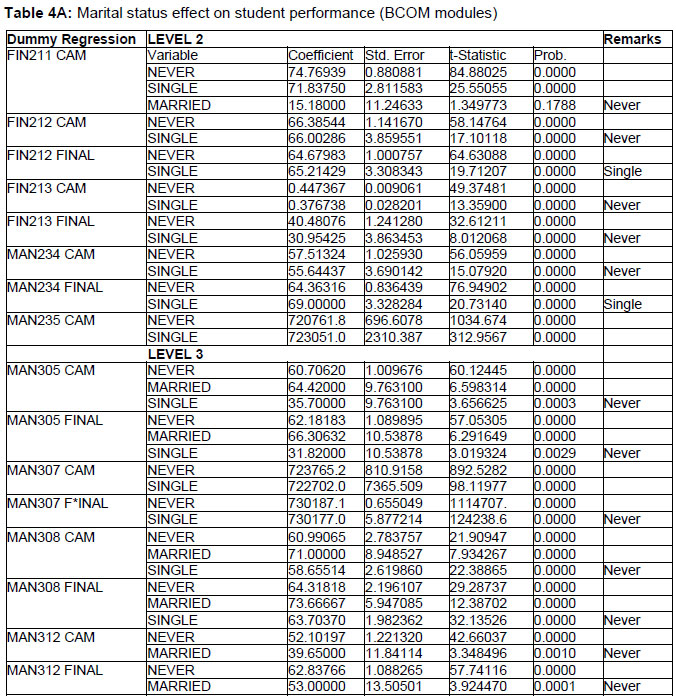
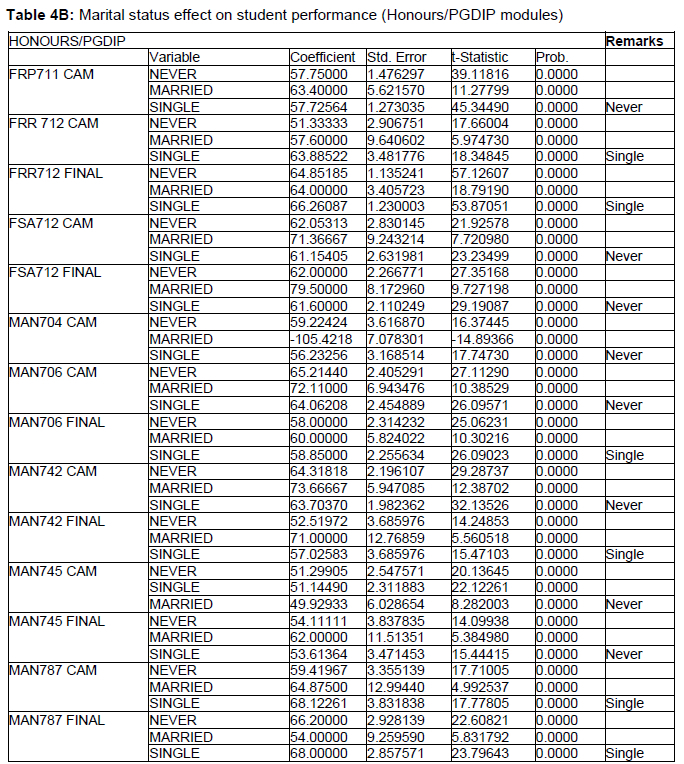
Table 4 reveals that the majority of undergraduate students were never married as none of the students registered for certain modules are single or married. This made it extremely difficult to assess marital status at the undergraduate level. Consequently, the interpretation was limited to the comparison of never-married and single categories while certain modules (MAN308, MAN312, ...) were excluded. The undergraduate results presented in Table 4A show that those who were never married generally outperformed their single counterparts. This could be due to extra responsibility of singlehood who may have to attend to the need of the child/children in addition to the demand of being a full-time student.
At the postgraduate level, never-married students performed relatively better than their single counterparts in 10 of the 16 mark components. The result is similar to what was obtained in the undergraduate modules; however, the performance of single students at postgraduate level was better than the performance of single students at undergraduate level.
Residence effect on student performance
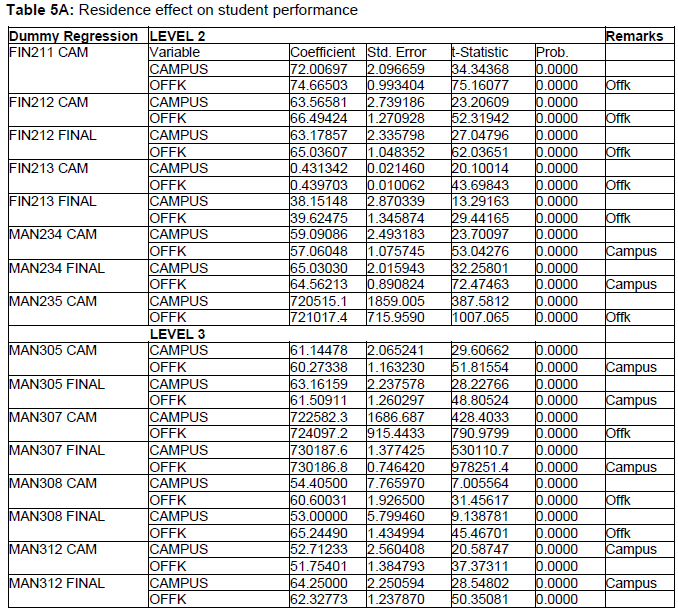
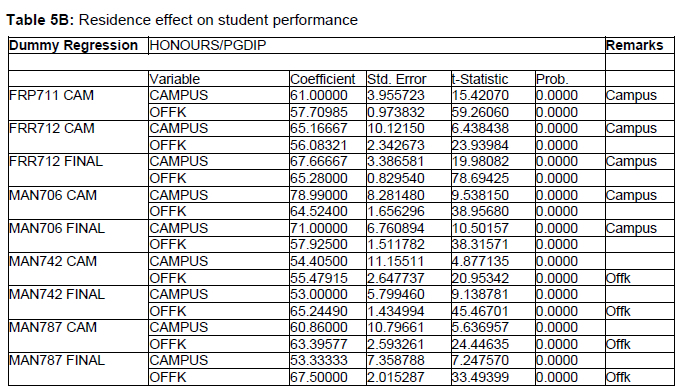
Table 5 reveals that the majority of students did not live in the university residence. Consequently, the outcome of this analysis had to be treated with caution. Table 5A shows that BCom Finance students residing outside campus performed well in nine mark components compared to those living in the university residence who outperformed in seven components. At postgraduate level, students living in a university residence outperformed their counterpart in five components and those living off-campus outperformed in four components. This suggests that there is no significant difference when one considers the fact that the majority are not accommodated in the university residence.
Attendance effect on student performance
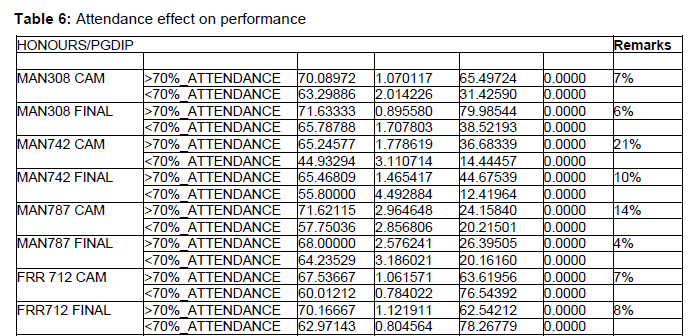
There is abundant literature on the positive influence of class attendance on student performance. Interestingly, certain universities, including UWC, have no clear institutional policy on class attendance. The results in Table 6 are limited to six modules with complete attendance registers throughout 2023. The results revealed that students with greater than 70 per cent class attendance outperformed their counterparts with fewer than 70 per cent class attendance in both CAM and final marks. Specifically, the magnitude of outperformance ranges from 21 to 14, 10, 8, 7 and 4 marks depending on the modules and assessments. Ontong, Bruwer and Dreyer (2020) also revealed that traditional class and tutorial attendance induce performance.
Study type effects on student performance
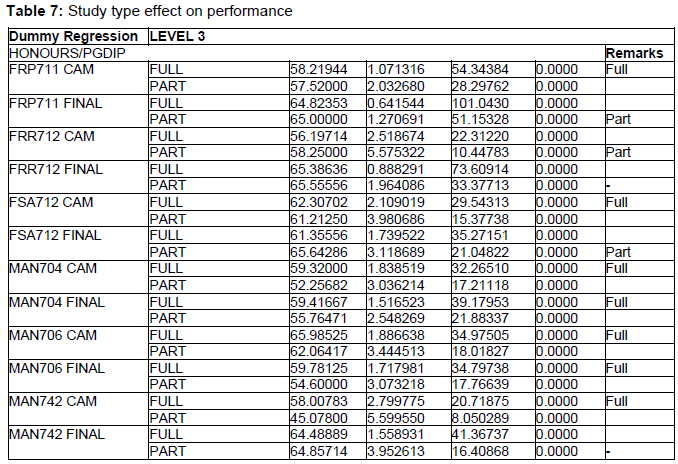
Table 7 shows that part-time study is not popular at the undergraduate level while postgraduate students are able to register for full-time and part-time studies. Table 7 presents the categorical differences in performance of postgraduate students based on study types. The results show that full-time students performed better than part-time students in seven of the 12 mark components but the reverse is the case in three of the components while there is no significant difference in the remaining two mark components. Although, the number of students registered on full time basis were more than the latter, a categorical difference in performance was not expected because part-time students are only permitted to register for half as many module as full-time students.
DISCUSSION
This study investigated the categorical association between demographics and student performance, as well as ascertaining the influence of the class attendance on performance in the Department of Finance at UWC. The research employed the quantitative method in achieving the aims by using dummy multiple regressions as statistical techniques. Results of the dummy regression output presented showed that female CA and final marks performance on average exceeded that of males. This study contradicts Luwes and Swartz (2017) who submitted that males marginally outperform female engineering students in South Africa; and Bagwandeen and Singaram (2018) who showed that there is no statistical difference based on gender. However, our finding is consistent with Schmulian and Coetzee (2011) and Almutawa and Suwaidan (2020) who demonstrated that female accounting students outperform males in South Africa and Kuwait respectively. This finding is also consistent with Alhajraf and Alasfour (2014), Sommerville and Singaram (2018), Tabassum and Akhter (2020) who also found females often display superior performance to male students. Although this gender performance gap is deemed challenging to quantify, Van Broekhuizen and Spaull (2017) and Hofmeyr (2022) attributed this gap to previous high school performance which is also superior to the males. Female outperformance could be traced to their activeness in academic help seeking behaviour (Cheng, Yu and Sun, 2024) and diligence (Bagwandeen and Singaram, 2018). Traditionally, males tend to be self-dependent while females do not shy away from seeking help where necessary. Additionally, South African females generally have a more positive attitude towards reading and education than their male peers. There is also a running theme in literature that females perform better because they are involved in various housework chores, therefore making them capable of managing and excelling at multiple courses in university. However, in the South African context, specifically among the demographic observed in this study, males also have various housework duties to juggle, therefore this argument may not fit well in the South African context. Further exploration of this gender gap is necessary.
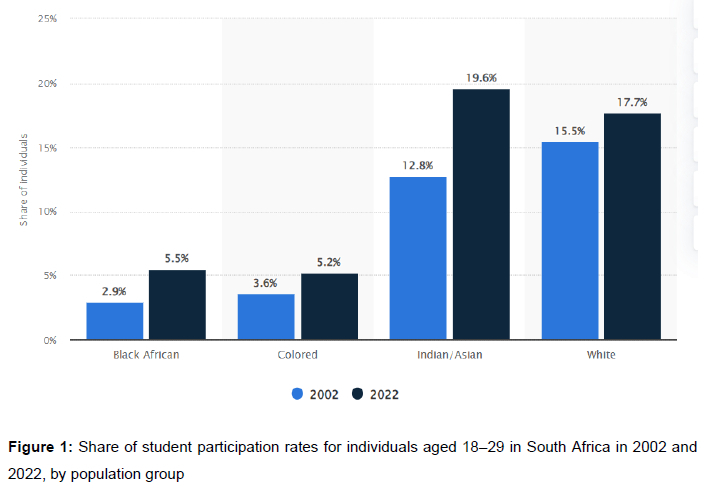
The regression output revealed that the 2-group performs better than population groups 5 and 3 respectively. The concentration of Black and Coloured students in the Department of Finance is in line with the mission of UWC to give access to groups with lower levels of post-school education. Figure 1 showed that Black students' participation rate was lower in 2002 and higher in 2022 compared to the Coloured students. However, the increase in enrolment of group 5 did not translate to better performance when compared to group 2. Considering the marital status effect on student performance, never married students outperformed the single students at undergraduate and postgraduate levels. While the findings should be treated with caution at the undergraduate level due to dominance of never-married students, the Honours and PGDip programme has a considerable number of single students. Out findings contradict Gishiwa and Muktar (2021) and Hiko, Cakici Es and Baysen (2023) who submitted that single childrearing does not affect students' academic achievement in Nigeria. The rate of single motherhood is high in Southern Africa (Chadoka-Mutanda and Mbanefo, 2015), hence students in this category will need a lot of support if they must excel in their studies. This could include parental support as Dube and Mlotshwa (2018) showed that parental involvement enhances performance.
Punctual students exhibit better performance than their unpunctual counterparts. In this context, the performance of students with ≥70 per cent class attendance far exceeded their counterparts. Academics in the Department of Finance shared the same sentiment with Khan (2022) who found that academics are favourably disposed to class attendance. This finding is consistent with Ontong et al. (2020) and Schmulian and Coetzee (2011) who demonstrated that class attendance increased the final mark and continuous assessment respectively of accounting students in Stellenbosch. This finding supports the need to introduce class attendance as a prerequisite for participation in assessments. There was no significant categorical difference among the students in a university residence and those who were not. This revelation confirms the findings of Swanepoel et al. (2021) who demonstrated that residence type and transport modes do not significantly affect performance in the ECO year level one course. It is interesting to note that the part-time students underperformed relative to the full-time students, despite the former being allowed to register half as many credit units as the latter. This suggests that it is difficult to combine work and study in the Department of Finance because part-time students usually work during the day and attend evening classes. This calls for consideration of alternative lecture arrangements such as different modes of block teaching that allow students to concentrate on studies during certain periods of the year.
CONCLUSION
This study examined the effect of demographics and class attendance on student performance in the Department of Finance. There are interesting findings from the dummy regression analysis. First, the females outperformed the male students especially in the undergraduate modules. Second, population group 2 performed better than group 5. Third, students who never married outperformed the single students at undergraduate and postgraduate levels. Fourth, there was no categorical difference in student performance based on residence type. Fifth, the part-time students underperformed relative to the full-time students despite the former being allowed to register half as many credit units as the latter. Lastly, the performance of students with ≥70 per cent class attendance far exceeds their counterparts. The current findings support Tinto's (1975) theory and Biggs 3P model by discovering that for finance students enrolled at UWC, demographic characteristics are influential in the academic performance of a student.
Based on the findings of the study, we conclude that the four demographic features that explain student performance are gender, marital status, population group, and programme type, while there is no categorical difference based on university residence. In addition, student performance is a positive function of class attendance. In terms of policy implications, these findings favour the consideration of additional support for male, population group 5, single and part-time students as well as attraction of group 3 students in the Department of Finance by relevant stakeholders, namely the university, funding organisations, family and partners and government ministries. University, faculty and similar departments must consider introducing ≥70 per cent class or tutorial attendance as a requirement for participation in assessments to boost performance and throughput rate. The results of this study speak directly to our L&T practices, specifically the finding that students who attend classes more perform better than those who attend less frequently. In the context of the post-COVID-19 cohort who were used to distance learning, this finding calls for academics to consider the adoption of more active learning approaches, which motivate more in-class participation that is aimed at increasing lecture attendance. It remains to be seen whether consultation, group assessment and similar practices inform students' performance in the Department of Finance. This is essentially a question for future empirical analysis.
REFERENCES
Alhajraf, N. M., and A. M. Alasfour. 2014. "The impact of demographic and academic characteristics on academic performance". International Business Research, 7(4), 92. [ Links ]
Almutawa, A., and M. S. Suwaidan. 2020. "Students' perceptions regarding classroom attendance and its impact on their academic performance: evidence from a developing country". Education & Training, 62 (6), 693-706 [ Links ]
Ancheta, R. F., D. Daniel, and R. Ahmad. 2021. "Effect of class attendance on academic performance". European Journal of Education Studies, 8(9). [ Links ]
Bagwandeen, C. I., and V. S. Singaram. 2018. "Effects of demographic factors on provision of feedback in postgraduate medical education". South African Journal of Higher Education, 32(1), 31-48. [ Links ]
Bagwandeen, C. I., and V. S. Singaram. 2018. "Exploring demographic influences on students' academic performance over a five-year programme". South African Journal of Higher Education, 32(2), 273-287 [ Links ]
Bank SETA, 2020. Sector Skills Plan 2020 - 2025 enabling skills development in the banking and alternative banking sector. https://www.bankseta.org.za/wp-content/uploads/2020/01/BankSeta-SSP-2020-2025.pdf [ Links ]
Bean, J. P. (1980). "Dropouts and turnover: The synthesis and test of a causal model of student attrition". Research in Higher Education, 12, 155-187. [ Links ]
Bozalek, V. and Boughey, C., 2012. "(Mis) framing higher education in South Africa". Social Policy & Administration, 46(6), 688-703. [ Links ]
Carpenter, R., and T. Kraus. 2020. "Potential determinants of students' academic success in private tertiary education in South Africa". The Business & Management Review, 11(2), 69-78. [ Links ]
Chadoka-Mutanda, N., and Mbanefo, C. M. 2015. "Demography and Population Studies Programme, Schools of Public Health and Social Sciences, University of Witwatersrand, Johannesburg, South Africa". https://uaps2015.popconf.org/papers/150595 [ Links ]
Cheng, W., Yu, X. and Sun, H., 2024. "Do girls perform better than boys in school? A meta-analysis of sex differences in academic help seeking behaviours". Asia Pacific Education Review, 25(5), 1273-1287. [ Links ]
Dube, M. B., and P. R. Mlotshwa. 2018. "Factors influencing enrolled nursing students' academic performance at a selected private nursing education institution in KwaZulu-Natal". Curationis 41(1), 1-7. [ Links ]
Ekong, N., Moffat, I., Usoro, A., Matthew, I. 2021. "A comparative study of the impact of dummy variables on regression coefficients and canonical correlation indices: An empirical perspective". International Journal of Analysis and Applications, 19 (4), 576-586 [ Links ]
El Refae, G., A. Kaba, and S. Eletter, S. 2021. "The impact of demographic characteristics on academic performance: Face-to-face learning versus distance learning implemented to prevent the spread of COVID-19". International Review of Research in Open and Distributed Learning, 22(1), 91-110. [ Links ]
Gishiwa, M., and Muktar, A. 2021. "Impact of Marital Status and Family Size on Academic Achievement of Students of Umar Suleiman College of Education Gashua, Yobe State, Nigeria". The International Journal of Humanities and Social Studies, 9(8), 2321-9203. [ Links ]
Gujarati, D. N., and Porter, D. C. 2020. Basic econometrics (6th ed.). McGraw-Hill. [ Links ]
Guleker, R., and J. Keci. 2014. "The effect of attendance on academic performance. Mediterranean". Journal of Social Sciences, 5(23). [ Links ]
Hiko, M.A.A., Es, A.C. and Baysen, E. 2023. "Single parenting and students' academic performance". South African Journal of Education, 43(4), 1-9. [ Links ]
Hofmeyr, H. 2022. "Why do girls do better? Unpacking South Africa's gender gap in PIRLS and TIMSS". International Journal of Educational Development, 94, 102648. [ Links ]
Kanashiro, P., E. S. Iizuka, C. Sousa, and S. E. F. Dias. 2020." Sustainability in management education: A Biggs' 3P model application". International Journal of Sustainability in Higher Education, 21(4), 671-684. [ Links ]
Khan, N. R. 2022. "Attendance Matters: Student Performance and Attitudes". International Journal of Innovation in Science and Mathematics Education, 30(4), 42-63. [ Links ]
Labador, J., J. Borinaga, R. C. Bofill, J. Bacatan. 2023. "The Relationship between Demographic Characteristics and Academic Performance in English of Grade 11 Students". Quest Journals, Journal of Research in Humanities and Social Science, 11(12), 150-158. [ Links ]
Luwes, N. J., and J. Swartz. 2017. The relationship between demographics and the academic achievement of engineering students. 3rd International Conference on Higher Education Advances, HEAd'17 Universitat Politècnica de València, València, [ Links ]
Maraschin, S. 2008. Factors influencing enrolment and academic performance at a South African university. Masters dissertation. Johannesburg: University of Witwatersrand. [ Links ]
Mbanefo, C.M. 2013. Levels and correlates of single motherhood in Southern Africa. [ Links ]
McGhie, V. F. 2012. Factors impacting on first-year students' academic progress at a South African university. Doctoral dissertation. Stellenbosch: Stellenbosch University. [ Links ]
Mthimunye, K. D. T., A. Pedro, and F. M. Daniels. 2018. "Predictors of academic performance among second-year nursing students at a university in the Western Cape". South African Journal of Higher Education, 32(1), 192-215. [ Links ]
Obalade, A. A. 2022. Freedom Charter: Why it is still relevant to contemporary South Africa. https://ddp.org.za/blog/2022/04/11/freedom-charter-why-it-is-still-relevant-to-contemporary-south-africa/ [ Links ]
Ontong, J. M., J. Bruwer, and J. A. Dreyer. 2020. "An investigation of the interaction of class attendance, tutorials, mentor sessions, video presentations and external tutoring, and the effect thereof on student performance". South African Journal of Higher Education, 34(4), 269-285. [ Links ]
Papageorgiou, E. 2019. "Lecture attendance versus academic performance and prior knowledge of accounting students: An exploratory study at a South African university". South African Journal of Higher Education, 33(1), 262-282. [ Links ]
Pozo-Burgos, E. J., M. R. Burbano-Pulles, J. L. Vidal-Chica, and G. E. Revelo-Salgado. 2022. "Sociocultural and Demographic Factors That Influence Academic Performance: The Pre-University Case of the Universidad Politécnica Estatal del Carchi". Journal of Technology and Science Education, 12(1), 147-156. [ Links ]
Pretorius, T. 2023. Autumn Graduation Ceremony 11 - 21 April 2023, 09h30 - Economic And Management Sciences https://www.youtube.com/watch?v=F9N-67sdj_4 [ Links ]
Schmulian, A., and S. Coetzee. 2011." Class absenteeism: reasons for non-attendance and the effect on academic performance". Accounting Research Journal, 24(2), 178-194. [ Links ]
Singh, S. C. 2020. An examination of the factors affecting the performance of Management Accounting students at the Durban University of Technology. Masters dissertation. Durban: Durban University of Technology. [ Links ]
Sommerville, T., and V. S. Singaram. 2018. "Exploring demographic influences on students' academic performance over a five-year programme". South African Journal of Higher Education, 32(2), 273-287. [ Links ]
Spady, W. G. 1970. "Dropouts from higher education: An interdisciplinary review and synthesis". Interchange, 1(1), 64-85. [ Links ]
Statista 2024. Share of student participation rates for individuals aged 18-29 in South Africa in 2002 and 2022, by population group. https://www.statista.com/statistics/1115545/student-participation-rates-in-south-africa-by-population-group/ [ Links ]
Swanepoel, C., R. Beukes, and D. Yu. 2021. "Investigating factors influencing class attendance and performance of first-year economics students". South African Journal of Higher Education, 35 (4) 272-294 [ Links ]
Tabassum, R. and N. Akhter. 2020. "Effect of Demographic Factors on Academic Performance of University Students". Journal of Research & Reflections in Education (JRRE), 14(1). [ Links ]
Thatcher, A., P. Fridjhon, and K. Cockcroft. 2007. "The relationship between lecture attendance and academic performance in an undergraduate psychology class". South African Journal of Psychology, 37(3), 656-660. [ Links ]
Tinto, V. 1975. "Dropout from higher education: A theoretical synthesis of recent research". Review of Educational Research, 45(1), 89-125. [ Links ]
Van Broekhuizen, H., and N. Spaull. 2017. The "Martha Effect": The compounding female advantage in South African higher education. Unpublished manuscript, Stellenbosch University, Stellenbosch. [ Links ]
Van der Walt, E. S., Z. Hattingh, and H. J. Moolman. 2017." The impact of socio-demographic variables on the study experience of second year Hospitality Management students at selected South African Higher Education Institutions". African Journal of Hospitality, Tourism and Leisure, 6 (4), 1-22. [ Links ]
1 Population group: 2- Coloured, 5- African, 3- Indian
2 while population group 3 are underrepresented in the student profile
3 This finding at the undergraduate level must be treated with caution because the majority of students are never married
4 1-Never Married, 2- Married, 6-Single, 5- Unknow
5 Masters and PhD students are excluded because they are full thesis programmes
6 Off campus (offk) is used to denote student not living in university residence.