Services on Demand
Journal

Article
 English (pdf)
 Article in xml format
 Article references
 Automatic translation
 Send this article by e-mail
Indicators
Related links
-
 Cited by Google
 -
 Similars in Google
Share

 Permalink
South African Journal of Higher Education
On-line version ISSN 1753-5913
S. Afr. J. High. Educ. vol.40 n.1 Stellenbosch Mar. 2026
https://doi.org/10.20853/40-1-6323
GENERAL ARTICLES
Adoption and implementation of infrastructure as a service (IAAS) model within south african universities
M. MoetiI; S. MokwenaII
IDepartment of Computer Science, Tshwane University of Technology, Pretoria, South Africa. https://orcid.org/0000-0003-3783-7130
IIDepartment of Computer Science, School of Mathematics and Computational Sciences, University of Limpopo, Polokwane, South Africa. https://orcid.org/0000-0002-6160-863X
ABSTRACT
This article aims to investigate how university infrastructure management perceives the difficulties in implementing infrastructure as a service in South African universities. Understanding the benefits that infrastructure as a service can provide in comparison to the on-premises model now used by most South African Universities is a particular focus. The identified criteria were validated using theme analysis and interviews. Trust, security, and attitude were found to be three new, crucial issues for implementing infrastructure as a service (IaaS). The results of this article reveal that IaaS provides a competitive advantage in terms of scalability, pay-as-you-go flexibility, accessibility, and immediate service provision on demand. To better understand how the contextual aspects of emerge themes, and how they relate to the ideas required for the adoption of infrastructure as a service on the surrounding South African universities, this article presents a comprehensive infrastructure as a service adoption model (IaaSF).
Keywords: Infrastructure as a service, cloud computing, thematic analysis, client server model, adoption model
INTRODUCTION
The computing infrastructure delivery models first emerged from the 1950s with IBM mainframe. The future of technology has evolved, started when major businesses employ mainframe computers to process large amounts of data from enterprise resource planning and transaction processing as well as complex applications (Jamsa, 2022)
The rising demands of Internet and its invention around the world has simplified information processing, storage, and delivery. However, organizations such as universities are continuing to use the first-generation on-premises infrastructure model, which was the driving force behind it. The on-premises model is plagued with serious problems such static hard-drive storage, sluggish central processing units (CPU), and distributed IT support, which have contributed to a significant rise in the cost of procuring hardware and software maintenance.
Studies have shown that the present approach is ineffective at addressing corporate needs. Economically, total spending on power, IT hardware, and software has greatly increased (Rad et al., 2020). Businesses have been compelled to discover a better infrastructure delivery model with better benefits, cheaper total infrastructure costs, and more operational availability due to the shortcomings of an on-premises infrastructure architecture.
South African universities are constrained by the conventional on-premises infrastructure approach (Gao, Li, & Yu, 2022). The fact that there are system bottlenecks at peak periods, such registration times, is a glaring indication that the current infrastructure is insufficient to handle the information processing needs of these institutions. To support the current on-premises infrastructure, it is getting more complex and expensive to maintain (Olariu and Alboaie, 2023). This study focuses on the advantages that infrastructure as a service, may offer compared to the on-premises model that is currently in use by South African universities.
Organizations are now utilizing the new computing paradigm known as Infrastructure as a Service (IaaS) to effectively deliver high-quality services on dwindling budgets. IaaS is a shift away from old models to one with platform virtualization, dynamic scalability, and automated administrative activities, making resources available when needed (Sundarakani et al., 2021). If IaaS adoption is done with enough research and planning beforehand, it can increase the efficiency of university ICT infrastructure. If not, it could result in a poor implementation process and, as a result, a decline in trust between universities and cloud providers. Therefore, before deciding to adopt, the move to implement IaaS by the university management must be carefully examined, and both driving and impeding elements must be carefully considered. The article look into factors that might affect universities in Southern Africa's adoption of infrastructure as a service (IaaS) and how those factors might improve the effectiveness of managing the ICT infrastructure at those universities.
The remaining sections of the article is structured as follows: The risks that new technologies present to users are discussed, together with the regulatory environment for privacy in South Africa. The research methodology follows, and the results section comes after that. Together with a broad explanation of the key findings, our conceptual framework-which was created in response to the findings-is offered. The article concludes with some suggestions and directives for future studies.
BACKGROUND
Since 1994, the South African government has been working to modernize the country's higher education system, broaden the national reform movement, eliminate the divisiveness and injustice caused by the apartheid system, and increase access for formerly underserved groups (Hancock, Algozzine, & Lim, 2021). The majority of South Africans suffered from a system of racial injustice for almost 50 years, which included a subpar education for the bulk of the people. Critical skills were lacking in the domains of management, science, technology, engineering, and other academic disciplines as a result of this racial injustice. Blaisdell (2023) claims that the path to restructuring was paved by mergers and incorporations in succession intended to reduce 36 universities and technical schools to only 22 institutions. As a result of the merger, The department of higher learning has classified South African universities into three categories: traditional universities, universities of technology, and comprehensive universities (Boggs and Galizio, 2021). The on-premises infrastructure paradigm is still prevalent in most of this higher education institutions (Boggs and Galizio, 2021).
RELATED WORK
Infrastructure as a service (IaaS) is a computational infrastructure that is instantly delivered and managed over the Internet, such as servers, storage, and networking devices, (Kamal et al., 2020). Users can scale up or down based on demand while only paying for the services they really use. Companies can save money and time by using IaaS instead of acquiring and maintaining their physical servers and other data centre hardware (Ghandour, Kafhali & Hanini , 2023).
(Ali et al., 2020) conducted a study to better understand how cloud-based service adoption affects organizational flexibility. The study investigated the factors influencing the use of cloud-based services. In-depth interviews were used in the study to collect qualitative data on the identified factors. According to Lal and Bharadwaj (2016) who integrated the three theories of innovation include the following: diffusion of innovation (DOI), technology-organization-environment (TOE) and technology acceptance model (TAM), to investigate some of the factors that influencing the adoption of cloud-based services. T discovered criteria were used to create the conceptual model, and data analysis shows that cloud-based services have a comparative advantage in terms of scalability, accessibility, and fast deployment service. The findings also revealed that the user-friendliness of the interface, the knowledge and experience of the cloud service provider, and top management support all had a significant impact on the decision to adopt the cloud. Furthermore, their research found that cloud-based service adoption affects organizational flexibility regardless of whether the service is software-as-a-service (SaaS), platform-as-a-service (PaaS), or infrastructure-as-a-service (IaaS). Market flexibility, performance flexibility, process flexibility, and economic flexibility are the four categories.
Some research such as Wulf et al. (2021) investigated the adoption of cloud computing and discovered that the recent advancements in the industry have enabled cloud computing providers to offer infrastructure-as-a-service, platform-as-a-service, and software-as-a-service. In terms of organizational context and demands, and their study examined the impact of characteristics such as top-management support, organizational size, and organizational readiness of organization when coming to the decision adoption of cloud computing.
Raghavan, Jayasimba & Nargundkar (2020) discovered a similar result: three organizational variables influence the decision to adopt software as a service: top-management support, organizational readiness, and organizational size had a huge impact in the decision to adopt. To collect quantitative data, they used an online questionnaire. The data was analysed using one-way ANOVA, and the hypotheses were tested using SPSS (version 19). The study's findings revealed that a company's IT team's awareness of SaaS has an impact on SaaS technology adoption. The study also revealed that organizational size, organizational readiness, and top-management support all have an impact on the decision to accept or reject IaaS. According to the authors' recommendation, future studies should investigate how prepared companies are to accept new technologies in terms of their size and availability of physical, human, and financial resources. And their recommendation for future researchers is to investigate the effects of various technologies on cloud computing services such as IaaS, of which this article is leveraging on their recommendation.
Sharma, Gupta & Acharya (2020) investigated the study titled: the development of a model for selecting a cloud computing system and the study looked at essential elements in a hierarchical structure of decision domains, such as technology, organization, and environment, as well as seven (7) variables and twenty-three (23) attributes that were based on the core choice factors for cloud computing adoption. The study used interviews to acquire qualitative data on the identified criteria, which were then analysed using the Analytic Hierarchy Process (AHP) and Delphi analysis. According to their findings, the most important factors for cloud computing adoption are top-management support, competitive pressure, and compatibility. According to the study, the highest priority criteria for the demander are compatibility and competitive pressure, rather than linked advantage and top management backing.
The majority of cloud computing studies discovered that deployment and service models such as IaaS necessitate in-depth evaluations and, if possible, input from a large number of study participants, countries, or organizations. They consequently advocated for the conduct of more empirical research in order to guide the adoption of cloud computing and/or its service models.
CHALLENGES OF IMPLEMENTING lAAS WITHIN INSTITUTION OF HIGHER LEARNING
Although IaaS provides notable benefits as compared to traditional on-premises model, but there are still some implementation challenges that one needs to consider before implementation. If due diligence is not performed prior to IaaS deployment., especially for service take-on which have clear cost consequences and savings, there are hurdles that may hinder that may hinder consumers from realizing the full potential (Abdulwahab, 2023).
Sallehudin et al. (2020) conducted research study on cloud computing adoption and implementation, and the study discovered that technical improvement has created opportunities for cloud computing vendors to deliver IaaS, PaaS, and SaaS. The study found that several elements can influence a customer's purchasing decisions while purchasing software items. The overall readiness of the institution to transition from traditional teaching methods to new teaching pedagogies remains a significant barrier. The similar opinion was expressed by Weerd et al. (2016), who discovered that factors such as organizational readiness, organizational size, and top-management support may influence IaaS adoption in higher education institutions.
Some of the studies employed the TOE (Technology, Organization, and Environment) framework to identify characteristics that influence students' use of cloud computing services. These include organizational readiness, scale, and top-level management support. The study discovered that security concerns, data privacy issues, potential vendor lock-in, a lack of IT expertise within the institution, integration with existing systems, cost management, and adapting to changing user needs all play a role in navigating the complex landscape of student and faculty technology usage across diverse departments. The results reveal that contemporary students are better familiar with studying technological tools than instructors.
METHODOLOGY
Twelve in-depth interviews with key role players who work on the university infrastructure from three universities in South Africa were undertaken. Their identities are hidden, as proposed by Simons (Bakasa and Pekane, 2021). Participants were able to give away more information as a result, and the researchers received help in minimizing any comments that would be sensitive or that might suggest flaws at their institutions.
Three technical managers, two IT directors, two IT infrastructure operational managers, two IT architects, one leader of the IT planning team, and one system administrator were among the study's participants. These classifications were made to support respondents' views on the adoption of IaaS at South African Universities. The ICT Directorate gave permission to conduct the interviews, which ranged in length from 45 to 60 minutes per interview (Oladejo and Hadzidedic, 2021).
Data analysis
Data analysis is the process of combining what the researcher has heard, observed, and read in order to derive meaning from the data collected (Timmermans and Tavory, 2022). It explains how the researcher should extract useful information from the data acquired (Timmermans and Tavory, 2022). Thematic analysis was utilized to analyse data, as described by Braun and Clarke (2006). Thematic analysis enables researchers to systematically identify, analyse, and report on patterns or themes in qualitative data. The primary goal of employing a qualitative technique in data analysis is to identify new meaningful terms, patterns, and themes in a semantic fashion. According to Giang (2021) thematic analysis requires a six-phased approach to effectively discover theme patterns. Below is the step by step on how thematic analysis was applied to critically analyses data for the development of new and emerging themes for this study.
Thematic Analysis
Thematic analysis was chosen as the approach to analyse the data that was gathered because it enables researchers to precisely identify, examine, and present themes or patterns in qualitative data. A six-phase process is used in theme analysis to precisely detect thematic patterns (Qaissi, 2024).Throughout the process of thematic analysis, all the themes were identified and collected. Only the notions that were crucial to this study were given more interpretation, which led to the development of a story that was focused on these key themes. The authors (Hancock et al., 2021) draw a distinct line between theory- and data-driven investigations, and this distinction is crucial to highlight. However, as noted by the author, we discovered that when these two methodologies were applied in a complementary manner, the quality of the study significantly increased (Veronese et al., 2023). According to Wang, (2020), "data is not coded in an epistemic vacuum."
Storey et al. (2020) hermeneutic cycle was applied extensively throughout the six rounds in analysing collected data, with a strong emphasis on identifying latent rather than semantic themes. The detail mechanisms that comprise the actual analysis process are explained and followed in detail in the sections below by the researcher. All six phases of analysis involved the hermeneutic cycle, with an emphasis on the discovery of latent rather than semantic themes (Storey et al., 2020). The researcher has supplied information below about the mechanisms that make up the analytic procedure itself.
Phase One: Acquaintance with the data collected
This phase was a crucial element of the analysis process, owing to it forming the foundation of all the analytical work. The researcher now has the chance to familiarize ourselves with the data as a result. The researcher could become familiar with the data because all of the interview tapes had been transcriptions. The researcher was able to compile a list of pertinent ideas during this stage, which later became a component of fresh topics. Given that some of the basic thoughts for data analysis were carried out in this phase, it assisted with the implementation of Phase Two.
Phase Two: Coding
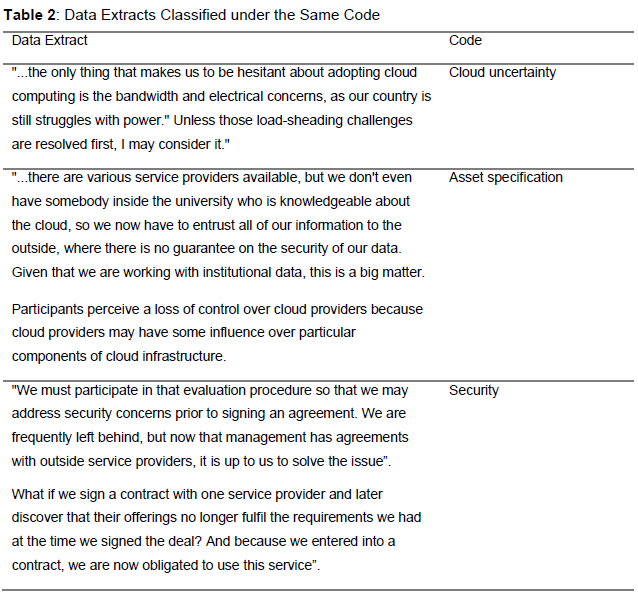
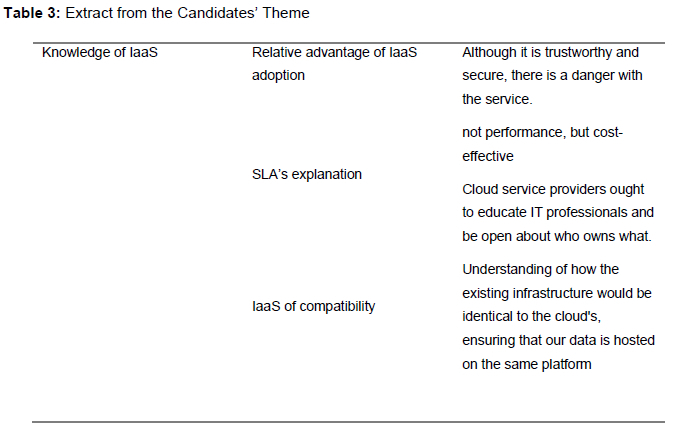
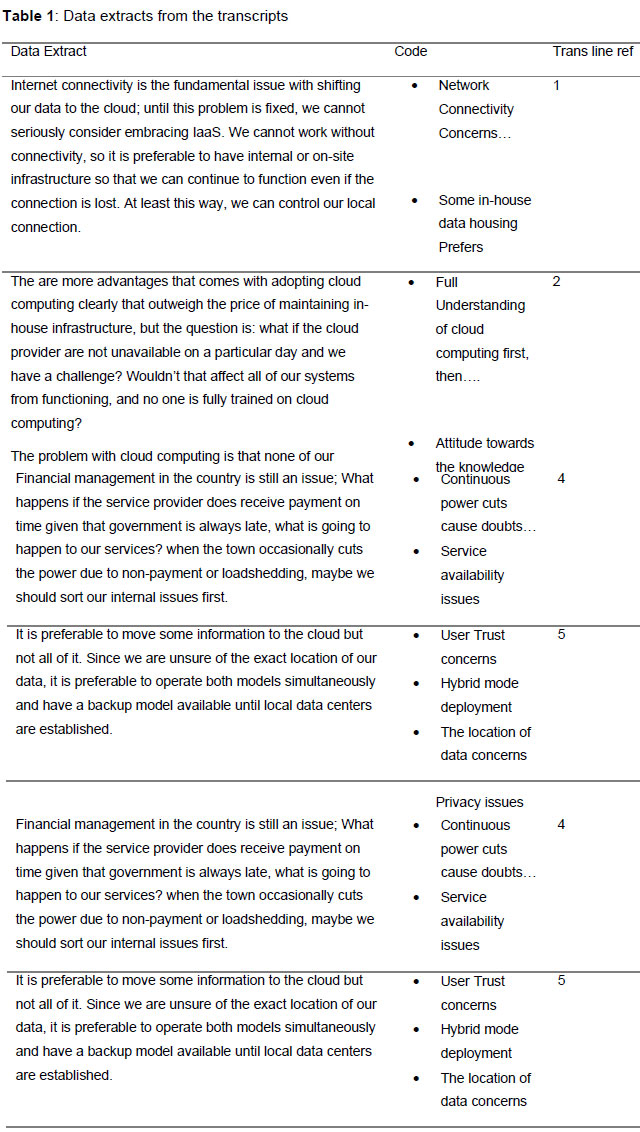
The researcher coded the framework that includes all the facts about this study and goes beyond the fundamental ideas of IaaS adoption because the complete transcribed data was coded as shown in table 2. This classification coding technique comprises of reviewing the transcripts of each participant interview, while keeping in mind that the list was created in Phase One were a researcher had to acquainted with data. Initial coding was critical since it ensured that no information was overlooked that would later be useful. This implies that programs must be developed for specialized data extractions. During Phase 2, data extracts was coded more than once or more than once as illustrated in Table 2, where Column Two (code column) has multiple data codes derived from Column One. The reader can find the transcript for each participant by clicking on the third column in Table 2. As shown in Table 3, several of the codes can be connected to various data extracts. Table 3, first row, shows three data extracts linked to a single code (in column two). The researchers must focus solely on developing a coding framework based on the interview transcripts during the execution of this phase and refrain from attempting to interpret any data extracts.
Instead of interpreting any data that had been retrieved during Phase Two, we focused on creating a coding system that was based on the views of the participants.
Phase Three: Searching for themes
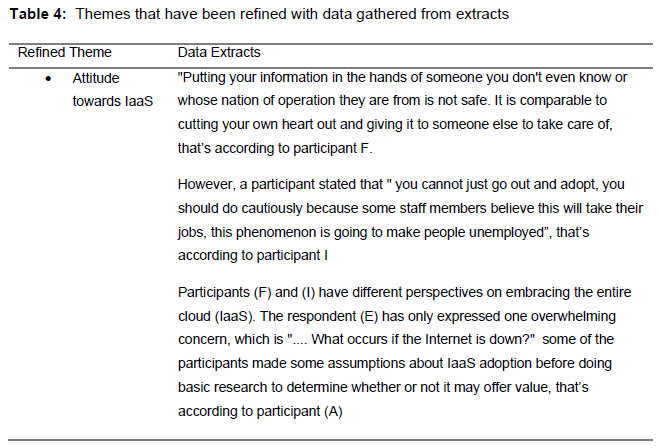
All candidate themes from coded data and extracts, as well as all related sub-themes, were discovered in Phase 3. The alphabetic character (in Column 3, Table 2) is used to distinguish the participant according to the source of the code and to aid in additional analysis. The candidate topics were improved in Phase Four, where university data was useful, and their related data extracts were compiled. At this stage, forming as many candidate themes as possible was the main goal rather than removing any topics.
Phase Four: Reviewing themes
In phase four, the researcher refined the transcripts to fit with the coded extracts while also continuing to review the themes of the candidates. At this point, the researcher changed the themes of the candidates by assigning them a code or key phrase. The themes were assessed again across the data set until all of the data had been analysed. This method made sure that the themes were legitimate in connection to the entire data set and that they accurately represented the meanings as described by the participants.
As a result of the theme-refinement process at these phases, some of the topics or statements had to be renamed, removed, or mixed with other participating candidate themes as part of process.
Phase Five: Defining and naming themes
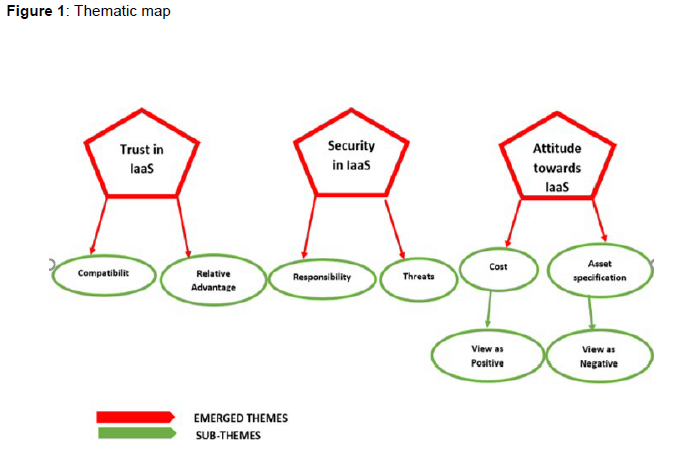
As advised by Nowell et al., (2017), After reviewing all of the interview transcripts, the article developed the final thematic map from the main themes. (see Figure 1). The main goal of Phase Five was to create the final thematic map, which would help the researcher and reader understand the data extracts and how they relate to the subjects of IaaS.
Phase Six: Creating the final report
In the last phase, the researcher finished reviewing the results by composing a narrative based model using the final themes emerged from phase on to phase six:
• Discovery of themes and supporting data extracts;
• The use of data extracts in some specific context.
• The operating environment at each university and the IaaS adoption rate.
The researcher emphasized the contextual variations between the participants inside each participating university throughout this explanation. This narrative covered more than just how the participants' operational context and relationship to these statements were interpreted. The reader was also given participant statements in the narrative to support these claims. Literature citations from earlier chapters were included where appropriate to support views within the same context. The major theme, its sub-themes, and the resulting story are presented in the next section.
THE THEMATIC MAP
Thematic maps are useful tools for describing the stages of a research project, the progress of the project, and the findings, whether they are preliminary or conclusive. When mapping is applied in research, it can help the researcher to demonstrate genuine gaps in the available data or the adequacy of the class intervals chosen. Mapping could also show connections or linkages that were previously unknown. Jackman et al. (2023) asserts that the geographer presents their own study data on the thematic map and gains fresh perspectives from it. Figure 1 shows the final thematic map that served as a guide for developing the adoption model for this study. The map is a tool for a final product, a record, a repository of information, and most importantly, a channel of communication (Jackman et al., 2023). To create an infrastructure as a service (laaS) adoption model for this study, all past topics and emerging themes from the analysis of the study were used in a thematic map (Figure 1). (ISAM). Figure 1 shows how this was done to manage university ICT infrastructure more effectively.
The Narrative
The following sections describe the emergence of new topics and how the conceptual framework relates to each issue that has an impact on the adoption of IaaS in South African colleges.
Trust in the IaaS
The study of the data transcripts' findings made it abundantly evident that "trust" was a brand-new, developing motif. Regarding this study, "trust" can be described as a participant's reflection of their understanding and opinions regarding the adoption of IaaS. (Cito, et al 2015). One participant (Interviewee A) stated, "...The only issue that keeps me from trusting cloud computing is bandwidth and electricity issues, as our country continues to struggle with power." Unless those load shedding issues are resolved first, I maybe then we can consider it."..."Trust is something you cannot buy but it needs to be earned; the only way to trust something is to give it a chance," remarked a different participant (Interviewee C). The one problem with trust is that it cannot be managed or even controlled. It exists in people's brains and is shaped by their prior experiences.
Security
"Security" was another subject that emerged from the thematic analysis. Versity is considered a research-intensive university. Academics and postgraduates must be given the chance to share their insights on infrastructure security. Participants in the interviews said that while not all applications should be run in the cloud, certain kinds of systems and data are appropriate for this sort of computing. Most of the time, it was not advised to store on the cloud data that was useful (or crucial) to the university.
The study's conclusions concur with those of (Wang, 2022), who noted that when businesses consider using cloud computing, security should come first. Adopting any cloud computing service requires careful consideration of the issue of protecting sensitive data. (Parast et al., 2022) further argued that as security is crucial to an organization, any actions taken within it should be viewed from the standpoint of IS security policy violations as paradoxes. Additionally, Wang (2022) and Parast et al. (2022) who reported that most nations, particularly those in Africa, fall short of the data-protection legislative act when compared to other industrialized nations throughout the world, validate these findings. This suggests that adoption of cloud-based settings places a high priority on security.
Attitude towards IaaS
The term "attitude" refers to the mindset or propensity that results in a person acting in a certain way as a result of both experience and temperament (Zhang and Yao, 2022). In this study, a stakeholder's attitude represents their readiness to adopt IaaS based on their past experiences and other factors.
The participants' responses varied depending on how well they understood IaaS and the potential risks, advantages, and beliefs associated with it. The adoption of IaaS in universities was largely perceived as a favourable option by participants at all levels of management. Students who are the main custodian if this technology is adopted already showed positive attitude towards the adoption of IaaS within institution of higher learning from other researchers (Manga, 2024)
Relative advantage
Most of participants stressed the relative advantage of adopting cloud computing services for providing universal, practical, on-demand network connectivity of the university. Furthermore; they indicated that having remote access will be very advantageous because it allowed employees to choose to work remotely, or even from home. This helps the business conserve resources like the power the employee might otherwise use while at work.
Cost was seen as a benefit because one just pays for what they use. However, even if one just need a small amount of computing resources, traditional networking requires that one pay for everything, including the hardware, installation, and maintenance.
Compatibility of laaS
The degree to which IaaS adoption complies with an organization's operational procedures and strategic objectives is known as compatibility. Regardless of where they are situated, their operating systems, or their formats, compatibility is seen as a crucial facilitator for moving applications seamlessly between various cloud-service providers. It is crucial for businesses to identify cloud computing services that are compatible with their operational requirements in order to adopt them, with all of their advantages and disadvantages (Golightly et al., 2022).
Uncertainty
Despite extensive research done on the problem of uncertainty in other disciplines of study, such as computational biology, economics, physics, and social sciences, there is still controversy about what defines uncertainty in cloud computing. Adoption of cloud computing is fraught with a variety of unknowns, including those related to performance, security, and dependability. The gap between the knowledge that is now known, and all the knowledge can be thought of as uncertainty (Asghar et al., 2020). This study investigates how participant confusion over cloud adoption may affect SA universities. The objective is to gain a thorough knowledge of the uncertainties surrounding the adoption of IaaS from many parties rather than to discover a perfect answer. The following query was posed to elicit a minimum level of knowledge.
Cost
Cost, as addressed in the section of "related work", refers to how resources are allocated to improve organizational efficiency and get value for money. In other words, the potential effects of unanticipated transaction expenses shouldn't jeopardize laaS's overall cost-performance. As a result, while adopting IaaS, a clear balance between transaction costs and total adoption advantages must be taken into account. This makes it crystal evident that the transaction costs and adoption advantages need to be balanced, and that process should be carried out before signing any agreements with the service provider. In order to finalise whether we adopt the service or not the operational costs and strategic needs of the institution needs to be considered to determine whether the adoption advantages surpass the transaction costs.
These results of this article are supported by those of (Zhang, Liu & Guo, 2021; Zhang & Yao, 2022), who identified some of the related themes in their studies as a major driving force behind the adoption of cloud services. The article gives the impression that although participants lack financial skills, yet the results show that the costs have a favourable impact on the adoption of cloud computing services.
laaS Adoption Model within South African Universities
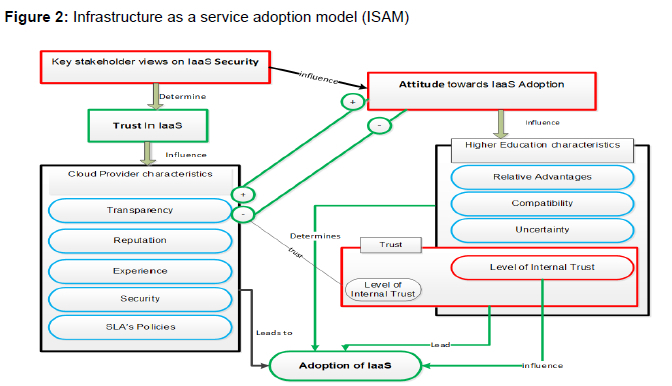
A model for adoption of infrastructure as a service (ISAM) constructed from the article using discovered themes. As shown in Figure 2, discovered new themes and priority topics were incorporated into the creation of ISAM.
KEY BENEFITS OF lAAS FOR HIGHER EDUCATION INSTITUTIONS
Infrastructure as a Service (IaaS) can significantly benefit higher institutions of learning by providing scalable, flexible computing power, allowing for faster deployment of new technologies, lower IT costs, increased collaboration, and improved resource accessibility for students and faculty, all while eliminating the need to manage on-premise hardware, resulting in a more streamlined and efficient operation. This will allow institutions to adopt newer teaching and learning pedagogies which are centred around students as compared to traditional methods that are more instructional focused. This will help students to develop graduate attributes that can make a societal impact. The following benefits were discovered:
• Pay-as-you-go models
This will allow institutions to deploy resources more efficiently towards educational programs, reducing initial hardware and maintenance costs.
• Scalability: laaS
This will allow universities to adjust computer power based on demand, addressing changes in student enrolment or research projects that require significant processing power.
• Improved agility
Rapid deployment of new applications and services with minimum IT overhead enables institutions to adapt to changing educational trends and demands.
• Access to sophisticated technology
Institutions can use powerful computer resources, such as high-performance clusters, without investing heavily in hardware.
• Flexible learning environments
Students can access materials and virtual labs from anywhere with an internet connection, allowing for remote learning and tailored study regimens.
• Virtual laboratories
offer students access to specialized software and experimental environments without requiring physical lab space, lowering expenses and expanding accessibility.
• Supporting computationally intensive research initiatives
This platform will benefit the universities community of researchers through on-demand allocation of large-scale computer resources.
• Cloud-based online learning solutions
This will provide effective distribution of instructional content to reach wider audiences
RECOMMENDATIONS
According to the finding of this article, the following suggestion could boost the effectiveness of managing the university's ICT infrastructure when adopting IaaS:
Engagement with intended users
Users should be included from the inception of the adoption process. This will include students as their custodian of this implementation of this technology.
Engage with ICT services department
It was found that ICT division had complained that senior managers were making decisions that ICT services would have to support without consultation.
Engagement with the providers of cloud
The institution must properly interact with cloud providers given the variety of business strategies.
Employment and train of staff members on cloud
The likelihood that Universities will adopt IaaS will increase with the availability of a specialist cloud expert. The researcher impression is that the existence of such a staff member within the university is not just a recommendation but rather a requirement based on the data acquired throughout the analysis of this study. These staff members ought to be responsible for communicating with all important stakeholders at all levels and for assessing SLAs.
Separating critical and suitability information
Considering which sort of data is essential in effecting the operation of the institution is necessary when separating critical from suitable information. Because even if they are hacked, a few hours of non-notice are not that important, some of the participants stipulated that information like students' email addresses might be moved to the cloud.
Cost-analysis performance
A few participants raised concerns about the costs associated with using IaaS. Even though cloud computing appears to be inexpensive, you might be surprised to learn otherwise. Universities must carefully consider the financial ramifications before the adoption process starts; this cannot be taken for granted
Building data centers within SA borders
Concerns regarding the location of the data were raised by many individuals. As expressed by university participant D.
CONCLUSION
In the academic era, IaaS appears to be the upcoming new infrastructure computing model. Adopting IaaS looks to have several advantages. According to the results of this study and an industry publication, it is crucial that the adoption of IaaS not be done in a blind manner, despite the fact that the numerous advantages associated with IaaS adoption may increase the effectiveness of the university ICT infrastructure. Inadequate preparation and preceding research could result in a subpar implementation process, which would erode universities' and cloud providers' trust. Therefore, before making a decision to adopt, the university management's decision to adopt IaaS must be properly studied, and both motivating factors and obstructive factors must be thoroughly analysed. This study makes an effort to aid in a better understanding of the university administration's perspective on the choice to adopt IaaS. Such opinions might improve the administration of the ICT infrastructure at universities.
Open communication is the key to any project's implementation success. The adoption procedure ought to incorporate all interested parties. Before any adoption process starts, they ought to be involved in the initial phases. Top management, IT staff, the anticipated cloud service's users, and the desired cloud provider should be considered key stakeholders.
REFERENCES
Abdulwahab, A. S. (2023). Investigating the e-service adoption of SMES in Oman using the technology readiness model 2.0 with a focus on business size. International Journal of Management & Entrepreneurship Research, 5(4), 186-198. [ Links ]
Ali, O.A. Shrestha, V. Osmanaj & S. Muhammed. (2020). Cloud computing technology adoption: an evaluation of key factors in local governments. Information Technology & People, 34(2), 666703. [ Links ]
Asghar, S., G. Rextina, T. Ahmed, and M. I. Tamimy. (2020). The fourth industrial revolution in the developing nations: Challenges and road map. [ Links ]
Bakasa, T., and A. Pekane. (2021). The decision criteria used by large enterprises in south africa for the adoption of cloud computing. arXiv preprint arXiv:2108.09757. [ Links ]
Blaisdell, B. (2023). Counternarrative as strategy: Embedding critical race theory to develop an antiracist school identity. International Journal of Qualitative Studies in Education, 36(8), 15581578. [ Links ]
Boggs, G. R., and L. Galizio. (2021). A college for all Californians: A history of the California community colleges. Teachers College Press. [ Links ]
Braun, V., & Clarke, V. (2006). Using thematic analysis in psychology. Qualitative Research in Psychology, 3(2), 77-101. https://doi.org/10.1191/1478088706qp063oa [ Links ]
Cito, J., P. Leitner, T. Fritz, and H. C. Gall. 2015, August. The making of cloud applications: An empirical study on software development for the cloud. In Proceedings of the 2015 10th Joint Meeting on Foundations of Software Engineering (pp. 393-403). [ Links ]
Gao, D., G. Li, and J. Yu. (2022). Does digitization improve green total factor energy efficiency? Evidence from Chinese 213 cities. Energy, 247, 123395. [ Links ]
Ghandour, O., S. El Kafhali, and M. Hanini. (2023). Computing resources scalability performance analysis in cloud computing data center. Journal of Grid Computing, 21(4), 61. [ Links ]
Giang, N. N. H. (2021). Thematic analysis of pre-service teachers'design talks. Tap chí Khoa hoc Ngoai ngu(67), 26-43. [ Links ]
Golightly, L., V. Chang, Q. A. Xu, X. Gao, and B. S. Liu. (2022). Adoption of cloud computing as innovation in the organization. International Journal of Engineering Business Management, 14, 18479790221093992. [ Links ]
Hancock, D. R., B. Algozzine, and J. H. Lim. (2021). Doing case study research: A practical guide for beginning researchers. [ Links ]
Jackman, P. C., J, Allen-Collinson, N. Ronkainen, and N. E. Brick. (2023). Feeling good, sensory engagements, and time out: Embodied pleasures of running. Qualitative Research in Sport, Exercise and Health, 15(4), 467-480. [ Links ]
Jamsa, K. (2022). Cloud computing. Jones and Bartlett Learning. [ Links ]
Kamal, M. A., H. W. Raza, M. M. Alam, and M. Mohd. (2020). Highlight the features of AWS, GCP and Microsoft Azure that have an impact when choosing a cloud service provider. Int. J. Recent Technol. Eng, 8(5), 4124-4232. [ Links ]
Lal, P., and Bharadwaj, S.S. (2016). Understanding the impact of cloud-based services adoption on organizational flexibility. Journal of Enterprise Information Management, 29(4), 566-588. https://doi.org/http://dx.doi.org/10.1108/09564230910978511 [ Links ]
Manga, E. A. (2024). Exploring Virtual Desktop Deployment on Public Organization Productivity Using the Technology Acceptance Model National University]. [ Links ]
Nowell, L.S., J. M. Norris, D. E. White, and N. J. Moules. 2017. Thematic analysis: Striving to meet the trustworthiness criteria. International journal of qualitative methods, 16(1), p.1609406917733847 [ Links ]
Oladejo, B., and S. Hadzidedic. (2021). Electronic records management-a state of the art review. Records Management Journal, 31(1), 74-88. [ Links ]
Olariu, F., and L. Alboaie. (2023). Challenges in Optimizing Migration Costs from On-Premises to Microsoft Azure. Procedia Computer Science, 225, 3649-3659. [ Links ]
Parast, F. K., C. Sindhav, S. Nikam, H. L. Yekta, K. B. Kent, and S. Hakak. (2022). Cloud computing security: A survey of service-based models. Computers & Security, 114, 102580. [ Links ]
Qaissi, A. (2024). Exploring Thematic Analysis in Qualitative Research. In Data Collection and Analysis in Scientific Qualitative Research (pp. 253-294). IGI Global. [ Links ]
Rad, M. A. v., A. Toopshekan, P. Rahdan, A. Kasaeian, and O. Mahian. (2020). A comprehensive study of techno-economic and environmental features of different solar tracking systems for residential photovoltaic installations. Renewable and Sustainable Energy Reviews, 129, 109923. [ Links ]
Raghavan R S., Jayasimha, K.R., and Nargundkar, R.V. (2020). Impact of software as a service (SaaS) on software acquisition process. Journal of Business & Industrial Marketing, 35(4), 757-770. [ Links ]
Sallehudin, H., A. H. M. Aman, R. C. Razak, M. Ismail, N.A.A. Bakar, A. F. M. Fadzil, and R. Baker. (2020). Performance and key factors of cloud computing implementation in the public sector. International Journal of Business and Society, 21(1), 134-152. [ Links ]
Sharma, M., R. Gupta, and P. Acharya. (2020). Prioritizing the critical factors of cloud computing adoption using multi-criteria decision-making techniques. Global Business Review, 21(1), 142161. [ Links ]
Storey, M.-A., N. A. Ernst, C. Williams, and E. Kalliamvakou. (2020). The who, what, how of software engineering research: a socio-technical framework. Empirical Software Engineering, 25, 40974129. [ Links ]
Sundarakani, B., R. Kamran, P. Maheshwari, and V. Jain. (2021). Designing a hybrid cloud for a supply chain network of Industry 4.0: a theoretical framework. Benchmarking: An International Journal, 28(5), 1524-1542. [ Links ]
Timmermans, S., and I. Tavory. (2022). Data analysis in qualitative research: Theorizing with abductive analysis. University of Chicago Press. [ Links ]
Veronese, N., G. Honvo, O. Bruyère, R. Rizzoli, M. Barbagallo, S. Maggi, L. Smith, S. Sabico., N. Al-Daghri, and C. Cooper. (2023). Knee osteoarthritis and adverse health outcomes: an umbrella review of meta-analyses of observational studies. Aging Clinical and Experimental Research, 35(2), 245-252. [ Links ]
Wang, P. (2022). A study on the intellectual capital management over cloud computing using analytic hierarchy process and partial least squares. Kybernetes, 51(6), 2089-2108. [ Links ]
Zhang, G., L. Liu, and H. Guo. (2021). Investigating the impact of cloud computing vendor on the adoption of cloud computing. Mobile Information Systems, 2021(1), 655-7937. [ Links ]
Zhang, Y., and L. Yao. (2022). How the leading Chinese real estate brokerage transformed into a digital platform business. Strategy & Leadership, 50(1), 19-24. [ Links ]