Services on Demand
Journal

Article
 English (pdf)
 Article in xml format
 Article references
 Automatic translation
 Send this article by e-mail
Indicators
Related links
-
 Cited by Google
 -
 Similars in Google
Share

 Permalink
South African Journal of Higher Education
On-line version ISSN 1753-5913
S. Afr. J. High. Educ. vol.39 n.1 Stellenbosch Mar. 2025
https://doi.org/10.20853/39-1-6007
LEADING ARTICLE
Longitudinal career construction counselling for a black female student experiencing career indecision
J.G. Maree
Dept of Educational Psychology, Faculty of Education, University of Pretoria, Pretoria, South Africa. http://orcid.org/0000-0002-9492-8445
ABSTRACT
This article reports on the longitudinal effect of career construction counselling on a black female student experiencing career indecision. Purposive sampling was used to select an adolescent experiencing career indecision. An integrative, QUALITATIVE-quantitative methodology was employed as the research lens, and a longitudinal, seven-year, explanatory, single-participant study design was adopted. The Career Construction Interview (CCI), the Career Interest Profile (CIP), and the Maree Career Matrix (MCM) were used to elicit the participant's many micro-life stories and key life themes and to co-construct her future career-life story narrative. Adapted thematic data analysis incorporating the analytic style proposed by Savickas was carried out to analyse the data reflexively. In the short term, the participant's psychological self as a social actor was enhanced by confirming her career choice, and her psychological self as a motivated agent was promoted by bolstering her goal-setting capacity and sense of self. Longitudinally, her self-and career identity was clarified and her sense of hope rekindled (the self as an autobiographical author was strengthened). Future research should examine the short- and longer-term effects of the approach described here in diverse career counselling contexts. More information is needed on when drawing on the CCI as a standalone assessment intervention may suffice.
Keywords: Career choice indecision, Career construction counselling (intervention), Career Interest Profile, Maree Career Matrix, Connecting conscious knowledge with subconscious insight
INTRODUCTION
This article reports on the longitudinal effect of career construction counselling on a black female student experiencing career indecision. Career choice and enactment challenges commonly manifest in people's career-lives. Unsurprisingly, much research has been conducted on the effect of career construction counselling on people with career decision-making challenges in Global North (developed country) contexts. However, the situation is entirely different in developing country (Global South) contexts. Whereas most research projects on career construction counselling have yielded promising, positive outcomes in Global North contexts, very little has been reported, for instance, on career counsellors' and their clients' longitudinal experiences of and reflections on these interventions in developing country contexts. This assertion is supported by Dalene (2023) who states that most career counsellors in Norway, for example, remain sceptical about the use of, for instance, earliest recollections in career counselling. Research reports on the longitudinal (and short-term) experiences of and reflections on career counselling interventions of people from marginalised and non-white groups are even rarer (Blustein and Flores 2023; Wilkens and Farra 2023).
Career decision-making challenges
A twofold distinction has been drawn between types of career choice-making challenges (Gati and Asher 2001):
i. Career indecision, which is regarded as a "normal" phenomenon (part of people's career decision-making development).
ii. Career indecisiveness, which is regarded as a long(er)-lasting challenge. Career indecisiveness is linked to personality traits (Levin et al. 2020; Udayar et al. 2020).
Different interventions are required to resolve these two kinds of challenges. Various models of career decision-making challenges have been proposed over the past few decades (Xu 2022). Career counsellors draw on these theoretical models to promote i) their understanding of, ii) their explanation of, and iii) their planning of career counselling interventions to address people's idiosyncratic career counselling challenges.
Models of career decision-making challenges
Gati and Kulcsár (2021) and Kulcsár et al. (2020) list four factors that influence people's career choice-related challenges. A need to
i. compromise between career-related choices they prefer and options others prefer for them,
ii. identify and choose a satisficing career (a choice that meets their minimum requirements for a satisfying career),
iii. deal with career indecision, and
iv. consider the interaction between their conscious knowledge and subconscious career decision-making-related motivations and a course of action (Maree 2020).
Gati and Asher (2001) and Kelly and Lee (2002) believe decision-making challenges can be categorised into the following five categories:
i. A lack of general career choice information.
ii. An inadequate sense of self- and career identity.
iii. An unevolved, undeveloped, or underdeveloped capacity to choose a career and related study fields.
iv. Excessive personal challenges or anxiety (angst) regarding career choice making.
v. A disjunction between people's career choices decisions/views and the views and opinions of their significant others.
Marcia (1980) maintains that younger people especially use four interrelated yet different career 'identity statuses' to manage self- and career identity issues related to their age and life phases. These identity achievement statuses range from high to low and are also differentiated in terms of exploration and commitment: identity achievement, foreclosure, identity diffusion, and moratorium.
In the current intervention, counselling based on career construction theory and practice principles (Savickas, 2019a) were used to address the participant's unique career decisionmaking challenges. Based on my (the author's) experience, career construction counselling theory and intervention could provide an ideal framework for helping her deal with the challenge of transitioning from being a master's degree student to entering the world of work (a typical, life phase-related transition). Interested readers are referred to, for instance, Hartung (2019), Maree (2013, 2022), and Savickas (2019a, 2019b) for more information on this topic.
THEORETICAL AND CONCEPTUAL FRAMEWORKS
Career construction counselling and career decision-making challenges
The steps of career construction counselling (Savickas 2019a, b, 2021) are threefold, each associated with actions needed to enact the specific step. First, clients' many micro-career stories are elicited through the career construction interview and, if necessary, through auxiliary instruments and strategies. Second, clients are asked to authorise their stories. Counsellors craft, read, and reflect on clients' life or self- portraits (career-life story narratives) and relate these to why career counselling was sought. Third, career counsellors encourage constructive forward movement by clients.
By eliciting and integrating clients' micro-stories, career counsellors enhance and enrich clients' dialogues (both internal and external). Clients are helped to integrate conscious knowledge about themselves (the outcomes of assessment with standardised tests) with subconscious insights (uncovered by "storied" questions about their earliest as well as later recollections) (Freud 1964; Savickas 2019a). Choosing appropriate careers and fields of study can therefore not be regarded as happenstance only (Krumboltz 2009). Rather, making appropriate career-related decisions stems from adapting to constant change and acting on life experiences (Arastaman 2019). Career construction counselling merges three experiential categories into perpetually developing central life themes by drawing on "ordinary everyday" dialogue. These categories are i) personal meanings attached to recollections, ii) present experiences, and iii) future prospects, opportunities, and objectives. Reflecting on clients' "subjective" (idiosyncratic) careers enhances critical self- and meta-reflection, expedites meta-communication, illuminates and clarifies clients' self- and career identities, and facilitates autobiographicity to promote consistency and continuity in clients' storylines (Cardoso et al. 2019; Savickas 2015).
Career construction counselling and self- and identity formation
McAdams (2013, 2015), McAdams (2001), and Savickas (2019a) define self- and career identity establishment and promotion as a lifelong process of self- and career construction. Stringer et al. (2011, 158) define identity formation as "the sense of self - derived from one's development of an occupational career". - which is regarded as a key developmental task that has to be mastered (Erikson 1968). Clarifying and establishing people's personal and career identity formation assumes particular importance during those stages (adolescence) when people normally make their career choices and subsequently enter the world of work (transition from adolescence to early adulthood). Erikson (1968) argues that an inability to choose and execute a career can adversely affect people's sense of self- and career identity. Ultimately, such people often find it difficult to navigate repeated career transitions effectively.
Context of the Study
As I demonstrate later, this study encompassed issues such as blackness, empowerment, gender, transformation, social justice, and emancipation. All that is discussed below should be viewed against this background. Career construction counselling, with its emphasis on empowering individuals, guiding self-advisement, and liberating people from the constraints of an excessively positivist approach to career counselling and decision making, can significantly advance the cause of decolonising and transforming career counselling to the benefit of marginalised, excluded groups in particular.
Purpose of the study
The study investigated the following causal questions:
i. What was the short-term effect of a career construction intervention on a black female postgraduate student facing a career decision-making challenge?
ii. What was the long-term effect of the intervention on the participant's psychological self?
METHOD
Participant and context
I used purposeful, convenient, and random sampling to identify and select an information-rich case associated with the research topic. The participant (Chloe, pseudonym) was a 25-year-old black, Tswana-speaking female master's degree counselling psychology student. Chloe enacted the role of counsellee during a live career construction intervention demonstration, which formed part of a workshop on career construction counselling in 2016. After the demonstration, the other participants were invited to thank Chloe for her courageous participation in the demonstration, and to say what the demonstration had meant to them.
Mode of inquiry
I drew on a qualitative (interpretivist) paradigm and used a longitudinal, intrinsic, descriptive, intervention single-case study design in the investigation (Yi, 1984).
Data generation sources
Career Construction Interview (CCI). The CCI (Savickas 2019a) is administered to identify a client's role models; favourite magazines, television programmes, and websites; favourite books/movies or books turned into movies; and favourite quotations. The first four questions help create an atmosphere of mutual trust between counsellor and client, after which the client is asked to recount his or her three earliest recollections.
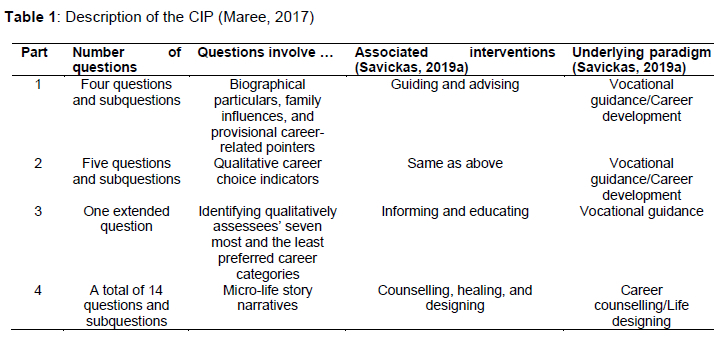
Career Interest Profile (CIP). The CIP aims to uncover and interpret people's interests, attitudes, beliefs, career values and, especially, their key life themes and to help them design successful careers. The questionnaire is premised on the belief that people can derive personal meaning and purpose from their many career-life encounters or happenstances (chance encounters) (Krumboltz 2015, Vecchio 2013).
CIP questions are carefully structured, beginning with questions based on differential and developmental issues. In Part 4, "storied" questions are asked that shed light on assessees' subconsciously motivated motives (key life themes). Some questions are rephrased and asked again to obtain a qualitative consistency index.
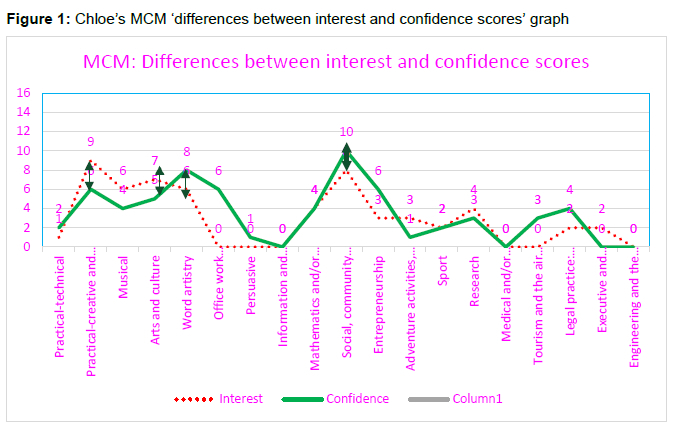
The Maree Career Matrix (MCM). The MCM measures assessees' career interests and self-estimates of their confidence in their aptitude for certain careers. Developed in South Africa, the MCM has excellent psychometric qualities (Maree and Taylor 2016).
Intervention procedure
The intervention was conducted in three phases. First, on day 1, Chloe's career-life story was elicited. Her reason for consulting me (psychologist) was clarified after which the CCI was administered followed by the MCM and the CIP. On day 2, in the second phase (authorisation), Chloe and I identified her central life themes and then reconstructed her many micro-narratives into a larger, coherent narrative (a reflection of her current career-life story) that shed light on her advice to herself concerning her reason for seeking counselling. Chloe continually reflected on her career-life story while co-authoring her life portrait. Matters that were unclear to her were clarified. I helped Chloe integrate her conscious knowledge (career information) with her subconscious insights into her deepest motivations and "advise" herself regarding her "presenting problem". In the third phase (on day 3), we co-constructed her future career-life plans and deliberated on a positive, active movement forward (Bimrose et al. 2019). The session concluded by revisiting her reason for seeking counselling, examining the outlines of her envisaged career-life story, ensuring that the emerging dots in her story had been connected, and finalising action steps and strategies. A written "road map" to map her way forward was jointly finalised and handed to her.
Data analysis and interpretation
Thematic analysis
I video-typed all interactions (reflective conversations or dialogues) between Chloe and me, after which they were transcribed verbatim. Braun and Clarke's (2021) thematic data analysis strategy was adapted and integrated with Savickas' (2019a) data analysis strategy to identify themes and subthemes from the data. I drew on the CCI as well as the CIP and the MCM, where necessary, and used the following strategies to ensure trustworthy and reliable data analysis (Savickas 2019a):
a. Chloe elaborated on the personal meaning of her answers to the CCI, CIP, and MCM questions.
b. I recorded repeated words and phrases and bodily expressions (insofar as it was possible to record physical responses during our meetings).
c. I asked Chloe to repeat words and phrases out loud to enhance authentication of her career-life.
d. We used Chloe's responses to the earliest recollections and CIP questions on the biggest challenges in her early years to uncover her key life themes.
e. We related Chloe's key life themes to study fields and careers (co-construction). Enacting these careers and themes could help her "heal" others and herself.
Analysing Cloe's responses
Chloe's responses to the CCI and CIP questions were analysed and used in the following manner (Maree 2020; Savickas,2019a) to create her life portrait:
Step 1: Her answers to the first CCI question (phrased slightly differently in the CIP) were analysed to determine what she wanted from the intervention and what her suggested solution to her "problem" was.
Step 2: Her earliest recollections (read in conjunction with her responses to the CIP question about her greatest challenges when she was young) were used to identify her central life themes or preoccupations.
Step 3: Scrutiny of her role models revealed her sense of who she was and the building blocks she used to construct herself.
Step 4: Analysis of her responses to questions about her favourite magazine, etc., shed light on environments that suited her preferred lifestyle. Here, however, I drew mainly on the MCM outcomes.
Step 5: Examining her favourite story revealed characters who faced the same "problem" she was facing but also guidance on how to solve the "problem".
Step 6: Her favourite quotations (and also her key life themes) shed light on her inner advice regarding how she could "heal" others (and in doing so also "heal" herself). Step 7: Recommending possible career trajectories to help her navigate her transition. (Career choice category options yielded by the MCM were considered here to arrive at possible career choice-related options.)
Step 8: Her initial reason for requesting counselling was reconsidered.
The rigour of the study
I asked qualitative questions to promote the trustworthiness and validity of the research and, ultimately, enhance crystallisation (Janesick 2013). Savickas (2016, n.p.) recommends that others "use my strategy or [devise and] use your own, but you need to have some way to listen for valid stories, not veracity". I therefore integrated the information generated by the CIP and MCM with the CCI outcomes to enhance the trustworthiness and validity of Chloe's life portrait.
Peer debriefing was conducted and participant reflection, review, and reflexivity were facilitated. Feedback was given throughout the intervention, and misunderstanding or confusion was limited by my repeatedly asking Chloe whether she agreed with what I said (my interpretation of her responses). Where possible, Chloe's responses were recorded verbatim, and I did my best to avoid using data selectively. Lastly, an experienced researcher-psychologist was invited to scrutinise the research outcomes to bolster intercoder and intercoding reliability (O'Connor and Joffe 2020).
Role of the researcher. In the context described here, I performed the roles of researcher-counsellor, confidante, and sounding board for Chloe.
Ethical considerations
Chloe's consent to report the intervention outcomes was obtained. At all times, "standard" ethical guidelines regarding participation, privacy, anonymity, and protection from harm were adhered to. The University of X's Institutional Ethics Review Board approved the research.
OUTCOMES
Career Construction Interview
Responses to questions in the CCI appear below (responses are verbatim with only light editing to preserve the authenticity of the responses).
Introductory question "How can I be useful, of value, or of help to you?":
"Could I get direction on how to proceed from here? I've been thinking in the past (the past two weeks especially) about what I will do after my studies. Where do I live? Do I want to continue with counselling psychology outside Africa? Or do something different so I can continue to live where I want to live? I have a connection with Germany with the relationship I am in. He wants us to live and work in Germany. It's sudden (he is an accountant and more connected to Germany than I am). [Looks up, smiles pensively] Am I committing too quickly to Germany? I don't know if it's my first choice. This may be something I am willing to do because of my relationship. Maybe I should listen to myself."
Role models
i. "Dr Phil. He was the psychiatrist on his show and would have different clients; I liked that he was giving them hope, turning situations around - conquering their problems. I wanted to have a similar show myself - I've always wanted to be a presenter and give people advice, and I've wanted to work with my husband on the show; writing books together; inviting different people to come up and talk about their situations and giving people hope that it is possible to overcome challenges."[Smiles]
ii. "Dexter. Whereas people identified me with DD, I identified myself with Dexter. It allowed me to identify with my little brother. I am the only child to my mother and father; then my mother got married to my stepdad - so there was a disconnect because he was my stepfather's son - my stepfather supported him more than me. This cartoon allowed me to appreciate our relationship, sit together, and find common ground."
iii. "Pam Andrews [South African actress/singer]. I liked her because she was a very good dancer -and I love dancing. She was also a good singer. I'm also tempted to say I'm a good singer, but I've heard that I'm not a good singer by my family and friends. Their comments hurt me because someone said music creates a bond, and my singing could create meaning in their hearts. People saying that my singing isn't good breaks my heart. It takes away my ability to create a bond in this way."
Favourite magazine, television show, and website
"Idols - it's a singing show; they make sure they unearth talent. They get votes from people to say who is the best singer. In the end, only one is crowned. My favourite part about it is the people who can't sing. Are there people who "can't sing" but actually can sing? [Sighs softly] Everybody can sing. I hold on to these kinds of stories - someone who is told they can't do something and rises and does it."
'YouTube. It's the one thing that gives me access to life and the world. You can watch videos from England about their lives; from China about their culture. It gives me access to the world."
"Pinterest - it's about how you can get to know how to take care of natural hair, weddings, different outsides, fix your garden, do art, bake cakes and wedding gowns. It's about the creating side of things - particularly of interest to women."
Favourite book or movie
"Book without a name - an African book - is set in Botswana. It was about different chiefdoms, the life of a chief, the village's culture, and what happens in the village. The Chiefs are exalted above other people - they are the go-to people when you need help, and they take care of the entire village's needs. Physical needs, giving food; if there's a quarrel, they help prevent the conflict. They are also the advisors of the community. They tell when to harvest, how to ensure plants don't die, and how to keep families together - from information to modern-day counselling."
Favourite sayings or mottoes
i. "There is no compromise on the cross, only sacrifice."
ii. "Do all the good you can to all the people that you can at all the times that you can and at all the places that you can, as long as you can."
iii. "Above all, love each other deeply because love covers a multitude of sins."
Three earliest recollections
(Chloe's and my proposals for headlines for the recollections appear above each recollection.) "Rejected" girl realises she has always been loved
"I was five when this happened at home. I was sleeping alone in the room. When I went to bed, there was no one in the room. Yet, I woke up during the night and overheard my paternal grandparents, maternal grandmother, and parents discussing the end of the parental engagement. I could hear everything they were saying. I felt anxious and struggled for breath. This was the formal meeting to decide how we bring back the cows, move forward, and do with "this child" (me).
Deep attachment makes love linger despite "absence"
[Sighs] "At the age of six, my paternal grandmother bought me cases of cold drinks and sent them home (my real dad gave grandmother the money). One night, we sat outside, and I had a cold drink can in my hand. I was lying on the stretcher with my uncle, looking at the stars. I fell asleep, and when I woke up, everyone was gone; they did not want to disturb me and left me outside to sleep. That was okay; I knew nothing would happen. I felt safe."
Absence does not impact genuine love and care
[Scratches head) "I was five years old. My father (a soldier) is a member of a Christian church. My paternal grandfather is a pastor, so he grew up in that environment. [Sighs] One morning before I went to preschool, he burned a piece of newspaper, circulated it around me, and said a prayer: 'I'm protecting this child for today.' He left me feeling he loved me and wanted to protect me. [Covers her mouth with her hand, cries, rubs her eyes] It touches me so much because I missed an opportunity to feel this daily. I was with my stepfather, who didn't care about us, while my mother did everything she could to enhance my education. He said he would care for her and me, but he didn't." [Looks up] "My dad was not allowed to care for me because of circumstances, but it did change what was in his heart."
Career Interests
According to the Career Interest Profile and Maree Career Matrix (see Figure 1) outcomes, Chloe's highest integrated interest and confidence categories were Social, caregiving and community services; Practical-creative and consumer science; Word artistry; Arts and culture; Musical; and Entrepreneurship.
Chloe's self-portrait (Savickas 2019a, b)
"I need direction on how to proceed after my master's studies. My partner for the last three-four years wants us to move to, live, and work in Germany together. He is particularly keen but I am not convinced. I should rather listen to myself. Having suffered the heart-breaking trauma of seeing my parents' engagement end when I was young made me realise that love is not always dependent on being close to the object of your love. I do not need to be in Germany to feel close to my partner. I want to give people hope, turn their situations around, help them conquer challenging situations, and show them it is possible to overcome challenges. I am keenly interested in the creative and creating side of thing. I want to use my sense of creativity and my singing to help me connect to others (women especially) and their pain, bond with their pain, generate meaning in their hearts, and inspire them to rise above negative voices. My training as a psychologist has taught me to respect others' views but also that their frame of reference cannot be my frame my reference. I am a deeply religious, spiritual woman and I will do all the good I can to all the people that I can at all the places I can, as long as I can. I struggled to forgive the "betrayal" of people very close to me who took decisions that hurt me immensely for a long time; decisions that left me vulnerable but I am able to forgive now."
I then asked Chloe to compose her mission statement (MS). This is what she and I decided on:
"I am sure now that I want to be a counselling psychologist. I want to run my own TV show myself one day, giving people advice, working with my future husband, advising others together, writing books together; inviting people to talk about their situations and giving people hope. I would love to use my voice to entertain and inspire others."
Chloe then composed her vision statement (VS):
"I am an artist, an entertainer, a beautiful person who deeply cares about and loves others. Having suffered greatly in the past without being able to change the situation, I am marvellously equipped with the skills to help others who are going through the pain of a similar kind. That is my north star, my destiny in life. When life fails others, I will metaphorically honour my loving grandmother's legacy by "rubbing their shoulders". Additionally, I intend to integrate my profound love and respect for others (especially those who have been betrayed or left in the lurch by others), my adherence to the timeless values that define me, my profound sense of selflessness, and my desire to provide a holding environment for others to enable me, ultimately, to make meaningful social contributions."
We used these statements to identify the resources Chloe needed to devise a feasible action strategy to realise her stated aims. She should for instance clarify whether or not to relocate to Germany with her future husband. She could also find out whom to contact regarding training to help her improve her singing, song writing, and acting skills.
I then proposed to Chloe that she return home, consider these suggestions, and report back to me if she wanted to.
Wrapping up the counselling session
Chloe's love for others, her inner and outer beauty, her modesty and artistic endowments, her desire to provide a holding environment for others who had been hurt (disappointed and abandoned by their significant others), as well as her reference to the joy she experienced when using her voice to entertain, uplift, and inspire others, prompted me to make the following comment at the end of the session:
"It feels as if I am standing in the presence of an artist, a soul singer, a caring, loving, resilient leader. A psychologist; a woman with real, timeless values, beliefs, and courage. A spiritual being who will stop at nothing to help people who have "suffered" or suffer what she has "suffered", even if that means making sacrifices on her part to strengthen their sense of who they are and can be. She inspires many women (men as well), young and old. She strives to restore the pride, dignity, self-respect, and identity of those who need help most; the "unvoiced", the vulnerable, and the forgotten. She exhibits a sense of what is fair and right for women who have been abandoned and wants to help them feel safe, secure, and wanted. Chloe, you are that inspirational counselling psychologist, leader, "chief", artist, entertainer, singer, and advocate for the rights of people (women in particular) who have suffered disappointment and rejection."
Follow-up
After the session, Chloe commented: "I cannot believe my life story revealed these beautiful truths about who I am. It means so much to know these are not just stories of who I would like to be, but are stories of who I am. I hope to carry these eternally into my life; they have given me the gift of life. In trying times, I will be inspired and motivated by these powerful words."
DISCUSSION
On the surface, the study examined the longitudinal effect of a career construction intervention on a black female student experiencing career indecision. However, on a more conceptual plane, it advocated a contextually sensitive, African-centred, feminist, and community-oriented approach to career counselling. Such an approach involves the innovative reframing of conventional Western paradigms in the counselling field, as highlighted by Laher and Kramer (in press).
The following research questions guided the study:
i. What was the short-term effect of a career construction intervention on a black, female, postgraduate student facing a career decision-making challenge?
ii. What was the long-term effect of the intervention on the student's psychological self? These two questions are discussed below.
What was the short-term effect of a career construction intervention on a black female postgraduate student facing a career decision-making challenge?
The participant (Chloe) presented with career choice ambivalence that caused her distress and affected her sense of emotional well-being. My decision to apply a career construction intervention in her case was based on previous research findings. Many authors, for example Cochran (2011), Maree (2020), Nystul (2016), and Sharf (2013), contend that qualitative (narrative) career counselling gives counsellors the opportunity to help clients clarify their needs, values, and aspirations and also to address their emotional distress in determining the future direction of their career-life stories. In addition, Hartung et al. (2022) found that people's emotional condition correlated strongly positively with career choice and career decision-making "processes of occupational engagement, career adaptability, and career decidedness" (p. 2). I accordingly used career construction counselling to help the participant derive meaning from her undecidedness. With her help I encouraged her to clarify and draw on key facets of her career-life story to help her negotiate the transition she was facing.
Chloe's and my conversations were instrumental in helping her recount her career-life story thereby facilitating narratability (Savickas 2019a). Reflecting on these conversations helped her articulate her many micro-stories thus enabling her to outline and clarify her subjective identity in addition to her objective identity (Savickas and Savickas 2019). She similarly engaged in personal dialogues, reflections, and meta-reflections. These reflections shed light on her past as well as her recent experiences and enabled her to uncover, understand, appreciate, and draw on her life themes in conjunction with her vocational personality (traits) and her developmental resources (adaptability). Her uncertainty about the future gradually gave way to a regained sense of direction (goals) and a sense of intention (intentionality), which we drew on to help her negotiate her feeling of being stuck and to move forward (actionality). Her life portrait was instrumental in facilitating her forward movement. These findings support those of researchers such as Del Corso et al. (2011), Maree (2019), Nota et al. (2016), and Taber and Briddick (2011), and Taber et al. (2011) on the value of career construction counselling and the crafting of life- or self-portraits to help people deal with career indecision in the short term. In addition, the intervention facilitated the elicitation and integration of Chloe's many "micro-stories" (conscious knowledge about herself) and also clarified her subconscious insights about herself. Ultimately, by promoting autobiographicity (drawing on her career-life stories), the intervention helped Chloe break through the fourth wall ("the invisible line that separates the stage from the audience, named for the imaginary fourth wall of the room in which the play might be set") (Stichter 2016, 5) in career counselling (Kleynhans 2023; Maree 2020). In other words, for Chloe, "receptivity" (enacting a script prepared by others) gradually gave way to "interaction" (with the counsellor) and self-interaction (communicating with and being advised by her deepest self). She was thus enabled to advise herself on the questions she was seeking answers to.
The "storyline" that permeates and "glues together" Chloe's self- and career identity indicates who she is, what she wishes to do in the workplace, why she exists, and why enacting her key life theme (her desire to work with traumatised youth especially) is so important to her (Savickas 2019a). This assertion corresponds positively with Fouad et al. (2009) and Gati et al.'s (2013) view that merely providing more information (of whatever kind) alone does not decrease people's career choice ambivalence (uncertainty).
What was the long-term effect of the intervention on the participant's psychological self?
Seven years after the intervention, there is sufficient evidence that the intervention described in this article advanced the enactment of the three "developmental layers of psychological self, namely the person as an actor, the person as agent, and the person as the author" (McAdams 2013, p. 273). The intervention helped Chloe transition from i. performing adequately as a social actor to ii. demonstrating sufficient motivated agency to iii. drawing on and integrating her many career-life stories as an autobiographical author (Maree 2020)
The psychological self as a social actor
Chloe's question about whether she should "do something different so I can continue to live where I want to live" was clarified satisfactorily after the assessment outcomes had been conveyed to her. From a vocational guidance perspective, in the short and the long term, she understood that her career choice (to become a counselling psychologist) was consistent with the integrated assessment outcomes. That she exhibited an enhanced sense of self-insight regarding her interests and social roles was confirmed by her responses during the feedback interview and by her reflections on her life portrait (Gülsen et al. 2021). Insecurity and emotional turbulence (caused by her close friend's sudden and unexpected decision to relocate, expecting her to follow suit) negatively influenced her emotional well-being temporarily and clouded her perspective on her career choice.
The psychological self as a motivated agent
Chloe's responses after the intervention confirmed her enhanced sense of adaptivity and her readiness to take the steps needed to continue to act adaptively when facing transitions. She expressed her joy about having a deeper understanding of her resilience and willingness to adapt if and when needed: "My stories were not just stories of who I could and would like to be, but are current stories of who I am." Her psychological self as a motivated agent was strengthened from a career guidance perspective. As her life portrait shows, the intervention helped her clarify and enhance her career-life goals and gain insight into her deep-seated reasons for "suddenly" feeling insecure and confused about her career choices and plans. These developments helped her arrive at appropriate and informed career choices and plans for the future (thus advancing herself as a motivated agent) (Gülsen et al. 2021). In summary: Her psychological self as a motivated agent, too, was enhanced in the short and long term.
The psychological self as an autobiographical author
Today, seven years after the intervention, Chloe's feedback confirms that the intervention advanced her psychological self as an autobiographical author especially. She was able to advise herself on the questions she raised when asked why she had sought career counselling. In addition, jointly with me, she succeeded in "connecting the dots" of her life story (integrating her scores (conscious knowledge about herself) and stories (subconscious insights)) (Gati and Kulcsár 2021). Even more tellingly, during the past seven years she consistently drew on her 'autobiography', in other words, autobiographicity occurred, meaning that her psychological self as an autobiographical author was enhanced. At the same time, her psychological functioning and self-efficacy improved (Bandura, 1997). From a career construction perspective, facets of her detached and disjointed past were unified with her present life and prompted a hope- and purpose-filled future career-life story (Hartung et al. 2022; Rottinghaus et al. 2009). In conclusion: The current findings support McAdams' (2010) finding that "[n]umerous studies have shown that deriving positive meanings from negative events are associated with life satisfaction and indicators of emotional wellbeing" (191).
SUMMARY
The QUALITATIVE-quantitative intervention described here targeted all three developmental layers of the participant's psychological self. First, she felt unsure about her career choice (expressed a need for vocational guidance). Second, she felt uncertain about her future goals and capacity to deal with sudden (and longer-term) changes. Third, her sense of positivity, hope for the future, and belief that she could make meaning of her career life and also make social contributions were adversely impacted. The outcomes of the study vindicated the decision to apply a QUALITATIVE-quantitative intervention.
Savickas (2002) urges career counselling researchers and practitioners to update and innovate career construction theory and practice continually. This article represents a response to his directive. Given the complexity of applying career construction counselling, and the need for more research on such counselling (Dalene 2023), I further recommend that career counsellors initially refrain from using the CCI as a standalone assessment and intervention. Using new auxiliary questionnaires such as the MCM and the CIP to promote the rigour of an intervention would seem to be the better route to follow.
In conclusion, the study findings underscore the importance of research on career construction counselling in excluded, marginalised contexts to determine its effect in such contexts, particularly in Global South countries. It is noteworthy that very few studies have explored the career counselling nuances discussed in this article (Maree, 2020).
Factors prevalent in Global South countries, such as the scarcity of adequately trained black (and white) psychologists in career construction counselling, impact negatively on the career decision making of excluded, marginalised groups (Maree, 2019; 2022). What needs to be explored in particular are the views of black women on historical and current marginalisation in career counselling, particularly as regards career decision making. This could foster a better understanding of career choices and associated career trajectories. Research in this area should examine the connection between career counselling and broader socio-political and economic issues.
Limitations
First, more (short- and longer-term) research with people from diverse contexts (developing country/Global South contexts especially) is needed to assess the value of the approach and intervention demonstrated in this article. Second, applying the intervention described here is time consuming and expensive. Most people with career counselling needs are excluded from accessing such an intervention. Third, research is needed to devise a strategy to facilitate the implementation of the approach in group contexts. Fourth, the approach needs to be adapted to enhance its cross- and multi-cultural applicability. Fifth, the extensive data generated complicated in-depth analysis of the data. Lastly: The possibility of researcher bias can also be considered a limitation of the study.
Recommendations and Implications for Theory, Practice, Future Research, and Policy
Too few black career counsellors especially are currently undergoing training in the intervention mode described here. Intensive training in the theory and practice of career construction intervention is a prerequisite for administering the intervention described here. In addition, applying the intervention under the watchful eye of an experienced mentor will increase the success of novice career construction counsellors. Likewise, regular attendance of continuing professional development courses on the subject is recommended. Moreover, the success or failure of involving clients in the intervention style discussed here will depend largely on whether counsellors can establish an atmosphere of mutual trust and create a safe space where clients can feel 'held' (Winnicott 1965). Lastly, and most importantly, it should be noted that the intervention described here amounts to a therapeutic, psychological act and that therefore only registered counsellors and psychologists may use the psychological constructs and administer the therapeutic interventions described in this article.
Follow-up after seven years
After seven years, the participant (Chloe) reported that she had benefited greatly from the intervention. After completing her studies, she accepted a university post as a lecturer in counselling psychology. A few years later, she accepted a position at a South African university. She specialises in helping women especially share their untold stories and draw on their "pain' to help others facing similar challenges. She also specialises in helping women resolve early childhood attachment issues that resurface in adolescence. Lastly: Chloe is a sought-after public speaker who exhorts women to stand up for themselves, to believe in themselves, and to meet their emotional needs in innovative and creative ways - realising their innate inner and outer beauty and living without depending on others for love and appreciation. (Although she is no longer involved romantically with her former male partner, they remain good friends.)
CONCLUSION
The article shows that career construction intervention and the subsequent writing of life portraits can help people deal successfully with career ambivalence and related issues. The intervention not only helped a young woman resolve pressing career choice challenges in the short term, it also enhanced her psychological self as an autobiographical author. The fact that the positive intervention effect was still felt after seven years is encouraging. The intervention helped the research participant discover the authentic, deep-seated reason for seeking career counselling, restored continuity in her career-life story, helped her move forward, and rekindled her sense of career resilience, hope, and excitement (O'Reilly 2013; Rath, 2010).
Lastly, the approach discussed here is in line with endeavours to redress power imbalances, address colonial legacies, and promote social justice in career counselling. It is hoped this will lead to more balanced and empowering outcomes in career decision making for single individuals as well as groups of individuals. This study thus underscores the importance of embracing a decolonial and transformative agenda in career counselling.
NOTES
i. Chloe's verbatim responses were edited only lightly to conserve their authenticity.
ii. I thank Chloe for participating in the research.
iii. I thank Tim Steward for his editing of the text.
REFERENCES
Arastaman, G. 2019. Reconsidering the career construction in the modern era. In Vocational identity and career construction in education, ed. T. Fidan, 1-14. Hershey: IGI Global. [ Links ]
Maree, J.G. and Taylor, N. 2016. Development of the Maree Career Matrix: A new interest inventory. South African Journal of Psychology 46(4): 462-476. [ Links ]
Maree, J.G.. 2013. Counselling for career construction: Connecting life themes to construct life portraits. Turning pain into hope. Rotterdam: Sense. [ Links ]
Maree, J.G.. 2017. The Career Interest Profile (Version 6). Randburg: JvR Psychometrics. [ Links ]
Maree, J.G.. 2019. Group career construction counseling: A mixed-methods intervention study with high school students. The Career Development Quarterly 67(1): 47-61. [ Links ]
Maree, J.G.. 2020. Innovating counseling for self- and career construction: Connecting conscious knowledge with subconscious insight. Cham: Springer. [ Links ]
Maree, J.G.. 2022. Managing the Covid-19 pandemic in South African Schools: turning challenge into opportunity. South African Journal of Psychology 52(2): 249-261. [ Links ]
Bandura, A. 1997. Self-efficacy: The exercise of control. New York: Freeman. [ Links ]
Bimrose, J., A. Brown, R. Mulvey, B. Kieslinger, C.M.Fabian,, T.Schaefer and R.T.Dewantic. 2019. Transforming identities and co-constructing careers of career Counsellors. Journal of Vocational Behavior 111: 7-23. [ Links ]
Blustein, D. L. & L.Y.Flores. 2023. Rethinking work: Essays on building a better workplace. New York: Routledge. [ Links ]
Braun, V. and V. Clarke. 2021. Thematic analysis: A practical guide. London: SAGE Publications [ Links ]
Cardoso, P., M.L. Savickas and M. M. Gonçalves. 2019. Career construction counseling: Proposal for an integrative model. Career Development Quarterly 67(3): 188-204. [ Links ]
Cochran, L. R. 1997. Career counseling: A narrative approach. California: Thousand Oaks. [ Links ]
Dalene, K. M. 2023. Career counselors' experiential reflections on early recollections in career construction counseling. Career Development Quarterly. DOI: 10.1002/cdq.12327 [ Links ]
Del Corso, J., M.C. Rehfuss and K. Galvin. 2011. Striving to adapt: Addressing Adler's work task in the 21st century. Journal of Individual Psychology 67: 88-106. [ Links ]
Erikson, E. H. 1968. Identity: Youth and crisis. New York: Norton. [ Links ]
Fouad, N., E.W. Cotter, and N. Kantamneni. 2009. The effectiveness of a career decision-making course. Journal of Career Assessment 17(3): 338-347. [ Links ]
Freud, S.1964. The standard edition of the complete psychological works of Sigmund Freud. London: Hogarth Press. [ Links ]
Gati., I. and I. Asher. 2001. Pre-screening, In-depth exploration, and choice: From decision theory to career counseling practice. The Career Development Quarterly 50(2): 140-157. https://doi.org/10.1002/j.2161-0045.2001.tb00979.x [ Links ]
Gati, I. and V. Kulcsár.2021. Making better career decisions: From challenges to opportunities. Journal of Vocational Behaviour 126: 1-18. https://doi.org/10.1016/j.jvb.2021.103545 [ Links ]
Gati, I., T. Ryzhik and D. Vertsberger. 2013. Preparing young veterans for civilian life: The effects of a workshop on career decision-making difficulties and self-efficacy. Journal of Vocational Behaviour 83(3): 373-385. [ Links ]
Gülsen, C., G. Seçim, and M.L. Savickas. 2021. A career construction course for high school students: development and field test. Career Development Quarterly 69(3): 201-215. https://doi.org/10.1002/cdq.12268 [ Links ]
Hartung, P. J. 2019. Life design: A paradigm for innovating career counselling in global context. In Handbook of innovative career counselling, ed. AUTHOR, 735-737. https://doi.org/10.1080/03069885.2020.1773394 [ Links ]
Hartung, P. J., J.M Taylor and B. J. Taber. 2022. Affect as a predictor of occupational engagement, career adaptability and career decidedness. African Journal of Career Development 4(1). https://doi.org/10.4102/ajcd.v4i1.58 [ Links ]
Janesick, V. J. 2000. The choreography of qualitative research. In Handbook of qualitative research, ed. N. K. Denzin and Y. S. Lincoln, 390-396. London: Sage. [ Links ]
Kelly, K. R. and W.C. Lee. 2002. Mapping the domain of career decision problems. Journal of Vocational Behavior 61(2): 302-326. https://doi.org/10.1006/jvbe.2001.1858 [ Links ]
Kleynhans. R. 2023. The career construction of performing artists. PhD diss, University of the Free State, Bloemfontein. [ Links ]
Krumholtz, J. D. 2009. The happenstance learning theory. Journal of Career Assessment 17(2): 135154. https://doi.org/10.1177/1069072708328861 [ Links ]
Krumholtz, J. D. 2015. The purpose of career counseling. Career Convergence Magazine April: 3-4. [ Links ]
Kulcsár, v., a. Dobrean and I. Gati. 2020. Challenges and difficulties in career decision making: Their causes, and their effects on the process and the decision. Journal of Vocational Behaviour 116(Part A): 103346. [ Links ]
Laher, S. and S. Kramer. (in press). Qualitative research quality in South African Psychology. The SAGE Handbook of qualitative research quality (pp. ), ed. U. Flick, London: Sage. [ Links ]
Levin, N., H. Braunstein-Bercovitz, Y. Lipshits-Braziler, I. Gati and J. Rossier. 2020. Testing the structure of the career decision-making difficulties questionnaire across country, gender, age, and decision status. Journal of Vocational Behavior 116 (Part A): 1-13. https://doi.org/10.1016/j.jvb.2019.103365 [ Links ]
Marcia, J. E. (1980). Identity in adolescence. In Handbook of adolescent psychology, ed. J. Adelson, 159187, New York: Wiley. [ Links ]
McAdams, D. P. 2001. The psychology of life stories. Review of General Psychology 5: 100-122. doi: 10.1037/1089-2680.5.2.100 [ Links ]
McAdams, D. P. 2010. The problem of meaning in personality psychology from the standpoints of dispositional traits, characteristic adaptations, and life stories. Japanese Journal of Personality 18: 173-186. [ Links ]
McAdams, D. P. 2013. The psychological self as actor, agent, and author. Perspectives on Psychological Science 8(3): 272-295. [ Links ]
Nota, L., S. Santilli and S. Soresi. 2016. A life-design-based online career intervention for early adolescents: Description and initial analysis. The Career Development Quarterly 64(1): 4-19. [ Links ]
Nystul, M. S. 2016. Introduction to counselling: an art and science perspective (5th ed.). Thousand Oaks: Sage. [ Links ]
O'Connor, C. and H. Joffe. 2020. Intercoder reliability in qualitative research: Debates and practical guidelines. International Journal of Qualitative Methods 19(2): 1-13. [ Links ]
O'Reilly, N. 2013. Wellbeing: The five essential elements. The Journal of Positive Psychology 8(2): 174-176. [ Links ]
Rath, T, J.K Harter and J. Harter. 2010. Wellbeing: The five essential elements. Washington: Gallup Press. [ Links ]
Rottinghaus, P. J., N. Jenkins and A. M. Jantzer. 2009. Relation of depression and affectivity to career decision status and self-efficacy in college students. Journal of Career Assessment 17(3): 271285. [ Links ]
Savickas, M. L. 2002. Career construction: A developmental theory of vocational behavior. In D. Brown (Ed.). Career choice and development, 149-205 (4th ed.). San Francisco, CA: Jossey-Bass. [ Links ]
Savickas, M. L. 2015. Career counseling paradigms: Guiding, developing, and designing. In The APA handbook of career intervention, ed. P. J. Hartung., M. Savickas, and W. Walsh, 129-143. Washington: APA Books. [ Links ]
Savickas, M. L. 2016, July. Meaning at work: work at meaning. Closing keynote presentation, National Career Development Association Conference, Chicago, United States of America. [ Links ]
Savickas, M. L. 2019a. Career Counseling. Washington, DC: American Psychological Association. [ Links ]
Savickas, M. L. 2019b. Career construction theory. Life Portraits of attachment, adaptability and identity. Author. [ Links ]
Savickas, M. L. 2021, May. Keynote Address at the 2021 APCDA Conference. Paper presented at the Asia Pacific Career Development Conference. Virtual conference in Singapore. [ Links ]
Savickas, M. L. and S. Savickas. 2019. A history of career counseling. In International handbook of career guidance, ed. J. A. Athanasou and H. N. Pereira, 25-44. Cham: Springer. [ Links ]
Sharf, R. 2013. Applying career development theory to counseling (6th ed.). Belmon: Thompson Brooks/Cole. [ Links ]
Stringer, K., J. Kerpelman. and V. Skorikov. 2011. Career preparation: a longitudinal, process-oriented examination. Journal of Vocational Behavior 79(1): 158-169. [ Links ]
Taber, B. J. and W. C. Briddick. 2011. Adlerian-based career counseling in the age of Protean Careers. Journal of Individual Psychology 67(2): 107-121. [ Links ]
Taber, B. J., P.J Hartung, H. Briddick, W.C. Briddick and M. Rehfuss. 2011. Career Style Interview: A contextualized approach to career counseling. Career Development Quarterly: 59:274-287. [ Links ]
Udayar, S., N. Levin, Y. Lipshits-Braziler, S. Rochat, A. Di Fabio, I. Gati and J. Rossier. 2020. Difficulties in career decision making and self-evaluations: A meta-analysis. Journal of Career Assessment 28(4): 608-635. https://doi.org/10.1177/1069072720910089 [ Links ]
Vecchio, C. A. 2013. Happenstance. In Ten ideas that changed career development, ed. M. L. Savickas, 12., Broken Arrow: NCDA [ Links ]
Wilkens, K. and A. Farra, A. 2023. Black Women, work, and liberation: (Re)Envisioning a more equitable workplace. Ed. D. L. Blustein and L. Y. Flores, L. Y,. Rethinking work: Essays on building a better workplace, 138-143. New York: Routledge. [ Links ]
Winnicott, D. W. (1965.) The family and individual development. London: Tavistock [ Links ]
Xu, H. (2022). Viewing the joint operation of five major decision difficulties within the dual-process theory of career decision-making. Journal of Vocational Behavior 31(2): 340-358. [ Links ]
Yin, R. K. (1984.) Case study research: Design and methods. London: SAGE. [ Links ]