Services on Demand
Journal

Article
 English (pdf)
 Article in xml format
 Article references
 Automatic translation
 Send this article by e-mail
Indicators
Related links
-
 Cited by Google
 -
 Similars in Google
Share

 Permalink
Acta Commercii
On-line version ISSN 1684-1999Print version ISSN 2413-1903
Acta Commer. vol.25 n.1 Johannesburg 2025
https://doi.org/10.4102/ac.v25i1.1446
ORIGINAL RESEARCH
Tapping into play: Flow and brand attitude driving satisfaction in mobile advergaming
Mayemba K. Nzita; Isolde Lubbe
Department of Marketing Management, School of Consumer Intelligence and Information Systems, University of Johannesburg, Johannesburg, South Africa
ABSTRACT
ORIENTATION: Mobile advergaming, which integrates branded content into interactive gaming platforms, offers an innovative approach to engage consumers digitally. Little is known about how satisfaction develops in mobile advergames within emerging economies.
RESEARCH PURPOSE: This study examines how flow experience and brand attitude shape satisfaction in the M&M's1 Adventure mobile game among South African millennials and Generation Z (Gen Z).
MOTIVATION FOR THE STUDY: Understanding psychological and experiential dimensions of mobile advergaming can provide valuable insights into consumer engagement and brand perception, particularly in emerging markets where digital connectivity is rapidly expanding.
RESEARCH DESIGN, APPROACH, AND METHOD: A quantitative approach was employed, using partial least squares structural equation modelling (PLS-SEM) to test a model incorporating mediation (brand attitude) and moderation (brand familiarity). Data were collected via an online questionnaire from South African respondents aged 18-35 who played the game.
MAIN FINDINGS: Flow experience significantly enhances brand attitude and satisfaction. Brand attitude positively influences satisfaction and partially mediates the flow experience- satisfaction relationship. Brand familiarity does not moderate this link, suggesting that engaging gameplay captivates users regardless of prior brand knowledge
PRACTICAL/MANAGERIAL IMPLICATIONS: Marketers should prioritise immersive game design, seamless branding and mobile optimisation to expand market reach among younger audiences using experience-based metrics.
CONTRIBUTION/VALUE-ADD: This study uniquely integrates mediation and moderation analyses to explore flow experience, brand attitude and satisfaction, offering pioneering insights into advergaming in an emerging market.
Keywords: mobile advergaming; flow experience; brand attitude; consumer satisfaction; gamified marketing; interactive advertising; digital engagement; millennial consumers.
Introduction
Mobile advergaming, derived from the fusion of 'advertising' and 'gaming', has emerged as a dynamic component of digital marketing, marked by the seamless incorporation of branded elements within mobile gaming platforms (Chiong, Yang & Chen 2020). This approach provides an innovative alternative to conventional advertising by offering users engaging, interactive experiences that enhance brand communication through gameplay (Adis 2020; Catalán, Martínez & Wallace 2019). Mobile advergaming is important because it not only entertains but also embeds brand messages in immersive environments, shaping consumer perceptions in ways traditional advertising cannot. Its effectiveness, however, depends on psychological and experiential dimensions such as user flow experience, enjoyment and the impact these have on brand perception (Catalán et al. 2019).
Van Berlo and Chen (2024) show that experiential satisfaction mediates the relationship between advergaming and brand engagement, but their quantitative study focuses on developed markets and does not explore mobile-first branded games. Similarly, Catalán et al. (2019) examined flow and brand familiarity, and Adis (2020) assessed brand communication outcomes in Malaysia. Yet none directly investigate user satisfaction within a real mobile advergame environment. Research in this area is relevant because satisfaction is a critical driver of sustained engagement and brand loyalty (Kim, Kim & Wachter 2013), but current scholarship has not clarified how satisfaction develops in mobile advergames, particularly in emerging-market contexts. This gap highlights the need for studies that examine satisfaction in real-time gameplay settings among under-represented consumer groups.
This study addresses these gaps through the M&M's Adventure mobile game, involving digitally engaged South African millennials and Generation Z, who played the game before completing the questionnaire. By doing so, it provides an ecologically valid view of how flow experience, brand attitude and satisfaction interact in real-time gameplay. As mobile connectivity and digital technology reshape consumer behaviour, brands increasingly turn to gamified platforms to deepen engagement (Adis 2020; Kim et al. 2013). Purposefully designed advergames communicate brand messages through interactive mechanics and narratives, offering an immersive alternative to traditional advertising.
The study examines the interrelated roles of flow experience, brand attitude and satisfaction in mobile advergaming. Focusing on the M&M's Adventure game, it explores how these constructs shape consumer engagement and brand perception, positioning advergaming as an innovative digital communication tool (Hartini 2020). Aligned with the journal's mission to advance responsible and relevant management research in an African and global context, it responds to the growing need to understand digital engagement in marketing. The global gaming industry was valued at over $187.7 billion in 2024, with mobile games accounting for $92bn (49% of total revenue) (Knezovic 2025). With more than half of the world's 3.3 billion gamers accessing games via mobile devices, gaming has overtaken film, music and television in cultural reach, and is projected to reach $266bn by 2028 (Paizanis et al. 2024).
Several factors explain this dominance: accessibility through mobile and cloud platforms, the rise of social gaming environments such as Roblox and Twitch, and the constant release of new content extending user involvement (Ball 2024). In-game advertising also achieves high completion and viewability rates, with advertising spend in gaming channels increasing steadily (Paizanis et al. 2024).
While prior research has addressed flow, brand attitude and satisfaction in advergaming (Catalán et al. 2019; Hsiao, Lin & Wu 2022; Van Berlo & Chen 2024), the current study extends this work by focusing on a mobile-based branded game in an emerging market. It uniquely examines whether flow and brand attitude explain satisfaction among digitally engaged South African millennials and Generation Z, a group largely absent from existing emerging context advergaming literature. Unlike studies anchored in developed economies or general gaming platforms, this research situates its contribution in a single-brand, single-game mobile format, enabling deeper contextual exploration. By integrating mediation (brand attitude) and moderation (brand familiarity) into a unified partial least squares structural equation modelling (PLS-SEM) model, it advances understanding of the psychological mechanisms driving satisfaction in mobile-first, brand-discovery environments.
Literature review
This study is anchored in the flow experience theory (Csikszentmihalyi 1975), which describes the optimal psychological state of deep absorption, enjoyment and focused engagement that individuals experience when immersed in a challenging and rewarding activity. In the context of advergaming, flow experience has emerged as a critical construct explaining how interactive and immersive experiences shape affective responses towards brands (Ghosh, Sreejesh & Dwivedi 2021; Hooker et al. 2019). Flow experience theory offers a compelling lens for modelling advergame-induced engagement, as it provides a mechanism through which users' intrinsic enjoyment during gameplay can influence their cognitive evaluations (e.g. brand attitude) and emotional responses (e.g. satisfaction). By integrating flow experience theory with branding constructs, this study seeks to extend the theory's relevance into mobile advergaming by testing both direct and indirect pathways to satisfaction, as well as boundary conditions (via moderation) relevant to emerging markets. Specifically, the study contributes to flow experience theory by: (1) extending it to a mobile-first advergame context in a developing economy, (2) clarifying its indirect influence through brand attitude and (3) setting empirical boundaries by testing the moderating role of brand familiarity.
Mobile advergaming and consumer engagement
Mobile advergaming has emerged as a powerful tool in digital marketing, offering brands a unique way to connect with consumers through immersive, game-based experiences. As mobile devices become increasingly integral to daily life, advergames provide interactive, on-the-go engagement that surpasses the limitations of traditional media (Mittal & Kumar 2020; Mittal, Kumar & Seppi 2022). These games encourage repeated use, creating multiple touchpoints for brand exposure while maintaining user interest through entertaining gameplay mechanics. Unlike static advertisements, advergames integrate brand content directly into the gaming experience, fostering deeper engagement and brand familiarity. This form of gamified advertising uses game elements, such as rewards, challenges and progress tracking, to make interactions more enjoyable and emotionally resonant (Van Berlo & Chen 2024; Van Berlo, Van Reijmersdal & Eisend 2021). Advergames positively influence consumer perceptions and attitudes by increasing the hedonic value of brand messages (Singh & Milan 2025; Van Berlo et al. 2021).
The effectiveness of advergames is reflected in market trends: global mobile in-app advertising spend is projected to grow from $1bn to $1.5bn per day by 2029, with mobile gaming leading this growth (Statista Market Insights 2024). Recent studies affirm that advergaming enhances consumer engagement across cognitive, emotional, and behavioural domains, with satisfaction acting as a key mediator (Van Berlo & Chen 2024). Furthermore, advergames strengthen brand recall, attitude and purchase intention, especially when brand identity aligns with game content (Adis 2020). Elements such as music can further enrich the user experience and increase brand resonance, particularly among younger audiences (Farzinnejad et al. 2024).
Flow experience, brand familiarity and attitude in gaming environments
Advergames offer a powerful marketing tool by merging gameplay with brand messaging, capitalising on players' immersive flow experiences to enhance consumer engagement. The intense and voluntary involvement in gaming can positively shape brand perceptions and influence purchasing behaviour (Ghosh et al. 2021; Hsiao et al. 2022). The notion of 'flow experience', a state of deep concentration and enjoyment, emerges as a central mechanism linking gameplay to positive brand outcomes (Csikszentmihalyi 1975; Hooker et al. 2019).
Numerous studies highlight how flow experience enhances brand attitudes and purchase intentions in advergaming environments (Anandya, Prabowo & Darsono 2023; Catalán et al. 2019). Flow experience is often induced by gameplay factors, such as interactivity, challenge and immersion (Catalán et al. 2019). Positive emotions triggered by enjoyment fuel deeper flow states, which are, in turn, associated with stronger engagement and brand affinity (Biró & Kato 2024; Wang, Wang & Zuo 2023). Brand interactivity and familiar gameplay further increase user satisfaction and brand awareness (Farzinnejad & Baghaei 2022; Khezrian, Farzinnejad & Baghaei 2022). However, findings on the mediating role of flow experience are mixed. Some studies indicate that flow experience indirectly enhances satisfaction and continuance intention through enjoyment (Masao & Salehudin 2023), while others question flow experience's direct impact on satisfaction (Catalán et al. 2019).
In emerging markets, such as India, Brazil, China and South Africa, advergames are increasingly used to build brand familiarity and drive behavioural responses (Komulainen, Lappeman & Islam 2019; Wanick et al. 2019). These culturally relevant games leverage the intrinsic motivation of users to share, invite others and interact with branded content, further amplifying engagement (Heidari 2024). Catalán et al. (2019) explore how brand familiarity enhances flow experience in mobile advergames, boosting their effectiveness. These authors found that familiarity and game repetition positively affect brand attitude and purchase intentions, though they did not examine the link between flow experience and satisfaction, focusing instead on brand-related outcomes. Similarly, Hsiao et al. (2022) showed that brand familiarity strengthens the connection between advergame attitudes and brand attitudes, with game beliefs driving purchase intentions. However, both studies overlooked the role of flow experience in shaping user satisfaction. Catalán et al. (2019) focused primarily on how brand familiarity and repeated gameplay influenced brand attitudes and purchase intentions, but did not assess satisfaction as an outcome of flow experience. Likewise, Hsiao et al. (2022) examined the moderating role of brand familiarity on the relationship between advergame and brand attitudes, omitting satisfaction from their framework. While both confirm the importance of flow experience and brand familiarity in building brand perceptions, neither empirically tested whether immersive gameplay translates into satisfaction. This leaves a conceptual gap concerning the emotional outcomes of flow experiences, which this study seeks to address by positioning satisfaction as a key mediating mechanism in advergaming.
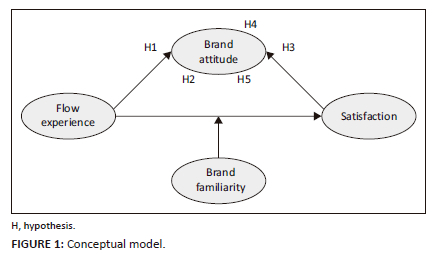
From a flow experience theory perspective, immersive experiences can trigger positive affective and cognitive responses towards associated stimuli, in this case, the embedded brand. The more immersive the gameplay, the more favourable the user's perception of the brand becomes, as flow experience fosters openness and receptivity (Biró & Kato 2024). Thus, flow experience is expected to shape brand attitude directly. The literature supports that advergames enhance brand engagement through flow experience. While the exact mechanisms may differ across studies, converging motivational states, immersive gameplay and brand interactivity remain critical to favourable brand outcomes. Flow experience theory also posits that the flow state itself is intrinsically rewarding and pleasurable (Csikszentmihalyi 1975). Applied to advergaming, this suggests that users who experience flow during gameplay derive greater satisfaction from the interaction, independent of their brand-related perceptions. This forms the basis for a direct relationship between flow experience and satisfaction. Finally, brand familiarity is introduced as a boundary condition that may influence how flow experience affects satisfaction. Prior literature suggests that familiarity strengthens or weakens the impact of experiential stimuli, depending on the context (Catalán et al. 2019). Testing this moderation contributes to boundary-setting in flow experience theory by examining whether the effect of flow experience is uniform across consumer segments with varying brand knowledge. Consequently, the study hypothesises that:
H1: Flow experience positively affects brand attitude towards the M&M's brand.
H2: Flow experience positively affects satisfaction with the M&M's Adventure mobile game.
H5: Brand familiarity moderates the relationship between flow experience and satisfaction with M&M's Adventure mobile game, such that the positive effect of flow experience on satisfaction is stronger for players with higher brand familiarity.
Satisfaction as a key outcome in advergaming
Satisfaction plays an important role in advergaming, functioning as a mediating factor between immersive gameplay and consumer responses such as engagement, loyalty and behavioural intentions (Van Berlo & Chen 2024). Their quantitative study confirms that experiential satisfaction links advergame interaction to cognitive, emotional and behavioural engagement, positioning satisfaction as both a key outcome and a psychological mechanism within the consumer journey. A key driver of satisfaction is immersion, a state in which players become deeply engaged with the game environment, enhancing enjoyment and sustained playtime (Demidiuk & Plechawska 2022). Recent studies in gamification contexts further support the view that immersion precedes satisfaction. For instance, Li and Aumeboonsuke (2025) found that immersion, achievement and social interaction significantly enhance the overall consumer experience, which in turn strengthens brand engagement and loyalty in co-branded gamification campaigns. Similarly, in the domain of augmented reality gaming, immersive experiences have been shown to significantly predict satisfaction and continued engagement intentions (Utomo & Oktavia 2024). Research shows that experiential satisfaction plays a central mediating role in gamified advertising. Van Berlo and Chen (2024) found that advergaming enhances cognitive, emotional and behavioural responses, with satisfaction linking these effects to brand engagement. Similarly, Arifah, Suryani and Samopa (2022) highlight that integrating marketing messages within engaging advergames fosters emotional connection and brand recall in e-commerce settings. Beyond advertising, gamification in contexts like savings promotion also shows strong links to satisfaction. Kusumo et al. (2024) found that rewards and challenges increase user satisfaction, driving positive behavioural outcomes among millennials. User satisfaction reflects how well a product meets user expectations, influencing continued use and brand loyalty (Lukita et al. 2023). Using the KANO model2, Zhang and Tang (2023) further demonstrate that different gamification elements have varying effects on satisfaction, with some generating excitement and others fulfilling basic expectations.
In summary, satisfaction is both an outcome and a mechanism in advergaming, connecting gameplay experiences with meaningful consumer responses across different domains. While existing studies have investigated gamification and advergaming's impact on consumer engagement and brand recall (Arifah et al. 2022; Van Berlo & Chen 2024), the psychological mechanisms driving satisfaction in advergame experiences remain underexamined. Research highlights immersion, cognitive involvement and gamified features as key influencers of user behaviour (Demidiuk & Plechawska 2022; Kusumo et al. 2024), yet few studies integrate flow experience, brand familiarity, brand satisfaction and brand attitude into a cohesive model, especially for mobile advergames. Catalán et al. (2019) demonstrate that brand familiarity enhances flow experience, boosting brand attitude and purchase intentions, but they do not connect flow experience to satisfaction. Similarly, Hsiao et al. (2022) show that brand familiarity strengthens the advergame attitudes' effect on brand perceptions, yet these authors also overlook the link between satisfaction and flow experience. Although satisfaction is recognised as a vital outcome (Zhang & Tang 2023), its mediating role, alongside the sequential or parallel mediation of flow experience and brand attitude between gameplay and satisfaction, remains largely unexplored. Building on cognitive appraisal models, a favourable brand attitude is theorised to enhance overall evaluation of the brand-related experience. When gameplay evokes a positive brand impression, this cognitive evaluation may transfer to emotional satisfaction with the advergame, reinforcing post-consumption responses. While flow experience is inherently enjoyable, its effect on satisfaction may also operate indirectly by enhancing brand attitude. This aligns with flow experience theory's assertion that immersive experiences can alter attitudes, which subsequently shape outcome evaluations. This hypothesis clarifies the mechanism through which flow experience impacts satisfaction by testing brand attitude as a mediator, thereby contributing to theory development. It is thus proposed that:
H3: Brand attitude towards the M&M's brand positively affects satisfaction with the M&M's Adventure mobile game.
H4: Brand attitude towards M&M's brand mediates the relationship between flow experience and satisfaction with M&M's Adventure mobile game.
This study addresses these gaps by testing a structural model within M&M's Adventure mobile game context, examining how flow experience shapes brand attitude and satisfaction, and assessing flow experience and brand attitude as mediators among young South African consumers. In summary, the proposed model leverages flow experience theory to explain how psychological immersion during gameplay translates into favourable brand and experience outcomes. By testing mediation and moderation mechanisms, the study not only applies but also extends and qualifies flow experience theory within a mobile advergame setting in an emerging market.
The proposed hypotheses are collectively illustrated in the conceptual model presented in Figure 1.
Research methods and design
Research design and data collection
This study employed a quantitative research design and utilised PLS-SEM to examine consumer satisfaction and engagement in advergaming. The branded game, M&M's Adventure, served as the focal advergame. Before completing the questionnaire, respondents were required to download and play the advergame on their mobile devices (iOS or Android), enabling a more immersive and reflective engagement with the brand-embedded experience.
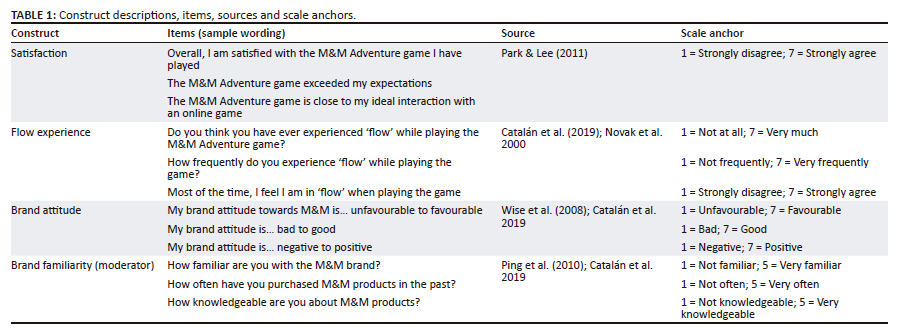
Data were collected through an online questionnaire administered after gameplay. The questionnaire comprised four main sections: (1) screening and consent, (2) technology and gaming background, (3) demographic profile and (4) psychometric measures of the focal constructs. Measurement items were adapted from validated scales in the literature to ensure construct reliability and contextual relevance (see Table 1). These included items for flow experience (Catalán et al. 2019; Novak, Hoffman & Yung 2000), satisfaction (Park & Lee 2011), brand attitude (Catalán et al. 2019; Wise et al. 2008) and brand familiarity (Catalán et al. 2019; Ping, Goh & Teo 2010).
A pilot test involving 30 respondents was conducted to assess the clarity, sequence and relevance of the questionnaire. Feedback from the pilot informed final refinements to ensure a clear and user-friendly instrument. The pilot group reflected similar demographic characteristics to the main sample, increasing contextual relevance.
Sample and procedure
A total of 311 online questionnaires were received between 25 June and 23 July 2023. Following a data quality review, five responses were removed because of incompleteness or response bias, resulting in a final valid sample of 306 respondents and a response rate of 98.5%. Respondents were recruited using a combination of convenience and snowball sampling (Etikan & Bala 2017). Respondents were South African consumers aged between 18 and 35 years, corresponding to digitally engaged Generation Z and Millennial cohorts - demographics known to be most responsive to mobile advergames.
To participate, respondents had to meet the following inclusion criteria: (1) be at least 18 years old, (2) agree to participate voluntarily, (3) consent to downloading and playing the M&M's Adventure mobile game (the game was free) and (4) complete the online questionnaire in full. Individuals who did not fulfil these requirements were excluded from the study. Respondents were asked to first play the advergame and then complete the survey, which took approximately 10 min to complete.
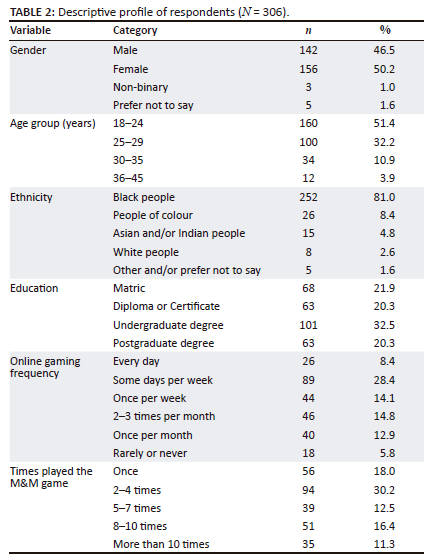
A summary of the demographic characteristics of the sample is provided in Table 2. The majority of respondents identified as black (81%), female (50.2%) and aged between 18 and 24 years (51.4%). Online gaming frequency and preferences varied, with a substantial proportion engaging in virtual reality (25.7%) and augmented reality games (19%). Respondents reported various motivations for gaming, including escapism, social connection and fantasy.
Construct measurement
Table 1 presents the constructs, sources, item wording and scale anchors. All items were measured using seven-point or five-point Likert-type scales, depending on construct-specific best practices.
Data analysis and validity checks
Data were analysed using SmartPLS 4 (Ringle, Wende & Becker 2024), a widely recognised tool for estimating both the measurement model and structural paths in PLS-SEM. The model's adequacy was verified using several criteria. Standardised Root Mean Square Residual (SRMR) was used to assess global model fit (Henseler, Ringle & Sarstedt 2016). Variance Inflation Factors (VIF) were used to detect multicollinearity among indicators (Diamantopoulos & Siguaw 2006). To assess common method bias (CMB), the full collinearity approach was applied, whereby VIF values for each latent construct were examined (Kock 2015). In addition, Harman's single-factor test was conducted, along with a one-factor model using maximum likelihood (ML) estimation with Promax rotation, to determine whether a single factor accounted for the majority of the variance, and further ensure that CMB is not a significant threat to validity.
To detect non-response bias, early and late respondents were compared following Armstrong and Overton's (1977) method. The potential for endogeneity was addressed through the Gaussian copula (GC) approach (Hult et al. 2018), which is suited for nonlinear estimation within PLS-SEM.
Moderation analysis
The moderating effect of brand familiarity on the relationship between flow experience and satisfaction was examined using a two-stage approach in SmartPLS. In the first stage, latent variable scores were extracted based on the measurement model. In the second stage, an interaction term was computed by multiplying standardised scores for flow experience and brand familiarity. This interaction term was added to the structural model to test whether the relationship between flow experience and satisfaction was contingent upon brand familiarity. Significance was assessed via bootstrapping with 5 000 subsamples as recommended by Hair et al. (2019), producing bias-corrected confidence intervals and p-values.
Ethical considerations
Throughout both the pilot and main data collection phases (June 2023-August 2023), strict ethical protocols were observed. Ethical clearance was granted by the researchers' higher education institution under approval number 2022SCiiS019. The Faculty Research Ethics Committee reviewed and approved the questionnaire, cover letter and consent documentation to ensure compliance with institutional and national ethical standards. Informed consent was obtained electronically at the start of the online questionnaire. Respondents confirmed that they were 18 years or older and voluntarily agreed to download and play the M&M's Adventure mobile game before completing the survey. Participation was entirely voluntary, with the right to withdraw at any time without penalty. No personally identifiable information was collected, ensuring anonymity and confidentiality. Respondents were informed about how their data would be accessed, securely stored, and used solely for academic purposes. In line with data protection regulations, they also retained the right to access, amend or object to the processing of their personal information. The study focused exclusively on human participants engaging with a mobile advergame.
Results
Measurement model evaluation
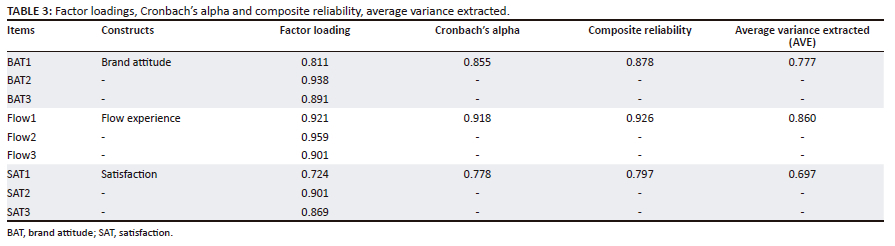
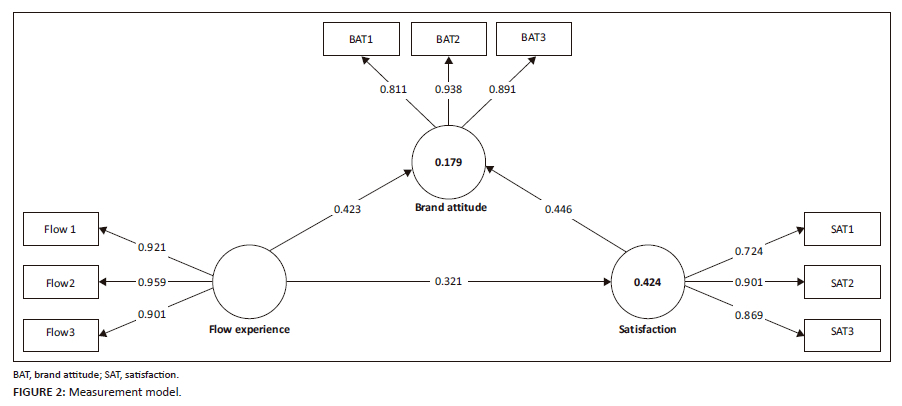
The reliability and validity of the constructs, flow experience, brand attitude, satisfaction and brand familiarity were assessed before estimating the structural model. Table 3 presents the indicator loadings, Cronbach's alpha values, composite reliability (CR) and average variance extracted (AVE) for all constructs. All item loadings ranged from 0.724 satisfaction/satisfaction item 1 (SAT/SAT1) to 0.959 (Flow2), exceeding the recommended threshold of 0.70 (Hair et al. 2019). Internal consistency reliability was confirmed as Cronbach's alpha, and CR values for each construct exceeded 0.70, ranging between 0.778 and 0.926. Convergent validity was established as all AVE values were above the 0.50 threshold, ranging from 0.697 to 0.860 (see Figure 2).
Discriminant validity
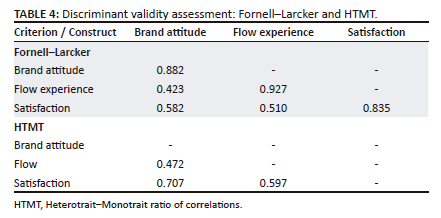
Discriminant validity was assessed using the Fornell-Larcker criterion and Heterotrait-Monotrait ratio of correlations (HTMT) ratios (Table 4). The square root of each construct's AVE (brand attitude: 0.882; flow experience: 0.927; satisfaction: 0.835) exceeded its inter-construct correlations (e.g. brand attitude-satisfaction: 0.582), satisfying the Fornell-Larcker criterion. HTMT ratios (e.g. brand attitude-satisfaction: 0.707; flow experience-satisfaction: 0.597) were below the 0.85 threshold, further confirming discriminant validity (Henseler et al. 2016).
Structural model assessment
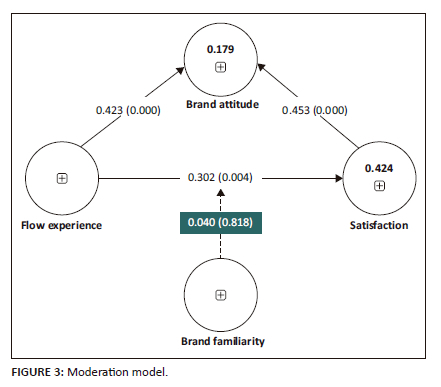
Figure 3 and Table 5 present the structural model results. All direct paths were statistically significant and in the expected direction. Flow experience significantly influenced brand attitude (β = 0.423, p < 0.001, f2 = 0.218), and both flow experience (β = 0.321, p < 0.001, f2 = 0.147) and brand attitude (β = 0.446, p < 0.001, f2 = 0.284) significantly influenced Satisfaction. The coefficient of determination (R2) indicated that 17.9% of the variance in brand attitude and 42.4% of the variance in Satisfaction were explained by the model. The R2 values of brand attitude and satisfaction align with typical explanatory power in behavioural research, where complex psychological constructs often yield moderate R2 values (Hair et al. 2019), as the study focuses on positive engagement drivers (flow experience, brand attitude, satisfaction). Predictive relevance (Q2) was confirmed with Q2 values of 0.169 for brand attitude and 0.253 for Satisfaction, exceeding zero.
Mediation and moderation analyses
A mediation analysis was conducted to examine whether brand attitude mediates the relationship between flow experience and Satisfaction. As shown in Table 6, the indirect effect from flow experience to satisfaction through brand attitude was statistically significant (β = 0.189, p < 0.001). This indicates partial mediation, as the direct effect of flow experience on Satisfaction remained significant. Thus, flow experience contributes to Satisfaction both directly and indirectly by enhancing brand attitude.
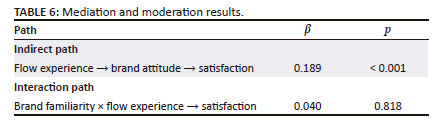
A moderation analysis was then performed using a two-stage approach to test whether brand familiarity moderates the relationship between flow experience and satisfaction. The interaction term was non-significant (β = 0.040, p = 0.818), indicating that brand familiarity does not significantly alter the strength of the flow experience-satisfaction relationship (see Figure 3). This result suggests that the influence of flow experience on satisfaction remains stable regardless of whether respondents are highly or minimally familiar with the brand.
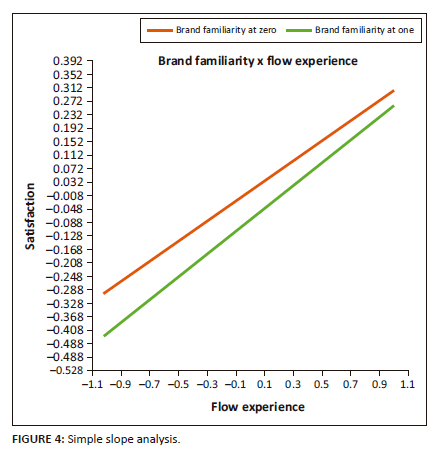
As illustrated in Figure 4, the slopes for both levels of brand familiarity (mean-centred at 0 and 1) are positive, indicating that higher levels of flow experience are associated with higher levels of satisfaction in both conditions. However, the lines are nearly parallel, and the slope difference is minimal, aligning with the non-significant interaction effect. Specifically, while satisfaction increases with flow experience, this increase occurs at a comparable rate regardless of respondents' brand familiarity.
Model fit and diagnostic checks
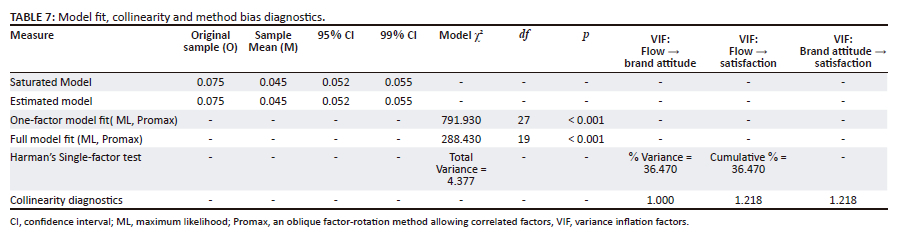
The structural model exhibited satisfactory fit. The SRMR for both the saturated and estimated models was 0.075, which is below the recommended cut-off of 0.08, indicating a good model-data fit (Henseler et al. 2016). The 95% and 99% confidence intervals for the SRMR further support the robustness of this fit (see Table 7).
Multicollinearity diagnostics were conducted by examining VIF values for all predictor constructs. As shown in Table 7, all VIF values were comfortably below the commonly accepted threshold of 2.0, suggesting no multicollinearity concerns among the predictors in the model.
To assess CMB, two diagnostic techniques were applied. Firstly, Harman's single-factor test was conducted. The analysis revealed that the first unrotated factor accounted for 36.47% of the total variance, which is below the conservative threshold of 50%, indicating that CMB is unlikely to substantially distort the data. Secondly, a confirmatory comparison between a constrained one-factor model and the full measurement model was performed using ML estimation with Promax rotation. The one-factor model yielded a poor fit (χ2 = 791.93, df = 27, p < 0.001), while the full model demonstrated a significantly better fit (χ2 = 288.43, df = 19, p < 0.001). This provides further evidence that the data are not dominated by a single latent factor, thereby supporting the absence of severe CMB (see Table 7).
Bias and endogeneity assessment
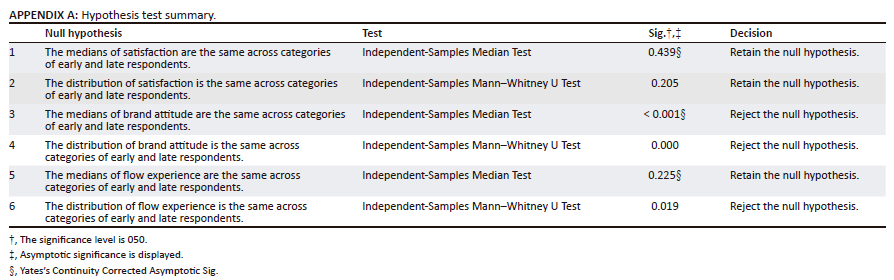
To examine potential non-response bias, a series of independent-samples median tests and Mann-Whitney U tests were conducted to compare early and late respondents. As reported in Appendix A, the findings indicate no statistically significant differences in satisfaction across response waves, both in terms of median and distribution. Similarly, while the median scores for flow experience did not differ significantly (p = 0.225), the distributional test revealed a statistically significant difference (p = 0.019), suggesting mild variation in how flow experience was experienced between early and late respondents.
Of particular note, brand attitude showed significant differences across both median (p < 0.001) and distribution (p = 0.000) tests, indicating a moderate degree of non-response bias on this construct. However, this bias is unlikely to affect the integrity of the structural model, as brand attitude acts as a mediator rather than an outcome, and all associated path relationships remain statistically significant and theoretically coherent.
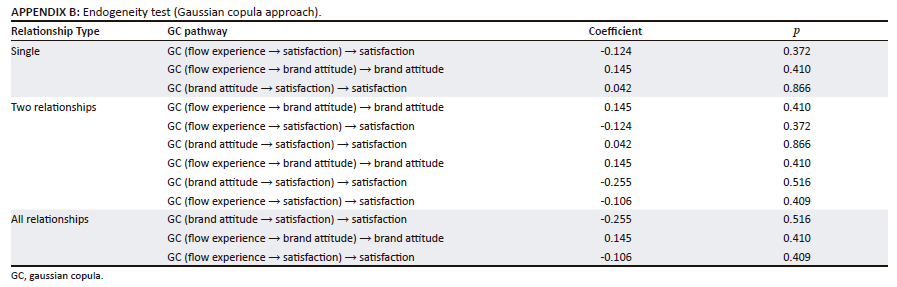
To further ensure the validity of the model, endogeneity was tested using the GC method, which is well-suited for detecting endogenous bias in non-linear models estimated using PLS-SEM (Hult et al. 2018). As summarised in Appendix B, all copula-based coefficients across single-path, two-path and full model specifications were statistically non-significant (p > 0.05). These findings confirm that none of the latent path relationships are biased by omitted variable endogeneity, and thus the model's inferences are statistically robust.
Discussion
This study offers a distinctive contribution to the advergaming literature by contextualising flow, brand attitude and satisfaction within a mobile-first branded game situated in the emerging market of South Africa. Whereas prior research has predominantly focused on Western, console-based or general online gaming platforms, this study targets younger mobile users aged 18-35 (Generation Z and Millennials) in a developing economy, users who are not only highly active on mobile but also key to future brand loyalty in these contexts. By examining a single-brand (M&M's), single-game (M&M's Adventure) format, the research provides granular insights into how immersive game design translates into consumer satisfaction and brand perception. These boundary conditions, market (South Africa), format (mobile advergame) and demographic (Generation Z and millennials), help explain why this model is theoretically and managerially relevant, despite the focused scope.
The findings from this study provide strong support for the proposed model connecting flow experience, brand attitude and satisfaction within the advergame context of M&M's Adventure mobile game. The results confirm that flow experience, a psychological state of deep involvement and immersion in gameplay, substantially influences users' attitudes towards the brand. This aligns with Van Berlo and Chen's (2024) work, which found that immersive game experiences heighten emotional and cognitive brand engagement. Similarly, Demidiuk and Plechawska (2022) emphasised the importance of immersion in generating user involvement and prolonged engagement, which subsequently strengthens brand perception.
In addition, flow experience was found to have a direct and positive influence on satisfaction with the game. This supports previous research by Kusumo et al. (2024), who reported that engaging gamification elements, such as challenges and rewards, enhances user satisfaction, particularly among younger demographics like millennials. Arifah et al. (2022) also observed that advergame satisfaction arises from successfully integrating entertainment and branding, creating positive emotional responses.
Brand attitude also emerged as a strong predictor of satisfaction. This aligns with the literature on gamified marketing, where a favourable attitude towards a brand often translates into positive evaluations of the brand experience. Zhang and Tang (2023) highlighted that gamification features in digital media platforms can significantly shape attitudes, affecting satisfaction levels. Lukita et al. (2023) similarly noted that positive brand attitudes often lead to increased brand loyalty and long-term engagement.
Significantly, brand attitude partially mediates the relationship between flow experience and satisfaction. This suggests that while flow experience directly influences satisfaction, it also indirectly affects how users perceive the brand. This echoes the findings of Van Berlo and Chen (2024), who argued that brand-related satisfaction in gamified environments is driven not only by the game experience itself but also by the perceptions formed about the brand during gameplay.
However, the results did not reveal a significant moderating effect of brand familiarity on the relationship between flow experience and satisfaction. This result contrasts with earlier studies, such as those by Arifah et al. (2022), which suggested that consumers with a higher degree of familiarity with a brand are more responsive to its gamified content. One plausible explanation for the present finding is that the immersive design of M&M's Adventure game may have been engaging enough to generate satisfaction independently of prior brand familiarity.
Practical managerial implications and recommendations
The findings of this study hold several valuable implications for brand managers, digital marketers and game developers aiming to integrate gamification strategies, particularly advergames, into their marketing communication mix. As the evidence from this study demonstrates, immersive gameplay (flow experience) plays a significant role in shaping consumers' brand attitudes and overall satisfaction with the branded experience. These insights can be translated into actionable strategies to enhance brand-consumer engagement in competitive digital environments.
Prioritise game design that facilitates flow experiences
The results indicated flow experience as a central psychological mechanism that enhances brand attitude and satisfaction. Flow experience is characterised by a deep absorption and enjoyment during gameplay, significantly influencing how consumers experience the brand. Therefore, companies aiming to deploy advergames must invest in game design that provides clear objectives, balanced difficulty and immediate feedback to sustain user engagement. Developers should create intuitive user interfaces, integrate storytelling elements and ensure responsive controls to maintain seamless interactivity. These are all features known to support immersive experiences. Investing in user testing during development can help identify friction points hindering the flow experience state.
Embed branding subtly within the gaming experience
Rather than intrusive or overt branding, it is suggested that the effectiveness of advergames lies in how well brand elements are woven into the gaming narrative and mechanics. When the brand is perceived as part of the experience rather than an interruption, it positively shapes consumer perceptions. Brands can incorporate their visual identity through characters, themes or in-game items to reinforce brand values without overwhelming the gameplay. This integration enhances brand attitude, which drives satisfaction and potentially brand loyalty. It is critical to balance entertainment and promotion to avoid perceptions of inauthenticity or manipulation.
Enhance post-game engagement strategies
The results revealed that a positive brand attitude formed during gameplay can significantly impact satisfaction. Capitalising on this emotional connection, marketers should develop strategies to extend the engagement beyond the game itself. For example, satisfied players could be incentivised to participate in loyalty programmes, social media campaigns or brand communities. Offering limited-time in-game events or exclusive content can also encourage repeat play and deepen the emotional bond with the brand. Furthermore, sharing in-game achievements or rewards on social platforms may create word-of-mouth momentum and help expand the brand's reach.
Use advergames for market expansion and brand discovery
Interestingly, brand familiarity did not significantly moderate the relationship between flow experience and satisfaction, suggesting that even consumers unfamiliar with the brand can have highly satisfying experiences if the gameplay is well-designed. This finding holds important implications for brands aiming to expand into new markets or reach previously untapped demographics. By offering an engaging and immersive gaming experience, brands can overcome initial awareness barriers and establish meaningful connections with new consumers. Advergames, therefore, are not just tools for retention but also powerful vehicles for customer acquisition and market entry strategies.
Evaluate success using experience-based metrics
Traditional advertising metrics, such as impressions or click-through rates, may be inadequate to assess the impact of advergames. Given that psychological engagement (flow experience) and affective response (brand attitude and satisfaction) are key outcomes, marketers should consider adopting experience-based metrics, such as user immersion, emotional response, game enjoyment and time spent in-game. These indicators provide a more nuanced understanding of how users interact with the brand through the game and can inform iterative improvements to enhance effectiveness.
Collaborate across disciplines for holistic advergame development
Successful advergame execution requires collaboration between marketing strategists, user experience (UX) designers, behavioural scientists and data analysts. While marketing teams can define brand messaging goals, UX experts ensure that gameplay aligns with cognitive and emotional engagement principles. Behavioural insights can help structure rewards and challenge systems, while data analysts monitor engagement patterns and satisfaction drivers. A multidisciplinary approach ensures that all elements of the advergame work cohesively to create meaningful and enjoyable brand interactions.
Future-proof engagement through mobile optimisation
Given the mobile-first nature of M&M's Adventure game, marketers should ensure that advergames are optimised for mobile devices. As younger consumers, particularly Generation Z and millennials, spend significant time on mobile platforms, advergames must provide quick load times, offline functionality and seamless integration with app stores and social sharing features. A mobile-optimised game ensures accessibility, user convenience and broader reach.
Limitations and future research
Firstly, adventure mobile games may limit the generalisability of findings to other advergames with different mechanics, narratives or brand integrations. Secondly, the sample is restricted to South African millennials and Generation Z, potentially overlooking cultural, socio-economic or generational variations that could influence consumer responses to advergaming. In addition, the cross-sectional design captures a snapshot of consumer behaviour, which may not account for long-term engagement or evolving brand perceptions. Lastly, the reliance on self-reported data introduces the possibility of response bias, which could affect the accuracy of the findings.
Future research should address these limitations by exploring a broader range of advergames to assess the consistency of flow experience, brand attitude and satisfaction across diverse gaming contexts. Comparative studies across different cultural or demographic groups could elucidate how contextual factors shape advergaming effectiveness. Longitudinal designs would offer insights into the sustained impact of advergames on brand loyalty and consumer behaviour over time. Furthermore, incorporating objective measures, such as gameplay analytics or physiological data, could mitigate self-report biases and provide a more nuanced understanding of user engagement. These avenues would enhance advergaming research's theoretical and practical contributions, particularly in emerging markets.
Conclusion
This study provides empirical insights into how advergames influence consumer engagement outcomes, specifically M&M's Adventure mobile game. The findings demonstrate that the psychological flow experience state during gameplay significantly enhances users' attitudes towards the brand and overall satisfaction with the advergame. In addition, brand attitude was found to partially mediate the relationship between flow experience and satisfaction, suggesting that positive perceptions of the brand further reinforce the satisfaction derived from the gaming experience. Although brand familiarity was proposed as a moderator, it did not significantly influence the relationship between flow experience and satisfaction, indicating that advergames can generate positive outcomes regardless of a user's prior knowledge or connection with the brand.
This research is significant for several reasons. It advances the limited empirical literature on advergaming by validating a model that links flow experience, brand attitude and satisfaction using PLS-SEM. It also contributes contextual relevance by focusing on South African millennials and Generation Z, key demographics in the digital marketing landscape. The study offers practical guidance for marketers seeking to enhance brand engagement through gamified experiences. It confirms that well-designed advergames can be effective even among users less familiar with the brand.
Overall, this study demonstrated that advergames are a valuable tool for fostering deeper consumer engagement and satisfaction, and it provides a foundation for future research into the psychological and branding impacts of gamification across diverse markets.
Acknowledgements
The authors wish to acknowledge S. Ncube, A. Baule, and K. Mbatha, who, as part of their Honours research project, conducted an initial study entitled Analysing Mobile Advergaming Effectiveness in an Emerging Market Context. The present article extends this foundational work by collecting additional empirical data, refining the theoretical framework, and performing new analyses to develop an enhanced conceptual model. These efforts culminated in the current study titled Tapping into Play: Flow and Brand Attitude Driving Satisfaction in Mobile Advergaming in Mobile Advergaming.
Competing interests
The authors declare that they have no financial or personal relationship(s) that may have inappropriately influenced them in writing this article.
Authors' contributions
M.K.N. and I.L. contributed to the design and implementation of the research, to the analysis of the results and to the writing of the manuscript. All authors, M.K.M. and W.I.L., contributed to the article, discussed the results and approved the final version for submission and publication.
Funding information
This research did not receive any specific grant from funding agencies in the public, commercial or not-for-profit sectors.
Data availability
Data sharing is not applicable to this article as no new data were created or analysed in this study.
Disclaimer
The views and opinions expressed in this article are those of the author(s) and are the product of professional research. It does not necessarily reflect the official policy or position of any affiliated institution, funder, agency or that of the publisher. The author(s) are responsible for this article's results, findings and content.
References
Adis, A.A., 2020, 'Use of mobile advergame as brand communication tool', Journal of Social Transformation and Regional Development 2(1), 27-41. https://doi.org/10.30880/JSTARD.2020.02.01.004 [ Links ]
Anandya, D., Prabowo, B. & Darsono, A., 2023, 'The effect of flow factor on brand attitude and purchase intention in mobile legend: Bang-Bang', Jurnal Ekonomi dan Bisnis 4(3), 159-166. https://doi.org/10.24123/jeb.v4i3.5812 [ Links ]
Arifah, I.D.C., Suryani, E. & Samopa, F., 2022, 'Advergame and e-commerce consumer decision: Systematic literature network analysis', in Proceedings of the 6th International Conference on E-Commerce, E-Business and E-Government, Association for Computing Machinery, New York, NY, pp. 51-58. [ Links ]
Armstrong, S.J. & Overton, T.S., 1977, 'Estimating nonresponse error in mail surveys', Journal of Marketing Research 14(3), 396-402. [ Links ]
Ball, M., 2024, The tremendous yet troubled state of gaming in 2024, viewed 17 August 2025, from https://www.matthewball.co/all/gaming2024. [ Links ]
Biró, E. & Kato, B., 2024, 'Exploring enjoyment and flow among monolingual and bilingual learners of English', Acta Universitatis Sapientiae 16(2), 88-107 https://doi.org/10.47745/ausp-2024-0018 [ Links ]
Catalán, S., Martínez, E. & Wallace, E., 2019, 'Analysing mobile advergaming effectiveness: The role of flow, game repetition and brand familiarity', Journal of Product and Brand Management 28(4), 502-514 https://doi.org/10.1108/JPBM-07-2018-1929 [ Links ]
Chiong, K., Yang, S. & Chen, R., 2020, 'Understanding the effect of incentivized advertising along the conversion funnel', SSRN Electronic Journal 1-63. https://doi.org/10.2139/ssrn.3714353 [ Links ]
Csikszentmihalyi, M., 1975, Beyond boredom and anxiety: Experiencing flow in work and play, Jossey-Bass, San Francisco, CA. [ Links ]
Demidiuk, K. & Plechawska-Wójcik, M., 2022, 'Analysis of the impact of various gamification factors on the level of player satisfaction', Journal of Computer Sciences Institute 22, 1-7. https://doi.org/10.35784/jcsi.2770 [ Links ]
Diamantopoulos, A. & Siguaw, J.A., 2006, 'Formative versus reflective indicators in organizational measure development: A comparison and empirical illustration', British Journal of Management 17(4), 263-282. [ Links ]
Etikan, I. & Bala, K., 2017, 'Sampling and sampling methods', Biometrics and Biostatistics International Journal 5(6), 149. https://doi.org/10.15406/bbij.2017.05.00149 [ Links ]
Farzinnejad, F. & Baghaei, N., 2022, 'Enhancing customer experience and brand awareness through familiar gameplay in advergames', in 2022 IEEE Asia-Pacific Conference on Computer Science and Data Engineering (CSDE), IEEE, December 18-20, 2022, pp. 1-5. [ Links ]
Farzinnejad, F., Khezrian, H., Kasiri, M. & Baghaei, N., 2024, 'Enhancing consumer user experience, education and brand awareness through musical advergames', arXiv. https://doi.org/10.48550/arxiv.2406.12598 [ Links ]
Ghosh, T., Sreejesh, S. & Dwivedi, Y.K., 2021, 'Examining the deferred effects of gaming platform and game speed of advergames on memory, attitude, and purchase intention', Journal of Interactive Marketing 55(1), 52-66. https://doi.org/10.1016/j.intmar.2021.02.002 [ Links ]
Hair, J.F., Babin, B.J., Anderson, R.E. & Black, W.C., 2019, Multivariate data analysis, 8th edn., Pearson Prentice Hall, Upper Saddle River, NJ. [ Links ]
Hair, J.F., Black, W.C., Babin, B.J. & Anderson, R.E., 2019, CRS 714: Advanced quantitative research methodology, Cengage, Boston, MA. [ Links ]
Hartini, S., 2020, 'Mobile advergame: Analysis of flow, attitudes and competitor trait as the moderating variable', International Journal of Mobile Learning and Organisation 14(3), 322-337. https://doi.org/10.1504/IJMLO.2020.108929 [ Links ]
Heidari, H.M., 2024, 'The effect of viral promotional advergames on the behavioural reactions', Journal of Business Management 16(3), 721-748. [ Links ]
Henseler, J., Ringle, C.M. & Sarstedt, M., 2016, 'A new criterion for assessing discriminant validity in variance-based structural equation modeling', Journal of the Academy of Marketing Science 43(1), 115-135. https://doi.org/10.1007/s11747-014-0403-8 [ Links ]
Hooker, R., Wasko, M., Paradice, D.B., Teigland, R. & Hofacker, C.F., 2019, 'Beyond gaming: Linking flow, brand attitudes, and purchase intent in realistic and emergent three-dimensional virtual environments', Information Technology and People 32(6), 1397-1422. https://doi.org/10.1108/ITP-11-2017-0407 [ Links ]
Hsiao, W., Lin, Y.-H. & Wu, I.-L., 2022, 'Advergame for purchase intention via game and brand attitudes from antecedents of system design, psychological state, and game content: Interactive role of brand familiarity', Journal of Organizational Computing and Electronic Commerce 32(1), 45-68. https://doi.org/10.1080/10919392.2022.2038526 [ Links ]
Hult, G.T.M., Hair, Jr. J.F., Proksch, D., Sarstedt, M., Pinkwart, A. & Ringle, C.M., 2018, 'Addressing endogeneity in international marketing applications of partial least squares structural equation modeling', Journal of International Marketing 26(3), 1-21. [ Links ]
Khezrian, N., Farzinnejad, F. & Baghaei, N., 2022, 'Enhancing customer experience and brand awareness through familiar gameplay in advergames', in 2022 IEEE Asia-Pacific Conference on Computer Science and Data Engineering (CSDE), IEEE, pp. 1-5. [ Links ]
Kim, Y.H., Kim, D.J. & Wachter, K., 2013, 'A study of mobile user engagement (MoEN): Engagement motivations, perceived value, satisfaction, and continued engagement intention', Decision Support Systems 56, 361-370. [ Links ]
Knezovic, A., 2025, Gaming industry report 2025: Market size & trends, viewed 17 August 2025, from https://www.blog.udonis.co/mobile-marketing/mobile-games/gaming-industry. [ Links ]
Kock, N., 2015, 'Common method bias in PLS-SEM: A full collinearity assessment approach', International Journal of e-Collaboration 11(4), 1-10. [ Links ]
Komulainen, R., Lappeman, J. & Islam, A.K.M.N., 2019, 'Determining banner advertisement effectiveness in mobile games: A study from South Africa', The Retail and Marketing Review 15(1), 57-71. [ Links ]
Kusumo, A.J., Aini, Q., Millah, S., Nurhaeni, T. & Sunarya, L., 2024, 'Exploring the user satisfaction of gamification in promoting savings among Millennials', in 2024 International Conference on Technology, Informatics, and Information Applications (ICTIIA), IEEE, pp. 1-6. [ Links ]
Li, N. & Aumeboonsuke, V., 2025, 'How gamification features drive brand loyalty: The mediating roles of consumer experience and brand engagement', Journal of Theoretical and Applied Electronic Commerce Research 20(2), 113. https://doi.org/10.3390/jtaer20020113 [ Links ]
Lukita, C., Lutfiani, N., Panjaitan, A.R.S., Rahardja, U. & Huzaifah, M.L., 2023, 'Harnessing the power of random forest in predicting startup partnership success', in 2023 Eighth International Conference on Informatics and Computing (ICIC), IEEE, pp. 1-6. [ Links ]
Masao, M. & Salehudin, I., 2023, 'Unveiling the dynamics of expectation, flow, enjoyment, and satisfaction: Drivers of continued subscription intentions among Netflix users', South East Asian Journal of Management 17(2), 96-121. https://doi.org/10.21002/seam.v17i2.1410 [ Links ]
Mittal, S. & Kumar, V., 2020, 'A framework for ethical mobile marketing', International Journal of Technoethics 11(1), 28-42. https://doi.org/10.4018/IJT.2020010103 [ Links ]
Mittal, S., Kumar, V. & Seppi, J., 2022, 'Targeting mobile gamers community for marketing campaigns', Journal of Content, Community and Communication 16(2), 106-117. https://doi.org/10.31620/JCCC.06.22/09 [ Links ]
Novak, T.P., Hoffman, D.L. & Yung, Y.F., 2000, Measuring the flow construct in online environments: A structural modeling approach, Owen Graduate School of Management, Vanderbilt University, Nashville, TN. [ Links ]
Paizanis, G., Schonfeld, R., Pagano, E. & Schmidt, N., 2024, The gaming report: Leveling up for the new reality, Boston Consulting Group, viewed 17 August 2025, from https://www.bcg.com/publications/2024/leveling-up-new-reality. [ Links ]
Park, J.H. & Lee, B.R., 2011, 'Towards an understanding of user satisfaction and continuance intention in human-mediated services: An investigation of academic libraries', Journal of Information Management 42(3), 187-210. [ Links ]
Ping, J.W., Goh, K.Y. & Teo, H.H., 2010, 'Engaging consumers with advergames: An experimental evaluation of interactivity, relevancy and expectancy', in International conferences on information systems (ICIS), Association for Information Systems (AIS), Saint Louis, MI, pp. 1-22, 12-15 December. [ Links ]
Ringle, C.M., Wende, S. & Becker, J.-M., 2024, SmartPLS 4, SmartPLS, Bönningstedt, viewed 08 August 2025, from https://www.smartpls.com. [ Links ]
Singh, Y. & Milan, R., 2025, 'Utilitarian and hedonic values of gamification and their influence on brand engagement, loyalty, trust and WoM', Entertainment Computing 52, 100868. https://doi.org/10.1016/j.entcom.2024.100868 [ Links ]
Statista Market Insights, 2024, In-app advertising - Worldwide, viewed 08 August 2025, from https://www.statista.com/outlook/amo/advertising/in-app-advertising/worldwide#ad-spending. [ Links ]
Utomo, K. & Oktavia, T., 2024, 'Effects of user experience on immersion and intention to play augmented reality games', Journal of Logistics, Informatics and Service Science 11(7), 170-187, viewed 17 August 2025, from https://www.aasmr.org/liss/Vol.11/No.7/Vol.11.No.7.10.pdf. [ Links ]
Van Berlo, Z.M., Van Reijmersdal, E.A. & Eisend, M., 2021, 'The gamification of branded content: A meta-analysis of advergame effects', Journal of Advertising 50(2), 179-196. https://doi.org/10.1080/00913367.2020.1858452 [ Links ]
Van Berlo, Z.M.C. & Chen, X., 2024, 'Advergames and consumer brand engagement: Experiential satisfaction as a mediator of gamified advertising effects', Journal of Interactive Advertising 24(1), 1-9. https://doi.org/10.1080/15252019.2024.2335398 [ Links ]
Wang, Y., Wang, J. & Zuo, W., 2023, 'The influence of enjoyment factors, satisfaction, and flow experience on the happiness of Chinese dance sports participants', Asia Pacific Journal of Applied Sport Sciences 4(2), 1-14. https://doi.org/10.46695/ascs.4.2.1 [ Links ]
Wanick, V., Dunn, R., Ranchhod, A. & Wills, G., 2019, 'Analysing cross-cultural design in advergames: A comparison between the UK and Brazil', EAI Endorsed Transactions on Serious Games 18(1), 1-13. https://doi.org/10.4108/eai.26-9-2019.162935 [ Links ]
Wise, K., Bolls, P.D., Kim, H., Venkataraman, A. & Meyer, R., 2008, 'Enjoyment of advergames and brand attitudes: The impact of thematic relevance', Journal of Interactive Advertising 9(1), 27-36. https://doi.org/10.1080/15252019.2008.10722141 [ Links ]
Zhang, J. & Tang, Q., 2023, 'Research on user satisfaction of gamification elements in short video applications: A comprehensive method based on Kano model', in P.-L.P. Rau (ed.) Human-centered design, operation and evaluation: 15th International Conference, CCD 2023, Held as Part of the 25th International Conference, HCII 2023, Copenhagen, Denmark, Proceedings, Part II, Springer, Cham, July 23-28, 2023, pp. 47-70. [ Links ]
 Correspondence:
Mayemba Nzita
mayemban@uj.ac.za
Received: 21 May 2025
Accepted: 01 Oct. 2025
Published: 19 Nov. 2025
1. M&M (Mars Incorporated) is a global confectionery brand, featuring the branded mobile advergame 'M&M's Adventure'.
2. The KANO model is a model of customer satisfaction that classifies features into must-be, one-dimensional, attractive, indifferent, reverse (and questionable) categories to predict satisfaction effects.
Appendices