




Services on Demand
Journal

Article
 English (pdf)
 Article in xml format
 Article references

 Automatic translation
 Send this article by e-mail
Indicators
Related links
-
 Cited by Google
-
 Similars in Google
Share

 Permalink

Obiter
On-line version ISSN 2709-555XPrint version ISSN 1682-5853
Obiter vol.46 n.2 Port Elizabeth 2025
NOTES / AANTEKENINGE
Determining a Reasonable Deposit in terms of Section 17 of the Consumer Protection Act 68 of 2008 in the Tourism Industry
1 Introduction
Judge Malcolm Wallis of the Supreme Court of Appeal wrote:
"To some it may seem axiomatic that we need legal certainty in regard to commercial transactions, be they multi-billion rand contracts between commercial and financial behemoths, or the everyday shopping expedition of ordinary citizens." ("Commercial Certainty and Constitutionalism: Are They Compatible?" 2016 (3) SALJ 545 547)
The judge continued:
"In a modern regulated society the need for some regulation of economic activity is regarded as essential. That is why we have legislation governing certain types of contracts and, in the interests of certainty, require them to be in writing. It is also why we have consumer protection legislation and a Competition Act and Competition Appeal Court." (550-551, footnotes omitted)
By regulating the relations between consumers and service providers, the Consumer Protection Act (68 of 2008) (CPA) is meant to provide certainty to the parties. Greater certainty reduces conflict requiring resolution through mechanisms such as the courts, which, in turn, better serves the interests of consumers and service providers alike. A good example is section 17 of the CPA. This section provides a consumer with the right to cancel an advance booking, reservation or order. In turn, the section permits a service provider to request payment of a reasonable deposit, and if the advance booking, reservation or order is cancelled, the service provider is entitled to impose a reasonable cancellation charge. Section 17(4) provides some guidance on what constitutes a "reasonable charge" in terms of the section.
At first glance, these provisions appear to be rather straightforward and not to present problems in practical situations. However, it is not as straightforward as it may appear for consumers and service providers to know with some degree of certainty what section 17 permits in allowing service providers to require payment of a reasonable deposit and a reasonable charge for cancellation of an advance booking, reservation or order. What is to be understood by the right of the service provider to request a reasonable deposit and impose a reasonable cancellation charge? For consumers and service providers to understand what is permissible in terms of section 17 and what is not, a more detailed consideration of the section is required. The first question one may ask is: what constitutes a reasonable deposit and how is it to be determined? Stated differently, the question may be formulated as: when is a deposit reasonable? Answering this question, in turn, may require determining whether the reasonableness of a deposit is to be decided by having regard to the factors provided in section 17(4), or whether these factors are only to be considered when determining a charge for cancellation. Furthermore, is there a relationship between a reasonable deposit and a reasonable charge for cancellation? A final question for consideration is whether a "non-refundable" deposit is permitted in terms of the CPA, and if so, under what circumstances. The aim of this note is to consider and answer these questions.
Problems are more likely to arise when an advance booking is cancelled, and a cancellation charge, that the consumer considers unreasonable is imposed. At this juncture, it is noted that the determination of a reasonable charge for cancellation of an advance booking has been considered elsewhere (see Tait "Accommodation Establishments and the Cancellation of Advance Bookings: The Challenge of Determining a Reasonable Cancellation Fee" 2020 32(2) SA Merc LJ 277). For that reason, the emphasis in this note is on determining a reasonable deposit, which is done within the context of the tourism and hospitality industry.
The recent COVID-19 pandemic and resultant lock-down legislation implemented in many countries, including the prohibition of especially leisure travel, resulted in the cancellation of many advance bookings in the hospitality and travel industry. It is probably fair to say that because of these tumultuous events, both consumers and service providers in the tourism industry (but also service providers and suppliers generally) have realised how quickly things can change. As a result, it is likely that consumers are taking more careful note of the terms and conditions of consumer contracts offered by service providers in the tourism industry insofar as they pertain to the payment of deposits, the cancellation of advance bookings, and the refunding of deposits. Similarly, service providers in the industry need to consider their policies carefully, insofar as they pertain to deposits required and cancellation charges, to ensure that such policies are compliant with the law. However, as stated above, determining compliance with section 17 may not be as easy as it appears at face value. This note is an attempt to assist both consumers and service providers with clear and practical guidance on the use of section 17. It is by no means suggested that this note proposes the final answer, but it may assist consumers and service providers to establish the certainty sought from the legislation.
For purposes of this note, it needs to be pointed out that although section 17 can apply to suppliers generally, reference is only made here to service providers, and not suppliers, as the discussion is placed within the context of the tourism and hospitality industry, which essentially is a service industry. Section 17 is also especially likely to affect the tourism and hospitality industry (see De Stadler Consumer Law Unlocked (2013) 131).
For current purposes, reference is made only to "booking" as opposed to the phrase "booking, reservation and order", which is used in section 17. It has been argued elsewhere (see Tait 2020 SA Merc LJ 280-281) that there are some concerns with how section 17 is drafted. One such concern pertains to the inconsistent use of the terms "booking" and "reservation" in the section. The heading of the section refers to "advance reservation, booking or order". In subsections (2) and (5), it is changed to "advance booking, reservation or order". Subsection (3) provides that a service provider "who makes a commitment or accepts a reservation to supply goods and services on a later date may" require payment of a reasonable deposit (emphasis added). It makes no mention of an advance booking or order. Section 17(3)(0), which permits the charging of a reasonable cancellation charge, again makes no mention of "booking", referring only to "order or reservation". It could not have been the intention to permit a service provider to require payment of a deposit only in respect of an advance reservation and not an advance booking. Nor could it have been the intention that a cancellation charge only be capable of being imposed in respect of the cancellation of an advance reservation, but not for an advance booking. In any event, it is submitted that reservation and booking carry the same meaning and are synonyms (see the definitions of the two terms respectively in Wehmeier Oxford Advanced Learner's Dictionary of Current English 7ed (2005) 159 and 1242, where it is also indicated that "booking" is the term used in British English. The use of both terms in the section, therefore, is tautologous.)
2 The right to cancel an advance booking
The starting point for this discussion must be section 17, which provides consumers with a specific right to cancel an advance booking. Section 17(2) reads as follows:
"Subject to subsections (3) and (4), a consumer has the right to cancel any advance booking, reservation or order for any goods or services to be supplied."
Section 17(2) contains the core element of the provision and gives effect to the fundamental consumer right to choose. As pointed out by Van Eeden and Barnard (Consumer Protection Law in South Africa 2ed (2017) 370-371), before the enactment of the CPA and in terms of the principle of freedom of contract, a service provider would have been permitted to hold a consumer liable for performance (payment) where the consumer has made an advance booking, regardless of any change in circumstances of the consumer or whether the consumer will be able to derive any benefit or enjoyment from the booking, and even where the service provider does not suffer a loss as the booking was sold to another consumer. This section now provides consumers with a clear right to cancel an advance booking. Simply put, it means that a consumer, despite having concluded a valid contract with a service provider, cannot be forced to go through with the contract. The consumer's right to cancel a contract without reason (considering the fundamental role and importance of the principle of sanctity of contracts expressed in the maxim pacta servanda sunt) is indeed of considerable benefit to the consumer, particularly when making advance bookings for services such as accommodation and for participating in future excursions or activities.
At this juncture, it is necessary to refer to section 51 of the CPA. This section provides that a service provider is prohibited from making a consumer contract subject to certain terms or conditions. Section 51(3) specifically provides that such prohibited terms or conditions are void to the extent that the term or condition contravenes the section. What terms and conditions are prohibited? Relevant parts of section 51(1) read as follows:
"A supplier must not make a transaction or agreement subject to any term or condition if-
(a) ...
(b) it directly or indirectly purports to-
(i) waive or deprive a consumer of a right in terms of this Act;
(ii) ...
(iii) set aside or override the effect of any provision of this Act;
It appears clear that a service provider cannot include a term or condition in a consumer contract that derogates from the consumer's right to cancel an advance booking or renders it nugatory, and a term or condition attempting to do so will be void.
However, the right of the consumer to cancel an advance booking is not an unqualified right and is subject to subsections (3) and (4), as follows:
"(3) A supplier who makes a commitment or accepts a reservation to supply goods or services on a later date may-
(a) require payment of a reasonable deposit in advance; and
(b) impose a reasonable charge for cancellation of the order or reservation, subject to subsection (5).
(4) For the purposes of this section, a charge is unreasonable if it exceeds a fair amount in the circumstances, having regard to-
(a) the nature of the goods or services that were reserved or booked;
(b) the length of notice of cancellation provided by the consumer;
(c) the reasonable potential for the service provider, acting diligently, to find an alternative consumer between the time of receiving the cancellation notice and the time of the cancelled reservation; and
(d) the general practice of the relevant industry."
The payment of a reasonable deposit is considered next.
3 The right to require payment of a reasonable deposit
The right of the consumer to cancel an advance booking is balanced first by the service provider's right to require payment of a reasonable deposit. "Deposit" is not defined by the CPA, but the dictionary definition states that a deposit is "a sum of money that is given as the first part of a larger payment" (Wehmeier Oxford Advanced Learner's Dictionary of Current English 392). Requiring a deposit in advance serves to provide security to ensure that the consumer will honour the booking when the time comes, failing which the deposit is forfeited to make good the (potential) loss suffered. De Stadler states:
"What would happen in practice is that the supplier will charge a reasonable deposit, which will be forfeited in part or in whole upon cancellation. This approach is to the benefit the supplier, because the supplier will not have to bring a claim against the consumer for the cancellation penalty; it can simply deduct it from the deposit already in its possession." (De Stadler Consumer Law Unlocked 131)
(In this regard, see also De Stadler "Section 17" in Naudé and Eiselen (eds) Commentary on the Consumer Protection Act Revision Service 5 (2020) 173), as well as Adlam v Fabri South Africa (Pty) Ltd ([2022] ZAGPJHC 108.)
The service provider can only require payment of a reasonable deposit.
This raises two interlinked questions: when is a deposit reasonable, and how is reasonableness determined? To answer the second question, one may have to consider whether the "charge" referred to in section 17(4) pertains only to the cancellation charge mentioned in section 17(3)(b), or also to the "deposit" mentioned in section 17(3)(a)? In other words, are the factors listed in section 17(4), and which are to be considered in determining whether a charge is (un)reasonable, also to be applied when determining whether a deposit is reasonable (s 17(3)(a)), or only when the reasonableness of a cancellation charge is determined.
If the provisions of section 17(4) do not apply to section 17(3)(a), to provide guidance in determining a reasonable deposit, then how is the reasonableness of a deposit to be determined in the circumstances? Elsewhere, it has been suggested that the factors provided in section 17(4) for determining a reasonable charge pertain to both the cancellation charge referred to in section 17(3)(b) and the deposit referred to in section 17(3)(a) (see Tait SA Merc LJ 281. A similar view has been expressed by De Stadler Consumer Law Unlocked 131 and Melville The Consumer Protection Act Made Easy (2010) 86). The argument in favour of this approach, it is submitted, is based on the context and structure of the section: section 17(4) indicates that it applies to the whole section but it is clear that it applies specifically to section 17(3), as the subsection is the only provision in the whole of section 17 authorising a service provider to require payment of a sum of money from the consumer - namely, the payment of a deposit or payment of a cancellation charge. It is apparent that the aim and tenor of section 17(4) is to provide guidance on determining the reasonableness of monies demanded by the service provider and to be paid by the consumer. In the context of the section, the term "charge" used in section 17(4) then has a wider meaning than "charge" used in section 17(3)(b), as the latter is specified as being a charge in the event of cancellation. A wider meaning would encapsulate any amount that may be required by the service provider of the consumer for payment in terms of the section, including both a deposit and a charge for cancellation. One must also bear in mind that the legislature has used different terms to mean the same thing in the section. Reference has been made above to the meaning of "booking" and "reservation" - two words that mean the same thing. Another example relates to the use of the terms "charge" and "fee". Section 17(3)(b) refers to a "charge for cancellation", while section 17(5) uses "cancellation fee". It would appear from the context that the term "cancellation fee" used in section 17(5) refers to the "charge for cancellation" used in section 17(3)(b). Although the use of different terms to mean and refer to the same thing is not ideal, it does seem to support a wider understanding of the word "charge" in the context of the section. Such an understanding of "charge" also aligns with the dictionary definition of "charge", which is "the amount of money that somebody asks for goods and services" (Wehmeier Oxford Advanced Learner's Dictionary of Current English 23), especially if read with the definition of "deposit" quoted earlier. Because of the inconsistent use of terminology by the legislature, it is best not to place too much reliance on the word used, but one should carefully balance it with the context, and read it within the provision as a whole.
However, concern with the drafting of the section causes one to consider whether it is not reasonably possible to read section 17 differently to the extent that the factors contained in section 17(4) only apply in determining a reasonable charge for cancellation and not also for determining the reasonableness of a deposit. Arguments in favour of such an interpretation start with the express use of the term "charge" in section 17(4), which corresponds to the use of the term "charge for cancellation" in section 17(3)(b). If "charge" in section 17(4) is read to refer to section 17(3)(b) only, then a clear distinction is made between the term "charge" used specifically in the context of a cancellation on the one hand and a deposit on the other. The consequence of such an approach - a narrower approach - is that the factors listed in section 17(4)(a)-(d) apply to the charge for cancellation only and do not assist in determining what constitutes a reasonable deposit. (This of course raises the question as to what should be considered to determine a reasonable deposit. And why would the legislature provide guidance in respect of one amount but not the other?) If the legislature was consistent in the use of terminology, then this interpretation - that is, that the "charge" used in section 17(4) only refers to a cancellation charge and not a deposit -would certainly be more persuasive. Unfortunately, as indicated, this is not the case, leaving it very much in doubt whether the reference to "charge" in section 17(4) refers only to determining a cancellation fee, as opposed to determining both a reasonable cancellation fee and a reasonable deposit.
A second argument in favour of the narrower approach, it may be argued, is that some of the factors stated in section 17(4) do not lend themselves easily to determining the reasonableness of a deposit. The factor mentioned in section 17(4)(b), for instance, specifically provides for "the length of notice of cancellation". This factor seems to exclude itself from being considered in determining a reasonable deposit. The length of the cancellation notice period can only be ascertained at the time the cancellation notice is conveyed to the service provider and cannot be known at the time when payment of the deposit is required. However, it need not be that the factor only be considered after the cancellation notice has been conveyed to the service provider. It would be relatively simple to have a system in terms of which different lengths of cancellation notices are incorporated into the process of determining a reasonable deposit. How this can be done practically is illustrated further below.
Section 17(4)(c), in turn, requires consideration of what the reasonable potential is for finding an alternative consumer specifically "between the time of receiving the cancellation notice and the time of the cancelled reservation". From the language of the provision, it again seems that this factor is not intended to be considered at a time before cancellation, but rather at the time of a cancelled reservation.
It is important to note that what is required is consideration of the reasonable potential for finding an alternative consumer and not the actual finding - or not finding - of an alternative consumer. It is suggested that the wording of this provision does indeed envisage consideration of the factor in anticipation of a possible cancellation rather than only after a cancellation. As the potential of finding a replacement consumer is to be considered, there is no reason why this cannot be done at the time of determining the deposit. In fact, it may be argued that, as the deposit is aimed at providing the service provider with some form of security, the optimal time for considering this factor is at the time of determining the deposit. Such a reading will also address the concern raised by Melville (The Consumer Protection Act Made Easy 87) about having to decide whether the next sale after a cancellation constitutes an alternative consumer. This is not to say that it will be particularly easy to determine the required potential for finding an alternative consumer. For one, it may require historical data to support the service provider's estimation of the reasonable potential for finding an alternative consumer, which may be interrelated with the length of the notice given and the nature of the service, which in turn may be affected by matters such as seasonality.
Of course, one cannot ignore the duty of the service provider to mitigate its loss by acting diligently in finding an alternative consumer. Does this not then mean that such a factor can only be considered at the time the cancelled booking has occurred, for how can one consider whether the service provider acted diligently unless one has regard to the actions of the service provider between the time of the cancellation and the time of the scheduled booking? It is suggested that, in determining a reasonable deposit, it is more than likely that a service provider will act diligently in the normal course of events, for it is in its best interests to do so in a competitive business environment. However, where the reasonableness of a deposit is questioned, compliance with this requirement will have to be considered. As mentioned before, it is very likely that in a practical situation, the reasonableness or otherwise of a deposit will come into question only after there has been a cancellation of an advance booking and a dispute arises as to the refunding of the deposit. At that point, it should be relatively simple to establish whether the service provider acted diligently in finding an alternative consumer. This aspect further points to a close relationship between a reasonable deposit and a reasonable cancellation fee - an aspect that is further illustrated below.
The factors contained in section 17(4)(a) and (d) can more readily be considered in determining a reasonable deposit. The first of these is the nature of the service booked, provided for in section 17(4)(a). One of the characteristics of a service is that it is perishable, which means that it cannot be stored for later use (Tait and Mazibuko "Introduction to Marketing Management" in Bosch, Tait and Venter (eds) Business Management: An Entrepreneurial Perspective 3ed (2018) 300). An advance booking for a service is a one-off occurrence. The booking is often for a fixed time in the future, such as a seat for a specific concert or flight or a particular week at a resort hotel or a place at a unique event that is held once a year, such as a cycling event. Cancellations in these instances can pose a significant business risk for the service provider, which would want to use the deposit to mitigate this risk as much as possible. Fluctuating demand owing to, for instance, seasonality may further complicate matters for the service provider, and it has to design marketing strategies accordingly. Such strategies include determining the deposit it requires for payment. For instance, service providers, such as accommodation establishments, may require smaller deposits in the off-season to be more attractive to potential consumers during these periods (George "Product, Branding and Services Strategy" in Kotler, Armstrong and Tait (eds) Principles of ¡Marketing 2ed (2015) 249).
Section 17(4)(d) requires consideration of the general practice of the relevant industry, provided there is such a practice. Whether a particular industry or segment of an industry has a general practice when it comes to the payment of deposits will be an objective fact. Of course, the fact that a required deposit is aligned with a general industry practice does not by itself make the required deposit reasonable. Where a general practice does exist, it can determine the reasonableness of a deposit only if it is reasonable. For a (reasonable) general practice to exist, it must be informed by the factors in section 17(4)(a), (b) and (c), which in turn, then inform the reasonableness of a deposit or charge for cancellation. Where there is no general practice, this factor will play no role, and a reasonable charge for cancellation will be determined only by considering the other three factors in section 17(4) (see also De Stadler "Section 14" in Naudé and Eiselen Commentary on the Consumer Protection Act 14-16).
If it was indeed the aim of the legislature for the factors in section 17(4) to apply only in determining a reasonable charge for cancellation, then any confusion could have been easily avoided by the insertion of the word "cancellation" before "charge" in section 17(4), so that the provision reads as follows: "For the purpose of this section, a cancellation charge is unreasonable If that was not the intention, the legislature could have eliminated this potential uncertainty by merely inserting the words "deposit or cancellation" before "charge" for section 17(4) to read: "For the purposes of this section, a deposit or cancellation charge is unreasonable Unfortunately, this was not done, and it is, therefore, necessary for the provision to be interpreted to determine which is the proper approach.
4 Interpretation of the CPA
Section 2(1) requires that the CPA be interpreted purposively. The purposes of the Act are set out in section 3 and include the achievement and maintenance of a consumer market that is fair; the promotion of fair business practices; and the protection of consumers from unconscionable, unfair, unreasonable, unjust or other improper trade practices. In Eskom Holdings Limited v Halstead-Cleak (2017 (1) SA 333 (sCA) par 16), the Supreme Court of Appeal states that "[f]rom the definitions, Preamble and purposes of the Act, it is clear that the whole tenor of the Act is to protect consumers". In Imperial Group (Pty) Ltd t/a Auto Niche Bloemfontein v ¡EC: Economic Affairs and Tourism ([2016] 3 All SA 794 (FB) par 27), the court indicated that a reading of the long title of the CPA, its Preamble and sections 2 to 4 confirm that the Act is concerned primarily with the social and economic welfare of consumers in a market-based society. In Vousvoukis v Queen Ace CC t/a Ace Motors (2016 (3) SA 188 (ECG)), the court concluded
"that the purpose of the Act is generally to promote and advance the social and economic welfare of consumers and, in the event of any ambiguity in the provisions of the Act, a court interpreting it must prefer the meaning referred to in section 4(3)." (par 91)
Section 4(3) provides that if a provision of the Act read in its context reasonably can be construed to have more than one meaning, then a meaning that "best promotes the spirit, and purposes of this Act, and will best improve the realisation and enjoyment of consumer rights generally" must be preferred.
Delport ("Problematic Aspects of the Consumer Protection Act 68 of 2008 in Relation to Property Transactions: Linked Transactions, Fixed Term Contracts and Unsigned Sale Agreements" 2014 35(1) Obiter 60 68-69) argues that a sensible interpretation of the CPA requires a balancing of the legitimate interests of the consumer and that of the service provider. It is important to remember that what may be seen as a favourable interpretation for an individual consumer may have adverse consequences, albeit perhaps unforeseen, in that the prohibition of certain trade practices or business models may ultimately result in reduced consumer choice (see Naudé and De Stadler "The Consumer Protection Act 68 of 2008" in Hutchison and Pretorius (eds) The Law of Contract in South Africa 4ed (2022) 435).
It is submitted that, considering the provisions of section 17(4) within the context of the whole section, and the certainty that is provided by using the factors in section 17(4) to determine the reasonableness of both a deposit and a cancellation fee, serves the best interests of both consumers and service providers, but especially the interests of consumers; without these guiding factors, as difficult as they may be, there would be little if any guidance for determining a reasonable deposit. Providing guidance to determine a reasonable cancellation charge but not doing the same to determine a reasonable deposit may create unnecessary uncertainty regarding what factors are then to be considered in determining the deposit. It is suggested that such an interpretation is aligned with Natal Joint Municipal Pension Fund v Endumeni Municipality (2012 (4) SA 593 (SCA)), where the court stated:
"Whatever the nature of the document, consideration must be given to the language used in the light of the ordinary rules of grammar and syntax; the context in which the provision appears; the apparent purpose to which it is directed, and the material known to those responsible for its production. Where more than one meaning is possible each possibility must be weighed in the light of all these factors. The process is objective not subjective. A sensible meaning is to be preferred to one that leads to insensible or unbusinesslike results or undermines the apparent purpose of the document." (par 18)
It is submitted that, in the final analysis, the focus of section 17(4) is to provide guidance on what constitutes a reasonable amount demanded of a consumer, be it a reasonable cancellation fee or a reasonable deposit, as opposed to only on determining a cancellation fee. The factors contained in section 17(4), it is submitted, are to be considered also in determining a reasonable deposit.
5 Determining a reasonable deposit for purposes of the CPA
The question now to be addressed is how to determine the amount of a reasonable deposit. To answer this question, it is proposed that one must consider the manner of determining a reasonable charge for cancellation. It has been suggested elsewhere that designing a relatively simple scorecard that incorporates the factors in section 17(4) may assist service providers in calculating a reasonable charge for cancellation (see Tait 2020 SA Merc LJ 292-294).
The scorecard uses a weighted value for each of the applicable factors that section 17(4) requires to be considered. The weighting is determined based on the proportionate role or impact each factor plays in determining the cancellation charge. Each factor is again subdivided into different levels or sub-categories, each with a weighted value. The different sub-categories represent different alternatives for how that factor may manifest in practice in the context of that specific service provider - such as different notice periods. The total values of the different sub-categories of a factor must add up to the total value assigned to that specific factor. However, the weighted values of the factors may be different from one another depending on the relative importance of that factor, but the total of the values of the four factors must add up to 100.
By using the total monetary value of the booking (the full contract price) and the weighted value from the most applicable sub-category from each of the relevant factors, a charge can be calculated. Potential advantages of this method are first, that a service provider can provide a rational basis for the way the cancellation charge is calculated as opposed to determining it by considering only, for instance, the length of the notice period. Secondly, this method should allow the service provider to comply with the requirement of section 50(2)(ii) of the CPA to provide the consumer with an itemised breakdown of the consumer's financial obligations under the agreement. Although a specific amount may not be stipulated, the consumer will at least know how the cancellation charge is calculated. One disadvantage is that the weighted values initially assigned to the factors may involve some guesswork. However, with the collection of more data over time, the scorecard can be adapted to reflect more accurately the actual weighted value of each factor.
A hypothetical scorecard for a service provider, Karoo Cycling Adventures, offering three-day mountain bike excursions in the Karoo may then look as follows:
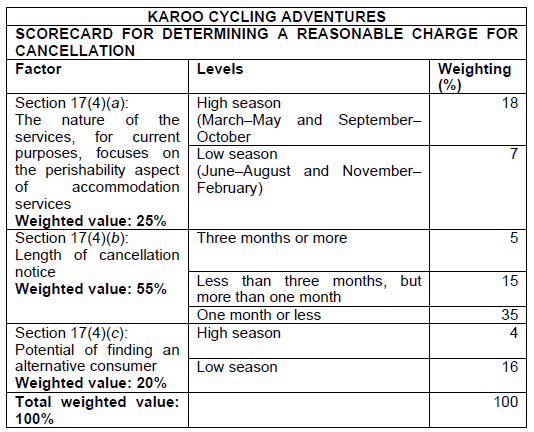
(It is assumed for the sake of the illustration that there is no comparable trade practice for this service provider.)
The cancellation charge for a consumer (A) who has made an advance booking for an excursion during April and cancels in February will be calculated as follows. If the total price of the excursion is R25 000:
18 (booking is in high season) + 15 (cancellation notice is given less than three months but more than one month) + 4 (greater potential to find an alternative consumer, therefore the factor is weighted lower) = 37% of R25 000 = R9 250.
This calculation provides one with a method to determine a reasonable cancellation fee. How does this relate to the determination of a reasonable deposit? One must first consider the purpose of a deposit. As indicated earlier, the purpose of a deposit is to serve as security for the service provider to ensure that the consumer will honour the booking at a future date. A deposit allows the service provider to recover any losses occasioned by a cancellation, which are quantified in the form of the cancellation charge. Should the consumer cancel the advance booking, the service provider is then in a beneficial position to be able to deduct the calculated loss (cancellation charge) from the deposit and repay the remainder of the deposit to the consumer, if any.
A scorecard cannot be designed for determining a deposit directly; one must use the scorecard designed for calculating the charge for cancellation to determine a reasonable deposit. The reason is simply that using a scorecard presents one with different outcomes or amounts, depending on the facts of each individual case. Considering the Karoo Cycling Adventures scorecard above, the cancellation charge for the consumer A was R9 250, but if the cancellation had been made in December, the cancellation charge would be:
18 (booking is in high season) + 5 (cancellation notice is given more than three months in advance) + 4 (the potential to find an alternative consumer) = 27% of R25 000 = R6 750
Also, when it comes to requiring the payment of a deposit, the service provider must normally provide the consumer with a specified amount - the deposit - at the time of concluding the contract, well before any cancellation. The suggested solution is for the service provider to charge as a deposit the maximum cancellation charge possible in terms of the scorecard in each situation. In the case of consumer A, who made a booking for April and cancelled in February, Karoo Cycling Adventures can request payment of a deposit that would amount to the following:
18 (booking is in high season) + 35 (cancellation notice is given less than one month) + 4 (the potential to find an alternative consumer) = 57% of R25 000 = R14 250.
This will be the highest cancellation charge possible for a booking in the high season and will, therefore, be the highest amount chargeable as a deposit for it to be reasonable. For a booking in the low season, the maximum cancellation charge will be:
7 (booking is in low season) + 35 (cancellation notice is given less than one month) + 16 (less potential to find an alternative consumer in low season, therefore the factor is weighted higher) = 58% of R25 000 = R14 500.
This shows that the deposit that can be charged for a low-season booking is more than the deposit that can be charged during the high season, to be reasonable although it seems counterintuitive. This is the result of the values assigned to the potential of finding an alternative consumer (the s 17(4)(c) factor). As it is easier to find an alternative consumer in the high season, the value of the factor should be lower, and, in turn, the value should be higher for the low season when it is more difficult to find an alternative consumer. The lower value will reduce the cancellation charge because of the higher probability of finding an alternative consumer. In the low season, the probability of finding an alternative consumer is lower and therefore, the risk of loss is higher, thus increasing the need for the service provider to have more cover through a deposit for a cancellation. There may, of course, be reasons why a higher value is assigned to the factor for determining the potential of finding an alternative consumer during high season as opposed to a lower value used in the example and for the reasons stated above. One such reason could be that the service provider must contract with other service providers to provide meals and accommodation, and these providers may ask for higher prices (deposits) in the high season.
Of course, the service provider may wish to require a smaller deposit as part of its marketing strategy - and that is completely within its right to do. However, the purpose of this note is to consider the maximum amount a service provider can rationally require as a deposit and still be compliant with the CPA.
Using the scorecard arguably provides a method for determining a reasonable cancellation fee and a reasonable deposit, based on something more than guesswork. It also confirms the connection between what may constitute, respectively, a reasonable deposit and a reasonable cancellation fee. Lastly, it also addresses the question of whether the factors listed in section 17(4) are to be used for determining both a reasonable cancellation fee and a reasonable deposit, or only for determining a reasonable cancellation fee. As the factors are incorporated into the scorecard, they play a role in determining both the cancellation fee and the deposit - in the case of the cancellation fee, more directly and in the case of the deposit, in a more indirect manner.
6 The position concerning "non-refundable deposits"
Considering that a consumer cannot be forced to go through with an advance booking, it also means that the consumer cannot be forced to pay the full price for a booking that has been cancelled in advance. The necessary implication of this is that the consumer cannot be required to pay a deposit that is equal to the full contract price for the booked service and be liable to forfeit such an amount in the event of a cancellation. An attempt to include a term in a consumer agreement providing for a deposit of the full contract price and then providing that such deposit is non-refundable in the event of advance cancellation falls foul of section 51 (1) in that it negates the consumer's right to cancel.
It is suggested that a deposit may be forfeited completely only where the service provider demands payment of a deposit that is equal to or less than the maximum deposit that could be required in accordance with the earlier discussion, and where the charge for cancellation is equal to or greater than the amount of the deposit paid. It is only in this situation that a supplier should be allowed to impose and enforce a non-refundable deposit. However, this aspect should be made clear to the consumer, as using "nonrefundable deposit" representations or terms may well constitute a breach of the provisions of the CPA, especially section 41(1)(a), which prohibits expressing or implying a false, misleading or deceptive representation concerning a material fact in the marketing of services to consumers, or section 48(1)(b), which prohibits a service provider from marketing services or from entering into an agreement for the supply of services in a manner that is unfair, unreasonable or unjust. Representing, for instance, that a deposit is non-refundable may constitute a breach of these provisions (see also the Consumer Protection Act Regulations 44(3)(q) and (r)).
7 Conclusion
A deposit generally is a part-payment of a larger contract price and is required in the normal course of events to ensure that the consumer honours the booking made in advance. The service provider holds the deposit and offsets a cancellation charge against the amount so held in the event of an advance cancellation. The CPA regulates this situation by providing the consumer with the right to cancel an advance booking. This right cannot be made nugatory by directly or indirectly forcing the consumer to go through with the booking or to pay the full price for the booking when cancelled in advance. However, the right to cancel is qualified in that the service provider may require the payment of a reasonable deposit and may impose a reasonable cancellation fee in the event of an advance cancellation.
This note considers the relationship between a reasonable deposit and a reasonable cancellation charge. It is argued that a relatively simple scorecard can be developed to assist consumers and service providers alike in calculating a reasonable cancellation charge. It is suggested that the same scorecard can be used for determining a reasonable deposit by calculating the maximum reasonable cancellation charge possible in terms of the scorecard in a given context, and which amount then constitutes a reasonable deposit.
It is hoped that this proposal may serve to contribute to the development of a system that will assist in bringing about greater legal certainty for both consumers and suppliers.
AM Tait
B Juris LLB MBL LLM LLD
Mercantile Law Department, Nelson Mandela University,George Campus, South Africa, https://orcid.org/0000-0001-5405-0191
