




Services on Demand
Journal

Article
 English (pdf)
 Article in xml format
 Article references

 Automatic translation
 Send this article by e-mail
Indicators
Related links
-
 Cited by Google
-
 Similars in Google
Share

 Permalink

Image & Text
On-line version ISSN 2617-3255Print version ISSN 1021-1497
IT n.40 Pretoria 2026
https://doi.org/10.17159/2617-3255/2026/n40a9
ORIGINAL RESEARCH
Interpreting lived experiences through the contemporary jewellery of Beverley Price: A case study
Nina NewmanI; Anne Mastamet-MasonII; Nalini Moodley-DiarIII
IDepartment of Fine and Studio Arts, Tshwane University of Technology, Pretoria, South Africa. newmann@tut.ac.za (ORCID: https://orcid.org/0009-0007-5363-7119)
IIDepartment of Fashion Design, Tshwane University of Technology, Pretoria, South Africa. masona@tut.ac.za (ORCID: https://orcid.org/0000-0003-1423-2075)
IIIFaculty of Arts and Design, Tshwane University of Technology, Pretoria, South Africa. moodleydiarn@tut.ac.za (ORCID: https://orcid.org/0009-0004-5364-0455)
ABSTRACT
Contemporary jewellery serves as a form of self-expression, creating new aesthetics and meanings for wearable adornment through innovative processes and materials. South African contemporary jewellers frequently draw inspiration from their lived experiences, reflecting the country's rich natural, cultural, social, and political landscapes. However, scholarly analysis of its thematic, conceptual, and interdisciplinary aspects remains limited. This article addresses this gap by examining how lived experience is expressed through the contemporary jewellery practice of South African practitioner, Beverley Price. Using a single case study, it interprets Price's work, Nelson Mandela neckpiece - A concentric chronology of his life, through an integrated theoretical framework combining life history research, contemporary jewellery studies, and hermeneutic phenomenology. The article situates Price's creative practice within her socio-political and cultural context, highlighting how personal experience and political awareness intersect in her jewellery. Drawing on Paul Ricœur's (1992) theory of narrative identity, the article argues that Price's work embodies both idem and ipse identities, reflecting continuity and transformation in her self-conception. The analysis demonstrates how contemporary jewellery can serve as a form of political engagement and meaning-making by materially reinterpreting political symbols, communicating ideological affiliation, and positioning identity within post-apartheid South African discourse.
Keywords: Contemporary jewellery, life history, hermeneutic phenomenology, narrative identity, Beverley Price, South Africa.
Introduction
Jewellery is commonly perceived as an object of adornment; however, in contemporary practice, it has evolved into a medium of narrative and artistic inquiry. Unlike commercial jewellery, which is often mass-produced and associated with luxury consumption and status, contemporary jewellery prioritises artistic authorship and conceptual inquiry. Lignel (2006:1) defines contemporary jewellery as a craft-based design practice and a form of individual expression, acknowledging its craft origins while recognising its evolution to reflect modern trends and technologies. Skinner (2013:10) similarly describes the field as a 'self-reflexive studio craft practice oriented to the body', emphasising the significance of hand-working skills and the intimate connection between jewellery and human physicality. Scarpitti (2021:60) expands on these perspectives, describing contemporary jewellery as multi-faceted objects that pose questions and express concepts, thereby becoming narrative and relational subjects that connect practitioners, wearers, and viewers through personal, cultural, or societal narratives. Within this conceptual frame, contemporary jewellery becomes an artefact of self-reflection, translating lived experience and the practitioner's responses to cultural, social, emotional, and environmental contexts into wearable forms (Fenn 2017:8).
While there are extensive studies on contemporary jewellery in international scholarship, there has been limited sustained academic engagement with South African practice and its broader design history (Den Besten 2012:7-8; Fenn 2019a:1; Pretorius 2016:42; Skinner 2013:184). This lack of critical discourse hinders a deeper understanding of the thematic, conceptual, and interdisciplinary perspectives present in local practice. The absence of South African discourse is particularly regrettable, as Den Besten (2012:26) points out that contemporary jewellery can reflect a place and culture by incorporating indigenous themes, materials, and techniques. In a post-apartheid context rich with social, political, and cultural narratives, South African practitioners have significant potential to express a distinct identity through their work.
This article addresses this gap by presenting a case study of South African contemporary jeweller Beverley Price. The article explores how her life history influences her practice and how her experiences intersect with various social, political, and cultural contexts, all of which are reflected in her creative work. Rather than analysing multiple works, this single case study provides a "thick description", offering in-depth insights into her practice and enhancing the understanding of her identity (Geertz 1973:9-10).
The article first provides an overview of South African contemporary jewellery to position Price's life and practice within local and global contexts. A brief account of Price's life history is then presented, highlighting her formative experiences. An interpretive analysis then follows of one of her key works, Nelson Mandela neckpiece - A concentric chronology of his life, drawing on life history research, contemporary jewellery, and hermeneutic phenomenology. The article concludes by considering how Price's lived experiences contribute to broader discourses of meaning-making in contemporary jewellery within a South African context. The interpretive case study illustrates how contemporary jewellery functions as a narrative, and how the formal features are intentionally selected to support the personal and socio-political intent of the work.
Contemporary jewellery in South Africa
While a comprehensive documented history of contemporary jewellery practice in South Africa remains limited, recent publications by Van Staden (2010; 2011; 2013; 2014; 2016; 2017), Rhodes (2013), and Fenn (2019a; 2019b) have provided valuable insights into its development and practitioners. As more South African contemporary jewellers gain international recognition, this jewellery practice is gradually receiving increased scholarly and curatorial attention. Several factors contribute to the lack of documentation about South African contemporary jewellery. These include its small scope and niche market; the impact of apartheid, which restricted exposure for local jewellery artists; limited engagement in academic research; and the country's geographic distance from major jewellery centres and exhibitions.
Historical emergence
Before the rise of contemporary jewellery, South African jewellery production was largely associated with commercial manufacturing, precious materials, and traditional goldsmithing practices linked to the mining economy and luxury trade (Van Staden 2016:122-123). The origins of contemporary jewellery in South Africa can largely be traced to these commercial jewellery production workshops established by skilled immigrant goldsmiths from Italy, Switzerland, Germany, Sweden, the United Kingdom, and Austria (Van Staden 2014:91). Many of these jewellers founded workshops in South Africa from the 1950s onwards as they struggled to recover economically in their respective countries after the Second World War (Van Staden 2016:123). During the late twentieth century, these workshops became sites of experimentation with materials and techniques, significantly contributing to the development of contemporary jewellery practice in South Africa by the early 1970s.
A defining moment occurred in 1973 with the establishment of the Goldsmiths Guild of South Africa in Johannesburg, under the guidance of Peter Cullman (Van Staden 2017:95). The guild promoted contemporary jewellery through national and international exhibitions, raising awareness of jewellery designed and manufactured in South Africa, while fostering knowledge exchange among practitioners (Van Staden 2017:95-96). The guild's inaugural exhibition was held in Johannesburg in 1975, featuring 120 works, followed by another exhibition in Stellenbosch (Van Staden 2017:97). However, by the late 1980s, the guild's activities declined, largely due to political instability, rising crime and theft, and the absence of government support. Many members emigrated, leading to the eventual dissolution of the guild (Van Staden 2017:99-100). Subsequently, contemporary jewellers found representation through the Jewellery Council of South Africa, which was established in 1987 (Van Staden 2016:128).
Contemporary jewellery in post-apartheid South Africa
The post-apartheid era has significantly advanced contemporary South African jewellery. Rhodes (2013:174) notes that the lifting of sanctions led to increased international exposure. Simultaneously, the establishment of jewellery courses in higher education institutions contributed to the growth of the practice, while digital platforms enhanced practitioners' visibility (Rhodes 2013:183-184). Additionally, government initiatives in the creative industries offered support to local practitioners. Collectively, these factors fostered the emergence of a more defined contemporary jewellery practice in South Africa, prompting practitioners to explore themes of representation and identity in their work.
A key feature of this period was the articulation of a South African design identity. Lange and Van Eeden (2016:60-61) argue that visual culture contributes to national consciousness and inclusive identity-making. Efforts to rebrand South Africa after apartheid extended into the visual arts and design (Lange & Van Eeden 2016:69). However, Fenn (2019a:26) cautions that defining a South African design identity is complex due to the country's diverse cultural backgrounds and influences. While contemporary jewellers often drew on local themes, materials, and crafts, Butina-Watson and Bentley (2007:3-4) emphasise that national identity in design cannot be reduced to visible markers alone; it is also shaped by personal identity and lived experiences.
Contemporary jeweller and academic Carine Terreblanche (cited in Skinner 2013:176) echoes these sentiments, reflecting that contemporary jewellery in South Africa can provoke, critique, record, and generate new meanings. She argues that jewellery can create personal connections while also forging shared bonds, a quality that is particularly important in the context of post-apartheid South Africa. Her statement underscores jewellery's function as a medium of communication and its potential to reflect and reshape not only personal identity, but also a collective social identity.
Despite Terreblanche's critical engagement (cited in Skinner 2013:176), scholarship on contemporary jewellery remains limited in relation to South African visual and material culture, feminist perspectives, cultural identity, and social and political expression. Over the past three decades, jewellery competitions, exhibitions, the establishment of galleries, and the founding of contemporary jewellery organisations have increased visibility both locally and internationally. It is within this evolving context that this article situates Price, whose practice is recognised for its innovative engagement with South African identity and socio-political narratives.
Positioning Beverley Price
Within this historical and post-apartheid landscape, Beverley Price has remained a pivotal figure in South African contemporary jewellery. Her identity as a first-generation South African of Jewish heritage is central to her practice, informing her exploration of cultural and political themes through hybridity by combining indigenous craft practices with western perspectives. Through her work, she emphasises the interpretive roles of the wearer and the viewer, framing her jewellery as open to multiple readings and fostering dialogue among the maker, the object, the wearer, and the viewer. Price's thematic explorations, combined with her material and technical experimentation, offer valuable insights into South African design identity from a contemporary jewellery perspective.
Unlike the historical overviews by Van Staden (2010; 2011; 2013; 2014; 2016; 2017) and Rhodes (2013), Price's contribution to existing scholarship centres on her responses to social and political conditions, illustrating her practice as a form of meaning-making. Furthermore, her hybrid work embraces diversity and layered interpretations, addressing concerns raised by Fenn (2019a; 2019b) about the challenges of defining a South African design identity. Her contribution is further realised through her interdisciplinary approach. By intersecting jewellery with crafts, fashion, graphic design, and Fine Arts, Price challenges conventional boundaries between wearable adornment and related disciplines, positioning her jewellery within a broader cultural discourse. Through this approach, Price demonstrates how contemporary jewellery can be both wearable and conceptual, while remaining a medium of self-expression and a form of South African identity.
Price's work has been exhibited locally and internationally, with her works represented in public and private collections, highlighting the recognition of South African contemporary jewellery as a form of artistic expression. The exhibitions of Price's work affirm her as a prominent jeweller and a meaningful case study for examining broader questions of identity, interdisciplinarity, and socio-political engagement in South African contemporary jewellery. By situating her work within her life history, this article also contributes to expanding the limited discourse on South African contemporary jewellery and its role in expressing personal and collective identity.
Framework for interpretation
To interpret Price's contemporary jewellery through her lived experiences, a theoretical framework was developed that integrates life history research, contemporary jewellery, and hermeneutic phenomenology. This combination is necessary, as no single framework addresses the analysis of contemporary jewellery as a reflective and interpretative practice. By layering these perspectives rather than treating them separately, the framework provides a holistic approach that clarifies the relationship between lived experience and creative practice, while also offering a structured method for interpretation.
This approach aligns with Ojermark (2007:45), who notes that life history research does not conform to a prescribed theoretical or methodological framework, allowing for flexibility across disciplines. Collins and Stockton (2018:5) assert that integrating multiple framing lenses deepens the analysis, while Berge and Ingerman (2017:43) confirm that such intersections enhance understanding of lived experiences.
The first lens, life history research, documents and discusses Price's experiences, situating them within broader cultural, social, and political contexts. This approach aids in constructing identity, revealing how her personal experiences inform her creative practice and the meanings embedded in her jewellery (Samuel, Reddy & Brown 2022:187).
The second lens contextualises her life history within the contemporary jewellery practice by examining the themes, formal features, and interdisciplinary positioning evident in her work. This lens explores how personal narratives inform artistic expression and how jewellery functions as a medium of storytelling. Fenn (2017:6) describes narrative jewellery as encompassing thoughts and emotions that connect making and storytelling. Drawing on Bernabei (2011), the interpretation considers both formal features, such as materials, techniques and form, and jewellery as self-expression. These aspects serve as vehicles for expressing cultural, political, and identity-based narratives, reinforcing jewellery's role as a site for personal and collective meaning-making. Furthermore, the discussion considers contemporary jewellery's interdisciplinary connections to crafts, Fine Arts, design, fashion, traditional goldsmithing, and technology.
The third lens, hermeneutic phenomenology, provides the interpretative foundation for understanding Price's narratives and practice. Hermeneutics, as defined by Jupp (2006:133), concerns the interpretation of meaning through the details and nuances of lived experiences. Following Heidegger's (1996:10-12) hermeneutic-phenomenological approach, interpreting a person's social and cultural background reveals the meaning of their da-sein (existence).
Paul Ricœur's Oneself as another (1992) introduces the concept of narrative identity, shaped by external factors and internal reflections, encompassing the dynamic nature of idem- and ipse-identities (Ricœur 1992:121-122). The term idem (identity understood in terms of the same, or sameness) refers to the enduring aspects of character that remain stable over time, whereas ipse (selfhood) is grounded in self-reflection and personal change (Ricœur 1992:2-3). When applied to life history research, this duality highlights how Price's stable characteristics (idem) and her evolving self-understanding (ipse) are intertwined in her creative practice.
Hans-Georg Gadamer's Truth and method (2006) deepens the understanding of Price's work by employing the concepts of fore-structure, the hermeneutic circle, and the fusion of horizons to interpret the construction of identity and meaning. While Ricœur (1992) focuses on narrative identity construction through sameness and selfhood, Gadamer's (2006) hermeneutics positions the interpretation of Price's work within experience and understanding.
This framework synthesises life history, contemporary jewellery, and hermeneutic phenomenology to interpret how personal histories influence artistic expression. It advances methodological innovation in the contemporary jewellery practice by moving beyond formal or visual analysis, offering insights into artefacts as mediums of self-expression within broader local and global contexts.
Methodology
This article adopts an interpretivist approach to extract meaning from Price's experiences and interpret how her contemporary jewellery works reflect these meanings. Given the interpretivist paradigm's subjective nature, a qualitative research approach was used.
Data collection
Guided by the interpretivist paradigm, the data collection included semi-structured interviews and artefacts. The interview questions were constructed using Plummer's (2001:124-125) narrative question format, which included key themes such as social factors, education, work and historical events. Jewellery-specific questions were informed by Bernabei's (2011:xiv) interviews with European contemporary jewellers and aligned with the definition, features, and positioning of contemporary jewellery. Two Microsoft Teams interviews were conducted by the main author with Price: the first on 16 July 2024 and the second on 31 July 2025.
Artefacts such as journals, drawings, practical experiments, materials and various contemporary jewellery works captured through photographs, provide visual information to support the interpretation. These photographs offered insight into Price's identity and experiences and revealed contextual information about the contemporary jewellery practice in South Africa, including inspiration, materials, and techniques.
Data analysis
Thematic and hermeneutic analyses were applied to construct Price's life history and to interpret one selected work as a case study. Thematic analysis was used to identify key themes in Price's life experiences, particularly her life history, identity, and features of her contemporary jewellery. These themes served as a foundation for the hermeneutic analysis, which involved a deeper interpretation of her experiences and the selected work, which was chosen for its relevance to the thematic, material, and technical aspects of her practice.
The data was analysed using Atlas.ti software. Coding followed an integrated inductive and deductive approach. The initial codes were generated inductively from Price's interviews and artefacts, allowing her experiences to guide the process and minimise researcher bias. This aligns with Gadamer's (2006) hermeneutic process of moving back and forth between data and interpretation to accommodate new insights and identify similarities. Deductive reasoning was also applied, drawing on literature, the question framework, and the main author's disciplinary knowledge to establish an initial structure that evolved through engagement with the data. The deductive framework provided organisation, while inductive analysis enabled new meanings to emerge from Price's experiences.
Positionality of the main author
Positionality acknowledges the researcher's identity and experiences as integral to the research process, influencing the interpretation and co-construction of knowledge. The main author acknowledges her positionality as a South African woman and a practising jeweller. With over 25 years of experience in academia and jewellery practice, and having exhibited alongside many South African contemporary jewellers, the main author approaches this study with both professional and contextual understanding. This dual perspective allows her to interpret Price's narratives through a shared practical and cultural lens.
O'Boyle (2018:4-6) notes that shared positionalities between researcher and participant can enhance trust, foster a deeper contextual understanding, mitigate power imbalances, encourage open dialogue, raise awareness of cultural sensitivities, and validate participants' experiences. The main author's background provides an informed interpretative stance while maintaining reflexive awareness of her influence on the research process.
Beverley Price: Life history and practice
Beverley Rose Price was born on 20 May 1956 in Johannesburg. She was raised in a family that upheld Jewish culture and traditions, which instilled a strong sense of dual belonging and loyalty towards South Africa, Judaism, and, by extension, Israel. This solid family foundation influenced her broader outlook on life, characterised by a commitment to the collective, whether through culture, nationality, or contemporary jewellery practice.
Price initially studied speech therapy at the University of the Witwatersrand, completing her qualification in 1978. From 1979 until early 1982, she practised as a speech therapist but found the profession unfulfilling. She also felt increasingly unsettled living under apartheid, as witnessing the marginalisation and oppression of black people in South Africa became untenable for her. Consequently, she decided to relocate to Israel in 1983. In Israel, Price trained with a jeweller and later completed a course in Industrial Jewellery Manufacture at the Jerusalem Technical Institute. Inspired by the prospect of a jewellery career, she moved to London in 1989 to pursue a three-year City & Guilds Diploma in Jewellery and Allied Crafts, with an apprenticeship in Manufacturing. After completing the course, Price returned to Israel at the end of 1992 to continue her professional development.
Motivated by both personal and political reasons, Price moved back to South Africa in 1995. She was drawn back to witness Nelson Mandela's release and to celebrate the emergence of a democratic nation, which led her to establish her jewellery practice in Johannesburg. After spending a weekend at a Buddhist retreat in Ixopo, KwaZulu-Natal, she found the location ideal for her practice and remained there from 1996 to 1999. Price (2024) describes her time in Ixopo as her 'most significant experience' both personally and professionally, where she formed strong relationships with the local Zulu community and developed her acclaimed picture jewellery range. In this range, she used existing images as visual narratives, expanding to include recognisable South African product labels and icons. She refers to these picture units as photemes, a term she adapted from the linguistic concept of a phoneme, which she encountered during her speech studies, and repurposed to describe visual units of information.
In 2000, she enrolled in a two-year Advanced Diploma in Fine Arts at the University of the Witwatersrand, where her works explored performative and large-scale sculptural forms. In 2022, Price returned to Israel and enrolled in her master's in Holocaust studies at Haifa University, where she investigated the role of gold under the Nazi regime from a jeweller's perspective. In 2024, she joined the Jerusalem House of Quality, where she currently works in a studio shared with other artisans. Although she has lived in several countries, Price (2024; 2025) notes that South Africa remains a defining part of her identity.
Intersections of life and practice
Price's position as a first-generation South African Jew and her experiences have significantly shaped her contemporary jewellery practice. Price (2024) describes her jewellery as 'my puppet. It goes ahead of me; it introduces me, or it's like an alter ego of myself', indicating that her works serve as an extension of her identity. Her lived experiences, along with her social, political, and cultural narratives, are translated through selected materials and techniques to create her jewellery.
Thematically, her practice explores social, economic, cultural, and political influences, often drawing on recognisable images of local brands and famous people. Some of these images are obtained from Drum magazine, Madam and Eve cartoons, and photographs and portraits of icons such as Nelson Mandela, Mahatma Gandhi, and Frida Kahlo. While Price encourages both the wearer and viewer to generate their own interpretations, her choice of overtly political images related to South Africa or influential figures guides this interpretation towards a socio-political narrative. The underpinning of South African themes is also evident in her larger works, where she reinterprets traditional materials, artefacts, and customs such as the Ndebele liphoto (wedding apron) and wedding cape, creating cultural hybrids that engage with both western and indigenous influences, as well as the dynamic interaction between jewellery and the body.
Aligned with Price's thematic exploration is her emphasis on materiality, which is crucial to the visual language and conceptual foundation of her works. Physical interaction with materials is important to her, and during the interviews, she references affect theory, which posits that engaging with materials fosters relationships with objects. Price (2024) explains, 'you transfer, you project onto the object, how it becomes an object of value, even if it's just a piece of plastic'. This projection is rooted in her historical Jewish sensitivities, where dehumanisation was a consequence of Nazi greed. Consequently, she values objects, regardless of their material worth. This connection becomes even more significant in jewellery, given its intimate nature as a body adornment.
Technically, Price prioritises hand-based methods, working directly with materials rather than relying on digital technologies. Her joining technique, where different components are drilled and connected with o-links, has become synonymous with her practice. This method allows her to assemble larger works and incorporate alternative materials, ensuring articulation when worn on the body. Price also incorporates various surface embellishments, such as enamelling to introduce colour to metal surfaces and hammer-textured patterns that reference African visual motifs. These techniques demonstrate how her craft knowledge is applied to realise the conceptual intent of her work while providing practical solutions for her affinity for using alternative materials.
Price's practice illustrates how her personal history and identity can inform her contemporary jewellery. This is evident in her thematic exploration, choice of materials, and technical application, all of which reflect her ongoing negotiation of identity both within South Africa and beyond.
Case study: Interpreting Price's Nelson Mandela neck-piece - A concentric chronology of his life
The following section analyses one of her key works, Nelson Mandela neckpiece - A concentric chronology of his life (2005) as a case study. This discussion synthesises insights from Price's life history to illustrate how her experiences intersect with her contemporary jewellery practice. Rather than comparing multiple works, the in-depth interpretation offers a thick description that explores her personal identity, cultural hybridity, and political engagement in relation to the work's theme, materiality, and techniques. In Price's case, political engagement is understood as the use of wearable objects to communicate her ideological position and negotiate cultural identity within broader socio-political discourse. Through its material reinterpretation of political symbolism, the neckpiece reflects Price's political ideology, personal memories, and cultural affiliations. This interpretation reveals how her practice extends her personal history and identity, demonstrating that contemporary jewellery can serve as a site of narrative construction and meaning-making.
The neckpiece, illustrated in Figure 1, was originally commissioned by the Royal Ontario Museum of Toronto (ROM) but was instead purchased by South African collector Natalie Knight. It was sold at auction through Aspire Art in 2018 to a new private collector. Made from aluminium, plastic, paper, wire, leather, fabric, glass beads, and buttons, the neckpiece measures 54 cm in diameter.
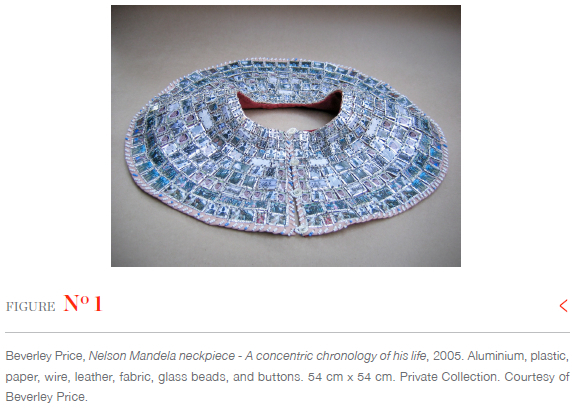
The neckpiece explicitly conveys political commentary through its inclusion of images of Nelson Mandela. Price (2024) describes her upbringing as a 'non-apartheid life', in which her family focused on inclusivity and embraced people of other races. As a white South African during apartheid, Price (2024) refers to her racial position as 'privileged', making her engagement with Mandela and the anti-apartheid sentiments expressed through the neckpiece significant within the socio-political context of the time. Her admiration for Mandela and the use of his image in this work may also be interpreted as counter-normative within apartheid South Africa and during South Africa's democratic transition.
These political convictions are further reflected in Price's decision to leave South Africa in the early 1980s due to the atrocities of apartheid, before later returning to celebrate Mandela's release. Upon her return, she immersed herself in Zulu culture while living in Ixopo, reflecting her idem identity - a stable political orientation consistent with her earlier life experiences. Price (2024) notes that her Buddhist experiences have led her to follow individuals who are 'remarkable' and 'wise', sentiments expressed in the neckpiece. Her excitement about contributing to a new democratic South Africa and her admiration for Mandela became central themes she wished to convey in her work.
Scarpitti (2021:60) emphasises the importance for contemporary jewellers to engage with broader societal concepts, including political aspects, to create meaning. This perspective is further supported by Pauwels (2022:116), who asserts that art serves as a highly visible medium for reflecting South Africa's post-apartheid discussions and political issues concerning race, privilege, gender, culture, and ideology. This commentary is particularly pronounced in contemporary jewellery, where the narrative object gains visibility through being worn and encountered by the viewer. Although Price's work may not align directly with Pauwels's definition of protest art, it nonetheless presents commentary on Mandela and South Africa's political landscape.
The thematic focus on Mandela in this neckpiece also highlights Price's transnational identity as a South African Jew who lived in Israel during apartheid. Her movement between South Africa and Israel, along with her subsequent return during the democratic transition and her residency in Ixopo among the local Zulu community, situates the neckpiece within broader contexts of belonging, displacement, and political and cultural identification. While Mandela's image serves as a national symbol of South Africa, it also holds personal significance for Price, allowing her to express both her evolving and anchoring relationship with her South African identity. Thus, Mandela's image transcends its role as a national political symbol and becomes a stabilising cultural reference through which Price navigates her sense of belonging across multiple national and cultural contexts.
Price applies the images of Mandela in concentric circles on the neckpiece, enlarged in Figure 2, creating a visual chronology of his life. This circular arrangement of repeated Mandela images resembles the rings of a tree, presenting a narrative of his life and political career. In this format, the horizontal plane (each row) represents different periods of his life, while the vertical plane (leading towards the edge) illustrates the progression of his life experiences. Price's deliberate composition transforms the neckpiece into an adornment that supports her intent. It serves not only as a wearable adornment that visually reflects Mandela's life but also embodies Price's own experiences and interpretation of her South African political consciousness through its design.
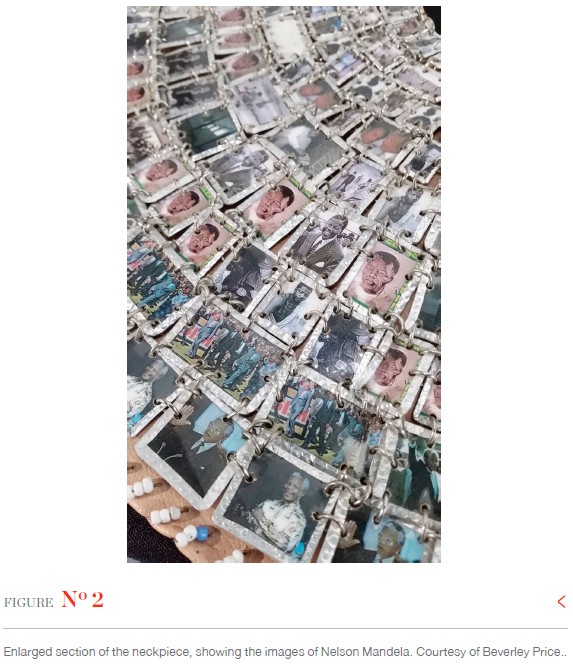
Price approaches this chronology through the format of a traditional beaded Xhosa ithumbu collar, referencing the adornment Mandela chose to wear at his sentencing (Le Van 2006:52). The traditional Xhosa beaded collar conveys social identities and signifies the status of the wearer (Van Wyk 2003:14). Mandela's use of the collar during the Rivonia Trial transformed this adornment into a political symbol associated with cultural identity and defiance within apartheid South Africa. By reinterpreting this culturally significant form, Price situates the neckpiece within both South Africa's political history and Mandela's Xhosa identity. However, within Price's contemporary jewellery practice, the meaning of the collar shifts from its traditional cultural function to become a narrative and interpretive object that communicates admiration and political consciousness. Through this recontextualisation, the neckpiece illustrates how contemporary jewellery's interdisciplinary nature can engage with traditional craft forms to generate new meanings through format and wear.
Price also references her own identity through this format. Considering Price's lived experiences, the structure of the neckpiece resembles a crochet blanket composed of joined sections, reflecting the influence of her maternal grandmother, who taught her to crochet and made blankets for each grandchild. In this work, the crochet-like blocks are replaced with repeated images of Mandela, merging personal memory with political symbolism. While the arrangement visually and symbolically centres Mandela as an emblem of unity and leadership, it also allows Price to embed aspects of her own lived experience within the work. The neckpiece, therefore, operates as a hybrid narrative object, where familial craft traditions intersect with South African cultural attire and political ideology. Through this merging of personal memory and material practice, the work reflects Ricœur's understanding of narrative identity as continuously shaped through experience and symbolic interpretation.
The repeated use of Mandela's image echoes Pop Art, characterised by the repetition of popular culture and mass media imagery, such as comic strips, advertisements, and everyday objects (Frey & Baetens 2019:129-132). Frey and Baetens (2019:136) explain that this repetition, especially in photomontages, underscores commercial aesthetics while producing a sequential narrative. Similarly, Price's repetition of Mandela's image in the neckpiece creates a sequential representation of his life, resonating with her description of her 'story around the neck' when discussing her picture jewellery during the interviews (Price 2024).
The photographs, or photomes, of Mandela interconnect through o-links, a technique that Price consistently employs in her work, reflecting her idem identity as a contemporary jeweller. While this method serves a practical purpose by linking the photographs and providing articulation, it also represents a distinctive aspect of Price's practice, thereby embedding her identity within the work. Other formal features, such as the large scale of the neckpiece, connect to her earlier liphoto works, drawing inspiration from indigenous artefacts in terms of format and scale, which ties Price to her South African heritage. Although the large scale and use of o-links to join elements are hallmarks of her practice, her thematic approach has evolved, showcasing her ipse identity, where her artistic expression is in a continuous state of transformation. Equally, the texture Price applied to the 120-micron-thick aluminium foil that encases the individual image, seen in Figure 2, can also be considered an identifiable characteristic of her practice.
Contemporary jewellery uses photographs as a medium to create context within works. In this neckpiece, they serve a dual purpose. Firstly, the photographs of Mandela become the main focal material, with his image serving as a symbol of South African culture. Truman (2017:830) notes that traits of the selected individual can 'function as repositories of collective cultural values' within specific historical contexts. This reference to a cultural symbol also reflects Ricœur's (1976:55) description of an icon as a symbol imbued with cultural significance, thus functioning as 'a surplus of signification'. Through repetition and layering, Mandela's image extends beyond its documentary function. It becomes a cultural symbol imbued with Price's personal admiration and national hope, thereby exemplifying Ricœur's (1992) notion of a symbol as a site of surplus meaning.
Secondly, the photograph of Mandela in his traditional Xhosa attire, wearing a beaded ithumbu collar on the first day of the Rivonia trial, inspired Price's design for the neckpiece. Figure 3 shows the neckpiece displayed alongside the photograph by Eli Weinberg at Price's solo exhibition All Gold is Gold, at the Standard Bank Gallery in 2007. This photograph shaped the format of the neckpiece, grounding it in a cultural foundation and situating the work within a South African context.
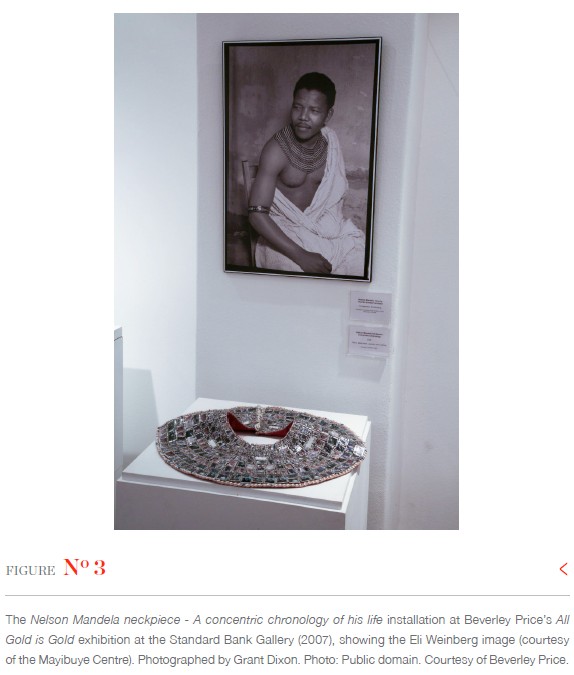
Price selected the materials, namely aluminium, plastic, paper, wire, leather, fabric, glass beads, and buttons, to support the cultural and political intent of the neckpiece and contribute to its narrative meaning. In the traditional Xhosa ithumbu collar, beadwork functions as a semiotic system and expression of cultural identity, traditionally worn by leaders during ceremonial occasions (Van Wyk 2003:14, 22). Similarly, Price's neckpiece is lined with white, pink, and blue beads and fastened with buttons at the back. These colours carry Xhosa cultural significance, as white represents purity and is often paired with blue and contrasted with pink (Van Wyk 2003:19, 25). Beads and buttons were also historically used by the Xhosa communities for trade, making them valuable commodities of social and material value, which Price reinterprets within the neckpiece.
While the work references indigenous craft practices through its format and material use, Price does not reproduce the ithumbu collar within its original Xhosa context. Instead, she interprets the neckpiece through her identity as a white, western-trained jeweller, bringing her post-apartheid political commentary into dialogue with South African cultural traditions. Her deliberate use of non-precious materials further reflects her idem identity as a contemporary jeweller, as she consistently experiments with alternative materials to challenge conventional notions of preciousness and value. This approach also relates to her Jewish identity and to her engagement with affect theory, in which objects are valued for their personal associations rather than their intrinsic worth. Consequently, the materials reinforce the conceptual dimensions of the neckpiece, shifting the emphasis from material value to political symbolism and Price's cultural identity as a Jewish South African.
This neckpiece is uniquely positioned at the intersection of contemporary jewellery, Fine Arts, photography, and crafts. Pop Art elements, evident in the use of repeated iconography, allow the aesthetic of the neckpiece to engage more directly with a western visual language. The photographic imagery extends Price's political views by drawing on visual and material culture. The recognisability of Nelson Mandela's image facilitates an immediate connection between maker, wearer, and viewer, enabling a shared understanding of the work's intent.
As a tribute to Nelson Mandela, the neckpiece serves as a medium through which Price articulates her political consciousness and navigates her South African identity, as well as her sense of belonging as a South African Jew who relocated to Israel. The interpretation illustrates how her idem political identity, shaped throughout her life, converges with her ipse identity as a contemporary jeweller constantly exploring new thematic inspiration. Through this convergence, Price's neckpiece offers a critical engagement with political and cultural references, revealing how her lived experiences shape her creative practice. The result is a neckpiece that reflects a moment in South Africa's early 2000s, capturing the nation-building optimism associated with the early democratic period. It affirms that contemporary jewellery can function as a site of political engagement and meaning-making, contributing to the discourse of South African contemporary jewellery practice. It reveals how contemporary jewellery, as a creative practice, can contribute to the formation of a post-apartheid South African design identity, through the use of a practitioner's lived experiences and selection of formal features.
Conclusion
This article presents a single case study that demonstrates how contemporary jewellery reflects lived experiences. Price (2024) describes her jewellery creations as her 'alter ego', emphasising their role in expressing her identity, which is shaped by her Jewish heritage and South African nationality. This is exemplified in Nelson Mandela neckpiece - A concentric chronology of his life, which engages with her personal, cultural, and political narratives through formal features.
In contemporary jewellery, meaning is shaped through the selection of themes, materials, and techniques that embody both personal and collective narratives. Cole and Knowles (2001:10-11) explain that individuals construct meaning from their experiences through storytelling, which can also manifest in artistic practice. Consequently, contemporary jewellery functions as an artefact that captures and communicates Price's lived experiences and identity. In this article, the intersection between life history research and contemporary jewellery reveals how her practice materialises her personal narrative.
Although the neckpiece was created two decades ago, this temporal distance allows for reflection and contextualises the historical, political, and social shifts in South Africa during that period. The case study demonstrates how Price's political awareness is expressed both thematically and materially through her use of photographic imagery. Her work illustrates how contemporary jewellery, as a wearable adornment, can serve as a site of political engagement and identity construction. Future research may extend this interpretive framework to other contemporary South African jewellers, exploring how their works reflect on socio-political and cultural issues, interrogate gender dynamics, and comment on economic value within a local context.
References
Berge, M & Ingerman, A. 2017. Multiple theoretical lenses as an analytical strategy in researching group discussions. Research in Science and Technological Education 35(1):42-57. https://doi.org/10.1080/02635143.2016.1245657 [ Links ]
Bernabei, R. 2011. Contemporary jewellers: Interviews with European artists. Oxford: Berg. [ Links ]
Den Besten, L. 2012. On jewellery: A compendium of international art jewellery. Stuttgart: Arnoldsche Art. [ Links ]
Butina-Watson, G & Bentley, I. 2007. Identity by design. Oxford & Burlington: Butterworth-Heinemann. [ Links ]
Cole, AL & Knowles, JG. 2001. Lives in context. Walnut Creek: AltaMira. [ Links ]
Collins, CS & Stockton, CM. 2018. The central role of theory in qualitative research. International Journal of Qualitative Methods 17(1):1-10. https://doi.org/10.1177/1609406918797475 [ Links ]
Fallan, F & Lees-Maffei, G (eds). 2016. Designing worlds: National design histories in an age of globalization. New York: Berghahn. [ Links ]
Fenn, M. 2017. Narrative jewelry: Tales from the toolbox. Atglen: Schiffer. [ Links ]
Fenn, G. 2019a. Jewellery art: a crash course in the niche market of contemporary jewellery. [O]. Available: https://www.wantedonline.co.za/watches-and-jewellery/2019-11-13-jewellery-art-a-crash-course-in-the-niche-market-of-contemporary-jewellery/ Accessed 28 March 2023. [ Links ]
Fenn, G. 2019b. Lay of the land: Contemporary jewelry in a changing South Africa. Metalsmith Magazine 39(2):24-27. [ Links ]
Frey, H & Baetens, J. 2019. Comics culture and Roy Lichtenstein revisited: Analysing a forgotten 'feedback loop'. Art History 42(1):127-152. https://doi.org/10.1111/1467-8365.12416 [ Links ]
Gadamer, HG. 2006 [1975]. Truth and method. 2nd ed. Translated by J Weinsheimer and DG Marshall. London: Continuum. [ Links ]
Geertz, C. 1973. The interpretation of cultures. New York: Basic Books. [ Links ]
Heidegger, M. 1996 [1927]. Being and time: A translation of Sein und Zeit. Albany: SUNY Press. [ Links ]
Jupp, V (ed). 2006. The SAGE dictionary of social research methods. London: Sage. [ Links ]
Lange, J & Van Eeden, J. 2016. Designing the South African nation: From nature to culture, in Designing worlds: National design histories in an age of globalization, edited by K Fallan & G Lees-Maffei. New York: Berghahn:60-75. [ Links ]
Le Van, M (ed). 2006. 500 neckpieces. New York: Lark Books. [ Links ]
Lignel, B. 2006. What does contemporary jewellery mean? Metalsmith Magazine 26(3):14-15. [ Links ]
O'Boyle, A. 2018. Encounters with identity: Reflexivity and positioning in an interdisciplinary research project. International Journal of Research and Method in Education 41 (3):353-366. https://doi.org/10.1080/1743727X.2017.1310835 [ Links ]
Ojermark, A. 2007. Presenting life histories: A literature review and annotated bibliography. Working Paper 101. Manchester: Chronic Poverty Research Centre. [ Links ]
Pauwels, M. 2022. Art as a battleground for struggles over politics, race, gender and privilege in contemporary South Africa. Critical Arts 36(3-4):116-134. https://doi.org/10.1080/02560046.2022.2143833 [ Links ]
Plummer, K. 2001. Documents of life 2: An invitation to a critical humanism. London: Sage. [ Links ]
Pretorius, D. 2016. Does Southern African design history exist?, in Designing worlds: National design histories in an age of globalization, edited by K Fallan & G Lees-Maffei. New York: Berghahn:42-59. [ Links ]
Price, B. 2024. Interview by author via Microsoft Teams. 16 July. [ Links ]
Price, B. 2025. Interview by author via Microsoft Teams. 31 July. [ Links ]
Rhodes, S. 2013. Southern Africa, in Contemporary jewelry in perspective, edited by D Skinner. New York: Lark Jewelry & Beading:172-185. [ Links ]
Ricœur, P. 1976. Interpretation theory: Discourse and the surplus of meaning. Fort Worth: Texas Christian University. [ Links ]
Ricœur, P. 1992 [1990]. Oneself as another. Translated by K Blamey. Chicago: University of Chicago Press. [ Links ]
Samuel, MA, Reddy, S & Brown, CJW. 2022. Critical reflections on researching lived and learning experiences: Towards a critical phenomenology. African Perspectives of Research in Teaching & Learning 6(3):185-206. [ Links ]
Scarpitti, C. 2021. The contemporary jewelry perspective: Meanings and evolutions of a necessary practice. Journal of Jewellery Research 4:59-76. [ Links ]
Skinner, D (ed). 2013. Contemporary jewelry in perspective. New York: Lark Jewelry & Beading. [ Links ]
Truman, E. 2017. Rethinking the cultural icon: Its use and function in popular culture. Canadian Journal of Communication 42(5):829-849. https://doi.org/10.22230/cjc.2017v42n5a3223 [ Links ]
Van Staden, F. 2010. Joe Calafato: A late twentieth century South African precious metal artist. South African Journal of Cultural History 24(1):127-150. [ Links ]
Van Staden, F. 2011. Erich Frey and his associates: A unique contribution to South African jewellery design and its goldsmith tradition. South African Journal of Cultural History 25(1):148-179. [ Links ]
Van Staden, F. 2013. Legacies of immigrant gold- and silversmiths during early and mid-twentieth century South Africa. South African Journal of Cultural History 27(1):139-163. [ Links ]
Van Staden, F. 2014. An overview of noted gold and silversmiths in South Africa in the 1950s. South African Journal of Cultural History 28(1):90-113. [ Links ]
Van Staden, F. 2016. Mid-twentieth century jewellery making in South Africa. South African Journal of Cultural History 30(1):119-143. [ Links ]
Van Staden, F. 2017. Notes on the hallmarking of twentieth century South African precious metal artefacts. South African Journal of Cultural History 31 (1):82-105. [ Links ]
Van Wyk, G. 2003. Illuminated signs. Style and meaning in the beadwork of the Xhosa- and Zulu-speaking peoples. African Arts 36(3):12-33. [ Links ]
Received: 2025-11-04
Accepted: 2026-05-21
Published: 2026-09-04
