




Services on Demand
Journal

Article
 English (pdf)
 Article in xml format
 Article references
 Automatic translation
 Send this article by e-mail
Indicators
Related links
-
 Cited by Google
 -
 Similars in Google
Share

 Permalink
Acta Theologica
On-line version ISSN 2309-9089Print version ISSN 1015-8758
Acta theol. vol.45 n.1 Bloemfontein 2025
https://doi.org/10.38140/at.v45i1.8623
ARTICLES
Naming and shaming? Exploring space(s) between women in Philippians 4:2-3
A. PotgieterI; J. du PlessisII
IDepartment of New Testament and Related Literature, University of Pretoria, Pretoria, South Africa. E-mail: annette.potgieter@up.ac.za; ORCID: https://orcid.org/0000-0002-5987-4912
IIDepartment of New Testament and Related Literature, University of Pretoria, Pretoria, South Africa. E-mail: jankeduples@gmail.com; ORCID: https://orcid.org/0000-0002-5717-3821
ABSTRACT
At face value, Philippians 4:2-3 may come across as Paul (the authority) talking down on Euodia and Syntyche. Παραχαλέω is often translated as "rebuke" or "plead", especially in Afrikaans translations (see 1933, 1953, 1983, 2020; Direkte vertaling, the word "vermaan" is used). According to Silva (1988:221), παραχαλέω is "an express and unquestionable rebuke, telling us a great deal about the seriousness of the Philippian problem". Naming these two women may be shaming them, since Paul refers to the "guilty" in the text. Should Philippians 4:2-3 be interpreted as violent, or is it a mere reflection of the reality of the church in Philippi? Into this dynamic, we bring the element of spatiality within the question of power dynamics, arguing that this method brings another lens onto this pericope. Space replicates power in societies. Accordingly, this article explores power dynamics and violence in Philippians 4:2-3 through the lens of spatial theory.
Keywords: Euodia and Syntyche, Spatiality, Philippi, Conflict
Trefwoorde: Euodia en Sintige, Ruimtelikheid, Filippi, Konflik
1. INTRODUCTION
Let us face it, as New Testament scholars, we tend to be logocentric. Nasrallah (2012:53) makes the case that New Testament scholarship has been influenced for too long by "in the beginning was the word" and too little by "the word became flesh".1 A too narrow focus on the text may result in forgetting that Paul's letters were intended for a specific audience who lived within a specific location.2 If we are serious about discerning Paul's letters as occasional letters, then we also need to mind the first audience's location. In the case of the letter to Philippi, the original intended audience is located in a city imbued in conflict. Philippi endured successive colonisations, but after the Battle of Philippi in 42 BCE, it became a "Roman colony", settled by an army of veterans.3 After the battle of Actium in 31 BCE, the city was founded again, and more Roman veterans settled there (Achtemeier, Green & Thompson 2001:391). The city was rebuilt and became the leading city of the district of Macedonia (Walker 2008:94). The vestiges of the past impacted the community that lived during the time when Paul wrote the letter to the Philippian community.
By examining ancient texts through the perspective of lived space, we can determine how space intertwines with events, architectural design, political boundaries, and personal ambitions (Matthews 2003:12). As the archaeology of Philippi reminds us, place is not static. Human beings shape it as human beings are operations on space.4 Power exists within space, mirroring power structures prevalent in societies (Stewart 2011:114). Conversely, certain behaviours are often "hidden" by the space produced by groups. Some behaviours are viewed as "normal" as it is what is expected of a certain space (Stewart 2011:116). As space is not fixed, these spaces of power can be negotiated and changed, displacing relationships between the controlled and the controller (Stewart 2011:116).
Accordingly, this article explores the space(s) between Euodia and Syntyche in Philippians 4:2-3. A common convention with letter writing was that an accused person's name, normally addressed in person, would not be uttered in the letter.5 In 1 Corinthians 5, Paul does not name the man he accuses of indecency and the same is observed in 2 Corinthians 7:12. In both instances, the correspondents know who Paul is referring to. It can thus be argued that it is not necessary to say the name again. In a seemingly unusual move in Philippians 4:2-3, Paul names the parties involved in a transpired conflict as "Euodia" and "Syntyche". Is Paul essentially naming and shaming these women or is there something else at play? This article uses spatial theory to explore why Paul names the women in Philippians 4:2. The interplay between the location of Philippi, the naming of the women, and the supposed conflict that transpired are examined. This article aims to shed light on Euodia and Syntyche and the role of power.
2. METHODOLOGY
The "spatial turn" has marked an interest in the importance of space as more than a mere background. The seminal work of Henri Lefebvre, The production of space (1991 [1974]), distinguishes between three categories of "perceived-conceived-lived" space. Lefebvre intended his spatial theory as a Marxist sociological approach to urban theory, as he was interested in the change in society and was himself, in fact, sceptical about applying it to literature. Soja (1996:74-75) propounded on Lefebvre's triad, coining the terms "Firstspace", i.e. physical space, "Secondspace", i.e. cultural stereotypes, ideologies, and imaginations, and "Thirdspace", i.e. lived space as embodied experience. However, Lefebvre's sensitivity to capitalism impacts us as readers to move away from the simple binary of epistemological or social notions of space (Nasrallah 2012:55). The by-product of Lefebvre's spatial theory is that it aids in shedding light on the people in the text that would have been forgotten, particularly rethinking the position of women. Studies on women in the ancient world have been especially guilty of applying anachronistic views of women being "inside the house" as where women may be, while "outside" was considered as not a place for women.6 It is perplexing that women are described as inferior and confined to the household and yet, simultaneously, women are leaders of their communities and hold offices, exerting authority (Hylen 2020:534). Accordingly, considering spatiality helps with important questions such as who gets to produce space, who is included, and who is excluded, who finds it safe, and who finds it dangerous (Nasrallah 2012:57)?
3. WHAT IS IN A NAME?
Epigraphic evidence found in Philippi signals that women played an important role in leadership positions, especially among religious groups in the colony, during the Imperial era (Blois 2024:1). The Acropolis of Philippi offers evidence of numerous important cults in the city such as Diana, Isis and Silvanus with a great number of rock reliefs clustered at various points (Concannon 2022:135). Based on archaeological data, Abrahamsen (1995:81) estimates that a seemingly equal and supportive society of women, girls, and even goddesses functioned. Women formed an intrinsic part of the Christian community from its inception and the expectation would have been that women participated in both leadership and cultic life (see Marchal 2006:90; Ascough 2003:134-136).
Euodia and Syntyche's names belonged exclusively to the Roman-Hellenistic world (Bromann 2012:229). Names in ancient times conveyed the quintessence of a person. The name Euodia means "go well" and Syntyche means "with luck" (Reumann 2008:607).7 They were likely to have been socially prominent (Hull 2016:4). Roman women would have benefited from the Roman Empire (Concannon 2022:136). It should be mentioned that women who were not Roman would be excluded from Rome's benefits and they most probably lived in conditions of poverty, enslavement, and oppression (Marchal 2008:98). However, the names Euodia and Syntyche could also have indicated that they were slaves and that they brought good fortune for their master. Inscriptions attest to their names being used for slaves, freed persons and co-workers of the elite (Standhartiger 2021:271). Thus, their names could be reminiscent of belonging to a master. It is difficult to say, but we deem it more likely that they were members of the elite.
4. FOCUS ON PHILIPPIANS 4:2-3
The argument in Philippians 4 is transitory, as the conjunction ώστε signals the audience needs to look back to the fact that Paul establishes that believers are citizens of heaven (Phlp. 3:20) from where Jesus Christ their Saviour can be expected (Phlp. 3:20). In Phlp. 4:1, the audience is addressed with great admiration. Paul starts by endearingly addressing them as αδελφοί μου αγαπητοί, "my beloved brothers", drawing on a familial image which we often observe in Paul. But Paul also adds that he longs for the audience (έπιπόθητοι) that they provide joy (χαρά) and that they are "his crown" (στέφανος μου). This is high praise. Paul continues to address them as "beloveds" (αγαπητοί) and exhorts them to stand firm in the Lord (στήκετε έν κυρίω).8 Spatiality is evoked with images of believers having to stand firm (Phlp. 4:1). Immediately, the notion of a body with feet that is in an upright position is being called upon. The place to stand is specifically έν κυρίω "in (the) Lord". The preposition functions as a preposition of location.
Philippians 4:2 is not necessarily building on Philippians 4:1 (Standhartinger 2021:267). After Paul's challenge to the community to stand firm, he addresses Euodia and Syntyche. The naming seems to rather fit a typical Pauline letter ending. Paul addresses each woman separately (Εύοδίαν παρακαλώ και Συντύχην παρακαλώ) with the repetition of παρακαλέω underscoring that Paul is not taking any side.9 Paul wants these two colleagues, who are prominent in the Philippian congregation, to be of the same mind in the Lord (το αυτό φρονεΐν έν κυρίω). The phrase έν κυρίω is repeated, as noted in Philippians 4:1, but it also harks back to Philippians 3:1, with the exhort to rejoice in the Lord (χαίρετε έν κυρίω). The phrase implies spatiality with the preposition έν as locative. The believers place themselves under the Lordship of Christ (Hawthorne 2004:240), with έν κυρίω functioning as an ecclesial sphere where the Lord Jesus rules (Reumann 2008:608).
However, Euodia and Syntyche are addressed to be of the same mind in the Lord (τό αυτό φρονεΐν έν κυρίω), but the phrase does not indicate a conflict between them, nor does it provide any information about what is being quarrelled about. It seems that Paul is trying to persuade the women to think the same way he is thinking. It could be that the two women quarrel with Paul. However, this is not the understanding that mainstream scholarship opts for. Most of the commentaries indicate that the women are in conflict with one another. However, D'Angelo and Cynthia Briggs Kittredge were among the first to develop the counterargument that Euodia and Syntyche were working together. As D'Angelo (2000a:79) rightly points out, in Philippians 4:3, Euodia and Syntyche are presented as two women who struggled (συναθλέω) alongside Paul as colleagues. The use of συναθλέω evokes athletic imagery portraying Euodia and Syntyche's earlier missionary ventures with Paul in a heroic manner (see Phlp. 4:14-21) (D'Angelo 2000a:79).
Paul is receiving financial support from the Philippi for his missionary work. Quigley (2021) argues that Paul is in an economic venture with the Philippian community as Paul peddles Christ and the Philippian community is invested in this.10 Similarly, Sampley (1980) argues that Paul is in a societas consensualis partnership with the Philippian community where two or more parties agree to contribute to a common goal. Paul accordingly does not thank the Philippian community for the money when he receives it from Epaphroditus. Paul is in prison, and argues that his situation is not hampering him from fulfilling his part of the partnership. The money does not stop Paul from establishing his views. Tracing Paul proclaiming rival preachers in Philippians 1:15; appealing for agreement in Philippians 2:1-11 and obedience in Philippians 2:2, and ultimately naming Euodia and Syntyche in Philippians 4:3 might indicate that Paul was directing his words to them (D'Angelo 2000a:79). It could be that Paul is in conflict with Euodia and Syntyche.
Marchal (2008:102) ponders whether Euodia and Syntyche may be working against the Roman Empire. Epaphroditus risked his life (2:25-30); just as four other colleagues, Prisca and Aquila, "risked their necks" (Rm. 16:3-4); as well as Andronicus and Junia (Rm. 16:7) (Marchal 2008:102). Moreover, the work entailed being sent and travelling, which would have been risky. What is more, scholarship in Philippians has shifted in understanding the letter as a friendship letter. The phrase το αυτό φρονεΐν is part of the technical vocabulary of friendship noted in Plato, Cicero, and Dio Chrysostom (Marchal 2006:79). Not only the phrase τό αυτό φρονεΐν, but four σύν compounds are noted in Philippians 4:2-3, which is indicative of friendship language (Marchal 2006:81). We can glean from Paul's words that the women played a prominent role, as they are colleagues with Paul and Clement.11 They could have been deaconesses, active workers or could have offered their homes as the place for these church services (Hawthorne 2004:241).
The interjection ναί underscores the assertion that women should be in union with the Lord. Paul understands conflict and enlists the help of a third party whom he addresses as γνήσιε σύζυγε "true yokefellow". The use of σύζυγος underscores the necessity of shared work as it is a common expression signifying partnership (Holloway 2017:182). The identity of this third person remains unknown. Despite the disagreement between these women, Paul values their striving (συνήθλησάν) with him for the Gospel, and he declares that their names are in the book of life (έν βίβλω ζωής) (Gromacki 2003:103). Note the "book of life" is eschatological, connecting the previous thought in Philippians 3:20-21.
What if Euodia and Syntyche are not necessarily named to be shamed, but the precise opposite? They are long-time friends who strived together with Paul for the gospel, and naming them might be evidence thereof,
[s]ince one of the marks of 'enmity' in polemical letters is that enemies are left unnamed, thus denigrated by anonymity (Fee 1995:390).
Paul used strong language to seek peace between these women; they must have the "same mind in the Lord" (φρονεΐν έν κυρίω). However, why does Paul appeal to them in this way?
4.1 The case of παρακαλέω
Paul used παρακαλέω in several of his letters and generally translated as to "urge", "appeal", or "encourage".12 According to Bauer et al. (2000:765), παρακαλέω means "to urge strongly, appeal to, urge, exhort, encourage". The verb παρακαλέω is used twice to emphasise that and does not side with one of them (Hansen 2009:282). Silva (1988:221) avers that παρακαλέω
express[es] an unquestionable rebuke, telling us a great deal about the seriousness of the Philippian problem13 ... one does not take risks of this sort unless one can depend on thick cushions of love and trust to absorb the impact of a rebuke.
On the contrary, Hansen (2009:282) states that παραχαλέω is employed as "an appeal, request and encouragement treating someone in an inviting and congenial manner". Is this an authoritative "rebuke" or is Paul a friend who is truly concerned "urging", "begging" or encouraging them to unite?
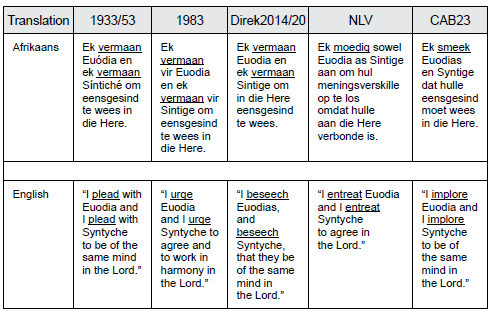
Repeated twice, some translations in the Afrikaans (33, 53, 83, Direkte Vertaling-2014, 20 - Bybelgenootskap) used the word "vermaan" - which is usually a very strong word in Afrikaans. "Vermaan" means to influence someone's behaviour by means of warning, rebuke, to threaten, to admonish, to reprimand, or to have a serious talking to (Odendal & Gouws 1965). "Vermaan" could also have a more positive meaning: to encourage and to urge - although, practically, it is almost never used in that sense. Other translations such as the NLV14 and CAB2315 translated παραχαλέω in a much "softer" tone, to "urge" (om aan te moedig - NLV), or to "beg" (om te smeek - CAB23). Only the Bybelgenootskap translators used the word "vermaan" and, at face value, this is a serious word. None of the English translations translated παραχαλέω as "rebuke". The strongest words used in English might be "entreat, implore or beseech". None of the English translators used the word "admonish" - which is perhaps the best English equivalent for "vermaan".
The problem with παρακαλέω translations is, on the one hand, that these women are named and praised for their side-by-side contending/labouring (συνήθλησάν) with Paul for the gospel cause. On the other hand, there is this sense of "admonishment" and perhaps a public shaming for grief caused by conflict and disunity. The term παρακαλέω is less polite and humbler than its technical term counterpart ερωτάω (Reumann 2008:607). In Philippians 4:3, the third person referred to as "yokefellow" is addressed with the verb ερωτάω, whereas Euodia and Syntyche are addressed with the verb παρακαλέω, indicating that the women are more subordinated than the person referred to in verse 3 (Reumann 2008:607). Significantly, παρακαλέω has a much stronger tone than έρωτω (v. 3) (I ask). That may be the reason why some translations use words such as "beseech", "entreat" or "plead". Paul is strongly calling these women to have the same mind in (the) Lord (έν κυρίω). However, παρακαλέω and έρωτάω could also justify a much "softer"16 approach to the situation, placing the audience and Paul on equal status (Snyman 2007:231). Most of the translations of παρακαλέω indicate the authority of Paul over the two women (Standhartinger 2021:270).
5. SPACES IN BETWEEN
If we consider Philippi as first space, we consider a location of conflict. Philippi bears the traces of wars, occupation, and veterans. Nasrallah (2012:60) refers to Philippi as a "contact zone", where racial, ethnic, and imperial conflicts and negotiations occurred. The second space is interwoven with the first space as Philippi became a colony of Rome again, with deep fractures within Roman society itself defined by war, wealth, and loyalties. It is difficult to plot the second space as it relates to the ideological and cultural setting. The culture and ideology we associate with the second space can be traced to the Roman rule of Philippi. Philippi was a contested space between the locals who had lived there and the new imperial military colonists, but it was also a contested space between the Romans (Nasrallah 2012:62). The newfound Roman military colony of Philippi endowed its population with Roman citizenship, thus explaining the political and citizenship language in the letter (De Silva 2004:641).
Part and parcel of the language of the Philippians is Paul's use of the civic and political language, mentioning that this colony that is suffering finds that they belong to an alternative state (πολίτευμα Phlp. 3:20) which determines their ethics as Roman citizenship would have determined the ethics of the Romans (Oakes 2005:319). The Philippians are expecting the coming of their σωτήρ, who will save them based on his imperial power (Phlp. 3:20-21) (Oakes 2005:319). The earthly citizenship in Christ functions as the point of orientation for believers and situates their hope as the political practices in their location are dependent upon the heavenly citizenship (Blumenthal 2023:159).
Paul challenges the material spatial practices and the ideologies that support Roman citizenship, by employing the imagined place (third space) φρονεΐν έν κυρίω that relates to and challenges the spatial structures of Philippi and establishes an alternative structure - citizenship in Heaven. The phrase τα ονόματα έν βίβλω ζωής "in the name of the book of life" is a reminder of citizenship in heaven (Phlp. 3:20). The declaration that their names are in the book of life causes that Paul and his fellow workers (including Euodia and Syntyche) are heavenly citizens. This supersedes their Roman citizenship and evokes an imagined space of harmony, humility, oneness, and like-mindedness found in the Lord.17
For Paul, the unity and continuance of the Philippians community is at stake as a place that takes the shape of being έν κυρίω (Blumenthal 2023:156). The community makes the saving action of Christ visible and possible to experience in the way in which they live (Blumenthal 2023:156). In Philippians 3:1, έν κυρίω is already employed, opening multiple interpretations in the letter. The phrase έν κυρίω is again repeated in Philippians 4:2, but specifically, the believers, called by name, must φρονεΐν έν κυρίω "think in the Lord". Again, the spatiality persists as the head is signalled with the use of φρονεΐν "to think", followed by the power agency - in the Lord (έν κυρίω). Paul seeks oneness (Phlp. 2:2), "[p]articulary his emphasis on thinking the same thing or being likeminded" (Nasrallah 2012:68), to have the same thinking among themselves as they have in their fellowship with Christ (Phlp. 2:5).
Space implicates a perspective that involves identity. Identity is contested and always conflictual because it is an extension of self, those whose identity is in Christ (έν κυρίω), over and against the Philippian world. Oakes (2005:322) argues that Paul strengthens suffering Christians, by emphasising that the universe is not as it appears. Believers have a secure place close to the real central power and they should, therefore, encourage one another (Oakes 2005:322). Accordingly, Euodia and Syntyche need to put their own interests aside for the sake of the community and orientate themselves to the Lord (Blumenthal 2023:156). An important motif throughout the letter is Paul presenting himself as the homo humilis (Becker 2020:141).18 He sets the pattern for what is considered to be the ultimate pattern for a humble person who reflects Christ-oriented humility (see Phlp. 2:1-18) (Becker 2020:141). The community must emulate Paul to learn about humility (Becker 2020:142). The unity between believers is of vital importance to a Christ-centric way of living (Hawthorne 2004:240).
The letter to the Philippians is written while Paul was in prison (1:12). Paul is in a confined setting. This raises the question of whether Euodia and Syntyche are subordinated to Paul? Standhartinger (2021:270) notes that, as Paul is in prison, he is not in a position of power over Euodia and Syntyche, who are free. Yet, Marchal (2008:98) notes that Paul has influence in the prison, as he is speaking with imperial authorities, namely the praetorian guard (Phlp. 1:13). As mentioned earlier, most of the scholars believe that Euodia and Syntyche had important roles, most likely leaders of the episkopoi in Philippi (Allred 2019:6). It is possible to imagine that these two women were the patrons of Paul (Standhartinger 2021:270),19 providing him with food and the essentials that he needed whilst in prison.
These women are in a stronger position than Paul - they are free, have resources, and, like Paul, are active in spreading the Gospel. Yet Paul seeks to assert his influence. As these women were part of Paul's friendship circle, keeping in mind the hierarchical patterns found in Philippians,20 it is Paul's wish that their thinking should align with his way of thinking. Paul does not argue from a physical place of power (he is in prison). He argues for his continued importance in the community as he relies on his reputation and his constructed successful advancement of the Gospel (see Phlp. 1:12-26). For Paul, this way of thinking is described as φρονεΐν έν κυρίω, signalling the "dominating" space.
The word παρακαλέω is used to have a certain effect. The Afrikaans translation of "vermaan" does not reflect the discourse of the dominating space of being in the Lord. Euodia and Syntyche would be at odds with their context for merely being believers. Paul rather reminds them of the new space they have entered as believers, a third space, where the power dynamics are different.
It seems that, for Paul, unity is more than the absence of conflict. The "enemies of the cross" and the "dogs" are described as causing division (Phlp. 1:15-17), bringing destruction upon themselves (Phlp. 1:28; 3:15, 19), and having the wrong thinking (Phlp. 3:15, 19). Perhaps, in Paul's thinking, the rise and fall of powers depended on unity. Philippians was a contested space between locals and military colonists. The Philippians experienced great shifts in politics and ethnicity. Those who heard Paul's letter would be keenly aware of the rise and fall of various powers (Nasrallah 2012:62). Allred (2019:6) writes that Euodia and Syntyche become the application of Philippians 3:17-21, to follow Paul's example (Phlp. 3:17), not to live as enemies of the cross, for those who do their destiny is destruction, their glory is their shame, and their minds are on earthly things (Phlp. 3:18-19). This is in stark contrast with those whose "citizenship is in heaven" (Phlp. 3:20-21).
6. CONCLUSION
The city of Philippi emerges as a complex nexus of conflict, shaped by its turbulent history of wars, occupation, and the collision of diverse cultures within its boundaries. As a Roman military colony, Philippi epitomised the tensions inherent in the Roman Empire's expansion, where citizenship bestowed both privilege and division. Within this contested space, Euodia and Syntyche's apparent conflict echoes the broader discord permeating Philippi. The spatiality evoked in Paul's letter underscores the intertwined relationship between physical and ideological landscapes. Paul challenges the prevailing spatial practices and ideologies of Roman citizenship, advocating instead for a citizenship in heaven that transcends earthly divisions. By positioning Euodia and Syntyche within this framework, Paul urges them to align their thinking with the Lord, thereby fostering unity and harmony amidst the tumult of their surroundings.
The nuances between the Greek terms έρωτω and παρακαλέω within the context of Philippians 4:2 shed light on the intricacies of Paul's approach to addressing the situation between Euodia and Syntyche. While some scholars suggest that the distinction may signify a difference in status, with παρακαλέω implying a softer approach due to potential subordination, others argue for a more egalitarian interpretation, positioning both Paul and his audience on equal footing. However, regardless of the specific connotations of these terms, Paul's intent to foster unity and reconciliation among the Philippian community remains clear. The repetition of παρακαλέω underscores the urgency and importance of his plea, emphasising his earnest desire to see unity restored.
Unity, for Paul, signifies more than the absence of conflict: it embodies a transformative force capable of resisting destructive powers and upholding the values of the cross. The fate of Euodia and Syntyche, like that of Philippi itself, hinges on their willingness to embrace this vision of unity and transcendence. Failure to do so not only threatens their own well-being, but also jeopardises the integrity of their witness in the face of opposition, whether internal or external.
In this light, Paul's admonition takes on a profound urgency, urging Euodia and Syntyche to reconcile their differences and embody the transformative power of unity in the Lord. Theirs is not merely a personal conflict but a microcosm of the larger struggle for identity and allegiance in a world marked by division and discord. As they navigate the contested terrain of Philippi, their choice carries weight not only for themselves, but also for the very fabric of their community and its witness to the transformative message of the cross.
BIBLIOGRAPHY
Abrahamsen, V.A. 1995. Women and worship at Philippi: Diana/Artemis and other cults in the Early Christian era. Portland, OR: Astarte Shell Press. [ Links ]
Achtemeier, P.J., Green, J.B & Thompson, M.M. 2001. Introducing the New Testament: Its literature and theology. Grand Rapids, MI: Wm B. Eerdmans. [ Links ]
Allerd, T. 2019. Philippians 4:2-3: An alternative view of the Euodia-Syntyche debate. Priscilla Papers 33(4):4-7. [ Links ]
Artz-Grabner, P. 2023. Letters and letter writing - Papyri and the New Testament. Paderborn: Brill/ Schöningh. [ Links ]
Ascough, R. 2003. Paul's Macedonian associations: The social context of Philippians and 1 Thessalonians. Tübingen: Mohr Siebeck. WUNT 161. [ Links ]
Balz, H.R. & Schneider, G. 1978. Exegetical dictionary of the New Testament. Grand Rapids, MI: Wm B. Eerdmans. [ Links ]
Bauer, W., Danker, F.W., Arndt, W.F. & Gingrich, F.W. 2000. A Greek-English lexicon of the New Testament and other early Christian literature. 3rd edition. Chicago, IL: University of Chicago Press. https://doi.org/10.7208/chicago/9780226028958.001.0001 [ Links ]
Becker, E. 2020. Der Philipperbrief des Paulus - Vorarbeiten zu einem Kommentar. (Neutestamnetliche Entwürfe zur Theologie Band 29). Tübingen: Narr Francke Attemptp Verlag GmbH + Co. KG. [ Links ]
Blois, I.D. 2024. Brave priestesses of Philippi: The cultic role of Euodia and Syntyche (Phil 4:2). Religions 15:1-12. https://doi.org/10.3390/rel15010127 [ Links ]
Blumenthal, C. 2023. Paulinische Raum-Politik im Philipperbrief. (Forschungen zur Religion und Literatur des Alten und Neuen Testaments Band 286). Göttingen: Vandenhoeck & Ruprecht. https://doi.org/10.13109/9783666500008 [ Links ]
Bromann, L. 2012. The letter to the Philippians. In: O. Wischmeyer {ed.), Paul, life, setting, works, letters (London: T&T Clark International), pp. 223-237. [ Links ]
Concannon, C. 2022. Archaeology and the Pauline Letters. In: M.V. Novenson & R.B. Matlock (eds), The Oxford handbook of Pauline studies (Oxford: Oxford University Press), pp. 129-145. https://doi.org/10.1093/oxfordhb/9780199600489.013.28 [ Links ]
D'Angelo, 2000a. Euodia. In: C. Meyers, T. Craven & R.S. Kraemer (eds), Women and Scripture: A dictionary of named and unnamed women in the Hebrew Bible, the Apocryphal/Deuterocanonical books, and the New Testament (Grand Rapids, Ml: Wm B. Eerdmans), p. 79. [ Links ]
D'Angelo, 2000b. Syntyche. In: C. Meyers, T. Craven & R.S. Kraemer (eds), Women and Scripture: A dictionary of named and unnamed women in the Hebrew Bible, the Apocryphal/Deuterocanonical books, and the New Testament (Grand Rapids, Ml: Wm B. Eerdmans), p. 159. [ Links ]
De Silva, D.A. 2004. An introduction to the New Testament: Context, method and ministry formation. Nottingham: Apollos. [ Links ]
Fee, G.D. 1995. The new international commentary of the New Testament: Paul's Letter to the Philippians. Grand Rapids, Ml: Wm B. Eerdmans. [ Links ]
Gromacki, R. 2003. The books of Philippians and Colossians: Joy and completeness in Christ. Chattanooga, TN: AMG Publishers. [ Links ]
Hansen, G.W. 2009. The Letter to the Philippians (The Pillar New Testament Commentary). Grand Rapids, MI: Wm B. Eerdmans. [ Links ]
Hawthorne, G.F. 2004. Philippians. (Word Biblical Commentary, Vol. 43). Dallas, TX: Word Incorporated. [ Links ]
Holloway, P. A. 2017. Philippians: A commentary. Hermeneia - A critical and historical commentary on the Bible. Minneapolis, MN: Fortress Press. [ Links ]
Hull, R.F. 2016. Constructing Euodia and Syntyche: Philippians 4:2-3 and the informed imagination. Priscilla Papers 30(2):3-7. [ Links ]
Hylen, S.E. 2020. Public and private space and action in the Early Roman period. New Testament Studies 66:534-553. https://doi.org/10.1017/S0028688520000120 [ Links ]
Krentz, E. 2000. Meeting Paul anew: Rereading an old friend in a new age. Journal of Theology 39(4):267-283. https://doi.org/10.1111/0012-2033.00045 [ Links ]
Lefebvre, H. 1991 [1974]. The production of space. Cambridge, MA: Blackwell. [ Links ]
Marchal, J.A. 2006. With friends like these A feminist rhetorical reconsideration of scholarship and the Letter to the Philippians. Journal of the Study of New Testament 29(1):77-106. https://doi.org/10.1177/0142064X06068382 [ Links ]
Marchal, J.A. 2008. The politics of heaven. Minneapolis, MN: Fortress Press. [ Links ]
Matthews, V.H. 2003. Physical space, imagined space, and "lived space" in Ancient Israel. Biblical Theology Bulletin: Journal of Bible and Culture 33(1):12-20. https://doi.org/10.1177/014610790303300103 [ Links ]
Nasrallah, L.S. 2012. Spatial perspectives - Space and archaeology in Roman Philippi. In: J.A. Marchal (ed.), Studying Paul's Letters: Contemporary perspectives and methods (Augsburg: Fortress Publishers), pp. 53-74. https://doi.org/10.2307/j.ctt22nm6n1.9 [ Links ]
Cakes, P. 2005. Re-mapping the universe: Paul and the Emperor in 1 Thessalonians and Philippians. Journal for the Study of the New Testament 27(3):301-322. https://doi.org/10.1177/0142064X05052508 [ Links ]
Odendal, F.F. & Gouws, R.H. (eds) 1965. HAT: Verklarende handwoordeboek van die Afrikaanse taal. Kaapstad: Laetitia Botha en Irèna Wasserfall. [ Links ]
Pilhofer, P. 1995. Philippi. Band I: Die erste christliche Gemeinde Europas. Tübingen: Mohr Siebeck. WUNT 87. [ Links ]
Quigley, J. A. 2021. Divine accounting: Theo-economics in Early Christianity. Yale, CT: Yale University Press. https://doi.org/10.12987/yale/9780300253160.001.0001 [ Links ]
Reumann, J. 2008. Philippians: A new translation with introduction and commentary, Vol. 33B. Anchor Yale Bible. New Haven, CT: Yale University Press. [ Links ]
Sampley, P. 1980. Pauline partnership in Christ. Philadelphia, PA: Fortress Press. [ Links ]
Silva, M. 1988. Philippians. The Wycliffe exegetical commentary. Chicago, IL: Moody Press. [ Links ]
Snyman, A. 2007. Philippians 4:1-9 from a rhetorical perspective. Verbum et Ecclesia 28(1):224-243. https://doi.org/10.4102/ve.v28i1.106 [ Links ]
Soja, E.W. 1996. Thirdspace: Journeys to Los Angeles and other real-and-imagined places. Malden, MA: Blackwell. [ Links ]
Standhartinger, A. 2021. Der Philipperbrief. Tübingen: Mohr Siebeck. https://doi.org/10.1628/978-3-16-160103-3 [ Links ]
Stewart, E.C. 2011. New Testament space/spatiality. Biblical Theology Bulletin 42(3):114-123. https://doi.org/10.1177/0146107912452241 [ Links ]
Walker, P. 2008. In the steps of Saint Paul. Oxford: Lion Hudson. [ Links ]
Date received: 8 October 2024
Date accepted: 20 May 2025
Date published: 30 June 2025
1 Nasrallah (2012:53) mentions that "New Testament scholarship has long experienced a tyranny of the book or tyranny of the word".
2 We tend to forget that these letters were read aloud and performed. To receive a letter in the 1century meant understanding that the letter was also an extension of the sender. In an ostracon letter O. Krok 2.155 (2.117) 98-138 CE, Philokles asks his business partners to take care of his child and her mother and everything in the house, adding the lines: "I consider that I am there" (Artz-Grabner 2023:60). See P. Col. 10.279 (mid III CE).
3 Land was violently confiscated and redistributed to a few wealthy Roman colonists. Pilhofer (1995) indicates that the Roman tribe of the Voltinii and their descendants from 42 BCE to 200 CE were considered superior colonists. Coinage in Philippi represents the realities of centuriation and land division that followed the imperial occupation (Nasrallah 2012:63). The military presence is important to consider, as Krentz (2000:276) mentions that Paul employs military metaphors to implore his audience to a unified heavenly citizenship.
4 However, archaeology must not be romanticised, as it also requires examination (see Concannon 2022:132).
5 Various examples indicate this trend. For example, in a letter the sender asks his addressee for help in the struggle to be paid back for a debt that the person who loaned the money is clearly not intending to honour. The letter reads in lines 9-14: "You too know the man who owes me (money), since it would not be right to name him by letter and please also do as much (as you can), for I know that you love me, in order to bother him, since he is careless" (Artz-Grabner 2023:60).
6 Hylen (2020:534-553) rightly asserts that there is a need in scholarship to reject the uses of public/private dichotomy as a heuristic tool, as it is anachronistic in the New Testament period.
7 Theodore, bishop of Mopsuestia, changed Syntyche's name to the masculine form, thinking that she was Euodia's husband and Paul's jailer, as noted in Acts 16:27-34 (D'Angelo 2000b:159).
8 With στήκετε, "stand firm", he describes them as soldiers who are to stand at their post, irrespective of the pressures to abandon it (Hawthorne 2004:240).
9 Conflict between two prominent leaders in the community could have resulted in members within the community having to choose sides (Hansen 2009:282).
10 She coins the phrase "theo-economics" as economics and religion would not have been separated in the ancient world.
11 Not much is known about Clement. It could have been that he already passed away, but that he was a beloved worker in the Philippian community. Paul evokes the memory of him to cultivate unity (Holloway 2017:182).
12 See, for example, 1 Th. 4:1, 10; 5:10; 2 Th. 3:12; 1 Cor. 1:10; 4:16; 16:15; 2 Cor. 2:8; 6:1; Rm. 12:1; 15:30; Phlm. 9:10; Eph. 4:1. This verb is used frequently in the New Testament and predominantly means "request" in the sense of a petition; as request in the sense of summoning and as exhort and comfort (Balz & Schneider 1978:23).
13 The Philippians had some serious problems. Opponents of the community caused fear and unrest in the congregation as the Judaizer threat started to be felt (Phlp. 1:27-30; 3:2, 18-19). They had physical needs that caused anxiety (Phlp. 4:6, 19). All these factors created distrust, selfishness (Phlp. 2:1-4), and disagreements.
14 NLV: Nuwe Lewende Vertaling.
15 CAB23: Contemporary Afrikaans Bible.
16 Philippians 4:1: Paul gives an imperative command "to stand firm". Philippians 4:2-3: παρακαλέω and έρωτω is indicative, which is a request rather than a command (Snyman 2007:230).
17 Hansen (2009:282): "The citizens of the Roman colony of Philippi who have their names recorded in a civic register of citizens know that they have a duty to live in harmony and peace with one another."
18 In the pericope of Philippians 4:8-9a, popular philosophy seems to influence Paul's language as he is established as an example of morals (tugende) (Standhartiger 2021:268).
19 John Chrysostym refers to Euodia and Syntyche "the head of the congregation" το κεφάλαιον εϊναι της Εκκλησίας της έκεϊ, in Philippians 14:3 (Standhartinger 2021:271).
20 By re-examining the dynamics of ancient Graeco-Roman friendships, which were exploitative toward lower classes and exclusionary towards the vast majority of women, these friendship patterns could be connected to the hierarchical patterns in the letter to the Philippians (Marchal 2006:95).
