




Services on Demand
Journal

Article
 English (pdf)
 Article in xml format
 Article references
 Automatic translation
 Send this article by e-mail
Indicators
Related links
-
 Cited by Google
 -
 Similars in Google
Share

 Permalink
Acta Theologica
On-line version ISSN 2309-9089Print version ISSN 1015-8758
Acta theol. vol.45 n.1 Bloemfontein 2025
https://doi.org/10.38140/at.v45i1.8617
ARTICLES
How negotiated peace in underdeveloped countries results in structural violence: Healing memories in South Africa
L.J. Modise
Department of Philosophy, Practical and Systematic Theology, University of South Africa, Pretoria, South Africa. E-mail: modislj@unisa.ac.za; ORCID: https://orcid.org/0000-0001-7206-2698
ABSTRACT
This article focuses on the South African massacres that took place between 1960 and 1994 to stimulate a global mentality about what led to peace in South Africa. It discusses the role of the superpower in peacebuilding in South Africa. In 1986, four cardinal points led to negotiations and the release of political prisoners. The article also discusses the peace negotiation that occurred prior to the April 1994 election. It also addresses the Truth and Reconciliation Commission as a vehicle for healing memories. The thesis is that peacebuilding ought to be holistic, in order to avoid structural violence. The proposal for a solution to South Africa's structural violence is the establishment of a universal income grant for the middle class and the poor, in order to curb poverty, unemployment, and inequality. The article uses political theology as its framework, based on restorative Justice.
Keywords: Healing memories, Negotiation, Structural violence, Reconciliation, Peacebuilding
Trefwoorde: Genesing van herinnerings, Onderhandeling, Strukturele geweld, Versoening, Vredesgesprekke
1. INTRODUCTION
The year 1986 marks the dawn of South African negotiated freedom, initiated by the United States of America (USA). This article highlights the South African massacres that took place between 1960 and 1992 to stimulate the minds of the global communities about what led to peace in South Africa. It focuses on the international turning point of 1986, because Russia realised its need for a more international coalition than the USA. The following aspects lead to this turning point: the State of Emergency; the Anti-Apartheid Act of the American Congress; the Summit in Reykjavik between Reagan and Gorbachev, and pressure from the USA and other Western countries on the apartheid regime. These pointers led to negotiation and the release of political prisoners. The article highlights how the talks that took place led to the peaceful election on 27 April 1994 and a Government of National Unity. Unresolved issues from the official negotiations have led to the establishment of healing memories (Truth and Reconciliation Commission).
2. PROBLEM STATEMENT
The South African negotiated peace has generated structural violence that impacts heavily on the Black people of South Africa. The international intervention of the South African political parties and the apartheid regime negotiations have achieved peace in South Africa on the level of direct or political violence (Terreblanche 2012:12-15).
A peaceful alternative to this is world order, which is unity based not on force but on negotiation, the rule of law, the common rights of all, and agreements along the legally fixed path ... The crucial condition for this peaceful world order is the moral way of thinking as an internal determinant of the movement toward a future with no imperialist domination and no wars (Demenchonok 2009:17).
Since 1994, there have been no political or military wars in South Africa. Still, the challenge is that these negotiations for peace managed to draw an imaginary roadmap to take the nation to holistic peace. At the same time, issues such as poverty, unemployment, and inequality were not addressed. The gap between the rich and the poor shifted the direction of violence from direct violence to indirect violence. In this sense, political violence turned into structural violence. Lase (2022:145) indicates that violence continues to breed violence. Negotiation and healing memories managed to establish and maintain peace on direct or political violence, but the current context in South Africa is another type of violence, namely structural violence. Demenchonok and Peterson (2009:51) postulate that the moral force of the notion of violence is preserved in the case of structural violence when agents knowingly permitted predictable harm, even though they did not intend them, as is the case with direct violence. In this somewhat restricted sense, structural violence includes poverty exacerbated by the dramatic increase of inequality caused by international investors both on a global scale and within many national societies, in this instance, the South African society. This violence manifests itself in the proliferation of sweatshops and other kinds of hard labour, including contemporary forms of slavery and trafficking in human beings. It continues manifesting through so-called natural disasters, where conscious policies have made populations vulnerable and unprepared for predictable harms triggered by dramatic weather and artificial events.
In the South African context, this new type of violence manifested itself in poverty, unemployment, inequality, gender-based violence, killings of farmers, protest marches - Rhodes must fall, fees must fall, post-apartheid massacre - Marikana. The central premise of this article is that peacebuilding can be an act of violence, whereas conflict may be an act of resistance.
3. RESEARCH QUESTIONS AND METHODOLOGY
The research questions include the following:
• What type of peace exists in South Africa in a democratic state?
• What does the eschatological vision of "peace among the nations" mean, given the past and the current South African conflicts that impact (geo-) political peacebuilding?
• What can the nations learn from South African peacebuilding and peace maintenance by healing memories?
This qualitative research uses literature study, observation, and literature analysis to reach the intended research aims.
4. ASSUMPTION AND THEOLOGICAL FRAMEWORK
Peacebuilding should address all aspects of life, rich and poor, weak and influential, on an equal basis to prevent peace from turning into structural violence that weakens the masses. The researcher assumes that introducing a universal basic income grant for the middle class, the unemployed, and the poor will curb poverty, unemployment, and inequality within the country. The theological framework for this article is political theology based on restorative justice. The hypothesis is that long-lasting peace will be maintained by healing memories, where storytelling will be a continuous process in church and society for checks and balances of the redistribution of wealth and power.
5. DEFINITION AND CLARIFICATION OF CONCEPTS
The Old Testament used the word "Shalom" for the English concept of "peace". Shalom is a Hebrew word that has multiple meanings and connotations. It was used to greet Jewish people and check their well-being daily. It is also used by the Basotho in South Africa and by Lesotho to greet each other and check the wellness of the other Sotho person. The words "Shalom" and "Khotso" have the following meanings and connotations:
• Peace: Shalom is often a greeting or farewell, meaning "peace be with you".
• Wholeness: Shalom implies completeness, integrity, and well-being.
• Harmony: Shalom connotes harmony and balance in relationships and within oneself.
• Prosperity: Shalom can also mean prosperity, success, and good fortune.
• Spiritual wellness: In Jewish tradition, Shalom is associated with spiritual wellness and connection to God.
Modise (2009) indicates that, when observing wellness in rural and semi-rural areas, one might see shalom in the sense of wholeness in the anthropocosmic principle, meaning a good relationship with God, human beings, and the environment. The over-emphasis of one component in this threesome, violence, is prominent. If it is not direct violence, it will be structural violence. South Africa will have less poverty, inequality, and fewer natural disasters in this context.
6. SOUTH AFRICAN VIOLENCE THAT LED TO NEGOTIATED PEACE
One cannot deal with South African violence in isolation from other African countries that influenced violence in South Africa. South Africa is not immune to the African countries that were militarised by outside wars. The latter have militarised Africans to the point where they can use war strategies from outside Africa to fight for their liberation. The wars of liberation have led many African nations to civil wars and wars for survival. These wars are the First and the Second World Wars, independence-liberation wars, post-colonial wars, and divisional wars for survival. The world wars in which Africans participated in the first half of the 20th century were not African wars. The two world wars fought outside of Africa were wars of imperial rivalry (Prah 1999:46). Prah (1999:48) indicates that the Second World War saw African soldiers fighting in Europe and Asia on a larger scale than during the First World War.
African people were militarised to participate in these wars with the assistance of the Europeans. Various wars of independence resulted from the First and Second World Wars. The following wars have occurred in Africa since 1955. In Guinea-Bissau and Cape Verde, the struggle started in earnest with the Pidjiguiti massacre of August 1959. This massacre was the response of the Portuguese to a dockworkers' strike planned by the infant Party for African Independence in Guinea-Bissau and Cape Verde (PAIGC).
Zimbabwe began in 1955 with the Southern Rhodesian African Youth League, which was formed in the same year, and the Southern Rhodesian African National Congress in September 1957, on the 67th anniversary of the establishment of colonial power. By the mid-1970s, ZANU was at the forefront of the armed struggle, and remained the dominant faction of the anti-colonial war until independence in 1980.
Namibia then dominated the anti-colonial war in the South-West Africa People's Organisation. The armed struggle in Namibia commenced in August 1966 and took 25 years to yield results with an independent state after hotly contested elections.
South Africa has been the most significant example of the ravages of settler-colonialism on African soil. The armed struggle started immediately after the Sharpeville massacre in the 1960s and lasted until 1994 and the post-apartheid elections.
These wars for independence have led African countries to democratic elections. Democratic governments are overloaded with a colonial legacy. The following were post-liberation wars in Africa. Prah (1999:52) indicates that the continent has experienced many coups or palace revolutions since the onset of the independence era. The Zanzibar revolution in 1964 overthrew the Sultanate and the Arab oligarchy. The Nigerian coup in 1965 was quickly followed by the Ghanaian coup d'état, which ousted the Nkrumah regime. Over the years, Africa has seen many coups d'état such as in Latin America. The causes of the coup d'état represented intra-elitist changing of the guards. These coups have led to civil wars, which is the problem the church and society currently face.
The following civil wars in Africa were caused by greed, nepotism, and elite upliftment: Zanzibar 1964; the Nigerian civil war; the Ethiopian civil war and the Eritrean independence struggle; Sudan; Senegal; Sierra Leone; Somalia; Angola; Mozambique, and Liberia. South Africa is the only country not listed on this list of civil wars.
After a series of massacres and protests in South Africa, the negotiated peace helped South Africa avoid coups or civil wars because of the well-crafted constitution that raised hope for a better life for all.
7. MAIN MASSACRES FROM 1960 TO 1994 IN SOUTH AFRICA THAT HAVE LED TO GLOBAL INTERVENTION
This article highlights the massacres and killings of Black South Africans that amount to genocide. The Sharpeville massacre on 21 March 1960 led to the birth of Mkhondo We Sizwe, the military wing of the African National Congress (ANC). The people of South Africa were engaged in a peaceful march at a police station in Sharpeville, South Africa. Police officials killed roughly 5,000 to 7,000 protestors. Since 21 March 1960, there have been pockets of killings, some of which are not recorded. Sixteen years later, the well-known strike in Soweto on 16 June 1976 was another eye-opener for the international community to intervene (McRae 2019:1).
In March 1985, tensions between the African population in Uitenhage's townships and the apartheid government reached a boiling point. Between 8 and 10 March, police reported 23 incidents of arson and 18 of stone-throwing, causing damage estimated at R220,000. This massacre claimed the lives of many people in the Eastern Cape. The incident became known as the Uitenhage/Langa massacre. It was now of paramount importance for the South African regime, the mineral and energy complex, as well as the corporations to intervene as sanctions were placed on South Africa to pressurise the regime to release political prisoners and to free the oppressed.
Kynoch (2013:289) labels the violence in South African townships as the township wars between 1990 and 1994. Kynoch (2013:90) also mentions that,
[a]lthough the advent of democracy ended centuries of white political domination and repression, the four-year transition period preceding the elections witnessed the bloodiest 'political' violence of the apartheid era.
In Thokoza and Katlehong - two adjoining townships south-east of Johannesburg that experienced extraordinary levels of violence - third-force elements are reputed to have made common cause with IFP supporters housed in municipal hostels to target the common ANC enemy (Kynoch 2013:290; Ackermann et al. 1990:17).
Coverage of the 1992 Boipatong massacre provides perhaps the best documented example of the type of uncritical reporting that resulted from this state of affairs. After residents of Kwa-Madala Hostel, a stronghold of IFP supporters, launched a night-time raid on Boipatong township, slaughtering dozens of unsuspecting victims, the ANC immediately accused the police of assisting the attackers (Ackermann et al. 1990:22-24).
Journalist Daniel Reed recorded an incident of ethnic partisan policing involving an attack on a Khumalo Street hostel. Phola Park's great war of December 1990 began at midnight when an army set out from the shanty town under police escort to annihilate Mshayazafe hostel. Xhosa police officers sympathetic to their clan members in Phola Park were a vital part of that night's operation. Two armoured police vehicles escorted the Phola Park war party. The Xhosa-speaking police officers were fighting shoulder to shoulder with the Xhosa blanket men, gunning down the hostel residents in the yard. The violence in South Africa has many layers: political, racial, and ethnic. The country is now facing structural violence (Kynoch 2013:298).
8. THE ROLE OF GLOBAL ACTORS ON PEACE IN SOUTH AFRICA
Terreblanche (2012:7) views 1986 as the turning point in the politics and history of the world and South Africa. He highlights the following events that have changed world history, namely the explosion at the Chernobyl nuclear plant in the Soviet Union on 26 April 1986; the comprehensive state of emergency declared by the apartheid government on 12 June 1986; the enactment of the Comprehensive Anti-Apartheid Act by the American Congress in early October 1986, and the summit conference between President Reagan and Mikhail Gorbachev on 11-12 October near Reykjavik.
The state of emergency led to negotiation. Because of the internal and external pressure, the apartheid regime had no choice but to agree to negotiate the terms of a new dispensation with the ANC.
Anti-Apartheid Act of the American Congress. Based on the sanctions, disinvestment, and boycott, the Afrikaners and the English became a strong pressure group for radical transformation in South Africa. The corporate sector and the mineral and energy complex influenced the pressure from the international community. This complex had a significant influence on the South African government, due to disinvestment, which had a heavy impact on their global business; they had no choice but to push the apartheid regime to negotiate (Terreblanche 2012:11). The giant companies in South Africa were suffocating from the international sanctions advocated by Bishop Desmond Tutu; they did not have a choice but to pressure the South African regime to push for transformation and the ANC to cease armed struggle. The meeting of the actors in the Cold War, Reagan and Gorbachev, came in handy for the corporate group in South Africa and the South African regime. This was a surprise for the ANC and the people of South Africa, who were prepared to die for the freedom of their children rather than to break the chains of bondage.
The Summit in Reykjavik between Reagan and Gorbachev. Moscow declared to the ANC in exile in their head office in Lusaka, Zambia, that they were no longer inclined to support the ANC in its military struggle against the apartheid regime in South Africa. Furthermore, Moscow pressured the ANC in exile to seek a negotiated settlement in South Africa. Terreblanche used the term "settlement", but not peace; settlement can bring any peace.
While Moscow was dealing with the ANC, Washington and other Western countries, especially Britain, strongly increased their pressure on the apartheid regime to seek a negotiation route.
After Reykjavik, the Soviet Union put pressure on the ANC in exile to seek a negotiated settlement in South Africa, and after the enactment of the comprehensive Antiapartheid Act of 1986, the US and the other Western countries strongly increased their pressure on the apartheid regime to, similarly, negotiate a solution to the apartheid problem. Remarkably, pressure on the ANC to seek a negotiated solution came in 1986 from Moscow. In the same year, South Africa's white government was pressured by Washington to do the same (Terreblanche 2012:13).
The settlement was pushed outside the country, which is very sceptical of some African people seeking peace from the preferential option for the poor. People experiencing poverty should be at the centre of the settlement to bring holistic peace, justice, and dignity. In his lecture on Christian witness in democracy, Bedford-Strohm (2024) states:
There is a direct line to a central biblical tradition of Latin American Liberation Theology called the 'preferential option for the poor'. We can only understand the prominent place of this option for the poor in the Bible when we see that it is the exact consequence of the affirmation of human beings created in God's image. The exceptional sensitivity towards the poor and marginalised is precisely based on the scandal, which the lack of treatment of human beings in tune with their dignity means for their status as created in the image of God. Preference for the poor is necessary and appropriate as long as there are people whose 'kingly dignity' is gravely denied. The choice for people with low incomes is no longer required when all human beings can live without human-made material, physical and spiritual threats.
The entire negotiation and pressure process resembled an economic game of chess, in which people experiencing poverty were to be sacrificed, in order to save the international investors and the corporate group of South Africa. In this politico-economic chess game, the poor were merely the pawns to defend the kings and queens.
After Reagan and Gorbachev agreed that the leaders of the Great Powers would seek a diplomatic solution for the South African problem, they decided that Margaret Thatcher, the British prime minister, was in the best position to convince the South African government to negotiate with the ANC (Terreblanche 2012:15).
The above quotations clearly show that the superpower negotiated South African liberation, not the people of South Africa or the military takeover. The pressure exerted on the political party and the South African regime yielded multiple negotiation results. It was not as Demenchonok and Peterson (2009:17) put it:
A peaceful alternative to this is world order, which is unity based not on force but on negotiation, the rule of law, the common rights of all, and agreements along the legally fixed path ... The crucial condition for this peaceful world order is the moral way of thinking as an internal determinant of the movement toward a future with no imperialist domination and no wars.
There were forces and threats for the ANC and the South African regime in the South African peace process, but negotiations did start on the international stage. It is suspected that Amanze (2018:143) put pressure on African governments and political parties to govern in a way that amounts to lousy governance that neglects the needs of the people.
Multinational Corporations. It has also been observed that multinational companies lead to bad governance. This has been the case in Nigeria, where the Shell Oil Company admitted to having fuelled conflict, poverty, and corruption through its oil trade, and in the Democratic Republic of Congo, where multinational companies have directly or indirectly contributed to the war in that country. This is the role played by the Mineral and Energy Complex via the USA in South Africa, leading to peace negotiations.
9. NEGOTIATIONS FOR SETTLEMENT IN SOUTH AFRICA
To negotiate the settlement for the people of South Africa, internal and external meetings were held with South African academics and the ANC, Britain and the USA, and the South African regime. The South African political leadership had this philosophical approach in mind after the political turning point in 1986: Talks about talks. The Convention for a Democratic South Africa (CODESA) talks about one constitution.
These meetings led to the draft and adoption of the constitution, which is anchored on the following points: Heal the divisions of the past and create a society based on democratic values, social justice and fundamental human rights. Lay the foundations for a democratic and open society in which government is based on the people's will and every citizen is equally protected by the law. Improve the quality of life of all citizens and free the potential of all people, and build a united and democratic South Africa to take its rightful place as a sovereign state in the family of nations. The talks led to peaceful elections and the institution of a new government of national unity.
The vast majority of South Africans viewed 27 April 1994 as the sunset of a brighter life for all. Clause 88 of the Interim Constitution of South Africa established the government of national unity. After the first democratic election in 1994, over 19 million votes were counted, and over 190,000 were rejected as invalid. The mission of the government of national unity was to oversee a new South African Constitution and radically improve the quality of life of all people of South Africa. Recognising that gross human rights violations and atrocities had been committed during the apartheid period, the government of national unity established the Truth and Reconciliation Commission (TRC). This social contract led to the peaceful election on 27 April 1994 and healing memories through the TRC and institutions for healing memories, which led the vast majority of South Africans to the second phase of violence.
10. HEALING MEMORIES FOR THE SOUTH AFRICANS
Political theology must deal with injustices in our world. It provides possible solutions to injustices, racism, poverty, and inequality (Schmitt 2012:284). It encourages activists for justice to be militant but use a non-violent approach, while addressing the injustices, using Gandhi's approach. Political theology must be about where, how, and with whom we do our reflection; this reflection must echo the justice necessary to restore humanity (Myers 2012:340-341). Reflecting on the healing memories embodied in TRC, restorative justice must host the five R's, one of which is reconciliation (Modise 2025:76-77). Healing memories will be discussed in the restorative justice package: facing realities, taking responsibility, repentance, reconciliation, and restitution (Modise 2025:77).
Healing memories of a negotiated peace in undeveloped countries can lead to structural violence, as it often involves power imbalances and compromises that may perpetuate systematic injustice. The process of healing memories was made to sustain the negotiated peace in the country. Philosophers and theologians support healing memories for nations involved in wars or violence. Fiala (2009:77), Hicks (2009:153) and Sanbonmatsu (2009:101) argue in favour of healing memories regarding historical tragedies such as the Holocaust and the Hiroshima atomic bombing. I add apartheid events, as mentioned earlier. Preserving the memory of historical tragedies is very important, as well as visiting memorial museums in Auschwitz or Hiroshima, and the Apartheid Museum in Johannesburg (Demenchonok 2009:36). The memories assist society in healing from the past violence. Demenchonok (2009:37) argues:
Nevertheless, theoretical reconstructions of historical events are not impartial, nor are the presentations of the historical places and museums completely free from the 'politics of memory': they are influenced by the essential connection of knowledge and power.
In the context of South Africa, the TRC aimed to promote healing and reconciliation, but it also faced criticism for not adequately addressing the structural violence perpetuated by the apartheid regime. Reconciliation was established to address the atrocities committed during apartheid - truth and reconciliation without justice for the masses who are landless, homeless, poor, and powerless.
For unless houses replace the hovels and shacks in which most blacks live, unless blacks gain access to clean water, electricity, affordable health care, decent education, good jobs, and a safe environment -things which the vast majority of whites have taken for granted for so long - we can just as well kiss reconciliation goodbye (Tutu 2012:495).
The process of reconciliation and healing memories in the context of poverty, unemployment, and inequality is a process that I perceive as an opium or a drug that makes people sleep and not remember that they are landless, poor, homeless, and powerless. This is one of the steps leading to structural violence. The question is: Has there been peace in South Africa over the past thirty years of democracy? Answering this question, one must use restorative justice to augment the truth and reconciliation within the TRC. One learns from the theories of restorative justice that reconciliation is part of restorative justice; there must be a thorough engagement to extract the truth, so that both the perpetrators and the victims can face the reality caused by the injustice, and take responsibility for the injustices perpetrated to the victims; repentance will be the phase of emptying oneself and coming to the same level of understanding about the injustices of the past and their benefits to
some. Reconciliation takes place in the safe space of equality, where people have emptied themselves, and love, care, and service become the pillars of reconciliation. When facing the reconciliation realities, the majority's needs will be identified, and restitution will occur (Modise 2025:78). Reconciliation without facing reality, taking responsibility, repentance, and restitution led to structural violence.
11. ALTERNATIVE TO PEACE IN THE SOFT WAY: STRUCTURAL VIOLENCE
Alternative to peace in a soft way led to structural violence. The negotiated peace does not address the holistic challenges of society. That peace grants the oppressed access to political freedom but denies them economic freedom. That peace results in poverty, unemployment, and inequality. According to Tutu (2012:495), peacebuilding without confronting the realities of life leads to violence. Lase (2022:144) points out that, as a result, violence continues to breed violence instead of peace. Lase believes that the circumstances in South Africa differ from those of other countries that were oppressed and colonised. I find contrasting circumstances in South Africa. To prevent retaliation against White people, the South African government deliberately devised the largest and most complex post-conflict reconstruction design in the peacemaking process, the TRC. Through this TRC, reconciliation was created in a country that had been devastated by oppressive apartheid politics. Lase (2022) views South Africa from an outsider's perspective; the insider's perspective is different. The reality is that there is structural violence. As Demenchonok and Peterson (2009:51) postulate, structural violence is the vandalisation of human rights and dignity. Structural violence, in this somewhat restricted sense, includes poverty exacerbated by the dramatic increase of inequality caused by international investors, both on a global scale and within many national societies, in this instance, South African society.
Galtung (1996) contends that structural violence refers to the harm and injustice perpetuated through social, economic, and political structures, often unintentionally or indirectly. He believes that structural violence can manifest itself in multiple ways, including institutional racism and discrimination; economic inequality and poverty; political oppression and marginalisation; cultural domination and erasure; environmental degradation, and resource exploitation.
Structural violence is often invisible and embedded in the fabric of societies. Individuals, institutions, and systems can perpetuate it, even if they do not intend to cause harm. Recognising and addressing structural violence is crucial for building a more just and peaceful society. In the South African context, structural violence manifests itself in the form of poverty. According to the Multidimensional Poverty Index (2024), the poverty level in South Africa is as follows:
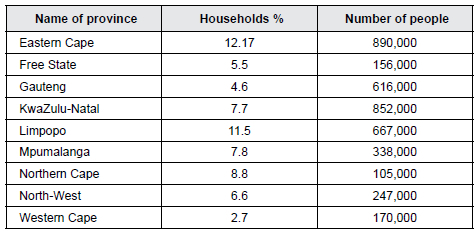
The total percentage of the country's poverty level is 62.7%, while the unemployment rate was 32.4% in 2023, with women and youth being affected the most. This high rate of poverty, unemployment, and inequality is related to many structural violence activities such as high crime rates, death related to poverty, human trafficking, and physical violence that led to many killings, namely farmer attacks and killings. The level of poverty increases the level of physical violence against Black and White farmers.
According to the SAPS Report on Farmers Attacks and Killings (2021:2) and Clark and Minnar (2018:113), farm killings, also known as farm attacks, are a serious concern in South Africa. I view them as the result of structural violence and the failure to heal memories. These crimes involve violent attacks on farmers, their families, and farm workers, often resulting in murder, injuries, and trauma. Between 2010 and 2022, there were over 4,000 farm attacks, resulting in over 1,200 deaths. In 2020/2021, there were 469 farm attacks, when 63 farmers, workers or members of their families were killed.
The vast majority of farm attacks occur in Gauteng, KwaZulu-Natal, Limpopo, Mpumalanga, and the Western Cape (SAPS Report on Farmers Attacks and Killing 2021). One might correlate the provinces' poverty and wealth with these attacks. Police reports indicate that the motives behind these attacks are linked to robbery, land reform, and racial tension.
In their article entitled "Rural crime in South Africa: An exploratory review of 'farm attacks' and stock-theft as the primary crimes in rural areas", Clark and Minnar (2018:111) confirm 3,065 attacks and 677 killings of farmers in rural areas between 1991 and 1997, according to the farm attack stats collected by SAAU/AGRISA for the said period. The statistics for 1991-1997 differ for the same period from another organisation, the Transvaal Agricultural Union (TAU), which records 764 attacks and 445 killings (Clark & Minnar 2018:111). Furthermore, they confirm that between 1997 and 2006, approximately 20,000 killings took place annually and 17,000 killings between 2007 and 2016 annually, according to SAPS reports (Clark & Minnar 2018:113). These statistics illustrate how the country is violent under the negotiated peace that did not address the real challenges of life such as poverty, unemployment, and inequality. On moral grounds, it is unethical to kill a person; on the other hand, poverty, unemployment, and inequality might be the reasons for these attacks, livestock theft and killings, but this is the research for the future. This indicates the violence in the so-called peaceful country that has inherited peace during the transition from apartheid to democracy - structural violence has turned into physical violence.
12. FINDINGS AND RECOMMENDATIONS
This research study found structural violence in South Africa instead of holistic peace, including the distribution of power and wealth. This is evident in the high levels of poverty, unemployment, and inequality. In a country where poverty, unemployment, and inequality are high, healing memories are used to cool off the people or are used as opium to drug people to sleep and not see the real challenges in their lives.
This study found that structural violence was created in the name of a negotiated peace, in order to protect the interests of the Mineral and Energy Complex, which was heavily struck by sanctions and disinvestment strategies to end apartheid.
It also found that there are more killings through violent means, such as the attacks on and killings of farmers. Many deaths were linked to poverty-related diseases within this structural violence.
Based on poverty, unemployment, and inequality, it was found that healing memories is an opium that makes people forgive but not remember what has happened to them and what is happening to them at present.
Negotiated peace agreements frequently prioritise short-term stability (like social grants that cannot provide a better life for all) over long-term transformation (industrialisation of the country alleviates poverty and reduces unemployment).
Unaddressed historical injustices and economic disparities perpetuate structural violence in the form of poverty, unemployment, and inequality.
Healing memories in the form of TRCs in South Africa provide crucial healing spaces, but they face limitations.
13. RECOMMENDATIONS
The eschatological vision of peace is holistic, irrespective of equality of power, wealth, and well-being. People do not fight for abundant resources in the hands of the few. Jesus said, I have come so that they may have life and life in abundance. Peace should be obtained based on what the eschatological vision of "peace among the nations" means, given the past and current South African conflicts that impact (geo-)political peacebuilding.
14. CONCLUSION
Exploring negotiated peace in underdeveloped countries reveals that structural violence often persists, despite intentions to end conflict. South Africa's experience serves as a poignant illustration. Negotiated peace in underdeveloped countries such as South Africa requires a nuanced understanding of structural violence. South Africa's experience highlights the importance of addressing economic and historical injustices. In prioritising healing memories and inclusive transformation, future peace negotiations can strive for more sustainable and equitable results for all the people of South Africa as per the Freedom Charter. Exploring a negotiated peace in South Africa must consider the complex interplay between political, economic, and social factors perpetuating structural violence.
BIBLIOGRAPHY
Ackermann, L., Boesak, A.A., Baraine, Chambers, J., Chikane, F., Tutu, M.D. et al. 1990. Fortresses of fear: Report of the Independent Board of Inquiry. Braamfontein: SACC. [ Links ]
Amanze, J. 2018. Bad governance in Africa: An ecumenical concern. In: A. Karamaga (ed.), African Christian theology: Focus on human dignity (Nairobi, Kenya: All Africa Conference of Churches), pp. 132-149. [ Links ]
Bedford-Strohm. H. 2024. Christian witness in Democracy. Lecture in Bloemfontein, February 12, 2024. Unpublished. [ Links ]
Clark, W. & Minnar, A. 2018. Rural crime in South Africa: An exploratory review of "farm attacks" and stock theft as the primary crimes in rural areas. Acta Criminologica: Southern African Journal of Criminology 31(1):103-135. [ Links ]
Demonchonok, E. 2009. Between global violence and the ethics of peace: Philosophical perspectives. Oxford: Wiley-Blackwell [ Links ]
Demenchonok, E. & Peterson, R. 2009. Globalisation and violence: The challenge to ethics. The American Journal for Economics and Sociology 68(1):1-352. https://doi.org/10.1111/j.1536-7150.2008.00613.x [ Links ]
Fiala, A. 2009. The democratic peace myth: From Hiroshima to Baghdad. In: E. Demenchonok (ed.), Between global violence and the ethics of peace: Philosophical perspectives (Oxford: Wiley-Blackwell), pp. 77-100. https://doi.org/10.1111/j.1536-7150.2008.00616.x [ Links ]
Galtung, J. 1996. Peace by peaceful means: Peace and conflict, development and civilisation. International Peace Research Institute. Oslo: Sage Publications. https://doi.org/10.4135/9781446221631 [ Links ]
Hicks, S.V. 2009. The project of reconciliation and the road to redemption: Hegel's social philosophy and Nietzsche's critique. In: E. Demenchonok (ed.), Between global violence and the ethics of peace: Philosophical perspectives (Oxford: Wiley-Blackwell), pp. 153-180. https://doi.org/10.1111/j.1536-7150.2008.00619.x [ Links ]
Kynoch, G. 2013. Reassessing transition violence: Voices from South Africa's township wars, 1990-1994. African Affairs 112(447):283-303, https://doi.org/10.1093/afraf/adt014 [ Links ]
Lase, D. 2022. Forgiveness, reconciliation and identity of the church. In: J. Motte, A. Parlindungan & S. Hübner (eds), Building inciusive communities: How can the church fight against discrimination, exclusion and violence (Wuppertal, Germany: United Evangelical Mission), pp. 144-152. [ Links ]
McRae, M. 2019. Sharpeville massacre: A violent turning point in the history of South African apartheid. Canada: Civil and political rights. [ Links ]
Modise, L.J. 2009. Reflections on the well-being levels of professionals in rural and semi-rural areas - A faith theoretical perspective. Unpublished doctoral thesis. Pretoria: Unisa Press. [ Links ]
Modise, L.J. 2025. The poor and voiceless in the context of Belhar Confession: Ecumenical response to South African and giobai challenges. Wellington: CLF Publishers. [ Links ]
Myers, C. 2012. Introduction to confronting the power. In: W.T. Cavanaugh, J.W. Bailey & C. Hovey (eds), An Eerdmans reader in contemporary political theology (Grand Rapids, MI: Wm B. Eerdmans), pp. 337-341. [ Links ]
Prah, K.K. 1990. African renaissance or warlordism? In: M.W. Makgoba & T. Mbeki (eds), African renaissance (Cape Town: Tafelberg Publishers), pp. 37-61. [ Links ]
Reed, D. 1991. The killings in South Africa: The role of the security forces and the response of the state. New York: Human Rights Watch. [ Links ]
Sanbonmatsu, J. 2009. The Holocaust sublime: Singularity, repression, and violence of everyday life. In: E. Demenchonok (ed.), Between global violence and the ethics of peace: Philosophical perspectives (Oxford: Wiley-Blackwell), pp. 101-126. https://doi.org/10.1111/j.1536-7150.2008.00617.x [ Links ]
saps Report on Farmers Attacks and Killings 2021. South African Annual Crime Report 2020/201: SAPS Report on Farmers Attacks and Killings 2021. Pretoria: SAPS Corporate Communication and Liaison [ Links ]
Schmitt, C. 2012. Political theology. In: W.T. Cavanaugh, J.W. Bailey & C. Hovey (eds), An Eerdmans reader in contemporary political theology (Grand Rapids, MI: Wm B. Eerdmans), pp. 275-285. [ Links ]
Terreblanche, S.J. 2012. Lost in transformation: South Africa's search for a new future since 1986. Stellenbosch: KMM Review Publishing Company. [ Links ]
Tutu, D. 2012. Without forgiveness, there is no future. In: W.T. Cavanaugh, J.W. Bailey & C. Hovey (eds), An Eerdmans reader in contemporary political theology (Grand Rapids, MI: Wm B. Eerdmans), pp. 482-502. [ Links ]
Date received: 4 October 2024
Date accepted: 17 May 2025
Date published: 30 June 2025
