




Services on Demand
Journal

Article
 English (pdf)
 Article in xml format
 Article references
 Automatic translation
 Send this article by e-mail
Indicators
Related links
-
 Cited by Google
 -
 Similars in Google
Share

 Permalink
Acta Theologica
On-line version ISSN 2309-9089Print version ISSN 1015-8758
Acta theol. vol.44 n.2 Bloemfontein 2024
https://doi.org/10.38140/at.v44i2.8344
ARTICLES
Jesus talks to the Samaritan woman: A dialogic analysis
P. Rule
Department of Curriculum Studies, Stellenbosch University, South Africa. E-mail: prule2015@sun.ac.za; ORCID: https://orcid.org/0000-0002-4746-8482
ABSTRACT
The contemporary world is characterised by the dehumanisation of "the other" on multiple grounds. Jesus' encounter with the Samaritan woman (John 4:1-42) sheds light on his attitude towards, and his engagement with her as a conventional "other" for Jews. This article aims to explain their dialogic encounter as an informal teaching and learning event against the backdrop of Jew-Samaritan relations and the status and roles of women in New Testament times. It uses the conceptual framework of diacognition, drawing on the notions of dialogue, position, and cognition to conduct an analysis of the episode as a learning event. It finds that the encounter enables the Samaritan woman to recognise Jesus as prophet and Messiah and transforms her conventional female positions to those of partner in dialogue, agent, and apostle. It thus challenges the "othering" of outsiders in contemporary church and society and affirms the leadership and agency of women.
Keywords: Samaritan woman, Jesus, Dialogue, Position
Trefwoorde: Samaritaanse vrou, Jesus, Dialoog, Posisie
1. INTRODUCTION
Our world is characterised by the alienation of "the other" who is seen as different from "those who belong", based, inter alia, on race, class, religion, ethnicity, place of origin, gender, and/or sexuality. This othering - constructing the other as inferior and less than human - provides the ideological basis for treating people in abominable ways through processes such as colonisation, enslavement, exclusion, systematic discrimination (e.g. apartheid in South Africa), the pervasive abuse of women exposed by the #MeToo movement, the massacre and bombing of civilians (e.g. Israel/Gaza), and, in its most extreme form, genocide. Unfortunately, religion has often played a central role in the justification and perpetuation of othering.
In the Gospel of John (4:1-42),1 Jesus' encounter with the Samaritan woman throws light on the recounted attitude and actions of Jesus (and perhaps of the tradition from which John's Gospel arises) towards women and towards those who were "other" than Jews (in this instance, Samaritans). The purpose of this article is to provide a dialogic analysis of the encounter between Jesus and the Samaritan woman. To do this, I adopt the framework of diacognition, using the lenses of dialogue, position, and cognition to analyse the encounter as a teaching/learning event. I begin with a brief review of relevant scholarship, first on John's Gospel and the Samaritan woman, and then on two other pertinent themes, namely Jews and Samaritans as well as Jesus and women. I outline the analytical framework of diacognition and then apply this framework, employing in turn each of the complementary analytical lenses. I argue that the encounter brings about a radical transformation at both a personal and communal level that manifests in the dialogue itself, in the positioning and repositioning that takes place in the dialogue, as well as in the processes of coming to know and believe that it reveals.
The article contributes to the scholarship, by challenging interpretations that denigrate and sexualise the Samaritan woman, and extends those that emphasise her agency and leadership. It also provides novel insights into the encounter as a learning event for the Samaritan woman and her community.
2. THE GOSPEL OF JOHN AND THE SAMARITAN WOMAN
The story of Jesus' encounter with the Samaritan woman has been interpreted in a variety of ways in the theological literature. As far back as the early 3rdcentury, Origen of Alexandria viewed the Samaritan woman's search for understanding and witness to her neighbours as an example for all Christians. He also focused on the Samaritan woman's five husbands allegorically as the five senses that rule the soul before it comes to faith (Bruner 2012). Subsequent allegorical interpretations of the husbands saw them as the five books of Moses and the five Gentile nations that colonised Israel (Ray 2002), and, in an African context, the five political regimes that dominated Zimbabwe at different times, with the Samaritan woman symbolising African woman and the land (Dube 2001).
From the 19th century, biblical scholarship began to focus on the historical context of the time that the gospel was written, presumed to be in the last quarter of the 1st century or the 1st quarter of the 2nd century (Köstenberger 2009). For example, Westcott (1975) viewed the destruction of the temple in Jerusalem in 70AD as a key context informing the writing of John's Gospel, together with the Christian mission to the Gentiles (which had been underway for several decades previously) and the emergence of Gnosticism. The destruction of the temple resonates with the theme of true worship in Jesus' dialogue with the Samaritan woman, and the conversion of the woman and her community ties in with the historical Christian mission to Samaria and beyond (Köstenberger 2009). Much of the literature on the Samaritan woman has, through the centuries, focused on her "sinfulness" and "ill-repute" and her litany of deplorable qualities. I address these dominant interpretations and recent challenges to them in more detail below.
3. JEWS AND SAMARITANS
Historically, there is contention regarding the exact origins of the Samaritans as a people. The unified kingdom of Israel divided into the Northern Kingdom (Israel) and Southern Kingdom (Judah) in the 10th century BCE. The Samaritans perceived themselves as descendants of the northern kingdom, specifically the tribes of Ephraim and Manasseh, while the Jews traced their descent from Judah. The northern king, Omri, is credited with building a hilltop city called Samaria (1 Kings 16:24). However, the northern kingdom was swept away by the Assyrian Empire in 722 BCE and its ruling classes exiled, never to return, while Judah remained intact. Peoples from elsewhere in the empire were resettled to replace the exiled northern Israelites (2 Kings 17:24). The new settlers merged in time with the remaining Israelites and were eclectic in their religious adherence, "they worshipped the Lord but also served their own gods" (2 Kings 17:33). This mixed-race and religiously diverse group "became the people we know today as the Samaritans" (Potok 1978:180).
The Babylonian Empire replaced the Assyrian and, in 586 BCE, invaded Judah, destroyed Jerusalem and the temple, and carried off many Jews into exile. In 538 BCE, Babylon was, in turn, overwhelmed by the Persians under King Cyrus and the Jews were allowed to return to Jerusalem and rebuild the temple. According to the book of Ezra, the people of Samaria approached the Jewish returnees and offered help in rebuilding "for we worship your God as you do" and had been sacrificing to him since the Assyrians resettled them in Samaria (Ezra 4:3). The Jews refused their help and the Jewish leaders prohibited Jews from inter-marrying with Samaritans and other neighbouring peoples. The Samaritans later built their own temple on Mount Gerizim in Samaria. The Pentateuch was their sacred text, whereas the Jews added to this the other books of the Old Testament.
When the Jewish exiles returned to rebuild Jerusalem, they perceived the Samaritans and other neighbours as political enemies who tried to sabotage the rebuilding in various ways, including petitioning the Persian king and temporarily halting construction (Neh. 4; Ezra 4:21). In religious terms, the Jews regarded the Samaritans as "unclean" and their worship at Mount Gerizim as sacrilegious, although both traditions adhered to Torah and revered common ancestors. The Samaritans, on the other hand, viewed themselves as the true descendants of Israel (Witherington 1995; Mukansengimana-Nyirimana & Draper 2012). This enmity was accentuated when the Maccabean ruler John Hyrcanus, high priest and king of Judah, destroyed the temple on Mount Gerizim in the 2nd century BCE (Josephus, A.J. 13.254). In Jesus' times, the Jewish authorities looked down on Samaritans. Seeking to discredit Jesus, they suggested that he was a demon-possessed Samaritan (John 8:49). The hostility continued into the Christian era. The historian Josephus recounts an incident when Samaritans killed Galileans on their way to the feast of tabernacles in Jerusalem, resulting in widespread clashes between Jews and Samaritans (Josephus, A.J. 20.118-120.136). This simmering enmity was thus the backdrop to both the parable of the Good Samaritan (Luke 10:25-37) (Rule 2017) and Jesus' encounter with the Samaritan woman, as portrayed in John 4 (Okure 2009).
The early Christian movement did not retain this ancient grudge. The apostles, flrst Phillip and then Peter and John (Acts 8), of the early Christian movement preached, healed, and baptised converts in Samaria. It is likely that Christian communities in Samaria would have been receptive to oral and written traditions about Jesus' activities in the region, especially given the prevalent hostility between Jews and Samaritans (Schüssler Fiorenza 1996).
4. JESUS AND WOMEN
Biblical evidence indicates that Jesus saw and treated women in ways that were significantly different from those imposed by the patriarchal cultures (both Roman and Jewish) in which he lived (Ray 2002). He is portrayed as encouraging Mary to sit and learn from him rather than work in the kitchen (Luke 10:38-42); he refrained from condemning the woman caught in adultery (John 8:3-11); Mary of Magdala was the first witness to his resurrection and apostle of the Good News (John 20:14-18). Feminist biblical scholars have emphasised the agency and leadership of women in the New Testament and early church who played prominent roles such as apostles, missionaries, leaders of house churches, deaconesses, prophets, and martyrs (Kienzle & Walker 1998; Madigan & Osiek 2005; Miller 2005). As the church became institutionalised and aligned with the patriarchal state after Constantine's conversion, women's leadership became less visible and their agency was suppressed in liturgical worship, biblical studies, and theology: "women wishing to serve were increasingly circumscribed by legal and canonical controls" (Nathan 2008:368).
Historical interpretations of the encounter of Jesus and the Samaritan woman, from Origen and Tertullian to Calvin and 21st-century interpreters, have tended to focus on the woman's sexual history of having five husbands and living with a sixth "not her husband" (Reeder 2022). The 19th-century theologian C.J Ryle (2019:65), for example, characterises the Samaritan woman as "an ignorant, carnal-minded woman, whose moral character was more than ordinarily bad". In these readings, the story is about the woman's sinfulness as a "prostitute" and "adulterer" and God's forgiveness (see Maree 2022) or Jesus' tact in dealing with her (Ryle 2019), even though "sin" and "forgiveness" are not mentioned in the passage (Reeder 2022). Some contemporary interpretations by African theologians, while recontextualising the story in African terms and contesting traditional interpretations, have focused on the sexual history, identity, and symbolism of the Samaritan woman and her husbands (Dube 2001; Ademiluka 2023). Others have focused on the Samaritan woman's agency with Jesus as a peacemaker between Jews and Samaritans (Mukansengimana-Nyirimana & Draper 2012) and how, through their dialogue, Jesus and the woman transcend "barriers of prejudice and the stigmas of racism and sexism" (Okure 2009:409).
The feminist scholarship on the encounter of Jesus with the Samaritan woman reflects concerns with the denigration and sexualisation of the Samaritan woman in historical and contemporary interpretations. Schüssler Fiorenza (1996:237) argues that the episode is "probably based on a missionary tradition that ascribed a primary role to a woman missionary in the conversion of the Samaritans". She emphasises the woman's agency in announcing Jesus to her community and inviting them to meet him. Reeder (2022) reads the story in light of the #MeToo and #ChurchToo movements that exposed abuse in the church. She argues that traditional readings, with their emphasis on the sinfulness of the woman and her need to repent, display "the church's minimization of women in the Bible and marginalization of women in Christian communities" (Reeder 2022:65), rather than focusing on the Samaritan woman's leadership, agency, and initiative. In an Indian context, Victor (2016) draws the parallels between the Samaritan woman and the outcast Dalit women in India. He notes in the story Jesus' accommodation of "the Dalits of the society of Jesus' day" (Victor 2016:160). This article draws upon insights from feminist interpretations and from other commentaries on the gospel, in its dialogical analysis of the episode. It does not make judgements about the Samaritan woman's sexual history; rather, it focuses on her active role in the dialogue itself and its outcomes.
5. DIACOGNITION AS AN ANALYTICAL FRAMEWORK
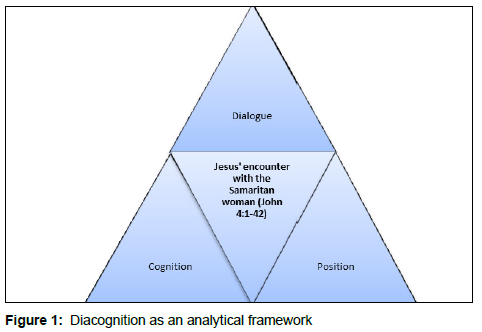
Diacognition as an analytical framework is based on the understanding of teaching and learning as moments in the wider process of knowing or cognising (Freire 1994; Rule 2015). The term "diacognition" derives from the combination of the three key concepts that make up the framework: dialogue, cognition and position. Diacognition can be used to understand how these three concepts relate in episodes of teaching and learning. It concerns "coming to know through a situated process of positioning and repositioning in dialogic exchange with oneself and others" (Rule 2015:143). The framework has been used to analyse a variety of teaching and learning episodes (Rule 2015; Mather 2022; De Klerk 2024), including Jesus' pedagogy in the parable of The Good Samaritan (Rule 2017). I use it, in this instance, to understand the dialogic exchange between Jesus and the Samaritan woman as an informal episode of teaching, learning, and coming to know. I elaborate on the three interleaving lenses of dialogue, position, and cognition below.2
Dialogue concerns the verbal and non-verbal exchange between interlocutors engaged in conversation. Its dimensions include the interpersonal (between people), the intrapersonal (within persons) and the transpersonal (between broader social aspects such as religion, race, class, and historical identity). For example, in the prelude to the parable of the Good Samaritan, Jesus engages in an interpersonal dialogue with the lawyer (Luke 10:25-28). The lawyer then engages in an intrapersonal dialogue ("wanting to justify himself" [Luke 10:29]) before his next question and re-entering the interpersonal dialogue: "And who is my neighbour?". The parable brings into dialogue broader ideas such as love, ethics, neighbourliness, and social difference (transpersonal dialogue). It may also include intertextual and intratextual dimensions (between and within texts, stories, genres) such as the relations between the Good Samaritan and other parables in Luke (intratextual), as well as other episodes involving Samaritans in classical literature such as Josephus' writings (intertextual).
Position is about how interlocutors place themselves and others within a dialogue. For example, someone asking a question typically takes on the position of questioner and positions the interlocutor as the one who answers.3 Besides the overarching social positionalities such as "Jewish man", "teacher", "Samaritan woman", and "ex-wife" that interlocutors bring to the dialogue, position includes the more or less temporary self-positions that they adopt and attribute in the dialogue as it proceeds. These may be rhetorical positions (e.g. the questioner, the one who answers, the explainer, and the proposer), small-"p" political positions (e.g. subordinate, superordinate, equal, imposing, and resisting) and positions of attitude and emotion (e.g. I-as-surprised, anxious, resolute, and disapproving).
The lens of cognition focuses on knowing and coming to know. One cognises an object of cognition when learning about it for the first time. For example, the lawyer cognises the parable which Jesus tells as an object of cognition. One might re-cognise an object by looking at it from a different perspective and so come to know it differently. This might involve a process of de-cognition (questioning what one thought one knew). For example, the lawyer re-cognises the commandment, "you shall love your neighbour as yourself" after listening to the parable (Luke 10:37). It might also involve inter-cognition (knowing it together with others).
These lenses are conceptually distinct. However, they are mutually informing in understanding processes of meaning-making that take place in a dialogic exchange. They can thus provide a composite and cumulative analytical view of a dialogic exchange as each lens overlays the episode (see Figure 1). I now use the three lenses in turn to analyse Jesus' dialogue with the Samaritan woman.
6. ANALYSIS OF JESUS' ENCOUNTER WITH THE SAMARITAN WOMAN
6.1 Dialogue
The dialogue that occurs when Jesus engages with the Samaritan woman operates at a number of interlayered levels (see Figure 2), including the interpersonal and intrapersonal, the transpersonal and the intertextual and intratextual. The dialogue occurs within a historical context, including both the context of circa 90 CE when it was written and the context of Jesus' ministry when it occurred. The dialogue has two main thematic movements. The first one is initiated by Jesus' request for a drink and its focus is on "living water". The second one is initiated by Jesus' instruction that the woman call her husband and bring him back to the well. The focus shifts to who the interlocutors are and their coming to know each other.
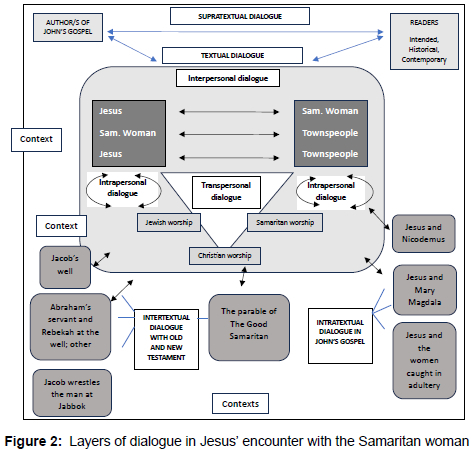
At the interpersonal level, the dialogue at the well takes the form of a series of alternating rejoinders in the form of question and answer: "Will you give me a drink?" (v. 7), asks Jesus. Given that Jews did not associate with Samaritans and regarded them as unclean (v. 9), and that coming into contact with a Samaritan woman was "clearly ill-advised for a Torah-faithful Jewish man" (Neely 2018:333), this request might also be viewed as a dialogical provocation.4 It implicitly provokes an intrapersonal dialogue in the Samaritan woman: "How can he, a Jew, ask me to give him a drink? Who does he think he is? Why is he making such a request?". This kind of intrapersonal dialogue is suggested by the Samaritan woman's response to Jesus when she questions the problematic premise of his request that it is somehow in order for her to oblige him: "You are a Jew and I am a Samaritan woman. How can you ask me for a drink?" (v. 9).
Jesus' response suggests that he is using the request to open up a conversation at a deeper spiritual level about water, not as physical sustenance but as spiritual nourishment that he can provide: "a spring of water welling up to eternal life" (v. 14). There is thus a dialogue between these two senses of water: the physical and the spiritual, the literal and the metaphorical. Jesus characteristically used these kinds of metaphors, in addition to parables, to talk about the kingdom of God in the synoptic gospels (mustard seed, lost coin, lost sheep) and about his own identity in John's gospel (light, bread, water, way) (Borg 2011). Jesus thus points to the metaphorical sense of "living water", but the Samaritan woman insists on the literal meaning: "Sir you have nothing to draw on and the well is deep. Where can you get this living water?" (v. 11).
Jesus explains the difference between the two kinds of water: "everyone who drinks this water will be thirsty again but whoever drinks the water I give him will never thirst" (vv. 13, 14). The woman then requests this living water: "Sir, give me this water so that I won't get thirsty and have to keep coming here to draw water" (v. 15). It sounds to her as if the water Jesus gives will have considerable practical benefits that will save her from an arduous routine. This daily physical task seems to dominate her interpretation of Jesus' words. It is as if Jesus cannot get her to grasp their spiritual and transformative significance. Perhaps this provokes Jesus' own intrapersonal dialogue: "How can I get her to understand who I am and what I can give her and her people?".
This would account for his sudden change of direction: "Go, call your husband and come back" (v. 16). Again, as in his first request for a drink, this is a dialogic provocation. She replies that she does not have a husband (v. 17). Taking this opening, Jesus then reveals to her that he knows her, that she has five husbands, and that the man she now has is not her husband. This intimate knowledge of the Samaritan woman and her history shocks her into a recognition of Jesus: "Sir, I can see that you are a prophet." After further discussion, he reveals himself to her: "I know that the Messiah is coming.
When he comes, he will explain everything to us." / "I who speak to you am he." The Samaritan woman responds to this with action. She goes to the town's people and calls them (rather than "her husband") to meet Jesus: "Come, see a man who told me everything I ever did. Could this be the Christ?" (v. 29)
The transpersonal dialogue between what it means to be and to worship as Jewish and as Samaritan frames and informs the interpersonal dialogue. The conventional nature of this Jewish-Samaritan dialogue would be non-dialogue. It could not take place, as a Jewish man would not talk to an "unclean" Samaritan. In any case, a Jewish teacher would not speak to a woman in public. Thus, the disciples are surprised to see Jesus engaging with the Samaritan woman (v. 27). This perhaps provokes their own internal dialogue: "Why is he speaking to her? - it is not allowed." Interestingly, they decide not to say anything, perhaps out of respect or their prior experience of Jesus' penchant for engaging with outcasts and the "unclean". Jesus thus creates a dialogue in a situation and with an interlocutor where there should be no dialogue. This disturbs the conventionally and historically entrenched Jew-Samaritan mode of interaction, thereby creating the possibility for transformation. At a transpersonal level, it moves beyond the Jewish way (which includes worshipping in Jerusalem) and the Samaritan way (worshipping on "this mountain" - Mount Gerizim) to a new Jesus way practised by the Johannine community from which the gospel arose ("the true worshipper will worship the Father in spirit and in truth" [v. 23]).
The dialogue also operates at an intertextual level. In its resonance with the story of Jacob's well and other biblical "well stories", the location and situation of the dialogue underline Jesus' Jewishness. It takes place at the well of Jacob who, according to the Samaritan woman, "gave us this well and drank from it himself" (v. 12). For both Jews and Samaritans, the place is significant, providing a connection to the ancestors and the ancient tradition that Jews and Samaritans share; it "symbolises the heritage of both" (Reeder 2022:5). In addition, it links Jesus to Abraham who sent his servant to find a wife for his son Isaac (Gen. 24:10-51). The servant went to the well outside the city of Nahor and requested a drink from a woman. The first one who met his request (it turned out to be Rebekah) would become Isaac's wife. Like Rebekah and her family, the Samaritans offered the travellers (Jesus and his disciples) hospitality and both encounters engendered new relationships: Rebekah became Isaac's wife, and the Samaritans became believers in Jesus as Messiah. One important difference was that Rebekah turned out to have kinship ties with Abraham as the daughter of Abraham's brother, whereas the ties between Jesus and the Samaritan woman were not blood ties. They were ties of the spirit and of the "living water" that Jesus offered and that she and the townspeople received from him. For those who knew the story in Genesis (and others such as Jacob meeting Rachel at the well [Gen. 29]), this intertextual dialogue would perhaps have encouraged readers to see the commonality of Jews and Samaritans, and the transformative overtones of the encounter at the well (Victor 2016).
At the intratextual level, the episode resonates with other episodes in John's Gospel. The Samaritan woman is like Nicodemus (John 3:1-17), in that she engages in dialogue with Jesus and seeks to understand his message. Unlike Nicodemus, "a Jewish leader" and a prominent man in his community, the woman is a Samaritan of lesser status performing the menial daily task of drawing water. Unlike Nicodemus, who comes to Jesus "by night" perhaps to avoid being seen with him, the Samaritan woman encounters Jesus in broad daylight (the sixth hour) at a public place. Witherington (1995:119) highlights the contrast between the Samaritan woman "who gains some insight into Jesus' true character" and Nicodemus, "a teacher and representative of normative Judaism, who fails to understand Jesus". The encounter also resonates with Jesus' interaction with other women in John's Gospel: the woman caught in adultery (John 8:1-11); Mary who anoints his feet (John 12:1-8) (Reeder 2022). In all these episodes, he treats the women with respect, insight, and affirmation.
6.2 Position
The lens of position and positioning provides especially pertinent insights into the story, given the transpersonal (non-)dialogue between Jews and Samaritans and the "othering" that informed it. In his request for a drink, Jesus re-positions himself from the conventional stance of a Jew (shunning Samaritans) and a Jewish teacher (avoiding public contact and conversation with women). By positioning himself as an interlocutor with the Samaritan woman, he transgresses this double taboo, much to the surprise and perhaps initial disapproval of both the Samaritan woman and his disciples.
Interestingly, by requesting a drink, Jesus ostensibly positions the Samaritan woman in the conventional women's role of drawer and provider of water. However, the effect as a dialogic provocation is that the Samaritan woman refuses Jesus' positioning of her and positions herself as an active, questioning interlocutor who exercises her own distinctive voice as they discuss the "living water" that Jesus proffers. She is knowledgeable about Jewish and Samaritan traditions, grounded in her identity as a Samaritan woman, inquisitive about Jesus and his words, and tenacious in pursuing the dialogue. As the "revelatory dialogue" (Schüssler Fiorenza 1996) progresses, their positioning changes to Jesus as provider and the Samaritan woman as receiver of living water: "Sir, give me this living water so that I won't get thirsty (v. 15).
Similarly, in the second movement of the dialogue, Jesus ostensibly positions the woman in the conventional role of wife: "Go, call your husband." (v. 16). She declines this positioning: "I have no husband" (v. 17). However, this serves as a prelude to him positioning himself as someone who knows her, and her as one who is known: "You are right You have had Ave husbands and the man you now have is not your husband" (vv. 17, 18). This leads to the revelation of Jesus as prophet and Messiah.
Through the transformative impact of her encounter with Jesus, the Samaritan woman changes position from a drawer and provider of water going about her daily chores to someone who announces Jesus to her community and invites them to meet him. This change is indicated in her physical movement as she leaves her water jar behind and goes back to the city, and in her functional movement from drawer of water to witness and evangelist (Köstenberger 2009). The Gospel thus positions her as the flrst apostle to the Samaritans who takes the lead in spreading the news: "Come, see a man who told me everything I ever did" (v. 29). In doing so, she re-positions Jesus from the rather strange and troublesome Jewish man at the well to the possible Messiah: "He cannot be the Messiah, can he?" (v. 29).
Through her encounter with Jesus and her testimony about him to the townspeople, she aIso re-positions the way in which they would conventionally position a Jewish man - possibly as an aloof and unfriendly stronger who looks down on them, perhaps even as an enemy. On another occasion, a Samaritan viilage refuse to admit Jesus "because his face was set towards Jerusalem" (Luke 9:52-56). Instead, these townspeople welcome him as a guest ("they asked him to stay with them, and he stayed two days" (v. 40) and subsequently as the Messiah ("And many more believed because of his word" [v. 41]).
So far, our use of dialogue and position as analytical lenses shows that Jesus' dialogue with the Samaritan woman challenges the conventional Jewish-Samaritan non-dialogue with a transformative dialogue that radically changes the position of the Samaritan woman (from drawer of water to apostle of the Good News) and the Samaritan town's people (from potentially hostile strangers to hosts and believers). The third lens of cognition provides insight into how this transformation happens.
6.3 Cognition
In the story, there is a strong thematic thread concerning knowledge, knowing, and coming to know in the dialogic teaching and learning process, and how they link to believing. Through their dialogue, Jesus challenges many of the things that the Samaritan woman ostensibly knows (see Table 1):
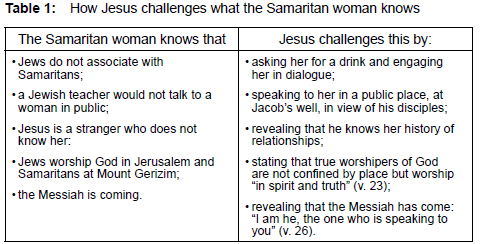
This leads the Samaritan woman to question what she thought she knew, a process of decognition of her assumptions about Jews and Samaritans, men and women, and the private knowledge of her own relationships. She is thrown into aporia (profound doubt or uncertainty), the state of not knowing what she thought she knew. This allows her to re-cognise Jesus not as a strange Jewish man (according to her initial cognition), but as a prophet and possibly the Christ (according to her progressive revelatory recognition). Her new cognition transforms her own position from being a drawer and provider of water to being an apostle of "living water" to the townspeople. She opens a space through her testimony and her invitation to meet Jesus for them to come to know him for themselves.
For the Samaritan woman, it is not Jesus' theological assertions about "living water" and "true worship" that transforms her, but rather knowing that he knows her. Her new knowledge and fledgling faith arise from dialogue and relationship. This resonates with Jesus' calling of Nathanael: Jesus' knowing of Nathanael enables him to recognise Jesus: "Where did you get to know me?"/" I saw you under the fig tree before Philip called you."/" Rabbi, you are the Son of God!" (John 1:45-49). Similarly, the faith of the Samaritan townspeople arises not only from the Samaritan woman's testimony, but also from coming to know Jesus personally for themselves through their own observation and experience, "we have heard for ourselves and know that this is truly the Savior of the world" (v. 42).
This deep sense of transformative knowing that leads to belief and lasting relationship recalls Jacob's encounter with God at the stream of Jabbok (Gen. 32:22-30): "So Jacob was left alone and a man wrestled with him till daybreak" (v. 24). The man finds Jacob's point of physical vulnerability: "he touched the socket of Jacob's hip so that his hip was wrenched" (v. 25). Similarly, the Samaritan woman as a "daughter of Jacob" encounters a "man at the well". Through their dialogue, Jesus finds her place of social vulnerability: her multiple husbands and current partner. For both Jacob in his wrestling with the man and the Samaritan woman in her dialogue with Jesus, this moment of encounter is transformative: the man renames Jacob as Israel "because you have struggled with God and with men and have overcome" (v. 28); the Samaritan woman becomes an apostle to her people through the "struggle" of her dialogue with Jesus and her coming to know him through this encounter (Köstenberger 2009).
In another example of intertextual dialogue, in both the parable of The Good Samaritan (Lk 10:25-37) and the encounter with the Samaritan woman, Jesus challenges the Jews' and Samaritans' deeply entrenched "othering" of one another. In the parable, it is the "other" - the Samaritan who helps the wounded man rather than the Jewish priest and Levite (Dagmang 2024). In the encounter with the Samaritan woman, it is she - not Jesus nor one of the disciples - who announces Jesus to the community and invites them to meet him. Both stories offer listeners/readers the position of re-cognising Samaritans - and, by extension, other people who are conventionally "othered" (lepers, tax collectors, "unclean" women) - and their relation to Jews.
7. CONCLUSION
In this article, I used the analytical framework of diacognition to analyse Jesus' encounter with the Samaritan woman. Their interpersonal dialogue throws her into aporia in challenging what she thought she knew, leading to a process of decognition. This creates a space for her to re-cognise Jesus as prophet and Messiah and transforms her positions from the conventional ones of drawer-of-water, provider, ex-wife and partner, to agent and apostle. At the transpersonal level, the story subverts the conventional Jew-Samaritan non-dialogue by repositioning Samaritans as hosts of Jesus and his disciples, and believers in Jesus the Jew as Messiah. It also affirms the leadership and agency of women. The story thus points to the inclusiveness and egalitarianism of the community of early Christian believers: "all who believed were together and had all things in common" (Acts 2: 44) (Lozada 2020).
For the contemporary world, this article presents a challenge to the multiple forms of "othering" of contemporary society (Neely 2018). Speciflcally, it challenges the sexualisation and subordination of women in biblical interpretation and in the life of the church and society. Historical interpretations of Jesus' encounter with the Samaritan woman have emphasised the woman's "sinfulness" and need for forgiveness, although the terms "sin" and "forgiveness" do not appear in the text. This article points to the Samaritan woman's active, questioning role in her dialogue with Jesus and her coming-to-know him, and to her initiative and agency in taking up the positions of interlocutor and messenger to her community. As one of the earliest apostles of the Good News, her voice and actions, as depicted in the Gospel, reach across the centuries to affirm women's transformative roles in contemporary church and society.
BIBLIOGRAPHY
Ademiluka, S.O. 2023. "[Y]ou have had five husbands": Interpreting the Samaritan woman's marital experience (Jn 4:16-18) in the Nigerian context. HTS Teologiese Studies/ Theological Studies 79(1): a8197. https://doi.org/10.4102/hts.v79i1.8197 [ Links ]
Borg, M. 2011. Jesus: Uncovering the life, teachings, and relevance of a religious revolutionary. London: Society for Promoting Christian Knowledge. [Online]. Retrieved from: https://www.amazon.com/Jesus-Teachings-Relevance-Religious-Revolutionary/dp/0061434345 [3 July 2024]. [ Links ]
Bruner, F.D. 2012. The Gospel of John: A commentary. Grand Rapids, MI: Wm B. Eerdmans. [Online]. Retrieved from: https://www.eerdmans.com/9780802866356/the-gospel-of-john/ [6 November 2024]. https://doi.org/10.5040/bci-0k34 [ Links ]
Dagmang, F.D. 2024. The enthronement of compassion and care and the unseating of customary obligation in the parable of The Good Samaritan. Acta Theologica 44(1):71-84. https://doi.org/10.38140/at.v44i1.7832 [ Links ]
De Klerk, M. 2024. Investigating the design and facilitation of an online short course for dialogic learning at Stellenbosch University: A complex systems perspective. Unpublished PhD thesis. Stellenbosch University, Stellenbosch. [ Links ]
Dube, M.W. 2001. John 4:1-42 - The five husbands at the well of living waters. In: N.J. Njoroje & M.W. Dube (eds.), Talitha cum!: Theologies of African women (Pietermaritzburg: Cluster), pp. 40-65. [Online]. Retrieved from: https://books.google.co.za/books/about/Talitha_Cum.html?id=OPkQAQAAIAAJ&redir_esc=y [3 July 2024]. [ Links ]
Freire, P. 1994. Pedagogy of hope. Reliving pedagogy of the oppressed. New York: Continuum. [Online]. Retrieved from: https://www.google.co.za/books/edition/_/wVXNl2s915cC?hl=en&gbpv=1 [1 July 2024]. [ Links ]
Josephus, Flavius (c. 75). The wars of the Jews or History of the destruction of Jerusalem. In: Josephus: The complete works (Grand Rapids MI:Christian Classics Ethereal Library), pp.1086-1544 [Online]. Retrieved from: https://ccel.org/ccel/j/josephus/complete/cache/complete.pdf [6 March 2024]. [ Links ]
Kienzle, B.M. & Walker, P.J. (Eds) 1998. Women preachers and prophets through two millennia of Christianity. Berkeley, CA: University of California Press. [Online]. Retrieved from: https://www.degruyter.com/document/doi/10.1525/9780520919273/html?lang=en [1 July 2024] [ Links ]
Kostenberger, A.J. 2009. A theology of John's Gospel and letters. Biblical theology of the New Testament. Grand Rapids, MI: Zondervan. [ Links ]
Lozada, F. 2020. John: An introduction and study guide. History, community, and ideology. London: Bloomsbury Academic. [Online]. Retrieved from: https://books.google.co.za/books/about/John_An_Introduction_and_Study_Guide.html?id=5bnEDwAAQBAJ&redir_esc=y [6 November 2024]. [ Links ]
Madigan, K. & Osiek, C. (Eds) 2005. Ordained women in the early church. A documented history. Baltimore, MD: Johns Hopkins University Press. [Online]. Retrieved from: https://www.press.jhu.edu/books/title/3880/ordained-women-early-church [25 June 2024] [ Links ]
Maree, M. 2022. Jesus can free you from your shame. The Gospel Coalition Africa (Africa edition), 24 August. [Online]. Retrieved from: https://africa.thegospelcoalition.org/article/jesus-can-free-you-from-your-shame/ [5 March 2024]. [ Links ]
Mather, N. 2022. The impact of teacher and learner positioning in the writing classroom. Journal for Language Teaching 56(1). https://doi.org/10.56285/jltVol56iss1a5412 [ Links ]
Matusov, E. 2009. Journey into dialogic pedagogy. New York: Nova Science Publishers. [Online]. Retrieved from: https://www.researchgate.net/publication/281654792_Journey_into_Dialogic_Pedagogy [7 November 2024]. [ Links ]
Miller, P.C. (ED.) 2005. Women in early Christianity: Translations from Greek texts. Washington, DC: Catholic University of America Press. [Online]. Retrieved from: https://www.jstor.org/stable/j.ctt3fgq5h [7 November 2024]. [ Links ]
Mukansengimana-Nyirimana, R. & Draper, J.A. 2012. The peacemaking role of the Samaritan woman in John 4:1-42: A mirror and challenge to Rwandan women. Neotestamentica 46(2):299-318. [Online]. Retrieved from: https://www.jstor.org/stable/43049200 [6 July 2024] [ Links ]
Nathan, G. 2008. Remapping the landscape: Early Christianity and the Graeco-Roman world. A review article. Journal of Religious History 32(3):361-370. https://doi.org/10.1111/j.1467-9809.2008.00719.x [ Links ]
Neely, B. 2018. Jesus at the well (John 4.4-42): Our approach to the "other". Theology 121(5):332-340. https://doi.org/10.1177/0040571X18779027 [ Links ]
Okure, T. 2009. Jesus and the Samaritan woman (Jn 4:1-42) in Africa. Theological Studies 70:401-418. https://doi.org/10.1177/004056390907000209 [ Links ]
Potok, C. 1978. Wanderings: Chaim Potok's history of the Jews. New York: Ballantine Books. [Online]. Retrieved from: https://www.amazon.com/s?k=Chaim+Potok+wanderings [13 November 2024] [ Links ]
Ray, S.K. 2002. St. John's Gospel: A bible study guide and commentary. San Francisco: Ignatius Press. [Online]. Retrieved from: https://ignatius.com/st-johns-gospel-bsgjnp/ [6 November 2024]. [ Links ]
Reeder, C.A. 2022. The Samaritan woman's story: Reconsidering John 4 after #ChurchToo. Downers Grove IL: Intervarsity Press. [Online]. Retrieved from: https://www.christianart.co.za/The-Samaritan-Womans-Story-Reconsidering-John-4-After-ChurchToo-Paperback [4 July 2024]. [ Links ]
Rule, P. 2015. Dialogue and boundary learning. Rotterdam: Sense Publishers. [Online]. Retrieved from: https://link.springer.com/book/10.1007/978-94-6300-160-1 [4 July 2024]. [ Links ]
Rule, P. 2017. The pedagogy of Jesus in the parable of The Good Samaritan: A diacognitive analysis. HTS Theological Studies, 73(3), a3886. https://doi.org/10.4102/hts.v73i3.3886 [ Links ]
Ryle, J.C. 2019. Expository thoughts on the Gospel of John. [Online]. Retrieved from: www.anekopress.com https://www.gracegems.org/Ryle/John.htm [6 November 2024]. [ Links ]
Schüssler Fiorenza, E. 1996. In memory of her: A feminist theological reconstruction of Christian origins. Second edition. London: SCM Press. [Online]. Retrieved from: https://scmpress.hymnsam.co.uk/books/9780334026396/in-memory-of-her [8 January 2024]. [ Links ]
Victor, R. 2016. Jesus and the Samaritan woman: Liberation of a Dalit. Asia Journal of Theology 30(2):160-176. [ Links ]
Westcott, B.F. 1975. Commentary on the gospel according to John. Grand Rapids, MI: Wm B. Eerdmans. [Online]. Retrieved from: https://www.amazon.com/Gospel-According-St-John/dp/B00104COU4 [6 November 2024]. [ Links ]
Witherington, B. 1995. John's wisdom: A commentary on the fourth gospel. Cambridge: The Lutterworth Press. [Online]. Retrieved from: https://www.google.co.za/books/edition/John_s_Wisdom/Bgi8AZRKfYsC?hl=en&gbpv=1&pg=PA1&printsec=frontcover [6 November 2024]. [ Links ]
Date received: 3 July 2024
Date accepted: 31 October 2024
Date published: 17 December 2024
1 Bible quotations from NRSV, Catholic edition.
2 For a fuller elaboration of the framework, see Rule (2015 and 2017).
3 A rhetorical question involves a different positioning since the speaker is using the form of a question to make a statement.
4 A pedagogical move in a dialogue that is intended to provoke further thinking and learning, by creating "an opportunity for dialogic disagreements, issues, problems, or dilemmas" (Matusov 2009:196).
