




Services on Demand
Journal

Article
 English (pdf)
 Article in xml format
 Article references
 Automatic translation
 Send this article by e-mail
Indicators
Related links
-
 Cited by Google
 -
 Similars in Google
Share

 Permalink
Acta Theologica
On-line version ISSN 2309-9089Print version ISSN 1015-8758
Acta theol. vol.44 n.2 Bloemfontein 2024
https://doi.org/10.38140/at.v44i2.8582
ARTICLES
Let's do theology - as in the book of Job: Developing theology in dialogue
V. Kessler
GBFE, Gummersbach, Germany; Research Institute for Theology and Religion, University of South Africa, Pretoria. E-mail: volker.kessler@gbfe.eu; ORCID: https://orcid.org/0000-0002-8420-4566
ABSTRACT
This article demonstrates how the Book of Job might inspire us to do theology in a different way. For nearly two millennia, Christian theology has mainly been presented in monologues, either from the pulpit or in the classroom. The Book of Job offers an alternate way to develop theology - through dialogue. It is argued that the speeches of the three (or four) friends should be valued and viewed as an important part of the Book of Job. The faith-based facilitation (FBF) process, a praxis cycle developed by the Salvation Army, is used as a filter on the Book of Job. The FBF process stresses communal decision-making and the importance of Kairos experiences. It is argued that the Book of Job contains at least two Kairos experiences, the divine speech from the storm and the soft voice in Eliphaz' first speech, which was unfortunately overheard. The article ends with four conclusions for doing theology nowadays.
Keywords: Doing theology, Book of Job, FBF process, Kairos experiences
Trefwoorde: Teologie doen, Boek Job, FBF-proses, Kairos-ervarings
1. INTRODUCTION
This article contributes to what practical theology can learn from the Old Testament Book of Job.1It is argued that the Book of Job describes an interesting, alternative approach of doing theology. For nearly 2,000 years, Christian theology has been taught through monologues, whether in the New Testament letters or later from the pulpit or in the classroom. In the Book of Job, theology is developed in a dialogue (Müllner 2003).2 The dialogue naturally followed the typical pattern of that time. Nevertheless, this form of discussion might inspire the way in which we do theology nowadays.
Currently, there are several approaches to doing theology as a group; some are known as theory-practice cycles. They all have in common that doing theology is regarded as a communal act. This idea is expressed in the book titled Let's do theology. Resources for contextual theology (Green 2012), which inspired the title of this article: Let's do theology - as In the Book of Job.
I would like to investigate how the Book of Job can serve as an inspiration for doing theology, solving theological questions nowadays. Sometimes conservative Christians are fairly critical of the idea of doing theology collectively. They regard such a process as a capitulation to the liberal Zeitgeist. In their eyes, theology should be taught by teachers and appointed leaders. The discovery that, at least in the Book of Job, theology is created by dialogue, could perhaps weaken their resistance to such methods.
In particular, I will use the faith-based facilitation (FBF) process developed for and published by the Salvation Army (2010). This process is suitable because of its emphasis on joint discussion and the expectation of Kairos experiences (see below).
In section 2, I present reasons why I believe that Chapters 3 to 27 (or 37) in the Book of Job can be understood as a series of dialogues. Section 3 then introduces the FBF process as a helpful type of praxis cycle. In section 4, the FBF process is applied as a filter to the Book of Job, in order to identify similarities and differences. I especially examine the process of doing theology communally and the Kairos experiences in the Book of Job. It is argued that there are at least two such experiences. The conclusion suggests ways in which the Book of Job might inspire our way of doing theology in a community nowadays.
2. DIALOGUE OR DIATRIBES OR SIMPLY "MANSPLAINING" OR...?
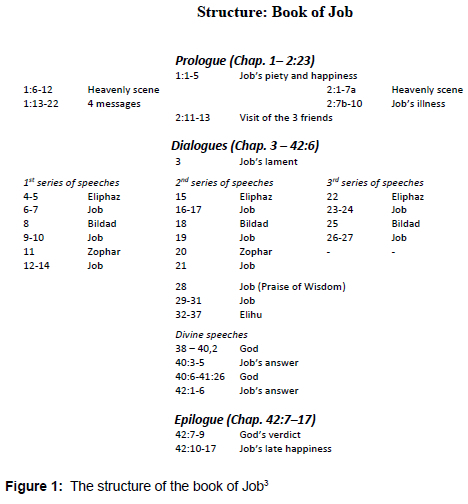
Why is the Book of Job so thick? Why do we not simply jump from Chapter 3 (Job's lament ) to Chapter 38 (the divine answer)? I argue that the dialogues from Chapters 3 to 37 are very important for the book. It starts with the three cycles of dialogue between Job and his friends Eliphaz, Bildad, and Zophar (Ch. 3-27) and continues with Elihu's speech (Ch. 32-37).
One could, of course, doubt whether the three series of speeches (Ch. 4-27) really qualify as a dialogue. At first glance, one gets the impression that it is more a series of monologues, or a kind of "mansplaining", to use a popular term of our time. Indeed, the speeches contain long passages in which the speaker generally reflects on God and the world, or as in the case of Job, on his own fate. But there are plenty of examples in which the speaker reacts to the previous speakers. In her investigation of the dialogues, Müllner (2003:173) concludes:
Passages in which (from the perspective of the respective speaker) generally valid issues are negotiated or Job's own fate is addressed alternate with passages that focus on the other person.4
I simply list some examples in which the three friends refer either back to Job or to each other.5 Eliphaz refers several times to Job's words, "Your own mouth condemns you, not mine, your own lips testify against you" (Job 15:6). Similarly, Bildad refers to Job's words: "How long will you say such things? Your words are a blustering wind" (Job 8:2). In his third speech, Bildad raises the question "How then can a mortal be righteous before God?" (Job 25:4) and thus almost quotes from the first speech of Eliphaz: "Can a mortal be more righteous than God?" (Job 4:17) (Kaiser 2010:107). Zophar also refers to statements made by Job, "you say to God" (Job 11:4). To give two examples of Job reacting to his friends: "I also could speak like you, if you were in my place" (Job 16:4a). And when Eliphaz in his last speech recommends that Job submit to God and return to the Almighty (Job 22:21.23), Job's direct response is: "If only I knew where to find him; if only I could go to his dwelling!" (Job 23:3). Finally, Elihu, the fourth visitor, claims to have carefully listened to the three friends and to Job:
I waited while you spoke, I listened to your reasoning; while you were searching for words, I gave you my full attention. But not one of you has proved Job wrong; none of you has answered his arguments (Job 32:11-12).
An example of Elihu taking up the former discussion is his use of the phrase "deep sleep" (tardema) (Job 33:15). This phrase has also been used by Eliphaz when reporting his divine revelation (Job 4:13). This phrase only occurs seven times in the Old Testament, and at very crucial passages, as in the creation of Eve (Gen. 2:21) and God's covenant with Abraham (Gen. 15:12).6 Thus we can assume that it is no coincidence that, in this instance, Elihu chooses exactly the same word tardema that Eliphaz used previously.
I think it is legitimate to regard the speeches as a series of dialogues. Although it is widely believed that there is no real communication between Job and his friends, a deep analysis shows that this impression is not correct (Scherer 2008:153). Of course, their communication is not what we would consider good group communication by modern standards, nor what is aimed at by the FBF process. But still, they are dialogues, and Job and his friends "do theology" by interacting with each other (at least to a limited extent).
In saying this, it becomes clear that I do not share the one-sided, negative view of the friends, expressed by many commentaries in the past. Job's three friends have negative press right from the beginning, for example, Job's comment ("If only you would be altogether silent" Job 13:5); Elihu's comment (Job 32:12), and finally God's verdict (Job 42:7). This continues in Christian theological commentaries. For example, Karl Barth called them "agents of Satan".7 Only in recent years have the commentaries on the friends become somewhat more differentiated. Ebach (1995:60) presents a "plea for the friends of Job", despite God's judgement.8 Scherer (2008:5-17) presents a good summary of the different exegetical perspectives on the three friends. I share the more balanced and more positive views of Ebach (1995), Oeming (2001:46-49), Newsom (2003:90), Müllner (2003), Scherer (2008), and Nömmik (2010). I find that the wisdom of friends should be valued, despite their limitations. They contribute to "doing theology" in the Book of Job. I agree with Newsom's statement:
Frequently, the friends are interpreted as religiously narrow, mean-spirited hypocrites. ... Such an attitude diminishes the intellectual challenge of the book. What is lost when the friends are dismissed is the generic force of the wisdom dialogue as a confrontation between two significant but incommensurable perspectives (Newsom 2003:90-91).
Müllner (2003:169) calls the Book of Job a "dialogical work of art" (dialogisches Kunstwerk). "Here, conversations are shown whose outcome has not yet been determined" (Müllner 2003:170).9 Walton (2012:27) uses the phrase "irreducible complexity" to describe the beauty of the Book of Job, where each part "has a significant role to play".
Several commentaries have pointed out that the speeches in Job resemble speeches before a court (Köhler 1931:11; Fischer 2021:12). This type of language is obvious in Eliphaz' advice: "But if it were I, I would appeal to God, I would lay my cause before him" (Job 5:8) (Walton 2012:182).
Although the three friends are often addressed as one group, there are differences between them, as already noted by Herder in 1819 (quoted in Fischer 2014:72). Eliphaz is the oldest among them; he represents the wisdom of experience ("as I have observed", Job 4:8). Bildad stands for tradition, for wisdom handed down over generations ("ask the former generations and find out what their ancestors learned", Job 8:8). Zophar is hot-tempered and more aggressive than the other two. Already in his first speech, he starts reproaching Job (Job 11:2). Thus there is some diversity in the group of friends.10 This diversity makes the discussion more lively and creative.11Indeed, the arguments of the friends are not bad as such:
The experience of the old Eliphaz, the tradition of the fathers and the 'eternal', probably 'divine' truth presented by Zophar are arguments that should by no means be underestimated in relation to Job's existential experience (Nömmik 2010:234).12
Newsom (2003:115) takes the side of the three friends:
Thus, what Eliphaz, Bildad, and Zophar offer to their friend Job is no illusion, no irrelevant and insensitive advice that overlooks his 'true' situation. ... They offer him a way beyond turmoil.
3. PRAXIS CYCLES
In section 4, I apply the FBF process as a filter to the Book of Job. Before doing so, I explain the FBF process in the context of the theory-practice discussion in practical theology.
3.1 Variants of the theory-practice cycles
The theory-practice discussion became prominent through the work of the Belgian Catholic priest Joseph Cardijn (1882-1967). In 1912, he founded the Young Christian Workers and suggested that reflection on a given situation should consist of three steps "see - judge - act" (Green 2012:18; Ward 2017:96). These three steps even received papal approval when Pope John XXIII used them in his encyclical Mater et Magistra (Pope John XXIII 1961:no. 236): "These are the three stages that are usually expressed in the three terms: look, judge, act."
These three steps were then taken up in Latin American liberation theology by Paulo Freire et al. (Ward 2017:97). The German Catholic theologian Zerfaβ (1974:166) presented "an action-scientific model for the correction of Christian church practice".13 With 12 steps, this model is more sophisticated and more detailed than the three steps "see-judge-act". Since it was published in German only, it hardly received notice outside of the German-speaking countries.
In 1980, the American authors Joe Holland and Peter Henriot published the "pastoral circle", which has become famous worldwide (Holland & Henriot 1980). Their circle consists of four steps, namely insertion; social analysis; theological reflection, and action. Since their publication was in English, unlike Zerfaβ (1974), it was received worldwide and led to many variations.
For example, the South African missiologist Klippies Kritzinger (2002:149) made a five-point praxis cycle out of it; in particular, he added spirituality as a fifth element. His "five-point praxis cycle" consists of involvement; context analysis; theological reflection; spirituality, and planning.
Another variant was presented by the Anglican bishop Laurie Green in his book Let's do theology, first published in 1989. Since I like this title, I re-used it for the title of this article.14 The phrase "Let's do theology" views theology as an activity, preferably "including of all types of people" (Green 2012:5). Green comes up with a "doing theology spiral", consisting of four phases, namely experience; exploring; reflecting, and responding.
These approaches all have in common that they start with practice, not with theory. They include theory but always with the goal of improving practice, moving ahead from practice 1 to a better practice 2, as Zerfaβ (1974:166) put it. They are all "practice-theory-practice models" (Osmer 2008:148).
I consider the FBF process developed by the Salvation Army to be a very promising way to do theological reflection in a group.15
3.2 Faith-based facilitation16
The faith-based facilitation (FBF) is a process used by The Salvation Army. The development of the FBF process emanated from the need to integrate Christian faith into the decision-making process as a crucial factor. In 2009, the British Salvation Army officer Dean Pallant asked the Oxford Centre for Ecclesiology and Practical Theology (OXEPT) to develop a resource for Salvation Army staff. The project was guided by Judith Thompson.17 This resource included the methodology later called faith-based facilitation (FBF), which was published in the booklet Building deeper relationships: Using faith-based facilitation (Salvation Army, The 2010).
The development of the FBF process thus arose from the need to incorporate the Christian faith as a decisive factor in decision-making and evaluation practice:
Faith-Based Facilitation (FBF) is a way of helping people think, talk, explore and respond to their issues in the light of faith. It results in the development of healthier people and communities who enjoy deeper relationships. FBF is not a theory or a project - it is a way of working (Salvation Army, The 2010:3).
Pallant (2012:173) adds: "An intentional searching for spiritual insight (called 'Kairos experience') is central to Faith-Based Facilitation."
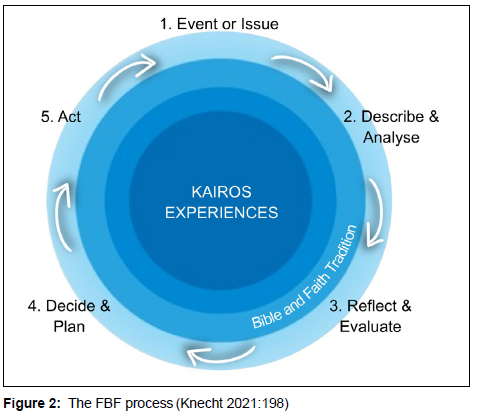
"The FBF process starts when people identify an issue which needs to be reviewed" (Salvation Army, The 2010:6). Although the issue can be detected by an individual, the booklet suggests that the identification should be done "preferably by a group of people working together" (Salvation Army, The 2010:6). Thus, ideally, the FBF process is a communal process right from the beginning. In the second step, the initial question is described and analysed as precisely as possible in its context. The third step consists of theological reflection with the help of biblical texts, faith tradition, and prayer. The results of the first three steps then flow into the fourth phase, where the actual decision is made and practical measures defined. In phase 4, the decision is made in view ot the yields from the "search for traces" in the first three steps. In this phase, the participants give space to spirituality by working with so-called "listening sessions", alternating with personal reflection times. "Listening sessions" are group discussions in which each participant brings his/her contribution to the group. Betweenthe individual statements, a moment of silence allows the participants to appreciate what has been said. The personal time of silence offers the opportunity to listen to God in prayer (Knecht 2021:201). It should be noted that the FBF process is not complete without the fifth phase, "act". But this last step is beyond the scope of this article.
In the centre, there are Kairos experiences. This refers to unexpected ideas that
can occur at any step of the FBF process but especially during the times of reflection, evaluation and decision. People of faith can often sense God at work in these moments (Salvation Army, The 2010:9).
Knecht explains the crucial role of the Kairos experiences in the FBF process:
The concept of 'Kairos Experiences' placed in the centre of the illustration makes the decisive difference, distinguishing it from similar models like that of the pastoral circle. 'Kairos Experiences' are unforeseen revelations of God's speaking and acting. The central position of the 'Kairos Experiences' in the model signifies that each phase of the process has a spiritual character. The expectation of a 'Kairos Experience' is not focused on a particular place in the process, but is expressed as an openness to it throughout the process. (Kessler et al. 2021:195-196).
When looking at the Book of Job through the lens of the FBF process, we will especially focus on step 3, reflecting and evaluating in a group, and on the Kairos Experiences.
4. DOING THEOLOGY IN THE BOOK OF JOB
4.1 Theology starts with experience
The Anglican bishop Laurie Green (2012:41) points out that doing theology always starts with experience. The experience in the Book of Job is Job's loss of his wealth and his children (Job 1:13-19), and finally the loss of his health (Job 2:7-8). This experience brings the three friends Eliphaz, Bildad, and Zophar to the house of Job (Job 2:11-13). In the language of the FBF, Job's fate is the event that leads to an intensive discussion and reflection. It actually triggers an intercultural discussion, as can be noted from the indications of origin: "Eliphaz the Temanite, Bildad the Shuhite and Zophar the Naayite" (Job 2:11), showing that they represent international wisdom (Fischer 2021:15).
Sometimes there is a discussion about whether theology should start with experience or with the Bible. I would argue that, in reality, theology always starts with experience. This does not challenge the authority of the Bible. But, as a matter of fact, it can be noted that the selection of Bible verses is guided by the experience and the culture of the Bible reader.18
4.2 No social analysis
In current applications of the FBF process, step 2 would typically include a deep social analysis such as, for example, an investigation into the economic reasons for people's poverty. Neither the friends nor Job raise such a question. As was customary at that time, they do not seek any other reasons outside the will of God and the godly retribution principle.
4.3 Doing theology in a group
As argued in section 2, the three series of speeches in Chapters 3-27 can be viewed as a dialogue in a group, even if they are not suitable as a model for successful and appreciative communication by present standards. The diversity of the group, friends from different areas, contributes to the creativity of the discussion.
4.4 No clear solution in sight
However, the dialogues with the three friends (Ch. 3-27) do not lead to any solution:
There is no rapprochement, but the disputes escalate. ... The discussion with the friends did not lead to any constructive solutions (Fischer 2021:16.23).19
The aim of the FBF process is conversations that lead to a solution in step 4. It is assumed that, in steps 3 and 4, opposing parties will come closer to each other through dialogue. This is not the case in the Book of Job, at least not in Chapters 3-27.
Even the remainder of the book does not give the answer one is looking for. Neither Elihu's long speech (Ch. 32-37), nor the two divine speeches in Chapters 38 to 41 really give an answer to the question of why Job had to suffer. Job was longing for God to speak: "I cry out to you, God, but you do not answer" (Job 30:20a). When God finally speaks, he does not provide the answer Job is looking for. Instead God directs Job's gaze to his creation, to his greatness, and power. God does not explain to Job why he had to suffer. He asks him to reorientate himself, to view his suffering in light of the big picture. Trained counsellors may be tempted to criticise such an approach, because it appears that God ignored Job's fundamental question. But Job seems to benefit from this change of perspective: "My ears had heard of you but now my eyes have seen you" (Job 42:5). The Old Testament scholar Bernd Janowski (2020:224) calls this divine reaction a "therapeutic distraction" ("therapeutische Ablenkung").
Although the Book of Job offers a way out for Job, it does not answer the fundamental question of why a righteous and innocent person has to suffer. The idea of step 3 of the FBF process is to look at the Bible and at faith tradition to find an answer. But in Job's case, the tradition of their faith does not provide an answer. Although the combined theological wisdom of Job and his friends is considerable, they do not have an answer. What shall we do if the Bible and our faith tradition do not provide an answer to our theological issue?
The Book of Job offers an interesting twist. Since neither the persons involved nor the narrator offer a definite answer, the reader is challenged.
The Old Testament scholar Carol Newsom (2003:3-31) applies the Bakhtin concept of "polyphony"20 to the Book of Job and concludes:
Read as a polyphonic work, the purpose of the book of Job is not to advance a particular view, neither that of the prose tale, nor that of the friends, nor that of Job (Newsom 2003:30).21
The "dialogical nature of the work" invites the reader to become part of the dialogue, again and again (Müllner 2003:180). This is very different from the vast majority of biblical texts. In most instances, whether in the Old Testament law and prophets or in the New Testament letters, there is a clear statement of what the reader should think. The Book of Job invites the reader to form his or her own opinion.
4.5 Looking for Kairos experiences
As pointed out by Knecht, Kairos experiences can happen in each phase. Since in phase 3 the participants are reflecting on the Bible and faith tradition, it offers a good opportunity for Kairos experiences. Reading and studying a Bible verse with a fresh eye might lead to a spiritual experience, so that, ultimately, the group testifies that God has spoken to them at this very moment via a special Bible verse. But what happens if faith tradition does not provide a convincing answer, as in the case of the Book of Job? Then one would need a special revelation from God.
In the Book of Job, one can discover at least two special revelations. The famous one is God speaking out of the storm (Ch. 38-41), with a small interruption from Job (40:3-5). Job confirms this as a Kairos experience when he testifies: "now my eyes have seen you" (Job 42:5b). This has been Job's indestructible hope amidst his suffering: that one day he would see God with his own eyes (Job 19:27a). Seeing God is considered a high privilege in the Old Testament.
Only a few named people in the Old Testament are granted to see God - Moses is the most prominent of them; for most of them, seeing God means dying (Mathys 2010:203).22
Obviously, Job 42:5b refers back to the two divine speeches (Ch. 38-41). Although Job actually listened to God, this encounter must have been so powerful that Job contests that he has seen him.
In addition to these well-known and powerful divine speeches, there is another example of special revelation in the Book of Job. This is sometimes overlooked or regarded as an overestimation of Eliphaz. In his first speech, Eliphaz tells about a special revelation he received (Job 4:12-21). It appears to him to be a mystic experience, again a Kairos experience in the language
of FBF:
Job 4:12: A word was secretly brought to me, my ears caught a whisper of it.
13 Amid disquieting dreams in the night, when deep sleep falls on people,
14 fear and trembling seized me and made all my bones shake.
15 A spirit glided past my face, and the hair on my body stood on end.
16 It stopped, but I could not tell what it was. A form stood before my eyes, and I heard a hushed voice.
As pointed out by many commentaries, it is unusual to have a prophetic message embedded in wisdom literature, which is more grounded on general revelation. Thus this passage (Job 4:12-21) is often disqualified as "quasiprophecy" (Scherer 2008:40; Kaiser 2010:65). The fact that the word tardema is used, a term pregnant with meaning (Gen. 2:21, 15:12), underlines the possible importance of the message. The revealed message itself is about the "lowliness" of human beings:
17 Can a mortal be more righteous than God? Can even a strong man be more pure than his Maker?
18 If God places no trust in his servants, if he charges his angels with error,
19 how much more those who live in houses of clay, whose foundations are in the dust, who are crushed more readily than a moth!
20 Between dawn and dusk they are broken to pieces; unnoticed, they perish for ever.
21 Are not the cords of their tent pulled up, so that they die without wisdom?
This message describes human beings as being very "low" in comparison to God. This anthropology of lowliness ('Niedrigkeitsanthropologie", Scherer 2008:55) could have provided another explanation for what Job was going through. The suffering of human beings is part of their lowliness, irrespective of their guilt or innocence (Scherer 2008:58).
Could it be that this message to Eliphaz was really a Kairos experience, but unfortunately it was not taken up as such in the further discussion? Scherer (2008:161) raises the question as to whether Eliphaz fully grasped the meaning of the revelatory sentence addressed to him in Job 4:17. Eliphaz had the opportunity to apply the theological category of creation to Job's problem, but he unfortunately missed this opportunity. According to Scherer (2008:161), this missed opportunity is part of Eliphaz' failure towards Job and God. Scherer's interpretation has something going for it, because God's answer to Job consists in the fact that he describes his majesty and power, compared with which human ability is minuscule.23 This view could also be supported by the fact that Elihu later confirms that God speaks "when deep sleep falls on men" (Job 33:15). As mentioned earlier, Elihu uses the same word as Eliphaz did: tardema. Is it possible that Elihu indirectly confirms the authenticity of Eliphaz' dream?
In total, we have discovered two Kairos experiences in the Book of Job, the prophecy given to Eliphaz (Job 4:12-21) and the divine speeches in Chapters 38-41. Only the last event was perceived as a Kairos element, as testified in Job 42:5. Maybe the flrst revelation was too soft ("whisper", Job 4:12) to be heard. God's voice out of the storm could not be overheard (Job 38:1, 40:6).
5. CONCLUSION
Of course, one must be careful not to read a modern concept such as FBF into an Old Testament text. But still, there are some elements in the Book of Job that could inspire our way of doing theology in a group and of approaching contemprary theological issues. It has been argued that at least some elements of FBF can be found in the Book of Job. This observation could be an important argument for those who reject the idea of doing theology communally, simply because it is historically rooted in liberation theology.24
• All theology starts with experience.
• It is good to do theology as a group. The Book of Job describes a process in which theology is done by dialogues. It is a "dialogical work of art". Furthermore, since the book does not offer a clear answer, even the reader becomes involved in the dialogue.
• The Book of Job shows that there are situations in which Bible and faith tradition fail to provide a clear and unambiguous solution. At present, we find ourselves in a similar situation when confronted with new issues such as overpopulation or the use of Artificial Intelligence. The Bible does not address these issues because when it was written, there was neither over-population nor AI. In such instances, we have to do theological reflection and seek spiritual guidance in Kairos experiences.
• Kairos experiences are crucial in the Book of Job. The divine speeches help Job come to terms with his situation. The Book of Job reports two Kairos experiences. The early one was soft, and not heard. The second one was loud and could not be overheard.
BIBLIOGRAPHY
Ebagh, J. 1995. Gott und die Normativitat des Faktischen. Pladoyer für die Freunde Hiobs. In: J. Ebach (Hrsg.), Hiobs Post: Gesammelte Aufsatze (Neukirchen-Vluyn: Neukirchen), pp. 55-66. [ Links ]
Fischer, S. 2014. Hiobsbotschaften - von guten Freunden und schlechten Ratgebern. In: W. Engemann (Hrsg.), Glaubenskultur und Lebenskunst (Göttingen: V&R Unipress), pp. 71-86. [ Links ]
2021. Streitkultur im Buch Hiob. In: U. Heil & A Schellenberg (Hrsg.), Theologie als Streitkultur (Wiener Jahrbuch für Theologie, Göttingen: V&R unipress,), pp. 11-29. https://doi.org/10.14220/9783737013215.11 [ Links ]
GBFE 2024. Gesellschaft für Bildung und Forschung in Europa. [Online.] Retrieved from: https://gbfe.eu/home/ [2 July 2024]. [ Links ]
Green, L. 2012. Let's do theology. Resources for contextual theology. Completely revised and updated version. London: Bloomsbury [ Links ]
Holland, J. & Henrigt, P. 1980. Social analysis: Linking faith and justice. Maryknoll, NY: Orbis. [ Links ]
Janoswki, B. 2020. Ein Gott, der straft und tötet? Zwölf Fragen zum Gottesbild des Alten Testaments. 4. Aufl. Göttingen: Vandenhoeck & Ruprecht. [ Links ]
Kaiser, G. 2010. Das Buch Hiob: Dichtung als Theologie. In: G. Kaiser & H.P. Mathys (Hrsg.), Das Buch Hiob: Dichtung als Theologie (Berlin: Verlag der Weltreligionen), pp. 13-172. [ Links ]
Kessler, V. 2017. "Diversity is strength" and "Do not communicate". In: J. Barentsen, S.C. van den Heuvel & V. Kessler (eds), Increasing diversity: Loss of control or adaptive identity construction? (Leuven: Peeters), pp. 19-36. [ Links ]
Kessler, V., Kneght, S. & Marsgh, A. 2021. Integrating spirituality into decision-making: Case studies on international faith-based organisations. In: M. Cristofaro (eds.), Emotion, cognition, and their marvellous interplay in managerial decision-making (Newcastle upon Tyre: Cambridge Scholar), pp. 186-208. [ Links ]
Knecht, S. 2020. Die Rolle der Spiritualitat in Entscheidungsprozessen: Der "Faith-Based Facilitation"-Prozess der Heilsarmee. Master of Theology dissertation, University of South Africa, Pretoria. [ Links ]
Knecht, S. 2021. Integrating spirituality in decision-making processes: The "Kairos experiences" in the "Faith-Based-Facilitation" Process of the Salvation Army. Acta Theologica Supplementum 31:194-206. https://doi.org/10.18820/23099089/actat.Sup31.12 [ Links ]
Köhler, L. 1931. Die hebräische Rechtsgemeinde. Jahrbuch der Universität Zurich 1931 (Zürich: Orell Füssli), pp. 3-23. [ Links ]
Kritzinger, J.N.J. 2002. A question of mission - A mission of questions. Missionalia 30(1):144-173. [ Links ]
Mathys, H.P. 2010. Vier Exkurse. In: G. Kaiser & H.P. Mathys (Hrsg.), Das Buch Hiob: Dichtung als Theologie (Berlin: Verlag der Weltreligionen), pp. 173-203. [ Links ]
Müllner, I. 2003. Erkenntnis im Gespräch: Zur Bedeutung der (verbalen) Begegnung im Ijobbuch. In: I. Fischer, U. Rapp & J. Schiller (Hrsg.), Auf den Spuren der schriftgelehrten Weisen (Berlin: De Gruyter), pp. 167-180. https://doi.org/10.1515/9783110923988.167 [ Links ]
Newsom, C. 2003. The Book of Job: A contest of moral imaginations. Oxford: Oxford University Press. [ Links ]
Nömmik, U. 2010. Die Freundesreden des ursprünglichen Hiobdialogs: Eine form- und traditionsgeschichtliche Studie. Berlin: DeGruyter, BZAW 410. https://doi.org/10.1515/9783110224368 [ Links ]
Oberhänsli-Widmer, G. 2016. Hiob in jüdischer Antike und Moderne: Die Wirkungsgeschichte Hiobs in der jüdischen Literatur. Neukirchen: Neukirchener Verlag. https://doi.org/10.13109/9783788731748 [ Links ]
Oeming, M. 2001. Die Dialoge mit Frau und Freunden. In: M. Oeming & K. Schmid (Hrsg.), Hiobs Weg: Stationen von Menschen im Leid (Neukirchen-Vluyn: Neukirchen), pp. 35-56. [ Links ]
Osmer, R. 2008. Practical theology. An introduction. Grand Rapids, MI: Wm B. Eerdmans. [ Links ]
Pallant, D. 2012. Keeping faith in faith-based organizations: A practical theology of Salvation Army Health Ministry. Eugene, OR: Wipf & Stock. [ Links ]
Pope John XXIII 1961. 15 May. Mater et magistra. Encyclical of Pope John XXiii on Christianity and social progress. [Online.] Retrieved from: https://www.vatican.va/content/john-xxiii/en/encyclicals/documents/hf_j-xxiii_enc_15051961_mater.html [1 December 2024] [ Links ]
Salvation Army, The 2010. Building deeper relationships: Using faith-based facilitation. London: The Salvation Army. [Online.] Retrieved from: https://www.salvationarmy.org/fbf [1 July 2024]. [ Links ]
Scherer, A. 2008. Lastiger Trost: Ein Gang durch die Eliphas-Reden im Hiobbuch. Neukirchen-Vluyn: Neukirchener Verlag. [ Links ]
Thompson, J., Pattison, S. & Thompson, R. 2008. SCM Study guide to theological reflection. London: SCM. [ Links ]
Walton, J.H. 2012. The NiV application commentary: Job. Grand Rapids, MI: Zondervan. [ Links ]
Walton, J.H. 2015. The lost world of Adam and Eve: Genesis 2-3 and the humans origins debate. Downers Grove, IL: IVP Academic. [ Links ]
Ward, P. 2017. introducing practical theology: Mission, ministry, and the life of the church. Grand Rapids, MI: Baker Academic. [ Links ]
Zerfass, R. 1974. Praktische Theologie als Handlungswissenschaft. In: F. Klostermann & R. Zerfaβ (Hrsg.), Praktische Theologe heute (Mainz: Matthias-Grünewald), pp. 164-177. [ Links ]
Date received: 23 September 2024
Date accepted: 26 November 2024
Date published: 17 December 2024
1 An earlier version of this article was presented at the conference "Exegesis and Reception: Job and cognate wisdom books, including Song of Songs" at the University of Tartu, 8-10 August 2024. I thank the organisers, Urmas Nõmmik, Stefan Fischer, and Christo S.J. Lombaard, for this wonderful opportunity.
2 Of course, I will have to argue that it really is a dialogue.
3 The figure is mine and is adapted from Janowski (2020:207).
4 German original: "Passagen, in denen (in der Perspektive des jeweils Sprechenden) allgemein Gültiges verhandelt oder von Seiten Ijobs das eigene Schicksal thematisiert wird, wechseln sich mit Passagen ab, die das Gegenüber in den Blick nehmen" (Müllner 2003:173).
5 Fischer (2014:83) argues that the friends only refer to each other to a very limited extent.
6 See, for example, Walton (2015:79).
7 In the Jewish tradition, the friends were received in a more friendly manner (Oberhansli-Widmer 2016).
8 Ebach interprets Job 42:7 as follows: In all his complaints, Job stays God's servant. "Die Freunde aber ... erheben sich über Gott, sobald sie, als ware er ihr Mündel seinen Prozeβ führen wollen" (Ebach 1995:63). Thus Job 42:7 is not so much a judgement on the content of the speeches as on the different attitudes of the speakers.
9 German original: "Hier werden Gespräche gezeigt, deren Ausgang noch nicht festgelegt ist" (Müllner 2003:170).
10 See, for example, Scherer (2008:19); Watson (2012:106-107); Fischer (2014:73-77). Each of these scholars points out that there are differences between the friends although their classifications differ slightly from each other.
11 See my earlier publication on the need of diversity within a group for achieving a good result (Kessler 2017).
12 German original: "Die Erfahrung des alten Elifas, die Tradition der Väter und die ,ewige', wohl ,göttliche' Wahrheit bei Zofar bilden keinesfalls zu unterschatzende Argumente gegenüber der existentiellen Erfahrung Hiobs" (Nömmik 2010:234).
13 German original "ein handlungswissenschaftliches Modell der Korrektur christlich-kirchlicher Praxis". It was inspired by the US pastoral theologian Steward Hiltner (Zerfaβ 1974:166).
14 It has also become the motto of GBFE (2024), the organisation for which I work.
15 I thank my former Master student, Stephan Knecht, Salvation Army officer in Switzerland, for introducing the FBF process to me (Knecht 2020; 2021).
16 This short summary is taken from Knecht (2021); Kessler et al. (2021:194-199); Salvation Army, The (2010). More detailed information about the FBF process can be found in Knecht (2020).
17 Thompson authored the SCM Study guide for theological reflection (Thompson et al. 2008).
18 I teach Christian Leadership in different cultures worldwide. When I ask the students which Bible text is the most relevant to Christian Leadership, they come up with different answers, because their culture influences their selection of Bible verses.
19 German original: "Es kommt zu keiner Annaherung, sondern die Streitgesprache eskalieren" (Fischer 2021:16). "Das Streitgesprach mit den Freunden hat zu keinen konstruktiven Lösungen geführt" (Fischer 2021:23).
20 This concept goes back to Russian literature theorist Mikhail Bakhtin (1895-1975). "In Bakthin's account a polyphonic text has three distinctive aspects: (1) it embodies a dialogic sense of truth; (2) the author's position, although represented in the text, is not privileged; and (3) the polyphonic text ends without finalizing closure." (Newsom 2003:21).
21 Newsom also added "nor even that of God". I think this statement is too strong because the narrator of the Book of Job obviously ascribed authority to God's speeches.
22 German original: "Wenigen namentlich genannten Menschen ist es im Alten Testament beschieden, Gott zu sehen - Mose ist der prominenteste unter ihnen; für die meisten gilt: Wer Gott sieht, muss sterben" (Matthys 2010:203).
23 By contrast, Fischer (2014:73-74) argues that, since this special revelation does not provide any new information, Eliphaz would simply use it to underpin his authority.
24 In fact, it is not a good argument to reject a method simply because of its origin. But that is another topic.
