




Services on Demand
Journal

Article
 English (pdf)
 Article in xml format
 Article references
 Automatic translation
 Send this article by e-mail
Indicators
Related links
-
 Cited by Google
 -
 Similars in Google
Share

 Permalink
Acta Theologica
On-line version ISSN 2309-9089Print version ISSN 1015-8758
Acta theol. vol.44 suppl.38 Bloemfontein 2024
https://doi.org/10.38140/at.vi.8756
ARTICLES
The use of empirical data in communal discernment and decision-making processes in the Dutch Reformed Church
L. Bosman
Research Fellow, Department of Practical and Missional Theology, University of the Free State. E-mail: llbosman@gmail.com; ORCID: https://orcid.org/0009-0007-5499-8389
ABSTRACT
This article endeavours to present an overview of communal discernment processes developed in the Dutch Reformed Church over the span of two decades. The focus falls on the use of empirical data in these processes. The DRC research team, under the leadership of Prof. Kobus Schoeman, amassed a rich repository of data on the church and its congregations. This data, when used within a framework of discernment, can play an invaluable role in the development of a theology from below, where the theological foundations and concrete reality of the church's context are taken into account. Discernment processes then provide frameworks wherein God's call and preferred future for the church as well as its identity can be discovered. The processes that are developed are becoming increasingly more precise and user friendly. This is important because discernment processes can be dauntingly complex and protracted. By paying attention to discernment processes developed in the ecumenical world, the self-developed processes can be enriched and corrected where necessary.
Keywords: Discernment, Communal, Process, Empirical data
Trefwoorde: Onderskeiding, Gemeenskaplik, Proses, Empiriese data
1. INTRODUCTION
Discernment has gained significant traction in the Dutch Reformed Church (DRC) and the broader missional movement. This interest is part of a general revival of spirituality (Waaijman 2013:12) and serves as a compass in the realm of spirituality in the sense that it anchors spirituality in the pursuit of discerning God's will, not simply being a general orientation towards the mystical (Waaijman 2013:14). The interest in discernment can also be viewed as an effort to regain the uniqueness of planning and decision-making processes in the church in opposition to processes shaped by business models. However, faith discernment can be a fuzzy and imprecise approach if it is not anchored in the reality of the context. Empirical data provides one such anchor that can safeguard discernment processes from arbitrariness.
A very concise definition of discernment would be: To find out what God is doing and to join him in his movements towards and in the world. This definition, which originates from the missional movement, does not say enough for the purposes of this article. Finding "God's will" or "God's calling" or "God's preferred future" for the community of faith would be more appropriate descriptions, to which must be added that it is done by a group of believers within and for a community of faith. Communality is important to
negate the danger inherent to all discernment processes in that one group, or individual, will coerce others to do their will by invoking the language of 'God told me to (Nel 2013:6).
Definitions of discernment usually add that it is part of decision-making processes or that it eventually leads to decision(s). This is not necessarily true for the understanding of discernment in this article. Communal discernment can also lead to a declaration about a church's calling, a vision statement, a description of the community of faith's identity or the formation of a culture among leaders or members. Therefore, for the purposes of this article, discernment is defined as a communal process, within a community of faith, of discerning God's will and/or preferred future for this community. This may or may not include decisions that lead to concrete actions.
Prof. Kobus Schoeman played a significant role in the development of empirical practical research in South Africa. The DRC, in particular, benefitted from his leadership in the four-yearly survey Church Mirror (since 1981) and the Church Life Survey (since 2010), which provides important longitudinal data about the church (Schoeman 2011; Hermans & Schoeman 2015:49, 53). He brought this repository of knowledge into the DRC in his role as leader of the Research Team of the General Synod since 2011. In recent years, this was expanded by way of regular surveys documenting the attitudes and needs of ministers. This work has played a pertinent role in the discernment processes of the meeting in the General Synods of 2019 and 2023.
This article explores the use of empirical data in discernment processes in the church. In my experience as facilitator of communal decision-making processes in the church, one of two errors can easily occur. On the one hand, the process may emphasise spiritual disciplines (reading the Bible, praying, and listening for the voice of the Spirit) to such an extent that the identity and context of the organisation, be it a local congregation, synod, commission or task team, is not adequately considered. On the other hand, in some instances, the use of data may dominate the process to such an extent that it can hardly be recognised as a process of faith discernment. This article endeavours to show how empirical data can be incorporated into discernment processes in such a way that it enriches and grounds the discernment process, without negating spiritual disciplines. Four discernment processes are discussed with special attention to the utilisation of empirical data in each. The processes and outcomes of the last two meetings of the General Synod (2019 and 2023) will then be presented as an example of the use of data produced in-house, in this instance by the Research Team of the General Synod.
2. PROCESSES OF COMMUNAL DISCERNMENT
The Church Order of the DRC (DRC 2019:3, 6) names "discernment" as the first of the responsibilities of pastors (Article 9) and elders (Article 16). Furthermore, the regulations for the General Synod explicitly state: "5.3.1 Decisions are made by means of the process of spiritual discernment, inclusive and consultative processes with consensus in mind" (DRC 2019:33). The process is then indicated as follows:
5.1.2 Meetings are conducted in a manner that carries the character of spiritual discernment, seeking consensus. This process could evolve in the following manner:
5.1.2.1 Processes of spiritual discernment during the meeting under the guidance of the Spirit listening to the Word, one another, and other voices.
5.1.2.2 Focussed processes whereby the input may be either formal or is solicited from within the meeting.
5.1.2.3 Deliberation on the work of task teams of the GSM.
The regulations briefly name elements of the process without giving an explicit and clear exposition. There may be truth in the charge that spiritual discernment as a corporate decision-making process is fuzzy and uncertain. What do discerning processes resemble? This article presents three examples developed in the DRC's missional movement, as well as an overview of the detailed process developed by Barton (2012). The three processes from the DRC's missional movement are examined because they are well known and available and inform many discernment processes that are used in die DRC. The process proposed by Barton may present different perspectives that can act as corrective or enrichment of the home-grown processes. The value of these four processes lies therein that each of these presents a well-defined process. The aim would be to find out, if and how, empirical data is used in these processes. A second aim would be to find common markers as pointers for the design of communal discernment processes for use in the church.
2.1 The South African Partnership for Missional Churches
In the early 2000s, in a partnership between the Church Innovation Institute (CII) and the South African Partnership for Missional Churches (SAPMC), a journey for missional transformation in the DRC was developed, with the aim to enable local churches to discern God's preferred and promised future (Smith 2021:26). The point of departure was that
... moving to a process of spiritual discernment focused on the question of God's preferred and promised future is necessary to reveal both what needs to change and how those changes can be made (Keifert & Granberg-Michaelson 2019:25).
The process itself calls for "the practical skills of attending, asserting, deciding, and acting on the basis of a process of spiritual discernment" (Smith 2021:28).
The process of discernment developed in the SAPMC took a congregation on a journey of between three and five years. The process moved through four phases: discovery, developing the core capacity of listening; exploring, where the core capacity of taking risks was developed; embodiment for vision with the core capacity of focus, and learning and growing aimed at ongoing education. In each of these phases, specific habits and practices were developed and implemented. According to Nel (2013:2), Dwelling in the Word (part of phase 1) proved to be the most important of these practices. It develops capacities to listen for God's voice when reading the Bible, to read the Bible together, to engage with a friendly-looking stranger, to listen to another person into free speech, and to develop a missional imagination. An important and enduring feature of this habit is that a specific text, usually Luke 10:1-12, is read and reread over an extended period of months and sometimes years (Cordier 2014:46).
Possibly the most important contribution of the process developed in the SAPMC is that it places discernment at the centre of transformational processes. It shows a way beyond the usual practice of debate and decision-making by way of a majority vote. It is anti-Deistic and presupposes the possibility to discern God's will by listening to the Word, to each other, and to the world or context. Discernment is not viewed as a skill; it is a gift from God that believers receive in a stance of not-knowing (Cordier 2014:83).
The gathering of data occurs primarily in Phase 1: Discovery, in the form of a report on the congregation's culture and a community analysis (Cordier 2014:74). This knowledge is used in Phase 2, where emphasis is placed on insight into the dynamics of the change of the culture of the congregation (Cordier 2014:76), and Phase 3 where
The discovery, exploration, and experimentation of phases 1 and 2 are included in a process to discern the specific calling for this congregation in its local context (Cordier 2014:78).
2.2 The Season of Listening
The Season of Listening in the DRC was born from a sense of being overwhelmed by the changes that shook South Africa at the turn of the previous century (Niemandt 2007:10). A task team, under the leadership of Nelis J van Rensburg, was formed and produced valuable instruments for discernment in congregations. The season was intended to develop a culture of listening:
The Season of Listening should be treated with seriousness. The season should not be treated, however, as just another program of the church but should become a new culture in the church. It should become part of the essential structure of the church, a value, a basic attitude (DRC General Synod 2007:49).
At the heart of the outputs from this season is the Listening Cycle, which formalises the process in three movements, namely rest, listen, live. This cycle is intended, first, to assist groups and meetings to move together into God's time. Secondly, to listen to God's Word, each other, other voices, and the times. Lastly, to listen to the Word again and be attentive to the movement of the Spirit. The importance of listening to the Word is clear: the second movement starts with listening to the Word and ends with retrospectively listening again: how do we hear God's Word after listening to each other, to other people, and the times? The third movement asks the participants to focus on God and what he is doing and to answer with their lives (Marais 2007:69-137).
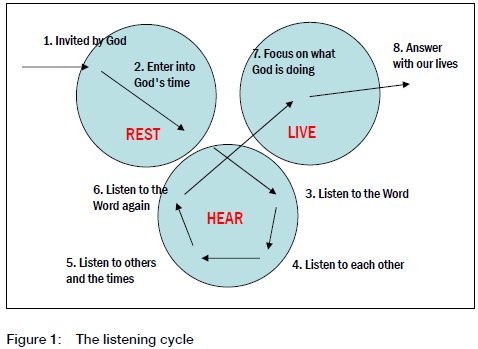
Marais (2007:11) was asked to write "a short guide for the use of the Listening Cycle for use in meetings". This request resulted in the book which was later translated as Meeting with God's voice: A guide for leaders seeking God's agenda for their congregation (Marais 2011). The importance of this publication is that it presents a process for communal discernment that can be used in a single meeting. Marais (2007:63) suggests that tending to all eight stations would take a minimum of 60 minutes.
Although this process does not explicitly mention the use of data, in his exposition of the fifth station: "Listen to others and the times", Marais (2007:111-113) encourages meetings to surrender positions of power or privilege and listen to voices that are not usually heard. In practice (Marais 2007:117-118), this would mean gathering data about the community, opening meetings to invite people from the community, or going out and asking people about their hopes and needs.
2.3 In step with the living God
From 2015, a renewed focus was placed on the missional transformation of the DRC. This started with the meeting of the General Synod Mode-ramen (GSM) in November 2015, where two priorities for the new term were identified: missional transformation and the future and unity of the denomination (DRC GSM 2015:14). Flowing from the first focus, a workbook for missional transformation was written: In step with the living God (Cordier et al. 2020) with faith discernment as its focus (Bosman 2023:108). The handbook is organised in five rhythms, of which the first three have components of an overarching discerning process. These are:
-
Discover and celebrate helps the congregation discover how God is already present in the story of the congregation and in the community. Communal practices in this rhythm are telling God stories; developing a story-wall; public celebration of God's journey with the congregation; discovering patterns of missionality, and appointing a team to facilitate the process (Cordier 2020:40-59).
-
•Listen and discern, with habits such as being quiet and receiving God's presence; reading the Word with a listening stance, and discerning God's will. Communal practices such as Dwelling in the Word, Asking God questions, and listening to the disruptive or confirming voice of the Spirit are described (Cordier 2020:65-75). Research done in preparation for the handbook showed that Dwelling in the Word proved to be the most useful practice for discerning God's call and the formation of the leadership. Nel (2013:2) states that "Dwelling in the Word stimulates the ability of church leaders to imagine their everyday life within the narrative of Scripture ...".
-
Take risks and experiment develops habits to venture into the unknown, build partnerships, and experiment with new practices.
-
Enlighten and focus describes a more explicit and concise discerning process. It invites the congregation to look in the mirror by gathering information about its members using the Church Life Survey, intentional listening processes (focus groups), and surveys (Cordier 2020:108-116).
A second group of practices is geared towards getting to know the local community. This can be done by using data from the national census, inviting community leaders to inform the congregation about the affairs and needs of the local community, and searching for patterns emerging from the data. Guidelines for a more formalised community analysis were added later.1
A third group of practices describes a process to discern the call and focus of the congregation by considering three factors: how the leaders hear and understand God's call, the needs of the local community, and the gifts and passions of the members. An inclusive process is suggested where both the leaders and the members are included. Behind this process lies the assumption that the congregation already went through a prolonged period of listening to the Word, to each other, and to voices from the community.
In step with the living God represents a further step in the evolution of the development of processes of discernment in the DRC. Throughout the book, but especially in Chapter 4, a clearly defined process of discernment is described. Ways of gathering and using empirical data are expanded far beyond the two processes that preceded it. It should, however, be noted , in all of these processes, the use of data is embedded in a larger listening process through which the formational reading of the Bible runs as a common thread.
2.4 Barton: Pursuing God's will together
In her book Pursuing God's will together: A discernment practice for leadership groups, Barton (2012) presents a process and practical guidance for leadership teams seeking to discern God's will collectively. Barton (2012:7) describes it as follows:
Corporate or leadership discernment, then, is the capacity to recognize and respond to the presence and activity of God as a leadership group relative to the issues we are facing, and to make decisions in response to that presence. Spiritual leaders are distinguished by their commitment to discern important matters together so they can affirm a shared sense of God's desire for them and move forward on that basis.
Barton's process is represented in this instance because it is such a comprehensive process and can serve as a control and enrichment of the three processes that were developed within the DRC.
The major part of the book focuses on the development of leaders who are willing and able to discern God's will together. It touches on the spiritual transformation of leaders (2012:25-36); building community at the leadership level (2012:56-81); practices for opening to God together (2012:82-98); listening to each other and setting aside one's own agenda (2012:99-115), and creating a safe and respectful space for discernment by way of a covenant to each other (2012:116-126). Barton's emphasis on the development of leaders for taking part in discernment processes provides an important insight.
The practice of communal discernment (Barton uses the word "corporate") is presented in four movements: Get Ready, Get Set, Go, and Do (2012:130-131). Again, the time and weight afforded to preparing for the actual discernment process should be noted. What interests us in this instance, however, is the process of discernment unpacked in the movement "Go! Discerning God's Will Together" (2012:131; 153-168). Barton 2012:156) emphasises that:
leadership discernment involves a major commitment to listening with love and attention (1) to the movement of the Holy Spirit in the world, (2) to the promptings of the Holy Spirit deep within ourselves and the group, (3) to Scripture, religious tradition (although sometimes it is the tradition that is being challenged, as it was in this case), pertinent facts and information, and the voices of those who will be affected by our decisions, and (4) to that place in us where God's Spirit witnesses with our spirit about those things that are true.
"Listening" in the actual discernment process is described as paying attention to the question which asks for a process of discernment, listening to each other, to pertinent facts and information, to inner dynamics, creating space for God in silence, to reconvene and listen again, to select and weigh the options, to agree together, and finally, to seek inner confirmation.
Barton (2012:142-156) identifies a subset she calls "Gather information and notice without judging". The first practice she identifies here is "Pertinent facts and information", whereby she means, "pertinent research and statistics, actual proposals, advice from experts, and so forth" (Barton 2012:147).
Of interest for this article is that to take heed of "pertinent facts and information" comprises a single paragraph in a long and detailed description of what it means to gather as much data as possible. Other "data" in this list are listening to voices from the community of believers; attending to the direction and calling of the church; listening to Scripture; paying attention to the life of Christ; furthering the fruit of the Spirit; experiences of consolation and desolation (which correlates with Listen to the Spirit in In step); the tradition, and asking how love and unity can best be served (2012:159-161).
Barton acknowledges that discernment is not a quick fix. It requires patience, practice, and a willingness to learn from both successes and failures. The effectiveness of this approach lies in the transformation of leadership teams into spiritual communities that seek God's guidance together. In summary, Barton's model encourages leaders to move beyond mere decision-making and embrace a communal discernment process that aligns with God's heart and purposes for their leadership context.
2.5 Some preliminary remarks on the processes
In these processes, descriptions of the use of empirical data vary. The following terms are used: listening to other voices; listening to others and the times; preparing a report on the congregation's culture; doing a community analysis; doing a story wall and culture analysis of the congregation; gathering data about the congregation and community; consulting with community leaders, and paying attention to pertinent facts and information. The emphasis on data also varies. In Barton, it is afforded a rather small role, in the Listening Cycle it is vaguely described. The process developed in the SAPMC gives the gathering and use of empirical date a much clearer and more important role to understand the congregation and the community. In step with the living God, however, gives great weight to the gathering and interpretation of data and information. It becomes indispensable for the understanding of the congregation and the community. Discernment of God's call is viewed as wholly contextual: it comes to this congregation in this community at this time.
In thinking about discerning the call or vocation of a church (congregation or denomination), it is useful to distinguish between theological and empirical-analytical descriptions. In discernment processes, the two cannot be separated and must be considered equally (Schoeman 2020a:324).
In the processes developed in the DRC, reading and listening to the Word is the most fundamental spiritual discipline in these discernment processes. Dwelling in the Word is also regarded as a keystone habit for developing a culture of discernment, in that it functions as a practice for leadership formation (Cordier et al. 2020:66; Nel 2013:4). Other keystone habits include listening to each other, to the community, and to the Spirit. Barton's detailed attention to the development of leaders points out that this is an area that needs to be expanded in processes used in the DRC.
Schoeman (2020b:104) points out, however, that discernment should go further than listening to one or more Bible texts and take into account the theological foundations, tradition, and identity of the church. The concrete reality of church life and the resources that enable the church to function and realise its calling should also be considered (Schoeman 2015:79). Schoeman names the financial assets, the human capital, including the relational networks inside the congregation and the community, and the buildings as available resources. The "concrete reality" of the church includes the immediate context wherein the church exists, the broader context of the country and its realities, and the global context with its larger trends and contemporary occurrences (Schoeman 2015:78).
3. TWO EXAMPLES OF COMMUNAL DISCERNMENT: THE DUTCH REFORMED CHURCH GENERAL SYNOD MEETINGS OF 2019 AND 2023
3.1 General Synod meeting, 6-11 October 2019
Approaching the 2019 meeting of the General Synod, the Research Team prepared reports using existing research as well as designing and employing new instruments, in collaboration with Dr Marius Oosthuizen from The Gordon Institute for Business Science, University of Pretoria. Two instruments were specially designed for this purpose:
-
Four focus-group discussions with 27 opinion leaders from various walks of life took place in Pretoria, Bloemfontein, Stellenbosch, and Cape Town. The following themes were discussed: the internal and external challenges facing the church; the impact of these challenges on the vocation and ministry; the future institutional shape and structure, and the future theological direction of the church (DRC Research Team 2019).
- Simultaneously, six surveys were conducted in the official church newspaper (Die Kerkbode) with a mean of 316 responses, based on the themes discussed by the focus groups.
Some prominent outcomes from the focus-group discussions were:
External challenges
-
The rise of identity politics: People feel alone and isolated, seeking a place to belong.
-
The 30 per cent unemployment rate in South Africa.
-
Emigration as a global trend.
-
Families are breaking down.
-
Anxiety is high, nothing is any longer the same.
-
The DRC's whiteness and history of apartheid make the church unattractive to Black people.
- The DRC is a first-world church in a third-world country.
Internal challenges
-
The way we deal with differences in the church.
- To come down from our pedestal, become humble, and listen to others.
- The rise of female ministers is viewed as a positive development.
- The polarisation between enlightened and conservative members and leaders creates confusion about what is right and wrong.
-
The DRC is moving too slowly.
-
Young ministers want to collaborate, but the larger discourse in the church is one of polarisation.
-
The DRC was compared to a 150-year-old business: Conservative, slow, and cumbersome.
Dr Marius Oosthuizen and Prof. Kobus Schoeman led the discernment process during the meeting. A report: "Seven key uncertainties that could shape the future of the church" (Oosthuizen & Schoeman 2019) was prepared and served as the basis for three different scenarios that were presented in video format. The process included reports on the research, table discussions, and innovative feedback from the delegates by way of an online platform: bit.ly/NGKERK2030 (now closed).
The outcome of this process was presented to the delegates in the form of a "Dream Scenario" on 10 October. It reads as follows:
The 20th General Synod of 2030 will discover that dramatic shifts have taken place in the NG Church. These include a shift from self-care to caring for the most wounded places in South African society, from survival to service, from uncertainty to hope for the broken, and from self-interest to a life of love.
Features of our church's ecclesiastical identity, culture, and leadership.
What lies behind the noteworthy change in ecclesiastical identity and culture?
Our leaders are focused on forming life-giving relationships across borders with each other and others. Therefore, we focus on listening, loving, and serving, in communion with Christ. The goal is simple, "Servant leadership, like Jesus".
Characteristics of our institutional form.
Aside from a cultural shift, does the church also look institutionally different?
Yes, today we understand that our church is called to embrace the synergy of networks, and thereby to be creative and relevant. Therefore, our church consists of inclusive, relevant, and creative networks. Through this, congregations are helped in a sustainable way to discover their calling and live it out with courage.
What is the church's dream for the future?
We dream of a network of inclusive congregations, which, at ground level, from God's love, are serving our communities.
The General Synod referred the outcome of the scenario planning to the General Synod Moderamen (GSM), the leadership body mandated to continue the work of the General Synod in the interim. The GSM discussed the feedback from the General Synod on November 12, 2019, and identified four focuses:
We want to ...
-
create reconciliatory spaces and platforms for listening and conversations, for stories of hope and renewal.
- empower, equip, and mobilize leaders and members.
- network and synchronize, rethink structures, and cultivate ecumenical integration.
- embrace diversity: to be inclusive and promote multiculturality and multi-language ministry.
The Research Team identified the development of empowering leaders as the most important driver of these four. The foci of GSM were reformulated as follows:
Develop and mobilize empowering leaders,
who create spaces and platforms for reconciliatory listening and conversation about stories of hope and renewal,
and form faith communities where people of different cultures and languages are included,
so that structures are transformed into synchronized, ecumenically integrated networks (DRC Research Team 2020:6).
To this was added:
Our ecclesiological starting point is not the survival of the NG Church as an institution, but an attitude of participation in the Missio Dei. The vision is one of a church as a foretaste and sign of the Kingdom of God. What would it look like if the church were to express the Lordship of Christ in Southern Africa? (DRC Research Team 2020:6).
Further work to develop a strategy to realise these foci was referred to the GSM Steering Committee and the different task teams of the GSM. It was decided that some of the tasks would fall on the terrain of the GSM and its task teams, others would be best served by the different synods, and others would be within the scope of congregations (DRC GSM 2020:20).
3.1.1 A few remarks about the process and its outcome
Criticism has been levelled about the process that was followed to formulate the scenario, specifically about unchurchly language and processes (DRC General Synod 2023a:163). The General Synod of 2023 was asked to
reconsider her point of departure, the underlying view of the church, the formulation of and aim with a future scenario for our church, in the light of the Scriptures and our Creed (DRC General Synod 2023a:162).
This criticism is not without merit, but it also overlooks some important aspects. It is indeed true that the idea of a dream scenario and the methodology to formulate it were informed by discourses from the business and socio-political milieus. It would indeed be more fitting to speak of the call or vocation of the church as received from God, rather than the development of a preferred scenario.
However, the processes during the synod that led to the formulation of the dream scenario did not take place in isolation. It constituted a rather small part of a six-day meeting. Daily devotions and keynote speakers placed the following themes on the table: the vocation and future of the church; the church's witness in the world; the church's role in a divided society, and our connection to the land and its context. Table discussions took place about these themes with a discernment model of listening to the Word, to experts, and to each other. Therefore, although the process of formulating the dream scenario itself was not cast as a discerning process, the overall process of the synod was structured in such a way (DRC GSM Design Team 2019)
It should also be noted that the dream scenario emphasises several extremely important themes that were on the agenda of the General Synod. It positions the church as an instrument of service; its focus is not on the survival of the church. It explicitly mentions the importance of local ecumenical relationships, multiculturalism, and a new institutional form. Most importantly, it situates church leadership firmly in the church's communion with Christ and as "servant leadership, like Jesus". The formulation is concise and clear and creates a bold new imagination of the church in 2030.
3.2 The interim between the two synod meetings
What happened next was the advent of the COVID-19 pandemic, the lockdowns, and the ensuing crisis to feed and provide shelter to the poor. This was followed by floods, political unrest, and looting in KwaZulu-Natal. This meant that the intentional roll-out of the four foci was mostly put on the back burner. However, this did not mean that it did not take place, even if in a more informal and spontaneous, one would say, organic way. The Research Team used this window to research the ways in which local congregations actualised some of the key points in the preferred scenario as well as shortcomings in the capacities of clergy that would be necessary to perform leadership roles.
Parallel to the impact of the COVID-19 pandemic on the church was the increasingly vocal and public resistance to the standpoint of the General Synod on same-sex relations (DRC General Synod 2023b:33). The view of the General Synod Moderamen on the 2019 decision was
The General Synod did not make a principled decision for or against same-sex unions in 2019, but it did make a policy decision that creates room for different viewpoints on same-sex unions in the church. The decision of 2019 can at most be understood as a process decision with the assumption that further thinking and discernment will take place about the matter throughout the church (DRC GSM 2022:10).
It also reiterated that the concept of "marriage" is reserved for heterosexual, monogamous, lasting, and exclusive relations. The resistance came from regional synods and groups that opined that the church should take a firm stand against all forms of same-sex relations, with a growing suspicion that the DRC is abandoning the authority of the Bible and the Creeds.
The Research Team conducted surveys to test the position of the clergy about these matters and found that 67 per cent agree in principle with the adopted policy that local churches should have the jurisdiction to formulate their position regarding ethical issues, 73 per cent welcome the space created for local churches to formulate their own positions about same-sex relations, and 75 per cent feel adequately empowered to explain the 2019 position (DRC Research Team 2021:5-6) Furthermore, regarding the authority of the Bible and the Creeds, the surveys showed broad consensus about the authority of the Scriptures and Creeds and that both need to be interpreted in light of their historical and cultural backdrop (DRC Research Team 2022). These findings were again presented at the October 2023 meeting of the General Synod.
3.3 The General Synod meeting: 15-20 October 2023
Coming to the 2023 synod meeting itself, the ongoing debate about same-sex relations still dominated the discourse in both the formal and social media. The design of the meeting, however, focused on processes that would serve discernment, rather than debate. Exodus 33 was chosen to serve as the guiding text. It marks the transition from the events surrounding the golden calf (Ex. 32) to God's grace (Ex. 34). God's presence remains elusive; we cannot manipulate it. God remains God, and his presence is mysterious. Moses can only appeal to God's promises and the fact that God knows the name of his people. As the story unfolds, God's presence is manifested in the tabernacle filled with smoke (Ex. 36). For us, this culminates in the incarnation of Christ - His tent pitched among us. It was anticipated that the synod could progress from lament and humility to an encounter with God's presence (DRC GSM 2023:10). Exodus 33 was to be read and reread during devotions over the six days of the meeting. The work schedule was aligned accordingly. Themes from the text served as daily themes: Let us meet you here, Lord, show us your face, your glory; show us your land, show us your church, show us your rest, your favour, and may others see your presence in us. Keynote speakers handled relevant themes: a navigable way of reading the Scriptures; the context wherein we meet and whereto we are led; churches' response to disasters; the ecumenical role of the DRC in a deeply divided community, and the hope to which we cling. Reports from the various task teams were integrated into the liturgical movement of the synod as far as possible.
To the Research Team, various slots were allocated to inform the synod with data relevant to the reports that served. Reports were delivered on demographic shifts about ministers and congregations, the views of ministers on the Creeds and Scripture, the views of young ministers, and the impact of COVID-19 on congregations, especially finances, worship-service attendance, and missionality (DRC Research Team 2023). The team also served as a "listening team" and used electronic media to gather feedback on discussions at the tables and opinions of individual delegates. The team reported back to the synod in progress on the feedback received.
Despite the well-set-out work schedule that favoured discernment, the meeting was forced to spend a large amount of time on debates on the issue of same-sex relations. This impacted on the time available for discerning God's preferred future of the church. One of the tasks of the General Synod is to discern priorities for the next term. The Research Team conducted daily Lickert-scale surveys on how important the delegates rated the items that served on that day's agenda. On the last day, a full list of all the reports was sent out with the request to choose the most important three for the immediate future. From these surveys the following priorities came out on top: the ministry of congregations (youth ministry, catechesis, evangelisation, missional transformation); the functioning of the denomination (unity of the DRC, communication to congregations), and the church's role in the community (public witness, developing a national disaster response). The lowest priorities were controversial and potentially divisive issues (abortion, marriage and sexuality, interfaith dialogue, anti-racism, and theological training) (DRC Research Team 2024).
It should be noted that, despite an overall positive evaluation of the synod, there was also dissatisfaction with the style of debating and the brutal language used by some delegates. Too much time was spent on controversial matters and too little on the calling of the church, given the needs of the Southern African society. The priorities of the church must shift, away from controversial matters to the health of congregations, the church's role in society, and enabling leaders for the challenges of the time, public witness, and cooperation (DRC Research Team 2024).
As prescribed in the regulations, at the first in-person meeting of the GSM on 27-29 February 2024, a process was followed to discern the focus for the work of the GSM and its teams in the upcoming term of four years. This process entailed an overview of the story of the DRC in Southern Africa from 1824 up to the present, feedback by the Research Team from the General Synod, and feedback from discussions held with the leadership of every regional synod. Table discussions were led by Dr Fredrick Marais and the tables were asked to pay attention to three circles: what they heard from Exodus 33, previous declarations of calling since 2002, and the current context. From these discussions, a declaration: Our Calling 200+ was discerned.2 The GSM also considered the focus of the work in the upcoming term and identified four clusters: the witness of the church together with other churches; creating safe and friendly congregations where people can be disciples; working together to alleviate the needs of the community and minister hope; and growing in faith, worship, and leadership. Existing and new task teams and work groups will be aligned around these four foci.
4. CONCLUSION
Communal discernment is a complex and time-consuming process. The rewards, however, are rich and often surprising. Discerning God's will and preferred future for his church is never a quick or easy process nor should it be. Increasingly more refined and concise processes of discernment are developed, however. This is an important development that can help the broader church and local congregations tremendously in being true to their own identity in discerning their vocation and in their decision-making.
Empirical data used in a communal process of discernment takes on various forms: reports, polls, reading existing data, hearing expert voices, and listening to the marginalised. Interpreting data can be described as a habitual ability to read "the signs of the times" wisely and to act thereupon with clarity, wisdom, and soberness. (Joubert 2017:144). It grounds the discernment process in the realities of the context.
Discernment must not take place without taking heed of what is going on in the broader world and immediate context. However, this is not in itself the whole process (Schoeman 2020b:104). Discernment should never dissolve into interpreting empirical data, however rigorous the process of data gathering may be. In the processes of the two synods that were described, the presentation of empirical research outcomes formed a rather small part of the whole process that took place over six days.
Data must be interpreted to be of value, and processes of discernment provide a framework for interpretation. It can be compared to exegesis and hermeneutics. In homiletics, we take rigorous steps to ensure that we understand what the text meant in its original historical context(s). The text must, however, be interpreted to discover what it means nowadays. In the same way, data must be rigorously gathered and read, and all available measures must be employed to ensure that the data is taken seriously. Then a process of discernment is needed to discover what the data means in light of the church's theological identity and calling. Some crucial questions need to be asked that go beyond: What is going on?. These are questions such as: Where is God in this? Is God in this? What are we hearing repeatedly from God?
Discernment is not of necessity geared towards decision-making. It is, however, suited for identity-finding and discerning God's preferred future for a denomination or congregation. In times of transition and uncertainty, discernment might be more geared towards getting to know the landscape in which the church is situated and finding a broad direction toward the future (Schoeman 2020a:322). In this, empirical data enriches the discernment process as a crucial element for developing an ecclesiology from below (Schoeman 2020b:104).
The value of a focus text can hardly be overstated. The reading and rereading of one text over time in a congregation or over days in a synodal meeting anchors the discernment process in the Word (Cordier 2014:46). It grounds the process as spiritual discernment and honours the reformed tradition as being founded on the Word. The selection of a text is very important, especially for meetings with direction-giving outcomes. A complaint heard after a previous General Synod meeting was that Bible texts were chosen to manipulate the delegates for a certain outcome. The choice of Exodus 33 as the focus text for the General Synod of 2023, however, proved to be enriching and direction-giving for a church in a period of huge transitions. The fact that it was the Revised Common Lectionary text for the Sunday immediately after the synod meeting silenced any objections. In congregations, finding a suitable focus text usually occurs over a longer period, and it is often read and reread for years. This reading and rereading of a text over time brings depth and a repository of meaning that shapes the self-understanding of the church.
According to Koenig (2009),
Christians stress that discernment goes on in intentional relation to Jesus Christ, and they insist that it participates in his cross. That means that when a decision-making process takes God and the Christian community into account, some kind of sacrifice will be required.
This remark enriches the process immensely. Churches cannot look at data or listen to expert voices without considering the question: "Knowing all of this, what does it mean to follow the crucified Christ?".
BIBLIOGRAPHY
Barton, R.H. 2012. Pursuing God's will together. A discernment practice for leadership groups. Downers' Grove, IL: Intervarsity Press. [ Links ]
Bosman, L.L. 2023. In step with the living God: Designing an instrument for missional culture change. In: M.J. Nel & P. van der Walt (Eds), Facilitating God's preferred future. Faith formation, missional transformation and theological education (Wellington: Biblecor), pp. 102-115. [ Links ]
Cordier, G.S. 2014. Kernkapasiteite van die predikant as missionale leier in die vorming van 'n missionale gemeentekultuur. Unpublished Doctoral thesis. Pretoria: University of Pretoria. [ Links ]
Cordier, G.S. (Ed.), Bosman, L.L. & Van der Walt, P. 2020. In pas met die lewende God. Ritmes en gewoontes van roepingsgetroue gemeentes. Pretoria: LFPrinters. [Online.] Retrieved from: https://www.inpas.co.za/wp-content/uploads/2020/11/IN-PAS-DIGITAAL.pdf [Accessed on 17 November 2020]. [ Links ]
DRC General Synod 2007. Agenda vir die 13de vergadering van die Algemene Sinode van die Nederduitse Gereformeerde Kerk. [Online.] Retrieved from:https://www.kerkargief.co.za/doks/acta/AS_Agenda_2007.pdf [19 December 2022]. [ Links ]
DRC General Synod 2023a. Addendum tot die Agenda. 18de Algemene Sinode. [Online.] Retrieved from: https://ngkerk.net/wp-content/uploads/2023/09/ADDENDUM-TOT-DIE-AGENDA-final-met-voorblad.pdf [20 March 2024]. [ Links ]
DRC General Synod 2023b. Agenda. 18de Algemene Sinode. [Online.] Retrieved from: https://ngkerk.net/wp-content/uploads/2023/09/AGENDA-AS-2023-Elektronies.pdf [20 March 2024]. [ Links ]
DRC GSM 2015. Minutes of the General Synod Moderamen (2015-2019), 16-18 November 2015. Beulah Park, Edenvale. [ Links ]
DRC GSM 2020. Minutes of the General Synod Moderamen (2019-2023), 3-5 March 2020. Bonaeropark. [ Links ]
DRC GSM 2022. Minutes of the General Synod Moderamen (2019-2023), 17-19 May 2022. Bonaeropark. [ Links ]
DRC GSM 2023. Minutes of the General Synod Moderamen (2019-2023), 15-16 August 2023. Bonaeropark. [ Links ]
DRC GSM Design Team 2019. Unpublished minutes. 10 July 2019. [ Links ]
DRC Research Team 2019. Unpublished report on the outcomes of focus group discussions. Pretoria. [ Links ]
DRC Research Team 2020. Strategic process proposal to the GSM for the achievement of the dream scenario from the General Synod 2019 and GSM 2019/2020. Unpublished report to the DRC GSM, 3-5 March 2020. Bonaeropark. [ Links ]
DRC Research Team 2021. Ethical discernment. Unpublished report to the DRC GSM, 3-5 March 2021. Bonaeropark. [ Links ]
DRC Research Team 2022. Tendencies in the DRC. Unpublished report to the DRC GSM, 17-19 May 2022. Bonaeropark. [ Links ]
DRC Research Team 2023. Concept report. The impact of the pandemic on congregations of the DRC. Unpublished report to the GSM, 15 August 2023. Bonaeropark. [ Links ]
DRC Research Team 2024. General Synod priorities. Unpublished report to the DRC GSM, 27-29 February. Bonaeropark. [ Links ]
Dutch Reformed Church (DRC) 2019. The Church Order of the Dutch Reformed Church. Articles, regulations, rolicy, related/clarifying resolutions as determined by the General Synod in October 2019. [Online.] Retrieved from: https://ngkerk.net/wp-content/uploads/2022/08/THE-CHURCH-ORDER-2019-articles-and-first-three-Regulations-for-AGM-ATR-2021.pdf [2 March 2024]. [ Links ]
Hermans, C. & Schoeman, W.J. 2015. Survey research in Practical Theology and congregational studies. Acta Theologica Supplementum 22:45-63. https://doi.org/10.4314/actat.v21i1.5S [ Links ]
Joubert, S.J. 2017. A well-played life: Discernment as the constitutive building block of selfless leadership. In: J. Kok & S.C. van den Heuvel (Eds), Leading in a VUCA world. Integrating leadership, discernment and spirituality. Springer Open. Retrieved from: https://www.researchgate.net/publication/345125530_Leading_in_a_VUCA_World_Integrating_Leadership_Discernment_and_Spirituality_Integrating_Leadership_Discernment_and_Spirituality [Accessed on: 08 October 2024]. https://doi.org/10.1007/978-3-319-98884-9_9 [ Links ]
Keifert, p. & Granberg-Michaelson, W. 2019. How change comes to your church: A guidebook for church innovations. Grand Rapids, MI: Wm B. Eerdmans Publishing. [ Links ]
Koening, E. 2009. Dark nights and white knuckles. Faith and leadership. A learning resource for Christian leaders and their institutions from Leadership Education at Duke Divinity. [Online.] Retrieved from: https://faithandleadership.com/dark-nights-and-white-knuckles?page=0,0 [7 March 2024]. [ Links ]
Marais, F. 2007. God praat: Leef luisterryk vir vergaderings: Handleiding vir gemeenteleiers op soek na God se agenda vir gemeentes. Wellington: Bybelkor. [ Links ]
Marais, F. 2011. Meeting with God's voice: A guide for leaders seeking God's agenda for their congregation. Wellington: Bible Media. [ Links ]
Nel, M.J. 2013. The influence of dwelling in the Word within the Southern African partnership of missional churches. Verbum et Ecclesia 34(1), Art. #778, 7 pages. https://doi.org/10.4102/ve.v34i1.778 [ Links ]
Niemandt, N. 2007. Preface. In: Marais, F., God praat: Leef luisterryk vir vergaderings: Handleiding vir gemeenteleiers op soek na God se agenda vir gemeentes (Wellington: Bybelkor), pp. 9-10. [ Links ]
Oosthuizen, M. & Schoeman, W.J. 2019. Unpublished report to the General Synod, 6-11 October 2019. Bonaeropark. [ Links ]
Schoeman, W.J. 2011. Kerkspieël - 'n kritiese bestekopname. Nederduits Gereformeerde Teologiese Tydskrif 52(3). https://doi.org/10.5952/52-3-57 [ Links ]
Schoeman, W.J. 2015. Exploring the practical theological study of congregations. Acta Theologica Supplementum 22:64-84. https://doi.org/10.4314/actat.v21i1.6S [ Links ]
Schoeman, W.J. 2020a. Re-imagining the congregation's calling - Moving from isolation to involvement. Acta Theologica 40(2):321-341. https://doi.org/10.18820/23099089/actat.v40i2.17 [ Links ]
Schoeman, W.J. 2020b. Developing contemporary ecclesiologies. In: W.J. Schoeman (ed.), Churches in the mirror. Developing contemporary ecclesiologies (Bloemfontein: Sun Media), pp. 93-106. https://doi.org/10.18820/9781928424710 [ Links ]
Smith, T.J. 2021. Designing and developing a "rhythm of life" as a pedagogy that assists in the cultivation of missional disciple formation. Unpublished Doctoral thesis. Pretoria: University of Pretoria. [ Links ]
Waaijman, K. 2013. Discernment - The compass on the high sea of spirituality. Acta Theologica Supplementum 17:13-24. https://doi.org/10.4314/actat.v32i2S.2 [ Links ]
Date received: 23 March 2024
Date accepted: 12 September 2024
Date published: 14 November 2024
1 https://www.inpas.co.za/wp-content/uploads/2021/02/GemeenskapsanaliseSep2020Verwerk.pdf.
2 https://ngkerk.net/wp-content/uploads/2024/03/Roepingsverklaring-2024-A1.pdf.
