




Services on Demand
Journal

Article
 English (pdf)
 Article in xml format
 Article references
 Automatic translation
 Send this article by e-mail
Indicators
Related links
-
 Cited by Google
 -
 Similars in Google
Share

 Permalink
Old Testament Essays
On-line version ISSN 2312-3621Print version ISSN 1010-9919
Old testam. essays vol.38 n.3 Pretoria 2025
https://doi.org/10.17159/2312-3621/2025/v38n3a3
ARTICLES
Psalms 42-43 and 137: A Timeless Balm for Modern Trauma
Daniel Simango
North-West University
ABSTRACT
The Babylonian captivity and exile inflicted profound trauma upon the Jewish people, wrenching them from their loved ones, displacing them from their families, homeland and the temple. The significance of the temple extended far beyond mere architecture; it symbolised the people's faith and the presence of YHWH in their midst. The ensuing loss reverberated deeply within the Jewish community. A hermeneutics of trauma will be applied to the reading of Pss 42-43 and 137 to uncover how the Israelites responded to the trauma of losing their entire world-the temple, homeland and security. The article concludes that contemporary worshippers can draw on these psalms to find solace and healing amidst contemporary trauma.
Keywords: Psalms 42-43 and 137, Babylonian captivity, trauma, hermeneutics of trauma, Psalms of Lament, God's justice.
A INTRODUCTION
A growing number of biblical scholars1 have observed the significant role that the lament psalms play in the lives of individuals or communities dealing with trauma. These psalms may be therapeutic and can bring healing to those who are struggling or who are trying to cope with trauma in their lives. Walter Brueggemann2 categorises the Psalter into three groups, namely Psalms of orientation, disorientation and re-orientation which show the various seasons of faith in the lives of God's people. Therefore, God's people can embrace Psalms of lament "as part of ancient Israel's therapeutic process."3 This process helped Israel cope with its collective and individual trauma resulting from invasions, deportations and oppression by foreign armies (e.g. the Assyrian invasion in 722 BC and the Babylonian invasion in 586 BC), which led to the loss of significant symbols of faith and identity, such as the temple and kingship. This collective and individual trauma is reflected in some of the Psalms of Lament in the Hebrew Bible. These psalms depict the horrors of war and displacement yet simultaneously offer hope to the Hebrew community which had experienced trauma due to the devastation caused by foreign nations like Babylon. Hopkins and Kopel refer to these psalms as "disaster and survival literature."4 In this article, I argue that Pss 42-43 and 137 are examples of "disaster and survival literature," specifically lament psalms that can be therapeutic and bring healing to those experiencing trauma. Psalms 42-43 and 137 emerged out of the traumatic exile that Israel experienced and may be used as "a timeless balm" for those who are struggling with trauma in their lives.
In this article, I will first describe the trauma hermeneutical framework and define trauma, followed by a discussion of the relationship between trauma and the Psalms of lament. I will explore the fall of Jerusalem, deportation, exile and oppression as examples of traumatic events. A brief rationale will be provided for selecting Pss 42-43 and 137 as the focus of this study. I will then give a brief discussion on the structure of Pss 42-43 and 137. A hermeneutics of trauma5 will be applied to the study of Pss 42-43 and 137. I will conclude by exploring how Pss 42-43 can offer solace and healing for those dealing with modern trauma.
B THE TRAUMA HERMENEUTICAL APPROACH
The hermeneutics of trauma is a heuristic framework that explores the relationship between traumatic experiences and the production or interpretation of texts. It recognises that language can encode and respond to trauma in ways that reflect survival, recovery and resilience. This approach considers both linear and nonlinear narrative elements, revealing deeper meanings beyond the plain sense of the text. In biblical studies, trauma hermeneutics complements historical-critical and other interpretive methods by illuminating the psychological, cultural and sociological impacts of traumatic events on texts, particularly those emerging from contexts of collective devastation, exile or oppression. It highlights how trauma narratives may use fragmented or affective imagery to convey experiences, thereby, challenging traditional interpretations. Additionally, trauma hermeneutics examines how texts have supported identity and solidarity historically, offering resilience against further trauma. It also addresses the appropriation of biblical texts by traumatised communities, thus, recognising the role of ritual in shaping collective identity. By understanding trauma's effects on language and memory, this framework offers new insights into difficult aspects of biblical texts, such as violent imagery and it sheds light on their organising principles, ultimately helping to support both individual and communal well-being in the face of trauma.6
C TRAUMA
The word "trauma" is derived from the Greek word meaning "wound." We often describe individuals or a community of people as being "traumatised" to convey the impact of trauma. Trauma can affect both individuals and groups, overwhelming personal and social coping mechanisms, memory and language. Trauma instils a sense of terror in those who experience it, leading to a loss of control, self-worth, dignity and meaning. 7
Following the approach used by Hopkins and Koppel,8 our discussion is framed by trauma definitions drawn from psychology, sociology and literary theory:
Trauma is an overwhelming event or experience that (1) leaves people (whether individuals or groups) feeling helpless and dehumanized, without the capacities or categories to understand the trauma; (2) affects their emotions and memories in sometimes indirect ways; and (3) often profoundly and negatively impacts their behavior and interpersonal relationships. Their recovery from trauma may then be defined as the various ways and means by which people (whether individuals or groups) somehow overcome the many ways trauma has wounded them."9
Trauma studies have revealed that the disclosure of trauma has some benefits with regards to personal health. For example, James Pennebaker shows that disclosure of trauma helps the immune system, while "inhibition" and "non verbalization" have an unhealthy effect.10 There are those who respond to trauma by avoiding thinking about it or pretending it never happened; but this approach is ineffective in the long run. Residue of violent trauma remains in those who try to suppress it, for violent trauma leaves fragments in the mind "like broken glass" and can be triggered in a "mute repetition of suffering."11
Brent Strawn uses Ps 35 to argue that both trauma and recovery are present in the psalm of lament, particularly through the victims' honest disclosure of feelings, emotions and thoughts about the experiences they endured. Pennebaker contends that the psalmist's "prayer is a form of disclosure or confiding," suggesting that these prayers can be seen as means of disclosure.12Disclosure, especially in written form, offers a means to confront the trauma that is often considered "unspeakable."13
Eve-Marie Becker sees the psalms as "cultural artifacts" that offer "an essential cultural and religious strategy for coping with trauma."14 Exegetes face the challenge of determining whether the stressors that caused ancient trauma are comparable to modern experiences of trauma. Becker, for instance, suggests that the destruction of the Jerusalem temple is analogous to the destruction of the World Trade Center in the United States in 2001. Both events "symbolize the loss of a core piece of national or cultural identity," contributing to trauma.15
Psalms 42-43 and 137 not only exemplify Israel's disclosure in the process of recovering from trauma but also offer solace and healing for those dealing with modern trauma.
D FALL OF JERUSALEM, DEPORTATION, EXILE AND OPPRESSION AS EXAMPLES OF TRAUMA
The fall of Jerusalem in 586 BC and the aftermath was traumatic for the people of ancient Judah, who had witnessed several devastating occurrences. These included the destruction of the Temple and the city, the loss of many lives, widespread starvation, the deportation of a significant number of Jews to Babylon, the collapse of the Davidic monarchy and a deep religious and cultural crisis. These events constituted a large-scale national trauma for the people Judah.
The temple was destroyed. The Babylonian army, led by King Nebuchadnezzar, destroyed Solomon's Temple. The army burned down the temple (2 Kgs 25:9). The temple was the centre of worship of YHWH and a symbol of his presence among the Jewish people. This loss was a severe blow to the religious and cultural identity of the Israelites. The destruction of the temple symbolised YHWH's rejection of his altar and abandonment of his sanctuary (Lam 2:27).
The capital city, Jerusalem, was razed to the ground. The city walls, which provided protection and security, were torn down, leaving the inhabitants vulnerable and desolate (2 Kgs 25:9-10). The royal palace and all the houses in Jerusalem were burned down (Jer 52:13-14). The siege of Jerusalem led to widespread famine, suffering and death. Many inhabitants were killed during the invasion, while others succumbed to starvation and disease (Lam 4:9-10; Jer 52:6).
The Babylonians deported a significant portion of the population, particularly the elite, to Babylon. They became exiles in Babylon (Ps 137:1-2). This forced displacement from their homeland disrupted their way of life, causing immense psychological and emotional distress (2 Kgs 25:11; Jer 52:11). The fall of Jerusalem also resulted in the collapse of the Davidic monarchy and the execution or capture of the king and other leaders (2 Kgs 25:7). This loss of political and social leadership contributed to the chaos and sense of abandonment among the people (Lam 4:20).
The destruction of the Temple and the exile posed a severe challenge to the Israelites' faith. They would have struggled with questions about God's presence and promises, leading to a crisis of identity and belief. They would have "called into question the authority, benevolence, and power of God, their identity as the chosen people, and their claims to their land."16
The above factors contributed to the traumatic impact of the fall of Jerusalem, leading to deep sorrow, disorientation and a sense of hopelessness among the survivors. The religious texts of the exiled Hebrew community can be seen as part of shared, communal discourses, helping to cement community identity and religious outlook in the face of adversity.17 Psalms 42-43 and 137 may have served to give voice and offer healing to a community struggling to come to terms with a particular traumatic event of a national scale, possibly the Exile and its aftermath.
E BASIS FOR SELECTING PSS 42-43 AND 137 FOR ANALYSIS
What is the rationale for selecting Pss 42-43 and 137 for analysis in this essay? Both psalms share several themes, summarised below:
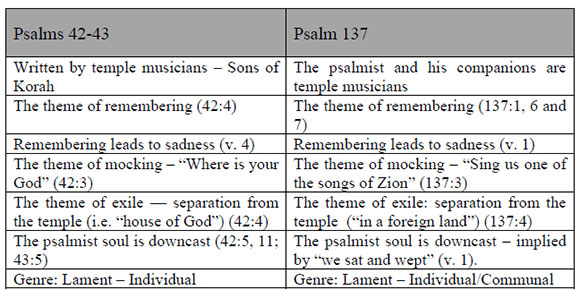
Since Pss 42-43 and 137 share the thematic affinities mentioned above, it would be logical to study them together. Both psalms are laments, which would contribute to a well-rounded analysis.
F STRUCTURE OF PSS 42-43 and 137
In this study, Pss 42 and 43 are read together as a unified composition.18 Psalms 42-43 are an individual lament and plea for vindication from oppression from enemies.19 Psalm 137 is however a communal lament "culminating in an imprecation of Israel's enemies."20
With the regards to the structure of Pss 42-43, the unified psalm is composed into three stanzas: 42:1-5, 42:6-11 and 43:1-5. Each stanza ends with the same refrain in 42:5, 42:11 and 43:5 and each ends with the same regain.21
On the structure of Pss 137, the psalm may be subdivided into three stanzas, viz. vv. 1-4, 5-6 and 7-9. This three-fold subdivision of the psalm is underwritten by the majority of scholars.22
G READING PSS 42-43 AND 137 FROM A TRAUMA HERMENEUTICAL APPROACH
1 Psalms 42-43
1a Introduction
The author of both psalms (42 and 43) appears to be a Levite exiled among Gentiles (Ps 43:1), who oppressed him and questioned his faith (Pss 42:3, 10; 43:2). He was likely a worship leader who had led groups of pilgrims to Jerusalem for the appointed festivals (Ps 84:7; cf. Exod 23:14-17; 34:18-26; Deut 16:1-17). Now, the psalmist finds himself in distress, feeling abandoned by God, while his enemies mock and persecute him. He is also disappointed in himself, as nothing seems to be going right. In response, he calls on God for help, anticipating that God will answer his prayer (Ps 43:1-5).
The psalmist's distress seems traumatic, as he fluctuates between faith and despair while wrestling with the Lord. The vivid imagery of a drought (vv. 1-5) that makes the psalmist compare himself to a deer panting and struggling to find water, symbolising his deep longing for God, depicts the emotional trauma he endures. A second image of overwhelming waters, which makes the psalmist feel like he is drowning, further illustrates the severity of his distress and its traumatic impact (vv. 6-11). In this section, we will discuss further how the psalmist responds to his suffering and trauma.
1b The psalmist has a deep longing for God (42:1)
The imagery of drought is seen in Stanza I (vv. 1-5), where the psalmist compares himself as a deer that pants for flowing water. This is how he longs for God (v. 2) - his soul thirsts for, longs for the living God (לְ אֵ֪ל חָ֥י). In a sense, the flowing water is "called living, as the spring or fountain of life (Ps. 36:10) from which flows forth a grace that never dries up, and which stills the thirst of the soul."23
1c The psalmist breaks the silence of pain (42:1-3)
The psalmist does not suppress his pain or suffering; instead, he openly expresses his emotions, thoughts and distress. Pain, whether emotional, physical or psychological, is often endured in silence due to fear or shame. However, in verses 1-3, the psalmist speaks out about his suffering: "My tears have been my food day and night" (הָֽיְ תה־לִִּ֬י דִמְ עתִִ֣י לֶֶ֭חֶם יוֹ מִ֣ם ו לָ֑יְ לה). His grief is so overwhelming that it becomes his constant companion, to the point where his tears are his only sustenance-a habitual and necessary part of his daily routine. He weeps continuously, day and night, and his sorrow is so profound that he seems to have forsaken eating and drinking altogether. 24
The psalmist longs for the life-giving streams of water, which represent God's presence and sustenance, instead of the tears that have become his food. His enemies only deepen his anguish, taunting him relentlessly (כל־ היּ֗וֹם) with the question, "Where is your God?" (א יָ֥ה אֱלֹהֶָֽיךָ) (vv. 3, 10). Their mockery implies that God has abandoned him, further intensifying his sense of separation, particularly from the temple-the place of worship.
The behaviour of his enemies may have traumatised the psalmist, contributing to his ongoing suffering. Rather than bottling up his fears and distress, the psalmist chooses to voice his pain. This act of expressing his emotions signifies a shift from isolation to connection, a step that can lead to healing and a deeper understanding of his circumstances.
1d The psalmist reflects on past memories (42:4)
As the psalmist contemplates his present miserable condition(וְאֶשְפְ כה ע לי׀ נפְשִּ֗ י -"as I pour out within me my soul"), he remembers the times in the past when his relationship with God was good and positive.25 He remembers how he used to go to the temple (i.e. עד־ בָ֥ית אֱלֹֹ֫הִָ֥י ם -"up the house of God") and experience the sheer joy of praising God in the community (המָ֥וֹן חוֹ גָֽג - "among the festive throng"). The participle חוֹ גָֽג ("celebrating a festival") refers to a significant religious occasion in the Israelite calendar, such as Passover, the Feast of Booths or Pentecost, when the people of God would gather in Jerusalem and the sanctuary to express their overflowing joy before the Lord. Reflecting on these moments would inspire renewed hope in God, as the psalmist draws strength from the positive memories of a time when his relationship with God was strong and filled with blessing. The vivid recollection of his joyful worship stands in stark contrast to his current sorrow. Therefore, this memory would ease his emotional pain by offering a comparison between his present sadness and the joy he once knew.
1e The psalmist puts his hope or trust in God (42:5, 11; 43:5)
The refrain in Pss 42:5, 11 and 43:5 serves to link Pss 42 and 43 together. The fact that the refrain is repeated 3 times in Pss 42 and 43 highlights the importance of putting one's hope in God even in times of distress. In these verses, the psalmist speaks to himself, questioning his emotional state and attempting to shift his mindset. He uses rhetorical questions to reflect on his inner turmoil (מה־ תִשְתִּ֬וֹחֲחִַ֨י׀ נפְשִי֮ ותֶהֱמִֵ֪י ֹ֫ ע לָ֥ י - "Why, my soul, are you downcast? Why so disturbed within me?"). The psalmist acknowledges his depression and the ongoing internal struggle or conflict with despair, which is a recurring battle in his life. The fact that the psalmist repeats the rhetorical questions "Why, my soul, are you downcast? Why so disturbed within me?" three times (42:5, 11; 43:5) shows how difficult it is to maintain hope in the face of emotional turmoil. The rhetorical questions reveal the psalmist's self-evaluation; they reveal the desire to dig deep into the cause of the psalmist despair, which suggests that the psalmist engages in introspection where he seeks to align his feelings with his faith in YHWH. In the refrain (42:5, 11; 43:5), he encourages himself to hold on to hope, envisioning a future where his relationship with God will be restored and he will once again praise Him.26 This marks a shift from despair to hope. The psalmist trusts in God's future deliverance - God is his saviour (implied by יְשוּעָ֥וֹת פ נָֽיו), despite his current emotional state of pain and suffering.
2 Psalm 137
2a Introduction
Psalm 137 reflects on the traumatic experience of exile in Babylon. The psalmist recounts the suffering and trauma endured by those who witnessed the destruction of Jerusalem in 587 BC and the persecution by their Babylonian captors. In response to this persecution, the Israelite captives express unwavering loyalty to YHWH and cry out for justice, praying that God's wrath be unleashed upon their enemies-the Edomites and Babylonians-who were responsible for the destruction of Jerusalem and their misery in exile. This section will explore how the psalmist responds to his suffering and trauma.
2b The psalmist recounts the suffering and trauma caused by exile (137:1-4)
The psalmist recounts the suffering and trauma experienced by those who witnessed the destruction of Jerusalem and endured persecution by their Babylonian captors. Along with fellow musicians and other Judeans, the psalmist found himself in exile by the irrigation canals of Babylon. There, they reflected on the devastation of the temple in Zion; overwhelmed with sorrow, they sat down to mourn. The joy of YHWH's presence in the temple was now just a distant memory, as Zion lay in ruins. In their grief, they hung their musical instruments on the trees, no longer playing them.27
The Babylonian masters asked the Israelite captives to sing the sacred songs once used to worship YHWH in the temple, but their request was intended as mockery. By asking for these songs, which celebrated YHWH's majesty and protection over His people,28 the Babylonians were indirectly mocking both Israel's worship and the character of YHWH. In doing so, they were attempting to force the exiles to join in ridiculing their own God. The temple, which symbolised YHWH's presence and Zion, the heart of Israel's identity and survival,29 had been destroyed by the Babylonians. Their request carried the mocking implication, "Where is your God?"30 They sought to convince the Israelite captives that YHWH had abandoned them, suggesting that He was weak, powerless and unable to deliver His people in their time of need. 31
Recounting suffering and trauma plays a significant role in the healing process. Kraus32 argues that most likely Ps 137 was issued from an observance of the lamentation by the exiles. The exiled community of the Jews could have gathered together at the streams of the canals to reminisce about the destruction of Jerusalem. By recounting the suffering and trauma, the exiled Jews could become active participants in their healing journey, shaping how the trauma is understood and interpreted.
2c The psalmist and his companions express their deep loyalty to God (137:5-6)
The psalmist and his companions refuse to sing as their captors demanded, recognising that doing so would mock YHWH. Despite their exile, the psalmist cannot forget Jerusalem, which remains his greatest joy.33 In response, he vows complete loyalty and devotion to Jerusalem and, by extension, to YHWH. His deep love for Jerusalem, the centre of worship, is expressed through a solemn vow that invokes a severe penalty upon himself. If he were to forget his allegiance to Jerusalem, he would lose the use of the most essential parts of a musician-his hands and tongue34-rendering him unable to play his instrument or sing again. His loyalty to Jerusalem reflects his loyalty to YHWH, as the city represents the divine presence.
The mockery of the Babylonian captors may have added to the psalmist's trauma and ongoing suffering. However, instead of suppressing their fears and distress, the psalmist and his companions choose to vocalise their pain by reaffirming their deep loyalty to God. This expression of unwavering devotion marks a transition from feeling isolated in a foreign land to reconnecting with God-a step that can bring healing and a greater understanding of their situation.
2d The psalmist calls out for justice (137:7-8)
The psalmist and his companions respond to the mockery of the Babylonian captors by calling out for justice by praying "a series of imprecations on the nations that were hostile to Israel."35 The psalmist calls upon YHWH to remember the wicked deeds of the Edomites. During the destruction of Jerusalem in 587 BC, the Edomites followed behind the Babylonians, much like scavengers trailing a predator. Though Babylon had already destroyed the city, the Edomites continued the devastation, plundering Jerusalem and killing those who fled.36 In response to their hostility towards Israel, the psalmist prays for justice, asking YHWH to bring divine retribution (lex talionis)37 upon the Edomites for their role in the destruction (v. 7).
The psalmist further calls for divine retribution on Babylon for its brutal atrocities against Judah (vv. 8-9). Babylon had laid waste Jerusalem, the centre of YHWH's worship. The psalmist believes that YHWH's honour and justice can only be restored through Babylon's destruction.
The captors' mockery likely intensified the psalmist's trauma and suffering. However, rather than suppressing their fears and distress, the psalmist and his companions choose to vocalise their pain by calling out for justice. In seeking justice from God, they affirm the reality of their suffering and recognise the wrongdoing they had endured. This act allows them to redirect their fears, distress and pain toward God, trusting Him to change their situation.
H HOW CAN PSS 42-43 AND 137 PROVIDE SOLACE AND HEALING FOR THOSE STRUGGLING WITH TRAUMA TODAY?
In this section, I will conclude the article by exploring the various ways in which trauma survivors can draw solace and healing from Pss 42-43 and 137.
1 Longing for God and trusting him
In Pss 42-43, the psalmist expresses a deep longing for God (42:1), a powerful source of comfort, healing and resilience for those experiencing trauma. This longing helps individuals navigate the emotional, psychological and spiritual challenges that arise from trauma by offering a sense of meaning and purpose. Through faith, trauma can be understood as part of a larger spiritual journey, with the belief that God can use suffering for personal growth, spiritual refinement or a purpose beyond human understanding. This perspective helps individuals mentally and emotionally process their pain, providing peace and a deeper sense of meaning.
A deep connection with God also brings an awareness of His presence, offering comfort in moments of despair. For many, turning to God during trauma creates a sense of being understood and no longer feeling alone. Scriptures, such as Ps 23 ("The Lord is my shepherd ... even though I walk through the darkest valley, I will fear no evil, for you are with me..."), reassure believers that God is with them even in their darkest moments.
Trauma often leaves individuals feeling hopeless or lost. Longing for God restores hope by grounding them in His promises. Followers of YHWH can cling to the belief that God will bring healing, redemption and restoration (Pss 42:5, 11; 43:5), whether in this life or the next. This hope fuels resilience, empowering individuals to endure emotional and physical pain with the belief that things will improve in time.
When trauma creates a sense of loss of control, longing for God helps individuals trust in His sovereignty. Believers can find peace in knowing that God is in control, even in the midst of chaos and pain. Trusting in His plan- despite life's unpredictability-enables trauma survivors to release the need for immediate answers and instead focus on faith. This trust reduces anxiety and the pressure to "fix" everything themselves.
Trauma can also evoke feelings of guilt, shame or unworthiness, especially if the individual blames themselves for what happened. Longing for God encourages individuals to seek His grace and forgiveness, which can be transformative. The belief that God loves and forgives unconditionally allows survivors to release self-blame and shame, enabling them to embrace their worth and begin the healing process.
Additionally, longing for God often leads individuals to seek community, such as a church or fellowship group. Being part of a faith community offers emotional, spiritual and practical support to trauma survivors. Fellow believers provide prayers, encouragement and companionship-key elements in the healing process. This shared faith fosters a sense of belonging and purpose, combating the isolation that trauma often brings.
For those who have suffered at the hands of others, such as victims of war-the people of Ukraine enduring the trauma caused by Russia or Palestinians affected by Israeli bombardments-longing for God can guide them toward forgiveness. Although forgiveness may be difficult, it is an essential part of healing. Looking to God's example of grace and mercy can help individuals find the strength to forgive, not to excuse the harm but to release the grip of anger and bitterness. This spiritual release can greatly accelerate emotional healing.
2 Breaking the silence of pain and trauma
Breaking the silence is a crucial step in healing from trauma. Often, trauma leads individuals to suppress or avoid talking about their experiences due to fear, shame, guilt or the belief that no one will understand or believe them. However, remaining silent can prolong emotional pain and hinder the healing process. In Pss 42-43 and 137, the psalmist chooses to voice his pain to God, breaking the silence of trauma. This act of expressing emotions marks a shift from isolation to connection, paving the way for healing and deeper understanding.
Bringing hidden pain into the open is often the first step toward healing. Naming and identifying the trauma make it tangible, allowing individuals to confront it rather than avoid it. By sharing their experiences-whether through talking, praying, writing or creative expression-they release some of the burden of their suffering, leading to relief and emotional freedom.
Breaking the silence invites support from others, whether from a faith community, family, friends, professionals or support groups. Trauma can foster feelings of isolation, but speaking out connects survivors to those who understand or can offer emotional and practical assistance, reducing the loneliness that trauma often brings.
Trauma often involves loss of control and remaining silent can reinforce feelings of helplessness. Speaking out helps survivors reclaim their power, as they take an active role in their healing journey, asserting their right to be heard and seek justice or recovery.
Silence can also distort self-image, causing survivors to internalise the trauma and define themselves by their suffering. By breaking the silence, they begin to redefine their identity beyond the trauma, reclaiming their self-worth and seeing themselves as survivors rather than victims.
When one person speaks out, it can inspire others to do the same. The courage it takes to break the silence can create a ripple effect, empowering more survivors to share their stories. This collective sharing fosters a culture of openness, understanding and support around trauma.
In essence, breaking the silence transforms trauma from a hidden wound to a shared experience, opening the door to healing, connection and growth. By confronting their pain and speaking out, survivors take a vital step toward reclaiming their lives and moving forward in their healing journey.
3 Reflecting on past memories and trauma
Past memories can play a crucial role in helping individuals cope with trauma by providing a foundation for understanding, healing and resilience. Revisiting positive memories (cf. Ps 42:4) offers perspective and helps reinterpret traumatic experiences, reminding individuals of their capacity for resilience and healing. Memories of safety, love or achievements serve as emotional anchors, showing that life is not defined solely by trauma and that positive experiences can co-exist with difficult ones. These provide comfort and hope during challenging times.
Trauma often disrupts one's sense of continuity and identity. Reflecting on past memories helps reintegrate the traumatic experience into a broader personal history, restoring a sense of wholeness. Additionally, traumatic experiences can remain unresolved when suppressed or unacknowledged. Revisiting memories allows individuals to process emotions they may have avoided, creating space for emotional release and healing.
By reflecting on past memories, individuals can draw strength from their personal history, process their emotions and further their healing journey.
4 Crying out for justice and trauma
Calling out for God's justice can be a crucial part of the healing process for those dealing with trauma (cf. Ps 137:7-8). Trauma often leaves individuals feeling powerless and out of control, but seeking justice empowers them by providing a sense of agency as they actively pursue accountability for those responsible. Justice offers the possibility of closure-when wrongs are addressed, people feel their experiences have been acknowledged, helping to restore balance and close a painful chapter.
Seeking justice also reaffirms the individual's worth and dignity, counteracting the dehumanisation that often accompanies trauma. It sends a powerful message that they deserve respect and fairness, which aids in rebuilding self-worth. Additionally, expressing the desire for justice channels intense emotions like anger, pain and frustration into a constructive outlet, allowing individuals to focus on holding those responsible accountable.
Rooted in the belief that wrongs can be addressed and healing is possible, the pursuit of justice offers hope for the future and the restoration of peace and fairness. Ultimately, calling out for justice transforms feelings of powerlessness and despair into empowerment and healing.
BIBLIOGRAPHY
Allen, Leslie C. Psalms 101-150. WBC 21. Dallas: Word Books, 1983. [ Links ]
Anderson, Arnold A. Psalms 73-150: The Book of Psalms. Volume 2. New Century Bible. London: Butler & Tanner, 1972. [ Links ]
Bar-efrat, Shimon. "Love of Zion: A Literary Interpretation of Psalm 137." Pages 3-11 in Tehillah le-Moshe: Biblical and Judaic Studies in Honor of Moshe Greenberg. Edited by Mordechai Cogan, Barry L. Eichler, and Jeffrey H. Tigay. Winona Lake: Eisenbrauns, 1997. [ Links ]
Becker, Eve-Marie. "'Trauma Studies' and Exegesis: Challenges, Limits and Prospects." Pages 15-29 in Trauma and Traumatization in Individual and Collective Dimensions: Insights from Biblical Studies and Beyond. Edited by Eve-Marie Becker, Jan Dochhorn, and Else Kragelund Holt. Göttingen: Vandenhoeck & Ruprecht, 2014. [ Links ]
Boase, Elizabeth and Christopher G. Frechette. Bible through the Lens of Trauma. Atlanta: SBL Press, 2016. [ Links ]
Bratcher, Robert G. and William D. Reyburn. A Translator's Handbook on the Psalms: Helps for Translators. New York: United Bible Societies, 1991. [ Links ]
Briggs, Charles A. and Emilie G. Briggs. A Critical and Exegetical Commentary on the Book of Psalms. International Critical Commentary. Vol. 2. Edinburgh: T & T Clark, 1906-1907. [ Links ]
Brown, Jennifer E. and Joanna Collicutt. "Psalms 90, 91 and 92 as a Means of Coping with Trauma and Adversity." Mental Health, Religion & Culture 25/3 (2022): 276-287. https://doi.org/10.1080/13674676.2021.2021873. [ Links ]
Brueggemann, Walter. "The Costly Loss of Lament." Journal for the Study of the Old Testament 36 (1986): 57-71. [ Links ]
Caruth, Cathy. Trauma: Explorations in Memory. Baltimore: Johns Hopkins University Press, 1995. [ Links ]
Dahood, M. Psalms I, 1-50. AncB 16. New York: Doubleday. 1966. [ Links ]
Davidson, Robert. The Vitality of Worship: A Commentary on the Book of Psalms. Grand Rapids: Eerdmans, 1998. [ Links ]
Delitzsch, Franz. Biblical Commentary on the Psalms. Vol. 3. Grand Rapids: Eerdmans, 1980. [ Links ]
Eaton, John H. The Psalms: A Historical and Spiritual Commentary - with an Introduction and New Translation. London: T & T Clark, 2003. [ Links ]
Frechette, Christopher G. "Destroying the Internalized Perpetrator: A Healing Function of the Violent Language against Enemies in the Psalms." Pages 71-84 in Trauma and Traumatization in Individual and Collective Dimensions: Insights from Biblical Studies and Beyond. Edited by Eve-Marie Becker, Jan Dochhorn and Else K. Holt. Goettingen: Vandenhoeck & Ruprecht, 2014. [ Links ]
Frechette, Christopher G. and Elizabeth Boase. Defining 'Trauma' as a Useful Lens for Biblical Interpretation. Atlanta: SBL Press, 2016. [ Links ]
Gerstenberger, Erhard S. Psalms, Part 2, and Lamentations. Forms of the Old Testament Literature 15. Grand Rapids: Eerdmans, 2001. [ Links ]
Gerstenberger, John. Psalms 90-150. Volume 3. BCOTWP. Grand Rapids: Baker Academic, 2008. [ Links ]
Herman, Judith. Trauma and Recovery: The Aftermath of Violence--From Domestic Abuse to Political Terror. New York: Basic Books, 1997. [ Links ]
Hopkins, Denise Dombkowki and Michael S. Koppel. "Lament Psalms through the Lens of Trauma: Psalms 74, 79, and 137." Liturgy 39:2 (2024): 23-36. [ Links ]
Kidner, Derek. Psalms 1-72: An Introduction and Commentary on Books I and II of the Psalms. Leicester: InterVarsity Press, 1973. [ Links ]
Kraus, Hans-Joachim. Psalms 60-150: A Commentary. Minneapolis: Augsburg, 1989. [ Links ]
Longman III, Tremper. Psalms: An Introduction and Commentary. Tyndale Old Testament Commentaries 15-16. Leicester: Inter-Varsity Press, 2014. [ Links ]
Maré, Leonard P. "Psalm 137: Exile - Not the Time for Singing the Lord's Song." OTE 23/1 (2010): 116-128. [ Links ]
Mays, James L. Psalms. IBC. Louisville: John Knox Press, 1994. [ Links ]
McCann, Clinton J. "The Book of Psalms." Pages 641-1280 in 1 & 2 Maccabees; Introduction to Hebrew Poetry; Job; Psalms. Volume 4. The New Interpreter's Bible. Edited by Leander E. Keck. Nashville: Abingdon, 1996. [ Links ]
Motyer, J. Alec. "Psalms." Pages 446-547 in New Bible Commentary: 21st Century Edition. 4th ed. Edited by Donald A. Carson, Gordon J. Wenham, J. Alec Motyer and R. T. France. Leicester: Inter-Varsity Press, 1994. [ Links ]
Pennebaker, James W. Opening up: The Healing Power of Confiding in Others. New York: Morrow, 1990. [ Links ]
Prinsloo, Willem S. Van kateder tot kansel. Pretoria: NG Kerkboekhandel Transvaal, 1984. [ Links ]
Seybold, Klaus. Die Psalmen. HAT 1/15. Tübingen: J. C. B. Mohr (Paul Siebeck), 1996. [ Links ]
Simango, Daniel. "A Comprehensive Reading of Psalm 137." OTE 31/1 (2018): 221222. [ Links ]
Strawn, Brent A. "Poetic Attachment, Psychology, Psycholinguistics, and the Psalms." Pages 404-423 in The Oxford Handbook of the Psalms. Edited by William Brown. New York: Oxford University Press, 2014. [ Links ]
Tucker Jr., W. Dennis. Constructing and Deconstructing Power in Psalms 107-150. AIL 19. Atlanta: SBL Press, 2014. [ Links ]
VanGemeren, Willem A. "Psalms." Pages 1-880 in Psalms, Proverbs, Ecclesiastes, Song of Songs. Volume 5. Expositor's Bible Commentary. Edited by Frank E. Gæbelein. Grand Rapids: Zondervan, 1991. [ Links ]
Vos, Cas J. A. Theopoetry of the Psalms. Pretoria: Protea Book House, 2005. [ Links ]
Wilcock, Michael. The Message of Psalms 73-150. The Bible Speaks Today Series. Leicester: Inter-Varsity Press, 2001. [ Links ]
Wilson, Gerald H. Psalms Vol. 1. The NIV Application Commentary: From Biblical Text to Contemporary Life. Grand Rapids: Zondervan, 2002. [ Links ]
Submitted: 03/03/2025
Peer-reviewed: 18/09/2025
Accepted: 21/10/2025
* Dr Daniel Simango, Extra-ordinary Researcher, Unit for Reformed Theology and the Development of the South African Society, North-West University. He is also the Principal and Senior OT Lecturer of the Bible Institute of South Africa, 180 Main Road, Kalk Bay, 7975 near Cape Town, RSA. Email: danielsimango@outlook.com. ORCID: https://orcid.org/0000-0001-7651-7813.
1 See Christopher G. Frechette, "Destroying the Internalized Perpetrator: A Healing Function of the Violent Language against Enemies in the Psalms," in Trauma and Traumatization in Individual and Collective Dimensions: Insights from Biblical Studies and Beyond (ed. Eve-Marie Becker, Jan Dochhorn and Else K. Holt; Goettingen: Vandenhoeck & Ruprecht, 2014), 25. J.E. Brown and J Collicut, Psalms 90, 91 and 92 as a Means of Coping with Trauma and Adversity, Mental Health, Religion and Culture 25/3 (): 276-287. Denise Dombkowki Hopkins and Michael S. Koppel, "Lament Psalms through the Lens of Trauma: Psalms 74, 79, and 137," Liturgy 39:2 (2024): 23-36.
2 Walter Brueggemann, "The Costly Loss of Lament," JSOT 36 (1986): 57-71.
3 Hopkins and Koppel, "Lament Psalms," 23.
4 Ibid.
5 See Christopher G. Frechette and Elizabeth Boase, Defining 'Trauma' as a Useful Lens for Biblical Interpretation (Atlanta: SBL Press, 2016), 13-16.
6 Frechette and Boase, Defining 'Trauma,' 13-15.
7 Elizabeth Boase and Christopher G. Frechette, Bible through the Lens of Trauma (Atlanta: SBL Press, 2016), 4-10.
8 Hopkins and Koppel, "Lament Psalms," 24.
9 See Brent A. Strawn, "Poetic Attachment, Psychology, Psycholinguistics, and the Psalms," in The Oxford Handbook of the Psalms (ed. William Brown; New York: Oxford University Press, 2014), 404.
10 James W. Pennebaker, Opening up: The Healing Power of Confiding in Others (New York: Morrow, 1990).
11 Cathy Caruth, Trauma: Explorations in Memory (Baltimore: Johns Hopkins University Press, 1995), 9.
12 Pennebaker, Opening up, 24.
13 Judith Herman, Trauma and Recovery: The Aftermath of Violence-From Domestic Abuse to Political Terror (New York: Basic Books, 1997), 1.
14 See Eve-Marie Becker, "'Trauma Studies' and Exegesis: Challenges, Limits and Prospects," in Trauma and Traumatization in Individual and Collective Dimensions: Insights from Biblical Studies and Beyond (ed. Eve-Marie Becker, Jan Dochhorn and Else Kragelund Holt; Göttingen: Vandenhoeck & Ruprecht, 2014), 15.
15 See Becker, "'Trauma Studies,'" 19-20.
16 Jennifer E. Brown and Joanna Collicutt, "Psalms 90, 91 and 92 as a Means of Coping with Trauma and Adversity" Mental Health, Religion & Culture 25/3 (2022): 276-287 , (8), https://doi.org/10.1080/13674676.2021.2021873.
17 Erhard S. Gerstenberger, "The Psalms: Genres, Life Situations, and Theologies -Towards a Hermeneutic of Social Stratification", in Diachronie and Synchronic: Reading the Psalms in Real Time: Proceedings of the Baylor Symposium on the Book of Psalms (ed. J. S. Burnett, W. H. Bellinger Jr. and W. D. Tucker Jr.; T & T Clark, 2007), 81-92.
18 Psalms 42 and 43 can be read together as a unified composition for four reasons. First, Ps 43 lacks a heading to distinguish it from Ps 42, suggesting that they were traditionally read together. Second, several ancient manuscripts of the Psalms do not separate these two but instead combine them into one. Third, the two psalms share a recurring refrain (42:5, 11; 43:5), which regularly appears throughout the combined composition, dividing it into three stanzas of similar length. Lastly, there is a strong parallel between 42:9, where the psalmist cries out, "Why have you forgotten me? Why must I go about mourning, oppressed by the enemy"? and a similar passage in 43:2, "Why have you rejected me? Why must I go about mourning, oppressed by the enemy"? See Gerald H. Wilson, Psalms (vol. 1; The NIV Application Commentary; Grand Rapids: Zondervan, 2002), 668-669.
19 See Wilson, Psalms, 669.
20 For more detailed discussion of the genre of Ps 137, see Daniel Simango, "A Comprehensive Reading of Psalm 137," OTE 31/1 (2018): 230-231. Some scholars argue that Ps 137 is a communal lament, e.g. Leonard P. Maré, "Psalm 137: Exile - Not the Time for Singing the Lord's Song," OTE 23/1 (2010): 118; Hans-Joachim Kraus, Psalms 60-150: A Commentary (Minneapolis: Augsburg, 1989), 501; Erhard S. Gerstenberger, Psalms, Part 2, and Lamentations (FOTL 15; Grand Rapids: Eerdmans, 2001), 394; Arnold A. Anderson, Psalms 73-150(vol. 2 of The Book of Psalms; NCB; London: Butler & Tanner, 1972), 897.
21 See Wilson, Psalms, 668; Michael Wilcock, The Message of Psalms: Songs for the People of God (The Bible Speaks Today Series; Leicester: Inter-Varsity Press, 2001), 153; Derek Kidner, Psalms 1-72: An Introduction and Commentary (Tyndale Old Testament Commentaries vol. 15; Downers Grove: InterVarsity Press, 1973), 182-183; Mitchell Dahood, Psalms I: 1-50: Introduction, Translation, and Notes (Anchor Yale Bible vol. 16; New Haven; London: Yale University Press, 2008), 255; Robert G. Bratcher and William David Reyburn, A Translator's Handbook on the Book of Psalms (UBS Handbook Series; New York: United Bible Societies, 1991), 398.
22 Charles A. Briggs and Emilie G. Briggs, A Critical and Exegetical Commentary on the Book of Psalms (ICC 2 vols; Edinburgh: T & T Clark; 1906-1907), 2:484; Anderson, Psalms 73-150, 896; Leslie C. Allen, Psalms 101-150 (WBC 21; Dallas: Word Books, 1983), 240; Willem S. Prinsloo, Van kateder tot kansel (Pretoria: NG Kerkboekhandel Transvaal, 1984), 117; Willem A. VanGemeren, "Psalms," in Psalms, Proverbs, Ecclesiastes, Song of Songs (Expositor's Bible Commentary vol. 5; ed. Frank E. Gsbelein; Grand Rapids: Zondervan, 1991), 826; James L. Mays, Psalms (IBC; Louisville: John Knox Press, 1994), 422; J. Alec Motyer, "Psalms," in New Bible Commentary: 21st Century Edition (4th ed.; ed. Donald A. Carson et al.; Leicester: Inter-Varsity Press, 1994), 577; Clinton J. McCann, "The Book of Psalms," in 1 & 2 Maccabees; Introduction to Hebrew Poetry; Job; Psalms (The New Interpreter's Bible vol. 4; ed. Leander E. Keck; Nashville: Abingdon, 1996), 1227; Shimon Bar-Efrat, "Love of Zion: A Literary Interpretation of Psalm 137," in Tehillah le-Moshe: Biblical and Judaic Studies in Honor of Moshe Greenberg (ed. Mordechai Cogan, Barry L. Eichler, Jeffrey H. Tigay; Winona Lake: Eisenbrauns, 1997), 3-11; Robert A. Davidson, The Vitality of Worship: Commentary on the Book of Psalms (Grand Rapids: Eerdmans, 1998), 439-441; Gerstenberger, Psalms, Part 2, , 390; John H. Eaton, The Psalms: A Historical and Spiritual Commentary - with an Introduction and New Translation (London: T & T Clark, 2003), 454; Maré, "Psalm 137," 117.
23 Carl Friedrich Keil and Franz Delitzsch, Commentary on the Old Testament (vol. 5; Peabody: Hendrickson, 1996), 312-313.
24 Tremper Longman III, Psalms: An Introduction and Commentary (Tyndale Old Testament Commentaries vol. 15-16Leicester: Inter-Varsity Press, 2014), 194.
25 Longman III, Psalms, 194.
26 Ibid., 194-195.
27 Simango, "A Comprehensive Reading," 221-222.
28 See Pss 46; 48; 76; 84; 87 and 122.
29 W. Dennis Tucker, Jr., Constructing and Deconstructing Power in Psalms 107-150 (AIL 19; Atlanta: SBL Press, 2014), 156.
30 Cf. Pss 42:3, 10; 79:10; 115:2.
31 Cas J. A. Vos, Theopoetry of the Psalms (Pretoria: Protea Book House, 2005), 267.
32 Kraus, Psalms 60-150, 502.
33 Vos, Theopoetry, 268.
34 Klaus Seybold, Die Psalmen (HAT 1/15; Tübingen: J. C. B. Mohr [Paul Siebeck], 1996), 510.
35 Simango, "A Comprehensive Reading," 225.
36 See Obad 10-14; Ezek 25:12-14; 35:5-6.
37 See Tucker, Constructing and Deconstructing, 123.
