




Services on Demand
Journal

Article
 English (pdf)
 Article in xml format
 Article references
 Automatic translation
 Send this article by e-mail
Indicators
Related links
-
 Cited by Google
 -
 Similars in Google
Share

 Permalink
Old Testament Essays
On-line version ISSN 2312-3621Print version ISSN 1010-9919
Old testam. essays vol.38 n.3 Pretoria 2025
https://doi.org/10.17159/2312-3621/2025/v38n3a1
ARTICLES
Towards a Phenomenology of Exegesis: "Structures of Feeling" and "Historical Imagination" as Concepts for Seeing Texts Differently, with Post-exilic יראת יהוה Yahwistic Piety in Job 28:28 as Example
Christo Lombaard
University of Pretoria
ABSTRACT
An aspect of the practice of exegesis is characterised in this contribution, namely by drawing on the concepts of "structures of feeling" and "historical imagination. " The unstated is often a key part of a communicative event, such as an ancient text, which enables understanding, but which is not openly put forward. "Structures of feeling" and "historical imagination" help to extend our understanding of the Hebrew Bible texts in order to grasp, to some extent, these underlying elements of meaning. This is concretely illustrated at the hand of the post-exilic יראת יהו Yahwistic piety concept in Job 28:28. The key insight is that there is more meaning to be found between the proverbial lines than in the words themselves, in this illustrated instance as much as in many, perhaps all cases of written communication.
Keywords: Phenomenology of exegesis, structures of feeling, historical imagination, the Fear of the Lord, Job 28:28
A NOTE ON PHENOMENOLOGY OF EXEGESIS (OR: EXEGESIS IS NO LAUGHING MATTER)
Bible exegesis may be typified as an exercise in intercultural communication- a communicative act in one context is analysed in another context, with the latter always foreign (though usually not unfamiliar) to the former. Such analyses have to deal with, inter alia, language, culture, period (namely time of narration; distinct from narrated time) and place as the general aspects of the communicative act; also with the specificities of the communicative act, which comprise the usual matters included in models of communication: sender, receiver, message, contextual or environmental factors and rhetorical intent).1
Regardless of whether it is explicitly acknowledged as such, these are the matters which exegetes deal with day to day),2 though in quite divergent manners.3
In a way, this exercise in intercultural communication in which exegetes engage routinely is a little like explaining a joke; by the time the witticism has been clarified, the humour is lost. Such is the inescapable fate of exegetes. We are, in a sense, fated to be, not the fêted, but the wearisome figures at an imagined party who drone on endlessly, illuminating even a one-liner - whether it be a quip or a pericope - ad tedium and, often, to the point of popular incomprehensibility. Nobody laughs. Perhaps this explains in part the occasional antipathy within communities of faith to our craft (as Zimmer formulates with his title, Schadet die Bibelwissenschaft dem Glauben?)4 and some of the difficulties in communicating our art in popular circles.5
Apart from the technicalities required of our vocation, our work as exegetes is furthermore restricted by what it is about a text we seek to communicate6 and/or translate.7 We can never say everything that there is to say about a text. The texts themselves always say more and our readers always want more - though often differently from what we are prepared (in both senses of this term) to say. (Can this communicative differentiation between the latter two, be labelled with a quantitative-qualitative distinction?) In a sense, our work is therefore futile in the proverbial catch-22 style; yet, as we constantly see, with for instance millions of sermons every week across the world being immanently valuable (the latter term, in both its meanings: intrinsically, in and of itself and in an implicit manner bringing the transcendent "home" in this world).
Perhaps the phenomenological joke is on us-we are, in a way, like court jesters, saying what simply must be said, yet infrequently to the effect we might hope for.
As an example within Old Testament scholarship, some of the work of Walter Brueggemann8 may be characterised in this way-that matrices of understanding from "outside" our discipline, often theories from social sciences, are employed in nucleo and brought into discussion with Bible texts. To some extent, this communicates Hebrew Bible scholarship to that "external" world in a constructive way. Although this approach contributes to a greater ability in communicating Old Testament scholarship amongst educated church memberships and within other, primarily USA, circles for whom Brueggemann usually writes, it brings less historical-exegetical value than many exegetes would expect. Though Brueggemann is by no means without influence in Old Testament exegetical circles,9 colleagues in other theology disciplines relate to him more readily.10 Such a matrix of reception does not however necessarily have to be the case when drawing on disciplines outside of the usual precincts of Old Testament scholarship, as shown for instance by the so-called sociological approach employed influentially by Gottwald11 or by Alter,12 with narrative exegetical methodology, or by Richter,13 with structuralist exegetical methodology.
What is offered below tries to be something aligned, broadly, to these mentioned kinds of attempts-bringing a concept or framework from outside the usual exegetical conceptualature to bear on our craft. As colleague Stefan Fischer has informally pointed out in characterising my work along these lines,14 my intention here too is not to deal with only a current interpretation or application (on which African Old Testament colleagues tend primarily to focus) only, but also to indicate the historical-exegetical worth (on which European Old Testament colleagues tend primarily to focus) of such an analysis.15 That these two engagements-with-text are in reality hardly distinguishable sides of the same exegetical currency has long been acknowledged.16 This given is articulated variously in academia, for instance, by means of philosophical hermeneutics,17which highly valuable specialism finds itself in a sensed relationship with exegesis (the implications of which is, however, never altogether easy to articulate) and in faith communities by the (often contrived)18 dichotomy of historicism/liberalism versus fundamentalism/conservatism.
B TWO RECRUITED KEY CONCEPTS TOWARDS A PHENOMENOLOGY OF EXEGESIS: "STRUCTURES OF FEELING" AND "HISTORICAL IMAGINATION"
Two related concepts will be employed in this endeavour-"structures of feeling," which is brought here newly to the biblical-exegetical disciplines and "historical imagination," which had long had some influence amongst colleagues concerned with the Philosophy of History in considering historiography of the biblical materials. These two concepts have not yet been brought together in relation to exegesis, but they offer the promise of combining fruitfully two imbedded cultural awarenesses of our time: modernism and post-secularism.
I will briefly summarise how this is the case thus:
• The central category of understanding within the cultural paradigm of modernism19 is that of history. Once anything is explained historically, it is innately sensed as now having been understood; the picture has been made clear. As the initial positivist or objectivist naïvetés of such historicism matured, the notion of imaginatively living into the past -historical imagination - developed within the historiography related to the biblical texts and histories too. This was required in order to acknowledge that history cannot be conveyed (i.e. historiographically represented) to our time, but is inescapably narrativised (the post-modern move, with the latter understood not as an "after-modern" development, but rather as a "late-modern yet still-modern" continuation of the cultural paradigm).20
• The central category of understanding within the cultural paradigm of post-secularism21 is experience;22 not when explained historically, as with modernism, but when something is felt to be personally touching it is recognised as now having meaning. The notion of "structures of feeling" gives expression to this awareness, which goes along with seeking something that is concrete, which can be related to, namely as adding to a web of "undergoing significance" as understanding. The broader, underpinning societal impulses involved relate to what has been termed neo-realism or neo-materialism.23
These two underlying cultural awarenesses of our time, modernism and post-secularism, are often misrepresented as relating to one another as a sequence, whereas they are rather contemporaneous sentiences of the relationship between ontology and epistemology (amongst other matters). Together, these two expressions of socio-cultural reflex form a manner of understanding in which neither the gains of historical criticism (for instance, related to exegesis) nor the value of relating such insights to personal(ised) (religious) meaning making, ancient and current, are disregarded. The modernist orientation for few people only can create in itself that kind of sense of meaning; the post-secular orientation does not ask questions of historical interest, yet cannot function without such grounding, given its realist (in a non-naïve fashion) orientation.
By bringing together here concepts that emerge from these respective cultural frames of reference (the usual term, "phases," is too readily misunderstood as denoting succession or replacement), the value of exegesis may be extended, not by giving up anything historically, but by adding something existentially. This is within post-secularist framework done deliberately or naturally-reflexively; often such dimensions had remained present, but were kept under wraps, as it were, in the modernist framework, because current experience from a text does not fit the protocols of historical-critical scholarship; understandably so. Such existential meaning-making is however of late becoming ever more acceptable in academic society under rubrics such as "spirituality." Each of these two concepts will be described briefly in what follows.
C "STRUCTURES OF FEELING" (OR: NOT FOR THE 'FEINT'-HEARTED)
Coined by Williams24 for the sake of characterising subtle, penetrating literary analysis, "structures of feeling" meant to convey the sense of, by name - not intentionally reflecting post-secular thinking, but by happy circumstance doing so; hence its utility -, "experience" within a society as reflected in its literature.25 Based on a thorough understanding of the history of literature and the relationship between literature and society, Williams's notion does not relate to individual emotiveness (as would be the case with for instance pietism), but rather to how the (perceived) reality is related to socially.26
In reading texts for their "structures of feeling," the interwoven intricacies of the realities within which those texts had functioned are sought. Importantly, a historical snapshot of sorts is provided in analysing texts in this manner, in which emotions or sensed recognitions are certainly not ignored (which attentiveness has itself become a burgeoning field of studies),27 but are taken into consideration along with time, space and power relations.28 This hence entails an involved interpretative methodology in which the faint meanings in a text can be sensed as they played into or over against the dominant meanings present in texts, co-texts and contexts.
Such "faint meanings" should not be taken as contrived (i.e. as feint meanings), as eisegesis or as of no true significance. Often, the inverse is the case-we all know from intimate relationships how the smallest intonation, nuance or word play can carry disproportionate power of meaning, positive or negative. These faint meanings of texts, their structures of feeling, observable only through intimate acquaintance with one's (here) Bible text-in-context, are by no means unimportant. Often, the greatest bearers of meaning lie within these structures of feeling - like load-bearing walls in a building which remain barely noticed within the completed, elaborate edifice.
Finding faint meanings is a way of finding the networks of meaning in texts akin to against-the-grain readings of biblical texts, which have become influential in some exegetical circles, though here with more of a historical significance and less of a contemporary (i.e. to socio-political matters in our time, usually) orientation. This difference finds reflection for instance in the earlier distinction drawn by Clines:29
a dialectic [in against-the-grain readings of biblical texts] ... set up between the text and the reader, when the reader takes up a position, or starts out from a position, that is not shared by the text. There is another kind of dialectic we can pay attention to, however. It is a dialectic that is immanent in the text, a dialectic between the elements of tension in the text itself.
The latter historical inclination is clear; still, it remains fully aware of the determinacies which constitute the exegete. However, sensing the "structures of feeling" goes further. The ancient text's relationship with its then-current and then-concurrent co-texts and with its social (including political, economic, religious and other aspects) contexts, form a matrix of understanding for the text. This at first glance may seem like standard fare in historical scholarship on the Bible; however, what is different, is that the subtle backgrounds to and contraindications of the dominant "truths" are here brought to attention. This can only be reached through the "intimate acquaintance with one's Bible text-in-context" mentioned above.
These immersed denotations and connotations are not then raised to prominence outside of the proportions that would have been likely, historically. Rather, the inferable networks of co-textual and contextual meanings, be they intentionally or reflexively absorbed referentially in the texts, are uncovered; better stated, are noticed. The almost-hidden "minority opinions" (to employ a term from jurisprudence) are observed, perhaps newly or perhaps anew, but such a bringing to attention does not serve now to prioritise these findings (in probably their ancient and possibly our contexts). Rather, the intent is more fully to understand the under- or unstated but real-life diversities and contestations that had been constitutive to the coming-into-being of the text; quoting Williams:30
certain experiences, meanings and values which cannot be expressed or substantially verified in terms of the dominant culture are nevertheless lived and practiced on the basis of the residue - cultural as well as social - of some previous social and cultural institution or formation.
To discern these meanings, we have to read between the lines, as it were. We quite possibly could see more in the life-world of the texts than those initially concerned might have noticed-we observe from a distance, noticing parallels and implications of which the initial "historical insiders" could not have been cognisant. This wider perspective renders us in a position of something like psychologists gaining insights about their clients, beyond what the clients themselves might be aware of concerning themselves.
Exegetes may try as textual interpreters to see the "life" of the ancient text; the concrete history in which it had been embedded and from which it then emerged. A pericope (or more or less) is, in this conception, less a text as a world-unto-its-own, without the possibility of external referentiality, as the case would be in narrative interpretations (particularly in the so-called New Criticism line of thinking),31 than the product of a culture, as in materialist interpretations.32 The text is an artefact borne from circumstances and relating in various ways to those elements of its originating reality. Rather than for instance Derrida's influential view of eternally postponed textual meaning,33 which holds validity as a phenomenology of understanding, here the subtly interwoven implication in a tapestry of meaning34 is traced, historically, as much as that is viable-this, in order to understand better the nuances reflected in the text.
D "HISTORICAL IMAGINATION" (OR: LEAVING THE STABLED TEXT)
In order to retrace such a fine array of interwoven meanings, an informed re-imagining of the historical circumstances is required. This is, naturally, fraught with many problems; hence the accompanying jargon of probabilities and possibilities and the conjectures on likelihoods and inferences. This is the usual apparatus of careful historical scholarship.
Hence, there is also the reaction against such an approach by some textual synchronists, at least by those who practice simpler exegetical forms and outside academia, by similarly-fundamentalist religious and anti-religious readers, all of whom require a firm text that flows free from context in order to give stability to their understanding. Such a stabled text never existed.35 Rather than relying on a make-belief construction and its accompanying modernistic mythologies (the "similarly-fundamentalist religious and anti-religious" positions mentioned just above) therefore, a historically imagined reconstruction sets out to catch glimpses of what had transpired.36
To ignore that ancient reality would be to ignore important aspects of the ancient text which had harboured it. Equally, to ignore the methodological impossibility of fully relaying in the here and now what had happened there and then, when the text had come into being, would be to ignore the limitations of our reality. However, by acknowledging the nature of both the text and of historiography as here indicated, we can, as a median way of sorts, create in our minds a picture of the life-world of the text from its co-texts and contexts. This picture, always open to various degrees of adjustment, is the historical imaginary with which we work.
Such a mind portrait exists with any interpreter, whether historically inclined or not. It is better, therefore, to acknowledge as much, in order more honestly to indicate the assumed reconstructed life-world of the text - its co-texts and contexts - and to debate those critically. In this way, we advance in our understanding of the ancient texts, not wildly imagining things, as critics of this approach may misconstrue it, but the opposite-carefully painting these historical portraits.
The methodological overlap between such an approach and Williams's "structures of feeling" seems particularly productive.
E ILLUSTRATED AT THE HAND OF THE יראת יהו ה CONCEPT AS YAHWISTIC PIETY
Here to examine in detail the concept of fear as it relates to God (usually rendered as "fear of the Lord" or "fear of God") and all the concomitant resonances of meaning is hardly possible.37
To add to Coetzee and Van Deventer's assessment38 that the concept of the fear of God / fear of the Lord has not been sufficiently studied (as noted too some half a century earlier by Engelbrecht,39 on his part echoing Dürr40 and so forth), the occurrences of the concept within the Old Testament,41 not to mention iterations of these terms, synonymous descriptions, the idea strongly or vaguely alluded to, and then also in the wider related literary (e.g. Ecclesiasticus42 or the New Testament) and encompassing cultural worlds,43 are simply too vast to review.
Besides, on a methodological note applicable to all such terminological investigations, even if a full review could be achieved, the breadth of the concept cannot be assumed then to apply to each occurrence of it. That would amount to the illegitimate totality transfer fallacy identified by Barr44 and recently revisited by Kurschner.45 Each instance, in any case, still has to be reviewed according to its own, unique usage. One instance may therefore well serve as an illustration and the famous theologising wisdom slogan of post-exilic Israel as it finds expression in Job 28:28, provides a convenient, manageable case.
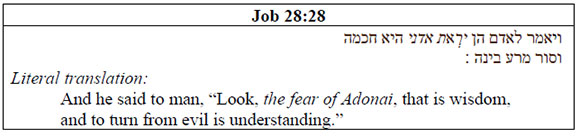
Of course, this chosen instance is not meant to convey that the concept of the fear of God / the Lord occurs only here in the book of Job, as may be illustrated with for instance Job 37:14-2446 or with the fear in Job 4:6 (cf. also Job 15:4), יר אתך, which creates implications of the fear of the Lord or with Job 6:14, the fear of the Almighty, ויר את שׁ די, which contains another variation on the more usual formulations. These are just some instances. Here, however, in Job 28:28, we come close to the more usual formulations of this wisdom saying,47 with as most noticeable exception the reference to the divine-אדני, rather than יהוה or האלהים, as a hapax legomenon in the book of Job.
The poem Job 28 is an exercise in pre-modern faith, which is to say, where religion is a fully-natural occurrence. Though at times contestatory and critical in nature, such questioning springs not from any opposition to reason or natural science in the manner that we have come to know since the Enlightenment. Possibilities of atheism, as understood in the modern age, are mostly philosophical and literary, related to times of crisis, rather than being a default societal position. Moreover, the conceptual separation of religion from any other spheres of life could, in such cultures, not take effect. God/s and faith/s were ever-present.
From this poem, hence, in such a religio-cultural ambience, much may be gathered. In the language of Fiddes, it is "a riddle for ancient and modem readers";48 more so again in our unfolding post-secular era in which faith is slowly again attaining the status of normalcy, in all respects, though certainly enriched by the two (differently) secular eras of modernism and post-modernism.
The poem opens with a broad metaphor of mining in the bid to search for wisdom. After that, elements of nature are explored to find wisdom; the same with human craft. In none of the places thus sought is wisdom however found,49not even in the personified afterlife. However, the metaphysical world holds an answer after all, in closing, namely in a way roughly analogous to when artists seek the origin of their creativity and conclude to "the muse" - something supra-human, yet concrete enough that it steers human actions on new pathways.
In the case of the Job 28 poem, God (initially אלהים, rather than יהוה) gives the answer with what may be termed a divine (or perhaps existential) aetiology of wisdom. Subsequently, אלהים in the opening word of the closing pericope of this poem, Job 28:23, is synonymised in the closing verse of the same pericope (and hence of the poem), as אדני. Unsurprisingly, many ancient manuscripts had replaced אדני here with יהוה, as indicated by the BHS text-critical apparatus-the latter simply is the term to be expected here.
The full closing verse of this poem is not necessarily out of kilter with the rest of Job 28, as many exegetes suggest; that is, thematically speaking-with the sources of wisdom sought widely, but not found, in the argumentative buildup of this poem, it is God who states in the concluding pericope where wisdom is to be sought, namely in relation toאדני. Not God self is wisdom, notably; this is no gnostic poem.50 Rather, in the association with God, wisdom unfolds. The alternative is then, redundantly and therefore significantly, put forward - "and to turn from evil is understanding." This part of the verse seems thematically to be a break from the previous line as the pinnacle of the poem. Proposals that at least this part of the closing verse could have been an addition, ascribable to habit of formulation (cf. Job 1:1; Prov 15:33), to a pedantic urge (cf. Ps 1) or perhaps to reflexive poetic technique, are reasonable.51
Notionally set in the speaker Job's mouth, given the complexity of the compositional structure52 and the editorial history53 of the book of Job as a whole and of this chapter too,54 this cannot straightforwardly be stated. The content of this entire chapter seems on its part too much like poetry from elsewhere. Commentators almost universally note that Job 28 does not link well with the rest of the book, even if they take an apologetic-of-unity approach to the text.55
Such kinds of evaluations of the text, as summarised here, come only from having lived intimately with Job 28, with the book of Job and with the vocabulary and thematics from wider co-texts and contexts. A bruta facta approach to our text, in an objectivist sense, cannot discern all nuances.56 Such structures of feeling require having lived into the textual possibilities implied in the text by well-(in)formed historical imagination in order to gain a sense of these referential realities.
F VERITY OF VERITIES...?
In Job 28:28, we also see a conundrum on a conundrum, structurally speaking- the poor fit of verse 28 within chapter 28 is paralleled by the poor fit of chapter 28 with the rest of the book of Job.57 It seems clear that studies that approach the text as a kind of firm, "finalised" form, have much less possibility of offering constructive insights on at least some of these puzzles than do historical approaches. Job shares in the Hebrew Bible the textual characteristic that these are, indisputably, developed texts and that those developments over time never "had in mind" our notions of what constitutes a smooth, now-complete, "publishable" text. The fractures of these texts58 or what Lo59 refers to as the contradictory juxta-positioning of pronouncements and thematics in the Old Testament (though in her case, with the intent of favouring a text-immanent reading), can only be explained if we understand how these texts came about, historically. Such an exegetical approach would be true to the nature of the texts and, more philosophically, to the nature of truth.
Another instance of structures of feeling along with historical imagination, can again illustrate such a sensing of nuanced meaning. This small example of Job 28:28, above all too lightly touched upon, already shows the intricate, difficult-to-navigate web of possible meanings that may be recognised regarding the concept of the fear of the Lord; yet such difficult navigation is what is required.
Moreover, the concept of the fear of the Lord stretches, because of its recurrence, even wider the sphere of the subject matter on which we are here devoting, sympathetically, our exegetical attentions. Evidently, this slogan-ish cultural wisdom (or catchphrase), in post-exilic Israel found itself inserted into many texts. These texts were in the context of then, presumed to be co-texts, all of which benefited from the insertion of the Yahwistic slogan. Hence, at the same time, such texts then contributed to that cultural deposit from the available conceptual library, which then continued into history through such textualisation. As part of an expanding Yahwistic piety, a cultural project of sorts, this saying (or, culturally incongruously, mantra) had a loose enough composition that it allowed for some variance, yet a firm enough resonance that the intent shows strong coherence - a moveable feast. This formulation thus functioned similarly to expressions in our time such as "what goes around, comes around" or "spiritual but not religious."
This post-exilic saying - here sensing its structures of feeling - shows also undertones of deuteronomistic theology, carrying here therefore the implicit understanding that a life lived well is one with wisdom and wisdom is found in the ambience of a relationship with God and even more. Such a metaphysical resonance was implicitly understood in much ancient wisdom; it did not have to be explicitly stated. However, given the broader deuteronomistic impulse of retaining firm loyalty to God in the wake of the exile experience, wisdom too now is brought under this broad theological rubric, more explicitly than had been the case traditionally. The slogan "the fear of Adonai, that is wisdom" carries in Job 28:28 the direct consequence, "and to turn from evil is understanding." The latter is not, however, part of the more general philosophical position on retributive justice; rather, it carries something contextually more precise- deuteronomistic thought. Here, the genre of wisdom is brought into a closer relationship with the deuteronomistic interpretative stream in Hebrew Bible texts than is often acknowledged.
This opens up the likelihood too of linkage to the same kind of theology portrayed in Ps 1 (and then the other Torah-psalms) of, in that case, following the Torah leading to a good life. The certainly still distinct Torah, deuteronomistic and wisdom strands of thought in post-exilic Israel, therefore, had a network of shared inferences and subtle association, which linked them in at times surprising ways. Sensing these structures of feeling brings alive such, historically speaking, very real cultural correlations, which once realised adds vibrancy and depth to our engagements with these texts, inasmuch as we can sense these understated / unstated real-life dynamics.
Such Yahwistic piety of course had a prior life of its own, as did equally obviously the wisdom ethos, before being brought together here. Post-exilically combined, this attempt to add Yahwistic wisdom piety into other texts did not take place in a vacuum, as that piety was playing out, extending its influence. It was in contestation with other theological streams - the rising legalism, the prophetic traditions that were continued in reapplied forms and more. As with all unfolding social trajectories, such interactions and contestations seldom follow an orderly pattern, but are characterised by the kind of randomness, the unpredictable fluidity, that goes along with all societal developments. Each text on its own can therefore provide us only with a static take on those processes. Taking into account their implied interconnections, these texts newly come alive to the sounds of their originating life-world.
G IN SUMMARY
In this ancient life-world, the experience of living underlies the texts, which can also be sought by exegetes open to the structures of feeling that permeated that society, discernible from its "canonised" texts as much as from other texts and available sources, in their reciprocal exchanges. Our historical imagination has to be employed in such investigations, as we reconstruct the nuances of living in that world, better to understand - sans naïve optimisms - the dimensions of ancient life as fully as possible from their texts, which are the remaining legacies.
Naturally, the influence of Rudolf Otto60 and others in dealing with this concept in Old Testament scholarship, recently again traced in outline by Ellis in relation to Job and other texts,61 is to be expected and is generally received appreciatively. Engleman62 however pleads against it, for his own theological reasons.
The concomitant perennial debate on whether the meaning of the expression fear of God / the Lord had changed over time seems somewhat contrived. Of course it had, though usually retaining a relation to the emotion or sensation of fear, as Clines observed.63 Pleading for a retention of the emotional and, thus in the language of earlier paragraphs above, the experiential, Clines64in summary states that:
[T]he whole edifice of a moral, ethical and cultic meaning for the phrase 'fear of God' is built on a confusion of sense and reference, which is to say, of denotation and connotation. My conclusion is that the ירא word group always signifies the emotion of fear (which is its sense or denotation), but that sometimes that emotion leads to actions (or avoidance of actions) of an ethical or cultic kind (which are then its reference or connotation).
The occurrence of the variance that the phrase exhibits in the terminology of both its main terms (fear, the divine), as much as the objective or subjective relation of these two terms, discussed in different ways in the literature, not to mention the nature of the expression as a whole conveying different pieties, already indicates that keeping to too essentialist an understanding of this expression would make careful exegesis difficult. Real life contexts lay behind the usage of the fear of the Lord concept. Add that to the social stratification that may be assigned to texts, as most influentially but differently indicated in the works of Gottwald65 (with his sociological approach) and Albertz66 (with his history-of-religions approach) and it is clear that group and class interests come into play within these texts too. Theological streams always have a social home.
That there is some stability (equi-valence) to the expression "fear of the Lord" seems fair, but not in the sense that one could speak of a firmly composed score. In the same way as, for instance, in English, a word (such as "outstanding" or "dust" or "overlook") or an expression (such as "an open secret") can have different, even opposite meanings, the range of meaning of the fear of the Lord is as open as both of its constitutive terms are and more besides. The latter can be brought to attention by the dual concepts of structures of feeling and historical imagination.
BIBLIOGRAPHY
Albertz, Rainer. Religionsgeschichte Israels in alttestamentlicher Zeit (1 & 2). Göttingen: Vandenhoeck & Ruprecht, 1992. [ Links ]
Alter, Robert. The Art of Biblical Narrative. Rev. ed. New York: Basic Books, 2011. [ Links ]
Bantock, G.H. "Educating the Emotions: An Historical Perspective." British Journal of Educational Studies 34/2 (1986): 122-141. [ Links ]
Barr, James. The Semantics of Biblical Language. Oxford: Oxford University Press, 1961. [ Links ]
Barton, John, ed. The Cambridge Companion to Biblical Interpretation. Cambridge: Cambridge University Press, 1998. [ Links ]
Becker, Joachim. Gottesfurcht im Alten Testament. Roma: Pontificio Istituto Biblico, 1965. [ Links ]
Böckle, Jakob. Ijob 28 in asthetisch-theologischer Perspektive: Wahrnehmung Gottes undder Weisheit als Herausforderung des Lebens. Berlin: LIT Verlag, 2018. [ Links ]
Boersma, Hans. Heavenly Participation: The Weaving of a Sacramental Tapestry. Grand Rapids: William B. Eerdmans, 2011. [ Links ]
Bosch, David. Witness to the World: The Christian Mission in Theological Perspective. Atlanta: John Knox, 1980. [ Links ]
Brueggemann, Walter. Spirituality of the Psalms. Minneapolis: Fortress Press, 2002. [ Links ]
___________. The Psalms and the Life of Faith. Minneapolis: Fortress Press, 1995. [ Links ]
Carr, David. Reading the Fractures of Genesis: Historical and Literary Approaches. Louisville: Westminster John Knox Press, 1996. [ Links ]
Clines, David. "God in the Pentateuch: Reading against the Grain." Pages 187-211 in Interested Parties: The Ideology of Writers and Readers of the Hebrew Bible. Edited by David Clines. Sheffield: Sheffield Academic Press, 1995. [ Links ]
___________. "'The Fear of the Lord Is Wisdom' (Job 28.28): A Semantic and Contextual Study." Pages 57-92 in Job 28: Cognition in Context. Edited by Ellen van Wolde. Leiden: Brill, 2003. [ Links ]
Coetzee, J. C. J. and Hans Van Deventer. "'Die Vrees van die Here' as 'n Sentrale Begrip in Bybelse Wysheidsliteratuur." In die Skriflig 38/3 (2004): 497-516. [ Links ]
Coleman, Rachel. "Walter Brueggemann's Enduring Influence on Biblical Interpretation." The Asbury Journal 70/2 (2015): 87-99. [ Links ]
Collingwood, Robin George. The Historical Imagination. Oxford: Clarendon Press, 1935. [ Links ]
Deist, Ferdinand. Witnesses to the Old Testament. Pretoria: NG Kerkboekhandel, 1988. [ Links ]
___________. Ervaring, Rede en Metode in Skrifuitleg: 'n Wetenskapshistoriese Ondersoek na Skrifuitleg in die Ned. Geref. Kerk 1840-1990. Pretoria: Raad vir Geesteswetenskaplike Navorsing, 1994. [ Links ]
De Margerie, Bertrand. Introduction à l'histoire de l' exégèse, I-IV. Paris: Cerf, 1996. [ Links ]
Derousseaux, Louis. La crainte de Dieu dans I'Ancien Testament. Royauté, alliance, sagesse dans les royaumes d'Israël et Juda: Recherches d'exégèse et d'histoire sur la racine yaré. Paris: Cerf, 1970. [ Links ]
Derrida, Jacques. Of Grammatology. Baltimore: Johns Hopkins University Press, 1976. [ Links ]
Dray, William. History as Re-enactment: R.G. Collingwood's Idea of History. Oxford: Clarendon Press, 1995. [ Links ]
Dürr, Lorenz. Das Erziehungswezen, im Alten Testament und im Antiken Orient. Leipzig: J.C. Hinrichs, 1932. [ Links ]
Ellis, Ettienne. "Reconsidering the Fear of God in Job 37:14-24 and Qohelet 3:1-17 in the Light of Rudolf Otto's Das Heilige:' Old Testament Essays 28/1 (2015): 53-69. [ Links ]
___________. "Reconsidering the Fear of God in the Wisdom Literature of the Hebrew Bible in the Light of Rudolf Otto's Das Heilige." Old Testament Essays 27/1 (2014): 82-99. [ Links ]
Engelbrecht, Ben. "Die Betekenis van die Begrip ' Vrees-van-die-Here' in Spreuke, Job en Prediker." Hervormde Teologiese Studies 7/4 (1951): 191-223. [ Links ]
Engleman, Eric. "Does Fear Remain in Old Testament יראת יהוה?" DTh dissertation, University of Vienna, Vienna, 2009. [ Links ]
Fiddes, Paul. "'Where Shall Wisdom Be Found?' Job 28 as a Riddle for Ancient and Modern Readers." Pages 171-190 in After the Exile: Essays in Honour of Rex Mason. Edited by John Barton and David Reimer. Macon: Mercer University Press, 1996. [ Links ]
Giddens, Anthony. The Consequences of Modernity. Stanford: Stanford University Press, 1990. [ Links ]
Goosen, Danie. Die Nihilisme: Notas oor ons Tyd. Pretoria: Praag, 2007. [ Links ] Gottwald, Norman. The Hebrew Bible: A Socio-Literary Introduction. Philadelphia: Fortress Press, 1985. [ Links ]
Holter, Knut. Old Testament Research for Africa: A Critical Analysis and Annotated Bibliography of African Old Testament Dissertations, 1967-2000. New York: Peter Lang, 2002. [ Links ]
Huehls, Mitchum. "Structures of Feeling: Or, How to Do Things (or not) with Books." Contemporary Literature 51/2 (2010): 419-428. [ Links ]
Ingman, Peik, Terhi Utriainen, Tuija Hovi and Mans Broo, eds. The Relational Dynamics of Enchantment and Sacralization: Changing the Terms of the Religion Versus Secularity Debate. Sheffield: Equinox, 2016. [ Links ]
Jancovich, Mark. The Cultural Politics of the New Criticism. Cambridge: Cambridge University Press, 1993. [ Links ]
Irwin, William. "Fear of God, the Analogy of Friendship and Ben Sira's Theodicy." Biblica 76/4 (1995): 551-559. [ Links ]
Kierkegaard, S0ren [= De Silentio, Johannes]. Frygt og Bæven: Dialektisk Lyrik. Copenhagen: CA Reitzel, 1843. [ Links ]
Kraus, Hans-Joachim. Geschichte der historisch-kritischen Erforschung des Alten Testaments von der Reformation bis zur Gegenwart. 3. erw. Auflage. Neukirchen-Vluyn: Neukirchener Verlag, 1982. [ Links ]
Kourie, Celia. "Weaving Colourful Threads: A Tapestry of Spirituality and Mysticism." HTS Teologiese Studies/ Theological Studies 71/1 (2015): 1-9. [ Links ]
Kurschner, Alan. "James Barr on the 'Illegitimate Totality Transfer' Word-Concept Fallacy." Pages 70-89 in James Barr Assessed. Evaluating His Legacy over the Last Sixty Years. Edited by Stanley Porter. Leiden: Brill, 2021. [ Links ]
Lasater, Phillip Michael. Facets of Fear. The Fear of God in Exilic and Post-Exilic Contexts. Tübingen: Mohr Siebeck, 2019. [ Links ]
Le Roux, Jurie. "The Nature of Historical Understanding (or: Hermeneutics and History)." Studia Historiae Ecclesiasticae XIX/1 (1993): 35-63. [ Links ]
Littlejohn, Stephen, Karen Foss and John Oetzel. Theories of Human Communication. 12th ed. Long Grove: Waveland Press, 2021. [ Links ]
Lo, Alison. Job 28 as Rhetoric: An Analysis of Job 28 in the Context of Job 22-31. Leiden: Brill, 2003. [ Links ]
Lombaard, Christo. "Elke Vertaling is 'n Vertelling. Opmerkings oor Vertaalteorie, geïllustreer aan die hand van die Chokmatiese Ratio Interpretationis'' Old Testament Essays 15/3 (2002): 754-765. [ Links ]
___________. "Four Recent Works on the Interpretation of the Old Testament in South Africa, with Evaluation and Some Implications." Scriptura 78 (2013): 467-478. [ Links ]
___________. "Getting Texts to Talk: A Critical Analysis of Attempts at Eliciting Contemporary Messages from Ancient Holy Books as Exercises in Religious Communication." Ned. Geref. Teologiese Tydskrif 55/1 (2014): 205-225. [ Links ]
___________. "Between the Literal and the Figurative: Textual Interplay in Sulamiet by Lina Spies and the Shulammite of Song of Songs." Pages 102-125 in The Song of Songs Afresh: Perspectives on a Biblical Love Poem. Edited by Stefan Fischer and Gavin Fernandes. Sheffield: Sheffield Phoenix Press, 2019. [ Links ]
Middlemas, Jill, David Clines and Else K. Holt, eds. The Centre and the Periphery: A European Tribute to Walter Brueggemann. Sheffield: Sheffield Phoenix, 2010. [ Links ]
Nõmmik, Urmas. Die Freundesreden des ursprünglichen Hiobdialogs: Eine form- und traditionskritische Untersuchung. Berlin: Walter de Gruyter, 2010. [ Links ]
Otto, Rudolf. Das Heilige: Über das Irrationale in der Idee des Göttlichen und sein Verhaltnis zum Rationalen. 10th ed. Breslau: Trewendt und Granier, 1923. [ Links ]
Peschel, Lisa. "'Structures of Feeling' as Methodology and the Re-emergence of Holocaust Survivor Testimony in 1960s Czechoslovakia." Journal of Dramatic Theory and Criticism 26/2 (2012): 161-172. [ Links ]
Pinch, Adela. "Emotion and History: A Review Article." Comparative Studies in Society and History 37/1 (1995): 100-109. [ Links ]
Plath, Siegfried. Furcht Gottes: Der Begriff Jr'a im Alten Testament. Stuttgart: Calwer Verlag, 1962. [ Links ]
Plato. Theaetetus. Edited and translated by Harold Fowler. Loeb Classical Library 123. Cambridge: Harvard University Press, 1921. [ Links ]
Richter, Wolfgang. Exegese als Literaturwissenschaft: Entwurf einer alttestamentliche Literaturtheorie und Methodologie. Göttingen: Vandenhoeck & Ruprecht, 1971. [ Links ]
Sæbø, Magne, ed. Hebrew Bible/Old Testament: The History of Its Interpretation. Vol. I-V. Göttingen: Vandenhoeck & Ruprecht, 1996-2015. [ Links ]
Schreiber, Dudley. "On the Epistemology of Postmodern Spirituality." Verbum et Ecclesia 33/1 (2012): 1-8. [ Links ]
Schulze, Gerhard. Die Erlebnis-Gesellschaft: Kultursoziologie der Gegenwart. Frankfurt a.M.: Campus, 1992. [ Links ]
Steck, Odil Hannes. Exegese des Alten Testaments: Leitfaden der Methodik. Göttingen: Vandenhoeck & Ruprecht, 1999. [ Links ]
Swanepoel, Francois. "Popularising Contextual Theology." Scriptura 45 (1993): 6778. [ Links ]
Thiselton, Anthony. New Horizons in Hermeneutics. Grand Rapids: Zondervan, 1992. [ Links ]
Tynan, Kenneth. "'Shadow of Heroes' by Robert Ardrey, at the Piccadilly." Pages 7-9 in Tynan Right and Left. Edited by Kenneth Tynan. New York: Atheneum, [1958] 1967. [ Links ]
Utriainen, Terhi, Peter Nynäs and Mika Lassander, eds. Post-secular Society. New Brunswick: Transaction Publishers, 2012. [ Links ]
Van Huyssteen, Wentzel. "Understanding Religious Texts: The Role of Models in Biblical Interpretation." Old Testament Essays 5 (1987): 9-23. [ Links ]
Van Oorschot, Jürgen. "Hiob 28: Die verborgene Weisheit und die Furcht Gottes als Überwindung einer generalisierten Hâkmâ." Pages 183-201 in The Book of Job. Edited by Wim Beuken. Leuven: Peeters, 1994. [ Links ]
Veeser, Harold, ed. The New Historicism. Abingdon: Routledge, 1989. [ Links ]
Vreekamp, Henk. De Vreze des Heren: Een Oorsprongswoord in de Systematische Theologie. Utrecht: Rijksuniversiteit te Utrecht, 1982. [ Links ]
West, Gerald and Musa Dube, eds. The Bible in Africa: Transactions, Trajectories and Trends. Leiden: Brill, 2000. [ Links ]
Williams, Raymond. Marxism and Literature. New York: Oxford University Press, 1977. [ Links ]
Zimmer, Siegfried. Schadet die Bibelwissenschaft dem Glauben? Klärung eines Konflikts. Göttingen: Vandenhoeck & Ruprecht, 2002. [ Links ]
Submitted: 16/09/2024
Peer-reviewed: 06/08/2025
Accepted: 25/08/2025
* Christo Lombaard is Head of the Department of Practical Theology and Mission Studies at the University of Pretoria. Email: cjs.lombaard@up.ac.za. ORCID: https://orcid.org/0000-0003-0019-4717.
1 Cf. Stephen Littlejohn, Karen Foss and John Oetzel, Theories of Human Communication (12th ed.; Long Grove: Waveland Press, 2021), as the latest edition of this standard work on Communications theory.
2 The history and practice of exegesis are relayed in e.g. Magne Sæbø, ed., Hebrew Bible/Old Testament: The History of Its Interpretation (Vol. I-V; Göttingen: Vandenhoeck & Ruprecht, 1996-2015), Odil Hannes Steck, Exegese des Alten Testaments: Leitfaden der Methodik (Göttingen: Vandenhoeck & Ruprecht, 1999), John Barton, ed., The Cambridge Companion to Biblical Interpretation (Cambridge: Cambridge University Press, 1998), Bertrand de Margerie, Introduction à l'histoire de l'exégèse (I-IV, Paris: Cerf, 1996) and the classic work of Hans-Joachim Kraus, Geschichte der historisch-kritischen Erforschung des Alten Testaments von der Reformation bis zur Gegenwart (3. erw. Auflage; Neukirchen-Vluyn: Neukirchener Verlag, 1982).
3 Cf. Knut Holter, Old Testament Research for Africa: A Critical Analysis and Annotated Bibliography of African Old Testament Dissertations, 1967-2000 (New York: Peter Lang, 2002), Gerald West and Musa Dube, eds., The Bible in Africa: Transactions, Trajectories and Trends (Leiden: Brill, 2000), Christo Lombaard, "Four Recent Works on the Interpretation of the Old Testament in South Africa, with Evaluation and Some Implications," Scriptura 78 (2013): 467-478, Ferdinand Deist, Ervaring, Rede en Metode in Skrijuitleg: 'n Wetenskapshistoriese Ondersoek na Skrifuitleg in die Ned. Geref. Kerk 1840-1990 (Pretoria: Raad vir Geesteswetenskaplike Navorsing, 1994) and Wentzel van Huyssteen, "Understanding Religious Texts: The Role of Models in Biblical Interpretation," OTE 5 (1987): 9-23.
4 Siegfried Zimmer, Schadet die Bibelwissenschaft dem Glauben? Klarung eines Konflikts (Göttingen: Vandenhoeck & Ruprecht, 2002).
5 Cf. Francois Swanepoel, "Popularising Contextual Theology," Scriptura 45 (1993): 67-78.
6 Christo Lombaard, "Getting Texts to Talk: A Critical Analysis of Attempts at Eliciting Contemporary Messages from Ancient Holy Books as Exercises in Religious Communication," Ned. Geref. Teologiese Tydskrif 55/1 (2014): 205-225.
7 Christo Lombaard, "Elke Vertaling is 'n Vertelling. Opmerkings oor Vertaalteorie, geïllustreer aan die hand van die Chokmatiese Ratio Interpretationis,'' OTE 15/3 (2002): 754-765.
8 Cf. Walter Brueggemann, Spirituality of the Psalms (Minneapolis: Fortress Press, 2002), based on the more exegetically extensive earlier work, Walter Brueggemann, The Psalms and the Life of Faith (Minneapolis: Fortress Press, 1995).
9 Jill Middlemas, David Clines and Else Holt, eds., The Centre and the Periphery: A European Tribute to Walter Brueggemann (Sheffield: Sheffield Phoenix, 2010).
10 Rachel Coleman, "Walter Brueggemann's Enduring Influence on Biblical Interpretation," The Asbury Journal 70/2 (2015): 88.
11 Norman Gottwald, The Hebrew Bible: A Socio-Literary Introduction (Philadelphia: Fortress Press, 1985).
12 Robert Alter, The Art of Biblical Narrative (rev. ed.; New York: Basic Books, 2011).
13 Wolfgang Richter, Exegese als Literaturwissenschaft: Entwurf einer alttestamentliche Literaturtheorie und Methodologie (Göttingen: Vandenhoeck & Ruprecht, 1971).
14 Christo Lombaard, "Between the Literal and the Figurative: Textual Interplay in Sulamiet by Lina Spies and the Shulammite of Song of Songs," in The Song of Songs Afresh: Perspectives on a Biblical Love Poem (ed. Stefan Fischer and Gavin Fernandes; Sheffield: Sheffield Phoenix Press, 2019), 102-125.
15 In this contribution, though, the weight lies on the programmatic aspect, with the Job 28:28 example drawing, for the most part, on extant exegesis. Perhaps this contribution can therefore best be characterised as a phenomenology of exegesis for exegetes.
16 Cf. Jurie le Roux, "The Nature of Historical Understanding (or: Hermeneutics and History)," Studia Historiae Ecclesiasticae XIX/1 (1993): 35-63.
17 Cf. Anthony Thiselton, New Horizons in Hermeneutics (Grand Rapids: Zondervan, 1992).
18 So already, David Bosch, Witness to the World: The Christian Mission in Theological Perspective (Atlanta: John Knox, 1980), 202-220.
19 Danie Goosen, Die Nihilisme: Notas oor ons Tyd (Pretoria: Praag, 2007).
20 Anthony Giddens, The Consequences of Modernity (Stanford: Stanford University Press, 1990), 45-54.
21 Cf. Terhi Utriainen, Peter Nynàs and Mika Lassander, eds., Post-secular Society (New Brunswick: Transaction Publishers, 2012).
22 Gerhard Schulze, Die Erlebnis-Gesellschaft: Kultursoziologie der Gegenwart (Frankfurt a.M.: Campus, 1992).
23 Cf. Dudley Schreiber, "On the Epistemology of Postmodern Spirituality," Verbum et Ecclesia 33/1 (2012): 1-8; Peik Ingman, Terhi Utriainen, Tuija Hovi and Mans Broo, eds., The Relational Dynamics of Enchantment and Sacralization: Changing the Terms of the Religion Versus Secularity Debate (Sheffield: Equinox, 2016).
24 Raymond Williams, Marxism and Literature (New York: Oxford University Press, 1977), 132.
25 Mitchum Huehls, "Structures of Feeling: Or, How to Do Things (or not) with Books," Contemporary Literature 51/2 (2010): 419.
26 Huehls, "Structures of Feeling," 419-420.
27 Cf. Adela Pinch, "Emotion and History: A Review Article," Comparative Studies in Society and History 37/1 (1995): 100-109; G. H. Bantock, "Educating the Emotions: An Historical Perspective," BJES 34/2 (1986): 122-141.
28 Lisa Peschel, "'Structures of Feeling' as Methodology and the Re-emergence of Holocaust Survivor Testimony in 1960s Czechoslovakia," Journal of Dramatic Theory and Criticism 26/2 (2012): 161.
29 David Clines, "God in the Pentateuch: Reading against the Grain," in Interested Parties: The Ideology of Writers and Readers of the Hebrew Bible (ed. David Clines; Sheffield: Sheffield Academic Press, 1995), 192.
30 Williams, Marxism and Literature, 122.
31 Cf. Mark Jancovich, The Cultural Politics of the New Criticism (Cambridge: Cambridge University Press, 1993).
32 Cf. Harold Veeser, ed., The New Historicism (Abingdon: Routledge, 1989).
33 E.g. Jacques Derrida, Of grammatology (Baltimore: Johns Hopkins University Press, 1976).
34 An overused metaphor by now, but brought anew into theological discussion in, for example, Hans Boersma, Heavenly Participation: The Weaving of a Sacramental Tapestry (Grand Rapids: William B Eerdmans, 2011) and Celia Kourie, "Weaving Colourful Threads: A Tapestry of Spirituality and Mysticism," HTS Teologiese Studies / Theological Studies 71/1 (2015): 1-9.
35 Ferdinand Deist, Witnesses to the Old Testament (Pretoria: NG Kerkboekhandel, 1988).
36 Cf. Robin George Collingwood, The Historical Imagination (Oxford: Clarendon Press, 1935); William Dray, History as Re-enactment: R.G. Collingwood's Idea of History (Oxford: Clarendon Press, 1995); Le Roux, "The Nature of Historical Understanding," 35-63.
37 This point is amply illustrated by Eric Engleman, "Does Fear Remain in Old Testament יראת יהוה?" (DTh dissertation, University of Vienna, 2009) and Joachim Becker, Gottesfurcht im Alten Testament (Roma: Pontificio Istituto Biblico, 1965). Cf. also Jakob Böckle, Ijob 28 in asthetisch-theologischer Perspektive: Wahrnehmung Gottes und der Weisheit als Herausforderung des Lebens (Berlin: LIT Verlag, 2018), Henk Vreekamp, De Vreze des Heren: Een Oorsprongswoord in de Systematische Theologie (Utrecht: Rijksuniversiteit te Utrecht, 1982), Louis Derousseaux, La crainte de Dieu dans I'Ancien Testament. Royauté, alliance, sagesse dans les royaumes d'Israël et Juda: Recherches d'exégèse et d'histoire sur la racine yaré (Paris: Cerf, 1970) and Siegfried Plath, Furcht Gottes: Der Begriff Jr'a im Alten Testament (Stuttgart: Calwer Verlag, 1962). These, apart from less extensive studies, included literary-philosophical re-interpretations, most notably Søren Kierkegaard [= Johannes de Silentio], Frygt og Bæven: Dialektisk Lyrik (Copenhagen: CA Reitzel, 1843) and theological expansions, most notably, Rudolf Otto, Das Heilige: Über das Irrationale in der Idee des Göttlichen und sein Verhaltnis zum Rationalen (10th ed.; Breslau: Trewendt und Granier, 1923).
38 J. C. J. Coetzee and Hans van Deventer, "'Die Vrees van die Here' as 'n Sentrale Begrip in Bybelse Wysheidsliteratuur," In die Skriflig 38/3 (2004): 497-516.
39 Ben Engelbrecht, "Die Betekenis van die Begrip 'Vrees-van-die-Here' in Spreuke, Job en Prediker," Hervormde Teologiese Studies 7/4 (1951): 191.
40 Lorenz Dürr, Das Erziehungswezen, im Alten Testament und im Antiken Orient (Leipzig: J.C. Hinrichs, 1932), 124.
41 Cf. Engleman, "Does Fear Remain," 145-163.
42 Cf. e.g. William Irwin, "Fear of God, the Analogy of Friendship and Ben Sira's Theodicy," Biblica 76/4 (1995): 551-559.
43 Cf. e.g. Becker, Gottesfurcht im Alten Testament. The wider Greek influences ought also to be considered; cf. Plato, Theaetetus 155c-d.
44 James Barr, The Semantics of Biblical Language (Oxford: Oxford University Press), 1961.
45 Alan Kurschner, "James Barr on the 'Illegitimate Totality Transfer' Word-Concept Fallacy," in James Barr Assessed. Evaluating His Legacy over the Last Sixty Years (ed. Stanley Porter; Leiden: Brill, 2021), 70-89.
46 Ettienne Ellis, "Reconsidering the Fear of God in Job 37:14-24 and Qohelet 3:1-17 in the Light of Rudolf Otto's Das Heilige," Old Testament Essays 28/1 (2015): 53-69.
47 As Clines states, "the noun [יראה] occurs 44 times in the Hebrew Bible (22 times in the phrase יראת יהוה, 3 times in the phrase אלהי ם יראת)"; David Clines, "'The Fear of the Lord Is Wisdom' (Job 28.28): A Semantic and Contextual Study," in Job 28: Cognition in Context (ed. Ellen van Wolde; Leiden: Brill, 2003), 58.
48 Paul Fiddes, "'Where Shall Wisdom Be Found?' Job 28 as a Riddle for Ancient and Modern Readers," in After the Exile: Essays in Honour of Rex Mason (ed. John Barton and David Reimer; Macon: Mercer University Press, 1996), 171.
49 Jürgen van Oorschot, "Hiob 28: Die verborgene Weisheit und die Furcht Gottes als Überwindung einer generalisierten Hâkmâ," in The Book of Job (ed. Wim Beuken; Leuven: Peeters, 1994), 183-201.
50 Fiddes, "Where Shall Wisdom Be Found?" 174-177.
51 Alison Lo, Job 28 as Rhetoric: An Analysis of Job 28 in the Context of Job 22-31 (Leiden: Brill, 2003), 2-3, 12-15.
52 Cf. Lo, Job 28 as Rhetoric, 22-78.
53 Notably, Urmas Nõmmik, Die Freundesreden des ursprünglichen Hiobdialogs: Eine form- und traditionskritische Untersuchung (Berlin: Walter de Gruyter, 2010).
54 The editorial development of the Job text, like all Bible texts, should not be understood, as had been implied at times in the past, that the older version is somehow more significant, given, in a sense, its more foundational nature. The opposite position is found more frequently, still, too: that the final form of the text is more authoritative. Redaction-critical studies on Job show how involved these compositional/ developmental processes had been. These studies too illustrate something, though, on a broader scale, of what follows.
55 Cf. Lo, Job 28 as Rhetoric, 3-15.
56 In a different context, this was memorably formulated as "accept[ing] facts not just as aspects of the truth but as the whole of it," by Kenneth Tynan, "'Shadow of Heroes,' by Robert Ardrey, at the Piccadilly," in Tynan Right and Left (ed. Kenneth Tynan; New York: Atheneum, [1958] 1967), 8.
57 In addition, it has often been seen as fitting between two different versions of Old Testament wisdom; as Fiddes, "Where Shall Wisdom Be Found?," 171, states: "[Job 28] is often interpreted as a move away from an earlier confidence that experience can be handled by the techniques of wisdom, to an admission that wisdom is totally hidden from human beings."
58 In the language of David Carr, Reading the Fractures of Genesis: Historical and Literary Approaches (Louisville: Westminster John Knox Press, 1996).
59 Lo, Job 28 as Rhetoric, 80-82, 237-253.
60 Otto, Das Heilige, 1923.
61 Ettienne Ellis, "Reconsidering the Fear of God in the Wisdom Literature of the Hebrew Bible in the Light of Rudolf Otto's Das Heilige^ OTE 27/1 (2014): 88-97.
62 Engleman, "Does Fear Remain."
63 Clines, "God in the Pentateuch," 62.
64 Ibid., 62, 64; cf. Engelbrecht, "Die Betekenis van die Begrip," 211, 216, 222-223.
65 Gottwald, The Hebrew Bible.
66 Rainer Albertz, Religionsgeschichte Israels in alttestamentlicher Zeit (1 & 2; Göttingen: Vandenhoeck & Ruprecht, 1992).
