




Services on Demand
Journal

Article
 English (pdf)
 Article in xml format
 Article references
 Automatic translation
 Send this article by e-mail
Indicators
Related links
-
 Cited by Google
 -
 Similars in Google
Share

 Permalink
Old Testament Essays
On-line version ISSN 2312-3621Print version ISSN 1010-9919
Old testam. essays vol.37 n.2 Pretoria 2024
https://doi.org/10.17159/2312-3621/2024/v37n2a5
ARTICLES
Another Look at Israel's War with Benjamin in Judges 20 from the Perspectives of African Biblical Hermeneutics
Michael Ufok Udoekpo
Veritas University
ABSTRACT
The Book of Judges is a continuation of Israel's history in the promised land, beginning from the death of Joshua to the time or before the birth of Samuel, the last judge of Israel (1 Sam 7:15). In Judges, we find a cycle of disobedience, infidelity, punishment, repentance and deliverance (3:7-16:31). Chapters 17-21 shed light on the social and religious history of Israel. They describe the cultic, moral anarchy of the era "when there was no king in Israel" (Judg 17:6; 19:1) and a time "when people did whatever was right in their own eyes" (21:25). In Judg 20, Israel overacts and revenges against injustices of Gibeah's crime (Judg 19). By doing these, she plunges into civil war against Benjamin. This affirms, in a way, the tragedy of confederacy without visionary leaders who fear the Lord, a phenomenon common in today's African societies. In the past, European and North American exegetes have interpreted Judg 19-20 historically, using various "western interpretative models." Conscious also of issues of wars and violence in Africa, this study analyses Judg 20 from the perspective of African Biblical Hermeneutics and as a post-colonial approach within the overall context of the theology of Deuteronomistic History (Joshua-Kings). It argues against incessant tragic phenomena of civil wars and domestic violence in African faith communities.
Keywords: African Biblical Hermeneutics (ABH), Judges, War, Crimes, Violence
A INTRODUCTION
In Judges, we find a cycle of disobedience, infidelity, repentance and deliverance (3:7-16:31). Chapters 17-21, in particular, represent a very old tradition which sheds light on the social and religious history of Israel. It describes the cultic and moral anarchy of the era "when there was no king in Israel" (Judg 17:6; 19:1) and "a time when people did whatever was right in their own eyes" (21:25). This refrain encapsulates this study and serves as a connecting bridge to the book of Samuel where Saul and David are introduced as kings with a theocratic implication of God as King of Israel (1 Sam 8:23). Chapters 19-21 broadly present a story of violence and Gibeah's crime (Judg 19), leading to Israel's bloody tribal war with the fellow tribe of Benjamin (Judg 20) and to kidnapping of the innocent dancing maidens at Shiloh (Judg 21).
In this story, a Levite from Ephraim went to Bethlehem of Judah searching for his concubine/wife (phîlegesh) who left him anger (ōrgisthē in LXX) or unfaithfulness/prostitution (zānāh in the MT) and went back to her parents in the southern Israel. Returning home late, they passed through Jebus (a pre-Israelite name for Jerusalem, about five miles (or seven kilometres north of Bethlehem) and passed a night in Gibeah, a city in the territory of Benjamin (vv.11-15), in the home of an elderly and hospitable man (zāqen) from Ephraim (vv.16-21). At night, some sons of worthlessness (bənȇ-bəliyyaʿl) surrounded the compound with an attempt to gang-rape the Levite (v.22). He hands over his concubine to these worthless men who raped her all night (vv.23-28). On reaching home, the Levites cuts up her body and distributes parts to all the tribes of Israel, demanding judgment (vv.29-30).
Outraged by the incident, Israel avenges the injustices of Gibeah's crime (Judg 19). The people took oaths never to give their daughters to the Benjamites in marriage and plunged into civil war against Benjamin. This war nearly wiped out the entire tribe, leaving only 600 men as survivors (Jud 20:21-48). They destroyed the city of Jabesh Gilead, whose citizens had not taken part in the war nor in the oath or gone to Mizpah (Judg 21:1-15). Israel tragically captured their 400 maidens as wives for the Benjamites (v.12), while their remaining 200 men were allowed to abduct the maidens dancing at Shiloh (vv.16-24).
This tragedy of lawless confederacy without visionary leaders who neither fear the Lord nor promote common good, justice, handwork, sacrifice and selflessness (v.25) is a phenomenon common in today's African tribalistic and ethnocentric society. Like ancient Israel of the time of the Judges, African societies today are daily confronted with all forms of conflicts, corruption and violence, including tribal and ethnic wars, religious extremism, kidnappings, killings, arm robberies and general disorder.1 In the 20th century alone, Africa experienced costly wars and conflicts in Somalia (1991), Nigeria (1967) and Uganda (1987) as well as the Rwandan and Burundi genocide (1994) and the Eritrean-Ethiopian War of 1998. This is not to mention several other bloody conflicts and the recent coup d'état and threats of war in the Republic of Niger.2
Past studies on this text or narrative, especially of non-African origin, deficient with their stories, values, cultures, customs and experiences, have often adopted the diachronic or historical, feminist and rabbinical approaches. Based on their unique experiences, outside Africa, they would also often approach the material, theoretically and historically (Judg 19-21).3 Heidi Szpek, for instance, exceptionally sees it not only as ahistorical but as "a metaphor of dire, not gentle, admonition, pieced together by allusions, of what Israel's destiny might become."4
Robert Boling sees the story, as merely representing "the confederacy as utterly leaderless."5 It is a rich mine of data on Israel's pre-monarchical organisation as well as dramatic ironies or a tragicomic.6 Martin Noth saw it as a reflection of military expedition of the twelve-tribes' organisation against one of its members in the pre-Davidic era.7 Wellhausens read it as an addition or late imitation of the story of Lot in Gen 19 and dismisses it as having no positive value.8 While others, such as Yairah Amit understand it as a supplement to Micah's story (Judg 17-18). Amit stresses what happened in Israel when there was no King (Judg 17:6; 18:1; 19:1; 21:25) as well as a post-exilic political narrative to demonstrate the unfading unity of Israel.9 These earlier, western and European-minded studies were devoid of African experiences, concerns, stories, examples, customs, culture or worldview, particularly those cherished by proponents African Biblical Hermeneutics.
Built on past contributions and using common African historical experiences as an exegetical point of departure, this work contextually studies Judg 20. It employs African Biblical Hermeneutics, a post-colonial enterprise, theologically within the overall contexts of Deuteronomistic History and Judges, particularly, chapters 19-21, with the hope that it will be transformational and beneficial for African readers within their faith context.
B EXPLANATION OF KEY TERMS
In what follows, few terms require further explanation. First of all, the term "the West" or "western" in this work refers to "the set of European countries and America, which colonized Africa or have had imperializing power over others from the nineteenth century onward. Both are "terminologies of power, domineering, monopoly and control, resisted by Postcolonial African approaches."10 There are minority groups that were not beneficiaries of the colonial infrastructure and power, including African Americans, Native Americans and the various minority groups found in Europe who were as much victims of colonial oppression as were Africans, located in today's African continent. In this study, following Mbuvi and others, these minority groups are excluded from the use of the term "West."11
Similarly, "Africa" and "African" are used in this work as umbrella terms to envelop African biblical interpretative approaches championed by many African scholars and writers, such as John S. Mbiti, Charles Nyamiti, John S. Pobee, David T. Adamo, Justin Ukpong, Teresa Okure, Andrew M. Mbuvi, Kenneth N. Ngwa, Mercy Amber Oduyoye and many others.12 Their approaches fully recognise that the Bible, a sacred text of which the book of Judges forms a part, is the Word of God, which became flesh and dwelt among us (John 1:14).
This sacred text has today more than ever witnessed fascinating debates, shifts among diachronic and synchronic methods and igniting a revival in its hermeneutical and exegetical approaches, some of which I have indicated in my earlier studies.13 Acknowledging this shift, Fernando Segovia writes, "The world of biblical criticism today is very different from that of the mid-1970s ... the field has undergone a fundamental and radical shift."14 As a beneficiary and promoter of this shift, postcolonial critical reading of the Bible is not only emancipatory, emphasising culture, context and one's social location, but its critical procedure is an amalgam of different contemporary literary methods which thrives on inclusiveness and probes injustice.15 Okure calls this shift "a revival of interest" in biblical scholarship that is mainly inspired by the changing situation in mission lands.16 Adamo describes African Biblical Hermeneutics as nothing less than "bringing real life interest into the biblical text and then [assigning] a very important role to this life interest."17 African Biblical Hermeneutics "is the principle of the interpretation of the Bible for transformation in Africa . that is vital to the wellbeing of our society."18 It is an "African cultural hermeneutics," "African biblical transformational hermeneutics" or "African biblical studies," which involves reading the Christian Scriptures, of which the book of Judges forms a part, from an African perspectives, worldview and culture.19
Its task is "liberational and transformational," that is, understanding the Bible and God in relation to the African experience and culture, promoting African culture and identity and making biblical interpretation relevant to daily experiences of Africans.20 Justin Ukpong describes this as "inculturation hermeneutics."21 Like African Biblical Hermeneutics, inculturation hermeneutics is "a contextual hermeneutical methodology or approach that seeks to make any community of ordinary people and their socio-cultural context the subject of interpretation of the Bible."22 It lays emphasis on the use of the conceptual frame of reference of the people doing the reading and comparison in the interpretation process and its characteristics. Its goal is consistently sociocultural transformation, focusing on a variety of issues and situations, while its ethos is cultural diversity and identity in reading practice.23
Additionally, Schreiter affirms the importance of contextualising and appropriating biblical exegesis and theology, but advises that "theology must not be reduced to context in a crude contextualism, for then it is likely to lose its critical edge as it becomes simply a product of its surroundings."24 Reading ancient Old Testament texts like the book of Judges in our African times, that is, using African Biblical Hermeneutics, can be challenging. However, this becomes easier when we keep in mind that the Word of God that became flesh and dwelt among us (John 1:14) is both timeless and without boundaries (Isa 40:8; 1 Pet 1:23-25).
In other words, the narrative in Judg 19-20 is capable of "entering into and finding expression in various cultural experiences and languages, yet that same word overcomes the limits of individual cultures to create fellowship between different people."25 African Biblical Hermeneutics must be distinctively communal, existential and reflective, African and comparative, evaluative in using Africa and African culture to interpret the Bible. Of course, this must not be done in isolation from other hermeneutical methods in an attempt to decolonise the interpretation of the Bible and the Word of God in light of African culture and tradition.26 What follows is a brief overview of the story in Judges, including information about who the judges were the text, versions, the setting, moral, structure and working-compositional structure that provides an outline for the rest of the exegesis.
C BRIEF OVERVIEW OF THE STORY IN JUDGES
Judges were charismatic leaders raised up by the impulses of God's spirit to deliver Israelites from their enemies. They were not Judges like in the modern courts in our judiciary systems today. Rather, through divine assistance they vindicated the justices of God. Oppression comes to Israel as a result of their infidelity to God. Salvation comes to Israel in their obedience to the Lord (Deut 28:15-68; Judg 2:11-18). They were the Lord's salvific fidelity to his word. The book of Judges is a continuation of Israel's history in the promised land, beginning from the death of Joshua to just the time or before the birth of Samuel, the last Judge of Israel (1 Sam 7:15). Its setting covers the time between the conquest of Canaan under Joshua until the rise of the monarchy under the first king of Israel, Saul. In modern scholarship, the book of Judges is treated as an important historical source for the time between the Exodus from Egypt and the beginning of the United Monarchy.27
The text itself has come to us in different versions such as (a) the Hebrew text, (b) the Hebrew text transliterated into Greek characters, (c) Aquila, (d) Symmachus, (e) Origen's LXX and (f)Theodotion.28 As Boling has observed, the principle of textual criticism has not changed.29 Throughout this study, we shall be indicating where necessary the relationship between the different versions cited above. The stories in the book of Judges generally are stories of God's faithfulness and Israel's unfaithfulness including its judges and leaders and the citizens.30 According to Vincent Branick, they are cyclical stories of extended laments about idolatry, tribal and defensive wars, violence and corruption of families, tribes, religious and political leaders when there was no king in Israel and every one, as mentioned earlier, "did what was good in his or her eyes" (2:10-19; 17:6; 18:1;19:1; 21:25). Its moral revolves around the fact that oppression of the Israelites is the punishment of impiety, disobedience and that victory, restoration, salvation comes as a result of repentance, conversion, renewal and making a "U-turn" from violence and war (milchamah) to God and peace (shalom).
Based on content, many scholars usually attribute three major parts to the 21 chapters of Judges: (a) Introduction (1:1-3:6), (b) stories about individual Judges (3:7-16:31) and (c) the concluding stories (17-21). John Currid, for instance, arranges his division of the book of Judges into:
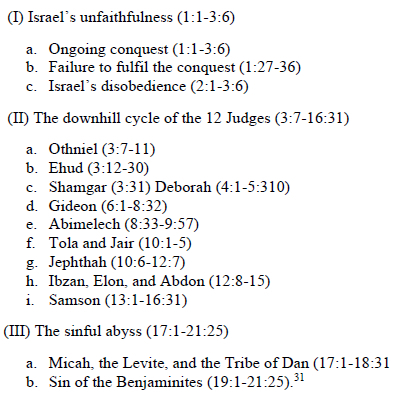
In other words, there are as many structures and outlines as there are authors and commentators. Our focus remains on the last section of any of these structures. That is, Israel's domestic war in the territory of Benjamin (Judg 20) in the proximate context of the antecedent crimes (Judg 19-21) and Judges as a whole.
D ANALYSIS OF ISRAEL'S WAR WITH BENJAMIN (JUDG 20)
There is no better place to begin the analysis of the story of Israel's war with Benjamin in Judg 20 than with a brief highlight on antecedent and responsible factors, such as disobedience to God's commands, idolatry, tribalism, relativism, selfishness, greed, unfaithfulness, anger, corruption, lack of thoughtful leaders, male dominated world and tribal conflicts.
1 Antecedent and Responsible Factors
Judges 19: 1 introduces a man, a Levite and a resident alien ( îsh, lēwî, gār), who lived in the remotest part of the hill country of Ephraim (bɘyarɘkkê harephrayîm). This was "in those days when there was no king in Israel" (wayɘhî bayyāmîm hāham ûmelek ên bdyisrā'êl). He took for himself a woman, a concubine from Bethlehem in Judah (wayyiqqh-lô sshāh phîlegesh mibbêt lehem ydhûdah). Obviously, this would indicate relativism and lack of a central human leadership as well as disobedience to God. In the Holiness Code, an obedient Levite was supposed to marry a virgin and not have concubines (Lev 21:10-5), although the concubine may have had the status of a legal mistress, as in the case of Abraham (Gen 25:6), Jacob (Gen 35:22), Saul (2 Sam 3:7), David (2 Sam 5:13), Solomon (1 Kgs 11:3), Caleb (1 Chr 2:46) and Rehoboam (2 Chr 11:21), but not exactly as that of a legal wife. This disobedient Levite is from the north while the concubine (phîlegesh) is from the south, setting the stage for tribal sentiments and other forms of lawlessness that would foreground the conflicts in Judg 20 and, by extension, wars and conflicts in different parts of Africa. Boling sees this north-south element not only as a "conscious contrast (narrative inversion) to the preceding story of "a young Levite" (Judg 18:3), but as "a partial antithesis of Micah's "priest" (17:7-12)."32
In verses 1-4, the Levite's concubine became "angry with him" (orgisthe auto, LXX). Other versions say she was unfaithful to him or got into harlotry or prostitution (wattizneh 'ālāw, MT). As a result, she went away to her father's house in Bethlehem for some months. A situation of this nature is common in Africa or familiar to an African reader of Judg 20. At such time of conflict, a loving African husband, with time, could seek reconciliation and reach out, respectfully, to the father-in-law of "an angry" or "unfaithful" wife for reconciliation. Sons-in-law, like grand-children in Africa, are 'sacred' and often would have maintained a mutual-loving relationship with the entire household of the father-in-law during such visits as narrated here in the book in Judges.33However, that was not the case. The Levite in Judges spent most of the four days with his hospitable father-in-law and spoke to the concubine only after her death or after she became unconscious (vv. 27-28). According to Boling, "It was a man's world. There is no mention of the interest of the girl in rejoining her husband, nor of what womenfolk did while the two men celebrated most of the week."34 This episode must be challenging as well to women readers today in Africa, especially in Annang land of Akwa Ibom State, Nigeria. In this culture and as rightly noted by John Bosco Ekanem, an African social anthropologist, "women have their special place in the house. They are mothers of the various houses. The generative potency of the houses comes to nothing without the woman. Women are regarded as the garden in which is planted the seeds of the house."35 Based on their experiences, values and customs, African mothers, wives and readers today would question vehemently the treatment given to this woman in the book of Judges, since women are generally and respectfully regarded not only as mothers to their children and wives to their husbands, but to the entire lineage and the community.36 In reading and appropriating this text today in the context of African cultural values, exchange of wine, kolanuts, blessings and other forms of prayer-rituals is expected to occur in the presence or assembly of the entire household including the daughter/concubine, extended relatives and elders of the family, for effective reconciliation of the kind orchestrated by the Levite before the father-in-law.
In verses 5-10, the father-in-law extended his hospitality to the Levite who, finally, succeeded in departing Bethlehem in the afternoon of the fifth day, instead of in the morning. Ironically, by seeking to avoid potential inhospitality and the risk of spending the night in Jebus, a foreign (Canaanite) city, the Levite and his entourage suffered that very fate in Gibeah, an Israelite city in northern Jerusalem (vv.11-15) even with the hospitality received from an old man, a fellow Ephraimite, whom he shared the same tribal region with (vv.16-21). Some sons of worthlessness (bənê-bəliyya'l) surrounded them at night in an attempt to gang-rape the Levite (v.22), who rather sadly surrendered his concubine to them. She was raped all night to death or to the point of unconsciousness (vv.23-28). On getting home with the body, which he discovered at the threshold of the house the following morning, the Levite cut and distributed her parts to all the tribes of Israel, demanding for judgment (vv.29-30). This terrible action, among many other factors listed above or antithetical to the above values of African woman or wife, generated Israel's war with Benjamin in Judg 20.
1a Israel's War with Benjamin (Judg 20)
Responding to the Levite's actions, all Israel assembled in Mizpah, a town located about five miles or seven kilometres north of Gibeah on the border between the tribal territories of Ephraim and Benjamine (vv.1-3). The introductory text of this war drumming and conflicts, leading to the Levites' testimony (vv.4-7), the people's response and planning (vv.8-11), the actual three-phased-battle's execution (12-36) and subsequent violence against the city of Jabesh Gilead (21:4-15) says:37
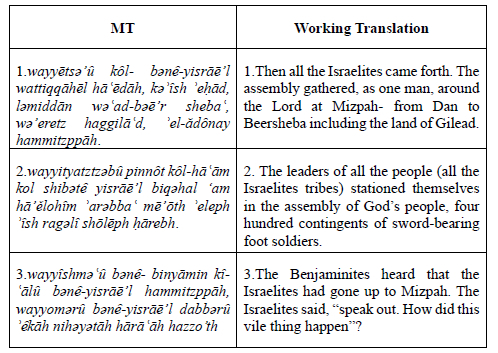
This introductory text places emphasis on the unity of the Israelites who all came out en masse, as shown by the expression used for the entirety of the land, "from Dan to Beersheba" (ləmiddān wəʿad-bəē'r shebaʿ). They were united before the Lord in Mizpah where they all gathered as "one man" (hāedāh, ks îsh ehād), that is, as one body, which the Levite had hoped for because of the horrible rape and murder of his concubine. Even though the tribe of Benjamin was not part of this gathering, the very idea of oneness and communal living in this narrative is something that resonate positively with Africans who so much value solidarity and community life.
In Africa, problems are handled as a community and with a deep sense of ubuntu, "I am because you are."38 In Africa, "It is unthinkable to celebrate even a feast without the participation of the whole village."39 This is "not simply a recognition of the core value of community in African identity formation, but, in distinct contrast to the prevalent individualism that governs the western society outlook."40 Africans also respond to calamities, funerals and other tragedies, including situations of wars based on the causes, such as tribalism, as was the case in the Israel-Benjamin story as well as external and colonial influences across Africa. That is to say, sometimes, Africans, like ancient Israel in Judg 20, can unite for a wrong reason.
Narrating causes of wars and conflicts in Africa known for communal living and ubuntu, David Crary, cites the case of Uganda where the guerrilla's militia took over power with the message of national unity and were later derailed by tribal affiliation, which led to the loss of more than half a million lives during the two decades of chaos. He cites the reports by Willie Musururwa, a political commentator in Zimbabwe, where the tribes of Ndebele and Shona sparred for over 150 years. He notes that "anybody who has been hanging around since Africa began to rule itself has seen tribalism butchering many people in our continent."41 Further, before colonialism, the tribes functioned as distinct nations. They sometimes engaged in wars with one another, as was the case with Israel and Benjamin, but before the advent of colonialism, tribes were not locked in day-to-day friction. This began when "they were lumped together by Europeans who drew the borders of their possessions without regards for the peoples, languages and cultures within them."42
Crary identifies tribal jealousies encouraged by colonial powers as a divide and rule tactics which resulted in wars in different parts of Africa including South Africa, Chad, Angola as well as Nigeria, during the Biafran-Nigerian civil wars in the 1960s.43 Like the brutality complained of by the Levite to the assembly of Israel, "Tens of thousands of people were slaughtered during the power struggles between the Tutsi and Hutu tribes of Burundi and Rwanda in the 1960s and 1990s" and the toll of violence along tribal lines continues to climb across the continent.44 The violence in Judg 20 serves as a warning bell to waring nations in Africa.
In Judg 20:4-7, for instance, the Levites presented his case against his brothers in Benjamin in the best possible light. He also accused the nobles/lords/leaders or chiefs (ba'al) of Gibeah of doing nothing to stop the assault. Boling notes that "nobility"/chief, leader or "the lords" (ba'al) is also used sarcastically in Judg 9:2.45 In Africa, nobles or "chiefs" or "elders" are meant to be wise, prudent, modest, honest, exemplary and full of experience that can serve as guidelines and yardsticks for moral conduct. Particularly, in Annang Land, where the text of Judg 20 is read, "the maintenance of discipline in the houses rests on the elders. Such discipline even extends to the lineage and indeed to the village."46 Elders are the custodians of norms, knowledge, wisdom, justice, peace, family ethics and values such as love, sexuality and respect for life and children, sons, daughters, mothers and wives. In affirmation, the Post-Synodal Apostolic Exhortation, Ecclesia in Africa, says, "it is precisely this love for life that leads them to give such great importance to the veneration of their ancestors" and fore-fathers.47 Africans, generally, show great respect for human life until its natural end and, as a sign of great respect and love for their elders, they keep elderly parents and relatives within the family.48 Nursing homes for the elderly are not popular in Africa.
Today's readers of this text in Africa, would think that it would have made much sense if the elders and the nobles of Gibeah had wisely discouraged others from rushing into judgment or reacting violently to the Levite's presentation. Unfortunately, the whole community including the elders and nobles agreed "as one man" (kəʾȋsh ʾeḥād) in establishing a draft to fight Gibeah (Judg 20:8, 11). Benjamin's help was sought to hand over the culprits, but the people refused to cooperate with Israel. In this case, Benjamin also put loyalty to tribe first, rather than to God. The people prepared 26, 000 warriors, 700 of whom were left-handed warriors, for tribal war (vv. 12-17). The other Israelites tribes with 400, 000 soldiers consulted the Lord in Bethel to decide which tribe would lead the fight against their brothers and sisters in Benjamin (v.18). Unlike some African civil wars and conflicts that spanned many years, Israelites-Benjamin war lasted only three days (vv. 19-36).49
On the first day of the battle, the tribe of Benjamin inflicted a stunning and resounding defeat on the Israelites because the Israelites relied on their army and in the goodness of their cause, but not in the Lord, who encouraged them, after their first consultation to return to battle a second time (vv.19-23). This consultation together with Judg 20:2 fits into De Vaux's description of the concept and rites of the Holy War in Israel:
When the people took up arms, they were called the people of Yahweh or the people of God (Jg: 5:13; 20:2), the troops of God (1 S 17:26), or the armies of Yahweh (Ex 12:41; cf. 7:4). The combatants had to be in a state of ritual cleanliness, i.e., 'made holy' (Jos 3:5; cf. Jr 6:4; 22:7; Jl 4:9). They were bound to remain continent (1 S 21:6; 2 S 11:11), and this obligation of cleanliness extended to the camp, which had to be kept 'holy' if Yahweh was to encamp with his troops (Dt 23:10-15).50
Israel's wars were the wars of the Lord (1 Sam 18;17; 25:28) and the national epic was even put into music in the "Books of the Wars of Yahweh" (Num 21:14). The enemies of Israel were Yahweh's enemies (Judg 5:31; 1 Sam 30:26; cf. Exod 17:16). As in case of the battle with Benjamin, before marching out to battle, not only did the people offer sacrifice to the Lord (1 Sam 7:9; 13:9, 12), but they also consulted the Lord (Judg 20:23, 28).51 Such consultation, of course, is common among the Africans. This is true, since part of African values is their profound religious sense of the sacred and of the existence of God as their creator and controller of events in both the physical and spiritual worlds.52 However, this discernment seems to have taken a different dimension today in the light of Christian values.
Interestingly, on the second day of the battle, the Israelites were defeated again, as 18, 000 of the soldiers were killed. Israel repented before the Lord in Bethel, led by Phinehas, the high priest (Num 25:6-11), mourning, praying and fasting (Judg 20:25-28). God might have used this defeat to remind Israel that the crime of Gibeah was not just a sin committed against God by an individual or a single tribe of Benjamin. Israel needed to recognise that the nation as a whole had a sin problem. That crime had social and communal implications. This is a stark reminder to warring and corrupt nations in Africa where wars, religious extremism and all forms of violence and brokenness have become daily routine, with communal negative implications as well. Wrong decisions might have been taken by a group of few men and women, nobles, politicians or leaders to the detriment of the entire nation, as it was for Israel (v.28).
The repentance led to the Lord "defeating Benjamin" on behalf of Israel on the third day of battle (with the exception of the 600 men who fled to the wilderness of Rimon Rock). In addition to their foolish oath never to marry their daughters to the men of Benjamin (Judg 21:1), the Israelites hastily placed a cruel and harsh ban (ḥerem) on Gibeah and on other Benjaminite towns, their fellow Israelites (Judg 20:29-49; 21:11). This is reminiscent of how we sometimes harshly and cruelly treat our fellow brothers and sisters in different parts of Africa.53 In a communiqué issued at the end of its 2022 First Plenary Meeting, the Catholic Bishops' Conference of Nigeria (CBCN) affirms some of the modern socio-political cruelties Nigerian leaders, mete out to their citizens, including (1) lack of fairness in the distribution of social amenities or in making appointment to offices despite the 'Federal Character' principle in the Constitution; (2) lack of functional, stable, qualitative and affordable educational system, which should be the bedrock of rebuilding a broken system and of development; (3) closure of public schools and universities because of strikes by unpaid civil servants, which leave many African youths on the streets; (4) gross lack of job opportunities, equity, gender balance between male and female, good moral standards, an adequate justice system, transparency and accountability by leaders and citizens.54 In other words, the cruelties described in Judges invite African readers to consider a new way of appropriating the text for the betterment of the society and avoidance of violence and wars.55 As if the above cruelties were not cruel enough, the Israelite army in Judges attacked an innocent city, Jabesh Gilead, which did not show up in Mizpah (vv.8-11), killing everyone, except 400 young women whom they forcefully abducted and gave to the men of Benjamin in marriage (vv.12-15). Echoes of such is heard in the "not-too-long-ago" practice of boko-haram extremists in north-eastern Nigerian town of Maiduguri, where they continue to kidnap, maim and kill innocent citizens.
In verses 16-24, a problem persisted in that there were not enough wives to go round the 600 men of Benjamin who survived the war and fled to the desert. This resulted in the kidnapping of the young women who came to dance during an annual festival in Shiloh (cf. 1 Sam 1:3). With these women, the people of Benjamin returned to their inheritance and rebuilt their cities. Again, there is no better way to end this narrative than by pointing to the era of relativism where every person did what they thought was right in his or her own eyes (Judg 21:25; cf. 2:10-19, 17:6; 18:1; 19:1).
E CONCLUSION
This study engaged in a fresh reading of Israel's war with Benjamin in Judg 20 from the perspective of African Biblical Hermeneutics. It approached the narrative theologically and contextually in the light of African culture, customs, values and stories and compared them with African experiences. In the analysis, the consequences of crimes, war, anarchy, conflicts and all forms of violence with their responsible factors, be it between Israel and Benjamin (Judg 19-21) or among African tribes and nations cannot be over-emphasised. In the Israel-Benjamin conflicts, the people's relationship with God was threatened as well as the extinction of fellow kin and tribe. Israel, as we saw during its war revenge mission, because of anger, foolish vows, tribal sentiments, lack of thoughtful leaders and noble men of integrity, brought the ban to bear on its own people and indulged in killing thousands of people. The Israelites also kidnapped their own women and daughters who were worshiping at the tabernacle of the Lord in Shiloh.
Similarly, tribal wars, conflicts and other forms of violence in Africa could have been avoided if not for greed, external colonial influences, lack of the fear of the Lord, recklessness, anger, inordinate pride and lack of vision. The problems that bring down Africans also include selfishness and thoughtless leadership and many more, as discussed throughout this study. Such conflicts, especially during the 20th century, have caused enormous loss of human lives, the collapse of socio-economic systems and the degradation of health and education services across the continent. African civil wars, as we have also noted, have subjected men, women, wives, husbands, children, and religious communities to intense physical and psychological traumas with negative impact on development of African nations. Like the Israelites in this study, who constantly returned to the Lord at the different stages of their wars, through repentance, Africans are invited to appropriate Judg 20 in a new way in their faith contexts and to drop radical relativism, tribalism, corruption and greed. They are encouraged to search for kings, elders and leaders who not only fear the Lord, but also are committed to leading the people in the search for common good, deeper trust in God, development, justice, prosperity, truthfulness and peace and not into tribal wars and abuse of women and the weak.
F BIBLIOGRAPHY
Adamo, David T. Africa and Africans in the Old Testament. San Francisco: nternational Scholars Publications, 1998. [ Links ]
_____. Explorations in African Biblical Studies. Eugene: Wipf & Stock, 2001. [ Links ]
_____. T. Africa and Africans in the New Testament. Washington: University Press of America, 2006. [ Links ]
_____. "The Task and Distinctiveness of African Biblical Hermeneutics." Old Testament Essays 28/1 (2015): 31-52. [ Links ]
Arnold, Patrick M. Gibeah: The Search for a Biblical City. New York: A & C Black 1999. [ Links ]
Barrete, Lois. The Way God Fights: War and Peace in the Old Testament. Eugene: Wipf & Stock, 2019. [ Links ]
Benedict XVI. Post-Synodal Apostolic Exhortation: Verbum Domini. Vatican City: Libreria Editrice Vaticana, 2010. [ Links ]
Boling, Robert G. Judges: Introduction, Translation and Commentary. Anchor Yale Bible. New Haven : Yale University Press, 2008. [ Links ]
Brown, R. E. and S. Schneiders. "Hermeneutics." Pages1146-1165 in The New Jerome Bible Commentary. Edited J. A. Fitzmyer and R. E. Murphy. Englewood Cliffs: Prentice-Hall, 1990. [ Links ]
Carry, David. "African Continent Tormented by Tribal Conflicts: Problem Has Triggered Wars, Toppled Governments and Wrecked Courtships." Los Angelos Times, 23 March 1986. [ Links ]
CBCN Secretariat. "Human Fraternity: Path to Building Sustainable Peace in Nigeria." A Communique Issued at the End of the First Plenary Meeting of the Catholic Bishops Conference of Nigeria (CBCN) at the Catholic Secretariat of Nigeria Resource Center, Durumi, Abuja, 5-11 March 2022. [ Links ]
Craigie, Peter C. The Problem of War in the Old Testament. Grand Rapids: Eerdmans, 1978. [ Links ]
Currid, John. Judges: Commentary. The Gospel Coalition Bible Commentary (TGCB). https://www.thegospelcoalition.org/commentary/judges/. Accessed 14 September 2023. [ Links ]
Currie, S. D. "Biblical Studies for a Seminar on Sexuality and the Human Community." Austin Seminary Bulletin 87 (1971): 14. [ Links ]
De Vaux, Roland. Ancient Israel: Its Life and Institutions. Grand Rapids: Eerdmans, 1997. [ Links ]
Ekanem, John B. Clashing Cultures: Annang Not(with)standing Christianity-An Ethnography. Bruxelles: Peter Lang, 2002. [ Links ]
Fitzmyer, J. A. The Biblical Commission's Document: The Interpretation of the Bible in the Church, Text and Commentary. Subsidia Biblical 18. Rome: Biblicum, 1995. [ Links ]
Fokkelman, J. P. Reading Biblical Narrative. Leiderdorp: Deo, 1999. [ Links ]
Hardon, J. A. The Catholic Lifetime Reading Plan. Royal Oak: Grotto, 1989. [ Links ]
Isabirye, Stephen B., and Kooros M. Mahmoudi. "Tribal Conflicts in Africa: A Case Study of Rwanda and Burundi." Ufahamu: Journal of African Studies 27/1-2-3 (1999): 63-91. http://doi.org/10.5070/F7271-2-3016611. [ Links ]
Mbiti, John S. African Religions and Philosophy. London: Heinemann, 1969 [ Links ]
_____. The Concepts of God in Africa. London: SPCK, 1970. [ Links ]
_____. "Christianity and Traditional Religions in Africa." IRM 59/236 (1970): 430-440. [ Links ]
_____. New Testament Eschatology in an African Background: A Study of the Encounter between New Testament and African Traditional Concepts. London: Oxford, 1971. [ Links ]
_____. "Some African Concepts of Christology." Pages 51-62 in Christ and Younger Churches: Theological Contributions from Asia, Africa and Latin America, ed. Georg Vicedom. London: SPCK, 1972. [ Links ]
Mbuvi, Andrew M. African Biblical Studies: Unmasking Embedded Racism and Colonialism in Biblical Studies. London: T & T Clark, 2023. [ Links ]
McKenzie, S. L., and S. R. Haynes, eds. An Introduction to Biblical Criticisms and Their Applications: To Each Its Own Meaning. Louisville: Westminster John Knox, 1999. [ Links ]
Najimdeen, Hakeem. "Politics, Tribal Violence, and Socio-Economic Rivalry in Africa." Politics Today. https://politicstoday.org/african-politics-tribal-violence-and-socio-economic-rivalry-in-africa/. Accessed 12 September 2023. [ Links ]
Niditch, Sudan. War in the Hebrew Bible: A Study in the Ethics of Violence. New York: Oxford University Press, 1993. [ Links ]
Norwich University. "Five Major African Wars and Conflicts of the Twentieth Century." Norwich University Online, 4 September 2017. https://online.norwich.edu/online/about/resource-library/five-major-african-wars-and-conflicts-twentieth-century. Accessed 12 September 2023. [ Links ]
Noth, Martin. The History of Israel. New York: Harper, 1960. [ Links ]
Nyamiti, C. Christ as Our Ancestor: Christology from an African Perspective. Gweru, Zimbabwe: Mambo Press, 1984. [ Links ]
_____ . Some Contemporary Models of African Ecclesiology. Studies in African Christian Theology 3. Nairobi: Catholic University Press, 2007. [ Links ]
Okure, T. The Johannine Approach to Mission: A Contextual Study of John 4:1-42. WUNT 2/31. Tübingen: Mohr Siebeck, 1988. [ Links ]
Schneider, Tammi J. Judges. Berith Olam Studies Hebrew Narrative & Poetry. Collegeville: Liturgical Press, 2000. [ Links ]
Schreiter, Robert. J. The New Catholicity: Theology between the Global and the Zocal.Maryknoll: Orbis, 1997. [ Links ]
Segovia, Fernado. F. Reading from this Place, vol. 1: Social Location and Biblical Interpretation in the United States. Minneapolis: Fortress, 1995. [ Links ]
Sugirtharajah, Rasiah S. The Bible and the Third Word: Precolonial, Colonial and Postcolonial Encounters. Cambridge: Cambridge University Press, 2001. [ Links ]
Szpek, Heidi M. "The Levites Concubine: The Story that Never Was." Women in Judaism 5/1 (2007): 1-10. [ Links ]
Udoekpo, Michael Ufok. Corruption in Nigerian Culture: The Liberating Mission of the Church. Enugu: Snaap Press, 1994. [ Links ]
_____ . "John 4:4-42: A Postcolonial Interpretation of the Discourse with the Samaritan Woman and Its Theological Implications in An African Context." MAThesis. St. John's University, 2005. [ Links ]
_____ . Rethinking the Day of YHWH and Restoration of Fortunes in the Prophet Zephaniah: An Exegetical and Theological Study of 1:14-18; 3:14-20. Das Alte Testament im Dialog. An Outline of an Old Testament Dialogue 2. Bern: Peter Lang, 2010. [ Links ]
_____. Rethinking the Prophetic Critique of Worship in Amos 5 for Contemporary Nigeria and the USA. Eugene: Pickwick, 2017. [ Links ]
_____ . The Limits of a Divided Nation with Perspectives from the Bible. Eugene: Resource Publication, 2020. [ Links ]
_____. "Studying Corruption in the Household Shrine of Micah in Judges 17:1-6 in the Nigerian Context." Pages 1-18 in Acts of the Catholic Biblical Association of Nigeria (CABAN). Vol. 12. Edited by Bernard Ukwuegbu et al. Port Harcourt: Catholic Biblical Association of Nigeria, 2020. [ Links ]
_____. "A Contextual Re-evaluation of Humanity's Responsible Identity in Genesis 1:26-28 in the Light of African Sense of Ubuntu." Light in Once-Dark World 4/November (2021): 196-220. [ Links ]
_____ . Second Inaugural Lecture: Biblical Studies and the Complementarity of Theology and Other Discipline. Abuja: Veritas University Press, 2022. [ Links ]
_____ . ed. A Biblical Approach to Mission in Context: A Festschrift in Honor of Sr. Prof. Teresa Okure, SHCJ. Eugene: Wipf & Stock, 2022. [ Links ]
_____. "A Study of the Ministry of the Royal Priesthood in Exodus 19:6 and Its Theological Expansion in 1 Peter 2:5, 9-10." European Journal of Theology and Philosophy 3/1 (2023): 1-7. https://doi.org/10.24018/theology.2023.3.1.82. [ Links ]
_____. "Hearing and Reading the 'Rebuilding' Voice of the Prophet Haggai (1:1-11) in the Context of African Christianity." Pages xxx-xxx in Bible, Interpretation, and Context: Reading Meaning from an African Perspectives. Edited by Ferdinand Okorie and Mark Enamali. New York: Lexington Books, 2023. [ Links ]
Ukpong, Justin. "Inculturation Hermeneutics: An African Approach to Biblical Hermeneutics." Pages 17-32 in The Bible in a World Context: An Experiment in Contextual Hermeneutics. Edited by Walter Dietrich and Ulrich Luz. Grand Rapids: Eerdmans, 2002. [ Links ]
Wellhausen, Julius. Prolegomena to the History of Ancient Israel. Translated by W. Robert Smith. New York: Meridian, 1957. [ Links ]
Wikipedia. List of Conflicts in Africa. https://en.wikipedia.org/wiki/List_of_conflicts_in_Africa. Accessed 12 September 2023. [ Links ]
Wikipedia. Levite's Concubine. https://en.wikipedia.org/wiki/Levite%27s_concubine. Accessed 12 September 2023. [ Links ]
Submitted: 08/10/2023
Peer-reviewed: 16/05/2024
Accepted: 07/01/2025
* Michael Ufok Udoekpo, Department of Theology, Veritas University, Abuja, Nigeria; email: ufokism@yahoo.com ; ORCID: https://orcid.org/0000-0001-7953-3392.
1 Some of these wars, conflicts and causes of violence in Africa are discussed in David Carry, African Continent Tormented by Tribal Conflicts: Problem Has Triggered Wars, Toppled Governments and Wrecked Courtships, Los Angelos Times 23 March (1986); Stephen B. Isabirye and Kooros M. Mahmoudi, "Tribal" Conflicts in Africa: A Case Study of Rwanda and Burundi, Ufahamu: Journal of African Studies 27/1-2-3 (1999), http://doi.org/10.5070/F7271-2-3016611; Norwich University, Five Major African Wars and Conflicts of the Twentieth Century (Norwich University Online 4 September (2017); Michael U. Udoekpo, The Limits of A Divided Nation with Perspectives from the Bible (Eugene: Resource Publications, 2020), 24-38; Wikipedia, List of Conflicts in Africa. https://en.wikipedia.org/wiki/List of conflicts in Africa, access 12 September 2023; Hakeem, Najimdeen, "Politics, Tribal Violence, and Socio-Economic Rivalry in Africa," Politics Today. https://politicstoday.org/african-politics-tribal-violence-and-socio-economic-rivalry-in-africa/, accessed 12 September 2023; Michael Ufok Udoekpo, Corruption in Nigerian Culture: The Liberating Mission of the Church (Enugu: Snaap Press, 1994).
2 See Norwich University, Five Major African Wars and Conflicts of the Twentieth Century.
3 For some of these readings, see Heidi M. Szpek, "The Levite's Concubine: The Story that Never Was," Women in Judaism: A Multidisciplinary Journal 5/1 (2007); Fokkelman, J. P. Reading Biblical Narrative (Leiderdorp: Deo, 1999), 110-111; Arnold S. J. and Patrick M, Gibeah: The Search for a Biblical City (New York: A & C Black, 1999).
4 Szpek, "Story that Never Was," 1-10. Kelly J. Murphy, "Judges in Recent Research," Current in Biblical Research 15/2 (2017): 1 -10, https://doi.org/10.1177/1476993X16659798.
5 Robert G. Boling, Judges: Introduction, Translation and Commentary; Anchor Yale Bible (New Haven: Yale University Press, 2008), 178.
6 Boling, Judges, 178; S. D. Currie, "Biblical Studies for a Seminar on Sexuality and the Human Community," Austin Seminary Bulletin 87 (1971): 14.
7 See Martin Noth, The History of Israel (New York: Harper, 1960), 104-106.
8 Julius Wellhausen, Prolegomena to the History of Ancient Israel (trans. by W. Robert Smith; New York: Meridian, 1957), 235-237.
9 See Yairah Amit, The Book of Judges: The Art of Editing (Biblical Interpretation 38, Brill: 1999).
10 A. M. Mbuvi, African Biblical Studies: Unmasking Embedded Racism and Colonialism in Biblical Studies (London: T&T Clark, 2023), 7.
11 Mbuvi, African Biblical Studies, 7.
12 Their thoughts and significant representative works will be further developed and integrated throughout this work, especially D. T. Adamo, "The Task and Distinctiveness of African Biblical Hermeneutics," Old Testament Essays 28/1 (2015): 31-52.
13 See Michael Ufok Udoekpo, Rethinking the Prophetic Critique of Worship in Amos 5 for Contemporary Nigeria and the USA (Eugene: Pickwick, 2017), xxxix-xxx, where echoes of these approaches are noted in R. E. Brown and S. Schneiders, "Hermeneutics," in The New Jerome Bible Commentary, ed. J. A. Fitzmyer and R. E. Murphy (Englewood Cliffs: Prentice-Hall, 1990), 1146-1165; J. A. Fitzmyer, The Biblical Commission's Document: The Interpretation of the Bible in the Church, Text and Commentary (Subsidia Biblical 18; Rome: Biblicum, 1995); S. L. McKenzie and S. R. Haynes, eds., An Introduction to Biblical Criticisms and Their Applications: To Each Its Own Meaning (Louisville: Westminster John Knox, 1999).
14 F. F. Segovia, Reading from This Place, vol. 1: Social Location and Biblical Interpretation in the United States (Minneapolis: Fortress,1995), 1; Michael Ufok Udoekpo, "John 4:4-42: A Postcolonial Interpretation of the Discourse with the Samaritan Woman and Its Theological Implications in an African Context" (MA Thesis; New York: St. John's University, 2005), 13-26.
15 R. S. Sugirtharajah, The Bible and the Third Word: Precolonial, Colonial and Postcolonial Encounters (Cambridge: Cambridge University Press, 2001), 258.
16 T. Okure, The Johannine Approach to Mission: A Contextual Study of John 4:1-42. WUNT 2/31 (Tübingen: Mohr/Siebeck, 1988), v; M. U. Udoekpo, ed., A Biblical Approach to Mission in Context: A Festschrift in Honor of Sr. Prof. Teresa Okure, SHCJ (Eugene: Wipf & Stock, 2022), xix-xxvii.
17 Adamo, "African Biblical Hermeneutics," 1.
18 Ibid.
19 Ibid., 1.
20 Ibid., 2-4.
21 For additional details and expansion of this reading, see J. Ukpong, "Inculturation Hermeneutics: An African Approach to Biblical Hermeneutics," in The Bible in a World Context: An Experiment in Contextual Hermeneutics (ed. Walter Dietrich and Ulrich Luz; Grand Rapids: Eerdmans, 2002), 17-32 (18); Udoekpo, Rethinking the Prophetic Critique, xxii, M. U. Udoekpo, Second Inaugural Lecture: Biblical Studies and the Complementarity of Theology and Other Discipline (Abuja: Veritas University Press, 2022), 16-23.
22 Ukpong, "Inculturation Hermeneutics," 18.
23 Ibid.
24 Robert. J. Schreiter, The New Catholicity: Theology between the Global and the Local (Maryknoll: Orbis, 1997), 1-27.
25 See Benedict XVI, Post-Synodal Apostolic Exhortation, Verbum Domini (Vatican City: Libreria Editrice Vaticana, 2010), 116.
26 Adamo, "African Biblical Hermeneutics," 4-10. See also Andrew M. Mbuvi. African Biblical Studies: Unmasking Embedded Racism and Colonialism in Biblical Studies (London: T&T Clark, 2023), 3, 11-12, 57, 100-111.
27 Tammi J. Schneider, Judges (Berith Olam Studies Hebrew Narrative & Poetry; Collegeville: Liturgical Press, 2000), xii; Michael U. Udoekpo, "Studying Corruption in the Household Shrine of Micah (Judges 17:1-6) in the Nigerian Context," in Acts of the Catholic Biblical Association of Nigeria (CABAN) (vol. 12; eds. Bernard Ukwuegbu et. al.; Port Harcourt, Nigeria: Catholic Biblical Association of Nigeria, 2020), 1-18.
28 Boling, Judges, 43; Udoekpo, Household Shrine of Micah (Judges 17:1-6), 1-18.
29 Boling, Judges, 46.
30 Vincent Branick, Understanding Historical Books of the Old Testament (New York: Paulist Press, 2011), 31.
31 John Currid, Judges: Commentary in The Gospel Coalition Bible Commentary (TGCB); https://www.thegospelcoalition.org/commentary/judges/, accessed 14 September 9 2023.
32 Boling, Judges, 173.
33 See John Bosco Ekanem, Clashing Cultures: Annang Not(with) standing Christianity-An Ethnography (Brussels: Peter Lang, 2002), 66-68. For details on the sacredness or "uterisation" of grand-children in Annang tribe of Akwa Ibom State, Nigeria.
34 Boling, Judges, 174.
35 Ekanem, Clashing Cultures, 65.
36 Ibid.
37 The Hebrew text is from MT, while the translation is from NRSV with some of my modification.
38 See Michael U. Udoekpo, "A Contextual Re-evaluation of Humanity's Responsible Identity in Genesis 1:26-28, in the Light of African Sense of Ubuntu," Light in Once-Dark World 4/November (2021): 196-220; Michael U. Udoekpo, "A Study of the Ministry of the Royal Priesthood in Exodus 19:6 and Its Theological Expansion in 1 Peter 2:5, 9-10," European Journal of Theology and Philosophy 3/1 (2023): 1 -7, https://doi.org/10.24018/theology.2023.3.1.82.
39 Ecclesia in Africa, no. 43.
40 Mbuvi, African Biblical Studies, 81.
41 David Crary, "African Continent Tormented by Tribal Conflicts: Problem Has Triggered Wars, Toppled Governments and Wrecked Courtships," Los Angelos Times, 23 March 1986.
42 Crary, "African Continent Tormented by Tribal Conflicts," 1.
43 Ibid., 2
44 Ibid.
45 Boiling, Judges, 183.
46 Ekanem, Clashing Cultures, 64.
47 Ecclesia in Africa, 43.
48 Ibid.
49 See details of these conflicts and wars in Africa in Norwich University Online, "Five Major African Wars and Conflicts of the Twentieth Century." See also Wikipedia, List of Conflicts in Africa; https://en.wikipedia.org/wiki/List_of_conflicts_in_Africa, accessed 12 September 2023.
50 Roland De Vaux, Ancient Israel: Its Life and Institutions (Grand Rapids: Eerdmans, 1997), 258-259. For additional insight into Israel's Holy Wars, see Peter C. Craigie, The Problem of War in the Old Testament (Grand Rapids: Eerdmans, 1978), 45-54; Sudan Niditch, War in the Hebrew Bible: A Study in the Ethics of Violence (New York: Oxford University Press, 1993), 20-25; Lois Barrete, The Way God Fights: War and Peace in the Old Testament (Eugene: Wipf & Stock, 2019), 13-74.
51 De Vaux, Ancient Israel, 259.
52 See J. S. Mbiti, African Religions and Philosophy (London: Heinemann, 1969); J. S. Mbiti, The Concepts of God in Africa (London: SPCK, 1970); Michael U. Udoekpo, Rethinking the Day of YHWH and Restoration of Fortunes in the Prophet Zephaniah: An Exegetical and Theological Study of 1:14-18; 3:14-20 (Das Alte Testament im Dialog. An Outline of an Old Testament Dialogue, volume 2 Bern: Peter Lang, 2010), 288-290; Ekanem, Clashing Cultures, 28-32.
53 For a reasonable explanation of herem (ban, anathema carried out on the vanquished enemy and his goods), see De Vaux, Ancient Israel, 260-261.
54 CBCN Secretariat, Human Fraternity : Path to Building Sustainable Peace in Nigeria - A Communique Issued at the End of the First Plenary Meeting of the Catholic Bishops' Conference of Nigeria (CBCN) at the Catholic Secretariat of Nigeria Resource Center, Durumi, Abuja, 5-11 March 2022.
55 For more of such violence, brokenness, cruelties and unethical behaviours, including, kidnapping, trafficking, bribery and corruption, in African societies, which must be rejected, see Michael U. Udoekpo, Hearing and Reading the 'Rebuilding' Voice of the Prophet Haggai (1:1-11) in the Context of African Christianity, in Bible, Interpretation, and Context: Reading Meaning from an African Perspectives (eds. Ferdinand Okorie and Mark Enamali; New York: Lexington Books, 2023), 120-122.
