Services on Demand
Journal

Article
 English (pdf)
 Article in xml format
 Article references
 Automatic translation
 Send this article by e-mail
Indicators
Related links
-
 Cited by Google
 -
 Similars in Google
Share

 Permalink
Old Testament Essays
On-line version ISSN 2312-3621Print version ISSN 1010-9919
Old testam. essays vol.37 n.2 Pretoria 2024
https://doi.org/10.17159/2312-3621/2023/v37n2a3
ARTICLES
Jeremiah's Prophetic Authenticity: Tracing the Mosaic Prophetic Tradition
Ferry Y. Mamahit; Christian R. Widodo
Southeast Asia Bible Seminary
ABSTRACT
This article re-evaluates the criteria for determining the authenticity of Hebrew prophets, focusing on tracing the Mosaic prophetic tradition in Jeremiah's life and ministry. While prophecy fulfilment is commonly used to assess authenticity, its unreliability calls for a more testable method grounded in Moses' model. Exploring the Deuteronomic Code, the study emphasises prophetic authenticity and employs a comparative analytical approach to investigate Jeremiah's embodiment of Mosaic traits. It suggests a revised approach to assessing prophet authenticity, advocating adherence to the Deuteronomic Covenant as a defining characteristic. The study identifies specific traits for evaluating prophetic authenticity across the Old Testament, noting some discontinuity between Jeremiah and the Deuteronomic Covenant. It underscores the need for a comprehensive approach to evaluating prophetic authenticity.
Keywords: prophetic authenticity, the prophet Jeremiah, Mosaic prophetic model, Deuteronomic Covenant
A INTRODUCTION
In Deut 13:1-5 and 18:15-22, the authenticity of a prophet is assessed and determined by their ability to prophesy in Yahweh's name without His command and the fulfilment of their prophecies.1 It, however, raises questions about how listeners can be sure that Yahweh is sending a prophet and what it means when an authentic prophet's prophecies do not come to pass. For instance, Micah's prophecy of Jerusalem's destruction did not occur (Mic 3:12; cf. Jer 26:18-19). According to Hibbard, Micah would be considered a false prophet based on Deut 18:22.2 However, this case is understandable because the recipient of the prophecy, King Hezekiah, repented (Jer 26:19; cf. Jonah 3). God's ability to alter His prophecies depends on human response to His word (Jer 18:7-10).
However, what happens if a prophecy is not fulfilled without any response from humankind, such as repentance, as in the cases of Jeremiah and Huldah? Jeremiah prophesied about the death of Jehoiakim (Jer 36:30), predicting a shameful demise, but instead, Jehoiakim was buried peacefully. Moreover, Jehoiakim was the only king of Judah after Josiah to secure his son as his successor to the royal throne (2 Kgs 24:6). Similarly, Huldah prophesied that Josiah would die in peace (2 Kgs 22:14-20), yet he died in battle (2 Kgs 22:1520; 23:29).3 In these cases, the prophecies seemingly failed to materialise and there was no apparent transgression that could have negated their fulfilment. These examples suggest that the authenticity of prophecy is at risk if the hallmark of genuine prophets is based solely on the fulfilment of their prophecies.
Old Testament scholars have attempted to address these issues by exploring solutions beyond Deut 18:15-22. Some scholars take a pessimistic view,4 while others work to identify characteristics of prophetic authenticity. Sanders emphasises the prophetic interpretation and argues that true prophets adapt old traditions or passages, such as Deuteronomy, to fit the society they serve even though the prophets' messages may seem inconsistent due to this adaptation.5Hibbard notes that a critical characteristic of a true prophet is that their prophecy encourages social and moral improvement among God's people.6 Thus, Jeremiah revises the characteristics of prophetic authenticity found in Deuteronomy, emphasising the accuracy of prophecy due to the damage inflicted during the monarchy in Israel, particularly after the kingdom split. However, it remains unclear whether Jeremiah revised or reaffirmed the Deuteronomic characteristics and whether there are other authentic prophetic characteristics in Deuteronomy besides those in 13:1-5 and 18:15-22.7
This article examines the traits of authentic prophets by analysing the covenant concept in Deuteronomy, with Jeremiah serving as a case study. The authors argue that exploring prophetic authenticity is crucial for three reasons. First, the prophets' primary role is to communicate the Deuteronomic Covenant, prioritising forth-telling over foretelling.8 Secondly, a lack of criteria to assess authenticity can lead to negative views of the prophet and God's reliability.9Thirdly, the older traditions are recontextualised in the Old Testament toward new situations and conditions.10 Thus, Jeremiah's authenticity aligns with Deuteronomy's Mosaic characteristics while remaining personalised to the unique circumstances and conditions of the prophet's ministry.
B METHODOLOGY
The study examines prophetic authenticity through the lens of the covenant concept in the book of Deuteronomy.11 It begins by exploring the book's social, and religious context, followed by an analysis of Moses as the ideal prophet who mediated between Yahweh and His people and interpreted the Torah. The concept of covenant in Deuteronomy is then discussed, including its relationship with Israel's election, the Torah and the land. Finally, the authors draw a connection between the covenant and Moses as the standard for an authentic prophet based on Deuteronomy.
The study takes a comparative approach to explore how prophetic authenticity is portrayed in the book of Jeremiah, drawing insights from principles outlined in Deuteronomy. Appropriating Mastnjak's perspective, this approach allows scholars to trace how the criteria for true prophecy in Deuteronomy are applied and how they evolved in Jeremiah's context.12Deuteronomy sets standards for discerning genuine prophets, such as adherence to Yahweh's commandments and the fulfilment of prophetic words (Deut 13:15; 18:15-22). By comparing these standards with Jeremiah's ministry, scholars can observe how his actions, messages and attitudes align with Deuteronomic principles.13 Jeremiah's challenge to false prophets and his call for genuine repentance mirror Deuteronomy's emphasis on faithfulness, reinforcing his legitimacy (Jer 23:16-22). This approach underscores the continuity and development of prophetic authenticity within the biblical narrative, showing how Jeremiah meets these established criteria and offering a deeper understanding of his role as a true prophet.
C PROPHETIC AUTHENTICITY: DEUTERONOMIC COVENANT AND MOSAIC MODEL
The proposed dating of the book of Deuteronomy (between the 14th and 12th centuries BCE)14 shows that it was composed in the context of the Israelites preparing to enter Canaan and contains Moses' farewell address. Brueggemann affirms that, in these speeches, Moses reinterpreted the covenant previously established at Sinai (i.e., "Sinai interpreted") into what is known as the Deuteronomic Covenant.15 Implicitly, this covenant was authoritative at Sinai and wherever and whenever it was received (as indicated in Deut 5:3, where the recipients are referred to as "all of us who are alive here today").16 The educational purpose of it was to re-teach the Sinai covenant. It emphasised that Yahweh was the only "King of Israel" and that Israel was his servant.17
The book of Deuteronomy, which uses the format of Hittite covenants as a template, presents Yahweh as a loving King with a special relationship with Israel (Deut 7:7-8; 14:1-2). Unlike a dictatorial ruler who dictates covenant terms to his subjects, Yahweh's relationship with Israel comes with responsibilities on both sides. God commanded Israel to uphold the covenant, having experienced divine love in the desert, by avoiding idolatrous practices. The book of Deuteronomy is the official covenant document between Yahweh and Israel, with its authority ascribed to Moses, the first interpreter and teacher of divine law. According to Römer, Moses ensured that his statements were publicly read and passed on, as seen in Deut 31:9-13 and other passages (Josh 1:7-9, 1 Kgs 2:13; 6:11-12).18 Moreover, Moses mentored the prophets who followed him, playing a critical role in establishing and ensuring the covenant's continuity and its correct interpretation by future prophets.19
Some Old Testament scholars have raised doubts about Moses serving as a role model for the prophets. Barstad, for instance, has interpreted the book of Deuteronomy in its final form as containing a negative assessment of the prophetic ministry, citing 18:19.20 The author of Deuteronomy suggested that the need for new revelation was unnecessary. The "promised prophet" (in Deut 18:15, 18) may presumably refer to Joshua rather than the prophets coming later.21 This view perceives that Joshua became the paradigm of the post-Mosaic guardian of the Torah. Petersen also argues that the book of Deuteronomy does not depict Moses as a role model for prophetic succession, as Moses himself was not a prophet.22 It was Joshua who became Moses' successor, not other prophets.
Hence, it is worth considering whether Moses should be regarded as merely the initiator of the Torah and the nation's leader or whether he could also be seen as a role model for the prophets.
Despite some scholars' reservations, the authors of this article argue that Moses can be a role model for the prophets who appeared later in Israel's history. As a servant of Yahweh, Moses stands out as an exemplary figure for all social positions in Israel, including the prophets. Coats notes that even Joshua, who is not considered a prophet, shares similarities with Moses,23 emphasising the importance of obedience from those he led, a central theme in Deut 18:9-22. Although the succession of prophets is not explicitly discussed, Moses still serves as a model for future prophets, judges, kings and priests. Yahweh chose these positions, and he expected Israel to obey these leaders. However, the specific characteristics Moses modelled for the prophets according to the Deuteronomic Covenant need further explanation.
1 Mosaic Prophetic Model: Teacher, Mediator and Preacher
The three main characteristics of Moses served as a model for the future prophets. First, Moses was the Torah teacher for Israel and explicitly mentioned as the recipient and mediator of the Torah. Although this was a unique position, the prophets could still follow Moses' example to establish the importance of the Torah in Israel. Their task was to restore the position of the Torah as a sign of Israel's loyalty to the covenant with Yahweh. O'Brien argues that due to their faithfulness to the Mosaic Covenant24 and as long as they do not conflict with it, they can prophesy new things.25 The traditions regarding the sayings of the prophets tend to conform to the words of Moses in the context of Deut 18:15.26
The second attribute of Moses that served as an exemplary model for the prophets is his role as a mediator between God and Israel whenever conflicts arose (Exod 20:19; Num 14:17-20; Deut 1:34-46; 5:24, 28-31). One can observe this in the actions of several prophets, including Samuel (1 Sam 7:7-12; 12:19-23), Amos (Amos 7:2, 5, 7-9; 8:1-3) and Jeremiah (Jer 7:16; 11:14; 14:11; 18:20). They exhibited dual role of the prophet; while they announce the punishment of Israel, they also intercede for their people before Yahweh. It means they act as a bridge between God and his people, conveying his judgment and mercy. Maintaining the relationship between God and Israel is crucial and the mediating function plays a significant role in the prophetic model based on Moses.
The third characteristic of Moses that serves as a model for prophets is preaching the same message as stated in Yahweh's covenant with Israel. In this regard, Nihan states that the prophets did not convey prophecies that deviated from the revelation in the book of Deuteronomy.27 Later prophets could bring new revelations but could not explicitly deviate from the Deuteronomic revelation. According to Craigie, the prophet who used Moses as a role model was responsible for inviting Israel to be faithful to the covenant and warning them of the consequences of disobedience.28 The traditions regarding the sayings of the prophets conform to the words of Moses, as observed in the context of Deut 18:15.
The emphasis in prophetic revelation is on the message's substance, not the mode of communication. The Deuteronomic Covenant gives guidelines for differentiating true prophets from false ones but does not provide specific instructions on receiving messages from God. Consequently, Thelle infers that Deuteronomy does not oppose specific Old Testament methods, such as using the ephod, Urim and Thumim and prophetic prophecies.29 Deuteronomy 34:1012 suggests that, unlike Moses, a prophet can have a unique encounter with Yahweh through different means allowed under Mosaic legislation (cf. Deut 13; 18:9-14). Thus, Edelman posits that the source of a prophet's revelation determines their authenticity.30 As long as their message does not contradict the covenant stipulations that exhort faithfulness to Yahweh, they are considered genuine prophets (Deut 13:2-6).
2 Mosaic Prophetic Kerygma: Election, Obedience-Blessing/ Disobedience-Curse and the Land
The Deuteronomic Covenant is a foundational idea in the book of Deuteronomy and is widely accepted without question. This covenant is characterised by three essential elements used to identify a true prophet- election, obedience-blessing/ disobedience-curse and the land. The election of Israel reflects Yahweh's benevolence in liberating the people from slavery and creating a free nation. Brueggeman and Linafelt highlight the impact of divine generosity in the Pentateuch by employing a pattern of admiration, gratitude and obedience.31 This pattern entails that after admiring divine generosity, Israel must express gratitude and move on to obedience, emphasising the importance of divine selection of Israel as reflected in the Deuteronomic Covenant. In essence, the covenant signifies the impact of the divine choice of Israel and the corresponding responsibility that comes with it. Election demonstrates divine generosity in turning Israel from slavery to a free nation. Israel's response to it must lead to obedience.
An essential purpose of obedience is not just for Israel's benefit as a vassal but also for Yahweh's as the sovereign suzerain. The main concern of a suzerain-vassal treaty is not the stipulations themselves. Walton and Walton explain that the purpose of such a treaty is not for the suzerain king to grant blessings to the vassal king through the stipulations.32 Instead, the treaty exists to demonstrate the power and glory of the suzerain king. Accordingly, ancient Near Eastern covenants were created not to bless the servants but to display the majesty of the ruling king. In the same way, the Torah's divine stipulations were used to achieve the covenant's goal-for the Israelites, as vassals, to know and maintain their relationship with Yahweh as the suzerain.
The Torah lays out the terms of the covenant between Yahweh and Israel, where obedience brings blessings and disobedience brings curses (as outlined in Deut 28). Including blessings and curses in the covenant highlights the significance of obedience. However, Brueggemann confirms that this should not be seen as conflicting with the idea of grace, as both are essential to the covenant.33 Instead, a dynamic relationship is established between Yahweh's love and Israel's obedience within this framework. Specifically, the obedience expected from the Israelites relates to their behaviour in the land of Canaan.
The third part of the Deuteronomic Covenant concerns the land, seen as the focus of obedience. The Torah specifies that the covenant would only take effect once the Israelites enter the land of Canaan (Deut 12:1). This land has a dual role in the Torah. On one hand, it is seen as a gift from God to the people of Israel for as long as they live on earth. On the other hand, Israel's ownership of the land depends on the people's obedience (Deut 4:25-27), emphasised by the term "inheritance" (נַחֲלָה; nahalâh). According to Rendtorff, this term implies that the land of Canaan remains under God's ownership and while the children of Israel have the right to use it, they never fully possess it.34 Milgrom argues that the conquest of Canaan established the land as solely God's property.35 Therefore, although the land was given to Israel, it remained God's and obedience was necessary to retain its rights.
Deuteronomy highlights the link between the Israelite's possession of Canaan and their obedience to God's commands (Deut 4:1; 7:12-16; 11:12). McConville points out that Yahweh's gift of the land is not meant to give Israel independence but rather to inspire obedience in His people.36 Canaan is given as a gift and obedience to divine law is required. In the Deuteronomic Covenant, Israel's actions in Canaan must align with the Torah and only obedient people may dwell in the land (Deut 28; 30:15-20). Obedience and blessings go hand in hand. Obedience is crucial to receiving blessings and blessings serve to motivate obedience.37 The blessing of the land depends on Israel's adherence to God's law. Without obedience, blessings cannot continue.
If the covenant was not followed, exile would be the consequence. For Israel, being exiled signaled that Yahweh had withdrawn his favour. This belief matched the suzerain-vassal agreements in the ancient Near East (ANE), which the author of Deuteronomy drew.38 Israel saw God's exile punishment as a consequence for breaking the covenant; just as they were free to disobey, Yahweh had the right to punish them. Exile was closely linked to the primary purpose of the Torah. Walton and Walton argue that the Torah aimed to showcase Yahweh's greatness, much like the covenants of the ancient Near East and that judgment and blessings followed accordingly.39 Punishment was given to maintain Yahweh's integrity as a fair ruler and to correct the wrongdoings of his followers, as foreseen by the prophets (Ezek 36:22-23).
The element of hope should not be overlooked when considering exile. While in exile, the Israelites were urged to repent, with the assurance that God would bring them back to the land of Canaan (Deut 4:23-31). The call for repentance suggests that exile was not meant to be permanent. Exile marked a break in the connection between Yahweh and Israel but the restoration to the land of Canaan symbolised the rekindling of their relationship. Klingbeil's analysis of the word (sub) in the book of Deuteronomy uncovers its theological significance as the restoration of God's relationship with Israel (Deut 4:30).40 In the text, both Israel and God are depicted as having "turned around" (sub) in the Deuteronomic Covenant, which has two facets-God, who initiated the act of welcoming Israel back with love, and Israel, as a collective entity,41which took the initiative to repent and return to God.
The discussion above highlights Yahweh's call for justice in Israel, which goes beyond mere acts of charity, including establishing public policies, practical measures and institutions that promote the common good and prevent harmful behaviour.42 The children of Israel exemplified God's unique character by displaying qualities of order, wisdom and justice, which other nations could observe through their actions. McConville suggests that Israel had a "political responsibility" to create a just global order in line with Yahweh's principles of righteousness and justice.43 Furthermore, Yahweh's directives to Israel to care for the environment (Deut 20:19-20; 22:6-7) illustrate how justice also applies to nature.
D THE DEUTERONOMIC COVENANT'S CRITERIA OF AN AUTHENTIC PROPHET: THE CASE OF JEREMIAH
The book of Jeremiah is often used to examine the characteristics of a genuine prophet as outlined in the Deuteronomic Covenant.44 In order to justify this usage, two questions need addressing. Why is Jeremiah suitable for this purpose and is there a connection between Jeremiah and Deuteronomy? The authors initially employ source and editorial criticisms to compare Jeremiah with other prophetic works. According to Römer, this method suggests that a Deuteronomistic historian (Dtr) edited the book of Jeremiah, using Deuteronomy as a benchmark for evaluating prophetic authenticity.45 Consequently, an indirect link emerges between Jeremiah and Deuteronomy. Leuchter highlights this by observing Jeremiah's frequent use of Deuteronomic vocabularies and themes compared to other prophetic texts.46
The books of Jeremiah and Deuteronomy share theological similarities, particularly in their emphasis on repentance and obedience to Yahweh (Deut 3:29; 6:4; Jer 29:13), both outwardly and inwardly (Deut 6:6; Jer 15:16; 17:1). The theology of the Deuteronomistic historian (Dtr) promises restoration and future blessings, which aligns with Jeremiah's message (Jer 30:1-15; 31-32). Stulman and Kim argue that Jer 11:1-14 also aligns with Dtr's theology regarding condemnation and reparation.47 Jeremiah 11:1-14, Deut 6 and 2 Kgs 17:7-18 all recount God's past deeds and promises and the failure of Israel's ancestors to follow divine statutes. Unterman suggests that the covenant in the book of Jeremiah also mirrors the covenant in Deuteronomy, where Yahweh is the king and ruler and Israel is His servant.48 Given these significant theological and thematic parallels, the book of Jeremiah serves as an appropriate case study for exploring the attributes of an authentic prophet according to the Deuteronomic Covenant.
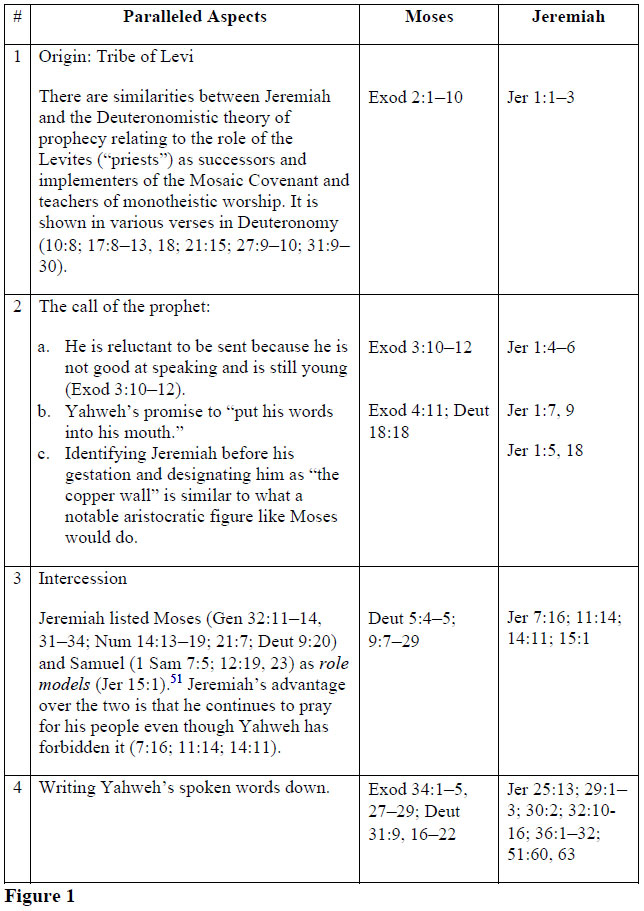
The discussion below examines the similarities between Jeremiah and the Deuteronomistic theory of prophecy. The authors note that these similarities primarily concern the personal aspect rather than the content of the message. Römer's analysis of Jer 1 indicates that the portrayal of Jeremiah in the book's opening aligns with the Deuteronomistic prophecy theory.49 Perdue also proposes that Jer 26-52 was written by a group of Deuteronomistic scribes, who depict Jeremiah as a prophet akin to Moses, as outlined in Deut 18:15-22.50
The comparison between Jeremiah and the Deuteronomistic theory of prophecy reveals significant parallels. Both emphasise the role of Levites in implementing the Mosaic Covenant and teaching monotheistic worship. Jeremiah's call and intercessory practices mirror those of Moses, while his dedication to recording Yahweh's words underscores his prophetic authenticity. These comparisons affirm his position as a genuine prophet within the biblical tradition.
1 Jeremiah and the Covenantal Messages
Having previously examined Jeremiah's attributes, the discussion now shifts to the substance of his message. He is portrayed as an authentic prophet who grounds his prophecies in the Torah. He also serves as an interpreter of the Torah, akin to Moses. The authors highlight four parallels between Jeremiah's message and the Deuteronomic Torah, emphasising Jeremiah's commitment to the covenant and affirming the authenticity of his prophetic ministry.
The first parallel lies in the message of devastation. Jeremiah's prophecy about the downfall of Judah aligns with Deuteronomist theology, which teaches that sin leads to punishment, as outlined in Deut 28. The prophet warns God's people that punishment is inevitable if they refuse to repent, as shown in various passages (Jer 7:25-34; 25:4-11; 26:4-6; 29:17-19; 44:4-6; 2 Kgs 17:13-18).
Stulman holds that the book of Jeremiah is a defence of divine theodicy.52 It suggests that God governs the universe and operates based on the principle of Deuteronomic retribution whereby every action results in a consequence. The book argues that disobedience leads to punishment because if God did not discipline his people, the world would become lawless and chaotic.
The second parallel is the message of hope. Jeremiah consistently prophesied about future restoration (Jer 30-33). Perdue argues that Jeremiah's theme of hope, including the new covenant, the inscription of the Torah on the heart and mind of God's people and future salvation, was rooted in the Deuteronomist's emphasis on repentance and obedience to the Torah.53 The word "sub" in the covenant context carries significant theological implications. However, Jeremiah's promise of comfort differs from the Deuteronomic Torah's concept. Yahweh initiated the assurance of bringing Judah back to their land and restoring the Davidic dynasty without waiting for their response beforehand. After the destruction of Jerusalem, the prophets declared that restoration was solely due to divine initiative and preceded any human effort to return to him (cf. Jer 31:31-34; 32:36-41; 33:14-26).54
The third parallel concerns the message of social justice. Throughout the book of Jeremiah, social justice is a prominent theme, with a focus on punishment for those who do not repent or change their behaviour regarding acts of social injustice, including having the blood of innocent poor on their clothes, denying justice to orphans, oppressing foreigners, murdering the innocent and many more (Jer 2:34; 5:28; 7:6; 22:3, 16; 39:10; 49:11). The book also underscores social and ethical dimensions (cf. Jer 21:2; 22:1-7, 13-19; 34:822). Weinfeld argues that Deuteronomy addresses similar themes-repentance and circumcision of the heart as prerequisites for forgiveness (cf. Deut 30:1 -10).55 Additionally, the Deuteronomic Covenant stresses brotherhood among the Israelites, manifested through social justice initiatives. The Torah emphasises caring for the marginalised but the nation's leaders failed to implement social justice policies. For instance, Jehoiakim was criticised for oppressing the people (Jer 21:12; 22:17). God desires a king skilled in administration and military tactics and committed to implementing justice in his government, particularly in economic affairs.
Jeremiah criticised not only Jehoiakim for his failure to maintain social justice but also Zedekiah who breached the regulations governing the seven-year celebration of debt relief (Jer 34:8-22) outlined in Deut 31:9-12. During this event, Levitical priests read the Torah to instruct the Israelites to revere God and faithfully practice its teachings. Leuchter argues that the events described in Jer 34:8-22 coincide with the seven-year reading of the Deuteronomic Torah.56Zedekiah's transgression involved re-enslaving individuals released during this period, contrary to the laws stipulated in Deut 15:12-15. Jeremiah reproached Zedekiah for neglecting his priestly duty as a Torah teacher and used his knowledge of the Torah to warn the people of impending punishment.57 This warning stemmed from Zedekiah's failure to uphold the Torah, particularly concerning social justice and violating his temple oath.
The fourth parallel is the message of authority. Scalise observes that this parallel is evident in Jehoiakim's burning of Jeremiah's prophetic scroll, paralleling Josiah's discovery of the Torah scroll (2 Kgs 22).58 The Torah and Jeremiah's scroll prophesied Yahweh's wrath and impending destruction. The reactions of these two kings highlight the connection between Jeremiah's prophetic authority and the authority of the Deuteronomic Torah. Josiah responded to the Torah scroll by repenting, symbolised by the tearing of his clothes and actively reforming his kingdom. Josiah then received a message of peace (2 Kgs 22:20). In contrast, Jehoiakim's response to Jeremiah's scroll was defiant, resulting in a message of punishment. According to Römer, texts such as 2 Kgs 22-23 and Jer 36 serve as definitive examples illustrating the stance of kings toward the written word.59 These events underscore the significance of kings' responses to divine revelations and their subsequent outcomes.
Jeremiah did not oppose the monarchy, which is evident in three ways. Firstly, he did not support Ishmael's coup against Gedaliah (Jer 40:7-41:18), as he believed Babylon was chosen by Yahweh for Judah's destruction and he expected the king and the people to accept this judgment. Secondly, Jeremiah sympathised with Judah's kings, particularly Josiah, who upheld the Deuteronomic Covenant and enacted significant reforms (Jer 22:15-16; cf. 2 Kgs 22-23). Lastly, Jeremiah prophesied the restoration of Israel and Judah (Jer 23: 1-8; 33:14-26), reinterpreting Isaiah's prophecy of restoration from exile (Isa 11:1 -6). This restoration prophecy after the Babylonian exile implies hope after Yahweh's judgment but prompts questions regarding Yahweh's punishment of Judah's institutions and expectations from them (Deut 17:14-20).
The previous explanations suggest that Israel's kings sinned religiously and socially. These kings were supposed to show their loyalty to the Torah of Yahweh, as David did.60 The monarchy should highlight a theocracy, with Yahweh as the ruling king. As king over Israel, David and his successors were seen as servants of Yahweh. The type of government Yahweh desired for each of his chosen kings is outlined in the Torah, specifically with instructions not to abuse their power, for example, as Jehoiakim did when used his authority to suppress his opponents, including Jeremiah (cf. Solomon in 1 Kgs 11:40).
2 Jeremiah and the Jerusalem Temple
Jeremiah's prophetic authenticity can be evaluated by understanding his messages, views and attitude toward the temple in Jerusalem. The temple played a crucial role in the lives of the Israelites, including the prophet. In the book of Kings, the neglect of proper worship was one of the reasons why Northern Israel always received negative evaluations (1 Kgs 16:19, 26, 31; 2 Kgs 3:3; 10:29, 31; 13:2; 14:24; 15:9, 18, 24, 28). Linville argues that the mesage of the prophets is the message of devastation.61 Just as Northern Israel was condemned for neglecting proper worship, Jeremiah condemned Judah for sins of inappropriate worship (Jer 7:26). This comparison underscores the consistent prophetic message emphasising the importance of proper worship and obedience to God.
Jeremiah's divergence from the temple as an institution is marked by irony, given that his divine prophecies, often delivered from outside the temple, frequently criticised it. Arena argues that Jeremiah dismissed prophets who claimed to receive visions from the temple as false (Jer 14:13-14; cf. 29:8-9, 21-23, 30-32) and rebuked those who prophesied lies in Yahweh's name.62Notably, he foretold the downfall of Pashhur, a temple official, for his false prophecies and abuse of authority (Jer 20:6) while also condemning prophets who spread false visions (Jer 23:16, 25-26, 32). Jeremiah's ministry, conducted outside the temple, underscored that Yahweh had chosen not to dwell there or in Judah and had ceased granting visions to the prophets (Jer 7:3-7).63 Drawing parallels between the days of Israel and Judah's kings (Ahab-Jehoshapat) and the prophet Micaiah (1 Kgs 22) in which palace prophets clashed with true prophets could offer insights into the dynamics at play within Jeremiah's religious and political landscape.64
Jeremiah's prophecy towards Judah conveyed that the blessing on the temple was not infinite. His reference to Shiloh in the sermon at the temple (Jer 7:12-15; cf. 26:6-9) is ironic, as Yahweh did not spare Shiloh due to its evil deeds nor did he spare the Jerusalem Temple. Jeremiah emphasised the true nature of the temple, challenging Zion's ideology that the divine covenant with David and the divine election of Jerusalem were unlimited. He stated that the temple's blessing depended on the people's observance of the Torah, particularly in social and ethical matters (Jer 7:3-6). Furthermore, Hurowitz argues that the temple was never Yahweh's direct residence.65 It was where God made his name present and where the ark was kept. Even offerings were not strictly regulated. The altar in the temple also served as a place to judge cases (1 Kgs 8:1-50).
In the book of Jeremiah, Yahweh's strong disapproval of the temple and the Levitical priesthood in Judah is expressed through various means. This disapproval is exemplified by Jeremiah's divine commandment to remain celibate (Jer 16:1 -4), symbolically rejecting traditional roles and practices associated with the priesthood. Yahweh's command for Jeremiah to abstain from marriage is a poignant illustration of the impending judgment upon Judah, highlighting the severe consequences of the people's moral and religious corruption. The phrase "of it" in the fourth paragraph refers to the defilement of the temple rather than the food. Jeremiah condemns impure religious practices and denounces the priests and prophets who defile the sanctuary with their actions. According to Carroll, the temple's significance lies not solely in its physical structure but in how individuals conduct themselves outside its walls, underscoring the importance of righteous living over mere ritualistic observance.66
The book of Jeremiah portrays Yahweh's strong disapproval of the temple and the Levitical priesthood in Judah, evident through Jeremiah's divine command for celibacy (Jer 16:1 -4). This command symbolically rejects the conventional roles and practices linked with the priesthood, serving as a stark illustration of the impending judgment upon Judah due to the people's moral and religious corruption. This rejection of Levitical authority is also hinted at in the new covenant prophecy (31:33-34), which implies equal access to the Torah for all Israelites. According to Leuchter, the prophetic texts provide a solution to the issue of corrupt priests (Jer 8:8).67 Jeremiah condemns impure religious practices such as burning offerings to the queen of heaven (7:18) as well as the defilement of the temple by the priests and prophets who served there. Carroll emphasises that the temple's significance extends beyond its physical structure to how individuals behave outside its walls, stressing the importance of righteous living over mere ritualistic observance.68
3 Jeremiah and His Opponents
Jeremiah condemned the prophets who opposed him, which was consistent with his stance towards the kingdom's institutions and the temple. Although he did not explicitly call them "false prophets," Jeremiah viewed their prophecies as untrue and deceitful, leading God's people astray (Jer 5:31; 6:13; 8:10; 14:1415; 23:11-16). He believed that God gave authentic prophecies and accurately reflected His will, whereas false prophecies did not. Jeremiah saw these opposing prophets as promoting their selfish agendas and denounced them for deviating from Yahweh's true path.
Jeremiah's perspective differed from that of the prophets who opposed him in several ways, particularly in his unique understanding of Yahweh's place of shalom, which the opposing prophets failed to grasp. In Jer 29, he explains that God has the power to relocate this place of shalom. Hill has shown the correlation between the land of Judah and Babylon in this context.69 Despite being temporary, as shown in the inclusion of this passage (29:5 and 29:28),70 Babylon became God's new place of shalom (Jer 29:3-7) where the exiles from Judah were instructed to settle as they would in their homeland (cf. Deut 20:5-8; 28:30; Isa 65:21-23). Yahweh's place of shalom here refers to the location where God's peace and presence reside, which Jeremiah believed could extend even to Babylon, contrary to the expectations of his contemporaries.
Jeremiah's unique perspective on Yahweh's servant is the second key factor distinguishing him from the prophets who opposed him. Yahweh appointed vassal kings outside of David's lineage, such as Nebuchadnezzar (Jer 25:9; 27:6; 43:10), to represent Him on earth as "My servant" (עַבְדִּי). This appointment demonstrated Yahweh's sovereignty over Israel and other nations.71Jeremiah's prophecy that Babylon would later be punished (Jer 25:11-12; 5152) and that the status of a vassal king would return to David's descendants (Jer 33:21-22, 26) further highlights divine control over the destiny of God's people. The appointment of a foreign king was not Jeremiah's political will, as the false prophets alleged, but God's. The status of the divine servant would return to a Davidic king when they had shown faithfulness.
Finally, Jeremiah's consistent message of punishment and restoration highlights his theological differences with his opponents. The book of Jeremiah explains that exile has two meanings-punishment and hope. The prophet corrected the common misconception among the people of Judah that Yahweh would not punish them. The exile was the consequence of their refusal to repent from their sins. However, he also conveyed hope amid exile. His life and actions demonstrated that the exile was both a sign of divine wrath and an opportunity for redemption. For instance, his purchase of a field symbolised God's intention to bring Judah back to their land (Jer 32:1-15), while his escapes from Jehoiakim (Jer 36:26) and other enemies (Jer 26:24; 38:8-10) showed that being faithful involves both suffering and joy. As a result, Jeremiah became a role model for the exiles.
In contrast to Jeremiah, his opponents-called the "bad insiders"-were responsible for Judah's downfall. According to Stulman, these corrupt insiders included prophets, priests and scribes who taught lies. Jeremiah, however, was considered the "insider par excellence,'' a faithful member of the house of Judah who delivered the word of God.72 Ironically, Babylon, which Judah saw as a "dangerous outsider," was a divine instrument of punishment for the wicked. The prophets opposing Jeremiah received a message of condemnation for failing to encourage repentance and instead leading God's people further into sin (Jer 23: 14b, 17, 22). Moreover, they failed to meet divine moral standards (Jer 23:10, 11, 14a) and delivered messages not from Yahweh but for their benefit (Jer 23:16, 18, 21-22).
E CONCLUSION
In conclusion, this study reconsiders the criteria for determining the authenticity of Hebrew prophets, with a specific focus on the Mosaic prophetic tradition as embodied in the life and ministry of Jeremiah. The traditional approach of evaluating prophetic authenticity solely based on fulfilling prophecies is deemed unreliable. Instead, the study suggests a more dependable method based on the prophetic model of Moses. The authors argue that an authentic prophet should consistently adhere to the Deuteronomic Covenant, which serves as a defining characteristic. Furthermore, the study identifies a set of characteristics that can be used to assess the authenticity of all Old Testament prophets, including the encouragement of Israel to remain faithful to Yahweh, the acknowledgment of their sin, the warning of punishment and exile, the invitation to repent and the promise of future restoration. The study also acknowledges some discontinuity between Jeremiah and the Deuteronomic Covenant, underscoring the importance of a comprehensive approach to evaluating prophetic authenticity.
BIBLIOGRAPHY
Alexander, T. Desmond. From Paradise to Promised Land: An Introduction to the Main Themes of Pentateuch. Grand Rapids: Baker, 1997. [ Links ]
Arena, Francesco. Prophetic Conflicts in Jeremiah, Ezekiel, and Micah: How Post-Exilic Ideologies Created the False (and the True) Prophet. FAT 2. Reihe 121. Tübingen: Mohr Siebeck, 2020. [ Links ]
Bakon, Shimon. "True and False Prophets." Jewish Biblical Quarterly 39/3 (2011): 152-158. [ Links ]
Balentine, Samuel E. "The Prophet as Intercessor: A Reassessment." Journal of Biblical Literature 103/2 (1984): 161-173. [ Links ]
Barstad, Hans M. "The Understanding of Deuteronomy." Scandinavian Journal of the Old Testament 8/2 (1994): 236-251. [ Links ]
Boda, Mark J. "Recycling Heaven's Words: Receiving and Retrieving Divine Revelations in the Historiography of Judges." Pages 43-68 in Prophets, Prophecy, and Ancient Israelites Historiography. Edited by Mark J. Boda and Lisa M. Wray Beal. Winona Lake: Eisenbrauns, 2012. [ Links ]
Brueggeman, Walter C. Theology of the Old Testament: Testimony, Dispute, Advocacy. Minneapolis: Fortress, 1997. [ Links ]
_______. The Theology of the Book of Jeremiah. Cambridge: Cambridge University Press, 2007. [ Links ]
Brueggemann and Tod Linafelt. An Introduction to the Old Testament: The Canon and Christian Imagination. Louisville: Westminster John Knox, 2003. [ Links ]
Bullock, C. Hassel. An Introduction to the Old Testament Prophetic Books. Chicago: Moody, 1986. [ Links ]
Burnett, Joel S. "'Going Down' to Bethel: Elijah and Elisha in the Theological Geography of the Deuteronomistic History." Journal of Biblical Literature 129/2 (2010): 281-297. [ Links ]
Carroll, Robert P. Jeremiah: A Commentary. OTL. Philadelphia: Westminster John Knox, 1986. [ Links ]
Coats, George W. Moses: Heroic Man, Man of God. JSOTSup 57. Sheffield: Sheffield Academic, 1988. [ Links ]
Cogan, Mordechai. 1 Kings: A New Translation with Introduction and Commentary. AB 11. New York: Doubleday, 2001. [ Links ]
Conrad, Edgar W. Reading the Latter Prophets: Toward a New Canonical Criticism. JSOTSup 376. London: T&T Clark, 2003. [ Links ]
Crenshaw, James L. Prophetic Conflict: Its Effect upon Israelite Religion. BZAW 124. Berlin: Walter de Gruyter, 1971. [ Links ]
De Hoop, Raymond. "Perspective after Exile: The King, 'עבדי' My Servant in Jeremiah': Some Reflection on MT and LXX." Pages 105-121 in Exile and Suffering. Edited by Bob Becking and Dirk Human. OTS 50. Leiden: Brill, 2009. [ Links ]
DeJong, David N. A Prophet Like Moses (Deut 18:15, 18): The Origin, History, and Influence of the Mosaic Prophetic Succession. JSJSup 205. Leiden: Brill, 2022. [ Links ]
Edelman, Diana V. "Court Prophets during the Monarchy and Literary Prophets in the So-called Deuteronomistic History." Pages 51-73 in Israelite Prophecy and the Deuteronomistic History. Edited by Mignon R. Jacobs and Raymond F. Person Jr. AIL 14. Atlanta: Society of Biblical Literature, 2013. [ Links ]
Fishbane, Michael. Biblical Interpretation in Ancient Israel. Oxford: Oxford University Press, 1985. [ Links ]
Habel, Norman C. "Deuteronomy 18: God's Chosen Prophet." Concordia Theological Monthly 35/9 (1964): 575-582. [ Links ]
Heller, Roy. Power, Politics, and Prophecy: The Character of Samuel and the Deuteronomistic Evaluation of Prophecy. LHBOTS 440. London: T & T Clark, 2006. [ Links ]
Hibbard, J. Todd. "True and False Prophecy: Jeremiah's Revision of Deuteronomy." Journal of the Study of the Old Testament 35/3 (2011): 339-358. [ Links ]
Hill, John. Friend or Foe? The Figure of Babylon in the Book of Jeremiah MT. BibInt 40. Leiden: Brill, 1999. [ Links ]
Hjelm, Ingrid. Jerusalem's Rise to Sovereignty: Zion and Gerizim in Competition. JSOTSup 404. London: T&T Clark, 2004. [ Links ]
Holladay, William L. "The Background of Jeremiah's Self-Understanding: Moses, Samuel, and Psalm 22." Journal of Biblical Literature 83/1 (1964): 153-164. [ Links ]
_______. "Jeremiah and Moses: Further Observations." Journal of Biblical Literature 85/1 (1966): 17-27. [ Links ]
Hurowitz, Victor A. I Have Built You an Exalted House: Temple Building the Bible in the Light of Mesopotamian and Northwest Semitic Writings. JSOTSup 115. Sheffield: Sheffield Academic, 1992. [ Links ]
Johnstone, William. "The Portrayal of Moses as Deuteronomic Archetypal Prophet in Exodus and Its Revisal." Pages 159-174 in Elusive Prophets: The Prophet as a Historical Person, Literary Character, and Anonymous Artist. OTS 45. Edited by Johannes C. de Moor. Leiden: Brill, 2001. [ Links ]
Klingbeil, Martin G. "Exile." Pages 246-249 in Dictionary of Old Testament: Pentateuch. Edited by T. Desmond Alexander and David W. Baker. Downers Grove: InterVarsity, 2003. [ Links ]
Knauf, E. Axel. "Kings among the Prophets." Pages 131-149 in The Production of Prophecy: Constructing Prophecy and Prophets in Yehud. BibleWorld. Edited by Diana V. Edelman and Ehud Ben Zvi. New York: Routledge, 2009. [ Links ]
Leuchter, Mark. "The Medium and the Message or What Is Deuteronomistic about the Book of Jeremiah?" Zeitschrift für die alttestamentliche Wissenschaft 126/2 (2014): 208-227. [ Links ]
_______. Josiah's Reform and Jeremiah's Scroll: Historical Calamity and Prophetic Responses. Sheffield: Sheffield Phoenix Press, 2006. [ Links ]
_______. Polemics of Exile in Jeremiah 26-45. Cambridge: Cambridge University Press, 2010. [ Links ]
_______. "Cult of Personality: The Eclipse of Pre-Exilic Judahite Cultic Structures in the Book of Jeremiah." Pages 95-116 in Construct of Prophecy in the Former and Latter Prophets and Other Texts. ANEM 4. Edited by Lester L. Grabbe and Martti Nissinen. Atlanta: Society of Biblical Literature, 2011. [ Links ]
Linville, James R. Israel in the Book of Kings: The Past as a Project of Social Identity. JSOTSup 272. Sheffield: Sheffield Academic Press, 1998. [ Links ]
Lundbom, Jack R. Jeremiah: A Study in Ancient Hebrew Rhetoric (Winona Lake: Eisenbrauns, 1997. [ Links ]
_______. Jeremiah: Prophet Like Moses. Eugene: Cascade, 2015. [ Links ]
Maier, Christie M. "Jeremiah as Teacher of Torah." Interpretation 62/1 (2008): 22-32. [ Links ]
Mastnjak, Nathan. Deuteronomy and the Emergence of Textual Authority in Jeremiah. FAT 2. Reihe 87. Tübingen: Mohr Siebeck, 2016. [ Links ]
McBride, Jr. S. Dean. "The God Who Creates and Governs: Pentateuchal Foundations of Biblical Theology." Pages 11-28 in The Forgotten God: Perspectives on Biblical Theology. Edited by A. Andrew Das and F. Matera. Louisville: Westminster John Knox, 2002. [ Links ]
_______. "Jeremiah and the Levitical Priest of Anathoth." Pages 179-196 in Thus Says the Lord: Essays on the Former and Latter Prophets. LHBOTS 502. Edited by John J. Ahn and Stephen L. Cook. London: T&T Clark: 2009. [ Links ]
McConville, Gordon. God and Earthly Power: An Old Testament Political Theology Genesis-Kings. LHBOTS 454. London: T&T Clark International, 2006. [ Links ]
Milgrom, Jacob. Leviticus 23-27. AB 3B. New York: Doubleday, 2001. [ Links ]
Moore, Rickie D. "The Prophet as Mentor: A Crucial Facet of the Biblical Presentations of Moses, Elijah, and Isaiah." Journal of Pentecostal Theology 15/2 (2007): 155172. [ Links ]
Nihan, Christophe. "'Moses and the Prophet:' Deuteronomy 18 and the Emergence of the Pentateuch as Torah." Svensk Exegetisk Ârsbok 75 (2010): 21-55. [ Links ]
Noll, Kurt L. "Presumptuous Prophets Participating in a Deuteronomic Debate." Pages 125-142 in Prophet, Prophecy, and Ancient Israelite Historiography. Edited by Mark J. Boda and Lisa M. Wray Beal.Winona Lake: Eisenbrauns, 2012. [ Links ]
O'Brien, Mark. "Prophetic Stories Making a Story of Prophecy." Pages 169-186 in Israelites Prophecy and Deuteronomistic History. Edited by Mignon R. Jacobs and Raymond F. Person Jr. AIL 12. Atlanta: Society of Biblical Literature, 2013. [ Links ]
Perdue, Leo G. "Baruch among the Sages." Pages 260-290 in Uprooting and Planting: Essays on Jeremiah for Leslie Allen. Edited by John Goldingay. LHBOTS 459. London: T&T Clark, 2007. [ Links ]
Petersen, David L. "The Ambiguous Role of Moses as Prophet." Pages 311-321 in Israel's Prophets and Israel's Past: Essays on the Relationship of Prophetic Texts and Israelite History. Edited by Brad E. Kelle and Megan B. Moore. LHBOTS 446. London: T&T [ Links ]
Rendtorff, Rolf. Canonical Hebrew Bible: A Theology of the Old Testament. Leiden: Deo, 2005. [ Links ]
Rimbach, James A. "Prophets in Conflict: Who Speaks for God." Currents in Theology and Mission 9/3 (1982): 174-177. [ Links ]
Römer, Thomas C. "The Book of Deuteronomy." Pages 178-212 in History of Israel's Tradition: The Heritage of Martin Noth. JSOTSup 182. Edited by Steven L. McKenzie and M. Patrick Graham. Sheffield: Sheffield Academic, 1994. [ Links ]
_______. "How Did Jeremiah Become a Convert to Deuteronomistic Ideology." Pages 189-199 in Those Elusive Deuteronomists: The Phenomenon of Pan-Deuteronomism. Edited by Linda S. Schearing and Steven L. McKenzie. JSOTSup 268. Sheffield: Sheffield Academic, 1999. [ Links ]
_______. "Is There a Deuteronomistic Redaction in the Book of Jeremiah?" Pages 388321 in Israel Constructs Its History: Deuteronomistic History in Recent Research. Edited by Albert de Pury, Thomas C. Römer and Jean-Daniel Macchi. Sheffield: Sheffield Academic Press, 2000. [ Links ]
_______. "The Formation of the Book of Jeremiah as a Supplement to the So-called Deuteronomistic History." Pages 168-183 in The Production of Prophecy: Constructing Prophecy and Prophets in Yehud. BibleWorld. Edited by Diana V. Edelman and Ehud Ben Zvi. New York: Routledge, 2009. [ Links ]
_______. "Moses, Israel's First Prophet, and the Formation of the Deuteronomistic and Prophetic Libraries." Pages 129-146 in Israelite Prophecy and the Deuteronomistic History. Edited by Mignon R. Jacobs and Raymond F. Person Jr. AIL 12. Atlanta: Society of Biblical Literature, 2013. [ Links ]
Sanders, James A. "Hermeneutics in True and False Prophecy." Pages 21-41 in Canon and Authority: Essays in Old Testament Religion and Theology. Edited by George W. Coats and Burke O. Long. Minneapolis: Fortress, 1977. [ Links ]
Scalise, Pamela J. "Baruch as First Reader: Baruch's Lament in the Structure of the Book of Jeremiah." Pages 291-207 in Uprooting and Planting: Essays on Jeremiah for Leslie Allen. Edited by John Goldingay. LHBOTS 459. London: T&T Clark, 2007. [ Links ]
Soza, J. R. "Repentance." Pages 685-687 in Dictionary of Old Testament: Pentateuch. Edited by T. Desmond Alexander and David W. Baker. Downers Grove: InterVarsity, 2003. [ Links ]
Stulman, Louis. Order amid Chaos: Jeremiah as Symbolic Tapestry. BibSem 57. Sheffield: Sheffield Academic, 1998. [ Links ]
_______. "'Jeremiah' as a Polyphonic Response to Suffering." Pages 289-306 in Inspired Speech: Prophecy in the Ancient Near East Essays in Honor of Herbert B. Huffman. Edited by John Kaltner and Louis Stulman. JSOTSup 378. London: T & T Clark, 2004. [ Links ]
Stulman, Louis and Hyun Chul Paul Kim. Yau are My People: An Intraductian ta Praphetic Literature. Nashville: Abingdon, 2010. [ Links ]
Sturdy, John V. M. "The Authorship of the 'Prose Sermons' of Jeremiah." Pages 143150 in Praphecy: Essays Presented ta Gearg Fahrer an His Sixty-Fifth Birthday, 6 September 1980. Edited by James A. Emerton. BZAW 145. Berlin: De Gruyter, 1980. [ Links ]
Thelle, Rannfrid. "Reflection of Ancient Israelite Divination in the Former Prophets." Pages 7-34 in Israelite Praphecy and the Deuteranamistic Histary. Edited by Mignon R. Jacobs and Raymond F. Person Jr. AIL12. Atlanta: Society of Biblical Literature, 2013. [ Links ]
Tigay, Jeffrey H. Deuteranamy. JPST. Philadelphia: Jewish Publication Society, 1996. [ Links ]
Unterman, Jeremiah. From Repentance to Redemption: Jeremiah's Thought in Transitian. JSOTSup 45. Sheffield: Sheffield Academic, 1987. [ Links ]
Walton, John H. and J. Harvey Walton. The Last Warld af the Tarah: Law as Cavenant and Wisdam in Ancient Cantext. Downers Grove: IVP Academic, 2019. [ Links ]
Weinfeld, Moshe. Deuteranamy 1-11: A New Translatian with Intraductian and Cammentary. AB 5. New Haven: Yale University Press, 2008. [ Links ]
Williamson, P. R. "Covenant." Pages 139-155 in Dictianary af the Old Testament: Pentateuch. Edited by T. Desmond Alexander and David W. Baker. Downers Grove: InterVarsity, 2003. [ Links ]
Submitted: 06/05/2023
Peer-reviewed: 18/04/2024
Accepted: 26/06/2024
* Ferry Y. Mamahit, Department of Old Testament Studies, Southeast Asia Bible Seminary, Malang, Indonesia, ferry.mamahit@seabs.ac.id and Christian R. Widodo, Department of Old Testament Studies, Southeast Asia Bible Seminary, Malang, Indonesia, email: christian_reynaldi_widodo@hotmail.com
1 Shimon Bakon, "True and False Prophets," JBQ 39/3 (2011): 152.
2 J. Todd Hibbard, "True and False Prophecy: Jeremiah's Revision of Deuteronomy," JSOT 35/3 (2011): 353; cf. James A. Rimbach, "Prophets in Conflict: Who Speaks for God," CurTM 9/3 (1982): 174-175; William Johnstone, "The Portrayal of Moses as Deuteronomic Archetypal Prophet in Exodus and Its Revisal," in Elusive Prophets: The Prophet as a Historical Person, Literary Character and Anonymous Artist (ed. Johannes C. de Moor; Leiden: Brill, 2001), 161-162.
3 Other examples can be found in Kurt L. Noll, "Presumptuous Prophets Participating in a Deuteronomic Debate," in Prophet, Prophecy, and Ancient Israelite Historiography (ed. Mark J. Boda and Lisa M. Wray Beal; Winona Lake: Eisenbrauns, 2012), 126, 133, 135.
4 Crenshaw argues that it is impossible to identify absolute characteristics to determine a prophet's authenticity. See James L. Crenshaw, Prophetic Conflict: Its Effect upon Israelite Religion (Berlin: Walter de Gruyter, 1971), 106. Brueggemann also shares a similar view, stating that claims of authenticity are subjective and difficult to verify. See Walter C. Brueggemann, Theology of the Old Testament: Testimony, Dispute, Advocacy (Minneapolis: Fortress, 1997), 631-632.
5 James A. Sanders, "Hermeneutics in True and False Prophecy," in Canon and Authority: Essays in Old Testament Religion and Theology (ed. George W. Coats and Burke O. Long; Minneapolis: Fortress, 1977), 38.
6 Hibbard, "True and False Prophecy," 354.
7 Using Deut 5:23-29; 18:15-22; and 34:10-12, Römer argues that conformity to Moses' prophetic activity is the more significant characteristic based on the teachings of Deuteronomy. See Thomas C. Römer, "Moses, Israel's First Prophet, and the Formation of the Deuteronomistic and Prophetic Libraries," in Israelite Prophecy and the Deuteronomistic History (ed. Mignon R. Jacobs and Raymond F. Person Jr.; Atlanta: Society of Biblical Literature, 2013), 144-145. Cf. David N. DeJong, A Prophet Like Moses (Deut 18:15, 18): The Origin, History, and Influence of the Mosaic Prophetic Succession (Leiden: Brill, 2022).
8 See C. Hassel Bullock, An Introduction to the Old Testament Prophetic Books (Chicago: Moody, 1986), 14; T. Desmond Alexander, From Paradise to Promised Land: An Introduction to the Main Themes of Pentateuch (Grand Rapids: Baker, 1997), 162-173; P. R. Williamson in "Covenant," in Dictionary of the Old Testament: Pentateuch (ed. T. Desmond Alexander and David W. Baker; Downers Grove: InterVarsity, 2003), 153.
9 See Noll, "Presumptuous Prophets," 133.
10 Cf. Michael Fishbane, Biblical Interpretation in Ancient Israel (Oxford: Oxford University Press, 1985), 7-8.
11 See Norman C. Habel, "Deuteronomy 18: God's Chosen Prophet," CTM 35/9 (1964): 576; Christophe Nihan, "'Moses and the Prophet:' Deuteronomy 18 and the Emergence of the Pentateuch as Torah," SEA 75 (2010): 32-33; Mark Leuchter, "The Medium and the Message or What Is Deuteronomistic about the Book of Jeremiah?" ZAW 126/2 (2014): 208-227; John V. M. Sturdy, "The Authorship of the 'Prose Sermons' of Jeremiah," in Prophecy: Essays Presented to Georg Fohrer on His Sixty-political Fifth Birthday, 6 September 1980 (ed. James A. Emerton; Berlin: De Gruyter, 1980), 143-150.
12 Nathan Mastnjak, Deuteronomy and the Emergence of Textual Authority in Jeremiah (Tübingen: Mohr Siebeck, 2016), 40-41.
13 Cf. Jack R. Lundbom, Jeremiah: Prophet Like Moses (Eugene: Cascade, 2015).
14 See Moshe Weinfeld, Deuteronomy 1-11: A New Translation with Introduction and Commentary (New Haven: Yale University Press, 2008), 13-16; Mordechai Cogan, 1 Kings: A New Translation with Introduction and Commentary (New York: Doubleday, 2001), 452, 56-57; Joel S. Burnett, "'Going Down' to Bethel: Elijah and Elisha in the Theological Geography of the Deuteronomistic History," JBL 129/2 (2010): 286-287.
15 Brueggemann, Theology of the Old Testament, 586.
16 Cf. Mastnjak, Deuteronomy and the Emergence, 18.
17 Thomas C. Römer, "The Book of Deuteronomy," in History of Israel's Tradition: The Heritage of Martin Noth (ed. Steven L. McKenzie and M. Patrick Graham; Sheffield: Sheffield Academic, 994), 197. Cf. Jeffrey H. Tigay, Deuteronomy (Philadelphia: Jewish Publication Society, 1996), xv.
18 Brueggemann, Theology of the Old Testament, 579.
19 Cf. Rickie D. Moore, "The Prophet as Mentor: A Crucial Facet of the Biblical Presentations of Moses, Elijah, and Isaiah," PENT 15/2 (2007): 160.
20 Hans M. Barstad, "The Understanding of the Prophets in Deuteronomy," SJOT 8/2 (1994): 243-246.
21 Ibid., 248-250.
22 David L. Petersen, "The Ambiguous Role of Moses as Prophet," in Israel's Prophets and Israel's Past: Essays on the Relationship of Prophetic Texts and Israelite History (ed. Brad E. Kelle and Megan B. Moore; London: T&T Clark, 2006), 314-315. Cf. S. Dean McBread, Jr. "The God Who Creates and Governs: Pentateuchal Foundations of Biblical Theology," in The Forgotten God: Perspectives on Biblical Theology (ed. A. Das and F. Matera; Louisville: Westminster John Knox, 2002), 19-20.
23 George W. Coats, Moses: Heroic Man, Man of God (Sheffield: Sheffield Academic, 1988), 203-205.
24 Mark O'Brien, "Prophetic Stories Making a Story of Prophecy," in Israelites Prophecy and Deuteronomistic History (ed. Mignon R. Jacobs and Raymond F. Person Jr.; Atlanta: Society of Biblical Literature, 2013), 179.
25 Cf. Rannfrid Thelle, "Reflection of Ancient Israelite Divination in the Former Prophets," in Israelite Prophecy and the Deuteronomistic History (ed. Mignon R. Jacobs and Raymond F. Person Jr.; Atlanta: Society of Biblical Literature, 2013), 29.
26 Roy Heller, Power, Politics, and Prophecy: The Character of Samuel and the Deuteronomistic Evaluation of Prophecy (London: T & T Clark, 2006), 141, 150.
27 Nihan, "'Moses and the Prophet,'" 34.
28 Craigie, Deuteronomy, 39.
29 Thelle, "Reflection of Ancient Israelite Divination," 29.
30 Diana V. Edelman, "Court Prophets during the Monarchy and Literary Prophets in the So-called Deuteronomistic History," in Israelite Prophecy and the Deuteronomistic History (ed. Mignon R. Jacobs and Raymond F. Person Jr.; Atlanta: Society of Biblical Literature, 2013), 53-54.
31 Walter C. Brueggemann and Tod Linafelt, An Introduction to the Old Testament: The Canon and Christian Imagination (Louisville: Westminster John Knox, 2003), 4344.
32 John H. Walton and J. Harvey Walton, The Lost World of the Torah: Law as Covenant and Wisdom in Ancient Context (Downers Grove: IVP Academic, 2019), 4849.
33 Brueggemann, Theology of the Old Testament, 419.
34 Cf. Rolf Rendtorff, Canonical Hebrew Bible: A Theology of the Old Testament (trans. David E. Orton; Leiden: Deo, 2005), 458.
35 Jacob Milgrom, Leviticus 23-27 (New York: Doubleday, 2001), 2392.
36 McConville, Law and Theology, 13.
37 Ibid., 15.
38 Weinfeld, Deuteronomy 1-11, 59.
39 Walton and Walton, Lost World of the Torah, 52.
40 Martin G. Klingbeil, "Exile," in Dictionary of Old Testament: Pentateuch (ed. T. Desmond Alexander and David W. Baker; Downers Grove: InterVarsity, 2003), 246247.
41 It is a national repentance, rather than individual one. See J. R. Soza, "Repentance," in Dictionary of Old Testament: Pentateuch (ed. T. Desmond Alexander and David W. Baker; Downers Grove: InterVarsity, 2003), 648.
42 Cf. Brueggemann, Theology of the Old Testament, 423.
43 McConville, God and Earthly Power: An Old Tetsament Political Theology Genesis-Kings (London: T&T Clark, 2006), 74.
44 S. Dean McBride, Jr., "Jeremiah and the Levitical Priest of Anathoth," in Thus Says the Lord: Essays on the Former and Latter Prophets in Honor of Robert R. Wilson (ed. John J. Ahn and Stephen L. Cook; London: T & T Clark, 2009), 180; E. Axel Knauf, "Kings among the Prophets," in The Production of Prophecy: Constructing Prophecy and Prophets in Yehud (ed. Diana V. Edelman and Ehud Ben Zvi New York: Routledge, 2009), 139; Brueggeman, The Theology of the Book of Jeremiah (Cambridge: Cambridge University Press, 2007), 142.
45 See Thomas C. Römer, "Is There a Deuteronomistic Redaction in the Book of Jeremiah?" in Israel Constructs Its History: Deuteronomistic History in Recent Research (ed. Albert de Pury, Thomas C. Römer and Jean-Daniel Macchi; Sheffield: Sheffield Academic Press, 2000), 388-421; "How Did Jeremiah Become a Convert to Deuteronomistic Ideology," in Those Elusive Deuteronomists: The Phenomenon of Pan-Deuteronomism (ed. Linda S. Schearing and Steven L. McKenzie; Sheffield: Sheffield Academic, 1999), 189-199.
46 Leuchter, "The Medium and the Message," 213. The appearance of Deuteronomic words and phrases in the book of Jeremiah cannot be denied (e.g. Jer 11:3 = Deut 27:26; Jer 11:4 = Deut 4:20; Jer 11:5 = Deut 7:8; 8:18; 9:5). Israel's status as a vassal required faithfulness to the covenant with Yahweh (Jer 11:3-5). The book of Jeremiah follows the structure of Deuteronomy, including its use of words and phrases. For instance, Jer 11:1-14 replicates the structure of Deuteronomy, with an introduction (11:1-2), Yahweh's commandment (11:3-6), a declaration of Judah's disobedience (11:7-10) and an announcement of divine judgment (11:11-14). Cf. Louis Stulman, "'Jeremiah' as a Polyphonic Response to Suffering," in Inspired Speech: Prophecy in the Ancient Near East Essays in Honor of Herbert B. Huffmon (ed. John Kaltner and Louis Stulman; London: T & T Clark, 2004), 306. Holladay identifies Deuteronomic themes in Jeremiah such as the call for justice (Jer 7:1 -7) that uses vocabulary from Deut 10:1018, the command to circumcise the heart (Jer 4:4) that is similar to Deut 10:16 and the condemnation of idolatry (Jer 7:9) that echoes the fourth commandment in Deut 5:9, 17-20. See William L. Holladay, "The Background of Jeremiah's Self-Understanding: Moses, Samuel, and Psalm 22," JBL 83/2 (1964): 153-164; and "Jeremiah and Moses: Further Observations," JBL 85/1 (1966): 17-27.
47 This is as seen in the parallel sections of both books (Jer 11:3//Deut 27:26; Jer 11:4//Deut 4:20; Jer 11:5//Deut 7:8; 8:18; 9:5; Jer 11:7//Deut 4:30; 8:20; Jer 11:8//Deut 29:1, 9; Jer 11:10//Deut 8:19; 11:28). See Louis Stulman and Hyun Chul Paul Kim, You Are My People: An Introduction to Prophetic Literature (Nashville: Abingdon, 2010), 116-119, 268.
48 Jeremiah Unterman, From Repentance to Redemption: Jeremiah's Thought in Transition (Sheffield: Sheffield Academic, 1987), 176.
49 Thomas C. Römer, "The Formation of the Book of Jeremiah as a Supplement to the So-called Deuteronomistic History," in The Production of Prophecy: Constructing Prophecy and Prophets in Yehud (ed. Diana V. Edelman and Ehud Ben Zvi; New York: Routledge, 2009), 174.
50 Leo G. Perdue, "Baruch among the Sages," Uprooting and Planting: Essays on Jeremiah for Leslie Allen (ed. John Goldingay; London: T&T Clark, 2007), 275-276.
51 Samuel E. Balentine, "The Prophet as Intercessor: A Reassessment," JBL 103/2 (1984): 169. Cf. Mark Leuchter, Josiah's Reform and Jeremiah's Scroll: Historical Calamity and Prophetic Responses (Sheffield: Sheffield Phoenix, 2006), 76-78; "Samuel: A Prophet Like Moses," 147-149.
52 Stulman, "'Jeremiah' as a Polyphonic Response to Suffering," 308.
53 Perdue, "Baruch among the Sages," 280.
54 Cf. Römer, "The Formation of the Book of Jeremiah," 178-179.
55 Weinfeld, Deuteronomy 1-11, 40.
56 Mark Leuchter, "Cult of Personality: The Eclipse of Pre-Exilic Judahite Cultic Structures in the Book of Jeremiah," in Construct of Prophecy in the Former and Latter Prophets and Other Text (ed. Lester L. Grabbe and Martti Nissinen; Atlanta: Society of Biblical Literature, 2011), 97.
57 Mark Leuchter, Polemics of Exile in Jeremiah 26-45 (Cambridge: Cambridge University Press, 2010), 85; Christie M. Maier, "Jeremiah as Teacher of Torah," Int 62/1 (2008): 29-30.
58 See Pamela J. Scalise, "Baruch as First Reader: Baruch's Lament in the Structure of the Book of Jeremiah," in Uprooting and Planting: Essays on Jeremiah for Leslie Allen (ed. John Goldingay; London: T&T Clark, 2007), 292-296; Knauf, "Kings among the Prophets," 141-143.
59 Römer, "The Formation of the Book of Jeremiah," 177.
60 The character of David seemed to be the standard of judgment for the kings of Judah and Israel due to David's obedience to the Torah and the message of the prophets. See Ingrid Hjelm, Jerusalem's Rise to Sovereignty: Zion and Gerizim in Competition (London: T&T Clark, 2004), 302.
61 James R. Linville, Israel in the Book of Kings: The Past as a Project of Social Identity (Sheffield: Sheffield Academic, 1998), 204-205.
62 Francesco Arena, Prophetic Conflicts in Jeremiah, Ezekiel, and Micah: How Post-Exilic Ideologies Created the False (and the True) Prophet (Tübingen: Mohr Siebeck, 2020), 58-68, 101-107.
63 See Edgar W. Conrad, Reading the Latter Prophets: Toward a New Canonical Criticism (London: T&T Clark, 2003), 133.
64 Cf. Arena, Prophetic Conflicts in Jeremiah, 7-10.
65 Victor A. Hurowitz, I Have Built You an Exalted House: Temple Building in the Bible in the Light of Mesopotamian and Northwest Semitic Writings (Sheffield: Sheffield Academic, 1992), 290.
66 Robert P. Carroll, Jeremiah: A Commentary. OTL (Philadelphia: Westminster John Knox, 1986), 290.
67 Leuchter, "Cult of Personality," 101-102.
68 Carroll, Jeremiah, 290.
69 John Hill, Friend or Foe: The Figure of Babylon in the Book of Jeremiah MT (Leiden: Brill, 1999), 146-153.
70 This inclusio forms a rhetorical whole intended to convey a single point: "Settle down and accept the exile as a thing which you must bear for a time." See Jack R. Lundbom, Jeremiah: A Study in Ancient Hebrew Rhetoric (Winona Lake : Eisenbrauns, 1997), 140.
71 Cf. Raymond de Hoop, "Perspective after Exile: The King, 'iny, 'My Servant in Jeremiah': Some Reflection on MT and LXX," in Exile and Suffering (ed. Bob Becking and Dirk Human; Leiden: Brill, 2009), 120.
72 Louis Stulman, Order amid Chaos: Jeremiah as Symbolic Tapestry (Sheffield: Sheffield Academic, 1998), 128-130; and "'Jeremiah' as a Polyphonic Response," 304.