



Services on Demand
Journal

Article
 English (pdf)
 Article in xml format
 Article references

 Automatic translation
 Send this article by e-mail
Indicators
Related links
-
 Cited by Google
-
 Similars in Google
Share

 Permalink

South African Journal of Animal Science
On-line version ISSN 2221-4062Print version ISSN 0375-1589
S. Afr. j. anim. sci. vol.56 n.3 Pretoria 2026
https://doi.org/10.17159/sajas.v56i03.01
RESEARCH ARTICLES
Copper nutritional status of free-ranging wild ruminants in southern Africa
J.B.J. van Ryssen; E.C. Webb
Department of Animal Science, Faculty of Natural and Agricultural Sciences, University of Pretoria, Pretoria, South Africa
ABSTRACT
To assess the copper nutritional status of southern African free-ranging wild ruminants, liver copper concentrations from more than 1000 animals representing 14 species were evaluated. Hepatic copper concentrations closely reflect copper intake levels in ruminants, and are widely accepted as the most reliable biomarker of copper status in ruminants, including in cases of environmental copper pollution. The liver serves as the primary copper storage organ in ruminants, maintaining copper supply until hepatic reserves are depleted, with plasma levels only declining once liver concentrations fall below approximately 20 mg/kg dry matter (DM). However, diagnostic thresholds for copper status vary among laboratories: some classify liver concentrations of 20-90 mg copper/kg DM as marginally deficient, whereas others consider concentrations of <20 mg/kg DM indicative of marginal to clinical deficiency. The latter criterion was adopted in this study. If the 20-90 mg/kg DM criterion had been applied, about 40% of the animals sampled would have been classified as marginally deficient; however, in this study a range of 20-500 mg copper/kg DM was interpreted as adequate. Most animals fell within this range, with a small proportion below the deficiency threshold, notably among grazers foraging on floodplains as well as in the southern Kruger National Park, and in the eastern Free State and Mpumalanga provinces. Although interspecies comparisons are confounded by dietary differences, mixed feeders (consuming grass and browse) often exhibited higher liver copper concentrations than grazers occupying the same areas, suggesting either species-specific differences in copper metabolism and/or higher copper concentrations in browse than in grass.
Keywords: browsers, game, grazers, liver, trace elements
Introduction
Analytical laboratories in South Africa frequently receive requests to measure the copper concentrations in the bodily tissues and fluids of wildlife species. These measurements are made to investigate whether a copper deficiency or excess could possibly be the cause of ill-health in animals, or to monitor the animals' copper nutritional status in general. Trace element analyses are also performed on the bodily tissues of wildlife to act as biomonitors or biomarkers of environmental pollution, to serve as ecotoxicological assessments, or to reflect the trace element nutritional status of an area (Kalisinska, 2019).
According to López-Alonso et al. (2002), the relatively unusual copper metabolism of cattle and other ruminants may make them particularly effective biomonitors of environmental copper exposure. In domestic ruminants, copper absorbed in excess of physiological requirements is stored in the liver, and the copper concentration in this organ increases linearly with copper intake (Dick, 1954; Van Ryssen & Stielau, 1980; Woolliams et al., 1983; Gummow, 1996). This stored copper remains available to meet metabolic demands until reserves are depleted (White, 1996). According to White (1996), nutrient concentrations in storage organs are generally among the most sensitive indicators of dietary change, and the liver copper concentration is widely accepted as the most reliable biomarker of copper status in domestic ruminants (López-Alonso et al., 2006; EFSA Panel, 2016; Spears et al., 2022).
Spears et al. (2022) highlighted major inconsistencies in the liver copper concentration ranges recommended for assessing the nutritional status of domestic ruminants, with notable variation among diagnostic laboratories and authorities. For instance, López-Alonso & Miranda (2020), drawing on Puls (1994), reported that the generally accepted safe and adequate range for domestic ruminants is 25100 mg/kg wet weight (≈89-357 mg/kg dry matter (DM)). Kincaid (2000) classified samples containing 33-125 mg copper/kg DM as marginally deficient and 125-600 mg/kg DM as adequate for cattle, while Herdt & Hoff (2011) set an adequacy range of 50-600 mg/kg DM for bovines. In contrast, Grace & Clark (1991) proposed much lower thresholds, regarding >21.7 mg/kg DM as adequate and <10.3 mg/kg DM as deficient in sheep and cattle. Similarly, Suttle (2022) suggested marginal ranges of 100-300 μmol/kg DM (6.4-19.2 mg/kg DM) for sheep and cattle, and 11.5-19.2 mg/kg DM for deer and goats. For wild African ruminants, Van Ryssen & Bath (2024) adopted Suttle's (2022) approach, recommending that liver copper concentrations of 20-500 mg/kg DM indicate an adequate status, thus categorising as adequate liver copper concentrations that Puls (1994) considered marginally deficient.
Typical clinical signs of copper deficiency and toxicity have been comprehensively reviewed by Van Ryssen & Bath (2024) and Suttle (2022). Of particular relevance is depigmentation (achromotrichia), a common early manifestation of copper deficiency. This condition usually begins around the eyes, creating a 'goggled' or 'spectacled' appearance, and is caused by the lightening of the coat's base colour (e.g. black to grey or brown to yellow) (EFSA Panel, 2016; Suttle, 2022). Such changes have also been observed in wildlife. Coat colour loss is frequently the earliest, and sometimes the only, visible sign of copper deficiency in ruminants (Herdt & Hoff, 2011; EFSA Panel, 2016). Pigmentation depends on copper as a cofactor of tyrosinase in melanogenesis (Britton & Davidowitz, 2022), and seems to be one of the first functions affected by a copper deficiency.
Of further relevance, Puls (1994) emphasised that the marginal deficiency category was defined to reflect impaired immune function or growth. In the same vein, Herdt & Hoff (2011) reported that marginal copper deficiency in cattle is linked to reduced weight gain, poor reproductive performance, weakened immunity, and higher disease incidence. Such effects of marginal deficiency are, however, difficult, if not impossible, to assess in free-ranging wildlife.
For free-ranging herbivores in southern Africa, copper is derived primarily from the innate copper content of natural vegetation. Since no copper-hyperaccumulating plant species occur in the region (Lange et al., 2017), excessive intake from forage alone is unlikely. Elevated soil copper also seldom results in substantially higher plant uptake (NRC, 2005). The plant leaf copper concentration is generally regulated within a narrow range of about 10 mg/kg DM, even on metalliferous soils, with an optimal range of 5-30 mg/kg DM (Van der Ent et al., 2013; Perlatti et al., 2015; Shabbir et al., 2020; Kumar et al., 2021). In the Karoo, shrubs typically contain more copper than grasses, e.g. 14.9 mg versus 5.4 mg copper/kg DM (Van der Merwe & Perold, 1967; Meissner et al., 1999). In contrast, studies from Kenya reported higher copper and cobalt but lower selenium concentrations in grasses than in browse species (Maskall & Thornton, 1989; Thornton, 2002).
In ruminants, the dietary copper concentration alone is of limited diagnostic value unless antagonists to copper absorption and metabolism are considered (Suttle, 2022). While molybdenum combined with sulphur is one of the most potent antagonists of copper metabolism in ruminants, South African soils are generally low in molybdenum (Farina & Thibaud, 2006; Steyn & Herselman, 2006), making it an unlikely limiting factor. However, sulphur may interfere with copper metabolism, mainly via polluted acidic water or atmospheric deposition in acid rain (Davies & Mundalamo, 2010). Iron, mainly derived from soil and dust, represents another important antagonist. South Africa has abundant iron-rich soils, although solubility is governed by soil factors (Steyn & Herselman, 2005). Given the diverse diets of free-ranging herbivores, however, quantifying the net effect of antagonists on copper metabolism is practically impossible. Furthermore, both inadvertent and deliberate ingestion of soil, including soil-derived dust, can contribute substantially to the copper intake of free-ranging herbivores (Thornton, 2002; López-Alonso, 2012). Dust enriched with copper from active or abandoned mines, which are common across southern Africa, represents a potential source of excessive exposure (Ngole & Ekosse, 2012; Jones & Mackey, 2015). On commercial farms, additional copper may also be provided through mineral supplements routinely offered to game (Taylor et al., 2021).
Geochemical mapping of trace elements highlights regional patterns determined by bedrock and soil composition (López-Alonso, 2012). However, the availability of these elements to plants depends on factors such as soil pH and the solubility of their chemical forms (Herselman et al., 2005). In a national survey of South African topsoils, Herselman et al. (2005) reported that approximately one-third of samples were deficient in plant-available copper. Deficiency was most prevalent in the North West province, where 43.5% of samples contained <1.0 mg copper/kg, and in the Northern Cape, which includes much of the Kalahari region, where 38.9% of samples were similarly deficient. However, copper concentrations in topsoils may be of limited relevance, especially to browsers, as many plant species have root systems that extend beyond the topsoil horizon (Van der Merwe & Perold, 1967; Carrick, 2003).
Hepatic copper concentrations in wild ruminants in southern Africa have been reported in a number of publications, including unpublished research reports, dissertations, and theses. For the present study, all available data were compiled, including unpublished survey data available to the authors. The aim was to provide an overview of existing information on the copper nutritional status of free-ranging ruminants, thereby enabling the identification of trends and regional variations, as well as potential shortcomings in the available data based on hepatic copper concentrations in wild African ruminant species.
Materials and methods
Liver samples were collected from animals harvested during hunting and culling operations on farms and game reserves in South Africa. These samples (identified as UP Nutrilab) were analysed for trace elements at the UP Nutrilab, Department of Animal Sciences, University of Pretoria, South Africa, with copper concentrations determined by atomic absorption (AA) spectrophotometry (Varian AA Spectrophotometer 50, 1997) following wet ash digestion. Where multiple samples were received from a single source, the source was identified by providing the name of the supplier (e.g. UP Nutrilab, Thulsie). Additional data originated from routine submissions to UP Nutrilab by animal nutritionists, veterinarians, and farmers, as well as from published studies and dissertations reporting liver copper concentrations in free-ranging ruminants in southern Africa. Samples from clinically ill animals (e.g., Mbatha et al., 2012) were excluded. Values reported on a wet (as-is) basis were converted to a DM basis, assuming a healthy ruminant liver contains 28% DM (Van Ryssen et al., 2023). Plasma copper concentrations from UP Nutrilab records were also incorporated, where relevant. Where liver samples were collected during routine game harvesting or hunting operations, no ethical approval was obtained as the animals were not killed specifically for the purpose of liver sampling.
Considering that different laboratories analysed the copper concentrations in this study, a degree of analytical variability was unavoidable. It is also well documented that trace elements are not homogeneously distributed within the liver (Miranda et al., 2010; Luna et al., 2019), and differences in sample preparation and storage procedures may therefore influence measured hepatic copper concentrations. Such variation should ideally be minimised in detailed comparative studies of copper metabolism, as sampling-related error may confound interpretation. However, within the range of adequate hepatic copper reserves in ruminants, liver copper functions primarily as a storage indicator rather than a direct measure of functional copper status (Herdt & Hoff, 2011). For instance, Herdt & Hoff (2011) stated that ruminants with hepatic copper concentrations of 100 mg/kg DM are not necessarily less healthy than those with concentrations of 300 mg/kg DM. Consequently, moderate differences in liver copper concentrations in ruminants owing to sampling variations are unlikely to be biologically meaningful, even if statistically significant.
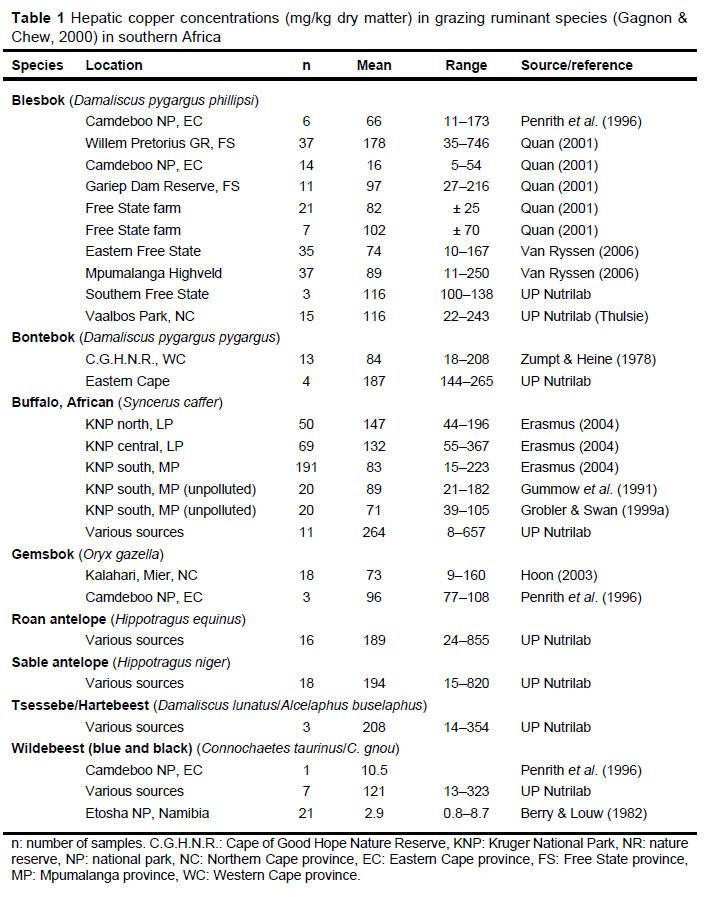
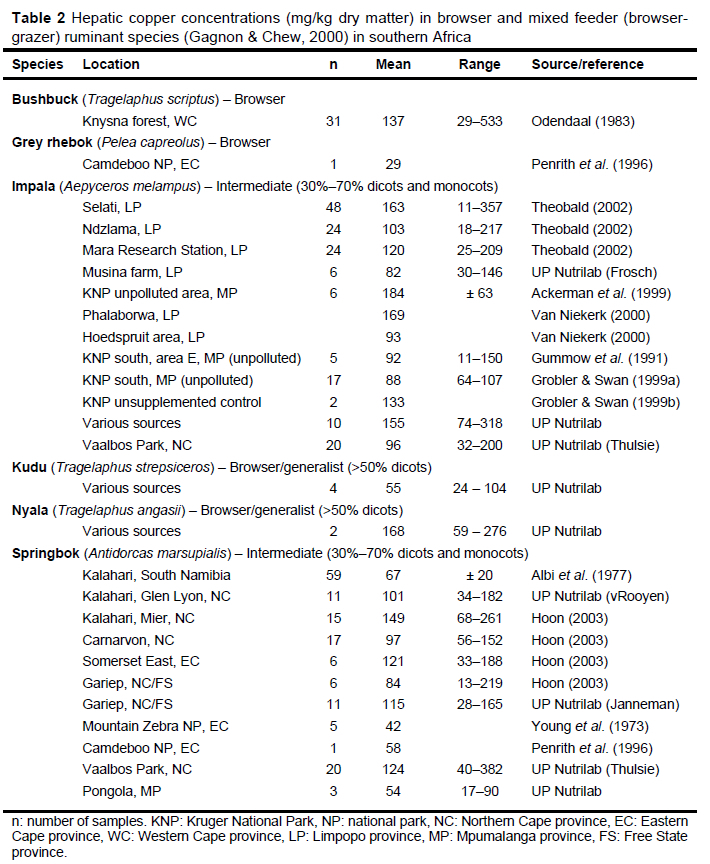
Results of hepatic copper concentrations from 14 species of wild ruminants in southern Africa were obtained, comprising more than 1000 records (Tables 1 and 2). The game species were separated according to feeding habit, with results for grazers reported in Table 1 and results for browsers and mixed feeders (consuming tree foliage and shrubs, as well as grass) reported in Table 2, according to the classification system described by Gagnon & Chew (2000). No statistical analyses were conducted because sources and levels of dietary copper differed widely both within and between species. In some of the individual studies, comparisons were made between sexes, ages, or seasons, but these details were impractical to report in this study. The liver copper concentrations of impala (Aepyceros melampus), African buffalo (Syncerus caffer), and cattle subjected to an incident of copper toxicosis owing to air pollution are reported separately.
Interpretation of the results is based on reference ranges for assessing the copper nutritional status of wild ruminants in southern Africa, as proposed by Van Ryssen & Bath (2024). These ranges were derived from hepatic and plasma copper concentrations, assuming that liver copper retention in ruminants is positively correlated with dietary copper intake.
Proposed hepatic copper concentrations (as per Van Ryssen & Bath, 2024):
• Liver copper concentrations of <20 mg copper/kg DM indicate a potentially marginal to acute copper deficiency, suggesting that the animal would respond positively to copper supplementation.
• Liver copper concentrations of between 20 and 300 mg copper/kg DM are suggested to indicate adequate copper intakes.
• Liver copper concentrations of 301 to 500 mg/kg DM are adequate but undesirable and potentially unhealthy because of the possibility of increased hepatic oxidative stress.
• Liver copper concentrations of >500 mg/kg indicate that the animals are at risk of developing copper toxicosis.
• Serum/plasma copper concentrations were defined as deficient at <0.6 mg copper/L and adequate at 0.6 to 1.5 mg copper/L (serum copper concentrations are usually slightly lower than plasma concentrations).
Before evaluating liver copper concentrations in wild ruminants, it is necessary to clarify the criteria used for assessing copper status, as they differ substantially from those applied to domestic ruminants by some diagnostic laboratories (Spears et al., 2022). The liver serves as the main copper reservoir, releasing copper when dietary intake is insufficient (White, 1996; Spears et al., 2022). Thus, plasma copper concentrations may remain within the normal range (0.6-1.5 mg/L) for months, even when animals are consuming copper-deficient diets, and will only decline once hepatic reserves have been exhausted (<20 mg/kg DM). Suttle (1994, 2022), White (1996), Herdt & Hoff (2011), and Spears et al. (2022) suggested that the depletion of liver stores to below 20-25 mg/kg DM represents deficiency, although thresholds will vary owing to inherent biological variability among animals. The proposal by Van Ryssen & Bath (2024) implies that liver copper concentrations of 20-90 mg/kg DM can be considered as within the adequate range for wild ruminants.
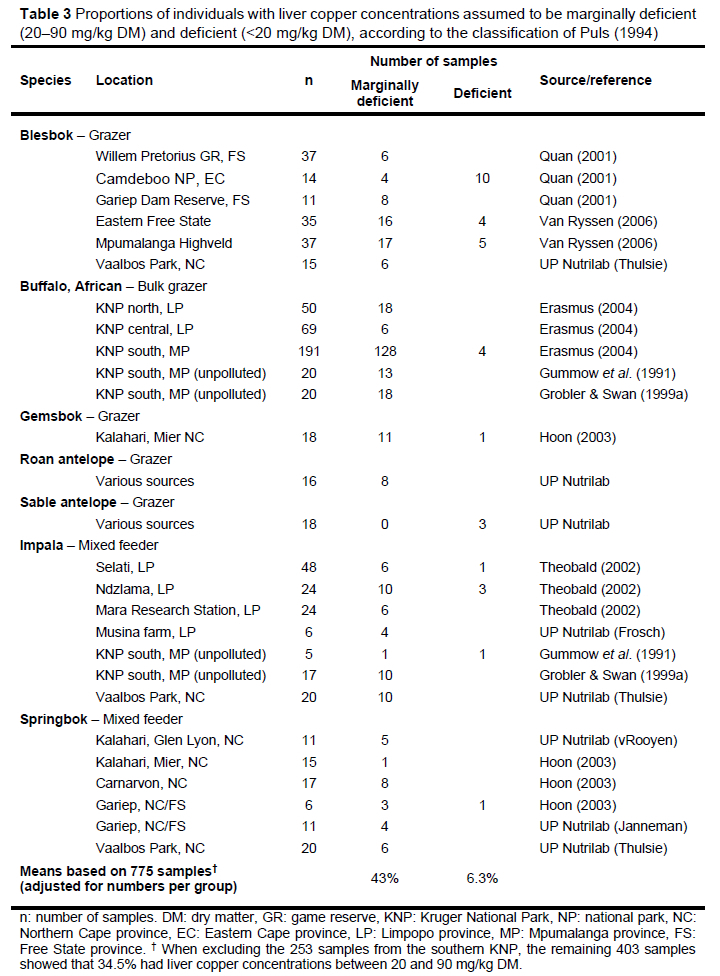
To evaluate how interpretations differed when applying the guidelines of Puls (1994) versus those of Van Ryssen & Bath (2024), the proportion of individuals with hepatic copper concentrations between 20 and 90 mg/kg DM - which is the range for cattle and sheep defined by Puls (1994) as marginally deficient - was calculated within each species group (Table 3). This dataset was compiled from published records as well as from unpublished data accessible to the authors through their roles as research collaborators or postgraduate supervisors.
Results and discussion
In 1989, South African veterinarians investigated cattle mortalities near Phalaborwa, on the border of the Kruger National Park (KNP), which is in the subtropical north-eastern region of South Africa. The deaths were attributed to copper poisoning, with mean hepatic and renal copper concentrations of 1078 ± 388 mg/kg DM and 108 ± 95.1 mg/kg DM, respectively (Gummow et al., 1991). The source of poisoning was linked to elevated environmental copper levels from air pollution generated by an open-cast copper mine near the town. This incident prompted further studies on copper accumulation in wildlife, focusing on impala (mixed feeders) and African buffalo (bulk grazers) inhabiting the adjacent KNP. Both species showed elevated liver copper concentrations that declined with increasing distance from the pollution source (Gummow et al., 1991; Grobler & Swan, 1999a). In impala, mean hepatic copper levels were 810 mg and 534 mg copper/kg DM in the respective studies, while in buffalo they were 287 mg and 196 mg copper/kg DM, respectively. These values contrasted sharply with the ca. 90 mg/kg DM recorded in individuals from the southern, unpolluted area of KNP (Tables 1 and 2). In domestic ruminants, clinical signs of copper toxicosis typically occur when hepatic concentrations exceed 1000 mg/kg DM (NRC, 2005). The upper safe limit of 500 mg/kg DM proposed by Van Ryssen & Bath (2024) is therefore lower than thresholds reported for domestic livestock (López-Alonso & Miranda, 2020). However, fatal cases of copper poisoning in impala have been documented at liver concentrations of 574 mg and 665 mg copper/kg DM (assuming copper depletion prior to death), under conditions of copper pollution (Gummow et al., 1991). Although differences in diet as well as the degree of pollution of the different feed sources complicate interspecies comparisons, in the high-risk zones buffalo consistently exhibited lower hepatic copper concentrations than impala.
To establish the principle that liver copper retention in ruminants correlates with dietary copper intake, controlled experiments with accurately measured copper intakes at varying levels are required. However, such studies are largely unfeasible in wildlife, especially in browsers, even under confinement. Consequently, assumptions must be made. For instance, in a species foraging across different environments, variations in liver copper concentrations can be taken as evidence that copper retention is influenced by dietary intake, although ideally at known distinctly different levels of exposure. Van Ryssen & Bath (2024) drew this conclusion from the case of copper poisoning near Phalaborwa, where liver copper levels in impala differed markedly depending on their proximity to a source of copper pollution. This was also observed in buffalo during the same pollution incident. Similarly, the data on buffalo in KNP (Erasmus, 2004) and blesbok (Damaliscus pygargus phillipsi) (Quan, 2001) in the Karoo and the Free State province show location-based variations (Table 1), supporting the inference that copper retention reflects intake. In most species recorded (Tables 1 and 2), fairly wide ranges of liver copper concentrations were found, implying the adequacy of a range of concentrations rather than a 'typical' or 'normal' liver copper concentration, as suggested by Boyazoglu (1973) and Quan (2001). Contrary to copper concentrations in the livers of ruminants, copper concentrations in other body tissues and animal products remain relatively constant despite higher intakes because physiological homeostatic mechanisms protect the tissues against toxic exposure to copper (López-Alonso, 2012). Although the game species in this study did not differ much in their liver copper concentrations, comparisons between species under free-ranging conditions are invalid because of differences in selective foraging, which preclude the accurate quantification of copper intake.
Accruing from this, Lanocha-Arendarczyk & Kosik-Bogacka (2019), in a review of copper concentrations in mammalian and avian tissues across the Northern Hemisphere, concluded that no reliable biomarkers exist for environmental copper pollution. In contrast, the present study indicates that hepatic copper concentrations in ruminants primarily reflect dietary copper intake, and that environmental contamination, for example copper-laden dust deposited on forage, would be expected to result in elevated liver copper levels. Accordingly, liver copper concentrations in ruminants may serve as useful biomarkers of environmental copper exposure, supporting the conclusions of López-Alonso et al. (2002).
According to the guidelines of Puls (1994), followed by López-Alonso & Miranda (2020) and several diagnostic laboratories (Spears et al., 2022), hepatic copper concentrations below 90 mg/kg DM are considered marginally deficient, while values <20 mg/kg DM are classified as deficient. In this dataset (Table 3), 43% of samples contained between 20 mg and 90 mg copper/kg DM, and would therefore be regarded as marginally deficient under the criteria of Puls (1994), with 4.3% falling below 20 mg/kg DM. However, because clinical copper deficiency in ruminants develops only once hepatic reserves are nearly exhausted, concentrations of 20-90 mg copper/kg DM should be regarded as adequate in wild ruminants. It is suggested that the statement by Herdt & Hoff (2011) that animals with hepatic copper concentrations of 100 mg/kg DM are not necessarily less healthy than those with concentrations of 300 mg/kg DM can be extended to hepatic copper concentrations of 20-500 mg/kg DM.
A decade after the copper pollution incident near Phalaborwa, Erasmus (2004) analysed 312 buffalo livers collected during a bovine tuberculosis survey in the KNP. In the southern region, mean liver copper concentrations averaged 83 mg/kg DM, closely matching earlier findings from the same area reported by Gummow et al. (1991) (89 mg/kg DM) and Grobler & Swan (1999a) (71 mg/kg DM). A substantial proportion of buffalo from the south (57%, 65%, and 88% in the respective studies) had liver copper concentrations of <90 mg/kg DM, while in the Erasmus (2004) survey, 2% contained <20 mg/kg DM, indicating a copper deficiency. Erasmus (2004) reported that liver copper concentrations in buffalo from the central (132 mg/kg DM) and northern (147 mg/kg DM) regions were significantly higher than in those from the southern region. Although these values were lower than those reported in animals from polluted areas in the earlier investigations, it remains uncertain as to whether they still reflected the residual effects of the 1989 pollution event or simply the natural copper content of the forage and dust deposition in these regions.
Several studies have examined liver copper concentrations in impala from the bushveld regions of Limpopo and Mpumalanga provinces, including the KNP (Tables 1 and 2). Excluding the previously reported contamination incident, these animals would have obtained copper almost entirely from natural dietary sources. The data include samples from impala from the unpolluted southern region of the KNP (Gummow et al., 1991; Grobler & Swan, 1999a; Ackermann et al., 1999), from a farm near Musina (Frosch samples), from game farms near Phalaborwa (Selati and Ndzlama), and from the Mara Research Station (Theobald, 2002). Across all these sites, which include the most northern regions of South Africa, liver values indicate adequate copper status, with the exception of samples collected from impala and buffalo from the southern region of KNP, where copper concentrations suggesting deficiency were recorded in some individuals. A further exception was seen in samples from two sable antelope (Hippotragus niger) bulls from the Hoedspruit area, close to Phalaborwa and the KNP. These animals showed faded coat colouration and had low serum copper concentrations (0.21 μg and 0.43 μg/mL, UP Nutrilab samples), consistent with a copper deficiency.
Summarising the results of investigations of co-workers and postgraduate students on the trace element concentrations in natural pastures in different regions of South Africa and Namibia, Van der Merwe & Perold (1967) concluded that pastures in the Western Cape coastal area are generally deficient in copper. This was supported by Young et al. (1973), with copper analyses of springbok (Antidorcas marsupialis) livers from this area, and by Van der Walt & Ortlepp (1960) and Zumpt & Heine (1978). Koen (1988) reported that food and faecal copper concentrations from elephants (Loxodonta africana) (mixed feeder/browser) from the Knysna forest suggested a potential copper deficiency during winter and early summer. In contrast, Odendaal (1983) recorded liver copper concentrations in bushbuck (Tragelaphus sylvaticus) (a browser) culled in winter from the same area that ranged from 29 mg to 533 mg copper/kg DM, indicating adequate to high copper intakes. Unfortunately, no recent data have been obtained on the copper status of game in the Western Cape province.
Penrith et al. (1996) reported swayback (a sign of copper deficiency) in a black wildebeest (Connochaetes gnou) and swayback and faded coat colour in a blesbok from the Karoo Nature Reserve (renamed Camdeboo National Park) near Graaff-Reinet. The copper concentrations in the livers of the two affected animals were 3.0 mg/kg wet weight (10.7 mg/kg DM), compared to copper concentrations in unaffected blesbok (n = 6) of 21.6 mg/kg wet weight (77.1 mg/kg DM), and unaffected rhebok (Pelea capreolus), springbok, and gemsbok (Oryx gazella) (n = 5) of 21.06 mg/kg wet weight (75.2 mg/kg DM). Quan (2001) later conducted an extensive investigation into the occurrence of copper deficiency among blesbok in the Camdeboo National Park. Blesbok in the park grazed almost continuously in the area surrounding the Vanryneveldspas (renamed Nqweba) dam, a floodplain with leached soils apparently grossly deficient in copper, and had an average liver copper concentration of 16.1 mg/kg DM and plasma concentration of 0.07 mg copper/L. Liver copper concentrations of <20 mg/kg DM in blue wildebeest (Connochaetes taurinus) in the Etosha Pan Game Reserve in Namibia were reported by Berry & Louw (1982), although no clinical signs of a copper deficiency were reported. Although Grant et al. (1996) did not analyse animal tissues from the Etosha Pan itself, the liver copper concentrations of cattle from the mopane savanna area surrounding the pan were high, being well above 100 mg/kg DM. Milewski (2012) similarly speculated that waterbuck (Kobus ellipsiprymnus) grazing on the floodplains surrounding Lake Urema in Mozambique suffered from a copper deficiency. The UP Nutrilab analysed the serum from six yellow roan antelope (Hippotragus equinus) from Savuti/Qenada in Botswana, with the serum of five of the group containing an average of 0.23 copper/mL and one containing 0.78 copper/mL. These results suggest that these antelope were probably copper deficient and not genetically yellow-coated animals. A point of similarity is that these suggested copper deficiency incidences all occurred in grazers foraging on floodplains or pans. Maskall & Thornton (1989) and Thornton (2002) reported copper deficiencies among impala (a mixed feeder) and Defassa waterbuck (Kobus defassa (Rüppell)) grazing wetlands in the Lake Nakuru National Park in Kenya's Rift Valley. Soils in this park are of volcanic origin, and the authors concluded that high levels of molybdenum in the soil and plants could be the main cause of an induced copper deficiency.
Chronic copper poisoning, also known as enzootic icterus (yellow disease/geelsiekte), is a unique condition affecting sheep in the semi-desert Karoo and southern Free State regions of South Africa (Bath, 1979; Van Tonder, 1986). According to the late Dr Coetzee (2018, J. Coetzee, Pers. Comm. via the pamphlet Jasper Coetzee Consulting), yellow disease remains a concern in the Karoo. The condition arises from the long-term ingestion of plants with copper concentrations of ~10 mg/kg DM and low molybdenum (<0.5 mg/kg DM) concentrations, leading to hepatic copper accumulation (Bath, 1979). The disease occurs mainly in aged, worn-mouthed sheep, with fatal haemolytic crises often triggered by stress such as transport or drought. Extremely high liver (up to 2501 mg/kg DM) and kidney (535 mg/kg DM) copper levels have been recorded in affected sheep (Bath, 1979). Notably, cattle, goats, and other domestic livestock in the region were unaffected. In the Karoo, both springbok and Merino sheep have been classified as intermediate feeders, utilising both grasses and shrubs (Davies et al., 1986). However, feeding preferences differ, with springbok tending to browse while Merino sheep preferentially graze on grasses when available (Davies et al., 1986; Fairall et al., 1990). In the study by Hoon (2003), springbok shot in the Gariep and Carnarvon regions, areas identified by Bath (1979) as high-risk for yellow disease in sheep, had mean liver copper concentrations of 84 and 97 mg/kg DM, respectively (Table 2). Similarly, springbok liver samples from the Gariep area, submitted by Janneman, contained, on average, 115 mg copper/kg DM, and blesbok liver samples contained 97 mg/kg DM (Quan, 2001). Although differences in copper consumption probably exist between sheep and these antelope species, the findings support the well-documented fact that sheep are more susceptible to copper poisoning than other ruminant species (Suttle, 2022), including the game species investigated in this study.
In a national survey of plant-available copper in South African topsoils, Herselman et al. (2005) identified the Kalahari semi-desert as having extremely copper-deficient soils. The Mier district is located within this region. Despite this, hepatic copper concentrations in springbok (149 mg copper/kg DM) and gemsbok (73 mg copper/kg DM), a grazer, harvested in the Mier district were not indicative of copper deficiency (Tables 1 and 2) (Hoon, 2003). Comparable findings were reported for springbok from farms in the southern Kalahari savanna of Namibia (Albi et al., 1977) and from the Glen Lyon Private Reserve near the Witsand Reserve (Van Rooyen samples), where liver copper concentrations likewise fell within normal ranges. In agreement with these observations, Grant et al. (1996) reported that cattle grazing sandy Kalahari soils in Namibia exhibited the highest hepatic copper concentrations in a broader national survey. The copper status of a small proportion of blesbok grazing the grasslands of the eastern Free State (around Vrede and Warden) and the eastern Mpumalanga Highveld (around Amersfoort) suggested a copper-deficient intake (Van Ryssen, 2006). In contrast, samples from the central and southern Free State indicated an adequate copper intake (Quan, 2001), a finding that was also reported in sheep from the south-western Free State (Van Ryssen, 2006).
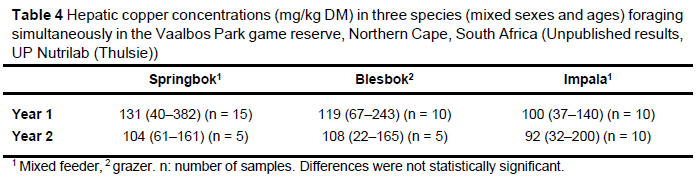
Distinct differences in foraging strategies between blesbok (grazers) and springbok (intermediate browser/grazers) were reported by Novellie (1978) on both burnt and unburnt veld across all seasons. Similarly, Klein & Fairall (1986), comparing impala (browser/grazers) and blesbok at three sites, confirmed that blesbok fed almost exclusively on graminoids, while impala consumed a high proportion of dicotyledons. In an unpublished study (UP Nutrilab, Thulsie), liver samples were collected over two seasons (2007 and 2008) from blesbok, springbok, and impala culled in the Vaalbos Park game reserve, Northern Cape province. Copper concentrations in the livers were determined (Table 4). Considerable variation was observed within species, and mean liver copper levels did not differ significantly between the three species, despite their contrasting diets.
A tendency was observed in some regions for grazers to have lower hepatic copper concentrations than mixed feeders. For instance, in the Kalahari, gemsbok exhibited lower liver copper levels (73 mg/kg DM) than springbok (149 mg/kg DM), and similar differences were reported between buffalo and impala in the copper-polluted areas of the KNP (Gummow et al., 1991; Grobler & Swan, 1999a). In contrast, no differences between foraging types were evident in unpolluted areas of the KNP (Tables 1 and 2) or in the Vaalbos National Park study (Table 4). Although physiological factors influence copper metabolism and result in interspecies differences (Van Ryssen & Bath, 2025), browse species are generally regarded as containing higher copper concentrations than grasses (Van der Merwe & Perold, 1967). Consequently, differences in dietary copper intake arising from contrasting copper concentrations in monocots and dicots may partly explain the observed patterns. However, the extent to which soil ingestion contributes to differences in copper intake between grazers and browsers remains uncertain. Browsers are generally reported to ingest less soil than grazers (Damuth & Janis, 2011; Hummel et al., 2020), although the significance of this factor in relation to hepatic copper accumulation in game is difficult to determine.
Conclusions
Liver copper concentrations of 20-500 mg/kg DM are considered indicative of a normal copper nutritional status in healthy, low-producing, free-ranging wild ruminants in southern Africa. This range can aid in the interpretation of hepatic copper concentrations as biomarkers of environmentally available copper. Because the study was conducted opportunistically, relying on existing data, it does not provide a comprehensive regional assessment of copper nutritional status in wild ruminants. Several regions with high game densities remain poorly represented, including bushveld areas of KwaZulu-Natal and the Eastern Cape, game reserves in the North West province such as the Pilanesberg Game Reserve, and the wetlands of KwaZulu-Natal. In addition, data for strict browsers were limited.
Despite these limitations, several informative patterns emerged. Copper deficiency was observed mainly in grazers foraging on floodplains. Overall, grazers were more likely to exhibit low copper status than mixed feeders and probably browsers, although direct interspecific comparisons were constrained by differences in dietary copper sources. Regions where copper deficiency may occur were identified, notably the southern KNP and eastern parts of the Free State and Mpumalanga provinces. Nevertheless, the general conclusion is that wild ruminants in southern Africa typically obtain sufficient copper from their natural diets, with little evidence of oversupply or a need for copper supplementation. Furthermore, maps of plant-available copper in South African topsoils appear to have limited value in predicting the copper nutritional status of free-ranging wild herbivores, particularly where browse constitutes a substantial or exclusive component of the diet.
Acknowledgements
The authors wish to thank the farmers and hunters who submitted liver samples for this investigation. The National Research Foundation's funding of the first author enabled the chemical analyses performed by UP Nutrilab.
Authors' contributions
J.B.J.v.R. did the literature search and wrote the initial copy. E.C.W. revised and edited the article. Both authors were promoters or co-promoters of most of the MSc dissertations cited.
Conflict of interest declaration
The authors declare no conflicts of interest.
References
Ackerman, D.J., Reinecke, A.J., Els, H.J., Grobler, D.G., & Reinecke, S.A., 1999. Sperm abnormalities associated with high copper levels in impala (Aepyceros melampus) in the Kruger National Park, South Africa. Ecotoxicology and Environmental Safety, 43(3):261-266. DOI: https://doi.org/10.1006/eesa.1999.1787 [ Links ]
Albi, P., Boyazoglu, P.A., & Bezuidenhout, J.P., 1977. Observations on the mineral status of springbok (Antidorcas marsupialis Zimmerman) in South West Africa. Madoqua, 10(1):79-83. [ Links ]
Bath, G.F., 1979. Enzootic icterus - A form of chronic copper poisoning. Journal of the South African Veterinary Association, 50(1):3-14. URL: https://hdl.handle.net/10520/AJA00382809_3632 [ Links ]
Berry, H.H. & Louw, G.N., 1982. Seasonal nutritive status of wildebeest in the Etosha National Park. Madoqua, 13(2):127-139. [ Links ]
Boyazoglu, P.A., 1973. Mineral imbalances of ruminants in southern Africa. South African Journal of Animal Science, 3:149-152. [ Links ]
Britton, S. & Davidowitz, G., 2022. The effect of diet on melanin pigmentation in animals. Functional Ecology, 37:206-217. DOI: https://doi.org/10.1111/1365-2435.14209 [ Links ]
Carrick, P.J., 2003. Competitive and facilitative relationships among three shrub species, and the role of browsing intensity and rooting depth in the Succulent Karoo, South Africa. Journal of Vegetation Science, 14:761772. DOI: https://doi.org/10.1111/j.1654-1103.2003.tb02208.x [ Links ]
Damuth, J. & Janis, C.M., 2011. On the relationship between hypsodonty and feeding ecology in ungulate mammals and its utility in palaeoecology. Biological Review, 86:733-758. DOI: https://doi.org/10.1111/j.1469-185X.2011.00176.x [ Links ]
Davies, T.C. & Mundalamo, H.R., 2010. Environmental health impacts of dispersed mineralisation in South Africa. Journal of African Earth Sciences, 58:652-666. DOI: https://doi.org/10.1016/j.jafrearsci.2010.08.009 [ Links ]
Davies, R.A.G., Botha, P., & Skinner, J.D., 1986. Diet selected by springbok Antidorcas marsupialis and Merino sheep Ovis aries during Karoo drought. Transactions of the Royal Society of South Africa, 46(2):165-176. DOI: https://doi.org/10.1080/00359198609520116 [ Links ]
Dick, A.T., 1954. Studies on the assimilation and storage of copper in crossbred sheep. Australian Journal of Agricultural Research, 5(3):511-544. [ Links ]
EFSA Panel (EFSA Panel on Additives and Products or Substances used in Animal Feed), 2016. Scientific opinion on the revision of the currently authorised maximum copper content in complete feed. EFSA Journal, 14(8):4563100. DOI: https://doi.org/10.2903/j.efsa.2016.4563 [ Links ]
Erasmus, M.E.A., 2004. Body composition estimation and nutritional status of African buffalo (Syncerus caffer) in the Kruger National Park. Unpublished MSc Agric (Production Physiology) dissertation, Department of Animal and Wildlife Sciences, University of Pretoria, South Africa. [ Links ]
Fairall, N., Jooste, J.F., & Conroy, A.M., 1990. Biological evaluation of a springbok-farming enterprise. South African Journal of Wildlife Research, 20(2):73. DOI: https://doi.org/10.1111/1365-2435.1420980 [ Links ]
Farina, M. & Thibaud, G., 2006. Micronutrient problems of field crops in Southern Africa (conference paper). URL: https://www.researchgate.net/publication/319645130 [ Links ]
Gagnon, M. & Chew, A.E., 2000. Dietary preferences in extant African Bovidae. Journal of Mammology, 81(2):490- 511. DOI: https://doi.org/10.1644/1545-1542(2000)081<0490:DPIEAB>2.0.CO;2 [ Links ]
Grace, N.D. & Clark, R.G., 1991. Chapter 15: Trace element requirements, diagnosis and prevention of deficiencies in sheep and cattle. In: Proceedings of the Seventh International Symposium on Ruminant Physiology - Physiology Aspects of Digestion and Metabolism in Ruminants. Eds: Tsuda, T., Sasaki, Y., & Kawashima, R., Academic Press Inc., Tokyo. pp. 321-341. [ Links ]
Grant, C.C., Biggs, H.C., & Meissner, H.H., 1996. Demarcation of potentially mineral deficient areas in central and northern Namibia by means of natural classification systems. Onderstepoort Journal of Veterinary Research, 63:109-120. URL: https://hdl.handle.net/2263/22039 [ Links ]
Grobler, D.G. & Swan, G.E., 1999a. Copper poisoning in the Kruger National Park: Field investigation in wild ruminants. Onderstepoort Journal of Veterinary Research, 86:157-168. URL: https://hdl.handle.net/2263/22089 [ Links ]
Grobler, D.G. & Swan, G.E., 1999b. Attempted induction of chronic copper poisoning in boma confined impala. Onderstepoort Journal of Veterinary Research, 86:169-174. URL: https://hdl.handle.net/2263/22088 [ Links ]
Gummow, B., 1996. Experimentally induced copper toxicity in cattle. Onderstepoort Journal of Veterinary Research, 63: 277-288. URL: https://hdl.handle.net/2263/22080 [ Links ]
Gummow, B., Botha, C.J., Basson, A.T., & Bastianello, S.S., 1991. Copper toxicity in ruminants: Air pollution as a possible cause. Onderstepoort Journal of Veterinary Research, 58(1):33-39. [ Links ]
Herdt, T.H. & Hoff, B., 2011. The use of blood analysis to evaluate trace mineral status in ruminant livestock. Veterinary Clinics.: Food Animal Practice, 27(2):255-283. DOI: doi.org/10.1016/j.cvfa.2011.02.004 [ Links ]
Herselman, J.E., Steyn, C.E., & Fey, M.V., 2005. Baseline concentrations of Cd, Co, Cr, Cu, Pb, Ni and Zn in surface soils of South Africa. South African Journal of Science, 101(11):509-512. URL: https://hdl.handle.net/10520/EJC96325 [ Links ]
Hoon, J.H., 2003. Mineral status of springbok (Antidorcas marsupialis) in different areas of South Africa. Grootfontein Agric, 6:25-27. [ Links ]
Hummel, J., Clauss, M., & Südekum, K-H., 2020. Aspects of food comminution in ungulates and their consequences for energy budget. In: Mammalian Teeth - Form and Function. Eds: Martin, T. & van Koenigswald, W. Verlag Dr. Friedrich Pfoil, München, Germany - ISBN 978-3-89937-266-3. pp. 87-101. DOI: http://doi.org/10.23788/mammteeth.06 [ Links ]
Jones, R.T. & Mackey, P.J., 2015. An overview of copper smelting in southern Africa. In: Copper Cobalt Africa, incorporating the 8th Southern African Base Metals Conference, Livingstone, Zambia, 6-8 July 2015, Southern African Institute of Mining and Metallurgy. pp. 499-504. [ Links ]
Kalisinska, E., 2019. Chapter 2: Endothermic animals as biomonitors of terrestrial environments. In: Mammals and Birds as Bioindicators of Trace Element Contaminations in Terrestrial Environments. Ed: Kalisinska, E., Springer Nature Switzerland. pp. 21-53. DOI: https://doi.org/10.1007/978-3-030-00121-6_2 [ Links ]
Kincaid, R.L., 2000. Assessment of trace mineral status of ruminants: A review. Journal of Animal Science, 77(Suppl E.):1-10. DOI: https://doi.org/10.2527/jas2000.77E-Suppl1x [ Links ]
Klein, D.R. & Fairall, N., 1986. Comparative foraging behaviour and associated energetics of impala and blesbok. Journal of Applied Ecology, 23:489-502. URL: https://www.jstor.org/stable/2404031 [ Links ]
Koen, J.H., 1988. Trace elements and some other nutrients in the diet of the Knysna elephants. South African Journal of Wildlife Research, 18(3):109-110. [ Links ]
Kumar, V., Pandita, S., Sidhu, G.P.S., Sharma, A., Khanna, K., Kaur, P, Bali, A.S., & Setia, R., 2021. Copper bioavailability, uptake, toxicity and tolerance in plants: A comprehensive review. Chemosphere, 262:127810. DOI: https://doi.org/10.1016/j.chemosphere.2020.127810 [ Links ]
Lange, B., Van der Ent, A., Baker, A.J.M., Echevarria, G., Mahy, G., Malaisse, F., Meerts, P., Pourret, O., Verbruggen, N., & Faucon, M-P., 2017. Copper and cobalt accumulation in plants: A critical assessment of the current state of knowledge. New Phytologist, 213:537-51. DOI: https://doi.org/10.1111/nph.14175 [ Links ]
Lanocha-Arendarczyk, N. & Kosik-Bogacka, D.I., 2019. Chapter 4: Copper, Cu. In: Mammals and Birds as Bioindicators of Trace Element Contaminations in Terrestrial Environments. Ed. Kalisinska, E., Springer Nature Switzerland. pp. 125-161. DOI: https://doi.org/10.1007/978-3-030-00121-6_2 [ Links ]
López-Alonso, M., 2012. Trace minerals and livestock: Not too much not too little. International Scholarly Research Network ISRN Veterinary Science, 2012:704825. DOI: https://doi.org/10.5402/2012/704825 [ Links ]
López-Alonso, M. & Miranda, M., 2020. Copper supplementation, a challenge in cattle. Animal, 10:1890. DOI: https://doi.10.3390/ani10101890 [ Links ]
López-Alonso, M., Benedito, J.L., Miranda, M., Castillo, C., Hernández, J., & Shore, R.F., 2002. Cattle as biomonitors of soil arsenic, copper, and zinc concentrations in Galicia (NW Spain;. Archives of Environmental Contamination and Toxicology, 43:103-108. DOI: https://doi.org/10.1007/s00244-002-1168-5 [ Links ]
López-Alonso, M., Crespo, A., Miranda, M., Castillo, C., Hernández, J., & Benedito, L.J., 2006. Assessment of some blood parameters as potential markers of hepatic copper accumulation in cattle. Journal of Veterinary Diagnostic Investigations, 18:71-75. DOI: https://doi.org/10.1177/104063870601800109 [ Links ]
Luna, D., Miranda, M., Pereira, V., & López-Alonso, M., 2019. Variation in trace element content between liver lobes in cattle. How important is the sampling site? Journal of Trace Elements in Medicine and Biology, 52:53-57. DOI: https://doi.org/10.1016/j.jtemb.2018.11.008 [ Links ]
Maskall, J.E. & Thornton, I., 1989. The mineral status of Lake Nakuru National Park, Kenya: a reconnaissance survey. African Journal of Ecology, 27:191-200. [ Links ]
Mbatha, K.R., Lane, E.P., Lander, M., Tordiffe, A.S.W., & Corr, S., 2012. Preliminary evaluation of selected minerals in liver samples from springbok (Antidorcas marsupialis) from the national Zoological Gardens of South Africa. Journal of the South African Veterinary Association, 83(1):119. DOI: http://dx.doi.org/10.4102//jsava.v83i1.119 [ Links ]
McCarthy, T.S., 2011. The impact of acid mine drainage in South Africa. South African Journal of Science, 107(5/6):712. DOI: https://doi.org/10.4102/sajs.v107i5/6.712 [ Links ]
Meissner, H.H., Zacharias, P.J.K., & O'Reagain, P.J., 1999. Chapter 6: Forage quality (feed value). In: Veld Management in South Africa. Ed: Tainton, N., University of Natal Press, Pietermaritzburg, South Africa. pp. 139-166. ISBN 0 86980 947 4. [ Links ]
Milewski, A.V., 2012. Copper deficiency in waterbuck: A disease of affluence. Grassroots, 12(1):19-23. [ Links ]
Miranda, M., Benedito, J.L., Gutiérrez, B., Garcia-Vaquero, M., Blanco-Penedo, I., & López-Alonso, M., 2010. The interlobular distribution of copper in the liver of beef calves on a high-copper diet. Journal of Veterinary Diagnostic Investigations, 22:277-281. DOI: https://doi.org/10.1177/104063871002200221 [ Links ]
National Research Council (NRC), 2005. Chapter 13: Copper. In: Mineral Tolerance of Animals, 2nd revised edition. The National Academies Press, Washington, D.C., USA. pp. 134-153. [ Links ]
Ngole, V.M. & Ekosse, G.I.E., 2012. Copper, nickel and zinc contamination in soils within the precincts of mining and landfilling environments. International Journal of Environmental Science and Technology, 9:485-494. DOI: https://doi.org/10.1007/s13762-012-0055-5 [ Links ]
Novellie, P.A., 1978. Comparison of the foraging strategies of blesbok and springbok on the Transvaal highveld. South African Journal of Wildlife Research, 8(4):137-144. [ Links ]
Odendaal, P.B., 1983. Feeding habits and nutrition of bushbuck in the Knysna forests during winter. South African Journal of Wildlife Research, 13:27-31. [ Links ]
Penrith, M-L, Tustin, R.C., Thornton, D.J., & Burdett, P.D., 1996. Swayback in a blesbok (Damaliscus dorcas phillipsi) and a black wildebeest (Connochaetes gnou). Journal of the South African Veterinary Association, 67(2):93-96. URL: https://hdl.handle.net/10520/AJA00382809_1644 [ Links ]
Perlatti, F., Ferreirra, T.O., Roberto, F.A.da C., Romero, R.E., Sartor, L.R., & Otero, X.L., 2015. Trace element/metalloid concentrations in waste rock, soils and spontaneous plants in the surroundings of an abandoned mine in semi-arid NE-Brazil. Environmental Earth Science, 74:5427-5441. DOI: https://doi.org/10.1007/s12665-015-4556-7 [ Links ]
Puls, R., 1994. Mineral Levels in Animal Health: Diagnostic Data (second edition). Sherpa International, Canada. [ Links ]
Quan, M., 2001. Copper deficiency in blesbok (Damaliscus pygargus phillipsi) from the Karoo Nature Reserve. Unpublished MSc (Veterinary Science) dissertation, University of Pretoria, Pretoria, South Africa. [ Links ]
Shabbir, Z., Sardar, A., Shabbir, A., Abbas, G., Shamshad, S., Khalid, S., Natasha, Murtaza, G., Dumat, C., & Shahid, M., 2020. Copper uptake, essentiality, toxicity, detoxification and risk assessment in soil-plant environment. Chemophere, 259:127436. DOI: https://doi.org/10.1016/j.chemophere.2020.127436 [ Links ]
Spears, J.W., Brandao, V.L.N., & Heldt, J., 2022. Invited review: Assessing trace element status in ruminants, and factors that affect measurements of trace elements. Applied Animal Science, 38:252-267. DOI: https://doi.org/10.15232/aas.2021-02232 [ Links ]
Steyn, C.E. & Herselman, J.E., 2005. Trace elements in developing countries using South Africa as a case study. Communications in Soil Science and Plant Analysis, 36:155-168. DOI: https://doi.org/10.1081/CSS-20043017 [ Links ]
Steyn, C.E. & Herselman, J.E., 2006. Trace element concentrations in soils under different land uses in Mpumalanga Province, South Africa. South African Journal of Plant and Soil, 23(4):230-236. DOI: https://doi.org/10.1080/02571862.2006.10634760 [ Links ]
Suttle, N.F., 1994. Chapter 9: Meeting the copper requirements of ruminants. In: Recent Advances in Animal Nutrition. Eds: Carnworthy, P.C. & Cole, D.J.A., 1994, Nottingham University Press, Leicestershire, U.K. pp. 173-187. [ Links ]
Suttle, N.F., 2022. Mineral Nutrition of Livestock, fifth edition. CABI Publishing, CABI International, Wallingford, Oxon OX10 8DE, UK. [ Links ]
Taylor, W.A., Child, M.F., Lindsey, P.A., Nicholson, S.K., Relton, C., & Davies-Mostert, H.T., 2021. South Africa's private wildlife ranches protect globally significant populations of wild ungulates. Biodiversity and Conservation, 30:4111-4135. DOI: https://doi.org/10.1007/s10531-021-02294-5 [ Links ]
Theobald, S., 2002. Nutritional status and growth of impala (Aepyceros melampus) in the Limpopo Province. Unpublished MSc Agric Dissertation, Department of Animal and Wildlife Sciences, University of Pretoria, South Africa. [ Links ]
Thornton, I., 2002. Geochemistry and the mineral nutrition of agricultural livestock and wildlife. Applied Geochemistry, 17:1017-1028. [ Links ]
Van der Ent, A., Baker, A.J.M., Reeves, R.D., Pollard, A.J., & Schat, H., 2013. Hyperaccumulators of metal and metalloids trace elements: Facts and fiction. Plant Soil, 362:319-334. DOI: https://doi.org/10.1007/s11104-012-1287-3 [ Links ]
Van der Merwe, F.J. & Perold, I.S., 1967. Trace elements in natural pastures. Journal of the South African Veterinary and Medical Association, 38(1):355-363. [ Links ]
Van der Walt, K. & Ortlepp, R.J., 1960. Moving the bontebok from Bredasdorp to Swellendam. Journal of the South African Veterinary and Medical Association, 31(4):459-463. [ Links ]
Van Niekerk, W.A., 2000. The copper, manganese and zinc content of livers of impala in the Hoedspruit area. South African Journal of Animal Science, 30(Suppl 1):142. [ Links ]
Van Ryssen, J.B.J., 2006. An evaluation of the trace element nutritional status of grazers in the eastern regions of the Free State and Mpumalanga. SA-ANIM SCI, 7:22-30. URL: https://www.sasas.co.za/AAH&RD/an-evaluation-of-the-trace-element-nutritional-status-of-grazers-in-the-eastern-regions-of-the-free-state-and-mpumalanga/ [ Links ]
Van Ryssen, J.B.J. & Bath, G.F., 2024. Copper (Cu) metabolism in domestic herbivores as guide to criteria for predicting the Cu nutritional status of wild ruminants in southern Africa. Journal of the South African Veterinary Association, 95(1):26-34. DOI: https://doi.org/10.36303/JSAVA.580 [ Links ]
Van Ryssen, J.B.J. & Bath, G.F., 2025. Possible factors affecting the bioavailability of copper and the copper requirements of wild, free-ranging African herbivores: A review. South African Journal of Animal Science, 55:539-550. DOI: https://dx.doi.org/10.17159/sajas.v55i11.02 [ Links ]
Van Ryssen, J.B.J. & Stielau, W.J., 1980. The influence of dietary sulphur on copper and molybdenum metabolism in sheep. South African Journal of Animal Science, 10(1):49-57. [ Links ]
Van Ryssen, J.B.J., Webb, E.C., & Myburgh, J.G., 2023. Liver moisture content in animals and possible causes of variations in hepatic dry matter content. Journal of the South African Veterinary Association, 94(1):7-15. DOI: https://doi.org/10.36303/JSAVA518 [ Links ]
Van Tonder, E.M., 1986. Research progress in some important problems in sheep and goats: 2. Elucidation of enzootic icterus (geelsiekte). Karoo Agric, 3(8):27-31. [ Links ]
White, C.L., 1996. Understanding the mineral requirements of sheep. In: Detection and Treatment of Mineral Nutrition Problems in Grazing Sheep. Eds: Masters, D.G. & White, C.L., ACIAR Monograph No 37, Canberra, Australia. pp. 15-29. [ Links ]
Woolliams, J.A., Suttle, N.F., Wiener, G., Field, A.C., & Woolliams, C., 1983. The long-term accumulation and depletion of copper in the liver of different breeds of sheep fed diets of differing copper content. Journal of Agricultural Science, 100(2):441-449. DOI: https://doi.org/10.1017/S0021859600033608 [ Links ]
Young, E., Zumpt, F., Basson, P.A., Erasmus, B., Boyazoglu, P.A., & Boomker, J., 1973. Notes on the parasitology, pathology and bio-physiology of springbok in the Mountain Zebra National Park. Kudu, 16:195-198. [ Links ]
Zumpt, I.F. & Heine, E.W.P., 1978. Some veterinary aspects of bontebok in the Cape of Good Hope Nature Reserve. South African Journal of Wildlife Research, 8:131-134. [ Links ]
Submitted 02 October 2025
Accepted 20 January 2026
Published 12 March 2026
# Corresponding author: jannes.jansenvanryssen@up.ac.za
* Current address: Department of Animal Science, College of Agriculture and Natural Resources, Tarleton State University, Texas A&M University System, Texas, 76402 4