Services on Demand
Journal

Article
 English (pdf)
 Article in xml format
 Article references
 Automatic translation
 Send this article by e-mail
Indicators
Related links
-
 Cited by Google
 -
 Similars in Google
Share

 Permalink
South African Journal of Animal Science
On-line version ISSN 2221-4062Print version ISSN 0375-1589
S. Afr. j. anim. sci. vol.55 n.10 Pretoria 2025
https://doi.org/10.17159/sajas.v55i10.04
RESEARCH ARTICLES
The effects of red and white LED lighting on laying performance in hens over 72 weeks of age
N.M.P. MonteiroI; D. SatoI, ; B.D.R. BombemI; J.E. De MoraesII; D.R. RodriguesI; E.P. PortoI; L.O. SilvaI; E.R. DuarteIII; M.A.A. SilvaI
IDepartment of Agricultural Sciences, State University of Northern Paraná (UENP), Luiz Meneghel Campus, 86360-000, BR-369, s/n, Bandeirantes/Paraná State, Brazil
IISão Paulo State Agency for Agribusiness Technology, Institute of Animal Science, 13380-011 Heitor Penteado Street, 56, Nova Odessa/São Paulo State, Brazil
IIIDepartment of Agricultural Sciences, Northern Paraná University (UNOPAR), 86360-000 Edelina Meneghel Rando Avenue, 151, Bandeirantes/Paraná State, Brazil
ABSTRACT
Artificial lighting has enabled improvements in egg production, and different types of light and wavelengths have been tested to achieve better production results in the past. It has been established that red light positively affects the laying performance of hens when such a lighting programme is applied prior to sexual maturation. However, few studies have investigated the effects of light colour on the performance of laying hens during the final stages of production. This study examined the effects of supplementing natural light with white or red lighting during the autumn-winter season on the laying performance, feed intake, average egg weight, egg mass, and feed conversion per egg of laying hens, and the albumen height, yolk colour, and Haugh units of their eggs. The effects on shell thickness, shell strength, body mass, ovary weight, and oviduct weight were also assessed. A total of 7680 70-week-old Lohmann LSL laying hens housed in four California-type sheds were used in the study. Hens exposed to the white light treatment had significantly heavier ovaries; however, no significant differences between red and white lighting were found among the other evaluated variables.
Keywords: egg production, light colour, photoperiod
Introduction
Light is a crucial environmental factor that regulates various physiological processes in animals, particularly reproduction. In avian species, photoperiod plays an essential role in the regulation of reproductive cycles (Bédécarrats & Hanlon, 2017). Since the significance of photoperiod in bird reproduction was first identified (Rowan, 1931), numerous studies have explored how artificial lighting can enhance egg production in commercial operations.
Light stimuli trigger a complex neuroendocrine cascade in the hypothalamic-pituitary-gonadal axis, regulating the secretion of gonadotropin-releasing hormone. Gonadotropin-releasing hormone subsequently stimulates the pituitary secretion of gonadotropins, including luteinising hormone and follicle-stimulating hormone, which, in turn, regulate gonad development and function (Bédécarrats & Hanlon, 2017). The mechanisms underlying the activation of this axis in birds, as well as its composition and integration, have been described in a number of papers (Bédécarrats, 2015; Bédécarrats & Hanlon, 2017).
Chickens (Gallus gallus) have seven types of photoreceptor cells in their retinas, including one rod and six cones. Their colour vision is tetrachromatic, enabling the perception of violet, blue, green, and red. Double cones are thought to enhance the ability of birds to detect movement (Kram et al., 2010). In addition to the light receptors in their retinas, fowl have other intracranial photoreceptors that respond only to long-wavelength light (Raziq et al., 2020). Consequently, some colours may be more stimulating than others (England & Ruhnke, 2020).
Evidence suggests that anthropogenic genetic changes have reduced the visual capacity of chickens, compared with that of other birds and their wild ancestors (Kristensen et al., 2007). However, chickens' vision is still superior to that of humans, and their eyes constitute a greater proportion of their cranial volume (Kamanli et al., 2015; Seifert et al., 2020). Hens perceive light with wavelengths between 320 nm and >700 nm. Hens also perceive ultraviolet (UV)-A radiation and use it to assess the fitness of cocks; therefore, breeder birds may not be able to evaluate each other in their preferred way in the absence of light of this wavelength (Prescott & Wathes, 1999). Supplemental UV light has consequently been found to reduce fear and stress in hens during the early lay period (Rana et al., 2024). Lighting also controls sexual maturation, leading to an advance or delay, according to the photoperiod. However, hens must be photosensitive to respond appropriately to this stimulation. Research has confirmed that the red spectrum is the most potent stimulator of sexual maturation (Baxter et al., 2014).
With the development of more energy-efficient lamps, such as light-emitting diodes (LEDs), several studies have evaluated the effects of using LED lights of various colours for lighting programmes (Huber-Eicher et al., 2013; Hassan et al., 2014; Su et al., 2021; Wei et al., 2022; Hanlon et al., 2023; Osadcha et al., 2023; Bahuti et al., 2023; Barros et al., 2024). While these studies have used varying light intensities, a recent study found that 5 lx (lumen/m2) was sufficient to ensure that birds could access feeders and drinkers comfortably, thereby avoiding potential losses in egg production (Bahuti et al., 2023).
Extending the production period of laying hens to over 72 weeks is a global goal. This could enhance profits, sustainability, and food security (Guo et al., 2021; Koeleman, 2024). Although numerous studies have investigated the effects of different lighting programmes on younger hens, few have examined the impact of different light wavelengths on the laying performance of hens over 70 weeks of age. Thus, the objective of this study was to evaluate the effects of natural light supplementation with red and white LED lamps on the production and quality of eggs from commercial laying hens over 70 weeks of age.
Materials and methods
This study was approved by the Animal Use Ethics Committee of the State University of Northern Paraná (CEUA/UENP) under reference number 03/2021. The study was conducted on a commercial farm in Palmital, São Paulo State (22°47'14.86" S, 50°14'4.39" W) between April and July of 2022, during the autumn-winter season.
A total of 7680 70-week-old commercial laying hens of the Lohmann LSL line were used. The birds were housed in four California-type sheds equipped with nipple drinkers and trough feeders, all of which were under automatic control. Each shed consisted of four rows of 96 cages, with a capacity of five birds per cage (450 cm2 per bird), totalling 1920 birds per shed. The sheds were spaced 5 m apart. The hens were randomly distributed in an experiment consisting of two treatments (white and red LED) with eight replicates each, and with each replicate comprising 96 cages containing 480 birds. The hens were allowed to adapt to the LED lighting systems for 10 days prior to data collection. Data were collected over three 28-day periods for each of the treatments.
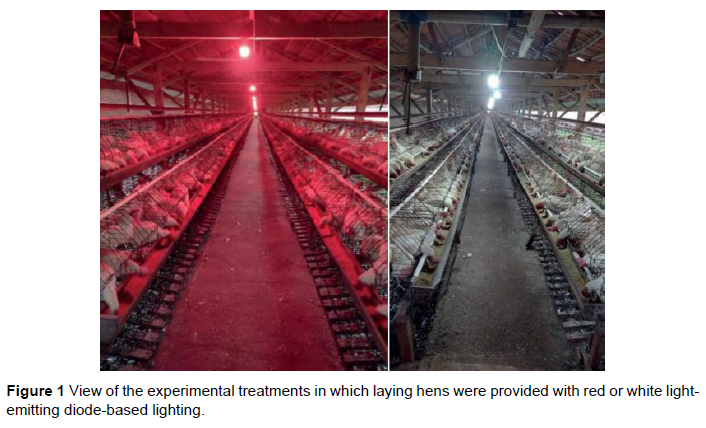
Lighting systems consisting of white LED lamps (Empalux® model E27 - AL10762: 6500 K, 10 W; Empalux, 2025) or red LED lamps (Empalux® model AL10319: 10 W, 650 nm; Empalux, 2023) were used for the treatments, with both systems built using SMD 2835 LEDs (Ledestar, 2021). Both treatments consisted of 13 lamps distributed throughout the sheds (Figure 1), with a standardised light intensity of 15 lx, calculated according to the dimensions of the sheds and measured using a digital lux meter (Instrutemp® model ITLD 300; Instrutemp, 2023). Measurements were taken at the level of the hens' heads. Sunlight intensity was not measured inside the houses because California-type houses provide sufficient light intensity for the hens' needs during the day (Gongruttananun & Guntapa, 2012; Bahuti et al., 2023).
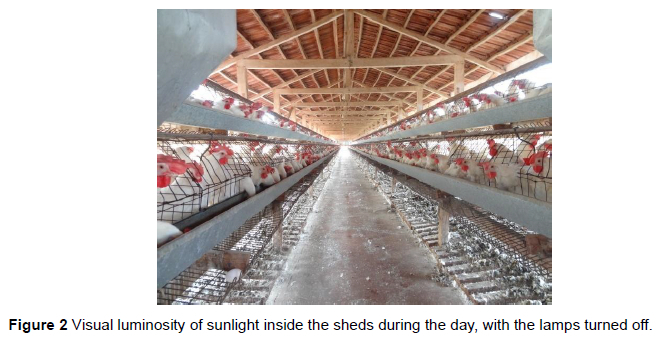
The artificial lighting system was connected to a timer and photocell to provide a continuous lighting programme of 16 hours, consisting of 10 hours of natural light and 6 hours of artificial light. The lights were turned on at 05:00 and switched off at sunrise, which occurred at around 07:00. The hens were then exposed to natural light until 17:00, after which the lights were turned on and kept on until 21:00. The luminous intensity of the sunlight inside the facilities was not measured in this study. Figure 2 shows the intensity of the sunlight in the sheds with the lamps turned off during the day.
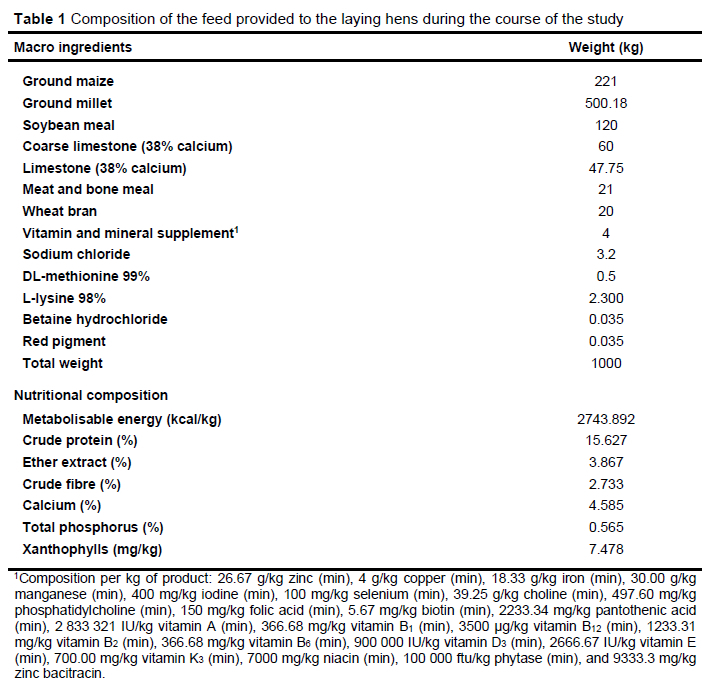
The birds were fed according to the nutritional requirements of their lineage, as shown in Table 1.
Laying performance and feed consumption data were collected daily during the three experimental periods. At the end of each period, 10 eggs from each replicate were randomly selected for quality analyses. Water and feed were provided ad libitum throughout the study. Leftover feed was collected, weighed, and deducted from the supply, and mortality was considered when calculating the daily feed consumption.
The feed conversion efficiency per egg mass was calculated by dividing the feed intake (in kg) by the egg mass (in kg). Egg mass was calculated by multiplying the egg production by the average egg weight in kilograms. The feed conversion efficiency per dozen was calculated by dividing the feed intake (in kg) by the number of dozens of eggs produced.
Egg quality was assessed using a Digital Egg Tester (DT6000, Nabel Co. Ltd., 2017). Analyses were performed to determine the albumen height, yolk colour (YolkFan™ colour scale; DSM-Firmenich, 2025), average egg weight (g), Haugh unit, shell thickness, and shell strength. For the shell percentage, the shells were washed and dried at room temperature for 48 hours and then weighed using a Scientech SA 210 analytical balance (Scientech, 2006). At the end of the experimental period, two hens with similar live weights were collected from each shed line and euthanised by cervical dislocation for necropsy to obtain the weights of the ovaries and oviducts.
The variables were initially subjected to the Shapiro-Wilk test to verify whether the data presented a normal distribution. An analysis of variance was performed to compare the mean results of the treatment groups. Variables with normal distributions are reported as arithmetic means and standard deviations. An independent samples t-test (P <0.05) was used to compare the different treatments.
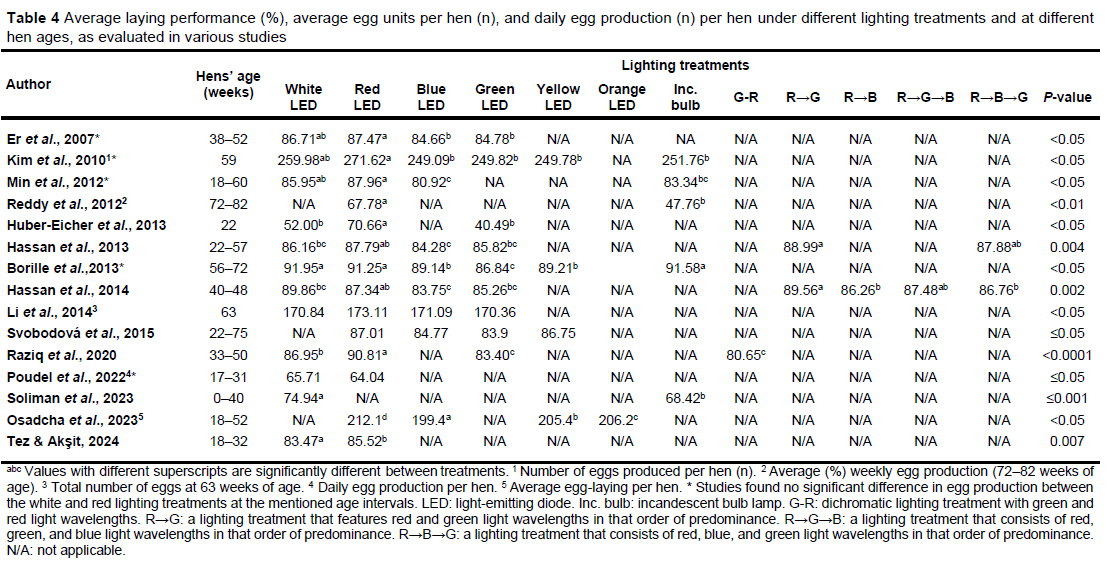
Two tables summarising the laying performance data from several studies were created for comparison purposes. Table 3 compares laying age phases under white and red lights, and Table 4 considers the effects of other colours and wavelength combinations.
Results and discussion
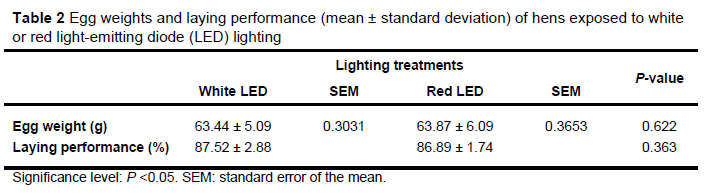
Egg weight and laying performance did not differ between the lighting treatments: egg weight was 63.44 g for the white LED hens and 63.87 g for the red LED hens. These results are similar to those reported in the Lohmann LSL management guide (Lohmann Breeders, 2020), where the target value for egg weight for hens aged 70 to 85 weeks is 64.4 g, and the egg production ratio is 72.2% per housed bird. The average egg production values found for the treatments in this study were similar to those in the breed manual, with 87.52% for the white LED hens and 86.88% for the red LED hens (Table 2).
Raziq et al. (2020) observed that Lohmann LSL-Lite hens maintained under red LED lighting had a higher egg number and overall egg production percentage (90.81%) than those maintained under white LED lighting (86.95%). However, hens aged 33 to 50 weeks and exposed to white LED light had significantly higher egg weights than those exposed to red LED light. Kim et al. (2010) found that hens exposed to red light initiated laying earlier and reached 50% egg production significantly sooner than those reared under other light colours. By 59 weeks of age, hens maintained under red LED lights produced the largest number of eggs per hen (271.62), when compared to those reared under white lights (259.98 eggs/hen) or incandescent lights (251.76 eggs/hen). Egg weight was significantly higher from 26 to 35 weeks of age under red lighting, but showed no significant difference from 16 to 25 weeks of age. Hassan et al. (2014) reported that monochromatic red light increased egg production (87.34%) in Hy-Line Brown hens, and that a combination of red and green light (R→G) resulted in even higher egg production (89.56%). However, from 22 to 48 weeks of age, egg weight was notably higher under blue and green light treatments than under monochromatic red light.
Huber-Eicher et al. (2013) demonstrated that red light significantly enhanced early laying performance, with hens under red lights achieving 70.66% laying performance at 22 weeks of age, compared to the 52.00% achieved by hens under white lights. Min et al. (2012) concluded that Hy-Line Brown pullets reared under red light matured significantly earlier, and subsequently exhibited higher egg production than those reared under incandescent or blue light. Tez & Akşit (2024) reported that Lohmann Brown hens reared under monochromatic red LED light reached sexual maturity and peak egg production five and four days earlier, respectively, than those reared under white light, and therefore produced 2.05% more eggs. Li et al. (2014) indicated that Chinese local mountainous laying hens reared under red light produced more eggs from the age of first egg to 42 weeks compared to other groups.
Reddy et al. (2012) asserted that red lighting improved the laying performance of hens over 72 weeks of age, based on a sample of 24 birds. However, these researchers reported that incandescent bulbs emit light at a wavelength of 450 nm, whereas incandescent bulbs have a range of emissions, between 300 nm and 1400 nm. Additionally, the light intensity was measured in watts per square meter (W/m2), which complicates comparisons with other studies, which report light intensity in lumens (lux).
Conversely, some studies have found no significant differences in egg production when red light was directly compared with white or control light, as observed in this study. Svobodová et al. (2015) reported no significant differences in hen-day egg production or egg weight among ISA Brown hens exposed to blue, green, red, or yellow LED lights from 22 to 75 weeks of age. Er et al. (2007) reported no significant difference in overall egg production from 19 to 52 weeks of age between Hy-Line Brown hens under incandescent white lights (85.15%) and red lights (85.53%). However, for the later period of production (38-52 weeks), hens under red lights (87.47%) had significantly higher overall egg production than hens under blue and green lights, but this did not significantly differ from those under white lights. Poudel et al. (2022) observed no difference in hen-day egg production between Hy-Line W-36 hens under red (64.04%) and white (65.71%) LEDs (P = 0.775) during the laying phase (17-31 weeks). Borille et al. (2013) showed that egg production rates were significantly higher for hens under red LEDs (91.25%), white LEDs (91.95%), and incandescent lights (91.58%), compared to those under green and blue LEDs, but there were no significant differences among the red, white, and incandescent light sources for the ISA Brown layer hens. Additionally, Min et al. (2012) found no significant difference in egg production between red and white lights across all the tested periods.
It is clear that red light has a positive effect on the laying performance of hens. Nonetheless, some controversy still exists regarding whether these positive effects persist throughout all laying phases. Furthermore, it is essential to consider other factors, such as pre-exposure, nutrition, genetics, type of lamp, lighting intensity, photoperiod duration, and age of the birds, as these can also significantly influence the results. This complicates the comparison of findings in the literature because these variables differ between the studies. Furthermore, a recent study found that constant exposure to red light wavelengths led to lower egg-laying performance because of refractoriness (Hanlon et al., 2023).
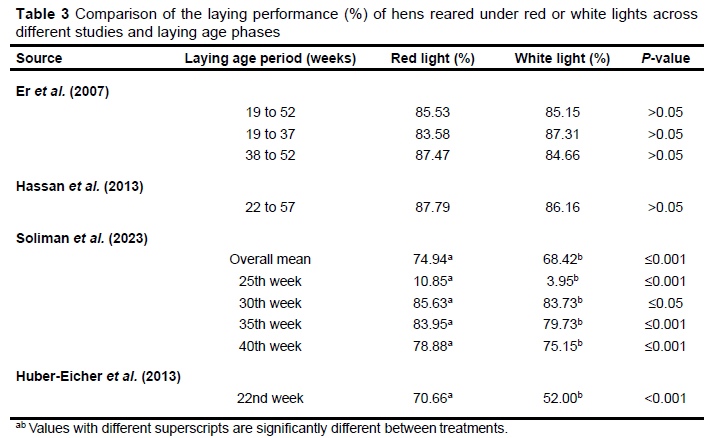
Er et al. (2007) evaluated three different laying periods of hens between 19 and 52 weeks of age and did not find significant differences in laying performance between red and white LED lights. In addition, Hassan et al. (2013) did not find significant differences in production between 22 and 57 weeks of age for hens under red and white LED lighting. In contrast, Soliman et al. (2023) and Huber-Eicher et al. (2013) found better results for laying performance between 25 and 40 weeks of age. Table 3 presents a comparison of the effects of red and white light according to the age of the hens during the study. Table 4 presents a more complete comparison of the laying performance of hens reared under different colours of light and wavelength combinations, as evaluated in several studies.
By analysing the comparative data from these two tables, it is evident that the egg-laying performance results depend on several factors, and that some studies have reported no significant differences between treatments with red and white light.
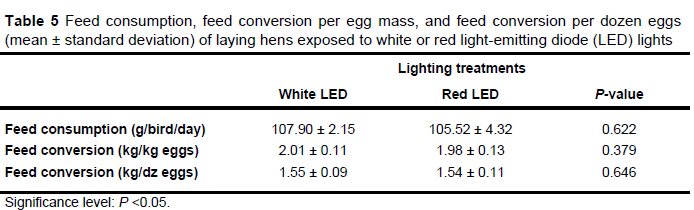
No differences between the treatments were observed in the feed consumption, feed conversion per egg mass, or feed conversion per dozen eggs (Table 4).
These results are similar to those of other studies in which no significant differences were found in feed consumption under different light colour conditions (Gongruttananun & Guntapa, 2012; Borille et al., 2013; Raziq et al., 2020). However, some studies have reported higher feed intakes in birds reared under red lights (Huber-Eicher et al., 2013).
The feed conversion ratio seems to be more affected by the photophase duration, the type of lighting, and the production phase than by the colour of the lights used (Soliman et al., 2023; Tez & Akşit, 2024). However, some studies have found more efficient feed conversion rates during the most productive phase when birds were reared under red lights (Min et al., 2012; Raziq et al., 2020; Tez & Akşit, 2024). Hassan et al. (2014) found that using combinations of red, green, and blue lights, as well as monochromatic red and green lights, improved the feed conversion efficiency. This concurred with the results of Barros et al. (2024), who found a better feed conversion ratio (P = 0.0500) when using a light treatment consisting of a dominant red band (43.7% 625-740 nm), indicating that having a higher intensity of red light than other light colours had a positive effect on feed conversion. Nonetheless, it should be noted that hens aged between 20 and 40 weeks were used in this study.
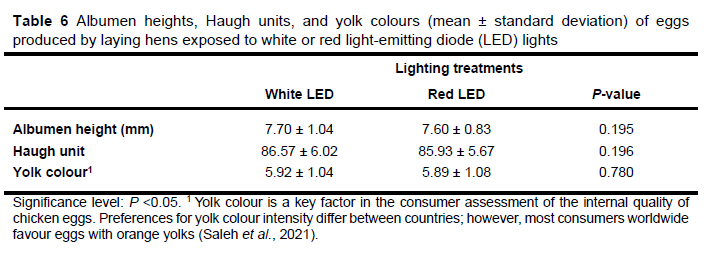
Table 6 reports the results of the egg quality parameters measured in this study, including the albumen height, Haugh unit, and yolk colour.
These findings are consistent with those of other studies, indicating that different light colours do not influence egg quality parameters (Huber-Eicher et al., 2013; Borille et al., 2013; Hassan et al., 2014; Raziq et al., 2020; Su et al., 2021). However, Poudel et al. (2022) found that the yolk percentage was higher (P = 0.0435) when hens were reared under red LED lights (23.37%) than when they were reared under white LED lights (22.49%), and that the albumen percentage was lower (P = 0.015) under red LED lights (67.05%) than under white LED lights (68.25%). Despite these varying results, it is clear that lighting and photoperiod are fundamental to egg quality (Bédécarrats & Hanlon, 2017).
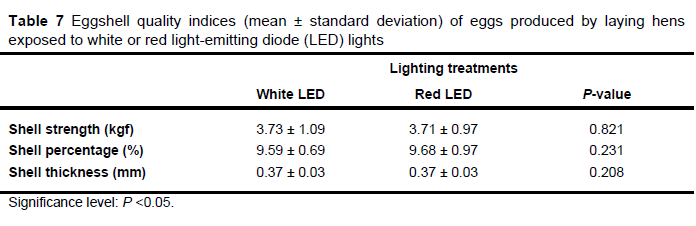
Natural or artificial carotenoids in the diet influence the intensity of yolk colouration (Grashorn, 2016; Wang et al., 2024); thus, diets with a higher carotenoid concentration result in eggs with more intense yolk colouration. In the present study, the feed formulation was not varied, and the tested lighting programme did not affect yolk colour. The eggshell quality indices and shell thickness values (Table 7) similarly did not differ between the treatments.
Other studies have supported these findings, as they found no significant differences in shell parameters when hens were reared under different LED light colours (Gongruttananun & Guntapa, 2012; Raziq et al. , 2020; Poudel et al. , 2022). However, two studies have reported that the strongest and thickest eggshells were produced by hens reared under red LED lights (Kim et al., 2010; Min et al., 2012), and two other studies found that hens reared under green LED lights had better results (Er et al. , 2007; Hassan et al., 2014).
The eggshell consists of approximately 95% calcium carbonate, and the diet provides 60%-70% of this essential mineral. However, because of an offset of calcium intake during the light period, a dark period is necessary for calcium fixation during eggshell production. The remaining 30%-40% of the calcium used to produce eggshells is mobilised from the bone, particularly from the medullary bone. This type of bone is produced at the onset of sexual maturity, and lighting programmes applied during this time could therefore affect eggshell quality parameters (Hervo et al., 2022).
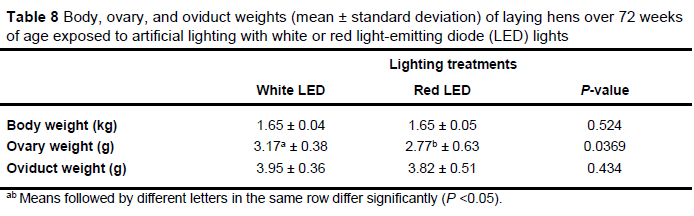
The body and reproductive system weights (ovaries and oviducts) of the hens exposed to red or white LED lights were also evaluated. No differences were observed in the body and oviduct weights (Table 8). However, there was a difference between the treatments in the ovary weight, with birds exposed to white LED lights having heavier ovaries than those exposed to red LED lights.
Hassan et al. (2013) found that laying hens had heavier ovaries at 22 weeks of age when reared under red lights (P = 0.002). Another study similarly found that the ovaries of laying hens reared under red lights were heavier than those of hens reared under other colour lights between 16 and 20 weeks of age (P <0.05) (Kim et al., 2010). However, Gongruttananun & Guntapa (2012) did not find any significant differences in the ovary weights of 28-week-old Thai indigenous hens reared under red and other light-colour treatments. Min et al. (2012) reported that the ovary weights of laying pullets grew significantly at 16 weeks of age (P <0.05) when they were reared under white LED lights. However, there were no significant differences between the light treatments in ovary weight at 20 weeks of age. Red light thus seems to enhance ovary weight; however, its impact varies based on light intensity, exposure duration, and the age and breed of the hens. We suspect that the white LED lights used in this study emit a combination of wavelengths, which could affect ovarian weight. However, we cannot confirm this assumption because we did not measure reproductive hormone levels.
The main limitation of this study was that the experiments were performed in a commercial production system. Therefore, it was not possible to provide completely artificial lighting for all the birds, as they were housed in a California-type shed system. However, this approach allowed the effects of lighting supplements to be evaluated using large numbers of birds. An additional study is planned to investigate the effects of red lighting on the laying performance of hens over 72 weeks of age in a fully enclosed shed system with artificial lighting.
Conclusions
Despite previous studies finding that exposure to red light improved laying performance, this effect depended on the pre-exposure during sexual maturation and the age of the hens. Thus, the colour of the light used did not affect the laying performance and egg quality characteristics of commercial laying hens aged over 70 weeks in this study. Further studies using extended photophases and only artificial lighting are necessary to assess the impact of coloured LED lights on laying performance and egg quality in hens beyond 70 weeks of age. Additionally, it is essential to consider nutritional and genetic factors when evaluating the effects of red light on hens over a 72-week period. It can be concluded that under California-type shed conditions, either red or white lights can be utilised without negatively impacting the laying performance of hens.
Acknowledgements
This study was partly funded by the Coordenação de Aperfeiçoamento de Pessoal de Nível Superior -Brazil (CAPES) - Finance Code 001, and the authors thank the Fundação Araucária for their research support.
Authors' contributions
N.M.P. Monteiro collected the data for this study, and collaborated in the manuscript writing and the interpretation of results. D. Sato was involved in writing the manuscript, English revision, statistical revision, interpretation of the results, and communication of responsibilities. B.D.R. Bombem participated in writing the manuscript. J.E. De Moraes collaborated in the planning and execution of the experiment. D.R. Rodrigues and E.P. Porto conducted the statistical analyses. L.O. Silva and E.R. Duarte were involved in running the trial. M.A.A. Silva contributed to writing, statistical analysis, leadership, experimentation, and planning.
Conflict of interest declaration
The authors have no conflicts of interest to declare.
References
Bahuti, M., Yanagi Jr, T., Fassani, É.J., Ribeiro, B.P.V.B., de Lima, R.R., & Campos, A.T., 2023. Evaluation of different light intensities on the well-being, productivity, and eggs quality of laying hens. Computers and Electronics in Agriculture, 215:108423-108423. DOI: https://doi.org/10.1016/j.compag.2023.108423 [ Links ]
Barros, J.S.G., Sartor, K., Pedroso, T.F., Vasconcelos, H., Scopacasa, V.A., Bottura, J.R., Sena, R.G., Salvador, M.J., & de Moura, D.J., 2024. Impact of light spectrum electromagnetic radiation variations on performance and hormonal profiles in laying hens. Scientific Reports, 14:30250-30250. DOI: https://doi.org/10.1038/s41598-024-81480-1 [ Links ]
Baxter, M., Joseph, N., Osborne, V.R., & Bédécarrats, G.Y., 2014. Red light is necessary to activate the reproductive axis in chickens independently of the retina of the eye. Poultry Science, 93:1289-1297. DOI: https://doi.org/10.3382/ps.2013-03799 [ Links ]
Bédécarrats, G.Y., 2015. Control of the reproductive axis: Balancing act between stimulatory and inhibitory input. Poultry Science, 94:810-815. DOI: https://doi.org/10.3382/ps/peu042 [ Links ]
Bédécarrats, G.Y. & Hanlon, C., 2017. Chapter 7 - Effect of lighting and photoperiod on chicken egg production and quality. In: Egg Innovations and Strategies for Improvements. Ed: Hester, P.Y., Academic Press, San Diego, CA, USA. pp. 65-75. DOI: https://doi.org/10.1016/B978-0-12-800879-9.00007-X [ Links ]
Borille, R., Garcia, R., Royer, A., Santana, M., Colet, S., Naas, I., Caldara, F., Almeida Paz, I., Rosa, E., & Castilho, V., 2013. The use of light-emitting diodes (LED) in commercial layer production. Revista Brasileira de Ciência Avícoia, 15:135-140. DOI: https://doi.org/10.1590/S1516-635X2013000200009 [ Links ]
DSM-Firmenich, 2025. Measuring egg yolk color [Online]. DSM-Firmenich Essential Products. Available: https://www.dsm-firmenich.com/anh/products-and-services/tools/yolkfan.html [08 May 2025]. [ Links ]
Empalux, 2023. Lâmpada Bulbo LED Color. Tech. datasheet [Online]. Available: https://empalux.com.br/wp-content/uploads/2023/11/Ficha-Tecnica-Lampada-Bulbo-LED-Colorida.pdf [12 April 2025]. [ Links ]
Empalux, 2025. AL10762 Tech. datasheet [Online]. Available: https://empalux.com.br/iluminacao/tecnologia-led/lampada-bulbo-led/lampada-bulbo-led-10w-bivolt-6-500k-e27-al10762/ [12 April 2025]. [ Links ]
England, A. & Ruhnke, I., 2020. The influence of light of different wavelengths on laying hen production and egg quality. World's Poultry Science Journal, 76:443-458. DOI: https://doi.org/10.1080/00439339.2020.1789023 [ Links ]
Er, D., Wang, Z., Cao, J., & Chen, Y., 2007. Effect of monochromatic light on the egg quality of laying hens. Journal of Applied Poultry Research, 16:605-612. DOI: https://doi.org/10.3382/japr.2006-00096 [ Links ]
Gongruttananun, N. & Guntapa, P., 2012. Effects of red light illumination on productivity, fertility, hatchability and energy efficiency of Thai indigenous hens. Agriculture and Natural Resources, 46:51-63. URL: https://li01.tci-thaijo.org/index.php/anres/article/view/242746 [ Links ]
Grashorn, M., 2016. 14 - Feed additives for influencing chicken meat and egg yolk color. In: Handbook on Natural Pigments in Food and Beverages. Eds: Carle, R. & Schweiggert, R.M., Woodhead Publishing, Cambridge, UK. pp. 283-302. DOI: 10.1016/B978-0-08-100371-8.00014-2 [ Links ]
Guo, S., Niu, J., Xv, J., Fang, B., Zhang, Z., Zhao, D., Wang, L., & Ding, B., 2021. Interactive effects of vitamins A and K3 on laying performance, egg quality, tibia attributes and antioxidative status of aged Roman Pink laying hens. Animal, 15:100242-100242. DOI: https://doi.org/10.1016/j.animal.2021.100242 [ Links ]
Hanlon, C., Zuidhof, M.J., Rodriguez, A., Takeshima, K., & Bédécarrats, G.Y., 2023. Continuous exposure to red light induces photorefractoriness in broiler breeder pullets. Poultry Science, 102:102542-102542. DOI: https://doi.org/10.1016/j.psj.2023.102542 [ Links ]
Hassan, Md.R., Sultana, S., Choe, H.S., & Ryu, K.S., 2013. Effect of monochromatic and combined light colour on performance, blood parameters, ovarian morphology and reproductive hormones in laying hens. Italian Journal of Animal Science, 12:e56-e56. DOI: https://doi.org/10.4081/ijas.2013.e56 [ Links ]
Hassan, Md.R., Sultana, S., Choe, H.S., & Ryu, K.S., 2014. Effect of combinations of monochromatic LED light color on the performance and behavior of laying hens. The Journal of Poultry Science, 51:321-326. DOI: https://doi.org/10.2141/jpsa.0130105 [ Links ]
Hervo, F., Narcy, A., Nys, Y., & Létourneau-Montminy, M.-P., 2022. Effect of limestone particle size on performance, eggshell quality, bone strength, and in vitro/in vivo solubility in laying hens: a meta-analysis approach. Poultry Science, 101:101686-101686. DOI: https://doi.org/10.1016/j.psj.2021.101686 [ Links ]
Huber-Eicher, B., Suter, A., & Spring-Stâhli, P., 2013. Effects of colored light-emitting diode illumination on behavior and performance of laying hens. Poultry Science, 92:869-873. DOI: https://doi.org/10.3382/ps.2012-02679 [ Links ]
Instrutemp, 2023. Luxímetro Digital Com Datalogger - Technical sheet [Online]. Available: https://drive.google.com/file/d/1h-y-6CRLOv6jeVBzS9-Gfz4TOtXgL6p0/view [12 April 2025]. [ Links ]
Kamanli, S., Durmus, I., Demir, S., & Tarim, B., 2015. Effect of different light sources on performance and egg quality traits in laying hens. European Poultry Science (EPS), 79:1 -7. DOI: https://doi.org/10.1399/eps.2015.109 [ Links ]
Kim, M.-J., Choi, H.-C., Suh, O.-S., Chae, H.-S., Na, J.-C., Bang, H.-T., Kim, D.-W., Kang, H.-K., & Park, S.-B., 2010. A study of different sources and wavelengths of light on laying egg characteristics in laying hens. Korean Journal of Poultry Science, 37:383-388. DOI: https://doi.org/10.5536/KJPS.2010.37.4.383 [ Links ]
Koeleman, E., 2024. Lots to gain when layers live longer [Online]. Poultry World. Available: https://www.poultryworld.net/poultry/layers/lots-to-gain-when-layers-live-longer/ [10 April 2025]. [ Links ]
Kram, Y.A., Mantey, S., & Corbo, J.C., 2010. Avian cone photoreceptors tile the retina as five independent, self-organizing mosaics. PLoS ONE, 5(2):e8992. DOI: https://doi.org/10.1371/journal.pone.0008992 [ Links ]
Kristensen, H.H., Prescott, N.B., Perry, G.C., Ladewig, J., Ersb0ll, A.K., Overvad, K.C., & Wathes, C.M., 2007. The behaviour of broiler chickens in different light sources and illuminances. Applied Animal Behaviour Science, 103:75-89. DOI: https://doi.org/10.1016/j.applanim.2006.04.017 [ Links ]
Ledestar, 2021. SMD 2835 LED Tech. sheet [Online]. Available: https://www.ledestar.com/wp-content/uploads/2022/05/ldr-2835282b.pdf?srsltid=AfmBOop5P9uT1ScBs02sKd_jT3EpEkv95RacL3ZPB6qQPsJwa9JvrqFG [12 April 2025]. [ Links ]
Li, D., Zhang, L., Yang, M., Yin, H., Xu, H., Trask, J.S., Smith, D.G., Zhang, Z., & Zhu, Q., 2014. The effect of monochromatic light-emitting diode light on reproductive traits of laying hens. Journal of Applied Poultry Research, 23:367-375. DOI: https://doi.org/10.3382/japr.2013-00746 [ Links ]
Lohmann Breeders, 2020. Lohmann LSL-Lite: Management guide - cage housing [Online]. Available: https://lohmann-breeders.com/media/strains/cage/management/LOHMANN-LSL-Lite-Cage-1.pdf [12 April 2025]. [ Links ]
Min, J.K., Hossan, Md.S., Nazma, A., Jae, C.N., Han, T.B., Hwan, K.K., Dong, W.K., Hyun, S.C., Hee, C.C., & Ok, S.S., 2012. Effect of monochromatic light on sexual maturity, production performance and egg quality of laying hens. Avian Biology Research, 5:69-74. DOI: https://doi.org/10.3184/175815512X13350270679453 [ Links ]
Osadcha, Y., Sakhatsky, M., & Dzhus, P., 2023. Effect of monochrome light with different wavelengths on biochemical parameters of hens. Journal of Animal Behaviour and Biometeorology, 11:2023014-2023014. DOI: https://doi.org/10.31893/jabb.23014 [ Links ]
Poudel, I., Beck, M.M., Kiess, A.S., & Adhikari, P., 2022. The effect of blue and red LED light on the growth, egg production, egg quality, behavior, and hormone concentration of Hy-Line W-36 laying hens. Journal of Applied Poultry Research, 31:100248-100248. DOI: https://doi.org/10.1016/j.japr.2022.100248 [ Links ]
Prescott, N.B. & Wathes, C.M., 1999. Spectral sensitivity of the domestic fowl (Gallus g. domesticus). British Poultry Science, 40:332-339. DOI: https://doi.org/10.1080/00071669987412 [ Links ]
Rana, M.S., Lee, C., Walkden-Brown, S.W., & Campbell, D.L.M., 2024. Effects of ultraviolet light supplementation on hen behaviour and welfare during early lay. Applied Animal Behaviour Science, 273:106235-106235. DOI: https://doi.org/10.1016/j.applanim.2024.106235 [ Links ]
Raziq, F., Hussain, J., Mahmud, A., & Javed, K., 2020. Effect of light-emitting diode (LED)-based colors on production performance and welfare of commercial layers. Turkish Journal of Veterinary and Animal Sciences, 44:1269-1278. DOI: https://doi.org/10.3906/vet-2007-30 [ Links ]
Reddy, I.J., David, C.G., Selvaraju, S., Mondal, S., & Ravi Kiran, G., 2012. GnRH-1 mRNA, LH surges, steroid hormones, egg production, and intersequence pause days alter in birds exposed to longer wavelength of light in the later stages of production in Gallus gallus domesticus. Tropical Animal Health and Production, 44:1311-1317. DOI: https://doi.org/10.1007/s11250-012-0073-9 [ Links ]
Rowan, W., 1931. The Riddle of Gigration, 1st edition. Williams & Wilkins Company, Baltimore, USA. DOI: https://doi.org/10.5962/bhl.title.6396 [ Links ]
Saleh, A.A., Gawish, E., Mahmoud, S.F., Amber, K., Awad, W., Alzawqari, M.H., Shukry, M., & Abdel-Moneim, A.-M.E., 2021. Effect of natural and chemical colorant supplementation on performance, egg-quality characteristics, yolk fatty-acid profile, and blood constituents in laying hens. Sustainability, 13:4503-4503. DOI: https://doi.org/10.3390/su13084503 [ Links ]
Scientech, 2006. Scientech SA 210 Analytical Balance [Online]. Available: https://www.hogentogler.com/scientech/sa-210-analytical-balance.asp?srsltid=AfmBOoosPMZ6CwsFwaYnckODPWOAWppJDUswxCa_J8JJ1Bp_710J7g0d [12 April 2025]. [ Links ]
Seifert, M., Baden, T., & Osorio, D., 2020. The retinal basis of vision in chicken. Seminars in Cell & Developmental Biology, 106:106-115. DOI: https://doi.org/10.1016/j.semcdb.2020.03.011 [ Links ]
Soliman, A.S., Khafaga, M.A., Soliman, F.N., & El-Sabrout, K.M., 2023. Effect of different lighting sources on the performance of broiler breeder hens. Journal of Animal Behaviour and Biometeorology, 11:e2023026. DOI: https://doi.org/10.31893/jabb.23026 [ Links ]
Su, C.-H., Cheng, C.-H., Lin, J.-H., Liu, H.-C., Yu, Y.-T., Lin, C.-C., & Chen, W.-J., 2021. The effect of different colored light emitting diode illumination on egg laying performance, egg qualities, blood hormone levels and behavior patterns in Brown Tsaiya duck. Animal Bioscience, 34:1870-1878. DOI: https://doi.org/10.5713/ab.20.0657 [ Links ]
Svobodová, J., Túmová, E., Popeiárová, E., & Chodová, D., 2015. Effect of light colour on egg production and egg contamination. Czech Journal of Animal Science, 60:550-556. DOI: https://doi.org/10.17221/8597-CJAS [ Links ]
Tez, N. & Ak§it, M., 2024. The effect of red and white LED light on performance, egg quality and some behavior characteristics of laying hens raised in enriched cages. Turkish Journal of Agriculture - Food Science and Technology, 12:375-381. DOI: https://doi.org/10.24925/turjaf.v12i3.375-381.6298 [ Links ]
Wang, Z., Sun, X., Xu, X., Zhou, D., & Wen, C., 2024. Effect of microencapsulated canthaxanthin and apo-ester on egg yolk color and antioxidant capacity in laying hens. Poultry Science, 103:104302-104302. DOI: https://doi.org/10.1016/j.psj.2024.104302 [ Links ]
Wei, Y., Zheng, W., Tong, Q., Li, Z., Li, B., Shi, H., & Wang, Y., 2022. Effects of blue-green LED lights with two perceived illuminance (human and poultry) on immune performance and skeletal development of layer chickens. Poultry Science, 101:101855. DOI: https://doi.org/10.1016/j.psj.2022.101855 [ Links ]
Submitted 11 May 2025
Accepted 30 September 2025
Published 14 October 2025
# Corresponding author: denissato@alumni.usp.br